
GETMusic: Generating Music Tracks with a Unified Representation and Diffusion Framework
Proceedings of the Thirty-Fourth International Joint Conference on Artificial Intelligence. AI, Arts & Creativity. Pages 10144-10152.
https://doi.org/10.24963/ijcai.2025/1127
Keywords
- Theory and philosophy of arts and creativity in AI systems: Autonomous creative or artistic AI
- Application domains: Music and sound
Abstract
Symbolic music generation aims to create musical notes, which can help users compose music, such as generating target instrument tracks based on provided source tracks. In practical scenarios where there’s a predefined ensemble of tracks and various composition needs, an efficient and effective generative model that can generate any target tracks based on the other tracks becomes crucial. However, previous efforts have fallen short in addressing this necessity due to limitations in their music representations and models. In this paper, we introduce a framework known as GETMusic, with ``GET'' standing for ``GEnerate music Tracks.'' This framework encompasses a novel music representation ``GETScore'' and a diffusion model ``GETDiff.'' GETScore represents musical notes as tokens and organizes tokens in a 2D structure, with tracks stacked vertically and progressing horizontally over time. At a training step, each track of a music piece is randomly selected as either the target or source. The training involves two processes: In the forward process, target tracks are corrupted by masking their tokens, while source tracks remain as the ground truth; in the denoising process, GETDiff is trained to predict the masked target tokens conditioning on the source tracks. Our proposed representation, coupled with the non-autoregressive generative model, empowers GETMusic to generate music with any arbitrary source-target track combinations.Our experiments demonstrate that the versatile GETMusic outperforms prior works proposed for certain specific composition tasks.
- [Austin et al., 2021] Jacob Austin, Daniel D. Johnson, Jonathan Ho, Daniel Tarlow, and Rianne van den Berg. Structured denoising diffusion models in discrete state- spaces. In A. Beygelzimer, Y. Dauphin, P. Liang, and J. Wortman Vaughan, editors, Advances in Neural Infor- mation Processing Systems, 2021.
- [Bengio et al., 1994] Y. Bengio, P. Simard, and P. Frasconi. Learning long-term dependencies with gradient descent is difficult. IEEE Transactions on Neural Networks, 5(2):157-166, 1994.
- [Christopher, 2011] Walshaw Christopher. The abc music standard 2.1. ABC notation standard, 2011.
- [Dhariwal and Nichol, 2021] Prafulla Dhariwal and Alexan- der Nichol. Diffusion models beat gans on image syn- thesis. In M. Ranzato, A. Beygelzimer, Y. Dauphin, P.S. Liang, and J. Wortman Vaughan, editors, Advances in Neu- ral Information Processing Systems, volume 34, pages 8780-8794.
- Curran Associates, Inc., 2021.
- [Dong et al., 2017] Hao-Wen Dong, Wen-Yi Hsiao, Li-Chia Yang, and Yi-Hsuan Yang. Musegan: Multi-track sequen- tial generative adversarial networks for symbolic music generation and accompaniment, 2017.
- [Dong et al., 2023] Hao-Wen Dong, Ke Chen, Shlomo Dub- nov, Julian McAuley, and Taylor Berg-Kirkpatrick. Mul- titrack music transformer. In Proceedings of the IEEE In- ternational Conference on Acoustics, Speech and Signal Processing (ICASSP), 2023.
- [Ens and Pasquier, 2020] Jeffrey Ens and Philippe Pasquier. MMM : Exploring conditional multi-track music genera- tion with the transformer. CoRR, abs/2008.06048, 2020.
- [Gu et al., 2022] Shuyang Gu, Dong Chen, Jianmin Bao, Fang Wen, Bo Zhang, Dongdong Chen, Lu Yuan, and Baining Guo. Vector quantized diffusion model for text- to-image synthesis. In Proceedings of the IEEE/CVF Conference on Computer Vision and Pattern Recognition (CVPR), pages 10696-10706, June 2022.
- [Ho and Salimans, 2021] Jonathan Ho and Tim Salimans. Classifier-free diffusion guidance. In NeurIPS 2021 Work- shop on Deep Generative Models and Downstream Appli- cations, 2021.
- [Ho et al., 2020] Jonathan Ho, Ajay Jain, and Pieter Abbeel. Denoising diffusion probabilistic models. In H. Larochelle, M. Ranzato, R. Hadsell, M.F. Balcan, and H. Lin, editors, Advances in Neural Information Process- ing Systems, volume 33, pages 6840-6851.
- [Hoogeboom et al., 2021] Emiel Hoogeboom, Didrik Nielsen, Priyank Jaini, Patrick Forré, and Max Welling. Argmax flows and multinomial diffusion: Learning categorical distributions. In A. Beygelzimer, Y. Dauphin, P. Liang, and J. Wortman Vaughan, editors, Advances in Neural Information Processing Systems, 2021.
- [Hsiao et al., 2021] Wen-Yi Hsiao, Jen-Yu Liu, Yin-Cheng Yeh, and Yi-Hsuan Yang. Compound word transformer: Learning to compose full-song music over dynamic di- rected hypergraphs. Proceedings of the AAAI Conference on Artificial Intelligence, 35(1):178-186, May 2021.
- [Huang and Yang, 2020] Yu-Siang Huang and Yi-Hsuan Yang. Pop music transformer: Beat-based modeling and generation of expressive pop piano compositions. In Pro- ceedings of the 28th ACM International Conference on Multimedia, MM '20, page 1180-1188, New York, NY, USA, 2020. Association for Computing Machinery.
- [Ju et al., 2021] Zeqian Ju, Peiling Lu, Xu Tan, Rui Wang, Chen Zhang, Songruoyao Wu, Kejun Zhang, Xiangyang Li, Tao Qin, and Tie-Yan Liu. Telemelody: Lyric- to-melody generation with a template-based two-stage method. CoRR, abs/2109.09617, 2021.
- [Kullback and Leibler, 1951] Solomon Kullback and Richard A Leibler. On information and sufficiency. The annals of mathematical statistics, 22(1):79-86, 1951.
- [Lv et al., 2022] Ang Lv, Xu Tan, Tao Qin, Tie-Yan Liu, and Rui Yan. Re-creation of creations: A new paradigm for lyric-to-melody generation, 2022. IJCAI
- [Mittal et al., 2021] Gautam Mittal, Jesse Engel, Curtis Hawthorne, and Ian Simon. Symbolic music generation with diffusion models, 2021.
- [Ren et al., 2020] Yi Ren, Jinzheng He, Xu Tan, Tao Qin, Zhou Zhao, and Tie-Yan Liu. Popmag: Pop music ac- companiment generation. In Proceedings of the 28th ACM International Conference on Multimedia, MM '20, page 1198-1206, New York, NY, USA, 2020. Association for Computing Machinery.
- [Sheng et al., 2020] Zhonghao Sheng, Kaitao Song, Xu Tan, Yi Ren, Wei Ye, Shikun Zhang, and Tao Qin. Songmass: Automatic song writing with pre-training and alignment constraint. CoRR, abs/2012.05168, 2020.
- [Shuyu and Sung, 2023] Li Shuyu and Yunsick Sung. Melodydiffusion: Chord-conditioned melody generation using a transformer-based diffusion model. Mathematics 11, no. 8: 1915., 2023.
- [Sohl-Dickstein et al., 2015] Jascha Sohl-Dickstein, Eric Weiss, Niru Maheswaranathan, and Surya Ganguli. Deep unsupervised learning using nonequilibrium thermody- namics. In Francis Bach and David Blei, editors, Pro- ceedings of the 32nd International Conference on Machine Learning, volume 37 of Proceedings of Machine Learn- ing Research, pages 2256-2265, Lille, France, 07-09 Jul 2015. PMLR.
- [Song et al., 2021] Jiaming Song, Chenlin Meng, and Ste- fano Ermon. Denoising diffusion implicit models. In Inter- national Conference on Learning Representations, 2021.
- [Su et al., 2021] Jianlin Su, Yu Lu, Shengfeng Pan, Ahmed Murtadha, Bo Wen, and Yunfeng Liu. Roformer: En- hanced transformer with rotary position embedding. arXiv preprint arXiv:2104.09864, 2021.
- [Tang et al., 2022] Zhicong Tang, Shuyang Gu, Jianmin Bao, Dong Chen, and Fang Wen. Improved vector quan- tized diffusion models, 2022. [Vaswani et al., 2017]
- Ashish Vaswani, Noam Shazeer, Niki Parmar, Jakob Uszkoreit, Llion Jones, Aidan N Gomez, Łukasz Kaiser, and Illia Polosukhin. Attention is all you need. In Advances in neural information processing sys- tems, pages 5998-6008, 2017.
- [Yang et al., 2017] Li-Chia Yang, Szu-Yu Chou, and Yi- Hsuan Yang. Midinet: A convolutional generative adver- sarial network for symbolic-domain music generation us- ing 1d and 2d conditions. CoRR, abs/1703.10847, 2017.
- [Yu et al., 2022] Botao Yu, Peiling Lu, Rui Wang, Wei Hu, Xu Tan, Wei Ye, Shikun Zhang, Tao Qin, and Tie-Yan Liu. Museformer: Transformer with fine-and coarse-grained attention for music generation. In Alice H. Oh, Alekh Agarwal, Danielle Belgrave, and Kyunghyun Cho, edi- tors, Advances in Neural Information Processing Systems, 2022.
- [Zeng et al., 2021] Mingliang Zeng, Xu Tan, Rui Wang, Ze- qian Ju, Tao Qin, and Tie-Yan Liu. MusicBERT: Sym- bolic music understanding with large-scale pre-training. In Findings of the Association for Computational Linguistics: ACL-IJCNLP 2021, pages 791-800, Online, August 2021. Association for Computational Linguistics.
- [Zhang et al., 2022] Chen Zhang, Yi Ren, Kejun Zhang, and Shuicheng Yan. Sdmuse: Stochastic differential music editing and generation via hybrid representation, 2022.
References were extracted automatically from the PDF and may contain errors.
Full text extracted automatically from the PDF; figures, tables and equations may differ. The PDF is the version of record.
1 Introduction
Symbolic music generation aims to create musical notes, which can help users in music composition. Due to the practical need for flexible and diverse music composition, the need for an efficient and unified approach capable of generating arbitrary tracks based on the others is high. 1 However, current research falls short of meeting this demand due to inherent limitations imposed by their representations and models. Consequently, these approaches are confined to specific source-target combinations, such as generating piano accompaniments based on melodies.
∗Corresponding authors: Xu Tan (xuta@microsoft.com) and Rui Yan (ruiyan@ruc.edu.cn).
Current research can be categorized into two primary approaches based on music representation: sequence-based and image-based. On one hand, sequence-based works [Huang and Yang, 2020; Zeng et al., 2021; Christopher, 2011] represent music as a sequence of discrete tokens, where a musical note requires multiple tokens to describe attributes such as onset, pitch, duration, and instrument. These tokens are arranged chronologically, resulting in the interleaving of notes from different tracks, and are usually predicted by autoregressive models sequentially. The interleaving of tracks poses a challenge of precise target generation because the autoregressive model implicitly determines when to output a targettrack token and avoids generating tokens from other tracks. It also complicates the specification of source and target tracks. Therefore, the existing methods [Dong et al., 2023; Ren et al., 2020; Yu et al., 2022] typically focus on either one specific source-target track combination or the continuation of tracks.
On the other hand, image-based research represents music as 2D images, with pianorolls being a popular choice. Pianorolls represent musical notes as horizontal lines, with the vertical position denoting pitch and the length signifying duration. A pianoroll explicitly separates tracks but it has to incorporate the entire pitch range of instruments, resulting in large and sparse images. Due to the challenges of generating sparse and high-resolution images, most research has focused on conditional composition involving only a single source or target track [Dong et al., 2017; Yang et al., 2017; Shuyu and Sung, 2023] or unconditional generation [Mittal et al., 2021].
1 Amusic typically consists of multiple instrument tracks. In this paper, given a predefined track ensemble, we refer to the tracks to be generated as "target tracks" and those acting as conditions as "source tracks." We refer to such an orchestration of tracks as a "sourcetarget combination."
To support the generation across flexible and diverse source-target track combinations, we propose a unified representation and diffusion framework called GETMusic ("GET" stands for GEnerate music Tracks), which comprises a representation named GETScore, and a discrete diffusion model [Austin et al., 2021] named GETDiff. GETScore represents the music as a 2D structure, where tracks are stacked vertically and progress horizontally over time. Within each track, we efficiently represent musical notes with the same onset by a single pitch token and a single duration token, and position them based on the onset time. At a training step, each track in a training sample is randomly selected as either the target or the source. The training consists of two processes: In the forward process, the target tracks are corrupted by masking tokens, while the source tracks are preserved as ground truth; in the denoising process, GETDiff learns to predict the masked target tokens based on the provided source. Our co-designed representation and diffusion model in GETMusic offer several advantages compared to prior works:
- With separate and temporally aligned tracks in GETScore, coupled with a non-autoregressive generative model, GETMusic adeptly compose music across various source-target combinations.
- GETScore is a compact multi-track music representation while effectively preserving interdependencies among simultaneous notes both within and across tracks, fostering harmonious music generation.
- Beyond track-wise generation, the mask and denoising mechanism of GETDiff enable the zero-shot generation (i.e., denoising masked tokens at any arbitrary locations in GETScore), further enhancing the versatility and creativity.
We demonstrate that our proposed versatile GETMusic surpasses approaches proposed for specific tasks such as conditional accompaniment or melody generation, as well as generation from scratch. 2
2 Background
2.1 Symbolic Music Generation
Symbolic music generation aims to generate musical notes, whether from scratch [Mittal et al., 2021; Yu et al., 2022] or based on given conditions such as chords, tracks [Shuyu and Sung, 2023; Huang and Yang, 2020; Dong et al., 2017], lyrics [Lv et al., 2022; Ju et al., 2021; Sheng et al., 2020], or other musical properties [Zhang et al., 2022], which can assist users in composing music. In practical music composition, a common user need is to create instrumental tracks from scratch or conditioning on existing ones. Given a predefined ensemble of tracks and considering flexible composition needs in practice, a generative model capable of handling arbitrary source-target combination is crucial. However, neither of the existing approaches can integrate generation across multiple source-target combinations, primarily due to inherent limitations in their representations and models.
Current approaches can be broadly categorized into two main categories with respect to adopted representation:
2 Demo link: https://ai-muzic.github.io/getmusic/. Code link: https://github.com/microsoft/muzic
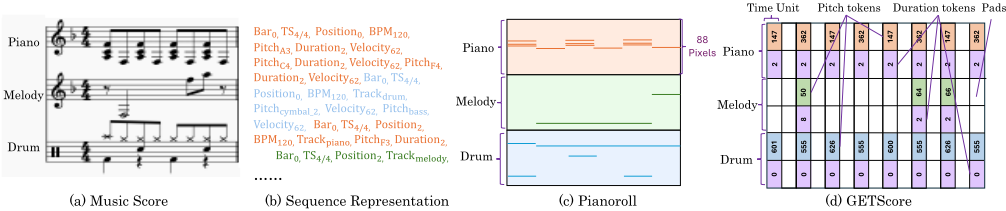
sequence-based and image-based. In sequence-based methods [Huang and Yang, 2020; Hsiao et al., 2021; Zeng et al., 2021; Ren et al., 2020], music is represented as a sequence of discrete tokens. A token corresponds to a specific attribute of a musical note, such as onset (the beginning time of a note), pitch (note frequency), duration, and instrument, and tokens are usually arranged chronologically. Consequently, notes that represent different tracks usually interleave, as shown in Figure 1(b) where the tracks are differentiated by colors. Typically, an autoregressive model is applied to processes the sequence, predicting tokens one by one. The interwove tracks and the autoregressive generation force the model to implicitly determine when to output tokens of desired target tracks and avoid incorporating tokens belonging to other tracks, which poses a challenge to the precise generation of the desired tracks; the sequential representation and modeling do not explicitly preserve the interdependencies among simultaneous notes, which impact the harmony of the generated music; furthermore, the model is required to be highly capable of learning long-term dependencies [Bengio et al., 1994] given the lengthy sequences. Some unconventional methods [Ens and Pasquier, 2020] organize tokens according to the track order in order to eliminate track interleaving. However, it comes with a trade-off, as it results in weaker dependencies both in the long term and across tracks.
Image-based methods mainly employ pianoroll representations which depict notes as horizontal lines in 2D images, with the vertical position denoting pitch and the length signifying duration. However, pianorolls need to include the entire pitch range of the instrument, resulting in images that are both large and sparse. For instance, Figure 1(c) illustrates a pianoroll representation of a three-track music piece, which spans a width of hundreds of pixels, yet only the bold lines within it carry musical information. Most works focus on conditional composition involving only a single source/target track [Dong et al., 2017; Yang et al., 2017; Shuyu and Sung, 2023] or unconditional generation [Mittal et al., 2021] because generating a sparse and high-resolution image is challenging.
Our proposed GETMusic addresses above limitations with a co-designed representation and a discrete diffusion model which together provide an effective solution to versatile track generation.
2.2 DiffusionModels
Diffusion models, initially proposed by [Sohl-Dickstein et al., 2015] and further improved by subsequent research [Ho et al., 2020; Song et al., 2021; Ho and Salimans, 2021; Dhariwal and Nichol, 2021], have demonstrated impressive capabilities in modeling complex distributions. These models consist of two key processes: a forward (diffusion) process and a reverse (denoising) process. The forward process
data x0 iteratively for T steps, corrupting it towards a prior distribution p(xT ) that is independent of x0. The goal of diffusion models is to learn a reverse process pθ(xt-1|xt) that gradually denoises xT to the data distribution. The model is trained by optimizing the variational lower bound (VLB) [Ho et al., 2020]:
The models that operate within the latent space are commonly referred to as continuous diffusion models, whereas the discrete diffusion models [Sohl-Dickstein et al., 2015] were developed for binary sequence learning. [Hoogeboom et al., 2021] extended these models to handle categorical random variables, while D3PM [Austin et al., 2021] introduced a more structured categorical forward process: the forward process is a Markov chain defined by transition matrices, which transitions a token at time t - 1 to another at time t by probability. In the reverse process, a pivotal technique known as x0-parameterization was introduced by [Austin et al., 2021]. Instead of directly predicting xt-1 at time step t, the model learns to fit the noiseless original data x0 and corrupts the predicted ˜x0 to obtain xt-1. Consequently, an auxiliary term scaled by a hyper-parameter λ is added to the VLB:
[Mittal et al., 2021] first applied continuous diffusion models to music generation. However, due to technical limitations at the time, their approach is not fully end-to-end and is restricted to generating single-track music unconditionally. They opted for a pianoroll representation in their model. SDMuse [Zhang et al., 2022] considered the limitations inherent in the pianoroll and sequence representation. They first employ a continuous diffusion model that operates on pianoroll, followed by an autoregressive model to refine the music sequence converted from generated pianorolls. This twostage pipeline significantly increases the computational cost but it does not fundamentally address the performance bottleneck, i.e., accurately generating sparse and high-resolution pianorolls.
In contrast to these prior works, GETDiff is an end-to-end discrete diffusion model. The rationale behind the discrete model lies in the fact that GETDiff is specifically crafted to operate on GETScore, which comprises discrete tokens, aligning perfectly with the inherently discrete nature of symbolic music. Moreover, [Gu et al., 2022; Tang et al., 2022] have demonstrated that, for conditional generation, discrete diffusion models offer many advantages over continuous diffusion models. Meanwhile, our novel representation combines the strengths of conventional representations while circumventing their shortcomings, thereby overcoming the obstacles associated with generating high-quality content.
3 GETMusic
In this section, we introduce two key components in GETMusic: the representation GETScore and the diffusion model GETDiff. We first provide an overview of each component, and then highlight their advantages in supporting the flexible and diverse generation of any tracks.
3.1 GETScore
Our goal is to design an efficient and effective representation for modeling multi-track music, which allows for flexible specification of source and target tracks and thereby laying the foundation of the diverse track generation tasks. Our novel representation GETScore involves two core ideas: (1) the 2D track arrangement and (2) the musical note tokenization.
Track arrangement. We derive inspiration from music scores to arrange tracks vertically, with each track progressing horizontally over time. The horizontal axis is divided into fine-grained temporal units, with each unit equivalent to the duration of a 16th note. This level of temporal detail is sufficient to the majority of our training data. This arrangement of tracks brings several benefits:
- It prevents content of different tracks from interleaving, which simplifies the specification of source and target tracks, and facilitates the precise generation of desired tracks.
- Because tracks are temporally aligned like music scores, their interdependencies are well preserved.
Note tokenization. To represent musical notes, we focus on two attributes: pitch and duration, which are directly associated with composition. Some dynamic factors like velocity and tempo variation fall outside the scope of our study. We use two distinct tokens to denote a note's pitch and duration, respectively. These paired pitch-duration tokens are placed in accordance with the onset time and track within GETScore. Some positions within GETScore may remain unoccupied by any tokens; in such instances, we employ padding tokens to fill them, as illustrated by the blank blocks in Figure 1(d). Each track has its own pitch token vocabulary but shares a common duration vocabulary, considering pitch characteristics are instrument-dependent, whereas duration is a universal feature across all tracks. To broaden the applicability of GETScore, we need to address two more problems:
- How to use single pitch and duration tokens to represent a group of notes played simultaneously within a track? We propose merging pitch tokens of a group of simultaneous notes into a single compound pitch token. Furthermore, we identify the most frequently occurring duration token within the group as the final duration token. This simplification of duration representation is supported by our observation from the entire training data, in only 0.5% groups, the maximum duration difference among notes exceeds a temporal unit. These findings suggest that this simplification has minimal impact on the expressive quality of GETScore. Figure 1(d) illustrates the compound token: in the piano track, we combine three simultaneous 1/8 notes played at the first beat, namely, "La", "Do", and "Fa," into a single pitch token indexed with "147" alongside a duration token "2."
- How to represent percussive instruments, such as drums, which do not involve the concepts of "pitch" and "duration?" We treat individual drum actions (e.g., kick, snare, hats, toms, and cymbals) as pitch tokens and align them with a special duration token. The drum track in Figure 1(d) illustrates our approach.
In conclusion, besides the benefits from track arrangement, our GETScore also gains advantages through this note tokenization:
- Each track requires only two rows to accommodate the pitch and duration tokens, significantly enhancing the efficiency of GETScore.
- The compound token preserves the interdependecies within a track. When a token is generated, the harmony is guaranteed because the corresponding note group is derived from real-world data.
3.2 GETDiff
We first introduce the forward and the denoising process of GETDiff. Next, we introduce the inference procedure and outline GETDiff's benefits for diverse generation needs.
The forward process. Our discrete diffusion model GETDiff takes GETScores as inputs. We introduce a special token [MASK] into the vocabulary as the absorbing state of the forward process. At time t - 1, a normal token remains in its current state with a probability of αt and transitions to [MASK] (i.e., corrupts to noise) with a probability of γt = 1 - αt. As GETScore includes a fixed number of tracks that GETMusic supports, and the composition does not always involve all tracks, we fill the uninvolved tracks with another special token [EMPTY]. [EMPTY] never transitions to other tokens, nor can it be transitioned to from any other tokens. This design prevents any interference from uninvolved tracks in certain compositions. Formally, a transition matrix [Qt]mn = q(xt = m|xt-1 = n) ∈ RK×K defines the transition probability from the n-th token at time t - 1 to the m-th token at time t:
where K is the total vocabulary size, including two special tokens. The last two columns of Qt correspond to the probability q (xt|xt-1 = [EMPTY]) and q (xt|xt-1 = [MASK]), respectively. Denoting v(x) as a one-hot column vector indicating the category of x and considering the Markovian nature of the forward process, we can express the marginal at t, and the posterior at t - 1 as:
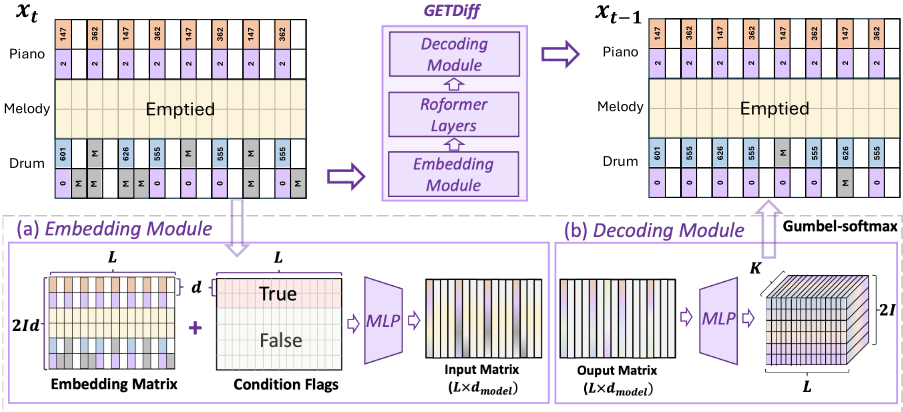
The denoising process. Figure 2 provides an overview of GETDiff denoising a three-track training sample of a length of L time units. GETDiff has three main components: an embedding module, Roformer [Su et al., 2021] layers, and a decoding module. Roformer is a Transformer [Vaswani et al., 2017] variant that incorporates relative position information into the attention matrix, which enhances the model's ability to length extrapolation during inference.
During training, GETDiff needs to cover the various source-target combinations for a music piece with I tracks, represented as a GETScore with 2I rows. To achieve this, m tracks (resulting in 2m rows in GETScore) are randomly chosen as the source, while n tracks (resulting in 2n rows in GETScore) are selected as the target, m ≥ 0, n > 0, and m+n ≤ I.
At a randomly sampled time t, to obtain xt from the original GETScore x0, tokens in target tracks are transitioned according to Qt, tokens in the source tracks remain as the ground truth, and uninvolved tracks are emptied. GETDiff denoises xt in four steps, as shown in Figure 2:
- All tokens in GETScore are embedded into ddimensional embeddings, forming an embedding matrix of size 2Id × L.
- Two types of learnable embeddings, named condition flags, are added to the matrix. These flags differentiate whether a token originates from the provided source ("True") or is generated by the model ("False"). The rationale behind this design is as follows: GETScore is designed to mimic a music score where each token, including paddings that signify rests or cadences, carries information. Because the tokens predicted at the current time step can act as conditions in the subsequent time step, any inaccuracies in these tokens can lead to deviations from the intended denoising direction during inference, especially in the first few steps. Condition flags explicitly indicates the reliability of the tokens upon which the model is conditioned, thereby enhancing the quality of generation.
- The embedding matrix is resized to GETDiff's input dimension dmodel using an MLP, and then fed into the Roformer model.
- The output matrix passes through a classification head to obtain the token distribution over the vocabulary of size K and we obtain the final tokens using the gumbel-softmax technique.
GETDiff employs the x0-parameterization [Austin et al., 2021] (see §2.2) and thus the training objective is defined as Eq.2. The posterior computation for the Lvlb term in Eq.2 is provided by Eq.5.
Inference. During inference, users specify source and target tracks, forming the GETScore representation xT with ground truth source tracks, masked target tracks, and empty tracks (if any). GETDiff denoises xT to produce x0 nonautoregressively, potentially altering source tokens. To maintain consistent guidance from source tracks, source tokens in xt-1 are restored to ground truth, and uninvolved tracks are re-emptied.
Considering the combined benefits of the representation and the diffusion model, our GETMusic framework offers several major advantages in addressing the diverse composition needs:
- Through a unified diffusion model, GETMusic has the capability to compose music across a range of source-target combinations without requiring re-training.
- Beyond the track-wise generation, the mask and denoising mechanism of GETDiff enables the zero-shot generation of any arbitrary masked locations in GETScore, which further enhances versatility and creativity.
4 Experiments
4.1 Experiment Settings
Data. Due to the data-hungry nature of the diffusionmodel, we ensured adequate data preparation for its training and testing. We gathered 1,569,469 MIDI files from the Musescore website. We processed the crawled data basically following the approach outlined in [Ren et al., 2020], resulting in symbolic music data comprising I = 6 instrumental tracks: bass, drum, guitar, piano, string, melody, along with an additional chord progression track. Further details are provided in Appendix A. After implementing rigorous cleansing and filtering procedures, we produced approximately 140,000 highquality GETScores, equivalent to approximately 3,000 hours, with the maximum L as 512. We sampled 1,000 GETScores for validation, 1,000 for testing, and the rest for training.
Tasks and baselines. We consider three symbolic music generation tasks: (1) accompaniment generation based on the melody, (2) melody generation based on the accompaniments, and (3) generating tracks from scratch.
For Task 1 and 2, we compare GETMusic with PopMAG [Ren et al., 2020], which is an autoregressive Transformer encoder-decoder model that processes a sequence representation MuMIDI. To be comparable, we restrict the generated music up to 128 beats, which is the longest composition length for PopMAG. Both PopMAG and GETMusic always employ the ground truth chord progression as a condition (i.e., a source track) for generation in these tasks. For the third task, we compare GETMusic with Museformer [Yu et al., 2022], one of the most competitive unconditional music generation models. For fair comparison, we train all baselines on our crawled data. Task 1 and 2 are evaluated on the test set, while Task 3 is evaluated by unconditionally generating 1,000 pieces of music using different random seeds.
Training details. We set diffusion timesteps T = 100 and λ = 0.001. For the transition matrix Qt, we linearly increase γt (cumulative γt) from 0 to 1 and decrease αt from 1 to 0. GETDiff has 12 Roformer layers with d = 96 and dmodel = 768, where there are about 86M trainable parameters. During training, we use AdamW optimizer with a learning rate of 1e - 4, β1 = 0.9, β2 = 0.999. The learning rate warmups first 1000 steps and then linearly decays. The training is conducted on 8 × 32G Nvidia V100 GPUs and the batch size on each GPU is 3. We train the model for 50 epochs and checkpoints are selected based on the validation loss.
4.2 EvaluationMetrics
Objective evaluation. We introduce objective metrics that quantitatively evaluates the generation quality. Following [Ren et al., 2020], we evaluate the models from two aspects:
(1) Chord accuracy: For Task 1 and 2, we measure the chord accuracy CA between generated target tracks and their ground truth to evaluate the melodic coherence:
Here, Ntracks and Nchords represent the number of tracks and chords, respectively. C ′ i,j and Ci,j denote the j-th chord in the i-th generated target track and the ground truth. Note that this metric is not suitable for the third task. Instead, melodic evaluation for the third task relies on both the pitch
distribution and human evaluation, which are discussed later.
(2) Feature distribution divergence: For the first two tasks, we assess the distributions of important musical features in generated and ground truth tracks: note pitch, duration (Dur) and Inter-Onset Interval (IOI) that measures the temporal interval between two consecutive notes within a bar. First, we quantize the duration and IOI into 16 classes, then convert the histograms into probability density functions (PDFs) using Gaussian kernel density estimation. Finally, we compute the KL-divergence [Kullback and Leibler, 1951] KL{Pitch,Dur,IOI} between PDFs of generated target tracks and ground truth. For task 3, we compute KL{P itch,Dur,IOI} between PDFs of generated target tracks and the corresponding distribution of training data. In this definition, KLPitch reflects the melody consistency, whereas KLDur and KLIOI are indicative of rhythm consistency.
Human evaluation. 30 evaluators, who possessed a basic knowledge of music, were divided into three groups, each comprising 10 members. Each group took part in a blind test dedicated to one of the three tasks, evaluating all music created by GETMusic and baseline models in this task. Evaluation metrics include "melodic," "rhythmic," and "musical structure," etc., as outlined in Appendix B.
| Method | CA(%) ↑ | KLPitch ↓ | KLDur ↓ | KLIOI ↓ |
|---|---|---|---|---|
| Task 1: Accompaniment Generation | ||||
| PopMAG | 61.17 | 10.98 | 7.00 | 6.92 |
| GETMusic | 65.48 | 10.05 | 4.21 | 4.22 |
| Task 2: Lead Melody Generation | ||||
| PopMAG | 73.70 | 10.64 | 3.97 | 4.03 |
| GETMusic | 81.88 | 9.82 | 3.67 | 3.49 |
| Task 3: Generation from Scratch | ||||
| Museformer | - | 8.19 | 3.34 | 5.71 |
| GETMusic | - | 7.99 | 3.38 | 5.33 |
4.3 Generation Results
Comparison with previous SOTA methods. Table 1 presents the objective evaluation results of three tasks. In Task 1 and 2, GETMusic significantly outperforms PopMAG across all metrics with a p-value of less than 0.01 in the t-test. This highlights its ability to create more harmonious melodies (higher CA and lower KLPitch) and more suitable rhythms (lower KLDur and KLIOI ) that align well with the provided source tracks. In Task 2, where all five accompaniment instruments serve as source tracks, we achieve better scores in all metrics compared to the first task which relies solely on the melody as the source track. This improvement caused by more generation conditions aligns with intuitive expectations. In Task 3, GETMusic outperforms the competitive baseline Museformer in most metrics. Subjective evaluations further confirm our effectiveness (Figure 1 in the appendix): In every aspect, GETMusic's human ratings outperform the competitive baselines. κ values for three tasks are 0.69, 0.72, and 0.62, all indicating a substantial agreement among evaluators.
Zero-shot generation. Though GETMusic is trained for track-wise generation, it can zero-shot recover masked tokens at arbitrary locations, due to its mask and denoising mechanism. This capability enhances the versatility and creativity of GETMusic. For example, we can insert mask tokens in the middle of two different songs to connect them: GETMusic generates a harmonious bridge by iteratively denoising the masked tokens while preserving the rest of the tokens unchanged. Despite the challenges in evaluation, our No.7 and 8 demos showcase GETMusic's flexibility and creativity.
5 Method Analysis
GETScore and GETDiff are complementary. To show this, we replace GETDiff with an autoregressive model. For the accompaniment generation task, we train a Transformer decoder equipped with 14 prediction heads. At each decoding step, it predicts tokens in a column of GETScore. This is denoted as GETMusic (AR). Table 2 highlights its suboptimal performance when compared to the original GETMusic.
| Method | CA(%) ↑ | KLPitch ↓ | KLDur ↓ | KLIOI ↓ | Time ↓ |
|---|---|---|---|---|---|
| PopMAG | 61.17 | 10.98 | 7.00 | 6.92 | 23.32 |
| GETMusic (AR) | 46.25 | 11.91 | 7.08 | 6.49 | 17.13 |
| GETMusic | 65.48 | 10.05 | 4.21 | 4.22 | 4.80 |
| Method | CA(%) ↑ | KLPitch ↓ | KLDur ↓ | KLIOI ↓ |
|---|---|---|---|---|
| Accompaniment Generation | ||||
| CON. | 63.22 | 10.10 | 4.49 | 4.54 |
| DIS. | 65.48 | 10.05 | 4.21 | 4.22 |
| Lead Melody Generation | ||||
| CON. | 78.51 | 10.25 | 3.80 | 3.88 |
| DIS. | 81.88 | 9.82 | 3.67 | 3.49 |
| Generation from Scratch | ||||
| CON. | - | 8.07 | 3.63 | 5.82 |
| DIS. | - | 7.99 | 3.38 | 5.33 |
Moreover, we show the average time required in seconds for composing each musical piece using an A100-80G GPU. Due to the considerably fewer denoising steps (T = 100) compared to the extensive prediction steps required by an autoregressive model, GETDiff exhibits notable speed advantages.
While evaluating diffusion models on traditional sequence representations would be informative, it is impractical for us. Firstly, due to the inherently higher computational resource requirements of training a diffusion model compared to an autoregressive model, coupled with the fact that traditional sequence representations are usually orders of magnitude longer than GETScore when representing the same musical piece, the training cost becomes unaffordable for our source. Furthermore, diffusion models require the specification of the generation length in advance. Yet, the length of traditional sequences representing the same number of bars can vary in a wide range, leading to uncontrollable variations in the generated music's length and structure.
Based on above analyses, we contend that our GETScore and GETDiff together provide an efficient and effective solution for versatile and diverse symbolic music generation.
Discrete diffusion models are better suited for symbolic music. Unlike continuous diffusion models, which require thousands of denoising steps to generate music [Mittal et al., 2021], discrete diffusion models achieve better results with just a hundred steps. As evidence of this, we trained a continuous variant (abbr. CON) of our discrete diffusion model (abbr. DIS), with hyperparameters following those detailed in [Mittal et al., 2021]. The results are shown in Table 3.
Performance across varied lengths is stable. In §4.3, Task 3 was tested with variable music lengths, whereas the first two tasks maintained a fixed length of 128 beats. To investigate performance across various lengths, we conducted the accompaniment generation with controlled lengths of 64 and 96 beats, respectively. Table 1 in the appendix demonstrates the superior and stable performance of our method.
Exploring learned embeddings of GETScore. Learned features in GETScore align closely with music theory. For example, while C and Cm share two of three notes, their roles in chord progressions differ-much like "gear" and "fear" in language-resulting in a low embedding similarity of 0.12. In contrast, C and its relative minor Am show a stronger connection, with a similarity of 0.43. These relationships show the music-theoretic coherence and effectiveness of GETScore.
Effectiveness of condition flags. To show the impact of condition flags, we remove them and re-train a diffusion model. We compare the new model with the original GETDiff in accompaniment generation task. We do not include the unconditional generation task in our report because the condition flags are all designated as "False," and their removal has minimal impact. The results are shown in Table 2 in the appendix. Given the comparable loss, removing the condition flags has minimal impact on training and convergence, but it leads to worse generation quality. This demonstrates that condition flags guide the model to generate high-quality music, particularly in conditional generation scenarios.
6 Conclusion
GETMusic is a unified representation and diffusion framework to effectively and efficiently generate desired target tracks from scratch or based on user-provided source tracks, which addresses diverse composition needs. It has two core components: a novel representation GETScore and a diffusion model GETDiff. GETMusic can compose music across various source-target combinations and perform flexible zeroshot generation.
Acknowledgements
Ang Lv is supported by the Outstanding Innovative Talents Cultivation Funded Programs 2023 of Renmin University of China and CIE-Tencent Doctoral Student Research Incentive Program (HunYuan Large Language Model Special Project). Ruobing Xie is supported by the Young Elite Scientists Sponsorship Program by CAST (2023QNRC001). This work is also supported by the Public Computing Cloud, Renmin University of China and by fund for building world-class universities (disciplines) of Renmin University of China.
@inproceedings{ijcai2025p1127,
  title     = {GETMusic: Generating Music Tracks with a Unified Representation and Diffusion Framework},
  author    = {Lv, Ang and Tan, Xu and Lu, Peiling and Ye, Wei and Zhang, Shikun and Bian, Jiang and Yan, Rui},
  booktitle = {Proceedings of the Thirty-Fourth International Joint Conference on
               Artificial Intelligence, {IJCAI-25}},
  publisher = {International Joint Conferences on Artificial Intelligence Organization},
  editor    = {James Kwok},
  pages     = {10144--10152},
  year      = {2025},
  month     = {8},
  note      = {AI, Arts & Creativity},
  doi       = {10.24963/ijcai.2025/1127},
  url       = {https://doi.org/10.24963/ijcai.2025/1127},
}
TY - CPAPER TI - GETMusic: Generating Music Tracks with a Unified Representation and Diffusion Framework AU - Lv, Ang AU - Tan, Xu AU - Lu, Peiling AU - Ye, Wei AU - Zhang, Shikun AU - Bian, Jiang AU - Yan, Rui T2 - Proceedings of the Thirty-Fourth International Joint Conference on Artificial Intelligence, IJCAI-25 PB - International Joint Conferences on Artificial Intelligence Organization PY - 2025 SP - 10144 EP - 10152 DO - 10.24963/ijcai.2025/1127 UR - https://doi.org/10.24963/ijcai.2025/1127 ER -Copied
Machine-readable versions of this paper, for tools and AI agents:





