
Explainability Through Human-Centric Design for XAI in Lung Cancer Detection
Proceedings of the Thirty-Fourth International Joint Conference on Artificial Intelligence. Human-Centred AI. Pages 10325-10333.
https://doi.org/10.24963/ijcai.2025/1147
Keywords
- IJCAI25: Human-Centred AI
Abstract
Deep learning models have shown promise in lung pathology detection from chest X-rays, but widespread clinical adoption remains limited due to opaque model decision-making. In prior work, we introduced ClinicXAI, a human-centric, expert-guided concept bottleneck model (CBM) designed for interpretable lung cancer diagnosis. We now extend that approach and present XpertXAI, a generalizable expert-driven model that preserves human-interpretable clinical concepts while scaling to detect multiple lung pathologies. Using a high-performing InceptionV3-based classifier and a public dataset of chest X-rays with radiology reports, we compare XpertXAI against leading post-hoc explainability methods and an unsupervised CBM, XCBs. We assess explanations through comparison with expert radiologist annotations and medical ground truth. Although XpertXAI is trained for multiple pathologies, our expert validation focuses on lung cancer. We find that existing techniques frequently fail to produce clinically meaningful explanations, omitting key diagnostic features and disagreeing with radiologist judgments. XpertXAI not only outperforms these baselines in predictive accuracy but also delivers concept-level explanations that better align with expert reasoning. While our focus remains on explainability in lung cancer detection, this work illustrates how human-centric model design can be effectively extended to broader diagnostic contexts — offering a scalable path toward clinically meaningful explainable AI in medical diagnostics.
- [Alshmrani et al., 2023] Goram Mufarah M Alshmrani, Qiang Ni, Richard Jiang, Haris Pervaiz, and Nada M Elshennawy. A deep learning architecture for multi-class lung diseases classification using chest x-ray (cxr) images. Alexandria Engineering Journal, 64:923-935, 2023.
- [Alukaev et al., 2023] Danis Alukaev, Semen Kiselev, Ilya Pershin, Bulat Ibragimov, Vladimir V. Ivanov, Alexey Ko- rnaev, and Ivan Titov. Cross-modal conceptualization in bottleneck models. In The 2023 Conference on Empirical Methods in Natural Language Processing, 2023.
- [Bazi et al., 2023] Y Bazi, MMA Rahhal, L Bashmal, and M. Zuair. Vision-language model for visual question an- swering in medical imagery. In Bioengineering (Basel). 2023 Mar 20;10(3):380., 2023.
- [Brunese et al., 2020] Luca Brunese, Francesco Mercaldo, Alfonso Reginelli, and Antonella Santone. Explain- able deep learning for pulmonary disease and coronavirus covid-19 detection from x-rays. Computer Methods and Programs in Biomedicine, 196:105608, 2020.
- [de Vries et al., 2023] Bart M. de Vries, Gerben J. C. Zwez- erijnen, George L. Burchell, Floris H. P. van Velden, Catharina Willemien Menke-van der Houven van Oordt, and Ronald Boellaard. Explainable artificial intelligence (xai) in radiology and nuclear medicine: a literature re- view. Frontiers in Medicine, 10, 2023.
- [Goldberger et al., 2000] A. Goldberger, L. Amaral, L. Glass, J. Hausdorff, P. C. Ivanov, R. Mark, ..., and H. E Stanley. Physiobank, physiotoolkit, and physionet: Components of a new research resource for complex physiologic signals. In Circulation [Online], 2000.
- [Haghanifar et al., 2020] Arman Haghanifar, Mahdiyar Mo- lahasani Majdabadi, Younhee Choi, S. Deivalakshmi, and Seokbum Ko. Covid-cxnet: Detecting covid-19 in frontal chest x-ray images using deep learning, 2020.
- [Hosny et al., 2018] Ahmed Hosny, Chintan Parmar, John Quackenbush, Lawrence H Schwartz, and Hugo JWL Aerts. Artificial intelligence in radiology. Nature Reviews Cancer, 18(8):500-510, 2018.
- [Irvin et al., 2019] Jeremy Irvin, Pranav Rajpurkar, Michael Ko, Yifan Yu, Silviana Ciurea-Ilcus, Chris Chute, Henrik Marklund, Behzad Haghgoo, Robyn Ball, Katie Shpan- skaya, Jayne Seekins, David A. Mong, Safwan S. Halabi, Jesse K. Sandberg, Ricky Jones, David B. Larson, Curtis P. Langlotz, Bhavik N. Patel, Matthew P. Lungren, and An- drew Y. Ng. Chexpert: A large chest radiograph dataset with uncertainty labels and expert comparison, 2019.
- [Johnson et al., 2019a] A. Johnson, M. Lungren, Y. Peng, Z. Lu, R. Mark, S. Berkowitz, and S. Horng. Mimic- cxr-jpg -chest radiographs with structured labels' (version 2.0.0), 2019.
- [Johnson et al., 2019b] A.E.W. Johnson, T.J. Pollard, S.J Berkowitz, and et al. Mimic-cxr, a de-identified publicly available database of chest radiographs with free-text re- ports. In Scientific data, 6(1), 317, 2019.
- [Kim et al., 2022] D. Kim, J. Chung, J Choi, and et al. Ac- curate auto-labeling of chest x-ray images based on quan- titative similarity to an explainable ai model., 2022.
- [Kim et al., 2023] Injae Kim, Jongha Kim, Joonmyung Choi, and Hyunwoo J. Kim. Concept bottleneck with vi- sual concept filtering for explainable medical image classi- fication. In M. Emre Celebi, Md Sirajus Salekin, Hyunwoo Kim, Shadi Albarqouni, Catarina Barata, Allan Halpern, Philipp Tschandl, Marc Combalia, Yuan Liu, Ghada Za- mzmi, Joshua Levy, Huzefa Rangwala, Annika Reinke, Diya Wynn, Bennett Landman, Won-Ki Jeong, Yiqing Shen, Zhongying Deng, Spyridon Bakas, Xiaoxiao Li, Chen Qin, Nicola Rieke, Holger Roth, and Daguang Xu, editors, Medical Image Computing and Computer Assisted Intervention -MICCAI 2023 Workshops, pages 225-233, Cham, 2023. Springer Nature Switzerland.
- [Koh et al., 2020] Pang Wei Koh, Thao Nguyen, Yew Siang Tang, Stephen Mussmann, Emma Pierson, Been Kim, and Percy Liang. Concept bottleneck models, 2020. [Kubát and Matwin, 1997] Miroslav Kubát and Stan Matwin. Addressing the curse of imbalanced training sets: One-sided selection. In International Conference on Machine Learning, 1997.
- [Lapuschkin et al., 2015] Sebastian Lapuschkin, Alexander Binder, Grégoire Montavon, Frederick Klauschen, Klaus- Robert Müller, and Wojciech Samek. On pixel-wise ex- planations for non-linear classifier decisions by layer-wise relevance propagation. PLoS ONE, 10:e0130140, 07 2015.
- [Lee et al., 2024] Seowoo Lee, Jiwon Youn, Hyungjin Kim, Mansu Kim, and Soon Ho Yoon. Cxr-llava: a multimodal large language model for interpreting chest x-ray images, 2024.
- [Legastelois et al., 2023] Benedicte Legastelois, Amy Raf- ferty, Paul Brennan, Hana Chockler, Ajitha Rajan, and Vaishak Belle. Challenges in explaining brain tumor detec- tion. In Proceedings of the First International Symposium on Trustworthy Autonomous Systems, TAS '23, New York, NY, USA, 2023. Association for Computing Machinery.
- [Li et al., 2023] Chunyuan Li, Cliff Wong, Sheng Zhang, Naoto Usuyama, Haotian Liu, Jianwei Yang, Tristan Naumann, Hoifung Poon, and Jianfeng Gao. Llava- med: Training a large language-and-vision assistant for biomedicine in one day, 2023.
- [Liu et al., 2023a] Haotian Liu, Chunyuan Li, Qingyang Wu, and Yong Jae Lee. Visual instruction tuning, 2023.
- [Liu et al., 2023b] Yunyi Liu, Zhanyu Wang, Dong Xu, and Luping Zhou. Q2atransformer: Improving medical vqa via an answer querying decoder, 2023.
- [Lu et al., 2023] Ming Y. Lu, Bowen Chen, Drew F. K. Williamson, Richard J. Chen, Kenji Ikamura, Georg Ger- ber, Ivy Liang, Long Phi Le, Tong Ding, Anil V Parwani, and Faisal Mahmood. A foundational multimodal vision language ai assistant for human pathology, 2023.
- [Lundberg and Lee, 2017] SM. Lundberg and S. Lee. A uni- fied approach to interpreting model predictions. In Pro- ceedings of the 31st international conference on neural in- formation processing systems, pages 4768 -4777, 2017.
- [Meena et al., 2023] Sitaram Meena, Amod Kumar, Meenakshi Sood, and Rajesh Kumar Meena. Lung cancer detection and classification model using inception v3 algorithm. In International Conference on Data Analytics & Management, pages 423-433. Springer, 2023.
- [Nguyen et al., 2020] Ha Q. Nguyen, Khanh Lam, Linh T. Le, Hieu H. Pham, Dat Q. Tran, Dung B. Nguyen, Dung D. Le, Chi M. Pham, Hang T. T. Tong, Diep H. Dinh, Cuong D. Do, Luu T. Doan, Cuong N. Nguyen, Binh T. Nguyen, Que V. Nguyen, Au D. Hoang, Hien N. Phan, Anh T. Nguyen, Phuong H. Ho, Dat T. Ngo, Nghia T. Nguyen, Nhan T. Nguyen, Minh Dao, and Van Vu. Vindr- cxr: An open dataset of chest x-rays with radiologist's an- notations, 2020.
- [Oakden-Rayner, 2017] Lauren Oakden-Rayner. Exploring the chestxray14 dataset: problems. LaurenOakdenRayner, 2017.
- [Oikarinen et al., 2023] Tuomas Oikarinen, Subhro Das, Lam M Nguyen, and Tsui-Wei Weng. Label-free concept bottleneck models. In International Conference on Learn- ing Representations, 2023. [OpenAI, 2024] OpenAI. Chatgpt, 2024. [PhysioNet, 2019] PhysioNet. Mimic-cxr dataset. https:// physionet.org/content/mimic-cxr/2.0.0/, 2019. Accessed: 28.02.2024. Link
- [Pitroda et al., 2021] Vidhi Pitroda, Mostafa M. Fouda, and Zubair Md Fadlullah. An explainable ai model for inter- pretable lung disease classification. In 2021 IEEE Interna- tional Conference on Internet of Things and Intelligence Systems (IoTaIS), pages 98-103, 2021.
- [Radford et al., 2018] Alec Radford, Karthik Narasimhan, Tim Salimans, and Ilya Sutskever. Improving language understanding by generative pre-training. 2018.
- [Radford et al., 2021] Alec Radford, Jong Wook Kim, Chris Hallacy, Aditya Ramesh, Gabriel Goh, Sandhini Agar- wal, Girish Sastry, Amanda Askell, Pamela Mishkin, Jack Clark, Gretchen Krueger, and Ilya Sutskever. Learning transferable visual models from natural language supervi- sion, 2021.
- [Rafferty et al., 2022] Amy Rafferty, Rudolf Nenutil, and Ajitha Rajan. Explainable artificial intelligence for breast tumour classification: Helpful or harmful. In Interpretabil- ity of Machine Intelligence in Medical Image Computing, pages 104-123, Cham, 2022. Springer Nature Switzer- land.
- [Rafferty et al., 2025] Amy Rafferty, Rishi Ramaesh, and Ajitha Rajan. Leveraging expert input for robust and ex- plainable ai-assisted lung cancer detection in chest x-rays, 2025.
- [Ribeiro et al., 2016] M. Ribeiro, S. Singh, and C. Guestrin. "Why should I trust you?": Explaining the predictions of any classifier. In arXiv, 1602.04938v3, 2016.
- [Selvaraju et al., 2019] Ramprasaath R. Selvaraju, Michael Cogswell, Abhishek Das, Ramakrishna Vedantam, Devi Parikh, and Dhruv Batra. Grad-CAM: Visual explanations from deep networks via gradient-based localization. Inter- national Journal of Computer Vision, 128(2):336-359, oct 2019.
- [Shadin et al., 2021] Nazmus Shakib Shadin, Silvia Sanjana, and Nusrat Jahan Lisa. Covid-19 diagnosis from chest x- ray images using convolutional neural network (cnn) and inceptionv3. In 2021 International Conference on Infor- mation Technology (ICIT), pages 799-804. IEEE, 2021.
- [Singh et al., 2021] R.K. Singh, R. Pandey, and R.N. Babu. Covidscreen: explainable deep learning framework for dif- ferential diagnosis of covid-19 using chest x-rays., 2021.
- [Szegedy et al., 2015] Christian Szegedy, Vincent Van- houcke, Sergey Ioffe, Jonathon Shlens, and Zbigniew Wojna. Rethinking the inception architecture for computer vision, 2015.
- [Tjoa and Guan, 2021] Erico Tjoa and Cuntai Guan. A sur- vey on explainable artificial intelligence (xai): Toward medical xai. IEEE Transactions on Neural Networks and Learning Systems, 32(11):4793-4813, 2021.
- [Vermeire et al., 2022] T. Vermeire, D. Brughmans, S. Goethals, and et al. Explainable image classifica- tion with evidence counterfactual. In Pattern Anal Applic 25, 315-335, 2022.
- [Wadden, 2022] Jordan Joseph Wadden. Defining the unde- finable: the black box problem in healthcare artificial intel- ligence. Journal of Medical Ethics, 48(10):764-768, 2022.
- [Yang et al., 2023] Yue Yang, Artemis Panagopoulou, Shenghao Zhou, Daniel Jin, Chris Callison-Burch, and Mark Yatskar. Language in a bottle: Language model guided concept bottlenecks for interpretable image clas- sification. In Proceedings of the IEEE/CVF Conference on Computer Vision and Pattern Recognition, pages 19187-19197, 2023.
- [Yuksekgonul et al., 2023] Mert Yuksekgonul, Maggie Wang, and James Zou. Post-hoc concept bottleneck models. In The Eleventh International Conference on Learning Representations, 2023.
- [Zak and Krzyżak, 2020] Matthew Zak and Adam Krzyżak. Classification of lung diseases using deep learning mod- els. In International Conference on Computational Sci- ence, pages 621-634. Springer, 2020.
References were extracted automatically from the PDF and may contain errors.
Full text extracted automatically from the PDF; figures, tables and equations may differ. The PDF is the version of record.
1 Introduction
The black-box nature of modern deep learning (DL) models makes it challenging to trust and understand the rationale behind their decisions, particularly in high-stakes domains such as medical diagnostics [Wadden, 2022]. Explainable artificial intelligence (XAI) aims to increase the transparency and trustworthiness of DL systems by offering interpretable insights into their decision-making processes. Broadly, XAI techniques fall into two categories: post-hoc methods, which are applied after model training, and ante-hoc methods, which are designed to make models intrinsically interpretable. Prior studies have shown that popular post-hoc techniques often underperform in medical imaging contexts compared to general computer vision tasks [Pitroda et al., 2021] [Brunese et al., 2020]. For example, image-based methods like LIME [Ribeiro et al., 2016] and Grad-CAM [Selvaraju et al., 2019] frequently miss clinically significant features [de Vries et al., 2023] [Rafferty et al., 2022], while recent large multimodal models such as LLaVA-Med [Li et al., 2023] struggle to capture pathology-specific signals that are readily recognized by human experts [Lu et al., 2023]. This may stem from several factors-including limited dataset quality and noisy annotations [Oakden-Rayner, 2017]-but we hypothesize that a critical and underappreciated limitation is the lack of expert involvement in the design of XAI techniques themselves.
Concept Bottleneck Models (CBMs) [Koh et al., 2020], a recently popular class of ante-hoc XAI, attempt to address this by embedding human-interpretable concepts directly into the model architecture. CBMs divide prediction into two stages. First, concepts-either pre-defined or learned unsupervised-are predicted from the input image. These concepts are then used to determine the final label. This intermediary step is valuable because it is fully transparent and can be examined and evaluated by an expert. In medical diagnostics, for example, the concepts might represent clinical features in a chest X-ray, which a trained clinician can analyze to support their diagnostic process. Our evaluation includes CBMs utilizing both supervised and unsupervised concepts.
Lung cancer remains one of the leading causes of cancerrelated mortality worldwide, and early, accurate diagnosis through chest X-rays is critical. In prior work, we proposed ClinicXAI [Rafferty et al., 2025], a CBM-based approach for lung cancer detection using expert-defined clinical concepts to improve interpretability. While binary classification of lung cancer presence is a natural first step, real-world diagnostic workflows require distinguishing lung cancer from a range of other thoracic pathologies with overlapping imaging characteristics. To reflect this clinical reality, in this work we extend that method and introduce XpertXAI, a generalizable, expert-driven concept bottleneck model designed to scale beyond a single disease. XpertXAI is trained to detect and explain lung cancer, our clinical focus, within a multi-pathology training setup that mirrors real-world diagnostic settings, allowing us to test its broader clinical utility.
To evaluate XpertXAI, we use the large-scale public dataset MIMIC-CXR [Johnson et al., 2019a] [PhysioNet, 2019] [Johnson et al., 2019b] of chest X-rays and associated radiological reports, comparing its performance and explanations against both post-hoc and ante-hoc XAI methods in the multiclass domain. Post-hoc techniques are applied to a 42-layer InceptionV3 model [Szegedy et al., 2015] trained for lung pathology detection, chosen for its strong performance and widespread use in medical AI [Meena et al., 2023] [Zak and Krzy˙zak, 2020] [Alshmrani et al., 2023] [Shadin et al., 2021]. The post-hoc methods evaluated include LIME [Ribeiro et al., 2016], SHAP [Lundberg and Lee, 2017], Grad-CAM [Selvaraju et al., 2019], and the textual LLMbased method CXR-LLaVA [Lee et al., 2024]. For antehoc comparison, we include XCBs [Alukaev et al., 2023], a recent unsupervised CBM approach that infers intermediate concepts without expert input.
Our evaluation reveals that post-hoc approaches fail to capture clinically relevant information in chest X-rays, both w.r.t the medical ground truth in our dataset and the opinions of an expert radiologist. These techniques also show consistent disagreement with each other. CXR-LLaVA is notably sensitive to the wording of the input question and exhibits a high rate of false negatives on our dataset. While XCBs perform relatively well by often highlighting pathology-specific clinical concepts, they also identify less relevant concepts that do not contribute to the explanation and have a high rate of false positives according to our expert radiologist.
To test our hypothesis that expert input improves XAI quality, we designed XpertXAI using clinical concepts curated in direct collaboration with radiologists. These concepts are automatically extracted from radiology reports using standard NLP techniques and serve as supervised bottlenecks in model training. XpertXAI achieves higher classification performance than both InceptionV3 and XCBs, while also producing explanations that capture a significantly greater proportion of clinically meaningful features. According to radiologist evaluations, performed on healthy and cancerous chest Xrays in accordance with our original clinical focus, XpertXAI explanations are more accurate, reliable and aligned with expert reasoning than those produced by baseline methods.
Although XpertXAI builds directly on our prior work in lung cancer detection, its extension to multiple lung pathologies demonstrates how human-centric design principles can scale to broader diagnostic tasks. Rather than introducing a radically new architecture, XpertXAI illustrates how expertinformed concept selection and supervision can meaningfully improve both the performance and interpretability of AI models in medicine - highlighting the importance of aligning model reasoning with clinical understanding.
2 RelatedWork
2.1 Post-Hoc Image XAI
Post-hoc image XAI is split into perturbation- and gradientbased techniques. Perturbation-based techniques (eg. LIME [Ribeiro et al., 2016], SHAP [Lundberg and Lee, 2017]) work by generating random masks of an image to determine which regions have the most effect on a model's classification decision. Gradient-based techniques (eg. Grad-CAM [Selvaraju et al., 2019], LRP [Lapuschkin et al., 2015]) instead use a forward or backward pass of a DL model to calculate the importance of each input neuron. Many recent studies apply post-hoc image XAI techniques to DL models in the domain of lung pathology classification, uncovering the lack of stability in the explanations produced [Pitroda et al., 2021] [Vermeire et al., 2022]. Explanations from these techniques have been shown to disagree with each other, with the medical ground truth of the dataset and with the opinions of a radiologist [Rafferty et al., 2022] [Legastelois et al., 2023] [Brunese et al., 2020] [Haghanifar et al., 2020] [Singh et al., 2021]. This has raised concerns regarding their use in the diagnostic domain [Tjoa and Guan, 2021]. Post-hoc explanations routinely highlight irrelevant regions of medical scans while missing clinical features, despite the high classification performances of the models they are applied to [de Vries et al., 2023].
2.2 Post-Hoc LLM-Based XAI
The recent popularity of ChatGPT [OpenAI, 2024] and associated open-source large language models (LLMs) has given rise to textual XAI techniques in the form of multimodal models like LLaVA [Liu et al., 2023a], which connect vision encoders and LLMs, usually in a chatbot format. These techniques use Visual Question Answering (VQA) - the process of building models which can answer questions about input images [Bazi et al., 2023] [Liu et al., 2023b]. In the medical domain, biomedical chatbots such as LLaVA-Med [Li et al., 2023] and CXR-LLaVA [Lee et al., 2024] have been introduced. In this work we examine the effectiveness of CXRLLaVA, which is pre-trained on multiple chest X-ray datasets including the one used in this work, for generating clinically relevant explanations for Chest X-Rays.
2.3 Concept BottleneckModels
[Koh et al., 2020] introduce CBMs, which essentially split the traditional classification pipeline into 2 separate models. The first model takes an image and predicts the presence of a list of pre-determined concepts, and the second takes these concepts and predicts the output label. These concepts act as a convenient middle step to the pipeline, giving the user valuable insight into the decision making process. A major drawback of CBMs is the need for a fully annotated training dataset, which for domains such as medical imaging is infeasible and expensive. There are many approaches for handling this problem in literature. [Yuksekgonul et al., 2023] apply CBMs in a post-hoc format, which can be applied to any classifier. Other approaches such as label-free CBMs [Oikarinen et al., 2023] and language model guided CBMs [Yang et al., 2023] leverage LLMs such as GPT-3 [Radford et al., 2018] to produce domain-specific concepts, and the CLIP model [Radford et al., 2021] to automatically label the images with these concepts. [Kim et al., 2023] highlight the fact that these LLM-based approaches tend to generate nonvisual concepts, and include visual activations to attempt to rectify this. [Alukaev et al., 2023] introduce a cross-modal CBM (XCBs) which instead extracts concepts from radiology reports associated with chest X-rays using an unsupervised cross-attention mechanism.
We note that these approaches generate concepts in an unsupervised manner, without expert input, and their clinical usability in specific medical domains is unclear. In order to test our hypothesis that expert input has a positive impact on the clinical relevance of explanations, we introduce our own expert-driven CBM approach in this work. Instead of extracting unsupervised concepts, we leverage common NLP techniques to automatically extract key phrases indicative of pathologies from the radiology reports associated with the chest X-rays in our dataset. The phrases we extract were decided under direct radiologist guidance, meaning that our concepts have direct diagnostic interpretability, and are fully customisable by the expert user.
3 Evaluation of Existing XAI
3.1 Dataset
We use the MIMIC-CXR dataset from PhysioNet, which comprises chest X-rays and associated free-text radiology reports [PhysioNet, 2019] [Johnson et al., 2019b] [Goldberger et al., 2000]. Although the dataset includes X-rays frommultiple views (PA, AP, and lateral), we focus exclusively on the Posterior-Anterior (PA) view to minimize confounding factors [Kim et al., 2022]. Under radiologist guidance, we select six clinically significant labels from the original fourteen: Healthy (No Finding), Lung Cancer (Lung Lesion), Pneumonia, Pneumothorax, Pleural Effusion, and Cardiomegaly. These conditions were chosen for their relevance to realworld diagnostic practice and their representation of general pathological categories rather than symptom-specific labels such as Consolidation or Lung Opacity. Due to a substantial class imbalance-most cases are labelled as Healthy-we apply the One-Sided Selection undersampling technique [Kub´at and Matwin, 1997] to mitigate its impact on classification performance. The final dataset comprises 35,893 image-report pairs, which we split into training, validation, and testing sets using an 80/10/10 ratio. All images are resized to 512×512 pixels, normalized, and cropped to remove black borders.
3.2 XAI Techniques
For our evaluation, we select XAI techniques from various families. For post-hoc image XAI, we use gradient-based Grad-CAM [Selvaraju et al., 2019] and perturbation-based LIME [Ribeiro et al., 2016] and SHAP [Lundberg and Lee, 2017], which are well-documented and widely used. For textual LLM-based XAI, we employ CXR-LLaVA [Lee et al., 2024], a high-performing LLaVA-based method specialized in chest X-ray pathologies. For ante-hoc XAI, we use XCBs [Alukaev et al., 2023], a recent CBM-based method that learns unsupervised concepts from chest X-rays and radiology reports, demonstrating promising results compared to other CBMs [Oikarinen et al., 2023]. LIME, SHAP and Grad-CAM are implemented using their respective Python libraries and applied post-hoc to an InceptionV3 model [Szegedy et al., 2015], which was trained on our MIMICCXR dataset, a widely-used dataset for chest X-ray pathology detection [Meena et al., 2023] [Alshmrani et al., 2023]. Implementations of CXR-LLaVA and XCBs are publicly available. All experiments were performed with an NVIDIA GTX 1060 6GB GPU.
3.3 Observations
Image-Based XAI
For LIME, SHAP and Grad-CAM, which generate explanations based solely on input images, we evaluate: 1) the agreement between techniques (multiclass), 2) the clinical relevance of explanations based on overlap with ground truth annotations (multiclass), and 3) the alignment with expert radiologist opinions (lung cancer only). While our technical evaluation spans multiple thoracic diseases, our clinical validation remains focused on lung cancer, aligning with our central clinical focus. These approaches are applied post hoc to a standard InceptionV3 model, which achieves a high macroaverage F1 score of 0.74 across the six classes in our dataset.
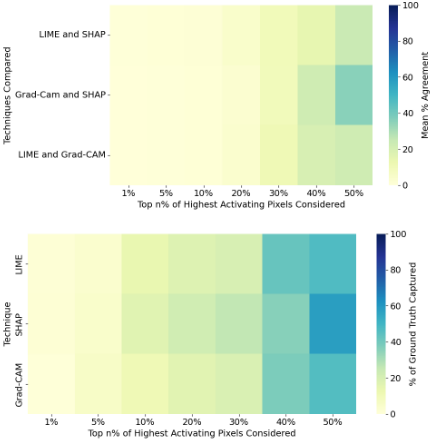
To assess agreement between techniques, we analyze the similarity of the top n% highest-activating pixels across the MIMIC-CXR test set for various values of n. These pixels represent the most salient regions influencing the model's classification decisions. If the explanations reliably highlight meaningful image features, we would expect a high degree of overlap between methods for small n. As shown in Figure 1(a), however, agreement remains consistently low across LIME, SHAP, and Grad-CAM, even in this multiclass diagnostic setting. This suggests that these techniques may not be reliably isolating shared diagnostic cues across pathologies.
To evaluate clinical relevance, we compare explanations to ground truth pathology locations using a subset of the VinDr-CXR dataset [Nguyen et al., 2020], which includes radiologist-annotated bounding boxes for multiple thoracic conditions. Since our goal is to assess technical explanation quality across a range of diseases, we extend this analysis to include all available annotated pathologies that correspond to our six target pathology labels - all except Pneumonia. We compute the proportion of bounding box pixels captured within the top n% of the explanation maps across this evaluation set of 921 chest X-rays. As shown in Figure 1(b), LIME, SHAP and Grad-CAM often fail to localize clinically relevant regions.
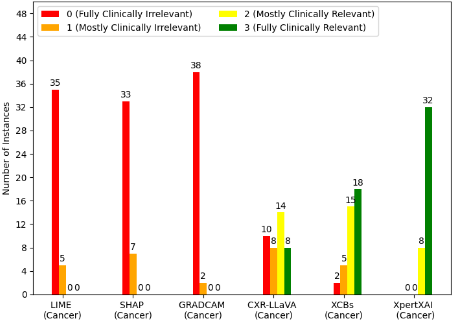
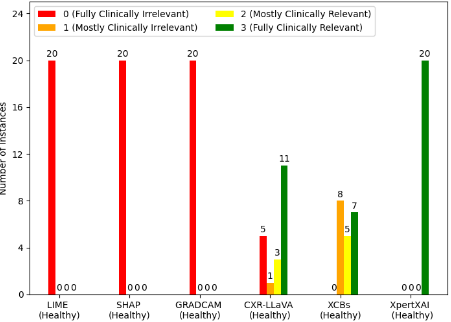
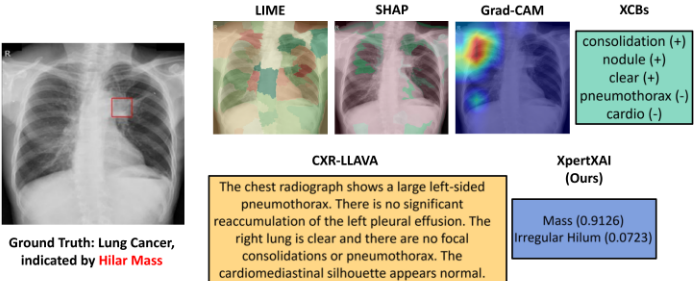
Comparisons to Expert Opinions (Lung Cancer Only) To assess alignment with human clinical reasoning, we compare explanations from LIME, SHAP, and Grad-CAM to the opinions of an expert radiologist, focusing exclusively on lung cancer cases. A radiologist with over 10 years of experience reviewed explanations for 60 chest X-rays - 40 cancerous and 20 healthy. This dataset is small due to radiologist availability, and will be expanded in future works. Each image was evaluated across all six XAI methods used in this study. The expert was asked to score each explanation between 0 and 3, where 0 indicates the explanation is fully clinically irrelevant, 1 indicates it is mostly clinically irrelevant, 2 indicates it is mostly clinically relevant, and 3 indicates that it is fully clinically relevant. As shown in Figure 2, post-hoc explanations for both cancerous and healthy images predominantly scored 0 across all techniques. The radiologist noted that image-based techniques frequently highlighted anatomically implausible regions such as clear lung fields or areas outside the lungs. This suggests a limited degree of clinical utility in their current form. An example of such mislocalization is shown in Figure 3(b-d), where LIME, SHAP and Grad-CAM scored 0, 1, and 0 respectively for a clearly cancerous scan. This reinforces concerns about the clinical utility of current XAI methods, particularly in critical tasks like lung cancer detection.
LLM-Based XAI
CXR-LLaVA is a vision-language model designed to generate radiology-style reports and answer diagnostic questions based on chest X-ray input. In this study, we evaluate CXRLLaVA in three key areas: 1) response consistency across semantically equivalent questions, 2) clinical relevance of generated reports based on proportion of ground truth clinical concepts captured (multiclass), and 3) alignment with expert radiologist judgment in the context of lung cancer detection.
To assess response consistency, we pose multiple semantically similar prompts for chest X-rays in our evaluation set. These include neutral queries (e.g., Do any clinical features of this chest X-ray indicate lung cancer?) and diagnosis-assuming prompts (e.g., Which clinical features of this chest X-ray indicate lung cancer?). We find that while neutral prompts typically result in appropriate "no finding" responses on healthy images, diagnosis-assuming prompts often elicit confident but incorrect pathology-related descriptions-despite the absence of pathology. This suggests that CXR-LLaVA may be vulnerable to prompt-induced hallucinations when prompt phrasing implies a disease presence.
To evaluate clinical relevance, we followed a method similar to [Lee et al., 2024], applying the same NLP concept extraction techniques to both ground truth MIMIC-CXR reports and CXR-LLaVA-generated reports. We then compared the proportion of shared clinical concepts. The clinical concepts, selected by a consultant radiologist, represent key phrases used by experts in describing healthy chest Xrays, or X-rays indicative of our five target pathologies (Lung Cancer, Cardiomegaly, Pneumonia, Pneumothorax, Pleural Effusion). We found that CXR-LLaVA's reports frequently produced false negatives specifically for cancer diagnosis, instead emphasizing pneumothorax or cardiomegaly, likely due to imbalances in the training dataset [Lee et al., 2024]. On our MIMIC-CXR test set of 3590 chest X-rays and radiology reports, CXR-LLaVA achieved an overall concept F1 score of 0.658.
We assess alignment with expert opinion through a radiologist-led lung cancer-specific evaluation of generated reports for 60 chest X-rays (40 cancerous, 20 healthy), as with post-hoc image XAI. As shown in Figure 2, CXR-LLaVA performs fairly well on healthy cases but often receives low scores on cancerous scans. The expert highlighted common failures such as omission of key cancer findings (e.g., small nodules, hilar masses), introduction of unrelated conditions
| Model | Accuracy | ||
|---|---|---|---|
| Precision | Recall | F1 Score | |
| CXR-LLaVA | 0.713 | 0.418 | 0.658 |
| XCBs | 0.588 | 0.854 | 0.799 |
| XpertXAI | 0.772 | 0.882 | 0.842 |
(e.g., scoliosis, pneumothorax), and logical inconsistencies within reports. An example is shown in Figure 3(f), where a scan with a visible hilar mass is misreported as clear, and a pneumothorax is incorrectly suggested, resulting in a clinical relevance score of 0.
CBM-Based XAI
XCBs adopt a CBM architecture utilizing an unsupervised learned concept space, rather than introducing direct expert input to concept design. We evaluate the clinical utility of concept-based explanations produced by XCBs in two ways: 1) clinical relevance based on proportion of ground truth clinical concepts captured (multiclass), and 2) agreement with expert radiologist judgment on cancer-related cases.
To assess clinical feature coverage, we apply the same NLP-based concept extraction strategy as in our CXRLLaVA analysis. Clinical concepts are extracted from ground truth MIMIC-CXR reports and compared to the five highest absolute-scoring concepts predicted by XCBs for each chest X-ray, following [Alukaev et al., 2023]. XCBs outperformed CXR-LLaVA, achieving an overall concept F1 score of 0.799, however the technique has a significantly lower Precision score, indicating a high rate of false positives.
For expert assessment, a consultant radiologist evaluated XCBs explanations for 60 chest X-rays (40 cancerous, 20 healthy), as with previous approaches. As shown in Figure 2, XCBs perform well on cancerous scans, frequently achieving scores of 2 or 3. The expert noted that XCBs were particularly effective at identifying salient abnormalities such as masses, but occasionally included irrelevant or misleading concepts (e.g., false mentions of consolidation). For example, Figure 3(e) shows an explanation which was scored 2 by the expert, in which a correctly identified hilar mass was accompanied by an erroneous reference to consolidation. Performance on healthy images was less reliable, with the model frequently surfacing spurious features, leading to lower expert scores and a higher false positive rate. This suggests that while XCBs offer a promising pathway toward interpretable AI, additional refinement is needed to improve specificity on normal scans.
4 XpertXAI: An Expert-Driven Concept Bottleneck Model
Existing XAI techniques often perform poorly in pathology detection from chest X-rays, failing to capture clinically relevant features. To explore the potential benefits of expert input on XAI performance and explanation quality, we introduce a CBM-based approach that uses clinical concepts selected by an expert radiologist. Unlike XCBs, which identify concepts unsupervised, XpertXAI predicts the presence of these expert-chosen concepts. This section describes XpertXAI
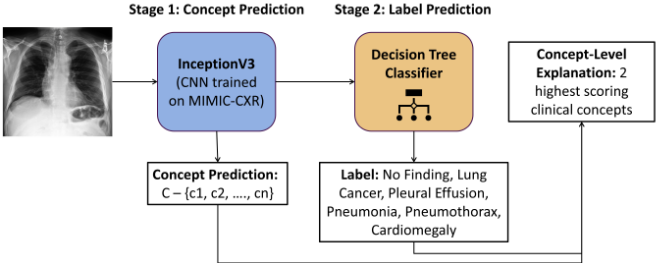
and compares its classification performance and clinical relevance of explanations with those of CXR-LLaVA and XCBs.
4.1 Clinical Concept Extraction
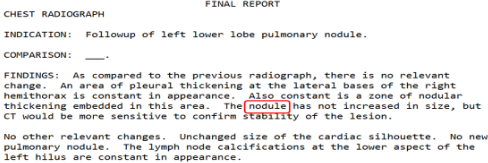
Each chest X-ray in the MIMIC-CXR dataset is linked to a free-text radiology report (Figure 4), similar to clinical practice. Given the variability in report structures, data cleaning was performed under radiologist guidance, focusing on relevant sections (FINDINGS and IMPRESSION) [Johnson et al., 2019a]. We removed punctuation and extraneous words to generate a list of cleaned sentences for analysis. Using a list of radiologist-provided clinical concepts in the form of key phrases, we identified which were present in the cleaned reports, excluding negative mentions. These phrases were grouped by meaning into clinical concepts by our expert radiologist to reduce sparsity and redundancy. This information was then used to automatically convert reports into binary values indicating each concept's presence. This domainspecific extraction method outperforms automated techniques like CheXpert [Irvin et al., 2019] by reducing false positives through the consideration of negative mentions.
Our final concept list contains 1 Healthy concept (Unremarkable), 5 Lung Cancer concepts (Mass, Nodule, Irregular Hilum, Adenopathy, Irregular Parenchyma), 4 Pneumonia concepts (Pneumonitis, Consolidation, Infection, Opacities), 4 Pleural Effusion concepts (Effusion, Fluid, Costophrenic Angle, Meniscus Sign), 1 Cardiomegaly concept (Enlarged Heart) and 2 Pneumothorax concepts (Absent Lung Markings, Irregular Diaphragm). These concepts, and their associated report phrases, are provided on Github 1 . A consultant radiologist analyzed a random sample of reports belonging to each target label, highlighting key phrases relevant to expert diagnosis. Single expert labeling, a common practice in radiology AI research [Hosny et al., 2018], was used. Since our clinical concepts are derived from pre-annotated reports, potential bias is minimized. The list of clinical concepts associated with a pathology is well understood in the medical community and is straightforward for an expert to provide.
1 https://github.com/AmyRaff/concept-explanations
The consultant radiologist in our study needed approximately 20 minutes to provide the list of concepts for our six target labels. It is worth noting that once the list of clinical concepts for a pathology has been provided, expert input is no longer needed - we automatically annotate our dataset with the presence of these concepts within the report and use them to train our model. Cost associated with obtaining expert input for XpertXAI is low as it is just the list of terms/concepts associated with a given pathology, which can be reused.
4.2 Architecture
As in the original CBM work [Koh et al., 2020], we split the traditional classification pipeline into two separate models, shown in Figure 5. We use the Independent CBM architecture as we are focusing on the clinical usability of explanations generated using the intermediate concept step, rather than the joint CBM architecture which merges the process into one end-to-end model. The first is the concept prediction model, which during inference takes a chest X-ray, and outputs a prediction score for each of a pre-determined list of concepts. This model is trained using both chest X-ray images and associated radiology reports from the MIMICCXR training set. As in the original CBM work we use an InceptionV3 architecture, trained with a batch size of 64 and learning rate of 0.001. The second model is the label prediction model, which during inference uses the concept prediction scores generated by the previous model to predict the image label. This model is trained on the radiology reports and pathology labels from our training dataset. The original CBM work uses a Multilayer Perceptron (MLP) model architecture for label prediction. We also experiment with Support Vector Machines (SVMs) and Decision Trees (DTs) to understand which architecture is most suitable for Chest X-rays. We find DTs have the best performance.
5 Results
5.1 Concept Prediction Performance
Since XpertXAI generates text-based explanations in the form of the two highest-confidence clinical concepts for a given chest X-ray, we evaluate its interpretability using the same methodology applied to other text-based approaches in this study, CXR-LLaVA and XCBs. Specifically, we assess its ability to reliably capture ground truth clinical concepts in its explanations. The results, presented in Table 1, show that XpertXAI has an F1 score of 0.842 for ground truth concept prediction on the MIMIC-CXR test set of 3590 chest X-rays and associated reports. A successful prediction is defined as the ground truth concept being one of the 2 highest scoring concepts in the prediction, as this is what we use as an explanation. This performance surpasses that of XCBs (0.799) and CXR-LLaVA (0.658). These findings support our hypothesis that incorporating expert input when designing an explainable model framework enhances its interpretability. By ensuring that the concept space is clinically relevant, XpertXAI aligns more closely with real-world clinical data, thereby increasing its interpretability and therefore usability to medical professionals. Our earlier model, ClinicXAI, trained exclusively for binary lung cancer classification, achieved 100% concept prediction accuracy on a smaller dataset. While expanding to multiclass training slightly reduces concept prediction performance, likely due to the larger concept space, XpertXAI maintains superior interpretability and clinical utility when compared to other approaches.
5.2 Label Prediction Performance
Table 2 summarizes the label prediction performance of XpertXAI using three label classifier architectures-MLP, Decision Trees (DT), and SVM - compared against the state-of-the-art CBM-based XAI approach, XCBs, and the standard InceptionV3 model. The InceptionV3 model, previously used to benchmark post-hoc image-based XAI in this study, serves as a baseline. All models were trained on our curated multiclass MIMIC-CXR dataset. Among the XpertXAI variants, the DT-based architecture achieved the highest performance, achieving an F1 score of 0.866 on the MIMIC-CXR test set comprising 3,590 chest Xrays. This outperforms the InceptionV3 baseline and the XCB model, highlighting XpertXAI's superior capability in clinically grounded label prediction over general-purpose and unsupervised concept-based alternatives. Our earlier model, ClinicXAI, trained for binary lung cancer classification, achieved a pathology prediction F1 score of 0.891. Expanding to multiclass training has had a negligible impact on label prediction performance, supporting the scalability of expert-centric explainable models to additional pathologies.
| Model | Precision | Recall | F1 |
|---|---|---|---|
| Standard (InceptionV3) | 0.555 | 0.731 | 0.740 |
| XCBs | 0.821 | 0.766 | 0.792 |
| XpertXAI with DT | 0.832 | 0.892 | 0.866 |
| XpertXAI with MLP | 0.722 | 0.639 | 0.688 |
| XpertXAI with SVM | 0.656 | 0.843 | 0.782 |
5.3 Alignment with Expert Opinions
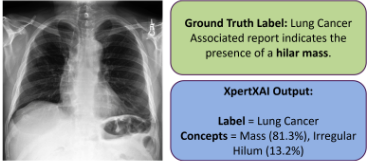
While all methods evaluated in this work were trained in a multiclass setting, we exclusively evaluate alignment with expert radiologist opinions for the lung cancer class to maintain fidelity with our research goals. XpertXAI demonstrates superior performance compared to all other evaluated approaches in our expert radiologist assessment of 60 chest X-rays. Explanations for all healthy scans and the majority of cancerous scans are deemed fully clinically relevant by the expert. The only critique was the occasional mislabeling of masses as nodules and vice versa. Figure 3 illustrates XpertXAI outperforming all other methods evaluated (LIME, SHAP, Grad-CAM, CXR-LLaVA, and XCBs). It shows explanations for a chest X-ray with a hilar mass, where XpertXAI correctly identifies "Mass" as the highest scoring concept and "Irregular Hilum" as the second, strongly indicating the presence of a hilar mass.
6 Conclusion
We evaluated the clinical relevance of leading explainable AI methods for chest X-ray pathology detection, using both posthoc and ante-hoc approaches. While the technical evaluation covered six lung pathologies, expert validation focused specifically on lung cancer-the central diagnostic task of this work. Existing XAI methods frequently failed to produce clinically meaningful explanations, missing key diagnostic features and diverging from expert reasoning. To address this, we introduce XpertXAI, an expert-guided concept bottleneck model that generates interpretable predictions grounded in clinically relevant concepts. XpertXAI outperformed post-hoc and unsupervised CBMs in both explanation quality (measured by proportion of ground truth clinical concepts captured) and classification performance. Crucially, it produced the most clinically relevant explanations for lung cancer cases, as assessed by a consultant radiologist. These findings underscore the importance of incorporating domain expertise into model design for trustworthy AI in high-stakes settings like lung cancer detection. We acknowledge that our current focus is limited to chest X-rays, and we plan to adapt our work to other imaging modalities, such as CT and MRI. Our expert evaluation is also limited, though important, and we will expand upon this in future work. While we employ an InceptionV3 model, which might raise concerns about the generalizability of our findings, this model has consistently demonstrated strong performance in the field and serves as the backbone of our CBM architecture.
@inproceedings{ijcai2025p1147,
  title     = {Explainability Through Human-Centric Design for XAI in Lung Cancer Detection},
  author    = {Rafferty, Amy and Ramaesh, Rishi and Rajan, Ajitha},
  booktitle = {Proceedings of the Thirty-Fourth International Joint Conference on
               Artificial Intelligence, {IJCAI-25}},
  publisher = {International Joint Conferences on Artificial Intelligence Organization},
  editor    = {James Kwok},
  pages     = {10325--10333},
  year      = {2025},
  month     = {8},
  note      = {Human-Centred AI},
  doi       = {10.24963/ijcai.2025/1147},
  url       = {https://doi.org/10.24963/ijcai.2025/1147},
}
TY - CPAPER TI - Explainability Through Human-Centric Design for XAI in Lung Cancer Detection AU - Rafferty, Amy AU - Ramaesh, Rishi AU - Rajan, Ajitha T2 - Proceedings of the Thirty-Fourth International Joint Conference on Artificial Intelligence, IJCAI-25 PB - International Joint Conferences on Artificial Intelligence Organization PY - 2025 SP - 10325 EP - 10333 DO - 10.24963/ijcai.2025/1147 UR - https://doi.org/10.24963/ijcai.2025/1147 ER -Copied
Machine-readable versions of this paper, for tools and AI agents:





