
A Formal Theory of Optimal Learning with Experimental Results
Proceedings of the Thirty-Fourth International Joint Conference on Artificial Intelligence. Doctoral Consortium. Pages 10967-10968.
https://doi.org/10.24963/ijcai.2025/1238
Keywords
- Search: S: Search and machine learning
- Planning and Scheduling: PS: Other
- Constraint Satisfaction and Optimization: CSO: Other
- Search: S: Other
- Machine Learning: ML: Learning theory
Abstract
Here I summarise some results from my thesis which are relevant to artificial intelligence (AI) and machine learning (ML). The key contribution is a theory of optimally sample and energy efficient learning, which is supported by mathematical proofs and experimental results.
- [Bennett et al., 2024] Michael T. Bennett, Sean Welsh, and Anna Ciaunica. Why is anything conscious? Preprint, 2024. https://osf.io/preprints/osf/mtgn7 v2. Link
- [Bennett, 2023a] Michael T. Bennett. Emergent causality and the foundation of consciousness. In Artificial General Intelligence. Springer Nature, 2023.
- [Bennett, 2023b] Michael T. Bennett. The optimal choice of hypothesis is the weakest, not the shortest. In Artificial General Intelligence. Springer Nature, 2023.
- [Bennett, 2024a] Michael T. Bennett. Computational dual- ism and objective superintelligence. In Artificial General Intelligence. Springer, 2024.
- [Bennett, 2024b] Michael T. Bennett. Is complexity an illu- sion? In Artificial General Intelligence. Springer, 2024.
- [Bennett, 2025a] Michael T. Bennett. How To Build Conscious Machines. PhD thesis, School of Com- puting, The Australian National University, 2025. github.com/ViscousLemming/Technical-Appendices. Link
- [Bennett, 2025b] Michael T. Bennett. What the f*ck is artifi- cial general intelligence? In Artificial General Intelligence (forthcoming). Springer Nature, 2025.
- [Bennett, 2025c] Michael Timothy Bennett. Are biological systems more intelligent than artificial intelligence? 2025. Forthcoming.
- [Borghi et al., 2024] Francesca Borghi, Thierry R. Nieus, Davide E. Galli, and Paolo Milani. Brain-like hardware, do we need it? Frontiers in Neuroscience, 18, 2024.
- [Chaitin, 1966] Gregory J. Chaitin. On the length of pro- grams for computing finite binary sequences. J. ACM, 1966.
- [Goertzel, 2014] Ben Goertzel. Artificial general intelli- gence: Concept, state of the art. Journal of Artificial Gen- eral Intelligence, 5(1):1-48, 2014.
- [Hutter and others, 2024] Marcus Hutter et al. An Introduc- tion to Universal Artificial Intelligence. CRC, 2024.
- [Leike and Hutter, 2015] Jan Leike and Marcus Hutter. Bad universal priors and notions of optimality. Proceedings of The 28th Conference on Learning Theory, 2015.
- [Man and Damasio, 2019] Kingson Man and Antonio R. Damasio. Homeostasis and soft robotics in the design of feeling machines. Nature Machine Intelligence, 2019.
- [Piccinini, 2015] Gualtiero Piccinini. Physical Computa- tion: A Mechanistic Account. Oxford Press, 2015.
- [Rissanen, 1978] Jorma Rissanen. Modeling by shortest data description. Automatica, 14:465-471, 1978.
- [Russell and Norvig., 2021] S. Russell and P. Norvig. Artifi- cial intelligence: A modern approach, 4th ed. 2021.
- [Thompson, 2007] Evan Thompson. Mind in Life: Biology, Phenomenology, and the Sciences of Mind. Havard, 2007.
References were extracted automatically from the PDF and may contain errors.
Full text extracted automatically from the PDF; figures, tables and equations may differ. The PDF is the version of record.
1 Introduction
Some believe simplicity is the key to general intelligence [Chaitin, 1966]. Simpler models generalise more often, meaning if either of two programs could have generated data and we have to guess which, it is more likely to be the simpler of the two. This correlation between simplicity and generalisation has profound implications for AI. Yet simplicity is a property of form, not function. The function of software is determined by the hardware that interprets it. This undermines claims regarding the behaviour of the theorised, software superintelligence AIXI [Leike and Hutter, 2015]. In theory there could be no correlation between simplicity and generalisation. In practice, there is. Why?
This question cannot be answered by formalisms like AIXI [Hutter and others, 2024], because they frame AI as a disembodied policy interacting with the environment through an interpreter. In previous work I named this 'computational dualism' [Bennett, 2024a], and argued an alternative is needed. The full formal treatment is lengthy, but greatly simplified version of the argument is as follows. Assume C is a space of software minds like AIXI. I want the optimal f1 ∈ C. I can't assume details like actions or timesteps because that would presuppose aspects of interpretation and undermine any claim I subsequently make [Leike and Hutter, 2015]. Fortunately we only need to know if overall behaviour satisfies goals, not how. Γ is a set of overall behaviours. f2 : C → Γ is a hardware body, like the UTM AIXI uses. It interprets f1. f3 : Γ → {0, 1} is the environment in which goals are pursued. If I constructed f1 for a purpose, then I decide whether it has fulfilled that purpose, and I am part of its environment f3. Goals are satisfied iff f3(f2(f1)) = 1. The performance of f1 in f3 depends on f2. It is pointless to make claims based on f1 alone. That is computational dualism. The problem is resolved by formalising the cognitive system-as-a-whole. I call this formalism Pancomputational Enactivism.
2 Formalism
Pancomputationalism holds all systems are computational [Piccinini, 2015]. Enactivism rejects the agent-environment paradigm, reframing cognition as a part of the environment [Thompson, 2007]. In Pancomputational Enactivism, goals are indistinguishable from the systems that pursue them. Instead, a 'task' represents both goal and computational system. Tasks allow claims to be made regarding subjective complexity of form in relation to objective function. Non-standard definitions of terms like language and extension are used to avoid computational dualism. All environments have at least one 'state', states are defined by their relative differences, and time is difference (so states are mutually exclusive). The justification for all of this is given at length in the thesis [Bennett, 2025a]. With abuse of notation, the formalism is:
- Programs: Φ is the set of states, and P = 2Φ is all possible declarative programs. Each program is a potential point of difference between states. Assume a present state ϕ ∈ Φ, and program f ∈ P is true if ϕ ∈ f .
- Embodied Language: A body is formalised as a finite vocabulary v ⊂ P. The embodied language is Lv = {l ⊆ v : ⋂ l ̸= ∅}. Members of Lv are statements the body can express (state of memory etc). A statement l ⊆ Lv is true when ϕ ∈ ⋃ l. El = {y ∈ Lv : l ⊆ y} is called the extension of l.
- v-Tasks: A v-task α = ⟨Iα,Oα⟩ has inputs Iα ⊂ Lv and outputs Oα ⊂ EIα . Assume a uniform distribution over v-tasks. Let α and ω be v-tasks. If Iα ⊂ Iω, Oα ⊆ Oω, then α is examples of ω.
- Policies: π ∈ Lv is a correct policy 1 for α if EIα ∩ Eπ = Oα. Πα is the set of all correct policies for α. The embodied system learns or generalises to ω by inferring a correct policy from examples α that is also correct for ω, meaning π ∈ Πα∩Πω. 'Experience' is adding inputs and outputs to the examples α. Intelligence is measured by sample and energy efficiency in learning ω from α.
- Heuristics: The weakness of a policy π ∈ Πα is |Eπ|, and its complexity is the cardinality of the smallest correct policy π′ ∈ Πα s.t. Eπ′ = Eπ 2 .
1 Assume only policies that imply past observations, like hypotheses in a Boolean SAT problem [Russell and Norvig., 2021].
2 Basically minimum description length [Rissanen, 1978]. Intu-
3 Results
Proof results. Assume you must choose a policy π ∈ Πα. I show that to maximise the probability of choosing π ∈ Πα ∩ Πω, maximising |Eπ| is necessary and sufficient. It is neither necessary nor sufficient to minimise complexity [Bennett, 2023b; Bennett, 2025c]. I prove an objective upper bound for sample and energy efficiency in adaptation, to complement AIXI's subjective upper bound [Bennett, 2024a]. I show correlation between simplicity and generalisation can be explained by weakness confounding the two [Bennett, 2024b]. These results are summarised as an epistemological razor: "explanations should be no more specific than necessary". See thesis appendices for proofs [Bennett, 2025a].
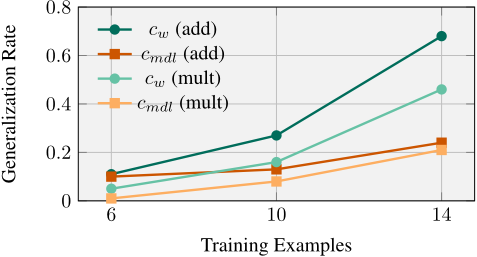
Experimental results. I implemented an A* search based learning system and had it learn to predict binary strings (4bits input, 4-bits output) [Bennett, 2023b]. The tasks were binary multiplication and addition. I compared weakness and simplicity as heuristics for policy selection. Experiments were run with different numbers of examples to learn from. In each experiment search found a simplest (cmdl) and a weakest (cw) policy to compare. With 6-14 training examples (out of 16 total), choosing weak policies yielded a 110 - 500% improvement in generalisation rate (Figure 1). See GitHub for details [Bennett, 2025a].
Interpretation. This can be seen as an alternative to the minimum description length principle [Rissanen, 1978]. The proofs and experiments show weakness is the better heuristic. This shows how to build more energy and sample efficient AI. If scaled, this approach will yield more reliable systems useful for domains where error-tolerance is low. Due to the enactive frame, this formalism also addresses questions in philosophy, biology and complex systems. Two significant results have already been obtained. The first is a formal explanation of the evolution and function of consciousness [Bennett, 2023a; Bennett et al., 2024]. The second formalises the multilayer architecture of biological self-organisation to show these systems leverage the delegation of control to maximise adaptability [Bennett, 2025c]. This provides a formal foundation for 'soft robotics' [Man and Damasio, 2019] and neuromophic computing [Borghi et al., 2024]. These results all together form a thesis [Bennett, 2025a] at the intersection of AI, philosophy of mind and theoretical neurobiology in pursuit of general intelligence [Goertzel, 2014; Bennett, 2025b].
itively, weakness measures function and complexity measures form.
@inproceedings{ijcai2025p1238,
  title     = {A Formal Theory of Optimal Learning with Experimental Results},
  author    = {Bennett, Michael Timothy},
  booktitle = {Proceedings of the Thirty-Fourth International Joint Conference on
               Artificial Intelligence, {IJCAI-25}},
  publisher = {International Joint Conferences on Artificial Intelligence Organization},
  editor    = {James Kwok},
  pages     = {10967--10968},
  year      = {2025},
  month     = {8},
  note      = {Doctoral Consortium},
  doi       = {10.24963/ijcai.2025/1238},
  url       = {https://doi.org/10.24963/ijcai.2025/1238},
}
TY - CPAPER TI - A Formal Theory of Optimal Learning with Experimental Results AU - Bennett, Michael Timothy T2 - Proceedings of the Thirty-Fourth International Joint Conference on Artificial Intelligence, IJCAI-25 PB - International Joint Conferences on Artificial Intelligence Organization PY - 2025 SP - 10967 EP - 10968 DO - 10.24963/ijcai.2025/1238 UR - https://doi.org/10.24963/ijcai.2025/1238 ER -Copied
Machine-readable versions of this paper, for tools and AI agents:





