
Automated Decision-Making on Networks with LLMs through Knowledge-Guided Evolution
Proceedings of the Thirty-Fourth International Joint Conference on Artificial Intelligence. Demo Track. Pages 11137-11140.
https://doi.org/10.24963/ijcai.2025/1279
Keywords
- Machine Learning: ML: Deep learning architectures
- Machine Learning: ML: Automated machine learning
- Knowledge Representation and Reasoning: KRR: Applications
- Agent-based and Multi-agent Systems: MAS: Applications
Abstract
Effective decision-making on networks often relies on learning from graph-structured data, where Graph Neural Networks (GNNs) play a central role, but they take efforts to configure and tune. In this demo, we propose LLMNet, showing how to design GNN automated through Large Language Models. Our system develops a set of agents that construct graph-related knowlege bases and then leverages Retrieval-Augmented Generation (RAG) to support automated configuration and refinement of GNN models through a knowledge-guided evolution process. These agents, equipped with specialized knowledge bases, extract insights into tasks and graph structures by interacting with the knowledge bases.Empirical results show LLMNet excels in twelve datasets across three graph learning tasks, validating its effectiveness of GNN model designing.
- [Gilmer et al., 2017] Justin Gilmer, Samuel S Schoenholz, Patrick F Riley, Oriol Vinyals, and George E Dahl. Neural message passing for quantum chemistry. In ICML, pages 1263-1272, 2017.
- [Hamilton et al., 2017] Will Hamilton, Zhitao Ying, and Jure Leskovec. Inductive representation learning on large graphs. In NeurIPS, pages 1024-1034, 2017.
- [He et al., 2020] Xiangnan He, Kuan Deng, Xiang Wang, Yan Li, Yongdong Zhang, and Meng Wang. Lightgcn: Simplifying and powering graph convolution network for recommendation. In Proceedings of the 43rd International ACM SIGIR conference on research and development in Information Retrieval, pages 639-648, 2020.
- [Hoffman et al., 1995] Robert R Hoffman, Nigel R Shadbolt, A Mike Burton, and Gary Klein. Eliciting knowledge from experts: A methodological analysis. Organizational behavior and human decision processes, 62(2):129-158, 1995.
- [Kipf and Welling, 2016] Thomas N Kipf and Max Welling. Semi-supervised classification with graph convolutional networks. ICLR, 2016.
- [Wang et al., 2022] Xin Wang, Ziwei Zhang, and Wenwu Zhu. Automated graph machine learning: Approaches, li- braries and directions. arXiv preprint arXiv:2201.01288, 2022.
- [Wei et al., 2022] Lanning Wei, Huan Zhao, and Zhiqiang He. Designing the topology of graph neural networks: A novel feature fusion perspective. In The WebConf, pages 1381-1391, 2022.
- [Wei et al., 2023] Lanning Wei, Zhiqiang He, Huan Zhao, and Quanming Yao. Search to capture long-range depen- dency with stacking gnns for graph classification. In Pro- ceedings of the ACM Web Conference 2023, pages 588- 598, 2023.
- [Wu et al., 2020] Zonghan Wu, Shirui Pan, Fengwen Chen, Guodong Long, Chengqi Zhang, and S Yu Philip. A comprehensive survey on graph neural networks. IEEE Transactions on Neural Networks and Learning Systems (TNNLS), 2020.
- [Ying et al., 2018] Zhitao Ying, Jiaxuan You, Christopher Morris, Xiang Ren, Will Hamilton, and Jure Leskovec. Hierarchical graph representation learning with differen- tiable pooling. In NeurIPS, pages 4800-4810, 2018.
- [Zhang and Chen, 2018] Muhan Zhang and Yixin Chen. Link prediction based on graph neural networks. Advances in neural information processing systems, 31, 2018.
- [Zhang et al., 2018] Muhan Zhang, Zhicheng Cui, Marion Neumann, and Yixin Chen. An end-to-end deep learning architecture for graph classification. In AAAI, 2018.
References were extracted automatically from the PDF and may contain errors.
Full text extracted automatically from the PDF; figures, tables and equations may differ. The PDF is the version of record.
1 Introduction and RelatedWork
Effective decision-making in networks-such as in communication networks, social networks, and transportation networks- often relies on graph-structured data representations. Among the techniques developed for learning from such data, Graph Neural Networks (GNNs) have become widely adopted across diverse domains, including tasks such as anomaly detection and recommendation systems in social networks [Hamilton et al., 2017], as well as for predicting biomedical molecular properties [Gilmer et al., 2017]. The majority of existing GNNs are designed for diverse graphs under a specific task [Wu et al., 2020], such as capturing graph-level representations [Zhang et al., 2018; Ying et al., 2018]. and learning subgraph patterns in link-level tasks [He et al., 2020; Zhang and Chen, 2018]. However, designing effective GNNs for different graph learning problems is challenging, as it requires substantial graph-related knowledge in order to understand the tasks and graphs [Hoffman et al., 1995]. Then, there is a natural question: How to integrate graph learning knowledge to design effective GNNs? It is non-trivial to answer this question. Firstly, existing methods have not provided explicit guidelines for utilizing knowledge in designing GNN model architectures. Most GNNs are designed to effectively model graphs for a specific task [Wu et al., 2020; Hamilton et al., 2017; Ying et al., 2018], based on implicit human expertise, which is difficult to explicitly describe and extract.
∗Corresponding author
Therefore, we propose LLMNet, which automates GNN design using LLMs. Specifically, we have designed a Knowledge Agent to extract graph-related knowledge, building knowledge bases covering advanced graph learning research. Then, we have developed a set of agents that use RAG (Retrieval-Augmented Generation) to interact with knowledge bases, designing GNNs step by step in a knowledgeguided manner. Leveraging LLMs' task analysis, LLMNet streamlines the designing and refinement of GNN model architectures. Extensive experiments on twelve datasets across three tasks demonstrate LLMNet's superior performance and efficiency, proving the effectiveness of integrating knowledge for automated GNN design. A concrete case demonstrating this process is presented in Section 4.
2 Method
We introduce LLMNet, which prepares and utilizes knowledge to design GNN model architectures for diverse graph learning tasks using LLM-based agents. Firstly, we gather graph-related resources and develop a knowledge agent for knowledge extraction and retrieval. Subsequently, the knowledge is then used by several LLM-based agents step by step to design effective GNN model architectures.
2.1 Knowledge Bases Construction and Utilization
Knowledge Bases Construction LLMs face challenges due to outdated knowledge and hallucinations. We address this by creating two knowledge bases, which is currently lacking for designing GNN model architectures. We collect resources and use the Knowledge Agent to manage them.
The Knowledge Agent is tasked with acquiring and integrating specialized knowledge tailored to specific user requirements. This agent mainly manages two types of knowledge bases, as shown in Figure 1: the prior knowledge base and the experiment knowledge base. The prior knowledge base is enriched with task-specific information extracted from sources such as the Open Graph Benchmark (OGB) leaderboards, the PyTorch Geometric (PyG) documentation, and the top-tier conference proceedings that are accessible on Arxiv, ensuring the agent remains at the cutting edge of technology and methodology. The experiment knowledge base archives detailed experimental outcomes such as the benchmark evaluation results, including models setups and their performance on specific datasets, thereby providing insights into their effectiveness and application contexts.
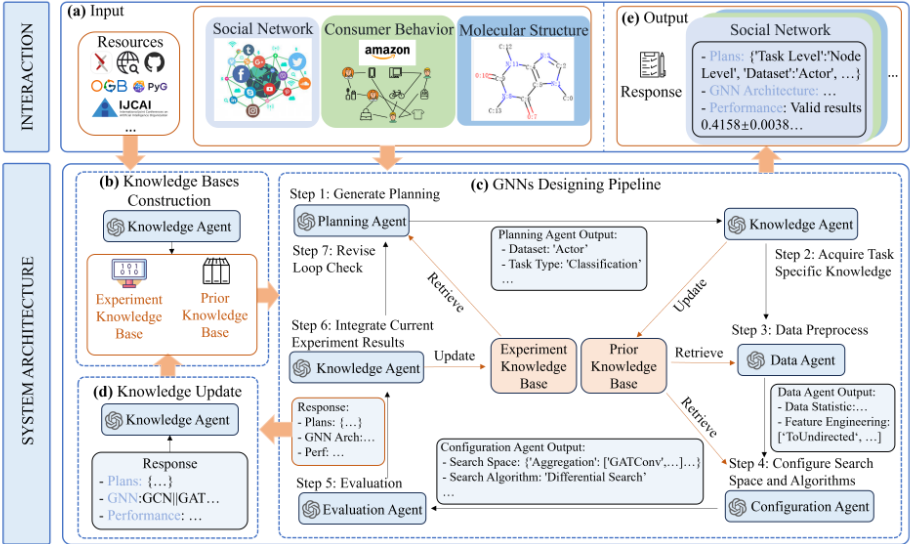
The content of papers and reports often overlaps, with redundant background information and methods that can introduce noise and reduce the informativeness of retrieved knowledge. To address this, we employ a two-level knowledge extraction strategy, first, we start by summarizing inputs to obtain coarse-grained knowledge, then refine this into finegrained details specific to graph learning tasks, such as architecture design and dataset usage. The code and the extended version with more details are available. 1 .
Knowledge Utilization and Update To effectively utilize the constructed knowledge bases, we implement a goal-aware knowledge retrieval mechanism. Utilizing the RAG technique, we enhance the effectiveness of the designing GNN model architectures by retrieving relevant knowledge. The pre-trained model all-MiniLM-L6-v2 encodes both the extracted knowledge and the queries from other agents. We calculate the cosine similarity in the embedding space to identify the most relevant knowledge. To accommodate the varying goals and resource types in graph learning, we apply a post-ranking strategy. The top-k knowledge items from each resource type are initially retrieved and then re-ranked and selected by the knowledge agent based on the query's context. This refined knowledge is integrated into the graph learning agent's prompt, facilitating the design of GNN model.
1 https://github.com/lgssstsp/LLMNet
LLMNet also incorporates a dynamically knowledge update mechanism. After the evaluation of a GNN model, the experimental summary, including the task plan, designed GNNs, and results, is stored in memory. The planning agent then compiles a report, which is added to the knowledge base, ensuring that the system's knowledge remains current and applicable for future pipeline runs. This continuous update process allows LLMNet to adapt and improve over time, enhancing its ability to design effective GNN models.
2.2 Knowledge-Guided GNNs Model Designing
Figure 1 illustrates how each agent engages with knowledge bases to streamline the entire process. The two knowledge bases bridge research and application, they empower agents to make informed decisions.
Planning Agent The Planning Agent generate a task plan based on user instructions, to direct subsequent agent actions, which includes specifications for datasets, task types and evaluation metrics. After all agents completed their tasks, this agent evaluates the experimental results, utilizing insights from the experiment knowledge base to determine whether a revision loop is necessary.
Data Agent The Data Agent utilizes insights from the prior knowledge base to perform feature engineering tailored to specific graphs and tasks, ensuring alignment with expert practices in a knowledge-guided manner.
| Cora | Photo | Actor | Genius | obgn-arxiv | DD | Proteins | ogbg-molhiv | Amazon-Sports(↓) | Avg. Rank | |
|---|---|---|---|---|---|---|---|---|---|---|
| LLMNet | 87.10(0.36) 86.68(0.40) | 96.11(0.33) 95.50(0.21) | 40.93(0.35) 39.59(0.39) | 90.89(0.11) 90.33(0.15) | 72.70(0.54) 72.30(0.54) | 78.27(2.57) 77.69(2.24) | 75.44(0.93) 74.88(1.16) | 74.27(1.54) 73.37(1.23) | 0.9298(0.0071) 0.9622(0.0103) | 1 2.5 |
| LLMNet (GL) GCN | 85.68(0.61) | 93.13(0.27) | 33.98(0.76) | 89.10(0.13) | 71.74(0.29) 71.49(0.27) | 73.59(4.17) 76.99(2.74) | 74.84(3.07) | 73.89(1.46) 73.46(1.69) | 1.0832(0.0077) | 5.25 |
| SAGE | 86.18(0.35) | 94.60(0.25) | 39.28(0.18) | 89.71(0.09) | 77.03(2.48) | 73.87(2.42) | 0.9900(0.0125) | 4.5 | ||
| AutoML | 86.57(0.32) | 95.38(0.30) | 40.39(0.03) | 90.81(0.04) | 72.42(0.37) | 74.58(2.61) | 73.51(3.21) | 0.9327(0.0006) | 2.63 | |
| LLM-GNN | 5.13 | |||||||||
| 84.64(1.04) | 93.73(0.38) | 38.92(0.07) | 89.31(0.17) | 70.83(0.93) | 75.12(3.44) | 74.47(3.65) | 72.93(0.90) | 0.9670(0.0079) |
Configuration Agent The Configuration Agent is responsible for configuring the search space, which includes possible model architecture configurations such as layers and connections, and the search algorithm that explores this space. It interacts with the prior knowledge base to gain insights on model design, enhancing the effectiveness of search space configuration and algorithm selection.
Evaluation Agent The Evaluation Agent is designed to finetune the designed GNN and conduct experiments to validate its performance. After completing the experiments, the Evaluation Agent transmits the results to the Knowledge Agent for integration into the experiment knowledge base.
3 Experiments
We evaluate LLMNet's effectiveness on twelve datasets across three tasks as shown in Table 1, the performance of another three datasets are shown in appendix of extended version. Detailed resource costs and ablation studies are in the appendix of the extended version.
3.1 Experimental Settings
Datasets We evaluate twelve widely used datasets across three tasks as shown in Table 1. The detailed introduction of these datasets and the evaluation performance of another three datasets are shown in appendix of extended version.
Baselines In this paper, we provide several kinds of baselines. (1) GNNs with task adaption, including GCN [Kipf and Welling, 2016] and GraphSAGE [Hamilton et al., 2017] with task-specific adaptations. (2) AutoML-based methods. We adopt F2GNN [Wei et al., 2022] / LRGNN [Wei et al., 2023] / Prof-CF [Wang et al., 2022] for three tasks. (3) LLM-GNN. GNNs generated by LLMs. (4) LLMNet (GL) operates without external knowledge.
3.2 Performance Comparisons
Table 1 showcases the performance of LLMNet on twelve datasets across three tasks. LLMNet consistently outperforms all baselines, highlighting its ability to design effective GNNs for various graph learning tasks. The enhanced performance of LLMNet over LLMNet (GL) underscores the value of incorporating extracted knowledge into the GNN design process. Unlike AutoML methods that operate within a predefined design space, LLMNet (GL) leverages LLMs to expand this space, achieving comparable performance and validating the agents' problem-solving capabilities. The LLMGNN baseline, which relies solely on LLM suggestions without knowledge integration, faces challenges in understanding tasks and graphs, resulting in less effective GNN designs. LLMNet's superior performance highlights the significance of knowledge in designing effective GNNs.
4 Demonstration
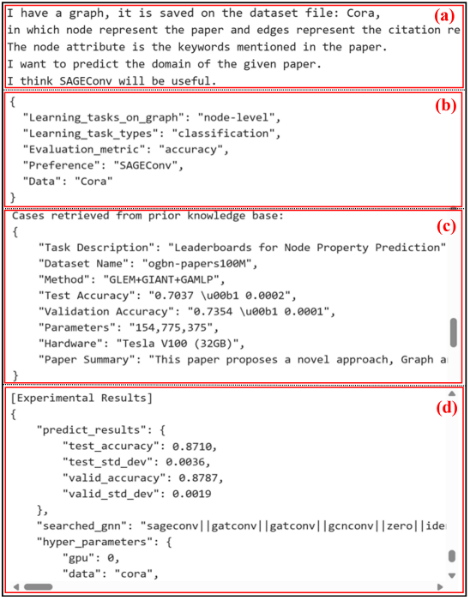
In this section, we demonstrate the use case of LLMNet on a real-world problem. For example, users aim to predict the category of articles within a citation network.
As shown in Figure 2, (a) illustrates the user's input instructions, (b) displays the task plan generated by the Planning Agent, which interprets the user's intention to predict the category of articles within a citation network as a node classification task. (c) shows the Data Agent retrieving relevant knowledge from the prior knowledge base, including methods for node classification. (d) displays the system's experimental results and its designed GNN model, LLMNet achieves an accuracy of 0.8710 on the Cora dataset, surpassing the GNN-based baselines GCN at 0.8568, ACM-GCN at 0.8667 (Detailed experiments is in the extended version), and the AutoML-based baseline SANE at 0.8640.
This demonstration showcases the effectiveness of LLMNet in automatically designing GNN model for real-world graph learning problems.
Acknowledgement
This work is supported by National Key Research and Development Program of China (under Grant No.2023YFB2903904), the National Natural Science Foundation of China (under Grant No. 92270106), and the Beijing Natural Science Foundation (under Grant No. 4242039).
@inproceedings{ijcai2025p1279,
  title     = {Automated Decision-Making on Networks with LLMs through Knowledge-Guided Evolution},
  author    = {Zheng, Xiaohan and Wei, Lanning and Li, Yong and Yao, Quanming},
  booktitle = {Proceedings of the Thirty-Fourth International Joint Conference on
               Artificial Intelligence, {IJCAI-25}},
  publisher = {International Joint Conferences on Artificial Intelligence Organization},
  editor    = {James Kwok},
  pages     = {11137--11140},
  year      = {2025},
  month     = {8},
  note      = {Demo Track},
  doi       = {10.24963/ijcai.2025/1279},
  url       = {https://doi.org/10.24963/ijcai.2025/1279},
}
TY - CPAPER TI - Automated Decision-Making on Networks with LLMs through Knowledge-Guided Evolution AU - Zheng, Xiaohan AU - Wei, Lanning AU - Li, Yong AU - Yao, Quanming T2 - Proceedings of the Thirty-Fourth International Joint Conference on Artificial Intelligence, IJCAI-25 PB - International Joint Conferences on Artificial Intelligence Organization PY - 2025 SP - 11137 EP - 11140 DO - 10.24963/ijcai.2025/1279 UR - https://doi.org/10.24963/ijcai.2025/1279 ER -Copied
Machine-readable versions of this paper, for tools and AI agents:





