
Online 3D Gaussian Splatting Modeling with Novel View Selection
Proceedings of the Thirty-Fourth International Joint Conference on Artificial Intelligence. Main Track. Pages 1323-1331.
https://doi.org/10.24963/ijcai.2025/148
Keywords
- Robotics: ROB: Robotics and vision
- Robotics: ROB: Localization, mapping, state estimation
- Computer Vision: CV: 3D computer vision
- Computer Vision: CV: Image and video synthesis and generation
Abstract
This study addresses the challenge of generating online 3D Gaussian Splatting (3DGS) models from RGB-only frames. Previous studies have employed dense SLAM techniques to estimate 3D scenes from keyframes for 3DGS model construction. However, these methods are limited by their reliance solely on keyframes, which are insufficient to capture an entire scene, resulting in incomplete reconstructions. Moreover, building a generalizable model requires incorporating frames from diverse viewpoints to achieve broader scene coverage. However, online processing restricts the use of many frames or extensive training iterations. Therefore, we propose a novel method for high-quality 3DGS modeling that improves model completeness through adaptive view selection. By analyzing reconstruction quality online, our approach selects optimal non-keyframes for additional training. By integrating both keyframes and selected non-keyframes, the method refines incomplete regions from diverse viewpoints, significantly enhancing completeness. We also present a framework that incorporates an online multi-view stereo approach, ensuring consistency in 3D information throughout the 3DGS modeling process. Experimental results demonstrate that our method outperforms state-of-the-art methods, delivering exceptional performance in complex outdoor scenes.
- [Bhat et al., 2023] Shariq Farooq Bhat, Reiner Birkl, Diana Wofk, Peter Wonka, and Matthias Müller. Zoedepth: Zero- shot transfer by combining relative and metric depth. arXiv preprint arXiv:2302.12288, 2023.
- [Bloesch et al., 2018] Michael Bloesch, Jan Czarnowski, Ronald Clark, Stefan Leutenegger, and Andrew J Davi- son. Codeslam-learning a compact, optimisable repre- sentation for dense visual slam. In Proceedings of the IEEE conference on computer vision and pattern recog- nition, pages 2560-2568, 2018.
- [Cao et al., 2022] Chenjie Cao, Xinlin Ren, and Yanwei Fu. Mvsformer: Multi-view stereo by learning robust image features and temperature-based depth. arXiv preprint arXiv:2208.02541, 2022.
- [Eftekhar et al., 2021] Ainaz Eftekhar, Alexander Sax, Jiten- dra Malik, and Amir Zamir. Omnidata: A scalable pipeline for making multi-task mid-level vision datasets from 3d scans. In Proceedings of the IEEE/CVF International Con- ference on Computer Vision, pages 10786-10796, 2021.
- [Engel et al., 2017] Jakob Engel, Vladlen Koltun, and Daniel Cremers. Direct sparse odometry. IEEE trans- actions on pattern analysis and machine intelligence, 40(3):611-625, 2017.
- [Feng et al., 2024] Ziyue Feng, Huangying Zhan, Zheng Chen, Qingan Yan, Xiangyu Xu, Changjiang Cai, Bing Li, Qilun Zhu, and Yi Xu. Naruto: Neural active reconstruc- tion from uncertain target observations. In Proceedings of the IEEE/CVF Conference on Computer Vision and Pat- tern Recognition, pages 21572-21583, 2024.
- [Forster et al., 2014] Christian Forster, Matia Pizzoli, and Davide Scaramuzza. Svo: Fast semi-direct monocular vi- sual odometry. In 2014 IEEE international conference on robotics and automation (ICRA), pages 15-22. IEEE, 2014.
- [Hamdi et al., 2024] Abdullah Hamdi, Luke Melas-Kyriazi, Jinjie Mai, Guocheng Qian, Ruoshi Liu, Carl Vondrick, Bernard Ghanem, and Andrea Vedaldi. Ges: General- ized exponential splatting for efficient radiance field ren- dering. In Proceedings of the IEEE/CVF Conference on Computer Vision and Pattern Recognition, pages 19812- 19822, 2024.
- [Hu et al., 2024] Yan Song Hu, Nicolas Abboud, Muham- mad Qasim Ali, Adam Srebrnjak Yang, Imad Elhajj, Daniel Asmar, Yuhao Chen, and John S Zelek. Mgso: Monocular real-time photometric slam with efficient 3d gaussian splatting. arXiv preprint arXiv:2409.13055, 2024.
- [Hu et al., 2025] Jiarui Hu, Xianhao Chen, Boyin Feng, Guanglin Li, Liangjing Yang, Hujun Bao, Guofeng Zhang, and Zhaopeng Cui. Cg-slam: Efficient dense rgb-d slam in a consistent uncertainty-aware 3d gaussian field. In Eu- ropean Conference on Computer Vision, pages 93-112. Springer, 2025.
- [Huang et al., 2024] Huajian Huang, Longwei Li, Hui Cheng, and Sai-Kit Yeung. Photo-slam: Real-time si- multaneous localization and photorealistic mapping for monocular stereo and rgb-d cameras. In Proceedings of the IEEE/CVF Conference on Computer Vision and Pat- tern Recognition, pages 21584-21593, 2024.
- [Jiang et al., 2025] Wen Jiang, Boshu Lei, and Kostas Dani- ilidis. Fisherrf: Active view selection and mapping with radiance fields using fisher information. In European Con- ference on Computer Vision, pages 422-440. Springer, 2025.
- [Jin et al., 2024] Rui Jin, Yuman Gao, Yingjian Wang, Yuze Wu, Haojian Lu, Chao Xu, and Fei Gao. Gs-planner: A gaussian-splatting-based planning framework for ac- tive high-fidelity reconstruction. In 2024 IEEE/RSJ In- ternational Conference on Intelligent Robots and Systems (IROS), pages 11202-11209. IEEE, 2024.
- [Kerbl et al., 2023] Bernhard Kerbl, Georgios Kopanas, Thomas Leimkühler, and George Drettakis. 3d gaus- sian splatting for real-time radiance field rendering. ACM Trans. Graph., 42(4):139-1, 2023.
- [Knapitsch et al., 2017] Arno Knapitsch, Jaesik Park, Qian- Yi Zhou, and Vladlen Koltun. Tanks and temples: Bench- marking large-scale scene reconstruction. ACM Transac- tions on Graphics (ToG), 36(4):1-13, 2017.
- [Koestler et al., 2022] Lukas Koestler, Nan Yang, Niclas Zeller, and Daniel Cremers. Tandem: Tracking and dense mapping in real-time using deep multi-view stereo. In Conference on Robot Learning, pages 34-45. PMLR, 2022.
- [Lee et al., 2024] Byeonggwon Lee, Junkyu Park, Khang Truong Giang, Sungho Jo, and Soohwan Song. Mvs-gs: High-quality 3d gaussian splatting mapping via online multi-view stereo. arXiv preprint arXiv:2412.19130, 2024.
- [Ma et al., 2024] Yikun Ma, Dandan Zhan, and Zhi Jin. Fastscene: Text-driven fast 3d indoor scene generation via panoramic gaussian splatting. In IJCAI, 2024.
- [Matsuki et al., 2024] Hidenobu Matsuki, Riku Murai, Paul HJ Kelly, and Andrew J Davison. Gaussian splatting slam. In Proceedings of the IEEE/CVF Conference on Computer Vision and Pattern Recognition, pages 18039-18048, 2024.
- [Mildenhall et al., 2021] Ben Mildenhall, Pratul P Srini- vasan, Matthew Tancik, Jonathan T Barron, Ravi Ra- mamoorthi, and Ren Ng. Nerf: Representing scenes as neural radiance fields for view synthesis. Communications of the ACM, 65(1):99-106, 2021.
- [Mur-Artal et al., 2015] Raul Mur-Artal, Jose Maria Mar- tinez Montiel, and Juan D Tardos. Orb-slam: a versatile and accurate monocular slam system. IEEE transactions on robotics, 31(5):1147-1163, 2015.
- [Newcombe et al., 2011] Richard A Newcombe, Steven J Lovegrove, and Andrew J Davison. Dtam: Dense tracking and mapping in real-time. In 2011 international confer- ence on computer vision, pages 2320-2327. IEEE, 2011.
- [Peng et al., 2024] Chensheng Peng, Chenfeng Xu, Yue Wang, Mingyu Ding, Heng Yang, Masayoshi Tomizuka, Kurt Keutzer, Marco Pavone, and Wei Zhan. Q-slam: Quadric representations for monocular slam. arXiv preprint arXiv:2403.08125, 2024.
- [Ran et al., 2023] Yunlong Ran, Jing Zeng, Shibo He, Jim- ing Chen, Lincheng Li, Yingfeng Chen, Gimhee Lee, and Qi Ye. Neurar: Neural uncertainty for autonomous 3d re- construction with implicit neural representations. IEEE Robotics and Automation Letters, 8(2):1125-1132, 2023.
- [Ranftl et al., 2021] René Ranftl, Alexey Bochkovskiy, and Vladlen Koltun. Vision transformers for dense prediction. In Proceedings of the IEEE/CVF international conference on computer vision, pages 12179-12188, 2021.
- [Redmon, 2016] J Redmon. You only look once: Unified, real-time object detection. In Proceedings of the IEEE conference on computer vision and pattern recognition, 2016.
- [Rosinol et al., 2023] Antoni Rosinol, John J Leonard, and Luca Carlone. Nerf-slam: Real-time dense monocular slam with neural radiance fields. In 2023 IEEE/RSJ In- ternational Conference on Intelligent Robots and Systems (IROS), pages 3437-3444. IEEE, 2023.
- [Rota Bulò et al., 2024] Samuel Rota Bulò, Lorenzo Porzi, and Peter Kontschieder. Revising densification in gaussian splatting. In European Conference on Computer Vision, pages 347-362. Springer, 2024.
- [Sandström et al., 2024] Erik Sandström, Keisuke Tateno, Michael Oechsle, Michael Niemeyer, Luc Van Gool, Mar- tin R Oswald, and Federico Tombari. Splat-slam: Globally optimized rgb-only slam with 3d gaussians. arXiv preprint arXiv:2405.16544, 2024.
- [Scott et al., 2003] William R Scott, Gerhard Roth, and Jean- Franc ¸ois Rivest. View planning for automated three- dimensional object reconstruction and inspection. ACM Computing Surveys (CSUR), 35(1):64-96, 2003.
- [Song et al., 2021] Soohwan Song, Daekyum Kim, and Sunghee Choi. View path planning via online multiview stereo for 3-d modeling of large-scale structures. IEEE Transactions on Robotics, 38(1):372-390, 2021.
- [Straub et al., 2019] Julian Straub, Thomas Whelan, Lingni Ma, Yufan Chen, Erik Wijmans, Simon Green, Jakob J En- gel, Raul Mur-Artal, Carl Ren, Shobhit Verma, et al. The replica dataset: A digital replica of indoor spaces. arXiv preprint arXiv:1906.05797, 2019.
- [Sturm et al., 2012] Jürgen Sturm, Nikolas Engelhard, Felix Endres, Wolfram Burgard, and Daniel Cremers. A bench- mark for the evaluation of rgb-d slam systems. In 2012 IEEE/RSJ international conference on intelligent robots and systems, pages 573-580. IEEE, 2012.
- [Teed and Deng, 2020] Zachary Teed and Jia Deng. Raft: Recurrent all-pairs field transforms for optical flow. In Computer Vision-ECCV 2020: 16th European Confer- ence, Glasgow, UK, August 23-28, 2020, Proceedings, Part II 16, pages 402-419. Springer, 2020.
- [Teed and Deng, 2021] Zachary Teed and Jia Deng. Droid- slam: Deep visual slam for monocular, stereo, and rgb-d cameras. Advances in neural information processing sys- tems, 34:16558-16569, 2021.
- [Wang et al., 2004] Zhou Wang, A.C. Bovik, H.R. Sheikh, and E.P. Simoncelli. Image quality assessment: from error visibility to structural similarity. IEEE Transactions on Image Processing, 13(4):600-612, 2004.
- [Yan et al., 2023] Dongyu Yan, Jianheng Liu, Fengyu Quan, Haoyao Chen, and Mengmeng Fu. Active implicit ob- ject reconstruction using uncertainty-guided next-best- view optimization. IEEE Robotics and Automation Let- ters, 2023.
- [Yao et al., 2018] Yao Yao, Zixin Luo, Shiwei Li, Tian Fang, and Long Quan. Mvsnet: Depth inference for unstructured multi-view stereo. In Proceedings of the European confer- ence on computer vision (ECCV), pages 767-783, 2018.
- [Zhang et al., 2023] Youmin Zhang, Fabio Tosi, Stefano Mattoccia, and Matteo Poggi. Go-slam: Global optimiza- tion for consistent 3d instant reconstruction. In Proceed- ings of the IEEE/CVF International Conference on Com- puter Vision, pages 3727-3737, 2023.
- [Zhang et al., 2024] Ganlin Zhang, Erik Sandström, Youmin Zhang, Manthan Patel, Luc Van Gool, and Martin R Oswald. Glorie-slam: Globally optimized rgb-only implicit encoding point cloud slam. arXiv preprint arXiv:2403.19549, 2024.
- [Zhou et al., 2023] Xingchen Zhou, Ying He, F Richard Yu, Jianqiang Li, and You Li. RePaint-NeRF: Nerf editting via semantic masks and diffusion models. In IJCAI, 2023. IJCAI
- [Zhu et al., 2024] Zihan Zhu, Songyou Peng, Viktor Lars- son, Zhaopeng Cui, Martin R Oswald, Andreas Geiger, and Marc Pollefeys. Nicer-slam: Neural implicit scene encoding for rgb slam. In 2024 International Conference on 3D Vision (3DV), pages 42-52. IEEE, 2024.
References were extracted automatically from the PDF and may contain errors.
Full text extracted automatically from the PDF; figures, tables and equations may differ. The PDF is the version of record.
1 Introduction
Online 3D modeling from an image stream is a critical challenge in robotics, virtual reality, augmented reality, and related fields. Visual Simultaneous Localization And Mapping (SLAM) has emerged as a key solution to this challenge. In particular, dense SLAM techniques [Newcombe et al., 2011] [Teed and Deng, 2021] focus on real-time depth estimation to enable detailed 3D scene reconstruction. Recently, dense SLAM [Rosinol et al., 2023] [Zhang et al., 2023] [Zhu et al., 2024] has been further developed to incorporate neural scene representations [Mildenhall et al., 2021] [Kerbl et al.,
∗ corresponding authors
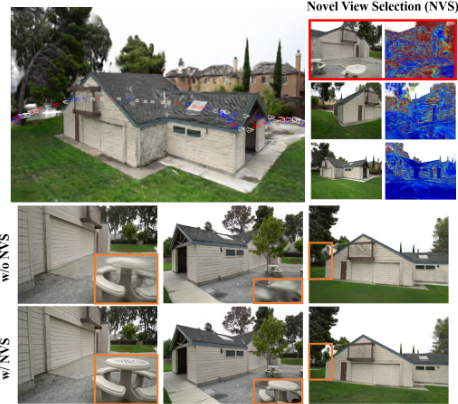
2023] [Zhou et al., 2023], enhancing high-quality rendering and realistic scene synthesis. Among these advancements, 3D Gaussian Splatting (3DGS) [Kerbl et al., 2023] has attracted significant attention for its efficient 3D scene representation and real-time rendering capabilities.
In this study, we tackle the challenge of generating online 3DGS models from RGB-only frames. Previous works [Matsuki et al., 2024] [Huang et al., 2024] [Sandstr¨om et al., 2024] have focused mainly on dense SLAM frameworks that utilize 3DGS as a map representation. These methods achieve real-time depth estimation through techniques such as optical flow [Teed and Deng, 2020], depth prediction [Eftekhar et al., 2021], or motion stereo [Song et al., 2021], integrating the estimated depths directly into the 3DGS model. While these approaches have shown promising results, they still face notable limitations that require further attention.
First, many studies rely on sparse or low-resolution depths to ensure real-time processing, which inherently limits the quality of the final model. Notably, some approaches [Zhu et al., 2024] [Sandstr¨om et al., 2024] employ depth prediction networks [Eftekhar et al., 2021] that infer depth directly from images but often generate ambiguous estimates. Second, existing methods [Huang et al., 2024] [Sandstr¨om et al., 2024] [Lee et al., 2024] store depth information only for keyframes, restricting 3DGS model training to these frames. This limitation can lead to incomplete reconstruction not only of unobserved areas but also of covered 3D scenes due to insufficient keyframe coverage. Lastly, online 3D modeling must operate within a constrained timeframe, which restricts the number of image frames and training iterations that can be processed. To achieve the best results within these constraints, it is essential to identify and prioritize the frames that most effectively enhance the performance of 3DGS during training.
To address these challenges, we propose a novel method that adaptively improves model completeness through novel view selection. Our approach identifies an optimal set of nonkeyframes for additional training by analyzing the online reconstruction quality of the 3DGS model. Specifically, we define the uncertainty of Gaussian primitives based on their shapes and the gradients of their positions. This uncertainty metric is then used to calculate the information gain from a given viewpoint, enabling the selection of optimal views. By incorporating both keyframes and selected non-keyframes, our method refines incomplete regions from diverse viewpoints, resulting in improved completeness (see Fig. 1).
Additionally, we present an efficient framework for online 3DGS mapping that integrates an independent frontend and backend for streamlined processing. The frontend leverages a state-of-the-art multi-view stereo (MVS) network [Cao et al., 2022] to generate accurate depths from sequential input images. Operating in parallel, the backend focuses on optimizing 3DGS models, allowing sufficient time for effective parameter refinement. To maintain consistency between the frontend and backend, the framework continuously applies global bundle adjustment (GBA) and Gaussian deformation. This approach achieves superior rendering accuracy compared to state-of-the-art methods, demonstrating exceptional performance in handling complex outdoor environments.
The main contributions are summarized as follows:
- We propose an online 3DGS modeling method that leverages novel view selection. This approach selects optimal views from non-keyframes for additional training, significantly improving model completeness.
- We define the uncertainty of Gaussians using their shapes and positional gradients. This approach allows for more effective view selection compared to other uncertainty metrics [Jiang et al., 2025] [Jin et al., 2024].
- We present a 3DGS mapping framework that utilizes an online MVS approach. This framework ensures consistent 3D information throughout the entire process.
- The proposed method was evaluated using two benchmarks for indoor scenes [Sturm et al., 2012] [Straub et al., 2019]. To highlight its generalization capability, we also extended the evaluation to include challenging outdoor scenarios [Song et al., 2021] [Knapitsch et al., 2017].
2 RelatedWorks
2.1 Monocular Dense SLAM
Monocular SLAM [Mur-Artal et al., 2015] [Forster et al., 2014] traditionally generates sparse feature maps from monocular images and uses them to estimate camera poses. These methods have mainly focused on achieving precise pose estimation and have achieved significant success. The focus has shifted to reconstructing detailed 3D scenes, fueling the development of dense SLAMs [Engel et al., 2017].
With deep learning achieving state-of-the-art performance in optical flow [Teed and Deng, 2020] and depth estimation [Eftekhar et al., 2021] [Yao et al., 2018], many studies also have investigated the incorporation of deep learning modules into dense SLAM systems [Bloesch et al., 2018; Koestler et al., 2022; Teed and Deng, 2021]. DROID-SLAM [Teed and Deng, 2021] combines an optical flow network with GBA to achieve precise trajectory estimation and dense 3D modeling.
2.2 Differentiable Rendering SLAM
Differentiable volumetric rendering, popularized by NeRF [Mildenhall et al., 2021], has recently emerged as a key technique for achieving photorealistic scenes and has been applied to dense SLAM. GO-SLAM [Zhang et al., 2023] and NeRF-SLAM [Rosinol et al., 2023] integrate low-resolution depth maps estimated from DROID-SLAM [Teed and Deng, 2021] into NeRFs. NICER-SLAM [Zhu et al., 2024] and GLORIE-SLAM [Zhang et al., 2024] leverage depth prediction networks to generate high-resolution depth maps, which are further utilized to improve NeRFs.
Recently, 3DGS [Kerbl et al., 2023; Ma et al., 2024] has gained attention as a promising solution for 3D modeling, offering faster rendering speeds compared to NeRF. By representing 3D space with Gaussian primitives, 3DGS achieves efficient rendering through rasterization and spatial optimization, making it highly suitable for dense SLAM. PhotoSLAM [Huang et al., 2024] and MGSO [Hu et al., 2024] generate Gaussian points from sparse feature points extracted using ORB-SLAM [Mur-Artal et al., 2015] and Direct Sparse Odometry [Engel et al., 2017], respectively. Splat-SLAM [Sandstr¨om et al., 2024] further enhances 3DGS mapping by combining proxy depth maps with depth prediction results. It employs deformable Gaussians and globally optimized optical flow tracking, resulting in improved accuracy.
Existing methods [Kerbl et al., 2023] [Matsuki et al., 2024] [Huang et al., 2024] [Hu et al., 2024] [Sandstr¨om et al., 2024] suffer from reduced quality due to their reliance on sparse or imprecise depth data, with depth prediction performing poorly in untrained environments like outdoor scenes. To address this limitation, MVS-GS [Lee et al., 2024] leverages an online MVS approach [Song et al., 2021] to estimate highquality depth maps, enabling accurate Gaussian initialization. Building on the MVS-GS framework, our method further improves 3DGS mapping by incorporating iterative GBA with Gaussian deformation. Additionally, we propose a novel view selection strategy that prioritizes non-keyframes with high information gain, integrating them into the training process. These enhancements significantly improve the completeness and quality of the resulting 3DGS model.
2.3 Next-Best-View Planning
The next-best-view (NBV) problem [Scott et al., 2003] focuses on identifying optimal viewpoints to gather specific information. This process aims to maximize information gain, typically defined based on uncertainty, which varies depending on the type of 3D modeling.
With advancements in NeRF, many NBV-related studies have emerged. These approaches estimate uncertainty by analyzing factors such as occupancy probability [Yan et al., 2023], color similarity [Ran et al., 2023], or implicit neural representations [Feng et al., 2024] derived from NeRF models. However, NBV research specifically tailored to 3DGS remains limited. FisherRF [Jiang et al., 2025] quantifies information gain using Fisher information in Gaussian parameters, but it relies on computationally intensive gradient calculations. GS-Planner [Jin et al., 2024] evaluates completeness by comparing rendered color and depth values with their captured ones, using this measure to estimate information gain.
These methods [Jiang et al., 2025; Jin et al., 2024] measure uncertainty using rendered images; however, they provide inaccurate results when the original image contains noise and are heavily affected by less significant areas, such as the sky. In contrast, the proposed method effectively represents the quality of each Gaussian by leveraging its shape and gradients, allowing for efficient and precise uncertainty estimation.
3 ProposedMethod
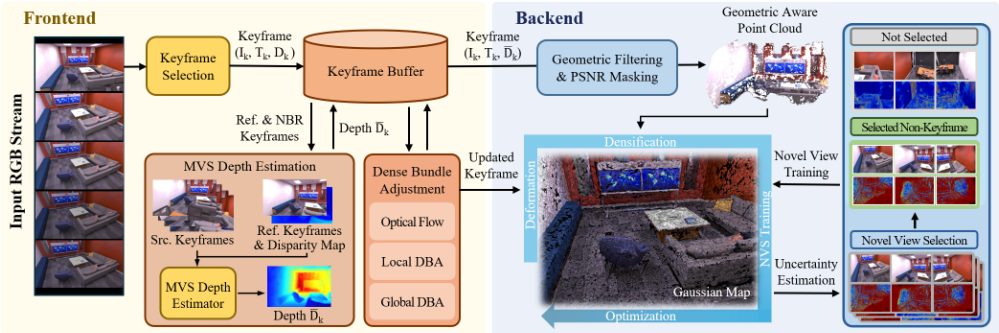
We present a system for online 3DGS modeling using RGB images, designed for high-quality rendering. This system is built on the MVS-GS framework [Lee et al., 2024], featuring parallel operation of frontend and backend modules. For the frontend module, we directly adopt the tracking method of [Teed and Deng, 2021] and the MVS networks from [Cao et al., 2022] to simultaneously estimate camera poses and depth maps from an image stream. Based on the outputs of the frontend, we propose novel techniques to learn a high-fidelity 3DGS scene representation in the backend module.
3.1 SystemOverview
Fig. 2 depicts an overview of the proposed system. Given an input image stream, the frontend dynamically constructs a frame-graph G, where each node Ik represents a selected keyframe, and each edge (Ik, Il) denotes a co-visibility connection between two keyframes. During the construction of the graph G, the frontend tracks the camera pose and estimates the depth map for each inserted keyframe. To mitigate the effects of pose and scale drift and enhance global geometric consistency, we perform GBA online on the entire graph G every 30 keyframes. The original tracking system [Teed and Deng, 2021] performs GBA only at the end of the mapping process. In contrast, we continuously perform GBA to consistently optimize the global consistency of 3D model.
Next, the frontend estimates accurate and reliable depth maps based on the MVS network, MVSFormer [Cao et al., 2022]. Depth prediction methods commonly employed in dense SLAM [Ranftl et al., 2021] [Bhat et al., 2023] suffer from scale ambiguity issues due to the inherent limitations of single-image-based estimation, which can result in reduced accuracy and consistency in depth estimation. In contrast, MVS leverages information from surrounding frames, effectively overcoming the scale ambiguity inherent in singleframe estimation and generating more accurate and consistent depth maps. We compute the coarse depths based on the dense optical flow results estimated during the tracking step and use it to initialize the depth map in the first layer of MVSFormer. This approach improves consistency between the tracking and MVS stages, enhancing the robustness of depth estimation while reducing computational costs.
The backend module consistently trains a 3DGS model for scene representation using the estimated camera pose Tk and depth map ¯Dk of each keyframe Ik. The module begins by using the depths of some initial keyframes to initialize a 3DGS model. Subsequently, it incrementally integrates new 3D Gaussians from incoming keyframes into the existing model (Section 3.2). Additionally, we perform a novel view selection (NVS) strategy to identify a set of non-keyframes that significantly enhance 3DGS quality, using them for further training of the 3DGS model (Section 3.3). The NVS quantifies the uncertainty of Gaussians and determines the non-keyframes that cover the largest number of uncertain Gaussians. Our method uses the selected frames for additional training, significantly improving the completeness of the 3DGS model and the generalizability of its rendering.
3.2 Online 3DGSModeling
Map Construction. For each keyframe, we first transform the depth map ¯Dk into a point cloud based on the camera pose Tk. We remove noisy points and outliers from the point cloud to obtain reliable and consistent 3D points. This step was implemented using geometric and photometric consistency criteria commonly employed in MVS [Cao et al., 2022].
The initial point cloud, generated from the first few keyframes, is used to create a set of Gaussian primitives for the 3DGS model. As new keyframes are extracted, the 3DGS model is incrementally updated by incorporating additional Gaussians. Following the approach of [Lee et al., 2024], we generate new Gaussians exclusively from unexplored regions with low rendering quality to improve computational efficiency. The unexplored regions are identified by comparing the rendered image ˆ Ik with the original images Ik using the peak signal-to-noise ratio (PSNR), marking those below a threshold as such regions. Throughout the map construction process, we regularly perform GBA and Gaussian optimization to refine camera poses and update the model parameters. Gaussian Representation. We utilize the generalized exponential splatting (GES) [Hamdi et al., 2024] to parameterize each Gaussian in a 3DGS model. Specifically, a Gaussian point gi is defined by several attributes: a covariance matrix ∑i ∈ R3×3 , a mean µi ∈ R3 , opacity oi ∈ [0, 1], color ci ∈ R3 , and a shape parameter βi ∈ (0,∞). The shape parameter βi, which is learnable, controls the sharpness of the Gaussian. The GES framework efficiently captures highfrequency details of the scene using fewer primitives, making it well-suited for real-time mapping and rendering. The Gaussian density function in GES is defined as follows:
To render an image ˆ Ik from an input pose Tk, the 3D Gaussians are projected onto the image plane. The color ˆ c(p) of each pixel p is determined by sorting the Gaussian points by depth and performing alpha blending from front to back:
where αi = oigi(x) ensures that closer Gaussian points contribute more to the color of the pixels. Similarly, the depth ˆDk can be rendered using the same projection approach:
where zi is the distance to the Gaussian mean along the ray. Map Deformation. During incrementally building the 3D Gaussian map, the GBA module updates camera poses and disparity map of keyframes in entire history. Therefore, the 3D Gaussian map should be updated accordingly after each GBA update. However, our map is only rigidly deformed based on the updated camera poses instead of using non-rigid deformation as in [Sandstr¨om et al., 2024]. The 3D data generated by MVS is highly accurate, allowing for the generation of a consistent model with rigid deformation. This approach helps improve the efficiency of the deformation process. The map deformation process is executed after the GBA and before the Gaussian optimization step. This helps refine the entire Gaussian map to adapt to the updated camera poses.
3.3 3DGS Optimization with Novel View Selection
Existing online methods [Sandstr¨om et al., 2024; Huang et al., 2024; Lee et al., 2024] learn Gaussian parameters using only tracked keyframes. The keyframes are usually selected by thresholding mean of optical flow between image frames [Teed and Deng, 2020]. Those keyframes sometimes cannot fully cover the entire scene due to fast motion changes or occlusions. Additionally, it is infeasible to use all frames, including both keyframes and non-keyframes, for optimization. To address this, our NVS selects top-k non-keyframes that cover poorly reconstructed regions, based on estimated information gain.
Uncertainty Estimation. For each non-keyframe In, we extract visible Gaussians and compute an uncertainty score based on their shapes and positional gradients. For each Gaussian gn,i visible in In, we extract the largest eigenvalue of its covariance Σn,i. Here, Σn,i = Rn,iSn,iST n,iRTn,i , where Rn,i and Sn,i represent the orientation and scale components of Gaussian gn,i, respectively. Since Sn,i = diag (sn,i) where sn,i ∈ R3 , it follows that Sn,iST n,i = diag (s2n,i ). The largest eigenvalue λn,i is then calculated as:
This eigenvalue λn,i represents the largest size of gn,i in the direction corresponding to the rotation Rn,i. Incorporating the eigenvalue into the uncertainty formulation helps address the over-reconstruction indicated by large Gaussians [Hu et al., 2025; Matsuki et al., 2024].
The second component of uncertainty is derived from the adaptive density control mechanism in existing 3DGS models [Matsuki et al., 2024][Sandstr¨om et al., 2024]. A large positional gradient indicates that the 3DGSmodel is still undergoing optimization. Therefore, high gradients suggest that the parameters have not yet been fully optimized [Rota Bul`o et al., 2024] [Kerbl et al., 2023]. Therefore, we adopted the gradient as a factor for measuring the uncertainty of Gaussians. Let dµn,i ∈ R3 be the positional gradient of Gaussian gn,i. We calculate the magnitude of the gradient An,i = ||dµn,i|| as a measure of uncertainty estimation. This approach helps prioritize regions requiring further optimization.
Using these two components, an uncertainty score Un,i is computed for each Gaussian gn,i as follows:
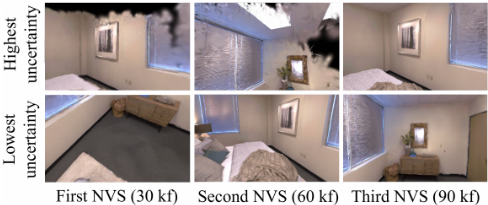
where α1 = 0.7, α2 = 0.3 are weighted hyperparameters.
Finally, the information gain of the view In is defined as the total uncertainty of all Gaussians visible from In.
where zn,i represents the depth of the Gaussian gn,i in the view In. This equation highlights that Gaussians closer to the view In have a greater impact on the uncertainty score.
After calculating an information gain for each nonkeyframe, we sort all candidate frames in descending order based on their scores. Since consecutive frames often have similar scores, we apply non-maximum suppression (NMS) [Redmon, 2016] within a local window to the sorted list. This process avoids selecting frames within the local window of previously chosen frames, promoting the selection of frames from diverse viewpoints. The top-k frames with the highest information gain are then selected and combined with the 30 most recently tracked keyframes to form the training frame set. The frame set is used for additional training, enabling the 3DGS model to enhance under-reconstructed areas and refine recently observed regions that require further training.
We construct a candidate set consisting of non-keyframes captured within the span of the 30 most recent keyframes, and apply NVS to this set. We identify 20 high-informationgain frames selected from the current set and include them in the subsequent candidate set. This approach allows for an efficient evaluation of information gain by focusing on the latest non-keyframes while incorporating selected older nonkeyframes. Fig. 3 depicts the non-keyframes with the highest and lowest gain within the set constructed at each iteration. Gaussian Training This optimization step is iteratively performed to refine Gaussian parameters. These Gaussians are trained using both keyframes and selected non-keyframes.
The loss function for keyframes is defined as follows:
where L1 represents the L1 loss between the rendered images (Eq. 2) and the original images. LSSIM is the structural similarity index measure (SSIM) loss, which preserves image quality [Wang et al., 2004]. Ldepth is calculated between the rendered depths (Eq. 3) and the MVS depths, helping to maintain the geometric structure. Lastly Lsmooth is the smoothness loss, designed to minimize depth differences between neighboring pixels, which is expressed as:
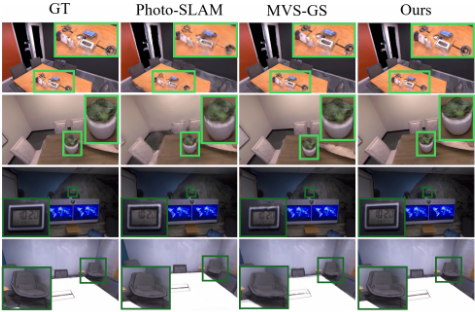
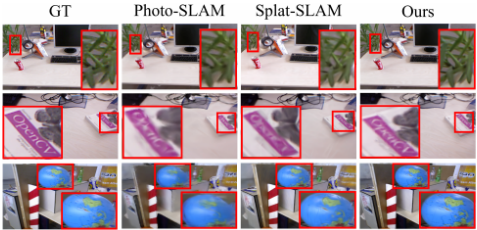
Figure 4: Qualitative evaluation on (a) the Replica and (b) TUMRGBD datasets. The boxes highlight areas where our method produces fine details with higher accuracy than the competing methods.
This smooths abrupt depth changes between pixels, yielding natural transitions and fewer discontinuities.
Non-keyframes contain only image information and do not include depth information. Therefore, for the non-keyframes, the loss function simplifies image rendering losses:
This approach ensures that both keyframes and nonkeyframes contribute effectively to improving the 3DGS model, balancing geometric accuracy and image quality.
4 Experiment Results
To assess the quality of our method, we compared to stateof-the-art methods on various datasets, including indoor and outdoor scenes. For indoor scenes, we conducted experiments using the Replica [Straub et al., 2019] and TUMRGBD [Sturm et al., 2012] datasets, following the same experimental setups as other methods ([Matsuki et al., 2024],
| Method | Off0 | Off1 | Off2 | Off3 | Off4 | Rm0 | Rm1 | Rm2 | Avg. |
|---|---|---|---|---|---|---|---|---|---|
| PSNR ↑ | |||||||||
| Q-SLAM | 36.31 | 37.22 | 30.68 | 30.21 | 31.96 | 29.58 | 32.74 | 31.25 | 32.49 |
| MonoGS | 32.00 | 31.21 | 23.26 | 25.77 | 23.85 | 23.53 | 25.00 | 22.42 | 25.88 |
| Splat-SLAM | 40.81 | 40.64 | 35.19 | 35.03 | 37.40 | 32.25 | 34.31 | 35.95 | 36.45 |
| Photo-SLAM | 36.99 | 37.52 | 31.79 | 31.62 | 34.17 | 29.77 | 31.30 | 33.18 | 33.29 |
| MGS-SLAM | 35.51 | 34.25 | 30.83 | 31.86 | 34.38 | 29.91 | 31.06 | 31.49 | 32.41 |
| MVS-GS | 41.02 | 42.04 | 34.00 | 34.65 | 33.33 | 32.20 | 31.54 | 35.84 | 35.58 |
| Ours | 43.93 | 43.98 | 37.98 | 36.31 | 39.59 | 34.88 | 37.99 | 39.60 | 39.28 |
| SSIM ↑ | |||||||||
| Q-SLAM | 0.94 | 0.94 | 0.90 | 0.88 | 0.89 | 0.83 | 0.91 | 0.87 | 0.89 |
| MonoGS | 0.90 | 0.88 | 0.82 | 0.84 | 0.86 | 0.75 | 0.79 | 0.81 | 0.83 |
| Splat-SLAM | 0.97 | 0.99 | 0.97 | 0.97 | 0.97 | 0.96 | 0.97 | 0.96 | 0.97 |
| Photo-SLAM | 0.96 | 0.95 | 0.93 | 0.92 | 0.94 | 0.87 | 0.91 | 0.93 | 0.93 |
| MGS-SLAM | 0.94 | 0.93 | 0.90 | 0.92 | 0.95 | 0.89 | 0.90 | 0.91 | 0.92 |
| MVS-GS | 0.98 | 0.98 | 0.95 | 0.96 | 0.95 | 0.95 | 0.92 | 0.96 | 0.96 |
| Ours | 0.99 | 0.99 | 0.98 | 0.97 | 0.98 | 0.96 | 0.97 | 0.98 | 0.98 |
| LPIPS ↓ | |||||||||
| Q-SLAM | 0.13 | 0.15 | 0.20 | 0.19 | 0.18 | 0.18 | 0.16 | 0.15 | 0.17 |
| MonoGS | 0.23 | 0.22 | 0.30 | 0.24 | 0.34 | 0.33 | 0.35 | 0.39 | 0.30 |
| Splat-SLAM | 0.05 | 0.07 | 0.06 | 0.04 | 0.10 | 0.09 | 0.06 | 0.05 | 0.06 |
| Photo-SLAM | 0.06 | 0.06 | 0.09 | 0.09 | 0.07 | 0.10 | 0.08 | 0.07 | 0.08 |
| MGS-SLAM | 0.07 | 0.11 | 0.12 | 0.07 | 0.08 | 0.08 | 0.09 | 0.09 | 0.09 |
| MVS-GS | 0.05 | 0.05 | 0.09 | 0.07 | 0.10 | 0.10 | 0.13 | 0.07 | 0.08 |
| Ours | 0.02 | 0.02 | 0.03 | 0.03 | 0.03 | 0.04 | 0.04 | 0.03 | 0.03 |
[Sandstr¨om et al., 2024], [Zhang et al., 2024]). For outdoor scenarios, we used the Aerial [Song et al., 2021] and Tanks&Temples datasets [Knapitsch et al., 2017]).
Implementation Details. All experiments were carried out on a desktop equipped with an AMD Ryzen9 7900X 12core processor and an NVIDIA GeForce RTX 4090 GPU. Training and evaluation were performed in PyTorch with CUDA to accelerate rasterization and gradient computations. While most hyperparameters follow the original 3DGS setting [Kerbl et al., 2023], we empirically set λL1, λSSIM, λdepth and λsmooth to 0.95, 0.2, 0.2, and 0.1, respectively, for the loss function of Gaussian training. We used 100 nonkeyframes for NVS, and set the NMS gap between frames to 3 to exclude neighboring frames.
Baseline Methods. We evaluated the performance of our method by comparing it with state-of-the-art monocular dense SLAM methods, including NeRF-based (Q-SLAM [Peng et al., 2024] and GLORIE-SLAM [Zhang et al., 2024]) and 3DGS-based (MonoGS [Matsuki et al., 2024], SplatSLAM [Sandstr¨om et al., 2024], Photo-SLAM [Huang et al., 2024], and MVS-GS [Lee et al., 2024]) methods.
Evaluation Metrics. We assessed the modeling quality using rendered images and depth maps. For image rendering quality, we report PSNR, SSIM, and LPIPS by comparing the rendered images with the original images.
4.1 Evaluation in Indoor Scenes
Table 1 shows the rendering performance results on the Replica dataset, highlighting that our method significantly outperforms other methods. Notably, it achieves superior results in both PSNR and SSIM, with a substantial improvement compared to the second-best method, Splat-SLAM.
Fig. 4a shows a qualitative comparison between our method and the other 3DGS-based methods. Our method effectively captures intricate scene details, resulting in highquality renderings with fewer artifacts. Our texture details are significantly better than those produced by Photo-SLAM. Notably, MVS-GS fails to handle loop closing, causing the chair to appear doubled. In contrast, our method accurately reconstructs a single, complete representation of the chair.
| Method | Metrics | f1/desk | f2/xyz | f3/off | Avg. |
|---|---|---|---|---|---|
| MonoGS | 19.67 | 16.17 | 20.63 | 18.82 | |
| Photo-SLAM | 20.97 | 21.07 | 19.59 | 20.54 | |
| GLORIE-SLAM | 20.26 | 25.62 | 21.21 | 22.36 | |
| Splat-SLAM | PSNR ↑ | 25.61 | 29.53 | 26.05 | 27.06 |
| MVS-GS | 20.67 | 24.53 | 22.37 | 22.52 | |
| Ours | 26.34 | 28.72 | 28.10 | 27.72 | |
| MonoGS | 0.73 | 0.72 | 0.77 | 0.74 | |
| Photo-SLAM | 0.74 | 0.73 | 0.69 | 0.72 | |
| GLORIE-SLAM | 0.87 | 0.96 | 0.84 | 0.89 | |
| Splat-SLAM | SSIM ↑ | 0.84 | 0.90 | 0.84 | 0.86 |
| MVS-GS | 0.77 | 0.86 | 0.80 | 0.81 | |
| Ours | 0.89 | 0.91 | 0.91 | 0.90 | |
| MonoGS | 0.33 | 0.31 | 0.34 | 0.33 | |
| Photo-SLAM | 0.23 | 0.17 | 0.24 | 0.21 | |
| GLORIE-SLAM | 0.31 | 0.09 | 0.32 | 0.24 | |
| Splat-SLAM | LPIPS ↓ | 0.18 | 0.08 | 0.20 | 0.15 |
| MVS-GS | 0.25 | 0.15 | 0.24 | 0.21 | |
| Ours | 0.12 | 0.07 | 0.10 | 0.10 |
Table 2 presents the evaluation results on real-world scenes from the TUM-RGBD dataset. Despite the inherent challenges of real-world datasets, including noisy images and complex scene variations, our approach maintains stable and reliable rendering quality. The qualitative results are shown in Fig. 4b. This demonstrates the robustness of our method in handling real-world data, ensuring consistent performance across diverse indoor scenes.
4.2 Evaluation in Outdoor Scenes
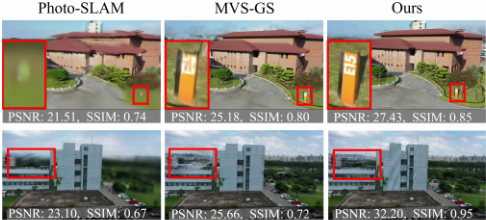
In this section, we validated the generalization capability of our method by evaluating its performance on outdoor scenes. Depth prediction-based methods, including Splat-SLAM and GLORIE-SLAM, failed to generate 3DGS models in these environments. Fig. 5a presents a performance evaluation of aerial scenes, demonstrating that our method outperforms both Photo-SLAM and MVS-GS, particularly in capturing small structural details. Leveraging the strengths of MVS in accurately reconstructing large-scale scenes, our method significantly outperformed Photo-SLAM in aerial scenes.
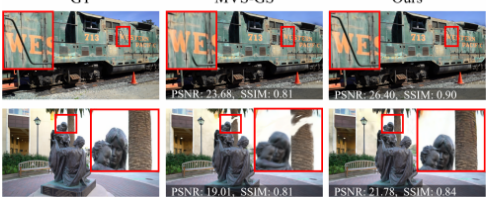
On the Tanks and Temples dataset, Splat-SLAM, MonoGS, and even Photo-SLAM failed to generate 3DGS models due to the lack of sufficient continuous motion in the image frames. Fig. 5b presents the rendering results for this dataset. While MVS-GS successfully produced a 3DGS model, its quality was compromised by limited training views and the absence of loop closure. In contrast, our method delivered high-quality rendering results that closely resembled real photographs. These findings highlight the effectiveness of the proposed NVS method and consistent geometric alignment, even in challenging outdoor scenes.
4.3 Ablation Study
To evaluate the impact of each key component in our method, we performed an ablation study on the "Office0" scene from the Replica dataset. Each component was progressively assessed as follows:
(a) Results on the Aerial dataset
| Method | PSNR ↑ | SSIM↑ | LPIPS ↓ | Depth L1 ↓ | FPS ↑ | #Gaussians (K) ↓ | Map Size [GiB] ↓ |
|---|---|---|---|---|---|---|---|
| A | 40.92 | 0.979 | 0.023 | 0.042 | 19.39 | 1365 | 0.305 |
| B | 42.37 | 0.984 | 0.019 | 0.046 | 15.66 | 1253 | 0.280 |
| C | 42.71 | 0.985 | 0.018 | 0.044 | 15.28 | 1357 | 0.303 |
| D | 42.73 | 0.985 | 0.019 | 0.038 | 15.11 | 1377 | 0.308 |
| E | 43.93 | 0.988 | 0.016 | 0.034 | 9.18 | 1078 | 0.241 |
Table 3: Comparison results of our method with different model variants on the Replica "office 0" scene.
- Method-A: The baseline method, MVS-GS.
- Method-B: Incorporates the global GBAmodule.
- Method-C: Builds on Method-B by applying depth initialization using the disparity map from DROID-SLAM.
- Method-D: Extends Method-C by introducing a smoothness loss for training Gaussians.
- Method-E: Represents our full model, including the NVS.
We evaluated both image and depth rendering performance using metrics such as PSNR, SSIM, and LPIPS for images, and L1 error for depths. We also reported the number of Gaussians, map size, and computational speed (measured in frames per second, FPS) for each method. Table 3 summarizes the results for the variant methods.
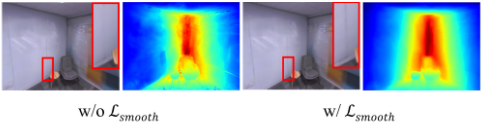
Compared to Method-A, both Method-B and Method-C showed progressive improvements in rendering performance. This indicates that the application of the GBA and the depth initialization approach enhances the completeness of 3DGS modeling. Furthermore, Method-D incorporated the smooth depth loss, which showed no noticeable improvement in rendering quality but led to substantial enhancements in reconstruction performance. Fig. 6 shows the comparison results between Method-C and Method-D, where the improvements in reconstruction performance are visually apparent. Finally, when the NVS technique was applied, Method-E achieved superior performance in both rendering quality and depth reconstruction. Furthermore, in terms of model compactness, Method-E significantly reduces the number of Gaussians compared to Method-D, resulting in approximately a 60 MB reduction in map size. The NVS optimization helps eliminate or merge redundant keyframe Gaussians, thereby minimizing unnecessary overhead.
| Metrics | α1=0.0 α2=1.0 | α1=0.1 α2=0.9 | α1=0.3 α2=0.7 | α1=0.5 α2=0.5 | α1=0.7 α2=0.3 | α1=0.9 α2=0.1 | α1=1.0 α2=0.0 |
|---|---|---|---|---|---|---|---|
| PSNR ↑ | 43.802 | 43.820 | 43.859 | 43.877 | 43.932 | 43.841 | 43.812 |
| SSIM ↑ | 0.986 | 0.986 | 0.987 | 0.987 | 0.988 | 0.987 | 0.985 |
| LPIPS ↓ | 0.018 | 0.017 | 0.017 | 0.016 | 0.016 | 0.018 | 0.019 |
We further analyzed the impact of the uncertainty score parameters in Eq. (7) on the effectiveness of view selection. Table 4 shows the effect of the α1 and α2. The largest eigenvalue primarily captures uncertainty in high-frequency regions, while the positional gradient focuses on low-frequency areas. Thus, α1 and α2 serve to balance these two complementary measures. If either value is too large, uncertainty estimation becomes biased and less effective. Therefore, we empirically determined suitable α1 and α2 values for balanced and accurate estimation.
5 Conclusion
We present a novel online mapping approach for high-quality 3DGS modeling that introduces uncertainty estimation directly within Gaussians. Our method utilizes an uncertaintyaware view selection strategy to extract the most informative views, improving the completeness of 3DGS models. Additionally, we develop a framework that integrates an online MVS technique, maintaining consistency in 3D information throughout the modeling process. Extensive experiments show that the proposed approach surpasses state-of-the-art dense SLAM methods, demonstrating outstanding performance, especially in complex outdoor environments. To the best of our knowledge, this is the first work to introduce non-keyframe selection in a 3DGS-based SLAM framework. The proposed formulation is general and applicable to various SLAM systems.
Acknowledgments
This research was supported by the MSIT(Ministry of Science and ICT), Korea, under the ITRC(Information Technology Research Center) support program(IITP-2025-RS-2020II201789), and the Artificial Intelligence Convergence Innovation Human Resources Development(IITP-2025-RS-202300254592) supervised by the IITP(Institute for Information & Communications Technology Planning & Evaluation).
@inproceedings{ijcai2025p148,
  title     = {Online 3D Gaussian Splatting Modeling with Novel View Selection},
  author    = {Lee, Byeonggwon and Park, Junkyu and Giang, Khang Truong and Song, Soohwan},
  booktitle = {Proceedings of the Thirty-Fourth International Joint Conference on
               Artificial Intelligence, {IJCAI-25}},
  publisher = {International Joint Conferences on Artificial Intelligence Organization},
  editor    = {James Kwok},
  pages     = {1323--1331},
  year      = {2025},
  month     = {8},
  note      = {Main Track},
  doi       = {10.24963/ijcai.2025/148},
  url       = {https://doi.org/10.24963/ijcai.2025/148},
}
TY - CPAPER TI - Online 3D Gaussian Splatting Modeling with Novel View Selection AU - Lee, Byeonggwon AU - Park, Junkyu AU - Giang, Khang Truong AU - Song, Soohwan T2 - Proceedings of the Thirty-Fourth International Joint Conference on Artificial Intelligence, IJCAI-25 PB - International Joint Conferences on Artificial Intelligence Organization PY - 2025 SP - 1323 EP - 1331 DO - 10.24963/ijcai.2025/148 UR - https://doi.org/10.24963/ijcai.2025/148 ER -Copied
Machine-readable versions of this paper, for tools and AI agents:





