
Antibody Design and Optimization with Multi-scale Equivariant Graph Diffusion Models for Accurate Complex Antigen Binding
Proceedings of the Thirty-Fourth International Joint Conference on Artificial Intelligence. Main Track. Pages 2722-2730.
https://doi.org/10.24963/ijcai.2025/303
Keywords
- Data Mining: DM: Applications
- Machine Learning: ML: Geometric learning
- Multidisciplinary Topics and Applications: MTA: Bioinformatics
Abstract
Antibody design remains a critical challenge in therapeutic and diagnostic development, particularly for complex antigens with diverse binding interfaces. Current computational methods face two main limitations: (1) capturing geometric features while preserving symmetries, and (2) generalizing novel antigen interfaces. Despite recent advancements, these methods often fail to accurately capture molecular interactions and maintain structural integrity. To address these challenges, we propose AbMEGD, an end-to-end framework integrating Multi-scale Equivariant Graph Diffusion for antibody sequence and structure co-design. Leveraging advanced geometric deep learning, AbMEGD combines atomic-level geometric features with residue-level embeddings, capturing local atomic details and global sequence-structure interactions. Its E(3)-equivariant diffusion method ensures geometric precision, computational efficiency, and robust generalizability for complex antigens. Furthermore, experiments using the SAbDab database demonstrate a 10.13% increase in amino acid recovery, 3.32% rise in improvement percentage, and a 0.062 Å reduction in root mean square deviation within the critical CDR-H3 region compared to DiffAb, a leading antibody design model. These results highlight AbMEGD's ability to balance structural integrity with improved functionality, establishing a new benchmark for sequence-structure co-design and affinity optimization. The code is available at: https://github.com/Patrick221215/AbMEGD.
- [Adolf-Bryfogle et al., 2018] Jared Adolf-Bryfogle, Oleks Kalyuzhniy, Michael Kubitz, Brian D Weitzner, Xiaozhen Hu, Yumiko Adachi, William R Schief, and Roland L Dun- brack Jr. Rosettaantibodydesign (rabd): A general frame- work for computational antibody design. PLoS computa- tional biology, 14(4):e1006112, 2018.
- [Alford et al., 2017] Rebecca F Alford, Andrew Leaver-Fay, Jeliazko R Jeliazkov, Matthew J O'Meara, Frank P Di- Maio, Hahnbeom Park, Maxim V Shapovalov, P Douglas Renfrew, Vikram K Mulligan, Kalli Kappel, et al. The rosetta all-atom energy function for macromolecular mod- eling and design. Journal of chemical theory and compu- tation, 13(6):3031-3048, 2017.
- [Alley et al., 2019] Ethan C Alley, Grigory Khimulya, Suro- jit Biswas, Mohammed AlQuraishi, and George M Church. Unified rational protein engineering with sequence-based deep representation learning. Nature methods, 16(12):1315-1322, 2019.
- [Cai et al., 2024] Huiyu Cai, Zuobai Zhang, Mingkai Wang, Bozitao Zhong, Quanxiao Li, Yuxuan Zhong, Yanling Wu, Tianlei Ying, and Jian Tang. Pretrainable geometric graph neural network for antibody affinity maturation. Nature communications, 15(1):7785, 2024.
- [Carter, 2006] Paul J Carter. Potent antibody therapeutics by design. Nature reviews immunology, 6(5):343-357, 2006.
- [Dunbar et al., 2014] James Dunbar, Konrad Krawczyk, Jin- woo Leem, Terry Baker, Angelika Fuchs, Guy Georges, Jiye Shi, and Charlotte M Deane. Sabdab: the structural antibody database. Nucleic acids research, 42(D1):D1140-D1146, 2014.
- [Eastman et al., 2017] Peter Eastman, Jason Swails, John D Chodera, Robert T McGibbon, Yutong Zhao, Kyle A Beauchamp, Lee-Ping Wang, Andrew C Simmonett, Matthew P Harrigan, Chaya D Stern, et al. Openmm 7: Rapid development of high performance algorithms for molecular dynamics. PLoS computational biology, 13(7):e1005659, 2017.
- [Gallier and Xu, 2003] Jean Gallier and Dianna Xu. Com- puting exponentials of skew-symmetric matrices and log- arithms of orthogonal matrices. International Journal of Robotics and Automation, 18(1):10-20, 2003.
- [Garcia Satorras et al., 2021] Victor Garcia Satorras, Emiel Hoogeboom, Fabian Fuchs, Ingmar Posner, and Max Welling. E (n) equivariant normalizing flows. Advances in Neural Information Processing Systems, 34:4181-4192, 2021.
- [Ho et al., 2020] Jonathan Ho, Ajay Jain, and Pieter Abbeel. Denoising diffusion probabilistic models. Advances in neural information processing systems, 33:6840-6851, 2020.
- [Hoogeboom et al., 2021] Emiel Hoogeboom, Didrik Nielsen, Priyank Jaini, Patrick Forré, and Max Welling. Argmax flows and multinomial diffusion: Learning categorical distributions. Advances in Neural Information Processing Systems, 34:12454-12465, 2021.
- [Jin et al., 2021] Wengong Jin, Jeremy Wohlwend, Regina Barzilay, and Tommi Jaakkola. Iterative refinement graph neural network for antibody sequence-structure co-design. arXiv preprint arXiv:2110.04624, 2021.
- [Joubbi et al., 2024] Sara Joubbi, Alessio Micheli, Paolo Mi- lazzo, Giuseppe Maccari, Giorgio Ciano, Dario Carda- mone, and Duccio Medini. Antibody design using deep learning: from sequence and structure design to affinity maturation. Briefings in Bioinformatics, 25(4):bbae307, 2024.
- [Jumper et al., 2021] John Jumper, Richard Evans, Alexan- der Pritzel, Tim Green, Michael Figurnov, Olaf Ron- neberger, Kathryn Tunyasuvunakool, Russ Bates, Au- gustin Žídek, Anna Potapenko, et al. Highly accu- rate protein structure prediction with alphafold. nature, 596(7873):583-589, 2021.
- [Kong et al., 2022] Xiangzhe Kong, Wenbing Huang, and Yang Liu. Conditional antibody design as 3d equivariant graph translation. arXiv preprint arXiv:2208.06073, 2022.
- [Kulytė et al., 2024] Paulina Kulytė, Francisco Vargas, Si- mon Valentin Mathis, Yu Guang Wang, José Miguel Hernández-Lobato, and Pietro Liò. Improving antibody design with force-guided sampling in diffusion models. arXiv preprint arXiv:2406.05832, 2024.
- [Leach et al., 2022] Adam Leach, Sebastian M Schmon, Matteo T Degiacomi, and Chris G Willcocks. Denois- ing diffusion probabilistic models on so (3) for rotational alignment. 2022.
- [Li et al., 2024a] Kun Li, Xiuwen Gong, Jia Wu, and Wenbin Hu. Contrastive learning drug response models from natu- ral language supervision. In Kate Larson, editor, Proceed- ings of the Thirty-Third International Joint Conference on Artificial Intelligence, IJCAI-24, pages 2126-2134. Inter- national Joint Conferences on Artificial Intelligence Orga- nization, 8 2024. Main Track. IJCAI
- [Li et al., 2024b] Kun Li, Weiwei Liu, Yong Luo, Xiantao Cai, Jia Wu, and Wenbin Hu. Zero-shot learning for pre- clinical drug screening. In Kate Larson, editor, Proceed- ings of the Thirty-Third International Joint Conference on Artificial Intelligence, IJCAI-24, pages 2117-2125. Inter- national Joint Conferences on Artificial Intelligence Orga- nization, 8 2024. Main Track. IJCAI
- [Lin et al., 2024] Haitao Lin, Lirong Wu, Yufei Huang, Yun- fan Liu, Odin Zhang, Yuanqing Zhou, Rui Sun, and Stan Z. Li. GeoAB: Towards realistic antibody design and reliable affinity maturation. In Ruslan Salakhutdinov, Zico Kolter, Katherine Heller, Adrian Weller, Nuria Oliver, Jonathan Scarlett, and Felix Berkenkamp, editors, Proceedings of the 41st International Conference on Machine Learning, volume 235 of Proceedings of Machine Learning Re- search, pages 30346-30361. PMLR, 21-27 Jul 2024.
- [Lindorff-Larsen et al., 2010] Kresten Lindorff-Larsen, Ste- fano Piana, Kim Palmo, Paul Maragakis, John L Klepeis, Ron O Dror, and David E Shaw. Improved side-chain torsion potentials for the amber ff99sb protein force field. Proteins: Structure, Function, and Bioinformatics, 78(8):1950-1958, 2010.
- [Luo et al., 2022] Shitong Luo, Yufeng Su, Xingang Peng, Sheng Wang, Jian Peng, and Jianzhu Ma. Antigen-specific antibody design and optimization with diffusion-based generative models for protein structures. Advances in Neu- ral Information Processing Systems, 35:9754-9767, 2022.
- [Martinkus et al., 2024] Karolis Martinkus, Jan Ludwiczak, Wei-Ching Liang, Julien Lafrance-Vanasse, Isidro Hotzel, Arvind Rajpal, Yan Wu, Kyunghyun Cho, Richard Bon- neau, Vladimir Gligorijevic, et al. Abdiffuser: full-atom generation of in-vitro functioning antibodies. Advances in Neural Information Processing Systems, 36, 2024.
- [Matthies et al., 1988] Siegfried Matthies, J Muller, and GW Vinel. On the normal distribution in the orientation space. Texture, Stress, and Microstructure, 10(1):77-96, 1988.
- [Nikolayev and Savyolov, 1997] Dmitry I Nikolayev and Tatjana I Savyolov. Normal distribution on the rotation group so (3). Texture, Stress, and Microstructure, 29(3- 4):201-233, 1997.
- [North et al., 2011] Benjamin North, Andreas Lehmann, and Roland L Dunbrack Jr. A new clustering of antibody cdr loop conformations. Journal of molecular biology, 406(2):228-256, 2011.
- [Ruffolo et al., 2021] Jeffrey A Ruffolo, Jeffrey J Gray, and Jeremias Sulam. Deciphering antibody affinity matura- tion with language models and weakly supervised learn- ing. arXiv preprint arXiv:2112.07782, 2021.
- [Ruffolo et al., 2023] Jeffrey A Ruffolo, Lee-Shin Chu, Sai Pooja Mahajan, and Jeffrey J Gray. Fast, accurate antibody structure prediction from deep learning on mas- sive set of natural antibodies. Nature communications, 14(1):2389, 2023.
- [Schütt et al., 2021] Kristof Schütt, Oliver Unke, and Michael Gastegger. Equivariant message passing for the prediction of tensorial properties and molecular spectra. In International Conference on Machine Learning, pages 9377-9388. PMLR, 2021.
- [Shen et al., 2023] Cong Shen, Jiawei Luo, and Kelin Xia. Molecular geometric deep learning. Cell reports methods, 3(11), 2023.
- [Shin et al., 2021] Jung-Eun Shin, Adam J Riesselman, Aaron W Kollasch, Conor McMahon, Elana Simon, Chris Sander, Aashish Manglik, Andrew C Kruse, and Debora S Marks. Protein design and variant prediction using au- toregressive generative models. Nature communications, 12(1):2403, 2021.
- [Sohl-Dickstein et al., 2015] Jascha Sohl-Dickstein, Eric Weiss, Niru Maheswaranathan, and Surya Ganguli. Deep unsupervised learning using nonequilibrium thermody- namics. In International conference on machine learning, pages 2256-2265. PMLR, 2015.
- [Song and Ermon, 2019] Yang Song and Stefano Ermon. Generative modeling by estimating gradients of the data distribution. Advances in neural information processing systems, 32, 2019.
- [Thölke and De Fabritiis, 2022] Philipp Thölke and Gianni De Fabritiis. Torchmd-net: equivariant transformers for neural network based molecular potentials. arXiv preprint arXiv:2202.02541, 2022.
- [Wang et al., 2024] Yusong Wang, Tong Wang, Shaoning Li, Xinheng He, Mingyu Li, Zun Wang, Nanning Zheng, Bin Shao, and Tie-Yan Liu. Enhancing geometric representa- tions for molecules with equivariant vector-scalar interac- tive message passing. Nature Communications, 15(1):313, 2024.
- [Zhu et al., 2024] Tian Zhu, Milong Ren, and Haicang Zhang. Antibody design using a score-based diffusion model guided by evolutionary, physical and geometric constraints. In Forty-first International Conference on Ma- chine Learning, 2024.
References were extracted automatically from the PDF and may contain errors.
Full text extracted automatically from the PDF; figures, tables and equations may differ. The PDF is the version of record.
1 Introduction
Antibodies are essential for targeting disease-related antigens in the therapeutic and diagnostic fields [Carter, 2006]. Their binding specificity and affinity are governed by complementarity-determining regions (CDRs), which exhibit high sequence and structural diversity [North et al., 2011]. As a result, designing antibodies to effectively bind complex antigens requires addressing two key challenges: (i) simplifying geometric feature extraction while preserving critical symmetries, and (ii) enhancing model generalization to novel antigen interfaces. This is because current methods often fail to capture precise molecular interactions and preserve structural integrity.
*Corresponding author
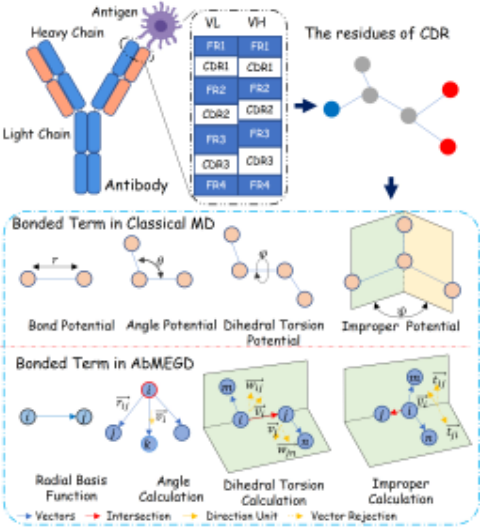
First,the complexity of extracting geometric features while accurately modeling symmetries essential for antibody functionality poses a critical challenge in therapeutic antibody design. Thus, accurate CDR modeling is crucial, as geometric attributes such as bond lengths, angles, and torsions regulate antigen-binding capabilities [Carter, 2006]. However, maintaining symmetries such as rotation and translation invariance during feature extraction remains difficult. Traditional methods such as molecular dynamics (MD) and density functional theory provide precise geometric representations but are computationally restrictive in large-scale antibody modeling [Cai et al., 2024; Luo et al., 2022]. Consequently, advances in geometric deep learning (GDL) have introduced symmetrybased inductive biases, enabling accurate molecular modeling with smaller datasets [Shen et al., 2023]. For example, equivariant graph neural networks (EGNNs), central to GDL, efficiently capture molecular properties by embedding symmetries (e.g., rotation and translation invariance) [Garcia Satorras et al., 2021]. In comparison, innovations such as GearBind improve binding affinity predictions through multirelational graph construction and contrastive pretraining [Cai et al., 2024], while IgFold highlights the importance of structural precision in antibody design using advanced deep learning [Ruffolo et al., 2023]. Additionally, models like AbX integrate evolutionary and physical constraints with geometric factors to optimize antibody sequences [Zhu et al., 2024].
Second, generalizing antibody design to out-of-distribution antigen interfaces presents a significant challenge [Li et al., 2024b; Li et al., 2024a], complicating the development of effective antibodies. Antibody-antigen interactions are inherently unique and ad-hoc. This is because antibodies evolve rapidly to counter diverse pathogens without the long coevolutionary histories typical of other protein-protein interactions [Adolf-Bryfogle et al., 2018; Kong et al., 2022]. As a result, predictive models often fail to adapt to novel antigens that differ substantially from the existing training datasets [Joubbi et al., 2024]. As antibody design continues to evolve, integrating advanced computational techniques with a deeper understanding of structural dynamics will be crucial for overcoming these challenges and unlocking the full potential of therapeutic antibodies.
To address these challenges, we propose AbMEGD, an end-to-end solution integrating Multi-scale Equivariant Graph Diffusion for co-designing antibody sequences and structures. Inspired by ViSNet [Wang et al., 2024], which balances computational efficiency with effective geometric information utilization, AbMEGD incorporates geometry calculation and vector-scalar interactive equivariant message passing (ViS-MP). These strategies enable efficient modeling of atomic-level features such as bond angles, dihedral torsions, and improper angles, aligning with classical molecular dynamics force fields while ensuring geometric precision and scalability. AbMEGD combines atomic-level geometric features with residue-level embeddings in a multiscale framework, capturing local atomic details and global sequence-structure interactions to maintain CDR structural fidelity. Leveraging ViS-MP, the model facilitates interactions between vector representations and scalar embeddings, fully exploiting geometric features while preserving E(3)- equivariance. This multi-scale architecture simplifies geometric feature extraction and enhances generalization to complex antigen interfaces. Unlike existing methods such as GEOAB [Lin et al., 2024], which separate structure generation and affinity prediction, AbMEGD employs a unified framework that preserves essential geometric symmetries and addresses the computational challenges of high-throughput antibody design.
We validate AbMEGD using the SAbDab database [Dunbar et al., 2014], which includes diverse antigen-antibody complexes. Compared to DiffAb, a leading model in antibody design, AbMEGD achieves a 10.13% increase in amino acid recovery (AAR), a 3.32% rise in improvement percentage (IMP), and a 0.062 ˚A reduction in root mean square deviation (RMSD) within the critical CDR-H3 region. These results highlight its capacity to generate accurate structures and highaffinity antibodies, particularly for complex antigens. AbMEGD also excels in CDR design and affinity optimization tasks. Furthermore, its robust generalizability supports highaffinity antibody design for novel and out-of-distribution antigens, establishing a new benchmark in balancing structural conservation with improved functionality.
In summary, our contributions are as follows:
- Unified Generative Framework with Multi-Scale Equivariant Graph Diffusion: We propose AbMEGD, an end-to-end framework that unifies sequence-structure co-design and affinity optimization. By leveraging a multi-scale architecture, AbMEGD captures global sequence-structure interactions and local atomic details, preserving geometric symmetry while ensuring accuracy and efficiency.
- Superior Performance and Broad Applicability: Evaluations on the SAbDab database confirm AbMEGD's superior performance in sequence-structure co-design and affinity optimization. The model achieves structural fidelity and enhances functionality, showcasing adaptability across antibody design tasks and setting a new benchmark in therapeutic antibody development.
2 RelatedWork
2.1 Computational Antibody Design
Traditional antibody design methods rely on statistical energy functions and Monte Carlo sampling for sequence-structure optimization [Adolf-Bryfogle et al., 2018; Ruffolo et al., 2021], but suffer from inefficiency and local optima due to the rugged energy landscape. They also struggle with the vast sequence-structure space, especially for complex antigens, limiting design diversity. Deep learning has enabled sequence-based generative models that treat proteins as language [Alley et al., 2019; Shin et al., 2021], offering efficient sequence generation but often neglecting structural cues critical for antigen binding. The first CDR co-design model [Jin et al., 2021], targeting SARS-CoV-2, incorporated structure but depended on antigen-specific predictors, limiting generalizability. Moreover, it focused on backbone atoms while ignoring side-chain orientations essential for protein-protein interactions. In contrast, our method captures both backbone and side-chain features via multi-level representation, enabling a more complete modeling of the antigen-antibody interface for high-affinity binding.
2.2 Diffusion-based Generative Model
Diffusion probabilistic models (DDPMs) have gained traction for generating protein sequences and structures by denoising samples from a prior distribution [Sohl-Dickstein et al., 2015; Song and Ermon, 2019; Ho et al., 2020; Martinkus et al., 2024]. Models like DiffAb [Luo et al., 2022] and DIFFFORCE [Kulyt˙e et al., 2024] have demonstrated superior efficiency in generating antibody sequences and structures. However, these models primarily focus on residue-level features and often fail to capture atomic-level interactions essential for high-specificity antibody-antigen binding. In comparison, our approach enhances existing DDPMs using VisNetinspired graph-based modules [Wang et al., 2024] to model atomic-level geometric features. This facilitates the effective representation of complex three-dimensional (3D) spatial relationships among the atoms in antibodies and antigens, optimizing antibody specificity and affinity through detailed atomic interaction modeling.
3 Methodology
This section is organized as follows: Section 3.1 introduces the notations used throughout this paper and formally defines the problem. Section 3.2 presents the multi-level feature generation and unified representation mechanism, integrating residue- and atom-level features. Finally, Section 3.3 details the diffusion processes tailored for modeling antibodies.
3.1 ProblemDefinitions and Notations
In this study, we represent each amino acid in a protein complex using three components: type, Cα atom coordinates, and orientation. Specifically, the amino acid type is denoted as sri ∈ {ACDEFGHIKLMNPQRSTVWY }, where i = 1, . . . , N and N is the total number of amino acids in the complex. The spatial position of each residue is described by the Cα coordinates xri ∈ R3 , and the orientation is denoted as Ori ∈ SO(3), which captures the geometric directionality in 3D space.
We consider the antigen structure and the antibody framework as given, focusing our design efforts on the CDRs of the antibody. Specifically, let the generated CDR consist of m amino acids, indexed from c + 1 to c + m, the set of residues in the CDR is denoted as R = {(srj , xrj ,Orj ) | j = c + 1, . . . , c +m}. Our objective is to model the conditional distribution P(R | C), where C = {(sri , xri ,Ori ) |
ri ∈ {1, . . . ,N}\{c+1, . . . , c+m}} represents the antigenantibody framework excluding the CDR regions.
3.2 Multi-level Feature Generation and Unified Representation Mechanism
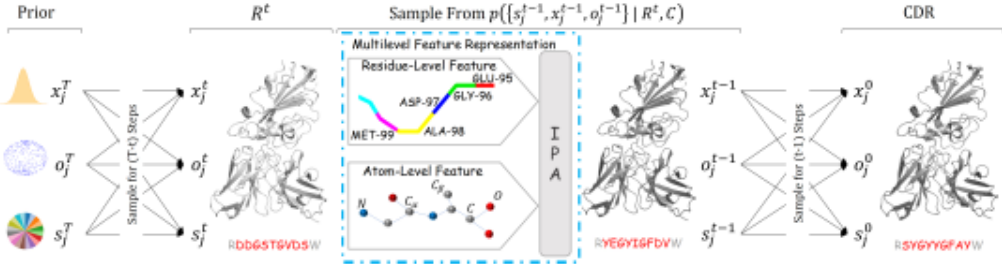
The overall workflow of AbMEGD is illustrated in Figure 2. This study presents an innovative multi-level feature generation and unified representation mechanism that seamlessly integrates residue- and atom-level features. This approach leverages the complementary nature of these features to simultaneously capture global structural information and finegrained geometric details, enabling comprehensive characterization of antibody-antigen complexes.
Residue-Level Feature Generation. At the residue level, we employ a multi-layer perceptron (MLP) module to process features of individual residues and residue pairs. We define the following variables to represent the feature states of the CDRs:{strj , xtrj ,Otrj }c+m j=1 ∪ {stri , xtri ,Otri }i∈{1,...,N}\{c+1,...,c+m}, where strj denotes the amino acid type of residue j at time step t, xtrj represents the Cα backbone coordinates, and Otrj ∈ SO(3) indicates the orientation.
The single-residue features encapsulate each residue's chemical properties, geometric characteristics, and local structural environment. Thus, the features for residue ri are defined as [Luo et al., 2022]:
where tri represents the amino acid type features, obtained by embedding the amino acid type sri into a low-dimensional vector. gri denotes the local geometric features, derived by constructing a local reference frame based on the backbone atomic coordinates pri . dri encodes the backbone dihedral angles through angular encoding of ϕri and ψri , which describe the torsional conformation of the protein backbone. Finally, fri represents the fragment type features, capturing local fragment-level structural information.
Pairwise residue features describe the interactions and geometric relationships between residues. The features for a residue pair (ri, rj) are represented by [Luo et al., 2022]:
where tri,rj represents the residue-pair type features, encoded by embedding the combination of the amino acid types sri and srj . rri,rj indicates the relative positional features of the residue pair, derived from the sequence index difference ∆ri,rj = |ri -rj|. dri,rj denotes the geometric distance features, calculated as the Euclidean distance between the backbone atoms of the two residues ∥pri -prj ∥ and further represented using Gaussian distribution encoding. Lastly, ori,rj refers to the orientation features of the residue pair, based on the relative orientation angles (ϕri,rj , ψri,rj ). Specifically, ϕri,rj and ψri,rj capture spatial orientation and torsional relationships, ensuring rotationally invariant geometric properties.
Atom-Level Feature Generation. To enhance complex representation, we focus on heavy atoms (N, Cα, C,O, and side-chain Cβ, excluding glycine which lacks Cβ). The atomlevel feature extraction process utilizes the positions of selected atoms X ∈ RA×3 and their atomic indices Z ∈ N A, where A is the number of heavy atoms.
Initially, an embedding block encodes the atomic indices and pairwise edge distances into a high-dimensional embedding space. Then, a series of ViS-MP blocks iteratively update the heavy atoms' scalar and vector representations based on their interactions. Subsequently, residual connections are incorporated between consecutive ViS-MP blocks [Wang et al., 2024]. Thus, the final output includes node and edge features, representing the molecular structure at the atomic level.
Furthermore, the embedding process starts with the heavy atomic indices zai of atom ai, embedded along with the pairwise distances eaiaj using radial basis functions within a cutoff distance. The initial node and edge embeddings are defined as [Wang et al., 2024]:
where N(ai) denotes the set of first-order neighbors of atom ai, and aj represents one of its neighbors. The initial vector embedding v0ai is initialized to 0 and projected into the embedding space as v0ai ∈ R3×K , where K is the hidden dimension size.
Moreover, the ViS-MP mechanism facilitates the interaction between scalar and vector features, enhancing the geometric representation of the molecular structure. Therefore, the mechanism's key operations expressed as follows [Wang et al., 2024]:
Here, hlai denotes the scalar embedding of atom ai at layer l, f lai,aj stands for the edge feature between atoms ai and aj at layer l, and vlai represents the vector embedding of atom ai at layer l. Meanwhile, mlai is the aggregated scalar message for atom ai at layer l, computed by the scalar message function ϕsm. Similarly, mlai is the aggregated vector message for atom ai at layer l, computed by the vector message function ϕvm. The update functions ϕsun and ϕvun respectively update the scalar and vector embeddings based on the aggregated messages and current state. Likewise, the edge features f l+1 ai,aj are updated using ϕsue , which incorporates the vector rejection of embeddings vlai and vlaj along the relative position vector raiaj , ensuring rotationally invariant geometric representation.
Notably, this approach updates node and edge features during message passing, providing a more comprehensive geometric representation compared to previous studies [Sch¨utt et al., 2021; Th¨olke and De Fabritiis, 2022].
Residue and Atom Feature Integration. The residue features (eri , zri,rj ) and atom features (hai , vai ) are integrated and input into an invariant point attention (IPA) [Jumper et al., 2021] module to capture interactions between residue and atom features:
Furthermore, the IPA module facilitates learning local-toglobal relationships within molecular structures by leveraging the interplay between residue and atom features.
3.3 Diffusion Processes
Unlike traditional models focused on denoising molecular states, our approach incorporates multi-level molecular features, enhancing accuracy and structural fidelity by leveraging residue- and atom-level information. Let Rt = {stj , xtj , Otj }c+m j=c+1 denote the intermediate states of residue j at time step t. At t = 0, the system represents real data, including observed CDR sequences and structures, while at t = T, it corresponds to samples from the prior distribution. Thus, the forward diffusion process adds noise incrementally from t = 0 to t = T , while the generative process denoises in reverse. Hence, the diffusion processes for amino acid types stj , coordinates xtj , and orientations Otj are defined as follows:
Multinomial Diffusion for Amino Acid Types. The forward diffusion process for amino acid types follows a multinomial distribution, formulated as [Hoogeboom et al., 2021]:
where the onehot function maps an amino acid type into a 20-dimensional one-hot vector, and 1 represents an all-one vector. The parameter βt type denotes the probability of uniformly resampling an amino acid across 20 types. As t → T , βt type approaches 1, driving the distribution closer to uniformity. Thus, the following probability density offers an efficient mechanism to perturb stj at each timestep t during training [Hoogeboom et al., 2021]:
where ˜αt type = ∏tτ=1 (1 - βτ type ).
The generative diffusion process is defined as:
where F(·)[j] represents a neural network model that takes as input both the structural context (comprising the antigen and antibody framework) and the CDR state from the previous step. This model predicts the probability distribution over the 20 amino acid types for the j-th residue in the CDR.
Unlike forward diffusion, the generative process relies on the structural context C and the CDR state from the previous step, which includes positions and orientations. Generative diffusion aims to approximate the posterior q(st-1 j |stj , s0j ), derived from Eq.10 and Eq.11, for denoising purposes. Thus, the objective of training the generative diffusion process to predict amino acid types is to minimize the expected Kullback-Leibler (KL) divergence between Eq.12 and the posterior distribution. Let DjKL denote the KL divergence for the j-th term. Then, we define the loss function as:
where DjKL = DKL (q(st-1 j | stj , s0j )∥p(st-1 j | Rt , C)).
Cα Coordinate Diffusion. To accurately capture the hierarchical spatial configurations between residues and atoms, our framework models the forward diffusion of normalized Cα coordinates xtj as a Gaussian distribution:
where the diffusion rate βtpos determines the noise level at each timestep t, increasing from 0 to 1 as the process progresses. The cumulative scaling factor, ¯αtpos = ∏tτ=1 (1 - βτpos ). By applying the reparameterization trick [Ho et al., 2020], the generative diffusion process is formalized as:
where the mean µp(Rt , C) is computed as:
where G(·)[j] is a neural network model that predicts the standard Gaussian noise ϵj ∼ N(0, I), which is added to the scaled coordinate of amino acid j, √¯α0 posx0j , following the reparameterization process described in Eq.15: xtj = √¯α0 posx0j + √1 - ¯α0 pos ϵj .
The objective function for training the generative process is the expected mean squared error (MSE) between G and ϵj. This is derived by aligning the distribution p with the posterior q(xt-1 j | xtj , x0j ) [Ho et al., 2020]:
SO(3)-Based Orientation Diffusion. We propose a diffusion framework based on the SO(3), extending the method [Leach et al., 2022] by incorporating multi-level features. The diffusion process on SO(3) is modeled as an isotropic Gaussian distribution, with dynamics governed by the diffusion parameter βtori . This process transitions molecular orientations from well-defined real states at t = 0 to near-uniform distributions at t = T, simulating the gradual addition of noise [Leach et al., 2022]:
IGSO(3) represents the isotropic Gaussian distribution on SO(3), parameterized by a mean rotation and a scalar variance [Leach et al., 2022; Matthies et al., 1988; Nikolayev and Savyolov, 1997]. Then, the ScaleRot operation modifies the rotation matrix by scaling its rotation angle while keeping the rotation axis fixed [Gallier and Xu, 2003]. ¯αtori = ∏tτ=1 (1 - βτ ori ), where βτ ori represents the variance that increases with the diffusion step t. The conditional distribution used for the orientation generation process is defined as:
Here, H(·)[j] represents a neural network designed to denoise orientations, producing the denoised orientation matrix for amino acid j. Training the conditional distribution involves aligning the predicted orientation from H(·) with the real orientation. Consequently, the training objective is formulated to minimize the expected discrepancy, measured using the inner product between the real and predicted orientation matrices:
where ˆOt-1 j = H(·)[j] represents the predicted orientation matrix for amino acid j.
| AAR (%) ↑ | IMP (%) ↑ | RMSD ( ˚A) ↓ | |||||||
|---|---|---|---|---|---|---|---|---|---|
| Method | H1 | H2 | H3 | H1 | H2 | H3 | H1 | H2 | H3 |
| RAbD | 22.85 | 25.50 | 22.14 | 43.88 | 53.50 | 23.25 | 2.261 | 1.641 | 2.900 |
| DiffAb | 67.63 | 44.20 | 28.70 | 42.84 | 30.26 | 20.42 | 1.248 | 1.108 | 3.481 |
| DIFFFORCE | 60.78 | 53.51 | 29.52 | 49.45 | 36.81 | 30.22 | 1.561 | 1.401 | 3.612 |
| AbMEGD | 66.96 | 55.40 | 38.93 | 55.11 | 24.05 | 23.74 | 1.169 | 1.130 | 3.419 |
The Overall Training Objective. By summing Eq.13, 18, and 22, and taking the expectation over t, the final training objective function is formulated as:
Training begins by selecting a random time step t and generating noisy states {stj , xtj ,Otj }c+m j=c+1 ∼ p through the diffusion process, which incorporates noise into the data as described in Eq.11, 15, and 20. The model parameters are updated by computing the loss based on the perturbed data and applying backpropagation.
4 Experiments
We propose AbMEGD, an end-to-end framework that integrates multi-scale equivariant graph diffusion for codesigning antibody sequences and structures. It addresses two key tasks: sequence-structure co-design (Section 4.1) and antibody optimization (Section 4.2).
4.1 Sequence-Structure Co-design
We evaluated our model using data from the SAbDab [Dunbar et al., 2014], collected up to September 2024. Antibodyantigen complexes with resolutions worse than 4 ˚A and those binding non-protein antigens were excluded. Antibodies were clustered by 50% CDR-H3 sequence identity, as in [Luo et al., 2022], and five clusters (19 antibody-antigen complexes) formed the test set, including antigens from SARSCoV-2, MERS, and influenza. The remaining clusters formed the training set.
For evaluation, we removed the CDRs from the test set, generating sequences and structures for the removed regions. We fixed the CDR length to the original value (though other lengths could be explored). Each model generated 100 samples per CDR, with all generated and native structures refined using AMBER99 force field [Lindorff-Larsen et al., 2010] in OpenMM [Eastman et al., 2017] and Rosetta [Alford et al., 2017].
Baseline Models. To evaluate performance, as described in Section 2.1, we selected three baseline models for comparison. DiffAb [Luo et al., 2022] represents a diffusionbased generative model specifically designed for antibody structure and sequence modeling. DIFFFORCE [Kulyt˙e et al., 2024] leverages a diffusion framework with force-guided sampling to enhance the quality of generated molecular structures. Additionally, we included the traditional energy-based method RABD [Adolf-Bryfogle et al., 2018], which utilizes energy minimization to design antibodies and optimize binding affinities.
Evaluation Metrics. The models are evaluated using four key metrics: (1) AAR measures how accurately the generated sequences match the native amino acid sequences; (2) RMSD quantifies the structural deviation between the generated and native CDRs by comparing the Cα atom coordinates;
and (3) IMP indicates the proportion of designed antibodies that achieve improved binding energy (∆G) compared to the baseline, calculated using the InterfaceAnalyzer module in Rosetta.
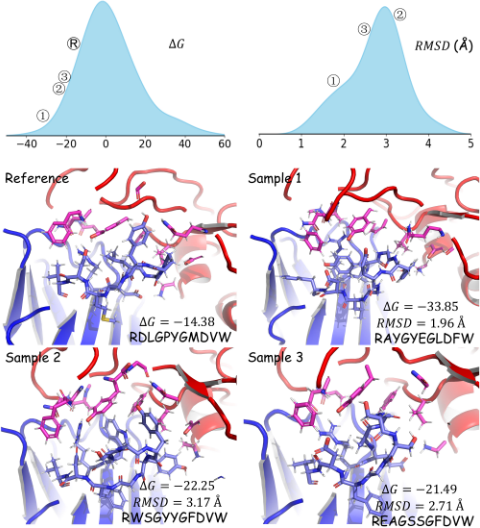
Table 1 compares four antibody design models across three metrics. AbMEGD excels overall, leading in AAR for H2 and H3, with competitive results in H1. It achieves the lowest RMSD in H1, indicating high structural accuracy, and performs well in H2 and H3 RMSD. While DIFFFORCE slightly outperforms AbMEGD in IMP for H2 and H3, AbMEGD leads in H1, balancing binding energy improvement with sequence recovery. DIFFFORCE demonstrates its strength in affinity optimization, particularly in H3, while DiffAb performs well in AAR and achieves the lowest RMSD in H2 but lags in IMP. RAbD shows moderate IMP in H2 but low AAR, indicating poor sequence recovery, with favorable RMSD only in H3 due to reliance on the Rosetta energy function. In contrast, AbMEGD achieves robust energy improvements without Rosetta supervision. Building on DiffAb, which is widely recognized as a leading model in antibody design, AbMEGD significantly improves performance in the critical CDR-H3 region, achieving a 10.13% increase in AAR (from 28.70% to 38.93%), a 3.32% boost in IMP (from 20.42% to 23.74%), and a 0.062 ˚A reduction in RMSD (from 3.481 ˚A to 3.419 ˚A). These results highlight AbMEGD's capability to refine sequence-structure co-design and affinity optimization, surpassing current models. Figure 3 illustrates three designed examples of CDR-H3 interacting with the SARS-CoV2 RBD. Among these, Sample 1 exhibits the strongest binding affinity, as reflected by its lowest binding energy, and demonstrates superior structural complementarity with the antigen. In contrast, Sample 3 shows a higher binding energy compared to the reference, and its CDR shape appears less compatible with the antigen, indicating weaker interactions.
4.2 Antibody Optimization
| RMSD ( ˚A) ↓ | AAR (%) ↑ | IMP (%) ↑ | ||||
|---|---|---|---|---|---|---|
| Steps | AbMEGD | DiffAb | AbMEGD | DiffAb | AbMEGD | DiffAb |
| 1 | 1.166 | 1.239 | 91.63 | 91.60 | 20.00 | 13.04 |
| 2 | 1.274 | 1.244 | 90.97 | 91.23 | 18.64 | 10.53 |
| 4 | 1.284 | 1.342 | 91.18 | 91.19 | 31.48 | 22.18 |
| 8 | 1.404 | 1.490 | 89.27 | 88.58 | 22.24 | 20.66 |
| 16 | 1.728 | 1.880 | 80.09 | 76.70 | 16.53 | 14.56 |
| 32 | 2.458 | 2.657 | 48.97 | 40.24 | 15.64 | 15.89 |
| 64 | 3.253 | 3.286 | 38.91 | 28.44 | 15.11 | 7.58 |
| T | 3.419 | 3.481 | 38.93 | 28.70 | 23.74 | 20.42 |
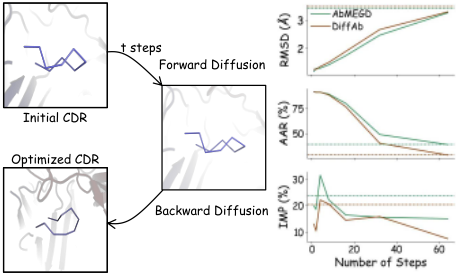
Our model is designed to optimize existing antibodies, providing an important application in the pharmaceutical domain. The optimization process begins by perturbing the CDR sequence and structure for t steps using the forward diffusion process. Afterward, starting from the (T - t)-th step (with t steps remaining) of the generative diffusion process, the sequences are denoised to produce a set of optimized antibodies. This procedure is illustrated in Figure 4a.
We focus specifically on optimizing the CDR-H3 antibody region in the test set with varying t values. For each antibody and t, the CDR is independently perturbed 100 times, yielding 100 optimized CDRs distinct from the original CDR. We evaluate the performance of our model and DiffAb by reporting the percentage of antibodies with IMP, RMSD, and AAR of the optimized CDRs relative to the original antibody. Additionally, we compare the optimized antibodies with de novo antibodies (t = T = 100) introduced in Section 4.1.
As depicted in Table 2 and Figure 4b , our optimization method produces antibodies with superior binding energy (IMP) as measured by the Rosetta energy function. At t = 4, the optimized CDRs reach an IMP score comparable to that of de novo antibodies, while maintaining significantly higher structural similarity to the original CDRs. The RMSD and AAR results further demonstrate that our model achieves a better trade-off between binding energy improvement and structural conservation compared to DiffAb, making it more suitable for practical applications.
5 Conclusion
In this study, we propose the AbMEGD, an advanced diffusion-based generative model addressing key challenges in antibody design. By integrating residue- and atomic-level features into a unified framework, AbMEGD achieves high performance in sequence-structure co-design and antibody optimization. The experimental results confirm its ability to balance structural conservation and enhance functionality during antibody refinement.
Ethical Statement
There are no ethical issues.
Acknowledgments
This work was supported in part by the Natural Science Foundation of China (No.62476203), and the Guangdong Provincial Natural Science Foundation General Project (No.2025A1515012155). Key Program of Hubei Natural Science Foundation Traditional Chinese Medicine Innovation and Development Joint Fund (2025AFD470).
@inproceedings{ijcai2025p303,
  title     = {Antibody Design and Optimization with Multi-scale Equivariant Graph Diffusion Models for Accurate Complex Antigen Binding},
  author    = {Chen, Jiameng and Cai, Xiantao and Wu, Jia and Hu, Wenbin},
  booktitle = {Proceedings of the Thirty-Fourth International Joint Conference on
               Artificial Intelligence, {IJCAI-25}},
  publisher = {International Joint Conferences on Artificial Intelligence Organization},
  editor    = {James Kwok},
  pages     = {2722--2730},
  year      = {2025},
  month     = {8},
  note      = {Main Track},
  doi       = {10.24963/ijcai.2025/303},
  url       = {https://doi.org/10.24963/ijcai.2025/303},
}
TY - CPAPER TI - Antibody Design and Optimization with Multi-scale Equivariant Graph Diffusion Models for Accurate Complex Antigen Binding AU - Chen, Jiameng AU - Cai, Xiantao AU - Wu, Jia AU - Hu, Wenbin T2 - Proceedings of the Thirty-Fourth International Joint Conference on Artificial Intelligence, IJCAI-25 PB - International Joint Conferences on Artificial Intelligence Organization PY - 2025 SP - 2722 EP - 2730 DO - 10.24963/ijcai.2025/303 UR - https://doi.org/10.24963/ijcai.2025/303 ER -Copied
Machine-readable versions of this paper, for tools and AI agents:





