
A Dynamic Knowledge Update-Driven Model with Large Language Models for Fake News Detection
Proceedings of the Thirty-Fourth International Joint Conference on Artificial Intelligence. Main Track. Pages 3000-3008.
https://doi.org/10.24963/ijcai.2025/334
Keywords
- Data Mining: DM: Mining text, web, social media
- Data Mining: DM: Mining graphs
Abstract
As the Internet and social media evolve rapidly, distinguishing credible news from a vast amount of complex information poses a significant challenge. Due to the suddenness and instability of news events, the authenticity labels of news can potentially shift as events develop, making it crucial for fake news detection to obtain the latest event updates. Existing methods employ retrieval-augmented generation to fill knowledge gaps, but they suffer from issues such as insufficient credibility of retrieved content and interference from noisy information. We propose a dynamic knowledge update-driven model for fake news detection (DYNAMO), which leverages knowledge graphs to achieve continuous updating of new knowledge and integrates with large language models to fulfill dual functions: news authenticity detection and verification of new knowledge correctness, solving the two key problems of ensuring the authenticity of new knowledge and deeply mining news semantics. Specifically, we first construct a news-domain-specific knowledge graph. Then, we use Monte Carlo Tree Search to decompose complex news and verify them step by step. Finally, we extract and update new knowledge from verified real news texts and reasoning paths. Experimental results demonstrate that DYNAMO achieves the best performance on two real-world datasets.
- [Abdin et al., 2024] Marah I Abdin, Sam Ade Jacobs, Am- mar Ahmad Awan, and et al. Phi-3 technical report: A highly capable language model locally on your phone. CoRR, abs/2404.14219, 2024.
- [Adlakha et al., 2024] Vaibhav Adlakha, Parishad BehnamGhader, Xing Han Lu, Nicholas Meade, and Siva Reddy. Evaluating correctness and faithfulness of instruction-following models for question answer- ing. Transactions of the Association for Computational Linguistics, 12:681-699, 2024.
- [Aly et al., 2021] Rami Aly, Zhijiang Guo, Michael Sejr Schlichtkrull, James Thorne, Andreas Vlachos, Christos Christodoulopoulos, Oana Cocarascu, and Arpit Mittal. FEVEROUS: fact extraction and verification over unstruc- tured and structured information. In Proceedings of the 35th Conference on Neural Information Processing Sys- tems (NeurIPS) Track on Datasets and Benchmarks, 2021.
- [Bian et al., 2020] Tian Bian, Xi Xiao, Tingyang Xu, Peilin Zhao, Wenbing Huang, Yu Rong, and Junzhou Huang. Ru- mor detection on social media with bi-directional graph convolutional networks. In Proceedings of the 34th AAAI Conference on Artificial Intelligence, pages 549- 556, 2020.
- [Chen and Freire, 2020] Zhouhan Chen and Juliana Freire. Proactive discovery of fake news domains from real-time social media feeds. In Companion Proceedings of the In- ternational World Wide Web Conference, pages 584-592, 2020.
- [Chen et al., 2024] Jiawei Chen, Hongyu Lin, Xianpei Han, and Le Sun. Benchmarking large language models in retrieval-augmented generation. In Proceedings of the 38th AAAI Conference on Artificial Intelligence, pages 17754- 17762, 2024.
- [Chung et al., 2024] Hyung Won Chung, Le Hou, Shayne Longpre, and et al. Scaling instruction-finetuned language models. Journal of Machine Learning Research, 25(70):1- 53, 2024.
- [Dong et al., 2023] Yiqi Dong, Dongxiao He, Xiaobao Wang, Yawen Li, Xiaowen Su, and Di Jin. A general- ized deep markov random fields framework for fake news detection. In Proceedings of the 32nd International Joint Conference on Artificial Intelligence, pages 4758-4765, 2023. IJCAI
- [Dong et al., 2024] Yiqi Dong, Dongxiao He, Xiaobao Wang, Youzhu Jin, Meng Ge, Carl Yang, and Di Jin. Unveiling implicit deceptive patterns in multi-modal fake news via neuro-symbolic reasoning. In Proceedings of the 38th AAAI Conference on Artificial Intelligence, pages 8354-8362, 2024.
- [Dou et al., 2021] Yingtong Dou, Kai Shu, Congying Xia, Philip S. Yu, and Lichao Sun. User preference-aware fake news detection. In Proceedings of the 44th International ACM SIGIR Conference on Research and Development in Information Retrieval, pages 2051-2055, 2021.
- [Hu et al., 2021] Linmei Hu, Tianchi Yang, Luhao Zhang, Wanjun Zhong, Duyu Tang, Chuan Shi, Nan Duan, and Ming Zhou. Compare to the knowledge: Graph neural fake news detection with external knowledge. In Proceedings of the 59th Annual Meeting of the Association for Compu- tational Linguistics, pages 754-763, 2021.
- [Hu et al., 2024] Beizhe Hu, Qiang Sheng, Juan Cao, Yuhui Shi, Yang Li, Danding Wang, and Peng Qi. Bad actor, good advisor: Exploring the role of large language models in fake news detection. In Proceedings of the 38th AAAI Conference on Artificial Intelligence, pages 22105-22113, 2024.
- [Jiang et al., 2020] Yichen Jiang, Shikha Bordia, Zheng Zhong, Charles Dognin, Maneesh Kumar Singh, and Mo- hit Bansal. Hover: A dataset for many-hop fact extraction and claim verification. In Findings of the Empirical Meth- ods in Natural Language Processing, pages 3441-3460, 2020.
- [Jin et al., 2025] Di Jin, Yujun Zhang, Bingdao Feng, Xi- aobao Wang, Dongxiao He, and Zhen Wang. Backdoor attack on propagation-based rumor detectors. In Proceed- ings of the 39th AAAI Conference on Artificial Intelligence, pages 17680-17688, 2025.
- [Khaliq et al., 2024] Mohammed Abdul Khaliq, Paul Yu- Chun Chang, Mingyang Ma, Bernhard Pflugfelder, and Filip Miletić. Ragar, your falsehood RADAR: rag- augmented reasoning for political fact-checking using multimodal large language models. In Proceedings of the 7th Workshop on Fact Extraction and VERification (FEVER), pages 280-296, 2024.
- [Li et al., 2024a] Dawei Li, Shu Yang, Zhen Tan, Jae Young Baik, Sukwon Yun, Joseph Lee, Aaron Chacko, Bojian Hou, Duy Duong-Tran, Ying Ding, Huan Liu, Li Shen, and Tianlong Chen. DALK: dynamic co-augmentation of llms and KG to answer alzheimer's disease questions with scientific literature. In Findings of the Empirical Methods in Natural Language Processing, pages 2187-2205, 2024.
- [Li et al., 2024b] Guanghua Li, Wensheng Lu, Wei Zhang, Defu Lian, Kezhong Lu, Rui Mao, Kai Shu, and Hao Liao. Re-search for the truth: Multi-round retrieval-augmented large language models are strong fake news detectors. CoRR, abs/2403.09747, 2024.
- [Ma et al., 2024] Huiying Ma, Dongxiao He, Xiaobao Wang, Di Jin, Meng Ge, and Longbiao Wang. Multi-modal sar- casm detection based on dual generative processes. In Pro- ceedings of the 33rd International Joint Conference on Ar- tificial Intelligence, pages 2279-2287, 2024. IJCAI
- [Mou et al., 2024] Xinyi Mou, Zejun Li, Hanjia Lyu, Jiebo Luo, and Zhongyu Wei. Unifying local and global knowl- edge: Empowering large language models as political ex- perts with knowledge graphs. In Proceedings of the Inter- national World Wide Web Conferences, pages 2603-2614, 2024.
- [Nie et al., 2020] Yixin Nie, Adina Williams, Emily Dinan, Mohit Bansal, Jason Weston, and Douwe Kiela. Adver- sarial NLI: A new benchmark for natural language under- standing. In Proceedings of the 58th Annual Meeting of the Association for Computational Linguistics, pages 4885- 4901, 2020.
- [Niu et al., 2024] Cheng Niu, Yang Guan, Yuanhao Wu, Juno Zhu, Juntong Song, Randy Zhong, Kaihua Zhu, Sil- iang Xu, Shizhe Diao, and Tong Zhang. Veract scan: Retrieval-augmented fake news detection with justifiable reasoning. CoRR, abs/2406.10289, 2024.
- [Pan et al., 2023] Liangming Pan, Xiaobao Wu, Xinyuan Lu, Anh Tuan Luu, William Yang Wang, Min-Yen Kan, and Preslav Nakov. Fact-checking complex claims with program-guided reasoning. In Proceedings of the 61st An- nual Meeting of the Association for Computational Lin- guistics, pages 6981-7004, 2023.
- [Przybyla, 2020] Piotr Przybyla. Capturing the style of fake news. In Proceedings of the 34th AAAI Conference on Artificial Intelligence, pages 490-497, 2020.
- [Qi et al., 2024] Zhenting Qi, Mingyuan Ma, Jiahang Xu, Li Lyna Zhang, Fan Yang, and Mao Yang. Mutual reason- ing makes smaller llms stronger problem-solvers. CoRR, abs/2408.06195, 2024.
- [Shu et al., 2017] Kai Shu, Amy Sliva, Suhang Wang, Jiliang Tang, and Huan Liu. Fake news detection on social me- dia: A data mining perspective. SIGKDD Explorations, 19(1):22-36, 2017.
- [Soleimani et al., 2020] Amir Soleimani, Christof Monz, and Marcel Worring. BERT for evidence retrieval and claim verification. In Proceedings of the 42nd Euro- pean Conference on Information Retrieval, pages 359- 366, 2020.
- [Sun et al., 2023] Ling Sun, Yuan Rao, Yuqian Lan, Bingcan Xia, and Yangyang Li. HG-SL: jointly learning of global and local user spreading behavior for fake news early de- tection. In Proceedings of the 37th AAAI Conference on Artificial Intelligence, pages 5248-5256, 2023.
- [Sun et al., 2024] Jiashuo Sun, Chengjin Xu, Lumingyuan Tang, Saizhuo Wang, Chen Lin, Yeyun Gong, Lionel M. Ni, Heung-Yeung Shum, and Jian Guo. Think-on-graph: Deep and responsible reasoning of large language model on knowledge graph. In Proceedings of the 12th Interna- tional Conference on Learning Representations, 2024.
- [Tan et al., 2024] Zhen Tan, Dawei Li, Song Wang, Alimo- hammad Beigi, Bohan Jiang, Amrita Bhattacharjee, Man- sooreh Karami, Jundong Li, Lu Cheng, and Huan Liu. Large language models for data annotation and synthesis: A survey. In Proceedings of the Conference on Empirical Methods in Natural Language Processing, pages 930-957, 2024.
- [Touvron et al., 2023] Hugo Touvron, Thibaut Lavril, Gau- tier Izacard, Xavier Martinet, Marie-Anne Lachaux, Tim- othée Lacroix, Baptiste Rozière, Naman Goyal, Eric Hambro, Faisal Azhar, Aurélien Rodriguez, Armand Joulin, Edouard Grave, and Guillaume Lample. Llama: Open and efficient foundation language models. CoRR, abs/2302.13971, 2023.
- [Wang et al., 2023] Xiaobao Wang, Yiqi Dong, Di Jin, Yawen Li, Longbiao Wang, and Jianwu Dang. Augment- ing affective dependency graph via iterative incongruity graph learning for sarcasm detection. In Proceedings of the 37th AAAI Conference on Artificial Intelligence, pages 4702-4710, 2023.
- [Wang et al., 2024] Bo Wang, Jing Ma, Hongzhan Lin, Zhi- wei Yang, Ruichao Yang, Yuan Tian, and Yi Chang. Ex- plainable fake news detection with large language model via defense among competing wisdom. In Proceedings of the International World Wide Web Conferences, pages 2452-2463, 2024.
- [Wang et al., 2025] Xiaobao Wang, Yujing Wang, Dongxiao He, Zhe Yu, Yawen Li, Longbiao Wang, Jianwu Dang, and Di Jin. Elevating knowledge-enhanced entity and relation- ship understanding for sarcasm detection. IEEE Transac- tions on Knowledge and Data Engineering, 37(6):3356- 3371, 2025.
- [Wen et al., 2024] Yilin Wen, Zifeng Wang, and Jimeng Sun. Mindmap: Knowledge graph prompting sparks graph of thoughts in large language models. In Proceedings of the 62nd Annual Meeting of the Association for Compu- tational Linguistics, pages 10370-10388, 2024.
- [Xu et al., 2022] Weizhi Xu, Junfei Wu, Qiang Liu, Shu Wu, and Liang Wang. Evidence-aware fake news detection with graph neural networks. In Proceedings of the Inter- national World Wide Web Conferences, pages 2501-2510, 2022.
- [Yu et al., 2023] Zhe Yu, Di Jin, Xiaobao Wang, Yawen Li, Longbiao Wang, and Jianwu Dang. Commonsense knowl- edge enhanced sentiment dependency graph for sarcasm detection. In Proceedings of the 32nd International Joint Conference on Artificial Intelligence, pages 2423-2431, 2023. IJCAI
- [Zhang et al., 2024] Yichi Zhang, Zhuo Chen, Yin Fang, Yanxi Lu, Fangming Li, Wen Zhang, and Huajun Chen. Knowledgeable preference alignment for llms in domain- specific question answering. In Findings of the Association for Computational Linguistics, pages 891-904, 2024.
- [Zhu et al., 2024a] Peican Zhu, Jiaheng Hua, Keke Tang, Ji- wei Tian, Jiwei Xu, and Xiaodong Cui. Multimodal fake news detection through intra-modality feature aggregation and inter-modality semantic fusion. Complex & Intelligent Systems, 10(4):5851-5863, 2024.
- [Zhu et al., 2024b] Peican Zhu, Zechen Pan, Yang Liu, Jiwei Tian, Keke Tang, and Zhen Wang. A general black-box adversarial attack on graph-based fake news detectors. In Proceedings of the 33rd International Joint Conference on Artificial Intelligence, pages 568-576, 2024. IJCAI
References were extracted automatically from the PDF and may contain errors.
Full text extracted automatically from the PDF; figures, tables and equations may differ. The PDF is the version of record.
1 Introduction
With the rapid development of the Internet and social media, fake news has been proliferating amid the high-speed dissemination of information [Jin et al., 2025; Wang et al., 2025; Yu et al., 2023; Zhu et al., 2024b]. Misleading information, false advertisements, fabricated accounts, and other statements all seriously impact the online experience of users and the security of the network environment [Shu et al., 2017; Dong et al., 2023; Wang et al., 2023]. Given the complexity and diversity of information types, identifying credible news among a vast amount of information is challenging [Ma et al., 2024]. Compared to human judgment, automated technical means for determining the authenticity of news are better suited to handle vast and complex information on the Internet.
∗Corresponding Author
Traditional methods for detecting fake news can be categorized into three types based on the information required: content-based methods [Hu et al., 2021; Przybyla, 2020; Dong et al., 2024; Zhu et al., 2024a], user-based methods [Chen and Freire, 2020; Dou et al., 2021] and propagation-based methods [Bian et al., 2020; Sun et al., 2023]. These approaches leverage various types of newsrelated information and have achieved good results in detection accuracy. However, due to their black-box nature [Wang et al., 2024], the models cannot provide explicit reasons to enhance the credibility of detection results. Additionally, traditional methods often require a large amount of manually annotated data for model training. High-quality annotated samples are not only time-consuming and labor-intensive to obtain, but also require annotators to have sufficient understanding of events to assign accurate labels [Tan et al., 2024], making data collection a pressing issue.
To address the data issue in fake news detection, some studies have begun to consider unsupervised detection methods. Large language models (LLMs), renowned for their remarkable zero-shot learning and advanced reasoning abilities, have been introduced into fake news detection. Using techniques such as chain of thought to guide LLMs in outputting their thinking and reasoning processes [Wang et al., 2024; Pan et al., 2023], reasonable and informative rationales can be provided from multiple perspectives [Hu et al., 2024], effectively enhancing interpretability. However, LLMs are insensitive to real-world dynamics [Sun et al., 2024]. News events are often sudden and unstable, and their development can lead to shifts in the authenticity of news. Therefore, promptly updating the latest developments of events and acquiring the newest information are crucial for fake news detection.
The substantial update costs associated with LLMs hinder the timely updating of their internal knowledge, making it difficult to meet the high timeliness demands of fake news detection [Wen et al., 2024]. A direct and effective approach to address the timeliness issue is to use RetrievalAugmented Generation (RAG). RAG retrieves information from external resources, such as web pages, in an effort to capture the latest event developments [Li et al., 2024b; Niu et al., 2024]. However, RAG is not without its flaws. It faces challenges such as insufficient credibility of the retrieved content, interference from noisy information, retrieval inefficiency caused by information overload, and network latency issues [Chen et al., 2024], which may lead to hallucination issues in LLMs and reduced efficiency in fake news detection [Adlakha et al., 2024].
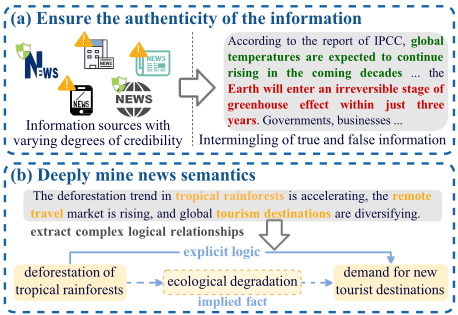
Given the significant advantages of knowledge graphs in adaptability and expansibility, maintenance costs, knowledge reliability, and retrieval efficiency [Mou et al., 2024; Zhang et al., 2024], we explore the possibility of using knowledge graphs to address the timeliness issue in fake news detection, envisioning the continuous integration of new information (both labeled and unlabeled) into the knowledge graph. Furthermore, due to the timeliness of news, which allows for prompt reporting on the latest events, we choose news as the source of new knowledge. However, as shown in Figure 1, implementing this idea requires overcoming two key challenges: (1) Ensuring the authenticity of the information: Due to the complexity of knowledge sources and the intermingling of true and false information, verifying the authenticity of the information when updating the knowledge graph is an extremely challenging task. (2) Deeply mining news semantics: News is often rich in complex semantic information and multi-layered logical relationships. How to accurately and comprehensively mine the rich information embedded in news presents another major challenge.
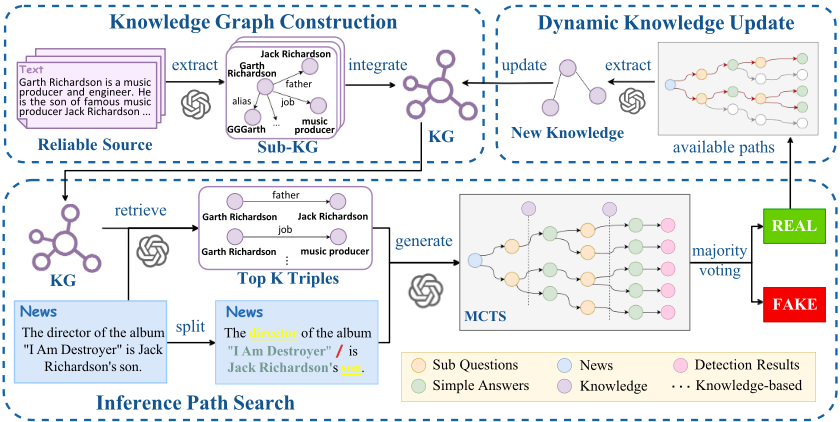
Addressing the aforementioned issues, we propose a DYnamic kNowledge updAte-driven MOdel for fake news detection (DYNAMO). The model simultaneously performs fake news detection and verifies the accuracy of new knowledge. It achieves dynamic knowledge updates in fake news detection by updating the knowledge graph, and continuously injecting new knowledge to enhance LLMs' understanding of various news events. This improves the model's ability to adapt to event developments, effectively addressing the timeliness requirements of fake news detection. Specifically, we first utilize the LLM to assist in constructing a news-domainspecific knowledge graph as external supplemental knowledge. Next, the knowledge graph aids the LLM in detecting fake news. Using Monte Carlo Tree Search, the news is broken down into multiple sub-questions, which are answered sequentially to verify the authenticity of the news. Additionally, we predict the authenticity of new knowledge by examining the news content. Through Monte Carlo Tree Search, the model explores different news splitting combinations to identify the optimal splitting approach, thus unveiling the deep logical relationships within the news, which is beneficial for subsequent new knowledge extraction. Besides, by splitting the news, the model can gradually verify the authenticity of the content, reducing the chances of missing information points and improving detection accuracy and credibility. Finally, for news that is verified as true, the LLM extracts knowledge triples from the news text and reasoning paths, enabling efficient and convenient knowledge updates.
To summarize, the contributions of this paper include:
- We identify a new issue that needs attention in fake news detection. Due to the development of news events, which may result in alterations to news labels, there is a timeliness requirements for news detection.
- We propose a dynamic knowledge update-driven model that innovatively verifies the correctness of new knowledge through detecting the authenticity of news, while simultaneously extracting knowledge from real news.
- Extensive experiments on two real-world datasets demonstrate that the proposed model achieves the stateof-the-art performance on various metrics.
2 RelatedWork
2.1 Traditional Methods in Fake News Detection
Content-based methods determine the authenticity of news by analyzing features such as text, topic selection, and writing style. [Przybyla, 2020] focuses on typical words in fake news to learn the emotional language elements of news for detection. As for news spreading on social media, additional social context information can serve as supplementary information to assist in detecting fake news. User-based methods believe that factors such as users' social behaviors and attitudes can reveal the likelihood of users spreading fake news. UPFD [Dou et al., 2021] obtains user preferences by analyzing users' historical posts on social media. Propagation-based methods detect fake news by extracting features of the propagation network. Bi-GCN [Bian et al., 2020] considers both the "top-down" propagation and the "bottom-up" dissemination structure to learn the causal and structural characteristics of rumor propagation. However, due to their black-box nature, themodels lack interpretability. Furthermore, traditional models in fake news detection rely on high-quality annotated data for model training, which is difficult to collect.
2.2 LLMs in Fake News Detection
To alleviate the issues of data collection and interpretability, some approaches have introduced Large Language Models
(LLMs) as detectors. ProgramFC [Pan et al., 2023] decomposes complex claims into simpler subtasks and processes them sequentially, guiding the LLM to provide explicit reasoning processes. L-Defense [Wang et al., 2024] utilizes the reasoning abilities of the LLM to conduct reasoning and judgment on two opposing sets of evidence, and generate a summary of reasons. Due to the lack of domain-specific expertise in news field by LLMs, some approaches introduce knowledge graphs to provide external knowledge for assistance. PEG [Mou et al., 2024] refines external knowledge through semantic filtering and aggregates it into global knowledge. DALK [Mou et al., 2024] collects evidential subgraphs through path-based and neighbor-based exploration. To address the timeliness requirements of fake news detection, some approaches adopt Retrieval-Augmented Generation. STEEL [Li et al., 2024b] and VeraCT Scan [Niu et al., 2024] retrieve and extract key information from web as external knowledge, thereby mitigating the issue of outdated knowledge in LLMs. However, due to lack of verification of the retrieved information, it may instead mislead the LLM intomaking incorrect judgments. Furthermore, it fails to truly achieve knowledge updating.
3 Methods
Figure 2 presents the overview of our model. Firstly, we extract knowledge from news-related texts generated by reliable sources to construct a news-domain-specific knowledge graph. Secondly, we utilize the knowledge graph to assist the LLM in completing fake news detection. Lastly, we leverage the LLM to extract new knowledge from authentic news and reasoning paths for updating the knowledge graph.
3.1 Task Definition
There is a news-domain-specific knowledge graph G = (E,R, S), where E is the set of entities, R is the set of relations and S ⊆ E×R×E is the set of triples. L denotes the LLM used for detection. The task of our model is to predict the label y ∈ {Real, Fake} for a given news article c involving the knowledge graph. Mathematically, y = L(c, G).
3.2 Knowledge Graph Construction
Knowledge graphs possess structured formats and expansibility [Li et al., 2024a], hence we select knowledge graphs as the carrier for knowledge retrieval and updating. The existing knowledge graphs lack the relevant knowledge to support fake news detection. To enhance LLMs' understanding of news, we first construct a news-domain-specific knowledge graph G, integrating various types of information involved in news events in a structured manner. The source of knowledge is news-related texts generated by reliable sources.
Entity-Centered Knowledge Extraction. Firstly, key entities are extracted from the text to form an entity set E. To obtain more knowledge-rich triples, inspired by [Li et al., 2024a], we adopt a generative approach to extract relations between entities. Thus, the vocabulary used to describe relations between entities is not limited by the original text. The entity set and text are input into the LLM, which is instructed to extract keywords for describing the relations between relevant entities or directly generate new summary terms R, and output the corresponding knowledge triples S.
Event-Centered Knowledge Extraction. Furthermore, due to the inclusion of multifaceted factors such as time and location in facts, these elements cannot be simply summarized as two entities and the relationship between them. Consequently, we also adopt the form of (subject, predicate, object) to guide the LLM in extracting triples for events.
Thus, we obtain a comprehensive news-domain-specific knowledge graph and it is used to assist subsequent modules.
3.3 Inference Path Search
Due to the pursuit of concise expression in news reporting, many complex semantics and logical relationships may be summarized in brief statements, leading to increased difficulty in understanding. We break down complex news into several simple sub-questions, answer and verify their truthfulness sequentially, thereby dissecting the underlying semantic relationships and reducing the difficulty for the LLM to understand and judge. Additionally, breaking down the news allows the LLM to output its thinking and reasoning processes, enhancing interpretability. At the same time, by requiring the LLM to output intermediate results, we prompt it to more fully utilize its internal knowledge and provide richer information for subsequent updates to the knowledge graph.
Monte Carlo Tree Search. Inspired by [Qi et al., 2024], we utilize Monte Carlo Tree Search (MCTS) with multiple types of actions to generate reasoning paths, thereby accomplishing the breakdown and verification of news. MCTS is capable of finding approximately optimal strategies within limited time, thus it is ideal for large-scale problems. Additionally, the algorithmic structure of MCTS is relatively simple, facilitating easy implementation and extension.
For each piece of news c, the model constructs a search tree T. The root node of T represents the news c, an edge represents an action a, and each child node is an intermediate step s generated by the LLM L based on the corresponding action. The path from the root node to a leaf node sd constitutes a candidate reasoning path t = (c, s1, s2, . . . , sd), where d ≤ h and h is the pre-defined height limit of the tree. From the search tree T , we can extract a set of reasoning paths Troute = {t1, t2, . . . , tn}, where n ≥ 1 and n is the number of searches conducted.
To enhance detection efficiency and adapt the model to fake news detection tasks, we define three types of actions:
A1: Generate a sub-question. In this step, the LLM is required to propose the next sub-question to be answered based on the previous question-and-answer process, thereby breaking down the news into simpler content that is easier for the LLM to verify as true or false.
A2: Answer a sub-question. In this step, the LLM utilizes its own knowledge to answer the sub-question generated in step A1, thereby prompting the LLM to generate a detailed and reliable reasoning process and providing more knowledge for subsequent updates to the knowledge graph.
A3: Provide a detection result. If the current question-andanswer process generated contains sufficient information to determine the authenticity of the news, the LLM is allowed to directly give the final prediction result in this step.
Next, we introduce how to select actions. For explored nodes, reward scores are assigned to the nodes during the back-propagation process. Initially, the reward score for all nodes is defined as Q(s) = 0. We define the reward score based on the current reasoning results as follows:
where pmajor is the number of reasoning paths whose results belong to the majority outcome, and pminor is the number of reasoning paths with minority outcomes.
When a leaf node sd appears, if the judgment result of this leaf node sd is consistent with the judgment results of the current majority, then a reward will be assigned to each node on the corresponding reasoning path t′ of sd, that is:
Then, the Upper Confidence Bounds applied to Trees (UCT) strategy is used for node selection, with the specific formula as follows:
Here, Q represents the node score, α is a constant, V denotes the visit count, and Vparent is the visit count of the parent node.
At each timestamp i, MCTS randomly selects an unexplored node si and uses a prompt to guide the LLM to generate the relevant content for si based on the current path (c, s1, s2, . . . , si-1), or selects an explored node according to the UCT strategy. Additionally, there exists a precedence relationship among different action types, which is manifested as follows: A2 can only occur after A1, and A3 can only occur after the root node and A2. For the final detection result of news c, we adopt the majority voting, where the majority result among multiple leaf nodes is selected as the final result.
Knowledge Graph Enhancement. To enhance the understanding of news by the LLM, we utilize the knowledge graph constructed in Section 3.2 as the external knowledge to assist in detection. During Action A2 of the MCTS, news-related knowledge triples can be provided as supplementary knowledge to the LLM, thereby augmenting its capabilities. Firstly, we extract key entities from the sub-question to form an entity set for the question, denoted as EQ. We then match the entities in EQ with those in the knowledge graph G to obtain a matched entity set EG. From EG, we construct a problemspecific knowledge subgraph GQ comprising the one-hop triples associated with the entities in EG. Due to the limited input text length of LLMs, we filter the retrieved triples. We use a prompt to guide the LLM in ranking the knowledge triples based on their relevance to the sub-question, and select the top-K triples as the final supplementary knowledge.
3.4 Dynamic Knowledge Update
We aim to fully leverage the knowledge acquired during the detection process to facilitate detection of similar news in the future. Additionally, dynamically updating the model's knowledge allows it to stay informed about the development of events, thereby enhancing its capability to handle realworld scenarios. Therefore, for news confirmed as true in the detection results, we extract new knowledge from the question-and-answer process involving the news text and reasoning paths, which is used to update the knowledge graph.
The method for extracting triples here is the same as the approach used in Section 3.2 for constructing the knowledge graph. Firstly, we extract key entities from the text to form a new entity set Enew. We then input the entity set and the text into the LLM, instructing it to extract keywords that describe the relationships between relevant entities or directly generate new summary terms Rnew, and output the corresponding triples Snew. Finally, we store the newly acquired triples Gnew = (Enew, Rnew, Snew) into the knowledge graph G. The updated G will be utilized in the subsequent news detection, and it will continuously be updated with new knowledge extracted from news that will be verified as true.
| Methods | Hover | Feverous | ||||||
|---|---|---|---|---|---|---|---|---|
| Accuracy | F1 | Precision | Recall | Accuracy | F1 | Precision | Recall | |
| RoBERTa-NLI | 0.4395 | 0.3141 | 0.6145 | 0.2109 | 0.4301 | 0.1986 | 0.5266 | 0.1224 |
| BERT-FC | 0.5858 | 0.5619 | 0.5660 | 0.5579 | 0.5548 | 0.3081 | 0.4603 | 0.2315 |
| GET | 0.5378 | 0.4398 | 0.4830 | 0.4928 | 0.5523 | 0.4427 | 0.5579 | 0.5005 |
| ProgramFC | 0.4701 | 0.3640 | 0.7280 | 0.2427 | 0.5433 | 0.4869 | 0.7345 | 0.3641 |
| TOG | 0.5548 | 0.5915 | 0.6736 | 0.5272 | 0.6093 | 0.6599 | 0.7143 | 0.6132 |
| CoRAG | 0.5440 | 0.3824 | 0.6474 | 0.2732 | 0.6030 | 0.5912 | 0.6293 | 0.5574 |
| Phi3-mini | 0.5850 | 0.5951 | 0.7176 | 0.5083 | 0.6090 | 0.5412 | 0.7169 | 0.4347 |
| DYNAMO | 0.6250 | 0.7401 | 0.7367 | 0.7436 | 0.6167 | 0.7433 | 0.7384 | 0.7483 |
4 Experiments
We first introduce the datasets, baselines, and various settings used in the experiments (Section 4.1). We validate the model's performance on two real-world datasets (Section 4.2). Additionally, we design experiments to demonstrate the advantages of dynamic knowledge updating (Section 4.3). Then, we conduct ablation experiments to verify the necessity of each component and the rationality of the parameter (Section 4.4). Finally, we present a case to showcase how dynamic knowledge updating aids fake news detection (Section 4.5).
4.1 Experiment Setting
Datasets. To validate the enhancement effect of the dynamically updated knowledge graph, we require datasets that comprise a series of news with similar content but differing keywords and labels. Additionally, we desire the datasets to include factual statements related to the news, which can be utilized to construct a news-specific knowledge graph. In summary, two real-world datasets are selected for experiments. Hover [Jiang et al., 2020] is a dataset of multi-hop factual statements, containing 18,171 samples. It extracts facts from several Wikipedia articles related to factual statements and categorizes whether the statements are correct. Feverous [Aly et al., 2021], with 26,928 samples, extracts structured evidence, unstructured evidence, or a combination of both from Wikipedia to verify statements. Since we focus solely on data in natural language form, we follow the setup of [Pan et al., 2023] and select only sentence evidence and corresponding statements as our samples.
Baselines. We compare the proposed model with the following baseline models: (1) Traditional methods: RoBERTaNLI [Nie et al., 2020] utilizes a finely tuned version of RoBERTa-large across four natural language inference datasets and BERT-FC [Soleimani et al., 2020] trains BERT to complete fact-checking tasks. GET [Xu et al., 2022] implements graph-based semantic structure mining to learn longdistance semantic dependency relationships. (2) LLM-based methods: ProgramFC [Pan et al., 2023] breaks down complex claims into simpler sub-claims and TOG [Sun et al., 2024] utilizes a LLM agent iteratively to perform beam search on the KG to discover the most promising reasoning paths. CoRAG [Khaliq et al., 2024] is a real-time retrieval-based model. Phi3-mini [Abdin et al., 2024] is the LLM backbone that we utilize for DYNAMO and the LLM-based baselines.
Here we use the form of direct questioning to prompt Phi3mini to assess the authenticity of the news.
Implementation Details. We select Phi3-mini-128k as the LLM backbone for DYNAMO and the LLM-based baselines. We follow the experimental setup for few-shot learning, so we set the number of samples for training and few-shot learning to 3, and adopt 5 epochs for training. For the proposed model, the number of times MCTS is executed, n, is 5, with the height limit h of the search tree set to 5 and 9 respectively for the Hover and Feverous datasets. Each node generating 2 child nodes when a new action is executed. For knowledge graph retrieval, we select the top-5 knowledge triples as external knowledge input to the large language model. The constant α in the formula 3 is set to 2.
Experimental Environment. Experiments are conducted on the PyTorch 2.5.0 platform with an Intel(R) Xeon(R) Gold 6326 CPU (2.90GHz) and an NVIDIA A40 48GB GPU.
4.2 Experiment Results
Table 1 presents the performance of the proposed model and baseline models on two datasets. Relevant knowledge triples are retrieved from the knowledge graph constructed in Section 3.2 to serve as external knowledge. As can be seen from Table 1, we can draw the following conclusions: (1) DYNAMO has achieved state-of-the-art accuracy on two datasets. This is attributed to the Monte Carlo Tree Search, which breaks down logically complex news text into easily understandable sub-questions. The simpler input content and tasks alleviate the difficulty for LLMs in understanding the text, preventing issues such as hallucinations, where LLMs provide incorrect answers or refuse to answer, thereby enhancing the quality of task completion. Since the decomposed sub-questions require LLMs to provide intermediate answers, it can guide LLMs to integrate external knowledge and fully utilize their internal knowledge for comprehensive analysis when answering questions. (2) Furthermore, we employ F1 score, precision, and recall to conduct a more detailed evaluation of each model's performance. It can be observed that DYNAMO achieves optimal performance across all these metrics. High precision and high recall indicate that DYNAMO identifies as many positive samples as possible with a high degree of confidence. This means that we have identified a significant number of real news, and our predictions for these real news are reliable. This is highly beneficial for our subsequent new knowledge extraction, as our new knowledge is derived from the texts and reasoning processes of real news. (3) Compared to traditional methods, LLM-based approaches do not demonstrate significant advantages in terms of various metrics. This suggests that using LLMs does not necessarily enhance the performance of fake news detection and may even make it difficult for the models to learn the hidden relationships between data. LLMs can only fully exert their potential when appropriate input content is designed.
| Settings | Hover1 | Hover2 | Hover2+kg1 | Hover3 | Hover3+kg1&2 |
|---|---|---|---|---|---|
| DYNAMO | 0.6309 | 0.6267 | 0.6400 | 0.6167 | 0.6300 |
| Settings | Feverous1 | Feverous2 | Feverous2+kg1 | Feverous3 | Feverous3+kg1&2 |
|---|---|---|---|---|---|
| DYNAMO | 0.6373 | 0.6127 | 0.6195 | 0.6000 | 0.6075 |
| Methods | Hover | Feverous | ||
|---|---|---|---|---|
| w/o kg | w/ kg | w/o kg | w/ kg | |
| LLaMA | 0.5000 | 0.5167 | 0.6180 | 0.6342 |
| Flan-T5 | 0.5707 | 0.5807 | 0.5667 | 0.5753 |
| Phi3-mini | 0.5790 | 0.5850 | 0.5990 | 0.6090 |
| Ours + LLaMA | 0.5241 | 0.5441 | 0.6233 | 0.6550 |
| Ours + Flan-T5 | 0.5962 | 0.6077 | 0.5874 | 0.5924 |
| Ours + Phi3-mini | 0.6007 | 0.6250 | 0.6042 | 0.6167 |
4.3 Evaluation on Knowledge Graph Update
Table 2 and Table 3 demonstrate the improvement in detection accuracy brought about by updates to the knowledge graph. To verify the contribution of these updates, we divide each of the two datasets into three subsets. These subsets contain news reports on the same news events but with different focuses and labels, allowing us to validate whether newly acquired knowledge from previously encountered similar news events can assist in the detection of unseen news. To better validate the model's ability to handle unseen news, we reduce the external knowledge provided to the model regarding the last two data subsets of Hover and Feverous. Specifically, the initial knowledge graph used in this experiment is constructed solely based on the relevant factual texts from the 1st subset of Hover and Feverous, excluding any information from other subsets, and subsequent updates are made on this foundation. In the table header, "Hover2+kg1" indicates that when detecting the 2nd subset of Hover, the knowledge graph updated during the detection of the 1st subset is used as external knowledge to assist in the detection process. As shown in Table 2 and Table 3, through updates to the knowledge graph, the detection accuracy has been improved by an average of 1%. This is because our model extracts reliable and concise new knowledge from real news, filling the knowledge gap in LLMs and knowledge graphs regarding newly occurring news. The new knowledge enables LLMs to gain some understanding of new news events when they are unable to update their internal knowledge, thereby making more accurate judgments on the authenticity of the news.
4.4 Ablation Study
To validate the impact of different modules and the parameter on the overall performance of our proposed model, we conduct multiple ablation experiments.
LLM Backbones. To demonstrate the universality of our method across different LLMs, we additionally select two LLMs: Flan-T5-XL [Chung et al., 2024] and LLaMA13B [Touvron et al., 2023], as the backbone LLMs. The "w/o kg" stands for "without knowledge graph". The "w/ kg" stands for "with knowledge graph", representing the scenario where relevant knowledge triples are retrieved from the knowledge graph to serve as external knowledge. As shown in Table 4, by comparing the performance when only the LLM is used as the detector versus when our proposed framework is applied under the same LLM settings, it can be observed that our approach enhances the detection performance of various LLMs. This is because news segmentation alleviates the difficulty for LLMs in understanding complex logic, and Monte Carlo Tree Search optimizes the segmentation process by quickly identifying suitable segmentation methods within a large search space. This experiment confirms the effectiveness of our method across various LLMs.
External Knowledge. To validate the effectiveness of the knowledge graph extracted in Section 3.2, we conduct experiments with different LLM backbones and datasets under two settings: without the involvement of the knowledge graph and with the involvement of the knowledge graph. The "w/o kg" stands for "without knowledge graph" and the "w/ kg" represents the scenario where relevant knowledge triples are retrieved from the knowledge graph to serve as external knowledge. As shown in Table 4, the results confirm that the knowledge graph can provide additional knowledge for fake news detection, thereby improving detection accuracy.
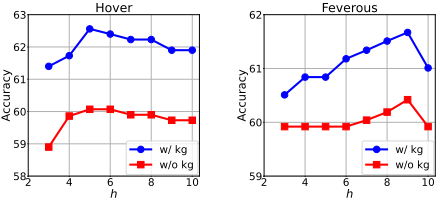
Hyper-parameter Sensitivity Analysis. To enhance reasoning efficiency, we impose a height limit on the Monte Carlo Tree Search. To investigate the impact of the parameter height limit h on detection results, we compare the accuracy of fake news detection under different height limits using the same experimental settings. Figure 3 illustrates that, on the whole, our model demonstrates robustness to the parameter h, and variations in h do not cause abrupt changes in detection accuracy. For the Hover dataset, the model performs best when h is set to 5, regardless of whether the knowledge graph is involved. In contrast, for the Feverous dataset, the optimal performance of the model occurs when h is set to 9. This is because compared to Hover, news in Feverous tend to be more verbose, containing more complex logical relationships. If h is set too low, the reasoning process for some samples may not be completed. Conversely, for the Hover dataset, an excessively high h can lead to excessive deep reasoning, potentially introducing too much interfering information and affecting the judgment of the LLM. Therefore, we set h to 5 and 9 respectively for the Hover and Feverous datasets.
4.5 Case Study
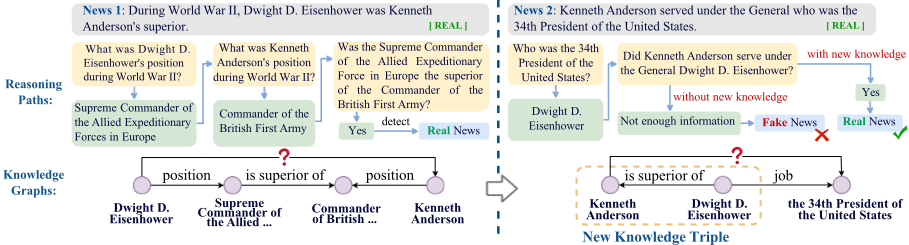
To visually demonstrate the enhancement effect of dynamically updated knowledge on fake news detection, we select a set of news cases from the Hover dataset and present the entire process of their detection and the process of updating the knowledge graph. As shown in Figure 4, News 1 and News 2 constitute a pair of news that are content-related but differ in their wording and focus.
During the initial stage of detecting News 1, the model lacks relevant information about the relationship between Dwight D. Eisenhower and Kenneth Anderson, and therefore can not directly provide a detection result. During the Monte Carlo Tree Search process, the LLM leverages its internal knowledge and the initial knowledge graph to obtain the positions held by Dwight D. Eisenhower and Kenneth Anderson during World War II, and recognizes the hierarchical relationship between the two positions. Based on this, the model integrates the information contained in the reasoning path, deduces the relationship between the two individuals, and judges the news to be true. Subsequently, the model extracts "Dwight D. Eisenhower was Kenneth Anderson's superior" from the news content as new knowledge and updates it into the knowledge graph. For the detection of News 2, if there is no additional new knowledge, the model still would not know the relationship between the two individuals and cannot guide itself to think step-by-step by splitting the news. Therefore, in situations where there is insufficient information to support a judgment, the model tends to deem the news as fake. However, with the incorporation of new knowledge, the model can directly retrieve the relevant triples of knowledge to obtain the relationship between the two individuals, thereby swiftly judging the news as true.
Thus, using Monte Carlo Tree Search to split the news can guide the model to think step-by-step and integrate the information, thereby obtaining new relationships between entities. Through knowledge updating, the model can possess more adequate knowledge to judge similar news.
5 Conclusion
In this work, we achieve dynamic knowledge updating in fake news detection, , thus providing a feasible approach to address the timeliness requirements in this field. Specifically, we leverage knowledge graphs to enable continuous updating of new knowledge and integrate large language models to perform the dual functions of news authenticity detection and verification of the correctness of new knowledge, thereby solving two key issues: ensuring the authenticity of new knowledge and deeply mining news semantics.
Since fake news often contains a mixture of true and false information, and useful real information may be embedded within false news, in the future, we plan to implement finegrained acquisition of new knowledge. For news detected as fake, we will distinguish between the true and false parts and extract new knowledge from the true parts, thereby maximizing the utilization of the detected news.
Acknowledgements
This work was supported by the National Natural Science Foundation of China (No. 62302333, 92370111, 62422210, 62272340, 62276187), and Hebei Natural Science Foundation (No. F2024202047) .
@inproceedings{ijcai2025p334,
  title     = {A Dynamic Knowledge Update-Driven Model with Large Language Models for Fake News Detection},
  author    = {Jin, Di and Yang, Jun and Wang, Xiaobao and Zhang, Junwei and Li, Shuqi and He, Dongxiao},
  booktitle = {Proceedings of the Thirty-Fourth International Joint Conference on
               Artificial Intelligence, {IJCAI-25}},
  publisher = {International Joint Conferences on Artificial Intelligence Organization},
  editor    = {James Kwok},
  pages     = {3000--3008},
  year      = {2025},
  month     = {8},
  note      = {Main Track},
  doi       = {10.24963/ijcai.2025/334},
  url       = {https://doi.org/10.24963/ijcai.2025/334},
}
TY - CPAPER TI - A Dynamic Knowledge Update-Driven Model with Large Language Models for Fake News Detection AU - Jin, Di AU - Yang, Jun AU - Wang, Xiaobao AU - Zhang, Junwei AU - Li, Shuqi AU - He, Dongxiao T2 - Proceedings of the Thirty-Fourth International Joint Conference on Artificial Intelligence, IJCAI-25 PB - International Joint Conferences on Artificial Intelligence Organization PY - 2025 SP - 3000 EP - 3008 DO - 10.24963/ijcai.2025/334 UR - https://doi.org/10.24963/ijcai.2025/334 ER -Copied
Machine-readable versions of this paper, for tools and AI agents:





