
TrajCogn: Leveraging LLMs for Cognizing Movement Patterns and Travel Purposes from Trajectories
Proceedings of the Thirty-Fourth International Joint Conference on Artificial Intelligence. Main Track. Pages 3698-3706.
https://doi.org/10.24963/ijcai.2025/411
Keywords
- Data Mining: DM: Mining spatial and/or temporal data
Abstract
Spatio-temporal trajectories are crucial for data mining tasks, requiring versatile learning methods that can accurately extract movement patterns and travel purposes. While large language models (LLMs) have shown remarkable versatility through training on extensive datasets, and trajectories share similarities with natural language, standard LLMs cannot directly handle spatio-temporal features or extract trajectory-specific information.
We propose TrajCogn, a model that effectively adapts LLMs for trajectory learning. TrajCogn incorporates a novel trajectory semantic embedder to process spatio-temporal features and extract movement patterns and travel purposes, along with a trajectory prompt that integrates this information into LLMs for various downstream tasks. Experiments on three real-world datasets and four representative tasks demonstrate TrajCogn's effectiveness.
- [Brown et al., 2020] Tom B. Brown, Benjamin Mann, Nick Ryder, Melanie Subbiah, Jared Kaplan, Prafulla Dhari- wal, Arvind Neelakantan, Pranav Shyam, Girish Sastry, Amanda Askell, Sandhini Agarwal, Ariel Herbert-Voss, Gretchen Krueger, Tom Henighan, Rewon Child, Aditya Ramesh, Daniel M. Ziegler, Jeffrey Wu, Clemens Win- ter, Christopher Hesse, Mark Chen, Eric Sigler, Ma- teusz Litwin, Scott Gray, Benjamin Chess, Jack Clark, Christopher Berner, Sam McCandlish, Alec Radford, Ilya Sutskever, and Dario Amodei. Language models are few- shot learners. In NeurIPS, 2020.
- [Chang et al., 2023] Yanchuan Chang, Jianzhong Qi, Yux- uan Liang, and Egemen Tanin. Contrastive trajectory sim- ilarity learning with dual-feature attention. In ICDE, pages 2933-2945, 2023.
- [Chen et al., 2020] Ting Chen, Simon Kornblith, Moham- mad Norouzi, and Geoffrey E. Hinton. A simple frame- work for contrastive learning of visual representations. In ICML, volume 119, pages 1597-1607, 2020.
- [Chen et al., 2021] Yile Chen, Xiucheng Li, Gao Cong, Zhifeng Bao, Cheng Long, Yiding Liu, Arun Kumar Chan- dran, and Richard Ellison. Robust road network represen- tation learning: When traffic patterns meet traveling se- mantics. In CIKM, pages 211-220, 2021.
- [Chen et al., 2022a] Wei Chen, Huaiyu Wan, Shengnan Guo, Haoyu Huang, Shaojie Zheng, Jiamu Li, Shuohao Lin, and Youfang Lin. Building and exploiting spatial- temporal knowledge graph for next poi recommendation. Knowledge-Based Systems, 258:109951, 2022.
- [Chen et al., 2022b] Zebin Chen, Xiaolin Xiao, Yue-Jiao Gong, Jun Fang, Nan Ma, Hua Chai, and Zhiguang Cao. Interpreting trajectories from multiple views: A hierarchi- cal self-attention network for estimating the time of arrival. In KDD, pages 2771-2779, 2022.
- [Chen et al., 2025] Wei Chen, Haoyu Huang, Zhiyu Zhang, Tianyi Wang, Youfang Lin, Liang Chang, and Huaiyu Wan. Next-poi recommendation via spatial-temporal knowledge graph contrastive learning and trajectory prompt. IEEE Transactions on Knowledge and Data En- gineering, 2025.
- [Dai and Le, 2015] Andrew M. Dai and Quoc V. Le. Semi- supervised sequence learning. In NeurIPS, pages 3079- 3087, 2015.
- [Devlin et al., 2019] Jacob Devlin, Ming-Wei Chang, Ken- ton Lee, and Kristina Toutanova. BERT: pre-training of deep bidirectional transformers for language understand- ing. In NAACL, pages 4171-4186, 2019.
- [Du et al., 2022] Zhengxiao Du, Yujie Qian, Xiao Liu, Ming Ding, Jiezhong Qiu, Zhilin Yang, and Jie Tang. GLM: gen- eral language model pretraining with autoregressive blank infilling. In ACL, pages 320-335, 2022.
- [Fang et al., 2022a] Ziquan Fang, Yuntao Du, Xinjun Zhu, Danlei Hu, Lu Chen, Yunjun Gao, and Christian S. Jensen. Spatio-temporal trajectory similarity learning in road net- works. In KDD, pages 347-356, 2022.
- [Fang et al., 2022b] Ziquan Fang, Yuntao Du, Xinjun Zhu, Danlei Hu, Lu Chen, Yunjun Gao, and Christian S. Jensen. Spatio-temporal trajectory similarity learning in road net- works. In KDD, pages 347-356, 2022.
- [Feng et al., 2018] Jie Feng, Yong Li, Chao Zhang, Funing Sun, Fanchao Meng, Ang Guo, and Depeng Jin. Deep- move: Predicting human mobility with attentional recur- rent networks. In WWW, pages 1459-1468, 2018.
- [Fu and Lee, 2020] Tao-Yang Fu and Wang-Chien Lee. Trembr: Exploring road networks for trajectory repre- sentation learning. ACM Trans. Intell. Syst. Technol., 11(1):10:1-10:25, 2020.
- [Han et al., 2022] Xu Han, Weilin Zhao, Ning Ding, Zhiyuan Liu, and Maosong Sun. PTR: prompt tuning with rules for text classification. AI Open, 3:182-192, 2022.
- [Hinton and Salakhutdinov, 2006] Geoffrey E Hinton and Ruslan R Salakhutdinov. Reducing the dimensionality of data with neural networks. science, 313(5786):504-507, 2006.
- [Hu et al., 2022] Edward J. Hu, Yelong Shen, Phillip Wallis, Zeyuan Allen-Zhu, Yuanzhi Li, Shean Wang, Lu Wang, and Weizhu Chen. Lora: Low-rank adaptation of large language models. In ICLR, 2022.
- [Jiang et al., 2023] Jiawei Jiang, Dayan Pan, Houxing Ren, Xiaohan Jiang, Chao Li, and Jingyuan Wang. Self- supervised trajectory representation learning with tempo- ral regularities and travel semantics. In ICDE, pages 843- 855, 2023.
- [Jin et al., 2023] Ming Jin, Shiyu Wang, Lintao Ma, Zhix- uan Chu, James Y Zhang, Xiaoming Shi, Pin-Yu Chen, Yuxuan Liang, Yuan-Fang Li, Shirui Pan, et al. Time-llm: Time series forecasting by reprogramming large language models. arXiv preprint arXiv:2310.01728, 2023.
- [Kingma and Welling, 2014] Diederik P. Kingma and Max Welling. Auto-encoding variational bayes. In ICLR, 2014.
- [Kong and Wu, 2018] Dejiang Kong and Fei Wu. HST- LSTM: A hierarchical spatial-temporal long-short term memory network for location prediction. In IJCAI, pages 2341-2347, 2018. IJCAI
- [Li et al., 2018a] Xiucheng Li, Kaiqi Zhao, Gao Cong, Christian S. Jensen, and Wei Wei. Deep representation learning for trajectory similarity computation. In ICDE, pages 617-628, 2018.
- [Li et al., 2018b] Yaguang Li, Kun Fu, Zheng Wang, Cyrus Shahabi, Jieping Ye, and Yan Liu. Multi-task representa- tion learning for travel time estimation. In KDD, pages 1695-1704, 2018.
- [Li et al., 2024a] Zhonghang Li, Lianghao Xia, Jiabin Tang, Yong Xu, Lei Shi, Long Xia, Dawei Yin, and Chao Huang. Urbangpt: Spatio-temporal large language models. In KDD, pages 5351-5362. ACM, 2024.
- [Li et al., 2024b] Zhonghang Li, Lianghao Xia, Yong Xu, and Chao Huang. Flashst: A simple and universal prompt- tuning framework for traffic prediction. In ICML, 2024.
- [Liang et al., 2022] Yuxuan Liang, Kun Ouyang, Yiwei Wang, Xu Liu, Hongyang Chen, Junbo Zhang, Yu Zheng, and Roger Zimmermann. Trajformer: Efficient trajectory classification with transformers. In CIKM, pages 1229- 1237, 2022.
- [Lin et al., 2021] Yan Lin, Huaiyu Wan, Shengnan Guo, and Youfang Lin. Pre-training context and time aware lo- cation embeddings from spatial-temporal trajectories for user next location prediction. In AAAI, pages 4241-4248, 2021.
- [Lin et al., 2023] Yan Lin, Huaiyu Wan, Shengnan Guo, Jilin Hu, Christian S Jensen, and Youfang Lin. Pre-training gen- eral trajectory embeddings with maximum multi-view en- tropy coding. IEEE Trans. Knowl. Data Eng., 2023.
- [Liu et al., 2020] Yiding Liu, Kaiqi Zhao, Gao Cong, and Zhifeng Bao. Online anomalous trajectory detection with deep generative sequence modeling. In ICDE, pages 949- 960, 2020.
- [Miao et al., 2020] Congcong Miao, Jilong Wang, Heng Yu, Weichen Zhang, and Yinyao Qi. Trajectory-user linking with attentive recurrent network. In AAMAS, pages 878- 886, 2020.
- [Pang et al., 2023] Ziqi Pang, Ziyang Xie, Yunze Man, and Yu-Xiong Wang. Frozen transformers in language mod- els are effective visual encoder layers. arXiv preprint arXiv:2310.12973, 2023.
- [Paszke et al., 2019] Adam Paszke, Sam Gross, Francisco Massa, Adam Lerer, James Bradbury, Gregory Chanan, Trevor Killeen, Zeming Lin, Natalia Gimelshein, Luca Antiga, Alban Desmaison, Andreas Köpf, Edward Z. Yang, Zachary DeVito, Martin Raison, Alykhan Tejani, Sasank Chilamkurthy, Benoit Steiner, Lu Fang, Junjie Bai, and Soumith Chintala. Pytorch: An imperative style, high- performance deep learning library. In NeurIPS, pages 8024-8035, 2019.
- [Radford et al., 2019] Alec Radford, Jeffrey Wu, Rewon Child, David Luan, Dario Amodei, Ilya Sutskever, et al. Language models are unsupervised multitask learners. OpenAI blog, 1(8):9, 2019.
- [Raffel et al., 2020] Colin Raffel, Noam Shazeer, Adam Roberts, Katherine Lee, Sharan Narang, Michael Matena, Yanqi Zhou, Wei Li, and Peter J. Liu. Exploring the limits of transfer learning with a unified text-to-text transformer. J. Mach. Learn. Res., 21:140:1-140:67, 2020.
- [Shen et al., 2025] Zekai Shen, Haitao Yuan, Xiaowei Mao, Congkang Lv, Shengnan Guo, Youfang Lin, and Huaiyu Wan. Towards an efficient and effective en route travel time estimation framework. arXiv preprint arXiv:2504.04086, 2025.
- [Vaswani et al., 2017] Ashish Vaswani, Noam Shazeer, Niki Parmar, Jakob Uszkoreit, Llion Jones, Aidan N. Gomez, Lukasz Kaiser, and Illia Polosukhin. Attention is all you need. In NeurIPS, pages 5998-6008, 2017.
- [Wang et al., 2018] Dong Wang, Junbo Zhang, Wei Cao, Jian Li, and Yu Zheng. When will you arrive? estimat- ing travel time based on deep neural networks. In AAAI, pages 2500-2507, 2018.
- [Yang et al., 2021a] Peilun Yang, Hanchen Wang, Ying Zhang, Lu Qin, Wenjie Zhang, and Xuemin Lin. T3S: effective representation learning for trajectory similarity computation. In ICDE, pages 2183-2188, 2021.
- [Yang et al., 2021b] Sean Bin Yang, Chenjuan Guo, Jilin Hu, Jian Tang, and Bin Yang. Unsupervised path representa- tion learning with curriculum negative sampling. In IJCAI, pages 3286-3292, 2021. IJCAI
- [Yang et al., 2023] Sean Bin Yang, Jilin Hu, Chenjuan Guo, Bin Yang, and Christian S. Jensen. Lightpath: Lightweight and scalable path representation learning. In KDD, pages 2999-3010, 2023.
- [Yao et al., 2017] Di Yao, Chao Zhang, Zhihua Zhu, Jian- Hui Huang, and Jingping Bi. Trajectory clustering via deep representation learning. In IJCNN, pages 3880-3887, 2017.
- [Yao et al., 2019] Di Yao, Gao Cong, Chao Zhang, and Jing- ping Bi. Computing trajectory similarity in linear time: A generic seed-guided neural metric learning approach. In ICDE, pages 1358-1369, 2019.
- [Zheng et al., 2008] Yu Zheng, Longhao Wang, Ruochi Zhang, Xing Xie, and Wei-Ying Ma. Geolife: Manag- ing and understanding your past life over maps. In MDM, pages 211-212, 2008.
- [Zhou et al., 2018] Fan Zhou, Qiang Gao, Goce Tra- jcevski, Kunpeng Zhang, Ting Zhong, and Fengli Zhang. Trajectory-user linking via variational autoencoder. In IJ- CAI, pages 3212-3218, 2018. IJCAI
- [Zhou et al., 2023] Tian Zhou, Peisong Niu, Xue Wang, Liang Sun, and Rong Jin. One fits all: Power general time series analysis by pretrained LM. In NeurIPS, 2023.
References were extracted automatically from the PDF and may contain errors.
Full text extracted automatically from the PDF; figures, tables and equations may differ. The PDF is the version of record.
1 Introduction
A spatio-temporal (ST) trajectory is a sequence of timestamped locations, represented as T = ⟨(l1, t1), (l2, t2), . . . , (ln, tn)⟩. It tracks the movements of an individual or object in a geographical space. With the widespread use of mobile phones, car navigation systems, location-based services, and online map services, ST trajectories are being recorded and collected from various sources [Zheng et al.2008]. They enable a wide range of spatio-temporal data mining tasks and applications, including trajectory prediction [Feng et al.2018, Kong and Wu2018], POI recommendation [Chen et al.2022a, Chen et al.2025], travel time estimation [Wang et al.2018, Shen et al.2025], trajectory similarity measurement [Yao et al.2019, Fang et al.2022a, Li et al.2018a, Yang et al.2021a], and trajectoryuser linking [Zhou et al.2018,Miao et al.2020].
∗Corresponding author.
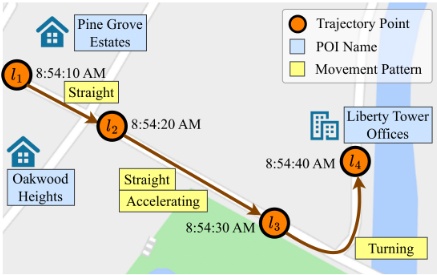
To enhance the use of ST trajectories in tasks and applications, it is essential to develop a trajectory learning method that 1) effectively captures the information embedded in the trajectory, specifically, movement patterns that describe how the individual or object moves from one location to another and travel purposes that indicate the underlying reason or motivation for the movement; and 2) accurately performs a variety of downstream tasks, reducing the need for designing a separate method for each task and application. methods primarily use self-supervised learning [Dai and Le2015,Devlin et al.2019] to map trajectories into embedding vectors, training models from scratch [Yang et al.2023, Fu and Lee2020, Jiang et al.2023]. However, these models face limitations due to the complexity of trajectory information and constraints in model capacity, as well as the size and quality of available datasets.
On the other hand, versatile models have been highly successful in the domain of natural language processing (NLP), showcasing promising results on various downstream tasks [Radford et al.2019,Devlin et al.2019,Raffel et al.2020, Du et al.2022]. These models, often referred to as large language models (LLMs), benefit mainly from their large capacity, abundant large-scale corpus datasets, and well-thoughtout prompt engineering [Brown et al.2020]. Given the similarities between trajectories and sentences in NLP, LLMs hold promise for enhancing trajectory learning models. Trajectory points share spatio-temporal correlations akin to word contexts, with movement patterns and travel purposes resembling word and sentence semantics. However, adapting LLMs for trajectory modeling presents challenges.
First, LLMs are incapable of processing the raw features in trajectories. LLMs are designed for discrete word sequences, but trajectories involve continuous and discrete spatio-temporal data like GPS coordinates and timestamps, which are difficult for LLMs to process. Second, LLMs are unable to extract the movement patterns and travel purposes directly from trajectories. For example, a moving object might go straight, accelerate, or turn, as shown in Figure 1. These movement patterns can be derived from changes in coordinates, timestamps, and velocities, while travel purposes are linked to the trajectory's origin and destination. The example trajectory which starts near residential buildings and ends near an office building suggests commuting. LLMs, however, focus on word semantics and are not equipped to interpret these spatio-temporal patterns or purposes.
To address these challenges and effectively leverage LLMs to construct a versatile trajectory learning model, we propose a novel approach named Trajectory Cognition (TrajCogn). TrajCogn employs a trajectory prompt to integrate movement patterns and travel purposes, and uses task-p-tuning to adapt to various tasks and make accurate predictions. It includes a trajectory semantic embedder to enable LLMs to process spatio-temporal features and extract movement patterns and travel purposes. Additionally, a cross-reconstruction pretext task based on self-supervised learning is implemented to enhance TrajCogn's ability to learn from trajectory data. Our contributions are summarized as follows:
- We introduce TrajCogn, a model that migrates LLMs to cognize movement patterns and travel purposes from trajectories, accurately performing different downstream tasks despite small dataset limitations.
- We develop a novel trajectory prompt to integrate movement patterns and travel semantics into LLMs, enhancing adaptability to various tasks.
- We propose a trajectory semantic embedder to process spatio-temporal features, allowing LLMs to extract movement patterns and travel semantics explainably.
- We conduct extensive experiments on three real-world trajectory datasets, and the results demonstrate TrajCogn's versatility and strong performance across different tasks.
2 RelatedWorks
Trajectory Learning Models aim to extract information from trajectories and perform various related tasks. Compared to task-specific prediction models [Feng et al.2018, Yao et al.2019, Fang et al.2022a, Wang et al.2018, Chen et al.2022b, Li et al.2018b], which are end-to-end trained for one specific task, trajectory learning models are versatile and useful in modern intelligent transportation applications that usually involve multiple tasks.
Most existing efforts adhere to the self-supervised learning approach. Earlier research commonly used RNNs to reconstruct discrete locations [Li et al.2018a,Liu et al.2020,Fu and Lee2020] or continuous movement features [Yao et al.2017] of trajectories based on auto-encoding [Hinton and Salakhutdinov2006] and variational auto-encoders [Kingma and Welling2014]. Additionally, methods like CTLE [Lin et al.2021] and Toast [Chen et al.2021], based on transformers [Vaswani et al.2017] and Masked Language Model (MLM) tasks [Devlin et al.2019], treat trajectory points as tokens in a sentence. Furthermore, contrastive learning methods such as PIM [Yang et al.2021b], TrajCL [Chang et al.2023], and MMTEC [Lin et al.2023] implicitly model the travel purpose of a trajectory. More recently, methods combining multiple approaches have been developed. START [Jiang et al.2023] leverages both MLM tasks and SimCLR [Chen et al.2020], while LightPath [Yang et al.2023] incorporates a reconstruction task and a contrastivestyle rational reasoning task.
Since these methods are self-supervised and trained from scratch, their performance heavily relies on the size and quality of the training datasets, which often have limitations. Despite the achievements of existing methods, further efforts are needed to enhance the performance of trajectory learning models.
Cross-domain Application of LLMs. The versatility and superior performance of large language models (LLMs) in the NLP domain have led to efforts to adopt LLMs in other fields to enhance performance. GPT4TS [Zhou et al.2023] uses LLMs by freezing the self-attention feed-forward layers. Time-LLM [Jin et al.2023] introduces a reprogramming framework. LM4VisualEncoding [Pang et al.2023] incorporates a frozen transformer block from an LLM as a general-purpose visual encoder layer. UrbanGPT [Li et al.2024a] employs spatio-temporal encoding combined with LLM instruction-tuning for generalized zero-shot prediction. FlashST [Li et al.2024b] introduces an innovative prompttuning framework designed to adapt pre-trained models for spatio-temporal prediction tasks.
Although these studies provide valuable insights, their methods cannot be directly applied to trajectory learning. Trajectory data has unique spatio-temporal features that require tailored approaches and considerations.
3 Preliminaries
3.1 Definition
Definition 1 (Road Network). A road network is represented as a directed graph G = (V, E). V is a set of |V| vertices, and each vertex vi ∈ V represents an intersection between road segments or the end of a segment. E is a set of |E| segments, where each segment si ∈ E represents a road segment linking two vertices.
Definition 2 (Trajectory). A trajectory T is a sequence of timestamped locations, represented as T = ⟨(l1, t1), (l2, t2), · · · , (ln, tn)⟩. Here, each location li is represented by its latitude and longitude coordinates, i.e., li = (llat i , llng i ). The timestamp ti indicates when li is visited. To simplify, we denote the i-th trajectory point (li, ti) as τi.
Definition 3 (Point of Interest, POI). A POI is a particular location that individuals may find valuable or intriguing. It is denoted as p = (l, n, a), where l represents its coordinates, n indicates its name, and a refers to its address.
3.2 Problem Statement
Trajectory Learning. The objective is to develop a trajectory learning model fΘ with a set of learnable parameters Θ. This model takes a trajectory T as input and extracts information from it. Subsequently, this model can adapt to various downstream tasks by accurately predicting the required outputs y for the task at hand, denoted as ˆ y = fΘ(T ). For example, in travel time estimation, y and ˆ y represent the ground truth and the estimated travel time, respectively.
3.3 Pre-trained Language Model
In this work, a Large Language Model (LLM) refers to a Transformer-based language model pre-trained on corpus datasets. It consists of four essential functions. Formally,
where ◦ represents the composition of functions. Specifically, a LLM consists of a tokenizer (Tok) to break down text into discrete tokens, a word token embedding layer (WTE) that converts the tokens into numerical vectors to capture their linguistic features, a transformer block (TransBlk) that further processes the vectors to capture their contextual relationships, and a prediction head (LMHead) that is respondible for making specific predictions, such as generating the next word in a sequence. In a LLM, the dimension of the word token embedding is denoted as d.
4 Methodology
4.1 Overview
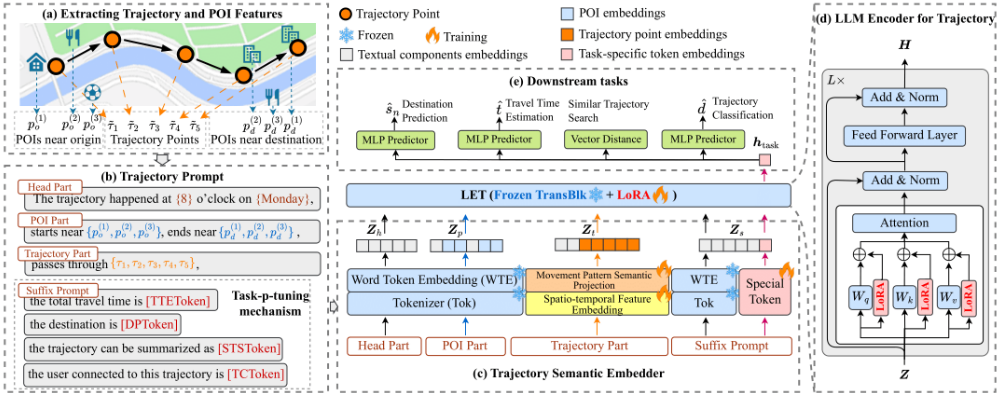
Figure 2 shows the overall framework of TrajCogn. It is implemented in the following four steps:
- Trajectory and POI Feature Extraction: Given a trajectory T , we perform map-matching and calculate highorder features such as velocity, acceleration, and direction to expand its features, denoted as ˜ T . We also extract the address and name features of POIs near the trajectory's origin and destination.
- Trajectory Prompt Construction: We integrate the extracted features into one sequence, called the trajectory prompt. This prompt also includes a task-p-tuning mechanism-based suffix to enable adaptation to various tasks.
- Trajectory Prompt Embedding: We map the trajectory prompt into a sequence of d-dimensional embeddings with a trajectory semantic embedder. This embedder is designed to enable LLMs to process spatio-temporal features and effectively extract movement patterns and travel purposes with explainability.
- Model Training and Task Adaptation: We process the embedding sequence with a LLM Encoder for Trajectory (LET). The last point of the output sequence of LET is used for performing downstream tasks. The learnable parameters in the model are refined by integrating a crossreconstruction pretext task and further optimized with a dedicated objective function for each specific downstream task.
The following sections provide a detailed explanation of the steps in TrajCogn.
4.2 Trajectory Prompt
As illustrated in Figure 1, movement patterns in a trajectory can be represented by positions on the road network and variations in spatio-temporal features. Travel purposes can be inferred from the functionalities of locations near the OD points, and the address and name features of a POI indicate its functionalities.
To incorporate the movement patterns and travel purposes of a trajectory, we first extract spatio-temporal and POI features from the trajectory, as shown in Figure 2(a). To integrate these features into LLMs, we introduce a Trajectory Prompt, as illustrated in Figure 2(b). This prompt fuses natural language and the extracted features into a sequence. Furthermore, to adapt the model to different downstream tasks, we introduce a task-p-tuning mechanism, which provides a specific suffix for each task.
Trajectory and POI Feature Extraction
Given a trajectory T = ⟨(l1, t1), (l2, t2), . . . , (ln, tn)⟩ and a road network G, we apply the Leuven Map Matching (LMM) algorithm to map each trajectory point τi onto the road network, denoted as LMM(τi, G) = (li, si, ti), where si is the road segment containing li. We then calculate the velocity vi, acceleration ai, and direction θi of each point based on differences between consecutive points. The trajectory point ˜ τi = (li, si, ti, vi, ai, θi) is formed with these spatio-temporal features, setting the velocity and acceleration of the last point ˜ τn to 0. The final trajectory ˜ T = ⟨ ˜ τ1, ˜ τ2, . . . , ˜ τn⟩ is obtained. For POI feature extraction, we first identify the origin l1 and destination ln of the trajectory T . Using the Ball Tree algorithm, we retrieve the closest NPOI POIs to l1, denoted as PO = {p(1) o , . . . , p(NPOI) o }, ordered by distance from the origin. The same process is applied to retrieve POIs around ln, denoted as PD. For each POI p ∈ PO ∪PD, we extract its address p.a and name p.n features, both represented as word lists.
Trajectory Prompt Construction
The trajectory prompt is made up of four parts. First, the ⟨Head Part⟩ introduces the context by stating "The trajectory happened on {day-in-week} at {hour} o'clock." Second, the ⟨POI Part⟩ provides details about the POIs near the origin and destination, saying "starts near: {p(1) o , p(2) o , . . . , p(NPOI) o }, ends near: {p(1) d , p(2) d , . . . , p(NPOI) d }." Third, the ⟨Trajectory Part⟩ includes the extracted features of the trajectory points, described as "passes through {˜ τ1, ˜ τ2, . . . , ˜ τn}."
Finally, the ⟨Suffix Prompt⟩ is constructed using the taskp-tuning mechanism, which combines hard and soft components [Han et al.2022]. The hard component contains taskspecific words, while the soft component is a task-specific token represented as [Token]. For example, for travel time estimation (TTE), the suffix prompt would read "the total travel time is [TTEToken]." For destination prediction (DP), it would be "the destination is [DPToken]." For trajectory classification, it would be "the user connected to this trajectory is [TCToken]."
| Categories | Words |
|---|---|
| Driving Behaviors | straight, turn, u-turn, brake, acceler- ate, decelerate, stop, overtake, zigzag, swerve, detour, slide, cruise, glide, cau- tious, reckless, leisurely |
| Traveling Dynamics | steady, smooth, rough, constant, dy- namic, fast, slow, rapid, rushed, erratic, agile, stationary, sluggish |
4.3 Trajectory Semantic Embedder
In order to equip LLMs with the ability to process the spatiotemporal features in the trajectory prompt, we propose the Trajectory Semantic Embedder, demonstrated in Figure 2(c).
Spatio-temporal Feature Embedding
The spatio-temporal features in the trajectory prompt are embedded into a d-dimensional space. For discrete road segments si, an index-fetching embedding module EE ∈ R|E|×d is used. Timestamps ti are embedded using modules Edw ∈ R7×d and Eh ∈ R24×d for day-in-week and hour features, respectively. Continuous features of trajectory points are embedded using a one-dimensional convolution, inspired by previous studies [Wang et al.2018, Liang et al.2022], to model movement patterns. The continuous embedding vector of τi is obtained as follows:
where k denotes the kernel size, τ con =
i , llat i , vi, ai, θi, ti) presents the continuous features.
i (llat
Finally, the embedding vector ei of the i-th trajectory point τi is derived as follows:
Movement Pattern Semantic Projection
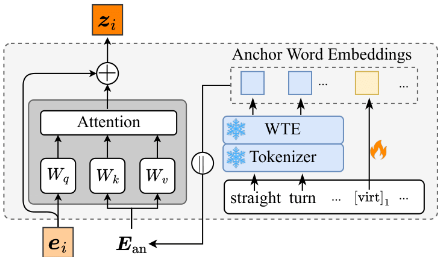
To improve the model's understanding and interpretability of movement patterns, each embedding vector ei is projected onto a semantic-rich textual space, as shown in Figure 3. This space is defined by a set of descriptive words M and a set of vitual words A. The descriptive words are listed in Table 1 and the virtual words are initialized randomly and trained end-to-end. These words form anchor words, whose embeddings are concatenated into Ean. Using multi-head attention [Vaswani et al.2017], where ei serves as the query and Ean acts as both the key and value, ei is projected onto this space, resulting in ˜ zi. The final embedding vector zi is obtained by adding a residual connection through a two-layer MLP:
The sequence of these embeddings for the trajectory is denoted as ZT = ⟨z1, z2, . . . , zn⟩.
POI Feature Embedding
The travel purpose is inferred by analyzing the functionalities of POIs near the origin and destination points. To model these functionalities, we derive embeddings for POIs based on their address and name features. For the closest POIs to the origin or destination, p(1) o or p(1) d , embeddings are obtained by concatenating their address and name:
where ∥ denotes list concatenation. For other POIs, only the name is used for embedding: ETok(p) = WTE ◦ Tok(p.n).
Sequence of Trajectory Prompt Embeddings
After obtaining embeddings of spatio-temporal and POI features, the remaining textual components in the trajectory prompt are embedded using WTE ◦ Tok. Then, we concatenate the embeddings into a sequence in the same order as their raw features appear in the prompt. For example, the embeddings of the trajectory part are obtained as follows:
The embeddings of the ⟨Head Part⟩, ⟨POI Part⟩, and ⟨Suffix Prompt⟩ are denoted as Zh, Zp, and Zs, respectively. Finally, the sequence of trajectory prompt embeddings is gathered as follows:
4.4 LLMEncoder for Trajectory
We use the transformer block TransBlk from an LLM as the backbone for the proposed LLM Encoder for Trajectory (LET). To better adapt the pre-trained TransBlk to trajectory learning, we employ the Low Rank Adaptation (LoRA) algorithm [Hu et al.2022], adding extra parameters to TransBlk.
Construction of LET
As illustrated in Figure 2(d), all parameters in the TransBlk are kept fixed, while we introduce a new learnable parameter matrix in every self-attention block by applying LoRA algorithm. The proposed LET can be expressed as follows:
LET takes the embedding sequence Z from Equation 7 as input, and outputs a sequence of hidden vectors H = LET(Z),H ∈ RL×d , where L represents the length of Z.
Adaptation to Downstream Tasks
LET adapts to different downstream tasks using the task-ptuning mechanism described in Section 4.2. Specifically, the hidden vector corresponding to the task-specific token, i.e., the L-th hidden vector htask ∈ Rd in H, can be utilized to perform downstream tasks.
In this study, we present Travel Time Estimation (TTE), Destination Prediction (DP), Similar Trajectory Search (STS) and Trajectory Classification (TC) tasks for evaluation, as shown in Figure 2(e).
The TTE task aims to estimate travel time using spatial features and departure time, excluding time-related features. A two-layer MLP is used to predict travel time: ˆ yTTE = MLPTTE(htask).
The DP task aims to predict the destination road segment, excluding the last 5 trajectory points and nearby POIs to prevent data leakage. A two-layer MLP predicts the segment: ˆ yDP = argmaxs(ˆp), ˆp = Softmax(MLP(htask)).
The STS task aims to find the most similar trajectory using cosine similarity on htask. We construct ground truth by selecting 1,000 test trajectories, using odd-numbered points as queries T q and even-numbered points as targets T t . We exclude the 10 closest trajectories and randomly select 5,000 others as negatives. Distances are calculated by downsampling to a uniform length and using mean square error, as per [Fang et al.2022b].
The TC task aims to classify trajectories by driver, using a two-layer MLP to predict the driver: ˆ yTC = argmaxd(ˆp), ˆp = Softmax(MLP(htask))
4.5 Model Training
We propose a cross-reconstruction pretext task to train the learnable parameters in the model, helping it adapt to trajectories. Before performing a specific task, the model can be further fine-tuned with supervision for that task.
Cross-reconstrution Pretext Task
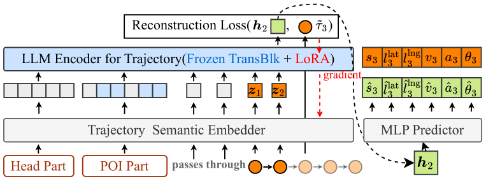
The proposed pretext task involves reconstructing each trajectory point given ⟨Head Part⟩ and ⟨POI Part⟩, and reconstructing each POI given ⟨Head Part⟩ and ⟨Trajectory Part⟩.
As shown in Figure 4, for trajectory points, LET processes embeddings up to the i - 1 step as Htraj,i-1 = LET(Zh∥Zp∥Zt,:i-1), and predicting features with a twolayer MLP. The loss Ltraj combines the cross-entropy loss of the predicted segments and the MSE loss of the predicted continuous features. For POIs, LET processes embeddings similarly as HPOI,i-1 = LET(Zh∥Zt∥Zp,:i-1), predicting features with the LLM's LMHead. The loss LPOI is the crossentropy of predicted features. The total pretext loss is
Teacher-forcing is used to enhance training efficiency.
Task-specific Fine-tuning
When performing a specific task, the proposed model can be fine-tuned with the task's supervision to further improve prediction accuracy.
For the TTE task, the loss function is defined with mean square error (MSE) loss. For the DP and TC task, the loss function is defined with the cross-entropy loss. The STS task does not require fine-tuning, using the hidden state htask from the pretext task directly.
| Task | Travel Time Estimation | Destination Prediction | Similar Trajectory Search | |||||||
|---|---|---|---|---|---|---|---|---|---|---|
| Datasets | Methods | RMSE (sec) ↓ | MAE (sec) ↓ | MAPE (%) ↓ | ACC@1 (%) ↑ | ACC@5 (%) ↑ | Recall (%) ↑ | Mean Rank ↓ | ACC@1 (%) ↑ | ACC@5 (%) ↑ |
| Traj2vec | 130.872 ± 2.013 | 59.993 ± 2.225 | 14.870 ± 0.698 | 43.074 ± 1.255 | 73.899 ± 1.568 | 14.760 ± 0.345 | 3.371 ± 0.156 | 83.325 ± 0.754 | 89.375 ± 0.459 | |
| T2vec | 128.508 ± 2.600 | 60.520 ± 2.575 | 15.224 ± 0.446 | 47.739 ± 0.239 | 73.509 ± 0.147 | 16.638 ± 0.108 | 3.345 ± 0.380 | 81.450 ± 0.778 | 93.700 ± 1.838 | |
| TremBR | 125.535 ± 2.849 | 57.965 ± 2.588 | 13.964 ± 0.860 | 48.987 ± 0.377 | 72.082 ± 0.289 | 17.010 ± 0.495 | 4.659 ± 1.010 | 83.980 ± 1.145 | 89.880 ± 0.303 | |
| CTLE | 132.636 ± 3.973 | 57.481 ± 1.144 | 13.153 ± 0.750 | 51.004 ± 0.683 | 79.434 ± 0.641 | 21.467 ± 0.704 | 9.429 ± 1.587 | 53.767 ± 7.414 | 69.200 ± 4.508 | |
| Chengdu | Toast | 128.793 ± 2.566 | 60.997 ± 3.537 | 14.883 ± 0.576 | 50.897 ± 0.495 | 79.664 ± 0.498 | 21.068 ± 0.383 | 5.944 ± 1.130 | 53.640 ± 2.244 | 71.600 ± 2.819 |
| TrajCL | 120.211 ± 1.040 | 59.816 ± 1.841 | 14.741 ± 0.443 | 50.847 ± 0.249 | 79.693 ± 0.577 | 21.572 ± 0.324 | 1.198 ± 0.219 | 95.125 ± 5.022 | 98.875 ± 1.350 | |
| START | 122.205 ± 3.181 | 55.922 ± 2.397 | 12.717 ± 0.788 | 52.775 ± 0.311 | 80.423 ± 0.409 | 23.316 ± 0.310 | 1.089 ± 0.041 | 96.933 ± 2.060 | 99.900 ± 0.100 | |
| LightPath | 119.23 ± 2.367 | 55.614 ± 1.518 | 12.760 ± 0.854 | 49.154 ± 0.234 | 78.587 ± 0.583 | 20.660 ± 0.273 | 27.266 ± 3.544 | 74.267 ± 4.765 | 86.100 ± 3.874 | |
| TrajCogn (ours) | 115.079 ± 1.608 | 51.973 ± 1.922 | 11.635 ± 0.587 | 59.594 ± 0.867 | 86.740 ± 0.294 | 30.184 ± 0.875 | 1.068 ± 0.044 | 99.240 ± 0.152 | 99.940 ± 0.060 | |
| Task | Trajectory Classification | Destination Prediction | Similar Trajectory Search | |||||||
| Datasets | Methods | ACC@1 (%) ↑ | ACC@5 (%) ↑ | Recall (%) ↑ | ACC@1 (%) ↑ | ACC@5 (%) ↑ | Recall (%) ↑ | Mean Rank ↓ | ACC@1 (%) ↑ | ACC@5 (%) ↑ |
| Traj2vec | 51.469 ± 1.221 | 95.464 ± 0.135 | 45.225 ± 2.185 | 19.403 ± 0.754 | 42.086 ± 0.735 | 4.832 ± 0.578 | 2.365 ± 0.304 | 90.320 ± 1.492 | 93.838 ± 0.960 | |
| T2vec | 50.880 ± 1.964 | 96.248 ± 0.044 | 49.191 ± 1.933 | 20.168 ± 0.246 | 43.230 ± 0.881 | 5.324 ± 0.483 | 1.683 ± 0.108 | 91.640 ± 0.913 | 95.133 ± 0.404 | |
| Trembr | 55.300 ± 0.960 | 95.581 ± 0.113 | 50.321 ± 1.703 | 20.472 ± 0.762 | 43.974 ± 0.153 | 5.626 ± 0.392 | 2.051 ± 0.317 | 89.908 ± 1.016 | 93.504 ± 0.537 | |
| CTLE | 85.162 ± 4.111 | 97.426 ± 0.361 | 66.663 ± 3.049 | 18.775 ± 0.917 | 40.718 ± 1.093 | 2.796 ± 0.655 | 5.589 ± 0.621 | 64.675 ± 4.565 | 82.750 ± 4.778 | |
| Porto | Toast | 51.102 ± 4.921 | 82.088 ± 5.294 | 27.604 ± 4.898 | 18.731 ± 0.353 | 39.673 ± 0.688 | 2.412 ± 0.273 | 6.013 ± 1.097 | 61.533 ± 3.886 | 80.367 ± 2.602 |
| TrajCL | 88.012 ± 2.085 | 96.308 ± 0.342 | 76.217 ± 2.541 | 20.601 ± 0.121 | 45.876 ± 0.204 | 4.590 ± 0.200 | 1.196 ± 0.0462 | 93.500 ± 0.765 | 98.933 ± 0.408 | |
| START | 89.464 ± 3.085 | 97.122 ± 0.612 | 73.913 ± 3.183 | 21.377 ± 0.129 | 46.777 ± 0.158 | 5.750 ± 0.030 | 1.127 ± 0.016 | 96.500 ± 0.141 | 99.300 ± 0.212 | |
| LightPath | 88.294 ± 0.398 | 93.272 ± 0.033 | 86.241 ± 0.671 | 22.092 ± 0.102 | 47.131 ± 0.092 | 5.728 ± 0.491 | 5.678 ± 0.309 | 83.067 ± 2.594 | 90.578 ± 1.034 | |
| TrajCogn (Ours) | 92.021 ± 1.145 | 97.443 ± 0.302 | 87.101 ± 2.325 | 22.609 ± 0.524 | 48.827 ± 0.364 | 6.459 ± 0.092 | 1.034 ± 0.007 | 99.600 ± 0.216 | 99.900 ± 0.083 | |
| Task | Travel Time Estimation | Destination Prediction | Similar Trajectory Search | ||||||
|---|---|---|---|---|---|---|---|---|---|
| Methods | RMSE (sec) ↓ | MAE (sec) ↓ | MAPE (%) ↓ | ACC@1 (%) ↑ | ACC@5 (%) ↑ | Recall (%) ↑ | Mean Rank ↓ | ACC@1 (%) ↑ | ACC@5 (%) ↑ |
| w/o PT | 120.737 ± 0.634 | 54.951 ± 2.632 | 12.087 ± 0.980 | 57.455 ± 0.723 | 85.331 ± 0.161 | 28.390 ± 1.512 | 3.914 ± 0.033 | 88.000 ± 0.566 | 94.600 ± 0.707 |
| w/o POI | 116.132 ± 2.131 | 52.941 ± 4.453 | 12.080 ± 0.924 | 58.711 ± 0.215 | 86.128 ± 0.118 | 29.372 ± 0.666 | 1.092 ± 0.065 | 98.200 ± 2.115 | 99.325 ± 0.754 |
| w/o Conv | 117.038 ± 2.237 | 53.402 ± 3.175 | 11.836 ± 1.175 | 59.078 ± 1.054 | 86.200 ± 0.673 | 29.521 ± 1.477 | 1.137 ± 0.050 | 96.733 ± 1.823 | 98.700 ± 0.781 |
| w/o PSP | 115.454 ± 5.551 | 53.003 ± 2.363 | 12.265 ± 0.856 | 58.797 ± 0.698 | 86.166 ± 0.460 | 29.503 ± 0.779 | 1.256 ± 0.256 | 96.667 ± 2.214 | 98.367 ± 1.037 |
| w/oM | 115.233 ± 0.509 | 52.790 ± 3.297 | 11.891 ± 0.794 | 58.930 ± 0.220 | 86.668 ± 0.324 | 29.626 ± 0.287 | 1.069 ± 0.022 | 98.525 ± 0.551 | 99.350 ± 0.100 |
| TrajCogn (full) | 115.079 ± 1.608 | 51.973 ± 1.922 | 11.635 ± 0.587 | 59.594 ± 0.867 | 86.740 ± 0.294 | 30.184 ± 0.875 | 1.068 ± 0.044 | 99.240 ± 0.152 | 99.940 ± 0.060 |
Table 3: Performance of variants of TrajCogn.
al.2023] incorporates a time-aware encoder and GAT, trained with MLM and SimCLR-based contrastive tasks. LightPath [Yang et al.2023] uses a sparse path encoder with path reconstruction and cross-view contrastive tasks.
5.3 Settings
For each dataset, we divide the trajectories into training, validation, and testing sets in an 8:1:1 ratio, ordered by departure time. Pre-training for the cross-reconstruction task and embedding methods lasts 20 epochs, with early stopping for downstream predictors based on validation performance.
All models are implemented using PyTorch [Paszke et al.2019]. We choose GPT2 [Radford et al.2019] as the foundation LLM to develop our model and obtain addresses and names of POIs using Amap APIs 4 . Our source codes are available at https://github.com/Zeru19/TrajCogn. Key hyperparameters for TrajCogn are NA = 15, K = 5, r = 8, and NPOI = 3, optimized based on Acc@1 and Recall for destination prediction on Chengdu's validation set. The Adam optimizer is used with a learning rate of 1e-4 for our method and 0.001 for others. Experiments run on Ubuntu 22.04 with Intel(R) CPUs and nVidia(R) TITAN RTX GPUs, repeated 5 times to report mean and deviation of metrics.
5.4 Performance Comparison
Overall Performance
Table 2 present a comprehensive comparison of the performance of all task-adaptable trajectory learning methods
4 https://lbs.amap.com/
5 Experiments
5.1 Datasets
In our experiments, we use three real-world datasets called Chengdu, Xi'an and Porto. Chengdu and Xi'an datasets were released by Didi 1 and consist of GPS trajectories recorded by taxis in Chengdu and Xi'an, China. Porto is an open-source dataset released for a Kaggle competition 2 . Trajectories with fewer than 6 points were excluded. Road networks from OpenStreetMap 3 were used for map-matching. An overview of the dataset statistics is shown in Appendix A.
5.2 ComparisonMethods
We compare the proposed method with several state-of-theart trajectory learning methods. Traj2vec [Yao et al.2017] calculates features with sliding windows and trains with an auto-regressive pretext task. T2vec [Li et al.2018a] pretrains the model using a denoising auto-encoder to reconstruct trajecotories. TremBR [Fu and Lee2020] constructs an RNN-based seq2seq model for recovering road segments and times. CTLE [Lin et al.2021] utilizes a bi-directional Transformer with MLM tasks for location and hour predictions. Toast [Chen et al.2021] employs a context-aware node2vec model with MLM and sequence discrimination tasks. TrajCL [Chang et al.2023] introduces a dual-feature, attentionbased encoder trained with InfoNCE loss. START [Jiang et across four tasks and two datasets. The TTE task was excluded for Porto due to potential data leakage from equalinterval sampling, and trajectory classification was limited to Porto due to insufficient trajectories per driver in Chengdu. Our proposed method consistently outperforms the others and performs well across tasks, providing evidence that it is an advanced task-adaptable trajectory learning method.
1 https://gaia.didichuxing.com/
2 https://www.kaggle.com/c/pkdd-15-predict-taxi-servicetrajectory-i
3 https://www.openstreetmap.org/
Methods like Traj2vec, T2vec, and TremBR use RNNbased frameworks but lack crucial spatio-temporal features, leading to poor downstream performance. CTLE and Toast use bi-directional Transformers with MLM tasks [Devlin et al.2019] but miss essential continuous features and travel purposes, affecting their STS task performance. TrajCL, START, and LightPath use contrastive learning, aiding STS performance, but overlook POI functionalities and struggle with movement pattern extraction, resulting in unsatisfactory TTE and DP results. Our method utilizes LLMs for adaptable trajectory learning, effectively extracting movement patterns and incorporating POI functionalities and travel purposes through a trajectory prompt. These strengths lead to superior performance across tasks.
Scalability
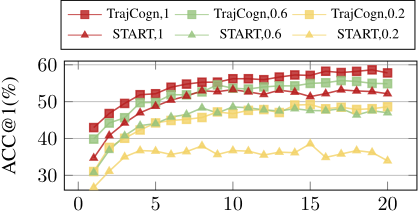
To compare the scalability of the proposed model against START, one of the state-of-the-art models, we refine our model using varying proportions of the training data: 100%, 60%, and 20% for the destination prediction task on the Chengdu dataset. We use the START model as a reference point with an identical learning rate of 5 × 10⁻⁴ for comparison. The results are presented in Figure 5. It can be seen that our model demonstrates faster progress and achieves superior performance with less data compared to START. This shows that our model can be adapted to downstream tasks with lightweight finetuning.
5.5 Model Analysis
Effectiveness of Components
To evaluate components implemented in TrajCogn, we compared the performance of the complete model with the following variants. w/o PT excludes the cross-reconstruction pretext task, training directly on downstream tasks. w/o POI removes the ⟨POI Part⟩ from the trajectory prompt. w/o Conv replaces the convolution operator in the trajectory semantic embedder with a fully connected layer. w/o PSP excludes the pattern semantic projector, using only the trajectory point embedding ei; and w/o M omits the movement pattern vocabulary, relying solely on virtual anchor words.
We measured the performance of these variants on the Chengdu dataset, and the results are presented in Table 3. w/o PT shows performance degradation, proving the contribution of the cross-reconstruction pretext task to TrajCogn. The worse performance witnessed by w/o POI demonstrates the effectiveness of integrating POI information. w/o Conv, w/o PSP, and w/o M all have worse performance compared to full, showing that the removed components all contribute to TrajCogn's performance.
Attention Map Visualization
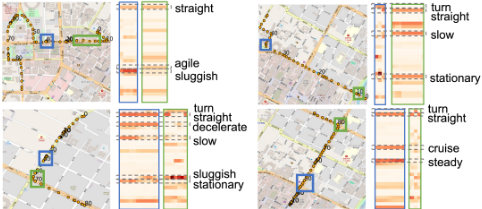
To demonstrate our model's ability to extract interpretable movement patterns, we visualize attention scores in the pattern semantic projector, as shown in Figure 6. Each subfigure shows the trajectory with marked points and subtrajectories on the left, and their attention maps on the right. We observed that trajectory points' movement patterns correspond to specific anchor words. Terms like "turn," "slow," and "steady" reveal the semantics of these patterns. For instance, turns increase attention for "turn," while "slow" and "stationary" suggest slowmovement. However, these words do not always fully capture true movement semantics, highlighting the need for accurate labeled data for better alignment.
Additional Model Analysis
Further analysis of TrajCogn is detailed in the Supplementary Material. Appendix B covers its performance on the Xi'an dataset. Appendix C examines hyper-parameter effectiveness. Appendix D explores TrajCogn's efficiency. Appendix E discusses the impact of anchor words, while Appendix F looks at additional features. Appendix G analyzes the foundation LLM's effectiveness.
6 Conclusion
We propose TrajCogn, a novel trajectory learning model that leverages LLMs to model trajectories and accurately perform various trajectory-related tasks. TrajCogn introduces a trajectory prompt that combines movement patterns and travel purposes, enabling task adaptability. It also includes a trajectory semantic embedder for processing spatio-temporal features, allowing for effective and explainable extraction of movement patterns and travel purposes. Experiments on real-world datasets confirm TrajCogn's superior performance.
Ethical Statement
There are no ethical issues.
Acknowledgments
This work was supported by the National Natural Science Foundation of China (No. 62272033).
Contribution Statement
Zeyu Zhou and Yan Lin contributed equally to this research.
@inproceedings{ijcai2025p411,
  title     = {TrajCogn: Leveraging LLMs for Cognizing Movement Patterns and Travel Purposes from Trajectories},
  author    = {Zhou, Zeyu and Lin, Yan and Wen, Haomin and Guo, Shengnan and Hu, Jilin and Lin, Youfang and Wan, Huaiyu},
  booktitle = {Proceedings of the Thirty-Fourth International Joint Conference on
               Artificial Intelligence, {IJCAI-25}},
  publisher = {International Joint Conferences on Artificial Intelligence Organization},
  editor    = {James Kwok},
  pages     = {3698--3706},
  year      = {2025},
  month     = {8},
  note      = {Main Track},
  doi       = {10.24963/ijcai.2025/411},
  url       = {https://doi.org/10.24963/ijcai.2025/411},
}
TY - CPAPER TI - TrajCogn: Leveraging LLMs for Cognizing Movement Patterns and Travel Purposes from Trajectories AU - Zhou, Zeyu AU - Lin, Yan AU - Wen, Haomin AU - Guo, Shengnan AU - Hu, Jilin AU - Lin, Youfang AU - Wan, Huaiyu T2 - Proceedings of the Thirty-Fourth International Joint Conference on Artificial Intelligence, IJCAI-25 PB - International Joint Conferences on Artificial Intelligence Organization PY - 2025 SP - 3698 EP - 3706 DO - 10.24963/ijcai.2025/411 UR - https://doi.org/10.24963/ijcai.2025/411 ER -Copied
Machine-readable versions of this paper, for tools and AI agents:





