
Modality-Fair Preference Optimization for Trustworthy MLLM Alignment
Proceedings of the Thirty-Fourth International Joint Conference on Artificial Intelligence. Main Track. Pages 403-411.
https://doi.org/10.24963/ijcai.2025/46
Keywords
- Natural Language Processing: NLP: Question answering
- AI Ethics, Trust, Fairness: ETF: Fairness and diversity
- AI Ethics, Trust, Fairness: ETF: Trustworthy AI
Abstract
Multimodal large language models (MLLMs) have achieved remarkable success across various tasks. However, separate training of visual and textual encoders often results in a misalignment of the modality. Such misalignment may lead models to generate content that is absent from the input image, a phenomenon referred to as hallucination. These inaccuracies severely undermine the trustworthiness of MLLMs in real-world applications. Despite attempts to optimize text preferences to mitigate this issue, our initial investigation indicates that the trustworthiness of MLLMs remains inadequate. Specifically, these models tend to provide preferred answers even when the input image is heavily distorted. Analysis of visual token attention also indicates that the model focuses primarily on the surrounding context rather than the key object referenced in the question. These findings highlight a misalignment between the modalities, where answers inadequately leverage input images. Motivated by our findings, we propose Modality-Fair Preference Optimization (MFPO), which comprises three components: the construction of a multimodal preference dataset in which dispreferred images differ from originals solely in key regions; an image reward loss function encouraging the model to generate answers better aligned with the input images; and an easy-to-hard iterative alignment strategy to stabilize joint modality training. Extensive experiments on three trustworthiness benchmarks demonstrate that MFPO significantly enhances the trustworthiness of MLLMs. In particular, it enables the 7B models to attain trustworthiness levels on par with, or even surpass, those of the 13B, 34B, and larger models.
- [Achiam et al., 2023] Josh Achiam, Steven Adler, Sandhini Agarwal, Lama Ahmad, Ilge Akkaya, Florencia Leoni Ale- man, Diogo Almeida, Janko Altenschmidt, Sam Altman, Shyamal Anadkat, et al. Gpt-4 technical report. arXiv preprint arXiv:2303.08774, 2023.
- [Bai et al., 2023] Jinze Bai, Shuai Bai, Shusheng Yang, Shijie Wang, Sinan Tan, Peng Wang, Junyang Lin, Chang Zhou, and Jingren Zhou. Qwen-vl: A versatile vision-language model for understanding, localization, text reading, and beyond. 2023.
- [Bai et al., 2024] Zechen Bai, Pichao Wang, Tianjun Xiao, Tong He, Zongbo Han, Zheng Zhang, and Mike Zheng Shou. Hallucination of multimodal large language models: A survey. arXiv preprint arXiv:2404.18930, 2024.
- [Bianchini et al., 2005] Monica Bianchini, Marco Gori, and Franco Scarselli. Inside pagerank. ACM Transactions on Internet Technology (TOIT), 5(1):92-128, 2005.
- [Boudin, 2018] Florian Boudin. Unsupervised keyphrase extraction with multipartite graphs. arXiv preprint arXiv:1803.08721, 2018.
- [Casper et al., 2023] Stephen Casper, Xander Davies, Clau- dia Shi, Thomas Krendl Gilbert, Jérémy Scheurer, Javier Rando, Rachel Freedman, Tomasz Korbak, David Lindner, Pedro Freire, et al. Open problems and fundamental lim- itations of reinforcement learning from human feedback. arXiv preprint arXiv:2307.15217, 2023.
- [Chen et al., 2024] Huayu Chen, Guande He, Hang Su, and Jun Zhu. Noise contrastive alignment of language models with explicit rewards. arXiv preprint arXiv:2402.05369, 2024.
- [Christiano et al., 2017] Paul F Christiano, Jan Leike, Tom Brown, Miljan Martic, Shane Legg, and Dario Amodei. Deep reinforcement learning from human preferences. Ad- vances in neural information processing systems, 30, 2017.
- [Cui et al., 2023] Chenhang Cui, Yiyang Zhou, Xinyu Yang, Shirley Wu, Linjun Zhang, James Zou, and Huaxiu Yao. Holistic analysis of hallucination in gpt-4v (ision): Bias and interference challenges. arXiv preprint arXiv:2311.03287, 2023.
- [Dawande et al., 2001] Milind Dawande, Pinar Keskinocak, Jayashankar M Swaminathan, and Sridhar Tayur. On bipar- tite and multipartite clique problems. Journal of Algorithms, 41(2):388-403, 2001.
- [Farquhar et al., 2024] Sebastian Farquhar, Jannik Kossen, Lorenz Kuhn, and Yarin Gal. Detecting hallucinations in large language models using semantic entropy. Nature, 630(8017):625-630, 2024.
- [Feng et al., 2024] Duanyu Feng, Bowen Qin, Chen Huang, Zheng Zhang, and Wenqiang Lei. Towards analyzing and understanding the limitations of dpo: A theoretical perspec- tive. arXiv preprint arXiv:2404.04626, 2024.
- [Guan et al., 2024] Tianrui Guan, Fuxiao Liu, Xiyang Wu, Ruiqi Xian, Zongxia Li, Xiaoyu Liu, Xijun Wang, Lichang Chen, Furong Huang, Yaser Yacoob, et al. Hallusionbench: an advanced diagnostic suite for entangled language hallu- cination and visual illusion in large vision-language models. In Proceedings of the IEEE/CVF Conference on Computer Vision and Pattern Recognition, pages 14375-14385, 2024.
- [Ho et al., 2020] Jonathan Ho, Ajay Jain, and Pieter Abbeel. Denoising diffusion probabilistic models. Advances in neu- ral information processing systems, 33:6840-6851, 2020.
- [Huang et al., 2024] Qidong Huang, Xiaoyi Dong, Pan Zhang, Bin Wang, Conghui He, Jiaqi Wang, Dahua Lin, Weiming Zhang, and Nenghai Yu. Opera: Alleviating hallucination in multi-modal large language models via over-trust penalty and retrospection-allocation. In Proceed- ings of the IEEE/CVF Conference on Computer Vision and Pattern Recognition, pages 13418-13427, 2024.
- [Jiang et al., 2024a] Chaoya Jiang, Haiyang Xu, Mengfan Dong, Jiaxing Chen, Wei Ye, Ming Yan, Qinghao Ye, Ji Zhang, Fei Huang, and Shikun Zhang. Hallucination augmented contrastive learning for multimodal large lan- guage model. In Proceedings of the IEEE/CVF Conference on Computer Vision and Pattern Recognition, pages 27036- 27046, 2024.
- [Jiang et al., 2024b] Songtao Jiang, Tuo Zheng, Yan Zhang, Yeying Jin, Li Yuan, and Zuozhu Liu. Med-moe: Mixture of domain-specific experts for lightweight medical vision- language models. arXiv preprint arXiv:2404.10237, 2024.
- [Jin and Zhang, 2014] Ya-Lei Jin and Xiao-Dong Zhang. Complete multipartite graphs are determined by their dis- tance spectra. Linear Algebra and its Applications, 448:285- 291, 2014.
- [Kirillov et al., 2023] Alexander Kirillov, Eric Mintun, Nikhila Ravi, Hanzi Mao, Chloe Rolland, Laura Gustafson, Tete Xiao, Spencer Whitehead, Alexander C Berg, Wan- Yen Lo, et al. Segment anything. In Proceedings of the IEEE/CVF International Conference on Computer Vision, pages 4015-4026, 2023.
- [Lai et al., 2024] Xin Lai, Zhuotao Tian, Yukang Chen, Yan- wei Li, Yuhui Yuan, Shu Liu, and Jiaya Jia. Lisa: Reasoning segmentation via large language model. In Proceedings of the IEEE/CVF Conference on Computer Vision and Pattern Recognition (CVPR), pages 9579-9589, June 2024.
- [Leng et al., 2024] Sicong Leng, Hang Zhang, Guanzheng Chen, Xin Li, Shijian Lu, Chunyan Miao, and Lidong Bing. Mitigating object hallucinations in large vision-language models through visual contrastive decoding. In Proceed- ings of the IEEE/CVF Conference on Computer Vision and Pattern Recognition, pages 13872-13882, 2024.
- [Li et al., 2024] Yanwei Li, Yuechen Zhang, Chengyao Wang, Zhisheng Zhong, Yixin Chen, Ruihang Chu, Shaoteng Liu, and Jiaya Jia. Mini-gemini: Mining the potential of multi-modality vision language models. arXiv preprint arXiv:2403.18814, 2024.
- [Liu et al., 2024a] Haotian Liu, Chunyuan Li, Yuheng Li, and Yong Jae Lee. Improved baselines with visual instruction tuning. In Proceedings of the IEEE/CVF Conference on Computer Vision and Pattern Recognition, pages 26296- 26306, 2024.
- [Liu et al., 2024b] Haotian Liu, Chunyuan Li, Qingyang Wu, and Yong Jae Lee. Visual instruction tuning. Advances in neural information processing systems, 36, 2024.
- [Meng et al., 2024] Yu Meng, Mengzhou Xia, and Danqi Chen. Simpo: Simple preference optimization with a reference-free reward. arXiv preprint arXiv:2405.14734, 2024.
- [Mihalcea and Tarau, 2004] Rada Mihalcea and Paul Tarau. Textrank: Bringing order into text. In Proceedings of the 2004 conference on empirical methods in natural language processing, pages 404-411, 2004.
- [Naveed et al., 2023] Humza Naveed, Asad Ullah Khan, Shi Qiu, Muhammad Saqib, Saeed Anwar, Muhammad Usman, Naveed Akhtar, Nick Barnes, and Ajmal Mian. A compre- hensive overview of large language models. arXiv preprint arXiv:2307.06435, 2023.
- [Ouyang et al., 2022] Long Ouyang, Jeffrey Wu, Xu Jiang, Diogo Almeida, Carroll Wainwright, Pamela Mishkin, Chong Zhang, Sandhini Agarwal, Katarina Slama, Alex Ray, et al. Training language models to follow instructions with human feedback. Advances in neural information processing systems, 35:27730-27744, 2022.
- [Paas et al., 2003] Fred Paas, Alexander Renkl, and John Sweller. Cognitive load theory and instructional design: Recent developments. Educational psychologist, 38(1):1-4, 2003.
- [Peng et al., 2023] Baolin Peng, Linfeng Song, Ye Tian, Lifeng Jin, Haitao Mi, and Dong Yu. Stabilizing rlhf through advantage model and selective rehearsal. arXiv preprint arXiv:2309.10202, 2023.
- [Rafailov et al., 2024] Rafael Rafailov, Archit Sharma, Eric Mitchell, Christopher D Manning, Stefano Ermon, and Chelsea Finn. Direct preference optimization: Your lan- guage model is secretly a reward model. Advances in Neural Information Processing Systems, 36, 2024.
- [Rohrbach et al., 2018] Anna Rohrbach, Lisa Anne Hen- dricks, Kaylee Burns, Trevor Darrell, and Kate Saenko. Object hallucination in image captioning. arXiv preprint arXiv:1809.02156, 2018.
- [Sarkar et al., 2024] Pritam Sarkar, Sayna Ebrahimi, Ali Etemad, Ahmad Beirami, Sercan Ö Arık, and Tomas Pfis- ter. Mitigating object hallucination via data augmented contrastive tuning. arXiv preprint arXiv:2405.18654, 2024.
- [Schulman et al., 2017] John Schulman, Filip Wolski, Pra- fulla Dhariwal, Alec Radford, and Oleg Klimov. Prox- imal policy optimization algorithms. arXiv preprint arXiv:1707.06347, 2017.
- [Shah et al., 2019] Meet Shah, Xinlei Chen, Marcus Rohrbach, and Devi Parikh. Cycle-consistency for robust visual question answering. In Proceedings of the IEEE/CVF Conference on Computer Vision and Pattern Recognition, pages 6649-6658, 2019.
- [Sun et al., 2023] Zhiqing Sun, Sheng Shen, Shengcao Cao, Haotian Liu, Chunyuan Li, Yikang Shen, Chuang Gan, Liang-Yan Gui, Yu-Xiong Wang, Yiming Yang, et al. Align- ing large multimodal models with factually augmented rlhf. arXiv preprint arXiv:2309.14525, 2023.
- [Venhuizen et al., 2019] Noortje J Venhuizen, Matthew W Crocker, and Harm Brouwer. Semantic entropy in language comprehension. Entropy, 21(12):1159, 2019.
- [Wang et al., 2023a] Junyang Wang, Yuhang Wang, Guohai Xu, Jing Zhang, Yukai Gu, Haitao Jia, Ming Yan, Ji Zhang, and Jitao Sang. An llm-free multi-dimensional bench- mark for mllms hallucination evaluation. arXiv preprint arXiv:2311.07397, 2023.
- [Wang et al., 2023b] Weihan Wang, Qingsong Lv, Wenmeng Yu, Wenyi Hong, Ji Qi, Yan Wang, Junhui Ji, Zhuoyi Yang, Lei Zhao, Xixuan Song, et al. Cogvlm: Visual expert for pretrained language models. arXiv preprint arXiv:2311.03079, 2023.
- [Wang et al., 2024] Fei Wang, Wenxuan Zhou, James Y Huang, Nan Xu, Sheng Zhang, Hoifung Poon, and Muhao Chen. mdpo: Conditional preference optimiza- tion for multimodal large language models. arXiv preprint arXiv:2406.11839, 2024.
- [Xu et al., 2024] Shusheng Xu, Wei Fu, Jiaxuan Gao, Wen- jie Ye, Weilin Liu, Zhiyu Mei, Guangju Wang, Chao Yu, and Yi Wu. Is dpo superior to ppo for llm alignment? a comprehensive study. arXiv preprint arXiv:2404.10719, 2024.
- [Yu et al., 2024a] Tianyu Yu, Yuan Yao, Haoye Zhang, Tai- wen He, Yifeng Han, Ganqu Cui, Jinyi Hu, Zhiyuan Liu, Hai-Tao Zheng, Maosong Sun, et al. Rlhf-v: Towards trust- worthy mllms via behavior alignment from fine-grained cor- rectional human feedback. In Proceedings of the IEEE/CVF Conference on Computer Vision and Pattern Recognition, pages 13807-13816, 2024.
- [Yu et al., 2024b] Tianyu Yu, Haoye Zhang, Yuan Yao, Yunkai Dang, Da Chen, Xiaoman Lu, Ganqu Cui, Taiwen He, Zhiyuan Liu, Tat-Seng Chua, et al. Rlaif-v: Aligning mllms through open-source ai feedback for super gpt-4v trustworthiness. arXiv preprint arXiv:2405.17220, 2024.
- [Yue et al., 2024] Zihao Yue, Liang Zhang, and Qin Jin. Less is more: Mitigating multimodal hallucination from an eos decision perspective. arXiv preprint arXiv:2402.14545, 2024.
- [Zhang and Rong, 2024] Mengxi Zhang and Kang Rong. Au- tomated multi-level preference for mllms. arXiv preprint arXiv:2405.11165, 2024.
- [Zhao et al., 2023] Zhiyuan Zhao, Bin Wang, Linke Ouyang, Xiaoyi Dong, Jiaqi Wang, and Conghui He. Beyond hallucinations: Enhancing lvlms through hallucination- aware direct preference optimization. arXiv preprint arXiv:2311.16839, 2023.
- [Zhou et al., 2024] Yiyang Zhou, Chenhang Cui, Rafael Rafailov, Chelsea Finn, and Huaxiu Yao. Aligning modal- ities in vision large language models via preference fine- tuning. arXiv preprint arXiv:2402.11411, 2024.
References were extracted automatically from the PDF and may contain errors.
Full text extracted automatically from the PDF; figures, tables and equations may differ. The PDF is the version of record.
1 Introduction
Recent advances in multimodal large language models (MLLMs) [Liu et al., 2024b; Wang et al., 2023b; Jiang et al., 2024b] have achieved remarkable performance on diverse multimodal tasks. However, separate training of visual and textual encoders often causes a misalignment of the modality [Cui et al., 2023; Guan et al., 2024] of MLLMs, which can cause the model to generate content that does not exist in the visual input-a phenomenon known as hallucination [Bai et al., 2024]. This issue compromises the reliability of MLLMs in real-world applications [Shah et al., 2019].
† Corresponding author: zuozhuliu@intl.zju.edu.cn
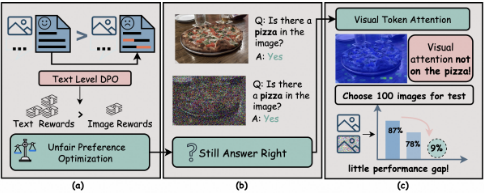
To address this issue, recent work has applied preference optimization to improve the alignment of modalities in MLLM [Rafailov et al., 2024; Naveed et al., 2023]. These methods typically train models to favor accurate responses over those that contain erroneous image descriptions. They achieve this by using inaccurate outputs as rejected options to enhance learning from correct responses, thus improving the alignment of modality [Wang et al., 2024; Zhang and Rong, 2024].
Although current preference optimization methods show success on trustworthiness benchmarks, they mainly rely on text preference optimization. This raises a critical question: What does the model learn during preference optimization when only text preferences are used? Is it merely memorizing text preferences or is it learning to align image and text data? Our experiments shown in Figure 1 reveal that even with severe noise-degrading image content [Leng et al., 2024], the model consistently provides accurate answers. Across a sample of 100 images, the disparity in performance between the original and degraded images is only 9%. Furthermore, the visualization of visual token attention shows that the model mainly focuses on the surrounding contexts rather than the key object mentioned in the question. These findings suggest that the model seems to lean more towards memorizing text preferences rather than achieving modality alignment after preference optimization.
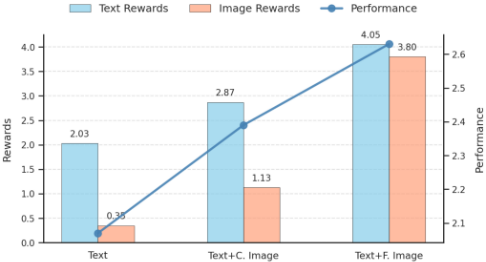
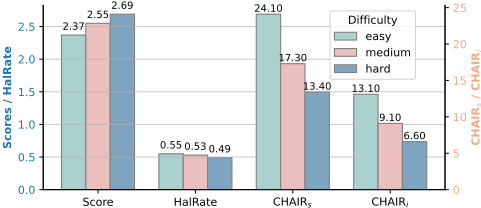
We explore implementing more modality balanced preference optimization to encourage MLLMs to focus more on modality alignment for improved trustworthiness. As shown in Figure 2, we evaluated adding image-related rewards with a simple image preference dataset and a more fine-grained image preference dataset. As we progressively update the approach, the image and text rewards become higher and also more balanced, and the model's trustworthy performance consistently improves. The limited impact of simple image degradation may be due to the model quickly learning to distinguish these variations after only a few training steps, which leads it to continue prioritizing text preference optimization. These findings illustrate the effectiveness of more balanced optimization in achieving trustworthiness. Motivated by our investigation, we propose Modality-Fair Preference Optimization (MFPO) for trustworthy MLLM alignment. To circumvent mere memorization of text responses, we propose to jointly optimize over both text and image preference in a modality-fair manner. In particular, we first construct a multimodal preference dataset encompassing both text and image preference data. Beginning with a text preference dataset, we characterize the relationship between words using a multipartite graph [Jin and Zhang, 2014; Boudin, 2018] to identify the top-K keywords. These keywords are then linked to relevant image regions using a modified Segment Anything Model (SAM) [Kirillov et al., 2023]. By introducing diffusion noise, we generate dispreferred image data that remains largely faithful to the originals while introducing meaningful differences [Jin and Zhang, 2014; Dawande et al., 2001], which are critical for preference optimization. Afterwards, to encourage fair alignment over both modalities, we devise a novel loss function consisting of text preference alignment, image preference alignment and a margin loss for stablized training. Furthermore, to tackle the instability in joint modality optimization, we propose an iterative alignment approach [Paas et al., 2003]. By categorizing training data into varying complexities using semantic entropy, we initially train the model on simpler data and gradually advance to more challenging samples.
Extensive experiments demonstrate the effectiveness of MFPO in improving model trustworthiness. Remarkably, MFPO empowers 7B LLaVA-v1.5 to achieve trustworthiness levels that are comparable to, or even exceed, those of significantly larger 13B, 34B, and larger-scale models. Specifically, when applied to models such as LLaVA-v1.5-13B, MFPO outperforms GPT-4V, achieving a substantial 40% improvement on Object HalBench and setting new state-of-the-art results on both Object HalBench and AMBER benchmarks. Furthermore, LLaVA-v1.5-7B+MFPO and LLaVA-v1.5-13B+MFPO demonstrate superior performance over GPT-4V across five out of eight evaluation metrics. Comprehensive ablation studies further confirm the efficacy of the three core components in MFPO. Our work underscores the importance of balanced preference optimization over different modalities for MLLMs.
2 Preliminaries
Reinforcement Learning from Human Feedback (RLHF) aligns models with human preferences using a reward model rϕ [Schulman et al., 2017], trained on pairwise preference data [Christiano et al., 2017; Ouyang et al., 2022; Casper et al., 2023]. The model assigns higher rewards to preferred outputs, with the cross-entropy loss:
where σ(·) is the logistic sigmoid, and rϕ(x, yw) and rϕ(x, yl) are the rewards for the preferred and less preferred outputs.
After training, the policy πθ is optimized by maximizing the expected reward while regularizing it to prevent divergence from the reference policy πref, using a KL divergence penalty:
where β balances reward maximization and regularization. The KL divergence ensures policy stability [Peng et al., 2023]. Direct Preference Optimization (DPO) directly optimizes a policy πθ using preference data D [Rafailov et al., 2024], without relying on a reward model. Concretely, DPO derives a mapping between the reward r(x, y) and the policy πθ:
where Z(x) is the partition function, defined as Z(x) = ∑y πref(y|x) exp ( 1β r(x, y)). Substitute Eq. 3 into Eq. 1, we can derive the following loss:
where yw and yl denote the preferred and less preferred outputs, respectively. This approach bypasses the complexity of RLHF by allowing the policy gradient to be computed analytically, ensuring efficient alignment with human preferences [Xu et al., 2024; Feng et al., 2024].
The common approach in DPO for MLLMs [Yu et al., 2024a; Yu et al., 2024b; Sun et al., 2023; Zhou et al., 2024] involves concatenating the image m and question t into a single input x, followed by optimization using Eq. 4. Chosen responses yw typically provide accurate, hallucination-free information, while rejected responses yl often contain hallucinated details, making them less preferred.
3 Modality-Fair Preference Optimization
3.1 Image Preference Data Generation
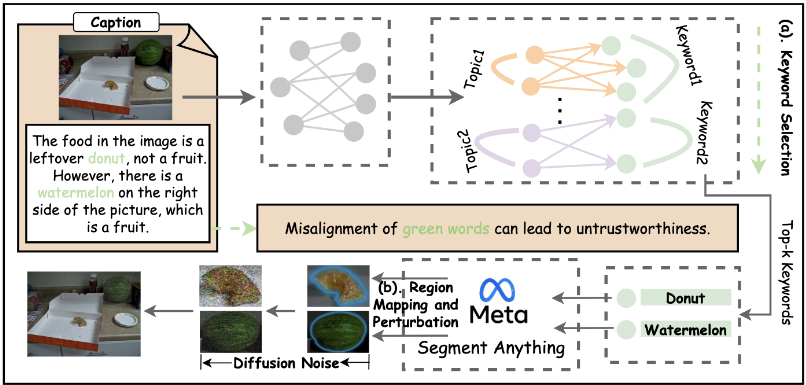
We first introduce the construction of our multimodal preference data as shown in Figure 4. A key question is: what defines effective image preference data in DPO for MLLMs? Previous works on text preference data [Chen et al., 2024] suggest that optimal preference data consists of chosen and rejected responses with moderate differences, as this balance enhances gradient effectiveness during training and helps the model capture subtle content distinctions. Inspired by this, our approach focuses on generating image preference data with fine-grained variation, which involves introducing perturbations only to the key regions of the original image most relevant to the chosen responses. The details of the hyperparameters in this section can be found in Supplementary Section 2.
Keyword Selection. To achieve balanced optimization of image and text preferences, we refine the construction of image preference data at the region level to better capture image preferences. We first construct a multipartite graph [Boudin, 2018], G = (V, E), where nodes V represent words and edges E encode both positional and semantic relationships. The positional influence between two words ki and kj is defined as θij = ∑li∈L(ki) ∑lj∈L(kj) 1 1+|li-lj |φ , where φ controls the decay with distance. Semantic similarity is calculated using cosine similarity: S(ki, kj) = v(ki)·v(kj) ∥v(ki)∥∥v(kj)∥ , and the edge weight is a combination of positional and semantic factors: µij = θij + σij, with σij = γ · S(ki, kj). We further refine these relationships by adjusting edge weights contextually using related words and apply positional decay κij = e-λli to emphasize proximity. The final edge weight ωij = τij · κij integrates positional, semantic, and contextual factors.
Once the graph is constructed, we compute a ranking score for each word based on its centrality using a weighted PageRank-inspired algorithm [Bianchini et al., 2005; Mihalcea and Tarau, 2004]. The initial score for each word ki is r0(ki) = (1 - αpage), where αpage is a damping factor. The score of each word is influenced by its neighbors, with the contribution from a neighboring word kj calculated as rc(ki, kj) = ωij·r(kj) ∑km∈N(kj) ωjm , where ωij is the edge weight, r(kj) is the neighbor's score, and N(kj) represents the neighbors of kj. The score for each word ki is updated iteratively using r(ki) = (1-αpage)+αpage · ∑kj∈N(ki) rc(ki, kj), with αpage controlling the influence of neighbors. This process continues until convergence, where all words are ranked by their final scores r(ki). The top-K keywords, corresponding to the most significant regions in the image, are then selected.
Region Mapping and Perturbation. The top-ranked keywords guide a modified Segment Anything Model (SAM) [Kirillov et al., 2023], mapping each keyword ki to its corresponding visual regions. We then apply diffusion noise to perturb these regions [Ho et al., 2020]. For each region Ri of the image m, the perturbation follows the diffusion process m′ = √αdiff,t · Ri + √1-αdiff,t · ϵ, where αdiff,t = ∏tj=0 βdiff,j (with βdiff,t ∈ (0, 1) as a hyperparameter controlling the noise schedule), and ϵ is random noise sampled from a standard normal distribution. This perturbation selectively distorts key regions, encouraging the model to focus on critical areas. For images whose keywords fail to locate any visual region, we add diffusion noise across all image areas to generate rejected image data. These perturbed images m′ serve as rejected preference images in DPO, refining the model's alignment with fine-grained visual details.
3.2 MFPOTraining Process
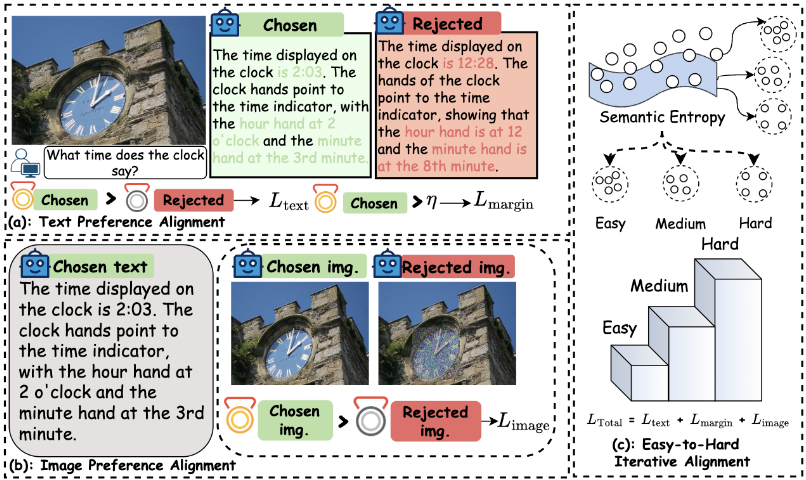
We leverage the generated image preference data for a unified optimization of the policy πθ across both text and image.
Text Preference Alignment. The DPO policy objective for text preference optimization is:
where t and m represents the original text and image inputs. yw and yl are the preferred and less preferred outputs. πref is the reference policy.
Image Preference Alignment. For image preference optimization, we use the original image m and the perturbed image m′ generated in earlier steps. The image preference loss is defined as:
Note that we only use the preferred response yw for image preference alignment.
Margin Loss for Stability. To address potential instability during the joint optimization of text and image preferences, we introduce a margin loss to penalize situations where both chosen and rejected responses experience a reduction in reward, drawing inspiration from previous research [Meng et al., 2024; Chen et al., 2024; Wang et al., 2024]. The margin loss is defined as:
where η is the margin parameter that enforces a greater separation between positive (chosen) and negative (rejected) responses. The total loss for the training phase is defined as Ltotal = Ltext +Limage +Lmargin, ensuring that both text and image preferences are jointly optimized while maintaining stability in their alignment.
3.3 Easy-to-Hard Iterative Alignment
We introduce an Easy-to-Hard Iterative Alignment algorithm to stabilize the training of MFPO.
Entropy Calculation. Leveraging semantic entropy [Venhuizen et al., 2019; Farquhar et al., 2024], we estimate the uncertainty of the model's responses. Given a probability distribution of predicted answers P = {p1, p2, . . . , pn}, where pi represents the probability of the i-th predicted token, the entropy H is calculated as H(P) = - ∑ni=1 pi log(pi). This measure quantifies the uncertainty inherent in the model.
Sorting by Difficulty. After calculating entropy for all training samples, we rank the training dataset according to their entropy scores, where higher values denoting more challenging inputs. We then divide the dataset into three distinct difficulty levels: "easy", "medium", and "hard".
Iterative Alignment. By progressively moving from easy to hard examples, the feedback distribution is iteratively updated. This ensures that the model first learns simpler patterns to build a foundation before tackling more complex cases. As the training progresses, the alignment becomes more refined, allowing the model to effectively handle harder examples.
| Methods | MMHalBench | Object HalBench | AMBER | |||||
|---|---|---|---|---|---|---|---|---|
| Score ↑ | HalRate ↓ | CHAIRs ↓ | CHAIRi ↓ | CHAIRs ↓ | Cover. ↑ | HalRate ↓ | Cog. ↓ | |
| 7B MLLMs | ||||||||
| LLaVA-v1.6-7B [Liu et al., 2024b] | 2.46 | 0.52 | 16.4 | 9.4 | 9.1 | 61.7 | 50.2 | 4.7 |
| LLaVA-v1.5-7B [Liu et al., 2024b] | 2.07 | 0.59 | 53.6 | 25.2 | 7.8 | 51.0 | 36.4 | 4.2 |
| + HACL [Jiang et al., 2024a] | 2.13 | 0.50 | - | - | - | - | - | - |
| + POVID [Zhou et al., 2024] | 2.08 | 0.56 | 48.1 | 24.4 | - | - | - | - |
| + OPERA [Huang et al., 2024] | 2.15 | 0.54 | 45.1 | 22.3 | - | - | - | - |
| + VCD [Leng et al., 2024] | 2.04 | 0.58 | 48.0 | 22.3 | - | - | - | - |
| + DPO [Rafailov et al., 2024] | 2.14 | 0.65 | 49.0 | 13.0 | 6.5 | 55.5 | 34.5 | 2.3 |
| + mDPO [Wang et al., 2024] | 2.39 | 0.54 | 35.7 | 9.8 | 4.4 | 52.4 | 24.5 | 2.4 |
| + EOS [Yue et al., 2024] | 2.03 | 0.59 | 40.3 | 17.8 | 5.1 | 49.1 | 22.7 | 2.0 |
| + HA-DPO [Zhao et al., 2023] | 1.97 | 0.59 | 39.9 | 19.9 | 6.7 | 49.8 | 30.9 | 3.3 |
| + HALVA [Sarkar et al., 2024] | 2.08 | 0.60 | 46.6 | 53.0 | 6.6 | 53.0 | 33.2 | 3.4 |
| LLaVA-v1.5-7B + MFPO | 2.69 (↑0.62) | 0.49 (↓0.1) | 13.4 (↓40.2) | 6.6 (↓18.6) | 4.1 (↓3.7) | 55.7 (↑4.7) | 22.5 (↓13.9) | 1.9 (↓2.3) |
| LLaVA-v1.6-7B + MFPO | 2.89 (↑0.43) | 0.45 (↓0.07) | 10.6 (↓5.8) | 5.1 (↓4.3) | 3.1 (↓6.0) | 58.8 (↓2.9) | 18.7 (↓31.5) | 1.1 (↓3.6) |
| ¿=13B MLLMs | ||||||||
| GPT-4V [Achiam et al., 2023] | 3.49 | 0.28 | 13.6 | 7.3 | 4.6 | 67.1 | 30.7 | 2.6 |
| MiniGemini-34B [Li et al., 2024] | 3.08 | 0.38 | 14.5 | 8.0 | - | - | - | - |
| Qwen-VL-Chat [Bai et al., 2023] | 2.89 | 0.43 | 36.0 | 21.3 | 6.6 | 53.2 | 31.0 | 2.9 |
| LLaVA-v1.5-13B [Liu et al., 2024a] | 2.42 | 0.53 | 46.3 | 22.6 | 7.8 | 51.0 | 36.4 | 4.2 |
| + RLHF-V [Yu et al., 2024a] | 2.81 | 0.49 | 12.2 | 7.5 | 6.3 | 46.1 | 25.1 | 2.1 |
| + HALVA [Sarkar et al., 2024] | 2.84 | 0.48 | - | - | 6.4 | 52.6 | 30.4 | 3.2 |
| LLaVA-v1.5-13B + MFPO | 2.94 (↑0.52) | 0.42 (↓0.11) | 11.4 (↓34.9) | 4.6 (↓18.0) | 3.4 (↓4.4) | 56.1 (↑5.1) | 19.4 (↓17.0) | 1.4 (↓2.8) |
| overall | attribute | adversarial | comparison | counting | relation | environment | holistic | other | |
|---|---|---|---|---|---|---|---|---|---|
| LLaVA-RLHF-7B | 2.05 | 2.92 | 1.83 | 2.42 | 1.92 | 2.25 | 2.25 | 1.75 | 1.08 |
| LLaVA-RLHF-13B | 2.53 | 3.33 | 2.67 | 1.75 | 2.25 | 2.33 | 3.25 | 2.25 | 2.42 |
| LLaVA-v1.5-7B | 2.07 | 3.08 | 1.08 | 2.58 | 2.25 | 2.0 | 3.0 | 1.42 | 1.33 |
| + MFPO | 2.69 | 3.33 | 3.67 | 2.42 | 2.25 | 2.75 | 3.42 | 2.00 | 1.83 |
4 Experiements
4.1 Experimental Setup
Implementation Details. We use LLaVA-v1.5 as the backbone for all experiments and include the latest top-performing LLaVA-v1.6 to validate the effectiveness of our method. The training consists of three stages: the first two stages follow standard LLaVA training, while MFPO is introduced in the third stage. Here, we construct image preference data based on Section 3.1, using text preference data from RLHF-V [Yu et al., 2024a], and apply MFPO optimization. Details are in Supplementary Section 4.
Evaluation. We evaluate the trustworthiness and general model capabilities with comprehensive experiments. For trustworthiness, we employ three widely used benchmarks to evaluate trustworthiness reflecting the degree of hallucination. Object HalBench [Rohrbach et al., 2018] was used to assess common object hallucinations in image descriptions, with CHAIR scores for both response-level (CHAIRs) and objectlevel (CHAIRi) hallucination rates. MMHal-Bench [Sun et al., 2023] measured response quality and hallucination rates by comparing model outputs with human responses and object labels. AMBER [Wang et al., 2023a] evaluated generative tasks, providing metrics on CHAIR variants, object coverage, and cognitive hallucination rates. For general capabilities, we employ the LLaVA-Bench [Liu et al., 2024b] for systematic comprehension, encompassing two categories: conversation, detailed description. See details in Supplementary Section 5. Baselines. We compare our model with state-of-the-art baselines under different settings. For general MLLMs, we include LLaVA1.5 [Liu et al., 2024a], Qwen-VL-Chat [Bai et al., 2023], LLaVA1.6, and MiniGemini [Li et al., 2024]. We also compare with preference-feedback models such as POVID [Zhou et al., 2024], RLHF-V [Yu et al., 2024a], Silkie [Sun et al., 2023] and DPO [Rafailov et al., 2024], as well as feedback-independent methods such as VCD [Leng et al., 2024]. We also benchmark against GPT-4V [Achiam et al., 2023]. See details in Supplementary Section 6.
4.2 Main Results
Comparison to Existing Methods. The main results are presented in Table 1. With MFPO integration, both LLaVA-v1.5 and LLaVA-v1.6 show consistent improvements across all three trustworthiness evaluation datasets. On MMHalBench and Object HalBench, our approach achieves state-of-the-art performance among all 7B-parameter models. As shown in Table 2, MFPO enhances performance across all metrics, demonstrating universal improvements in MLLM trustworthiness. These results highlight MFPO's ability to balance preference optimization across text and image modalities, leading to superior trustworthiness.
Notably, LLaVA-v1.5-7B+MFPO achieves trustworthiness levels comparable to or exceeding those of larger models, such as LLaVA-v1.5-13B and MiniGemini-34B. Furthermore, while baseline LLaVA-v1.5-7B and LLaVA-v1.5-13B underperform GPT-4V across all eight metrics, MFPO integration enables both models to outperform GPT-4V on five out of eight metrics. This underscores MFPO's capability to significantly enhance the trustworthiness of smaller MLLMs, bridging the performance gap with much larger models.
| Method | Conversation | Captioning |
|---|---|---|
| LLaVA-1.5 | 53.3 | 53.4 |
| + VIfeedback | 51.3 | 49.3 |
| + Human-Preference | 49.6 | 43.3 |
| + RLHF-V | 55.8 | 56.1 |
| Ours | 65.8 | 60.0 |
| Ltext | Limage | Lmargin | MMHalBench | Object HalBench | ||
|---|---|---|---|---|---|---|
| Score | ↑ HalRate↓ | CHAIRs ↓ | CHAIRi ↓ | |||
| ✓ | x | ✓ | 2.46 | 0.53 | 21.9 | 10.9 |
| x | ✓ | ✓ | 2.34 | 0.56 | 24.4 | 13.1 |
| ✓ | ✓ | x | 2.61 | 0.50 | 16.9 | 7.9 |
| ✓ | ✓ | ✓ | 2.69 | 0.49 | 13.4 | 6.6 |
| Margin | MMHalBench | Object HalBench | ||
|---|---|---|---|---|
| Score ↑ | HalRate ↓ | CHAIRs ↓ | CHAIRi ↓ | |
| 0 (Ours) | 2.69 | 0.49 | 13.4 | 6.6 |
| 0.2 | 2.58 | 0.50 | 15.7 | 7.1 |
| 0.4 | 2.63 | 0.52 | 16.0 | 7.9 |
General Perception Evaluation. To verify whether MFPO can enhance general perception capability of MLLM, we analyze different preference collection strategies on LLaVABench benchmark. We focus on the performance related to conversation and detailed descriptions, which represent general perception abilities. As shown in Table 3, our method outperforms both LLaVA-v1.5 and other alignment methods, indicating that our approach not only enhances trustworthiness but also improves overall perception capability of the model.
4.3 Ablation Study and Analysis
Ablation on Joint Text-Visual Reward Loss. We conduct experiments to validate the loss composition in MFPO. As shown in Table 4, optimizing only the text modality (Ltext) improves performance but overfits to text preferences, while optimizing only the image modality (Limage) addresses the text-image preference imbalance but underperforms due to lack of text optimization. This highlights the necessity of joint text-visual optimization in multimodal tasks.
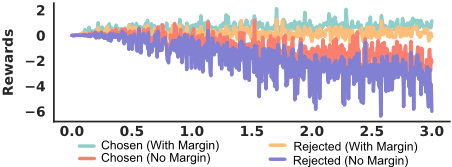
Ablation on Margin Loss. Adding margin loss (Lmargin) further improves performance. Figure 6 shows that without Lmargin, rewards for both chosen and rejected responses decrease simultaneously, while Lmargin stabilizes rewards by penalizing reductions for chosen responses. Table 5 demonstrates consistent performance gains across margin values (0, 0.2, 0.4), with the best results at 0.
Ablation on Loss Ratio. In Table 6, we present an ablation study on the weighting of different loss components. A balanced ratio of 1:1:1 yields the best results.
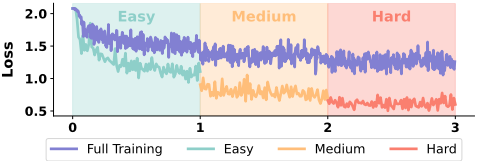
Ablation of Easy-to-Hard Alignment Scheme. We evaluate the effectiveness of the easy-to-hard alignment scheme against simultaneous training on all data. Table 7 shows that our approach consistently outperforms the traditional method. Figure 7 further reveals that the easy-to-hard strategy achieves better convergence, with losses steadily decreasing across easy, medium, and hard phases, indicating more efficient alignment learning. The loss reduction is fastest in the easy phase and gradually slows in later phases. Moreover, the easy-to-hard training curve exhibits greater stability compared to full training, demonstrating its stability and efficiency.
| MMHalbench | Object Halbench | |||
|---|---|---|---|---|
| Ratio | Score↑ | HalRate↓ | CHAIRs↓ | CHAIRi↓ |
| 1:1:1 | 2.69 | 0.49 | 13.4 | 6.6 |
| 1:5:1 | 2.66 | 0.50 | 13.9 | 6.9 |
| 5:1:1 | 2.59 | 0.55 | 15.6 | 8.2 |
| 1:1:5 | 2.62 | 0.52 | 14.5 | 7.0 |
| Training Method | MMHalBench ↑ | Object HalBench | ||
|---|---|---|---|---|
| Score | HalRate ↓ | CHAIRs ↓ | CHAIRi ↓ | |
| Easy-to-hard | 2.69 | 0.49 | 13.4 | 6.6 |
| End-to-end | 2.53 | 0.53 | 16.0 | 8.0 |
| Construction Method | MMHalBench | Object HalBench | ||
|---|---|---|---|---|
| Score ↑ | HalRate ↓ | CHAIRs ↓ | CHAIRi ↓ | |
| Global | 2.56 | 0.56 | 21.7 | 10.3 |
| Random 20% | 2.45 | 0.52 | 16.5 | 8.5 |
| Ours | 2.69 | 0.49 | 13.4 | 6.6 |
How Does Noise Proportion Affect Preference Optimization Balance? We study how noise granularity and proportion affect preference optimization balance by comparing three methods: applying global diffusion noise to the entire image, adding noise to 20% of random image regions, and our finegrained noise addition strategy. Table 8 demonstrates that image preference data construction enhances image-based optimization during alignment. However, as noise granularity becomes coarser, optimization increasingly favors text preferences, leading to performance degradation. Coarse-grained methods oversimplify image feature optimization, impairing image-text alignment. In contrast, fine-grained construction shifts optimization toward the image modality, achieving a more balanced multimodal alignment.
How Does Keyword Selection Perform? To evaluate the accuracy of extracting key visual keyphrases from the original text preference data using a multipartite graph, we randomly sample 100 examples and manually verify their correctness. We find that 86% of the extracted keyphrases correspond to important objects in the associated preference data. In the remaining 14% of cases, the selected keywords are not the most critical objects; however, using SAM to add diffusion noise to these regions still generates finely dispreferred images. We attribute the effectiveness of the multipartite graph to the relatively short text length and simple object relationships in the preference datasets, which enable robust keyword selection.
How Does SAM Perform on Region Mapping? To validate SAM's accuracy in region mapping, we randomly sample 100 images for manual evaluation. SAM achieves over 90% accuracy, with the remaining 10% of failures occurring when keywords refer to objects requiring contextual understanding beyond SAM's scope. In such cases, we apply global diffusion noise to the entire image. While this approach is suboptimal, the resulting dispreferred images still improve model performance. Furthermore, we experiment with more advanced segmentation models, such as LISA [Lai et al., 2024], which achieves over 95% accuracy in region mapping. Models with reasoning-based segmentation capabilities offer greater robustness to diverse keywords, enabling the generation of more refined dispreferred images.
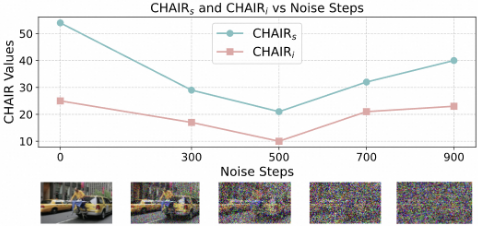
How Do Different Noise Levels Affect Performance? We investigate the impact of varying noise levels on preference optimization. As shown in Figure 8, adding diffusion noise to the entire image improves performance, with the best results achieved at 500 steps. At this level, the image undergoes an appropriate level of corruption: it avoids excessive noise that would erase critical details and make dispreferred images too easily distinguishable, while also preventing insufficient noise that would result in minimal image changes, failing to establish meaningful rewards for image optimization.
How to Achieve Modality-Fair Optimization? We investigate modality-fair optimization from both data and loss perspectives. On the data side, we analyze the impact of noisy region proportion and noise intensity in images. Our results show that region-level noise is more effective than global noise in guiding preference toward the visual modality. Moreover, moderate noise levels yield a better optimization balance than extremely high or low noise. On the loss side, jointly optimizing text and image rewards facilitates balanced modality alignment while preserving overall performance.
| MMHalbench | Object Halbench | |||
|---|---|---|---|---|
| Methods | Score↑ | HalRate↓ | CHAIRs↓ | CHAIRi↓ |
| mDPO (RLHF-V) | 2.42 | 0.56 | 29.3 | 9.2 |
| MFPO (RLHF-V) | 2.69 | 0.49 | 13.4 | 6.6 |
| mDPO (Silkie) | 2.39 | 0.54 | 35.7 | 9.8 |
| MFPO (Silkie) | 2.67 | 0.46 | 14.7 | 7.1 |
More Comparisions to mDPO. While mDPO demonstrated its effectiveness by only training on Silkie, Table 9 reports MFPO's performance when trained on Silkie and mDPO's performance when trained on RLHF-V. This ensures a fair comparison under equivalent dataset conditions. The results show that dataset differences have minimal impact on MFPO's performance, and MFPO consistently outperforms mDPO across both datasets, further validating MFPO's effectiveness.
5 Conclusion
In this paper, we investigate the limitation of text preference optimization and propose Modality-Fair Preference Optimization (MFPO) for trustworhty aligntment in MLLMs. We constructed a new dataset with fine-grained image preference, and implemented balanced preference optimization between text and image using a multi-stage alignment strategy alongside novel loss functions. Extensive experiments and analysis demonstrate that MFPO notebly diminishes hallucinations and attains state-of-the-art performance across trustworthiness and general capability benchmarks.
Acknowledgments
This work is supported by the National Natural Science Foundation of China (Grant No. 12326612, 62476241), the Natural Science Foundation of Zhejiang Province, China (Grant No. LZ23F020008), and the Zhejiang University-Angelalign Inc. R&D Center for Intelligent Healthcare.
@inproceedings{ijcai2025p46,
  title     = {Modality-Fair Preference Optimization for Trustworthy MLLM Alignment},
  author    = {Jiang, Songtao and Zhang, Yan and Chen, Ruizhe and Hu, Tianxiang and Jin, Yeying and He, Qinglin and Feng, Yang and Wu, Jian and Liu, Zuozhu},
  booktitle = {Proceedings of the Thirty-Fourth International Joint Conference on
               Artificial Intelligence, {IJCAI-25}},
  publisher = {International Joint Conferences on Artificial Intelligence Organization},
  editor    = {James Kwok},
  pages     = {403--411},
  year      = {2025},
  month     = {8},
  note      = {Main Track},
  doi       = {10.24963/ijcai.2025/46},
  url       = {https://doi.org/10.24963/ijcai.2025/46},
}
TY - CPAPER TI - Modality-Fair Preference Optimization for Trustworthy MLLM Alignment AU - Jiang, Songtao AU - Zhang, Yan AU - Chen, Ruizhe AU - Hu, Tianxiang AU - Jin, Yeying AU - He, Qinglin AU - Feng, Yang AU - Wu, Jian AU - Liu, Zuozhu T2 - Proceedings of the Thirty-Fourth International Joint Conference on Artificial Intelligence, IJCAI-25 PB - International Joint Conferences on Artificial Intelligence Organization PY - 2025 SP - 403 EP - 411 DO - 10.24963/ijcai.2025/46 UR - https://doi.org/10.24963/ijcai.2025/46 ER -Copied
Machine-readable versions of this paper, for tools and AI agents:





