
Screening, Rectifying, and Re-Screening: A Unified Framework for Tuning Vision-Language Models with Noisy Labels
Proceedings of the Thirty-Fourth International Joint Conference on Artificial Intelligence. Main Track. Pages 5101-5109.
https://doi.org/10.24963/ijcai.2025/568
Keywords
- Machine Learning: ML: Cost-sensitive learning
- Computer Vision: CV: Machine learning for vision
- Machine Learning: ML: Classification
- Computer Vision: CV: Transfer, low-shot, semi- and un- supervised learning
Abstract
Pre-trained vision-language models have shown remarkable potential for downstream tasks. However, their fine-tuning under noisy labels remains an open problem due to challenges like self-confirmation bias and the limitations of conventional small-loss criteria. In this paper, we propose a unified framework to address these issues, consisting of three key steps: Screening, Rectifying, and Re-Screening. First, a dual-level semantic matching mechanism is introduced to categorize samples into clean, ambiguous, and noisy samples by leveraging both macro-level and micro-level textual prompts. Second, we design tailored pseudo-labeling strategies to rectify noisy and ambiguous labels, enabling their effective incorporation into the training process. Finally, a re-screening step, utilizing cross-validation with an auxiliary vision-language model, mitigates self-confirmation bias and enhances the robustness of the framework. Extensive experiments across ten datasets demonstrate that the proposed method significantly outperforms existing approaches for tuning vision-language pre-trained models with noisy labels.
- [Arazo et al., 2019] Eric Arazo, Diego Ortego, Paul Albert, Noel O'Connor, and Kevin McGuinness. Unsupervised la- bel noise modeling and loss correction. In Proceedings of the International Conference on Machine Learning, pages 312-321. PMLR, 2019.
- [Arpit et al., 2017] Devansh Arpit, Stanisław Jastrzunde- finedbski, Nicolas Ballas, David Krueger, Emmanuel Ben- gio, Maxinder S. Kanwal, Tegan Maharaj, Asja Fischer, Aaron Courville, Yoshua Bengio, and Simon Lacoste- Julien. A closer look at memorization in deep networks. In Proceedings of the International Conference on Machine Learning, page 233-242, 2017.
- [Bae et al., 2024] HeeSun Bae, Seungjae Shin, Byeonghu Na, and Il chul Moon. Dirichlet-based per-sample weight- ing by transition matrix for noisy label learning. In Proceedings of the International Conference on Learning Representations, 2024.
- [Berthelot et al., 2019] David Berthelot, Nicholas Carlini, Ian Goodfellow, Nicolas Papernot, Avital Oliver, and Colin A Raffel. Mixmatch: A holistic approach to semi- supervised learning. Proceedings of the Advances in Neu- ral Information Processing Systems, 32, 2019.
- [Bossard et al., 2014] Lukas Bossard, Matthieu Guillaumin, and Luc Van Gool. Food-101-mining discriminative com- ponents with random forests. In Proceedings of the Eu- ropean Conference on Computer Vision, pages 446-461, 2014.
- [Chen et al., 2024] Shengyuan Chen, Qinggang Zhang, Jun- nan Dong, Wen Hua, Qing Li, and Xiao Huang. En- tity alignment with noisy annotations from large language models. In Proceedings of the Advances in Neural Infor- mation Processing Systems, 2024.
- [Cimpoi et al., 2014] Mircea Cimpoi, Subhransu Maji, Ia- sonas Kokkinos, Sammy Mohamed, and Andrea Vedaldi. Describing textures in the wild. In Proceedings of the IEEE Conference on Computer Vision and Pattern Recog- nition, pages 3606-3613, 2014.
- [Deng et al., 2009] Jia Deng, Wei Dong, Richard Socher, Li- Jia Li, Kai Li, and Li Fei-Fei. Imagenet: A large-scale hierarchical image database. In Proceedings of the IEEE Conference on Computer Vision and Pattern Recognition, pages 248-255, 2009.
- [Fei-Fei et al., 2004] Li Fei-Fei, Rob Fergus, and Pietro Per- ona. Learning generative visual models from few train- ing examples: An incremental bayesian approach tested on 101 object categories. In Proceedings of the IEEE Confer- ence on Computer Vision and Pattern Recognition Work- shops, pages 178-178, 2004.
- [Feng et al., 2024] Chen Feng, Georgios Tzimiropoulos, and Ioannis Patras. Clipcleaner: Cleaning noisy labels with clip. In Proceedings of the ACM International Conference on Multimedia, pages 876-885, 2024.
- [Guo and Gu, 2024] Yuncheng Guo and Xiaodong Gu. Joapr: Cleaning the lens of prompt learning for vision- language models. In Proceedings of the IEEE Confer- ence on Computer Vision and Pattern Recognition, pages 28695-28705, June 2024.
- [He et al., 2016] Kaiming He, Xiangyu Zhang, Shaoqing Ren, and Jian Sun. Deep residual learning for image recognition. In Proceedings of the IEEE Conference on Computer Vision and Pattern Recognition, pages 770-778, 2016.
- [Helber et al., 2019] Patrick Helber, Benjamin Bischke, An- dreas Dengel, and Damian Borth. Eurosat: A novel dataset and deep learning benchmark for land use and land cover classification. IEEE Journal of Selected Top- ics in Applied Earth Observations and Remote Sensing, 12(7):2217-2226, 2019.
- [Kim et al., 2024] Jang-Hyun Kim, Sangdoo Yun, and Hyun Oh Song. Neural relation graph: a unified frame- work for identifying label noise and outlier data. Pro- ceedings of the Advances in Neural Information Process- ing Systems, 36, 2024.
- [Krause et al., 2013] Jonathan Krause, Michael Stark, Jia Deng, and Li Fei-Fei. 3d object representations for fine- grained categorization. In Proceedings of the IEEE In- ternational Conference on Computer Vision Workshops, pages 554-561, 2013.
- [Li et al., 2020] Junnan Li, Richard Socher, and Steven C. H. Hoi. Dividemix: Learning with noisy labels as semi- supervised learning. In Proceedings of the International Conference on Learning Representations, 2020.
- [Li et al., 2022] Junnan Li, Dongxu Li, Caiming Xiong, and Steven Hoi. BLIP: Bootstrapping language-image pre- training for unified vision-language understanding and generation. In Proceedings of the International Confer- ence on Machine Learning, pages 12888-12900, 2022.
- [Lin et al., 2024] Yexiong Lin, Yu Yao, and Tongliang Liu. Learning the latent causal structure for modeling label noise. In Proceedings of the Advances in Neural Infor- mation Processing Systems, 2024.
- [Liu et al., 2020] Sheng Liu, Jonathan Niles-Weed, Narges Razavian, and Carlos Fernandez-Granda. Early-learning regularization prevents memorization of noisy labels. Pro- ceedings of the Advances in Neural Information Process- ing Systems, 33:20331-20342, 2020.
- [Lu et al., 2021] Yangdi Lu, Yang Bo, and Wenbo He. Co- matching: Combating noisy labels by augmentation an- choring. arXiv:2103.12814, 2021.
- [Nguyen et al., 2024] Tri Nguyen, Shahana Ibrahim, and Xiao Fu. Noisy label learning with instance-dependent outliers: Identifiability via crowd wisdom. In Proceed- ings of the Advances in Neural Information Processing Systems, 2024.
- [Nilsback and Zisserman, 2008] Maria-Elena Nilsback and Andrew Zisserman. Automated flower classification over a large number of classes. In Proceedings of the Indian Conference on Computer Vision, Graphics & Image Pro- cessing, pages 722-729, 2008.
- [Park et al., 2023] Dongmin Park, Seola Choi, Doyoung Kim, Hwanjun Song, and Jae-Gil Lee. Robust data prun- ing under label noise via maximizing re-labeling accuracy. Proceedings of the Advances in Neural Information Pro- cessing Systems, 36:74501-74514, 2023.
- [Parkhi et al., 2012] Omkar M Parkhi, Andrea Vedaldi, An- drew Zisserman, and CV Jawahar. Cats and dogs. In Pro- ceedings of the IEEE Conference on Computer Vision and Pattern Recognition, pages 3498-3505, 2012.
- [Patel and Sastry, 2023] Deep Patel and PS Sastry. Adaptive sample selection for robust learning under label noise. In Proceedings of the IEEE Winter Conference on Applica- tions of Computer Vision, pages 3932-3942, 2023.
- [Radford et al., 2021] Alec Radford, Jong Wook Kim, Chris Hallacy, Aditya Ramesh, Gabriel Goh, Sandhini Agar- wal, Girish Sastry, Amanda Askell, Pamela Mishkin, Jack Clark, Gretchen Krueger, and Ilya Sutskever. Learning transferable visual models from natural language supervi- sion. In Proceedings of the International Conference on Machine Learning, pages 8748-8763, 2021.
- [Sohn et al., 2020] Kihyuk Sohn, David Berthelot, Nicholas Carlini, Zizhao Zhang, Han Zhang, Colin A Raffel, Ekin Dogus Cubuk, Alexey Kurakin, and Chun-Liang Li. Fixmatch: Simplifying semi-supervised learning with con- sistency and confidence. Proceedings of the Advances in Neural Information Processing Systems, 33:596-608, 2020.
- [Soomro, 2012] K Soomro. Ucf101: A dataset of 101 human actions classes from videos in the wild. arXiv:1212.0402, 2012.
- [Tian et al., 2024] Xinyu Tian, Shu Zou, Zhaoyuan Yang, and Jing Zhang. Argue: Attribute-guided prompt tuning for vision-language models. In Proceedings of the IEEE Conference on Computer Vision and Pattern Recognition, pages 28578-28587, 2024.
- [Vaswani et al., 2017] Ashish Vaswani, Noam Shazeer, Niki Parmar, Jakob Uszkoreit, Llion Jones, Aidan N Gomez, Ł ukasz Kaiser, and Illia Polosukhin. Attention is all you need. In I. Guyon, U. Von Luxburg, S. Bengio, H. Wallach, R. Fergus, S. Vishwanathan, and R. Garnett, editors, Pro- ceedings of the Advances in Neural Information Process- ing Systems, volume 30.
- Curran Associates, Inc., 2017.
- [Wu et al., 2023] Cheng-En Wu, Yu Tian, Haichao Yu, Heng Wang, Pedro Morgado, Yu Hen Hu, and Linjie Yang. Why is prompt tuning for vision-language models robust to noisy labels? In Proceedings of the IEEE Inter- national Conference on Computer Vision, pages 15488- 15497, 2023.
- [Xiao et al., 2010] Jianxiong Xiao, James Hays, Krista A Ehinger, Aude Oliva, and Antonio Torralba. Sun database: Large-scale scene recognition from abbey to zoo. In Pro- ceedings of the IEEE Conference on Computer Vision and Pattern Recognition, pages 3485-3492, 2010.
- [Yao et al., 2021] Yazhou Yao, Zeren Sun, Chuanyi Zhang, Fumin Shen, Qi Wu, Jian Zhang, and Zhenmin Tang. Jo- src: A contrastive approach for combating noisy labels. In Proceedings of the IEEE Conference on Computer Vision and Pattern Recognition, pages 5192-5201, 2021.
- [Yao et al., 2024] Lujian Yao, Haitao Zhao, Zhongze Wang, Kaijie Zhao, and Jingchao Peng. CoSW: Conditional sam- ple weighting for smoke segmentation with label noise. In Proceedings of the Advances in Neural Information Pro- cessing Systems, 2024.
- [Yu et al., 2024] Yeonguk Yu, Minhwan Ko, Sungho Shin, Kangmin Kim, and Kyoobin Lee. Curriculum fine-tuning of vision foundation model for medical image classifica- tion under label noise. In Proceedings of the Advances in Neural Information Processing Systems, 2024.
- [Zhang and Sabuncu, 2018] Zhilu Zhang and Mert Sabuncu. Generalized cross entropy loss for training deep neural networks with noisy labels. Proceedings of the Advances in Neural Information Processing Systems, 31, 2018.
- [Zhang et al., 2021] Yikai Zhang, Songzhu Zheng, Pengx- iang Wu, Mayank Goswami, and Chao Chen. Learn- ing with feature-dependent label noise: A progressive ap- proach. arXiv:2103.07756, 2021.
- [Zhang et al., 2024] Jiaming Zhang, Xingjun Ma, Xin Wang, Lingyu Qiu, Jiaqi Wang, Yu-Gang Jiang, and Jitao Sang. Adversarial prompt tuning for vision-language models. In Proceedings of the European Conference on Computer Vi- sion, pages 56-72. Springer, 2024.
- [Zhou et al., 2022a] Kaiyang Zhou, Jingkang Yang, Chen Change Loy, and Ziwei Liu. Conditional prompt learning for vision-language models. In Proceedings of the IEEE Conference on Computer Vision and Pattern Recognition, pages 16816-16825, 2022.
- [Zhou et al., 2022b] Kaiyang Zhou, Jingkang Yang, Chen Change Loy, and Ziwei Liu. Learning to prompt for vision-language models. International Journal of Computer Vision, 130(9):2337-2348, 2022.
- [Zhu et al., 2024] Yilun Zhu, Jianxin Zhang, Aditya Gan- grade, and Clayton Scott. Label noise: Ignorance is bliss. In Proceedings of the Advances in Neural Information Processing Systems, 2024.
References were extracted automatically from the PDF and may contain errors.
Full text extracted automatically from the PDF; figures, tables and equations may differ. The PDF is the version of record.
1 Introduction
In the field of image classification, label quality often depends on various factors, such as the complexity of distinguishing target objects and the expertise of annotators. In annotation systems like crowdsourcing, noisy labels are inevitable. Considering deep neural networks (DNNs) are highly susceptible to memorizing mislabeled training samples, addressing learning with noisy labels is essential for ensuring the robustness of learned DNNs. Recently, pre-trained vision-language models [Radford et al., 2021] have achieved remarkable progress and are increasingly adopted for downstream image classification tasks. This paper specifically tackles the challenge of fine-tuning pre-trained vision-language models under the presence of noisy labels.
Learning DNNs with noisy labels presents two main challenges. First, it requires effectively identifying mislabeled samples to prevent DNNs from memorizing incorrect data. Research [Arpit et al., 2017] reveals that DNNs tend to first memorize clean samples with dominant patterns before noisy samples with less representative patterns. Hence, the small loss criterion is widely used for separating clean samples from noisy samples. Methods such as co-training with two models [Li et al., 2020; Lu et al., 2021; Kim et al., 2024] leverage this criterion to mutually identify noisy samples. The second challenge is extracting value from noisy samples. Existing methods typically assign pseudo-labels to noisy samples [Li et al., 2020; Yao et al., 2021] or design self-supervised constraints [Liu et al., 2020].
∗Corresponding author (De Cheng)
Recently, several studies [Wu et al., 2023; Guo and Gu, 2024; Feng et al., 2024] have explored the challenge of tuning the vision-language models under noisy labels. For example, [Wu et al., 2023] analyzes the impact of noisy labels on CLIP [Radford et al., 2021], revealing that performance significantly deteriorates as noise increases. To address this, existing methods often rely on self-generated predictions to clean samples or assign pseudo labels, as seen in [Guo and Gu, 2024] and [Feng et al., 2024]. However, these approaches suffer from self-confirmation bias, where prediction errors propagate and amplify during training. Besides, conventional small-loss criterion fails to reliably distinguish clean samples from noisy ones, especially in ambiguous cases.
To address these limitations, we propose a novel algorithm that consists of three main steps: screening observed labels, rectifying potential noisy labels, and re-screening rectified labels. First, we introduce a dual-level semantic matching criterion that combines macro-level and micro-level textual prompts to better differentiate clean samples from noisy ones in the training loss space. This criterion is applied for identifying whether a training sample is a clean, ambiguous, or noisy sample. Second, we design separate label rectification strategies for refining labels of noisy and ambiguous samples with pseudo labels, aiming to effectively incorporate them into training. Lastly, we mitigate self-confirmation bias by re-screening rectified labels using cross-validation with another vision-language model, BLIP [Li et al., 2022]. Extensive experiments conducted on ten datasets, demonstrate that the proposed method achieves state-of-the-art performances in tuning vision-language models with noisy labels.
Key contributions of this paper are summarized as below:
- We propose a novel unified framework, comprising three steps: Screening to identify noisy and ambiguous samples, Rectifying to assign corrected labels, and ReScreening to validate the rectified labels for improving model robustness.
- A novel dual-level semantic matching method is introduced, using macro- and micro-level textual prompts to effectively distinguish noisy samples from clean ones.
- Extensive experiments on ten datasets demonstrate that our method establishes a new state-of-the-art for tuning vision-language models with noisy labels.
2 RelatedWork
Learning with Noisy Labels. Noisy labels degrade robustness of DNNs due to their susceptibility to overfitting. To mitigate this, researchers have developed methods for noise detection and label cleaning. Leveraging the observation that DNNs learn clean samples faster than noisy ones [Arpit et al., 2017], several methods (e.g., [Park et al., 2023; Patel and Sastry, 2023; Kim et al., 2024]) utilize the smallloss criterion to identify clean samples. While effective to some extent, these methods can misclassify noisy samples resembling clean ones. Approaches like [Guo and Gu, 2024; Feng et al., 2024] employ label correction techniques after sample partitioning, but they are prone to self-confirmation bias due to their reliance on model predictions, potentially hindering performance.
The other type of methods uses training objectives based on label transfer matrices [Lin et al., 2024; Nguyen et al., 2024; Bae et al., 2024], reweighted losses [Yao et al., 2024], and self-supervised learning [Liu et al., 2020; Zhu et al., 2024]. However, these methods often exhibit limited effectiveness due to their reliance on specific noise patterns.
Training strategies like curriculum learning (e.g., [Yu et al., 2024]) and progressive label adjustment (e.g., [Zhang et al., 2021], [Chen et al., 2024]) mitigate noisy labels by gradually refining the learning process. While effective, these methods often entail increased computational overhead and necessitate careful hyperparameter tuning (e.g., epochs, curriculum structure). Improper optimization can lead to longer training times, higher resource consumption, and suboptimal performance.
Unlike existing methods, our method presents a threestep framework-screening, rectifying, and re-screening labels. We use a dual-level semantic matching criterion for improved label screening and distinct label rectification strategies for noisy and ambiguous samples. To mitigate selfconfirmation bias, we employ a pre-trained vision-language model to cross-validate rectified labels, enhancing label correction accuracy and robustness compared to methods relying on a single model for both detection and rectification.
Prompt Tuning for Vision-Language Models. Visionlanguage pre-trained models have advanced significantly in recent years. CLIP [Radford et al., 2021] employs prompt engineering to incorporate category-specific information into text inputs, allowing its pre-trained model to adapt to various tasks without further training. However, manual prompt design is time-consuming and requires expertise. To address this, CoOp [Zhou et al., 2022b] introduces learnable prompts optimized for specific datasets, reducing manual effort and improving task adaptability. CoCoOp [Zhou et al., 2022a] further enhances this by integrating image information into prompts using a lightweight network, enabling better context learning and generalization to unseen categories. BLIP [Li et al., 2022] leverages weak supervision to generate highquality visual information for task-specific purposes, improving performance. More recent works like ArGue [Tian et al., 2024] align prompts with visual attributes from large language models and apply negative prompting for better outof-distribution generalization, while AdvPT [Zhang et al., 2024] uses learnable text prompts aligned with adversarial image embeddings to enhance robustness. While these methods advance prompt tuning, they primarily focus on static or model-based prompt designs. In contrast, our approach aims to adapt the pre-trained model to noisy label tasks. We combine macro- and micro-level textual prompts for label screening and rectification, and use BLIP to cross-validate rectified labels. This approach improves model robustness and adaptability, complementing traditional prompt tuning techniques.
3 Preliminary
Problem Definition. This paper aims to address the adaptation of the vision-language pre-trained model using training data with noisy labels. Formally, we denote the training dataset as {(xi, yi)}Ni=1 , where xi denotes the i-th training sample, yi denotes the observed label of xi, and N represents the total number of training images. Supposing the number of classes be C, we have yi ∈ {1, · · · , C} which may be incorrect. The target is to adapt a pre-trained vision-language model which can tackle the image recognition task through matching images with class descriptions to the above dataset. Prompt Tuning for Vision-Language Model. Following [Zhou et al., 2022b], we use the vision-language pretrained model CLIP consisting of an image encoder and a text encoder, as the image classification backbone model. We apply the prompt tuning algorithm to adapt the pre-trained text encoder to the target dataset. Given an input image xi, the image encoder transforms it into a feature vector fi. For purpose of tuning the text encoder, a set of learnable prompts are used to provide extra context of each class's textual prompt. We denote the learnable prompts of the j-th class as tj. Feeding the j-th class's text descriptions and the learnable prompts tj into the text encoder, we can obtain the j-th class's embedding vector oj. Based on the image feature vector fi and all classes' embedding vectors, we can infer the probability of xi belonging to the j-th class as follows:
where τ is a hyperparameter set to 2. Through optimizing the learnable prompts only while freezing the image and text encoder, we can achieve the efficient adaptation of the pretrained model into the target dataset. This can take advantage of the prior knowledge of the pre-trained model in extracting generalized vision and textual features. Due to few parameters required for optimization, only a small number of training data is required during the model adaptation process.
4 Method
4.1 Overview of Proposed Framework
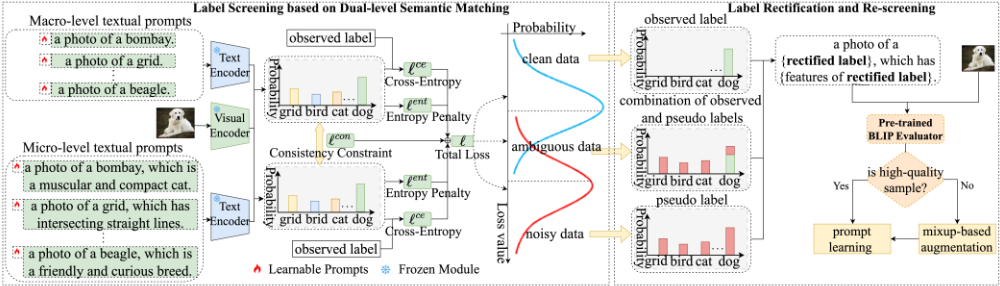
As shown in Fig. 1, we propose a framework leveraging pretrained vision-language models to tackle noisy label learning. It consists of three steps: 1) screening observed labels to identify potential mislabels, 2) rectifying these labels for effective optimization, and 3) re-screening to mitigate selfconfirmation bias.
In the screening step, we use a dual-level semantic matching mechanism with macro-level and micro-level prompts to classify samples as clean, ambiguous, or noisy ones. For rectification, noisy samples are assigned pseudo-labels, while ambiguous ones receive a combination of observed and pseudo labels. Finally, we use BLIP to re-screen and validate rectified labels. High-quality samples are directly used for prompt learning, while the rest are augmented via data mixing to minimize the influence of error labels.
4.2 Label Screening Based on Dual-level Semantic Matching
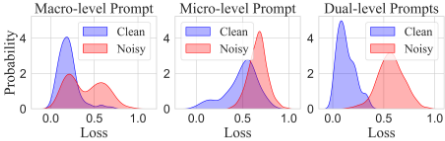
Dual-level Semantic Matching. During training, DNNbased models tend to memorize clean samples first, followed by noisy samples, which is why the small-loss criterion is commonly used to differentiate between the two. However, for CLIP prompt learning, using a single textual prompt struggles to effectively separate clean and noisy samples in the loss space. Macro-level prompts, based on class names, ensure inter-class separability but are prone to overfitting noisy samples due to the simplicity of the image-language matching. On the other hand, micro-level prompts, which describe fine-grained attributes, provide more reliable matching, reducing overfitting to noisy samples but may cause underfitting on clean samples. As a result, relying on just one type of prompt for image-class matching leads to significant overlap between clean and noisy samples. To address this, we propose a dual-level semantic matching mechanism, combining both macro-level and micro-level prompts as a label screening criterion. This approach facilitates the identification of clean, ambiguous, and noisy samples.
- Macro-level Textual Prompt. We follow CLIP's original design, using a class name template to generate macro-level textual prompts. For class j, the macro-level textual prompt T mac j is defined as:
By feeding T mac j and learnable prompts tmac j into the text encoder, we obtain the embedding vector omac j for class j. According to Eq. 1, these class embeddings {omac j }Cj=1 are then used to compute the probabilities pmac i ∈ [0, 1]C , representing the likelihood of sample xi belonging to each class.
2) Micro-level Textual Prompt. Unlike macro-level prompts, micro-level prompts introduce class-specific features to enhance the alignment between image and text embeddings. Following [Feng et al., 2024], we generate these prompts by incorporating detailed features such as shapes, textures, colors, and other unique attributes of each class. For class j, the micro-level textual prompt T mic j is expressed as:
The text encoder processes T mic j and tmic j to produce the micro-level embedding omic j . Using these embeddings {omic j }Cj=1 , we can predict the class probabilities pmic i ∈ [0, 1]C , which represent the likelihood of xi belonging to each class.
3) Label Screening Criterion. Based on the class probabilities estimated from the macro-level and micro-level textual prompts, we define a label screening criterion with a samplewise loss function composed of three key terms: (1) a conventional cross-entropy loss, (2) a consistency constraint between the two types of prompt-induced predictions, and (3) an entropy penalty term. These terms are designed to enhance model robustness, especially in the presence of noisy labels.
The cross-entropy loss evaluates the discrepancy between the predicted class probabilities and the observed label. Specifically, for sample xi with observed label yi (one-hot encoded vector of yi), the loss is computed as:
where yi,j represents the j-th element of yi, and pmac i,j and pmic i,j are the j-th elements of pmac i and pmic i , respectively.
To address the issue of noisy labels, we impose a consistency constraint between the predictions generated by macrolevel and micro-level prompts. This is achieved by calculating the Jensen-Shannon divergence between the two probability distributions pmac i and pmic i . The consistency loss for sample xi is given by:
This term helps mitigate the impact of noisy labels by promoting agreement between the predictions from both levels, effectively reducing the overfitting to noisy samples. By aligning the macro-level and micro-level predictions, the model is less likely to overfit to mislabeled data, resulting in improved generalization.
The entropy penalty term encourages more tight predictions by penalizing overly smooth outputs. It is designed to reduce the overlap between clean and noisy samples. The entropy penalty for sample xi is calculated as:
The overall loss function is a weighted sum of the three loss terms:
where λ and β are hyperparameters.
Fig. 2 illustrates the loss distributions of clean and noisy samples using macro-level, micro-level, and dual-level textual prompts on the DTD dataset with 75% Pairflip label noise. The loss distributions of clean and noisy samples overlap significantly when using either macro-level or micro-level prompts alone. In contrast, the dual-level textual prompts effectively reduce the overlap between clean and noisy samples, highlighting the advantage of combining macro-level and micro-level prompts for more accurate label screening. Tri-Segment Sample Screening. Previous approaches [Guo and Gu, 2024; Arazo et al., 2019] typically use small-loss mechanisms to separate clean and noisy samples. However, noise complexity often leads to misclassification of clean samples with losses resembling noisy ones, or vice versa. To address this, we propose a tri-segment screening strategy that categorizes samples into clean, ambiguous, noisy classes, accounting for overlap between clean and noisy data.
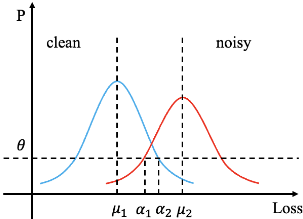
We model sample-wise losses with a two-component Gaussian Mixture Model (GMM), fitting the model every two epochs. The first and second Gaussian components represent the clean and noisy data loss distributions, respectively:
where fc(l) and fn(l) are the probability density functions of clean and noisy data, respectively. µk and σk denote the mean and variance of the k-th Gaussian component, respectively.
Given the overlap between these distributions as illustrated in Fig. 3, we define the ambiguous region for samples with loss values in this range. For a confidence level θ, we determine the ambiguous region boundaries α1 and α2 as follows:
Solving these equations gives thresholds α1 and α2:
The lower and upper boundaries of the ambiguous region are ηl = min(α1, α2) and ηu = max(α1, α2), respectively. A sample xi is classified as follows:
- If ℓ(xi, yi) < ηl, xi is clean;
- If ηl ≤ ℓ(xi, yi) < ηu, xi is ambiguous;
- If ℓ(xi, yi) ≥ ηu, xi is noisy.
This label screening strategy partitions the dataset into clean, ambiguous, and noisy subsets, guiding further data utilization and label rectification for training.
4.3 Label Rectification and Re-screening
Label Rectification. To ensure sufficient training data, we introduce label rectification strategies that update each training sample's label using pseudo labels generated from model predictions. The pseudo label of sample xi, denoted as ˆyi, is the average of predicted probabilities from macro-level and micro-level prompts, i.e., ˆyi = (pmac i +pmic i )/2.
The updated label ˜yi is determined by the following rules:
- If xi is clean, ˜yi = yi.
- If xi is ambiguous, we combine the observed label yi and pseudo label ˆyi with confidence weight wi:
wi is determined by the posterior probability that xi belongs to the clean set.
- If xi is noisy, the observed label is likely incorrect, so the pseudo label ˆyi is used: ˜yi = ˆyi.
Label Re-screening. Using pseudo labels for rectification can introduce self-confirmation bias due to the lack of reliable quality evaluation. To mitigate this, we use the pretrained BLIP model for cross-validation. For each sample xi, we generate a text prompt ˜ Ti by incorporating the class with the highest value in ˜yi into the micro-level prompt template. We then use BLIP to compute the similarity between xi and ˜ Ti, denoted as si. The scores of all samples are fitted with a two-component GMM, and the posterior probability of si belonging to the component with the larger mean is calculated, resulting in a quality score qi. This score is used to separate the training samples into high-quality and low-quality sets:
where κ is a threshold, typically set to 0.5.
4.4 Training Objective
Considering the unreliability of samples in ˜Dl, we apply the mixup operation [Berthelot et al., 2019] to augment them, yielding an updated dataset ˜D′ l . This reduces the model's reliance on individual noisy labels and enhances data diversity, preventing overfitting. The final training objective is computed by accumulating losses over the union of ˜Dh and ˜D′ l :
This objective is used to optimize the learnable prompts, mitigating the influence of noisy samples while making full use of all training samples.
5 Experiments
5.1 Datasets
We evaluate our method on ten datasets, including Flowers102 [Nilsback and Zisserman, 2008], EuroSAT [Helber et al., 2019], StanfordCars [Krause et al., 2013], OxfordPets [Parkhi et al., 2012], DTD [Cimpoi et al., 2014], Caltech101
[Fei-Fei et al., 2004], UCF101 [Soomro, 2012], Food101 [Bossard et al., 2014], ImageNet [Deng et al., 2009] and SUN397 [Xiao et al., 2010]. Following JoAPR [Guo and Gu, 2024], we adopt the same noise-labeled ways to generate our noisy dataset. One is Symflip noise, which is generated by randomly drawing labels from other categories in the dataset to replace the true labels. The other is more challenging Pairflip noise, which is generated by exclusively selecting labels that are adjacent to the true label to replace it. Following CoOp [Zhou et al., 2022b], we sample a 16-shot training set from each dataset and employ the original test set for evaluation. To assess robustness, we test the method under noise rates ranging from 12.5% to 75%.
5.2 Implementation Details
Following the previous works [Zhou et al., 2022b; Guo and Gu, 2024], we adopt the CLIP model with ResNet-50 [He et al., 2016] as visual encoder and Transformer [Vaswani et al., 2017] as text encoder. The number of tokens in learnable prompts is set to 16. We adopt SGD optimizer to train our model with an initialization learning rate of 0.002 and apply cosine annealing strategy. The maximum number of training epochs is set to 200, except for ImageNet where it is set to 50. To mitigate gradient explosion in the early stages of training, we adopt a warm-up strategy and fix the learning rate to 1 × 10⁻⁵ in first training epoch. The hyper-parameters λ, β and θ, are set to 0.5, 0.001, and 0.01, respectively.
5.3 Comparison with State-of-the-art Methods
Table 1 presents a comprehensive comparison between our method and state-of-the-art (SoTA) approaches including CoOp [Zhou et al., 2022b], Robust UPL [Wu et al., 2023], and JoAPR/JoAPR* [Guo and Gu, 2024], across ten datasets under various noise levels. Our method achieves the highest accuracy in most scenarios and the highest average accuracy across all noise levels. It can be seen that CoOp demonstrates robustness at lower noise levels, but its performance deteriorates significantly as the noise ratio increases. Robust UPL [Wu et al., 2023] rely on pseudo-labels to alleviate the impact of noisy data on model performance. As the noise rate increases, the confidence in pseudo-labels decreases, which negatively impacts model performance. JoAPR improves upon CoOp by using data partitioning and label refurbishment but still struggles in high-noise scenarios. For instance, under 62.5% Symflip noise on the DTD dataset, our method outperforms JoAPR by 8.73%. On the StanfordCars dataset with 75% Pairflip noise, our method surpasses JoAPR* by 10.86%. Additionally, our method demonstrates strong robustness to high noise levels across all datasets.
5.4 Ablation Study
Effectiveness of Key Components. To better determine the contributions of key components in our method, we conducted a series of ablation experiments on the DTD and OxfordPets datasets, as shown in Table 2. The pre-trained vision-language model CoOp is used as the baseline (referred to as No.1). No.2, No.3, and No.4 represent the application of macro-level semantic prompt (MaLS), micro-level semantic prompt (MiLS), and dual-level semantic prompts (DLSM) to the baseline, respectively. Here, all training samples and their observed labels are directly used without processing. Comparing No.2, No.3, and No.4 highlights the effectiveness of using dual-level semantic matching for label screening. No.5 and No.6 demonstrate the importance of rectifying ambiguous and noisy labels selected out by our method, while No.7 and No.8 show that label re-screening further improves robustness. These contributions enhance our model's ability to handle various noise more effectively.
| Dataset | Method | Symflip | Pairflip | ||||||||||
|---|---|---|---|---|---|---|---|---|---|---|---|---|---|
| 12.5% | 25% | 37.5% | 50% | 62.5% | 75% | 12.5% | 25% | 37.5% | 50% | 62.5% | 75% | ||
| CoOp | 86.13 | 81.07 | 74.93 | 68.47 | 55.50 | 39.37 | 86.47 | 76.43 | 63.07 | 45.20 | 27.10 | 12.40 | |
| Robust UPL | 86.61 | 83.33 | 77.31 | 70.45 | 61.74 | 50.23 | 85.83 | 81.50 | 75.97 | 67.71 | 60.03 | 49.65 | |
| CoOp+JoAPR Flowers102 | 82.13 | 75.60 | 73.27 | 71.03 | 62.87 | ||||||||
| CoOp+JoAPR* | 90.13 | 88.13 | 84.47 | 75.13 | 89.80 | 88.83 | 84.73 | 76.47 | 73.80 | ||||
| Ours | 88.50 90.22 | 88.33 90.01 | 85.93 86.11 | 82.70 84.98 | 77.33 82.14 | 75.50 75.52 | 89.67 89.85 | 89.17 89.20 | 84.63 85.02 | 77.95 | 74.38 | 58.87 67.40 | |
| CoOp | 62.13 | 54.90 | 45.53 | 26.73 | 78.77 | 67.37 | 55.73 | 42.83 | 28.33 | 18.70 | |||
| Robust UPL | 77.77 77.46 | 71.27 71.87 | 64.05 | 57.13 | 46.11 | 32.36 | 76.78 | 70.71 | 63.51 | 52.14 | 41.70 | 27.11 | |
| CoOp+JoAPR EuroSAT | 78.33 | 79.37 | 78.33 | 72.23 | 66.20 | 49.37 | 80.00 | 78.57 | 73.03 | 63.03 58.23 | 58.47 40.85 | 39.47 25.90 | |
| CoOp+JoAPR* | 79.30 83.02 | 80.53 83.10 | 78.07 79.56 | 67.33 74.89 | 59.20 71.68 | 34.45 60.02 | 78.23 83.22 | 78.50 79.83 | 69.43 73.33 | 63.93 | 58.94 | 41.23 | |
| Ours | |||||||||||||
| CoOp | 66.37 | 59.00 | 54.23 | 47.70 | 36.93 | 24.70 | 65.67 | 57.03 | 46.47 | 33.10 | 20.70 | 11.30 | |
| Robust UPL | 65.23 | 60.66 | 55.43 | 49.30 | 43.42 | 30.53 | 64.35 | 59.75 | 53.70 | 47.16 | 42.75 | 28.84 | |
| CoOp+JoAPR StanfordCars | 68.60 | 67.63 | 65.77 | 63.53 | 58.97 | 51.53 | 67.00 | 64.47 | 61.20 | 54.87 | 47.20 | 36.57 | |
| CoOp+JoAPR* | 68.33 | 67.57 | 66.23 | 63.00 | 58.57 | 51.80 | 67.67 | 65.53 | 63.43 | 58.50 | 52.33 | 43.83 | |
| Ours | 70.13 | 68.60 | 66.57 | 64.18 | 60.30 | 57.05 | 68.92 | 67.04 | 64.21 | 58.56 | 55.55 | 54.69 | |
| CoOp | 77.67 | 69.23 | 58.73 | 48.37 | 35.37 | 22.37 | 76.40 | 65.70 | 51.87 | 37.00 | 25.90 | 14.17 | |
| Robust UPL | 83.79 | 82.37 | 79.25 | 79.69 | 67.90 | 46.29 | 83.13 | 81.77 | 79.18 | 77.95 | 65.17 | 44.43 | |
| CoOp+JoAPR OxfordPets | 85.20 | 85.40 | 85.27 | 85.67 | 85.30 | 83.77 | 85.97 | 86.93 | 86.07 | 85.87 | 82.77 | 76.93 | |
| CoOp+JoAPR* Ours | 85.93 90.32 | 86.13 89.89 | 85.17 89.48 | 86.27 89.56 | 84.53 88.66 | 83.10 88.23 | 87.13 90.95 | 87.50 89.34 | 87.37 88.99 | 86.53 88.72 | 85.33 88.44 | 81.17 87.93 | |
| CoOp | 55.50 | 49.27 | 43.83 | 36.00 | 27.23 | 19.77 | 55.43 | 46.77 | 37.40 | 27.53 | 18.87 | 10.17 | |
| 55.61 | 49.00 | 43.14 | 35.76 | 28.13 | 58.63 | 54.96 | 48.47 | 42.26 | 32.47 | 26.18 | |||
| Robust UPL | 58.69 | ||||||||||||
| CoOp+JoAPR DTD | 58.83 | 57.67 | 55.70 | 53.07 | 50.67 | 46.30 | 57.33 | 55.13 | 55.03 | 48.53 | 45.00 | 32.53 | |
| CoOp+JoAPR* Ours | 56.63 65.19 | 56.63 64.30 | 56.77 62.41 | 53.07 60.28 | 49.40 59.40 | 46.83 57.98 | 55.60 65.48 | 57.03 64.48 | 55.30 62.29 | 53.27 59.22 | 41.17 56.09 | 31.70 51.24 | |
| CoOp | 79.03 | 70.60 | 65.70 | 57.57 | 47.20 | 36.67 | 82.97 | 73.20 | 59.27 | 43.47 | 30.30 | 16.23 | |
| Robust UPL | 83.08 | 81.77 | 81.29 | 76.52 | 71.08 | 65.00 | 81.64 | 81.22 | 80.77 | 75.17 | 65.19 | 60.12 | |
| CoOp+JoAPR Caltech101 | 88.50 | 89.07 | 88.47 | 89.03 | 87.67 | 84.87 | 88.80 | 89.17 | 88.80 | 88.27 | 86.17 | 84.43 | |
| CoOp+JoAPR* | 89.60 | 85.20 | 89.47 | 89.57 | 89.13 | 86.07 | 84.27 | ||||||
| Ours | 89.20 91.16 | 89.30 91.60 | 91.44 | 88.83 91.39 | 87.10 90.83 | 89.70 | 91.72 | 89.47 91.08 | 91.32 | 90.99 | 89.78 | 88.88 | |
| CoOp | 68.73 | 64.43 | 58.37 | 51.83 | 43.67 | 30.30 | 68.83 | 61.27 | 49.37 | 38.80 | 24.63 | 13.73 | |
| Robust UPL | 69.91 | 67.35 | 64.24 | 59.98 | 54.69 | 45.52 | 68.56 | 65.37 | 63.67 | 57.19 | 52.85 | 43.46 | |
| CoOp+JoAPR UCF101 | 73.90 | 73.17 | 72.77 | 70.00 | 67.10 | 65.40 | 72.93 | 72.43 | 70.43 | 66.27 | 61.80 | 52.77 | |
| CoOp+JoAPR* Ours | 73.37 76.24 | 73.83 76.13 | 71.40 75.63 | 70.30 73.73 | 66.83 71.05 | 63.80 69.57 | 73.03 77.16 | 72.40 73.88 | 69.77 70.84 | 69.10 69.57 | 63.40 65.53 | 56.23 63.42 | |
| CoOp | 72.83 | 69.43 | 66.57 | 63.33 | 57.37 | 46.67 | 72.00 | 65.30 | 56.00 | 43.30 | 26.90 | 12.87 | |
| Robust UPL | 74.09 | 71.33 | 70.04 | 64.99 | 61.03 | 46.43 | 73.26 | 70.71 | 69.06 | 62.96 | 60.52 | 44.90 | |
| CoOp+JoAPR Food101 | 75.27 | 75.30 | 75.03 | 74.90 | 75.33 | 75.00 | 75.13 | 75.33 | 75.03 | 75.30 | 75.23 | 75.20 | |
| CoOp+JoAPR* | 75.50 | 75.10 | 74.90 | 75.07 | 75.07 | 75.00 | 74.77 | 75.10 | 75.03 | 75.45 | 75.03 | 74.75 | |
| Ours | 79.40 | 79.46 | 79.07 | 79.08 | 78.57 | 78.70 | 79.38 | 79.18 | 78.86 | 78.89 | 34.33 | 20.33 | |
| CoOp | 61.23 | 60.17 | 58.53 | 55.03 | 62.17 | 59.13 | 53.97 54.25 | 45.47 | 78.32 | 76.79 | |||
| CoOp+JoAPR | 61.97 | 51.16 | 49.03 | 41.27 | 37.58 | ||||||||
| CoOp+JoAPR* ImageNet | 60.87 | 61.07 | 60.70 | 60.30 | 58.77 | 55.60 | 60.00 | 59.97 | 59.23 | 56.43 | 53.67 | ||
| Robust UPL | 62.47 | 60.91 | 60.10 | 57.48 | 55.58 | 50.47 | 61.37 | 58.76 | 57.90 | ||||
| 61.23 | 61.30 | 60.70 | 60.33 | 59.00 | 55.13 | 60.73 | 60.67 | 60.07 | 58.53 | 56.67 | 53.53 | ||
| Ours | 61.27 | 60.83 | 60.64 | 60.42 | 60.23 | 61.43 | 61.16 | 60.99 | 60.96 | 60.63 | 60.43 | ||
| 61.36 | |||||||||||||
| CoOp | 66.30 | 63.37 | 60.07 | 56.63 | 50.73 | 40.27 | 64.73 | 57.17 | 47.53 | 21.30 | 10.37 | ||
| Robust UPL | 66.81 | 67.05 | 64.16 | 61.05 | 57.92 | 48.74 | 66.08 | 66.78 | 63.88 | 34.90 59.95 | 54.36 | 48.68 | |
| CoOp+JoAPR SUN397 | 67.23 | 68.13 | 67.33 | 67.03 | 64.77 | 60.90 | 66.97 | 66.30 | 64.90 | 61.50 | 55.90 | 48.83 | |
| CoOp+JoAPR* Ours | 67.47 67.78 | 67.47 68.40 | 67.07 67.62 | 66.70 67.53 | 63.87 64.92 | 58.03 63.13 | 66.80 67.39 | 66.77 66.92 | 65.23 65.68 | 63.10 63.92 | 57.87 63.13 | 51.10 62.39 | |
| CoOp | 71.28 | 65.89 | 60.47 | 54.33 | 45.46 | 33.73 | 71.34 | 62.94 | 52.07 | 39.16 | 25.84 | 14.03 | |
| Robust UPL | 72.76 | 70.23 | 66.49 | 61.97 | 55.52 | 44.44 | 71.96 | 69.15 | 65.25 | 59.15 | 51.63 | 41.10 | |
| CoOp+JoAPR Average | 74.69 | 74.49 | 73.38 | 71.79 | 69.04 | 64.79 | 74.39 | 73.71 | 71.85 | 67.48 | 64.00 | 56.33 | |
| CoOp+JoAPR* | |||||||||||||
| 74.55 | 74.62 | 73.58 | 71.36 | 68.09 | 62.88 | 74.31 | 74.21 | 71.98 | 68.83 | 63.25 | 56.14 | ||
| Ours | 77.47 | 77.29 | 75.87 | 74.63 | 72.80 | 70.01 | 77.55 | 76.21 | 74.15 | 71.27 | 69.08 | 65.44 | |
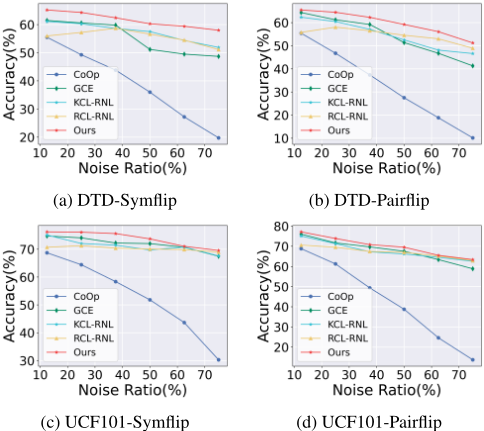
Comparison with Existing Two-Segment Label Screening and Rectification Methods. To evaluate the effectiveness of our proposed method, we compare it with two commonly used two-segment methods that categorize samples into clean and noisy categories: 1) keeping clean labels and refurbishing noisy labels as in Eq. (10) [Sohn et al., 2020; Feng et al., 2024], referred to as KCL-RNL; 2) refurbishing clean labels as in Eq. (10) and replacing noisy labels with pseudo labels [Li et al., 2020; Guo and Gu, 2024], referred to as RCL-RNL. As shown in Fig. 4, our method achieves superior performance across noise ratios on two datasets. This validates the advantages of tri-segment partitioning for precise label rectification and enhanced robustness through differentiated sample handling.
Confidence Weight Analysis. We compared our adaptive setting scheme of the confidence weight (wi) with fixed values (0.3, 0.5, 0.7). As shown in Table 3, the adaptive scheme consistently outperforms fixed weights by better handling uncertainty in ambiguous samples.
Robust Loss. Following [Wu et al., 2023], we evaluate CoOp with generalized cross-entropy (GCE) [Zhang and Sabuncu, 2018] on two noisy datasets. As shown in Fig. 4, while GCE improves CoOp's performance over cross-entropy, our method achieves better results in most cases.
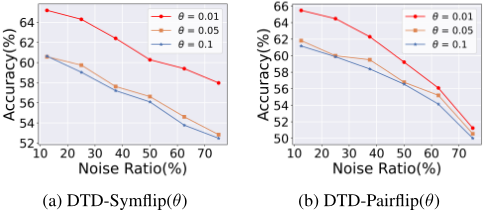
Hyper-parameters Analysis. We analyze the impact of confidence threshold θ on model performance (Fig. 5). The model performs best at θ = 0.01, with performance degrading as θ increases due to misclassification of clean samples.
| DTD | OxfordPets | ||||||||||||||||
|---|---|---|---|---|---|---|---|---|---|---|---|---|---|---|---|---|---|
| No. | MaLS | MiLS | DLSM | TSS-LR | LRS | Symflip | Pairflip | Symflip | Pairflip | ||||||||
| 12.5% | 50% | 75% | 12.5 | 50% | 75% | 12.5% | 50% | 75% | 12.5 | 50% | 75% | ||||||
| 1 | 55.50 | 36.00 | 19.77 | 55.43 | 27.53 | 10.17 | 77.67 | 48.37 | 22.37 | 76.40 | 37.00 | 14.17 | |||||
| 2 | ✓ | 60.17 | 47.77 | 33.94 | 59.01 | 40.20 | 27.84 | 87.54 | 80.10 | 60.83 | 86.14 | 75.42 | 60.89 | ||||
| 3 | ✓ | 60.13 | 47.54 | 32.16 | 60.12 | 39.96 | 25.11 | 87.36 | 80.03 | 58.27 | 86.89 | 74.22 | 60.53 | ||||
| 4 | ✓ | 60.52 | 48.46 | 35.82 | 60.76 | 41.31 | 30.73 | 87.68 | 80.57 | 64.98 | 87.03 | 77.35 | 61.98 | ||||
| 5 | ✓ | ✓ | 62.41 | 55.38 | 51.48 | 61.52 | 51.48 | 46.34 | 89.64 | 88.42 | 87.24 | 89.78 | 87.60 | 86.59 | |||
| 6 | ✓ | ✓ | 62.77 | 57.57 | 51.89 | 64.54 | 52.07 | 49.29 | 89.75 | 89.07 | 88.06 | 90.08 | 88.09 | 86.92 | |||
| 7 | ✓ | ✓ | ✓ | 63.12 | 58.04 | 52.25 | 63.00 | 54.43 | 46.57 | 90.13 | 88.74 | 87.68 | 90.02 | 87.98 | 86.73 | ||
| 8 | ✓ | ✓ | ✓ | 65.19 | 60.28 | 57.98 | 65.48 | 59.22 | 51.24 | 90.32 | 89.56 | 88.23 | 90.95 | 88.72 | 87.93 | ||
| wi | Symflip | Pairflip | ||||
|---|---|---|---|---|---|---|
| 12.5% | 50% | 75% | 12.5% | 50% | 75% | |
| 0.3 | 64.83 | 59.1 | 49.71 | 65.31 | 53.78 | 35.64 |
| 0.5 | 65.15 | 57.74 | 50.24 | 65.04 | 52.72 | 37.88 |
| 0.7 | 64.95 | 57.68 | 50.41 | 65.08 | 52.48 | 38.83 |
| Ours | 65.19 | 60.28 | 57.98 | 65.48 | 59.22 | 51.24 |
| Dataset | Method | Symflip 100% | Pairflip 100% |
|---|---|---|---|
| Caltech101 | CoOp CoOp+JoAPR CoOp+JoAPR* Ours | 1.3 81.50 84.80 87.71 | 0.6 84.90 84.10 87.63 |
| OxfordPets | CoOp CoOp+JoAPR CoOp+JoAPR* Ours | 4.7 72.60 82.40 85.45 | 1.4 76.90 70.40 85.04 |
5.5 Extreme Noisy Analysis
To assess the robustness of our method, we conducted a challenging experiment where we introduced 100% noise into the Caltech101 and OxfordPets datasets, meaning all training data were deliberately mislabeled. As shown in Table 4, our method demonstrates exceptional performance in both Symflip and Pairflip noise scenarios, significantly outperforming JoAPR. These results highlight the effectiveness and robustness of our approach under extreme noise conditions.
6 Conclusion
We propose a framework for tuning vision-language models with noisy labels through screening, rectifying, and rescreening strategies. Our dual-level semantic matching mechanism partitions samples into clean, ambiguous, and noisy samples, while the label rectification steps assign pseudo labels to ambiguous and noisy samples, and the re-screening step reduces self-confirmation bias through cross-validation.
Extensive experiments show superior performance over prior methods. However, challenges remain under high noise rates and fine-grained settings, which we aim to address through noise-robust loss functions and curriculum learning.
Acknowledgements
This work is supported in part by the National Key R&D Program of China (No. 2024YFB3908503, 2024YFB3908500, 2022ZD0120100), in part by the National Natural Science Foundation of China (No. 62376206, 62176198, 62322608), in part by Guangdong Basic and Applied Basic Research Foundation (No. 2024A1515010255), and in part by Fundamental Research Funds for the Central Universities (No. QTZX25083).
@inproceedings{ijcai2025p568,
  title     = {Screening, Rectifying, and Re-Screening: A Unified Framework for Tuning Vision-Language Models with Noisy Labels},
  author    = {Fang, Chaowei and Ma, Hangfei and Li, Zhihao and Cheng, De and Zhang, Yue and Li, Guanbin},
  booktitle = {Proceedings of the Thirty-Fourth International Joint Conference on
               Artificial Intelligence, {IJCAI-25}},
  publisher = {International Joint Conferences on Artificial Intelligence Organization},
  editor    = {James Kwok},
  pages     = {5101--5109},
  year      = {2025},
  month     = {8},
  note      = {Main Track},
  doi       = {10.24963/ijcai.2025/568},
  url       = {https://doi.org/10.24963/ijcai.2025/568},
}
TY - CPAPER TI - Screening, Rectifying, and Re-Screening: A Unified Framework for Tuning Vision-Language Models with Noisy Labels AU - Fang, Chaowei AU - Ma, Hangfei AU - Li, Zhihao AU - Cheng, De AU - Zhang, Yue AU - Li, Guanbin T2 - Proceedings of the Thirty-Fourth International Joint Conference on Artificial Intelligence, IJCAI-25 PB - International Joint Conferences on Artificial Intelligence Organization PY - 2025 SP - 5101 EP - 5109 DO - 10.24963/ijcai.2025/568 UR - https://doi.org/10.24963/ijcai.2025/568 ER -Copied
Machine-readable versions of this paper, for tools and AI agents:





