
Multi-view Clustering via Multi-granularity Ensemble
Proceedings of the Thirty-Fourth International Joint Conference on Artificial Intelligence. Main Track. Pages 6794-6802.
https://doi.org/10.24963/ijcai.2025/756
Keywords
- Machine Learning: ML: Clustering
- Machine Learning: ML: Multi-modal learning
- Machine Learning: ML: Unsupervised learning
- Machine Learning: ML: Multi-view learning
Abstract
Multi-view clustering aims to integrate complementary information from multiple views to improve clustering performance. However, existing ensemble-based methods suffer from information loss due to their reliance on single-granularity labels, limiting the discriminative capability of learned representations. Meanwhile, representation and graph fusion-based approaches face challenges such as explicit view alignment and manual weight tuning, making them less effective for heterogeneous views with varying data distributions. To address these limitations, we propose a novel multi-view clustering framework via Multi-granularity Ensemble (MGE), fully using the multi-granularity information across diverse views for accurate and consistent clustering. Specifically, MGE first modifies the hierarchical clustering and then leverages it on each view (including the fused view) to achieve multi-granularity labels. Moreover, the cross-view and cross-granularity fusion strategy is designed to learn a robust co-association similarity matrix, which effectively preserves the fine-grained and coarse-grained structures of multi-view data and facilitates subsequent clustering. Therefore, MGE can provide a comprehensive representation of local and global patterns within data, eliminating the requirement for view alignment and weight tuning. Experiments demonstrate that MGE consistently outperforms state-of-the-art methods across multiple datasets, validating its effectiveness and superiority in handling heterogeneous views.
- [Chao et al., 2021] Guoqing Chao, Shiliang Sun, and Jinbo Bi. A survey on multiview clustering. IEEE Transactions on Artificial Intelligence, 2(2):146-168, 2021.
- [Chen et al., 2024a] Man-Sheng Chen, Zhi-Yuan Li, Jia-Qi Lin, Chang-Dong Wang, and Dong Huang. Sparse graph tensor learning for multi-view spectral clustering. IEEE Transactions on Emerging Topics in Computational Intel- ligence, 8(5):3534-3543, 2024.
- [Chen et al., 2024b] Mulin Chen, Bocheng Wang, and Xue- long Li. Deep contrastive graph learning with clustering- oriented guidance. In Proceedings of the AAAI Conference on Artificial Intelligence, pages 11364-11372, 2024.
- [Cui et al., 2024] Chenhang Cui, Yazhou Ren, Jingyu Pu, Ji- awei Li, Xiaorong Pu, Tianyi Wu, Yutao Shi, and Lifang He. A novel approach for effective multi-view cluster- ing with information-theoretic perspective. Advances in Neural Information Processing Systems, 36:44847-44859, 2024.
- [Fang et al., 2020] Xiang Fang, Yuchong Hu, Pan Zhou, and Dapeng Oliver Wu. V3h: View variation and view heredity for incomplete multiview clustering. IEEE Transactions on Artificial Intelligence, 1(3):233-247, 2020.
- [Huang et al., 2018] Dong Huang, Chang-Dong Wang, Hongxing Peng, Jianhuang Lai, and Chee-Keong Kwoh. Enhanced ensemble clustering via fast propagation of cluster-wise similarities. IEEE Transactions on Systems, Man, and Cybernetics: Systems, 51(1):508-520, 2018.
- [Huang et al., 2022] Shudong Huang, Hongjie Wu, Yazhou Ren, Ivor Tsang, Zenglin Xu, Wentao Feng, and Jiancheng Lv. Multi-view subspace clustering on topological mani- fold. Advances in Neural Information Processing Systems, 35:25883-25894, 2022.
- [Huang et al., 2023a] Dong Huang, Chang-Dong Wang, and Jian-Huang Lai. Fast multi-view clustering via ensem- bles: Towards scalability, superiority, and simplicity. IEEE Transactions on Knowledge and Data Engineering, 35(11):11388-11402, 2023.
- [Huang et al., 2023b] Shudong Huang, Yixi Liu, Hecheng Cai, Yuze Tan, Chenwei Tang, and Jiancheng Lv. Smooth representation learning from multi-view data. Information Fusion, 100:101916, 2023.
- [Huang et al., 2024] Shudong Huang, Hecheng Cai, Hao Dai, Wentao Feng, and Jiancheng Lv. Adaptive instance- wise multi-view clustering. In Proceedings of the 32nd ACM International Conference on Multimedia, pages 5299-5307, 2024.
- [Jiang et al., 2025a] Bingbing Jiang, Jun Liu, Zidong Wang, Chenglong Zhang, Jie Yang, Yadi Wang, Weiguo Sheng, and Weiping Ding. Semi-supervised multi-view feature selection with adaptive similarity fusion and learning. Pat- tern Recognition, 159:111159, 2025.
- [Jiang et al., 2025b] Bingbing Jiang, Chenglong Zhang, Xinyan Liang, Peng Zhou, Jie Yang, Xingyu Wu, Junyi Guan, Weiping Ding, and Weiguo Sheng. Collaborative similarity fusion and consistency recovery for incomplete multi-view clustering. In Proceedings of the AAAI Confer- ence on Artificial Intelligence, pages 17617-17625, 2025.
- [Kang et al., 2020] Zhao Kang, Wangtao Zhou, Zhitong Zhao, Junming Shao, Meng Han, and Zenglin Xu. Large- scale multi-view subspace clustering in linear time. In Pro- ceedings of the AAAI Conference on Artificial Intelligence, pages 4412-4419, 2020.
- [Kumar et al., 2011] Abhishek Kumar, Piyush Rai, and Hal Daume. Co-regularized multi-view spectral clustering. Proceedings of the International Conference on Neural In- formation Processing Systems, pages 1413-1421, 2011.
- [Li et al., 2021] Zhenglai Li, Chang Tang, Xinwang Liu, Xiao Zheng, Wei Zhang, and En Zhu. Consensus graph learning for multi-view clustering. IEEE Transactions on Multimedia, 24:2461-2472, 2021.
- [Li et al., 2024] Taiyong Li, Xiaoyang Shu, Jiang Wu, Qingxiao Zheng, Xi Lv, and Jiaxuan Xu. Adaptive weighted ensemble clustering via kernel learning and lo- cal information preservation. Knowledge-Based Systems, 294:111793, 2024.
- [Liang et al., 2024] Xinyan Liang, Pinhan Fu, Qian Guo, Keyin Zheng, and Yuhua Qian. Dc-nas: Divide-and- conquer neural architecture search for multi-modal clas- sification. In Proceedings of the AAAI conference on Arti- ficial Intelligence, pages 13754-13762, 2024.
- [Liang et al., 2025] Xinyan Liang, Pinhan Fu, Yuhua Qian, Qian Guo, and Guoqing Liu. Trusted multi-view classifi- cation via evolutionary multi-view fusion. In Proceedings of the 13th International Conference on Learning Repre- sentations, pages 1-14, 2025.
- [Lou et al., 2024] Zhengzheng Lou, Chaoyang Zhang, Hang Xue, Yangdong Ye, Qinglei Zhou, and Shizhe Hu. Self- supervised weighted information bottleneck for multi- view clustering. In Proceedings of the International Joint Conference on Artificial Intelligence, pages 4643-4650, 2024.
- [Nie et al., 2018] Feiping Nie, Lai Tian, and Xuelong Li. Multiview clustering via adaptively weighted procrustes. In Proceedings of the ACM SIGKDD International Con- ference on Knowledge Discovery & Data Mining, pages 2022-2030, 2018.
- [Pfeifer et al., 2023] Bastian Pfeifer, Marcus D Bloice, and Michael G Schimek. Parea: multi-view ensemble cluster- ing for cancer subtype discovery. Journal of Biomedical Informatics, 143:104406, 2023.
- [Strehl and Ghosh, 2002] Alexander Strehl and Joydeep Ghosh. Cluster ensembles-a knowledge reuse framework for combining multiple partitions. Journal of Machine Learning Research, 3(12):583-617, 2002.
- [Sun et al., 2024] Yuan Sun, Yang Qin, Yongxiang Li, Dezhong Peng, Xi Peng, and Peng Hu. Robust multi-view clustering with noisy correspondence. IEEE Transactions on Knowledge and Data Engineering, 36(12):9150-9162, 2024.
- [Sun et al., 2025] Bohang Sun, Yongjian Deng, Yuena Lin, Qiuru Hai, Zhen Yang, and Gengyu Lyu. Graph consis- tency and diversity measurement for federated multi-view clustering. In Proceedings of the AAAI conference on Ar- tificial Intelligence, pages 20663-20671, 2025.
- [Wang et al., 2019] Hao Wang, Yan Yang, and Bing Liu. Gmc: Graph-based multi-view clustering. IEEE Transac- tions on Knowledge and Data Engineering, 32(6):1116- 1129, 2019.
- [Wang et al., 2024a] Jing Wang, Songhe Feng, Gengyu Lyu, and Jiazheng Yuan. Surer: Structure-adaptive unified graph neural network for multi-view clustering. In Pro- ceedings of the AAAI conference on Artificial Intelligence, pages 15520-15527, 2024.
- [Wang et al., 2024b] Siwei Wang, Xinwang Liu, Suyuan Liu, Wenxuan Tu, and En Zhu. Scalable and structural multi-view graph clustering with adaptive anchor fusion. IEEE Transactions on Image Processing, 33:4627-4639, 2024.
- [Wang et al., 2025] Zhongli Wang, Jie Yang, Junyi Guan, Chenglong Zhang, Xinyan Liang, Bingbing Jiang, and Weiguo Sheng. Enhanced density peak clustering for high- dimensional data. In Proceedings of the AAAI Conference on Artificial Intelligence, pages 21411-21419, 2025.
- [Wen et al., 2024] Jie Wen, Gehui Xu, Zhanyan Tang, Wei Wang, Lunke Fei, and Yong Xu. Graph regularized and feature aware matrix factorization for robust incomplete multi-view clustering. IEEE Transactions on Circuits and Systems for Video Technology, 34(5):3728-3741, 2024.
- [Wu et al., 2024] Danyang Wu, Zhenkun Yang, Jitao Lu, Jin Xu, Xiangmin Xu, and Feiping Nie. Ebmgc-gnf: Efficient balanced multi-view graph clustering via good neighbor fusion. IEEE Transactions on Pattern Analysis and Ma- chine Intelligence, 46(12):7878-7892, 2024.
- [Wu et al., 2025] Danyang Wu, Penglei Wang, Jitao Lu, Zhanxuan Hu, Hongming Zhang, and Feiping Nie. Trian- gle topology enhancement for multi-view graph clustering. IEEE Transactions on Knowledge and Data Engineering, 2025.
- [Xu et al., 2022] Jie Xu, Huayi Tang, Yazhou Ren, Liang Peng, Xiaofeng Zhu, and Lifang He. Multi-level feature learning for contrastive multi-view clustering. In Proceed- ings of the IEEE/CVF Conference on Computer Vision and Pattern Recognition, pages 16051-16060, 2022.
- [Xu et al., 2023] Cai Xu, Wei Zhao, Jinglong Zhao, Ziyu Guan, Yaming Yang, Long Chen, and Xiangyu Song. Pro- gressive deep multi-view comprehensive representation learning. In Proceedings of the AAAI Conference on Arti- ficial Intelligence, pages 10557-10565, 2023.
- [Xu et al., 2024] Jiaxuan Xu, Taiyong Li, and Lei Duan. Enhancing ensemble clustering with adaptive high-order topological weights. In Proceedings of the AAAI Confer- ence on Artificial Intelligence, pages 16184-16192, 2024.
- [Yang and Lin, 2024] Jie Yang and Chin-Teng Lin. En- hanced adjacency-constrained hierarchical clustering us- ing fine-grained pseudo labels. IEEE Transactions on Emerging Topics in Computational Intelligence, 8(3):2481-2492, 2024.
- [Yu et al., 2020] Zhiwen Yu, Daxing Wang, Xian-Bing Meng, and CL Philip Chen. Clustering ensemble based on hybrid multiview clustering. IEEE Transactions on Cy- bernetics, 52(7):6518-6530, 2020.
- [Zhang et al., 2023] Xuanqi Zhang, Qiangqiang Shen, Yongyong Chen, Guokai Zhang, Zhongyun Hua, and Jingyong Su. Multi-view ensemble clustering via low- rank and sparse decomposition: From matrix to tensor. ACM Transactions on Knowledge Discovery from Data, 17(7):1-19, 2023.
- [Zhang et al., 2024a] Chenglong Zhang, Yang Fang, Xinyan Liang, Xingyu Wu, Bingbing Jiang, et al. Efficient multi- view unsupervised feature selection with adaptive struc- ture learning and inference. In Proceedings of the 33rd International Joint Conference on Artificial Intelligence, pages 5443-5452, 2024.
- [Zhang et al., 2024b] Chenglong Zhang, Xinyan Liang, Peng Zhou, Zhaolong Ling, Yingwei Zhang, Xingyu Wu, Weiguo Sheng, and Bingbing Jiang. Scalable multi-view unsupervised feature selection with structure learning and fusion. In Proceedings of the 32nd ACM International Conference on Multimedia, pages 5479-5488, 2024.
- [Zheng et al., 2024] Dacheng Zheng, Zhiwen Yu, Wuxing Chen, Weiwen Zhang, Qiying Feng, Yifan Shi, and Kaix- iang Yang. Multiview ensemble clustering of hypergraph p-laplacian regularization with weighting and denoising. Information Sciences, 681:121187, 2024.
- [Zong et al., 2018] Linlin Zong, Xianchao Zhang, Xinyue Liu, and Hong Yu. Weighted multi-view spectral cluster- ing based on spectral perturbation. In Proceedings of the AAAI conference on Artificial Intelligence, pages 4621- 4628, 2018.
References were extracted automatically from the PDF and may contain errors.
Full text extracted automatically from the PDF; figures, tables and equations may differ. The PDF is the version of record.
1 Introduction
Multi-view clustering integrates complementary information from various modalities (e.g., images, texts, sensor readings) to produce more accurate and robust clustering [Chao et al.,
∗Corresponding author.
2021; Jiang et al., 2025b]. However, effectively leveraging multi-view information remains challenging due to inconsistencies in data quality, feature distributions, structural heterogeneity among views, and issues such as missing or redundant views [Jiang et al., 2025a]. Multi-view clustering can be broadly categorized based on their fusion strategies: (1) representation and graph-based fusion methods [Xu et al., 2023; Wang et al., 2024b; Huang et al., 2022; Huang et al., 2024], which construct a unified feature representation or similarity graph for clustering (commonly referred to as early fusion), and (2) ensemble-based methods [Pfeifer et al., 2023; Zheng et al., 2024; Xu et al., 2024], which combine clustering labels from different views to form a consensus result (referred to as late fusion). Some hybrid approaches combine feature-level and label-level integration for improved performance. Despite substantial progress, these categories face challenges such as information loss due to reliance on singlegranularity labels [Wang et al., 2025], sensitivity to heterogeneous view inconsistencies, and the need for manual tuning of view weights[Zhang et al., 2024a; Zhang et al., 2024b; Sun et al., 2025].
Representation and graph-based fusion methods aim to learn a shared representation or construct a consensus graph by aggregating information from multiple views [Chen et al., 2024b; Wen et al., 2024; Chen et al., 2024a; Huang et al., 2023b]. For instance, the consensus graph learning framework builds a robust consensus similarity graph by integrating spectral embeddings with a weighted tensor-based lowrank representation [Li et al., 2021]. The summarized multiview clustering approach reduces redundancy and enhances inter-view consistency by leveraging an information-theoretic variational lower bound [Cui et al., 2024]. Similarly, the robust multi-view clustering with noisy correspondence method employs a noise-tolerant contrastive loss to learn embeddings that remain robust even with misaligned views [Sun et al., 2024]. The multi-level feature learning framework for contrastive multi-view clustering independently learns low-level and high-level features, avoiding direct feature fusion and ensuring that private, view-specific information does not interfere with shared representations [Xu et al., 2022]. However, Data Multi-view and Multi-granularity Labels these methods often involve complex representation or graph alignment processes, which pose challenges for highly heterogeneous views, and they rely heavily on hyperparameter tuning, such as adjusting view weights and embedding dimensions, to achieve optimal performance [Wu et al., 2024; Lou et al., 2024; Liang et al., 2024; Wu et al., 2025].
Ensemble-based multi-view clustering methods aim to combine the strengths of multiple base clustering results to achieve robust and consistent consensus outcomes [Liang et al., 2025]. For example, the Parea hierarchical clustering ensemble framework leverages late-stage fusion to integrate clustering solutions from heterogeneous biomedical datasets, enhancing disease subtype discovery [Pfeifer et al., 2023]. The low-rank and sparse decomposition approach formulates ensemble clustering as a tensor decomposition problem, capturing high-order correlations across views [Zhang et al., 2023]. Similarly, the hybrid multi-view clustering ensemble method employs diverse view transformations and hybrid subspace learning to enhance the diversity of base clusterings [Yu et al., 2020]. The Fast Multi-view Ensemble Clustering (FMVEC) approach introduces a hybrid earlylate fusion strategy with random view groups, achieving nearlinear time complexity for large-scale datasets [Huang et al., 2023a]. However, most ensemble-based methods rely on single-granularity clustering labels, which often fail to capture critical hierarchical structures and limit their ability to learn more discriminative representations. Additionally, directly aggregating clustering labels into a final consensus label set can amplify errors, particularly when individual viewspecific labels are noisy, undermining their robustness and effectiveness [Wang et al., 2024a].
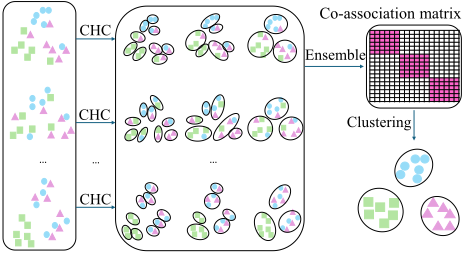
In this paper, we propose a novel multi-view clustering framework called Multi-granularity Ensemble (MGE), which addresses the limitations of both representation/graph fusionbased and ensemble-based methods by incorporating multigranularity clustering labels and constructing a co-association similarity matrix that encodes rich multi-view and multi-level information. Specifically, a constrained hierarchical clustering is introduced and exploited to each view and their fused view to generate multi-granularity labels that capture both fine-grained and coarse-grained cluster structures. The cross-view and cross-granularity fusion is then performed on these labels to construct a co-association matrix, encoding discriminative representations across local and global, multigranularity, and multi-view levels. As a result. MGE effectively avoids the challenges of heterogeneous view alignment and view-weight hyperparameter tuning that are typically required in representation/graph fusion-based methods. Moreover, it mitigates the impact of noisy labels from individual views by avoiding direct label aggregation and instead employing secondary clustering on the collaborative representation. Compared to existing ensemble-based methods, MGE captures richer local and global clustering structures by integrating multi-granularity information, ensuring more discriminative representation learning. Figure 1 illustrates the basic framework of MGE and the main contributions of this paper are summarized as follows:
- We propose a novel multi-view clustering framework, i.e., Multi-Granularity Ensemble (MGE), which effectively addresses the inherent information loss caused by reliance on single-granularity labels in existing methods, achieving more robust and accurate clustering results.
- MGE tackles the challenge of heterogeneous views existing in multi-view data, which effectively explore the structure information from varying data distributions without requiring explicit view alignment, enabling more accurate and robust clustering.
- We enhance representation learning via the cross-view and cross-granularity fusion that seamlessly integrates fine-grained and coarse-grained clustering structures, such that the local and global patterns across multiple views are simultaneously considered, further improving the discrimination and robustness of representations.
2 The Multi-granularity Ensemble Framework
2.1 Multi-view Multi-granularity Label Generation
To comprehensively capture fine-grained and coarse-grained clustering structures across multiple views, the proposed MGE framework introduced the Constrained Hierarchical Clustering (CHC) [Yang and Lin, 2024] to accommodate multi-view data, generating multi-granularity labels for each view and the fused view. Let X = {X1,X2, · · · ,Xv} be the multi-view dataset, where Xi represents the i-th view, and v denotes the number of views. The fused view Xf is defined based on the average of the similarity matrices Si derived from each view:
where Si is the similarity matrix corresponding to the i-th view. The matrix Sf serves as the similarity matrix for the fused view Xf , preserving cross-view consensus information.
To generate multi-granularity label sets for each view Xi (including Xf ), CHC is applied to produce Li = {Li,1,Li,2, . . . ,Li,ki }, where Li,j represents the clustering labels at the j-th granularity level for view i. The labels are ordered such that Li,1 corresponds to the finest partition (with the most clusters), and Li,ki represents the coarsest partition (with fewer clusters). The total number of clustering levels ki is determined based on a granularity termination parameter λ (discussed below).
Constrained Hierarchical Clustering
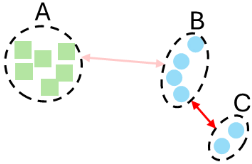
Hierarchical clustering (HC) constructs dendrograms to generate multi-granularity labels, enabling flexible exploration of data structures. However, traditional HC methods, such as single, complete, and average linkage, rely solely on 1nearest neighbor statistics, often merging sub-clusters from different categories, leading to low-purity multi-granularity labels. CHC addresses these limitations by introducing adjacency constraints, prioritizing sub-clusters that align with ground-truth structures, and using larger clusters to guide smaller ones. As illustrated in Figure 2, for the current clusters A, B, and C, a parallel merge based on 1-nearest neighbor relationships would result in A merging with B, and B merging with C. In contrast, CHC applies the constraint that the size of A is larger than that of B, no merge them; whereas the size of C is smaller than B, merge them, avoiding A merging with B while allowing B merging with C. This perfectly matches the ground truth and significantly improves the purity of the merging process at each iteration.
For each view Xi (including Xf ), CHC initializes each sample as its cluster. A graph G = (V,E) is constructed, where V represents the set of clusters (i.e., nodes), and an edge (Ci, Cj) ∈ E exists if cluster Cj is the 1-nearest neighbor (denoting as 1NN) of cluster Ci and |Ci| ≤ |Cj|. The adjacency matrix A is defined as:
where I(·) is the indicator function that returns 1 if the condition is true and 0 otherwise. The connected components of the graph G after each iteration represent the clusters at a specific granularity level. By iteratively merging clusters based on adjacency constraints, CHC produces hierarchical partitions corresponding to various levels of granularity.
When a target cluster number K is specified, CHC constructs a hierarchy and removes the K - 1 strongest edges from the graph G. The weight of each edge is computed as:
where d2 (Ci, Cj) denotes the squared distance between clusters Ci and Cj, and |Ci| represents the sizes of the clusters.
The K-1 edges with the highest weights are removed to disconnect the graph into K connected components, resulting in precisely K clusters.
Granularity Termination Hyperparameter λ
For each view Xi (including Xf ), CHC generates mi clustering partitions ranging from fine-grained to coarse-grained labels. The granularity termination parameter ki for view i determines the number of labels selected from the hierarchy:
where λ ∈ (0, 1] is a shared hyperparameter across all views, ensuring consistency in the number of clustering levels. Here, ⌊·⌋ denotes the rounding operation to the nearest integer. A smaller λ results in fewer clustering partitions (i.e., lower ki), corresponding to a coarser analysis. Conversely, a larger λ produces more clustering partitions (i.e., higher ki), corresponding to a finer breakdown with more detailed clustering levels.
By performing CHC to each view Xi and the fused view Xf , the proposed framework generates multi-granularity label sets Li = {Li,1,Li,2, . . . ,Li,ki }, where Li,ki corresponds to the clustering partition at the granularity level determined by ki. This ensures that both fine-grained and coarsegrained clustering structures are captured, enabling richer multi-view and multi-level representations for the subsequent integration process.
2.2 Cross-view and Cross-granularity Fusion
Previous ensemble methods, such as the Ensemble Learning via Propagation of Cluster-wise Similarities (ELPCS) [Huang et al., 2018], are restricted to single-view contexts, integrating labels of the same granularity from different algorithms. This design overlooks the complementary information inherent in multiple views and the enriched discriminative power provided by multi-granularity labels, thereby limiting clustering performance. To overcome these limitations, we extend ELPCS to support multi-view and multi-granularity data by introducing a cross-view and cross-granularity fusion strategy. This strategy facilitates a seamless global interaction between views and granularities, synergizing complementary insights and hierarchical structures to extract the most discriminative representations. The resulting co-association matrix effectively captures intricate relationships across views and granularities, serving as a robust foundation for accurate and reliable consensus clustering.
Cluster-wise Similarity Graph Construction
Given the multi-granularity label Li = {Li,1, · · · , Li,ki } for each viewXi (including the fused viewXf ), we construct a combined cluster-wise similarity graph G = (V, E), where: V represents the clusters across all views and granularities, and E represents edges weighted by the Jaccard coefficient:
where Cp and Cq are clusters from different views and/or different granularities, reflecting the proportion of overlapping data points. In this combined graph, nodes correspond
Algorithm 1 MGE framework
Input: Multi-view data X = {X1, · · · ,Xv}, and the cluster number c, and the granularity control parameter λ;
- 1: for each viewXi (including the fused viewXf );
- 2: Apply CHC to Xi to generate the multi-granularity label set Li by Eqs. (1)-(4);
- 3: end for
- 4: Construct the cluster-wise similarity graph using all label sets Li from all views by Eq. (5);
- 5: Construct the transition probability matrix P by Eq. (6);
- 6: Propagate cluster-wise similarities by Eq. (7);
- 7: Compute the cluster-wise similarity matrix Z by Eq. (8);
- 8: Construct the co-association matrix B by Eq. (9);
- 9: Apply CHC to B to obtain the final clustering label set L by Eqs. (2) and (3);
Output: The clustering result L.
to clusters from different views and granularities, and edges represent the similarity between these clusters based on the overlap of their constituent points.
Propagation of Cluster-wise Similarities
To capture both direct and indirect connections among clusters, a random walk propagation process is applied to the combined graph G. Let P denote the transition probability matrix for G, where each entry pp,q represents the probability of transitioning from cluster Cp to Cq in one step:
where ep,q is the Jaccard similarity between clusters Cp and Cq. The random walk propagation matrix P(t) after t steps captures indirect relationships:
The cluster-wise similarity matrix Z is computed by taking the cosine similarity of the random walk trajectories:
where P(1:t) (p, :) represents the trajectory of cluster Cp during the propagation process. The value of t is chosen to ensure clustering stability and efficiency, guided by practices commonly observed in related works.
Construction of the Co-association Matrix
To map the cluster-level similarities back to the object level, we construct the co-association matrix B as follows:
where v is the number of original views, and "+1" accounts for the fused viewXf , ki is the number of granularities in the i-th view. z(j) p,q represents the propagated similarity between clusters Cp and Cq at the j-th granularity level of the i-th view. x ∈ Cp and y ∈ Cq indicate that data points x and y belong to these clusters.
| Dataset | Classes | Data size | Feature size |
|---|---|---|---|
| 100Leaves | 100 | 1600 | 192(64/64/64) |
| UCI | 10 | 2000 | 356(76/216/64) |
| COIL20 | 20 | 1440 | 11078(1024/3304/6750) |
| Handwritten | 10 | 2000 | 316(76/240) |
| CMU-PIE | 68 | 2856 | 90(30/30/30) |
| ORL | 40 | 400 | 1689(512/59/864/254) |
Figure 1 illustrates the proposed MGE framework. For a multi-view dataset, the CHC is applied to each view (including the fused view) to generate multi-view, multi-granularity labels. These labels are then integrated through an ensemble method that performs cross-view and cross-granularity fusion, resulting in the co-association similarity matrix B. As a result, the co-association matrix B averages the cluster-wise similarities from all views and all granularity levels, capturing direct and indirect object-level relationships across all views and granularities, and it serves as input for the secondary clustering to generate the final clustering results. Algorithm 1 presents the procedures of the MGE framework.
2.3 Computational Complexity Analysis
The computational complexity of MGE is primarily determined by three stages: multi-view multi-granularity label generation, cross-view and cross-granularity fusion, and secondary clustering. In the first stage, applying CHC to each view (including the fused view) incurs a complexity of O(n2 ), where v is the number of views and n is the number of data points. In the second stage, constructing the cluster-wise similarity graph requires computing pairwise Jaccard coefficients between clusters, resulting in a complexity of O(K2 total ), where Ktotal is the total number of clusters across all views and granularities. The subsequent random walk propagation step involves matrix multiplications with a complexity of O(tK2 total ), where t is the number of propagation steps. Finally, the secondary clustering step applies CHC to the co-association matrix, contributing an additional complexity of O(n2 ). Therefore, the computational complexity of MGE is O(n2 + tK2 total ). By utilizing approximate methods such as kd-tree to accelerate the 1-nearest neighbor search in CHC, the complexity can be further reduced to O(n log n + tK2 total ).
3 Experiments
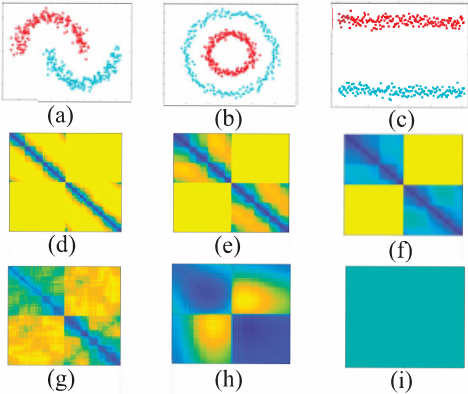
In this section, we present the experimental studies of the proposed MGE on a synthetic data and six real-world datasets, in which three views of the synthetic data are shown in Figures 3 (a)-(c), and the detailed information of real-world multi-view datasets are reported in Table 1.
3.1 Experimental Settings
MGE is compared with the state-of-the-art competitors, including three ensemble-based methods: Fast Multi-View Ensemble Clustering (FMVEC) [Huang et al., 2023a], Matrix Multi-View Ensemble Clustering (MMEC) [Zhang et al.,
| Methods | 100Leaves | UCI | COIL20 | Handwritten | CMU-PIE | ORL | Average | |
|---|---|---|---|---|---|---|---|---|
| GMC | 0.8237 | 0.8495 | 0.7910 | 0.8300 | 0.7048 | 0.6325 | 0.7719 | |
| TMMSC | 0.8356 | 0.9024 | 0.8042 | 0.9105 | 0.7953 | 0.7825 | 0.8384 | |
| V3H | 0.8237 | 0.9051 | 0.6012 | 0.8669 | 0.7231 | 0.7412 | 0.7769 | |
| LMVSC | 0.6575 | 0.8935 | 0.7569 | 0.9005 | 0.4769 | 0.6300 | 0.7192 | |
| AWP | 0.7856 | 0.8670 | 0.6757 | 0.9325 | 0.8120 | 0.6900 | 0.7938 | |
| ACC | CoReg | 0.8456 | 0.9560 | 0.8472 | 0.9110 | 0.7507 | 0.8200 | 0.8550 |
| WMSC | 0.8769 | 0.8410 | 0.8465 | 0.8335 | 0.6590 | 0.8300 | 0.8145 | |
| MMEC | 0.6770 | 0.6996 | 0.6494 | 0.8578 | 0.3548 | 0.5860 | 0.6374 | |
| FMVEC | 0.7981 | 0.7770 | 0.7979 | 0.8760 | 0.6604 | 0.7675 | 0.7794 | |
| CDEC | 0.5162 | 0.7490 | 0.7208 | 0.8155 | 0.5014 | 0.5650 | 0.6447 | |
| MGE | 0.9481 | 0.9725 | 1.0000 | 0.9825 | 0.9783 | 0.8525 | 0.9557 | |
| GMC | 0.9296 | 0.9013 | 0.9410 | 0.8767 | 0.8892 | 0.8590 | 0.8995 | |
| TMMSC | 0.9248 | 0.8885 | 0.9190 | 0.9190 | 0.9072 | 0.7800 | 0.8898 | |
| V3H | 0.9096 | 0.8118 | 0.7639 | 0.7425 | 0.8667 | 0.8633 | 0.8263 | |
| LMVSC | 0.8504 | 0.8321 | 0.8404 | 0.8366 | 0.6916 | 0.8246 | 0.8127 | |
| AWP | 0.8968 | 0.8949 | 0.9148 | 0.9072 | 0.9296 | 0.8529 | 0.8989 | |
| NMI | CoReg | 0.9346 | 0.9188 | 0.9548 | 0.8811 | 0.8791 | 0.9011 | 0.9116 |
| WMSC | 0.9481 | 0.8839 | 0.9486 | 0.8772 | 0.8571 | 0.8985 | 0.9022 | |
| MMEC | 0.8939 | 0.7177 | 0.8001 | 0.7814 | 0.7066 | 0.7984 | 0.7830 | |
| FMVEC | 0.9235 | 0.8894 | 0.9433 | 0.9008 | 0.8242 | 0.9029 | 0.8974 | |
| CDEC | 0.7123 | 0.6745 | 0.7754 | 0.7240 | 0.6224 | 0.7182 | 0.7045 | |
| MGE | 0.9712 | 0.9406 | 1.0000 | 0.9604 | 0.9846 | 0.9245 | 0.9636 |
(h)
Figure 3: Results on the synthetic data. (a)-(c) depict the original data distributions with three views, (d)-(f) show the co-association matrices learned by MGE with different granularities (i.e. 3 granularities, 6 granularities and 9 granularities), (g)-(i) illustrate the results of FMVEC, MMEC, and GMC, respectively.
2023], and Coordinate Descent Ensemble Clustering (CDEC) [Li et al., 2024], as well as seven graph/representation fusionbased methods, such as Graph-based Multi-View Clustering (GMC) [Wang et al., 2019], Multi-view Subspace Clustering on Topological Manifold (TMMSC) [Huang et al., 2022], View Variation and View Heredity for Multi-View Clustering (V3H) [Fang et al., 2020], Large-Scale Multi-View Subspace Clustering (LMVSC) [Kang et al., 2020], Multi-View Clustering via Adaptively Weighted Procrustes (AWP) [Nie et al., 2018], Co-Regularized Multi-View Spectral Clustering (CoReg) [Kumar et al., 2011], and Weighted Multi-View Spectral Clustering (WMSC) [Zong et al., 2018]. We evaluate the performance using two widely used external validation metrics: Accuracy (ACC), and Normalized Mutual Information (NMI) [Strehl and Ghosh, 2002]. For all methods, parameters are tuned according to the default settings in their original publications to ensure optimal performance.
3.2 Experiments on Synthetic Dataset
To intuitively demonstrate the advantages of MGE, we generated a synthetic dataset with three heterogeneous views, as illustrated in Figures 3(a)-(c). Differing from other ensemblebased methods, MGE integrates multi-granularity labels, capturing both fine-grained and coarse-grained structures to encode local and global patterns within data. This manner facilitates the learning of more discriminative ensemble representations. As shown in Figures 3(d)-(f), increasing the number of granularities (and λ is set to 0.3, 0.6, and 0.9, progressively covering granularities from fine to coarse) from three to nine progressively clarifies the clustering structures in the co-association matrices, providing a stronger foundation for subsequent clustering. Figures 3(g)-(i) further demonstrate that FMVEC and MMEC produce weaker representations due to their reliance on single-granularity label integration, while GMC fails to fuse these heterogeneous views, manifesting the limitations of graph fusion-based methods in such scenarios.
It should be pointed out that MGE can effectively leverage its advantages to enhance the clusterability of the coassociation matrix even when a single view exhibits nearperfect clustering potential, as seen in View 3. By employing a constrained 1NN merging strategy, the multi-granularity labels generated by MGE accurately capture proximity relationships across both local and global scales. In contrast, the single-granularity methods (e.g., FMVEC and MMEC) and the fusion-based methods fail to utilize the multi-layered, near-ground-truth information provided by such views, resulting in co-association matrices with significantly diminished discrimination.
3.3 Experiments on Real-world Datasets
The results of the proposed MGE and other state-of-theart methods across six datasets are presented in Table 2, from which we can find that MGE achieves the best performance across all datasets on the ACC and NMI, Specifically, MGE achieves improvements in the average ACC of 17.62% and 10.07% over the best ensemble-based method (i.e., FMVEC) and the best graph fusion-based (i.e., CoReg), respectively. For the average NMI metric, MGE likewise achieves 7.38% and 5.70% improvements over the best ensemble-based method (i.e., FMVEC) and the best graph fusion-based (i.e., CoReg), respectively. The superior performance of MGE can be attributed to its innovative clustering mechanism that addresses key limitations of existing methods. Unlike ensemble-based approaches like FMVEC and MMEC, which rely on single-granularity label aggregation and are sensitive to noisy labels, MGE employs multigranularity clustering to preserve fine-grained and coarsegrained structures. Its secondary clustering stage further mitigates the impact of noisy labels, ensuring robust results. Compared to graph fusion-based methods like GMC and CoReg, which require explicit view alignment and extensive parameter tuning, MGE leverages multi-granularity information for consistent and scalable clustering across heterogeneous views. Additionally, MGE surpasses representation fusion-based methods like TMMSC and LMVSC by utilizing clustering labels and encoding both local and global patterns, delivering comprehensive and discriminative representations.
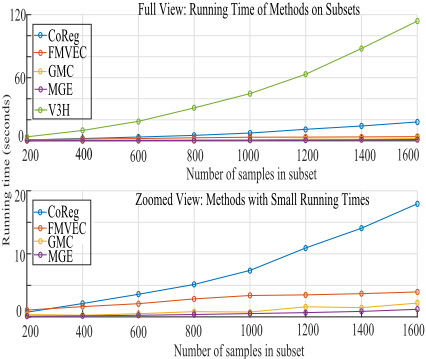
Figure 4 shows the runtime of MGE with several representative methods on the 100Leaves dataset, in which the number of samples varies from 200 to 1600. We note that MGE consistently exhibits the shortest runtime across different data sizes, attributed to its efficient two-stage process, i.e., generating multi-granularity clustering labels first and then clustering on the co-association matrix. This manner minimizes computational overhead by avoiding iterative optimization and graph alignment, which demonstrates the scalability of MGE and positions it as an effective solution for relatively large-scale clustering tasks.
3.4 Visualization
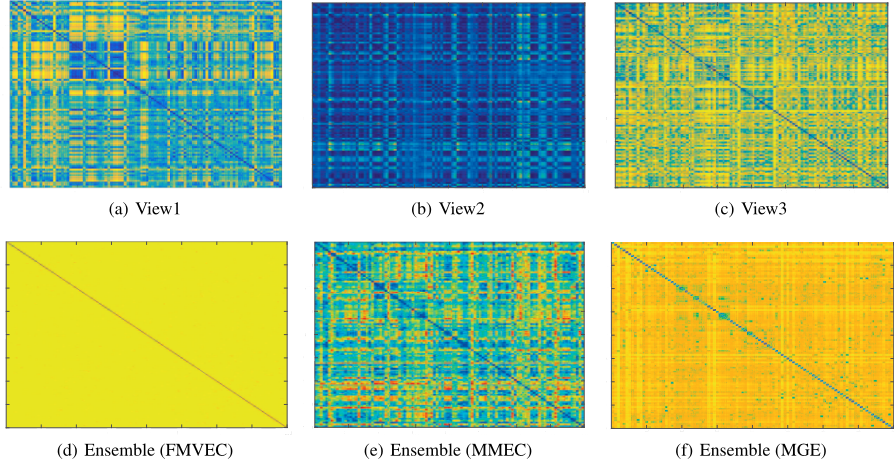
To demonstrate the advantages of the cross-view and crossgranularity fusion method in MGE, we compare its coassociation similarity matrix with those generated by two ensemble-based methods, MMEC and FMVEC, on the 100Leaves dataset. As shown in Figure 5, the first row presents the similarity matrices of the original three views, and the second row displays the co-association matrices learned by MGE, MMEC, and FMVEC. Specifically, the matrix of MGE exhibits a much clearer and more coherent clustering structure than those of MMEC and FMVEC. Moreover, the matrix of MMEC shows indistinct clustering patterns with significant noises, while the matrix of FMVEC, though clearer than MMEC, likewise suffers from low intracluster similarity (indicated by lighter diagonal regions), resulting in less compact clusters. This indicates that making full use of multi-granularity information facilitates capturing both fine-grained and coarse-grained structures as well as learning a more comprehensive representation for clustering.
3.5 Ablation Study
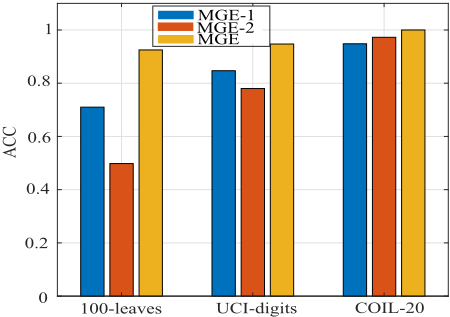
The MGE framework involves two clustering processes: the first generates multi-view, multi-granularity clustering labels, and the second performs secondary clustering on the coassociation matrix to produce the final result. In both stages, CHC is employed as the clustering method. To assess the impact of this choice, we replaced CHC with other hierarchical clustering algorithms, including single-linkage and averagelinkage, and named the corresponding variants MGE-1 and MGE-2, respectively. As shown in Figure 6, the ACC scores of MGE-1 and MGE-2 across three datasets were significantly lower than that of MGE, indicating the importance of using CHC in both stages of the proposed MGE framework.
3.6 Hyperparameter Sensitivity Analysis
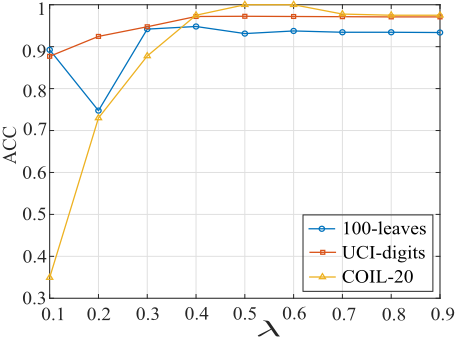
The MGE framework contains only one hyperparameter λ, which controls the granularity of the clustering labels generated for all views, including the fused view. Figure 7 illustrates the ACC scores of MGE on three datasets when adjusting λ within the range of [0.1:0.1:0.9]. It can be observed that setting λ around 0.5 achieves the best average performance across the three datasets. A larger λ produces an excessive number of coarse-grained multi-view labels, reducing the discriminative ability between different classes in the ground truth. Conversely, a smaller λ generates insufficient types of multi-granularity labels, leading to significant information loss and diminishing the ability of the co-association matrix to distinguish ground-truth classes.
4 Conclusion
In this paper, we introduce Multi-view Clustering via Multigranularity Ensemble (MGE), a novel framework designed to
200
400
600
800
1000
1200
1400
1600
1600
address the challenges posed by view-specific inconsistencies and single-granularity limitations in ensemble-based multiview clustering methods. The proposed framework leverages the CHC to generate multi-granularity clustering labels for each view, including the fused view, capturing both finegrained and coarse-grained cluster structures. By performing cross-view and cross-granularity fusion, we constructed a co-association similarity matrix that integrates local and global clustering patterns across views, enabling robust secondary clustering. Extensive experiments conducted on a synthetic dataset with heterogeneous views and real-world multi-view datasets demonstrated the superior performance of MGE compared to state-of-the-art multi-view clustering algorithms across key evaluation metrics (ACC and NMI). Notably, MGE consistently achieved the highest clustering accuracy, highlighting its resilience to noisy or low-quality views and its ability to provide comprehensive representations of complex data structures. In future work, we aim to extend MGE to scenarios with incomplete or missing views and explore its scalability for large-scale, high-dimensional datasets. Additionally, we plan to investigate adaptive granularity control mechanisms to further enhance its generalization across various domains.
Acknowledgments
This work was supported by National Natural Science Foundation of China (No. 62306171), the Science and Technology Major Project of Shanxi (No. 202201020101006).
@inproceedings{ijcai2025p756,
  title     = {Multi-view Clustering via Multi-granularity Ensemble},
  author    = {Yang, Jie and Chen, Wei and Liu, Feng and Zhou, Peng and Wang, Zhongli and Liang, Xinyan and Jiang, Bingbing},
  booktitle = {Proceedings of the Thirty-Fourth International Joint Conference on
               Artificial Intelligence, {IJCAI-25}},
  publisher = {International Joint Conferences on Artificial Intelligence Organization},
  editor    = {James Kwok},
  pages     = {6794--6802},
  year      = {2025},
  month     = {8},
  note      = {Main Track},
  doi       = {10.24963/ijcai.2025/756},
  url       = {https://doi.org/10.24963/ijcai.2025/756},
}
TY - CPAPER TI - Multi-view Clustering via Multi-granularity Ensemble AU - Yang, Jie AU - Chen, Wei AU - Liu, Feng AU - Zhou, Peng AU - Wang, Zhongli AU - Liang, Xinyan AU - Jiang, Bingbing T2 - Proceedings of the Thirty-Fourth International Joint Conference on Artificial Intelligence, IJCAI-25 PB - International Joint Conferences on Artificial Intelligence Organization PY - 2025 SP - 6794 EP - 6802 DO - 10.24963/ijcai.2025/756 UR - https://doi.org/10.24963/ijcai.2025/756 ER -Copied
Machine-readable versions of this paper, for tools and AI agents:





