
Learning Heterogeneous Performance-Fairness Trade-offs in Federated Learning
Proceedings of the Thirty-Fourth International Joint Conference on Artificial Intelligence. Main Track. Pages 6839-6847.
https://doi.org/10.24963/ijcai.2025/761
Keywords
- Machine Learning: ML: Federated learning
- AI Ethics, Trust, Fairness: ETF: Bias
Abstract
Recent methods leverage a hypernet to handle the performance-fairness trade-offs in federated learning. This hypernet maps the clients' preferences between model performance and fairness to preference-specifc models on the trade-off curve, known as local Pareto front. However, existing methods typically adopt a uniform preference sampling distribution to train the hypernet across clients, neglecting the inherent heterogeneity of their local Pareto fronts. Meanwhile, from the perspective of generalization, they do not consider the gap between local and global Pareto fronts on the global dataset. To address these limitations, we propose HetPFL to effectively learn both local and global Pareto fronts. HetPFL comprises Preference Sampling Adaptation (PSA) and Preference-aware Hypernet Fusion (PHF). PSA adaptively determines the optimal preference sampling distribution for each client to accommodate heterogeneous local Pareto fronts. While PHF performs preference-aware fusion of clients' hypernets to ensure the performance of the global Pareto front. We prove that HetPFL converges linearly with respect to the number of rounds, under weaker assumptions than existing methods. Extensive experiments on four datasets show that HetPFL significantly outperforms seven baselines in terms of the quality of learned local and global Pareto fronts.
- [Barenstein, 2019] Matias Barenstein. Propublica's compas data revisited. arXiv preprint arXiv:1906.04711, 2019.
- [Collins et al., 2021] Liam Collins, Hamed Hassani, Aryan Mokhtari, and Sanjay Shakkottai. Exploiting shared rep- resentations for personalized federated learning. In Pro- ceedings of International Conference on Machine Learn- ing, pages 2089-2099. PMLR, 2021.
- [Deng et al., 2020] Yuyang Deng, Mohammad Mahdi Ka- mani, and Mehrdad Mahdavi. Distributionally robust fed- erated averaging. In Proceedings of Advances in Neu- ral Information Processing Systems, volume 33, pages 15111-15122, 2020.
- [Du et al., 2021] Wei Du, Depeng Xu, Xintao Wu, and Hanghang Tong. Fairness-aware agnostic federated learn- ing. In Proceedings of the 2021 SIAM International Con- ference on Data Mining (SDM), pages 181-189. SIAM, 2021.
- [Dua et al., 2017] Dheeru Dua, Casey Graff, et al. Uci ma- chine learning repository, 2017. URL http://archive. ics. uci. edu/ml, 7(1):62, 2017. Link
- [Ezzeldin et al., 2023] Yahya H Ezzeldin, Shen Yan, Chaoyang He, Emilio Ferrara, and A Salman Avestimehr. Fairfed: Enabling group fairness in federated learning. In Proceedings of the AAAI Conference on Artificial Intelligence, volume 37, pages 7494-7502, 2023.
- [Feldman et al., 2015] Michael Feldman, Sorelle A Friedler, John Moeller, Carlos Scheidegger, and Suresh Venkata- subramanian. Certifying and removing disparate im- pact. In proceedings of the 21th ACM SIGKDD interna- tional conference on knowledge discovery and data min- ing, pages 259-268, 2015.
- [Hong et al., 2023] Mingyi Hong, Hoi-To Wai, Zhaoran Wang, and Zhuoran Yang. A two-timescale stochastic al- gorithm framework for bilevel optimization: Complexity analysis and application to actor-critic. SIAM Journal on Optimization, 33(1):147-180, 2023.
- [Imteaj and Amini, 2022] Ahmed Imteaj and M Hadi Amini. Leveraging asynchronous federated learning to predict customers financial distress. Intelligent Systems with Ap- plications, 14:200064, 2022.
- [Kamishima et al., 2012] Toshihiro Kamishima, Shotaro Akaho, Hideki Asoh, and Jun Sakuma. Fairness-aware classifier with prejudice remover regularizer. In Machine Learning and Knowledge Discovery in Databases: Eu- ropean Conference, ECML PKDD 2012, Bristol, UK, September 24-28, 2012. Proceedings, Part II 23, pages 35-50. Springer, 2012.
- [Li et al., 2019] Tian Li, Maziar Sanjabi, Ahmad Beirami, and Virginia Smith. Fair resource allocation in federated learning. arXiv preprint arXiv:1905.10497, 2019.
- [Lin et al., 2022] Xi Lin, Zhiyuan Yang, and Qingfu Zhang. Pareto set learning for neural multi-objective combinato- rial optimization. In Proceedings of International Confer- ence on Learning Representations, 2022.
- [Lyu et al., 2020] Lingjuan Lyu, Xinyi Xu, Qian Wang, and Han Yu. Collaborative fairness in federated learning. Fed- erated Learning: Privacy and Incentive, pages 189-204, 2020.
- [Makhija et al., 2024] Disha Makhija, Xing Han, Joydeep Ghosh, and Yejin Kim. Achieving fairness across local and global models in federated learning. arXiv preprint arXiv:2406.17102, 2024.
- [McMahan et al., 2017] Brendan McMahan, Eider Moore, Daniel Ramage, Seth Hampson, and Blaise Aguera y Ar- cas. Communication-efficient learning of deep networks from decentralized data. In Artificial Intelligence and Statistics, pages 1273-1282. PMLR, 2017.
- [Miettinen, 1999] Kaisa Miettinen. Nonlinear multiobjective optimization, volume 12. Springer Science & Business Media, 1999.
- [Moro et al., 2014] Sérgio Moro, Paulo Cortez, and Paulo Rita. A data-driven approach to predict the success of bank telemarketing. Decision Support Systems, 62:22-31, 2014.
- [Nguyen et al., 2021] Dinh C Nguyen, Ming Ding, Pub- udu N Pathirana, Aruna Seneviratne, Jun Li, and H Vin- cent Poor. Federated learning for internet of things: A comprehensive survey. IEEE Communications Surveys & Tutorials, 23(3):1622-1658, 2021.
- [Rieke et al., 2020] Nicola Rieke, Jonny Hancox, Wenqi Li, Fausto Milletari, Holger R Roth, Shadi Albarqouni, Spyri- don Bakas, Mathieu N Galtier, Bennett A Landman, Klaus Maier-Hein, et al. The future of digital health with feder- ated learning. NPJ digital medicine, 3(1):1-7, 2020.
- [Roh et al., 2020] Yuji Roh, Kangwook Lee, Steven Euijong Whang, and Changho Suh. Fairbatch: Batch selection for model fairness. arXiv preprint arXiv:2012.01696, 2020.
- [Salazar et al., 2023] Teresa Salazar, Miguel Fernandes, Helder Araújo, and Pedro Henriques Abreu. Fair-fate: Fair federated learning with momentum. In Proceedings of In- ternational Conference on Computational Science, pages 524-538. Springer, 2023.
- [Salimans et al., 2017] Tim Salimans, Jonathan Ho, Xi Chen, Szymon Sidor, and Ilya Sutskever. Evolution strategies as a scalable alternative to reinforcement learning. arXiv preprint arXiv:1703.03864, 2017.
- [Thapa et al., 2022] Chandra Thapa, Pathum Chamikara Mahawaga Arachchige, Seyit Camtepe, and Lichao Sun. Splitfed: When federated learning meets split learning. In Proceedings of the AAAI Conference on Artificial Intelligence, volume 36, pages 8485-8493, 2022.
- [Wang et al., 2021] Zheng Wang, Xiaoliang Fan, Jianzhong Qi, Chenglu Wen, Cheng Wang, and Rongshan Yu. Federated learning with fair averaging. arXiv preprint arXiv:2104.14937, 2021. IJCAI
- [Ye et al., 2025] Rongguang Ye, Wei-Bin Kou, and Ming Tang. Praffl: A preference-aware scheme in fair federated learning. In Proceedings of the 31st ACM SIGKDD Con- ference on Knowledge Discovery and Data Mining V.1, page 1797-1808, 2025.
- [Yue et al., 2023] Xubo Yue, Maher Nouiehed, and Raed Al Kontar. Gifair-fl: A framework for group and individ- ual fairness in federated learning. INFORMS Journal on Data Science, 2(1):10-23, 2023.
- [Zeng et al., 2021] Yuchen Zeng, Hongxu Chen, and Kang- wook Lee. Improving fairness via federated learning. arXiv preprint arXiv:2110.15545, 2021.
- [Zeng et al., 2023] Yuchen Zeng, Hongxu Chen, and Kang- wook Lee. Federated learning with local fairness con- straints. In Proceedings of IEEE International Symposium on Information Theory (ISIT), pages 1937-1942. IEEE, 2023.
- [Zitzler and Thiele, 1999] Eckart Zitzler and Lothar Thiele. Multiobjective evolutionary algorithms: a comparative case study and the strength pareto approach. IEEE transactions on Evolutionary Computation, 3(4):257-271, 1999.
References were extracted automatically from the PDF and may contain errors.
Full text extracted automatically from the PDF; figures, tables and equations may differ. The PDF is the version of record.
1 Introduction
Federated Learning (FL) [McMahan et al., 2017] is an emerging machine learning paradigm that designed to train neural network models using data silos while preserving data privacy. In recent years, FL has achieved remarkable success across various domains, including healthcare [Rieke et al., 2020], fintech [Imteaj and Amini, 2022], and the Internet of Things (IoT) [Nguyen et al., 2021]. As FL continues to develop, the issue of group fairness has become an increasingly significant focus. Specifically, there are two primary types of group fairness in FL: client-based fairness [Li et al., 2019;
∗Corresponding Author.
Lyu et al., 2020; Wang et al., 2021] and group-based fairness [Yue et al., 2023; Deng et al., 2020]. Client-based fairness aims to minimize the variance in model performance across clients while preserving the overall model performance. Our work focuses on group-based fairness, which ensures that a model performs equitably across different demographic subgroups (e.g., male or female) within each local dataset [Kamishima et al., 2012; Roh et al., 2020].
Recent studies have focused on improving the groupbased fairness of FL by proposing data sampling strategies and designing new optimization objectives. In terms of data sampling strategies, FedFB [Zeng et al., 2021] adjusts the sampling probabilities of subgroup samples during training, increasing the probability of underperforming groups to achieve group fairness. Meanwhile, FairFed [Ezzeldin et al., 2023] adopts a fairness-aware model aggregation scheme. Regarding the design of optimization objectives, LFT+FedAvg [Zeng et al., 2023] incorporates group fairness as a constraint during local training. FAIRFATE [Salazar et al., 2023] introduces a linear combination of model performance and group fairness as its objective function. In fact, a trade-off exists between model performance and model fairness, meaning that improving fairness often comes at the cost of performance. With respect to efficiency, learning the entire performance-fairness tradeoff curve (i.e., the Pareto front) for each client offers a more flexible scheme. Moreover, in terms of generalization, it is crucial to consider the quality of the global Pareto front on the global dataset. Recent studies [Lin et al., 2022; Ye et al., 2025] have introduced hypernets to learn the local Pareto front on the local dataset by modeling the mapping from a predefined preference distribution to preferencespecific models. However, these methods still exhibit limitations in efficiency and generalization within the FL context:
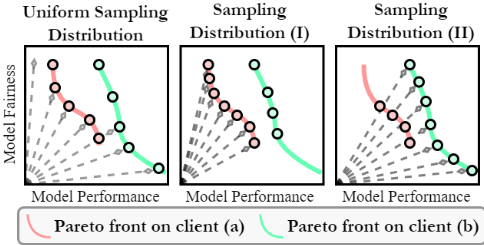
- Efficiency: As shown in Fig. 1, the heterogeneity of data in FL results in differences in the positions of local Pareto fronts across clients. Each local Pareto front has its own optimal preference sampling distribution. However, prior approaches assume a uniform preference sampling distribution across clients, which is inefficient for learning local Pareto fronts.
- Generalization: Achieving both optimal local and global Pareto fronts presents inherent conflicts. Prior approaches primarily focus on improving the local Pareto front while neglecting the global Pareto front.
Addressing these limitations presents several challenges. In terms of efficiency, determining the optimal preference sampling distribution for each client is non-trivial, as the position of each client's local Pareto front (ground truth) is initially unknown. Regarding generalization, aggregating clients' models to construct the optimal global model is difficult, as it requires identifying the strengths of each client's model for different preferences while maintaining data privacy.
In this paper, we propose HetPFL to efficiently learn both local and global Pareto fronts. HetPFL consists of Preference Sampling Adaptation (PSA) and Preference-aware Hypernet Fusion (PHF). PSA dynamically adjusts the preference sampling distribution by introducing data-driven HyperVolume Contribution (HVC), which quantifies each preference's contribution to the learned Pareto front. We then jointly optimize the preference sampling distribution based on HVC and the client's model as a bi-level optimization problem to enhance local Pareto front learning efficiency. To improve the global Pareto front, PHF considers a preference-aware hypernet aggregation at the server by identifying the capability of each client's hypernet for various preferences.
The primary contributions of this work are as follows:
- We propose a HetPFL framework that efficiently learns the heterogeneous local Pareto fronts across clients using PSA, while simultaneously achieving a high-quality global Pareto front through PHF;
- We analyze the convergence rate of HetPFL within the FL system and establish an error convergence rate of order O ( 1t ). This result is particularly challenging to derive due to the interdependence of the different components in the FL system;
- Extensive experiments on four datasets demonstrate that HetPFL outperforms the best-performing baseline, achieving approximately 1.75% and 5.5% improvements in the quality of the learned local and global
Pareto fronts, respectively.
2 ProblemFormulation
Let x ∈ X, y ∈ Y denote features and label, respectively. The features in x ≜ (a, b) contain sensitive features a (e.g., gender, race) and non-sensitive features b. Suppose there are K clients, and each client k ∈ [K] has a local dataset, denoted by Dk. The classifier fθk with learnable parameters θk of client k outputs a prediction fθk (x) from an input data x.
According to [Zeng et al., 2021], we define loss functions for model performance and fairness, respectively. Usually, model performance is characterized using cross-entropy loss
We use following loss function to quantify model fairness:
where ¯ak and ¯ fθk (x) represent the average values of a and fθk (x) over Dk, respectively. ℓF measures the correlation between sensitive features and model predictions. When the model prediction exhibits a stronger correlation with sensitive features, the value of ℓF rises, signaling a reduced model fairness.
The trade-off between ℓCE and ℓF is quantified using a preference vector λ ∈ Λ = {λ ∈ R2+ | ∑2i=1 λi = 1}. Following [Ye et al., 2025], we introduce a hypernet hβk : R|λ| → R|θk| with learnable parameters βk, which maps a preference vector λ to a preference-specific model θk = hβk (λ). We aim at optimizing βk to improve model performance and fairness (i.e., reducing the losses in Eqs. (1) and (2)), for which we can define a weighted Tchebycheff scalar loss [Miettinen, 1999] for each preference vector λ:
Eq. (3) satisfies the following Lemma [Miettinen, 1999]:
Lemma 1 (Preference Alignment). Given a preference vector λ, a preference-specific model hβk (λ) is weakly Pareto optimal to the problem (3) if and only if hβk (λ) is optimal for problem (3).
Lemma 1 guarantees that when hβk (λ) is optimal for problem (3), the loss vector (ℓCE, ℓF ) of hβk (λ) on dataset Dk aligns exactly with the direction of the preference vector and lies on the Pareto front, as shown by the points in Fig. 1.
We consider optimizing Eq. (3) over the preference distribution Λk of each client k, and define the following goal for the local Pareto front learning of client k.
where Λk is unknown in advance and depends on the position of the Pareto front of client k. Preference vector λ is sampled from Λk. Once Eq. (4) is completed, the hypernet can receive all possible preference vectors as inputs, generating a corresponding set of preference-specific models {θk = hβk (λ) | λ ∼ Λm}. This model set is then evaluated on the local dataset Dk, and the evaluation results collectively form the entire local Pareto front.
Similarly, the goal for the global Pareto front is to generate an aggregated hypernet βg = 1K ∑Kk=1 βk, which minimizes the gtch(·) over the global dataset:
where Λ can be an arbitrary distribution or defined as a combination of Λ1, ..., ΛK.
Our goal is to optimize Eq. (4) for all clients while simultaneously optimizing Eq. (5). The primary challenge in Eq. (4) arises from the distinctiveness of each client's local Pareto front. This implies the necessity of approximating preference distribution Λk for each client k to effectively learn the local Pareto fronts. For Eq. (5), the optimization objectives for local and global Pareto fronts are inherently conflicting, preventing simultaneous optimality for both.
3 Methodology
This section presents our HetPFL framework. We provide an overview and introduce the two main components, PSA and PHF, of HetPFL in Sections 3.1-3.3. Sections 3.4-3.5 describe the optimization procedure of HetPFL and analyze its convergence properties.
3.1 Overview
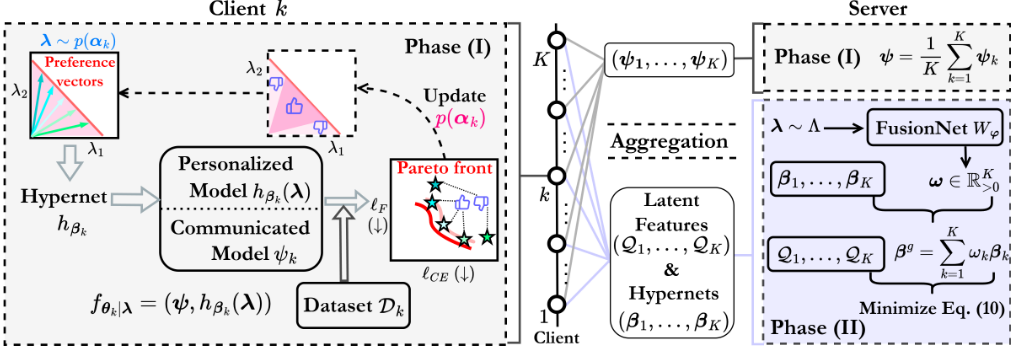
Fig. 2 shows our proposed HetPFL. The foundational components of HetPFL include communicated model ψ, hypernet hβk , preference sampling distribution p(αk), and FusionNet Wφ. HetPFL can be divided into two phases. Phase (I) focuses on efficiently learning the local Pareto fronts for all clients, while Phase (II) aims to learn the global Pareto front.
Phase (I)
In this phase, we aim to optimize the hypernet, sampling distribution, and the communicated model. The communicated model ψ transforms the features into d-dimensional latent features and is periodically aggregated at the server, as in FL. The hypernet hβk is kept locally at the client in Phase
(I). Its role is to map an arbitrary preference vector λ into a preference-specific model hβk (λ), and then hβk (λ) transforms the d-dimensional latent features to label. For each client k, we denote fθk|λ = (ψ, hβk (λ)).
Previous works simply set preference sampling distribution p(αk) to be uniform across all clients. In contrast, we consider jointly optimizing the hypernet hβk and p(αk):
where αk are the parameters of p(αk). HetPFL improves the efficiency of learning local Pareto fronts by identifying a suitable p(αk) for each client over the preference space. Meanwhile, the communicated model optimized to improve the model performance of all clients:
where fθk|˜λ = (ψ, hβk (˜λ)) and ˜λ is a predefined preference vector. The details of update steps for Eqs. (6) and (7) are provided in Section 3.4.
Phase (II)
Unlike previous works that overlook the global Pareto front, Phase (II) focuses on addressing this gap. After the final round, clients first transmit their hypernets and latent features, Qk = ψ(x) | (x, y) ∈ Dk, to the server. The server then uses FusionNet, Wφ, with parameters φ to learn effective aggregation strategies for these hypernets, tailoring the aggregation process to different preference vectors. Notably, transmitting only the latent features of the dataset is a common practice to mitigate privacy concerns [Thapa et al., 2022].
Given this framework, two key questions remain to be addressed. First, how can p(αk) be determined in Phase (I) to enable efficient learning of local Pareto fronts? Second, how to optimize FusionNet in Phase (II)? These questions will be explored in the following two subsections.
3.2 Preference Sampling Adaptation
In Phase (I), we propose Preference Sampling Adaptation (PSA) to determine p(αk). Determining p(αk) involves optimizing the quality of the sampled preference vectors during training. This process is non-trivial and unfolds in two steps: first, evaluating the quality of the sampled preference vectors without a true Pareto front (ground truth); and second, integrating the optimization of p(αk) into the hypernet's training.
For the first step, we introduce a data-driven Hypervolume Contribution (HVC) indicator to assess the quality of sampled preference vectors. Despite the absence of a true local Pareto front, it allows for quantifying each preference vector's contribution based on the training losses.
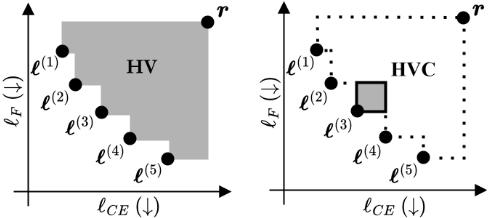
Definition 1 (HVC). Given a reference point r. Let S(λ, r) = {q ∈ R2 | ℓ(x, y | fθk|λ ) ≤ q and q ≤ r}, and the hypervolume of a set of N preference vectors Λαk = {λ1 , ..., λN | λi ∼ p(αk)} is
where L(·) denotes the Lebesgue measure and q represents any point in the gray area in the left figure of Fig. 3. The HVC of fθ|λi for the set Λαk is the difference between Hr(Λαk ) and Hr(Λαk \ λi ), as follows:
Fig. 3 shows that the HVC of fθk|λi is the difference between the HV of the full set of five models and that of the set excluding fθk|λi . The larger HCr(λi | Λαk ), the greater the contribution of λi , indicating a higher quality of λi .
We then move on to the second step. Based on HVC, we propose the following bi-level optimization objective to alternately optimize the hypernet and the preference sampling distribution of client k:
where fθk|λ = (ψk, hβk (λ)). The bi-level optimization first optimizes the hypernet as in Eq. (9). Then, the sampling distribution is further refined based on the solution of Eq. (9). As shown in Fig. 2, it makes the sampling distribution at the next iteration more beneficial to local Pareto front learning.
3.3 Preference-aware Hypernet Fusion
In Phase (II), we propose a preference-aware hypernet fusion (PHF) method. The intuition behind PHF is that each client's hypernet excels at specific preference vectors. Thus, for any given preference vector, PHF learns the preference-aware aggregation weight so that hypernets specializing in that vector are given higher weight, thereby improving the quality of the global Pareto front. As shown in Fig. 2, we introduce a FusionNet Wφ : R|λ| → RK>0 with parameters φ that learns a mapping from any preference vector λ to a fusion weight ω = Wφ(λ) ∈ RK . Based on the fusion weight, the hypernets from all clients are linearly combined to form a global hypernet βg = Wφ(λ) · [β1, ..., βK], where operation · is the vector inner product. This process is optimized through
where fθgk |λ = (ψ, hβg(λ)), and Yk represents labels on dataset Dk. Recalling Lemma 1, the global hypernet fθgk |λ aggregated by FusionNet is optimized towards the direction where the Pareto front intersects with λ. Once Eq. (10) is solved, the mapping from preference vectors to fusion weights during inference is highly efficient.
3.4 Algorithm: HetPFL
In this subsection, we present HetPFL algorithm to optimizing four components including communicated model ψ, hypernet hβk , preference sampling distribution p(αk), and FusionNet Wφ. At the beginning of Phase (I), each client downloads the global communicated model θ0k from the server.
In round t, the communicated model on client k is updated through τc steps of gradient descent with a learning rate of ηt:
To balance model performance and fairness, we set ˜λ to ( 12 , 12 ) in Eq. (11). Then, we proceed to optimize the hypernet and the preference sampling distribution (in Eqs. (9) and (8)). Note that lower-level problem (Eq. (9)) is a stochastic optimization problem, which is challenging to solve directly due to the expectation over preference distribution involving infinite possible values. To address this, we approximate the expectation term using Monte Carlo sampling and then solve the Eq. (9) with τp steps of gradient descent
where ηt denotes the learning rate, λv is a sampled preference vector and N is the number of sampled preference vectors.
Solving the upper-level problem in Eq. (8) relies on computing the HVC gradient, given by gαk = ∇αk Eλ∈Λαk E(x,y)∈Dk [-HCr(λ | Λαk )]. However, since this gradient is sometimes non-differentiable, we employ Natural Evolution Strategies (NES) [Salimans et al., 2017], which yield gradient estimation ˆ gαk for gαk :
where Λαk is the set of N preference vectors collected in Eq. (12). This gradient computation method only requires the preference sampling distribution p(αk) to be differentiable, without the need for HVC function to be differentiable. Based on Eq. (13), to optimize Eq. (8), αk is updated using the gradient ˆ gα by performing τp steps of gradient descent:
where κt is the learning rate. After round t is completed, all clients transmit their communicated models ψk, k ∈ [K], to the server. The server updates the communicated model by performing an averaging aggregation
Subsequently, each client initializes the communicated model as the aggregated model for round t + 1.
Upon completing a total of T rounds, we proceed to Phase (II), where the optimization of φt is updated by
where ηt is the learning rate.
3.5 Theoretical Analysis
In this subsection, we theoretically analyze the convergence of HetPFL algorithm. Our proof process is structured in two main steps. Firstly, we establish an upper bound of the communicated model at any given round t. Next, we provide the upper bound of the hypernet at any given round t.
To simplify the notation, we represent the expressions of Eqs. (8) and (9) as ghvc(αk, βk) = Eλ∼p(αk)E(x,y)∈Dk [-HCr(λ | Λαk )] and gtch(αk, βk) = Eλ∼p(αk)E(x,y)∈Dk [gtch(x, y, fθk|λ | λ)], respectively.
Based on [Hong et al., 2023], we make the following assumptions.
Assumption 1. ∇βgtch(αk, βk), ∇2αβ gtch(αk, βk), ∇2ββ gtch(αk, βk), ∇αghvc(αk, βk), and ∇βghvc(αk, βk) are Lipschitz continuous in βk with respective Lipschitz constants Lt1, Lt2, Lt3, Lh1 and Lh2.
Assumption 2. ∇2αβ gtch(αk, βk),∇2ββ gtch(αk, βk), ∇βghvc(αk, βk) is Lipschitz continuous in αk with respective Lipschitz constants Lt4, Lt5 and Lh3.
Assumption 3. gtch(αk, βk) is µ1-strongly convex in βk, and gtch(βk,α∗k ) is µ2-strongly convex in βk, where α∗k is optimal sampling distribution for client k.
Assumption 4. The expectation of stochastic gradients is always bounded. That is, ||∇2αβ gtch(αk, βk)|| ≤ G1, ||∇αghvc(αk, βk)|| ≤ G2, and ||∇βgtch(αk, βk)|| ≤ G3.
Let ∆tβk ≜ E [||βtk - β∗k|αt-1 k ||2 ] denote the error between the hypernet at round t and the optimal hypernet β∗k|αt-1 k given the sampling distribution p(αt-1 k ) in round t-1. Let ∆tψk ≜ E [||ψtk - ψ∗k ||2 ] denote the error between the communicated model at round t and the optimal communicated model ψ∗k . The communicated model has following upper bound.
Lemma 2 (Convergence of the Communicated Model [Collins et al., 2021]). If the communicated model ψ is optimized by FedAvg [McMahan et al., 2017] and given a constant ζ > 0, then ψ converges to the optimal communicated model ψ∗ at a linear rate:
with a probability at least 1 - te-100min(|x|2 log(|K|),d) .
Lemma 2 shows that the error convergence rate is O( 1t ). Under weaker assumptions compared to [Ye et al., 2025] (i.e., without requiring the initial convergence error of the hypernet to be a constant multiple of the communicated model), we establish the following upper bound for hypernet.
Theorem 1 (Convergence of the Hypernet). Under Assumptions 1-4 and Lemma 2, the upper bound of hypernet is
where z1, z2 are constants, and ∆tα0 = E [||α0k -α∗k ||2 ]. Theorem 1 guarantees an optimization error of order O(( 34 )τpt + (1 - ηtζ )t/4 + (1 - ηtζ )t/2 + σ2 1 µ1+c21L2q1+G23 µ1 µ31 ). When t → +∞, ∆t+1 βk converges to σ2 1 µ1+c21L2q1+G23 µ1 µ31 . Due to (1 - ηtζ)t/4 being the dominant term in the error convergence rate, the overall error convergence rate is O( 1t ).
4 Experiments
4.1 Experimental Settings
Datasets. Four widely-used datasets are employed to evaluate the performance of HetPFL, including a SYNTHETIC [Zeng et al., 2021], COMPAS [Barenstein, 2019], BANK [Moro et al., 2014], and ADULT [Dua et al., 2017].
Baselines. We compare HetPFL with seven state-of-theart methods, including two for addressing local fairness (LFT+Ensemble and LFT+Fedavg [Zeng et al., 2023]), three for global fairness (Agnosticfair [Du et al., 2021], FairFed [Ezzeldin et al., 2023] and FedFB [Zeng et al., 2021]), one for both local and global fairness ([Makhija et al., 2024]), and one for learning performance-fairness local Pareto fronts (PraFFL [Ye et al., 2025]). PraFFL is the most closely related work to ours in learning Pareto fronts.
Metrics. Based on [Ezzeldin et al., 2023], we use the model's error rate to quantify its performance and the DP disparity [Feldman et al., 2015] to measure its fairness, where a smaller DP disparity indicates a fairer model. Additionally, the hypervolume (HV) [Zitzler and Thiele, 1999] is employed to evaluate the quality of the learned Pareto front. We mainly report local HV on local datasets and global HV on global datasets.
| Method | SYNTHETIC | COMPAS | BANK | ADULT | ||||
|---|---|---|---|---|---|---|---|---|
| Local HV | Global HV | Local HV | Global HV | Local HV | Global HV | Local HV | Global HV | |
| LFT+Ensemble | 0.425 | 0.479 | 0.514 | 0.555 | 0.890 | 0.881 | 0.760 | 0.764 |
| LFT+Fedavg | 0.700 | 0.468 | 0.505 | 0.514 | 0.891 | 0.138 | 0.765 | 0.501 |
| Agnosticfair | 0.492 | 0.537 | 0.499 | 0.550 | 0.887 | 0.880 | 0.780 | 0.783 |
| FairFed | 0.339 | 0.367 | 0.418 | 0.434 | 0.889 | 0.878 | 0.267 | 0.270 |
| FedFB | 0.567 | 0.608 | 0.505 | 0.517 | 0.893 | 0.883 | 0.759 | 0.763 |
| EquiFL | 0.642 | 0.604 | 0.564 | 0.526 | 0.892 | 0.882 | 0.761 | 0.764 |
| PraFFL | 0.800 | 0.716 | 0.599 | 0.613 | 0.901 | 0.895 | 0.766 | 0.750 |
| HetPFL (Ours) | 0.830 | 0.827 | 0.623 | 0.626 | 0.904 | 0.898 | 0.783 | 0.846 |
Hyperparameters. Since PraFFL and HetPFL have the ability to generate any number of models during inference, we set them to generate 1,000 preference-specific models each for evaluation. Our implementation is available at https://github.com/rG223/HetPFL.
4.2 Experimental Results
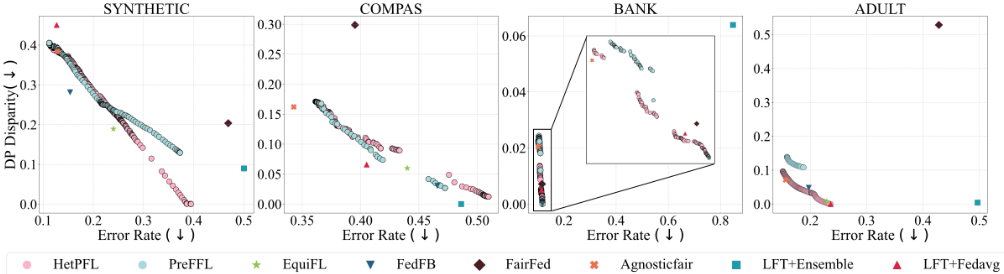
Main Results. We draw two key conclusions based on Table 1: (I) Methods capable of learning the Pareto front, such as PraFFL and HetPFL, outperform those that do not in most cases, in terms of both local HV and global HV. Fig. 4 shows that PraFFL and HetPFL are capable of generating more models that caters to large-scale preferences; (II) PraFFL focuses primarily on learning local Pareto fronts, it neglects the heterogeneity of Pareto fronts across clients and fails to ensure the quality of the global Pareto front, leading suboptimal on most datasets. In comparison, HetPFL outperforms PraFFL in terms of local HV and global HV across four datasets, achieving varying degrees of improvement. Fig. 4 indicates that HetPFL outperforms PraFFL on SYNTHETIC, BANK, and ADULT datasets. However, on the COMPAS, the Pareto front splits into two segments with a 3% disconnection in terms of DP disparity and error rate. HetPFL's unimodal sampling distribution prioritizes the tail regions' benefits while overlooking the middle sections compared to PraFFL.
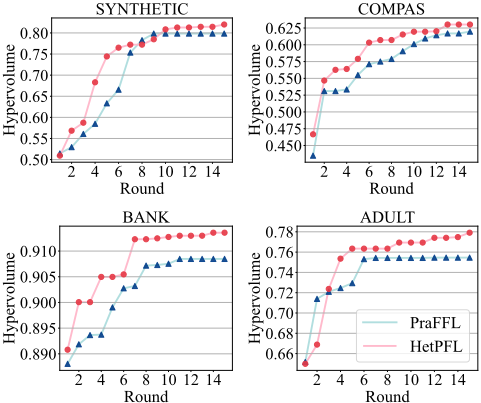
Convergence Results. Fig. 5 shows the convergence comparison of PraFFL and HetPFL on the client local validation set in each round. HetPFL shows consistently faster convergence compared to the PraFFL, validating the effectiveness of our proposed preference sampling adaptation method.
The Impact of Data Heterogeneity. Table 2 demonstrates that HetPFL consistently achieves the best performance in both local HV and global HV across all levels of data heterogeneity compared to seven baselines. Notably, the following observations emerge: (I) Comprehensiveness: First five baselines in Table 2 fail to learn the entire Pareto front and struggle with high data heterogeneity. Their performance deteriorates as heterogeneity increases. HetPFL not only learns the entire Pareto front but also handles high heterogeneity effectively; (II) Scalability: When compared with personalized FL methods such as EquiFL and PraFFL, our proposed HetPFL excels in handling high data heterogeneity in both local and global datasets. EquiFL and PraFFL are better at handling high heterogeneity on local datasets, but they fail to address heterogeneity effectively on the global dataset.
The Impact of the Number of Clients. We analyze Table 3 from following two aspects: (I) Comprehensiveness:
| Local HV | Global HV | |||||
|---|---|---|---|---|---|---|
| Method | Heterogeneity | Param. | Heterogeneity | Param. | ||
| 0.1 | 5 | 1000 | 0.1 | 5 | 1000 | |
| LFT+Ensemble | 0.311 | 0.481 | 0.463 | 0.487 | 0.487 | 0.475 |
| LFT+Fedavg | 0.593 | 0.692 | 0.701 | 0.468 | 0.468 | 0.468 |
| Agnosticfair | 0.417 | 0.535 | 0.526 | 0.537 | 0.537 | 0.537 |
| FairFed | 0.392 | 0.349 | 0.410 | 0.429 | 0.400 | 0.403 |
| FedFB | 0.518 | 0.602 | 0.597 | 0.616 | 0.615 | 0.607 |
| EquiFL | 0.734 | 0.626 | 0.615 | 0.584 | 0.644 | 0.643 |
| PraFFL | 0.802 | 0.781 | 0.789 | 0.707 | 0.744 | 0.768 |
| HetPFL | 0.808 | 0.806 | 0.810 | 0.820 | 0.791 | 0.817 |
The first six methods in Table 3, which lack the capability to learn the Pareto front, exhibit limited performance in both small and large-scale client scenarios, with both local HV and global HV consistently below 0.7. In contrast, HetPFL not only learns the Pareto front but also achieves the best performance across all scenarios, with both local HV and global HV exceeding 0.78; (II) Scalability: Compared to PraFFL, HetPFL demonstrates clear advantages in large-scale client scenarios. Notably, PraFFL tends to collapse in learning the global Pareto front under large-scale settings, whereas HetPFL consistently achieves the best results in both local HV and global HV, regarding different client scales.
Ablation Study. Table 4 reveals two key observations: (I) PSA enhances the learning ability of the local Pareto front. On the SYNTHETIC dataset, the local HV improves from 0.80 to 0.83 with PSA. Similar improvements in local HV can be observed across the other three datasets. (II) PHF enhances the performance of the global Pareto front. Without PSA, PHF achieves an approximately 8% improvement in global HV on the SYNTHETIC dataset (from 0.719 to 0.793). With PSA, the improvement is smaller (i.e., 0.2%) due to the high global HV had been achieved by PSA (i.e., 0.825). Similar patterns can be observed on the other three datasets.
| Method | Local HV | Global HV | ||||
|---|---|---|---|---|---|---|
| Number of Clients | Number of Clients | |||||
| 10 | 100 | 300 | 10 | 100 | 300 | |
| LFT+Ensemble | 0.475 | 0.464 | 0.535 | 0.463 | 0.536 | 0.470 |
| LFT+Fedavg | 0.664 | 0.472 | 0.605 | 0.460 | 0.589 | 0.469 |
| Agnosticfair | 0.548 | 0.557 | 0.547 | 0.551 | 0.635 | 0.553 |
| FairFed | 0.414 | 0.326 | 0.413 | 0.372 | 0.381 | 0.353 |
| FedFB | 0.610 | 0.599 | 0.562 | 0.613 | 0.667 | 0.581 |
| EquiFL | 0.564 | 0.602 | 0.620 | 0.613 | 0.573 | 0.607 |
| PraFFL | 0.803 | 0.716 | 0.789 | 0.807 | 0.578 | 0.621 |
| HetPFL | 0.808 | 0.785 | 0.848 | 0.808 | 0.814 | 0.813 |
| Dataset | PSA | PHF | Local HV | Global HV |
|---|---|---|---|---|
| SYNTHETIC | × × ✓ ✓ | × ✓ × ✓ | 0.800 0.800 0.830 0.830 | 0.719 0.793 0.825 0.827 |
| COMPAS | × × ✓ ✓ | × ✓ × ✓ | 0.599 0.599 0.623 0.623 | 0.613 0.639 0.624 0.626 |
| BANK | × × ✓ ✓ | × ✓ × ✓ | 0.901 0.901 0.904 0.904 | 0.895 0.896 0.886 0.898 |
| ADULT | × × ✓ ✓ | × ✓ × ✓ | 0.766 0.766 0.783 0.783 | 0.750 0.846 0.813 0.846 |
5 Conclusion
In this paper, we proposed HetPFL, a comprehensive method for learning both local and global Pareto fronts in fair federated learning. First, HetPFL includes a Preference Sampling Adaptation (PSA) approach, which adaptively learns the preference sampling distribution for each client. Second, HetPFL incorporates a Preference-aware Hypernet Fusion (PHF) approach, which guides the generation of the global hypernet by learning the mapping from preferences to fusion weights at the server. We theoretically prove that HetPFL achieves an error convergence rate of order O( 1t ). Experimental results demonstrate that HetPFL achieves superior performance in learning both local and global Pareto fronts compared to seven state-of-the-art methods across four datasets.
Acknowledgments
This work was supported in part by the National Natural Science Foundation of China under Grant 62202214 and Guangdong Basic and Applied Basic Research Foundation under Grant 2023A1515012819.
@inproceedings{ijcai2025p761,
  title     = {Learning Heterogeneous Performance-Fairness Trade-offs in Federated Learning},
  author    = {Ye, Rongguang and Tang, Ming},
  booktitle = {Proceedings of the Thirty-Fourth International Joint Conference on
               Artificial Intelligence, {IJCAI-25}},
  publisher = {International Joint Conferences on Artificial Intelligence Organization},
  editor    = {James Kwok},
  pages     = {6839--6847},
  year      = {2025},
  month     = {8},
  note      = {Main Track},
  doi       = {10.24963/ijcai.2025/761},
  url       = {https://doi.org/10.24963/ijcai.2025/761},
}
TY - CPAPER TI - Learning Heterogeneous Performance-Fairness Trade-offs in Federated Learning AU - Ye, Rongguang AU - Tang, Ming T2 - Proceedings of the Thirty-Fourth International Joint Conference on Artificial Intelligence, IJCAI-25 PB - International Joint Conferences on Artificial Intelligence Organization PY - 2025 SP - 6839 EP - 6847 DO - 10.24963/ijcai.2025/761 UR - https://doi.org/10.24963/ijcai.2025/761 ER -Copied
Machine-readable versions of this paper, for tools and AI agents:





