
Conditional Denoising Meets Polynomial Modeling: A Flexible Decoupled Framework for Time Series Forecasting
Proceedings of the Thirty-Fourth International Joint Conference on Artificial Intelligence. Main Track. Pages 6993-7001.
https://doi.org/10.24963/ijcai.2025/778
Keywords
- Machine Learning: ML: Time series and data streams
- Machine Learning: ML: Generative models
- Machine Learning: ML: Deep learning architectures
Abstract
Time series forecasting models are becoming increasingly prevalent due to their critical role in decision-making across various domains. However, most existing approaches represent the coupled temporal patterns, often neglecting the distinction between their specific components. In particular, fluctuating patterns and smooth trends within time series exhibit distinct characteristics. In this work, to model complicated temporal patterns, we propose a Conditional Denoising Polynomial Modeling (CDPM) framework, where probabilistic diffusion models and deterministic linear models are trained end-to-end. Instead of modeling the coupled time series, CDPM decomposes it into trend and seasonal components for modeling them separately. To capture the fluctuating seasonal component, we employ a probabilistic diffusion model based on statistical properties from the historical window. For the smooth trend component, a module is proposed to enhance linear models by incorporating historical dependencies, thereby preserving underlying trends and mitigating noise distortion. Extensive experiments conducted on six benchmarks demonstrate the effectiveness of our framework, highlighting the potential of combining probabilistic and deterministic models. Our code is available at https://github.com/zjt-gpu/CDPM.
- [Asteriou and Hall, 2011] Dimitros Asteriou and Stephen G Hall. Arima models and the box-jenkins methodology. Applied Econometrics, 2(2):265-286, 2011.
- [Bai et al., 2018] Shaojie Bai, J Zico Kolter, and Vladlen Koltun. An empirical evaluation of generic convolutional and recurrent networks for sequence modeling. arXiv preprint arXiv:1803.01271, 2018.
- [Bilos et al., 2023] Marin Bilos, Kashif Rasul, Anderson Schneider, Yuriy Nevmyvaka, and Stephan Günnemann. Modeling temporal data as continuous functions with stochastic process diffusion. In Proceedings of the 40th International Conference on Machine Learning, volume 202, pages 2452-2470. PMLR, 2023.
- [Cheng et al., 2024] Mingyue Cheng, Jiqian Yang, Tingyue Pan, Qi Liu, and Zhi Li. Convtimenet: A deep hierarchi- cal fully convolutional model for multivariate time series analysis. arXiv preprint arXiv:2403.01493, 2024.
- [Cheng et al., 2025a] Mingyue Cheng, Yiheng Chen, Qi Liu, Zhiding Liu, Yucong Luo, and Enhong Chen. Instructime: Advancing time series classification with multimodal lan- guage modeling. In Proceedings of the Eighteenth ACM International Conference on Web Search and Data Min- ing, pages 792-800, 2025.
- [Cheng et al., 2025b] Mingyue Cheng, Zhiding Liu, Xiaoyu Tao, Qi Liu, Jintao Zhang, Tingyue Pan, Shilong Zhang, Panjing He, Xiaohan Zhang, Daoyu Wang, et al. A com- prehensive survey of time series forecasting: Concepts, challenges, and future directions. Authorea Preprints, 2025.
- [Cleveland et al., 1990] Robert B Cleveland, William S Cleveland, Jean E McRae, Irma Terpenning, et al. Stl: A seasonal-trend decomposition. J. off. Stat, 6(1):3-73, 1990.
- Thomas M Cover. Geometrical and statistical properties of systems of linear inequalities with applica- tions in pattern recognition. IEEE transactions on elec- tronic computers, (3):326-334, 1965.
- [Ekambaram et al., 2023] Vijay Ekambaram, Arindam Jati, Nam Nguyen, Phanwadee Sinthong, and Jayant Kalagnanam. Tsmixer: Lightweight mlp-mixer model for multivariate time series forecasting. In Proceedings of the 29th ACM SIGKDD Conference on Knowledge Discovery and Data Mining, pages 459-469, 2023.
- [Feng et al., 2024] Shibo Feng, Chunyan Miao, Zhong Zhang, and Peilin Zhao. Latent diffusion transformer for probabilistic time series forecasting. In Proceedings of the AAAI Conference on Artificial Intelligence, volume 38, pages 11979-11987, 2024.
- [Gong et al., 2023] Zeying Gong, Yujin Tang, and Jun- wei Liang. Patchmixer: A patch-mixing architecture for long-term time series forecasting. arXiv preprint arXiv:2310.00655, 2023.
- [Goodfellow et al., 2014] Ian J. Goodfellow, Jean Pouget- Abadie, Mehdi Mirza, Bing Xu, David Warde-Farley, Sherjil Ozair, Aaron Courville, and Yoshua Bengio. Gen- erative adversarial networks, 2014.
- [Gruver et al., 2024] Nate Gruver, Marc Finzi, Shikai Qiu, and Andrew G Wilson. Large language models are zero- shot time series forecasters. Advances in Neural Informa- tion Processing Systems, 36, 2024.
- [Jin et al., 2023] Ming Jin, Shiyu Wang, Lintao Ma, Zhix- uan Chu, James Y Zhang, Xiaoming Shi, Pin-Yu Chen, Yuxuan Liang, Yuan-Fang Li, Shirui Pan, et al. Time-llm: Time series forecasting by reprogramming large language models. arXiv preprint arXiv:2310.01728, 2023.
- [Kashpruk et al., 2023] Nataliia Kashpruk, Cezary Piskor- Ignatowicz, and Jerzy Baranowski. Time series prediction in industry 4.0: A comprehensive review and prospects for future advancements. Applied Sciences, 13(22):12374, 2023.
- [Kilcioglu et al., 2017] Cinar Kilcioglu, Justin M Rao, Aad- harsh Kannan, and R Preston McAfee. Usage patterns and the economics of the public cloud. In Proceedings of the 26th International Conference on World Wide Web, pages 83-91, 2017.
- [Kim et al., 2021] Taesung Kim, Jinhee Kim, Yunwon Tae, Cheonbok Park, Jang-Ho Choi, and Jaegul Choo. Re- versible instance normalization for accurate time-series forecasting against distribution shift. In International Con- ference on Learning Representations, 2021.
- [Kingma and Welling, 2022] Diederik P Kingma and Max Welling. Auto-encoding variational bayes, 2022.
- [Kollovieh et al., 2024] Marcel Kollovieh, Abdul Fatir Ansari, Michael Bohlke-Schneider, Jasper Zschiegner, Hao Wang, and Yuyang Bernie Wang. Predict, refine, synthesize: Self-guiding diffusion models for probabilistic time series forecasting. Advances in Neural Information Processing Systems, 36, 2024.
- [Koprinska et al., 2018] Irena Koprinska, Dengsong Wu, and Zheng Wang. Convolutional neural networks for en- ergy time series forecasting. In 2018 international joint conference on neural networks (IJCNN), pages 1-8. IEEE, 2018.
- [Lai et al., 2018] Guokun Lai, Wei-Cheng Chang, Yiming Yang, and Hanxiao Liu. Modeling long-and short-term temporal patterns with deep neural networks. In The 41st international ACM SIGIR conference on research & devel- opment in information retrieval, pages 95-104, 2018.
- [Lee et al., 2024] Seunghan Lee, Kibok Lee, and Taeyoung Park. Ant: Adaptive noise schedule for time series diffu- sion models. Advances in Neural Information Processing Systems, 37:121099-121130, 2024.
- [Li et al., 2022] Yan Li, Xinjiang Lu, Yaqing Wang, and De- jing Dou. Generative time series forecasting with diffu- sion, denoise, and disentanglement. Advances in Neural Information Processing Systems, 35:23009-23022, 2022.
- [Lin et al., 2023] Shengsheng Lin, Weiwei Lin, Wentai Wu, Feiyu Zhao, Ruichao Mo, and Haotong Zhang. Segrnn: Segment recurrent neural network for long-term time se- ries forecasting. arXiv preprint arXiv:2308.11200, 2023.
- [Liu et al., 2021] Zhenyu Liu, Zhengtong Zhu, Jing Gao, and Cheng Xu. Forecast methods for time series data: A sur- vey. IEEE Access, 9:91896-91912, 2021.
- [Liu et al., 2022] Minhao Liu, Ailing Zeng, Muxi Chen, Zhi- jian Xu, Qiuxia Lai, Lingna Ma, and Qiang Xu. Scinet: Time series modeling and forecasting with sample convo- lution and interaction. Advances in Neural Information Processing Systems, 35:5816-5828, 2022.
- [Liu et al., 2023] Yong Liu, Tengge Hu, Haoran Zhang, Haixu Wu, Shiyu Wang, Lintao Ma, and Mingsheng Long. itransformer: Inverted transformers are effective for time series forecasting. arXiv preprint arXiv:2310.06625, 2023.
- [Liu et al., 2024] Zhiding Liu, Jiqian Yang, Mingyue Cheng, Yucong Luo, and Zhi Li. Generative pretrained hierarchi- cal transformer for time series forecasting. In Proceedings of the 30th ACM SIGKDD Conference on Knowledge Dis- covery and Data Mining, pages 2003-2013, 2024.
- [Masini et al., 2023] Ricardo P Masini, Marcelo C Medeiros, and Eduardo F Mendes. Machine learn- ing advances for time series forecasting. Journal of economic surveys, 37(1):76-111, 2023.
- [Nie et al., 2023] Yuqi Nie, Nam H. Nguyen, Phanwadee Sinthong, and Jayant Kalagnanam. A time series is worth 64 words: Long-term forecasting with transformers. In Proceedings of the Eleventh International Conference on Learning Representations, 2023.
- [Paszke et al., 2019] Adam Paszke, Sam Gross, Francisco Massa, Adam Lerer, James Bradbury, Gregory Chanan, Trevor Killeen, Zeming Lin, Natalia Gimelshein, Luca Antiga, et al. Pytorch: An imperative style, high- performance deep learning library. Advances in neural in- formation processing systems, 32, 2019.
- [Rasul et al., 2021] Kashif Rasul, Calvin Seward, Ingmar Schuster, and Roland Vollgraf. Autoregressive denois- ing diffusion models for multivariate probabilistic time se- ries forecasting. In International Conference on Machine Learning, pages 8857-8868. PMLR, 2021.
- [Rezende and Mohamed, 2016] Danilo Jimenez Rezende and Shakir Mohamed. Variational inference with normalizing flows, 2016.
- [Rombach et al., 2022] Robin Rombach, Andreas Blattmann, Dominik Lorenz, Patrick Esser, and Björn Ommer. High-resolution image synthesis with latent diffusion models. In Proceedings of the IEEE/CVF conference on computer vision and pattern recognition, pages 10684-10695, 2022.
- [Shen and Kwok, 2023] Lifeng Shen and James T. Kwok. Non-autoregressive conditional diffusion models for time series prediction. In Proceedings of the 40th International Conference on Machine Learning (ICML), pages 31016- 31029, 2023.
- [Song et al., 2021] Jiaming Song, Chenlin Meng, and Ste- fano Ermon. Denoising diffusion implicit models. In Pro- ceedings of the 9th International Conference on Learning Representations, 2021.
- [Tashiro et al., 2021] Yusuke Tashiro, Jiaming Song, Yang Song, and Stefano Ermon. Csdi: Conditional score- based diffusion models for probabilistic time series impu- tation. Advances in Neural Information Processing Sys- tems, 34:24804-24816, 2021.
- [Wu et al., 2020] Zonghan Wu, Shirui Pan, Guodong Long, Jing Jiang, Xiaojun Chang, and Chengqi Zhang. Con- necting the dots: Multivariate time series forecasting with graph neural networks. In Proceedings of the 26th ACM SIGKDD international conference on knowledge discov- ery & data mining, pages 753-763, 2020.
- [Wu et al., 2021] Haixu Wu, Jiehui Xu, Jianmin Wang, and Mingsheng Long. Autoformer: Decomposition transform- ers with auto-correlation for long-term series forecast- ing. Advances in neural information processing systems, 34:22419-22430, 2021.
- [Yan et al., 2021] Tijin Yan, Hongwei Zhang, Tong Zhou, Yufeng Zhan, and Yuanqing Xia. Scoregrad: Multi- variate probabilistic time series forecasting with contin- uous energy-based generative models. arXiv preprint arXiv:2106.10121, 2021.
- [Yi et al., 2024] Kun Yi, Qi Zhang, Wei Fan, Hui He, Liang Hu, Pengyang Wang, Ning An, Longbing Cao, and Zhen- dong Niu. Fouriergnn: Rethinking multivariate time series forecasting from a pure graph perspective. Advances in Neural Information Processing Systems, 36, 2024.
- [Yuan and Qiao, 2024] Xinyu Yuan and Yan Qiao. Diffusion-ts: Interpretable diffusion for general time series generation. In Proceedings of the Twelfth In- ternational Conference on Learning Representations, 2024.
- [Zeng et al., 2023] Ailing Zeng, Muxi Chen, Lei Zhang, and Qiang Xu. Are transformers effective for time series fore- casting? In Proceedings of the AAAI conference on artifi- cial intelligence, volume 37, pages 11121-11128, 2023.
- [Zhou et al., 2021] Haoyi Zhou, Shanghang Zhang, Jieqi Peng, Shuai Zhang, Jianxin Li, Hui Xiong, and Wan- cai Zhang. Informer: Beyond efficient transformer for long sequence time-series forecasting. In Proceedings of the AAAI conference on artificial intelligence, volume 35, pages 11106-11115, 2021.
References were extracted automatically from the PDF and may contain errors.
Full text extracted automatically from the PDF; figures, tables and equations may differ. The PDF is the version of record.
1 Introduction
Time series forecasting is a fundamental task across various domains, playing a crucial role in driving informed decisionmaking in industries such as finance, healthcare, and manufacturing [Kashpruk et al., 2023]. It involves analyzing historical patterns to model the dynamic evolution of underlying processes and predict future trends [Cheng et al., 2025a]. Accurate time series forecasting is essential for tasks such as demand prediction, resource allocation, enabling organizations to anticipate future needs and optimize operations [Kilcioglu et al., 2017; Liu et al., 2024].
∗Corresponding author
Over the years, various approaches have been proposed to address this challenge [Cheng et al., 2025b], ranging from classical statistical models, such as Autoregressive Integrated Moving Average (ARIMA) [Asteriou and Hall, 2011], to machine learning techniques [Masini et al., 2023], and advanced deep learning models, including recurrent neural networks (RNNs) [Lin et al., 2023; Lai et al., 2018], convolutional neural networks (CNNs) [Bai et al., 2018; Koprinska et al., 2018], and transformer-based models [Zhou et al., 2021; Wu et al., 2021]. Large language models (LLMs) such as TimeLLM and LLMTIME [Jin et al., 2023; Gruver et al., 2024] have demonstrated the potential in time series forecasting. In addition to their success, probabilistic models have emerged as promising alternatives, offering a principled framework for quantifying uncertainty and modeling complex distributions. Diffusion models [Rasul et al., 2021; Shen and Kwok, 2023], becoming the leading paradigm for probabilistic models originally developed for generation, have proven effective in time series forecasting due to their ability to capture intricate stochastic processes.
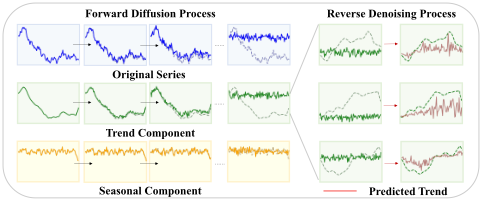
Diffusion-based methods [Lee et al., 2024] have shown great promise in time series forecasting. However, we argue that their naive application of noise addition and denoising overlooks the heterogeneous nature of temporal dynamics. In particular, these methods uniformly add noise across the entire sequence and apply denoising without distinguishing between different temporal components. However, time series inherently exhibits diverse dynamics, including trends and seasonal patterns, which require different treatment. Trends patterns, reflecting gradual shifts over extended periods, and seasonal patterns, characterized by periodic fluctuations, possess different structural properties. These distinct patterns require differentiated treatment. Such indiscriminate processing can distort essential features, especially intrinsic trends and fluctuations, thereby degrading forecasting performance. As shown in Fig.1, this indiscriminate approach disrupts critical trend information during denoising, hindering trend recovery and reducing accuracy.
Typically, a single model often struggles to capture the subtle and dynamic interplay between trends and variations, which can significantly affect the model's overall forecasting ability. Diffusion models, which excel at modeling complex dynamic processes, are more suitable for handling components characterized by large fluctuations and high-frequency variations in time series. In contrast, deterministic models, such as models based on linear layers, learn features from historical patterns and are particularly effective at identifying regular patterns, making them better suited for modeling components with stable trends. Therefore, by strategically leveraging the strengths of both model types and tailoring them to the distinct characteristics of time series, we can more fully capture the dynamic variations and enhance the final forecasting results.
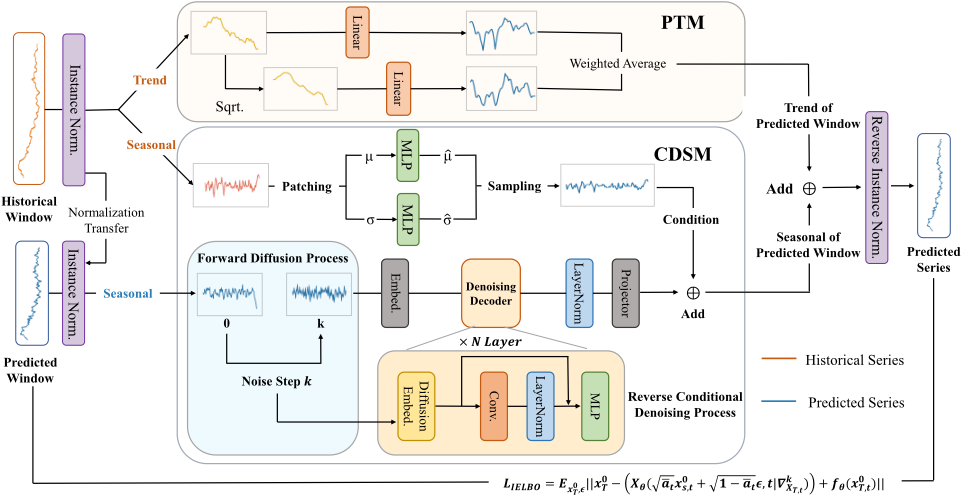
To overcome these challenges, we propose a novel Conditional Denoising Polynomial Modeling (CDPM) framework that leverages the inductive bias of time series decomposition. By separating the time series into trend and seasonal components, we enable decoupled modeling tailored to the characteristics of each component. Specifically, we employ a carefully designed Conditional Denoising Seasonal Module (CDSM) to capture the high-frequency seasonal component, introducing an innovative denoising strategy conditioned on statistical properties derived from historical window. Currently, we model the intrinsic trend component using the polynomial trend module (PTM), which is adept at capturing gradual changes. Additionally, we reformulate the Improved Evidence Lower Bound (ELBO) to facilitate joint training of the CDSM and PTM. This decoupling method of our framework improves the ability to capture temporal dependencies and complex patterns. The key contributions of this work are:
- We introduce a novel framework that enables the decoupled modeling of trend and seasonal components, providing new insights into time series forecasting.
- We design tailored methods and reformulate ELBO for each component-using CDSM for the seasonal component and PTM for the trend component-to effectively capture their distinct behaviors.
- We conduct comprehensive experiments on benchmark datasets to validate effectiveness of our framework, we also present the rationale for modeling different components with several case studies.
2 RelatedWork
2.1 Deterministic Forecasting
Deterministic models map deterministic inputs to deterministic outputs by learning consistent patterns within time series, making them crucial for capturing predictable temporal relationships. Recurrent neural networks (RNNs), such as LSTNet [Lai et al., 2018] and SegRNN [Lin et al., 2023], became popular for sequential dependencies, while convolutional neural networks (CNNs) [Cheng et al., 2024] like TCN [Bai et al., 2018] and SCINet [Liu et al., 2022] excelled at capturing both local and global temporal features. Graph-based models, such as MTGNN [Wu et al., 2020] and FourierGNN [Yi et al., 2024], improved forecasting by modeling interdependencies between time series. More recently, Transformer-based models like Informer [Zhou et al., 2021] and Autoformer [Wu et al., 2021] have utilized self-attention mechanisms to efficiently capture long-range dependencies, excelling in high-dimensional and long-horizon tasks. Surprisingly, well-tuned linear models such as DLinear [Zeng et al., 2023] and TSMixer [Ekambaram et al., 2023] have demonstrated strong performance by effectively capturing long-term trends, often outperforming more complex architectures and showcasing their efficiency. Despite advances, deterministic models often struggle with volatile fluctuations, limiting their ability to model complex time series dynamics.
2.2 Diffusion-Based Time Series Forecasting
Probabilistic models offer uncertainty estimation and the ability to model temporal distributions. These models, including Variational Autoencoders (VAEs)[Kingma and Welling, 2022], Generative Adversarial Networks (GANs)[Goodfellow et al., 2014], and flow-based models [Rezende and Mohamed, 2016], are designed to capture high-dimensional distribution. Recently, Denoising Diffusion Probabilistic Models (DDPMs) have emerged as a promising paradigm for generative modeling, demonstrating their potential in various time series applications. DDPMs have advanced time series forecasting by capturing complex temporal patterns. Early models like TimeGrad [Rasul et al., 2021] introduced autoregressive denoising with Langevin sampling for multivariate predictions. TSDiff [Kollovieh et al., 2024] improved shortterm accuracy through self-guiding mechanisms, while scorebased models such as ScoreGrad [Yan et al., 2021] applied stochastic differential equations (SDEs) for continuous-time forecasting, expanding diffusion to fluctuatingly sampled data. Conditional models like TimeDiff [Shen and Kwok, 2023] incorporated external information to guide the diffusion process, outperforming traditional methods. Latent Diffusion Models (LDMs)[Rombach et al., 2022] enhanced efficiency by performing diffusion in lower-dimensional spaces. This approach was further demonstrated by LDCast and Latent Diffusion Transformers (LDT)[Feng et al., 2024], which improved precipitation and time series forecasting. Models like DSPD and CSPD [Bilos et al., 2023] applied diffusion to anomaly detection and interpolation.
Despite the advancements in both deterministic and probabilistic forecasting approaches, existing research typically applies each paradigm separately to represent time series, with limited efforts to integrate them into a unified modeling framework. However, effectively capturing the diverse characteristics of time series, such as the smooth trend and fluctuating seasonal components, requires leveraging both deterministic and probabilistic models.
3 Problem Statement
Time series represent numerical sequence ordered chronologically, typically recorded at regular temporal intervals. Formally, consider a multivariate time series XL+T ∈ R(L+T)×d , where L and T denotes the length of the historical and the length of the predicted window respectively, with d channels recorded for each time step. The objective of time series forecasting is to train a model G that learns to map the historical series XL to the predicted series XT . The model leverages the information embedded in the historical series to predict future series, aiming to capture both temporal dependencies for accurate forecasting.
4 Methodology
In this section, we formalize the time series forecasting problem and present the proposed Conditional Denoising Polynomial Modeling (CDPM) framework, comprising two core components: the Conditional Denoising Seasonal Module (CDSM) and the Polynomial Trend Module (PTM).
4.1 Overall Framework
The CDPM addresses time series forecasting by independently modeling trend and seasonal patterns, thereby capturing distinct temporal behaviors more effectively. As depicted in Fig. 2, CDPM consists of two main modules: CDSM and PTM. The CDSM employs a denoising diffusion process conditioned on statistical properties from the historical window to accurately capture and refine seasonal variation patterns. In parallel, the PTM models trends using polynomial linear layers, providing flexibility in handling both linear and nonlinear trends. By decoupling and specifically modeling these components, CDPM enhances forecasting accuracy, offering an effective solution for capturing the complex temporal dynamics inherent in time series. We also reformulate the Evidence Lower Bound (ELBO) to better jointly train the PTM and CDSM. By handling trend and seasonal components independently, CDPM allows each module to focus on its respective dynamics, leading to enhanced overall performance.
4.2 Temporal Feature Structuring
Instance Normalization. Instance normalization across both historical and predicted windows is essential for maintaining the stability of the CDPM. We normalize the historical window by subtracting the mean and dividing by the standard deviation [Kim et al., 2021], and transfer the same statistics to normalize the predicted window during training. Specifically, xL is normalized to x0L, and xT is normalized to x0T using the statistics derived from xL. This ensures alignment between the windows and preserves both the temporal structure and stability in the forecasting process. The subsequent denormalization step restores the predicted values to their original scale, ensuring consistency with the input data distribution.
DecompositionOperation. Decomposition is an important approach to achieving decoupling in time series analysis, as it allows for the separation of trend components and seasonal components [Cleveland et al., 1990], enabling each characteristic to be handled independently. We decompose both historical X0L and predicted X0 T windows into trend and seasonal components. The trend component X0L,t of historical window is estimated using a moving average:
where Avg denotes the moving average.
where the seasonal component X0L,s is the residual after subtracting the trend. Thus, we obtain the trend component X0L,t and seasonal component X0L,s of historical window.
Similarly, we compute X0 T,t and X0 T,s . Decomposition operation isolates the distinct characteristics of time series.
4.3 Conditional Denoising Seasonal Module
Modeling fluctuating seasonal components in time series is challenging due to their intricate patterns. We propose CDSM, based on a denoising diffusion model. By incorporating historical statistical properties as conditional inputs, CDSM captures seasonal patterns more effectively.
Forward Diffusion Process. In the forward diffusion process, noise is progressively added to the seasonal component. At each diffusion step k, the noisy seasonal series is:
where Xk T,s is the seasonal component at step k, x0T,s is the original seasonal component, ϵ ∼ N(0, I) is Gaussian noise, and ¯αk ∈ [0, 1] is the noise schedule. As k increases, the seasonal component becomes more noise-dominated.
Reverse Conditional Denoising Process. The denoising process starts by embedding Xk T,s :
where Emb(·) is a convolutional MLP that maps the noisy sequence to a hidden dimension while capturing local temporal features. Sinusoidal positional encodings for diffusion step t are integrated via Adaptive Layer Normalization (AdaLN):
where αt and βt are learnable parameters projected from the diffusion step encoding.
The decoder composed of convolutional layers and MLPs, captures global dependencies and feature interactions. Convolutional layers extract fine-grained local temporal variations, while MLPs model cross-dimensional relationships. Layer normalization and a projection layer map the output back to the original feature space.
To enhance denoising process, we incorporate conditional information from the historical seasonal component X0L,s .
where, for each patch PL,i, µL,i represents the local mean and σ2L,i denotes the variance. The historical data is divided into patches P of length H.
These statistics capture seasonal variability. The predicted mean ˆµT,i and variance ˆσ2T,i for the target window PT,i are computed using two MLPs:
where MLPµ(·) and MLPσ(·) capture the mean and variance of the historical window features, respectively. These predicted statistics are subsequently used in the denoising process via Gaussian sampling:
where z ∼ N(0, I). This enables the model to incorporate stochastic variability while aligning with historical patterns.
Finally, the denoised output ˆx0T,s is combined with the conditional information through a weighted summation:
where ρ1 and ρ2 are learnable parameters that balance the denoised series and conditional information, ensuring effective seasonal modeling while maintaining statistical properties.
4.4 Polynomial TrendModule
Different trends follow distinct trajectories, including phases of growth and decline, highlighting the need to capture diverse trend behaviors. By leveraging Cover's theorem [Cover, 1965], we project smooth time series patterns into a polynomial space, facilitating the extraction of both linear and nonlinear trends. Based on this, polynomial modeling [Liu et al., 2021] is employed to better capture these diverse trend variations. To fully harness polynomial modeling, we introduce a square root transformation to smooth series and enhance the framework's flexibility in capturing diverse trend patterns.
As a deterministic model, PTM consists of two complementary pathways. The first models stable trends with a linear layer applied directly to the historical trend series:
where Linearorigin(·) captures the general trend.
The second pathway enhances trend modeling by applying square root transformation, thereby mitigating the impact of extreme values and stabilizing trend predictions:
where Linearsqrt(·) captures the transformed trend.
The outputs from both pathways are combined via weighted summation to capture a wider range of trends:
where λ1 and λ2 are learnable parameters that balance the contributions of the linear and root-based components. This mechanism allows the model to adapt to both linear and sublinear growth patterns, enhancing its ability to forecast complex time series with diverse dynamics.
4.5 Optimization
Integrating trend and seasonal components improves forecasting accuracy by combining their strengths for more comprehensive predictions. Finally, the derived loss function enables joint optimization, allowing both components to be learned concurrently and effectively.
Component Reconstruction. The final prediction ˆx0T is calculated by integrating the trend ˆx0T,t and seasonal components ˆx0T,s as follows:
where Xθ(·) represents the CDSM and fθ(·) corresponds to the PTM, respectively.
Improved ELBO Optimization. The final prediction ˆx0T is subsequently denormalized to ˆxT using the mean and variance derived from the historical window, ensuring that the forecast is consistent with the original distribution of the time series. The loss function in CDPM is derived from the Evidence Lower Bound (ELBO). Furthermore, we extend the traditional ELBO to accommodate the separate modeling of the trend and seasonal components. This decoupled modeling of the trend and seasonal components ensures that both contribute independently to the final forecast. Through derivation, we find that by modeling the seasonal component with CDSM and the trend component with PTM, the results can be jointly optimized and trained to improve the overall performance of our framework, leading to more accurate predictions. The improved ELBO is given by:
where x0T and ˆx0T represent the true and predicted values of the time series, respectively. This formulation combines the strengths of both probabilistic diffusion models and deterministic linear models, leading to more accurate forecasts.
| Dataset | ETTh1 | ETTm1 | Wind | Exchange | Weather | Electricity |
|---|---|---|---|---|---|---|
| Dimension | 7 | 7 | 7 | 8 | 21 | 321 |
| Frequency | 1 hour | 15 mins | 15 mins | 1 day | 10 mins | 1 hour |
| T (Steps) | 168 | 192 | 192 | 14 | 672 | 168 |
5 Experiments
5.1 Experimental Settings
Datasets. We evaluate the effectiveness of our proposed framework on multiple real-world time series datasets from various domains. The datasets include ETTh and ETTm [Zhou et al., 2021], which represent electricity transformer temperature data; Exchange, which contains exchange rates from eight countries; and Weather 1 , consisting of 21 meteorological indicators sampled at 10-minute intervals. Additionally, we use the Electricity dataset 2 , which records electricity consumption from 321 clients, and Wind [Li et al., 2022], comprising wind power measurements sampled every 15 minutes from 2020 to 2021.
To ensure consistency in chronological data splitting, we adopt a 6:2:2 split for the ETTh and ETTm datasets, and a 7:1:2 split for the Wind, Weather, Electricity, and Exchange datasets. This setup enables comprehensive testing of the framework's generalization across different temporal segments. Consistent with TimeDiff [Shen and Kwok, 2023], we evaluate performance using historical window lengths of 96, 192, 720, 1440 to cover varying forecasting horizons.
Baselines. We compare our proposed Conditional Denoising Polynomial Modeling (CDPM) framework against a diverse set of baseline models.
- Diffusion models: CSDI [Tashiro et al., 2021], Diffusion-TS [Yuan and Qiao, 2024].
- Transformer-based models: iTransformer [Liu et al., 2023], PatchTST [Nie et al., 2023].
- Linear-based models: DLinear [Zeng et al., 2023], TSMixer [Ekambaram et al., 2023].
- Hybrid model: PatchMixer [Gong et al., 2023], D3VAE [Li et al., 2022].
Implementation Details. Our proposed CDPM is implemented using PyTorch and trained with Exponential Learning Rate Scheduler [Paszke et al., 2019], starting with an initial learning rate of 1 × 10⁻³ and a batch size of 16. Early stopping with a patience of 10 epochs is employed to prevent overfitting. The diffusion process utilizes K = 50 steps with a cosine variance schedule [Rasul et al., 2021] from β1 = 10-4 to βK = 0.5. We adopt the DDIM sampler [Song et al., 2021]. All experiments are conducted on a workstation equipped with an NVIDIA GeForce RTX 4090 GPU.
5.2 Experiment Results
Main Results. The experimental results in Table 2 validate the effectiveness of the CDPM for time series forecasting. CDPM's decoupling strategy, which separates trend and seasonal components, allows for more accurate modeling of temporal patterns. It performs well on challenging datasets like ETTh1 and ETTh2, where traditional models such as Diffusion-TS and D3VAE struggle with varying time resolutions and high noise. CDPM's strength lies in its Polynomial Trend Module (PTM) and Conditional Denoising Seasonal Module (CDSM), which capture complex trends and seasonal dynamics. Unlike CSDI and Diffusion-TS, which struggle with long forecast horizons, CDPM handles longterm dependencies effectively. On volatile datasets like Wind, CDPM captures sharp fluctuations and achieves competitive results, though further refinement could improve performance on highly noisy data. Overall, CDPM shows strong generalization across various datasets.
1 https://www.bgc-jena.mpg.de/wetter/
2 https://archive.ics.uci.edu/ml/datasets/ElectricityLoadDiagrams 20112014
| Dataset | T | CDPM | iTransformer | Patchmixer | TSMixer | PatchTST | DLinear | Diffusion-TS | D3VAE | CSDI | |||||||||
|---|---|---|---|---|---|---|---|---|---|---|---|---|---|---|---|---|---|---|---|
| MSE | MAE | MSE | MAE | MSE | MAE | MSE | MAE | MSE | MAE | MSE | MAE | MSE | MAE | MSE | MAE | MSE | MAE | ||
| ETTh1 | 168 | 0.4364 | 0.4363 | 0.4433 | 0.4429 | 0.4610 | 0.4560 | 0.4418 | 0.4401 | 0.4401 | 0.4463 | 0.4372 | 0.4420 | 1.6559 | 1.0400 | 0.9523 | 0.8618 | 1.1090 | 0.8009 |
| ETTh2 | 168 | 0.3393 | 0.3826 | 0.4009 | 0.4156 | 0.3731 | 0.4055 | 0.3654 | 0.3981 | 0.3805 | 0.4036 | 0.3976 | 0.4233 | 3.2225 | 1.4736 | 5.3165 | 1.9796 | 2.0700 | 1.0748 |
| ETTm1 | 192 | 0.3532 | 0.3781 | 0.3685 | 0.3916 | 0.3731 | 0.3983 | 0.3673 | 0.3924 | 0.3626 | 0.3890 | 0.3706 | 0.3968 | 1.6769 | 1.0326 | 0.6341 | 0.6833 | 1.0770 | 0.7788 |
| ETTm2 | 192 | 0.2303 | 0.3009 | 0.2535 | 0.3184 | 0.2643 | 0.3226 | 0.2495 | 0.3108 | 0.2472 | 0.3129 | 0.2498 | 0.3224 | 2.9380 | 1.3732 | 4.1001 | 1.5884 | 1.6051 | 0.9397 |
| Electricity | 168 | 0.1606 | 0.2526 | 0.1531 | 0.2461 | 0.1559 | 0.2505 | 0.1563 | 0.2497 | 0.1537 | 0.2494 | 0.1628 | 0.2581 | 1.4888 | 0.9935 | 1.7061 | 0.9273 | -- | -- |
| Exchange | 14 | 0.0204 | 0.0979 | 0.0719 | 0.1896 | 0.0430 | 0.1150 | 0.0209 | 0.0955 | 0.0293 | 0.1178 | 0.0412 | 0.1320 | 2.7192 | 1.3573 | 4.8311 | 1.9942 | 1.3023 | 0.8719 |
| Weather | 672 | 0.3292 | 0.3373 | 0.3676 | 0.3709 | 0.3295 | 0.3411 | 0.3316 | 0.3430 | 0.3299 | 0.3400 | 0.3398 | 0.3801 | -- | -- | -- | -- | 0.4842 | 0.4498 |
| Wind | 192 | 1.1262 | 0.7534 | 1.0653 | 0.7227 | 1.1497 | 0.7582 | 1.2407 | 0.7845 | 1.1411 | 0.7607 | 1.0826 | 0.7378 | 2.0706 | 1.1185 | 3.6837 | 1.4195 | 1.4913 | 0.8942 |
| Method | ETTh2 | ETTm2 | ||
|---|---|---|---|---|
| MSE | MAE | MSE | MAE | |
| CDPM | 0.3393 | 0.3826 | 0.2303 | 0.3009 |
| CDPM 1 | 0.3404 | 0.3781 | 0.2320 | 0.3023 |
| CDPM 2 | 0.3433 | 0.3826 | 0.2450 | 0.3121 |
| CDPM 3 | 0.3853 | 0.4215 | 0.2459 | 0.3272 |
| CDPM 4 | 0.3442 | 0.3807 | 0.2335 | 0.3015 |
Ablation Study. The ablation experiments highlight the importance of each component in the CDPM framework, especially for handling complex temporal dynamics in datasets with varying granularities like ETTh2 and ETTm2. We present the results of ablation experiments in Table 3 to evaluate the contributions of individual components within the CDPM framework.
- CDPM 1 : Removes the conditional information.
- CDPM 2 : Replaces the PTMwith a simple linear layer.
- CDPM 3 : Removes instance normalization alignment.
- CDPM 4 : Removes the conditional information and replaces PTMwith a linear layer.
Removing the condition information injection module reduces performance, with a larger impact on ETTm2, where external factors influence intricate temporal patterns. Replacing the PTM with a linear layer causes a significant performance drop, which is crucial for capturing long-term trends and periodic behaviors. Eliminating instance normalization leads to the largest performance decline, highlighting its role in stabilizing training for high-resolution datasets. Removing both the condition information injection module and PTM
further degrades performance, emphasizing the necessity of both components.
| Method | ETTh2 | ETTm2 | ||
|---|---|---|---|---|
| MSE | MAE | MSE | MAE | |
| CDPM | 0.3393 | 0.3826 | 0.2303 | 0.3009 |
| CDPM 5 | 0.3839 | 0.4106 | 0.2518 | 0.3157 |
| CDPM 6 | 0.3541 | 0.3832 | 0.2452 | 0.3122 |
Evaluation of the Decoupling Strategy. The Decoupling Validation Study emphasizes the importance of using appropriate models to represent the distinct components of the time series, while also providing evidence for the effectiveness and validity of the decoupling strategy. We present the results of ablation experiments in Table 4 to evaluate the validation of our decoupling framework.
- CDPM 5 : This variant directly applies the CDSM to the original time series.
- CDPM 6 : In this variant, PTM and CDSM are reversed, with PTM predicting the seasonal component and CDSM predicting the trend component.
The decoupling strategy that separates trend and seasonal patterns markedly improves performance. Applying our framework directly underperforms due to its inability to separate trend and seasonal components, while reversing PTM and CDSM shows slight improvements but still falls short of our framework, highlighting the importance of proper module assignment. These results emphasize the need to tailor modules for distinct patterns, with decoupling especially beneficial for datasets with clear temporal structure.
PTM and CDSMModeling Analysis. To evaluate the effectiveness of PTM and CDSM in modeling different components of the ETTh1 dataset, we conducted experiments with an input length of 192 and a prediction horizon of 168. The results highlight the effectiveness of tailored modeling strategies for each component. As shown in Figure 4 (a), PTM excels in capturing intrinsic and gradual trends due to its linear structure, accurately modeling patterns and tracking the overall direction of the time series. In contrast, applying CDSM to the trend component introduces unnecessary noise and overfitting to minor variations, diminishing trend quality.
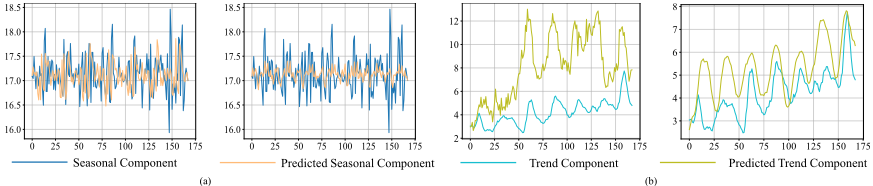
For the seasonal component, which exhibits complex fluctuations, the seasonal module demonstrates superior performance, as shown in Figure 4 (b). These results validate each module's modeling capabilities for its designated component.
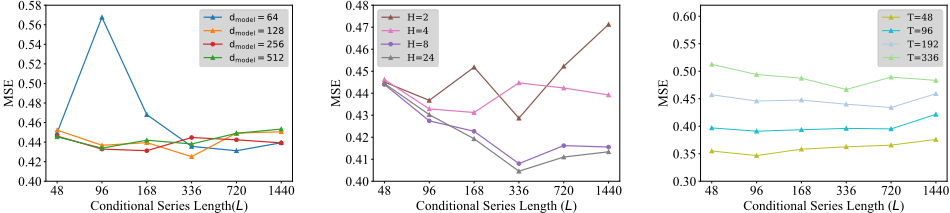
Hyper-Parameter Sensitivity Analysis. To investigate the impact of key design choices in CDPM, such as hidden dimension size (dmodel), patch length (H), and prediction horizon on model performance, we conducted a hyperparameter sensitivity analysis using the ETTh1 dataset. The results show that increasing dmodel initially improves performance, peaking at dmodel = 256, while larger values (e.g., dmodel = 512) offer diminishing returns and risk overfitting, highlighting the trade-off between model capacity and efficiency. Similarly, H significantly affects performance, with H = 8 capturing both local dependencies and global patterns, whereas larger values introduce redundancy and reduce efficiency. Finally, our framework performs consistently across prediction horizons.
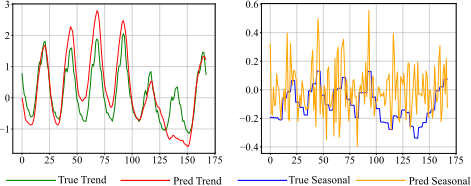
Combined Modeling Capability Analysis. To assess the interpretability and predictive performance of the framework, we conducted a joint analysis of the PTM and CDSM modules on the Electricity dataset, as shown in Figure 5. The framework decouples multidimensional time series, capturing diverse trends and cyclic patterns, demonstrating its capacity to model complex temporal dynamics. In Figure 5 (left), applied to the Electricity dataset with clear periodic and trend structures, the trend module captures the underlying patterns, with predictions closely matching actual values. Figure 5 (right) illustrates the seasonal module's ability to model periodic variations, where predicted components align well with the observed sequences, compensating for deviations in trend estimation and improving accuracy. The integration of deterministic and diffusion-based modules within the framework enhances both interpretability and predictive accuracy across datasets with combined components.
6 Conclusion
In this paper, we proposed the Conditional Denoising Polynomial Modeling (CDPM), a novel time series forecasting framework that separately models trend and seasonal components using specialized modules, trained in an end-to-end manner. The Polynomial Trend Module (PTM) captured intrinsic trends, while the Conditional Denoising Seasonal Module (CDSM) addressed complex seasonal fluctuations. By reformulating the Evidence Lower Bound, we were able to better integrate the training of both modules. This decoupling paradigm enhanced the modeling of temporal dynamics, resulting in improved forecasting accuracy. Extensive experiments on real-world datasets validated the effectiveness of the proposed CDPM.
Acknowledgements
This research was supported by grants from the grants of Provincial Natural Science Foundation of Anhui Province (No.2408085QF193), the National Natural Science Foundation of China (62337001), the Key Technologies R&D Program of Anhui Province (No. 202423k09020039), USTC Research Funds of the Double First-Class Initiative (No. YD2150002501), and the Fundamental Research Funds for the Central Universities (No. WK2150110032).
@inproceedings{ijcai2025p778,
  title     = {Conditional Denoising Meets Polynomial Modeling: A Flexible Decoupled Framework for Time Series Forecasting},
  author    = {Zhang, Jintao and Cheng, Mingyue and Tao, Xiaoyu and Liu, Zhiding and Wang, Daoyu},
  booktitle = {Proceedings of the Thirty-Fourth International Joint Conference on
               Artificial Intelligence, {IJCAI-25}},
  publisher = {International Joint Conferences on Artificial Intelligence Organization},
  editor    = {James Kwok},
  pages     = {6993--7001},
  year      = {2025},
  month     = {8},
  note      = {Main Track},
  doi       = {10.24963/ijcai.2025/778},
  url       = {https://doi.org/10.24963/ijcai.2025/778},
}
TY - CPAPER TI - Conditional Denoising Meets Polynomial Modeling: A Flexible Decoupled Framework for Time Series Forecasting AU - Zhang, Jintao AU - Cheng, Mingyue AU - Tao, Xiaoyu AU - Liu, Zhiding AU - Wang, Daoyu T2 - Proceedings of the Thirty-Fourth International Joint Conference on Artificial Intelligence, IJCAI-25 PB - International Joint Conferences on Artificial Intelligence Organization PY - 2025 SP - 6993 EP - 7001 DO - 10.24963/ijcai.2025/778 UR - https://doi.org/10.24963/ijcai.2025/778 ER -Copied
Machine-readable versions of this paper, for tools and AI agents:





