
Injecting Imbalance Sensitivity for Multi-Task Learning
Proceedings of the Thirty-Fourth International Joint Conference on Artificial Intelligence. Main Track. Pages 7236-7244.
https://doi.org/10.24963/ijcai.2025/805
Keywords
- Machine Learning: ML: Multi-task and transfer learning
- Machine Learning: ML: Meta-learning
Abstract
Multi-task learning (MTL) has emerged as a promising approach for deploying deep learning models in real-life applications. Recent studies have proposed optimization-based learning paradigms to establish task-shared representations in MTL. However, our paper empirically argues that these studies, specifically gradient-based ones, primarily emphasize the conflict issue while neglecting the potentially more significant impact of imbalance/dominance in MTL. In line with this perspective, we enhance the existing baseline method by injecting imbalance-sensitivity through the imposition of constraints on the projected norms. To demonstrate the effectiveness of our proposed IMbalance-sensitive Gradient (IMGrad) descent method, we evaluate it on multiple mainstream MTL benchmarks, encompassing supervised learning tasks as well as reinforcement learning. The experimental results consistently demonstrate competitive performance.
- [Chen et al., 2018] Zhao Chen, Vijay Badrinarayanan, Chen- Yu Lee, and Andrew Rabinovich. Gradnorm: Gradient normalization for adaptive loss balancing in deep multitask networks. In International conference on machine learning, pages 794-803. PMLR, 2018.
- [Chen et al., 2023] Zitian Chen, Yikang Shen, Mingyu Ding, Zhenfang Chen, Hengshuang Zhao, Erik G Learned-Miller, and Chuang Gan. Mod-squad: Designing mixtures of ex- perts as modular multi-task learners. In Proceedings of the IEEE/CVF Conference on Computer Vision and Pattern Recognition, pages 11828-11837, 2023.
- [Cordts et al., 2016] Marius Cordts, Mohamed Omran, Se- bastian Ramos, Timo Rehfeld, Markus Enzweiler, Rodrigo Benenson, Uwe Franke, Stefan Roth, and Bernt Schiele. The cityscapes dataset for semantic urban scene understand- ing. In Proceedings of the IEEE conference on computer vision and pattern recognition, pages 3213-3223, 2016.
- [Diamond and Boyd, 2016] Steven Diamond and Stephen Boyd. Cvxpy: A python-embedded modeling language for convex optimization. The Journal of Machine Learning Research, 17(1):2909-2913, 2016.
- [Fan et al., 2022] Zhiwen Fan, Rishov Sarkar, Ziyu Jiang, Tianlong Chen, Kai Zou, Yu Cheng, Cong Hao, Zhangyang Wang, et al. M 3 vit: Mixture-of-experts vision transformer for efficient multi-task learning with model-accelerator co- design. Advances in Neural Information Processing Sys- tems, 35:28441-28457, 2022.
- [Fernando et al., 2023] Heshan Devaka Fernando, Han Shen, Miao Liu, Subhajit Chaudhury, Keerthiram Murugesan, and Tianyi Chen. Mitigating gradient bias in multi-objective learning: A provably convergent approach. In The Eleventh International Conference on Learning Representations, 2023.
- [Gao et al., 2019] Yuan Gao, Jiayi Ma, Mingbo Zhao, Wei Liu, and Alan L Yuille. Nddr-cnn: Layerwise feature fusing in multi-task cnns by neural discriminative dimensionality reduction. In Proceedings of the IEEE/CVF conference on computer vision and pattern recognition, pages 3205-3214, 2019.
- [He et al., 2021] Junxian He, Chunting Zhou, Xuezhe Ma, Taylor Berg-Kirkpatrick, and Graham Neubig. Towards a unified view of parameter-efficient transfer learning. arXiv preprint arXiv:2110.04366, 2021.
- [Heuer et al., 2021] Falk Heuer, Sven Mantowsky, Saqib Bukhari, and Georg Schneider. Multitask-centernet (mcn): Efficient and diverse multitask learning using an anchor free approach. In Proceedings of the IEEE/CVF Interna- tional Conference on Computer Vision, pages 997-1005, 2021.
- [Jaggi, 2013] Martin Jaggi. Revisiting frank-wolfe: Projection-free sparse convex optimization. In Interna- tional conference on machine learning, pages 427-435.
- PMLR, 2013.
- [Kokkinos, 2017] Iasonas Kokkinos. Ubernet: Training a universal convolutional neural network for low-, mid-, and high-level vision using diverse datasets and limited memory. In Proceedings of the IEEE conference on computer vision and pattern recognition, pages 6129-6138, 2017.
- [Liu et al., 2015] Ziwei Liu, Ping Luo, Xiaogang Wang, and Xiaoou Tang. Deep learning face attributes in the wild. In Proceedings of the IEEE international conference on computer vision, pages 3730-3738, 2015.
- [Liu et al., 2019] Shikun Liu, Edward Johns, and Andrew J Davison. End-to-end multi-task learning with attention. In Proceedings of the IEEE/CVF conference on computer vision and pattern recognition, pages 1871-1880, 2019.
- [Liu et al., 2021a] Bo Liu, Xingchao Liu, Xiaojie Jin, Peter Stone, and Qiang Liu. Conflict-averse gradient descent for multi-task learning. Advances in Neural Information Processing Systems, 34:18878-18890, 2021.
- [Liu et al., 2021b] Liyang Liu, Yi Li, Zhanghui Kuang, Jing- Hao Xue, Yimin Chen, Wenming Yang, Qingmin Liao, and Wayne Zhang. Towards impartial multi-task learning. In International Conference on Learning Representations, 2021.
- [Liu et al., 2022] Haokun Liu, Derek Tam, Mohammed Muqeeth, Jay Mohta, Tenghao Huang, Mohit Bansal, and Colin A Raffel. Few-shot parameter-efficient fine-tuning is better and cheaper than in-context learning. Advances in Neural Information Processing Systems, 35:1950-1965, 2022.
- [Liu et al., 2023] Bo Liu, Yihao Feng, Peter Stone, and Qiang Liu. Famo: Fast adaptive multitask optimization. arXiv preprint arXiv:2306.03792, 2023.
- [Maninis et al., 2019] Kevis-Kokitsi Maninis, Ilija Ra- dosavovic, and Iasonas Kokkinos. Attentive single-tasking of multiple tasks. In Proceedings of the IEEE/CVF conference on computer vision and pattern recognition, pages 1851-1860, 2019.
- [Navon et al., 2022] Aviv Navon, Aviv Shamsian, Idan Achi- tuve, Haggai Maron, Kenji Kawaguchi, Gal Chechik, and Ethan Fetaya. Multi-task learning as a bargaining game. In International Conference on Machine Learning, pages 16428-16446. PMLR, 2022.
- [Sener and Koltun, 2018] Ozan Sener and Vladlen Koltun. Multi-task learning as multi-objective optimization. Ad- vances in neural information processing systems, 31, 2018.
- [Senushkin et al., 2023] Dmitry Senushkin, Nikolay Patakin, Arseny Kuznetsov, and Anton Konushin. Independent com- ponent alignment for multi-task learning. In Proceedings of the IEEE/CVF Conference on Computer Vision and Pattern Recognition, pages 20083-20093, 2023.
- [Silberman et al., 2012] Nathan Silberman, Derek Hoiem, Pushmeet Kohli, and Rob Fergus. Indoor segmentation and support inference from rgbd images. In Computer Vision-ECCV 2012: 12th European Conference on Com- puter Vision, Florence, Italy, October 7-13, 2012, Proceed- ings, Part V 12, pages 746-760. Springer, 2012.
- [Yang and Hospedales, 2016] Yongxin Yang and Timothy Hospedales. Deep multi-task representation learn- ing: A tensor factorisation approach. arXiv preprint arXiv:1605.06391, 2016.
- [Ye and Xu, 2022] Hanrong Ye and Dan Xu. Inverted pyra- mid multi-task transformer for dense scene understanding. In European Conference on Computer Vision, pages 514- 530. Springer, 2022.
- [Yu et al., 2020a] Tianhe Yu, Saurabh Kumar, Abhishek Gupta, Sergey Levine, Karol Hausman, and Chelsea Finn. Gradient surgery for multi-task learning. Advances in Neu- ral Information Processing Systems, 33:5824-5836, 2020.
- [Yu et al., 2020b] Tianhe Yu, Deirdre Quillen, Zhanpeng He, Ryan Julian, Karol Hausman, Chelsea Finn, and Sergey Levine. Meta-world: A benchmark and evaluation for multi-task and meta reinforcement learning. In Conference on robot learning, pages 1094-1100. PMLR, 2020.
- Zhou et al., ] Zhipeng Zhou, Liu Liu, Peilin Zhao, and Wei Gong. Pareto deep long-tailed recognition: A conflict- averse solution. In The Twelfth International Conference on Learning Representations.
References were extracted automatically from the PDF and may contain errors.
Full text extracted automatically from the PDF; figures, tables and equations may differ. The PDF is the version of record.
1 Introduction
Real-life scenarios often involve the need to handle multiple distinct tasks concurrently, typically achieved by designing task-specific models to ensure satisfactory performance. However, this approach becomes impractical as the number of tasks grows, as it would require significant computational resources and memory. To address this challenge and establish an efficient multi-task learning (MTL) framework, recent research has focused on developing a single model capable of performing well on all target tasks.
Currently, research on MTL can be broadly categorized into two frameworks: architecture-based [Liu et al., 2019; Ye and Xu, 2022; Gao et al., 2019; Chen et al., 2023] and optimization-based approaches [Sener and Koltun, 2018; Yu et al., 2020a; Liu et al., 2021a; Zhou et al., ; Liu et al., 2023]. The former emphasizes the design of efficient parameter sharing architectures for multiple tasks, whereas the latter typically employs a fixed architecture and focuses on developing optimization strategies to extract task-shared representations. In this paper, we exclusively introduce and compare our method with optimization-based approaches, as our proposed method falls within this framework.
† Corresponding authors. Work done when Z. Zhou works as an intern in Tencent AI Lab.
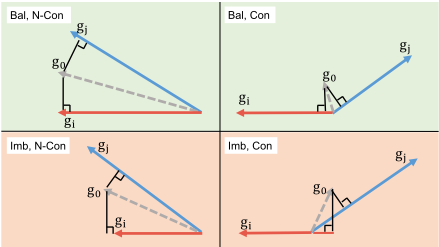
In the realm of optimization-based methods, particularly those involving gradient manipulation, a shared paradigm is commonly followed, where task gradients are combined to achieve Pareto optimality for individual tasks. Despite the high performance demonstrated by these methods, the literature has predominantly overlooked the significance of the inherent imbalance nature among individuals (see Definition 2). This oversight can be attributed to the greater emphasis placed on addressing the conflict issue. However, it is important to note that the conflict issue alone may not be the fundamental obstacle hindering optimization in MTL. As illustrated in Figure 1, a naïve linear scalarization (LS) strategy (gmean) effectively improves all individuals when they are balanced, regardless of conflicts. But it proves ineffective when both imbalance and conflict coexist, underscoring the importance of addressing conflicts that arise solely from imbalances. Furthermore, imbalanced task gradients can introduce optimization preferences and lead to imbalanced progress even in the absence of conflicts [Liu et al., 2023]. Although previous solutions, such as IMTL [Liu et al., 2021b] and Nash-MTL [Navon et al., 2022] illustrated in Table 1, have somewhat mitigated the imbalance/dominance issue, they neither explicitly provide evidence to demonstrate the importance of the imbalance issue nor consider both conflict and imbalance issues simultaneously.
| GD | GradDrop | MGDA | PCGrad | IMTL | CAGrad | Nash-MTL | MoCo | IMGrad | |
|---|---|---|---|---|---|---|---|---|---|
| Conflict-averse | � | � | � | � | � | � | � | � | � |
| Imbalance-sensitive | � | � | � | � | � | � | � | � | � |
In this paper, we begin by empirically highlighting the significance of the imbalance issue in MTL and elucidate the advantages of incorporating imbalance sensitivity into baseline methods as our primary motivation. Subsequently, we enhance the well-established baseline method by injecting imbalance sensitivity through the imposition of constraints on the projected norms. Convergence and speedup analysis are provided in the Appendix 1 . In a nutshell, we summarize our contributions as three-fold:
- We place significant emphasis on and empirically identify that the primary challenge in optimization-based MTL lies more in the aspect of imbalance rather than conflict. To the best of our knowledge, we are the first to explicitly assert this claim.
- To introduce the imbalance sensitivity into the existing paradigm, we integrate the projected norm constraint into the objectives. This incorporation allows for a dynamic equilibrium between Pareto property (see Definition 3) and convergence (two decoupled objectives), thereby enhancing the combined gradients and optimization trajectories.
- The extensive experimental results present compelling evidence that IMGrad consistently enhances its baselines and surpasses the current advanced gradient manipulation methods in a diverse range of evaluations, e.g., supervised learning tasks, and reinforcement learning benchmarks.
2 RelatedWork
Currently, MTL approaches can be broadly categorized into two groups: architecture-based and optimization-based methods. Architecture-based approaches encompass various paradigms, including hard parameter sharing [Heuer et al., 2021; Kokkinos, 2017], soft parameter sharing [Yang and Hospedales, 2016; Gao et al., 2019], modulation and adapters [He et al., 2021; Liu et al., 2022], and mixture of experts (MoE) [Chen et al., 2023; Fan et al., 2022], etc. On the other hand, optimization-based MTL methods primarily focus on learning paradigms rather than structural designs or parameter sharing strategies. These methods aim to optimize all individual tasks to extract task-shared representations.
One classical optimization-based MTL approach is MGDA [Sener and Koltun, 2018], which seeks a combined gradient with minimal norm using the Frank-Wolfe algorithm [Jaggi, 2013]. PCGrad [Yu et al., 2020a] addresses the conflict issue by projecting individual gradients onto orthogonal directions with respect to others. CAGrad [Liu et al., 2021a] considers preserving both the Pareto property and global optimization, ultimately striving for a balance between the two objectives using a hyper-parameter. NashMTL [Navon et al., 2022] negotiates to reach an agreement on a joint direction of parameter update, enabling all individual tasks to achieve more balanced progress. MoCo [Fernando et al., 2023] tackles the problem of biased gradient directions in previous solutions by developing tracking parameters for correction. Our method falls within the realm of optimizationbased MTL, with a specific focus on addressing the issue of imbalance-sensitivity, which is largely lacking in the aforementioned solutions.
1 Refer to https://arxiv.org/abs/2503.08006 for the Appendix.
Discussion with Counterparts: To the best of our knowledge, IMTL [Liu et al., 2021b], Nash-MTL [Navon et al., 2022], and FAMO [Liu et al., 2023] are three recent works that explicitly consider the imbalance issue. However, all three works fail to provide evidence demonstrating the importance of the imbalance issue. Moreover, none of these approaches possess conflict-averse properties. Thus, there is still room for improvement. Although Nash-MTL appears to be designed to avoid conflicts, its practical implementation does not achieve this goal. Please refer to the Appendix for more discussion.
3 Preliminary
3.1 Setup of Optimization-basedMTL
As mentioned, optimization-based MTL approaches operate under the assumption that the model consists of a task-shared backbone network alongside task-specific branches. Consequently, the primary objective of these approaches is to devise gradient combination strategies that optimize the backbone network to yield benefits across all tasks. Let us consider a scenario where there are K ≥ 2 tasks available, each associated with a differentiable loss function Li(Θ), where Θ represents the task-shared parameters. The goal of optimization-based MTL is to search for the optimal Θ∗ ∈ Rm that minimizes the losses for all tasks. However, it is widely recognized that a simplistic linear scalar strategy, L0(Θ) = 1K ∑Ki=1 Li(Θ), fails to achieve satisfactory performance due to the conflict and imbalance issue.
3.2 Pareto Concept
Formally, let us assume the weighted loss as Lω = ∑Ki=1 ωiLi(Θ), where ω ∈ W and W represents the probability simplex on [K]. A point Θ′ is said to Pareto dominate Θ if and only if ∀i, Li(Θ′ ) ≤ Li(Θ). Consequently, the Pareto optimal situation arises when no Θ′ can be found that satisfies ∀i,Li(Θ′ ) ≤ Li(Θ) for the given point Θ. All points that meet these conditions are referred to as Pareto sets, and their solutions are known as Pareto fronts. Another concept, known as Pareto stationary, requires minω∈W ∥gω∥ = 0, where gω

represents the weighted gradient ω⊤G, and G is the gradients matrix whose each row is an individual gradient. We also provide some definitions here for ease of description.
Definition 1 (Gradient Similarity). Denote ϕij as the angle between two task gradients gi and gj, then we define the gradient similarity as cosφij and the gradients as conflicting when cos ϕij < 0.
Definition 2 (Imbalance of Individuals). Assume the gradient owns the maximal norm in G is gmax, and the corresponding minimal one is gmin. We define the imbalance ratio of G as r = ∥gmax∥ ∥gmin∥ . If r > 1, we call it's imbalanced.
Definition 3 (Pareto Property). For each training step, the combined optimization direction strives to promote all individuals simultaneously (or at the very least, not cause detriment), i.e. for ∀i, the gradient similarity between gi and the combined gradient gω satisfies cos ϕωi ≥ 0. When this condition is not met, it is referred to as Pareto failure.
4 Motivation and Observation
A substantial body of previous studies [Sener and Koltun, 2018; Liu et al., 2021a; Yu et al., 2020a; Navon et al., 2022] have primarily focused on addressing the conflict issue rather than the imbalance issue. In this section, we aim to provide empirical insights into the significance of imbalance and elucidate how imbalance-sensitivity can bring benefits to current popular optimization-based MTL paradigms. Based on these insights, we naturally deduce our design in the next section.
4.1 Why Does Imbalance Matter More?
To begin, we conducted experiments on the CityScapes dataset [Cordts et al., 2016] to statistically analyze the imbalance ratios of representative optimization-based MTL methods (e.g., PCGrad [Yu et al., 2020a], CAGrad [Liu et al., 2021a], Nash-MTL [Navon et al., 2022]). The results of these experiments are presented in the Appendix. From the depicted results, it is evident that all the methods exhibit significant imbalance during training, which poses a substantial challenge when attempting to optimize all individuals simultaneously, thereby underscoring the importance of addressing the imbalance issue.
Secondly, to demonstrate the higher priority of imbalance issue, we show the toy example results that present imbalance and conflict among gradients in the following cases:
- Conflict (�); Imbalance (�): In Figure 3, we manually create scenarios where conflict exists but imbalance is absent. By closely examining the center trajectories in Figure 3 (d)(e), we observe that all methods can easily reach the optimal point when imbalance is absent, regardless of the presence of conflicts. This observation suggests that the sole existence of conflicts has limited impact on optimization, emphasizing the importance of addressing the imbalance issue.
- Conflict (�); Imbalance (�): Simulating an optimization trajectory without conflicts among individuals can indeed be challenging. Therefore, we adopt the setting from Nash-MTL [Navon et al., 2022] to handcraft an imbalance-dominated optimization scenario. The resulting trajectories are depicted in Figure 2. It is evident that all the compared approaches fail to converge at the desired global optimum from all initial starts under the extreme imbalance circumstances, though most of them reach the Pareto front. Additionally, the trajectories at the sides in Figure 3 (d)(e) also highlight the issue of progress hindered by imbalance. Specifically, CAGrad fails to reach the global optimum compared to IMGrad despite undergoing the same number of optimization steps.
4.2 The Impacts of the Imbalance Issue
In Table 1, we list and compare mainstream optimizationbased MTL approaches. The table focuses on two key properties: conflict-averse and imbalance-sensitive properties. It is observed that most MTL approaches possess the conflictaverse property due to their design nature. However, only a few approaches are imbalance-sensitive 2 , and currently, there are no methods that possess both properties simultaneously. Furthermore, we analyze two imbalance-deduced issues that occur and impede past solutions during optimization: Pareto failure and imbalanced individual progress.
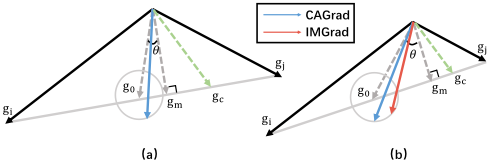
Pareto Failure: As shown in Figure 4 (a)(b), CAGrad exhibits a certain probability of failing to preserve the conflict issue due to its inherent compromise between conflict-averse and convergence. This compromise is inevitably influenced by the issue of imbalance. As illustrated in Figure 6, CAGrad tends to prioritize the combined gradient that deviates from the individual with the least norm when encountering imbalanced scenarios, leading to potential conflicts. Surprisingly, although Nash-MTL imposes a strong constraint for the Pareto property, i.e., ∀i, -φi(ω) ≤ 0, φi(ω) = log(ωi) + log(g⊤ i Gω),G = [g1, g2, ..., gK], it often fails to achieve such a guarantee. This failure can be attributed to the presence of negative terms in g⊤ i G, indicating conflicts between gi and gj . Consequently, this leads to infeasible errors in the cvxpy [Diamond and Boyd, 2016] implementation, and the Nash-MTL algorithm chooses to skip the current step when such errors occur. As a result, Nash-MTL frequently encounters Pareto failures due to the co-existence of imbalance and conflict, as depicted in Figure 4 (b). IMGrad demonstrates a tendency to acquire a combined gradient that effectively preserves the Pareto property as the imbalance ratio increases.
2 We provide imbalance-sensitive analysis for IMTL, Nash-MTL, and FAMO in the Appendix.

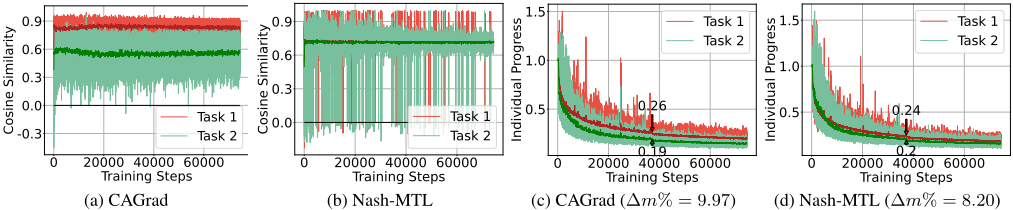
Imbalanced Individual Progress: We employ an individual progress metric proposed by [Chen et al., 2018], which is defined as follows:
where Li(t) represents the individual loss value at t time. As depicted in Figure 4 (c)(d), Nash-MTL demonstrates a narrower gap in terms of individual progress compared to CAGrad. This can be attributed to the more balanced combination employed by Nash-MTL, as indicated by the cosine similarity in (a)(b). Consequently, Nash-MTL exhibits superior overall performance, characterized by a smaller ∆m%. Specifically, ∆m% is widely adopted to evaluate the overall degradation compared to independently trained models, which are considered as the reference oracles. Its formal definition can be found in the Performance Evaluation section.
Unfortunately, none of the above methods get rid of both Pareto failure and imbalanced individual progress, primarily due to their limited focus on the imbalance issue.
4.3 Benefits of Integrating Imbalance-Sensitivity
The toy results depicted in Figure 2 and Figure 3 demonstrate that among the methods evaluated, only our proposed IMGrad, which incorporates imbalance-sensitivity, consistently arrives at the optimal point from all initial starts.
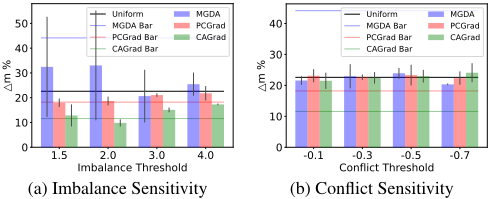
To further elucidate the advantages of imbalance-sensitivity in optimization-based MTL, we have implemented a naïve method called Adaptive Threshold. This baseline selectively applies optimization-based MTL approaches only when the imbalance ratio surpasses a specific threshold. The results of this implementation on CityScapes are presented in Figure 5 (a). It is evident that all baselines exhibit varying performance as the imbalance ratio fluctuates, emphasizing the significance of imbalance-sensitivity. Notably, all baselines outperform their respective vanilla versions under specific threshold conditions, providing additional evidence of the effectiveness of injecting imbalance-sensitivity.
Additionally, we have conducted a series of control group experiments to further support our findings. Similarly, we only apply optimization-based MTL when the gradient similarity falls below a certain threshold. As depicted in Figure 5 (b), all baselines demonstrate relatively stable performance compared to those in (a) and fail to outperform the vanilla version, except for MGDA (which itself performs worse than LS). This outcome further reinforces the claim that imbalance matters more.
5 Principal Design
In this section, taking CAGrad as the baseline, we present the principal design of IMGrad, encompassing its formulation in the objective function and the practical implementation. And we provide convergence and speedup analysis in the Appendix.
5.1 Injecting Imbalance-Sensitivity
As a widely adopted baseline, CAGrad strikes a balance between Pareto property and globe convergence, and its dual objective is formulated as follows:
where d represents the combined gradient, while g0 denotes the averaged gradient, and c is the hyper-parameter.
To alleviate the imbalance-deduced Pareto failures or individual progress issue as illustrated in Figure 4, a logical approach is to maximize the projected norm of the combined gradient across all individuals. To achieve this, we incorporate a stronger constraint (g⊤ i d - ∥gi∥2 ) into Eqn. 2, which encourages projected norms that surpass individual norms. This formulation is reflected in our objective presented in Eqn. 3, and subsequently, we derive the corresponding Lagrangian equations in Eqn. 4.
The strong duality property holds for the aforementioned objective, as supported by convex programming principles and the fulfillment of Slater's condition. Consequently, we interchange the positions of the minimum and maximum operators:
With λ, ω fixing, the optimal d is achieved when d = g0 + (1-µ)gω λ . Substitude the optimal d into Eqn. 5, yielding the following problem:
After optimizing out the λ we have
where λ = (1 - µ) ∥gω∥ /ϕ1/2 , and finally we have the optimization objective in Eqn. 8. By solving this objective, we can obtain gω and have d = g0 + ϕ1/2 ∥gω∥ gω .
Upon careful examination of Eqn. 8, it becomes evident that the final objective can be decomposed into two distinct components: CAGrad and MGDA. As depicted in Figure 6 (a), the gradient obtained by solving the practical objective in Eqn. 10, denoted as gc (represented by the green dotted line), predominantly resides within the region bounded by gm and gj. However, in the case of an extreme imbalance scenario, as illustrated in Figure 6 (b), the corresponding gc tends to lean towards the dominant gradient gi, thereby increasing the risk of conflicting with gj and resulting in Pareto failures. When confronted with such a situation characterized by varying imbalances, it is desirable for µ to adaptively adjust gc to consistently avoid Pareto failures while still promoting individual progress when the imbalance is less pronounced. Consequently, we establish a connection between µ and the gradient imbalances, effectively controlling the constraint (g⊤ i d - ∥gi∥2 ) adaptively based on the imbalance circumstances.
Multiple alternatives exist for quantifying the imbalance ratio among individuals 3 . We here choose to compute cos θ to represent the imbalance ratio (see negative correlation between imbalance ratio and cos θ in the Appendix), where θ denotes the angle between g0 and gm. As a result, Eqn. 8 can be re-written as:
3 Please refer to the Appendix for additional alternatives.
Simplification: As a matter of fact, CAGrad itself contains decoupled components in its practical objective:
where g⊤ ω g0 tends to push away from g0 and √ϕ ∥gω∥ plays the role of MGDA does. Thus we can simplify the Eqn. 9 as:
5.2 Augment Nash-MTLwith Imbalance Sensitivity
As stated in the previous Pareto Failure analysis, while NashMTL effectively addresses the imbalance issue and appears to be naturally conflict-averse, its implementation often leads to frequent Pareto failures. To address this problem, let's first examine its decoupled objective:
where φi(ω) = log(ωi)+log(g⊤ i Gω), G = [g1, g2, ..., gK]. ∑i g⊤ i Gω tends to push away from g0 and φ(ω) strives balance among individuals. Intuitively, we expect to preserve the Pareto property when encountering extremely imbalanced scenarios; therefore, ∑i g⊤ i Gω should be given more weight:
With the proper assumption of H-Lipschitz on gradients, we can still avoid Pareto failure with the derived weights among individuals from the last step. In a word, we augment Nash-MTL by injecting imbalance sensitivity to reduce Pareto failures. Please refer to the Appendix for more details.
5.3 Implementation
We implement our approach with Python 3.8, PyTorch 1.4.0 and cvxpy 1.3.1, while all experiments are carried out on Tesla V100 GPUs 4 . We follow the setting and general implementation of [Liu et al., 2021a], and the toy example generation is borrowed from [Navon et al., 2022; Senushkin et al., 2023]. See more implementation details in the Appendix.
6 Performance Evaluation
Following the evaluation protocol in [Navon et al., 2022] and taking it as the baseline, we conduct experiments under the supervised learning and reinforcement learning scenarios. Specifically, two scene understanding and one image classification benchmarks are involved in supervised learning, and the classical MT10 benchmark is adopted for reinforcement learning. The examination of Pareto failures, individual task progress, a sensitivity analysis of µ, the verification of negative correlation between imbalance ratio and cos θ, speed analysis, and more visualizations are also provided in the Appendix, please refer them for more details.
4 Code is avaliable at https://github.com/zzpustc/IMGrad.
Evaluation metric. In addition to reporting individual performance, we also incorporate a widely used metric, ∆m% [Maninis et al., 2019], which evaluates the overall degradation compared to independently trained models that are considered as the reference oracles. The formal definition of ∆m% is given as: ∆m% = 1K ∑Kk=1 (-1)δk (Mm,k - Mb,k)/Mb,k. Mm,k andMb,k represent the metricMk for the compared method and the independent model, respectively. The value of δk is assigned as 1 if a higher value is better for Mk, and 0 otherwise.
| Method | Segmentation (Higher Better) | Depth (Lower Better) | ∆ m% ↓ | ||
|---|---|---|---|---|---|
| mIoU | Pix. Acc. | Abs. Err. | Rel. Err. | ||
| Independent | 74.01 | 93.16 | 0.0125 | 27.77 | - |
| LS | 75.18 | 93.49 | 0.0155 | 46.77 | 22.60 |
| RLW | 74.57 | 93.41 | 0.0158 | 47.79 | 24.37 |
| DWA | 75.24 | 93.52 | 0.0160 | 44.37 | 21.43 |
| MGDA | 68.84 | 91.54 | 0.0309 | 33.50 | 44.14 |
| GradDrop | 75.27 | 93.53 | 0.0157 | 47.54 | 23.67 |
| PCGrad | 75.13 | 93.48 | 0.0154 | 42.07 | 18.21 |
| CAGrad | 75.16 | 93.48 | 0.0141 | 37.60 | 11.58 |
| IMTL | 75.33 | 93.49 | 0.0135 | 38.41 | 11.04 |
| Nash-MTL | 75.41 | 93.66 | 0.0129 | 35.02 | 6.82 |
| MoCo | 75.42 | 93.55 | 0.0149 | 34.19 | 9.90 |
| FAMO | 74.54 | 93.29 | 0.0145 | 32.59 | 8.13 |
| IMGrad | 75.13 | 93.45 | 0.0128 | 34.95 | 6.61 |
6.1 Supervised Learning
Customary evaluation in supervised learning for MTL involves assessing the ability of MTL approaches to handle multiple scene understanding and classification tasks. For scene understanding tasks, we follow previous studies [Liu et al., 2021a; Liu et al., 2021b; Navon et al., 2022] and employ a MultiTask Attention Network (MTAN)[Liu et al., 2019] as the fundamental architecture for all MTL approaches. Our experiments are conducted on two well-established datasets: NYUv2[Silberman et al., 2012] and CityScapes [Cordts et al., 2016]. To ensure fair comparisons, we adopt the same training strategy as described in prior works [Liu et al., 2021a; Navon et al., 2022]. Specifically, models are trained for 200 epochs using the Adam optimizer, with an initial learning rate of 1e-4, which decays to 5e-5 after 100 epochs. For the image classification task, we utilize a 9-layer convolutional neural network (CNN) as the backbone, with linear layers serving as task-specific heads, and conduct experiments on CelebA [Liu et al., 2015]. The model is trained using the Adam optimizer for 15 epochs, with an initial learning rate of 3.0e-4 and a batch size of 256.
NYUv2. NYUv2 is a widely used indoor scene understanding dataset for MTL benchmarking, encompassing three tasks:
| Segmentation | Depth | Surface Normal | |||||||||
|---|---|---|---|---|---|---|---|---|---|---|---|
| Method | (Higher Better) | (Lower Better) | Angle Distance (Lower | Better) | Within t◦ (Higher Better) | ∆ m% ↓ | |||||
| mIoU Pix. Acc. | Abs Err | Rel Err | Mean | Median | 11.25 | 22.5 | 30 | ||||
| Independent | 38.30 | 63.76 | 0.68 | 0.28 | 25.01 | 19.21 | 30.14 | 57.20 | 69.15 | - | |
| LS | 39.29 | 65.33 | 0.55 | 0.23 | 28.15 | 23.96 | 22.09 | 47.50 | 61.08 | 5.46 | |
| RLW | 37.17 | 63.77 | 0.58 | 0.24 | 28.27 | 24.18 | 22.26 | 47.05 | 60.62 | 7.67 | |
| DWA | 39.11 | 65.31 | 0.55 | 0.23 | 27.61 | 23.18 | 24.17 | 50.18 | 62.39 | 3.49 | |
| MGDA | 30.47 | 59.90 | 0.61 | 0.26 | 24.88 | 19.45 | 29.18 | 56.88 | 69.36 | 1.47 | |
| GradDrop | 39.39 | 65.12 | 0.55 | 0.23 | 27.48 | 22.96 | 23.38 | 49.44 | 62.87 | 3.61 | |
| PCGrad | 38.06 | 64.64 | 0.56 | 0.23 | 27.41 | 22.80 | 23.86 | 49.83 | 63.14 | 3.83 | |
| CAGrad | 39.79 | 65.49 | 0.55 | 0.23 | 26.31 | 21.58 | 25.61 | 52.36 | 65.58 | 0.29 | |
| IMTL | 39.35 | 65.60 | 0.54 | 0.23 | 26.02 | 21.19 | 26.20 | 53.13 | 66.24 | -0.59 | |
| Nash-MTL | 40.13 | 65.93 | 0.53 | 0.22 | 25.26 | 20.08 | 28.40 | 55.47 | 68.15 | -4.04 | |
| MoCo | 40.30 | 66.07 | 0.56 | 0.21 | 26.67 | 21.83 | 25.61 | 51.78 | 64.85 | 0.16 | |
| FAMO | 38.88 | 64.90 | 0.55 | 0.22 | 25.06 | 19.57 | 29.21 | 56.61 | 68.98 | -4.10 | |
| IMGrad | 40.20 | 66.19 | 0.52 | 0.22 | 25.15 | 19.94 | 28.69 | 55.80 | 68.44 | -4.57 | |
semantic segmentation, depth estimation, and surface norIMGrad surpasses the previous SOTA in terms of ∆m%, highlighting the effectiveness of incorporating imbalance sensitivity. IMGrad also achieves best performance on segmen-
mal prediction. The results, presented in Table 3, show that tation and depth tasks without much promise on other tasks. CityScapes. The CityScapes dataset is used for MTL evaluation, focusing on semantic segmentation and depth estimation tasks. Following the previous experimental setup, we utilize a coarser version that categorizes segmentation into 7 classes. The results, presented in Table 2, indicate that IMGrad exhibits a similar trend to its performance on NYUv2 and achieves SOTA results in terms of ∆m%.
| MT10 | CelebA | ||
|---|---|---|---|
| Method | Success ± SEM ↑ | Method | ∆m%↓ |
| LS | 0.49 ± 0.070 | LS | 4.15 |
| STL SAC | 0.90 ± 0.032 | SI | 7.20 |
| MTL SAC | 0.49 ± 0.073 | RLW | 1.46 |
| MH SAC | 0.54 ± 0.047 | DWA | 3.20 |
| SM | 0.73 ± 0.043 | UW | 3.23 |
| CARE | 0.84 ± 0.051 | MGDA | 14.85 |
| PCGrad | 0.72 ± 0.022 | PCGrad | 3.17 |
| CAGrad | 0.83 ± 0.045 | CAGrad | 2.48 |
| Nash-MTL | 0.91 ± 0.031 | Nash-MTL | 2.84 |
| FAMO | 0.83 ± 0.050 | FAMO | 1.21 |
| IMGrad | 0.93 ± 0.068 (+0.10) | IMGrad | 1.27 |
CelebA. CelebA is a widely used face attributes dataset containing over 200,000 images annotated with 40 attributes. Recently, it has been adopted as a 40-task MTL benchmark to evaluate a model's ability to handle a large number of tasks. The results, presented in Table 4, are averaged over three random seeds. While IMGrad does not achieve the best performance, it consistently ranks among the top methods, underscoring the importance of imbalance sensitivity.
6.2 Reinforcement Learning
Reinforcement learning is another domain where MTL is often essential, as it seeks to acquire a policy capable of succeeding across various manipulation tasks. To evaluate the generalizability of our proposed method, we use CAGrad as the baseline and conduct experiments on the MT10 environment from the Meta-World benchmark [Yu et al., 2020b]. The results, presented in Table 4, report the average success rate on the validation set over 10 random seeds. Consistent with the improvements observed in supervised learning evaluations, IMGrad enhances CAGrad by over 0.10, achieving SOTA performance on this benchmark. It is worth noting that Nash-MTL does not provide an official implementation for reinforcement learning benchmarks. As a result, we did not augment it for evaluation in this context.
7 Conclusion
In this paper, we begin by empirically demonstrating the significance of addressing the imbalance issue in optimization-based MTL. We assert that incorporating imbalance-sensitivity is crucial for avoiding Pareto failures and promoting balanced individual progress. Building upon this motivation, we propose IMGrad, a method derived from a projection norm constraint, which is further simplified as an adaptive balancer between decoupled objectives. Through extensive experiments, we validate the effectiveness of our proposed approach. We believe that our explicit emphasis on the imbalance issue, rather than the conflict issue, provides valuable insights for the future development of optimization-based MTL.
Acknowledgements
We thank anonymous reviewers for their valuable comments.
@inproceedings{ijcai2025p805,
  title     = {Injecting Imbalance Sensitivity for Multi-Task Learning},
  author    = {Zhou, Zhipeng and Liu, Liu and Zhao, Peilin and Gong, Wei},
  booktitle = {Proceedings of the Thirty-Fourth International Joint Conference on
               Artificial Intelligence, {IJCAI-25}},
  publisher = {International Joint Conferences on Artificial Intelligence Organization},
  editor    = {James Kwok},
  pages     = {7236--7244},
  year      = {2025},
  month     = {8},
  note      = {Main Track},
  doi       = {10.24963/ijcai.2025/805},
  url       = {https://doi.org/10.24963/ijcai.2025/805},
}
TY - CPAPER TI - Injecting Imbalance Sensitivity for Multi-Task Learning AU - Zhou, Zhipeng AU - Liu, Liu AU - Zhao, Peilin AU - Gong, Wei T2 - Proceedings of the Thirty-Fourth International Joint Conference on Artificial Intelligence, IJCAI-25 PB - International Joint Conferences on Artificial Intelligence Organization PY - 2025 SP - 7236 EP - 7244 DO - 10.24963/ijcai.2025/805 UR - https://doi.org/10.24963/ijcai.2025/805 ER -Copied
Machine-readable versions of this paper, for tools and AI agents:





