
Robust Misinformation Detection by Visiting Potential Commonsense Conflict
Proceedings of the Thirty-Fourth International Joint Conference on Artificial Intelligence. Main Track. Pages 7760-7768.
https://doi.org/10.24963/ijcai.2025/863
Keywords
- Data Mining: DM: Mining text, web, social media
- Multidisciplinary Topics and Applications: MTA: Web and social networks
- Knowledge Representation and Reasoning: KRR: Common-sense reasoning
- Natural Language Processing: NLP: Applications
Abstract
The development of Internet technology has led to an increased prevalence of misinformation, causing severe negative effects across diverse domains. To mitigate this challenge, Misinformation Detection (MD), aiming to detect online misinformation automatically, emerges as a rapidly growing research topic in the community. In this paper, we propose a novel plug-and-play augmentation method for the MD task, namely Misinformation Detection with Potential Commonsense Conflict (MD-PCC). We take inspiration from the prior studies indicating that fake articles are more likely to involve commonsense conflict. Accordingly, we construct commonsense expressions for articles, serving to express potential commonsense conflicts inferred by the difference between extracted commonsense triplet and golden ones inferred by the well-established commonsense reasoning tool COMET. These expressions are then specified for each article as augmentation. Any specific MD methods can be then trained on those commonsense-augmented articles. Besides, we also collect a novel commonsense-oriented dataset named CoMis, whose all fake articles are caused by commonsense conflict. We integrate MD-PCC with various existing MD backbones and compare them across both 4 public benchmark datasets and CoMis. Empirical results demonstrate that MD-PCC can consistently outperform the existing MD baselines.
- [Bosselut et al., 2019] Antoine Bosselut, Hannah Rashkin, Maarten Sap, Chaitanya Malaviya, Asli Celikyilmaz, and Yejin Choi. COMET: commonsense transformers for au- tomatic knowledge graph construction. In COLING, pages 4762-4779, 2019.
- [Brown et al., 2020] Tom B. Brown, Benjamin Mann, Nick Ryder, Melanie Subbiah, Jared Kaplan, Prafulla Dhari- wal, Arvind Neelakantan, Pranav Shyam, Girish Sastry, Amanda Askell, et al. Language models are few-shot learners. In NeurIPS, 2020.
- [Chen and Shu, 2024] Canyu Chen and Kai Shu. Can llm- generated misinformation be detected? In ICLR, 2024.
- [Chen et al., 2023] Qianglong Chen, Guohai Xu, Ming Yan, Ji Zhang, Fei Huang, Luo Si, and Yin Zhang. Distin- guish before answer: Generating contrastive explanation as knowledge for commonsense question answering. In Findings of ACL, pages 13207-13224, 2023.
- [Chung et al., 2024] Hyung Won Chung, Le Hou, Shayne Longpre, Barret Zoph, Yi Tay, William Fedus, Yunxuan Li, Xuezhi Wang, Mostafa Dehghani, Siddhartha Brahma, et al. Scaling instruction-finetuned language models. JMLR, 25:70:1-70:53, 2024.
- [Devlin et al., 2019] Jacob Devlin, Ming-Wei Chang, Ken- ton Lee, and Kristina Toutanova. BERT: pre-training of deep bidirectional transformers for language understand- ing. In NAACL, pages 4171-4186, 2019.
- [Dun et al., 2021] Yaqian Dun, Kefei Tu, Chen Chen, Chun- yan Hou, and Xiaojie Yuan. KAN: knowledge-aware at- tention network for fake news detection. In AAAI, pages 81-89, 2021.
- [Hu et al., 2021] Linmei Hu, Tianchi Yang, Luhao Zhang, Wanjun Zhong, Duyu Tang, Chuan Shi, Nan Duan, and Ming Zhou. Compare to the knowledge: Graph neural fake news detection with external knowledge. In ACL, pages 754-763, 2021.
- [Hu et al., 2023] Beizhe Hu, Qiang Sheng, Juan Cao, Yongchun Zhu, Danding Wang, Zhengjia Wang, and Zhi- wei Jin. Learn over past, evolve for future: Forecasting temporal trends for fake news detection. In ACL: Industry Track, pages 116-125, 2023.
- [Hu et al., 2024] Beizhe Hu, Qiang Sheng, Juan Cao, Yuhui Shi, Yang Li, Danding Wang, and Peng Qi. Bad actor, good advisor: Exploring the role of large language mod- els in fake news detection. In AAAI, pages 22105-22113, 2024.
- [Hwang et al., 2021] Jena D. Hwang, Chandra Bhagavatula, Ronan Le Bras, Jeff Da, Keisuke Sakaguchi, Antoine Bosselut, and Yejin Choi. (comet-) atomic 2020: On symbolic and neural commonsense knowledge graphs. In AAAI, pages 6384-6392, 2021.
- [Jiang et al., 2022] Gongyao Jiang, Shuang Liu, Yu Zhao, Yueheng Sun, and Meishan Zhang. Fake news detection via knowledgeable prompt learning. Information Process- ing & Management, 59(5):103029, 2022.
- [Jiang et al., 2024] Siqi Jiang, Zeqi Guo, and Jihong Ouyang. What makes sentiment signals work? senti- ment and stance multi-task learning for fake news detec- tion. Knowledge-Based Systems, 303:112395, 2024.
- Dan Jurafsky. Speech & language process- ing. Pearson Education India, 2000.
- [Lee et al., 2021] Nayeon Lee, Yejin Bang, Andrea Madotto, and Pascale Fung. Towards few-shot fact-checking via per- plexity. In NAACL, pages 1971-1981, 2021.
- [Lewandowsky et al., 2012] Stephan Lewandowsky, Ull- rich KH Ecker, Colleen M Seifert, Norbert Schwarz, and John Cook. Misinformation and its correction: Continued influence and successful debiasing. Psychological science in the public interest, 13(3):106-131, 2012.
- [Lin et al., 2022] Hongzhan Lin, Jing Ma, Liangliang Chen, Zhiwei Yang, Mingfei Cheng, and Guang Chen. Detect rumors in microblog posts for low-resource domains via adversarial contrastive learning. In Findings of NAACL, pages 2543-2556, 2022.
- [Lin et al., 2023] Hongzhan Lin, Pengyao Yi, Jing Ma, Haiyun Jiang, Ziyang Luo, Shuming Shi, and Ruifang Liu. Zero-shot rumor detection with propagation structure via prompt learning. In AAAI, pages 5213-5221, 2023.
- [Liu et al., 2023] Xuebo Liu, Yutong Wang, Derek F. Wong, Runzhe Zhan, Liangxuan Yu, and Min Zhang. Revisiting commonsense reasoning in machine translation: Training, evaluation and challenge. In ACL, pages 15536-15550, 2023.
- [Ma et al., 2016] Jing Ma, Wei Gao, Prasenjit Mitra, Sejeong Kwon, Bernard J. Jansen, Kam-Fai Wong, and Meeyoung Cha. Detecting rumors from microblogs with recurrent neural networks. In IJCAI, pages 3818-3824, 2016. IJCAI
- [Min et al., 2022] Sewon Min, Xinxi Lyu, Ari Holtzman, Mikel Artetxe, Mike Lewis, Hannaneh Hajishirzi, and Luke Zettlemoyer. Rethinking the role of demonstrations: What makes in-context learning work? In EMNLP, pages 11048-11064, 2022.
- [Min et al., 2023] Changrong Min, Ximing Li, Liang Yang, Zhilin Wang, Bo Xu, and Hongfei Lin. Just like a human would, direct access to sarcasm augmented with potential result and reaction. In ACL, pages 10172-10183, 2023.
- [Nan et al., 2022] Qiong Nan, Danding Wang, Yongchun Zhu, Qiang Sheng, Yuhui Shi, Juan Cao, and Jintao Li. Improving fake news detection of influential domain via domain-and instance-level transfer. In COLING, pages 2834-2848, 2022.
- [Nan et al., 2024] Qiong Nan, Qiang Sheng, Juan Cao, Beizhe Hu, Danding Wang, and Jintao Li. Let silence speak: Enhancing fake news detection with generated comments from large language models. In CIKM, pages 1732-1742, 2024.
- [Popat et al., 2017] Kashyap Popat, Subhabrata Mukherjee, Jannik Strötgen, and Gerhard Weikum. Where the truth lies: Explaining the credibility of emerging claims on the web and social media. In WWW Companion, pages 1003- 1012, 2017.
- [Raffel et al., 2020] Colin Raffel, Noam Shazeer, Adam Roberts, Katherine Lee, Sharan Narang, Michael Matena, Yanqi Zhou, Wei Li, and Peter J. Liu. Exploring the limits of transfer learning with a unified text-to-text transformer. JMLR, 21:140:1-140:67, 2020.
- [Scheufele and Krause, 2019] Dietram A Scheufele and Nicole M Krause. Science audiences, misinformation, and fake news. Proceedings of the National Academy of Sci- ences, 116(16):7662-7669, 2019.
- [Shen, 2024] Ke Shen. The generalization and robustness of transformer-based language models on commonsense rea- soning. In AAAI, pages 23419-23420, 2024.
- [Sheng et al., 2022] Qiang Sheng, Juan Cao, Xueyao Zhang, Rundong Li, Danding Wang, and Yongchun Zhu. Zoom out and observe: News environment perception for fake news detection. In ACL, pages 4543-4556, 2022.
- [Shu et al., 2020] Kai Shu, Deepak Mahudeswaran, Suhang Wang, Dongwon Lee, and Huan Liu. Fakenewsnet: A data repository with news content, social context, and spa- tiotemporal information for studying fake news on social media. Big Data, 8(3):171-188, 2020.
- [Speer et al., 2017] Robyn Speer, Joshua Chin, and Cather- ine Havasi. Conceptnet 5.5: An open multilingual graph of general knowledge. In AAAI, pages 4444-4451, 2017.
- [Sun et al., 2022] Mengzhu Sun, Xi Zhang, Jiaqi Zheng, and Guixiang Ma. DDGCN: dual dynamic graph convolutional networks for rumor detection on social media. In AAAI, pages 4611-4619, 2022.
- [van der Linden, 2022] Sander van der Linden. Misinforma- tion: susceptibility, spread, and interventions to immunize the public. Nature Medicine, 28:460-467, 2022.
- [Vosoughi et al., 2018] Soroush Vosoughi, Deb Roy, and Sinan Aral. The spread of true and false news online. Sci- ence, 359(6380):1146-1151, 2018.
- [Wan et al., 2024] Herun Wan, Shangbin Feng, Zhaoxuan Tan, Heng Wang, Yulia Tsvetkov, and Minnan Luo. DELL: generating reactions and explanations for llm- based misinformation detection. In Findings of ACL, pages 2637-2667, 2024.
- [Wang et al., 2018] Yaqing Wang, Fenglong Ma, Zhiwei Jin, Ye Yuan, Guangxu Xun, Kishlay Jha, Lu Su, and Jing Gao. EANN: event adversarial neural networks for multi-modal fake news detection. In KDD, pages 849-857, 2018.
- [Wang et al., 2023] Wenya Wang, Vivek Srikumar, Han- naneh Hajishirzi, and Noah A. Smith. Elaboration- generating commonsense question answering at scale. In ACL, pages 1619-1635, 2023.
- [Wang et al., 2024a] Bing Wang, Ximing Li, Changchun Li, Bo Fu, Songwen Pei, and Shengsheng Wang. Why misin- formation is created? detecting them by integrating intent features. In CIKM, pages 2304-2314, 2024.
- [Wang et al., 2024b] Bing Wang, Ximing Li, Changchun Li, Shengsheng Wang, and Wanfu Gao. Escaping the neutral- ization effect of modality features fusion in multimodal fake news detection. Information Fusion, 111:102500, 2024.
- [Wang et al., 2024c] Bing Wang, Shengsheng Wang, Changchun Li, Renchu Guan, and Ximing Li. Harmfully manipulated images matter in multimodal misinformation detection. In MM, pages 2262-2271, 2024.
- [Wang et al., 2024d] Weiqi Wang, Tianqing Fang, Chunyang Li, Haochen Shi, Wenxuan Ding, Baixuan Xu, et al. CAN- DLE: iterative conceptualization and instantiation distilla- tion from large language models for commonsense reason- ing. In ACL, pages 2351-2374, 2024.
- [Wu et al., 2023] Lianwei Wu, Yuan Rao, Cong Zhang, Yongqiang Zhao, and Ambreen Nazir. Category- controlled encoder-decoder for fake news detection. TKDE, 35(2):1242-1257, 2023.
- [Xiao et al., 2024] Liang Xiao, Qi Zhang, Chongyang Shi, Shoujin Wang, Usman Naseem, and Liang Hu. Msynfd: Multi-hop syntax aware fake news detection. In WWW, pages 4128-4137, 2024.
- [Xue et al., 2021] Linting Xue, Noah Constant, Adam Roberts, Mihir Kale, Rami Al-Rfou, Aditya Siddhant, Aditya Barua, and Colin Raffel. mt5: A massively mul- tilingual pre-trained text-to-text transformer. In NAACL, pages 483-498, 2021.
- [Ying et al., 2023] Qichao Ying, Xiaoxiao Hu, Yangming Zhou, Zhenxing Qian, Dan Zeng, and Shiming Ge. Boot- strapping multi-view representations for fake news detec- tion. In AAAI, pages 5384-5392, 2023.
- [Yuan et al., 2021] Weizhe Yuan, Graham Neubig, and Pengfei Liu. Bartscore: Evaluating generated text as text generation. In NeurIPS, pages 27263-27277, 2021.
- [Zhang et al., 2021] Xueyao Zhang, Juan Cao, Xirong Li, Qiang Sheng, Lei Zhong, and Kai Shu. Mining dual emo- tion for fake news detection. In WWW, pages 3465-3476, 2021.
- [Zhang et al., 2023] Yongjun Zhang, Hao Lin, Yi Wang, and Xinguang Fan. Sinophobia was popular in chinese lan- guage communities on twitter during the early covid-19 pandemic. Humanities and Social Sciences Communica- tions, 10(1):1-12, 2023.
- [Zhang et al., 2024] Jiajun Zhang, Zhixun Li, Qiang Liu, Shu Wu, Zilei Wang, and Liang Wang. Evolving to the future: Unseen event adaptive fake news detection on so- cial media. In CIKM, pages 4273-4277, 2024.
- [Zhu et al., 2022] Yongchun Zhu, Qiang Sheng, Juan Cao, Shuokai Li, Danding Wang, and Fuzhen Zhuang. Gener- alizing to the future: Mitigating entity bias in fake news detection. In SIGIR, pages 2120-2125, 2022.
References were extracted automatically from the PDF and may contain errors.
Full text extracted automatically from the PDF; figures, tables and equations may differ. The PDF is the version of record.
1 Introduction
Over the past decades, many social media platforms e.g., Twitter and Weibo, become the mainstream avenue to share information among human beings in daily life. Unfortunately, these platforms eventually afford convenience for the dissemination of various misinformation such as fake news and rumors [Vosoughi et al., 2018; van der Linden, 2022]. To reduce the negative effect of misinformation, how to detect them effectively and efficiently becomes the primary task in this endeavor. Accordingly, the emergent topic of problem is how to measure and express them for given articles. Accordingly, we propose a novel plug-and-play augmentation method for the MD task, namely Misinformation Detection with Potential Commonsense Conflict (MD-PCC). Specifically, we propose to measure the commonsense conflicts of articles by the difference between the extracted commonsense triplet and the golden triplet inferred by the wellestablished commonsense reasoning tool [Bosselut et al., 2019; Hwang et al., 2021], and use those triplets to specify a predefined commonsense template as commonsense expressions to express the potential commonsense conflicts. For each article, we integrate it with its corresponding specific commonsense expression to form an augmented one, named commonsense-augmented article. Given those augmented articles, one can build effective detectors by any existing MD methods and backbones.
∗Corresponding authors
For empirical evaluations, we employ 4 public benchmark datasets GossipCop [Shu et al., 2020], Weibo [Sheng et al., 2022], PolitiFact [Shu et al., 2020] and Snopes [Popat et al., 2017]. Additionally, we further collect a new Commonsenseoriented Misinformation benchmark datasets, named CoMis, whose all fake articles are caused by commonsense conflict. We integrate MD-PCC with various existing MD backbones and compare them across public benchmark datasets and CoMis. Empirical results demonstrate that MD-PCC can consistently outperform the existing MD baselines. The source code and data of MD-PCC are released in the repository https://github.com/wangbing1416/MD-PCC.
The primary contributions of this paper can be summarized as the following three-folds:
- We propose a plug-and-play augmentation MD method, named MD-PCC, by expressing the potential commonsense conflict.
- We collect a new commonsense-oriented misinformation dataset, named CoMis, whose all fake articles are caused by commonsense conflict.
- We conduct experiments across both public benchmark datasets and CoMis, and empirical results indicate the effectiveness of MD-PCC.
2 ProposedMD-PCC Method
In this section, we briefly review the task definition of MD and prevalent commonsense reasoning methods. We then describe the proposed method MD-PCC in more detail.
2.1 Preliminaries
Task formulation of MD. Commonly, the basic goal of MD is to induce a detector Fθ(·) over a given training dataset D, and use Fθ(·) to distinguish whether any unseen article is real or fake. We formally describe the dataset of N training samples as D = {xi, yi}Ni=1 , where each sample is composed of a raw article xi and its corresponding veracity label yi ∈ {0, 1}, i.e., 0/1 indicating fake/real. With any specific detector Fθ(·), it can be trained by optimizing the following objective with respect to θ:
where ℓ(·, ·) denotes the binary cross-entropy loss commonly.
Commonsense reasoning. Generally speaking, current commonsense reasoning methods aim to train a generative language model referring to the relation triplet (s, r, o), where s and o are the subject and object, respectively, and r is the relation between them. Given any subjectrelation pair (s, r), a commonsense reasoning method can accurately predict the corresponding object o. Typically, the methods are trained across the commonsense-oriented dataset ATOMIC20 20 [Hwang et al., 2021], which comprises a substantial collection of relation triplets. The typical commonsense-oriented relations of ATOMIC20 20 include {xNeed, xAttr, xReact, xEffect, xWant, xIntent, oEffect, oReact, oWant, isAfter, HasSubEvent, HinderedBy}, representing the relations between specific events or human actions. Beyond these ones, these methods can also be generalized to a large knowledge base ConceptNet [Speer et al., 2017], so as to capture the relations between entities including {MadeOf, AtLocation, isA, Partof, HasA, UsedFor}. To make notation simple, we use R to denote the set of all those relations captured by the commonsense reasoning methods.
2.2 Overview of MD-PCC
Basically, our MD-PCC is a plug-and-play augmentation method for the MD task. We take inspiration from the assumption that fake articles are more likely to involve commonsense conflict. Accordingly, we design a commonsense template to express the potential commonsense conflict measured by prevalent commensense reasoning methods and specify it for each original article as the augmentation. To be specific, the commonsense template is designed as
where (s, r, o) indicates the representative commonsense triplet extracted from the article, ˆo is the golded object corresponding to (s, r) generated by commonsense reasoning methods, and Γ(r) denotes the original expression of r, e.g., "is made of " is the original expression of MadeOf. We suppose that an article involves a commonsense conflict if o ̸= ˆo, otherwise o = ˆo. Accordingly, we define that c will be specified by the adversative conjunction word "However" when o ̸= ˆo; and by contrast, it will be specified by "And", and the text segment "instead of" ⊕ o will be excluded.
With this commonsense template, for each article xi, we form its corresponding commonsense expression ei by specifying (si, ri, oi), ˆoi and ci with three stages: commonsense triplet extraction, golden object generation, and commonsense expression construction, respectively. Accordingly, we concatenate xi and ei as a commonsenseaugmented article ˆxi. Given all commonsense-augmented samples {ˆxi, yi}Ni=1 , we can formulate the following objective with respect to any specific detector Fθ(·):
For clarity, the overall framework of MD-PCC is depicted in Fig. 1. In the following subsections, we will describe the three stages of generating commonsense expressions.
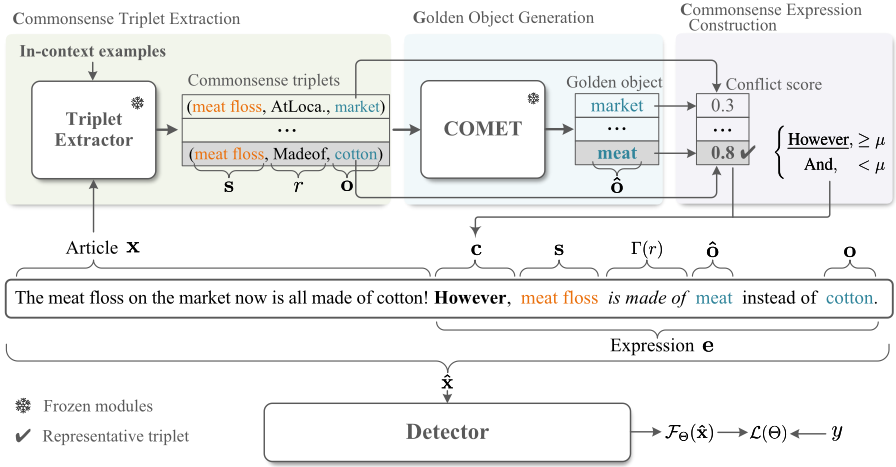
2.3 Commonsense Triplet Extraction
In this stage, for each article xi, we extract a certain number of relevant commonsense triplets {(sγi , rγ i , oγi )}|Ri| γ=1 . To achieve this, we first screen all relations of R to extract all corresponding triplets {(sγi , rγ i , oγi )}|R| γ=1 fromxi and then filter out the meaningless ones from them.
Specifically, we first extract {(sγi , rγ i , oγi )}|R| γ=1 by prompting an existing LLM with the In-Context Learning (ICL) method [Brown et al., 2020; Min et al., 2022]. We design natural language queries {T γ }|R| γ=1 for relations {rγ i }|R| γ=1 , e.g., "Extract entity1 and entity2 from the text where entity1 is made of entity2. Text:" for the relation MadeOf. Accordingly, the formulation of in-context examples {I γ k }Kk=1 for the relation rγ is delineated as:
We collect K labeled examples for each relation to facilitate ICL. Then, we input both in-context examples and query T γ ⊕xi into a triplet extractor GΦ(·) specified by a pre-trained T5 model [Raffel et al., 2020] to generate sγi and oγi :
Because an article does not always contain all relations of R, we filter out the meaningless ones. We design a filtering method based on the conditional generation logits. It follows the spirit that generative models always output lower probabilities for its generated uncertain word tokens, which can be evaluated by perplexity [Jurafsky, 2000;
Lee et al., 2021]. Specifically, we define the text generated by GΦ(·) in Eq. (4) as tγi = {tγi1 , tγi2 , · · · , tγiL}, where L indicates the length of the text. And we remove the triplet (sγi , rγ i , oγi ), if∑L
where ϵ is a controllable hyper-parameter. After filtering, the set of commonsense relations for xi is refined as Ri ∈ R.
2.4 Golden Object Generation
Given {(sγi , rγ i )}|Ri| γ=1 , we generate their golden objects {ˆoγi }|Ri| γ=1 , which are aligned with real-world commonsense knowledge. To be specific, we feed each (sγi , rγ i ) into the prevalent commonsense tool GΠ(·) [Bosselut et al., 2019] to generate its golden object ˆoγi as
We specially explain that because the prevalent commonsense reasoning tool has been pre-trained on a large-scale commonsense dataset ATOMIC20 20 , we treat ˆoγi as the ground-truth knowledge of (sγi , rγ i ), i.e., the corresponding golden object.
2.5 Commonsense Expression Construction
In this stage, we construct commonsense expression ei by filling the commonsense template in Sec. 2.2 based on {(sγi , rγ i , oγi )}|Ri| γ=1 and {ˆoγi }|Ri| γ=1 . Specifically, we first compute conflict scores {cγi }|Ri| γ=1 for each pair of oγi and ˆoγi . We
Algorithm 1 Training summary of MD-PCC.
Input: Training dataset D = {xi, yi}Ni=1; pre-trained language model GΦ(·); commonsense reasoning tool GΠ(·); commonsense relations R; query templates {T γ }|R| γ=1 . Output: detection model Fθ(·); expressions {ei}Ni=1.1: for i = 1, 2, · · · ,N do 2: Ci ← [ ], 3: for rγ i in R do 4: extract sγi and oγi with GΦ(·) in Eq. (4), 5: if Eq. (5) is not satisfied then 6: ̂oγi ← GΠ (sγi , rγ i ), 7: calculate cγi with Eq. (6), Ci ← cγi . 8: end if 9: end for 10: select {si, ri, oi} and ̂oi with max(Ci), 11: construct ei with Eq. (7). 12: end for 13: train Fθ(·) with L in Eq. (2).take inspiration from BARTSCORE [Yuan et al., 2021], and present a new evaluation metric to compute the commonsense conflict score cγi during the process that we input sγi and rγ i into the commonsense reasoning tool GΠ(·) with Eq. (5). The specific metric is as follows:
where L denotes the length of the generated ˆoγij .
Then, we select the highest conflict score ci from the set of {cγi }|Ri| γ=1 , and denote its corresponding representative commonsense triplet and golden object as {si, ri, oi} and ˆoi, respectively. Accordingly, we fill them into the commonsense template to obtain the expression as follows:
where Γ(·) is the original expression for each relation, e.g., "is made of " for the relation MadeOf. When ci ≥ µ, we argue that the article xi exists the commonsense conflict; otherwise, there is not. In summary, the training summary of MD-PCC is presented in Alg. 1.
3 Datasets
To evaluate the performance of MD-PCC, we conduct experiments by employing four public MD datasets GossipCop [Shu et al., 2020], Weibo [Sheng et al., 2022], PolitiFact [Shu et al., 2020] and Snopes [Popat et al., 2017]. Additionally, we also collect a new Chinese MD dataset, referred to as CoMis, wherein all fake articles can be verified by leveraging commonsense conflict. We describe their details in the following section. For clarity, their statistics are shown in Table 2.
3.1 Prevalent MDDatasets
We evaluate the method with the following four MD datasets:
| Dataset | # Train | # Val. | # Test | |||
|---|---|---|---|---|---|---|
| Fake | Real | Fake | Real | Fake | Real | |
| 2,561 | 7,660 | 499 | 1,918 | 754 | 2,957 | |
| GossipCop | 2,024 | 5,039 | 604 | 1,774 | 601 | 1,758 |
| PolitiFact | 1,224 | 1,344 | 170 | 186 | 307 | 337 |
| Snopes | 2,288 | 838 | 317 | 116 | 572 | 210 |
| CoMis | 560 | 440 | 170 | 125 | 162 | 123 |
- GossipCop and PolitiFact are English MD datasets sourced from FakeNewsNet [Shu et al., 2020]. We divide GossipCop based on [Zhu et al., 2022], which includes articles posted between 2000 and 2017 for training, with the test set consisting of articles from 2018. For PolitiFact, we adhere to its original dataset division.
- Weibo [Sheng et al., 2022] is sourced from a Chinese social media platform, and we split articles published from 2010 to 2017 allocated for training and those from 2018 used for testing.
- Snopes [Popat et al., 2017] is gathered from a wellknown fact-checking website snopes.com. We split the dataset according to its original paper.
3.2 Our Collected CoMis
We collect a new commonsense-oriented MD dataset CoMis with the effort of human annotators. Table 2 provides the statistics of our newly constructed dataset CoMis. The dataset contains a total of 1,580 pieces of data entries, covering diverse domains. The domain most extensively represented in the dataset pertains to food safety.
Data source. Our MD data is sourced from two distinct channels: pre-existing MD datasets and external websites.
First, we select suitable data items from pre-existing datasets dedicated to fake news and rumor detection, e.g., Weibo-16, Weibo-20, and Weibo-COVID19. Specifically, Weibo-16 [Ma et al., 2016] comprises posts spanning from December 2010 to April 2014, and many duplications are meticulously filtered by [Zhang et al., 2021]; Weibo-20 [Zhang et al., 2021] extends the temporal scope of Weibo-16, encompassing data from April 2014 to November 2018, and its labels are verified through NewsVerify 1 ; Weibo-COVID19 [Lin et al., 2022] is collected during the surge of the COVID19 pandemic, so all articles within this dataset are exclusively centered on COVID-19 topics.
To ensure completeness and timeliness, we also manually collect commonsense-oriented samples from two external websites. First, Food Rumor 2 is a Chinese rumor-refuting platform, which serves as a repository for misinformation and its corresponding verification, with a predominant focus on topics related to food safety, health science, and similar domains. Then, Science Facts 3 is another Chinese platform that specializes in disseminating science popularization content, covering subjects, e.g., food safety and biological science.
2 http://www.xinhuanet.com/food/sppy/
| Method | Macro F1 | Accuracy | Precision | Recall | F1real | F1fake | Avg.∆ |
|---|---|---|---|---|---|---|---|
| Dataset: Weibo | |||||||
| EANN [Wang et al., 2018] | 76.53±0.52 | 84.62±0.30 | 76.75±0.63 | 76.07±1.14 | 90.43±0.25 | 62.41±1.12 | - |
| + MD-PCC (ours) | 77.30±0.99∗ | 85.88±0.50∗ | 78.58±0.89∗ | 76.29±0.89 | 91.25±0.32∗ | 63.36±0.78∗ | +0.98 |
| BERT [Devlin et al., 2019] | 75.64±0.41 | 84.13±0.67 | 75.58±1.09 | 75.79±0.74 | 90.02±0.52 | 61.26±0.59 | - |
| + MD-PCC (ours) | 76.80±0.86∗ | 84.62±0.92 | 76.32±1.41∗ | 77.44±0.80∗ | 90.26±0.67 | 63.35±1.16∗ | +1.06 |
| BERT-EMO [Zhang et al., 2021] | 76.17±0.48 | 84.60±0.40 | 76.27±0.64 | 76.11±0.85 | 90.34±0.31 | 61.99±0.89 | - |
| + MD-PCC (ours) | 77.03±1.21∗ | 85.29±1.19∗ | 77.50±1.00∗ | 76.72±0.94∗ | 91.53±0.80∗ | 63.28±0.69∗ | +0.98 |
| CED [Wu et al., 2023] | 76.42±1.55 | 85.51±1.32 | 77.92±0.87 | 75.70±0.63 | 90.72±0.91 | 62.42±1.40 | - |
| + MD-PCC (ours) | 78.33±0.20∗ | 86.59±0.51∗ | 79.98±1.22∗ | 77.13±1.11∗ | 91.70±0.42∗ | 64.96±0.63∗ | +1.67 |
| DM-INTER [Wang et al., 2024a] | 76.29±0.42 | 84.59±0.33 | 76.23±0.51 | 76.39±0.87 | 90.31±0.27 | 62.26±0.84 | - |
| + MD-PCC (ours) | 77.59±0.23∗ | 85.80±0.72∗ | 78.43±0.77∗ | 77.32±0.74∗ | 91.15±0.58∗ | 64.13±0.64∗ | +1.39 |
| Dataset: GossipCop | |||||||
| EANN [Wang et al., 2018] | 78.59±0.84 | 84.47±0.66 | 80.37±1.46 | 77.42±1.36 | 89.80±0.55 | 67.39±1.59 | - |
| + MD-PCC (ours) | 79.80±0.47∗ | 85.08±0.35∗ | 80.82±0.86 | 79.02±1.05∗ | 90.12±0.32 | 69.48±0.99∗ | +1.05 |
| BERT [Devlin et al., 2019] | 78.23±0.45 | 83.78±0.80 | 79.00±1.45 | 77.49±0.57 | 89.21±0.69 | 67.24±0.45 | - |
| + MD-PCC (ours) | 79.10±0.46∗ | 84.61±0.56∗ | 80.32±1.10∗ | 78.24±0.47∗ | 89.85±0.45∗ | 68.37±0.60∗ | +0.92 |
| BERT-EMO [Zhang et al., 2021] | 78.42±0.47 | 83.92±0.39 | 79.15±0.73 | 77.10±1.01 | 89.67±0.59 | 67.23±1.03 | - |
| + MD-PCC (ours) | 79.32±0.27∗ | 84.68±0.66∗ | 80.28±1.38∗ | 78.63±0.67∗ | 90.03±0.36 | 68.81±0.31∗ | +1.04 |
| CED [Wu et al., 2023] | 78.33±0.40 | 83.77±0.68 | 78.85±1.26 | 77.94±0.25 | 89.17±0.57 | 67.49±0.25 | - |
| + MD-PCC (ours) | 79.79±0.52∗ | 85.52±0.31∗ | 82.04±0.67∗ | 78.23±0.84 | 90.54±0.22∗ | 69.04±0.96∗ | +1.60 |
| DM-INTER [Wang et al., 2024a] | 78.29±0.56 | 84.04±0.40 | 79.43±0.87 | 77.43±1.00 | 89.45±0.34 | 67.21±1.09 | - |
| + MD-PCC (ours) | 79.76±0.42∗ | 85.08±0.30∗ | 80.85±0.75∗ | 78.93±0.93∗ | 90.13±0.28∗ | 69.40±0.87∗ | +1.38 |
| Dataset: PolitiFact | |||||||
| BERT [Devlin et al., 2019] | 60.36±0.99 | 60.49±2.04 | 60.53±2.18 | 60.45±2.08 | 62.86±1.74 | 56.62±2.25 | - |
| + MD-PCC (ours) | 61.92±0.68∗ | 62.45±0.47∗ | 62.46±0.39∗ | 62.05±0.57∗ | 66.29±0.46∗ | 57.55±1.70∗ | +1.90 |
| CED [Wu et al., 2023] | 61.75±0.54 | 61.86±0.50 | 61.79±0.51 | 61.77±0.54 | 63.56±0.90 | 59.94±1.23 | - |
| + MD-PCC (ours) | 63.60±0.21∗ | 63.87±0.34∗ | 63.84±0.37∗ | 63.63±0.23∗ | 66.59±1.28∗ | 60.61±1.05∗ | +1.91 |
| DM-INTER [Wang et al., 2024a] | 60.85±1.96 | 61.23±1.77 | 61.23±1.71 | 60.97±1.81 | 64.15±1.56 | 57.54±1.57 | - |
| + MD-PCC (ours) | 63.13±1.58∗ | 63.37±1.51∗ | 63.29±1.51∗ | 63.14±1.55∗ | 66.08±1.28∗ | 60.17±1.17∗ | +2.20 |
| Dataset: Snopes | |||||||
| BERT [Devlin et al., 2019] | 62.74±0.78 | 72.15±1.74 | 64.36±2.03 | 62.14±0.70 | 43.56±1.71 | 81.91±1.58 | - |
| + MD-PCC (ours) | 64.69±1.36∗ | 73.42±1.89∗ | 65.99±1.50∗ | 64.14±1.20∗ | 47.19±1.48∗ | 82.19±1.43∗ | +1.79 |
| CED [Wu et al., 2023] | 63.60±1.15 | 72.39±0.93 | 64.34±0.79 | 63.29±1.51 | 45.74±1.93 | 81.44±1.06 | - |
| + MD-PCC (ours) | 66.41±1.32∗ | 74.82±0.77∗ | 67.46±1.02∗ | 65.79±1.49∗ | 49.61±1.58∗ | 83.21±0.63∗ | +2.75 |
| DM-INTER [Wang et al., 2024a] | 63.24±1.37 | 72.83±0.84 74.01±1.11∗ | 64.41±1.28 66.51±1.39∗ | 62.62±1.35 65.38±0.72∗ | 44.47±1.41 | 82.01±0.58 | - |
| + MD-PCC (ours) | 65.79±1.34∗ | 49.06±1.86∗ | 82.53±0.92 | +2.28 | |||
Annotation and post-process. The annotators are instructed to select and post-process the data items that can be verified using commonsense from the aforementioned data sources. For the data from pre-existing MD datasets, we preserve their veracity labels while systematically filtering any special symbols and website links from their content. For the data sourced from external websites, we collect fake claims in the rumor-refuting channels of these websites, and real claims from their science popularization channels. Meanwhile, we maintain a consistent average claim length of approximately 50, aligning with the standards set by existing datasets.
4 Experimental Results
In this section, we aim to empirically evaluate our proposed method MD-PCC, and answer the following questions:
- Q1: Can the proposedMD-PCC consistently improve the performance of misinformation detectors?
- Q2: Is MD-PCC sensitive to its hyper-parameters and primary components?
- Q3: Can the generated expression e expresses the commonsense conflict of the article?
4.1 Experimental Settings
Baselines. We evaluate our plug-and-play method MDPCC across five prevalent MD approaches, including EANN [Wang et al., 2018], BERT [Devlin et al., 2019], BERTEMO [Zhang et al., 2021], the SOTA MD model CED [Wu et al., 2023], and DM-INTER [Wang et al., 2024a].
Implementation Details. In our experiments, we employ pre-trained language models FlanT5Large 4 [Chung et al., 2024] and mT5Large 5 [Xue et al., 2021] to extract commonsense triplets for the English and Chinese MD datasets, respectively. To generate golden objects, we use COMETATOMIC20 20 6 [Hwang et al., 2021] for English datasets and comet-atomic-zh 7 for Chinese datasets Weibo and CoMis.
4 https://huggingface.co/google/flan-t5-large.
5 https://huggingface.co/google/mt5-large.
| Method | Macro F1 | Accuracy | Precision | Recall | F1real | F1fake | Avg.∆ |
|---|---|---|---|---|---|---|---|
| BERT [Devlin et al., 2019] | 88.70±0.53 | 89.02±0.56 | 88.90±0.69 | 88.54±0.42 | 88.22±0.67 | 90.60±0.55 | - |
| + MD-PCC (ours) | 91.55±0.36∗ | 91.71±0.35∗ | 91.42±0.33∗ | 91.78±0.48∗ | 90.37±0.47∗ | 92.72±0.34∗ | +2.60 |
| CED [Wu et al., 2023] | 89.22±1.09 | 89.58±1.00 | 89.82±0.88 | 88.88±1.27 | 87.31±1.45 | 91.12±0.77 | - |
| + MD-PCC (ours) | 91.69±1.11∗ | 91.86±1.12∗ | 91.61±1.25∗ | 91.87±0.93∗ | 90.51±1.16∗ | 92.78±1.07∗ | +2.40 |
| DM-INTER [Wang et al., 2024a] | 89.34±0.74 | 89.57±0.71 | 89.24±0.68 | 89.47±0.84 | 87.78±0.93 | 90.90±0.56 | - |
| + MD-PCC (ours) | 91.61±0.96∗ | 91.81±0.97∗ | 91.63±0.92∗ | 91.62±0.80∗ | 90.31±1.00∗ | 92.90±0.92∗ | +2.26 |
| Method | F1 | Acc. | Pre. | Rec. | F1real | F1fake |
|---|---|---|---|---|---|---|
| Dataset: Weibo | ||||||
| CED | 76.42 | 85.51 | 77.92 | 75.70 | 90.72 | 62.42 |
| +MD-PCC | 78.33 | 86.59 | 79.98 | 77.13 | 91.70 | 64.96 |
| w/o ICL | 76.43 | 84.84 | 76.87 | 76.39 | 90.49 | 62.38 |
| w/o c | 77.22 | 85.33 | 77.55 | 76.65 | 90.76 | 63.43 |
| w/o o | 77.45 | 85.56 | 77.87 | 77.69 | 91.00 | 64.14 |
| Dataset: GossipCop | ||||||
| CED | 78.33 | 83.77 | 78.85 | 77.94 | 89.17 | 67.49 |
| +MD-PCC | 79.79 | 85.52 | 82.04 | 78.23 | 90.54 | 69.04 |
| w/o ICL | 78.40 | 83.93 | 79.15 | 77.80 | 89.33 | 67.46 |
| w/o c | 78.90 | 84.85 | 81.01 | 77.41 | 90.10 | 67.69 |
| w/o o | 79.27 | 84.65 | 80.13 | 78.54 | 89.83 | 68.71 |
During the training stage, we use an Adam optimizer with a learning rate of 7 × 10⁻⁵ for the BERT model in baseline methods. For the other modules such as the linear classifier, we use a learning rate of 1×10⁻⁴ , and the batch size is consistently fixed to 64. We also fix some other manual parameters empirically, such as K, ϵ, and µ to 5, 0.8, and 0.6, respectively. To avoid overfitting of detectors, we adopt an early stop strategy. This means that the training stage will stop when no better Macro F1 value appears for 10 epochs.
4.2 Main Results (Q1)
To answer Q1, Tables 3 and 4 report the performance outcomes of our method MD-PCC on two benchmark datasets and our constructed dataset, respectively. To mitigate the influence of randomness, we repeat each experiment five times using five different seeds {1, 2, 3, 4, 5}. The standard deviations of the five replicates are also illustrated in Tables 3 and 4. Overall, our MD-PCC method, which functions as a plug-in approach, can significantly and consistently improve the performance of the baseline models across all evaluation metrics. For example, on the Weibo dataset, our MD-PCC improves the overall F1 and fake news F1 scores by 1.91 and 2.54, respectively, compared to the current state-of-the-art MD method CED. Additionally, on GossipCop, it achieves improvements of 1.46 and 3.19 in macro F1 and precision scores. When we compare different MD datasets, we observe that MD-PCC performs better on CoMis than on the other Chinese dataset Weibo across most evaluation metrics. Specifically, when compared to the BERT baseline, MD-PCC improves its macro F1 and precision scores by 1.16 and 0.74 on Weibo, while it shows more significant improvements of 2.85 and 2.52 on CoMis. These results highlight the effectiveness of MD-PCC in incorporating commonsense knowledge to enhance the detection of knowledge-rich misinformation.
6 https://github.com/allenai/comet-atomic-2020.
7 https://huggingface.co/svjack/comet-atomic-zh.
4.3 Ablative Study (Q2)
To investigate Q2, we implement ablative experiments to assess the effectiveness of key components in MD-PCC. Specifically, we conduct experiments on Weibo and GossipCop, and present three ablative versions of CED + MD-PCC as follows:
- MD-PCC w/o ICL: the version without ICL (K = 0) in the commonsense triplet extraction stage;
- MD-PCC w/o c: the version without conjunction words c, e.g., "However", in commonsense expressions;
- MD-PCC w/o o: the version without "instead of " ⊕ o in commonsense expressions.
The ablative results are presented in Table 5. Generally, each ablative version exhibits a decreasing trend compared to MD-PCC, illustrating the contribution of each component in our model. The overall performance ranking of these ablative versions is w/o o >w/o c >w/o ICL. This ordering indicates that: (1) the direct impact of commonsense triplet extraction on the model's performance is significant, and in-context learning consistently enhances the extraction; (2) conjunction words c is more important than o in commonsense expressions. This is because misinformation detectors can effectively learn the pattern between conjunctions and veracity labels, e.g., the pattern between "However" and Fake.
4.4 Case Study (Q3)
The goal of MD-PCC is to construct commonsense expressions that express the potential commonsense conflict. Therefore, we provide some representative cases in Table ?? to evaluate the generated expressions. Specifically, we select two cases from CoMis and translate them into English versions. We observe that (1) MD-PCC extracts commonsense triples accurately, even from relatively complex articles, e.g., the second case; (2) MD-PCC can assign a higher conflict Article: Meat floss is made of cotton. This was discovered by my niece's mother-in-law. Moms, please pay attention. Expression: However, meat floss is made of meatloaf instead of cotton.
| relation r | subject s | object o | gold object ̂o | conflict score c |
|---|---|---|---|---|
| ➊ MadeOf | meat floss | cotton | meatloaf | 0.853 |
| ➋ IsA / HasA | meat floss | cotton | crewmeat / eat meat | 0.728 / 0.835 |
| ➌ AtLocation | meat floss and cotton | - | - | - |
| Article: Everyone has been recommended "anti-blue light glasses" when they go shopping for glasses. Whether they are buying for themselves, these glasses seem to have become a must-have.Wearing it is good for your eyes and can even prevent myopia. Expression: However, anti-blue light glasses show the effect on getting rid of blue light instead of preventing myopia. | |||||
| relation r | subject s | object o | gold object ̂o | conflict score c | |
|---|---|---|---|---|---|
| ➊ | isA | anti-blue light glasses | glasses | protective eyeglasses | 0.313 |
| ➋ | xEffect | anti-blue light glasses | prevent myopia | get rid of blue light | 0.665 |
| ➌ | HinderedBy | PersonX has anti-blue light glasses | - | - | - |
score to the triplet that does exist the commonsense conflict; (3) our presented filtering method in Sec. 2.3 can indeed filter out commonsense relations that do not exist in the article, e.g., AtLocation in the first case.
5 RelatedWorks
In this section, we briefly review the related literature about misinformation detection and commonsense reasoning.
5.1 Misinformation Detection
Misinformation, e.g., fake news and rumors, has had a detrimental impact on society [Vosoughi et al., 2018; Zhang et al., 2023]. As a result, it has become increasingly important to identify and detect misinformation, which is referred to as misinformation detection. Specifically, most cuttingedge MD techniques focus on detecting misinformation based on its textual and multimodal content [Ying et al., 2023; Wang et al., 2024b], using advanced deep learning models [Ma et al., 2016; Shu et al., 2020; Wang et al., 2024c; Xiao et al., 2024]. These models often incorporate external features like knowledge bases [Dun et al., 2021], emotional signals [Zhang et al., 2021; Jiang et al., 2024], and user feedback [Ma et al., 2016; Lin et al., 2023]. Meanwhile, some recent works have also explored strategies to leverage pre-trained large models for MD [Hu et al., 2024; Chen and Shu, 2024; Nan et al., 2024; Wan et al., 2024].
In this study, we integrate commonsense knowledge into MD models. Prior to our work, certain research efforts have aimed to leverage knowledge graphs for the enhancement of MD models. These endeavors have primarily involved learning knowledge embeddings [Dun et al., 2021; Sun et al., 2022] or retrieving entity descriptions [Hu et al., 2021; Jiang et al., 2022]. In contrast to these approaches, our incorporation of commonsense knowledge aligns more closely with human reasoning and reactions. Meanwhile, we employ generative models for data augmentation explicitly, which obviates the need for extensive retrieval from large knowledge bases and reduces computational complexity.
5.2 Commonsense Bases and Reasoning
Commonsense knowledge bases, such as ConceptNet [Speer et al., 2017], ATOMIC20 20 [Hwang et al., 2021], offer a valuable resource for direct reasoning with commonsense knowledge and have found applications in various academic topics, e.g., machine translation [Liu et al., 2023], question answering [Wang et al., 2023; Chen et al., 2023] and sarcasm detection [Min et al., 2023]. Recently, especially within the context of Large Language Models (LLMs), the utilization of commonsense reasoning with LLMs has garnered significant attention [Liu et al., 2023; Shen, 2024; Wang et al., 2024d]. These works frequently treat commonsense knowledge as supplementary information or assess the presence of commonsense knowledge within LLMs.
6 Conclusion
In this paper, we aim to enhance MD models by uncovering commonsense conflicts. To achieve this goal, we propose a novel MD method named MD-PCC, designed to generate commonsense expressions for each article, explicitly expressing commonsense conflict existing inherent in articles, and leverage it to augment original articles. Specifically, the expression is constructed through a commonsense triplet extracted from the original article, the corresponding golden object, and a conjunction word. To obtain these components, we first prompt the pre-trained language model with in-context examples to extract triplets and filter out irrelevant triplets. Then, the commonsense tool is employed to generate their corresponding golden objects. Finally, a new metric is designed to measure the commonsense conflict, and the conjunction word is determined using this metric. Additionally, we also collect a new commonsense-oriented MD dataset, and extensive experimental results on the datasets are conducted and prove the effectiveness of our proposed MD-PCC.
Acknowledgements
We acknowledge support for this project from the National Key R&D Program of China (No.2021ZD0112501, No.2021ZD0112502), the National Natural Science Foundation of China (No.62276113), China Postdoctoral Science Foundation (No.2022M721321).
@inproceedings{ijcai2025p863,
  title     = {Robust Misinformation Detection by Visiting Potential Commonsense Conflict},
  author    = {Wang, Bing and Li, Ximing and Li, Changchun and Zhao, Bingrui and Fu, Bo and Guan, Renchu and Wang, Shengsheng},
  booktitle = {Proceedings of the Thirty-Fourth International Joint Conference on
               Artificial Intelligence, {IJCAI-25}},
  publisher = {International Joint Conferences on Artificial Intelligence Organization},
  editor    = {James Kwok},
  pages     = {7760--7768},
  year      = {2025},
  month     = {8},
  note      = {Main Track},
  doi       = {10.24963/ijcai.2025/863},
  url       = {https://doi.org/10.24963/ijcai.2025/863},
}
TY - CPAPER TI - Robust Misinformation Detection by Visiting Potential Commonsense Conflict AU - Wang, Bing AU - Li, Ximing AU - Li, Changchun AU - Zhao, Bingrui AU - Fu, Bo AU - Guan, Renchu AU - Wang, Shengsheng T2 - Proceedings of the Thirty-Fourth International Joint Conference on Artificial Intelligence, IJCAI-25 PB - International Joint Conferences on Artificial Intelligence Organization PY - 2025 SP - 7760 EP - 7768 DO - 10.24963/ijcai.2025/863 UR - https://doi.org/10.24963/ijcai.2025/863 ER -Copied
Machine-readable versions of this paper, for tools and AI agents:





