
Progressive Reasoning with Primitive Correction for Compositional Zero-Shot Learning
Proceedings of the Thirty-Fifth International Joint Conference on Artificial Intelligence. Main Track. Pages 1025-1033.
https://doi.org/10.24963/ijcai.2026/115
Keywords
- Computer Vision: Transfer, low-shot, semi- and un- supervised learning
- Computer Vision: Recognition (object detection, categorization)
Abstract
Compositional Zero-Shot Learning (CZSL) aims to combine known attributes and objects as primitives for recognizing previously unseen attribute-object pairs. Prior works either predict attributes and objects independently, missing their strong contextual dependency, or use unidirectional conditional modeling (e.g., object-guided attribute prediction), which is prone to error propagation. We propose PRPC, a Progressive Reasoning framework with Primitive Correction, which explicitly models the bidirectional dependency between attributes and objects via step-wise inference. PRPC performs mutual correction of primitives to suppress prediction errors in earlier steps. Specifically, we formulate CZSL as structured, Q&A-style Chain-of-Thought reasoning process and constrain the MLLM to follow predefined semantic steps to generate intermediate decisions. To further enhance the reliability and logical consistency of intermediate reasoning, we introduce reinforcement learning post-training with a GRPO-based objective, providing step-level rewards aligned with the progressive inference procedure. Extensive experiments on three CZSL benchmarks demonstrate that PRPC achieves state-of-the-art performance, validating the effectiveness of progressive reasoning and bidirectional correction for robust compositional generalization.
- [Bai et al., 2025] Shuai Bai, Keqin Chen, Xuejing Liu, Jialin Wang, Wenbin Ge, Sibo Song, Kai Dang, Peng Wang, Shi- jie Wang, Jun Tang, et al. Qwen2.5-vl technical report. arXiv preprint arXiv:2502.13923, 2025.
- [Bao et al., 2024] Wentao Bao, Lichang Chen, Heng Huang, and Yu Kong. Prompting language-informed distribution for compositional zero-shot learning. In ECCV, pages 107-123. Springer, 2024.
- [Chang et al., 2022] Zhi Chang, Dexin Zhao, Huilin Chen, Jingdan Li, and Pengfei Liu. Event-centric multi-modal fusion method for dense video captioning. Neural Net- works, 146:120-129, 2022.
- [Chen et al., 2024] Zhe Chen, Weiyun Wang, Yue Cao, Yangzhou Liu, Zhangwei Gao, Erfei Cui, Jinguo Zhu, Shenglong Ye, Hao Tian, Zhaoyang Liu, et al. Expanding performance boundaries of open-source multimodal mod- els with model, data, and test-time scaling. arXiv preprint arXiv:2412.05271, 2024.
- [Christiano et al., 2017] Paul F Christiano, Jan Leike, Tom Brown, Miljan Martic, Shane Legg, and Dario Amodei. Deep reinforcement learning from human preferences. NeurIPS, 30, 2017.
- [Dai et al., 2023] Wenliang Dai, Junnan Li, Dongxu Li, An- thony Tiong, Junqi Zhao, Weisheng Wang, Boyang Li, Pascale N Fung, and Steven Hoi. Instructblip: Towards general-purpose vision-language models with instruction tuning. NeurIPS, 36:49250-49267, 2023.
- [Deitke et al., 2024] Matt Deitke, Christopher Clark, Sangho Lee, Rohun Tripathi, Yue Yang, Jae Sung Park, Moham- madreza Salehi, Niklas Muennighoff, Kyle Lo, Luca Sol- daini, et al. Molmo and pixmo: Open weights and open data for state-of-the-art multimodal models. arXiv e- prints, pages arXiv-2409, 2024.
- [Guo et al., 2025] Daya Guo, Dejian Yang, Haowei Zhang, Junxiao Song, Ruoyu Zhang, Runxin Xu, Qihao Zhu, Shi- rong Ma, Peiyi Wang, Xiao Bi, et al. Deepseek-r1: In- centivizing reasoning capability in llms via reinforcement learning. arXiv preprint arXiv:2501.12948, 2025.
- [Gupta and Kembhavi, 2023] Tanmay Gupta and Aniruddha Kembhavi. Visual programming: Compositional visual reasoning without training. In CVPR, pages 14953-14962, 2023.
- [Hao et al., 2023] Shaozhe Hao, Kai Han, and Kwan-Yee K Wong. Learning attention as disentangler for composi- tional zero-shot learning. In CVPR, pages 15315-15324, 2023.
- [Huang et al., 2024] Siteng Huang, Biao Gong, Yutong Feng, Min Zhang, Yiliang Lv, and Donglin Wang. Troika: Multi-path cross-modal traction for compositional zero- shot learning. In CVPR, pages 24005-24014, 2024.
- [Hudson and Manning, 2019] Drew A Hudson and Christo- pher D Manning. Gqa: A new dataset for real-world vi- sual reasoning and compositional question answering. In CVPR, pages 6700-6709, 2019.
- [Hurst et al., 2024] Aaron Hurst, Adam Lerer, Adam P Goucher, Adam Perelman, Aditya Ramesh, Aidan Clark, AJ Ostrow, Akila Welihinda, Alan Hayes, Alec Rad- ford, et al. Gpt-4o system card. arXiv preprint arXiv:2410.21276, 2024.
- [Isola et al., 2015] Phillip Isola, Joseph J Lim, and Edward H Adelson. Discovering states and transformations in image collections. In CVPR, pages 1383-1391, 2015.
- [Kamath et al., 2021] Aishwarya Kamath, Mannat Singh, Yann LeCun, Gabriel Synnaeve, Ishan Misra, and Nicolas Carion. Mdetr-modulated detection for end-to-end multi- modal understanding. In ICCV, pages 1780-1790, 2021.
- [Kim et al., 2023] Hanjae Kim, Jiyoung Lee, Seongheon Park, and Kwanghoon Sohn. Hierarchical visual primi- tive experts for compositional zero-shot learning. In ICCV, pages 5675-5685, 2023.
- [Li et al., 2022a] Junnan Li, Dongxu Li, Caiming Xiong, and Steven Hoi. Blip: Bootstrapping language-image pre-training for unified vision-language understanding and generation. In ICML, pages 12888-12900, 2022.
- [Li et al., 2022b] Liunian Harold Li, Pengchuan Zhang, Haotian Zhang, Jianwei Yang, Chunyuan Li, Yiwu Zhong, Lijuan Wang, Lu Yuan, Lei Zhang, Jenq-Neng Hwang, et al. Grounded language-image pre-training. In CVPR, pages 10965-10975, 2022.
- [Li et al., 2022c] Xiangyu Li, Xu Yang, Kun Wei, Cheng Deng, and Muli Yang. Siamese contrastive embedding network for compositional zero-shot learning. In CVPR, pages 9326-9335, 2022.
- [Liu et al., 2023] Haotian Liu, Chunyuan Li, Qingyang Wu, and Yong Jae Lee. Visual instruction tuning. NeurIPS, 36:34892-34916, 2023.
- [Liu et al., 2024] Haotian Liu, Chunyuan Li, Yuheng Li, Bo Li, Yuanhan Zhang, Sheng Shen, and Yong Jae Lee. Llavanext: Improved reasoning, ocr, and world knowl- edge, 2024.
- [Misra et al., 2017] Ishan Misra, Abhinav Gupta, and Mar- tial Hebert. From red wine to red tomato: Composition with context. In CVPR, pages 1792-1801, 2017.
- [Naeem et al., 2021] Muhammad Ferjad Naeem, Yongqin Xian, Federico Tombari, and Zeynep Akata. Learning graph embeddings for compositional zero-shot learning. In CVPR, pages 953-962, 2021.
- [Nagarajan and Grauman, 2018] Tushar Nagarajan and Kris- ten Grauman. Attributes as operators: factorizing unseen attribute-object compositions. In ECCV, pages 169-185, 2018.
- [Nayak et al., 2023] Nihal V Nayak, Peilin Yu, and Stephen Bach. Learning to compose soft prompts for composi- tional zero-shot learning. In ICLR, 2023.
- [Ouyang et al., 2022] Long Ouyang, Jeffrey Wu, Xu Jiang, Diogo Almeida, Carroll Wainwright, Pamela Mishkin, Chong Zhang, Sandhini Agarwal, Katarina Slama, Alex Ray, et al. Training language models to follow instruc- tions with human feedback. NeurIPS, 35:27730-27744, 2022.
- [Pham et al., 2021] Khoi Pham, Kushal Kafle, Zhe Lin, Zhi- hong Ding, Scott Cohen, Quan Tran, and Abhinav Shri- vastava. Learning to predict visual attributes in the wild. In CVPR, pages 13018-13028, 2021.
- [Pratt et al., 2023] Sarah Pratt, Ian Covert, Rosanne Liu, and Ali Farhadi. What does a platypus look like? generating customized prompts for zero-shot image classification. In ICCV, pages 15691-15701, 2023.
- [Purushwalkam et al., 2019] Senthil Purushwalkam, Maxi- milian Nickel, Abhinav Gupta, and Marc'Aurelio Ranzato. Task-driven modular networks for zero-shot compositional learning. In ICCV, pages 3593-3602, 2019.
- [Qu et al., 2025] Hongyu Qu, Jianan Wei, Xiangbo Shu, and Wenguan Wang. Learning clustering-based prototypes for compositional zero-shot learning. In ICLR, 2025.
- [Radford et al., 2021] Alec Radford, Jong Wook Kim, Chris Hallacy, Aditya Ramesh, Gabriel Goh, Sandhini Agar- wal, Girish Sastry, Amanda Askell, Pamela Mishkin, Jack Clark, et al. Learning transferable visual models from nat- ural language supervision. In ICML, pages 8748-8763, 2021.
- [Ruis et al., 2021] Frank Ruis, Gertjan Burghouts, and Doina Bucur. Independent prototype propagation for zero- shot compositionality. NeurIPS, 34:10641-10653, 2021.
- [Saini et al., 2022] Nirat Saini, Khoi Pham, and Abhinav Shrivastava. Disentangling visual embeddings for at- tributes and objects. In CVPR, pages 13658-13667, 2022.
- [Saini et al., 2024] Nirat Saini, Khoi Pham, and Abhinav Shrivastava. Beyond seen primitive concepts and attribute- object compositional learning. In CVPR, pages 14466- 14476, 2024.
- [Sun et al., 2024] Zhiqing Sun, Sheng Shen, Shengcao Cao, Haotian Liu, Chunyuan Li, Yikang Shen, Chuang Gan, Liangyan Gui, Yu-Xiong Wang, Yiming Yang, et al. Aligning large multimodal models with factually aug- mented rlhf. In ACL, pages 13088-13110, 2024.
- [Surís et al., 2023] Dídac Surís, Sachit Menon, and Carl Vondrick. Vipergpt: Visual inference via python execu- tion for reasoning. In ICCV, pages 11888-11898, 2023.
- [Wang et al., 2023a] Henan Wang, Muli Yang, Kun Wei, and Cheng Deng. Hierarchical prompt learning for composi- tional zero-shot recognition. In IJCAI, volume 1, page 3, 2023.
- [Wang et al., 2023b] Qingsheng Wang, Lingqiao Liu, Chenchen Jing, Hao Chen, Guoqiang Liang, Peng Wang, and Chunhua Shen. Learning conditional attributes for compositional zero-shot learning. In CVPR, pages 11197-11206, 2023.
- [Wei et al., 2022] Jason Wei, Xuezhi Wang, Dale Schuur- mans, Maarten Bosma, Fei Xia, Ed Chi, Quoc V Le, Denny Zhou, et al. Chain-of-thought prompting elicits reasoning in large language models. NeurIPS, 35:24824- 24837, 2022.
- [Wu et al., 2024] Zhiyu Wu, Xiaokang Chen, Zizheng Pan, Xingchao Liu, Wen Liu, Damai Dai, Huazuo Gao, Yiyang Ma, Chengyue Wu, Bingxuan Wang, et al. Deepseek-vl2: Mixture-of-experts vision-language mod- els for advanced multimodal understanding. arXiv preprint arXiv:2412.10302, 2024.
- [Xu et al., 2021] Ziwei Xu, Guangzhi Wang, Yongkang Wong, and Mohan S Kankanhalli. Relation-aware compo- sitional zero-shot learning for attribute-object pair recog- nition. IEEE TMM, 24:3652-3664, 2021.
- [Yan et al., 2024] Siming Yan, Min Bai, Weifeng Chen, Xiong Zhou, Qixing Huang, and Li Erran Li. Vigor: Im- proving visual grounding of large vision language models with fine-grained reward modeling. In ECCV, pages 37- 53. Springer, 2024.
- [Yao et al., 2023] Shunyu Yao, Dian Yu, Jeffrey Zhao, Izhak Shafran, Tom Griffiths, Yuan Cao, and Karthik Narasimhan. Tree of thoughts: Deliberate problem solving with large language models. NeurIPS, 36:11809-11822, 2023.
- [Yu et al., 2024] Tianyu Yu, Yuan Yao, Haoye Zhang, Tai- wen He, Yifeng Han, Ganqu Cui, Jinyi Hu, Zhiyuan Liu, Hai-Tao Zheng, Maosong Sun, et al. Rlhf-v: To- wards trustworthy mllms via behavior alignment from fine-grained correctional human feedback. In CVPR, pages 13807-13816, 2024.
- [Zhou et al., 2023] Denny Zhou, Nathanael Schärli, Le Hou, Jason Wei, Nathan Scales, Xuezhi Wang, Dale Schuur- mans, Claire Cui, Olivier Bousquet, Quoc V Le, et al. Least-to-most prompting enables complex reasoning in large language models. In ICLR, 2023.
- [Zhou et al., 2025] Dongming Zhou, Jinsheng Deng, Zheng- bin Pang, and Wei Li. Diccr: Double-gated intervention and confounder causal reasoning for vision-language nav- igation. Neural Networks, 184:107078, 2025.
- [Zhu et al., 2023] Deyao Zhu, Jun Chen, Xiaoqian Shen, Xi- ang Li, and Mohamed Elhoseiny. Minigpt-4: Enhancing vision-language understanding with advanced large lan- guage models. arXiv preprint arXiv:2304.10592, 2023.
References were extracted automatically from the PDF and may contain errors.
Full text extracted automatically from the PDF; figures, tables and equations may differ. The PDF is the version of record.
1 Introduction
Humans naturally have the ability to generalize different learned concepts (e.g., objects and attributes), to form new compositions. For example, with images of 'yellow bird' and 'red flower' in mind, when an unseen image of 'yellow flower' emerges, humans can effortlessly comprehend such a new composite concept. Similarly, in language-based computer vision tasks (e.g., image or video captioning [Chang et al., 2022] and navigation [Zhou et al., 2025]) with insufficient training samples, recognizing novel composite concepts is crucial for visual understanding. Considering this, compositional zero-shot learning (CZSL), aiming to classify images into previously unseen attribute-object pair labels by learning primitives (i.e., attributes or objects) from images with known pair labels, has gained increasing attention.
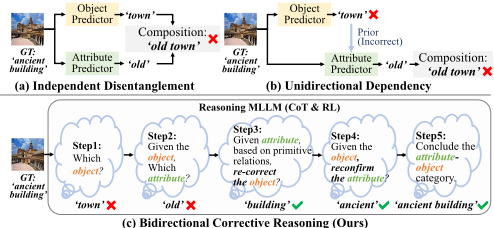
Early approaches typically treat primitive recognition as two independent tasks [Hao et al., 2023; Nayak et al., 2023]. By disentangling features into parallel predictors, these methods learn to identify attributes and objects separately. While effective for understanding primitives in unseen samples, this paradigm often overlooks the intrinsic interaction between attributes and objects, which is commonly referred to as contextuality, as shown in Figure 1 (a). The visual representation of an attribute is strongly correlated with its paired object; for instance, a 'wet' road looks significantly different from a 'wet' cat. Neglecting these correlations fundamentally limits generalization performance across varying contexts.
To address this, recent methods [Wang et al., 2023b; Kim et al., 2023] have moved beyond pure disentanglement by introducing conditional dependencies, typically using object predictions as priors to guide attribute estimation, as illustrated in Figure 1 (b). While this progressive strategy models primitive relations, it suffers from a critical drawback: error propagation. In a unidirectional pipeline, an incorrect object prediction inevitably misleads the subsequent attribute inference, degrading overall accuracy.
In this paper, we propose a Progressive Reasoning framework with Primitive Correction, termed PRPC, which explicitly models stepwise dependencies between objects and attributes for compositional zero-shot learning. Motivated by the mutually constraining nature of objects and attributes, we move beyond treating object recognition as a one-way prior for attribute inference. Instead, we design a bidirectional corrective reasoning mechanism in which attribute reasoning actively refines object recognition, allowing attribute and object predictions to be updated through iterative verification. Specifically, we formulate CZSL as a structured multi-step decision process: (1) predict which object is present; (2) given the object, predict which attribute applies; (3) given the attribute, verify and correct the object by grounding the decision in token-level visual information; (4) given the updated object, verify and correct the attribute; and (5) output the final attribute-object category. The object-attribute refinement steps (i.e., Steps 3-4) form a mutual verification and correction loop, which alternates between attribute and object reasoning, mitigates error propagation from earlier decisions, and progressively improves compositional consistency.
Inspired by the strong, structured reasoning behavior of Chain-of-Thought (CoT) prompting [Wei et al., 2022], we implement the above procedure in a Q&A-style format and constrain a reasoning-capable MLLM (e.g., Qwen-VL [Bai et al., 2025]) to produce structured intermediate decisions that follow these predefined semantic steps. Furthermore, we introduce an RL-based post-training objective based on the GRPO loss [Guo et al., 2025], providing step-level rewards to encourage faithful and logically consistent intermediate decisions throughout the verification loop.
Our main contributions are summarized below:
- We propose PRPC, a novel framework that transcends independent primitive prediction by introducing explicit progressive reasoning. We are the first to systematically introduce the reasoning paradigm with CoT to CZSL and build an MLLM-based benchmarking framework.
- We design a bidirectional corrective reasoning mechanism that utilizes attribute cues to refine object recognition, effectively mitigating the error accumulation inherent in unidirectional pipelines. Additionally, we integrate CoT constraints with GRPO-based reinforcement learning to enhance the reliability of intermediate reasoning steps.
- Extensive experiments on three benchmark datasets demonstrate that PRPC achieves state-of-the-art performance, validating the effectiveness of our progressive reasoning strategy.
2 RelatedWorks
2.1 Compositional Zero-Shot Learning (CZSL)
Compositional Zero-Shot Learning (CZSL) is a specialized branch of ZSL that classifies novel attribute-object pairs by learning primitives from seen pairs. Existing methods mainly differ in how explicitly they disentangle these primitives.
Early CZSL approaches do not explicitly disentangle primitives, treating each attribute-object pair as a holistic concept and learning joint embeddings between images and compositional label [Misra et al., 2017; Purushwalkam et al., 2019]. They perform well on seen pairs but often overfit training cooccurrences, limiting generalization to unseen compositions.
To improve compositionality, later work introduces disentanglement. Textual disentanglement exploits the attribute-object separability in language, learning contextualized composition representations from primitive embeddings [Nagarajan and Grauman, 2018; Xu et al., 2021] or retaining primitive semantics alongside composition features [Wang et al., 2023a], but text alone cannot capture object-dependent visual variations of attributes. Visual feature disentanglement separates attribute- and object-related cues in image features via augmentation [Li et al., 2022c; Kim et al., 2023], prototype anchors [Ruis et al., 2021; Qu et al., 2025], or auxiliary objectives encouraging consistency [Hao et al., 2023; Saini et al., 2024]. Recently, cross-modal disentanglement adapts CLIP [Radford et al., 2021] (e.g., prompting or encoder modifications) to align and disentangle primitives across vision and language, achieving strong results in open-world CZSL [Nayak et al., 2023; Huang et al., 2024; Bao et al., 2024].
Different from methods with independent primitive prediction or one-way conditioning, we formulate recognition as progressive bidirectional reasoning between attributes and objects, enabling mutual correction and stronger compositional generalization.
2.2 MLLMFine-Tuning and RL Post-Training
Recent advances in Multimodal Large Language Models (MLLMs) largely come from supervised fine-tuning and reinforcement learning-based post-training. Fine-tuning typically adapts pretrained multimodal backbones to downstream tasks by aligning visual and textual representations with taskspecific annotations. Common strategies include instruction tuning on image-text pairs [Liu et al., 2023; Zhu et al., 2023], region-level supervision [Kamath et al., 2021; Li et al., 2022b], and cross-modal contrastive objectives [Li et al., 2022a], which improve multimodal grounding, reasoning consistency, and task generalization.
Reinforcement learning post-training has emerged as a complementary paradigm that further refines model behavior beyond supervised signals. By optimizing task-level or preference-based rewards, RL post-training enables models to better follow complex instructions. In multimodal scenarios, rewards can be defined over textual outputs [Christiano et al., 2017; Ouyang et al., 2022], visual grounding quality [Yu et al., 2024; Yan et al., 2024], or cross-modal consistency [Sun et al., 2024]. By directly optimizing task-level rewards, RL post-training complements fine-tuning and enhances robustness and controllability.
2.3 Chain-of-Thought (CoT) in Visual Reasoning
Chain-of-Thought (CoT) prompting improves multi-step reasoning in large language models by eliciting intermediate inference steps, boosting performance on arithmetic, symbolic, and commonsense reasoning tasks [Zhou et al., 2023]. Follow-up work shows that simple decoding strategies, such as self-consistency, can further strengthen CoT
GT
CoT:
Output
CoT:
Input:
System
Prompt
Question
Prompt
<think> …
</think>
<answer>
Per Token CE Loss
<think>
…
</think>
Bidirectional Corrective Reasoning
<answer>
…
…
</answer>
</answer>
Qwen 3.0-VL
System
Prompt Question Prompt
Please analyze the image and determine its main attribute-object composition.
Follow the reasoning format required inside <think>...</think> and output the
final answer inside <answer>...</answer>.
You MUST follow exactly 5 steps in the reasoning: Step1: Identify the main
object in the image. Step2: Identify the attribute that the given object exhibits.
Step3: Based on the prior relations between attributes and objects, re-correct
which object the given attribute describes. Step4: Reconfirm the attribute that
the given object exhibits. Step5: Conclude the attribute-object category.
(a) Stage I: Supervised Fine-tuning
reliability [Yao et al., 2023]. More recently, CoT-style reasoning has been extended to vision-language settings, where models generate stepwise explanations that are encouraged to align with visual evidence (e.g., objects, attributes, and relations), improving interpretability and robustness on multimodal reasoning benchmarks [Liu et al., 2023; Dai et al., 2023]. Several approaches also combine CoT with tool- or program-based visual reasoning or instructiontuned multimodal LLMs to enable more controllable, compositional grounding [Sur´ıs et al., 2023; Gupta and Kembhavi, 2023].
3 Our Approach
3.1 ProblemFormulation
Let A = {a1, a2, . . . , a|A|} be an attribute set, O = {o1, o2, . . . , o|O|} be an object set, and C = A × O be the composition set, defined as C = {(a, o) | a ∈ A, o ∈ O}. The composition set C is divided into two disjoint subsets: the seen composition set Cs and the unseen composition set Cu, where Cs ∩ Cu = ∅. The dataset is split into a seen set Ts = {(x, c) | x ∈ I, c ∈ Cs} and an unseen set Tu.
Traditional approaches seek a mapping function f : I → C that directly outputs the highest-scoring pair. Here, we treat CZSL as a reasoning paradigm. We cannot include a candidate label set in the MLLM prompt for two reasons. First, it dilutes contextual attention. Many short labels are highly similar at the token level, so the MLLM does not compare them one by one but relies on coarse semantic information. Second, MLLMs are generative models designed to produce the most likely outputs, and thus cannot function as closed-set classifiers like CLIP-style VLMs.
We therefore formulate MLLM-based generative approaches to predicting compositional labels as open-form compositional prediction. This learning setting is substantially more challenging than the standard CZSL paradigm.
3.2 Framework Overview
We propose a new CZSL framework named PRPC, as shown in Figure 2, which introduces explicit progressive reasoning to model relations between primitives. Motivated by the strong reasoning ability of Chain-of-Thought (CoT), we cast CZSL as a structured, Q&A-style reasoning procedure. Concretely, we guide a reasoning-capable MLLM (e.g., QwenVL [Bai et al., 2025]) to follow a predefined chain of semantically grounded steps. During training, the model outputs in the CoT format, which includes multi-step thinking <think> . . . </think> and the final composition label inside <answer> . . . </answer>. For each input instance x (e.g., image + question), the policy generates a sequence y which can be formulated as:
where ythink is enclosed by <think> . . . </think> and yans is enclosed by <answer> . . . </answer>.
We design a bidirectional corrective reasoning mechanism that leverages attribute cues to refine object recognition, enabling our model to accurately capture the interactions between primitives and effectively mitigating the error accumulation inherent in one-way pipelines.
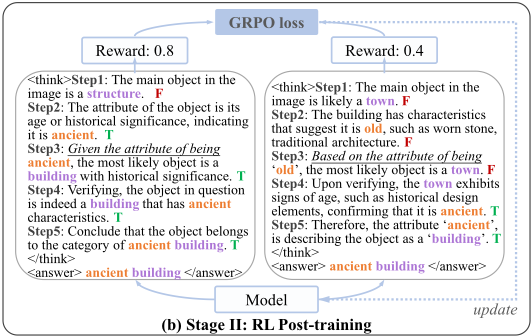
Specifically, training PRPC consists of two stages. Stage I (SFT): Given an image and its ground-truth composition, we generate stepwise CoT targets to supervise the baseline model to follow a template and perform coherent multi-step reasoning. Stage II (RL): We further fine-tune the baseline with a GRPO loss, evaluating each step in the progressive CoT via exact matching and assigning corresponding rewards.
3.3 Bidirectional Corrective Reasoning
We disentangle compositional concept recognition into distinct object and attribute predictions across five explicitly defined reasoning steps. Since objects typically dominate visual representations [Wang et al., 2023b], Step1 queries the model for the object category first. Step2 follows a strategy similar to prior CZSL works, where the predicted object serves as a prior for attribute inference.
We subsequently introduce a bidirectional correction mechanism to prevent initial object misclassification from compromising the final result. Step3 infers the object conditioned on the attribute, while Step4 reconfirms the attribute for verification. Attributes and objects in compositional learning exhibit strong co-occurrence and feasibility constraints. Inferring the object from the attribute eliminates implausible candidates and addresses common confusion among visually similar objects. The attribute thus functions as a disambiguation cue to validate the initial object prediction and mitigate error propagation.
Finally, an example of our model's output is as follows: <think> Step1: The main object in the image is a building.
Step2: The attribute of this object is its age or historical significance, as the label specifies it is 'ancient'.
Step3: Based on the attribute of being ancient, the most likely object is a building that has been preserved for its historical and cultural value, such as a monument, temple, or fortress.
Step4: Ancient buildings typically have specific architectural styles, materials, or decay that align with historical periods, confirming this building has the attribute 'ancient'.
Step5: Conclude that the object with the given attribute is an ancient building.
</think><answer>ancient building</answer>
3.4 Generated CoT Supervision
Standard training annotations provide only the correct composition c, while the full CoT trace sentences are not uniquely determined. High-quality supervision is essential for inducing explicit reasoning capabilities in the model.
To this end, we employ GPT-4o [Hurst et al., 2024] to generate structured reasoning traces that align with our CoT formulation, enabling stepwise supervision of the reasoning process. We impose structural constraints on the LLM-generated content primarily to mitigate the training and evaluation instability caused by open-form generation. By standardizing each step into fixed fields, we ensure that the parsing modules can reliably extract the target strings for primitive prediction.
For each training sample, we provide GPT-4o with the image and the ground-truth label c, instructing it to produce a fluent five-step reasoning trace ythink∗ . Notably, we use parsing functions to verify the correctness of the generated CoT ground truth. Finally, the composition label is encapsulated within yans∗ , which forms the complete ground-truth output y∗ .
3.5 Stage I: Supervised Fine-tuning
We start with supervised fine-tuning (SFT) to establish a reliable initialization, which serves two purposes. First, it teaches the model to consistently follow our output specification: a five-step <think> block followed by a concise
<answer>. Second, it encourages each step to expose primitive intermediate predictions that align with our step-wise evaluation protocol, allowing later stages to score progress at the granularity of individual steps.
We minimize the standard Cross-Entropy (CE) loss over all target tokens:
After SFT converges, we obtain an initial policy πθ0 that achieves high compliance with the structured output specification and provides a strong starting point for GRPO-based optimization under strict exact-matching rewards.
3.6 Stage II: RL Post-training
While supervised fine-tuning enables the model to adhere to the CoT format, its token-level supervision can restrict the diversity of reasoning trajectories and limit generalization beyond the training distribution. To overcome the inherent constraints of purely supervised optimization, we further optimize the policy with reinforcement learning to maximize step-wise correctness.
We face three main challenges: (1) exact-match scoring yields sparse and discontinuous rewards, (2) training is highly sensitive to formatting errors, since a single missing tag can break downstream parsing, and (3) learning from a single sampled trajectory leads to high gradient variance. To mitigate these issues, we adopt Group Relative Policy Optimization (GRPO) [Guo et al., 2025] for post-training. GRPO updates the policy by sampling multiple candidate trajectories for each input. It selectively reinforces responses using a group-relative baseline to boost task-level rewards, eliminating the need to train a separate critic model.
Structured generation and parsing. A deterministic parser extracts the intermediate step strings
where each sk corresponds to Stepk (Step1-Step5) defined by our template. If parsing fails (missing tags, wrong ordering, etc.), the extracted steps are marked invalid.
Step-wise exact-match rewards. We compute strict stepwise rewards by exact matching against ground-truth step targets {s∗k }5k=1 . For each step:
We define a format reward wfmt to encourage interpretable and well-structured outputs, which equals 1 if the output contains both the reasoning process ythink and the final answer yans , and 0 otherwise. We aggregate three reward components into a scalar return:
where rans(x, y) is the accuracy reward, which equals 1 if yans matches the correct composition label, wans, wfmt, and wk are weights for different rewards. Moreover, we assume that reasoning process constraints should be applied only when both the final prediction and the output format are correct. Therefore, wk > 0 only if both rans(x, y) and rfmt(x, y) equal 1. GRPO clipped objective with KL regularization. Given an input x, we sample a group of G complete trajectories (i.e., YG(x) = {y1, . . . , yG}) from the current model πθ. For each trajectory yg, we can compute a scalar reward Rg, and we compute group statistics and normalize returns to obtain group-relative advantages:
We broadcast the trajectory-level advantage to all decoding steps, i.e., ˆ Ag,t = Ag. At each decoding step, the importance sampling ratio is defined as
where πθold is the model before the current update. We optimize a PPO-style clipped surrogate objective with grouprelative advantages:
where δ is the clip range, πref is the model fixed after Stage I, and β is the KL penalty coefficient. We compute the KL penalty as the average token-level log-probability difference along sampled trajectories:
where T denotes the trajectory length. In practice, we maximize JGRPO(θ) using minibatches of inputs.
We argue that this formulation is well-suited for policy exploration in our reasoning-based CZSL. After SFT, the model produces structured reasoning traces. GRPO then explores alternative reasoning paths under minimal constraints. In each iteration, it samples multiple strategies that may yield different predicted objects, and the reward guides learning toward paths that improve prediction accuracy.
3.7 Inference Phase
We adopt two evaluation settings to assess the reasoning performance of our PRPC.
Setting 1. We require the model to produce a CoT output in the same format as used during training. We parse the output and extract the predicted attribute object label from yans , i.e., ˆ c. A prediction is considered correct if it exactly matches the ground truth label c, i.e., Acc(x) = I[ˆ c = c].
Setting 2. Following the evaluation paradigm commonly used for classification with MLLMs [Pratt et al., 2023], we prompt the model to generate an open-form text output. Specifically, the model describes the image using an attribute-object phrase ˆ y, e.g., 'a photo of attribute object'. We then embed both the generated text ˆ y and the candidate label set (prefixed with 'a photo of') using the CLIP text encoder. We select the label with the highest cosine similarity to ˆ y in the embedding space as the final predicted class ˆ c. This setting aligns the inference procedure with the traditional closed-world classification protocol in CZSL and provides an additional measure of model performance.
4 Experiments
4.1 Experimental Setup
Datasets. We evaluate our model on three benchmark datasets: 1) MIT-States [Isola et al., 2015] contains diverse real-world objects (e.g., cheese, sea) described by attributes (e.g., molten, dark). 2) C-GQA [Naeem et al., 2021] is the most extensive CZSL dataset, which is newly created based on the Stanford GQA dataset [Hudson and Manning, 2019] for VQA tasks, composed of attributes (e.g., red, dirty) and objects (e.g., pen, window) commonly found in daily life. 3) VAW-CZSL [Saini et al., 2022] is a large-scale dataset derived from the VAW (Visual Attributes in the Wild) dataset [Pham et al., 2021], composed of attributes (e.g., furry, wet) and objects (e.g., dog, umbrella) grounded in real-world images. These three datasets contain diverse natural-scene images with long-tailed distributions, making them well-suited for evaluating zero-shot performance.
Evaluation Metrics. Traditional CZSL methods are typically formulated as a closed-set classification problem, where the model outputs comparable scores over all candidate compositions. In this setting, the widely used AUC metric evaluates the trade-off between accuracy on seen and unseen compositions by calibrating prediction bias through a tunable margin parameter [Purushwalkam et al., 2019]. However, our approach reformulates CZSL as an open-form compositional reasoning task with MLLMs. The model directly generates a prediction without explicitly enumerating or scoring all logical candidates. Consequently, the calibration-based AUC metric is not directly applicable to our generative output. Therefore, we adopt distinct metrics for the two inference schemes introduced in Section 3.7: For Setting 1, we report the Top-1 accuracy on seen images (Seen-r) and unseen images (Unseen-r), and the corresponding best harmonic mean (HM-r). Additionally, to analyze the reasoning chain, we evaluate the Top-1 accuracy for primitive components: Attribute (Attr-r), Object (Obj-r), and the full Composition (Pair-r). Note that strict string matching is used here. For Setting 2, we follow the standard CZSL evaluation protocol and report the conventional metrics.
4.2 Comparison with State-of-the-arts
Compared in the Standard CZSL Evaluation Protocol. In
Table 1, we compare our method with representative MLLMs and the CLIP baseline under the hybrid evaluation Setting 2. We adopt CLIP as a unified decision interface for all methods and evaluate them under the standard CZSL protocol. Our approach differs from the CLIP baseline only in how the text queries are generated, while sharing the same visual encoder, label space, and similarity-based inference, allowing us to isolate the effect of reasoning on compositional recognition.
| Models | MIT-States | C-GQA | VAW-CZSL | |||||||||||||||
|---|---|---|---|---|---|---|---|---|---|---|---|---|---|---|---|---|---|---|
| AUC | HM | Seen | Unseen | Attr | Obj | AUC | HM | Seen | Unseen | Attr | Obj | AUC | HM | Seen | Unseen | Attr | Obj | |
| CLIP [Radford et al., 2021] | 11.0 | 26.1 | 30.2 | 46.0 | 33.2 | 51.1 | 1.4 | 8.6 | 7.5 | 25.0 | 13.9 | 30.2 | 0.2 | 3.7 | 3.9 | 9.6 | 7.7 | 24.0 |
| DeepSeek-VL2-Tiny [Wu et al., 2024] | 4.7 | 16.6 | 17.0 | 16.2 | 21.8 | 34.9 | 0.6 | 6.2 | 7.4 | 5.4 | 10.9 | 24.1 | 0.4 | 4.6 | 4.4 | 5.0 | 9.0 | 22.5 |
| LLaVA-Next-7B [Liu et al., 2024] | 4.7 | 16.3 | 21.6 | 13.0 | 18.4 | 36.8 | 3.3 | 15.5 | 16.6 | 14.6 | 23.5 | 33.5 | 0.7 | 7.0 | 7.1 | 6.9 | 11.2 | 25.7 |
| Molmo-7B-D [Deitke et al., 2024] | 6.4 | 19.5 | 25.1 | 15.9 | 24.0 | 38.1 | 2.7 | 13.2 | 17.1 | 10.7 | 21.5 | 33.2 | 0.3 | 4.5 | 5.1 | 4.0 | 8.9 | 20.7 |
| InternVL2-8B [Chen et al., 2024] | 6.8 | 20.7 | 19.9 | 21.6 | 27.9 | 40.2 | 3.9 | 15.8 | 15.4 | 16.3 | 21.9 | 32.6 | 0.6 | 6.2 | 7.4 | 5.3 | 10.9 | 24.1 |
| Qwen3.0-VL-8B [Bai et al., 2025] | 10.9 | 26.1 | 25.2 | 27.1 | 33.0 | 46.6 | 5.2 | 20.2 | 21.8 | 18.9 | 27.7 | 36.5 | 0.6 | 6.1 | 5.8 | 6.5 | 9.9 | 23.1 |
| PRPC (Ours) | 11.5 | 29.2 | 27.9 | 30.7 | 36.5 | 49.8 | 7.3 | 23.5 | 24.2 | 22.7 | 30.6 | 40.5 | 1.4 | 9.3 | 10.2 | 8.6 | 13.6 | 31.8 |
| Datasets | Obj-r | Attr-r | Obj-r↑ | Attr-r↑ | Pair-r | ||||
|---|---|---|---|---|---|---|---|---|---|
| S1 | S3 | S5 | S2 | S4 | S5 | ||||
| MIT-States | 35.1 | 40.8 | 41.0 | 21.4 | 22.2 | 22.4 | 5.9 | 1.0 | 12.7 |
| C-GQA | 47.9 | 49.8 | 50.2 | 34.7 | 35.5 | 35.6 | 2.3 | 0.9 | 24.5 |
| VAW-CZSL | 39.3 | 40.2 | 40.2 | 8.6 | 10.2 | 10.4 | 0.9 | 1.8 | 6.1 |
| Datasets | Obj-r | Attr-r | Obj-r↑ | Attr-r↑ | Pair-r | ||||
|---|---|---|---|---|---|---|---|---|---|
| S1 | S3 | S5 | S2 | S4 | S5 | ||||
| MIT-States | 28.4 | 35.6 | 35.9 | 15.4 | 18.4 | 18.5 | 7.5 | 3.1 | 11.0 |
| C-GQA | 41.3 | 46.6 | 47.8 | 28.3 | 31.2 | 31.2 | 6.5 | 2.9 | 22.4 |
| VAW-CZSL | 32.2 | 37.2 | 37.3 | 8.5 | 9.2 | 9.6 | 5.1 | 1.1 | 5.9 |
Our PRPC framework employs an MLLM for progressive compositional reasoning, while the final prediction is obtained by projecting the generated composition through the CLIP text encoder into the closed-set label space. Compared to direct MLLM baselines without structured reasoning, our method consistently improves recognition accuracy, indicating that intermediate verification and correction yield higherquality compositional hypotheses for downstream projection.
When evaluated against CLIP under the same projection protocol, our approach achieves comparable performance and shows gains on several datasets, despite sharing the same CLIP text encoder. This suggests that the improvements arise from enhanced reasoning and query generation quality rather than increased representation capacity.
More broadly, Setting 2 highlights the role of open-form reasoning even under closed-set evaluation. While CLIP provides strong embedding alignment, it lacks explicit mechanisms to verify or revise object-attribute associations. In contrast, MLLM-based reasoning supports iterative hypothesis refinement before projection, offering a more robust and extensible paradigm for compositional recognition.
Results of Step-wise Reasoning and Error Correction. We report the step-wise accuracies during reasoning under Setting 1 on the three datasets in Table 2. PRPC achieves higher object and attribute prediction accuracy at middle stages, indicating that explicitly decomposing compositional recognition into iterative sequential decisions already yields more reliable primitive predictions. More importantly, our model attains high success rates in primitive correction during reasoning and yields substantial gains in final composition prediction performance.
| Datasets | Model | AUC | HM | Seen | Unseen | Attr | Obj |
|---|---|---|---|---|---|---|---|
| MIT-States | Qwen | 10.9 | 26.1 | 25.2 | 27.1 | 33.0 | 46.6 |
| Qwen+Stage I | 11.5 | 26.4 | 27.4 | 25.0 | 33.4 | 45.7 | |
| Qwen+Stage II | 10.8 | 24.3 | 24.4 | 24.2 | 32.9 | 45.1 | |
| PRPC | 11.5 | 29.2 | 27.9 | 30.7 | 36.5 | 49.8 | |
| C-GQA | Qwen | 5.2 | 20.2 | 21.8 | 18.9 | 27.7 | 36.5 |
| Qwen+Stage I | 6.2 | 21.9 | 23.5 | 20.6 | 28.9 | 39.6 | |
| Qwen+Stage II | 5.5 | 20.0 | 21.6 | 17.4 | 28.0 | 36.6 | |
| PRPC | 7.3 | 23.5 | 24.2 | 22.7 | 30.6 | 40.5 | |
| VAW-CZSL | Qwen | 0.6 | 6.12 | 5.8 | 6.5 | 9.9 | 23.1 |
| Qwen+Stage I | 1.0 | 8.4 | 8.9 | 8.0 | 11.8 | 30.5 | |
| Qwen+Stage II | 0.7 | 6.0 | 6.6 | 5.5 | 9.1 | 23.4 | |
| PRPC | 1.4 | 9.3 | 10.2 | 8.6 | 13.6 | 31.8 |
To assess the robustness of the proposed reasoning framework, we conduct controlled error injection experiments by intentionally providing incorrect objects. Here, we use the CLIP text encoder to select the five objects most similar to each composition in the closed composition set. For each sample, we introduce a randomly selected incorrect object into the question prompt, ensuring sufficient difficulty for target correction. As the Table 3 shows, PRPC recovers a portion of errors through mutual verification, indicating that the proposed correction loop is highly effective at revising early decisions.
These results highlight a key distinction between reasoning-based and similarity-based CZSL formulations. While CLIP-based methods produce a single static similarity score and cannot revise intermediate predictions, PRPC explicitly models compositional reasoning as an iterative decision process, enabling systematic error correction and improved compositional consistency. This capability is particularly important in scenarios where early predictions are uncertain or partially incorrect, and cannot be captured by existing embedding-based evaluation protocols.
4.3 Ablation Analysis
Effect of Two-Stage Training. We evaluate the effectiveness of two-stage training in our model, and report the results of ablation studies in Table 4. We find that fine-tuning with Stage I alone yields a noticeable performance gain, whereas using Stage II alone leads to only marginal improvement. We think Stage I SFT is crucial because the subsequent GRPO relies on sparse exact-match rewards. Without SFT, early RL exploration often produces malformed trajectories (e.g., miss- MIT-States

dark sky dark sky dark sky dark sky
C-GQA

stripe crosswalk Ground truth
Qwen
Qwen+SFT
stripe crosswalk
stripe crosswalk
stripe crosswalk PRPC(Ours)


Success Cases


clean bedroom maroon chair maroon bedroom rustic bedroom
Failure Cases


Correction Cases


<think>Step1: The main object in the image is a container. F Step2: The attribute of the canyon is that it is 'molten'. T Step3: Given the attribute
'molten', the most likely object
is a metal in a liquid state due to
high temperature. T
Step4: Verifying the glowing
orange liquid is actually metal
being poured, meaning it is
'molten'. T
Step5: Conclude attribute-object category as of molten metal. T </think><answer> molten metal </answer>
<think>Step1: The main object in the image is a structure that provides shelter for animals. F Step2: The attribute of this structure is that it is made of
wood. F
Step3: Given the attribute
'wood', the most likely object is
a barn. T
Step4: Verifying, a barn can indeed be made of wood. F Step5: The attribute-object category is wood barn. F </think><answer> wood barn </answer>
| Datasets | Model | AUC | HM | Seen | Unseen | Attr | Obj |
|---|---|---|---|---|---|---|---|
| MIT-States | Qwen | 10.9 | 26.1 | 25.2 | 27.1 | 33.0 | 46.6 |
| PRPC w/o Steps1-5 | 10.8 | 26.3 | 25.1 | 27.6 | 32.0 | 45.6 | |
| PRPC w/o Steps3-5 | 10.9 | 26.7 | 25.2 | 28.5 | 33.3 | 45.5 | |
| PRPC | 11.5 | 26.4 | 27.4 | 25.0 | 33.4 | 45.7 | |
| C-GQA | Qwen | 5.2 | 20.2 | 21.8 | 18.9 | 27.7 | 36.5 |
| PRPC w/o Steps1-5 | 5.9 | 20.6 | 22.2 | 19.2 | 27.9 | 36.7 | |
| PRPC w/o Steps3-5 | 6.2 | 20.8 | 22.6 | 19.3 | 28.5 | 38.1 | |
| PRPC | 6.2 | 21.9 | 23.5 | 20.6 | 28.9 | 39.6 |
| Datasets | Methods | AUC | HM | Seen | Unseen | Attr | Obj |
|---|---|---|---|---|---|---|---|
| MIT-States | No Step-wise Reward | 10.2 | 26.2 | 25.6 | 26.8 | 32.8 | 45.8 |
| UniformReward Across Steps | 10.4 | 26.1 | 25.4 | 26.7 | 32.5 | 46.3 | |
| Higher Rewards in Early Steps | 11.1 | 28.1 | 26.7 | 29.5 | 35.2 | 48.6 | |
| Higher Rewards in Later Steps | 11.5 | 29.2 | 27.9 | 30.7 | 36.5 | 49.8 | |
| C-GQA | No Step-wise Reward | 6.8 | 22.7 | 24.6 | 21.2 | 30.3 | 40.4 |
| UniformReward Across Steps | 7.0 | 22.6 | 23.2 | 21.9 | 29.6 | 39.5 | |
| Higher Rewards in Early Steps | 7.1 | 23.0 | 23.9 | 21.9 | 30.2 | 40.2 | |
| Higher Rewards in Later Steps | 7.3 | 23.5 | 24.2 | 22.7 | 30.6 | 40.5 |
Table 7: Results (%) of different step-wise reward weights in Eq.5.
ing fields or an invalid step structure), leading to unreliable parsing and near-zero rewards. It slows optimization and encourages inefficient behaviors rather than reasoning.
Effect of Bidirectional Corrective Reasoning in CoT. We evaluate the effectiveness of iterative reasoning design in CoT, and report the results of ablation studies in Table 6. We additionally design two variants. In Table 6, Line 2 fine-tunes using only the <answer> portion yans of the CoT, i.e., α = 0 in Eq. 2; Line 3 fine-tunes after removing Steps3-5 from the <think> portion ythink in the ground-truth CoT. The results clearly demonstrate the effectiveness of using CoT for Bidirectional Corrective Reasoning, and in particular show that our proposed primitive-correction Steps3-5 provide a substantial performance boost.
Effect of Different Step-Wise Rewards. We evaluate the effectiveness of different step-wise rewards, and report the results of ablation studies in Table 7. Supervising only the final output or applying uniform rewards across steps leads to inferior performance, indicating that undifferentiated supervision is insufficient for multi-step reasoning. Emphasizing rewards on early steps improves initial predictions but degrades overall accuracy due to overconfident hypotheses. In contrast, assigning higher rewards to the verification and correction steps (Steps 3-4) consistently yields the best performance, highlighting the critical role of mutual refinement in compositional reasoning.
4.4 Qualitative Results
Figure 5 presents qualitative comparisons on MIT-States and C-GQA, and further illustrates the primitive prediction correction process through correction cases. The vanilla Qwen model often produces visually plausible yet incorrect compositions, mainly due to confusion between fine-grained attributes or drifting toward correlated but invalid concepts (e.g., foggy beach, outdoor zebra). Supervised fine-tuning partially mitigates these issues by improving primitive recognition, but attribute-object alignment remains inconsistent, especially when attributes require subtle visual discrimination. In contrast, the full PRPC model (i.e., including SFT+RL) consistently yields more accurate and coherent compositions. It successfully captures fine-grained attribute distinctions and recovers correct predictions in challenging cases such as 'diced cheese' and 'antique bed', where both Qwen and Qwen+SFT fail. Even in failure cases, our full PRPC produces predictions that are semantically closer to the ground truth, indicating reduced attribute hallucination and semantic drift. Overall, these qualitative results and correction cases highlight that the later steps (i.e., Steps3-4) play a critical role in refining compositional reasoning and enforcing semantic consistency.
5 Conclusion
In this paper, we revisit CZSL from a reasoning-centric perspective and formulate it as a structured multi-step inference problem. By enabling progressive verification and refinement between object and attribute predictions, our proposed approach PRPC improves compositional consistency and reduces error accumulation. Our results highlight reasoning-based learning as a complementary direction beyond similarity-based zero-shot compositional recognition.
Acknowledgments
This work was supported by the Beijing Natural Science - Xiaomi Innovation Joint Foundation (No. L253007).
Contribution Statement
Ziyi Chen and Haoyan Shi contributed equally to this work and are designated as co-first authors. Congyan Lang served as the corresponding author and is responsible for all communications related to this paper.
@inproceedings{ijcai2026p115,
  title     = {Progressive Reasoning with Primitive Correction for Compositional Zero-Shot Learning},
  author    = {Chen, Ziyi and Shi, Haoyan and Xu, Sunhan and Lang, Congyan},
  booktitle = {Proceedings of the Thirty-Fifth International Joint Conference on
               Artificial Intelligence, {IJCAI-26}},
  publisher = {International Joint Conferences on Artificial Intelligence Organization},
  editor    = {Diego Calvanese},
  pages     = {1025--1033},
  year      = {2026},
  month     = {8},
  note      = {Main Track},
  doi       = {10.24963/ijcai.2026/115},
  url       = {https://doi.org/10.24963/ijcai.2026/115},
}
TY - CPAPER TI - Progressive Reasoning with Primitive Correction for Compositional Zero-Shot Learning AU - Chen, Ziyi AU - Shi, Haoyan AU - Xu, Sunhan AU - Lang, Congyan T2 - Proceedings of the Thirty-Fifth International Joint Conference on Artificial Intelligence, IJCAI-26 PB - International Joint Conferences on Artificial Intelligence Organization PY - 2026 SP - 1025 EP - 1033 DO - 10.24963/ijcai.2026/115 UR - https://doi.org/10.24963/ijcai.2026/115 ER -Copied
Machine-readable versions of this paper, for tools and AI agents:





