
Benchmarking and Enhancing Relational Diagrams Reasoning for Multimodal Large Language Models
Proceedings of the Thirty-Fifth International Joint Conference on Artificial Intelligence. Main Track. Pages 1179-1187.
https://doi.org/10.24963/ijcai.2026/132
Keywords
- Computer Vision: Multimodal learning
- Natural Language Processing: Resources and evaluation
Abstract
Multimodal Large Language Models (MLLMs) have achieved strong performance on a wide range of vision--language tasks. However, their capabilities remain unclear in relational-diagram (RD) reasoning, where correct answers must satisfy diagram-defined constraints such as directed dependencies, branching conditions, and prerequisite relations. RDs, including hierarchical diagrams, fishbone diagrams, and flowcharts, require models to not only retrieve nodes and relations, but also maintain valid reasoning paths over multi-step dependency chains. In this paper, we introduce RD-Bench, a large-scale benchmark of verified diagram--question pairs covering three diagram categories and four difficulty levels. RD-Bench evaluates hierarchical localization, branch-condition selection, constraint-guided traversal, step counting, and prerequisite identification. Experiments on representative open-source and proprietary MLLMs reveal a consistent limitation: models perform much better on single-step reasoning than on multi-step dependency reasoning, especially for complex flowcharts with branching logic and long-range prerequisites. To reduce this gap, we propose RD-MCTS, a Monte Carlo Tree Search framework that incorporates diagram-derived structural priors, constraint-consistent state transitions, and inference-time step-level process rewards. RD-MCTS guides search toward dependency-relevant nodes and valid next steps, improving constraint-consistent reasoning on high-difficulty questions.
- [Achiam et al., 2023] Josh Achiam, Steven Adler, Sandhini Agarwal, Lama Ahmad, Ilge Akkaya, Florencia Leoni Aleman, Diogo Almeida, Janko Altenschmidt, Sam Alt- man, Shyamal Anadkat, et al. Gpt-4 technical report. arXiv preprint arXiv:2303.08774, 2023.
- [Alayrac et al., 2022] Jean-Baptiste Alayrac, Jeff Donahue, Pauline Luc, Antoine Miech, Iain Barr, Yana Hasson, Karel Lenc, Arthur Mensch, Katherine Millican, Malcolm Reynolds, et al. Flamingo: a visual language model for few-shot learning. In Proceedings of the 36th Interna- tional Conference on Neural Information Processing Sys- tems, pages 23716-23736, 2022.
- [Bai et al., 2025] Shuai Bai, Keqin Chen, Xuejing Liu, Jialin Wang, Wenbin Ge, Sibo Song, Kai Dang, Peng Wang, Shi- jie Wang, Jun Tang, et al. Qwen2. 5-vl technical report. arXiv preprint arXiv:2502.13923, 2025.
- [Chen et al., 2024] Lin Chen, Jinsong Li, Xiaoyi Dong, Pan Zhang, Yuhang Zang, Zehui Chen, Haodong Duan, Jiaqi Wang, Yu Qiao, Dahua Lin, et al. Are we on the right way for evaluating large vision-language models? In APro- ceedings of the 38th International Conference on Neu- ral Information Processing Systems, pages 27056-27087, 2024.
- [Fu et al., 2025] Chaoyou Fu, Peixian Chen, Yunhang Shen, Yulei Qin, Mengdan Zhang, Xu Lin, Jinrui Yang, Xiawu Zheng, Ke Li, Xing Sun, et al. Mme: A comprehensive evaluation benchmark for multimodal large language mod- els. In NeurIPS Datasets and Benchmarks Track, 2025.
- [Guo et al., 2023] Ziyu Guo, Renrui Zhang, Xiangyang Zhu, Yiwen Tang, Xianzheng Ma, Jiaming Han, Kexin Chen, Peng Gao, Xianzhi Li, Hongsheng Li, et al. Point-bind & point-llm: Aligning point cloud with multi-modality for 3d understanding, generation, and instruction following. arXiv preprint arXiv:2309.00615, 2023.
- [Heer et al., 2010] Jeffrey Heer, Michael Bostock, and Vadim Ogievetsky. A tour through the visualization zoo. Communications of the ACM, 53(6):59-67, 2010.
- [Hong et al., 2023] Yining Hong, Haoyu Zhen, Peihao Chen, Shuhong Zheng, Yilun Du, Zhenfang Chen, and Chuang Gan. 3d-llm: Injecting the 3d world into large language models. In Proceedings of the 37th International Con- ference on Neural Information Processing Systems, pages 20482-20494, 2023.
- [Kafle et al., 2018] Kushal Kafle, Brian Price, Scott Cohen, and Christopher Kanan. Dvqa: Understanding data visu- alizations via question answering. In CVPR, pages 5648- 5656, 2018.
- [Li et al., 2022] Junnan Li, Dongxu Li, Caiming Xiong, and Steven Hoi. Blip: Bootstrapping language-image pre- training for unified vision-language understanding and generation. In International conference on machine learn- ing, pages 12888-12900, 2022.
- [Li et al., 2024a] Bohao Li, Yuying Ge, Yixiao Ge, Guangzhi Wang, Rui Wang, Ruimao Zhang, and Ying Shan. Seed-bench: Benchmarking multimodal large language models. In CVPR, pages 13299-13308, 2024.
- [Li et al., 2024b] Feng Li, Renrui Zhang, Hao Zhang, Yuan- han Zhang, Bo Li, Wei Li, Zejun Ma, and Chunyuan Li. Llava-next-interleave: Tackling multi-image, video, and 3d in large multimodal models. CoRR, 2024.
- [Li et al., 2025a] Bo Li, Yuanhan Zhang, Liangyu Chen, Jinghao Wang, Fanyi Pu, Joshua Adrian Cahyono, Jingkang Yang, Chunyuan Li, and Ziwei Liu. Otter: A multi-modal model with in-context instruction tuning. IEEE Transactions on Pattern Analysis and Machine In- telligence, 47:7543-7557, 2025.
- [Li et al., 2025b] Jinke Li, Jiarui Yu, Chenxing Wei, Hande Dong, Qiang Lin, Liangjing Yang, Zhicai Wang, and Yan- bin Hao. Unisvg: A unified dataset for vector graphic understanding and generation with multimodal large lan- guage models. In Proceedings of the 33rd ACM Inter- national Conference on Multimedia, pages 13156-13163, 2025.
- [Liu et al., 2023] Haotian Liu, Chunyuan Li, Qingyang Wu, and Yong Jae Lee. Visual instruction tuning. In NeurIPS, 2023.
- [Liu et al., 2024] Yuan Liu, Haodong Duan, Yuanhan Zhang, Bo Li, Songyang Zhang, Wangbo Zhao, Yike Yuan, Jiaqi Wang, Conghui He, Ziwei Liu, et al. Mmbench: Is your multi-modal model an all-around player? In ECCV, pages 216-233. Springer, 2024.
- [Lu et al., 2024] Pan Lu, Hritik Bansal, Tony Xia, Jiacheng Liu, Chunyuan Li, Hannaneh Hajishirzi, Hao Cheng, Kai- Wei Chang, Michel Galley, and Jianfeng Gao. Mathvista: Evaluating mathematical reasoning of foundation models in visual contexts. In ICLR, 2024.
- [Lyu et al., 2023] Chenyang Lyu, Minghao Wu, Longyue Wang, Xinting Huang, Bingshuai Liu, Zefeng Du, Shum- ing Shi, and Zhaopeng Tu. Macaw-llm: Multi-modal lan- guage modeling with image, audio, video, and text inte- gration. arXiv preprint arXiv:2306.09093, 2023.
- [Masry et al., 2022] Ahmed Masry, Xuan Long Do, Jia Qing Tan, Shafiq Joty, and Enamul Hoque. Chartqa: A bench- mark for question answering about charts with visual and logical reasoning. In Findings of ACL, pages 2263-2279, 2022.
- [OpenAI, 2023] GPT OpenAI. 4v (ision) system card https://cdn. openai. com/papers. GPTV System Card. pdf, 2023. Link
- [Reid et al., 2024] Machel Reid, Nikolay Savinov, Denis Teplyashin, Dmitry Lepikhin, Timothy P Lillicrap, Jean- Baptiste Alayrac, Radu Soricut, Angeliki Lazaridou, Orhan Firat, Julian Schrittwieser, et al. Gemini 1.5: Un- locking multimodal understanding across millions of to- kens of context. CoRR, 2024.
- [Ren et al., 2024] Shuhuai Ren, Linli Yao, Shicheng Li, Xu Sun, and Lu Hou. Timechat: A time-sensitive multi- modal large language model for long video understanding. In CVPR, pages 14313-14323, 2024.
- [Shenoy et al., 2024] Ashish Shenoy, Yichao Lu, Srihari Jayakumar, Debojeet Chatterjee, Mohsen Moslehpour, Pierce Chuang, Abhay Harpale, Vikas Bhardwaj, Di Xu, Shicong Zhao, et al. Lumos: Empowering multimodal llms with scene text recognition. In KDD, pages 5690- 5700, 2024.
- [Wang et al., 2024] Zirui Wang, Mengzhou Xia, Luxi He, Howard Chen, Yitao Liu, Richard Zhu, Kaiqu Liang, Xindi Wu, Haotian Liu, Sadhika Malladi, et al. Charxiv: Charting gaps in realistic chart understanding in multi- modal llms. In Proceedings of the 38th International Con- ference on Neural Information Processing Systems, pages 113569-113697, 2024.
- [Ware, 2019] Colin Ware. Information visualization: per- ception for design. Morgan Kaufmann, 2019.
- [Wu et al., 2023] Chenfei Wu, Shengming Yin, Weizhen Qi, Xiaodong Wang, Zecheng Tang, and Nan Duan. Visual chatgpt: Talking, drawing and editing with visual founda- tion models. arXiv preprint arXiv:2303.04671, 2023.
- [Wu et al., 2024a] Jianzong Wu, Xiangtai Li, Chenyang Si, Shangchen Zhou, Jingkang Yang, Jiangning Zhang, Yin- ing Li, Kai Chen, Yunhai Tong, Ziwei Liu, et al. To- wards language-driven video inpainting via multimodal large language models. In CVPR, pages 12501-12511, 2024.
- [Wu et al., 2024b] Yifan Wu, Lutao Yan, Leixian Shen, Yun- hai Wang, Nan Tang, and Yuyu Luo. Chartinsights: Eval- uating multimodal large language models for low-level chart question answering. In Findings of EMNLP, pages 12174-12200, 2024.
- [Yang et al., 2023] Zhengyuan Yang, Linjie Li, Jianfeng Wang, Kevin Lin, Ehsan Azarnasab, Faisal Ahmed, Zicheng Liu, Ce Liu, Michael Zeng, and Lijuan Wang. Mm-react: Prompting chatgpt for multimodal reasoning and action. arXiv preprint arXiv:2303.11381, 2023.
- [Yu et al., 2024] Weihao Yu, Zhengyuan Yang, Linjie Li, Jianfeng Wang, Kevin Lin, Zicheng Liu, Xinchao Wang, and Lijuan Wang. Mm-vet: evaluating large multimodal models for integrated capabilities. In ICML, pages 57730- 57754, 2024.
- [Yue et al., 2024] Xiang Yue, Yuansheng Ni, Kai Zhang, Tianyu Zheng, Ruoqi Liu, Ge Zhang, Samuel Stevens, Dongfu Jiang, Weiming Ren, Yuxuan Sun, et al. Mmmu: A massive multi-discipline multimodal understanding and reasoning benchmark for expert agi. In CVPR, pages 9556-9567, 2024.
References were extracted automatically from the PDF and may contain errors.
Full text extracted automatically from the PDF; figures, tables and equations may differ. The PDF is the version of record.
1 Introduction
Multimodal Large Language Models (MLLMs) [Liu et al., 2024; Li et al., 2024a; Yue et al., 2024] have made rapid progress on vision-language tasks, including visual question answering [Li et al., 2024b; Li et al., 2022; Lyu et al., 2023], cross-modal retrieval [Li et al., 2022; Guo et al., 2023], and broader multimodal reasoning [Alayrac et al., 2022; Li et al., 2025a; Shenoy et al., 2024; Hong et al., 2023; Ren et al., 2024; Wu et al., 2024a]. However, real-world procedural and organizational knowledge is often expressed through relational diagrams (RDs), such as hierarchical diagrams for system architectures and organizational charts, fishbone diagrams for root-cause analysis, and flowcharts for workflows and business processes. Unlike natural images or unstructured text, RDs explicitly encode dependencies and decision points, requiring models to follow branch conditions, prerequisites, and multi-step dependency chains. This raises a basic yet under-explored question: Can MLLMs effectively leverage relational diagrams for reasoning, while producing answers and intermediate steps that satisfy the underlying graph constraints?
∗Corresponding author.
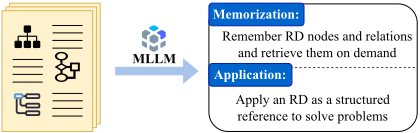
We refer to this setting as relational-diagram reasoning, and characterize it through two tightly coupled tasks: Memorization and Application. As illustrated in Figure 1, Memorization evaluates whether an MLLM can identify, store, and retrieve RD structural elements, including nodes, directed edges, branching conditions, and prerequisite dependencies, which are not explicitly isolated in existing visionlanguage benchmarks [Liu et al., 2024; Yue et al., 2024]. Application assesses whether the model can use the memorized RD structure for constraint-consistent reasoning, including branch selection, prerequisite-aware traversal, valid step counting, and prerequisite node identification. Although existing multimodal benchmarks broadly cover natural-image VQA and general multimodal reasoning [Alayrac et al., 2022; Li et al., 2024b; Li et al., 2022], systematic evaluation of RD memorization and RD-grounded application under diagramdefined graph constraints remains limited. This gap is important because RDs are common in document-centric workflows, such as clinical guidelines, business process specifications, and system design documents, where failures often appear as dependency-order violations, invalid branch selection, or infeasible path traversal.
These two tasks are tightly coupled: weak memorization prevents reliable diagram use, while accurate memorization does not guarantee correct application under multi-step dependency constraints. Consequently, RD reasoning is challenging for current MLLMs for three reasons. First, the model must extract and retain correct dependency structures from pixels, including nodes, edges, directions, and condition attachments; omissions or confusions undermine subsequent retrieval and use [Ware, 2019; Heer et al., 2010]. Second, many tasks require RD-grounded decisions with branching and long-range constraints, where single-step matching is insufficient and consistency must be preserved across transitions. Third, RD categories follow heterogeneous layouts and conventions, requiring models to generalize beyond a single rendering style [Ware, 2019; Heer et al., 2010; Wang et al., 2024]. Consistently, studies on charts and diagrams show that failures often come from incorrect relation handling or constraint violations rather than low-level perception alone [Kafle et al., 2018; Masry et al., 2022], and recent multimodal evaluations show that general benchmark strength does not imply reliability on structured inputs as dependency depth and constraint complexity increase [Yue et al., 2024; Lu et al., 2024; Wang et al., 2024; Wu et al., 2024b].
To enable diagnostic evaluation, we introduce RD-Bench (Relational Diagram Benchmark), a large-scale benchmark of rigorously verified diagram-question pairs spanning multiple RD categories and four difficulty levels. RDBench targets node/edge retrieval, hierarchical localization, branch-condition selection, constraint-guided path traversal, step counting, and prerequisite identification. Experiments on representative open-source and proprietary MLLMs reveal a consistent bottleneck: models often retrieve single-step RD facts but degrade sharply when applying RDs to multi-step dependency constraints, especially on flowcharts with branching and long-range prerequisites. These results show that current MLLMs struggle to maintain constraint-consistent RD-guided decisions as diagram complexity grows.
Motivated by these failure patterns, we propose RD-MCTS, a Monte Carlo Tree Search framework that strengthens RD-based application through inference-time search. RDMCTS incorporates structural priors, constraint-consistent state expansion, and inference-time step-level process supervision. Empirically, RD-MCTS yields substantial gains on the highest-difficulty subsets, demonstrating the effectiveness of constraint-consistent search for multi-step dependency RD application.
Our contributions are summarized as follows:
- To the best of our knowledge, we are among the first to discuss the capabilities of MLLMs on the relational diagrams reasoning task. We introduce RD-Bench, a largescale and rigorously verified benchmark spanning multiple RD categories and four difficulty levels, designed to diagnose RD memorization and RD-grounded application under explicit graph constraints.
- We conduct comprehensive evaluations of representative open-source and proprietary MLLMs on RD-Bench, and identify a consistent gap between memorizing and retrieving RD structures and applying them for constraintconsistent multi-step dependency reasoning, especially in complex diagrams with branching logic and longrange dependencies.
- To address these limitations, we propose RD-MCTS, a constraint-consistent MCTS framework with steplevel supervision distilled without human-annotated rationales. We will release the benchmark, protocols, and code.
2 RD-Bench: Benchmark Construction
We construct RD-Bench, a diagnostic benchmark for evaluating MLLMs on relational-diagram reasoning across multiple diagram categories (flowcharts, hierarchical frameworks, and fishbone diagrams). Each instance contains (1) a diagram image rendered from an explicit XML specification and (2) an aligned QA set with level labels. Figure 2 summarizes a three-stage pipeline: structured representation extraction, template matching and difficulty-stratified QA construction, and adversarial verification and rendering.
Benchmark goal. RD-Bench targets reasoning under graph constraints and characterizes RD reasoning with two coupled tasks: (1) memorization, remembering RD nodes and relations and retrieving them on demand; and (2) application, applying a RD as a structured reference to solve problems under diagram-wide constraints. This decomposition helps distinguish failures caused by missing/incorrect structure retrieval from those caused by constraint-inconsistent use of an otherwise correct structure.
Construction principles. We follow four principles to ensure RD-Bench is reliable and diagnostic. Typicality: cover representative RD categories and common patterns. Completeness: ensure coverage via a unified difficulty taxonomy. Discriminability: guarantee each QA has a unique answer determined by diagram constraints. Fairness: standardize rendering and balance instances across categories/levels to reduce non-structural confounds.
Structured representation extraction. As shown in Figure 2, we collect (1) diagram templates with clear node-edge structures and (2) domain texts describing procedures, hierarchies, or cause-effect relations. Templates are sourced from public repositories and official galleries with editable files or high-quality exemplars, including drawio-diagrams 1 , example draw.io diagrams and templates 2 , and bpmn-forresearch 3 . We re-create representative templates in draw.io and export XML skeletons as machine-readable formats. For each text segment, an LLM-based extractor produces a category-specific schema (nodes, relations, attributes), and we control structural complexity to support level-controlled memorization and application. We curate templates to cover common patterns and complexity ranges.
1 https://github.com/jgraph/drawio-diagrams
2 https://www.drawio.com/example-diagrams
3 https://github.com/camunda/bpmn-for-research
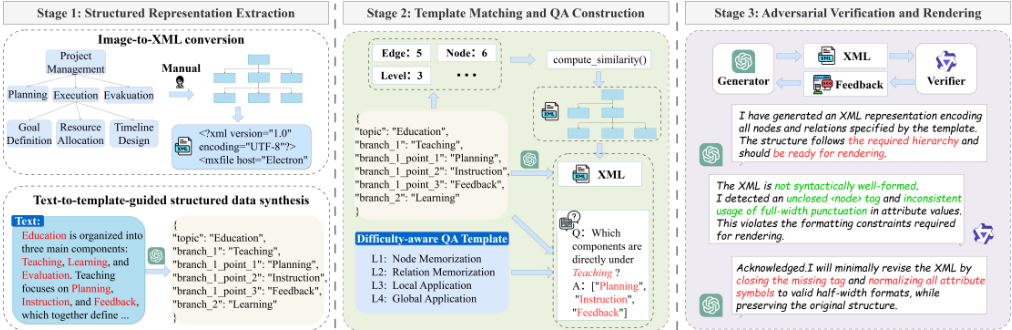
Template matching and difficulty-stratified QA construction. Following Stage 2 in Figure 2, given a structured schema, we retrieve a compatible XML skeleton using structural features and instantiate it to encode all required nodes and relations. We then generate QA items from a library of category-specific templates and assign them into four levels aligned with memorization-application: L1 (node memorization), L2 (relation memorization, including directionality and condition attachment), L3 (local application under localized constraints), and L4 (global application requiring diagramwide constraint consistency). We filter ambiguous items and balance configurations across categories and levels.
Adversarial verification and rendering. As illustrated in Figure 2, we apply a generator-verifier protocol before rendering: a generator proposes an XML candidate; an independent verifier checks XML well-formedness and schema coverage (missing nodes/edges, wrong links/directions, incorrect branching or condition attachment); the generator iteratively revises until all constraints pass. Verified XMLs are rendered into images under standardized visual settings, and each instance is released as {image, QA set with level labels}. This step removes structural inconsistencies and controls non-structural visual factors.
Benchmark statistics and quality. RD-Bench contains 17K images paired with 390K QA items over four levels: 39K (L1), 78K (L2), 156K (L3), and 117K (L4). We split RD-Bench into 14K images with 313K QA pairs for training and a held-out 3K images with 77K QA pairs for testing. We further conduct human verification on 1K randomly sampled questions per level, yielding low error rates of 0.2% (L1), 0.7% (L2), 2.3% (L3), and 4.9% (L4), indicating reliable annotations and scalable construction.
3 EvaluationMetrics
RD-Bench evaluates relational-diagram reasoning as formulated in Section 1, which consists of two coupled tasks: (1) memorization of RD nodes and relations with on-demand retrieval, and (2) application of an RD as a structured reference to solve problems under graph constraints. Our L1-L4 taxonomy is aligned with this view: L1 targets node memorization, L2 targets relation memorization (including directionality and condition attachment), L3 targets local application under localized constraints, and L4 targets global application requiring diagram-wide constraint satisfaction. Based on this decomposition, we define level-aware metrics that support diagnosis across memorization and application.
Following a lightweight canonicalization (lowercasing, punctuation removal, whitespace normalization), we convert both prediction and reference into normalized answer-item sets. Let Qℓ denote the set of questions at difficulty level ℓ ∈ {1, 2, 3, 4}, and let Apred i ,Agt i denote the predicted and ground-truth answer-item sets for instance i ∈ Qℓ. We add a small constant ϵ to the denominator for numerical stability.
Item-set micro Precision/Recall/F1 and its limitation. We compute overlap between Apred i and Agt i and report microaveraged Precision/Recall/F1 by pooling intersections and set sizes within a level (or a specified subset). For multiplechoice items, micro-F1 reduces to accuracy. However, overlap-based scores are not fully diagnostic for RD-Bench: they can miss constraint violations in L4,such as invalid reachability or termination, and they conflate errors from memorization (missing/incorrect nodes or relations) with errors from application (using the structure inconsistently). These limitations motivate task-aligned metrics below.
RD-Bench metrics: RS, LSS, and GCSR. To align evaluation with the L1-L4 taxonomy and the memorizationapplication decomposition, we report three complementary metrics: RS for L1-L2 memorization, LSS for L3 local application, and GCSR for L4 global constraint success. Together, they disentangle structure retrieval from constraint-consistent use beyond surface-form overlap.
Retrieval Score (RS). RS measures memorization and aggregates L1-L2, which target node and relation retrieval. We compute RS using micro-F1 on Q1 ∪ Q2:
| Model Name | Hierarchical diagram | Fishbone diagram | Flowchart | ||||||
|---|---|---|---|---|---|---|---|---|---|
| RS | LSS | GCSR | RS | LSS | GCSR | RS | LSS | GCSR | |
| LLaVA-1.5-7B | 0.775 | 0.502 | 0.382 | 0.689 | 0.352 | 0.226 | 0.718 | 0.382 | 0.253 |
| Qwen-2.5-VL-7B | 0.763 | 0.478 | 0.369 | 0.703 | 0.402 | 0.214 | 0.741 | 0.379 | 0.261 |
| Gemini-2.5-pro | 0.836 | 0.536 | 0.421 | 0.759 | 0.441 | 0.303 | 0.795 | 0.479 | 0.376 |
| GPT-4o | 0.891 | 0.578 | 0.492 | 0.788 | 0.505 | 0.389 | 0.844 | 0.574 | 0.451 |
| Claude-3.7 | 0.913 | 0.612 | 0.559 | 0.856 | 0.513 | 0.492 | 0.893 | 0.603 | 0.478 |
| Fine-tuned LLaVA-1.5-7B | 0.873 | 0.605 | 0.519 | 0.757 | 0.489 | 0.483 | 0.775 | 0.562 | 0.397 |
| Fine-tuned Qwen-2.5-VL-7B | 0.919 | 0.627 | 0.535 | 0.817 | 0.541 | 0.518 | 0.869 | 0.619 | 0.459 |
RS is diagnostic of whether an MLLM can correctly retrieve RD elements and relations needed for downstream application.
Local Solving Score (LSS). LSS measures local application on L3, where questions require constraint-aware use of a bounded diagram context, such as valid local transitions, localized verification, or bounded traversal/counting. We compute LSS using micro-F1 on Q3:
Compared with RS, LSS reflects whether the model can use retrieved structure to perform locally scoped, multi-step RDgrounded decisions.
Global Constraint Success Rate (GCSR). GCSR measures global application on L4, where correctness depends on diagram-wide constraints. Each i ∈ Q4 is associated with a set of verifiable global constraints Gi = {gi,1, . . . , gi,ni } derived from the XML/graph representation, such as global reachability, mandatory/unreachable nodes, and termination consistency. We define the per-instance satisfaction indicator:
and report the average success rate:
GCSR is intentionally stricter than overlap scores: a prediction is counted as correct only if it satisfies all required global constraints, matching RD-Bench's diagnostic goal for constraint-dominated RD application.
4 Empirical Study and Analysis
4.1 Experimental Setup
We conduct extensive empirical experiments on five representative multimodal large models, including Qwen2.5-VL7B[Bai et al., 2025], LLaVA-1.5-7B-hf[Liu et al., 2023], Gemini 2.5 Pro[Reid et al., 2024], GPT-4o[OpenAI, 2023], and Claude 3.7. For open-source models, we additionally fine-tune them on the RD-Bench training split (14K images with 313K QA pairs) to assess the effect of task-aligned supervision. All fine-tuning runs are performed on an RTX PRO 6000 GPU, using LoRA with r = 16 and o = 32, a learning rate of 1 × 10⁻⁵ , and training for 3 epochs. Unless otherwise specified, we report results on the held-out test split (3K images with 77K QA pairs) using the metrics defined in Section 3: RS (Retrieval Score on L1-L2 for memorization), LSS (Local Solving Score on L3 for local application), and GCSR (Global Constraint Success Rate on L4 for global application under diagram-wide constraints).
4.2 Experimental Results
Experimental results on RD-Bench are summarized in Table 1. We highlight the following findings.
Large gaps across diagram categories. Performance varies substantially across relational-diagram categories. In particular, fishbone diagrams obtain the lowest RS, suggesting that memorizing and retrieving fine-grained factors and their relations is more error-prone in this category. In contrast, flowcharts exhibit the lowest GCSR, indicating that applying the RD to satisfy diagram-wide constraints remains challenging under branching control flow, long-range prerequisites, and termination conditions. These results confirm that different RD categories stress distinct aspects of memorization and constraint-consistent application.
Fine-tuning yields consistent gains. Fine-tuning on the RD-Bench training split consistently improves the opensource models across all diagram categories and all three metrics (RS, LSS, and GCSR). Notably, the fine-tuned Qwen2.5VL-7B matches or surpasses strong proprietary MLLMs on several settings. This indicates that task-aligned supervision can substantially enhance RD memorization and RD-based application beyond relying on model scale or general-purpose training alone.
Constraint-dominated application is the bottleneck. Across models, RS is often relatively high, while LSS and GCSR are markedly lower, revealing a clear degradation from memorization (RS) to local application (LSS) and further to global constraint-consistent application (GCSR). Even for
̂
the strongest models, GCSR typically remains below 54%. This progressive drop highlights that current MLLMs struggle to maintain multi-step dependency consistency and enforce diagram-wide constraints, leaving substantial room for improvement.
5 RD-MCTS: Monte Carlo Tree Search for Relational-Diagram Reasoning
5.1 RD-MCTS Definition
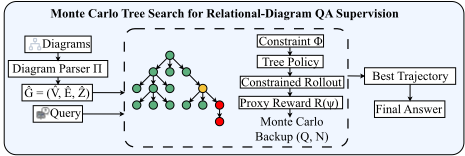
RD-MCTS is an inference-time (test-time) scaling method for relational-diagram reasoning. Given only a relationaldiagram image I and a query q, RD-MCTS parses a machinereadable graph and then searches over constraint-consistent reasoning trajectories under a fixed budget (Figure 3). RDMCTS is used only at inference time.
Diagram parsing. As shown in Figure 3, RD-MCTS first applies an image-to-graph parser Π to obtain an initial diagram graph
where ˆ V are detected nodes, ˆ E are directed relations, and ˆ Z contains symbols encoding constraints. RD-MCTS operates on ˆ G and allows constraint-consistent corrections during search (Section 5.2).
5.2 Search Space and Constraint Function
Trajectory and answer mapping. We model reasoning as a trajectory
where each xt is a valid operation over ˆ G (Figure 3), such as traversing an edge, resolving a branch condition, or accumulating required nodes. For structured targets (path extraction, step counting, prerequisite sets), the final answer is deterministically derived from the terminal trajectory; for free-form targets, the terminal trajectory is used as structured evidence for the base MLLM.
State representation. Each state is
where vt is the current node (or node set), Pt records satisfied requirements (covered nodes/relations), and Ct records resolved condition assignments.
Action space. An action at ∈ A(st) is a structurerespecting transition. To mitigate imperfect parsing, we include navigation and minimal repair actions: (1) Traverse to move along an outgoing edge; (2) Condition resolve to assign an unresolved branch condition and follow the consistent branch; (3) Requirement completion to add a missing required node/relation hypothesis when supported by local evidence in ˆ G.
Feasibility via constraint functionΦ. We enforce feasibility with
which prunes transitions that violate constraints implied by ˆ G and q, such as inconsistent condition assignments, skipping mandatory prerequisites, or entering unreachable regions. Thus, the search explores only constraint-consistent partial trajectories (Figure 3).
Terminal condition. A state is terminal if it contains sufficient information to derive the answer required by q. A rollout stops when this holds, when Tmax is reached, or when no feasible action exists.
5.3 Tree Policy with Structural Priors
PUCT selection rule. RD-MCTS uses MCTS to explore feasible trajectories under a fixed budget (Figure 3). During selection, actions follow PUCT:
where Q(st, a) is the empirical mean return, N(st) is the state visit count, N(st, a) is the action visit count, and c controls exploration.
Structural prior Pstr. The prior Pstr(st, a) is computed from ˆ G and q, combining: (1) Proximity (reducing distance to a query-implied target), (2) Requirement coverage (increasing unresolved coverage in Pt), and (3) Semantic relevance (embedding similarity between q and the node/edge/condition text in ˆ G). All signals are computed at inference time without any ground-truth XML.
Constraint-consistent expansion. After selection, we expand by adding feasible successors induced by A(st). Feasibility is guaranteed by Φ, so newly created states remain consistent with condition and requirement constraints.
5.4 Rollout, Value Backup, and Prediction
Constrained rollout. From an expanded state st, RDMCTS samples feasible actions until termination, producing a terminal trajectory x(ψ) 1:T and a candidate answer ˆa(ψ) derived from that trajectory. Rollouts terminate early at deadends (no feasible action).
Inference-time step-level reward (no gold answers). Since RD-MCTS runs at reasoning time without gold answers, we compute each rollout ψ with a proxy reward (Shown in Figure 3):
| Model Name | Method | Hierarchical diagram | Fishbone diagram | Flowchart | ||||||
|---|---|---|---|---|---|---|---|---|---|---|
| RS | LSS | GCSR | RS | LSS | GCSR | RS | LSS | GCSR | ||
| LLaVA-1.5-7B | Vanilla | 0.775 | 0.502 | 0.382 | 0.689 | 0.352 | 0.226 | 0.718 | 0.382 | 0.253 |
| Few-shot | 0.791 | 0.523 | 0.399 | 0.693 | 0.381 | 0.261 | 0.741 | 0.427 | 0.264 | |
| RD-MCTS | 0.775 | 0.552 | 0.443 | 0.689 | 0.415 | 0.303 | 0.718 | 0.439 | 0.291 | |
| Self-Training | 0.873 | 0.605 | 0.519 | 0.757 | 0.489 | 0.483 | 0.775 | 0.562 | 0.397 | |
| Self-Training + Few-shot | 0.902 | 0.614 | 0.532 | 0.775 | 0.503 | 0.487 | 0.815 | 0.589 | 0.412 | |
| Self-Training + RD-MCTS | 0.873 | 0.646 | 0.562 | 0.757 | 0.531 | 0.509 | 0.775 | 0.634 | 0.464 | |
| Qwen-2.5-VL-7B | Vanilla | 0.763 | 0.478 | 0.369 | 0.703 | 0.402 | 0.214 | 0.741 | 0.379 | 0.261 |
| Few-shot | 0.767 | 0.516 | 0.429 | 0.727 | 0.445 | 0.261 | 0.766 | 0.417 | 0.313 | |
| RD-MCTS | 0.763 | 0.532 | 0.477 | 0.703 | 0.461 | 0.330 | 0.741 | 0.443 | 0.376 | |
| Self-Training | 0.919 | 0.627 | 0.535 | 0.817 | 0.541 | 0.518 | 0.869 | 0.619 | 0.459 | |
| Self-Training + Few-shot | 0.927 | 0.646 | 0.550 | 0.841 | 0.572 | 0.545 | 0.882 | 0.633 | 0.539 | |
| Self-Training + RD-MCTS | 0.919 | 0.662 | 0.603 | 0.817 | 0.590 | 0.563 | 0.869 | 0.687 | 0.592 | |
where rcon(st) encourages intermediate constraint consistency and requirement coverage, rprog measures progress toward the terminal condition, and rver optionally verifies that ˆa(ψ) is supported by the image and parsed evidence without gold labels.
Concrete form of rcon(st). We instantiate
where ∆Cov(Pt) is incremental requirement coverage, Conf(Ct) penalizes inconsistent condition assignments, and Dead(st) penalizes states close to dead-ends under Φ.
Monte Carlo value estimation and backup. We estimate state value by averaging over K rollouts:
and backpropagate returns along the path to update Q(st, a) and visit counts.
Inference-time prediction. After exhausting the computation budget (Figure 3), we select the final trajectory by maximum visit count:
(or equivalently by maximizing Q). The selected trajectory yields the final answer, via deterministic extraction for structured targets or evidence-grounded generation for naturallanguage targets.
6 Experiments
6.1 Experimental Setup
We evaluate RD-MCTS on two open-source MLLMs, LLaVA-1.5-7B and Qwen2.5-VL-7B, on RD-Bench. For each backbone, we report results in both pre-finetuning and post-finetuning regimes, where post-finetuning denotes supervised fine-tuning on the RD-Bench training split (14K images, 313K QA pairs). We compare three inference configurations: Vanilla, Few-shot, and RD-MCTS. Unless otherwise specified, we evaluate on the held-out test split (3K images, 77K QA pairs) using Section 3: RS (L1-L2 memorization/retrieval), LSS (L3 local application), and GCSR (L4 global application success under constraints).
6.2 Main Results
RD-MCTS improves constrained solving and complements finetuning. RD-MCTS targets application rather than memorization. Accordingly, within the same training regime, RS (L1-L2) stays the same when switching from Vanilla/Few-shot to RD-MCTS, while gains concentrate on LSS and GCSR (L3-L4). As shown in Table 2, RD-MCTS outperforms Few-shot on constrained solving across both backbones and all diagram categories. For LLaVA-1.5-7B, RD-MCTS improves GCSR from 0.382 to 0.443 on hierarchical diagrams (+0.061) and from 0.226 to 0.303 on fishbone diagrams (+0.077), while also raising LSS from 0.502 to 0.552 (+0.050) and from 0.352 to 0.415 (+0.063), respectively. On flowcharts, RD-MCTS yields a clear boost on LSS (0.382→0.439, +0.057) and a consistent gain on GCSR (0.253→0.291, +0.038), indicating better constraintconsistent multi-step decisions under branching control flow.
The improvements are larger on Qwen-2.5-VL-7B, suggesting that a stronger base model benefits more from constraint-consistent search. RD-MCTS increases GCSR by more than +0.10 across all three categories: 0.369→0.477 on hierarchical diagrams, 0.214→0.330 on fishbone diagrams, and 0.261→0.376 on flowcharts. Similar trends hold for LSS, showing that RD-MCTS improves both locally bounded application and diagram-wide constraint satisfaction. Compared with Few-shot prompting, which brings modest gains (e.g., Qwen flowchart GCSR 0.261→0.313), RD-MCTS delivers substantially larger improvements on the constraintdominated metric (0.261→0.376), highlighting the advantage of explicit search over purely prompt-based guidance.
6.3 Analysis Experiments
We conduct fine-grained analyses on the flowchart subset of RD-Bench, reporting RS, LSS, and GCSR unless otherwise specified.
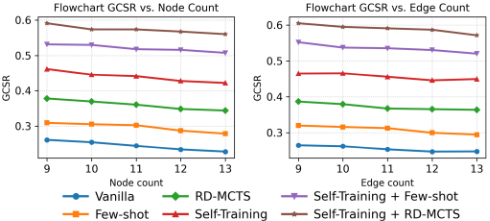
Flowchart size (node count). Figure 4 (left) shows that GCSR decreases as node count increases (9→13) across all inference settings, indicating that larger flowcharts introduce longer dependency chains and make globally constraintconsistent application harder.
Flowchart dependency load (edge count). Figure 4 (right) shows a similar downward trend as edge count increases, suggesting that denser dependencies further exacerbate global consistency. Under the same x-axis value, edge-count curves are slightly higher than node-count curves, implying that within this range, additional edges may offer explicit structural cues, while additional nodes mainly lengthen reasoning chains and increase compounding errors.
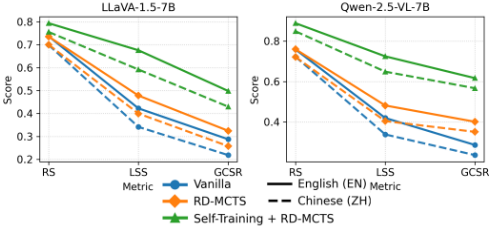
Language effect (Chinese vs. English). Figure 5 compares Chinese and English flowcharts with matched structure/content. English consistently outperforms Chinese on RS, LSS, and GCSR for both backbones and all settings. Moreover, the RS→LSS drop is generally smaller in English, suggesting that Chinese inputs incur a larger degradation when moving from memorization/retrieval to multi-step local application, which then propagates to lower global success.
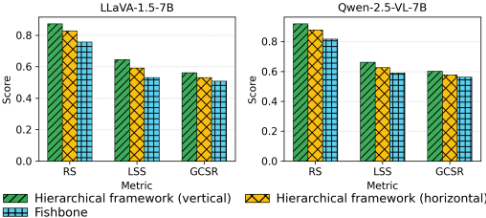
Diagram form (layout sensitivity). Figure 6 compares three renderings with identical text: vertical frameworks, horizontal frameworks, and fishbone diagrams. Vertical frameworks score highest, horizontal frameworks are intermediate, and fishbone diagrams perform worst across both backbones and metrics, showing that layout conventions affect RD-grounded application beyond text, likely through relation readability and implied reading order.
Figure 6: Layout Sensitivity in Relational-Diagram Reasoning: Vertical vs. Horizontal Frameworks vs. Fishbone
7 RelatedWork
Multimodal Large Language Models. MLLMs combine language models with vision encoders and achieve strong performance via instruction tuning on general vision-language benchmarks [Achiam et al., 2023; Liu et al., 2024; Li et al., 2024a; Yue et al., 2024]. Modular tool-based variants further decompose perception and reasoning, such as Visual ChatGPT and MM-ReAct [Wu et al., 2023; Yang et al., 2023]. Our work targets a less-studied setting: relational-diagram reasoning where correctness is determined by global structural constraints.
Evaluation benchmarks for MLLMs. General multimodal benchmarks are dominated by natural images and offer limited coverage of structured diagrams that require constraint-consistent reasoning [Liu et al., 2024; Li et al., 2024a; Yue et al., 2024]. Prior diagnostic evaluations and chart/diagram datasets show sharp degradation as layouts and structures grow more complex [Fu et al., 2025; Yu et al., 2024; Chen et al., 2024; Masry et al., 2022; Lu et al., 2024; Wang et al., 2024]. Recent vector-graphic benchmarks further reveal that MLLMs struggle with fine-grained structured visual understanding and code-level generation under strict graphical constraints, complementing bitmap-centric evaluations [Li et al., 2025b]. RD-Bench fills the remaining gap with multi-category relational diagrams, structure-grounded verification, and L1-L4 difficulty stratification; RD-MCTS further improves high-difficulty performance via constraintconsistent search.
8 Conclusion
We introduce RD-Bench for benchmarking MLLMs on relational-diagram reasoning under global graph constraints, covering multiple diagram categories with verified diagramquestion pairs and L1-L4 difficulty stratification. We further propose RD-MCTS, a test-time constraint-consistent search method with structural priors that consistently improves highdifficulty performance over vanilla and few-shot inference, and complements supervised finetuning.
Acknowledgments
We would like to thank the anonymous reviewers for their insightful comments. This work was supported by the National Science Foundation of China (Grant No. 62376057), the Start-up Research Fund of Southeast University (RF1028623234), and the Big Data Computing Center of Southeast University.
@inproceedings{ijcai2026p132,
  title     = {Benchmarking and Enhancing Relational Diagrams Reasoning for Multimodal Large Language Models},
  author    = {Hong, Tianyu and Wang, Peng and Ke, Wenjun and He, Yao and Wang, Hongao},
  booktitle = {Proceedings of the Thirty-Fifth International Joint Conference on
               Artificial Intelligence, {IJCAI-26}},
  publisher = {International Joint Conferences on Artificial Intelligence Organization},
  editor    = {Diego Calvanese},
  pages     = {1179--1187},
  year      = {2026},
  month     = {8},
  note      = {Main Track},
  doi       = {10.24963/ijcai.2026/132},
  url       = {https://doi.org/10.24963/ijcai.2026/132},
}
TY - CPAPER TI - Benchmarking and Enhancing Relational Diagrams Reasoning for Multimodal Large Language Models AU - Hong, Tianyu AU - Wang, Peng AU - Ke, Wenjun AU - He, Yao AU - Wang, Hongao T2 - Proceedings of the Thirty-Fifth International Joint Conference on Artificial Intelligence, IJCAI-26 PB - International Joint Conferences on Artificial Intelligence Organization PY - 2026 SP - 1179 EP - 1187 DO - 10.24963/ijcai.2026/132 UR - https://doi.org/10.24963/ijcai.2026/132 ER -Copied
Machine-readable versions of this paper, for tools and AI agents:





