
A3fford-HOI: Anatomy-Aligned Affordance Disentanglement for Fine-grained and Generalizable Hand Object Interaction
Proceedings of the Thirty-Fifth International Joint Conference on Artificial Intelligence. Main Track. Pages 1197-1205.
https://doi.org/10.24963/ijcai.2026/134
Keywords
- Computer Vision: 3D computer vision
- Computer Vision: Motion and tracking
Abstract
Hand Object Interaction (HOI) generation provides an efficient solution for virtual reality simulation and embodied AI deployment.Recent studies have explored instruction-driven HOI synthesis, yet they overlooked the fine-grained interactive contact and struggled with robust generalization in data-scarce scenarios. In addition, existing datasets are frequently constrained with limited object categories and monotonous motion patterns. To address these limitations, we first integrate a large-scale HOI dataset, namely HOI-X, which contains diverse objects, rich motion patterns, and part-level contact annotations. Along with HOI-X, we propose A3fford-HOI, a fine-grained and generalizable Hand Object Interaction framework with Anatomy-Aligned Affordance Disentanglement. Specifically, we define a Disentangle-2-Interact paradigm in A3fford-HOI. Considering the various interactions of distinct hand anatomical structures,
in the Disentangle stage, we devise an Anatomy-Aligned Affordance Predictor, which leverages the external plausible physical priors in 3D multimodal large language models for affordance disentanglement prediction. Then, the disentangled affordance is employed into the Interact stage, i.e. Affordance Driven Interactor. The interactor integrates textual instructions, object geometric features, and the external knowledge enhanced (MLLMs) affordance via a Diffusion Transformer (DiT) for generalizable HOI generation. Extensive experiments demonstrate that A3fford-HOI maintains superior generation quality and contact plausibility for fine-grained and generalizable hand object interaction.
- [Brahmbhatt et al., 2019] Samarth Brahmbhatt, Ankur Handa, and Hays et al. Contactgrasp: Functional multi- finger grasp synthesis from contact. In 2019 IEEE/RSJ International Conference on Intelligent Robots and Systems (IROS), pages 2386-2393. IEEE, 2019.
- [Cao et al., 2021] Zhe Cao, Ilija Radosavovic, and Kanazawa et al. Reconstructing hand-object interac- tions in the wild. In Proceedings of the IEEE/CVF international conference on computer vision, pages 12417-12426, 2021.
- [Cha and et al., 2024] Junuk Cha and Kim et al. Text2hoi: Text-guided 3d motion generation for hand-object inter- action. In Proceedings of the IEEE/CVF Conference on Computer Vision and Pattern Recognition, pages 1577- 1585, 2024.
- [Chao et al., 2021] Yu-Wei Chao, Wei Yang, and Xian et al. Dexycb: A benchmark for capturing hand grasping of ob- jects. In Proceedings of the IEEE/CVF conference on com- puter vision and pattern recognition, pages 9044-9053, 2021.
- [Christen et al., 2024] Sammy Christen, Shreyas Hampali, and Sener et al. Diffh2o: Diffusion-based synthesis of hand-object interactions from textual descriptions. In SIG- GRAPH Asia 2024 Conference Papers, pages 1-11, 2024.
- [Chu et al., 2025] Hengshuo Chu, Xiang Deng, and Lv et al. 3d-affordancellm: Harnessing large language models for open-vocabulary affordance detection in 3d worlds. arXiv preprint arXiv:2502.20041, 2025.
- [Corona and et al., 2020] Enric Corona and Pumarola et al. Ganhand: Predicting human grasp affordances in multi- object scenes. In Proceedings of the IEEE/CVF conference on computer vision and pattern recognition, pages 5031- 5041, 2020.
- [Cutkosky and others, 1989] Mark R Cutkosky et al. On grasp choice, grasp models, and the design of hands for manufacturing tasks. IEEE Transactions on robotics and automation, 5(3):269-279, 1989.
- [Deng et al., 2021] Shengheng Deng, Xun Xu, and Wu et al. 3d affordancenet: A benchmark for visual object affor- dance understanding. In proceedings of the IEEE/CVF conference on computer vision and pattern recognition, pages 1778-1787, 2021.
- [Do et al., 2018] Thanh-Toan Do, Anh Nguyen, and Ian Reid. Affordancenet: An end-to-end deep learning ap- proach for object affordance detection. In 2018 IEEE international conference on robotics and automation (ICRA), pages 5882-5889. IEEE, 2018.
- [Fan et al., 2023] Zicong Fan, Omid Taheri, and Tzionas et al. Arctic: A dataset for dexterous bimanual hand-object manipulation. In Proceedings of the IEEE/CVF conference on computer vision and pattern recognition, pages 12943- 12954, 2023.
- [Fang et al., 2018] Kuan Fang, Te-Lin Wu, and Yang et al. Demo2vec: Reasoning object affordances from online videos. In Proceedings of the IEEE Conference on Com- puter Vision and Pattern Recognition, pages 2139-2147, 2018.
- [Fang et al., 2023] Hao-Shu Fang, Chenxi Wang, and Fang et al. Anygrasp: Robust and efficient grasp perception in spatial and temporal domains. IEEE Transactions on Robotics, 39(5):3929-3945, 2023.
- [Ghosh et al., 2023] Anindita Ghosh, Rishabh Dabral, and Golyanik et al. Imos: Intent-driven full-body motion syn- thesis for human-object interactions. In Computer Graph- ics Forum, volume 42, pages 1-12. Wiley Online Library, 2023.
- [Hampali and et al., 2020] Shreyas Hampali and Rad et al. Honnotate: A method for 3d annotation of hand and ob- ject poses. In Proceedings of the IEEE/CVF conference on computer vision and pattern recognition, pages 3196- 3206, 2020.
- [Hu and et al., 2022] Edward J Hu and Shen et al. Lora: Low-rank adaptation of large language models. ICLR, 1(2):3, 2022.
- [Hu et al., 2022] Haoyu Hu, Xinyu Yi, Hao Zhang, Jun-Hai Yong, and Feng Xu. Physical interaction: Reconstructing hand-object interactions with physics. In SIGGRAPH Asia 2022 conference papers, pages 1-9, 2022.
- [Huang and et al., 2017] Xun Huang and Belongie et al. Ar- bitrary style transfer in real-time with adaptive instance normalization. In Proceedings of the IEEE international conference on computer vision, pages 1501-1510, 2017.
- [Huang et al., 2025] Mingzhen Huang, Fu-Jen Chu, and Tekin et al. Hoigpt: Learning long-sequence hand-object interaction with language models. In Proceedings of the Computer Vision and Pattern Recognition Conference, pages 7136-7146, 2025.
- [Jiang and et al., 2021] Hanwen Jiang and Liu et al. Hand- object contact consistency reasoning for human grasps generation. In Proceedings of the IEEE/CVF international conference on computer vision, pages 11107-11116, 2021.
- [Kwon et al., 2021] Taein Kwon, Bugra Tekin, and Stühmer et al. H2o: Two hands manipulating objects for first person interaction recognition. In Proceedings of the IEEE/CVF international conference on computer vision, pages 10138-10148, 2021.
- [Li et al., 2024] Yicong Li, Na Zhao, and Xiao et al. Laso: Language-guided affordance segmentation on 3d object. In Proceedings of the IEEE/CVF Conference on Computer Vision and Pattern Recognition, pages 14251-14260, 2024.
- [Liu et al., 2025] Yumeng Liu, Xiaoxiao Long, and Yang et al. Easyhoi: Unleashing the power of large models for reconstructing hand-object interactions in the wild. In Pro- ceedings of the Computer Vision and Pattern Recognition Conference, pages 7037-7047, 2025.
- [Lu et al., 2022] Liangsheng Lu, Wei Zhai, and Luo et al. Phrase-based affordance detection via cyclic bilateral in- teraction. IEEE Transactions on Artificial Intelligence, 4(5):1186-1198, 2022.
- [Luo et al., 2022] Hongchen Luo, Wei Zhai, and Zhang et al. Learning affordance grounding from exocentric images. In Proceedings of the IEEE/CVF conference on computer vi- sion and pattern recognition, pages 2252-2261, 2022.
- [Lv and et al., 2024] Xintao Lv and Xu et al. Himo: A new benchmark for full-body human interacting with multiple objects. In European Conference on Computer Vision, pages 300-318. Springer, 2024.
- [Mi et al., 2020] Jinpeng Mi, Hongzhuo Liang, Nikolaos Katsakis, Song Tang, Qingdu Li, Changshui Zhang, and Jianwei Zhang. Intention-related natural language ground- ing via object affordance detection and intention semantic extraction. Frontiers in Neurorobotics, 14:26, 2020.
- [Nagarajan et al., 2019] Tushar Nagarajan, Christoph Fe- ichtenhofer, and Kristen Grauman. Grounded human- object interaction hotspots from video. In Proceedings of the IEEE/CVF International Conference on Computer Vi- sion, pages 8688-8697, 2019.
- [Qi and et al., 2023] Zekun Qi and Dong et al. Contrast with reconstruct: Contrastive 3d representation learning guided by generative pretraining. In International Conference on Machine Learning, pages 28223-28243. PMLR, 2023.
- [Romero and et al., 2022] Javier Romero and Tzionas et al. Embodied hands: Modeling and capturing hands and bod- ies together. arXiv preprint arXiv:2201.02610, 2022.
- [Salehi and et al., 2017] Seyed Sadegh Mohseni Salehi and Erdogmus et al. Tversky loss function for image segmen- tation using 3d fully convolutional deep networks. In Inter- national workshop on machine learning in medical imag- ing, pages 379-387. Springer, 2017.
- [Sanghi and et al., 2022] Aditya Sanghi and Chu et al. Clip- forge: Towards zero-shot text-to-shape generation. In Pro- ceedings of the IEEE/CVF conference on computer vision and pattern recognition, pages 18603-18613, 2022.
- [Taheri et al., 2020] Omid Taheri, Nima Ghorbani, and Black et al. Grab: A dataset of whole-body human grasp- ing of objects. In European conference on computer vi- sion, pages 581-600. Springer, 2020.
- [Tevet and et al., 2022] Guy Tevet and Raab et al. Human motion diffusion model. arXiv preprint arXiv:2209.14916, 2022.
- [Touvron and et al., 2023] Hugo Touvron and Lavril et al. Llama: Open and efficient foundation language models. arXiv preprint arXiv:2302.13971, 2023.
- [Tzionas and Gall, 2015] Dimitrios Tzionas and Juergen Gall. 3d object reconstruction from hand-object interac- tions. In Proceedings of the IEEE International Confer- ence on Computer Vision, pages 729-737, 2015.
- [Wan et al., 2023] Weikang Wan, Haoran Geng, and Liu et al. Unidexgrasp++: Improving dexterous grasping policy learning via geometry-aware curriculum and iter- ative generalist-specialist learning. In Proceedings of the IEEE/CVF International Conference on Computer Vision, pages 3891-3902, 2023.
- [Wang and et al., 2024] Chen Wang and Shi et al. Dexcap: Scalable and portable mocap data collection system for dexterous manipulation. arXiv preprint arXiv:2403.07788, 2024.
- [Wang et al., 2024] Hanqing Wang, Chunlin Yu, and Luo et al. Seqafford: Sequential 3d affordance reasoning via multimodal large language model. 2024.
- [Wu et al., 2025] Lin Wu, Wei Wei, and Yu et al. Open- vocabulary 3d affordance understanding via functional text enhancement and multilevel representation alignment. In Proceedings of the 33rd ACM International Conference on Multimedia, pages 7988-7997, 2025.
- [Zhan and et al., 2024] Xinyu Zhan and Yang et al. Oakink2: A dataset of bimanual hands-object manipulation in com- plex task completion. In Proceedings of the IEEE/CVF Conference on Computer Vision and Pattern Recognition, pages 445-456, 2024.
- [Zhang and et al., 2024] Hui Zhang and Christen et al. Graspxl: Generating grasping motions for diverse objects at scale. In European Conference on Computer Vision, pages 386-403. Springer, 2024.
- [Zhang et al., 2019] Hao Zhang, Zi-Hao Bo, Jun-Hai Yong, and Feng Xu. Interactionfusion: real-time reconstruction of hand poses and deformable objects in hand-object inter- actions. ACM Transactions on Graphics (ToG), 38(4):1- 11, 2019.
- [Zhang et al., 2025] Zhenhao Zhang, Ye Shi, and Yang et al. Openhoi: Open-world hand-object interaction synthesis with multimodal large language model. arXiv preprint arXiv:2505.18947, 2025.
- [Zhao et al., 2020] Xue Zhao, Yang Cao, and Yu Kang. Ob- ject affordance detection with relationship-aware network. Neural Computing and Applications, 32(18):14321- 14333, 2020.
References were extracted automatically from the PDF and may contain errors.
Full text extracted automatically from the PDF; figures, tables and equations may differ. The PDF is the version of record.
1 Introduction
Hand Object Interaction (HOI) generation aims to synthesize realistic and interactive hand-object motion sequences.
In practice, HOI has broad applications in various fields, including Virtual Reality (VR) [Zhang and et al., 2024; Fang et al., 2023], Embodied AI [Wan et al., 2023], and robotics [Wang and et al., 2024]. Conventionally, HOI generation demands not merely visual realism, but also a grounding in physically plausible contact and interaction dynamics.
Recently, instruction-driven methods [Cha and et al., 2024; Huang et al., 2025; Zhang et al., 2025] have provided feasible paradigms for HOI generation by mapping natural language to 3D motion spaces. However, they remain circumscribed by monotonous interaction patterns and limited object categories. Researchers [Christen et al., 2024; Huang et al., 2025] primarily focus on kinematic motion synthesis, ignoring the explicit contact constraints, inevitably resulting in unnatural artifacts and physical implausibility. Only a few approaches [Cha and et al., 2024; Zhang et al., 2025] incorporate coarse contact information to guide generation. Specifically, they leverage interaction cues as guidance by calculating the contact probabilities between hand and object surfaces. However, they overlook the distinct physical roles of hand anatomical structures. Crucially, different hand parts - such as fingertips for precision and palms for stability - must be aligned with specific disentangled affordance regions on the object to guarantee functionally valid manipulation. As illustrated in Figure 2, different colors on the hand denote the contact regions of distinct anatomical structures, visually revealing the specific functional contribution to the interaction. Notably, due to the diversity of manipulation modes, each anatomical part may exhibit high contact probabilities across multiple distinct regions of the object surface. While pursuing fine-grained accuracy, generalization is also a more critical challenge. When confronted with rare object shapes and complex interaction patterns, existing methods [Cha and et al., 2024; Christen et al., 2024; Huang et al., 2025] exhibit significant performance degradation, due to the lack of external physical knowledge and geometric reasoning capabilities. Moreover, current datasets are limited in object diversity and manipulation patterns, which is a main reason for limiting the model generalization.
Thus, the HOI generation task still encounters two main challenges: 1) Building an extensive HOI dataset, including diverse objects and rich motion patterns. 2) Modeling finegrained and generalizable hand-object interaction motion following physically plausible contact and dynamics.
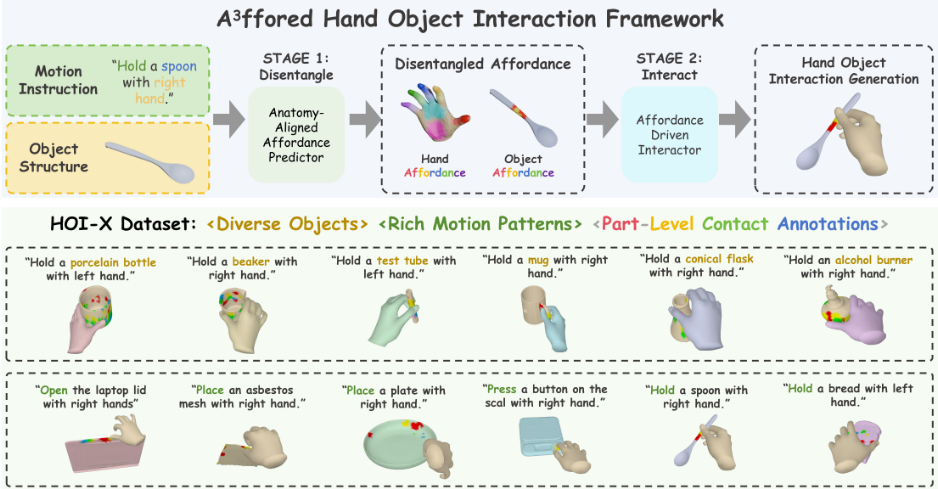
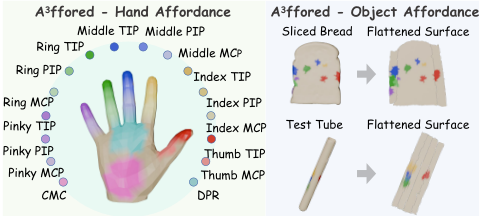
To address the data scarcity, we present HOI-X, an integrated comprehensive HOI dataset. By consolidating several public HOI datasets [Kwon et al., 2021; Taheri et al., 2020; Zhan and et al., 2024], our HOI-X contains various object categories and rich motion patterns. The rigorous pre-processing is then performed to unify data formats across different data sources. Significantly, we conduct part-level contact annotations (i.e., fine-grained quantification of object affordance) by calculating contact probabilities between specific hand anatomical structures and object surfaces, as shown in Figure 1. Along with HOI-X, we propose A3 fford-HOI, a novel two-stage framework that enables fine-grained and generalizable HOI motion generation. We formulate the generation process as a Disentangle-2-Interact paradigm. To decouple the complexities of interaction, in the Disentangle stage, we devise an Anatomy-Aligned Affordance Predictor. Specifically, we prompt 3D MLLMs with textual instructions and object geometries to extract latent physical commonsense-external knowledge that is often scarce in limited HOI datasets. Here, the predictor effectively transforms high-level semantic knowledge into fine-grained, partspecific functional cues. In this manner, the textual instructions and object geometries are adaptively transformed into spatially explicit and disentangled affordance maps. Subsequently, these disentangled affordance priors are seamlessly integrated into the Interact stage to guide the interaction synthesis. In particular, we present the Affordance-Driven Interactor, where textual instructions and object geometric features are fused to provide the global condition for coarse motion generation. Once we obtain initial results, we employ the MLLM-enhanced affordance map as an interactive guidance to refine local hand-object interactions, ensuring high-fidelity contact plausibility. The modulated features are finally fed into the diffusion-based transformer backbone to produce harmonic and physically plausible HOI sequences.
Overall, our contributions are summarized as follows:
- We present HOI-X, a comprehensive hand object interaction dataset with diverse objects, rich motion patterns, and part-level contact annotations for fine-grained interaction.
- We propose A3 fford-HOI, a novel two-stage framework
| Datasets | #Frames | #Sequences | #Objects | #Motion Patterns | Label Method | Caption | Affordance |
|---|---|---|---|---|---|---|---|
| GRAB [Taheri et al., 2020]ECCV | 1.62M | 1.33K | 51 | 276 | Mocap | ✗ | ✗ |
| HO3D [Hampali and et al., 2020]CV | PR 0.08M | 0.14K | 10 | 92 | Auto | ✗ | ✗ |
| H2O [Kwon et al., 2021]ICCV | 0.57M | 1K | 20 | 68 | Auto | ✗ | ✗ |
| DexYCB [Chao et al., 2021]CV PR | 0.57M | 0.67K | 8 | 243 | Mocap | ✗ | ✗ |
| ARCTIC [Fan et al., 2023]CV PR | 2.1M | 4.6K | 11 | 161 | Mocap | ✗ | ✗ |
| OakInk2 [Zhan and et al., 2024]CV PR | 4.01M | 2.2K | 75 | 254 | Mocap | ✓ | ✗ |
| HOI-X [Ours 2026] | 6.2M | 5.1K | 134 | 598 | Semi-Auto | ✓ | Disentangled |
that enables fine-grained and generalizable hand object interaction generation.
- We design an Anatomy-Aligned Affordance Predictor that injects external physical priors provided by 3D MLLMs for disentangled affordance prediction. Furthermore, we present an Affordance-Driven Interactor, integrating MLLM-enhanced affordance priors to ensure fine-grained and generalizable interaction synthesis.
- Extensive experiments demonstrate that A3 fford-HOI achieves SOTA performances, producing highly realistic and functionally accurate hand-object interaction on finegrained and generalizable scenarios.
2 RelatedWork
Hand Object Interaction Generation: Research in 3D Hand-Object Interaction (HOI) can be broadly categorized into two primary streams: reconstruction and generation. While reconstruction methods [Tzionas and Gall, 2015; Cao et al., 2021; Zhang et al., 2019; Hu et al., 2022; Liu et al., 2025] typically focus on recovering 3D hand-object dynamics from visual observations such as RGB videos or depth maps, the core objective of HOI generation is to synthesize realistic interaction sequences from multi-modal inputs. Early generation approaches [Ghosh et al., 2023; Brahmbhatt et al., 2019; Corona and et al., 2020] predominantly concentrated on synthesizing static grasping postures or simple manipulation primitives. Propelled by the advancements in Diffusion Models and Large Language Models (LLMs), recent frameworks like DiffH2O [Christen et al., 2024] and HOIGPT [Huang et al., 2025] have harnessed textual guidance to facilitate diverse interaction synthesis. Building on this, Text2HOI [Cha and et al., 2024] and OpenHOI [Zhang et al., 2025] explicitly incorporate interaction cues to further refine generation quality. However, existing methodologies largely overlook the distinct functional roles of different hand anatomical structures during interaction. In addition, existing datasets [Fan et al., 2023; Kwon et al., 2021; Taheri et al., 2020; Zhan and et al., 2024] are often limited by repetitive interaction patterns and a scarce variety of object shapes. To address these limitations, we introduce HOIX, a comprehensive dataset enriched with diverse objects and motions, and propose the A3 fford-HOI framework, aiming to achieve fine-grained and generalizable HOI generation.
Affordance Learning: The genesis of affordance learning lies in the image domain, with pioneering works [Do et al., 2018; Zhao et al., 2020] primarily targeting the detection of functional objects. Subsequent advancements [Lu et al., 2022; Mi et al., 2020] integrate linguistic context to refine this process. Nevertheless, these approaches remain constrained to coarse, object-level predictions. To overcome this limitation, contemporary research [Fang et al., 2018; Luo et al., 2022; Nagarajan et al., 2019] shifts towards specific affordance parts, establishing a new norm for precision in the field. With the rise of Embodied AI, affordance learning has rapidly expanded into the 3D domain. 3D AffordanceNet [Deng et al., 2021] constructs the first dataset for affordance detection in 3D point clouds. Building on this, works like LASO [Li et al., 2024] and AffordanceLLM [Chu et al., 2025] establish a bridge between the powerful natural language capabilities of LLMs and 3D object affordances, significantly enhancing static 3D understanding. Further advancements, such as SeqAfford [Wang et al., 2024] and OpenAfford [Wu et al., 2025], refine and expand this capability, realizing compositional affordance reasoning. However, these approaches remain confined to fundamental perception tasks, leaving the application of affordance insights to hand-object interaction generation unexplored. In contrast, our work introduces a "Disentangle-2-Interact" paradigm. Through this framework, we seamlessly integrate disentangled affordance into the HOI task, achieving superior finegrained and generalizable motion synthesis.
3 HOI-XDataset
To alleviate the limitations of object diversity and motion patterns in current datasets, we introduce HOI-X, a comprehensive hand object interaction dataset with Anatomy-Aligned Affordance (A3 fford) annotations, which consists of 5.1K high-quality motion sequences, with a total of 6.2M frames and 134 object templates.
We devise a rigorous data processing pipeline to integrate and canonicalize interaction data from several sources: GRAB [Taheri et al., 2020], H2O [Kwon et al., 2021], and OakInk2 [Zhan and et al., 2024]. The pipeline consists of two key phases. 1) Unified Spatial Projection. To eliminate spatial discrepancies caused by different capture systems, all hand-object interaction sequences are projected into a unified world coordinate system and normalized to a standard scale.
2) Object Representation Standardization. To facilitate efficient geometric learning, we perform uniform sampling on the diverse object meshes, converting them into standardized point cloud models with a fixed resolution of 1,024 points. The specific data statistics and comparisons are shown in Table 1.
4 ProposedMethod
4.1 ProblemFormulation
Given the multi-modal inputs of text descriptions text and object point clouds Po, the goal of our framework is to generate realistic and interactive hand-object motion sequences M. In practice, we leverage the parameterized hand model MANO [Romero and et al., 2022] to represent hand poses. We tackle this challenging problem with the designed framework A3 fford-HOI. The overall objective can be expressed as:
4.2 Disentangle-2-Interact Paradigm
Drawing from classical grasp taxonomy theory [Cutkosky and others, 1989], the anatomical structures of the hand assume distinct functional roles during interaction, governed by dual constraints of task requirements and object geometry. Inspired by these theoretical insights, we propose AnatomyAligned Affordance (A3 fford) to explicitly model disentangled part-specific contact potentials for fine-grained interaction synthesis. To implement this guidance, we introduce a Disentangle-2-Interact paradigm. As shown in Figure 3, we utilize the anatomy disentangled affordance, augmenting with external knowledge from MLLMs to guide the fine-grained and generalizable interactive motion generation.
Disentangle Stage: A3 fford Predictor To harness the advanced reasoning capabilities of large models for part-level contact prior prediction, we build an A3 fford Predictor upon the 3D MLLM to enhance fine-grained and external physical knowledge. The backbone integrates a 3D Vision Encoder (ReCon++ [Qi and et al., 2023]) for geometric object embedding, a pre-trained text encoder (CLIP [Sanghi and et al., 2022]) for text embedding, and a generic Large Language Model (LLaMA [Touvron and et al., 2023]) for affordance prediction. The multi-modal input features include representations of object structure (point features Fpoint) , text prompt (prompt features Fprompt), and motion instruction (instruction features Fins), which are then transformed into hybrid latent tokens H via LLM. Thus, the LLM inference process can be formulated as:
where H is the hybrid latent tokens and can also represent the textual tokens Htext, constrained by the annotated answer text in the following LLM tuning.
Meanwhile, to bridge the gap between textual semantics and geometric interactions in LLM, we expand the LLM
vocabulary with two specialized tokens: <Left/Right Hand Affordance> and <Object Affordance>, as shown in Figure 3 (left), serving as learnable instructors for affordance disentanglement. Thus, the hand mask tokens Hhand and object affordance tokens Hobject are separated from the hybrid latent tokens Htext/H. Finally, Htext, Hhand, Hobject are then fed into the specific Text Decoder, Hand Mask Decoder, and Object Affordance Decoder for subsequent features extraction, respectively.
The textual tokens are decoded into the answer text by Text Decoder (TD), which serves as a semantic constraint to ensure the synthesized interaction affordance aligns with the linguistic instructions.
where Tanswer is the answer text. To acquire the disentangled contact priors, the Hand Mask Decoder (HMD) projects hand mask tokens into active and anatomical hand contact affordance. Simultaneously, the Object Affordance Decoder (OAD) projects object affordance tokens into the geometric object affordance.
where Ahand is the predicted hand affordance, Aobject is the predicted object affordance. We employ the LoRA techniques [Hu and et al., 2022] to efficiently fine-tune the overall large model constrained by the annotated answer text. The specific decoders are trained with the supervision of annotated affordances.
Therefore, the A3 fford Predictor effectively transforms high-level interaction intent into spatially explicit, finegrained and disentangled affordance maps, ensuring strict alignment between anatomical hand structures and their corresponding functional regions on the object. Meanwhile, the introduction of large model provides external knowledge cues for the next Interact stage, improving both the fine-grained fidelity of the interaction and the generalization ability across diverse object categories.
Interact Stage: Affordance Driven Interactor In the Interact stage, we employ the anatomy-aligned affordance from A3 fford Predictor to facilitate high-fidelity and physically plausible hand-object interaction synthesis. The generation process is fundamentally guided by two-level conditions: holistic semantic constraints and the affordance features acquired from Affordance Encoder. The holistic constraints are composed of motion instruction feature, textural prompt feature and object structure feature. These global cues are integrated into our backbone via multi-head attention, which can generate rough motion trajectory and hand pose. Though the above holistic conditions determine the overall motion trend, they can not guarantee precise finger-level contacts without the contact priors. Hence, we introduce the Affordance Control mechanism that employs the aforementioned fine-grained affordance priors to explicitly guide the interaction details.
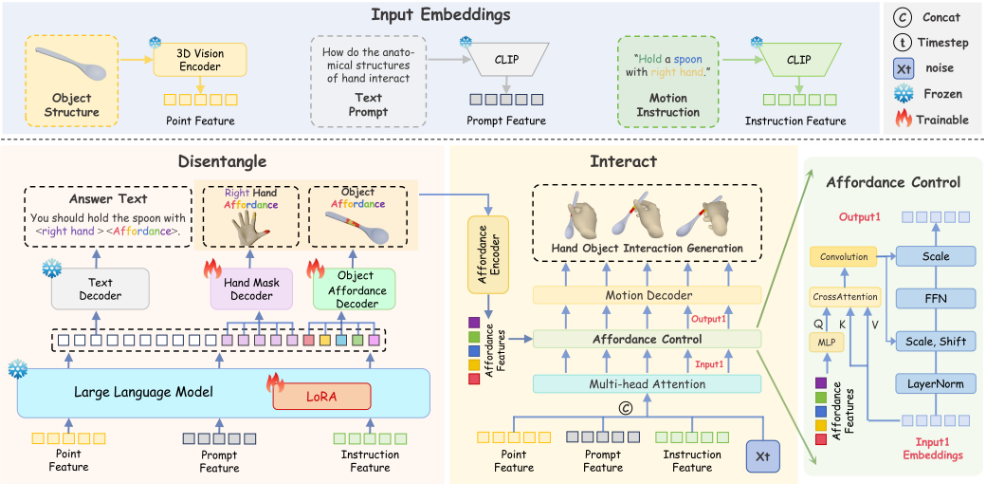
Affordance Control . As illustrated in Figure 3 (bottom right corner), we utilize the affordance features as the query Q to match the motion embeddings as key Kand value V , through the cross-attention mechanism. Then we obtain the affordance-guided motion features via the AdaLN [Huang and et al., 2017] layers. The modulated motion features are derived as:
where Fmotion donates the interaction motion features and Faff indicates the affordance features. Ultimately, the Motion Decoder translates these features into the final finegrained and physically plausible HOI sequences.
4.3 Objective Function
In the Disentangle stage, to effectively fit the complex distribution of anatomy-aligned affordances, we employ the Channel-Wise Tversky Loss (LTversky) [Salehi and et al., 2017]. Formally, we calculate the weighted overlap between the predicted probability map P and the ground truth G as
Similar to [Jiang and et al., 2021], we optimize the Interact stage using the composition of simple loss Lsimple, contact loss Lcontact, and penetration loss Lpenet to generate the high-fidelity interaction sequences that are both geometrically precise and physically plausible. The overall objective function is expressed as:
where λc, λp are the trade-off weight coefficient.
5 Experiments
5.1 Experimental Settings
Implementation Details: In our experiments, we set the generated motion length to 200 with FPS = 30. We employ a frozen CLIP-ViT-B-32 model as the text encoder. To train the disentangle stage, the batchsize is set to 128, and the epoch number is 100. The interact stage is trained for 600 epochs with a batchsize as 64. The learning rate of the disentangle stage is 1e-3, and weight decay is 2e-4. The interact stage is trained with 5e-5 learning rate within 2e-6 weight decay. All experiments are deployed on an NVIDIA A100 GPU for 24 hours. The trade-off weight coefficients λc, λp are set to 20 and 10, respectively.
Evaluation Metrics: To comprehensively evaluate the quality, diversity, and realism of our generated interaction motions, we utilize a set of quantitative metrics inspired by [Ghosh et al., 2023]. We roughly divide the 6 evaluation indicators into three categories:
- Motion Accuracy: Average Variance Error (AVE) measures the variance error between the joint positions. Fr´echet Inception Distance (FID) quantifies the distributional discrepancy between the synthesized results and the GT.
- Diversity: Diversity and multi-modality (MModality) measure the variability across different prompts.
- Interaction Quality: Contact percentage(C%) calculates the percentage of frames detected with contact. Penetra-
| Methods | FID ↓ | AVE ↓ | Diversity→ | MModality ↑ | C% ↑ | Penetrarion ↓ |
|---|---|---|---|---|---|---|
| GT | - | - | 1.573±.008 | 0.142±.002 | 0.549±.001 | 0.175±.003 |
| MDM [Tevet and et al., 2022]ICLR HIMO [Lv and et al., 2024]ECCV Text2HOI [Cha and et al., 2024]CVPR OpenHOI [Zhang et al., 2025]NeurIPS | 4.901±.106 3.325±.023 2.391±.031 2.448±.014 | 0.207±.025 0.114±.004 0.098±.001 0.097±.002 | 0.948±.082 0.952±.037 0.976±.041 1.005±.049 | 0.032±.008 0.048±.005 0.045±.008 0.044±.005 | 0.295±.013 0.313±.008 0.421±.007 0.397±.004 | 0.408±.016 0.388±.010 0.412±.019 0.322±.009 |
| A3 ffordance-HOI (Ours) | 1.995±.014 | 0.093±.001 | 1.139±.042 | 0.069±.006 | 0.481±.006 | 0.261±.009 |
tion quantifies physical implausibility by measuring the extent to which the hand mesh intersects with the object mesh.
5.2 Quantitative Evaluation
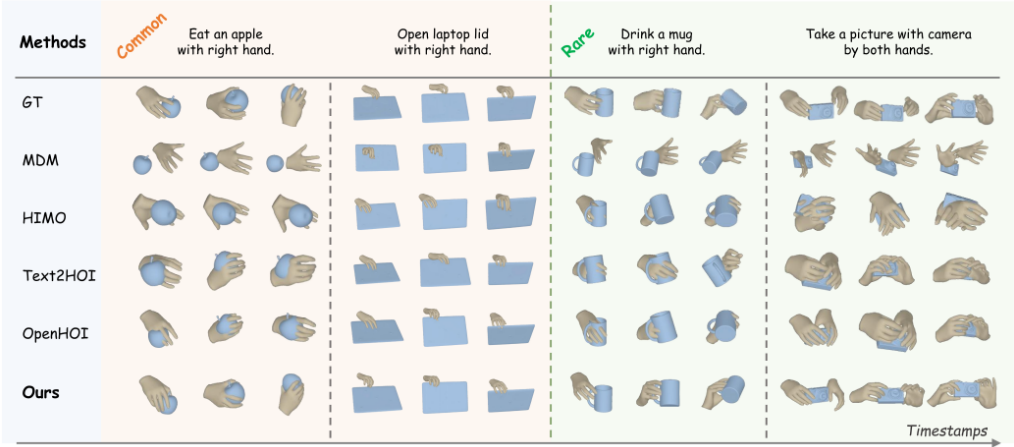
Comparing to SOTA Methods: We compare A3 fford-HOI with four state-of-the-art approaches, MDM [Tevet and et al., 2022], HIMO [Lv and et al., 2024], Text2HOI [Cha and et al., 2024], and OpenHOI [Zhang et al., 2025]. These methods are retrained and tested on the HOI-X dataset with the open-source code released by the authors. In particular, to evaluate the generalization capability of our model, we divide the test data into two categories: common objects and rare objects. The details of the dataset splitting are provided in the Supplementary Materials. The results in Table 2 indicate that our model outperforms the competitive methods on all the metrics in common objects, with the most notable lead observed in Interaction Quality. By leveraging anatomy-aligned affordance, our model employs the Affordance Control to seamlessly align interactive motions with fine-grained contact information, successfully enhancing the synthesis quality of HOI motions. Besides, in terms of scarce-category objects as depicted in Table 3, other methods suffer a notable decline in FID, C%, and Penetration scores. In contrast, our approach maintains strong performance in both motion accuracy and fine-grained interaction quality. This is attributed to our disentangle-to-interact paradigm, which enhances generalization by predicting object affordances that are fused with external physical priors.
Ablation Study: To evaluate the Disentangle-2-Iteract paradigm, we conduct an ablation study with different key components. Considering the fair comparison, our ablation study is conducted on the whole testing set, directly. For verifying the effects of the Disentangle stage, we conduct ablation studies on A3 fford Predictor. As shown in Table 4, removing the A3 fford Predictor leads to a severe drop in both contact ratio (C%) and penetration, which reveals that without external physical priors enhanced affordance (i.e.LLM tuning), the model can not generate reasonable hand-object contact. When we employ simple affordance without anatomy-aligned distinction, interaction quality decrease significantly, indicating the anatomy-aligned affordance plays a crucial role in fine-grained control. To demonstrate the effectiveness of the Interact stage, we further conduct an ablation by removing the Affordance Control module. In this impact, the interaction motions display misalignment with the affordance guidance, leading to the inaccurate contact pattern.
| Methods | FID ↓ | AVE ↓ | Diversity→ | MModality ↑ | C% ↑ | Penetrarion ↓ |
|---|---|---|---|---|---|---|
| Ground Truth | - | - | 1.566±.008 | 0.141±.002 | 0.552±.001 | 0.177±.003 |
| MDM [Tevet and et al., 2022]ICLR HIMO [Lv and et al., 2024]ECCV Text2HOI [Cha and et al., 2024]CVPR OpenHOI [Zhang et al., 2025]NeurIPS | 5.391±.064 3.477±.030 2.709±.033 2.682±.017 | 0.089±.013 0.117±.005 0.106±.001 0.104±.004 | 0.944±.096 0.935±.044 0.960±.039 0.905±.055 | 0.031±.014 0.034±.006 0.029±.006 0.024±.006 | 0.191±.021 0.284±.008 0.347±.008 0.304±.001 | 0.382±.028 0.382±.011 0.455±.024 0.418±.007 |
| A3 ffordance-HOI (Ours) | 2.051±.0020 | 0.099±.005 | 1.139±.055 | 0.066±.002 | 0.467±.006 | 0.285±.018 |
| Methods | FID ↓ | AVE ↓ | Diversity→ | MModality ↑ | C% ↑ | Penetration ↓ |
|---|---|---|---|---|---|---|
| Ground Truth | - | - | 1.573±.008 | 0.142±.002 | 0.549±.001 | 0.175±.003 |
| w/o affordance w/o anatomy-aligned w/o control | 2.432±.013 2.389±.021 2.397±.011 | 0.098±.002 0.096±.002 0.097±.003 | 0.981±.052 0.984±.058 1.084±.047 | 0.044±.001 0.045±.005 0.058±.004 | 0.351±.008 0.424±.004 0.453±.007 | 0.414±.017 0.389±.021 0.305±.011 |
| A3 ffordance-HOI (Ours) | 1.997±.016 | 0.094±.001 | 1.139±.036 | 0.069±.006 | 0.4814±.008 | 0.275±.014 |
5.3 Qualitative Evaluation
To demonstrate the effectiveness of our method, we present the visualized comparison between A3 fford-HOI and other works with the same motion patterns and object templates, as shown in Figure 4. A3 fford-HOI synthesizes superior, natural, and physically plausible HOI sequences. Other approaches are limited in their ability to capture sufficiently detailed contact information, which leads to unnatural interaction motions and severe penetration. Especially, in scenarios with scarce objects, our approach demonstrates stronger generalization capabilities. The key capability lies in generating fine-grained, physically plausible interactions without being confined to specific object shapes.
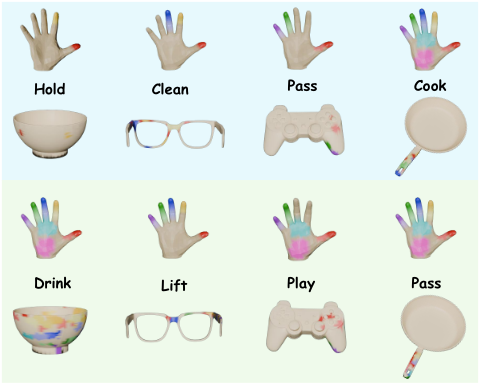
Additionally, we display various disentangled affordances across diverse objects and motion patterns corresponding to different actions, as shown in Figure 5. The LLM-enhanced external knowledge embedded within the affordance provides a strong prior and guidance for our method to generate finegrained and generalizable interactive motions. Moreover, we conduct a user study to assess the quality of the generated results from the perspective of the subjective metrics. The details are shown in the Supplementary Materials.
6 Conclusion
In this paper, we propose A3 fford-HOI, a fine-grained and generalizable Hand Object Interaction generation framework with Anatomy-Aligned Affordance Disentanglement. Meanwhile, we introduce HOI-X, a comprehensive HOI dataset which enriches object diversity, motion patterns, and finegrained contact information. Specifically, we propose a Disentangle-2-Interact Paradigm, including an A3 fford Predictor to acquire disentangled affordance and the Affordance Control in the interact stage to guide HOI synthesis. Finally, our method achieves SOTA performances with physically plausible, fine-grained and generalizable HOI sequences. In the future, we will focus on interaction tasks in more complex scenarios, such as simultaneously generation for hand and multi-object interaction.
Acknowledgements
This work is supported by NSFC No. 62306309, 62276031 and NKRDPC No. 2023YFF0904700.
Contribution Statement
Xurui Hu conducted the algorithm design, experiments, and paper writing. Xingqun Qi served as the project leader. Muyi Sun served as the corresponding author and provided research guidance. All authors contributed to the discussion and approved the final manuscript.
@inproceedings{ijcai2026p134,
  title     = {A3fford-HOI: Anatomy-Aligned Affordance Disentanglement for Fine-grained and Generalizable Hand Object Interaction},
  author    = {Hu, Xurui and Qi, Xingqun and Yang, Bingkun and Su, Chen and Ru, Yiwei and Yin, Junhui and Sun, Muyi and Zhang, Man},
  booktitle = {Proceedings of the Thirty-Fifth International Joint Conference on
               Artificial Intelligence, {IJCAI-26}},
  publisher = {International Joint Conferences on Artificial Intelligence Organization},
  editor    = {Diego Calvanese},
  pages     = {1197--1205},
  year      = {2026},
  month     = {8},
  note      = {Main Track},
  doi       = {10.24963/ijcai.2026/134},
  url       = {https://doi.org/10.24963/ijcai.2026/134},
}
TY - CPAPER TI - A3fford-HOI: Anatomy-Aligned Affordance Disentanglement for Fine-grained and Generalizable Hand Object Interaction AU - Hu, Xurui AU - Qi, Xingqun AU - Yang, Bingkun AU - Su, Chen AU - Ru, Yiwei AU - Yin, Junhui AU - Sun, Muyi AU - Zhang, Man T2 - Proceedings of the Thirty-Fifth International Joint Conference on Artificial Intelligence, IJCAI-26 PB - International Joint Conferences on Artificial Intelligence Organization PY - 2026 SP - 1197 EP - 1205 DO - 10.24963/ijcai.2026/134 UR - https://doi.org/10.24963/ijcai.2026/134 ER -Copied
Machine-readable versions of this paper, for tools and AI agents:





