
Neurosymbolic Framework for Concept-Driven Logical Reasoning in Skeleton-Based Human Action Recognition
Proceedings of the Thirty-Fifth International Joint Conference on Artificial Intelligence. Main Track. Pages 1233-1242.
https://doi.org/10.24963/ijcai.2026/138
Keywords
- Computer Vision: Action and behavior recognition
- Computer Vision: Transparency, accountability, fairness and privacy
- Computer Vision: Interpretability and transparency
- Computer Vision: Vision, language and reasoning
Abstract
Skeleton-based human activity recognition (HAR) has achieved strong empirical performance, yet most existing models remain black boxes and difficult to interpret. In this work, we introduce a neurosymbolic formulation of skeleton-based HAR that reframes action recognition as concept-driven first-order logical reasoning over motion primitives. Our framework bridges representation learning and symbolic inference by grounding first-order logic predicates in learnable spatial and temporal motion concepts. Specifically, we employ a standard spatio-temporal skeleton encoder to extract latent motion representations, which are then mapped to interpretable concept predicates via a spatio-temporal concept decoder that explicitly separates pose-centric and dynamics-centric abstractions. These concept predicates are composed through differentiable first-order logic layers, enabling the model to learn human-readable logical rules that govern action semantics. To impose semantic structure on the learned concepts, we align skeleton representations with LLM-derived descriptions of atomic motion primitives, establishing a shared conceptual space for perception and reasoning. Extensive experiments on NTU RGB+D 60/120 and NW-UCLA demonstrate that our approach achieves competitive recognition performance while providing explicit, interpretable explanations grounded in logical structure. Our results highlight neurosymbolic reasoning as an effective paradigm for interpretable spatio-temporal action understanding.
- [Asif et al., 2023] Umar Asif, Deval Mehta, Stefan Von Cav- allar, Jianbin Tang, and Stefan Harrer. Deepactsnet: A deep ensemble framework combining features from face, hands, and body for action recognition. Pattern Recogni- tion, 139:109484, 2023.
- [Barbiero et al., 2023] Pietro Barbiero, Gabriele Ciravegna, Francesco Giannini, Mateo Espinosa Zarlenga, Lu- cie Charlotte Magister, Alberto Tonda, Pietro Lió, Fred- eric Precioso, Mateja Jamnik, and Giuseppe Marra. In- terpretable neural-symbolic concept reasoning. In Inter- national Conference on Machine Learning, pages 1801- 1825. PMLR, 2023.
- [Bengio et al., 2013] Yoshua Bengio, Nicholas Léonard, and Aaron Courville. Estimating or propagating gradients through stochastic neurons for conditional computation. arXiv preprint arXiv:1308.3432, 2013.
- [Bhuyan et al., 2024] Bikram Pratim Bhuyan, Amar Ramdane-Cherif, Ravi Tomar, and TP Singh. Neuro- symbolic artificial intelligence: a survey. Neural Computing and Applications, 36(21):12809-12844, 2024.
- [Chen et al., 2021] Yuxin Chen, Ziqi Zhang, Chunfeng Yuan, Bing Li, Ying Deng, and Weiming Hu. Channel- wise topology refinement graph convolution for skeleton- based action recognition. In Proceedings of the IEEE/CVF international conference on computer vision, pages 13359-13368, 2021.
- [Chi et al., 2022] Hyung-gun Chi, Myoung Hoon Ha, Se- unggeun Chi, Sang Wan Lee, Qixing Huang, and Karthik Ramani. Infogcn: Representation learning for human skeleton-based action recognition. In Proceedings of the IEEE/CVF conference on computer vision and pattern recognition, pages 20186-20196, 2022.
- [Duan et al., 2022] Haodong Duan, Yue Zhao, Kai Chen, Dahua Lin, and Bo Dai. Revisiting skeleton-based action recognition. In Proceedings of the IEEE/CVF conference on computer vision and pattern recognition, pages 2969- 2978, 2022.
- [Garcez et al., 2002] Artur S d'Avila Garcez, Krysia B Broda, and Dov M Gabbay. Neural-symbolic learning sys- tems. Springer, 2002.
- [Grattafiori et al., 2024] Aaron Grattafiori, Abhimanyu Dubey, Abhinav Jauhri, Abhinav Pandey, Abhishek Kadian, Ahmad Al-Dahle, Aiesha Letman, Akhil Mathur, Alan Schelten, Alex Vaughan, et al. The llama 3 herd of models. arXiv preprint arXiv:2407.21783, 2024.
- [Hitzler and Sarker, 2022] Pascal Hitzler and Md Kamruzza- man Sarker. Neuro-symbolic artificial intelligence: The state of the art. 2022.
- [Hu et al., 2022] Edward J Hu, Yelong Shen, Phillip Wallis, Zeyuan Allen-Zhu, Yuanzhi Li, Shean Wang, Lu Wang, Weizhu Chen, et al. Lora: Low-rank adaptation of large language models. ICLR, 1(2):3, 2022.
- [Ilyas et al., 2025] Talha Ilyas, Deval Mehta, Shobi Si- vathamboo, Ilma Wijaya, Rob Steele, Hugh Simpson, Lyn Millist, Terence O'Brien, Patrick Kwan, and Zongyuan Ge. Privacy-centric seizure diagnosis via relation-aware fusion of minimally-invasive modalities. In International Workshop on Applications of Medical AI, pages 173-183. Springer, 2025.
- [Jiang et al., 2025a] Yiwen Jiang, Deval Mehta, Wei Feng, and Zongyuan Ge. Enhancing interpretable image classifi- cation through llm agents and conditional concept bottle- neck models. arXiv preprint arXiv:2506.01334, 2025.
- [Jiang et al., 2025b] Yiwen Jiang, Deval Mehta, Siyuan Yan, Yaling Shen, Zimu Wang, and Zongyuan Ge. Wise: Weak- supervision-guided step-by-step explanations for multi- modal llms in image classification. In Proceedings of the 2025 Conference on Empirical Methods in Natural Lan- guage Processing, pages 14685-14696, 2025.
- [Koh et al., 2020] Pang Wei Koh, Thao Nguyen, Yew Siang Tang, Stephen Mussmann, Emma Pierson, Been Kim, and Percy Liang. Concept bottleneck models. In Interna- tional conference on machine learning, pages 5338-5348.
- PMLR, 2020.
- [Kowal et al., 2024] Matthew Kowal, Achal Dave, Rares Ambrus, Adrien Gaidon, Konstantinos G Derpanis, and Pavel Tokmakov. Understanding video transformers via universal concept discovery. In Proceedings of the IEEE/CVF Conference on Computer Vision and Pattern Recognition, pages 10946-10956, 2024.
- [Lee et al., 2023] Jungho Lee, Minhyeok Lee, Dogyoon Lee, and Sangyoun Lee. Hierarchically decomposed graph con- volutional networks for skeleton-based action recognition. In Proceedings of the IEEE/CVF international conference on computer vision, pages 10444-10453, 2023.
- [Li et al., 2022] Yong-Lu Li, Xinpeng Liu, Xiaoqian Wu, Yizhuo Li, Zuoyu Qiu, Liang Xu, Yue Xu, Hao-Shu Fang, and Cewu Lu. Hake: A knowledge engine foundation for human activity understanding. IEEE Transactions on Pat- tern Analysis and Machine Intelligence, 45(7):8494-8506, 2022.
- [Liu et al., 2019] Jun Liu, Amir Shahroudy, Mauricio Perez, Gang Wang, Ling-Yu Duan, and Alex C Kot. Ntu rgb+ d 120: A large-scale benchmark for 3d human activity un- derstanding. IEEE transactions on pattern analysis and machine intelligence, 42(10):2684-2701, 2019.
- [Liu et al., 2023] Yanan Liu, Hao Zhang, Yanqiu Li, Kangjian He, and Dan Xu. Skeleton-based human action recognition via large-kernel attention graph convolutional network. IEEE Transactions on Visualization and Com- puter Graphics, 29(5):2575-2585, 2023.
- [Mahinpei et al., 2021] Anita Mahinpei, Justin Clark, Isaac Lage, Finale Doshi-Velez, and Weiwei Pan. Promises and pitfalls of black-box concept learning models. arXiv preprint arXiv:2106.13314, 2021.
- [Mehta et al., 2023] Deval Mehta, Shobi Sivathamboo, Hugh Simpson, Patrick Kwan, Terence O'Brien, and Zongyuan Ge. Privacy-preserving early detection of epileptic seizures in videos. In International Conference on Medical Image Computing and Computer-Assisted Intervention, pages 210-219. Springer, 2023.
- [Mehta et al., 2025] Deval Mehta, Yiwen Jiang, Cather- ine Jan, Mingguang He, Kshitij Jadhav, and Zongyuan Ge. Interpretable few-shot retinal disease diagnosis with concept-guided prompting of vision-language models. In International Conference on Information Processing in Medical Imaging, pages 263-277. Springer, 2025.
- [Okamoto and Parmar, 2024] Lauren Okamoto and Paritosh Parmar. Hierarchical neurosymbolic approach for compre- hensive and explainable action quality assessment. In Pro- ceedings of the IEEE/CVF Conference on computer vision and pattern recognition, pages 3204-3213, 2024.
- [Perfilieva, 2002] Irina Perfilieva. Logical approximation. Soft Computing, 7(2):73-78, 2002.
- [Qu et al., 2024] Haoxuan Qu, Yujun Cai, and Jun Liu. Llms are good action recognizers. In Proceedings of the IEEE/CVF Conference on Computer Vision and Pattern Recognition, pages 18395-18406, 2024.
- [Radford et al., 2021] Alec Radford, Jong Wook Kim, Chris Hallacy, Aditya Ramesh, Gabriel Goh, Sandhini Agar- wal, Girish Sastry, Amanda Askell, Pamela Mishkin, Jack Clark, et al. Learning transferable visual models from nat- ural language supervision. In International conference on machine learning, pages 8748-8763. PmLR, 2021.
- [Ridnik et al., 2023] Tal Ridnik, Gilad Sharir, Avi Ben- Cohen, Emanuel Ben-Baruch, and Asaf Noy. Ml-decoder: Scalable and versatile classification head. In Proceed- ings of the IEEE/CVF winter conference on applications of computer vision, pages 32-41, 2023.
- [Schrouff et al., 2021] Jessica Schrouff, Sebastien Baur, Shaobo Hou, Diana Mincu, Eric Loreaux, Ralph Blanes, James Wexler, Alan Karthikesalingam, and Been Kim. Best of both worlds: local and global explanations with human-understandable concepts. arXiv preprint arXiv:2106.08641, 2021.
- [Shahroudy et al., 2016] Amir Shahroudy, Jun Liu, Tian- Tsong Ng, and Gang Wang. Ntu rgb+ d: A large scale dataset for 3d human activity analysis. In Proceedings of the IEEE conference on computer vision and pattern recognition, pages 1010-1019, 2016.
- [Shi et al., 2019] Lei Shi, Yifan Zhang, Jian Cheng, and Hanqing Lu. Two-stream adaptive graph convolutional networks for skeleton-based action recognition. In Pro- ceedings of the IEEE/CVF conference on computer vision and pattern recognition, pages 12026-12035, 2019.
- [Vemuri et al., 2025] Deepika SN Vemuri, Gautham Bel- lamkonda, Aditya Pola, and Vineeth N Balasubrama- nian. Logiccbms: Logic-enhanced concept-based learn- ing. arXiv preprint arXiv:2512.07383, 2025.
- [Wang et al., 2014] Jiang Wang, Xiaohan Nie, Yin Xia, Ying Wu, and Song-Chun Zhu. Cross-view action modeling, learning and recognition. In Proceedings of the IEEE con- ference on computer vision and pattern recognition, pages 2649-2656, 2014.
- [Wang et al., 2023] Zhuo Wang, Wei Zhang, Ning Liu, and Jianyong Wang. Learning interpretable rules for scal- able data representation and classification. IEEE Trans- actions on Pattern Analysis and Machine Intelligence, 46(2):1121-1133, 2023.
- [Wu et al., 2023] Wenhan Wu, Yilei Hua, Ce Zheng, Shiqian Wu, Chen Chen, and Aidong Lu. Skeletonmae: Spatial- temporal masked autoencoders for self-supervised skele- ton action recognition. In 2023 IEEE international confer- ence on multimedia and expo workshops (ICMEW), pages 224-229. IEEE, 2023.
- [Xiang et al., 2023] Wangmeng Xiang, Chao Li, Yuxuan Zhou, Biao Wang, and Lei Zhang. Generative action de- scription prompts for skeleton-based action recognition. In Proceedings of the IEEE/CVF international conference on computer vision, pages 10276-10285, 2023.
- [Yan et al., 2018] Sijie Yan, Yuanjun Xiong, and Dahua Lin. Spatial temporal graph convolutional networks for skeleton-based action recognition. In Proceedings of the AAAI conference on artificial intelligence, volume 32, 2018.
- [Ye et al., 2025] Qilang Ye, Yu Zhou, Lian He, Jie Zhang, Xuanming Guo, Jiayu Zhang, Mingkui Tan, Weicheng Xie, Yue Sun, Tao Tan, et al. Sugar: Learning skele- ton representation with visual-motion knowledge for ac- tion recognition. arXiv preprint arXiv:2511.10091, 2025.
- [Zhou et al., 2024] Yuxuan Zhou, Xudong Yan, Zhi-Qi Cheng, Yan Yan, Qi Dai, and Xian-Sheng Hua. Block- gcn: Redefine topology awareness for skeleton-based ac- tion recognition. In Proceedings of the IEEE/CVF Confer- ence on Computer Vision and Pattern Recognition, pages 2049-2058, 2024.
- [Zhou et al., 2025] Youwei Zhou, Tianyang Xu, Cong Wu, Xiaojun Wu, and Josef Kittler. Adaptive hyper-graph con- volution network for skeleton-based human action recog- nition with virtual connections. In Proceedings of the IEEE/CVF International Conference on Computer Vision, pages 12648-12658, 2025.
- [Zhu et al., 2023] Wentao Zhu, Xiaoxuan Ma, Zhaoyang Liu, Libin Liu, Wayne Wu, and Yizhou Wang. Motionbert: A unified perspective on learning human motion represen- tations. In Proceedings of the IEEE/CVF international conference on computer vision, pages 15085-15099, 2023.
References were extracted automatically from the PDF and may contain errors.
Full text extracted automatically from the PDF; figures, tables and equations may differ. The PDF is the version of record.
1 Introduction
Skeleton-based human activity recognition (HAR) provides an efficient, privacy-preserving alternative to video-based methods by focusing on joint coordinates that isolate human structure from environmental noise [Duan et al., 2022;
* Corresponding author, now at School of Computing Technologies, RMIT
† Extended version of this paper can be found at: Arxiv
Liu et al., 2023; Asif et al., 2023]. While deep learning has advanced classification accuracy, these models remain black boxes, problematic for high-stakes domains such as healthcare and rehabilitation where transparent decision-making is essential [Ilyas et al., 2025; Mehta et al., 2023].
Neurosymbolic AI has gained traction for combining neural perception with formal logic interpretability [Garcez et al., 2002; Bhuyan et al., 2024]. However, its application to skeleton-based HAR remains largely unexplored due to fundamental integration challenges. This work addresses these challenges to achieve interpretable skeleton-based HAR.
Symbol Grounding. A key challenge is bridging continuous joint trajectories and discrete symbolic predicates. Traditional joint heuristics (e.g., knee angle < 90o for bent knee) [Okamoto and Parmar, 2024] are brittle, as small pose errors or variations in viewpoint and execution can prevent predicate activation for reliable HAR. Inspired by Concept Bottleneck Models (CBMs) [Koh et al., 2020], we instead learn abstract motion concepts and construct an LLM-generated concept bank of spatial primitives (e.g., arm raise, knee bend) that serve as symbolic predicates. We also enforce semantic grounding by aligning GCN-extracted skeleton features with pretrained text encoder based concept embeddings.
Temporal Dynamics. Actions are inherently temporal, varying in speed, duration, and execution order. WEARINGGLASSES and TAKEOFFGLASSES share similar static poses (hands near the face, arm engagement) but differ in temporal dynamics: the former involves grasping and upward motion, while the latter requires release and downward motion. Purely spatial logic cannot capture such distinctions, and incorporating temporal logical rules into neurosymbolic frameworks is challenging. To address this, we introduce explicit temporal concepts capturing motion direction (e.g., motion upward, motion downward), hand state transitions (e.g., hand grasp, hand release), and execution order (e.g., seq hands first). Our Spatio-Temporal Concept Decoder (STC-Decoder) then independently decodes spatial and temporal concepts, enabling distingushing semantically similar actions such as (arm raise ∧ hand grasp ∧ motion upward) ⇒ WEARGLASSES versus (arm lower ∧ hand release ∧ motion downward) ⇒ TAKEOFFGLASSES (Fig 1(b)).
End-to-End Learning. Discrete Boolean operators block gradient propagation, preventing joint optimization of perception and reasoning components [Schrouff et al., 2021]. While differentiable fuzzy logic [Barbiero et al., 2023] shows promise, scalability to large-scale, fine-grained skeletonbased HAR remains open. We employ differentiable logic layers with soft AND/OR operations [Perfilieva, 2002] and gradient grafting [Wang et al., 2023], enabling discrete inference with end-to-end differentiability. Final predictions aggregate triggered rules via learned weights, defining actions as logical compositions of motion concepts.
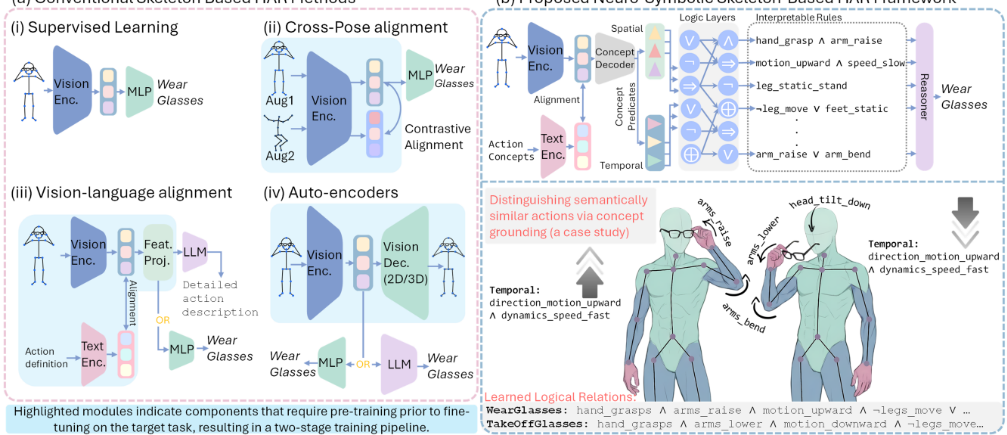
Together, these components form an end-to-end neurosymbolic framework (Fig 1(b)) in which a GCN encoder extracts spatio-temporal features with sequence-concept alignment, the STC-Decoder predicts interpretable concepts, and differentiable logic layers compose them via first-order operations (∧, ∨, ¬) to derive action predictions for action recognition. Grounding predictions in logical rules over concepts provides both local (concepts) and global interpretability (rules). Experiments on NTU RGB+D 60/120 [Shahroudy et al., 2016; Liu et al., 2019] and NW-UCLA [Wang et al., 2014] demonstrate we achieve competitive performance with transparent explanations. To summarize, our major contributions are:
- REASON (Rule-based Explainable Action via Symbolic cONcepts), a neurosymbolic framework for skeleton-based HAR that formulates action recognition as logical reasoning over learnable motion concepts and integrates concept-grounded representations with differentiable first-order logic for end-to-end training.
- A Spatio-Temporal Concept Decoder (STC-Decoder) that extracts spatial body-configuration and temporal motion-dynamics concepts, yielding interpretable abstractions robust to execution variability.
- A concept bank of spatial and dynamic concepts for actions available in NTU RGB+D and NW-UCLA.
2 RelatedWork
Skeleton-based HAR. ST-GCN [Yan et al., 2018] established the GCN paradigm by modeling joints as graph nodes with spatio-temporal convolutions. Subsequent work (Fig 1(a)-(i),(ii)) addresses topology rigidity: 2s-AGCN [Shi et al., 2019] learns adaptive joint relationships, CTRGCN [Chen et al., 2021] refines topology channel-wise, and InfoGCN [Chi et al., 2022] incorporates informationtheoretic objectives. Recent architectures like HD-GCN [Lee et al., 2023] and BlockGCN [Zhou et al., 2024] capture hierarchical interactions. Self-supervised approaches (Fig 1(a)- (iv)) including SkeletonMAE [Wu et al., 2023] and MotionBERT [Zhu et al., 2023] improve generalization via masked reconstruction. Despite strong performance, these models lack interpretable action semantics.
Vision-Language for HAR. Recent works have used LLMs for skeleton-based HAR (Fig 1(a)-(iii),(iv)). SUGAR [Ye et al., 2025] and LLM-AR [Qu et al., 2024] leverage LLM priors for classification or incorporate action prompts [Xiang et al., 2023]. However, these methods yield generic, noninstance-specific explanations and cannot distinguish execution variants (e.g., arms-first vs. legs-first), and are impractical for edge deployment. In contrast, our framework learns efficient, compositional logical rules over motion predicates that capture multiple execution pathways.
Explainable HAR and Neurosymbolic AI. Prior interpretable HAR work has focused on RGB video via post-hoc concept attribution [Kowal et al., 2024] or neurosymbolic pipelines with expert-defined rules [Okamoto and Parmar, 2024], inheriting privacy concerns and sensitivity to environmental noise. While neurosymbolic systems enable traceable reasoning [Hitzler and Sarker, 2022], skeleton data exhibit substantial subject and viewpoint variability, making handcrafted rules brittle. We address this with learnable concept predicates combined with differentiable logic layers to discover action-defining rules from data.
Concept Bottleneck Models. CBMs constrain representations to interpretable concept layers, enabling intervention and debugging [Koh et al., 2020], with extensions like Logic CBMs [Vemuri et al., 2025] incorporating differentiable logic for concept compositions. Recent work further automates concept bank construction using LLM priors [Mehta et al., 2025; Jiang et al., 2025a], reducing manual effort. Despite success in static image classification tasks [Jiang et al., 2025b], CBMs have not addressed skeleton-based HAR, which requires joint modeling of spatial and temporal dynamics. We bridge this gap by formulating skeleton-based HAR as logical reasoning over learnable motion concepts.
3 Method
Our work centres on the question: Can concepts serve as an intermediate representation for neurosymbolic skeletonbased HAR? We address this by first constructing a concept bank of spatial and temporal motion primitives (Sec. 3.1), and then developing a framework to predict concepts from skeleton sequences (Sec. 3.2& 3.3) and composing them via differentiable logic layers (Sec. 3.4& 3.5) for interpretable HAR.
3.1 Concept Bank Generation
Unlike image classification where concepts correspond to static attributes (e.g., a zebra has stripes), action recognition requires capturing spatio-temporal dynamics. Furthermore, execution variability within an action (e.g., armassisted v/s arm-free JUMP) makes manual concept enumeration infeasible. We address this by construcing a concept bank C = Cs ∪ Ct ∪ Cint of spatial, temporal, and interactive motion concepts through a three-stage LLM-based pipeline.
Fine-grained Action Description Generation
Following HAKE [Li et al., 2022], we decompose actions into six body parts: P = {head, hand, arm, hip, leg, foot}. We then prompt an LLM (GPT-3) to generate part-wise motion descriptions Da = {d(p) a }p∈P for each action a. For example, JUMP yields: {Leg: bends at knees then pushes explosively; Arm:
extends overhead; Foot: pushes off ground}.
From Action Descriptions to Abstract Concepts
Generated raw descriptions are action-specific. Thus, using them directly could cause vocabulary explosion [Jiang et al., 2025a]. Hence, we convert descriptions into canonical concepts by extracting {verb-direction-modifier} patterns from all actions, then embedding them via a sentence encoder ϕ, and clustering them with k-means. Cluster representatives form spatial concepts Cs (e.g., arm raise, leg jump, hand grasp). Additionally, we define temporal concepts Ct capturing motion direction, sequence, and dynamics (e.g., motion upward, hand first, speed fast), and an interaction concept for mutual actions.
Concept-Action Association and Refinement
We construct an association matrix M ∈ {0, 1}|A|×|C| where Ma,c = 1 indicates concept c is active for action a. Using LLaMA-3.2 7B [Grattafiori et al., 2024], we match each action's descriptions to semantically appropriate concepts, allowing multiple concepts per body part for compositional movements (e.g., JUMP activates both leg squat and leg jump). To ensure discriminability, we verify unique concept signatures and invoke refinement for ambiguous pairs (e.g., WEARGLASSES vs. TAKEOFFGLASSES are distinguished via opposing direction concepts, see Figure 1). Our final concept bank comprises |C| = 74 concepts (52 spatial + 21 temporal + 1 interaction). Implementation details, prompts, pseudocode and the complete vocabulary are provided in Appendix A.
3.2 Skeleton Representation Learning
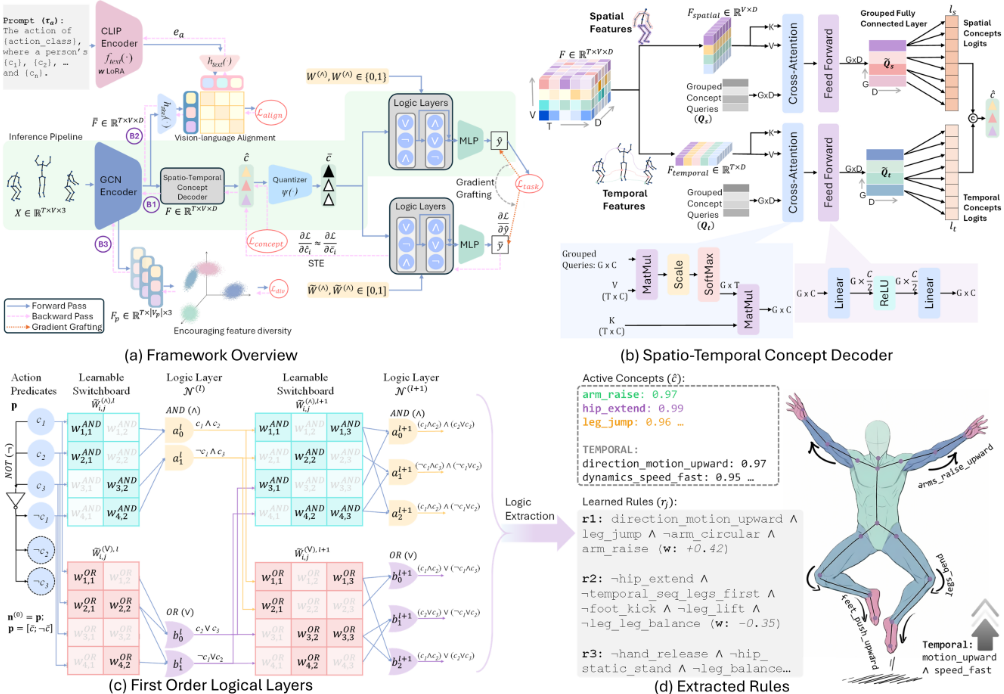
After constructing the concept bank, we describe the overall framework (Fig 2(a)). Skeleton sequences are first encoded using a GCN and aligned with concept semantics via a concept-grounded text encoder and a contrastive objective.
Skeleton Encoder Let X ∈ RT×V×3 denote an input skeleton sequence with T frames, V joints and (x,y,z) coordinates. We model the skeleton as a spatio-temporal graph and process it through a GCN backbone (e.g., Hyper-GCN [Zhou et al., 2025]) with multi-scale temporal convolutions. Crucially, we retain full spatio-temporal resolution without pooling, outputting features F ∈ RT×V×D to preserve finegrained motion information for concept prediction.
The encoder feeds into three branches (Fig 2(a)): (B1) the STC-Decoder for concept prediction, (B2) a text alignment branch where pooled features ¯F = Pool(F) are aligned with concept embeddings, and (B3) a part-divergence branch promoting discriminative representations across anatomical regions.
Body-Part Feature Divergence We partition joints into subsets {Vp}p∈P and extract part-specific features Fp ∈ RT×|Vp|×D . To prevent feature collapse across body parts, we introduce a divergence loss that penalizes high cosine similarity between pooled part representations. Let ¯fp = Pool(Fp) ∈ RD denote the feature of part (p). The loss minimizes off-diagonal similarities across all part pairs:
This regularization encourages each body part to learn discriminative features aligned with its corresponding concept subset Cp ⊂ Cspatial.
Concept-Grounded Text Encoder To ground skeleton features in semantic space, we encode textual descriptions using CLIP [Radford et al., 2021] with LoRA fine-tuning [Hu et al., 2022]. Crucially, rather than generic action labels, we construct concept-grounded prompts incorporating motion primitives from our concept bank. For action a with associated concepts {ci} from matrix M, we construct: "A person performing [action], where the [part1] [concept1], the [part2] [concept2], ...". For example, JUMP yields: "A person performing JUMP, where the arms swing upward, the knees bend, and the body moves upward." This formulation ensures text embeddings ea = ftext(τa) encode the same compositional semantics as the concept vocabulary.
We then align skeleton and text representations via contrastive learning. Projected skeleton features z = hskel(¯F) and concept embeddings t = htext(ea) are aligned through:
where τ is a learnable temperature. This objective encourages skeleton features to cluster with their concept-grounded descriptions, reinforcing the compositional structure.
3.3 STC-Decoder
The spatio-temporal concept decoder (STC-Decoder, Fig. 2b) maps continuous skeleton sequences to discrete concept activations, bridging skeleton representations and symbolic predicates. As actions activate multiple concepts, we adopt a multi-label design with separate spatial and temporal pathways.
Spatial-Temporal Feature Decoupling. Given encoder features F ∈ RT×V ×D , we decouple them through dimensionwise aggregation:
Spatial features Fs preserve per-joint information by aggregating across time, while temporal features Ft retain motion dynamics by aggregating across joints.
Group-Decoding with Concept Queries. Predicting all |C| concepts jointly poses an optimization challenge: concepts exhibit heterogeneous semantic relationships, some are mutually exclusive (motion upward vs. motion downward), others frequently co-occur (arm raise, hand grasp), and many are conditionally dependent on body-part context. Learning these complex inter-concept relationships in a single framework is difficult.
We address this by partitioning concepts into G groups, where each group predicts g = ⌈|C|/G⌉ concepts. Rather than manually assigning semantic roles, we let each group learn to specialize through end-to-end training, groups naturally discover coherent concept subsets (e.g., related bodypart configurations or temporal patterns) that exhibit homogeneous co-occurrence, making each sub-problem easier to optimize.
We initialize separate learnable query matrices Qs ∈ RGs×D and Qt ∈ RGt×D for spatial and temporal branches. Each branch performs cross-attention followed by a feedforward network, where group queries learn to selectively aggregate skeleton information relevant to their respective concept subsets (Appendix C).
Group Fully-Connected Layer. A Group-FC layer [Ridnik et al., 2023] projects the refined group queries to per-concept predictions. Each group k ∈ {0, . . . , G-1} maintains its own projection Wk ∈ RD×g , responsible for predicting g concepts. For concept i, we determine its group index k = ⌊i/g⌋ and position within the group j = i mod g, then compute:
This factorization encourages each group query to specialize in its concept subset through gradient-driven learning. Aggregating spatial and temporal logits yields:
where ˆ ci denotes the predicted probability of concept ci, providing soft symbolic grounding for the logic layers.
Concept Prediction Loss. Concept prediction is supervised using the action-concept matrixM. For an action label a, the target concept vector is c∗ = M[a, :] ∈ {0, 1}|C| , and training minimizes binary cross-entropy Lconcept = BCE(c∗ , ˆc). This supervision grounds continuous skeleton features into interpretable concept activations ˆc, which serve as symbolic predicates for logical composition.
3.4 Differentiable First-Order Logic Reasoning
Symbolic reasoning requires binary predicates, whereas our predicted concepts ˆc ∈ [0, 1]|C| provide soft activations over the motion vocabulary. We therefore binarize concept predictions and compose them using first-order logic, while also employing continuous relaxations to enable end-to-end learning and preserve discrete, interpretable rules.
Concept Binarization
Concept leakage [Mahinpei et al., 2021] occurs when downstream layers exploit spurious information in soft activations rather than intended semantics. We therefore employ a concept activation binarizer which applies a threshold ¯ ci = ⊮[ˆ ci > 0.5], yielding ¯c ∈ {0, 1}|C| . Furthermore, to enable logical negation of concepts, we augment the predicate space as:
allowing rules involving both presence and absence of concepts (e.g., leg jump ∧ ¬leg static).
Logical Layer Architecture
We compose concept predicates into action-discriminative rules through stacked logical layers (Fig. 2(c)). Each layer N (l) contains two sub-layers: conjunction (AND) and disjunction (OR), enabling arbitrary propositional formulas in disjunctive normal form [Wang et al., 2023]. Let n(l-1) denote the input (with n(0) = p). The conjunction (A(l) ) and disjunction layers (B(l) ) compute:
whereW(∧) ,W(∨) ∈ {0, 1} are learnable switchboards (i.e., binary adjacency matrices) specifying which predicates participate in each conjunction/disjunction. By stacking L layers with outputs n(l) = [a(l) ; b(l) ], the network learns compositional rules of increasing complexity, yielding rule activations r ∈ {0, 1}R.
Continuous Relaxation and Gradient Grafting
Discrete Boolean operations in logical layer produce zero gradients. For end-to-end training, we adopt differentiable logic relaxations [Barbiero et al., 2023] that approximate AND/OR via product-based formulations. During training, we maintain continuous weights ˜W(∧) , ˜W(∨) ∈ [0, 1] and compute soft operations:
When weights and inputs are binary, these reduce to standard AND/OR (Appendix D). Logical layer training employs gradient grafting [Wang et al., 2023] (Fig 2(a)): the forward pass uses binarized concepts ¯c and discrete weights W = ⊮[ ˜W > 0.5] for interpretable rule evaluation, while backpropagation computes gradients through the continuous relaxations (Eq. 8and 9) to update soft weights ˜W. For the concept binarizer, the Straight-Through Estimator [Bengio et al., 2013] passes gradients unchanged: ∂L/∂ˆ ci ≈ ∂L/∂¯ ci , as shown in Fig 2(a).
3.5 Rule-Based Action Classification
The rule activations r ∈ {0, 1}R encode which logical concept combinations are present. A linear classifier maps these to action predictions ˆy = Vr + b, where V ∈ R|A|×R, associates rules with actions, and b ∈ R|A| is a bias term. Post-training, we extract human-readable rules by tracing adjacency matrices back to concept combinations, yielding expressions like r1 : leg jump ∧ ¬arm swing ∧ motion upward. This ensures both local interpretability (instance-specific concept activations) and global interpretability (logical rules characterizing each action class). The details for post-training rule interpretation are provided in Appendix D.
Overall Training Objective The framework is trained endto-end by combining all loss terms: L = Ltask + αLconcept + βLalign +γLdiv +λ∥ ˜W∥1, where the ℓ1 regularization on ˜W enforces sparse, interpretable rules. At inference, concepts are binarized, rules are evaluated discretely, and actions are predicted via triggered rules.
| Methods | Venue | Mod. | NTU-RGB+D 60 | NTU-RGB+D 120 | NW-UCLA | Two-stage | Interpret. | |||
|---|---|---|---|---|---|---|---|---|---|---|
| Cat. | X-Sub | X-View | X-Sub | X-Set | ||||||
| ST-GCN | AAAI'18 | J+B | 81.5 | 88.3 | 70.7 | 73.2 | - | N | N | |
| 2s-AGCN | CVPR'19 | J+B | 88.5 | 95.1 | 82.5 | 84.2 | - | N | N | |
| MS-G3D | CVPR'20 | J+B | 86.0 | 94.1 | 80.2 | 86.1 | - | N | N | |
| UNIK | BMVC'21 | J+B | 86.8 | 94.4 | 80.8 | 86.5 | - | N | N | |
| InfoGCN | CVPR'20 | J+B | - | - | 88.5 | 89.7 | - | N | N | |
| REASON (Ours) | This work | J+B | 89.4 | 95.6 | 88.97 | 89.2 | - | N | Y | |
| DC-GCN+ADG | ECCV'20 | J+B+JM+BM | 90.8 | 96.6 | 86.5 | 88.1 | 95.3 | N | N | |
| MS-G3D | CVPR'20 | J+B+JM+BM | 91.5 | 96.2 | 86.9 | 88.4 | - | N | N | |
| MST-GCN | Access'21 | J+B+JM+BM | 91.5 | 96.6 | 87.5 | 88.8 | - | N | N | |
| CTR-GCN | ICCV'21 | J+B+JM+BM | 92.4 | 96.4 | 88.9 | 90.6 | 96.5 | N | N | |
| GCN | EfficientGCN-B4 | TPAMI'22 | J+B+JM+BM | 91.7 | 95.7 | 88.3 | 89.1 | - | N | N |
| InfoGCN | CVPR'20 | J+B+JM+BM | 92.7 | 96.9 | 89.4 | 90.7 | 96.6 | N | N | |
| FR Head | CVPR'23 | J+B+JM+BM | 92.8 | 96.8 | 89.5 | 90.9 | 96.8 | N | N | |
| HD-GCN* | ICCV'23 | J+B+J'+B' | 93.0 | 97.0 | 89.8 | 91.2 | 96.9 | N | N | |
| DS-GCN | AAAI'24 | J+B+JM+BM | 93.1 | 97.5 | 89.2 | 90.3 | - | N | N | |
| BlockGCN | CVPR'24 | J+B+JM+BM | 93.1 | 97.0 | 90.3 | 91.5 | 96.9 | N | N | |
| Hyper-GNN | TIP'21 | J+B+JM+BM | 89.5 | 95.7 | - | - | - | N | N | |
| Selective-HCN | ICMR'22 | J+B+JM+BM | 90.8 | 96.6 | - | - | - | N | N | |
| DST-HCN | ICME'23 | J+B+JM+BM | 92.3 | 96.8 | 88.8 | 90.7 | 96.6 | N | N | |
| Hyper-GCN | ICCV'25 | J+B+JM+BM | 93.7 | 97.8 | 90.9 | 92.0 | 97.6 | N | N | |
| REASON (Ours) | This work | J+B+JM+BM | 94.3 | 97.8 | 90.1 | 91.9 | 97.9 | N | Y | |
| DSTA-Net | ACCV'20 | J+B+JM+BM | 89.5 | 95.7 | 86.6 | 89.0 | - | N | N | |
| Trans. | IIP-Transformer | DATA'23 | J+B+JM+BM | 89.5 | 95.7 | 89.9 | 90.9 | - | N | N |
| SkateFormer | ECCV'24 | J+B+JM+BM | 93.5 | 97.8 | 89.8 | 91.4 | 98.3 | N | N | |
| USDRL | TPAMI'25 | J+M+B | 87.1 | 93.2 | 79.3 | 80.6 | - | Y | N | |
| GAP | ICCV'23 | J+B+JM+BM | 92.9 | 97.0 | 89.9 | 91.1 | 97.2 | N | N | |
| LLM | LLM-AR | CVPR'24 | J | 95.0 | 98.4 | 88.7 | 91.5 | - | Y | Y |
| SUGAR | AAAI'26 | J | 95.2 | 97.8 | 90.1 | 89.7 | - | Y | Y | |
| REASON+LLM (Ours) | This work | J | 95.6 | 98.3 | 91.2 | 92.8 | 98.1 | N | Y | |
4 Experiments
We evaluate our neurosymbolic framework on standard skeleton-based HAR benchmarks, focusing on: (i) performance competitiveness, (ii) interpretability of learned rules, and (iii) component-wise contributions.
4.1 Datasets
We evaluate on three benchmarks: NTU RGB+D 60 (56,880 sequences, 60 classes) under Cross-Subject (X-Sub) and Cross-View (X-View) protocols; NTU RGB+D 120 (114,480 sequences, 120 classes) under Cross-Subject (X-Sub) and Cross-Setup (X-Set) protocols; and NW-UCLA (1,494 sequences, 10 classes) following protocol to train on cameras 1&2, test on camera 3.
4.2 Implementation Details
We follow [Chen et al., 2021] for preprocessing, using random rotation, spatial flip, and temporal cropping with uniform 64-frame sampling. Training uses AdamW for 400 epochs with cosine decay on a single A6000 GPU.
We employ staggered warmup to prevent spurious rule formation: the GCN/CLIP/STC-Decoder warm up for 5 epochs while logic layers remain frozen for 15 epochs. This delay ensures logic layers learn from converged concept predictions rather than random activations. Logic layers use 10× higher learning rate (10-4 vs. 10-5 ) to traverse from dense initialization to sparse binary connectivity against ℓ1 regularization. Full hyperparameters are in Appendix F.
4.3 Comparison with State-of-the-Art
Table 1 compares against GCN-based, Transformer-based, and LLM-augmented methods. Beyond performance, we highlight whether methods require two-stage training (separate pretraining) and whether they provide interpretable predictions.
Our core neurosymbolic framework (REASON) achieves competitive performance while being the only single-stage, fully interpretable approach. In 4-stream configuration, we attain 94.3% on NTU-60 X-Sub and 92.8% on NTU-120 X-Set, surpassing black-box methods (Hyper-GCN, BlockGCN). Critically, the concept-rule reasoning chain remains fully auditable, distinguishing our approach from prior work. LLM Re-ranking (Optional). To enable fair comparison with LLM-augmented methods (SUGAR, LLM-AR), we evaluate an optional re-ranking stage. Unlike these methods that use generic action descriptions, we ground a LoRAfinetuned LLaMA-3.2 7B in instance-specific concept activations and top-K classifier candidates (Appendix G). With LLM re-ranking, we achieve 95.6% (X-Sub) and 93.2% (XSet), outperforming two-stage LLM methods, as we reason over interpretable concepts rather than opaque features.
Interpretable Reasoning via Concept-Rule Chains
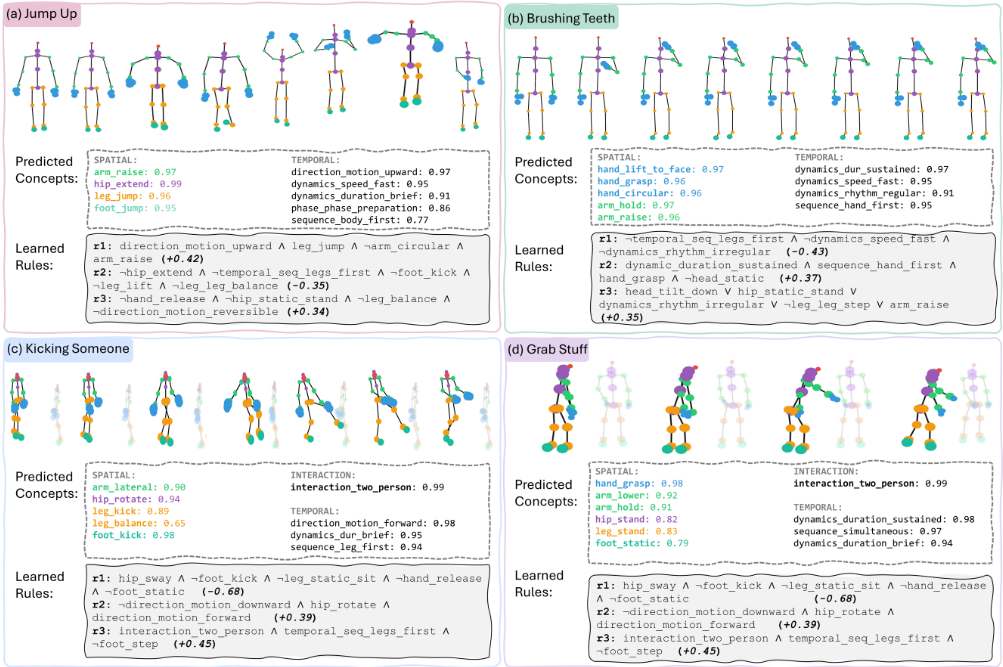
Beyond accuracy, our framework provides transparent reasoning through learned concept-rule chains. Figure 3 visualizes the complete reasoning pipeline for representative actions. Skeleton poses are rendered with joint sizes scaled by concept activation confidence, revealing which body parts drive predictions. For BRUSHINGTEETH, the model activates intuitive concepts (hand lift to face, duration sustained, rhythm regular) and applies learned rules such as r1 : duration sustained ∧ hand grasp ∧ ¬head static (+0.37). This end-to-end transparency, from skeleton input to concept activations to logical rule firings, enables systematic analysis of both correct classifications and failure cases, a capability absent in existing methods.
4.4 Ablation Studies
We conduct ablations on NTU RGB+D 120 (Table 2). Backbone Generalization (Table 2a). Our framework is encoder-agnostic: across ST-GCN, 2s-AGCN, CTR-GCN, ST-GCN++, and Hyper-GCN, our approach consistently improves performance, demonstrating plug-and-play applicability for existing GCN encoders.
Component Analysis (Table 2b). Each module contributes incrementally: text alignment (Lalign) adds +0.9-1.2%, part divergence (Ldiv) +0.4-1.0%, and STC-Decoder +0.2-1.6%. STC-Decoder Configuration (Table 2c). Group-decoding with Gs = 8, Gt = 4 achieves optimal accuracy while cutting cross-attention cost ∼6× vs. per-concept queries (G = 74). Concept Vocabulary (Table 2d). Spatial concepts alone achieve 78.39%; adding temporal concepts yields +7.8% (86.15%), demonstrating that motion dynamics are critical for distinguishing actions with similar poses. Interaction concepts provide a further +1.2%.
Logic Layer Capacity (Table 2e). The 128-node configuration is optimal; smaller (64) lacks expressiveness while larger (256/512) overfits. Crucially, disabling negation causes catastrophic failure (49.87%), many actions require ¬concepts (e.g., STANDING needs ¬leg walk). Skip connections contribute +3.6% by preserving atomic concept access.
Concept Intervention (Table 2f). Replacing mispredicted concepts ˆ ci with ground-truth c∗i improves accuracy monotonically: +1.9% (1 concept), +3.9% (2), +5.7% (3). This confirms that logic layers capture faithful concept-action relationships and errors stem from concept misprediction rather than flawed rules, enabling human-in-the-loop correction. Overall process of concept intervention is in Appendix H.
Feature Space Analysis Figure 4 compares t-SNE embeddings of Hyper-GCN features and STC-Decoder concept activations. Actions overlapping in the Hyper-GCN space (e.g., READING/WRITING, PUTON/TAKEOFFSHOE, THUMBUP/DOWN) are well separated in the concept space by discriminative temporal concepts (e.g., motion forward vs. motion backward), with similar separation for mutual actions (e.g., EXCHANGINGTHINGS, SHAKINGHANDS).
| Backbone | Accuracy (%) | ||
|---|---|---|---|
| w/o Lalign | w/o Ldiv | w/ both | |
| ST-GCN | 80.07 | 81.15 | 82.40 |
| 2s-AGCN | 82.15 | 83.20 | 84.85 |
| CTR-GCN | 82.90 | 84.10 | 86.12 |
| ST-GCN++ | 83.25 | 84.65 | 86.70 |
| Hyper-GCN | 84.08 | 85.27 | 87.34 |
(a) Backbone ablation
| Model Configuration | X-Sub | X-Set |
|---|---|---|
| Hyper-GCN | 84.28 | 84.08 |
| + Text Alignment (Lalign) | 85.20 | 85.27 |
| + Part Divergence (Ldiv) | 86.20 | 85.70 |
| + STC-Decoder | 86.38 | 87.34 |
| Config | NOT | Skip | L1/L2 | Final | Acc. |
|---|---|---|---|---|---|
| Small | ✓ ✓ ✓ | ✓ ✓ | 64 | 390 | 83.60 |
| Medium | 128 | 646 | 87.34 | ||
| Large | ✓ | 256 | 1158 | 86.18 | |
| XLarge | ✓ | ✓ | 512 | 2182 | 81.38 |
| No Skip | ✓ | ✗ | 128 | 256 | 83.77 |
| No NOT | ✗ | ✓ | 128 | 579 | 49.87 |
(e) Logic layer capacity
| Intervention Level | Accuracy (%) | ∆Acc. |
|---|---|---|
| No intervention | 87.35 | - |
| Correct 1 concept | 89.23 | +1.88 |
| Correct 2 concepts | 91.21 | +3.86 |
| Correct 3 concepts | 93.02 | +5.67 |
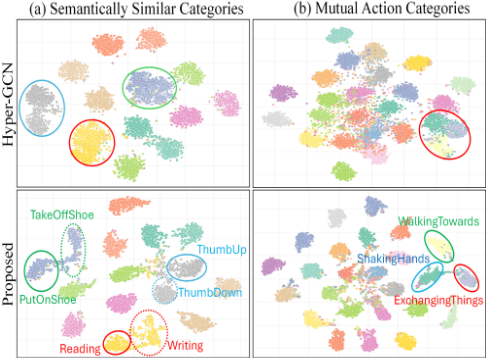
Figure 4: t-SNE visualization on NTU RGB+D 120. Hyper-GCN features (top) and our STC-decoder features (bottom). (a) Semantically similar action pairs. (b) Two-person interaction actions.
5 Conclusion
In this work, we presented REASON, a neurosymbolic framework that formulates skeleton-based HAR as logical reasoning over learnable motion concepts. Through concept grounding, spatio-temporal decoding, and differentiable logic, REASON achieves state-of-the-art performance while maintaining fully transparent concept-rule reasoning chains, establishing neurosymbolic learning as a promising paradigm for interpretable skeleton-based HAR.
@inproceedings{ijcai2026p138,
  title     = {Neurosymbolic Framework for Concept-Driven Logical Reasoning in Skeleton-Based Human Action Recognition},
  author    = {Ilyas, Talha and Mehta, Deval and Ge, Zongyuan},
  booktitle = {Proceedings of the Thirty-Fifth International Joint Conference on
               Artificial Intelligence, {IJCAI-26}},
  publisher = {International Joint Conferences on Artificial Intelligence Organization},
  editor    = {Diego Calvanese},
  pages     = {1233--1242},
  year      = {2026},
  month     = {8},
  note      = {Main Track},
  doi       = {10.24963/ijcai.2026/138},
  url       = {https://doi.org/10.24963/ijcai.2026/138},
}
TY - CPAPER TI - Neurosymbolic Framework for Concept-Driven Logical Reasoning in Skeleton-Based Human Action Recognition AU - Ilyas, Talha AU - Mehta, Deval AU - Ge, Zongyuan T2 - Proceedings of the Thirty-Fifth International Joint Conference on Artificial Intelligence, IJCAI-26 PB - International Joint Conferences on Artificial Intelligence Organization PY - 2026 SP - 1233 EP - 1242 DO - 10.24963/ijcai.2026/138 UR - https://doi.org/10.24963/ijcai.2026/138 ER -Copied
Machine-readable versions of this paper, for tools and AI agents:





