
TaylorMoDe-GS: Taylor-Driven Gaussian Splatting Motion Model for Multi-View Dynamic Scene Deblurring
Proceedings of the Thirty-Fifth International Joint Conference on Artificial Intelligence. Main Track. Pages 1568-1576.
https://doi.org/10.24963/ijcai.2026/175
Keywords
- Computer Vision: Image and video synthesis and generation
- Computer Vision: 3D computer vision
- Computer Vision: Low-level Vision
Abstract
While 3D Gaussian Splatting (3DGS) has excelled in dynamic scene reconstruction, it struggles with multi-view object motion blur, where view-dependent non-uniform blur violates fundamental multi-view geometric constraints. Existing methods fail to balance complex motion fitting with physical consistency across different views. To address the challenge, we propose TaylorMoDe-GS, the first 3DGS framework tailored for multi-view dynamic object deblurring. Specifically, we shift the modeling paradigm from displacement fitting to velocity driven modeling. This is achieved by analytically deriving instantaneous 3D velocities via Taylor series. To map 3D physical motion onto the 2D image plane, we propose a velocity splatting technique. Building upon this, we introduce a neural Peano remainder network to compensate for high frequency non-linear dynamics, effectively resolving the conflict between physical priors and fitting flexibility. Combined with a learnable physical blur synthesis mechanism, our framework ensures rigorous spatiotemporal and view consistency. Extensive experimental results validate that our method achieves notable advancements in restoring high-fidelity dynamic scenes and physically consistent motion fields, effectively addressing the challenges of multi-view dynamic object deblurring. The code is released at https://github.com/Chiffin-0816/TaylorMoDe-GS.
- [Bui et al., 2025] Minh-Quan Viet Bui, Jongmin Park, Jihy- ong Oh, and Munchurl Kim. MoBlurF: Motion deblurring neural radiance fields for blurry monocular video. IEEE Transactions on Pattern Analysis and Machine Intelligence (TPAMI), 2025.
- [Chen and Liu, 2024] Wenbo Chen and Ligang Liu. Deblur- GS: 3D Gaussian splatting from camera motion blurred images. Proceedings of the ACM on Computer Graphics and Interactive Techniques, 7(1):1-15, 2024.
- [Chen et al., 2022] Liangyu Chen, Xiaojie Chu, Xiangyu Zhang, and Jian Sun. Simple baselines for image restora- tion. In Proceedings of the European Conference on Com- puter Vision (ECCV), pages 17-33. Springer, 2022.
- [Chen et al., 2023] Zhang Chen, Zhong Li, Liangchen Song, Lele Chen, Jingyi Yu, Junsong Yuan, and Yi Xu. NeuRBF: A neural fields representation with adaptive radial basis functions. In Proceedings of the IEEE/CVF International Conference on Computer Vision (ICCV), pages 4182-4194, 2023.
- [Chung et al., 2024] Jaeyoung Chung, Jeongtaek Oh, and Ky- oung Mu Lee. Depth-regularized optimization for 3D Gaus- sian splatting in few-shot images. In Proceedings of the IEEE/CVF Conference on Computer Vision and Pattern Recognition (CVPR), pages 811-820, 2024.
- [Feng et al., 2025] Shengjie Feng, Xiaoqun Wu, and Jian Cao. A survey of multi-view stereo 3D reconstruction algo- rithms based on deep learning. Digital Signal Processing, 165:105291, 2025.
- [Gao et al., 2021] Chen Gao, Ayush Saraf, Johannes Kopf, and Jia-Bin Huang. Dynamic view synthesis from dynamic monocular video. In Proceedings of the IEEE/CVF Inter- national Conference on Computer Vision (ICCV), pages 5712-5721, 2021.
- [Guédon and Lepetit, 2024] Antoine Guédon and Vincent Lepetit. SuGaR: Surface-aligned Gaussian splatting for efficient 3D mesh reconstruction and high-quality mesh rendering. In Proceedings of the IEEE/CVF Conference on Computer Vision and Pattern Recognition (CVPR), pages 5354-5363, 2024.
- [Hu et al., 2025a] Bingbing Hu, Yanyan Li, Rui Xie, Bo Xu, Haoye Dong, Junfeng Yao, and Gim Hee Lee. Learnable infinite Taylor Gaussian for dynamic view rendering. In Proceedings of the IEEE/CVF Conference on Computer Vi- sion and Pattern Recognition (CVPR), pages 26844-26854, 2025.
- [Hu et al., 2025b] Yuxi Hu, Jun Zhang, Zhe Zhang, Rafael Weilharter, Yuchen Rao, Kuangyi Chen, Runze Yuan, and Friedrich Fraundorfer. ICG-MVSNet: Learning intra-view and cross-view relationships for guidance in multi-view stereo. In Proceedings of the IEEE International Confer- ence on Multimedia and Expo (ICME), pages 1-6. IEEE, 2025.
- [Huang et al., 2024] Yi-Hua Huang, Yang-Tian Sun, Ziyi Yang, Xiaoyang Lyu, Yan-Pei Cao, and Xiaojuan Qi. SC- GS: Sparse-controlled Gaussian splatting for editable dy- namic scenes. In Proceedings of the IEEE/CVF Confer- ence on Computer Vision and Pattern Recognition (CVPR), pages 4220-4230, 2024.
- [Keetha et al., 2024] Nikhil Keetha, Jay Karhade, Kr- ishna Murthy Jatavallabhula, Gengshan Yang, Sebastian Scherer, Deva Ramanan, and Jonathon Luiten. SplaTAM: Splat track & map 3D Gaussians for dense RGB-D SLAM. In Proceedings of the IEEE/CVF Conference on Com- puter Vision and Pattern Recognition (CVPR), pages 21357- 21366, 2024.
- [Keles ¸et al., 2021] Onur Keles ¸, M. Akın Yılmaz, A. Murat Tekalp, Cansu Korkmaz, and Zafer Dogan. On the com- putation of PSNR for a set of images or video. In 2021 Picture Coding Symposium (PCS), pages 1-5. IEEE, 2021.
- [Kerbl et al., 2023] Bernhard Kerbl, Georgios Kopanas, Thomas Leimkühler, and George Drettakis. 3D Gaussian Splatting for real-time radiance field rendering. ACM Trans- actions on Graphics (TOG), 42(4):139:1-139:14, 2023.
- [Kumar and Rajagopalan, 2025] Ashish Kumar and Am- basamudram Narayanan Rajagopalan. Dynamode-nerf: Motion-aware deblurring neural radiance field for dynamic scenes. In Proceedings of the IEEE/CVF Conference on Computer Vision and Pattern Recognition (CVPR), pages 21728-21738, June 2025.
- [Lee et al., 2024] Byeonghyeon Lee, Howoong Lee, Xiangyu Sun, Usman Ali, and Eunbyung Park. Deblurring 3D Gaus- sian Splatting. In Proceedings of the European Conference on Computer Vision (ECCV), pages 127-143. Springer, 2024.
- [Li et al., 2022] Tianye Li, Mira Slavcheva, Michael Zollhöfer, Simon Green, Christoph Lassner, Changil Kim, Tanner Schmidt, Steven Lovegrove, Michael Goesele, Richard Newcombe, and Zhaoyang Lv. Neural 3D video synthesis from multi-view video. In Proceedings of the IEEE/CVF Conference on Computer Vision and Pattern Recognition (CVPR), pages 5521-5531, June 2022.
- [Li et al., 2024] Zhan Li, Zhang Chen, Zhong Li, and Yi Xu. Spacetime Gaussian feature splatting for real-time dynamic view synthesis. In Proceedings of the IEEE/CVF Confer- ence on Computer Vision and Pattern Recognition (CVPR), pages 8508-8520, 2024.
- [Li et al., 2025] Jinxi Li, Ziyang Song, Siyuan Zhou, and Bo Yang. FreeGave: 3D physics learning from dy- namic videos by Gaussian velocity. In Proceedings of the IEEE/CVF Conference on Computer Vision and Pattern Recognition (CVPR), pages 12433-12443, 2025.
- [Lin et al., 2024] Youtian Lin, Zuozhuo Dai, Siyu Zhu, and Yao Yao. Gaussian-Flow: 4D reconstruction with dynamic 3D Gaussian particle. In Proceedings of the IEEE/CVF Conference on Computer Vision and Pattern Recognition (CVPR), pages 21136-21145, 2024.
- [Lu et al., 2025] Yiren Lu, Yunlai Zhou, Disheng Liu, Tuo Liang, and Yu Yin. BARD-GS: Blur-aware reconstruction of dynamic scenes via Gaussian Splatting. In Proceed- ings of the IEEE/CVF Conference on Computer Vision and Pattern Recognition (CVPR), pages 16532-16542, 2025.
- [Matsuki et al., 2024] Hidenobu Matsuki, Riku Murai, Paul H. J. Kelly, and Andrew J. Davison. Gaussian splatting SLAM. In Proceedings of the IEEE/CVF Conference on Computer Vision and Pattern Recognition (CVPR), pages 18039-18048, 2024.
- [Nah et al., 2017] Seungjun Nah, Tae Hyun Kim, and Ky- oung Mu Lee. Deep Multi-scale Convolutional Neural Network for Dynamic Scene Deblurring. In 2017 IEEE Conference on Computer Vision and Pattern Recognition (CVPR), pages 257-265, 2017.
- [Schönberger and Frahm, 2016] Johannes L. Schönberger and Jan-Michael Frahm. Structure-from-Motion revisited. In Proceedings of the IEEE Conference on Computer Vision and Pattern Recognition (CVPR), pages 4104-4113, 2016.
- [Schönberger et al., 2016] Johannes L. Schönberger, Enliang Zheng, Jan-Michael Frahm, and Marc Pollefeys. Pixelwise view selection for unstructured Multi-View Stereo. In Pro- ceedings of the European Conference on Computer Vision (ECCV), pages 501-518. Springer, 2016.
- [Tran et al., 2021] Phong Tran, Anh Tuan Tran, Quynh Phung, and Minh Hoai. Explore image deblurring via en- coded blur kernel space. In Proceedings of the IEEE/CVF Conference on Computer Vision and Pattern Recognition (CVPR), pages 11956-11965, 2021.
- [Wang et al., 2004] Zhou Wang, Alan C. Bovik, Hamid R. Sheikh, and Eero P. Simoncelli. Image quality assessment: From error visibility to structural similarity. IEEE Transac- tions on Image Processing, 13(4):600-612, 2004.
- [Wang et al., 2025] Rui Wang, Quentin Lohmeyer, Mirko Meboldt, and Siyu Tang. DeGauss: Dynamic-static de- composition with Gaussian splatting for distractor-free 3D reconstruction. In Proceedings of the IEEE/CVF Inter- national Conference on Computer Vision (ICCV), pages 6294-6303, 2025.
- [Wu et al., 2024] Guanjun Wu, Taoran Yi, Jiemin Fang, Lingxi Xie, Xiaopeng Zhang, Wei Wei, Wenyu Liu, Qi Tian, and Xinggang Wang. 4D Gaussian Splatting for real-time dynamic scene rendering. In Proceedings of the IEEE/CVF Conference on Computer Vision and Pattern Recognition (CVPR), pages 20310-20320, 2024.
- [Wu et al., 2025] Jiahao Wu, Rui Peng, Zhiyan Wang, Lu Xiao, Luyang Tang, Jinbo Yan, Kaiqiang Xiong, and Ronggang Wang. Swift4D: Adaptive divide-and-conquer Gaussian splatting for compact and efficient reconstruc- tion of dynamic scene. In Proceedings of the International Conference on Learning Representations (ICLR), 2025.
- [Xie et al., 2024] Tianyi Xie, Zeshun Zong, Yuxing Qiu, Xuan Li, Yutao Feng, Yin Yang, and Chenfanfu Jiang. Phys- Gaussian: Physics-integrated 3D Gaussians for generative dynamics. In Proceedings of the IEEE/CVF Conference on Computer Vision and Pattern Recognition (CVPR), pages 4389-4398, 2024.
- [Xu et al., 2025] Zhankuo Xu, Chaoran Feng, Yingtao Li, Jianbin Zhao, Jiashu Yang, Wangbo Yu, Li Yuan, and Yonghong Tian. Breaking the vicious cycle: Coherent 3D Gaussian splatting from sparse and motion-blurred views. arXiv preprint arXiv:2512.10369, 2025.
- [Yang et al., 2023] Jinyu Yang, Mingqi Gao, Zhe Li, Shang Gao, Fangjing Wang, and Feng Zheng. Track Anything: Segment Anything meets videos. In Proceedings of the IEEE/CVF International Conference on Computer Vision (ICCV), 2023.
- [Yang et al., 2024a] Lihe Yang, Bingyi Kang, Zilong Huang, Zhen Zhao, Xiaogang Xu, Jiashi Feng, and Hengshuang Zhao. Depth Anything V2. Advances in Neural Information Processing Systems (NeurIPS), 37:21875-21911, 2024.
- [Yang et al., 2024b] Ziyi Yang, Xinyu Gao, Wen Zhou, Shao- hui Jiao, Yuqing Zhang, and Xiaogang Jin. Deformable 3D Gaussians for high-fidelity monocular dynamic scene reconstruction. In Proceedings of the IEEE/CVF Confer- ence on Computer Vision and Pattern Recognition (CVPR), pages 20331-20341, 2024.
- [Yin et al., 2025] Zhenyu Yin, Xiaohui Wang, Feiqing Zhang, Xiaoqiang Shi, and Dan Feng. MVD-NeRF: Multi-view deblurring neural radiance fields from defocused images. Image and Vision Computing, 153:105876, 2025.
- [Zhang et al., 2018] Richard Zhang, Phillip Isola, Alexei A. Efros, Eli Shechtman, and Oliver Wang. The unreasonable effectiveness of deep features as a perceptual metric. In Proceedings of the IEEE Conference on Computer Vision and Pattern Recognition (CVPR), pages 586-595, 2018.
- [Zhang et al., 2025] Xuankai Zhang, Junjin Xiao, and Qing Zhang. Dynamic Gaussian splatting from defocused and motion-blurred monocular videos. In Advances in Neural Information Processing Systems (NeurIPS), 2025.
- [Zhao et al., 2024] Lingzhe Zhao, Peng Wang, and Peidong Liu. BAD-Gaussians: Bundle adjusted deblur Gaussian Splatting. In Proceedings of the European Conference on Computer Vision (ECCV), pages 233-250. Springer, 2024.
- [Zhong et al., 2022] Zhihang Zhong, Xiao Sun, Zhirong Wu, Yinqiang Zheng, Stephen Lin, and Imari Sato. Animation from blur: Multi-modal blur decomposition with motion guidance. In Proceedings of the European Conference on Computer Vision (ECCV), pages 599-615. Springer, 2022.
- [Zhong et al., 2023] Zhihang Zhong, Mingdeng Cao, Xiang Ji, Yinqiang Zheng, and Imari Sato. Blur interpolation transformer for real-world motion from blur. In Proceed- ings of the IEEE/CVF Conference on Computer Vision and Pattern Recognition (CVPR), pages 5713-5723, 2023.
References were extracted automatically from the PDF and may contain errors.
Full text extracted automatically from the PDF; figures, tables and equations may differ. The PDF is the version of record.
1 Introduction
Despite the success of 3DGS in dynamic reconstruction [Wu et al., 2024], recovering multi-view dynamic scenes from motion-blurred observations remains a significant bottleneck [Kumar and Rajagopalan, 2025; Hu et al., 2025a]. Unlike static deblurring which assumes global camera motion [Zhao et al., 2024; Chen and Liu, 2024], dynamic blur arises from the independent 3D trajectories of local objects integrated over the exposure time [Lu et al., 2025]. Due to motion parallax, these 3D motions project into anisotropic, view-dependent 2D blur kernels across different camera poses [Li et al., 2022].
∗Corresponding author.
This lack of instantaneous consistency violates fundamental multi-view geometric constraints [Matsuki et al., 2024; Keetha et al., 2024], leading models to erroneously compensate for local motion through geometric deformation, which results in severe topological distortions and artifacts [Feng et al., 2025].
Existing blurred scene reconstruction models exhibit significant inadequacies when addressing multi-view dynamic object motion blur [Yin et al., 2025; Hu et al., 2025b]. First, multi-view static deblurring methods generally assume that blur stems from global camera motion such as camera jitter or defocus [Zhao et al., 2024; Lee et al., 2024]. Their modeling logic relies on global camera pose transformations and lacks the perception of independent 3D trajectories for local objects within the scene. When applied to dynamic scenes, these methods fail to handle asymmetric local blur as the global geometric constraints are violated. Second, single-view dynamic deblurring methods [Gao et al., 2021; Zhang et al., 2025; Bui et al., 2025] attempt to fit motion trajectories through temporal deformation fields. However, these are essentially highly under-determined black-box fittings. Without explicit cross space physical mapping, the learned blur kernels fail to converge into a unified motion vector field in 3D space, leading to severe ill-posed deformations during multi-view optimization rather than recovering true physical motion laws.
Recent dynamic reconstruction advancements primarily follow two paradigms: enhancing explicit representations like 4D-GS [Wu et al., 2024] and Deformable 3DGS [Yang et al., 2024b], or employing scene decomposition as seen in Swift4D [Wu et al., 2025] and DeGauss [Wang et al., 2025] to separate dynamic and static components. While these excel in interframe modeling, deblurring requires capturing microscopic motion within the exposure. Current frameworks, such as our baseline Learnable Infinite Taylor Gaussian [Hu et al., 2025a], focus on "positional evolution" by using Taylor expansions to approximate Gaussian offsets. Nonetheless, such displacement-fitting tends to neglect the underlying physical constraints of intra-exposure motion.
In this work, we contend that modeling positional evolution alone is insufficient for the deblurring task. Blur [Zhong et al., 2023; Zhong et al., 2022] is the physical result of velocity integrated over time; displacement is merely the cumulative effect of this process. Therefore, we advocate for a paradigm shift from "displacement fitting" to "instantaneous velocity derivative modeling". As the first-order derivative of displacement, velocity more fundamentally carries the laws of dynamics and provides a physically meaningful integrand for blur kernel synthesis [Tran et al., 2021]. Through this paradigm shift, we naturally incorporate differential priors and ensure that multiview observations strictly converge to a unified 3D motion vector field [Lin et al., 2024].
Based on the insights, we propose TaylorMoDe-GS, a framework that deeply couples physical analytical modeling with neural flexibility [Xie et al., 2024; Li et al., 2025]. First, we derive the instantaneous velocity by analytically differentiating the Taylor motion model, ensuring strict alignment with geometric positions. To bridge the representation gap between 3D physical motion and 2D pixel observations, we introduce velocity splatting. This technique utilizes a customized differentiable rasterization module to explicitly project and accumulate 3D velocities into a continuous 2D world velocity map. To address truncation errors in finite-order Taylor expansions, we introduce the Peano remainder network. Taking the splatted physical velocity map as a strong prior, this network employs a residual learning strategy to capture high frequency, non-linear velocity components. This hybrid "physical principle + neural residual" formulation overcomes the accuracy bottlenecks of traditional Taylor modeling in complex motions while avoiding the rigidity of partial differential equation-based constraints [Chen et al., 2023].
Finally, we construct a learnable physical blur synthesis mechanism to close the optimization loop. By establishing a rigorous 2D-3D-2D mapping, back projecting pixels using hybrid depth priors, evolving trajectories via the learned velocity field, and re-projecting into image space, we explicitly synthesize physical blur kernels. This process naturally preserves motion parallax, ensuring that multi-view blurry observations provide strong constraints for a unified 3D motion field. Furthermore, we implement a gradient decoupling strategy to isolate static background gradients, ensuring the model fits observations by refining motion parameters rather than distorting static geometry. Our contributions are summarized as follows:
- We propose TaylorMoDe-GS, the first 3DGS framework tailored for multi-view dynamic object deblurring, enabling high-fidelity reconstruction from blurry video inputs.
- We propose Taylor-Driven velocity model, utilize taylor series to explicitly model 3D velocity and introduce velocity splatting to map spatial dynamics to the 2D plane, coupled with peano remainder compensation to maintain multi-view geometric consistency.
- We develop a learnable physical blur synthesis mechanism, accurately decouples motion blur through explicit physical projection, ensuring the structural stability of the reconstructed 3D scene.
2 RelatedWork
Dynamic Scene Reconstruction. In recent years, 3D Gaussian Splatting (3DGS) [Kerbl et al., 2023] has emerged as a dominant paradigm for dynamic scene reconstruction due to its explicit representation and exceptional rendering efficiency. 4DGS [Wu et al., 2024] decouples spatiotemporal features through 4D neural voxels, while Deformable 3DGS [Yang et al., 2024b] proposes learning deformation fields in canonical space to predict positional offsets. Furthermore, SCGS [Huang et al., 2024] and Spacetime Gaussians [Li et al., 2024] respectively introduce structure-consistent constraints and 4D temporal-spatial representations to improve dynamic modeling. To enhance reconstruction quality in complex environments, Swift4D [Wu et al., 2025] and DeGauss [Wang et al., 2025] respectively introduce efficient dynamic-static decomposition strategies, utilizing masking mechanisms to filter out dynamic distractors. Furthermore, Infinite Taylor Gaussian [Hu et al., 2025a] employs Taylor series to capture the continuous evolution of scene attributes. Despite the superior performance of these methods in sharp image reconstruction, they generally assume ideal sharp observations and lack physical mechanisms to account for temporal integration effects. When addressing multi-view motion blur [Xu et al., 2025], existing methods struggle to balance complex motion fitting with physical consistency, often erroneously compensating for local motion by distorting geometry, which leads to severe topological distortions.
Deblurring-based Scene Reconstruction. Existing deblurring approaches exhibit significant inadequacies when addressing multi-view dynamic scenarios. On one hand, static methods like BAD-Gaussians [Zhao et al., 2024] and Deblur-GS [Chen and Liu, 2024] rely on a global camera motion assumption [Nah et al., 2017], failing to perceive independent 3D trajectories of local objects. This leads to failure when handling asymmetric local blur where global geometric constraints are violated. On the other hand, monocular dynamic methods such as BARD-GS [Lu et al., 2025] attempt to fit motion via deformation fields, but suffer from the inherent under-determination of monocular views and the "spectral bias" of Multi-Layer Perceptron. Without explicit 3D-2D physical mapping, the learned blur kernels often fail to converge to a unified 3D motion field, causing severe ill-posed deformations during multi-view optimization. In contrast, our TaylorMoDe-GS bridges this gap through velocity-driven modeling.
Physics-Driven Modeling. To mitigate the limitations of heuristic deformation, recent research has begun injecting physical laws into Gaussian dynamics. For instance, PhysGaussian [Xie et al., 2024] and FreeGave [Li et al., 2025] enhance 4D reconstruction realism by introducing velocity fields and newtonian constraints. Building upon these physics aware representations, our work shifts the paradigm from simple displacement fitting to instantaneous velocity derivative modeling. By utilizing explicit physical projection ,such as velocity splatting, we bridge the gap between 3D motion dynamics and 2D blurry observations, ensuring that the recovered motion fields and scene geometry remain strictly consistent across multiple views.
3 Methodology
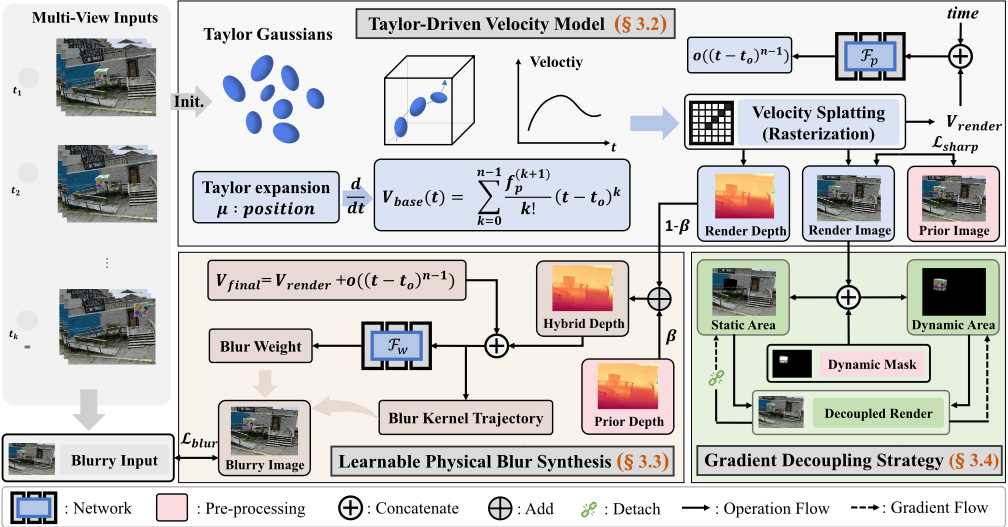
We propose TaylorMoDe-GS, a physics-aware dynamic deblurring framework based on 3D Gaussian Splatting, specifically designed to recover sharp, high-fidelity scenes from multi-view videos with motion blur. Distinct from traditional implicit deformation fields or linear motion assumptions, we employ Taylor expansions to explicitly model the physical blurring process. This approach bridges the gap between the continuous motion of Gaussian primitives and the resulting motion blur during exposure. In Sec. 3.1, we introduce the foundational theory. Subsequently, Sec. 3.2 details our motion model based on Taylor derivatives and the Peano remainder. Sec. 3.3 describes the learnable physical blur synthesis mechanism that simulates the exposure integration process. Finally, in Sec. 3.4, we present our optimization strategies and loss functions, incorporating a gradient decoupling strategy and hybrid priors to solve the ambiguities between geometry and motion.
3.1 Preliminaries
3DGaussian Splatting (3DGS). 3DGS [Kerbl et al., 2023] parameterizes a scene as a collection of 3D Gaussians G = {G1, . . . , GN}. Each primitive is parameterized by its center µi ∈ R3 , covariance matrix Σi ∈ R3×3 , opacity αi ∈ [0, 1], and spherical harmonics (SH) coefficients ci. To render an image, 3D Gaussians are projected onto the 2D image plane. The pixel color C is then synthesized via differentiable αblending of N sorted primitives:
where N denotes the set of Gaussians overlapping the target pixel.
Dynamic 3D Gaussians. We extend the static representation to the temporal domain by introducing a time variable t. A dynamic Gaussian primitive G(t) is formulated as a time-dependent tuple: G(t) = {µ(t),Σ(t), c(t), α(t)}. In this work, we focus on explicitly parameterizing the position trajectory µ(t) to model the continuous motion required for blur synthesis during the exposure time τ .
Infinite Taylor Gaussian Model. Inspired by the Infinite Taylor Gaussian (ITG) framework [Hu et al., 2025a], we parameterize the trajectory of the Gaussian position µ(t) via a Taylor series expanded at a reference time t0, rather than learning discrete parameters per timestamp. The trajectory is defined as:
where f (k) p ∈ R3 denotes the learnable k-th order Taylor coefficient, which represents the k-th derivative of the position function. Rn(t) represents the neural Peano remainder, designed to compensate for nonlinearities that low-order polynomials fail to capture. This formulation enables the analytical velocity derivation in Sec. 3.2.
3.2 Taylor-Driven VelocityModel
Taylor Series VelocityModel. Departing from traditional methods that learn discrete displacement vectors, we model the short-term trajectory of each Gaussian as a continuous smooth function. By analytically differentiating the Taylor expansion defined in Eq. (2), we obtain the instantaneous base velocity Vbase(t) consistent with the positional change:
This explicit derivation ensures that the velocity field aligns strictly with the physical motion trajectory.
Velocity Splatting. To achieve precise blur synthesis based on 3D motion, it is necessary to accurately accumulate the motion of visible surfaces onto the image plane. Inspired by the accumulation mechanism in depth rendering, we propose a velocity splatting strategy based on the physical rendering logic of 3DGS. We develop a customized differentiable rasterization module to explicitly project and accumulate the 3D base velocity Vbase onto the image plane. Utilizing the same α-blending mechanism used for color to account for perceptual visibility, we compute a dense rendered world velocity map Vrender:
where u denotes pixel coordinates, αi is opacity, and Ti = ∏i-1 j=1 (1-αj) represents transmittance. This operation transforms the discrete, unstructured 3D Gaussian representation into a continuous 2D field Vrender, representing the pixel-wise physical velocity.
Peano Remainder Compensation Network. Since the base velocity Vbase derived from low order Taylor expansions suffers from truncation errors, it often misses complex nonlinear dynamics. To recover these residuals (mathematically corresponds to the Peano remainder), we introduce a Peano remainder network. Using the rendered velocity Vrender as a physical prior, we feed it along with a time embedding γ(t) into a lightweight MLP to predict the velocity residual Rpeano:
The final velocity is given by Vfinal = Vrender + Rpeano. By modeling only the residual, the network compensates for nonlinearities without needing to learn the entire motion field.
3.3 Learnable Physical Blur Synthesis Mechanism
To simulate the physical exposure process, we synthesize motion blur by integrating radiance over the exposure time τ. This synthesis relies on three key components: incorporating hybrid geometric priors, deriving the blur kernel trajectory, and predicting adaptive weights via a blur weight network.
Hybrid Geometric Priors. Precise 3D localization is a prerequisite for accurate physical blur synthesis. However, relying solely on the rendered depth Drender is unstable, particularly in early training. Depth errors result in incorrect 3D back-projection, distorting the blur kernel trajectory. To mitigate this geometric instability, we utilize hybrid geometric priors [Chung et al., 2024]. We construct a stable depth map Din by blending the rendered depth with a prior Dprior derived from a pre-trained monocular estimator:
where β is a balancing coefficient. This hybrid depth Din provides a robust geometric basis for trajectory estimation, ensuring stability despite noise in the reconstructed geometry [Gu´edon and Lepetit, 2024].
Blur Kernel Trajectory. We utilize the Track-Anything Model (TAM) to generate a binary mask Mdyn isolating dynamic objects. The dynamic pixel set is defined as Ωdyn = {u | Mdyn(u) = 1}. Each dynamic pixel u ∈ Ωdyn corresponds to a 3D point traversing a motion trajectory during the exposure time τ. We treat τ as a learnable variable rather than a fixed hyperparameter, allowing the integration window to adapt to scene dynamics.
To simulate shutter integration, we discretize the exposure interval [-τ/2, τ/2] into N uniformly distributed timestamps. Let i ∈ {0, . . . ,N -1} be the time index, the time offset ti is defined as:
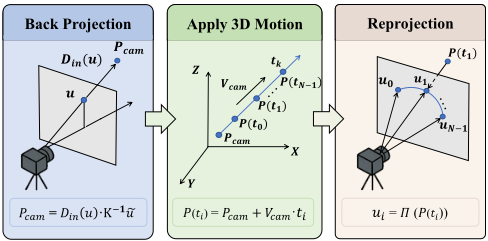
As shown in Figure 2, we back-project pixel u into camera space using the hybrid depth Din to obtain the initial position Pcam:
where K is the camera intrinsic matrix, and ˜u denotes homogeneous coordinates. The velocity Vfinal is transformed into the camera coordinate system via the rotation matrix Rview:
For each timestamp ti, projecting the instantaneous 3D position onto the image plane yields the sample coordinate ui:
where Π(·) denotes the perspective projection function. Deriving the 2D trajectory from 3D geometry allows this formulation to preserve motion parallax.
Blur Weight Network. While the trajectory defines the sampling path, the contribution of each sample to the final pixel color varies. This variation arises from two factors: (1) Motion Speed: Slower motion increases pixel dwell time (higher weight), whereas faster motion reduces intensity (lower weight). (2) Perspective Scale: Depth modulates projected motion, as distant objects show smaller apparent motion than nearby objects, concentrating the blur intensity.
To capture these dynamics, we employ a lightweight MLP that maps the velocity in camera space vcam(u) and hybrid depth Din(u) to a temporal weight vector w(u) ∈ RN :
where Fw denotes the weight prediction network, and wi represents the i-th element of w. The blurred color ˆ C(u) is then synthesized by accumulating colors along the trajectory:
where C denotes the rendered sharp image.
3.4 Optimization and Loss Functions
Our optimization strategy aims to decouple the ambiguity between geometry and motion by imposing separate constraints on the static background and dynamic foreground.
Decomposed Hybrid Supervision. We enforce consistency across both sharp and blurry domains to jointly optimize static structure and motion dynamics. To restore sharp textures, we construct a hybrid target Itarget by fusing the input background with the sharp foreground derived from a pre-trained deblurring model:
We constrain the rendered sharp image C to match this target using a combination of L1 and D-SSIM losses:
For motion blur synthesis, we minimize the reconstruction error constrained to the dynamic region:
To prevent the optimizer from distorting static geometry to fit this loss, we implement a gradient decoupling strategy. We explicitly detach the static background component during blur synthesis, ensuring that the model fits the observation by refining motion parameters rather than distorting the static background.
Physical Regularization. We impose three constraints to maintain physical consistency. First, to prevent geometric collapse, we align the rendered depth Drender with the prior Dprior by minimizing the L1 difference in the logarithmic domain:
where ϵ is a small constant for numerical stability. Second, for rigidly moving objects, we constrain the velocity field vcam using the object center displacement vguide:
Finally, to enforce temporal continuity, we regularize the weight network by penalizing abrupt changes between adjacent timestamps:
Total Objective. The final objective function is a weighted sum of the reconstruction and regularization terms:
4 Experiments
This section details the experimental evaluation of TaylorMoDe-GS. We compare our method with existing approaches using both quantitative metrics and qualitative visualizations. Additionally, we conduct ablation studies to verify the effectiveness of our core components.
4.1 Experimental Settings
Training Details. Our framework is implemented in PyTorch, with all experiments conducted on a single NVIDIA RTX A5000 GPU (24GB). Before training, we preprocess the data to acquire necessary priors: (1) We use DepthAnything V2 [Yang et al., 2024a] to extract monocular depth maps for geometric guidance; (2) We use NAFNet [Chen et al., 2022] to generate pseudo-sharp images for hybrid supervision; (3) We use Track-Anything Model (TAM) [Yang et al., 2023] to segment dynamic object masks Mdyn. To ensure geometric consistency, we follow the standard protocol using COLMAP [Sch¨onberger and Frahm, 2016; Sch¨onberger et al., 2016] to reconstruct sparse point clouds and camera poses.
For the introduced learnable modules, including the Peano remainder network (Fp) and the blur weight network (Fw), we use separate Adam optimizers with a learning rate of 1×10⁻⁴ and momentum parameters (0.9, 0.999). The learnable exposure time τ is also jointly optimized. For hyperparameters, we discretize the exposure integration into N = 7 timestamps and set the weight for the monocular depth prior to 0.3. The loss weights are set to: λblur = 0.5, λsmooth = 0.01, λdepth = 0.02, and λvel = 5 × 10⁻⁵ .
Datasets. We evaluate our method on the multi-view dynamic blur dataset provided by DynaMoDe-NeRF. This dataset contains 4 synthetic scenes (Cube, Lychee, Monkey, Sphere) rendered by Blender at 1024×768 resolution. Motion blur is simulated by temporally integrating high-frame-rate sharp videos. To ensure a unified experimental protocol across different baselines, we utilize a subset of 50 frames for training and evaluation. For each synchronized time step, we hold out one view as the test view and use the remaining views for training.
Baselines. Since TaylorMoDe-GS pioneers 3DGS-based multi-view deblurring, we compare it against state-of-the-art dynamic reconstruction methods, including 4DGS and Infinite Taylor Gaussian (ITG). Additionally, we include Swift4D and DeGauss to evaluate performance against recent staticdynamic decomposition approaches.
Metrics. We use PSNR [Keles¸ et al., 2021], SSIM [Wang et al., 2004], and LPIPS [Zhang et al., 2018] with AlexNet features to evaluate reconstruction and deblurring performance. Since motion blur primarily affects dynamic regions, we also report metrics computed within the dynamic mask Ωdyn to assess the recovery of moving objects.
4.2 Results and Comparisons
Quantitative Evaluation. Table 1 presents the quantitative results across four scenes. Swift4D and DeGauss fail to reconstruct blurred inputs, yielding notably lower scores across all metrics. While 4DGS and ITG achieve reasonable quality by fitting temporal deformations, they remain limited by motion blur ambiguity. In contrast, TaylorMoDe-GS outperforms all baselines. In terms of average performance, our method improves Dynamic PSNR by 1.9 dB compared to the ITG baseline. Furthermore, our method achieves the lowest LPIPS scores across all scenes and regions. This reduction in perceptual error confirms that our physical modeling restores superior perceptual quality globally, especially in dynamic regions.
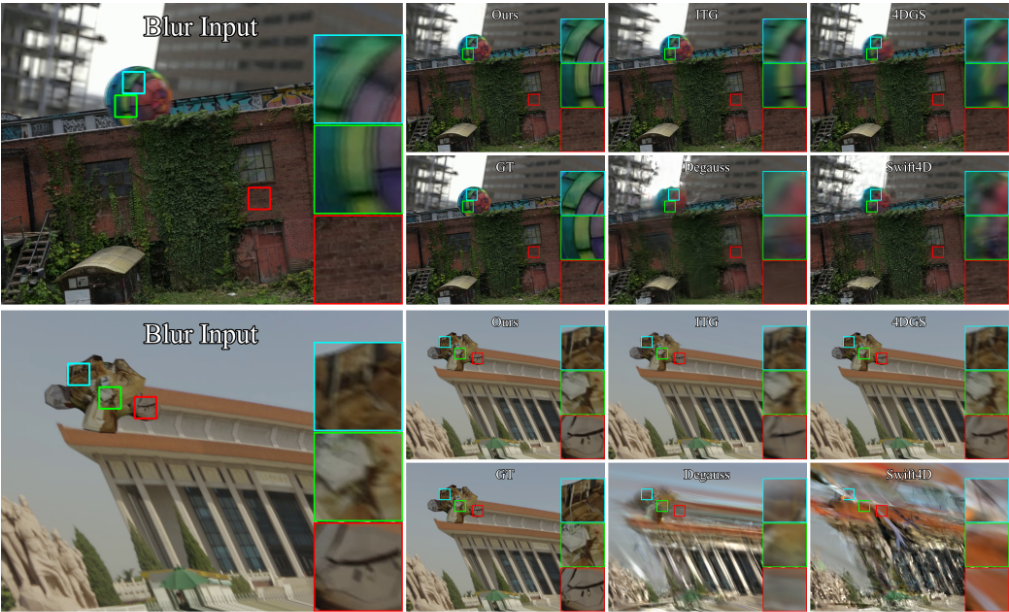
Qualitative Evaluation. Figure 3 compares the reconstruction results on the Monkey and Sphere scenes. Swift4D and DeGauss fail to model rapid motion, causing severe distortion across both background and foreground regions. While 4DGS and ITG maintain background stability, they produce visible residual blur and ghosting artifacts on moving objects. In contrast, TaylorMoDe-GS recovers sharp geometric details. As shown in the zoomed-in regions, our method restores fine structures, such as the facial geometry of the monkey and the surface texture of the sphere, which are lost in the baselines.
| Monkey | Sphere | |||||||||||
|---|---|---|---|---|---|---|---|---|---|---|---|---|
| Method | Overall | Dynamic | Overall | Dynamic | ||||||||
| PSNR↑ | SSIM↑ | LPIPS↓ | PSNR↑ | SSIM↑ | LPIPS↓ | PSNR↑ | SSIM↑ | LPIPS↓ | PSNR↑ | SSIM↑ | LPIPS↓ | |
| Swift4D[Wu et al., 2025] | 14.81 | 0.541 | 0.495 | 15.40 | 0.624 | 0.433 | 20.09 | 0.424 | 0.256 | 16.60 | 0.513 | 0.399 |
| DeGauss[Wang et al., 2025] | 14.93 | 0.614 | 0.362 | 18.73 | 0.644 | 0.388 | 19.56 | 0.479 | 0.363 | 16.03 | 0.569 | 0.420 |
| 4DGS[Wu et al., 2024] | 39.40 | 0.977 | 0.028 | 30.15 | 0.868 | 0.210 | 28.75 | 0.841 | 0.135 | 21.48 | 0.653 | 0.285 |
| ITG[Hu et al., 2025a] | 38.43 | 0.974 | 0.031 | 29.73 | 0.858 | 0.221 | 29.13 | 0.925 | 0.080 | 19.92 | 0.620 | 0.233 |
| TaylorMoDe-GS (Ours) | 40.88 | 0.982 | 0.016 | 33.79 | 0.928 | 0.088 | 31.76 | 0.940 | 0.052 | 22.57 | 0.666 | 0.112 |
| Cube | Lychee | |||||||||||
|---|---|---|---|---|---|---|---|---|---|---|---|---|
| Method | Overall | Dynamic | Overall | Dynamic | ||||||||
| PSNR↑ | SSIM↑ | LPIPS↓ | PSNR↑ | SSIM↑ | LPIPS↓ | PSNR↑ | SSIM↑ | LPIPS↓ | PSNR↑ | SSIM↑ | LPIPS↓ | |
| Swift4D[Wu et al., 2025] | 14.23 | 0.310 | 0.516 | 14.62 | 0.571 | 0.405 | 22.54 | 0.721 | 0.249 | 14.99 | 0.599 | 0.439 |
| DeGauss[Wang et al., 2025] | 14.22 | 0.352 | 0.531 | 16.31 | 0.589 | 0.476 | 21.22 | 0.715 | 0.311 | 14.13 | 0.575 | 0.414 |
| 4DGS[Wu et al., 2024] | 30.75 | 0.888 | 0.127 | 32.57 | 0.932 | 0.083 | 35.15 | 0.951 | 0.059 | 26.22 | 0.824 | 0.247 |
| ITG[Hu et al., 2025a] | 31.66 | 0.927 | 0.044 | 30.88 | 0.905 | 0.088 | 35.08 | 0.947 | 0.057 | 26.51 | 0.841 | 0.225 |
| TaylorMoDe-GS (Ours) | 32.63 | 0.943 | 0.032 | 31.65 | 0.920 | 0.027 | 35.08 | 0.948 | 0.050 | 26.63 | 0.848 | 0.159 |
| Overall | Dynamic | |||||
|---|---|---|---|---|---|---|
| Method | PSNR↑ | SSIM↑ | LPIPS↓ | PSNR↑ | SSIM↑ | LPIPS↓ |
| w/o Taylor Expansion | 34.25 | 0.939 | 0.058 | 28.45 | 0.823 | 0.131 |
| w/o Peano Remainder | 34.14 | 0.948 | 0.047 | 27.85 | 0.838 | 0.185 |
| w/o Gradient Decoupling | 32.84 | 0.937 | 0.057 | 28.25 | 0.840 | 0.100 |
| w/o Re-blurring Loss | 31.97 | 0.916 | 0.088 | 26.97 | 0.828 | 0.153 |
| w/o Hybrid Pseudo-GT | 34.07 | 0.947 | 0.049 | 27.80 | 0.838 | 0.183 |
| w/o Blur Weight Network | 33.20 | 0.943 | 0.053 | 27.52 | 0.824 | 0.152 |
| Ours Full | 35.09 | 0.953 | 0.038 | 28.66 | 0.841 | 0.096 |
4.3 Ablation Studies
We conduct ablation studies to evaluate the contribution of individual modules. The analysis is organized into two parts: core physical designs and auxiliary regularization terms.
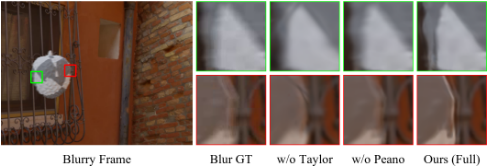
Effectiveness of Physical MotionModel. We evaluate the physical motion model consisting of the Taylor expansion and the Peano remainder. Fig. 4 illustrates the necessity of these components. w/o Taylor Expansion replaces physics-based derivative modeling with direct velocity prediction using an MLP, which results in physically inconsistent motion estimates and introduces geometric distortions and rendering artifacts. w/o Peano Remainder limits the model to Taylor terms, which cannot capture high-order residuals or truncation errors, leaving residual blur and ghosting. Quantitative results in Table 2 indicate that black-box prediction and simplified Taylor modeling do not fully recover complex dynamic trajectories.
Analysis of Other Core Designs. Table 2 evaluates other core designs. w/o Gradient Decoupling allows dynamic error gradients to affect static parameter optimization, which causes background geometry to distort to fit dynamic residuals. w/o Re-blurring Loss removes the explicit physical constraint on the blur formation process and decreases reconstruction consistency. w/o Hybrid Pseudo-GT eliminates sharp image guidance, preventing the model from converging to a sharp state in dynamic regions. w/o adaptive weights replaces the learnable weighting network with uniform weights, ignoring photometric contribution variations from parallax and motion divergence and leading to integration bias.
| Overall | Dynamic | |||||
|---|---|---|---|---|---|---|
| Method | PSNR↑ | SSIM↑ | LPIPS↓ | PSNR↑ | SSIM↑ | LPIPS↓ |
| w/o Smoothness Reg. | 33.59 | 0.946 | 0.047 | 28.43 | 0.838 | 0.102 |
| w/o Velocity Reg. | 32.88 | 0.939 | 0.057 | 28.28 | 0.833 | 0.143 |
| w/o All Regs. | 33.78 | 0.946 | 0.045 | 27.58 | 0.824 | 0.115 |
| Ours Full | 35.09 | 0.953 | 0.038 | 28.66 | 0.841 | 0.096 |
Analysis of Regularization Terms. Table 3 assesses the impact of auxiliary regularization. Specifically, the rigid velocity constraint narrows the solution space, aligning 3D motion fields with blur trajectories. Temporal smoothness enforces trajectory continuity across frames. The performance drop observed upon removing these terms underscores their necessity for stabilizing the joint optimization process.
5 Conclusions
This paper presents TaylorMoDe-GS, the first 3DGS-based framework for multi-view dynamic object deblurring. By transitioning from displacement fitting to instantaneous velocityderivative modeling, we overcome the physical limitations of existing models in handling intra-exposure integration effects. Our Taylor derived velocity field, coupled with neural peano remainder compensation, successfully balances rigid physical priors with high-frequency non-linear dynamics. Furthermore, the proposed velocity splatting and 2D-3D-2D physical mapping ensure rigorous cross-view geometric and motion consistency. Our velocity-driven method outperforms displacementbased approaches by analytically modeling physical motion from multiple blurred viewpoints. This multi-view motion representation effectively resolves the inherent ambiguity in motion-blurred observations, allowing reconstruction of sharp dynamic scenes and consistent 3D motion fields from blurry multi-view inputs.
Acknowledgments
This work was supported in part by the National Natural Science Foundation of China (NSFC) under Grants 62132006, U24A20220, and 62271237, the Natural Science Foundation of Jiangxi Province under Grants 20252BAC240227, 20252BAC230003, and 20242BAB26014, and the Postgraduate Innovation Special Fund Program of Jiangxi Province under Grant YC2024-B179.
@inproceedings{ijcai2026p175,
  title     = {TaylorMoDe-GS: Taylor-Driven Gaussian Splatting Motion Model for Multi-View Dynamic Scene Deblurring},
  author    = {Quan, Xiaofeng and Wan, Junzhe and Cai, Chao and Zuo, Yifan and Huang, Xiaoshui and Fang, Yuming},
  booktitle = {Proceedings of the Thirty-Fifth International Joint Conference on
               Artificial Intelligence, {IJCAI-26}},
  publisher = {International Joint Conferences on Artificial Intelligence Organization},
  editor    = {Diego Calvanese},
  pages     = {1568--1576},
  year      = {2026},
  month     = {8},
  note      = {Main Track},
  doi       = {10.24963/ijcai.2026/175},
  url       = {https://doi.org/10.24963/ijcai.2026/175},
}
TY - CPAPER TI - TaylorMoDe-GS: Taylor-Driven Gaussian Splatting Motion Model for Multi-View Dynamic Scene Deblurring AU - Quan, Xiaofeng AU - Wan, Junzhe AU - Cai, Chao AU - Zuo, Yifan AU - Huang, Xiaoshui AU - Fang, Yuming T2 - Proceedings of the Thirty-Fifth International Joint Conference on Artificial Intelligence, IJCAI-26 PB - International Joint Conferences on Artificial Intelligence Organization PY - 2026 SP - 1568 EP - 1576 DO - 10.24963/ijcai.2026/175 UR - https://doi.org/10.24963/ijcai.2026/175 ER -Copied
Machine-readable versions of this paper, for tools and AI agents:





