
GenID: A Generalizable Physical-Layer Device Identification Method for Out-of-Distribution Environments
Proceedings of the Thirty-Fifth International Joint Conference on Artificial Intelligence. Main Track. Pages 2091-2099.
https://doi.org/10.24963/ijcai.2026/233
Keywords
- Machine Learning: Open-World/Open-Set/OOD Learning
- Computer Vision: Representation learning
- Machine Learning: Time series and data streams
- Machine Learning: Feature extraction, selection and dimensionality reduction
- Data Mining: Anomaly/outlier detection
Abstract
Physical-layer device identification serves as a critical security mechanism for mitigating cyberattacks and enhancing network resilience. However, its deployment in modern full-duplex Ethernet networks faces two major challenges: (1) the presence of Out-of-Distribution (OOD) data caused by temporal distribution shift and diverse local transmitters, and (2) the difficulty of environment-agnostic device identification, where the unique features of target devices are often obscured in mixed signals. To address these challenges, we propose GenID, which consists of two core components. First, GenID constructs prototypes to emulate the full communication environment through a two stage process: offline and online. Based on the prototype context, it then introduces an invariant feature extraction method to disentangle mixed signals and improve generalization under OOD conditions.Extensive experiments demonstrate that GenID significantly outperforms state-of-the-art baselines, achieving an increase of at least 7.94\% in Macro-F1 score under OOD environments. Our code is available on https://github.com/zyw2004/GenID_IJCAI2026.
- [Al-Shawabka et al., 2025] Amani Al-Shawabka, Philip Pietraski, Sudhir B Pattar, Pedram Johari, and Tommaso Melodia. Signcrf: Scalable channel-agnostic data-driven radio authentication system. IEEE Transactions on Mobile Computing, 2025.
- [Brik et al., 2008] Vladimir Brik, Suman Banerjee, Marco Gruteser, and Sangho Oh. Wireless device identification with radiometric signatures. In Proceedings of the 14th ACM international conference on Mobile computing and networking, pages 116-127, 2008.
- [Carbino et al., 2015] Timothy J Carbino, Michael A Tem- ple, and Trevor J Bihl. Ethernet card discrimination us- ing unintentional cable emissions and constellation-based fingerprinting. In 2015 International Conference on Com- puting, Networking and Communications, pages 369-373. IEEE, 2015.
- [Cha et al., 2021] Junbum Cha, Hancheol Cho, Kyungjae Lee, Seunghyun Park, Yunsung Lee, and Sungrae Park. Domain generalization needs stochastic weight averag- ing for robustness on domain shifts. arXiv preprint arXiv:2102.08604, 3(3):13, 2021.
- [Choi et al., 2018] Wonsuk Choi, Kyungho Joo, Hyo Jin Jo, Moon Chan Park, and Dong Hoon Lee. Voltageids: Low- level communication characteristics for automotive intru- sion detection system. IEEE Transactions on Information Forensics and Security, 13(8):2114-2129, 2018.
- [Du et al., 2021] Yuntao Du, Jindong Wang, Wenjie Feng, Sinno Pan, Tao Qin, Renjun Xu, and Chongjun Wang. Adarnn: Adaptive learning and forecasting of time se- ries. In Proceedings of the 30th ACM international con- ference on information & knowledge management, pages 402-411, 2021.
- [Eldele et al., 2024] Emadeldeen Eldele, Mohamed Ragab, Zhenghua Chen, Min Wu, and Xiaoli Li. Tslanet: Re- thinking transformers for time series representation learn- ing. arXiv preprint arXiv:2404.08472, 2024.
- [Fu et al., 2023] Yuqian Fu, Yu Xie, Yanwei Fu, and Yu- Gang Jiang. Styleadv: Meta style adversarial training for cross-domain few-shot learning. In Proceedings of the IEEE/CVF conference on computer vision and pattern recognition, pages 24575-24584, 2023.
- [George et al., 2022] A Shaji George, AS Hovan George, T Baskar, and Digvijay Pandey. The transformation of the workspace using multigigabit ethernet. Partners Universal International Research Journal, 1(3):34-43, 2022.
- [Gerdes et al., 2012] Ryan M Gerdes, Mani Mina, Steve F Russell, and Thomas E Daniels. Physical-layer identifica- tion of wired ethernet devices. IEEE Transactions on In- formation Forensics and Security, 7(4):1339-1353, 2012.
- [Hall et al., 2004] Jeyanthi Hall, Michel Barbeau, Evangelos Kranakis, et al. Enhancing intrusion detection in wireless networks using radio frequency fingerprinting. Communi- cations, internet, and information technology, 1, 2004.
- [Han et al., 2023] Guangjie Han, Zhengwei Xu, Hongbo Zhu, Yunlu Ge, and Jinlin Peng. A two-stage model based on a complex-valued separate residual network for cross- domain iiot devices identification. IEEE Transactions on Industrial Informatics, 20(2):2589-2599, 2023.
- [He and Wang, 2020] Boxiang He and Fanggang Wang. Co- operative specific emitter identification via multiple dis- torted receivers. IEEE Transactions on Information Foren- sics and Security, 15:3791-3806, 2020.
- [Hippenstiel and Payal, 1996] Ralph D Hippenstiel and Yal- cin Payal. Wavelet based transmitter identification. In Fourth International Symposium on Signal Processing and Its Applications, volume 2, pages 740-742. IEEE, 1996.
- [Hollmann et al., 2022] Noah Hollmann, Samuel Müller, Katharina Eggensperger, and Frank Hutter. Tabpfn: A transformer that solves small tabular classification prob- lems in a second. In The Eleventh International Confer- ence on Learning Representations, 2022.
- [Huang et al., 2017] Guangquan Huang, Yingjun Yuan, Xi- ang Wang, and Zhitao Huang. Specific emitter iden- tification for communications transmitter using multi- measurements. Wireless Personal Communications, 94:1523-1542, 2017.
- [Khoee et al., 2024] Arsham Gholamzadeh Khoee, Yinan Yu, and Robert Feldt. Domain generalization through meta-learning: a survey. Artificial Intelligence Review, 57(10):285, 2024.
- [Kim et al., 2024] Jaeho Kim, Seok-Ju Hahn, Yoontae Hwang, Junghye Lee, and Seulki Lee. Cafo: Feature- centric explanation on time series classification. In Pro- ceedings of the 30th ACM SIGKDD Conference on Knowl- edge Discovery and Data Mining, pages 1372-1382, 2024.
- [LeCun et al., 2002] Yann LeCun, Léon Bottou, Yoshua Bengio, and Patrick Haffner. Gradient-based learning ap- plied to document recognition. Proceedings of the IEEE, 86(11):2278-2324, 2002.
- [Levy et al., 2023] Efrat Levy, Asaf Shabtai, Bogdan Groza, Pal-Stefan Murvay, and Yuval Elovici. Can-loc: Spoof- ing detection and physical intrusion localization on an in- vehicle can bus based on deep features of voltage signals. IEEE Transactions on Information Forensics and Security, 2023.
- [Li et al., 2022] Haoyang Li, Ziwei Zhang, Xin Wang, and Wenwu Zhu. Learning invariant graph representations for out-of-distribution generalization. Advances in Neural In- formation Processing Systems, 35:11828-11841, 2022.
- [Liu et al., 2022] Jiaqi Liu, Aiqun Hu, and Sheng Li. Spectrum-based fingerprint extraction and identification method of 100m ethernet card. In 2022 6th International Conference on Cryptography, Security and Privacy, pages 102-107. IEEE, 2022.
- [Lu et al., 2022] Wang Lu, Jindong Wang, Xinwei Sun, Yiqiang Chen, and Xing Xie. Out-of-distribution represen- tation learning for time series classification. arXiv preprint arXiv:2209.07027, 2022.
- [Mick, 2000] Colin Mick. Introduction to 100base-t: Fast (and faster) ethernet. In Network Design, pages 69-80.
- [Peng et al., 2019] Linning Peng, Junqing Zhang, Ming Liu, and Aiqun Hu. Deep learning based rf fingerprint identi- fication using differential constellation trace figure. IEEE Transactions on Vehicular Technology, 69(1):1091-1095, 2019.
- [Peng et al., 2021] Yang Peng, Pengfei Liu, Yu Wang, Guan Gui, Bamidele Adebisi, and Haris Gacanin. Radio fre- quency fingerprint identification based on slice integration cooperation and heat constellation trace figure. IEEE Wire- less Communications Letters, 11(3):543-547, 2021.
- [Peng et al., 2024] Yang Peng, Pengfei Liu, Qianyun Zhang, Lantu Guo, Yuchao Liu, Yu Wang, Yun Lin, and Guan Gui. Dynamic adaptation rff identification method leveraging cognitive representation learning. IEEE Transactions on Information Forensics and Security, 2024.
- [Polak et al., 2011] Adam C Polak, Sepideh Dolatshahi, and Dennis L Goeckel. Identifying wireless users via trans- mitter imperfections. IEEE Journal on selected areas in communications, 29(7):1469-1479, 2011.
- [Reising et al., 2020] Donald Reising, Joseph Cancelleri, T Daniel Loveless, Farah Kandah, and Anthony Skjellum. Radio identity verification-based iot security using rf-dna fingerprints and svm. IEEE Internet of Things Journal, 8(10):8356-8371, 2020.
- [Schroter et al., 2022] Hendrik Schroter, Alberto N Escalante-B, Tobias Rosenkranz, and Andreas Maier. Deepfilternet: A low complexity speech enhancement framework for full-band audio based on deep filtering. In IEEE International Conference on Acoustics, Speech and Signal Processing, pages 7407-7411. IEEE, 2022.
- [Shen et al., 2021] Guanxiong Shen, Junqing Zhang, Alan Marshall, Linning Peng, and Xianbin Wang. Radio fre- quency fingerprint identification for lora using deep learn- ing. IEEE Journal on Selected Areas in Communications, 39(8):2604-2616, 2021.
- [Shen et al., 2023] Guanxiong Shen, Junqing Zhang, Alan Marshall, Mikko Valkama, and Joseph Cavallaro. Towards length-versatile and noise-robust radio frequency finger- print identification. IEEE Transactions on Information Forensics and Security, 2023.
- [Shi et al., 2024] Ruize Shi, Hong Huang, Kehan Yin, Wei Zhou, and Hai Jin. Orthogonality matters: Invariant time series representation for out-of-distribution classification. In Proceedings of the 30th ACM SIGKDD Conference on Knowledge Discovery and Data Mining, pages 2674- 2685, 2024.
- [Sommer et al., 2010] Jorg Sommer, Sebastian Gunreben, Frank Feller, Martin Kohn, Ahlem Mifdaoui, Detlef Saß, and Joachim Scharf. Ethernet-a survey on its fields of application. IEEE Communications Surveys & Tutorials, 12(2):263-284, 2010.
- [Song et al., 2020] Chuanbiao Song, Kun He, Jiadong Lin, Liwei Wang, and John E. Hopcroft. Robust local features for improving the generalization of adversarial training. In International Conference on Learning Representations, 2020.
- [Vaswani et al., 2017] Ashish Vaswani, Noam Shazeer, Niki Parmar, Jakob Uszkoreit, Llion Jones, Aidan N Gomez, Łukasz Kaiser, and Illia Polosukhin. Attention is all you need. Advances in neural information processing systems, 30, 2017.
- [Vieira et al., 2010] Susana M Vieira, Uzay Kaymak, and João MC Sousa. Cohen's kappa coefficient as a perfor- mance measure for feature selection. In International con- ference on fuzzy systems, pages 1-8. IEEE, 2010.
- [Wang et al., 2022] Jindong Wang, Cuiling Lan, Chang Liu, Yidong Ouyang, Tao Qin, Wang Lu, Yiqiang Chen, Wen- jun Zeng, and Philip Yu. Generalizing to unseen domains: A survey on domain generalization. IEEE Transactions on Knowledge and Data Engineering, 2022. IJCAI
- [Wang et al., 2024] Junxiang Wang, Guangji Bai, Wei Cheng, Zhengzhang Chen, Liang Zhao, and Haifeng Chen. Pond: Multi-source time series domain adaptation with information-aware prompt tuning. In Proceedings of the 30th ACM SIGKDD Conference on Knowledge Discovery and Data Mining, pages 3140-3151, 2024.
- [Wang et al., 2025] Yuanchao Wang, Zhao-Rong Lai, and Tianqi Zhong. Out-of-distribution generalization for total variation based invariant risk minimization. arXiv preprint arXiv:2502.19665, 2025.
- [Xu et al., 2020] Zhenlin Xu, Deyi Liu, Junlin Yang, Colin Raffel, and Marc Niethammer. Robust and generalizable visual representation learning via random convolutions. In International Conference on Learning Representations, 2020.
- [Zhang et al., 2016] Jingwen Zhang, Fanggang Wang, Oc- tavia A Dobre, and Zhangdui Zhong. Specific emitter identification via hilbert-huang transform in single-hop and relaying scenarios. IEEE Transactions on Information Forensics and Security, 11(6):1192-1205, 2016.
- [Zhao et al., 2022] Shengkui Zhao, Bin Ma, Karn N Watcha- rasupat, and Woon-Seng Gan. Frcrn: Boosting feature representation using frequency recurrence for monaural speech enhancement. In IEEE international conference on acoustics, speech and signal processing, pages 9281- 9285. IEEE, 2022.
- [Zhong et al., 2025] Yingyi Zhong, Wen'an Zhou, and Zhix- ian Wang. A survey of data augmentation in domain gen- eralization. Neural Processing Letters, 57(2):34, 2025.
- [Zhou et al., 2023] Kaiyang Zhou, Yongxin Yang, Yu Qiao, and Tao Xiang. Mixstyle neural networks for domain gen- eralization and adaptation. International Journal of Com- puter Vision, pages 1-15, 2023.
References were extracted automatically from the PDF and may contain errors.
Full text extracted automatically from the PDF; figures, tables and equations may differ. The PDF is the version of record.
1 Introduction
The widespread adoption of the internet have significantly increased reliance on Ethernet networks. However, this increased connectivity also raises the risk of cyberattacks and security threats [Sommer et al., 2010], such as MAC address spoofing, firmware tampering, and switch port hijacking. To mitigate these risks, physical-layer device identification (PLDI), often referred to as Radio frequency (RF) fingerprinting [Zhang et al., 2016; Brik et al., 2008; Polak et al., 2011], has emerged as an effective security solution. PLDI aims to learn a device-unique fingerprint by utilizing the communication signal data that implies physically unclonable characteristics [Gerdes et al., 2012; Carbino et al., 2015; Liu et al., 2022]. Early PLDI methods relied on handcrafted features [Hall et al., 2004; Hippenstiel and Payal, 1996]. In
∗Lanting Fang is the corresponding author.
contrast, recent advancements leverage deep neural networks (DNNs) [Peng et al., 2019; Al-Shawabka et al., 2025] to learn discriminative representations directly from raw signal data. These DNN-based approaches automatically extract devicespecific features, enabling their use in more complex communication environments.
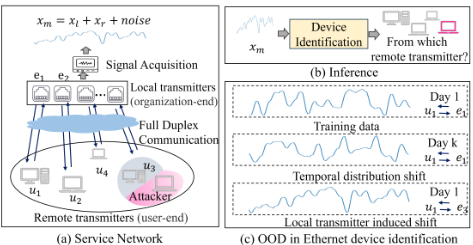
Most of existing PLDI methods are designed for halfduplex communication systems [Mick, 2000], where signals transmit in only one direction at a time. This design severely limits their applicability to full-duplex communication, which overwhelmingly adopted in modern Ethernet infrastructures [George et al., 2022]. As Figure 1 (a) shows, full-duplex communication support simultaneous bidirectional transmission over a single physical medium. In such systems, the acquired signal xm comprises a mix of the local transmitter's signal xl, the remote peer's signal xr, and environmental noise. We will hereafter refer to remote peer as the device for better distinguishing between these two signal sources. In this setting, the device's signal is entangled with other components in xm (Figure 1 (b)), posing unique challenges for device identification.
Specifically, the challenges of identifying devices in fullduplex system are two-fold: (1) Out-of-Distribution (OOD) environments. Existing PLDI models are highly susceptible to dynamic environmental shifts [Shen et al., 2021; Reising et al., 2020; He and Wang, 2020] including temporal distribution shift and local transmitter induced shift, as shown in Figure 1 (c). Temporal shifts arise when variations in ambient noise, temperature, or port configurations cause the same device-transmitter pair to produce different signals across days (e.g., Day 1 vs. Day k). Transmitterinduced shifts occur when the test-time transmitter differs from the one used during training (e.g., training with e1, testing with e3). While OOD generalization has been studied in domains like voice detection [Schroter et al., 2022; Zhao et al., 2022] and time series analysis [Lu et al., 2022; Wang et al., 2024], these methods do not transfer well to PLDI. This is primarily due to the nature of physical-layer signals: the device-specific features reside in extremely weak physical-layer characteristics that are easily overwhelmed by the dominant transmitter signal and ambient noise. Existing OOD methods may overlook these subtle features, leading to poor performances under distribution shifts. (2) Environment-agnostic device identification. In practice, the PLDI methods need to identify devices based on mixed signals, which introduces a major challenge: How to isolate environment-agnostic features from signals entangled by local transmitter and background noise. Existing environmentagnostic representation methods often adopt basic encoder architectures, such as CNNs [LeCun et al., 2002; Shi et al., 2024] or Transformers [Vaswani et al., 2017], to extract invariant and relevant feature representations. They combine task-specific learning strategies in model design to encourage feature disentanglement and are limit in environmentagnostic device feature extraction. For example, CNNs lack explicit mechanisms for separating mixed signal, and Transformers often overemphasize shared features, which hinders the extraction of device-specific information.
To address the aforementioned challenges, we propose GenID (GENeralizable Identification of Devices), which is the first work for PLDI under full-duplex and OOD settings. To master the varying environments and address the OOD problem, GenID introduces a set of anchor devices and constructs an offline feature dictionary that captures the unique signatures of local transmitters. When a device connects, GenID generates device-specific prototypes by integrating this dictionary with the incoming mixed signals based on a novel data augmentation method. These prototypes simulate how the device would perform with all local transmitters under diverse environments. Moreover, to extract environmentagnostic features, GenID leverages augmented mixed signals as input to the Invariant Feature Extraction (IFE) network. The IFE network employs an attention mechanism to assess the relevance of each feature dimension between the input signals and both inter- and intra-class prototypes. This process enables the network to distill the most salient and invariant device features, thereby ensuring reliable identification under dynamic environmental conditions.
- We propose GenID to achieve accurate device identification in full-duplex communication and OOD settings. To the best of our knowledge, GenID is the first PLDI method designed for full-duplex devices with OOD generalization.
- We design a novel mixed-signal augmentation technique that generates device-specific prototypes, simulating a variety of temporal and local transmitter conditions. Furthermore, we propose an Invariant Feature Extraction (IFE)
- network that leverages these prototypes to learn robust and discriminative device representations.
- Extensive experiments are conducted to verify the effectiveness and efficiency of GenID. The results show that GenID outperforms the state-of-the-art baselines with over 7.94% improvements of Macro-F1.
2 RelatedWork
2.1 Physical-Layer Device Identification
Device authentication methods can be broadly categorized into manual feature-based and deep learning-based approaches. Feature-based methods extract hand-crafted features such as signal amplitude and phase, followed by classification techniques like Euclidean distance [Hall et al., 2004; Hippenstiel and Payal, 1996] or traditional classifiers such as SVM [Reising et al., 2020; Carbino et al., 2015; Huang et al., 2017]. These approaches are lightweight but heavily depend on domain expertise and are often sensitive to environmental noise. In contrast, most deep learning-based approaches identify devices by inputting raw or minimally processed signals into deep neural networks. Peng et al.[Peng et al., 2021] transform I/Q samples into 2D representations and classify them using the InceptionV3 architecture. Shen et al. [Shen et al., 2023] apply short-time Fourier transform to obtain time-frequency representations and then feed them into a Transformer. However, these methods are primarily designed for in-distribution settings and often fail to generalize under OOD conditions.
2.2 OODGeneralization
OODGeneralization in PLDI. In PLDI, OOD challenges often arise from dynamic environmental shifts that distort signal characteristics. However, few studies explicitly address this issue. Existing methods typically rely on limited targetdomain data to adapt models trained on a source domain [AlShawabka et al., 2025; Han et al., 2023; Peng et al., 2024]. For example, SignCRF [Al-Shawabka et al., 2025] uses adversarial training with an environment translator to remove channel effects while preserving device-specific features.
In contrast, our approach seeks to achieve OOD generalization without any access to target-domain data.
General OODGeneralizationMethods. OOD generalization [Wang et al., 2022] approaches can be broadly categorized into three main strategies: data manipulation, learning strategies, and representation learning. Data manipulation techniques focus on increasing the diversity of the training data [Zhong et al., 2025], thereby exposing the model to a wider range of variations that might be encountered during testing. Learning strategies aim to enhance generalization by leveraging general learning frameworks, including techniques like ensemble learning [Cha et al., 2021] and metalearning [Khoee et al., 2024]. Among OOD generalization methods, representation learning is particularly prevalent. It primarily involves two strategies: domain invariant representation learning and feature disentanglement. Domaininvariant representation learning seeks features stable across domains using techniques like adversarial training [Fu et al.,
2023], feature alignment [Du et al., 2021], and invariant risk minimization [Wang et al., 2025]. Feature disentanglement aims to separate domain-shared from domain-specific components through methods such as causal inference [Li et al., 2022] and generative modeling [Kim et al., 2024].
Despite their success in other domains, general OOD generalization methods remain unexplored for physical-layer device identification. Physical-layer features are fine-grained, easily obscured by noise and transmitter interference, and often difficult to disentangle. As a result, these methods cannot be directly applied to this task.
3 Methodology
3.1 ProblemFormulation
Definition 1 (Physical-Layer Device Identification). Given a mixed signal segment x, produced by the interaction between a device u ∈ U u and a local transmitter e ∈ E, physical-layer device identification aims to predict the device u responsible for generating x.
Definition 2 (Temporal distribution shifts). The training signal segments Xtrain and the test signal segments Xtest are collected under different communication environments, leading to temporal distribution shifts.
Definition 3 (Local transmitter-induced shifts). The sets of local transmitters used for the training signal segments Xtrain and the test signal segments Xtest differ, inducing distribution shifts due to transmitter variations.
Problem Statement. The objective of this paper is to train a neural network capable of performing physical-layer device identification robustly under both temporal distribution shifts and local transmitter-induced shifts.
3.2 Overview of GenID
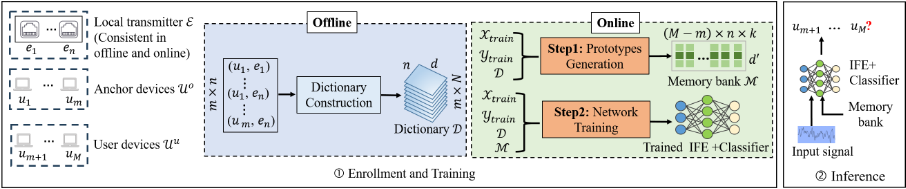
In this section, we introduce the proposed framework GenID and describe its key components. Collecting signals from devices under every possible communication condition is often impractical, and models trained solely on online data tend to perform poorly when the environment changes. To address this challenge, we adopt an offline-online training strategy.
During the offline phase, user devices are inaccessible or uncontrollable. Therefore, we use a set of anchor devices as proxies. These devices allow us to capture the communication characteristics of local transmitters when connected to diverse devices. At the end of this phase, we construct a dictionary of local transmitters, where each local transmitter is represented by multiple entries, and each entry corresponds to a feature extracted from a signal segment collected under a specific environment.
The online phase occurs during deployment, where signals are collected from only a single environment. The prototype generation module leverages these signals together with the offline dictionary to simulate mixed signals between the user device and different local transmitters under diverse environmental conditions. These simulated mixed signals are encoded and stored in a prototype memory bank. Subsequently, the network training module employs the Invariant Feature Extraction (IFE) network to learn robust and invariant representations from these prototypes, producing reliable embeddings for user devices. An overview of the proposed framework is shown in Figure 2 (a).
- Dictionary Construction (Offline): In this phase, each anchor device ui ∈ U o connects to every local transmitter ej ∈ E. For each device-transmitter pair (ui, ej), N signal samples are extracted, where N is a predefined hyperparameter. These samples are processed through a pre-processing pipeline to generate feature representations, which collectively form the dictionary D.
- Prototypes Generation (Online): Each user device in U u is connected to at least one available local transmitter from the set E. From this connection, we collect signal samples Xtrain along with their corresponding labels Ytrain. We design a data augmentation method to construct a prototype memory bank M using Xtrain, Ytrain, and the offline dictionary D.
- Network Training (Online): To distill invariant device features, GenID employs an Invariant Feature Extraction (IFE) network to learn invariant representations of user devices by modeling both intra-class consistency and interclass discrimination among their features.
3.3 Dictionary Construction (Offline)
The objective of this phase is to construct a dictionary D that captures local transmitter characteristics under varying environmental conditions. To this end, we leverage a set of anchor devices U o = {u1, . . . , um} as controlled signal sources and systematically connect each device to every local transmitter in E = {e1, . . . , en} at different times. The process will be described in order below.
Signal Collection and Pre-processing. Each anchor device ui ∈ U o is systematically paired with every local transmitter ej ∈ E. For each device-transmitter pair (ui, ej), we acquired N mixed signal sample {x1i,j , . . . , xNi,j }, where xki,j denotes the k-th acquired signal sample for pair (ui, ej).
Each signal sample is passed through a pre-processing pipeline Pre(·). Following prior works [Levy et al., 2023; Choi et al., 2018; Gerdes et al., 2012], the pipeline removes the direct current component and applies FFT-based spectral averaging to obtain a stable frequency-domain representation Pre(xki,j ) ∈ Rd .
Dictionary Construction. After pre-processing, each device -transmitter pair (ui, ej) yields N feature vectors {Pre(x1i,j ), . . . , Pre(xNi,j )}. We construct the dictionary D by collecting all feature units across the m anchor devices, each with N signal samples:
Each feature unit ηi,k corresponds to one environment and is formed by concatenating the pre-processed signals from all local transmitters ηi,k = [Pre(xki,1 ); . . . ; Pre(xki,n )].
3.4 Prototypes Generation (Online)
At the online stage, each user device ui ∈ U u typically communicates with only a limited set of transmitters under restricted temporal conditions. We leverage the offline dictionary D and a novel augmentation method to simulate the device's behavior across all transmitters across varying temporal conditions.
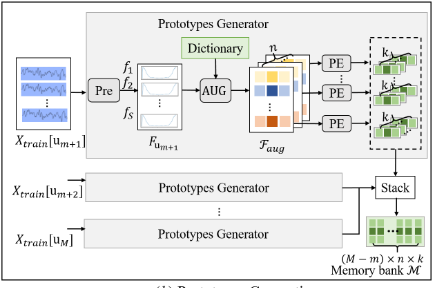
As shown in Figure 2 (b), we first partition the training data by device labels. Let Xtrain[ui] = {x′1 , . . . , x′S } denote the training samples collected from a user device ui. Each signal is processed by the pre-processing module Pre(·) to produce a feature set Fui = {Pre(x′1 ), . . . , Pre(x′S )}. These features, along with the dictionary D, are then feed into data augmentation.
Data Augmentation (AUG(·)). For each preprocessed feature f ′ ∈ Fui with label y′ = (ui, ek), we randomly sample a feature unit η = [de1 , . . . , den ] ∈ D, which encodes the signatures of all local transmitters. We take dbase = dek , representing the feature of the sampled anchor device when connected to transmitter ek.
To simulate how the user device ui would behave under other transmitters, we apply an augmentation function Faug to pair f ′ with each dej ∈ η, and compute the augmented features as:
This function approximates the preprocessed feature that would be observed if device ui were to communicate with transmitter ej. Further proof is provided as follows.
Proof. The preprocessed feature f ′ can be expressed as:
where xui and xek denotes the signal generated by ui and ek, respectively, and noise1 represents noise. Since the preprocessing module Pre(·) removes the direct current component and applies FFT-based spectral averaging, both of which preserve linearity, we have:
Similarly, dej = Pre(xui ) + Pre(xej ) + Pre(noise2), and the base feature vector can be expressed as dbase = P re(sui ) + P re(sek ) + P re(noise3).
According to the definition of mapping function Faug(dej , f ′ ) = f ′ - dbase + dej , we have:
(5)
where noise4 = P re(noise1) - P re(noise2) + P re(noise3) and noise5 = P re(noise4).
Memory Bank Construction. We construct the full augmented feature set as follows:
where Faug[s][j] represents the feature of the s-th simulated mixed signal from (ui, ej ) pair. To extract prototypes for each (ui, ej) pair, we first aggregate the features corresponding to transmitter ej across all S augmented samples:
We then apply a Prototype Extraction (PE) module to derive k prototypes, each capturing a representative environmental condition. Specifically, we perform K-Means clustering with k clusters on F(ui, ej ), and use the resulting cluster centroids as the prototypes.
Prototypes generated from M -m user devices and n local transmitters are aggregated into the memory bankM, resulting in a total of (M - m) × n × k prototypes.
3.5 Network Training (Online)
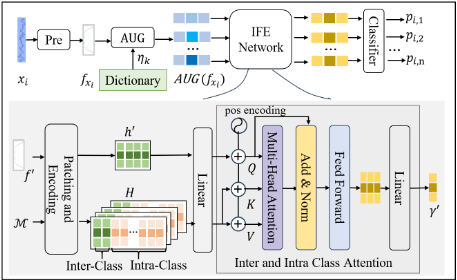
This step aims to optimize the Invariant Feature Extraction (IFE) network to produce robust features that are invariant to OOD environments. As illustrated in Figure 2 (c), each input signal xi is first processed by the pre-processing module (detailed in Section 3.3) and the augmentation strategy (detailed in Section 3.4) to increase input diversity and simulate variations in temporal and local transmitter induced environments. The resulting augmented features AUG(fxi ) = [Faug(de1 , fxi ), . . . , Faug(de|E| , fxi )] are then fed into the IFE network. The IFE network consists of two main modules: Patching and Encoding, and Inter- and Intra-Class Attention.
Patching and Encoding. For each feature vector f ′ ∈ AUG(fxi ), the IFE network divides it into s overlapping patches with a fixed size and 50% overlap, yielding {P1, P2, . . . , Ps}. Each patch, as well as the original feature, is independently projected by linear layers. The resulting embeddings are concatenated to form a joint representation h′ ∈ R(s+1)×l :
The same encoding process is applied to all prototypes in the memory bank M, producing a prototype representation tensor H ∈ R|M|×(s+1)×l , where |M| = (M - m) × n × k is the number of prototypes.
Inter- and Intra- Class Attention. The attention mechanism enables the network to selectively focus on the most relevant parts of the input for prediction, assigning varying importance (attention weights) to different components and thus emphasizing salient features while suppressing less informative ones [Vaswani et al., 2017]. To distill invariant device features, we design an attention mechanism that jointly models relationships within the same device class (intra-class) and across different device classes (inter-class).
The attention computation involves three key components: the query Q = Linear(hTi ) ∈ Rl×d , and the key and value K = V = Linear(H T ) ∈ R|M|×l×d . To incorporate spatial or sequential context, a learnable positional encoding hpos is added:
Multi-head attention is then applied, followed by a residual connection, layer normalization and a feedforward network:
where h′o ∈ Rl×d , with l denoting the mapping dimension and d the dimensionality of the hidden representation.
Finally, the invariant feature vector is computed as:
where W ∈ Rd×1 and b ∈ Rl . By jointly modeling intra- and inter-class interactions, this mechanism enhances the model's ability to distinguish subtle yet critical variations among devices.
Classifier. Each feature vector f ′ ∈ AUG(fxi ) is processed by the IFE network to produce an invariant representation γ ′ . Applying the IFE to all augmented samples of xi yields a set of representations γi,1, . . . , γi,n, which are then passed into the classifier consisting of normalization and linear projection:
where pi,j ∈ RM-m represents the predicted probability distribution over the M -m device categories for the j-th augmented sample of xi.
We train the IFE network and classifier using a categorical cross-entropy loss with label smoothing, which mitigates overconfidence and improves generalization:
The smoothed label ysmooth is calculated as:
where yi is the one-hot vector of the device label, ϵ is the label smoothing coefficient.
3.6 Inference
This section explains how the trained GenID model classifies new, unseen samples. As illustrated in Figure 2 (a), the Inference module processes each test sample xi ∈ Xtest as follows: First, each input xi is processed by the pre-processing module. The resulting feature fi is then passed into the IFE network along with the memory bank M to generate an invariant representation ˆ γi. Finally, the trained classifier outputs the predicted class probabilities:
The predicted label ˆ yi is determined by selecting the class with the highest probability.
Inference Time Complexity. During inference, GenID consists of: (1) FFT-based preprocessing with complexity O(d log d); (2) patch-based linear encoding with complexity O(sd2 ), where s is the number of patches and d is both the input and embedding dimension; (3) multi-head attention over P prototypes, yielding complexity O(sdP); and (4) final classification with complexity O(dC) over C classes. The overall inference time complexity per sample is: O(d log d+sd2 +sdP +dC). Neglecting lower-order terms, we further simplify to: O(sd(d + P)).
4 Experiments
4.1 Experimental Settings
Datasets. We collected data over many days from all possible combinations of 4 local transmitters, 4 user devices, and 6 anchor devices. For each target device and local transmitter combination, we gathered some data points each day. This resulted in a grand total of 2.52 × 10¹⁰ data points across the entire collection period.
Evaluation Scenarios. We pre-process the acquired mixed signal data by segmenting it into fixed lengths of 7 × 10⁴ for online data and 7 × 10⁵ for offline data, yielding 1,000 online samples and 100 offline samples per day for each device-local transmitter pair, respectively. A Fast Fourier Transform (FFT) with length 128 is applied to each segment. The online dataset is then randomly split into training, validation, and testing sets in a 7:1:2 ratio. To assess GenID's robustness, we evaluated it under four distinct settings:
- Exp.(a) Temporal + Local transmitter induced OOD: 15,000 samples where both acquisition days and local transmitters differ between training and testing sets.
- Exp.(b) Temporal OOD: 7,500 samples where local transmitters remain fixed but acquisition days differ.
- Exp.(c) Local transmitter induced OOD: 7,500 samples with consistent acquisition days but varying local transmitters.
- Exp.(d) i.i.d.: 20,000 samples where both acquisition days and local transmitters are shared across training and testing.
Evaluation Metrics. We assessed the performance of the GenID model using three key metrics: micro F1 score, macro F1 score, and the Kappa coefficient (KC) [Vieira et al., 2010].
Baselines. We evaluate GenID against four categories of baseline methods on the same preprocessed signal representations produced by our preprocessing pipeline for fair comparison: (1) Physical-layer device identification methods, including LoRa [Shen et al., 2021], RivIs [Reising et al., 2020], and Csei [He and Wang, 2020]. Due to protocol differences that prevent direct application to the 1000Base-T Ethernet setting, we adapt their classification backbones to the preprocessed fingerprints. (2) OOD generalization methods for classification, including RBS [Song et al., 2020], RandConv [Xu et al., 2020], and MixStyle [Zhou et al., 2023]. These methods are combined with our classifier to assess robustness under distribution shifts. (3) OOD-aware tabular and timeseries classifiers,including TabPFN [Hollmann et al., 2022] and ITSR [Shi et al., 2024]. (4) State-of-the-art time series classification methods, such as CAFO [Kim et al., 2024] and TSLANet [Eldele et al., 2024]. These two are evaluated using their open-source implementations on preprocessed data.
Hyper-Parameters. We set the PE module with k = 4 clusters. In the IFE network, we set the patch size to 16. The output dimensions of the patching-encoding module and the linear layer are 128 and 16, respectively. Multi-head attention is configured with a single layer and 4 heads. The feedforward network consists of two linear layers with intermediate dimensions of 64. All Dropout ratios were set to 0.1.
For optimization, we used AdamW with a learning rate of 1 × e-3 and a weight decay of 1 × e-4 . Training runs for up to 100 iterations, with early stopping applied if the validation loss does not improve for 30 epochs.
4.2 ComparisonWith SOTAMethods
(1) Does GenID outperform SOTA methods in terms of device classification performance? Table 1 presents the comparative results of GenID against a comprehensive set of SOTA baselines across four experimental settings Exps.(a-d), evaluated using micro-F1, macro-F1, and KC. GenID consistently outperforms all competing methods in almost all metrics and experimental settings,
While existing physical-layer identification methods perform comparably to GenID in the i.i.d. setting Exp.(d), their performance drops sharply in the OOD scenarios Exps.(a-c), indicating limited robustness to temporal and transmitterinduced distribution shifts. General OOD classification methods perform even worse, as the fine-grained physical-layer features are easily masked by noise and interference, making them difficult to disentangle. Tabular OOD method TabPFN and Time-series models like CAFO and TSLANet show good performance under specific OOD conditions but fail to generalize across all scenarios
Across all methods, performance in Exp.(d) is consistently higher than in Exp.(a-c), underscoring the challenge of distribution shifts. Notably, GenID demonstrates significantly smaller performance degradation, showcasing its robustness to both temporal and transmitter variations.
(2) How does GenID compare to SOTA methods in terms of generalization underOOD scenarios? We further evaluate GenID under varying device partitions using Exp.(a), the most challenging OOD setting. Specifically, we generate three alternative random partitions of online and anchor devices while keeping all other factors unchanged. As shown in Table 2, performance varies across partitions due to inherent differences in device distinguishability. Despite this variability, GGenID consistently outperforms all other configurations, achieving an average Macro-F1 improvement of 7.94% over the strongest competing baseline, thereby demonstrating robustness to device partitioning.
4.3 Efficiency
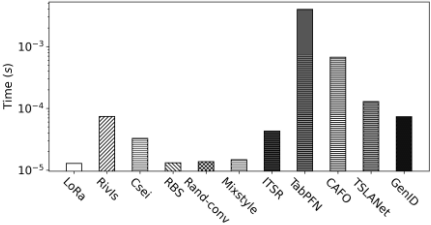
Figure 3 presents the per-sample inference time for all comparison methods. As expected, LoRa, using a traditional architecture, achieves the fastest processing speed. GOOD classification methods incur only a slight efficiency overhead, maintaining high efficiency. In contrast, more complex deep learning methods like TabPFN, CAFO, and TSLANet exhibit a significant drop in efficiency, with processing times increasing by one or two orders of magnitude. GenID, however, strikes a favorable balance, maintaining competitive speed while delivering strong performance, staying on par with traditional approaches in terms of inference time.
| Exp.(a) | Exp.(b) | Exp.(c) | Exp.(d) | |||||||||
|---|---|---|---|---|---|---|---|---|---|---|---|---|
| Method | micro-F1 % | macro-F1 % | KC % | micro-F1 % | macro-F1 % | KC % | micro-F1 % | macro-F1 % | KC % | micro-F1 % | macro-F1 % | KC % |
| LoRa RivIs Csei | 64.72 ± 0.87 71.73 ± 0.00 53.45 ± 1.28 | 63.58 ± 1.19 70.09 ± 0.00 47.28 ± 1.36 | 52.97 ± 1.15 62.31 ± 0.00 37.97 ± 1.70 | 72.88 ± 0.89 78.13 ± 0.00 66.16 ± 2.23 | 71.39 ± 1.22 77.36 ± 0.00 63.92 ± 2.78 | 63.82 ± 1.18 70.83 ± 0.00 54.85 ± 2.98 | 49.63 ± 1.88 58.00 ± 0.00 57.31 ± 4.34 | 44.88 ± 2.59 55.07 ± 0.00 55.35 ± 3.90 | 33.62 ± 2.40 44.72 ± 0.00 43.46 ± 5.65 | 86.79 ± 0.20 90.90 ± 0.00 86.71 ± 0.37 | 86.78 ± 0.20 90.89 ± 0.00 86.69 ± 0.37 | 82.39 ± 0.27 87.86 ± 0.00 82.28 ± 0.49 |
| RBS Rand-conv Mixstyle | 49.88 ± 0.67 64.67±0.94 64.91 ± 0.80 | 48.73 ± 0.82 64.03 ± 1.13 63.92 ± 1.01 | 33.22 ± 0.90 52.91 ± 1.25 53.22 ± 1.07 | 57.15 ± 1.89 71.52 ± 1.70 73.52 ± 2.09 | 56.71 ± 2.21 69.87 ± 2.32 72.20 ± 2.83 | 42.86 ± 2.53 62.00 ± 2.27 64.68 ± 2.78 | 58.72 ± 1.59 48.59 ± 0.89 50.77 ± 1.26 | 58.44 ± 1.45 43.45 ± 1.32 46.33 ± 1.76 | 44.95 ± 2.12 32.27 ± 1.12 35.07 ± 1.61 | 50.24 ± 3.33 85.52 ± 0.56 86.73 ± 0.40 | 48.91 ± 4.14 85.50 ± 0.55 86.72 ± 0.39 | 34.24 ± 4.12 80.69 ± 0.74 82.30 ± 0.52 |
| ITSR TabPFN | 46.04 ± 2.97 61.63±1.54 | 44.86 ± 3.73 56.44 ± 1.89 | 28.06±3.93 48.81 ± 2.04 | 41.25±12.58 75.89 ± 0.71 | 33.09±19.23 75.02 ± 0.89 | 21.63±16.77 67.85±0.95 | 46.21±4.42 66.32±12.41 | 42.33 ± 5.37 64.78±13.30 | 28.41 ± 5.61 55.55±16.29 | 75.50 ± 4.11 91.54±0.27 | 75.41 ± 4.17 91.53 ± 0.27 | 67.37 ± 5.44 88.71 ± 0.36 |
| CAFO TSLANet | 60.36 ± 2.50 75.71 ± 1.63 | 57.53 ± 4.10 75.58 ± 1.70 | 47.22 ± 3.29 67.63 ± 2.17 | 81.44 ± 1.46 80.88 ± 1.13 | 81.27 ± 1.53 80.59 ± 1.27 | 75.25 ± 1.94 74.50 ± 1.50 | 54.11 ± 3.62 57.44 ± 2.34 | 50.29 ± 4.08 54.02 ± 3.48 | 39.44 ± 4.59 43.99±2.96 | 85.51 ± 3.42 91.59±0.41 | 85.27 ± 3.71 91.58±0.41 | 80.66 ± 4.55 88.78±0.54 |
| GenID | 84.83±0.66 | 84.79±0.69 | 79.76±0.88 | 85.32±0.27 | 85.22±0.23 | 80.42±0.36 | 69.36±1.13 | 66.06±1.82 | 59.65±1.44 | 91.09±0.56 | 91.08 ± 0.56 | 88.12 ± 0.74 |
| Method | Exp.(a) | Exp.(a2) | Exp.(a3) | Exp.(a4) |
|---|---|---|---|---|
| LoRa | 63.58 ± 1.19 | 65.33 ± 0.67 | 70.30 ± 0.77 | 51.47 ± 0.99 |
| RivIs | 70.09 ± 0.00 | 67.11 ± 0.00 | 74.37 ± 0.00 | 60.74 ± 0.00 |
| Csei | 47.28 ± 1.36 | 66.40 ± 1.43 | 54.50 ± 7.15 | 64.02 ± 3.94 |
| RBS | 48.73 ± 0.82 | 59.43 ± 0.92 | 66.24 ± 1.33 | 45.96 ± 0.91 |
| Rand-conv | 64.03±1.13 | 65.21 ± 0.65 | 72.10 ± 0.90 | 52.32 ± 1.61 |
| Mixstyle | 63.92 ± 1.01 | 65.70 ± 0.57 | 70.32 ± 0.32 | 51.87 ± 0.79 |
| ITSR | 44.86 ± 3.73 | 56.54 ± 5.91 | 62.04 ± 3.57 | 42.87 ± 1.73 |
| TabPFN | 56.44±1.89 | 66.51 ± 0.47 | 68.45 ± 1.79 | 57.47 ± 0.81 |
| CAFO | 57.53 ± 4.10 | 67.29±1.91 | 59.55±10.03 | 54.59±2.69 |
| TSLANet | 75.58 ± 1.70 | 70.05 ± 2.92 | 72.54 ± 0.50 | 55.66 ± 0.94 |
| GenID | 84.79±0.69 | 81.11±1.07 | 81.83±0.61 | 70.52±1.43 |
| Methods | Exp.(a) | Exp.(b) | Exp.(c) | Exp.(d) |
|---|---|---|---|---|
| w/o AUG(·) in training | 62.83 | 79.33 | 54.21 | 92.24 |
| w/o AUG(·) in prototypes | 63.84 | 80.77 | 54.24 | 91.65 |
| w/o dictionary | 62.91 | 79.68 | 54.96 | 91.80 |
| w/o patching | 83.27 | 80.00 | 65.76 | 89.21 |
| w/ self-attention | 60.41 | 46.80 | 40.03 | 24.67 |
| GenID | 84.83 | 85.32 | 69.36 | 91.09 |
4.4 Ablation Study
Table 3 presents the ablation study evaluating the contribution of key components. We remove each component individually to assess its contribution except for the IFE network, we replace it with standard self-attention. The full model consistently performs well across all settings, especially in the IID setting Exp.(d), where it remains comparable to most ablated variants. In OOD scenarios, removing AUG(·) during either training or prototype generation leads to a significant performance drop, emphasizing the importance of augmenting training diversity. Removing the dictionary, which disables AUG(·) in both training and prototype generation, results in a performance degradation similar to removing only
- (b) Number of user devices
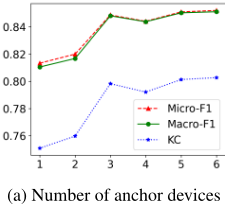
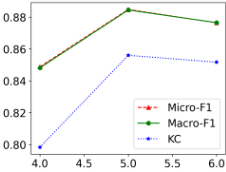
Figure 4: Sensitivity analysis on the number of devices
one of them. This suggests that the two augmentation stages provide cooperative benefits rather than independent contributions. The patch embedding module's removal causes a slight decline, suggesting its contribution to generalization. Lastly, replacing the IFE network with standard self-attention leads to a sharp performance drop, underscoring its superior ability to extract environment-agnostic representations.
4.5 Sensitivity Analysis on the Number of Devices
Figure 4 illustrates the model performance under varying numbers of anchor and user devices. For anchor-device evaluation, we vary the number of anchor devices in the dictionary while keeping all other settings fixed. For user-device evaluation, we use a fixed dictionary with three anchor devices and examine performance as the number of user devices increases. All experiments are conducted under Exp. (a). We observe that GenID achieves consistent performance when the number of anchor devices exceeds three. Furthermore, the number of user devices does not significantly affect performance.
5 Conclusions
We propose GenID, a deep learning-based physical-layer device identification framework. GenID tackles two key challenges: out-of-distribution shifts and environment-agnostic device identification. It employs a communication environment augmentation strategy using a transmitter dictionary and a prototype memory bank to simulate diverse signal conditions. Additionally, the IFE network extracts robust and invariant features by modeling class-level relationships. Extensive experiments demonstrate that GenID outperforms existing methods and generalizes well under OOD scenarios while maintaining computational efficiency.
Acknowledgments
This work was supported by the National Natural Science Foundation of China (No.62472091, 62394333, 62572361)
@inproceedings{ijcai2026p233,
  title     = {GenID: A Generalizable Physical-Layer Device Identification Method for Out-of-Distribution Environments},
  author    = {Zhang, Yawei and Fang, Lanting and Yao, Di and Feng, Kaiyu and Wang, Shuliang},
  booktitle = {Proceedings of the Thirty-Fifth International Joint Conference on
               Artificial Intelligence, {IJCAI-26}},
  publisher = {International Joint Conferences on Artificial Intelligence Organization},
  editor    = {Diego Calvanese},
  pages     = {2091--2099},
  year      = {2026},
  month     = {8},
  note      = {Main Track},
  doi       = {10.24963/ijcai.2026/233},
  url       = {https://doi.org/10.24963/ijcai.2026/233},
}
TY - CPAPER TI - GenID: A Generalizable Physical-Layer Device Identification Method for Out-of-Distribution Environments AU - Zhang, Yawei AU - Fang, Lanting AU - Yao, Di AU - Feng, Kaiyu AU - Wang, Shuliang T2 - Proceedings of the Thirty-Fifth International Joint Conference on Artificial Intelligence, IJCAI-26 PB - International Joint Conferences on Artificial Intelligence Organization PY - 2026 SP - 2091 EP - 2099 DO - 10.24963/ijcai.2026/233 UR - https://doi.org/10.24963/ijcai.2026/233 ER -Copied
Machine-readable versions of this paper, for tools and AI agents:





