
DiffVec: Diffusion Model for Trajectory Vector Recovery
Proceedings of the Thirty-Fifth International Joint Conference on Artificial Intelligence. Main Track. Pages 2546-2553.
https://doi.org/10.24963/ijcai.2026/283
Keywords
- Data Mining: Mining spatial and/or temporal data
- Data Mining: Knowledge graphs and knowledge base completion
- Data Mining: Frequent pattern mining
Abstract
The increasing availability of trajectory data is often hampered by sparsity and noise. Existing trajectory recovery methods are further limited by either information loss from coordinate discretization into location IDs, or the inefficiency of conventional diffusion models that require a lengthy denoising process from pure noise. To address these challenges, we propose DiffVec, a novel and efficient diffusion framework for free-space trajectory recovery that operates directly on continuous coordinate data. The backbone of our framework is MVformer, a Transformer-based architecture that models motion vectors—the differences between consecutive coordinates—to better capture the local motion patterns of movement. This model is trained within our ResTraj diffusion paradigm, which commences the denoising process from a structured, interpolated prior to significantly reduce sampling steps. Extensive experiments on the Geolife and Porto datasets demonstrate that DiffVec significantly outperforms state-of-the-art baselines across MAE, MSE, and NDTW.
- [Alcaraz and Strodthoff, 2022] Juan Miguel Lopez Alcaraz and Nils Strodthoff. Diffusion-based time series imputa- tion and forecasting with structured state space models. In arXiv, 2022.
- [Bu et al., 2025] Tianci Bu, Le Zhou, Wenchuan Yang, Jian- hong Mou, Kang Yang, Suoyi Tan, Feng Yao, Jingyuan Wang, and Xin Lu. Prodiff: Prototype-guided diffusion for minimal information trajectory imputation. arXiv, 2025.
- [Cao et al., 2018] Wei Cao, Dong Wang, Jian Li, Hao Zhou, Lei Li, and Yitan Li. Brits: Bidirectional recurrent impu- tation for time series. volume 31, 2018.
- [Chen et al., 2023] Yuqi Chen, Hanyuan Zhang, Weiwei Sun, and Baihua Zheng. Rntrajrec: Road network en- hanced trajectory recovery with spatial-temporal trans- former. pages 829-842, 2023.
- [Du et al., 2023] Wenjie Du, David Côté, and Yan Liu. Saits: Self-attention-based imputation for time series. Expert Systems with Applications, 219:119619, 2023.
- [Duan et al., 2024] Jiaqi Duan, Xiangfu Meng, and Guihong Liu. Where to go at the next timestamp. Data Science and Engineering, 9(1):88-101, 2024.
- [Goodfellow et al., 2014] Ian Goodfellow, Jean Pouget- Abadie, Mehdi Mirza, Bing Xu, David Warde-Farley, Sherjil Ozair, Aaron Courville, and Yoshua Bengio. Gen- erative adversarial nets. In Advances in neural information processing systems, volume 27, pages 2672-2680, 2014.
- [Ho et al., 2020] Jonathan Ho, Ajay Jain, and Pieter Abbeel. Denoising diffusion probabilistic models. arXiv, 2020.
- [Lan et al., 2024] Zhengxing Lan, Lingshan Liu, Bo Fan, Yisheng Lv, Yilong Ren, and Zhiyong Cui. Traj-llm: A new exploration for empowering trajectory prediction with pre-trained large language models. IEEE Transactions on Intelligent Vehicles, 2024.
- [Li et al., 2000] Xin Li, Guodong Cheng, and Ling Lu. Comparison of spatial interpolation methods. volume 15, pages 260-265, 2000.
- [Liu et al., 2023] Mingzhe Liu, Han Huang, Hao Feng, Leilei Sun, Bowen Du, and Yanjie Fu. PriSTI: A condi- tional diffusion framework for spatiotemporal imputation. In 2023 IEEE 39th International Conference on Data En- gineering (ICDE), pages 1927-1939. IEEE, 2023.
- [Moreira et al., 2013] João Moreira, Ricardo Gaetano, Mário Viana, Carlos Rocha, and Pedro Furtado. Predict- ing the next location: a recurrent model with spatial and temporal contexts. In ECML PKDD, pages 532-547. Springer, 2013.
- [Musleh and Mokbel, 2023] Mashaal Musleh and Mo- hamed F Mokbel. Kamel: A scalable bert-based system for trajectory imputation. Proceedings of the VLDB Endowment, 17(3), 2023.
- [Musleh and Mokbel, 2024] Mashaal Musleh and Mo- hamed F Mokbel. Let's speak trajectories: A vision to use nlp models for trajectory analysis tasks. ACM Trans- actions on Spatial Algorithms and Systems, 10(2):1-25, 2024.
- [Si et al., 2023] Junjun Si, Jin Yang, Yang Xiang, Hanqiu Wang, Li Li, Rongqing Zhang, Bo Tu, and Xiangqun Chen. Trajbert: Bert-based trajectory recovery with spatial-temporal refinement for implicit sparse trajectories. IEEE Transactions on Mobile Computing, 23(5):4849- 4860, 2023.
- [Song et al., 2021] Jiaming Song, Chenlin Meng, and Ste- fano Ermon. Denoising diffusion implicit models. In ICLR, 2021.
- [Tashiro et al., 2021] Yusuke Tashiro, Jiaming Song, Yang Song, and Stefano Ermon. CSDI: Conditional score-based diffusion models for probabilistic time series imputation. arXiv, 2021.
- [Wang et al., 2024] Xinyu Wang, Meng Chen, Rho Liu, Niexiao Liu, Yixu Shen, Yuhong We, and Wen-Chih Peng. Llm-mob: Large language models for human mobility pre- diction. In Proceedings of the 32nd ACM International Conference on Advances in Geographic Information Sys- tems (SIGSPATIAL '24), pages 1-10. ACM, 2024.
- [Xia et al., 2021] Tong Xia, Yunhan Qi, Jie Feng, Fengli Xu, Funing Sun, Diansheng Guo, and Yong Li. Attnmove: History enhanced trajectory recovery via attentional net- work. In Proceedings of the AAAI conference on artificial intelligence, volume 35, pages 4494-4502, 2021.
- [Yuan and Qiao, 2024] Xinyu Yuan and Yan Qiao. Diffusion-ts: Interpretable diffusion for general time series generation. arXiv, 2024.
- [Yue et al., 2023] Zongsheng Yue, Jianyi Wang, and Chen Change Loy. ResShift: Efficient diffusion model for image super-resolution by residual shifting. arXiv, 2023.
- [Zheng et al., 2010] Yu Zheng, Xing Chen, Xing Xie, and Wei-Ying Ma. Geolife: a collaborative social networking service among a user group in geo-life. In Proceedings of the 1st ACM SIGSPATIAL international workshop on location based social networks, pages 31-40, 2010.
- [Zhu et al., 2023] Yuanshao Zhu, Yongchao Ye, Shiyao Zhang, Xiangyu Zhao, and James J. Q. Yu. DiffTraj: Gen- erating GPS trajectory with diffusion probabilistic model. arXiv, 2023.
- [Zhu et al., 2024] Yuanshao Zhu, James Jianqiao Yu, Xi- angyu Zhao, Qidong Liu, Yongchao Ye, Wei Chen, Zijian Zhang, Xuetao Wei, and Yuxuan Liang. Controltraj: Con- trollable trajectory generation with topology-constrained diffusion model. In Proceedings of the 30th ACM SIGKDD Conference on Knowledge Discovery and Data Mining, pages 4676-4687, 2024.
References were extracted automatically from the PDF and may contain errors.
Full text extracted automatically from the PDF; figures, tables and equations may differ. The PDF is the version of record.
1 Introduction
The proliferation of mobile devices has generated massive trajectory data, enabling applications like next-location recommendation [Duan et al., 2024] and urban planning. However, raw data often suffers from sparsity and noise due to device constraints and privacy concerns, limiting its direct utility. This necessitates trajectory recovery. Distinct from map-matching approaches restricted to road networks, we focus on the general free-space setting. This is vital for multimodal scenarios (e.g., pedestrians, vessels) where underlying graph constraints are unavailable or inapplicable.
With the rapid advancement of deep learning, trajectory recovery methodologies have evolved significantly. Initially, rule-based approaches like linear interpolation [Li et al., 2000] and polygon interpolation were widely used. However, these methods often fail to capture complex, non-linear mobility patterns. To address this, deep learning-based methods emerged. Early works employed Recurrent Neural Networks to model sequential dependencies. Subsequently, attentionbased models and Transformers, such as AttnMove [Xia et al., 2021] and TrajBERT [Si et al., 2023], became the dominant paradigm. Most recently, Generative AI has brought Diffusion Probabilistic Models into this domain. By learning the underlying data distribution, models like DiffTraj [Zhu et al., 2023] and ControlTraj [Zhu et al., 2024] have demonstrated a superior capability to generate high-quality trajectory samples.
However, despite these advancements, current research on trajectory recovery still faces several key challenges:
- Inefficiency in Trajectory Diffusion Models: The standard "noise-to-data" diffusion paradigm fails to utilize observed segments of sparse trajectories as structural priors, ignoring local temporal correlations and causing severe computational inefficiency.
- Suboptimal Utilization of Trajectory Coordinates: Existing representations fail to fully utilize continuous trajectory coordinates, as raw absolute coordinates introduce non-stationary distributions that hinder the learning of consistent local geometries.
To address the first challenge, we adopt a diffusion modelbased approach but depart from the standard "noise-to-data" paradigm. We propose the ResTraj strategy. The core intuition is that trajectory recovery should be treated as a "refinement" process rather than a "creation" process. Simple heuristic methods, like linear interpolation, can essentially recover the rough "skeleton" of a trajectory. Therefore, starting the diffusion process from pure noise is counter-intuitive. Instead, ResTraj bridges the gap between this coarse structural prior and the ground truth. By learning to predict the residuals-the non-linear deviations needed to refine the linear skeleton into the true path-our model simplifies the learning objective significantly, allowing for high-fidelity generation with a fraction of the sampling steps.
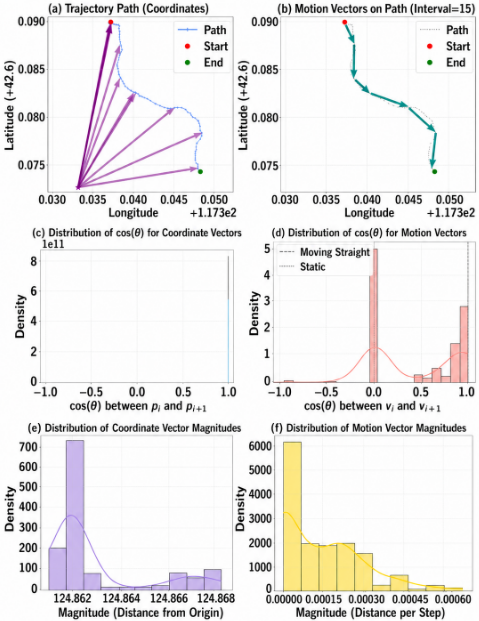
To address the second challenge, we introduce the MVformer (Motion Vector Transformer) backbone. The intuition behind this design stems from our observation that motion vectors possess more desirable properties compared to raw coordinates, particularly for Transformer architectures. As illustrated in Figure 1, raw coordinate vectors originate from the origin, leading to large absolute magnitudes and extremely limited angular variation (Figure 1(a, c)). In contrast, motion vectors (Figure 1(b)) are inherently suited for the dot-product self-attention mechanism. Since the attention score is derived from the dot product q · k = ∥q∥∥k∥ cos(θ), motion vectors allow the model to explicitly leverage vector magnitudes (representing instantaneous speed) and cosine angles (representing directional changes) to capture local motion patterns. This geometric richness, combined with a stable Gaussian distribution (Figure 1(f)), enables MVformer to learn geometrically coherent movement patterns rather than merely memorizing absolute positions.
In summary, our main contributions can be summarized as follows:
- We propose ResTraj, a residual diffusion paradigm that initiates generation from an interpolated prior. This strategy aligns with the intuition of "refinement over creation," significantly accelerating convergence.
- We design MVformer, a Transformer backbone that models motion vectors instead of coordinates. This representation effectively captures the local motion patterns and improves geometric stability.
- We conduct extensive experiments on the Geolife and
Porto datasets. The results demonstrate that DiffVec outperforms state-of-the-art baselines in recovery accuracy.
2 RelatedWork
2.1 Deep Learning for Trajectory Recovery
Trajectory recovery has evolved from heuristic interpolation [Li et al., 2000] to data-driven deep learning. Early methods employed Recurrent Neural Networks to capture sequential dependencies [Cao et al., 2018], while recent attention-based approaches have become dominant. Notable examples include AttnMove [Xia et al., 2021] for historyenhanced recovery and SAITS [Du et al., 2023], which utilizes diagonally-masked self-attention for precise time-series imputation. Similarly, TrajBERT [Si et al., 2023; Musleh and Mokbel, 2023] adapts the BERT architecture to model bidirectional mobility contexts, and RNTrajRec [Chen et al., 2023] further integrates road network constraints. A defining characteristic of these state-of-the-art methods is their reliance on spatial discretization, where continuous GPS coordinates are mapped into discrete location IDs (e.g., grid cells) to simplify the modeling vocabulary. Beyond standard architectures, recent works have also explored Large Language Models [Wang et al., 2024; Lan et al., 2024] for mobility modeling. However, we exclude LLM-based approaches from this study, as their inherent tokenization mechanisms struggle with the high-precision continuous coordinates required for fine-grained trajectory recovery [Musleh and Mokbel, 2024].
Consequently, the prevailing discretization strategy inevitably discards fine-grained geometric information, such as precise velocity vectors and distances, resulting in recovered paths that may lack geometric smoothness. To address this limitation, our DiffVec operates directly on continuous motion vectors, thereby preserving the local geometric structure of movement without suffering from quantization errors.
2.2 DiffusionModels in Spatio-Temporal Domains
Diffusion Probabilistic Models (DDPM) [Ho et al., 2020] have recently outperformed GANs [Goodfellow et al., 2014] in generative tasks. In the general spatio-temporal domain, score-based frameworks such as CSDI [Tashiro et al., 2021], SSSD [Alcaraz and Strodthoff, 2022], Diff-TS [Yuan and Qiao, 2024], and the recent PriSTI [Liu et al., 2023] have demonstrated superior performance in time-series imputation. Specific to trajectories, methods such as DiffTraj [Zhu et al., 2023], ControlTraj [Zhu et al., 2024], and the prototype-guided ProDiff [Bu et al., 2025] typically adhere to the standard "Noise-to-Data" paradigm. These models are designed to reconstruct the entire trajectory structure from scratch by progressively denoising from a pure Gaussian noise distribution.
Nevertheless, this standard generative process entails a significant efficiency bottleneck. Even with general acceleration samplers like DDIM [Song et al., 2021], reconstructing structure from pure randomness ignores the strong local linearity of movement data and necessitates hundreds of sampling steps. In contrast, our ResTraj paradigm reformulates the task as residual refinement from an informative linear interpolation prior, which significantly accelerates convergence by focusing solely on learning the non-linear deviations.
3 Preliminaries
In this section, we formally define the trajectory data structures and formulate the recovery problem.
3.1 ProblemFormulation
Trajectory. A trajectory is defined as a sequence of timestamped coordinates T = {p1, p2, ..., pN}, where each point pi at time ti consists of a latitude and longitude coordinate, i.e., pi = (lati, loni, ti). We assume the timestamps are strictly ordered such that t1 < t2 < ... < tN.
Sparse Trajectory. A sparse trajectory, denoted as ˆT, has the same sequence length N as the corresponding ground truth trajectory. We represent ˆT as {˜ p1, ˜ p2, ..., ˜ pN}, where ˜ pi is either the observed coordinate pi or a masked value. To indicate the observation status, we introduce a binary mask vector M = {m1,m2, ...,mN}. The elements of the sparse trajectory are defined based on this mask:
Problem Statement. Given a sparse trajectory ˆT and its corresponding maskM, the objective is to recover the ground truth trajectory T. Specifically, we aim to infer the missing locations pi where mi = 0 (i.e., pi ∈ T and pi /∈ ˆT), utilizing the observed points and the learned spatio-temporal patterns. We consider the free-space recovery setting, where no external road network topology is provided or assumed during the inference process.
3.2 ResTraj Diffusion Process
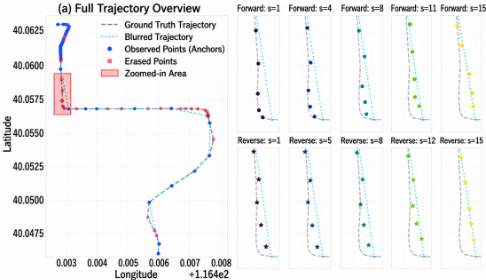
The objective of ResTraj is to enable trajectory recovery to depart from the conventional paradigm of denoising from pure noise. We first employ linear interpolation to construct a coarse "blurred trajectory" as a structural prior. As visualized in Figure 2, the forward process (top row) gradually perturbs the ground truth towards this interpolated prior, while the reverse process (bottom row) starts directly from this coarse initialization to iteratively recover the precise geometry. This formulation allows the model to focus on refining local details rather than reconstructing global structure from scratch.
Fill Sparse Trajectories
To provide an initial coarse imputation for our model, we first employ linear interpolation. This technique serves to fill missing segments in a trajectory by assuming uniform motion between known anchor points.
Formally, for each missing point pi in the trajectory T, where mi = 0 indicates it is a missing point that needs to be imputed, the linear interpolation method estimates its coordinates ˆpi at time ti. We first identify its nearest preceding observed anchor point pleft and succeeding observed anchor point pright. These anchors are defined by their timestamps, tleft and tright, as follows:
We then compute an interpolation ratio αi ∈ [0, 1] based on the timestamp ti's relative position between tleft and tright. The calculation for αi is given by:
The final imputed coordinate ˆpi is then computed as a weighted average of the two anchors, as follows:
This process is applied to all missing points. The resulting interpolated trajectory, which serves as a preliminary estimation, is referred to as the blurred trajectory (B0), formed by combining the observed points and the imputed points as follows:
Forward Process
In the forward diffusion process, we progressively add noise to the ground truth trajectory T0 conditioned on the established blurred trajectory B0. Unlike conventional diffusion models that add noise to every point, our approach focuses solely on the masked (missing) regions. Inspired by the work of ResShift, we design the following transition distribution of the forward process that focuses solely on the masked sites:
To distinguish the timestamp t in the trajectory sequence, we use s = 1, 2, · · · , S to denote the time step in the diffusion process.
Here, E0 = B0 -T0 represents the initial offset. The noise schedule is controlled by coefficients {ηs}Ss=1 . We adopt the exponential schedule from [Yue et al., 2023], defined as √ηs = √η1 · bβs , where b and βs are determined by a curvature hyperparameter p:
In this work, we use a fixed p for all samples. We define αs = ηs - ηs-1 as the accumulated offset proportion. κ is a scale hyperparameter. After transformation, we obtain the conditional distribution:
Reverse Process
During the reverse process, the model progressively recovers the ground truth trajectory by iteratively approximating the posterior distribution:
where p(TS | B0,M) ≈ N(TS;B0, diag(κ2M)) and pθ(Ts-1|Ts,B0,M) is the reverse transition probability. After reparameterization sampling, we obtain the following formula:
(15)
Here, fθ is a neural network parameterized by θ, which aims to predict the ground truth trajectory T0 from Ts. In the reverse denoising process, we specifically focus on denoising the masked regions, ensuring that the observed parts of the trajectory remain unchanged to preserve ground-truth information. To achieve precise coordinate estimation, we employ the Mean Absolute Error (MAE) as our optimization objective:
3.3 MVformer Architecture
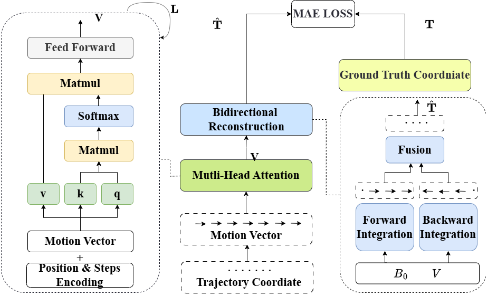
To parameterize the denoising network fθ within our ResTraj diffusion process, we design a Transformer-based architecture named MVformer (Motion Vector Transformer), as illustrated in Figure 3. The core principle of MVformer is to model the local motion patterns via motion vectors rather than absolute coordinates.
Motion Vector Representation
Standard trajectory recovery models typically take absolute coordinates (e.g., latitude and longitude) as input. However, absolute coordinates suffer from arbitrary origins and nonstationary distributions, making it difficult for neural networks to capture translation-invariant patterns. To address this, we transform the input coordinate trajectory Ts ∈ RN×2 into a sequence of motion vectors Vs ∈ RN×2 .
Formally, for a trajectory sequence at diffusion step s, the motion vector vs,i for the i-th point is defined as the spatial displacement relative to its predecessor:
This differential representation explicitly encodes the velocity and heading of the moving object. Unlike coordinates that vary significantly across different spatial regions, motion vectors follow a stable, zero-centered distribution (as visualized in the Figure 1), enabling the model to focus on learning the local geometric structure and sequential dependencies of human mobility.
Embedding and Encoder Backbone
The vector sequence Vs is first projected into a highdimensional hidden space RN×Dmodel via a linear layer. To inform the model of the current noise level, we inject the diffusion step s using a sinusoidal time embedding es:
To capture the sequential order without disrupting the translation invariance of motion vectors, we employ Rotary Positional Encoding (RoPE). RoPE encodes relative positions by rotating the query and key vectors in the attention mechanism, which is mathematically well-suited for vectorbased sequence modeling.
The backbone consists of L stacked Transformer encoder blocks. Each block comprises a Multi-Head Self-Attention (MSA) layer and a Feed-Forward Network (FFN), wrapped with residual connections and Layer Normalization:
Here, the MSA mechanism allows each motion vector to attend to all other vectors in the sequence, capturing long-range spatio-temporal correlations essential for recovering missing segments.
Bidirectional Reconstruction
The MVformer outputs a predicted sequence of motion vectors ˆV0 = {ˆv0,i}Ni=1 . To reconstruct the spatial trajectory ˆT0, we propose a bidirectional scheme that leverages observed anchors as hard constraints.
1) Forward Integration: We derive the forward candidate trajectory ˆTfwd = {ˆpfwd,i}Ni=1 . If the first point p1 is missing (m1 = 0), we use ˆv0,1 as the direct coordinate prediction. For subsequent points, we accumulate motion vectors. Observed anchors (mi = 1) reset the accumulation to prevent error propagation:
2) Backward Integration: We generate the backward trajectory ˆTbwd by integrating from the end (i = N . . . 1). If the last point is missing, we adopt the forward estimate ˆpfwd,N to initialize the backward pass:
3) Anchor-Constrained Fusion: Let τ = min{k | mk = 1} be the first observed anchor. For the initial missing segment (i < τ), forward integration relies on a predicted start point and may be unstable; we therefore use only the backward pass. For all other missing points, we average both passes to mitigate errors:
Optimization Objective
Recall that in Eq. (17), we defined the general diffusion training objective. In our framework, the denoising function fθ(Ts,B0, s) is parameterized by the MVformer backbone followed by the bidirectional reconstruction module.
Let ˆT0 denote the final reconstructed coordinates output by this process. We instantiate the loss function to specifically minimize the Mean Absolute Error (MAE) on the missing regions. The final optimization objective is formulated as:
By calculating the loss exclusively on the unobserved segments (where mi = 0), we enforce the model to learn the intrinsic geometric correlations required to infer the missing trajectory from the observed anchors.
4 Experiments
4.1 Datasets
We evaluate our model on two real-world trajectory datasets. The Geolife dataset [Zheng et al., 2010], collected by Microsoft Research Asia, records the GPS trajectories of 182
| Dataset | #Duration | #Trajectory | #Average Distance |
|---|---|---|---|
| Geolife | 5 years | 17,621 | 73.37 km |
| Porto | 1 year | 1,710,670 | 3.26 km |
users over a five-year period in Beijing. The data is sampled at 5-second intervals, covering diverse transportation modes such as walking, driving, and cycling. The Porto dataset [Moreira et al., 2013] consists of approximately 1.7 million taxi trajectories from the city of Porto, Portugal, sampled at a fixed 15-second interval, representing a highdensity, vehicle-only scenario. Following standard preprocessing [Si et al., 2023], we segment trajectories into fixedlength sequences (N = 64) and filter out static or short segments to ensure data quality. The basic statistics are summarized in Table 1.
4.2 Experimental Settings
Task Setup. To simulate sparse trajectories, we employ a normal distribution-based masking strategy to remove continuous sub-sequences of points in each trajectory. The missing rate is set to 50% during training. We partition the datasets into training, validation, and test sets with a ratio of 7:2:1.
Implementation Details. Our model is implemented in PyTorch. The MVformer backbone consists of L = 4 layers with a hidden dimension of d = 128 and 4 attention heads. For the ResTraj process, we set the total diffusion steps S = 15 and the noise scale kappa = 0.001. The noise schedule follows a fixed exponential curve (p = 0.3) as recommended in [Yue et al., 2023]. We use the AdamW optimizer with a learning rate of 1e-4 and a batch size of 2048. Training runs for 200 epochs with early stopping.
Evaluation Metrics. To evaluate performance from both microscopic (point-level) and macroscopic (trajectorylevel) perspectives, we employ three complementary metrics: Mean Absolute Error (MAE), which calculates the average L2 distance between recovered and ground-truth coordinates; Mean Squared Error (MSE), which computes the average squared L2 distance to strictly penalize large outliers; and Normalized Dynamic Time Warping (NDTW), which assesses the shape similarity and temporal alignment between the recovered and ground-truth trajectories.
Baselines
To demonstrate the effectiveness of our proposed DiffVec framework, we compare it against a comprehensive set of baseline methods spanning attention-based and diffusionbased categories. For attention and Transformer-based approaches, we evaluate AttnMove [Xia et al., 2021] (specifically its AttnMove-H variant), which employs an intratrajectory attention mechanism to dynamically weigh observed anchor points for inferring missing locations. We also include TrajBERT [Si et al., 2023], a BERT-based model that leverages bidirectional context and a Masked Trajectory Model objective to learn coordinate representations. Additionally, we adapt SAITS [Du et al., 2023], a state-ofthe-art imputation method utilizing Diagonally-Masked Self- Attention (DMSA), to capture temporal dependencies for spatial inference. In the realm of generative diffusion models, we compare against Diff-TS [Yuan and Qiao, 2024], a probabilistic framework utilizing a Transformer encoderdecoder adapted for continuous coordinate reconstruction; ControlTraj [Zhu et al., 2024], a conditional model featuring a U-Net backbone with geographic attention, adapted to treat observed anchors as topological constraints; and ProDiff [Bu et al., 2025], a prototype-guided diffusion model that integrates macro-level pattern learning, using observed anchors as conditional inputs for fine-grained reconstruction.
| Geolife Dataset | Porto Dataset | |||||||||||||||||
|---|---|---|---|---|---|---|---|---|---|---|---|---|---|---|---|---|---|---|
| Method | Missing 10% | Missing 30% | Missing 50% | Missing 10% | Missing 30% | Missing 50% | ||||||||||||
| MAE | MSE | NDTW | MAE | MSE | NDTW | MAE | MSE | NDTW | MAE | MSE | NDTW | MAE | MSE | NDTW | MAE | MSE | NDTW | |
| AttnMove | 4.25 | 110.5 | 4.25 | 6.45 | 149.2 | 6.85 | 8.25 | 182.3 | 8.55 | 7.85 | 3.25 | 5.15 | 10.55 | 4.85 | 6.85 | 14.50 | 6.55 | 9.25 |
| TrajBERT | 3.85 | 82.5 | 3.85 | 5.92 | 105.4 | 5.65 | 7.15 | 132.6 | 7.25 | 6.85 | 1.15 | 4.20 | 8.95 | 1.65 | 5.95 | 12.85 | 2.25 | 7.85 |
| SAITS | 5.55 | 115.2 | 4.85 | 7.55 | 162.5 | 7.15 | 9.25 | 205.8 | 9.55 | 9.55 | 4.55 | 5.85 | 12.25 | 6.25 | 7.85 | 16.85 | 8.55 | 10.25 |
| Diff-TS | 4.55 | 135.5 | 4.15 | 6.85 | 165.2 | 6.25 | 8.55 | 198.5 | 8.15 | 7.55 | 2.55 | 4.95 | 9.85 | 3.95 | 6.65 | 13.95 | 5.65 | 8.95 |
| ControlTraj | 3.45 | 75.5 | 3.25 | 5.65 | 95.8 | 4.85 | 6.85 | 125.6 | 6.15 | 6.15 | 0.85 | 3.85 | 8.25 | 1.25 | 5.55 | 11.95 | 1.85 | 7.15 |
| ProDiff | 2.92 | 28.4 | 1.25 | 5.35 | 56.8 | 2.45 | 6.15 | 68.2 | 3.85 | 5.25 | 0.45 | 3.45 | 7.15 | 0.65 | 4.95 | 11.45 | 1.55 | 5.85 |
| DiffVec | 2.50 | 21.5 | 1.00 | 4.80 | 47.1 | 2.15 | 5.52 | 55.5 | 3.45 | 4.55 | 0.25 | 3.12 | 6.56 | 0.45 | 4.45 | 10.81 | 1.25 | 5.13 |
4.3 Performance Comparison
Table 2 presents the quantitative comparison on the Geolife and Porto datasets. We analyze the performance differences based on the modeling mechanisms of the baselines compared to our proposed DiffVec.
Comparison with Traditional Baselines. Discreteadapted models, such as AttnMove and TrajBERT, effectively capture basic spatio-temporal dependencies; however, their design relies on discretizing continuous locations into grid tokens, which inherently limits their precision in recovering fine-grained GPS coordinates. Conversely, while SAITS is specifically designed for continuous time-series imputation, it treats trajectories as generic numerical sequences. It fails to explicitly model the complex spatial correlations and geographic constraints unique to mobility data, resulting in suboptimal performance compared to spatially-aware methods.
Comparison among Diffusion Baselines. While diffusion models generally surpass traditional baselines, existing methods face distinct limitations. ControlTraj, despite representing the state-of-the-art in generation, lacks conditional constraints for partial observations, rendering it inferior to the prototype-guided ProDiff in recovery tasks. Furthermore, standard diffusion paradigms are typically hindered by the inefficiency of denoising from pure noise and the neglect of local motion patterns, often yielding results that are plausible but geometrically inconsistent.
DiffVec employs ResTraj to reformulate the task as residual refinement from an interpolated prior, effectively overcoming the instability of pure-noise generation. Complementarily, by explicitly modeling local motion patterns, DiffVec captures trajectory flow patterns to facilitate more precise recovery.
4.4 Ablation Study
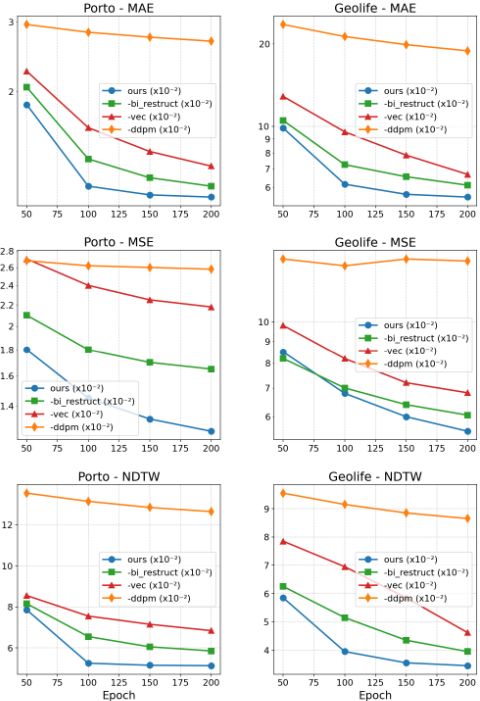
To rigorously assess the contribution of each component within the DiffVec framework, we conducted an ablation study by comparing the full model (Ours) against three specific variants: (1) -ddpm: Replaces our ResTraj paradigm with a standard DDPM that denoises from isotropic Gaussian noise; (2) -bi restruct: Removes the Bidirectional Reconstruction pass from the MVformer, relying solely on forward motion accumulation; and (3) -vec: Removes the motion vector formulation, operating directly on absolute coordinates. The convergence dynamics of MAE, MSE, and NDTW are visualized in Figure 4.
Efficacy of Residual Diffusion (ResTraj). As observed in Figure 4, the -ddpm baseline (orange curve) exhibits an inefficient convergence rate and significantly higher final error compared to our method. Standard diffusion models struggle to reconstruct the complex spatio-temporal structure of trajectories from pure noise within limited sampling steps. In contrast, by conditioning on an interpolated prior, our ResTraj strategy reformulates the generative task as residual refinement. This significantly simplifies the optimization landscape, leading to faster convergence and superior stability.
Impact of Bidirectional Reconstruction. The - bi restruct variant (green curve), which utilizes only forward integration, consistently underperforms the full model. This performance degradation is attributed to error propagation inherent in sequential motion accumulation. Without the constraints provided by the backward pass, minor deviations in early steps amplify over time. The full model effectively mitigates this by fusing forward and backward estimates, utilizing future anchors to calibrate the trajectory and ensure endpoint consistency.
Necessity of Motion Vector Modeling. The -vec variant (red line) exhibits a slow and linear descent, contrasting with the sharp convergence of vector-equipped models. This demonstrates that integrating motion vectors effectively captures the local motion patterns of trajectories, thereby significantly accelerating model convergence and facilitating the efficient recovery of geometric structures. The persistent gap in NDTW further confirms the superiority of this design in maintaining structural coherence.
4.5 Parameter Sensitivity and Efficiency Analysis
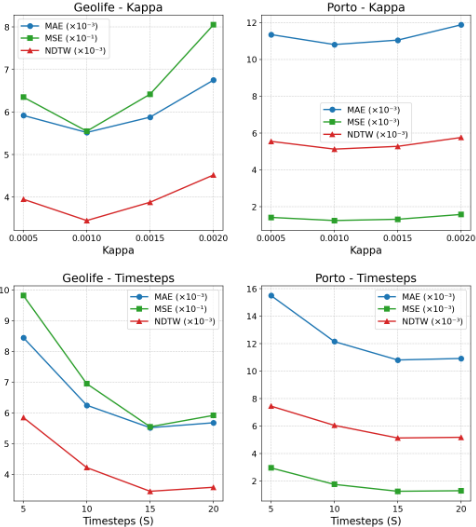
We investigate the impact of noise schedule κ and diffusion steps S to determine the optimal configuration. The results are shown in Figure 5.
Impact of Noise Schedule (kappa). Both datasets achieve the global optimum at κ = 0.001 but exhibit distinct sensitivity profiles. Geolife displays a pronounced convex pattern, where performance degrades significantly when κ > 0.0015, indicating low tolerance for structural disruption. In contrast, Porto demonstrates greater robustness with flatter curvature, suggesting that dense road constraints mitigate high noise levels. We select κ = 0.001 as the balanced optimum.
Impact of Diffusion Steps (S). DiffVec converges rapidly due to the ResTraj paradigm. For Geolife, the error decreases sharply to an inflection point at S = 15 before a slight rebound at S = 20, implying a risk of over-refinement. Porto shows more gradual improvement that saturates after S = 15. Consequently, we fix S = 15 to maximize efficiency without compromising accuracy.
Efficiency Comparison. We further compare DiffVec against diffusion-based baselines in Table 3. Thanks to the ResTraj paradigm, DiffVec requires only 15 denoising steps-20× fewer than the 300 steps used by others. This leads to substantially lower latency (∼57ms vs. ∼28597620ms) and the smallest model footprint (0.86M parameters), demonstrating clear computational advantages.
| Method | Params(M) | FLOPs(G) | Steps | Latency |
|---|---|---|---|---|
| ControlTraj | 8.20 | 0.1781 | 300 | ∼2859ms |
| Diffusion-TS | 2.30 | 0.1200 | 300 | ∼7620ms |
| ProDiff | 23.21 | 1.6100 | 300 | ∼4815ms |
| Ours | 0.86 | 0.0517 | 15 | ∼57ms |
5 Conclusion
In this paper, we proposed DiffVec, a diffusion-based framework for recovering fine-grained continuous trajectories from sparse observations in free space. To address inefficiency, we designed the ResTraj paradigm, which reformulates generation as residual refinement from a structural prior, significantly accelerating convergence. To overcome coordinate instability and non-stationary distributions, we introduced MVformer to model local motion patterns via motion vectors, capturing instantaneous velocities and directional changes. A bidirectional reconstruction mechanism with anchor-constrained fusion ensures endpoint consistency. Experiments on Geolife and Porto datasets demonstrate DiffVec's superiority over state-of-the-art baselines. Future work includes incorporating road network constraints and exploring lightweight model distillation for edge applications.
Acknowledgments
This work is supported in part by Tianshan Talent Training Program (2023TSYCLJ0023), Xinjiang Uygur Autonomous Region Universities Fundamental Research Funds Scientific Research Project (XJEDU2022P018), Excellent Graduate Innovation Project of Xinjiang University (XJDX2025YJS089).
@inproceedings{ijcai2026p283,
  title     = {DiffVec: Diffusion Model for Trajectory Vector Recovery},
  author    = {Duan, Jiaqi and Tian, Shengwei and Yu, Long and Meng, Xiangfu and Zhang, Ya},
  booktitle = {Proceedings of the Thirty-Fifth International Joint Conference on
               Artificial Intelligence, {IJCAI-26}},
  publisher = {International Joint Conferences on Artificial Intelligence Organization},
  editor    = {Diego Calvanese},
  pages     = {2546--2553},
  year      = {2026},
  month     = {8},
  note      = {Main Track},
  doi       = {10.24963/ijcai.2026/283},
  url       = {https://doi.org/10.24963/ijcai.2026/283},
}
TY - CPAPER TI - DiffVec: Diffusion Model for Trajectory Vector Recovery AU - Duan, Jiaqi AU - Tian, Shengwei AU - Yu, Long AU - Meng, Xiangfu AU - Zhang, Ya T2 - Proceedings of the Thirty-Fifth International Joint Conference on Artificial Intelligence, IJCAI-26 PB - International Joint Conferences on Artificial Intelligence Organization PY - 2026 SP - 2546 EP - 2553 DO - 10.24963/ijcai.2026/283 UR - https://doi.org/10.24963/ijcai.2026/283 ER -Copied
Machine-readable versions of this paper, for tools and AI agents:





