
From Discrete to Continuous: Progressive Hybrid-Distributional Learning for Gradual Emotion Transitions
Proceedings of the Thirty-Fifth International Joint Conference on Artificial Intelligence. Main Track. Pages 3691-3699.
https://doi.org/10.24963/ijcai.2026/411
Keywords
- Natural Language Processing: Sentiment analysis, stylistic analysis, and argument mining
- Natural Language Processing: Dialogue and interactive systems
- Humans and AI: Personalization and user modeling
- Machine Learning: Multi-label learning
Abstract
Modeling emotional dynamics in multi-turn dialogues remains challenging due to emotion shifts, where emotional states evolve gradually rather than change abruptly. Existing methods often rely on one-hot supervision, which fails to reflect the progressive nature of human emotions, particularly for neutral-valence emotions with subtle trajectories. To address this limitation, we propose a pseudo soft-label guided Progressive Hybrid-Distributional (PHD) learning framework. PHD reconstructs discrete labels into hybrid distributional representations that encode inter-emotion relations and mixed emotional tendencies. Based on these representations, a progressive training strategy is introduced to guide the model from learning blended emotional states toward the standard one-to-one prediction objective. Furthermore, we design a Graded Contrastive Learning mechanism that replaces rigid binary allocation with graded supervision to alleviate label conflicts. Experiments on benchmark datasets demonstrate PHD consistently improves diverse baseline models, yielding average w-F1 gains of 1.29%. Our framework highlights the critical importance of modeling emotional dynamics as a gradual, distributional process.
- [Baidu, 2023] Baidu. Ernie bot, 2023. Chatbot, based on the ERNIE large-language-model series. Released March 16, 2023.
- [Barrett, 2017] Lisa Feldman Barrett. The theory of con- structed emotion: an active inference account of intero- ception and categorization. Social cognitive and affective neuroscience, 12(1):1-23, 2017.
- [Busso et al., 2008] Carlos Busso, Murtaza Bulut, Chi-Chun Lee, Abe Kazemzadeh, Emily Mower, Samuel Kim, Jean- nette N Chang, Sungbok Lee, and Shrikanth S Narayanan. Iemocap: Interactive emotional dyadic motion capture database. Language resources and evaluation, 42(4):335- 359, 2008.
- [Cambria et al., 2026] Erik Cambria, Rui Mao, Xulang Zhang, Luwei Xiao, Tiesunlong Shen, and Avinash Anand. Senticnet 9: Generative commonsense for emo- tion ai via conceptual primitive discovery and time shift mechanism. IEEE Transactions on Computational Social Systems, 2026.
- [Cao et al., 2025] YuKun Cao, Luobin Huang, and Yijia Tang. Petracker: Poincaré-based dual-strategy emotion tracker for emotion recognition in conversation. IEEE Transactions on Affective Computing, 16(3):2020-2032, 2025.
- [Dai et al., 2024] Yijing Dai, Yingjian Li, Dongpeng Chen, Jinxing Li, and Guangming Lu. Multimodal decoupled distillation graph neural network for emotion recognition in conversation. IEEE Transactions on Circuits and Sys- tems for Video Technology, 34(10):9910-9924, 2024.
- [Hu et al., 2021] Dou Hu, Lingwei Wei, and Xiaoyong Huai. Dialoguecrn: Contextual reasoning networks for emotion recognition in conversations. In Proceedings of the 59th Annual Meeting of the Association for Computational Lin- guistics and the 11th International Joint Conference on Natural Language Processing (Volume 1: Long Papers), pages 7042-7052, 2021.
- [Ji et al., 2025] Hongru Ji, Xianghua Li, Mingxin Li, Meng Zhao, and Chao Gao. Hybrid relational graphs with sentiment-laden semantic alignment for multimodal emo- tion recognition in conversation. In Proceedings of the Thirty-Fourth International Joint Conference on Artificial Intelligence, pages 2973-2981, 2025. IJCAI
- [Joshi et al., 2022] Abhinav Joshi, Ashwani Bhat, Ayush Jain, Atin Singh, and Ashutosh Modi. Cogmen: Contextu- alized gnn based multimodal emotion recognition. In Pro- ceedings of the 2022 conference of the North American chapter of the association for computational linguistics: human language technologies, pages 4148-4164, 2022.
- [Kang and Cho, 2024] Yujin Kang and Yoon-Sik Cho. Im- proving contrastive learning in emotion recognition in con- versation via data augmentation and decoupled neutral emotion. In Proceedings of the 18th Conference of the European Chapter of the Association for Computational Linguistics (Volume 1: Long Papers), pages 2194-2208, 2024.
- [Kang and Cho, 2025] Yujin Kang and Yoon-Sik Cho. Be- yond single emotion: Multi-label approach to conversa- tional emotion recognition. In Proceedings of the AAAI Conference on Artificial Intelligence, volume 39, pages 24321-24329, 2025.
- [Kuppens et al., 2010] Peter Kuppens, Nicholas B Allen, and Lisa B Sheeber. Emotional inertia and psychologi- cal maladjustment. Psychological science, 21(7):984-991, 2010.
- [Li et al., 2025] Jiang Li, Xiaoping Wang, and Zhigang Zeng. Tracing intricate cues in dialogue: Joint graph structure and sentiment dynamics for multimodal emotion recognition. IEEE Transactions on Pattern Analysis and Machine Intelligence, 47(10):8786-8803, 2025.
- [Liu et al., 2022] Yuchen Liu, Jinming Zhao, Jingwen Hu, Ruichen Li, and Qin Jin. Dialogueein: Emotion interaction network for dialogue affective analysis. In Proceedings of the 29th International Conference on Computational Lin- guistics, pages 684-693, 2022.
- [Mao et al., 2023] Yuzhao Mao, Di Lu, Yang Zhang, and Xi- aojie Wang. Fatrer: Full-attention topic regularizer for ac- curate and robust conversational emotion recognition. In ECAI 2023, pages 1688-1695. IOS Press, 2023.
- [Mao et al., 2025] Rui Mao, Guanyi Chen, Xiao Li, Meng- shi Ge, and Erik Cambria. A comparative analysis of metaphorical cognition in chatgpt and human minds. Cog- nitive Computation, 17(1):35, 2025.
- [Mehrabian and Russell, 1974] A. Mehrabian and J.A. Rus- sell. An Approach to Environmental Psychology. M.I.T. Press, 1974.
- [Mohammad, 2025] Saif M Mohammad. Nrc vad lexicon v2: Norms for valence, arousal, and dominance for over 55k english terms. arXiv preprint arXiv:2503.23547, 2025.
- [Nie et al., 2023] Weizhi Nie, Yuru Bao, Yue Zhao, and Anan Liu. Long dialogue emotion detection based on com- monsense knowledge graph guidance. IEEE Transactions on Multimedia, 26:514-528, 2023.
- [Pereira et al., 2025] Patrícia Pereira, Helena Moniz, and Joao Paulo Carvalho. Deep emotion recognition in textual conversations: A survey. Artificial Intelligence Review, 58(1):10, 2025.
- [Poria et al., 2019] Soujanya Poria, Devamanyu Hazarika, Navonil Majumder, Gautam Naik, Erik Cambria, and Rada Mihalcea. Meld: A multimodal multi-party dataset for emotion recognition in conversations. In Proceedings of the 57th annual meeting of the association for computa- tional linguistics, pages 527-536, 2019.
- [Roohi et al., 2025] Samad Roohi, Richard Skarbez, and Hien Duy Nguyen. Reliable uncertainty estimation in emotion recognition in conversation using conformal prediction framework. Natural Language Processing, 31(5):1163-1186, 2025.
- [Shen et al., 2025a] Siyuan Shen, Feng Liu, Hanyang Wang, and Aimin Zhou. Towards speaker-unknown emotion recognition in conversation via progressive contrastive deep supervision. IEEE Transactions on Affective Com- puting, 16(3):2261-2273, 2025.
- [Shen et al., 2025b] Zhiyu Shen, Yunhe Pang, Yanghui Rao, and Jianxing Yu. Coe: A clue of emotion framework for emotion recognition in conversations. In Proceedings of the 63rd Annual Meeting of the Association for Computa- tional Linguistics (Volume 1: Long Papers), pages 23548- 23563, 2025.
- [Shing et al., 2025] Makoto Shing, Kou Misaki, Han Bao, Sho Yokoi, and Takuya Akiba. TAID: Temporally adap- tive interpolated distillation for efficient knowledge trans- fer in language models. In The Thirteenth International Conference on Learning Representations, 2025.
- [Speer et al., 2017] Robyn Speer, Joshua Chin, and Cather- ine Havasi. Conceptnet 5.5: An open multilingual graph of general knowledge. In Proceedings of the AAAI confer- ence on artificial intelligence, volume 31, 2017.
- [Sun et al., 2021] Yang Sun, Nan Yu, and Guohong Fu. A discourse-aware graph neural network for emotion recog- nition in multi-party conversation. In Findings of the As- sociation for Computational Linguistics: EMNLP 2021, pages 2949-2958, 2021.
- [Tu et al., 2023a] Geng Tu, Bin Liang, Ruibin Mao, Min Yang, and Ruifeng Xu. Context or knowledge is not always necessary: A contrastive learning framework for emotion recognition in conversations. In Findings of the association for computational linguistics: ACL 2023, pages 14054-14067, 2023.
- [Tu et al., 2023b] Geng Tu, Bin Liang, Bing Qin, Kam-Fai Wong, and Ruifeng Xu. An empirical study on multi- ple knowledge from chatgpt for emotion recognition in conversations. In Findings of the association for compu- tational linguistics: EMNLP 2023, pages 12160-12173, 2023.
- [Tu et al., 2024] Geng Tu, Feng Xiong, Bin Liang, and Ruifeng Xu. A persona-infused cross-task graph network for multimodal emotion recognition with emotion shift de- tection in conversations. In Proceedings of the 47th Inter- national ACM SIGIR Conference on Research and Devel- opment in Information Retrieval, pages 2266-2270, 2024.
- [Wang et al., 2024] Yan Wang, Bo Wang, Yachao Zhao, Dongming Zhao, Xiaojia Jin, Jijun Zhang, Ruifang He, and Yuexian Hou. Emotion recognition in conversa- tion via dynamic personality. In Proceedings of the 2024 Joint International Conference on Computational Linguistics, Language Resources and Evaluation (LREC- COLING 2024), pages 5711-5722, 2024.
- [Xie et al., 2025] Yunhe Xie, Cheng-Jie Sun, Ziyi Cao, Bingquan Liu, Zhenzhou Ji, Yuanchao Liu, and Lili Shan. A dual contrastive learning framework for enhanced mul- timodal conversational emotion recognition. In Proceed- ings of the 31st International Conference on Computa- tional Linguistics, pages 4055-4065, 2025.
- [Xu et al., 2025] Qinfu Xu, Yiwei Wei, Chunlei Wu, Lei- quan Wang, Shaozu Yuan, Jie Wu, Jing Lu, and Hengyang Zhou. Towards multimodal sentiment analysis via hier- archical correlation modeling with semantic distribution constraints. In Proceedings of the AAAI Conference on Ar- tificial Intelligence, volume 39, pages 21788-21796, 2025.
- [Yang et al., 2022] Lin Yang, Yi Shen, Yue Mao, and Longjun Cai. Hybrid curriculum learning for emotion recognition in conversation. In Proceedings of the AAAI conference on artificial intelligence, volume 36, pages 11595-11603, 2022.
- [Yang et al., 2025] Juan Yang, Puling Wei, Xu Du, and Jun Shen. Graph attention based on contextual reasoning and emotion-shift awareness for emotion recognition in con- versations. Complex & Intelligent Systems, 11(7):287, 2025.
- [Zahiri and Choi, 2018] Sayyed M Zahiri and Jinho D Choi. Emotion detection on tv show transcripts with sequence- based convolutional neural networks. In Workshops at the thirty-second aaai conference on artificial intelligence, 2018.
- [Zha et al., 2025] Xupeng Zha, Huan Zhao, Guanghui Ye, and Zixing Zhang. Dual-view learning for conversational emotion recognition through context and emotion-shift modeling. In Proceedings of the AAAI Conference on Arti- ficial Intelligence, volume 39, pages 25823-25831, 2025.
- [Zhang and Li, 2023] Xiaoheng Zhang and Yang Li. A cross-modality context fusion and semantic refinement network for emotion recognition in conversation. In Pro- ceedings of the 61st Annual Meeting of the Association for Computational Linguistics (Volume 1: Long Papers), pages 13099-13110, 2023.
- [Zhang et al., 2023] Duzhen Zhang, Feilong Chen, and Xi- uyi Chen. Dualgats: Dual graph attention networks for emotion recognition in conversations. In Proceedings of the 61st Annual Meeting of the Association for Computa- tional Linguistics (Volume 1: Long Papers), pages 7395- 7408, 2023.
- [Zhang et al., 2025] Yazhou Zhang, Mengyao Wang, Youxi Wu, Prayag Tiwari, Qiuchi Li, Benyou Wang, and Jing Qin. Dialoguellm: Context and emotion knowledge-tuned large language models for emotion recognition in conver- sations. Neural Networks, page 107901, 2025.
- [Zhao et al., 2022] Weixiang Zhao, Yanyan Zhao, and Bing Qin. Mucdn: Mutual conversational detachment network for emotion recognition in multi-party conversations. In Proceedings of the 29th International Conference on Com- putational Linguistics, pages 7020-7030, 2022.
References were extracted automatically from the PDF and may contain errors.
Full text extracted automatically from the PDF; figures, tables and equations may differ. The PDF is the version of record.
1 Introduction
Endowing machines with complex emotional reasoning is a crucial step from artificial general intelligence toward social intelligence, driving extensive research attention on Emotion Recognition in Conversations (ERC) [Xu et al., 2025]. ERC aims to track the emotional trajectory of interlocutors throughout an interaction. In real conversations, an interlocutor's emotion may fluctuate across dialogue turns, a phenomenon known as emotion shift [Zha et al., 2025]. Current ERC solutions still exhibit a large performance gap between emotion shift scenarios and those involving stable-emotion, limiting overall reliability [Tu et al., 2024; Yang et al., 2025].
Prior work attributes this insensitivity to emotional shifts mainly to model's tendency to replicate frequent emotion labels from nearby utterances while overlooking the actual semantic cues [Xie et al., 2025]. We argue that a more fundamental issue lies in the fact that human emotional transitions are dominated by gradual evolution rather than abrupt jumps [Kuppens et al., 2010]. For example, in a conversation from the MELD [Poria et al., 2019] dataset shown in Figure 1, Ross's Anger does not emerge as a sudden label-level jump, but progressively accumulates until it becomes dominant in utterance u5. Conventional one-hot annotations can only capture superficial transition patterns and fail to reveal deeper gradual-evolution dynamics [Cambria et al., 2026]. Hence, models can at best detect an emotion shift but struggle to infer where the shift is heading [Li et al., 2025]. This limitation becomes particularly pronounced when inferring shifts involving neutral-valence emotions, such as Surprise, whose subtle trajectories cannot be adequately represented by discrete labels [Roohi et al., 2025].
∗Corresponding author.
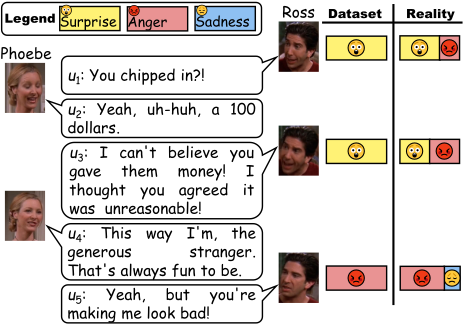
Moreover, allocating multiple emotion labels or even confidence scores per utterance during dataset construction heavily relies on annotators' subjective judgments and difficult to scale. Therefore, existing ERC models typically optimize a one-to-one matching objective that selects a most appropriate emotion label for each utterance [Pereira et al., 2025]. This setting is inherently suboptimal as human emotional expressions are intrinsically entangled [Barrett, 2017], and focusing solely on the dominant emotion inevitably discards valuable complementary cues [Mao et al., 2025].
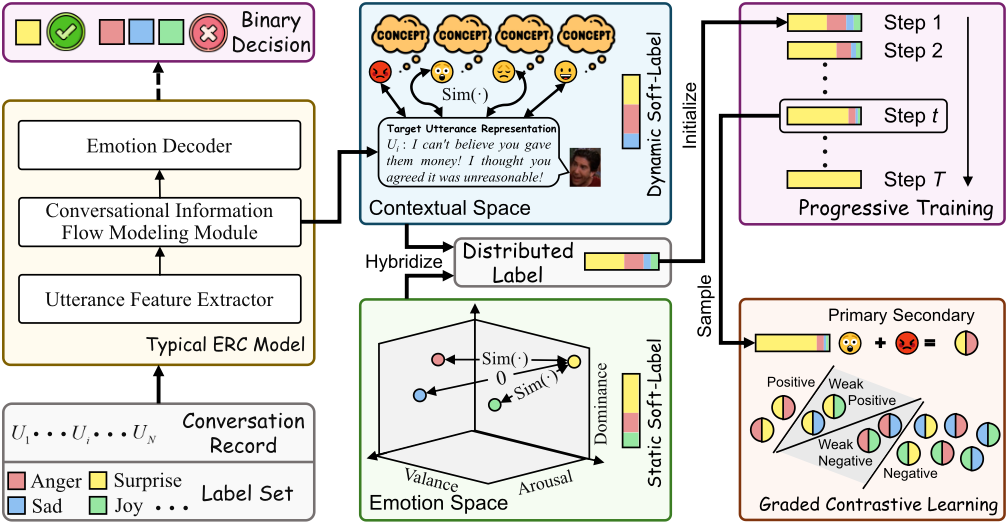
To overcome the constraints of one-hot supervision, we propose a pseudo soft-label guided Progressive HybridDistributional (PHD) learning framework, which can be seamlessly integrated with existing ERC methods across different paradigms. Specifically, we first reconstruct one-hot emotion labels into distributed representations in both the static emotion space and the dynamic contextual space, and then hybridize them. The resulting soft labels encode both fundamental inter-emotion relations and the multifaceted emotional tendencies in the utterance. Building on these representations, we further introduce a novel progressive training strategy that gradually guides the model from capturing mixed emotional states to converging toward the one-to-one matching objective. Additionally, inspired by graded decision systems (e.g., multi-level paper scoring rules in certain academic conferences) rather than binary evaluation, we design a Graded Contrastive Learning (GCL) mechanism. Beyond traditional positive and negative sets, GCL further defines weak-positive and weak-negative sets according to the emotion distribution, allowing a controllable gray zone of exchangeable samples between positive and negative sets and allocating loss weights accordingly in a graded manner.
Our main contributions are summarized as follows:
- We revisit the importance of distributional representations for modeling emotional dynamics in conversations and propose a cost-free soft-label generation method, ensuring strong portability of our PHD framework.
- We propose a novel progressive training strategy that enables the model to mimic gradual emotion transition patterns, improving recognition performance in emotion shift scenarios, especially for neutral-valence emotions.
- We design a graded contrastive mechanism that resolves label-conflict issues inherent in binary allocation rules, correcting the interference from outliers within positive/negative sets in conventional setups.
2 RelatedWork
2.1 Conversational Emotion Recognition
The primary feature of ERC lies in the context-dependent reasoning. Early studies employ Recurrent Neural Networks (RNNs) to sequentially encode utterances while struggle to capture the complex multi-party interaction [Hu et al., 2021; Liu et al., 2022]. Subsequent research increasingly adopts graph neural networks (GNNs) to propagate information. Some approaches treat utterances as nodes and construct fully-connected graphs [Joshi et al., 2022; Zhang and Li, 2023]; others rely on discourse parsing to mitigate the noise from redundant edges [Sun et al., 2021; Zhao et al., 2022]. DualGAT executes both modeling schemes in parallel and introduces a differential regularizer to maximize the extraction of complementary information [Zhang et al., 2023].
Beyond structural modeling, incorporating auxiliary information has proven effective. FATRER employs a topic modeling strategy that integrates emotion-aware signals [Mao et al., 2023]. MKFM treats large language models (LLMs) as knowledge providers and analyzes their complementary contributions [Tu et al., 2023b]. ERC-DP incorporates dynamic personality theory, introducing a personality prompt [Wang et al., 2024]. The recent trend of instruction-tuning LLMs for specific tasks has also shown promise. DialogueLLM [Zhang et al., 2025] uses ERNIE Bot [Baidu, 2023] to generate video-text descriptions and integrates them into instruction design. CoE advances this further by incorporating dialogue scenarios, and designs specialized multi-task instructions to incrementally fuse critical cues [Shen et al., 2025b].
Despite these impressive advances, existing approaches still struggle in emotion-shift scenarios. They tend to adopt conservative strategies that replicate frequent labels, failing to robustly infer the direction of emotional transitions. This significantly hinders their applicability in real-world settings.
2.2 Emotion Shift Modeling
Enhancing model awareness of emotion-shift has recently become a research focus. One mainstream solution formulates emotion-shift detection as an auxiliary task [Yang et al., 2025]. In addition, HCL defines the frequency of emotion shifts within a dialogue as a difficulty score and performs dialogue-level curriculum learning in an easy-to-hard manner [Yang et al., 2022]. CLED interpolates emotion centroids to generate augmented utterances, simulating emotional dynamics based on the emotion transition matrix [Kang and Cho, 2024]. PCGNet treats consecutive utterance dyads as positive or negative samples according to their emotion-shift patterns to perform contrastive learning [Tu et al., 2024].
The inherent limitation of one-hot supervision restricts current research to a relatively coarse level of emotion-shift perception, without capturing its direction. This limitation poses consistent challenges in modeling shifts involving neutralvalence emotions, such as transitions from the neutral state.
2.3 Interactive Dynamics Contrastive Learning
Complex interaction dynamics emerge from the information propagation among interlocutors, utterances, and their interactions. To better capture these dynamics, recent studies construct contrastive objectives. Specifically, positive and negative samples are defined based on whether utterances originate from the same dialogue [Nie et al., 2023], are produced by the same interlocutor [Shen et al., 2025a], or require auxiliary knowledge [Tu et al., 2023a], thereby enhancing model sensitivity to context, identity, and semantics, respectively. Supervised contrastive learning grounded in explicit emotion labels remains the dominant paradigm and has demonstrated strong compatibility with a wide range of architectures [Dai et al., 2024; Cao et al., 2025; Ji et al., 2025].
Existing contrastive frameworks largely rely on a rigid binary decision rule, which is suboptimal for emotion modeling. This all-or-nothing allocation can lead to the loss of nuanced emotional information. For instance, when joy is treated as positive, excitement, neutral, and sadness are all indiscriminately grouped together to the negative set, despite their different degrees of affective opposition. Current methods overlook such gradual emotional relatedness, making them struggle to capture subtle inter-emotion distinctions.
3 Proposed Framework
3.1 ProblemFormulation
A dialogue can be formally represented as an ordered sequence of utterances ⟨u1, ..., ui, ..., uN⟩, where i ∈ [1,N] denotes the utterance index and N is the total number of utterances in the dialogue. Each utterance ui is associated with its interlocutor Ii ∈ I, where |I| ≥ 2. We further define an interlocutor-utterance pair as Ui = (Ii, ui), and represent the entire conversation as C = {U1, ..., UN}. The goal of ERC is to recognize the discrete emotional state yi ∈ E of the target utterance ui conditioned on the conversational context, where E denotes the predefined emotion label set.
3.2 Typical ERC Pipeline
Typical ERC models follow a three-step sequential pipeline: Utterance Feature Extraction (UFE), Conversational Information Flow Modeling (CIFM), and Emotion Decoding (ED).
UFE first extracts context-independent features ui for ui:
The CIFM module then performs conversational modeling over preceding context u1:i-1 to capture temporal patterns under real-time settings, yielding a context-dependent emotion-aware hidden state hi ∈ Rd for each utterance ui:
Finally, a emotion decoder with learnable parameters W ∈ R|Y|×d and b ∈ R|Y| recognizes emotion probabilities of ui:
Equations (1)-(3) outline the complete ERC process:
Parameters are optimized via cross-entropy minimization:
where yi,e and ˆ yi,e denote the ground-truth and predicted probabilities for emotion e in utterance ui, respectively.
3.3 Hybrid-Distributed Label Allocation
One-hot labeling constrains yi,e to a binary set, which limits models to perceiving only emotion-shift triggers. We reconstruct emotion labels into distributed representations from both the emotion space and the contextual space, enabling the model not only to sense a shift but also to infer its tendency.
Static Emotion Space Modeling
Our modeling in the emotion space is grounded in the VAD theory [Mehrabian and Russell, 1974]. VAD posits that emotions are distributed in a continuous space with intrinsic coupling along three dimensions: Valence, Arousal, and Dominance. By representing emotions as continuous points in this space, the VAD framework provides a cognitively grounded perspective for characterizing inter-emotion relationships.
Datasets annotated with yi's corresponding VAD representations vi are rare and costly to scale. Without loss of generality, we extract VAD representations v ∈ R3 for each emotion using the NRC-VAD lexicon [Mohammad, 2025].
We then compute the cosine similarity between vi and the VAD representation ve of each emotion e ∈ E. The underlying relatedness between emotions is quantified as follows:
where θie denotes the angle between the two vectors, Sim(i, e) serves as a similarity score derived from the cosine similarity function cos(·) and constitutes a component of the distributed emotion label.
We apply L1 normalization over all similarity components to construct the static distributional representation ystatic i , ensuring its scale's consistency with the one-hot labeling:
where ystatic i,e denotes the distribution component corresponding to emotion e. However, modeling emotions solely in the static space remains insufficient for capturing the subtle variations among utterances that share the same emotion label.
Dynamic Contextual Space Modeling
In the contextual space, we leverage hi as the basis for allocating label components. The underlying intuition is that utterances sharing the same label may still exhibit subtle contextual semantic variations, which are often critical in shaping the direction of subsequent emotion shifts.
To capture these nuances, we first retrieve the top-C confidence concepts associated with each emotion e from ConceptNet [Speer et al., 2017]. These concepts are concatenated with e itself and used to replace ui. Leveraging the information-filtering capability of the CIFM module, irrelevant concepts are suppressed, yielding a context-aware emotion representation he that resides in the same space as hi.
Following the same procedure as in Equations (6)-(7), we then compute the cosine similarity between hi and he to obtain the component of the dynamic distributed label. These components are then proportionally normalized to form the dynamic distributional representation ydynamic i .
Finally, we introduce a tunable hyperparameter λ ∈ [0, 1] to control the fusion of the static and dynamic components, resulting in the final hybrid-distributional label ydis i :
Compared to the original one-hot label yi , the reconstructed soft label ydis i not only encodes the latent relatedness among emotions but also captures the multiple affective tendencies inherent to the utterance within its specific context.
3.4 Progressive Training Strategy
The conventional training paradigm for ERC, as formulated in Equation (5), aims to match each utterance with its most appropriate emotion label. However, human emotional expression during conversation is multi-faceted and entangled, and identifying only the dominant emotion inevitably discards other informative affective cues. Leveraging the unique advantages of the reconstructed distributional labels ydis i , we further propose a novel Progressive Training Strategy (PTS).
Specifically, at the early stage, we treat ydis i as the target probabilities. That is, each utterance is not only aligned with its ground-truth label but is also allowed to partially map to other emotions. At each training step, we smoothly guide the model from capturing mixed emotional states toward the onehot matching according to the following update rules:
where (t+1) ∈ [1, T ] denotes the current step, T is the maximum number of training steps, and yi represents the groundtruth emotion for ui. The coefficient ε decays linearly from 1 to 0 during training. Equation (9) ensures yi consistently maintains its dominant proportion within the evolving label.
At each training step, the updated label distribution yt+1 i serves as the new supervision signal, replacing Equation (5) with the following Kullback-Leibler divergence objective:
where the scheduling in Equation (11) guarantees that the training target gradually converges to one-hot supervision.
Theoretically, PTS performs a gradual entropy contraction of the supervision signal. This process is mathematically isomorphic to interpolation-based distillation, which has been shown to stabilize training in non-convex optimization settings [Shing et al., 2025].
3.5 Graded Contrastive Learning
Supervised Contrastive Learning (SCL) cannot be directly applied in the distributional setting, since each soft label is theoretically unique and thus cannot be grouped under conventional class-based definitions. Moreover, rigid binary partitioning rule inevitably leads to intra-set conflicts, where certain negative samples are closer to the anchor than some positives. In addition, the long-tailed distribution further exacerbates the imbalance between positive and negative sets.
Inspired by graded evaluation systems [Kang and Cho, 2025], we design a Graded Contrastive Learning mechanism to address these issues. Beyond binary partition, GCL further introduces two intermediate sets, weak positives and weak negatives. Concretely, we assign ui a primary emotion yp i and a secondary emotion ys i according to the component-wise ranking based on ydis i . For each sample j in the same minibatch, we define the following sets with respect to anchor i:
where P(i), N(i), WP(i), and WN(i) denote the positive, negative, weak-positive, and weak-negative sets, respectively, and U represents the set of all samples in the batch.
Algorithm 1 Training Process with PHD
Input: Conversation set C, emotion set E, max training steps T , fusion weight λ, temperature τ , GCL weight α
Output: Trained ERC model parameters Θ
- 1: Initialize model parameters Θ
- 2: Precompute emotion-level VAD embeddings {ve}e∈E
- 3: for each training step t +1 = 1 to T do
- 4: Sample a mini-batch B ⊂ C
- 5: ε ← T-t T-1 {PTS decay factor}
- 6: for each utterance ui ∈ B do
- 7: ui, hi, ˆyi ← ERC(C, ui)
- 8: ystatic i ← StaticAlloc(vyi , {ve})
- 9: ydynamic i ←DynamicAlloc(hi, {he})
- 10: ydis i ← λystatic i + (1-λ)ydynamic i
- 11: yt+1 i ←PTS update(yt i , yi, ε)
- 12: end for
- 13: LKL ←KL({yt+1 i }, ˆyi )
- 14: Construct graded sets {P(i),WP(i),WN(i),N(i)} for each i ∈ B
- 15: LGCL ←GCL loss(hi, ydis i , τ)
- 16: LPHD ←LKL +αLGCL
- 17: Update Θ by minimizing LPHD
- 18: end for
The composition-based criterion in Equation (13) and the primary-emphasis rule in Equation (14) resolve the sample conflict issue. The GCL part in Figure 2 enumerates all possible partitions under four emotion scenarios, achieving a more balanced distribution among sets, thereby alleviating the problem of insufficient positive samples.
To regulate attraction and repulsion across sets, we assign graded weights, which is formalized as follows:
where τ denotes the temperature parameter. The resulting GCL loss for a mini-batch B is then defined as:
The total training objective of our PHD framework consists of the progressive cross-entropy loss and the GCL loss:
where α is a hyperparameter controlling the contribution of LGCL. The complete optimization procedure of the PHD framework is summarized in Algorithm 1.
4 Experiments
4.1 Experimental Settings
Datasets and Metrics
We evaluate the proposed PHD framework on three ERC benchmark datasets: IEMOCAP [Busso et al., 2008], MELD [Poria et al., 2019], and EmoryNLP [Zahiri and Choi, 2018]. Following standard practice, performance is measured using the weighted F1 score (w-F1).
Baselines
To ensure a comprehensive comparison, we integrate PHD with five representative baseline methods covering diverse technical paradigms: GNN-based DualGATs [Zhang et al., 2023], knowledge-enhanced MKFM [Tu et al., 2023b], prompt-based ERC-DP [Wang et al., 2024], and LLM-based DialogueLLM [Zhang et al., 2025] and CoE [Shen et al., 2025b]. Detailed descriptions are provided in Section 2.1.
Implementation Details
For fair comparison, we retain the original configurations of all backbone models. Each backbone is first fine-tuned for several epochs using its standard training procedure and is then incorporated into the PHD framework for further optimization. For LLM-based methods, we introduce the following adaptations to ensure compatibility with PHD:
- (A) Instruction Template Adaptation. The instruction template is modified to end with: "Analyze the interlocutor's emotional state based on the dialogue. Output a probability distribution over the predefined emotion categories. The probabilities should sum to 1." Correspondingly, the structured output format is adjusted to align with ydis i .
- (B) Dynamic Label Construction. For each utterance, we fix the prompt as: "Given the dialogue context and the current utterance, estimate the interlocutor's emotional tendencies as a probability distribution." The resulting LLM outputs are used to construct the dynamic distribution ydynamic .
- (C) GCL Adaptation for LLMs. We adapt GCL to LLMs by operating on the logits produced by the LLM's decoder. Specifically, for each training instance ui, the model produces a emotion-related logit vector z ∈ R|E| . Based on ydis i,e , we derive ordered emotion pairs (em, en) whenever ydis i,m > ydis i,n . The supervision strength of each pair is weighted by the probability gap ∆mn = ydis i,m - ydis i,n . LGCL is thus reformulated as a weighted pairwise ranking loss:
which enables graded supervision for mixed emotional states, avoids rigid binary partitioning, and can be seamlessly integrated into standard instruction tuning via back propagation.
The temperature parameter τ = 0.07. The fusion weight λ is set to 0.3 on IEMOCAP and 0.4 on the other datasets, while LGCL weight α = 0.15. All experiments are conducted on two NVIDIA RTX A6000 GPUs. Reported results are averaged over five runs with random initialization. A paired t-test with a significance level of 0.05 is performed to validate the statistical significance of performance improvements.
| Methods | IEMOCAP | MELD | EmoryNLP | Average |
|---|---|---|---|---|
| DualGATs | 67.68 | 66.90 | 40.69 | 58.42 |
| w/ PHD | 69.70 | 68.52 | 41.24 | 59.82 |
| Improvement | ↑2.02 | ↑1.62 | ↑0.55 | ↑1.40 |
| MKFM | 68.08 | 65.50 | 39.76 | 57.78 |
| w/ PHD | 69.85 | 67.85 | 40.65 | 59.45 |
| Improvement | ↑1.77 | ↑2.35 | ↑0.89 | ↑1.67 |
| ERC-DP | 69.64 | 67.34 | 40.10 | 59.03 |
| w/ PHD | 70.72 | 68.60 | 40.92 | 60.08 |
| Improvement | ↑1.08 | ↑1.26 | ↑0.82 | ↑1.05 |
| DialogueLLM* w/ PHD | 69.87 | 68.54 | 40.28 | 59.56 |
| 70.94 | 70.11 | 41.12 | 60.72 | |
| Improvement | ↑1.07 | ↑1.57 | ↑0.84 | ↑1.16 |
| CoE* | 70.12 | 67.96 | 40.81 | 59.63 |
| w/ PHD | 71.14 | 69.62 | 41.62 | 60.79 |
| Improvement | ↑1.02 | ↑1.66 | ↑0.81 | ↑1.16 |
| Methods | DualGATs | DialogueLLM | CoE |
|---|---|---|---|
| PHD | 59.82 | 60.72 | 60.79 |
| w/o static | 59.42(↓0.40) | 59.98(↓0.74) | 60.08(↓0.71) |
| w/o dynamic | 58.30(↓1.52) | 58.85(↓1.87) | 58.93(↓1.86) |
| w/o PTS | 57.54(↓2.28) | 58.69(↓2.03) | 58.87(↓1.92) |
| w/o GCL | 58.71(↓1.11) | 59.84(↓0.88) | 59.84(↓0.95) |
4.2 Performance Comparison
As reported in Table 1, PHD consistently yields significant performance gains, demonstrating strong architectural portability. On average, PHD improves overall performance by 1.29 w-F1 points, with gains ranging from 1.05 to 1.67.
Notably, larger gains are observed on IEMOCAP and MELD, which are known to contain a higher proportion of emotion-shift utterances and neutral-valence transitions. The improvement on EmoryNLP is relatively moderate, suggesting that PHD does not introduce bias when emotional dynamics are relatively stable, but instead behaves conservatively.
The effectiveness of PHD further extends to LLM-based approaches, indicating that even LLMs remain constrained by one-hot emotion supervision. By injecting graded emotion relevance and progressive entropy contraction, PHD complements LLM reasoning, leading to additional improvements.
Overall, these results demonstrate that PHD functions as a model-agnostic, plug-and-play training framework. More importantly, they confirm that modeling emotional dynamics as a progressive, distributional process is critical for ERC.
4.3 Ablation Study
We conduct ablation experiments to quantify the contribution of each component and to validate their complementary roles. Specifically, w/o static removes the emotion-space distribution derived from VAD, w/o dynamic discards the contextaware distribution allocated in the conversational space, w/o PTS disables the progressive contraction strategy and trains with fixed labels, and w/o GCL removes LGCL from LPHD.
| Methods | IEMOCAP | MELD | EmoryNLP | Average |
|---|---|---|---|---|
| DualGATs | 59.30 | 57.49 | 36.28 | 51.02 |
| w/ PHD | 64.53 | 62.83 | 37.98 | 55.11 |
| Improvement | ↑5.23 | ↑5.34 | ↑1.70 | ↑4.09 |
| MKFM | 59.68 | 57.02 | 36.21 | 50.97 |
| w/ PHD | 64.34 | 60.51 | 38.38 | 54.41 |
| Improvement | ↑4.66 | ↑3.49 | ↑2.17 | ↑3.44 |
| ERC-DP | 56.66 | 51.50 | 35.41 | 47.86 |
| w/ PHD | 61.36 | 57.39 | 39.89 | 52.88 |
| Improvement | ↑4.70 | ↑5.89 | ↑2.48 | ↑4.36 |
| DialogueLLM w/ PHD | 58.76 | 60.16 | 37.13 | 52.02 |
| 61.91 | 64.40 | 39.28 | 55.20 | |
| Improvement | ↑3.15 | ↑4.24 | ↑2.15 | ↑3.18 |
| CoE | 60.08 | 59.35 | 37.82 | 52.42 |
| w/ PHD | 62.33 | 62.44 | 39.54 | 54.77 |
| Improvement | ↑2.25 | ↑3.09 | ↑2.41 | ↑2.58 |
As shown in Table 2, removing any component leads to consistent performance degradation, confirming that each module contributes meaningfully to PHD. Removing the dynamic component causes more pronounced drop than the static, highlighting the importance of context-dependent distributional cues for modeling emotional tendencies beyond label semantics. Disabling PTS results in the largest overall degradation, demonstrating that progressive supervision is critical for stabilizing training and mimicking gradual emotional evolution. The performance decrease observed without GCL verifies the necessity of graded sample partitioning for mitigating label conflicts under distributional supervision.
4.4 Performance on Emotion Shift
We further evaluate PHD specifically on emotion-shift scenarios to examine its ability to capture emotional transitions. As reported in Table 3, PHD consistently outperforms backbones across all emotion-shift subsets. Notably, the gains are more pronounced on MELD, where frequent subtle shifts occur, highlighting PHD's strength in anticipating the direction of emotion changes rather than merely detecting shifts.
Overall, these findings validate that PHD significantly enhances the model's sensitivity to evolving emotional dynamics, addressing a key limitation of existing methods.
4.5 Performance on Neutral-Valence Emotions
We further investigate the effectiveness of PHD on neutralvalence-initiated emotion transitions, which are particularly challenging for conventional ERC models due to their subtlety and low signal in one-hot supervision. As reported in Table 4, integrating PHD substantially improves performance across all datasets. The improvements are particularly pronounced for subtle valence shifts, such as Neutral-to-Other in IEMOCAP and Peaceful-to-Other in EmoryNLP. These results demonstrate that PHD effectively enhances ERC models' sensitivity to neutral-valence dynamics, enabling more reliable recognition of gradual emotional transitions.
| Methods | IEMOCAP | MELD | EmoryNLP | ||
|---|---|---|---|---|---|
| Neutral→ E\Neutral | Neutral→ E\Neutral | Surprise→ E\Surprise | Neutral→ E\Neutral | Peaceful→ E\Peaceful | |
| DualGATs w/ PHD | 34.12 47.00 (↑12.88) | 41.32 54.92 (↑13.60) | 31.89 38.22 (↑6.33) | 23.90 30.16 (↑6.26) | 24.00 34.53 (↑10.53) |
| DialogueLLM w/ PHD | 38.14 52.00 (↑13.86) | 36.95 43.31 (↑6.36) | 38.82 44.19 (↑5.37) | 31.31 43.15 (↑11.84) | 28.36 35.47 (↑7.11) |
| CoE w/ PHD | 43.37 55.24 (↑11.87) | 37.10 44.54 (↑7.44) | 37.73 47.31 (↑9.58) | 29.72 39.36 (↑9.64) | 28.03 35.82 (↑7.79) |
4.6 Effect of Graded Contrastive Learning
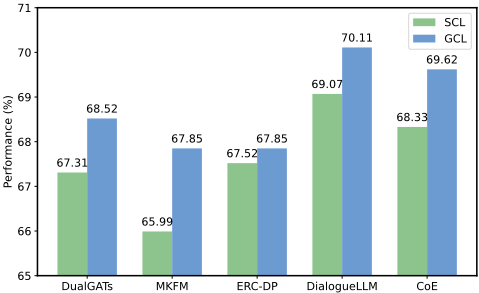
Qualitative Analysis. We further conduct a qualitative comparison between GCL and conventional SCL. As illustrated in Figure 3, GCL consistently outperforms SCL across all backbone models. The largest gain is observed on MKFM, demonstrating that GCL can effectively leverage nuanced inter-sample relationships to enhance feature representation. These results highlight the superiority of GCL over conventional SCL, indicating that modeling graded sample similarities can lead to more discriminative embeddings.
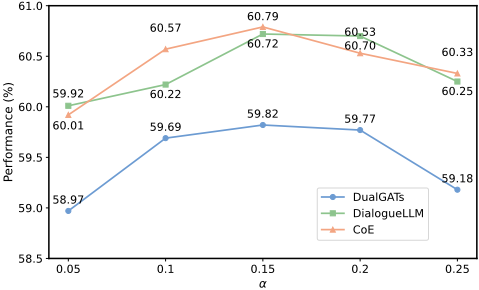
Quantitative Analysis. We conduct experiments by varying LGCL weight α from 0.05 to 0.25 to determine the optimal balance between the GCL loss and the primary task loss. As summarized in Figure 4, the performance initially improves as α increases from 0.05 to 0.15. Beyond this point, further increasing leads to a slight decline. The trends indicates that a moderate GCL weight effectively enhances the embedding quality while maintaining task-specific discriminability. Overall, a moderate α maximizes the benefits of graded contrastive supervision, yielding more discriminative embeddings and superior model performance.
4.7 Computational Efficiency
We evaluate the training efficiency of PHD. As shown in Table 5, for DualGATs, the additional cost remains within 5.2%- 9.6% range, while for DialogueLLM, the relative increase is slightly higher but still stable. Importantly, the absolute training time is largely dominated by the backbone itself.
| Methods | IEMOCAP | MELD | EmoryNLP |
|---|---|---|---|
| DualGATs w/ PHD | 52 57(↑9.6%) | 82 | 77 |
| 89(↑8.5%) | 81(↑5.2%) | ||
| DialogueLLM w/ PHD | 153 | 320 | 289 |
| 171(↑11.8%) | 359(↑12.2%) | 323(↑11.8%) |
Table 5: Training time(minute) comparison of backbone models before and after integrating PHD.
5 Conclusion
In this work, we introduce a novel, plug-and-play learning framework PHD for modeling emotion transitions that addresses the inherent limitations of one-hot supervision. By leveraging hybrid-distributional labels, a progressive training strategy, and graded contrastive learning, PHD enables models to capture both gradual emotion transitions and the entangled nature of affective states. Extensive evaluations across multiple benchmarks demonstrate that PHD consistently enhances performance of both conventional and LLM-based architectures, particularly in emotion-shift and neutral-valence scenarios. Ablation analyses confirm that each component contributes uniquely to the overall improvement, highlighting the synergy between static emotion-space modeling, dynamic context-aware allocation, progressive supervision, and graded contrastive reasoning. Our findings underscore that incorporating distributional and progressive perspectives is pivotal for building systems capable of robust and fine-grained emotional understanding in real-world dialogues.
Acknowledgements
We thank the reviewers for their insightful comments. This work was supported by the National Natural Science Foundation of China (NSFC) under Grant No. 62276059 and by the Fundamental Research Funds for the Central Universities under Grants No. 2572025JT05 and 2572026BR15.
@inproceedings{ijcai2026p411,
  title     = {From Discrete to Continuous: Progressive Hybrid-Distributional Learning for Gradual Emotion Transitions},
  author    = {Xie, Yunhe and Li, Yang},
  booktitle = {Proceedings of the Thirty-Fifth International Joint Conference on
               Artificial Intelligence, {IJCAI-26}},
  publisher = {International Joint Conferences on Artificial Intelligence Organization},
  editor    = {Diego Calvanese},
  pages     = {3691--3699},
  year      = {2026},
  month     = {8},
  note      = {Main Track},
  doi       = {10.24963/ijcai.2026/411},
  url       = {https://doi.org/10.24963/ijcai.2026/411},
}
TY - CPAPER TI - From Discrete to Continuous: Progressive Hybrid-Distributional Learning for Gradual Emotion Transitions AU - Xie, Yunhe AU - Li, Yang T2 - Proceedings of the Thirty-Fifth International Joint Conference on Artificial Intelligence, IJCAI-26 PB - International Joint Conferences on Artificial Intelligence Organization PY - 2026 SP - 3691 EP - 3699 DO - 10.24963/ijcai.2026/411 UR - https://doi.org/10.24963/ijcai.2026/411 ER -Copied
Machine-readable versions of this paper, for tools and AI agents:





