
EVENTTSF: Event-Aware Non-Stationary Time Series Forecasting
Proceedings of the Thirty-Fifth International Joint Conference on Artificial Intelligence. Main Track. Pages 4313-4321.
https://doi.org/10.24963/ijcai.2026/480
Keywords
- Machine Learning: Time series and data streams
Abstract
Time series forecasting is vital in diverse sectors such as energy and transportation, where non-stationary dynamics are deeply intertwined with external events in other modalities such as texts. However, incorporating natural language-based external events to improve non-stationary forecasting remains largely unexplored, as most approaches still rely on a single modality, resulting in limited contextual knowledge and model underperformance. Enabling fine-grained multimodal interactions between temporal and textual data is challenged by two fundamental issues: (1) the gap in modeling interactions among discrete external events and continuous time series in a unified framework; (2) classical uniform diffusion timestep ignores event-induced non-stationary variability, leading to imbalanced denoising difficulty across diffusion stages. In this work, we propose event-aware non-stationary time series forecasting EventTSF, an autoregressive diffusion framework that integrates historical time series and textual events via step-wise diffusion. To mitigate the imbalanced denoising difficulty of uniform timestep sampling, EventTSF uses an event-aware flow-matching timestep conditioned on event semantics. Extensive experiments on 7 synthetic and real-world datasets show that EventTSF outperforms 12 non-stationary time series forecasting baselines, achieving average gains of 41.3% in probabilistic forecasting and 27.5% in deterministic forecasting across all evaluation metrics.
- [Bai et al., 2024] Yun Bai, Simon Camal, and Andrea Mi- chiorri. News and load: A quantitative exploration of nat- ural language processing applications for forecasting day- ahead electricity system demand. IEEE Transactions on Power Systems, 39:6222-6234, 2024.
- [Box and Jenkins, 1976] George EP Box and Gwilym M Jenkins. Time series analysis. forecasting and control. Holden-Day Series in Time Series Analysis, 1976.
- [Chen et al., 2024] Boyuan Chen, Diego Martí Monsó, Yilun Du, Max Simchowitz, Russ Tedrake, and Vincent Sitz- mann. Diffusion forcing: Next-token prediction meets full-sequence diffusion. Advances in Neural Information Processing Systems, 37:24081-24125, 2024.
- [Choi et al., 2022] Jooyoung Choi, Jungbeom Lee, Chaehun Shin, Sungwon Kim, Hyunwoo Kim, and Sungroh Yoon. Perception prioritized training of diffusion models. In CVPR, pages 11472-11481, 2022.
- [Fan et al., 2023] Wei Fan, Pengyang Wang, Dongkun Wang, Dongjie Wang, Yuanchun Zhou, and Yanjie Fu. Dish-ts: a general paradigm for alleviating distribution shift in time series forecasting. In AAAI, volume 37, pages 7522-7529, 2023.
- [Ge et al., 2024] Yunfeng Ge, Yingxin Zhang, Keyi Shi, and Hongyan Li. A moment cross predictor for non-stationary mobile traffic forecasting. In ICCC, pages 2059-2064. IEEE, 2024.
- [Ge et al., 2025] Yunfeng Ge, Jiawei Li, Yiji Zhao, Haomin Wen, Zhao Li, Meikang Qiu, Hongyan Li, Ming Jin, and Shirui Pan. T2s: high-resolution time series gener- ation with text-to-series diffusion models. In IJCAI, pages 5208-5216, 2025. IJCAI
- [Guan et al., 2026] Tong Guan, Zijie Meng, Dianqi Li, Shiyu Wang, Chao-Han Huck Yang, Qingsong Wen, Zuozhu Liu, Sabato Marco Siniscalchi, Ming Jin, and Shirui Pan. Timeomni-1: Incentivizing complex reasoning with time series in large language models. In ICLR, 2026.
- [Jiang et al., 2025] Yushan Jiang, Wenchao Yu, Geon Lee, Dongjin Song, Kijung Shin, Wei Cheng, Yanchi Liu, and Haifeng Chen. Explainable multi-modal time se- ries prediction with llm-in-the-loop. arXiv preprint arXiv:2503.01013, 2025.
- [Jin et al., 2024] Ming Jin, Yifan Zhang, Wei Chen, Kexin Zhang, Yuxuan Liang, Bin Yang, Jindong Wang, Shirui Pan, and Qingsong Wen. Position: What can large lan- guage models tell us about time series analysis. In ICML. MLResearchPress, 2024.
- [Kim et al., 2021] Taesung Kim, Jinhee Kim, Yunwon Tae, Cheonbok Park, Jang-Ho Choi, and Jaegul Choo. Re- versible instance normalization for accurate time-series forecasting against distribution shift. In ICLR, 2021.
- [Kim et al., 2025] HyunGi Kim, Siwon Kim, Jisoo Mok, and Sungroh Yoon. Battling the non-stationarity in time series forecasting via test-time adaptation. In AAAI, volume 39, pages 17868-17876, 2025.
- [Lee et al., 2025] Geon Lee, Wenchao Yu, Kijung Shin, Wei Cheng, and Haifeng Chen. Timecap: Learning to con- textualize, augment, and predict time series events with large language model agents. In AAAI, volume 39, pages 18082-18090, 2025.
- [Li et al., 2022] Wendi Li, Xiao Yang, Weiqing Liu, Yingce Xia, and Jiang Bian. Ddg-da: Data distribution genera- tion for predictable concept drift adaptation. In AAAI, vol- ume 36, pages 4092-4100, 2022.
- [Li et al., 2024] Yuxin Li, Wenchao Chen, Xinyue Hu, Bo Chen, Mingyuan Zhou, et al. Transformer-modulated diffusion models for probabilistic multivariate time series forecasting. In ICLR, 2024.
- [Lian et al., 2026] Xinglin Lian, Yu Zheng, Yan Liu, Fan Zhou, Chunlei Peng, and Xinbo Gao. Contextual masking distillation for network traffic anomaly detection. IEEE Transactions on Information Forensics and Security, 2026.
- [Liang et al., 2024a] Yuebing Liang, Yichao Liu, Xiaohan Wang, and Zhan Zhao. Exploring large language models for human mobility prediction under public events. Com- puters, Environment and Urban Systems, 112:102153, 2024.
- [Liang et al., 2024b] Yuxuan Liang, Haomin Wen, Yuqi Nie, Yushan Jiang, Ming Jin, Dongjin Song, Shirui Pan, and Qingsong Wen. Foundation models for time series anal- ysis: A tutorial and survey. In KDD, pages 6555-6565, 2024.
- [Lipman et al., 2022] Yaron Lipman, Ricky TQ Chen, Heli Ben-Hamu, Maximilian Nickel, and Matt Le. Flow matching for generative modeling. arXiv preprint arXiv:2210.02747, 2022.
- [Liu et al., 2022a] Xingchao Liu, Chengyue Gong, and Qiang Liu. Flow straight and fast: Learning to gener- ate and transfer data with rectified flow. arXiv preprint arXiv:2209.03003, 2022.
- [Liu et al., 2022b] Yong Liu, Haixu Wu, Jianmin Wang, and Mingsheng Long. Non-stationary transformers: Explor- ing the stationarity in time series forecasting. Advances in neural information processing systems, 35:9881-9893, 2022.
- [Liu et al., 2023a] Yong Liu, Tengge Hu, Haoran Zhang, Haixu Wu, Shiyu Wang, Lintao Ma, and Mingsheng Long. itransformer: Inverted transformers are effective for time series forecasting. arXiv preprint arXiv:2310.06625, 2023.
- [Liu et al., 2023b] Yong Liu, Chenyu Li, Jianmin Wang, and Mingsheng Long. Koopa: Learning non-stationary time series dynamics with koopman predictors. Advances in neural information processing systems, 36:12271-12290, 2023.
- [Liu et al., 2024a] Haoxin Liu, Harshavardhan Kamarthi, Lingkai Kong, Zhiyuan Zhao, Chao Zhang, and B Aditya Prakash. Time-series forecasting for out-of-distribution generalization using invariant learning. arXiv preprint arXiv:2406.09130, 2024.
- [Liu et al., 2024b] Peiyuan Liu, Beiliang Wu, Yifan Hu, Naiqi Li, Tao Dai, Jigang Bao, and Shu-tao Xia. Time- bridge: Non-stationarity matters for long-term time series forecasting. arXiv preprint arXiv:2410.04442, 2024.
- [Liu et al., 2025a] Peiyuan Liu, Hang Guo, Tao Dai, Naiqi Li, Jigang Bao, Xudong Ren, Yong Jiang, and Shu-Tao Xia. Calf: Aligning llms for time series forecasting via cross-modal fine-tuning. In AAAI, volume 39, pages 18915-18923, 2025.
- [Liu et al., 2025b] Qinglong Liu, Cong Xu, Wenhao Jiang, Kaixuan Wang, Lin Ma, and Haifeng Li. Timestacker: A novel framework with multilevel observation for capturing nonstationary patterns in time series forecasting. In ICML, 2025.
- [Luo et al., 2025] Yuxiao Luo, Songming Zhang, Ziyu Lyu, and Yuhan Hu. Tfdnet: Time-frequency enhanced decom- posed network for long-term time series forecasting. Pat- tern Recognition, 162:111412, 2025.
- [Narasimhan et al., 2024] Sai Shankar Narasimhan, Shub- hankar Agarwal, Oguzhan Akcin, Sujay Sanghavi, and Sandeep Chinchali. Time weaver: A conditional time se- ries generation model. arXiv preprint arXiv:2403.02682, 2024.
- [Nie et al., 2022] Yuqi Nie, Nam H Nguyen, Phanwadee Sinthong, and Jayant Kalagnanam. A time series is worth 64 words: Long-term forecasting with transformers. arXiv preprint arXiv:2211.14730, 2022.
- [Qiu et al., 2026] Xiangfei Qiu, Yuhan Zhu, Zhengyu Li, Xingjian Wu, Bin Yang, and Jilin Hu. Dag: A dual corre- lation network for time series forecasting with exogenous variables. In ICML, 2026.
- [Shen and Kwok, 2023] Lifeng Shen and James Kwok. Non- autoregressive conditional diffusion models for time series prediction. In ICML, pages 31016-31029. PMLR, 2023.
- [Tashiro et al., 2021] Yusuke Tashiro, Jiaming Song, Yang Song, and Stefano Ermon. Csdi: Conditional score- based diffusion models for probabilistic time series im- putation. Advances in neural information processing sys- tems, 34:24804-24816, 2021.
- [Wang et al., 2022] Rui Wang, Yihe Dong, Sercan Ö Arik, and Rose Yu. Koopman neural forecaster for time se- ries with temporal distribution shifts. arXiv preprint arXiv:2210.03675, 2022.
- [Wang et al., 2024] Xinlei Wang, Maike Feng, Jing Qiu, Jin- jin Gu, and Junhua Zhao. From news to forecast: Inte- grating event analysis in llm-based time series forecasting with reflection. Advances in Neural Information Process- ing Systems, 37:58118-58153, 2024.
- [Wen et al., 2023] Qingsong Wen, Weiqi Chen, Liang Sun, Zhang Zhang, Liang Wang, Rong Jin, Tieniu Tan, et al. Onenet: Enhancing time series forecasting models under concept drift by online ensembling. Advances in Neural Information Processing Systems, 36:69949-69980, 2023.
- [Williams et al., 2024] Andrew Robert Williams, Arjun Ashok, Étienne Marcotte, Valentina Zantedeschi, Jithen- daraa Subramanian, Roland Riachi, James Requeima, Alexandre Lacoste, Irina Rish, Nicolas Chapados, et al. Context is key: A benchmark for forecasting with essen- tial textual information. arXiv preprint arXiv:2410.18959, 2024.
- [Wu et al., 2023] Haixu Wu, Tengge Hu, Yong Liu, Hang Zhou, Jianmin Wang, and Mingsheng Long. Timesnet: Temporal 2d-variation modeling for general time series analysis. In ICLR, 2023.
- [Xu et al., 2021] Wentao Xu, Weiqing Liu, Chang Xu, Jiang Bian, Jian Yin, and Tie-Yan Liu. Rest: Relational event- driven stock trend forecasting. In WWW, pages 1-10, 2021.
- [Xu et al., 2024] Zhijian Xu, Yuxuan Bian, Jianyuan Zhong, Xiangyu Wen, and Qiang Xu. Beyond trend and period- icity: Guiding time series forecasting with textual cues. arXiv e-prints, pages arXiv-2405, 2024.
- [Xue and Salim, 2023] Hao Xue and Flora D Salim. Prompt- cast: A new prompt-based learning paradigm for time se- ries forecasting. IEEE Transactions on Knowledge and Data Engineering, 36:6851-6864, 2023.
- [Ye et al., 2024] Weiwei Ye, Songgaojun Deng, Qiaosha Zou, and Ning Gui. Frequency adaptive normalization for non-stationary time series forecasting. Advances in Neural Information Processing Systems, 37:31350-31379, 2024.
- [Ye et al., 2025] Weiwei Ye, Zhuopeng Xu, and Ning Gui. Non-stationary diffusion for probabilistic time series fore- casting. arXiv preprint arXiv:2505.04278, 2025.
- [Yi et al., 2023] Kun Yi, Qi Zhang, Wei Fan, Shoujin Wang, Pengyang Wang, Hui He, Ning An, Defu Lian, Long- bing Cao, and Zhendong Niu. Frequency-domain mlps are more effective learners in time series forecasting. Advances in Neural Information Processing Systems, 36:76656-76679, 2023.
- [Yuan and Qiao, 2024] Xinyu Yuan and Yan Qiao. Diffusion-ts: Interpretable diffusion for general time series generation. arXiv preprint arXiv:2403.01742, 2024.
- [Zhan et al., 2025] Tianxiang Zhan, Ming Jin, Yuanpeng He, Yuxuan Liang, Yong Deng, and Shirui Pan. Continuous evolution pool: Taming recurring concept drift in online time series forecasting. arXiv preprint arXiv:2506.14790, 2025.
- [Zhang et al., 2025a] Huanyu Zhang, Chang Xu, Yi-Fan Zhang, Zhang Zhang, Liang Wang, and Jiang Bian. Timeraf: Retrieval-augmented foundation model for zero- shot time series forecasting. IEEE Transactions on Knowl- edge and Data Engineering, 2025.
- [Zhang et al., 2025b] Xiyuan Zhang, Boran Han, Haoyang Fang, Abdul Fatir Ansari, Shuai Zhang, Danielle C Mad- dix, Cuixiong Hu, Andrew Gordon Wilson, Michael W Mahoney, Hao Wang, et al. Does multimodality lead to better time series forecasting? arXiv preprint arXiv:2506.21611, 2025.
References were extracted automatically from the PDF and may contain errors.
Full text extracted automatically from the PDF; figures, tables and equations may differ. The PDF is the version of record.
1 Introduction
Time series forecasting is critical in sectors such as energy, transportation, and meteorology [Liang et al., 2024b], where accurate forecasting enables effective decision making and resource management. However, real-world forecasting faces longstanding challenges due to non-stationarity and distribution shifts [Box and Jenkins, 1976], where the underlying time series distribution changes over time. While recent advances, including normalization techniques (e.g., RevIN [Kim et al., 2021]), model decomposition (e.g., Koopa [Liu et al., 2023b]), and online learning (e.g., OneNet [Wen et al., 2023]), have partially addressed these issues, they typically operate on a single modality, overlooking that the change is entangled with external events from other modalities, particularly texts. This leaves valuable contextual knowledge largely unexploited, resulting in limited forecasting performance as evidenced in Figure 1 (a). The distinct segment-wise temporal distributions triggered by event type in Figure 1 (b) highlight the need for event-aware forecasting. To capture interactions between discrete textual events and continuous time series, we propose EVENTTSF, an autoregressive generative architecture (Figure 1 (c)).
∗Correspondence to Ming Jin (mingjinedu@gmail.com) and Shirui Pan (s.pan@griffith.edu.au).
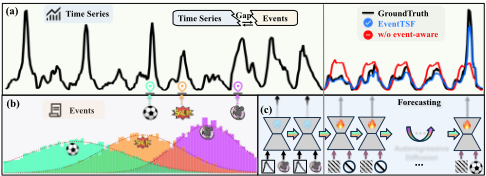
In many real-world systems, upcoming events such as holidays or planned promotions are known in advance of the forecast horizon, providing actionable exogenous priors to anticipate distribution shifts that cannot be inferred from historical observations alone. Recent efforts have explored multimodal integration for time series forecasting using large language models via exogenous information and agentic interactions [Qiu et al., 2026; Jiang et al., 2025]. However, these methods struggle to model non-stationarity driven by evolving temporal dynamics and complex event interactions. First, existing methods utilize general and coarse-grained textual context for forecasting [Zhang et al., 2025b], but struggle to capture fine-grained event-induced distribution shifts. Second, existing approaches rely on a deterministic event representation and produce point forecasts, limiting their ability to model event-induced uncertainty under non-stationary settings. Recent advances in flow matching and autoregressive generation offer some promising tools for event-aware forecasting [Lipman et al., 2022; Liu et al., 2022a].
However, two key challenges remain unresolved for multimodal event-aware forecasting: ❶ Fine-grained temporalevent interaction. Existing methods [Narasimhan et al., 2024] rely on static global "meta context", which fails to synchronize and align fine-grained discrete events with continuous time series at the segment level. In contrast, modeling fine-grained temporal and event interactions helps capture cascading and lagged dependencies between time series and event dynamics. Specifically, aligning chronologically discrete ordered event segments with the fixed-length time series windows enables step-wise event-series interaction, rather than conditioning on a single global context. ❷ Event-agnostic timestep sampling. Current diffusion-based time series forecasting models [Ye et al., 2025; Yuan and Qiao, 2024] typically sample diffusion timesteps from a fixed uniform distribution. However, uniform sampling can skew denoising difficulty across diffusion stages, undermining stability. Denoising difficulty is closely tied to the signal-tonoise ratio (SNR) of the denoiser's learning target [Choi et al., 2022]. External events can induce non-stationary shifts in magnitude and variance, yielding heterogeneous SNR and thus varied event-dependent denoising difficulty. Consequently, event-agnostic uniform timestep sampling cannot adapt to event-dependent dynamics, leading to imbalanced training difficulty and unstable denoiser optimization.
To address these challenges, we propose EVENTTSF, a diffusion-based autoregressive architecture for event-aware non-stationary time series forecasting. EVENTTSF jointly models historical time series and textual events to generate probabilistic forecasts under non-stationary dynamics, maintaining a learnable multimodal hidden state at each step and incrementally incorporating event information. To mitigate event-agnostic uniform diffusion timestep sampling, we introduce an event-aware mechanism that learns an event-conditioned reparameterization, mapping a base uniform sample to an event-dependent timestep via learnable distribution parameterized by event-conditioned networks. This adaptive sampling strategy balances denoising difficulty across diffusion stages. The implementation code is available 1 . Our key contributions are summarized as follows:
- Paradigm Reformulation. We formulate event-aware non-stationary time series forecasting as a paradigm that incorporates multimodal event information to better address distribution shifts in real-world forecasting.
- Methodological Innovation. We develop EVENTTSF, an autoregressive diffusion model that enables finegrained event-series alignment and mitigates denoising imbalance via event-aware timestep sampling.
- Superior Performance. EVENTTSF consistently improves forecasting performance across diverse scenarios, improving probabilistic forecasting by 41.3% and deterministic forecasting by 27.5% on average overall.
1 https://github.com/WinfredGe/EventTSF
2 Definition
Given a univariate time series X1:L = {xl}Ll=1 of length L, we define a set of N chronologically ordered fine-grained textual event embeddings C = {c1, c2, . . . , cs, . . . , cN}. Each event embedding cs corresponds to an aligned nonoverlapping consistent time segment xs = {xl}js l=is ⊂ X1:L, where is and js denote the start and end timestamps of event segment s. The multimodal time series datasets is defined as D = {(xs, cs)}Ns=1 , satisfying the constraints: (1) ⋃Ns=1 xs ⊆ X1:L(complete coverage), and (2) xs ∩ xs′ = ∅ for all s ̸= s′ (non-overlapping segments).
We address event-aware non-stationary time series forecasting, where the underlying time series distribution exhibits event-conditioned shifts across different event categories,
Given p historical time series and event pairs Hx = {xl}sl=s-p+1 and Hc = {cl}sl=s-p+1 , and q future event descriptions Fc = {cl}s+q l=s+1 , the objective is to forecast the following q future time series predictions ˆ Fx = Gθ(Hx,Hc,Fc), where ˆ Fx is the estimated Fx = {xl}s+q s+1 ; Gθ denotes an event-aware forecasting model that captures non-stationary dynamics conditioned on external events.
3 Methodology
As shown in Figure 2, we introduce EVENTTSF, an autoregressive diffusion architecture designed for event-aware non-stationary time series forecasting. EVENTTSF addresses events and time series synchronization and joint modeling. EVENTTSF integrates event-aware diffusion timestep, allowing event information to modulate the denoising process.
3.1 Multimodal Autoregressive Diffusion
Event Synchronization. Discrete events often exert influence on continuous time series in real-world forecasting. For example, traffic demand often surges during public celebrations; network bandwidth usage can spike during highly anticipated live broadcasts; and product sales rise during planned promotional campaigns. However, due to the lack of an effective joint representation, continuous time series and stochastic discrete events have been studied as two separate research topics: time series and temporal point process. To bridge this modality gap, we propose event synchronization, which constructs a unified event-series representation under a shared temporal granularity. Specifically, as illustrated in the left part of Figure 2, we partition the time series into nonoverlapping segment xs. according to selected window size, and align each segment with an event embedding cs that occurs within the same interval. If no event occurs in a segment window, we assign a NULL event. Synchronized event-time series pairs D = {(xs, cs)}Ns=1 are then used as inputs to our autoregressive diffusion model. Specifically, this model is trained on the synchronized multimodal segments produced by the forward flow matching process in Section 3.2.
Autoregressive Diffusion. The integration of autoregressive modeling and diffusion processes has proven effective for temporal data modeling [Chen et al., 2024]. We design an autoregressive diffusion model EVENTTSF for event-aware time series forecasting tasks, as illustrated in the middle of Figure 2. This model regards the probabilistic time series forecasting as an autoregressive fine-grained segments generation. Specifically, the model generates the segements xs at forecasting step s via a conditional diffusion denoising process. This denoising is initialized by a latent state Zh that summarizes historical time series and event observations. The hidden state Zs is updated at each step in an autoregressive manner through interactions with temporal segments and event semantics across the forecasting horizon.
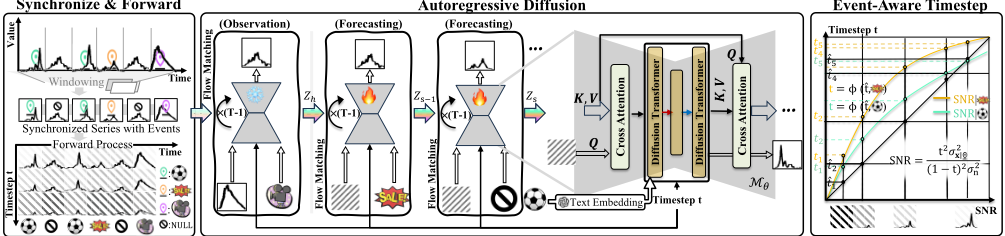
During the training stage, we autoregressively optimize a flow-matching denoiser Mθ conditioned on latent state Zs-1, noised time series segments xts , event-aware diffusion timestep t, and textual event embedding cs encoded by a frozen OpenAI text-embedding-3 model. Specifically, at each autoregressive step s and diffusion timestep t, the flow matching denoiser learns the velocity field vts and updated latent state Zs from vts ,Zs = Mθ(Zs-1, xts , cs, t) conditioned on the latent state Zs-1 and the event representation cs. The denoiserMθ is shared across all autoregressive steps, while step specific dynamics are captured through the evolving latent state Zs and event representation cs. This design enables fine-grained relationship modeling between synchronized temporal patterns and event semantics. The detailed training procedure is summarized in Algorithm 1.
During the inference stage, we first compute the historical state Zh from the clean historical time series Hx and the corresponding historical events Hc, which is denoted in Section 2. During the forecasting stage, the historical state Zh serves as the initial state Z0. At each autoregressive step s, the model takes a noise input ns and an exogenous event cs to generate the denoised segment xs via the learned flow matching denoiser Mθ(Zs-1, ns, cs, t), coupled with an vanilla ODE solver. The architecture of the denoiser is diffusion transformer, and the sampling procedure is detailed in Algorithm 2. Overall, EVENTTSF autoregressively incorporates dynamic event descriptions, enabling flexible and eventaware forecasting in evolving environments.
3.2 FlowMatching with Event-Aware Timestep
Flow Matching. We use the flow matching [Liu et al., 2022a; Ge et al., 2025] to jointly train textual events and time series. As illustrated in the left part of Figure 2, the forward diffusion process injects noise according to an event-aware diffusion timestep t. At each autoregressive step s and diffusion timestep t ∈ [0, 1], flow matching constructs data trajectories that transform samples from a simple prior distribution p(x0s ) ∼ N(0, I) into the target data distribution p(x1s ). An optimal transport path, realized through Rectified Flow [Liu et al., 2022a], guides this transformation process:
The instantaneous velocity vector field along this path vts with respect to diffusion timestep t is given by:
A neural network vθ(xts , Zs-1, cs, t) approximates the target vector field vts . To enhance generation quality, vθ is designed to integrate the conditional information [Lipman et al., 2022]. In our settings, this conditional information includes the historical state Zs-1 of the time series and the textual condition cs. During sampling, the model generates ˆx1s by first sampling noise x0s ∼ N(0, I) and then solving the learned velocity field vθ via a numerical ODE solver.
Event-Aware Timestep. Real-world time series exhibit event-dependent dynamics, and different events can induce distinct signal magnitudes and variances, leading to heterogeneous denoising difficulty. Denoising difficulty is closely tied to the SNR of the denoiser's learning target [Choi et al., 2022]; accordingly, we quantify denoising difficulty via SNR. Under the standard noise injection in Equation 1, the SNR at diffusion timestep t is given by:
where σ2x|c and σ2n denote the variances of the clean signal and noise, respectively. Notably, σ2x|c can vary across event
Algorithm 1 Training
Require: Training samples (xs, cs); number of time series and event pairs per sample S; learnable initial state Z0; flow matching model Mθ; the learnable event-aware reparameterization function ϕ; learning rate η; optimal transport path OT ; Uniform distribution U(0, 1).
1: Initialize predicted velocity set ˆ V ← {}. 2: Initialize groundtruth velocity set V ← {}. 3: for s = 1, . . . , S do 4: Sample ˆ t ∼ U(0, 1) 5: t ← ϕ(ˆ t, cs) 6: Define xts = OT(xs, t) and vts = dxts dt 7: Union Update (Zs, ˆvts ) =Mθ(Zs-1, xts , cs, t) 8: V ←V ∪ {vts } 9: ˆ V ← ˆ V ∪ {ˆvts } 10: end for 11: L =MSE(V, ˆ V) 12: θ ← θ - η∇θLconditions, implying that the effective denoising difficulty at the same t may differ under different events.
However, the diffusion timestep t is typically sampled from a condition-agnostic distribution, such as uniform distribution t ∼ U(0, 1). Such uniform sampling fails to allocate denoising difficulty appropriately; it ignores eventinduced heterogeneity, resulting in uneven difficulty allocation for the denoiser learning. As illustrated in the right panel of Figure 2, SNR varies nonlinearly with the diffusion timestep t increase, indicating that denoising difficulty varies nonlinearly across different diffusion stages. Moreover, the timestep-SNR curve is event-dependent, resulting in heterogeneous denoising difficulty under different event conditions.
To address these issues, we reparameterize uniformly sampled base timestep via an event-conditioned mapping, such that the effective denoising difficulty is more evenly allocated in an event-modulated manner. Specifically, we map a base timestep ˆ t ∈ [0, 1] drawn from a Uniform distribution ˆ t ∼ U(0, 1) into an event-adaptive timestep t ∈ [0, 1], whose distribution follows a Beta law t|c ∼ Beta(α(c), β(c)):
where ϕ is the event-aware reparameterization function parameterized by Θ, and F -1 α,β (·) is the inverse cumulative distribution function of a Beta distribution with parameters α and β. This design ensures: (i) t ∈ [0, 1], (ii) ϕ is strictly monotone increasing in ˆ t, preserving the intrinsic ordering of diffusion steps, and (iii) the mapping shape can be flexibly adjusted through (α, β) to realize condition-dependent adaptive schedules.
The Beta distribution parameters are predicted from the event representation c via two lightweight linear networks, fΘα and gΘβ , followed by softplus(·) activation:
Algorithm 2 Sampling (Forecasting)
Require: Initial state Z0; flow matching model Mθ;reparameterization function ϕ; historical p time series and event pairs (Hx, Hc); evolving event sequence {cs}qs=p+1 = Fc; Gaussian distribution N(0, I); total number of denoising steps T and its incremental
∆ˆ t = 1 T . 1: Initialize forecasting set ˆ X ← {}. 2: for s = 1, . . . , p do 3: (Zs, ) =Mθ(Zs-1, xs, cs, t = 1) 4: end for 5: for s = p+1, . . . , q do 6: n0s ∼N(0, I) 7: for t = ∆ˆ t , 2∆ˆ t , . . . , 1 do 8: ∆t ← ϕ(t - ∆ˆ t , cs) 9: (Zs, ˆv∆t s ) =Mθ(Zs-1, n∆t s , cs, t) 10: nts ← n∆t s +ODE(ˆv∆t s ,∆t) ▷ Refinement 11: end for 12: ˆxs ←n1s 13: ˆ X ← ˆ X ∪ {ˆxs} 14: end for 15: return ˆ Xwhere fΘα (·) and gΘβ (·) denote two separate lightweight learnable linear networks parameterized by Θα and Θβ, respectively; softplus(·) enforces α(c), β(c) > 0; and ϵ > 0 is a small constant added for numerical stability. By conditioning α(c), β(c) on the event representation c, the model adapts timestep conditioned on heterogeneous event semantics, thereby modulating the denoising process and enabling event-specific restoration dynamics for the denoising targets.
4 Experiments
We evaluate the performance of EVENTTSF and address core research questions. Experiments are conducted on 7 datasets spanning 12 models. Configurations follow NsDiff [Ye et al., 2025] and standard TSF protocols [Wu et al., 2023]. Results are averaged over three independent runs.
- RQ1: How effectively does EVENTTSF forecast nonstationary multimodal data in both deterministic and probabilistic settings?
- RQ2: When baselines can access event data, can they achieve performance comparable to EVENTTSF?
- RQ3: How effective are the components, textual event conditioning and event-aware timestep in enhancing the method's performance?
- RQ4: How does EVENTTSF's training efficiency compare to baselines and across forecasting horizons?
- RQ5: What insights can be gained from visualizations with vs. without events?
4.1 Experimental Settings
Datasets. The experiments are evaluated on one synthetic dataset and six real-world datasets spanning traffic, weather and atmospheric physics sector. These include Synthetic Dataset, Atmospheric Physics-Weather Events Dataset, Traffic-Public Events Dataset [Liang et al., 2024a], Temperature-Rainfall Events Dataset [Lee et al., 2025] and Traffic-News Events Dataset [Wang et al., 2024].
| Method | Metric | Synthetic | Atmosphere Physics | Traffic | Temperature-Rainfall | Avg. | |||
|---|---|---|---|---|---|---|---|---|---|
| Public | News | Houston | San Fran. | NewYork | |||||
| CRPS | 0.5769 | 1.3840 | 0.4359 | 0.4471 | 0.5742 | 0.5986 | 0.8201 | 0.6910 | |
| CSDI WQL | 0.3174 | 0.7452 | 0.2341 | 0.2445 | 0.3149 | 0.3274 | 0.4509 | 0.3763 | |
| MAE | 0.8901 | 2.1477 | 0.7623 | 0.6585 | 0.8165 | 0.8905 | 1.1509 | 1.0452 | |
| CRPS | 0.6718 | 1.3876 | 0.6179 | 0.4977 | 0.8092 | 0.7194 | 1.0869 | 0.8272 | |
| TimeDiff WQL | 0.3380 | 0.7475 | 0.3111 | 0.2509 | 0.4067 | 0.3618 | 0.5456 | 0.4231 | |
| MAE | 0.6858 | 2.1343 | 0.6320 | 0.5114 | 0.8233 | 0.7335 | 1.1012 | 0.9459 | |
| CRPS | 0.1842 | 1.6422 | 0.2796 | 0.3059 | 0.5500 | 0.5532 | 0.6857 | 0.6001 | |
| TMDM WQL | 0.0983 | 0.8233 | 0.1393 | 0.2012 | 0.2978 | 0.2987 | 0.3723 | 0.3187 | |
| MAE | 0.2899 | 1.6568 | 0.3598 | 0.4480 | 0.7297 | 0.7305 | 0.9258 | 0.7344 | |
| CRPS | 0.2101 | 1.2933 | 0.2825 | 0.4516 | 0.4924 | 0.6588 | 0.4585 | 0.5496 | |
| NsDiff WQL | 0.1131 | 0.6794 | 0.1406 | 0.3680 | 0.2769 | 0.2785 | 0.3612 | 0.3168 | |
| MAE | 0.2657 | 1.5355 | 0.3508 | 0.6199 | 0.7015 | 0.6836 | 0.9451 | 0.7289 | |
| CRPS | 0.6211 | 0.7151 | 0.5401 | 0.4437 | 0.6065 | 0.5453 | 0.8363 | 0.6154 | |
| DiffusionTS WQL | 0.3361 | 1.1631 | 0.2377 | 0.2388 | 0.3273 | 0.2938 | 0.4470 | 0.4348 | |
| MAE | 0.8818 | 3.8218 | 0.5930 | 0.5988 | 0.8280 | 0.7314 | 1.1070 | 1.2231 | |
| CRPS | 0.0776 | 0.2857 | 0.1908 | 0.2943 | 0.2670 | 0.5183 | 0.2895 | 0.2747 | |
| EVENTTSF WQL | 0.0395 | 0.1464 | 0.1006 | 0.1561 | 0.1405 | 0.2702 | 0.1532 | 0.1438 | |
| MAE | 0.0812 | 0.3544 | 0.2314 | 0.3561 | 0.3178 | 0.5869 | 0.3500 | 0.3254 | |
Evaluation Metrics. We use comprehensive metrics for different forecasting tasks. For deterministic forecasting, we use Mean Squared Error (MSE), Mean Absolute Error (MAE) and Root Mean Squared Error (RMSE) for evaluation. For probabilistic forecasting, we evaluate performance using Continuous Ranked Probability Score (CRPS) and Weighted Quantile Loss (WQL), and report MAE for point summaries. Baselines. To evaluate EVENTTSF's effectiveness, we benchmark it against probabilistic diffusion forecasting models and deterministic deep time series forecasting models. For the probabilistic diffusion forecasting models, CSDI [Tashiro et al., 2021], TimeDiff [Shen and Kwok, 2023], TMDM [Li et al., 2024], DiffusionTS [Yuan and Qiao, 2024], and NsDiff [Ye et al., 2025] are included. For the deterministic deep time series forecasting, we include representative models, including iTransformer [Liu et al., 2023a], Koopa [Liu et al., 2023b], NSTransformer [Liu et al., 2022b], PatchTST [Nie et al., 2022], TimesNet [Wu et al., 2023], and other used baselines. NsDiff [Ye et al., 2025], Koopa [Liu et al., 2023b], and NSTransformer [Liu et al., 2022b] are designed for the non-stationary time series forecasting.
4.2 Performance Comparison on Probabilistic and Deterministic Forecasting (RQ1)
EVENTTSF achieves superior performance across both deterministic and probabilistic forecasting tasks. Table 1 compares probabilistic forecasting performance across seven datasets using CRPS, WQL, and average MAE, where lower values indicate better performance. The results highlight EVENTTSF's superior performance across diverse eventaware forecasting settings, with average improvements of 41.3% and 27.5% across all datasets and metrics for probabilistic and deterministic forecasting, respectively. Specifically, EVENTTSF delivers notable gains, lowering the CRPS on the Synthetic dataset from TMDM's 0.1842 to 0.0776, a 58.4% improvement, and reducing the CRPS on the Atmosphere Physics dataset from DiffusionTS's 0.7151 to 0.2857, a 65.1% improvement. Table 2 reports deterministic forecasting results across datasets. On the Synthetic dataset, EVENTTSF achieves an MAE of 0.0812, an 74.1% reduction from Autoformer's 0.3141; on the averaged dataset results, EVENTTSF achieves an RMSE of 0.5846, denoting a 35.8% reduction from DLinear's 0.9088. Deterministic forecasting models perform competitively on the Traffic-News dataset, where the limited contextual relevance of long-form, lowinformation textual event representations significantly weakens the effectiveness of event-aware forecasting.
4.3 Event-Enhanced Baseline Performance (RQ2)
Most existing non-stationary time series forecasting baselines cannot natively incorporate external textual events; therefore, we augment both probabilistic and deterministic nonstationary time series forecasting baselines with the aligned external textual event embeddings for a fairer evaluation. For the probabilistic forecasting baselines, we replace the denoiser's transformer block with the crossformer block to enable event-conditioned cross-attention. For the deterministic forecasting baselines, we linearly project event embeddings into the input embedding space and add them to the input tokens as a residual conditioning signal.
| Method | Metric | Synthetic | Atmosphere Physics | Traffic | Temperature-Rainfall | Avg. | |||
|---|---|---|---|---|---|---|---|---|---|
| Public | News | Houston | San Fran. | NewYork | |||||
| MAE | 0.3141 | 2.0739 | 0.4296 | 0.3536 | 0.7127 | 0.7011 | 0.9930 | 0.7969 | |
| Autoformer MSE | 0.2612 | 6.5844 | 0.5258 | 0.2144 | 0.8194 | 0.8168 | 1.5016 | 1.5319 | |
| RMSE | 0.5161 | 2.5656 | 0.7294 | 0.4673 | 0.9062 | 0.9043 | 1.2215 | 1.0443 | |
| MAE | 0.3614 | 1.4269 | 0.4262 | 0.3165 | 0.7277 | 0.6016 | 0.9305 | 0.6844 | |
| DLinear MSE | 0.3022 | 3.5741 | 0.5786 | 0.1641 | 0.7980 | 0.5992 | 1.1781 | 1.0278 | |
| RMSE | 0.5493 | 1.8910 | 0.7617 | 0.4054 | 0.8943 | 0.7748 | 1.0852 | 0.9088 | |
| MAE | 0.3821 | 1.5398 | 0.4419 | 0.3136 | 0.7239 | 0.6275 | 0.9420 | 0.7101 | |
| iTransformer MSE | 0.3244 | 4.2576 | 0.6249 | 0.1657 | 0.8524 | 0.6970 | 1.3635 | 1.1836 | |
| RMSE | 0.5705 | 2.0634 | 0.7909 | 0.4067 | 0.9231 | 0.8358 | 1.1689 | 0.9656 | |
| MAE | 0.3233 | 1.6498 | 0.4161 | 0.3057 | 0.7226 | 0.6189 | 0.8582 | 0.6992 | |
| Koopa MSE | 0.2680 | 5.2355 | 0.5285 | 0.1640 | 0.8509 | 0.6462 | 1.1296 | 1.2604 | |
| RMSE | 0.5188 | 2.2884 | 0.7271 | 0.4054 | 0.9227 | 0.7852 | 1.0635 | 0.9587 | |
| MAE | 0.3261 | 1.7127 | 0.4569 | 0.3626 | 0.7698 | 0.6878 | 0.9752 | 0.7559 | |
| NSTransformer MSE | 0.2762 | 5.7245 | 0.6027 | 0.2198 | 0.9331 | 0.7514 | 1.3522 | 1.4086 | |
| RMSE | 0.5256 | 2.3902 | 0.7763 | 0.4672 | 0.9695 | 0.8677 | 1.1627 | 1.0227 | |
| MAE | 0.3228 | 1.8450 | 0.4029 | 0.3371 | 0.7743 | 0.6456 | 0.9150 | 0.7490 | |
| PatchTST MSE | 0.2614 | 5.7711 | 0.4693 | 0.1985 | 0.9516 | 0.7223 | 1.2445 | 1.3741 | |
| RMSE | 0.5118 | 2.4012 | 0.6890 | 0.4457 | 0.9750 | 0.8492 | 1.1135 | 0.9979 | |
| MAE | 0.3181 | 1.5708 | 0.4283 | 0.3263 | 0.7159 | 0.6367 | 0.9269 | 0.7033 | |
| TimesNet MSE | 0.2633 | 4.4105 | 0.5914 | 0.1861 | 0.8446 | 0.7087 | 1.3148 | 1.1885 | |
| RMSE | 0.5132 | 2.1030 | 0.7699 | 0.4321 | 0.9187 | 0.8462 | 1.1496 | 0.9618 | |
| MAE | 0.0812 | 0.3544 | 0.2314 | 0.3561 | 0.3500 | 0.3178 | 0.5869 | 0.3254 | |
| EVENTTSF MSE | 0.0235 | 0.3668 | 0.2243 | 0.3936 | 0.3512 | 0.3202 | 1.1526 | 0.4046 | |
| RMSE | 0.1535 | 0.6056 | 0.4736 | 0.6273 | 0.5926 | 0.5659 | 1.0736 | 0.5846 | |
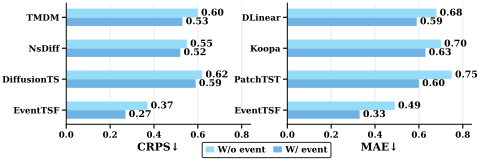
As reported in Fig. 3, incorporating events consistently improves the performance of both probabilistic and deterministic baselines. Even with event access, all baselines remain substantially inferior to EVENTTSF. For probabilistic forecasting, incorporating event information yields a CRPS reduction of 0.07 for TMDM, corresponding to an 11.7% relative improvement. In comparison, EVENTTSF achieves a larger CRPS reduction of 0.10, translating to a 27.1% improvement. For deterministic forecasting, under the MAE metric, EVENTTSF with textual event conditioning consistently outperforms the other event-augmented baselines, delivering an average gain of 0.28 corresponding to an 45.9% relative improvement. Overall, even with the textual event access, none of the event-enhanced baselines achieves performance comparable to EVENTTSF. This indicates that injecting event embeddings simply is insufficient to exploiting event information and achieve event-aware modeling.
4.4 Ablation Study (RQ3)
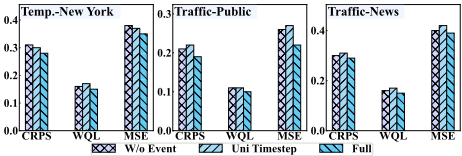
Figure 4 reports ablation results across three datasets under three experiment configurations and evaluated with three metrics. Removing textual events causes performance degradation: WQL increases 10.71% on the Temperature-New York events dataset. Moreover, replacing classical uniform diffusion timestep sampling with event-aware diffusion timestep yields consistent gains, reducing CRPS by 9.21%, WQL by 12.50%, and MSE by 10.42%. Additional detailed experimental on the effectiveness of event-aware diffusion timestep sampling are provided in Figure 2. Overall, the ablation results consistently confirm the necessity of each component, demonstrating that the complete architecture is essential for event-aware non-stationary time series forecasting.
4.5 Efficiency Analysis (RQ4)
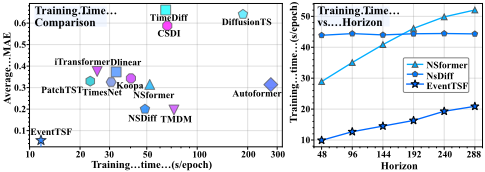
Figure 5 analyzes training efficiency across forecasting models and scalability with horizon lengths. EVENTTSF achieves the shortest training time and lowest forecasting error across all datasets. It shows 1.13× faster training and 4.85× lower forecasting error versus the second-best baseline on the Synthetic dataset. NSTransformer shows linear training time growth with horizon length, while NsDiff maintains consistently high training time across all horizons. In contrast, EVENTTSF achieves both lower training time and sublinear growth with increasing horizons. Because it generates forecasts segment-wise rather than point-wise. Results confirm method's superior efficiency in event-aware non-stationary forecasting, benefiting long-horizon scenarios.
4.6 Event-Aware Forecasting Visualization (RQ5)
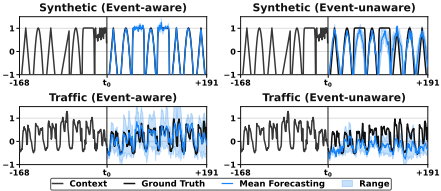
Figure 6 illustrates event-aware forecasting visualization on the Synthetic and Traffic-Public datasets. Textual event incorporation significantly improves accuracy. On the Synthetic dataset, the event-aware model accurately captures abrupt transitions while the event-unaware model produces smoothed responses. On the Traffic-Public dataset, event information improves the alignment with ground truth under noisy conditions, although improvements are more pronounced on the synthetic data. Results demonstrate that event information provides essential semantic cues for precise forecasting across both synthetic dataset and real-world dataset.
5 RelatedWork
5.1 Non-stationary Time Series Forecasting
Non-stationarity challenges time series forecasting; deep learning tackles it through normalization, model design, and learning theory. (I) Normalization plugins are designed from time domains [Kim et al., 2021; Fan et al., 2023] and frequency domains [Ye et al., 2024; Liu et al., 2025b]. (II) Models include tailored architectures [Liu et al., 2022b;
Liu et al., 2024b], such as frequency and statistical decompositions [Yi et al., 2023; Luo et al., 2025; Ge et al., 2024], and dynamic system modeling [Liu et al., 2023b; Wang et al., 2022]. (III) Learning-theoretic approaches handle distribution shifts via domain generation [Liu et al., 2024a], adaptation [Kim et al., 2025; Li et al., 2022], and online learning [Wen et al., 2023; Zhan et al., 2025]. However, incorporating external modality for non-stationary time series forecasting remains largely unexplored.
5.2 Multimodal for Time series Forecasting
Incorporating textual information into time series forecasting has gained attention across finance, traffic, and power systems [Xu et al., 2021; Liang et al., 2024a; Lian et al., 2026; Bai et al., 2024], showing promise in early LLM-based forecasting [Xue and Salim, 2023; Jin et al., 2024]. Subsequently,verious fusion methods have emerged exploring model architecture [Xu et al., 2024], learning strategies [Liu et al., 2025a], and benchmarks [Williams et al., 2024]. Recently, retrieval-augmented [Jiang et al., 2025; Zhang et al., 2025a], reasoning [Guan et al., 2026], and agent-based systems [Lee et al., 2025; Wang et al., 2024] leverage LLMs' contextual analysis capabilities. However, these approaches rely heavily on LLMs for modality fusion, potentially limiting their interactive generative expressiveness. Autoregressive diffusion architectures offer probabilistic forecasting capabilities while supporting textual conditioning. Combining autoregressive mechanisms with diffusion modeling remains unexplored for event-aware time series forecasting.
6 Conclusion
This work pioneers the integration of external multimodal knowledge to tackle non-stationarity in time series forecasting. EVENTTSF captures fine-grained time series and event interactions via an autoregressive diffusion architecture with event-aware timestep. This novel architecture addresses the gap in synchronizing and modeling discrete event and continuous time series. Event-aware timestep reallocate timesteps conditioned on the event so that the denoiser sees a more balanced difficulty distribution across diffusion stages. Success in modeling cross-modal non-stationary dynamics opens up a direction for non-stationary time series analysis.
@inproceedings{ijcai2026p480,
  title     = {EVENTTSF: Event-Aware Non-Stationary Time Series Forecasting},
  author    = {Ge, Yunfeng and Jin, Ming and Zhao, Yiji and Li, Hongyan and Du, Bo and Xu, Chang and Pan, Shirui},
  booktitle = {Proceedings of the Thirty-Fifth International Joint Conference on
               Artificial Intelligence, {IJCAI-26}},
  publisher = {International Joint Conferences on Artificial Intelligence Organization},
  editor    = {Diego Calvanese},
  pages     = {4313--4321},
  year      = {2026},
  month     = {8},
  note      = {Main Track},
  doi       = {10.24963/ijcai.2026/480},
  url       = {https://doi.org/10.24963/ijcai.2026/480},
}
TY - CPAPER TI - EVENTTSF: Event-Aware Non-Stationary Time Series Forecasting AU - Ge, Yunfeng AU - Jin, Ming AU - Zhao, Yiji AU - Li, Hongyan AU - Du, Bo AU - Xu, Chang AU - Pan, Shirui T2 - Proceedings of the Thirty-Fifth International Joint Conference on Artificial Intelligence, IJCAI-26 PB - International Joint Conferences on Artificial Intelligence Organization PY - 2026 SP - 4313 EP - 4321 DO - 10.24963/ijcai.2026/480 UR - https://doi.org/10.24963/ijcai.2026/480 ER -Copied
Machine-readable versions of this paper, for tools and AI agents:





