
URFPert: Unrolled Regulatory Flow Networks for Out-of-Distribution Single-Cell Perturbation Prediction
Proceedings of the Thirty-Fifth International Joint Conference on Artificial Intelligence. Main Track. Pages 4795-4803.
https://doi.org/10.24963/ijcai.2026/534
Keywords
- Machine Learning: Regression
- Multidisciplinary Topics and Applications: Health and medicine
- Multidisciplinary Topics and Applications: Bioinformatics
- Multidisciplinary Topics and Applications: Life sciences
Abstract
Single-cell perturbation screens enable systematic discovery of gene regulatory mechanisms, yet the exponential expansion of perturbation space makes comprehensive experimentation impractical. Although in silico predictors have been increasingly proposed to address this challenge, most existing methods either assume static regulatory priors or learn unconstrained data-driven representations. As a result, they often suffer from poor adaptation to state-dependent shifts and weak out-of-distribution generalization. In response, we propose URFPert, an unrolled regulatory flow network tailored for single-cell perturbation prediction. Specifically, URFPert is composed of three fundamental modules: (i) Regulatory Structure Unrolling module, which employs an iterative unrolling optimization algorithm to infer state-dependent gene regulatory networks (GRNs); (ii) Heterogeneous Graph Flow Network, which incorporates the inferred GRNs into a conditional velocity field to yield state-consistent and perturbation-specific trajectories; (iii)Discriminative Optimization Strategy, which combines Mean Squared Error~(MSE) with Maximal Coding Rate Reduction~(MCR²) to promote discriminative perturbation responses and mitigate training confounders. Comprehensive evaluations on five single-cell perturbation datasets demonstrate that URFPert outperforms state-of-the-art methods in unseen perturbation regimes, providing a powerful tool for interpreting regulatory mechanisms. The project code is public via https://github.com/Jiniretttt/URFPert.
- [Ahlmann-Eltze et al., 2025] Constantin Ahlmann-Eltze, Wolfgang Huber, and Simon Anders. Deep-learning- based gene perturbation effect prediction does not yet outperform simple linear baselines. Nature Methods, 22(8):1657-1661, 2025.
- [Barry et al., 2021] Timothy Barry, Xuran Wang, John A Morris, Kathryn Roeder, and Eugene Katsevich. Scep- tre improves calibration and sensitivity in single-cell crispr screen analysis. Genome biology, 22(1):344, 2021.
- [Beck and Teboulle, 2009] Amir Beck and Marc Teboulle. A fast iterative shrinkage-thresholding algorithm for lin- ear inverse problems. SIAM journal on imaging sciences, 2(1):183-202, 2009.
- [Bunne et al., 2023] Charlotte Bunne, Stefan G Stark, Gabriele Gut, Jacobo Sarabia Del Castillo, Mitch Levesque, Kjong-Van Lehmann, Lucas Pelkmans, An- dreas Krause, and Gunnar Rätsch. Learning single-cell perturbation responses using neural optimal transport. Na- ture methods, 20(11):1759-1768, 2023.
- [Busbridge et al., 2019] Dan Busbridge, Dane Sherburn, Pietro Cavallo, and Nils Y Hammerla. Relational graph at- tention networks. arXiv preprint arXiv:1904.05811, 2019.
- [Chen and Zou, 2025] Yiqun Chen and James Zou. Sim- ple and effective embedding model for single-cell biol- ogy built from chatgpt. Nature biomedical engineering, 9(4):483-493, 2025.
- [Chen et al., 2018] Ricky TQ Chen, Yulia Rubanova, Jesse Bettencourt, and David K Duvenaud. Neural ordinary dif- ferential equations. Advances in neural information pro- cessing systems, 31, 2018.
- [Consortium, 2021] The Gene Ontology Consortium. The gene ontology resource: enriching a gold mine. Nucleic Acids Research, 49(D1):D325-D334, 01 2021.
- [Cui et al., 2024] Haotian Cui, Chloe Wang, Hassaan Maan, Kuan Pang, Fengning Luo, Nan Duan, and Bo Wang. scgpt: toward building a foundation model for single- cell multi-omics using generative ai. Nature methods, 21(8):1470-1480, 2024.
- [Dhar et al., 2013] Manoj K Dhar, Archana Koul, and San- jana Kaul. Farnesyl pyrophosphate synthase: a key en- zyme in isoprenoid biosynthetic pathway and potential molecular target for drug development. New biotechnol- ogy, 30(2):114-123, 2013.
- [Dixit et al., 2016] Atray Dixit, Oren Parnas, Biyu Li, Jenny Chen, Charles P Fulco, Livnat Jerby-Arnon, Nemanja D Marjanovic, Danielle Dionne, Tyler Burks, Raktima Ray- chowdhury, et al. Perturb-seq: dissecting molecular cir- cuits with scalable single-cell rna profiling of pooled ge- netic screens. cell, 167(7):1853-1866, 2016.
- [Esser et al., 2024] Patrick Esser, Sumith Kulal, Andreas Blattmann, Rahim Entezari, Jonas Müller, Harry Saini, Yam Levi, Dominik Lorenz, Axel Sauer, Frederic Boe- sel, et al. Scaling rectified flow transformers for high- resolution image synthesis. In Forty-first international conference on machine learning, 2024.
- [Goeva et al., 2024] Aleksandrina Goeva, Michael-John Dolan, Judy Luu, Eric Garcia, Rebecca Boiarsky, Rajat M Gupta, and Evan Macosko. Hidden: a machine learning method for detection of disease-relevant populations in case-control single-cell transcriptomics data. Nature Communications, 15(1):9468, 2024.
- [Liu et al., 2022] Xingchao Liu, Chengyue Gong, and Qiang Liu. Flow straight and fast: Learning to generate and transfer data with rectified flow. arXiv preprint arXiv:2209.03003, 2022.
- [Loshchilov and Hutter, 2017] Ilya Loshchilov and Frank Hutter. Decoupled weight decay regularization. arXiv preprint arXiv:1711.05101, 2017.
- [Lotfollahi et al., 2023] Mohammad Lotfollahi, Anna Klimovskaia Susmelj, Carlo De Donno, Leon Hetzel, Yuge Ji, Ignacio L Ibarra, Sanjay R Srivatsan, Mohsen Naghipourfar, Riza M Daza, Beth Martin, et al. Pre- dicting cellular responses to complex perturbations in high-throughput screens. Molecular systems biology, 19(6):e11517, 2023.
- [Macek et al., 2018] Pavel Macek, Matthew J Cliff, Kevin J Embrey, Geoffrey A Holdgate, J Willem M Nissink, Stanislava Panova, Jonathan P Waltho, and Rick A Davies. Myc phosphorylation in its basic helix-loop-helix re- gion destabilizes transient α-helical structures, disrupting max and dna binding. Journal of Biological Chemistry, 293(24):9301-9310, 2018.
- [Monga et al., 2021] Vishal Monga, Yuelong Li, and Yon- ina C Eldar. Algorithm unrolling: Interpretable, efficient deep learning for signal and image processing. IEEE Sig- nal Processing Magazine, 38(2):18-44, 2021.
- [Pakos-Zebrucka et al., 2016] Karolina Pakos-Zebrucka, Iz- abela Koryga, Katarzyna Mnich, Mila Ljujic, Afshin Samali, and Adrienne M Gorman. The integrated stress response. EMBO reports, 17(10):1374-1395, 2016.
- [Papalexi et al., 2021] Efthymia Papalexi, Eleni P Mimitou, Andrew W Butler, Samantha Foster, Bernadette Bracken, William M Mauck III, Hans-Hermann Wessels, Yuhan Hao, Bertrand Z Yeung, Peter Smibert, et al. Characteriz- ing the molecular regulation of inhibitory immune check- points with multimodal single-cell screens. Nature genet- ics, 53(3):322-331, 2021.
- [Replogle et al., 2022] Joseph M Replogle, Reuben A Saun- ders, Angela N Pogson, Jeffrey A Hussmann, Alexan- der Lenail, Alina Guna, Lauren Mascibroda, Eric J Wag- ner, Karen Adelman, Gila Lithwick-Yanai, et al. Map- ping information-rich genotype-phenotype landscapes with genome-scale perturb-seq. Cell, 185(14):2559-2575, 2022.
- [Roohani et al., 2024] Yusuf Roohani, Kexin Huang, and Jure Leskovec. Predicting transcriptional outcomes of novel multigene perturbations with gears. Nature Biotech- nology, 42(6):927-935, 2024.
- [Roohani et al., 2025] Yusuf H Roohani, Tony J Hua, Po- Yuan Tung, Lexi R Bounds, Feiqiao B Yu, Alexander Dobin, Noam Teyssier, Abhinav Adduri, Alden Woodrow, Brian S Plosky, et al. Virtual cell challenge: Toward a turing test for the virtual cell. Cell, 188(13):3370-3374, 2025.
- [Saboksayr and Mateos, 2021] Seyed Saman Saboksayr and Gonzalo Mateos. Accelerated graph learning from smooth signals. IEEE Signal Processing Letters, 28:2192-2196, 2021.
- [Tancik et al., 2020] Matthew Tancik, Pratul Srinivasan, Ben Mildenhall, Sara Fridovich-Keil, Nithin Raghavan, Utkarsh Singhal, Ravi Ramamoorthi, Jonathan Barron, and Ren Ng. Fourier features let networks learn high fre- quency functions in low dimensional domains. Advances in neural information processing systems, 33:7537-7547, 2020.
- [Tian et al., 2021] Ruilin Tian, Anthony Abarientos, Jason Hong, Sayed Hadi Hashemi, Rui Yan, Nina Dräger, Kun Leng, Mike A Nalls, Andrew B Singleton, Ke Xu, et al. Genome-wide crispri/a screens in human neurons link lysosomal failure to ferroptosis. Nature neuroscience, 24(7):1020-1034, 2021.
- [Van de Sande et al., 2020] Bram Van de Sande, Christopher Flerin, Kristofer Davie, Maxime De Waegeneer, Gert Hulselmans, Sara Aibar, Ruth Seurinck, Wouter Saelens, Robrecht Cannoodt, Quentin Rouchon, et al. A scalable scenic workflow for single-cell gene regulatory network analysis. Nature protocols, 15(7):2247-2276, 2020.
- [Wan et al., 2011] Guohui Wan, Rohit Mathur, Xiaoxiao Hu, Xinna Zhang, and Xiongbin Lu. mirna response to dna damage. Trends in biochemical sciences, 36(9):478-484, 2011.
- [Wei et al., 2025] Zhiting Wei, Yiheng Wang, Yicheng Gao, Shuguang Wang, Ping Li, Duanmiao Si, Yuli Gao, Siqi Wu, Danlu Li, Kejing Dong, et al. Benchmarking algo- rithms for generalizable single-cell perturbation response prediction. Nature Methods, pages 1-14, 2025.
- [Wessels et al., 2023] Hans-Hermann Wessels, Alejan- dro Méndez-Mancilla, Yuhan Hao, Efthymia Papalexi, William M Mauck III, Lu Lu, John A Morris, Eleni P Mimitou, Peter Smibert, Neville E Sanjana, et al. Efficient combinatorial targeting of rna transcripts in single cells with cas13 rna perturb-seq. Nature methods, 20(1):86-94, 2023.
- [Yu et al., 2020] Yaodong Yu, Kwan Ho Ryan Chan, Chong You, Chaobing Song, and Yi Ma. Learning diverse and discriminative representations via the principle of maxi- mal coding rate reduction. Advances in neural information processing systems, 33:9422-9434, 2020.
- [Zhu and Li, 2025] Ouyang Zhu and Jun Li. Scouter pre- dicts transcriptional responses to genetic perturbations with large language model embeddings. Nature Compu- tational Science, pages 1-8, 2025.
- [Zou et al., 2018] Jiahuan Zou, Mengwei Zhuang, Xiaopeng Yu, Na Li, Rudi Mao, Zhida Wang, Jianing Wang, Xiaoyan Wang, Huaiyu Zhou, Lining Zhang, et al. Myc inhibition increases pd-l1 expression induced by ifn-γ in hepatocel- lular carcinoma cells. Molecular immunology, 101:203- 209, 2018.
References were extracted automatically from the PDF and may contain errors.
Full text extracted automatically from the PDF; figures, tables and equations may differ. The PDF is the version of record.
1 Introduction
Single-cell perturbation sequencing provides a powerful tool to characterize how genetic perturbations reshape cellular transcriptional states at scale. The accurate interpretation of how perturbation responses influence diverse gene functions and regulatory mechanisms is essential for enhancing our comprehension of fundamental biology [Dixit et al., 2016;
∗Corresponding author.
Bunne et al., 2023]. Nevertheless, given the exponential growth of potential genetic combinations, it is impractical to systematically screen all possible combinations through experimental methods [Lotfollahi et al., 2023]. As a result, developing in silico models for the accurate prediction of cellular perturbation effects has become necessary.
A variety of approaches have been developed for modeling single-cell perturbation. Early statistical frameworks such as MIMOSCA [Dixit et al., 2016] and hypothesis-testing pipelines such as SCEPTRE [Barry et al., 2021] quantify perturbation effects from scRNA-seq readouts. More recently, learning-based methods have been introduced to improve experimental annotations and trajectory-level reasoning, including HiDDeN [Goeva et al., 2024] for perturbation label refinement and CellOT [Bunne et al., 2023] for inferring perturbation-driven state transitions from unpaired single-cell measurements. However, these methods are developed and evaluated in in-distribution settings and do not explicitly aim for generalization to unseen perturbations.
Practical deployment increasingly relies on out-ofdistribution (OOD) generalization. This is crucial because only a small fraction of the combinatorial perturbation space has been experimentally measured. In silico predictors must extend beyond in-distribution settings to address unseen perturbations and their combinations. Recent foundation models such as scGPT [Cui et al., 2024] learn general-purpose gene and cell-state representations from millions of cells, providing strong encoders for perturbation response prediction. However, they often fail to generalize to unseen perturbations, as their static representations assume invariant regulatory dependencies across cell states. To address OOD generalization, GEARS [Roohani et al., 2024] incorporates a prior regulatory graph to guide perturbation response prediction. However, such priors are typically static and may not capture state-dependent regulatory remodeling under perturbation, making performance sensitive to graph coverage and quality. Scouter [Zhu and Li, 2025] instead leverages LLM-derived gene embeddings to handle unseen genes without relying on complete graph coverage. Nevertheless, both approaches only weakly adapt responses across cellular contexts, which can limit stability under distribution shifts.
To address the challenges of modeling cellular perturbation responses, we propose URFPert, a framework that simultaneously captures regulatory structures and cellular dynamics.
By treating the transformation from controlled to perturbed states as a continuous-time conditional flow, URFPert learns a state-dependent, heterogeneous gene regulatory network (GRN) along the cellular trajectory. Specifically, we model perturbation responses as flows driven by ordinary differential equations (ODE), with the vector field of perturbation response learned via conditional flow matching. A crucial innovation of URFPert is the dynamic inference of a statedependent GRN during ODE integration, rather than relying on a static regulatory network. This is achieved through the Regulatory Structure Unrolling (RSU) module, which infers GRN through state-aware attention and sparsity-constrained unrolled proximal optimization. Building on the inferred GRN, URFPert utilizes the Heterogeneous Graph Flow Network (HGFN), which integrates continuous condition vectors with perturbations conditions to generate a time-consistent velocity field adaptive to evolving regulatory topologies.
Finally, we employ a Discriminative Optimization Strategy (DOS) to train URFPert, coupling velocity supervision (MSE) with Maximal Coding Rate Reduction (MCR2 ) regularization. This strategy ensures the learning of perturbationspecific trajectories with high transcriptomic fidelity. We conduct experiments under explicit OOD settings with unseen single and paired genetic perturbations. Across multiple benchmarks, URFPert consistently outperforms state-of-theart (SOTA) models and provides interpretable regulatory relationships that align with known biology. Our main contributions are summarized as follows:
- We propose URFPert, a framework that couples structure and dynamics via continuous-time conditional flow to model perturbation responses. The model is guided by evolving heterogeneous regulatory networks, enabling adaptive learning of cellular state transitions.
- We introduce RSU, a heterogeneous graph structure learning module based on deep unrolled proximal optimization, which infers state-dependent and interpretable GRNs from biological priors with an explicit sparsity-fit trade-off.
- An effective state-aware module, termed HGFN, is designed to condition the neural velocity field on inferred gene regulatory networks and perturbation conditions, yielding time-consistent and perturbation-specific dynamics for out-of-distribution prediction.
- Comprehensive benchmark evaluations show that the proposed model consistently surpasses SOTA baselines under OOD settings, encompassing unseen single and combinatorial perturbations.
2 Preliminaries
This section introduces the essential preliminaries for this study. A summary of the notation used in this paper is provided in Appendix A.
2.1 ProblemDefinition
Let D = {(X0,X1,P)} denote a single-cell perturbation dataset, where X0 = {xi0 ∈ Rg }N0 i=1 ∼ π0 represents the population of unperturbed control cells, and P =
{p1, p2, . . . , pQ} is the set of Q distinct perturbation conditions. The perturbed population X1 = {xj1 }N1 j=1 ∼ π1(·|pj) represents cells under perturbation condition pj ∈ P. Here, g denotes the number of genes in D. For single-cell perturbation prediction tasks, the core objective is to learn a parameterized predictor fθ conditioned on p, which can reliably map unperturbed cell profiles X0 to corresponding perturbed profiles X1 across diverse cellular contexts.
To guide the model towards learning biologically consistent perturbation responses, we inject GRNs as prior knowledge. Formally, URFPert models the GRNs as a directed heterogeneous graph G = (V, E, T ,R, ϕ, ψ) with an adjacency matrix A, in which V and E denote the sets of nodes and directed edges, respectively. Each node n ∈ V is assigned a node type via ϕ : V → T , where the node-type set T = {TF, R, G} corresponds to Transcription Factors (TF), Regulon (R), and Genes (G) [Van de Sande et al., 2020]. Therein, each edge E ∈ E is assigned an edge type via ψ : E → R, where the relation set R is defined as: (i) Activates (TF-R): a TF activates a regulon (regulatory program); (ii) Regulates (TF-G): candidate TF-gene interaction inferred by co-expression; (iii) Includes (R-G): gene membership within a specific regulon.
Given the definitions above, the adjacency matrix A can be decomposed into a set of relation-specific sub-adjacency matrices. Specifically, each sub-adjacency matrix Ar corresponds to a unique interaction type r in the relation set R, leading to the formalization: A = {Ar | r ∈ R}.
2.2 Perturbation Dynamics
A Conditional Flow Matching (CFM) method [Esser et al., 2024] is used to parameterize the perturbation-dependent transition function fθ. Specifically, the fθ is defined implicitly as the solution of an ODE driven by a neural velocity field vθ. This field models the continuous time dynamics transforming an unperturbed cell distribution π0 into a perturbed distribution π1 under a given perturbation condition p.
Given paired observations of an unperturbed cell xi0 ∼ π0 and its corresponding perturbed state xi1 ∼ π1(· | pi), a continuous trajectory can be defined as {xti }t∈[0,1] governed by the following neural ODE:
where At is the cellular regulatory graph at time t and vθ denotes a learnable velocity field conditioned on pi and At.
Training Objective. Following [Liu et al., 2022], a simple straight line path is constructed using the interpolation operation between the source and target samples:
Differentiating Eq. (2) with respect to time yields a constant conditional velocity field:
which serves as the regression target for the perturbation velocity field vθ. The vθ can be optimized by minimizing the conditional flow matching objective:
Inference. At the inference phase, the perturbed cell state can be obtained by integrating the learned velocity vector from t = 0 to t = 1:
The resulting ODE in Eq. (5) is solved numerically using the Runge-Kutta method [Chen et al., 2018] or Euler method.
3 Methods
3.1 Overview
Fig. 1 illustrates the overall framework of the proposed URFPert. The training phase of URFPert (Fig. 1a) consists of three key components: the Regulatory Structure Unrolling (RSU) module, the Heterogeneous Graph Flow Network (HGFN), and the Discriminative Optimization Strategy (DOS). The RSU infers state-dependent GRNs by unrolling a proximal optimization procedure. It allows the regulatory topology to adapt dynamically to the current perturbation cell state xt. Conditioned on the inferred GRNs, the HGFN models perturbation-driven dynamics by parameterizing the statetransition velocity field. Finally, the DOS jointly minimizes MSE and MCR2 to preserve cross-perturbation separability and prevent representation collapse. During the Inference Phase (Fig. 1b), URFPert predicts the perturbed transcriptional state x1 by numerically integrating the learned velocity field from t = 0 to t = 1.
3.2 Regulatory Structure Unrolling
The RSU module encodes the regulatory structure from a prior biological-relation adjacency matrix A generated by pySCENIC [Van de Sande et al., 2020], together with the semantic context of gene interactions from the cell population Xt = {xit }Nt i=1 at time t. Through unrolled optimization for heterogeneous graph learning, the RSU iteratively updates relation-specific adjacencies to recover a state-conditioned regulatory topology.
Specifically, the initial cell representation Ht ∈ Rg×h is built by integrating gene identity with scalar expression values. For gene identity, the RSU utilizes gene embeddings eid ∈ Rg×d from scGPT as a frozen lookup table and projects them to the hidden dimension via a learnable matrix Wid ∈ Rd×h : hid = eidWid ∈ Rg×h . Then, the representation Hi is formed by addition:
where Ws ∈ Rg×h is a learnable weight. For regulation relation r ∈ R, the relation-specific node representation is calculated as Hr = Hr t W r ∈ Rg×h , where W r ∈ Rh×h is a learnable weight to capture interaction patterns specific to relation r. Specifically, Hr t denotes the node representations specific to relation graph Ar . Using these relationaware embeddings, the data-driven gene association matrix C r ∈ Rg×g is constructed using additive attention [Busbridge et al., 2019]. In detail, for any gene pair (m, n), the attention score quantifying their association strength under relation r is defined as follows:
where Hrm and Hrn are the relation-aware features of the source and target genes, respectively. The weights arm, arn ∈ Rh×1 are learned separately for each biological relation r ∈ R. Here, tanh(·) and LeakyReLU(·) are tanh and LeakyReLU functions, respectively. Following Graph Structure Learning [Saboksayr and Mateos, 2021], the optimal relation-specific GRN adjacency is obtained by solving:
where the inner product ⟨Ar , -Cr ⟩ maximizes the structural alignment between the learned adjacency matrix Ar and the inferred structure Cr . The Frobenius penalty βr 2 ∥Ar ∥2F provides smoothness that suppresses noise and stabilizes estimation, while the L1 penalty ∥Ar ∥1 promotes sparsity by pruning weak or indirect interactions. The RSU uses the proximal gradient descent method to solve Eq. (8), iteratively refining Ar . At iteration k, the Ark is updated by a gradient step on the smooth component followed by a proximal mapping proxΓq(·) for the non-smooth L1 term:
where f (Ar ) = ⟨Ar , -Cr ⟩ + βr 2 ∥Ar ∥2F is the differentiable component and q(Ar ) = λr∥Ar ∥1 is the non-differentiable term. Let ηr be the step size constant, Γ = ηrλr be the threshold and Y = Ark - ηr∇f(Ark ), then the proxηrq(Y ) can be defined as:
The optimization problem of Eq. (10) admits a closed-form solution known as the soft-thresholding operator [Beck and Teboulle, 2009], denoted as ΨΓ(·):
where (·)+ = max(0, ·) denotes the positive-part operator and sign(·) is the element-wise sign function. The ΨΓ(·) shrinks the input magnitude by the threshold Γ while preserving its sign, thereby strictly enforcing the sparsity of the learned graph structure. Thus, the Eq. (9) can be rewritten as:
where the initial value is given as A0 = A. Following deep unrolling technology [Monga et al., 2021], the RSU transforms the iterative updating rule derived in Eq. (12) into a cascaded neural network architecture. Formally, the RSU maps each iteration step k to a corresponding network layer. Rather than using fixed parameters, the RSU treats the step size ηr, smoothness coefficient βr, and sparsity threshold λr as learnable parameters. These parameters are automatically adapted from training data in an end-to-end manner. The operation of the k-th layer in RSU can be formally defined as:
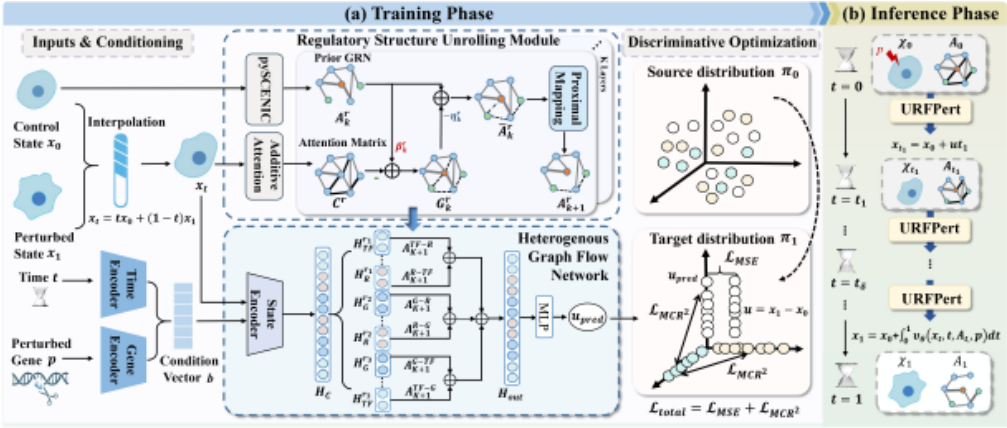
where Γrk = ηrk λrk is the learnable threshold parameter for the k-th layer. The state-dependent heterogeneous GRN at time t is defined as the set At = {ArK }r∈R. It is finalized by stacking K deep unrolling layers for each specific relation type r. The At allows the model to capture the dynamic reconfiguration of regulatory topologies as the cellular state evolves.
3.3 Heterogeneous Graph FlowNetwork
After getting the current GRN At, an HGFN is proposed to implement the neural velocity field vθ. The velocity field vθ maps the tuple (Ht, t, p,At) to the instantaneous velocity vector ut, parameterizing the direction and magnitude of the transcriptional transition. The prediction of the velocity vector ut is conditioned on the current cell state representation Ht, the continuous time variable t, perturbation condition pi, and the inferred GRN structure At derived from RSU:
Specifically, the HGFN integrates Ht, t, pi, and At to update the subsequent latent representation. The HGFN employs Gaussian Fourier Projection [Tancik et al., 2020] to encode the t ∈ [0, 1] into a latent space, thereby enabling the explicit modeling of continuous temporal dynamics:
where ˆW ∈ Rg×h is sampled from a Gaussian distribution N(0, σ2 ), with the scaling factor σ empirically fixed at 30.0. Subsequently, the perturbation state pi is encoded via a Gene Encoder F1: epert = F1(p) ∈ Rg×h . Therein, the F1 is implemented by a Multi-Layer Perceptron (MLP), utilizing scGPT embeddings (Appendix I). Next, the HGFN concatenates etime and epert to generate the unified conditional embedding: b = [etime||epert] ∈ Rg×2h , which provides a global context to ensure the learned dynamics are both timeconsistent and perturbation-specific.
Finally, the HGFN utilizes a state encoder SE to process cellular contexts and gene expression to get an initial contextaware representation Hc:
The HGFN captures regulatory influence by aggregating Hc with the state-dependent GRNs derived from the RSU. Since the adjacency matrices Ar already quantify regulatory intensities, a parameter-efficient direct summation is adopted:
Finally, the Hout is decoded into the global velocity vector upred via a learnable linear projection τ:
where upred ∈ Rg×1 denotes the estimated velocity vector for all g genes, and τ : Rg×h → Rg×1 maps the latent features back to the original expression space.
3.4 Discriminative Optimization Strategy
Following the velocity estimation upred via HGFN, we introduce DOS to supervise the learning of vθ via a dual-objective formulation. The DOS jointly enforces trajectory fidelity and enhances discriminability in the latent space, thereby improving sensitivity to subtle perturbation-specific gene signatures while maintaining accurate state-transition dynamics. Specifically, the DOS first minimizes the MSE between the estimated vector upred and the ground-truth vector u:
where u = xi1 - xi0 . Then, the DOS incorporates MCR2 [Yu et al., 2020] to enhance the discriminability and structural organization of perturbation-specific trajectories. To avoid interfering with ODE dynamics, the MCR2 is computed on the final cell representation Hout instead of the velocity field upred. The fundamental premise of MCR2 is that highdimensional gene expression profiles lie on the mixture of lower-dimensional representationHout. For a prescribed distortion tolerance ϵ, the coding cost of Z = [H 1 out , · · · ,H N1 out ] is bounded by the log-determinant of the covariance matrix:
where I is the identity matrix, dz = g×h denotes the dimension of each entry of Z and ϵ is the tolerated reconstruction error (default set to 0.01). The coding rate reduction ∆M quantifies the difference between the global coding rate M(Z, ϵ) (Expansion) and the weighted sum of individual cluster coding rates (Compression). The ∆M is maximized by the DOS to learn discriminative features for perturbation trajectories. Let Π = {Πj ∈ RN1×N1 }Qj=1 be a set of diagonal matrices whose diagonal entries encode the membership of the N1 samples in the Q perturbation types. The regularization objective is formulated as:
where the compression term M P is the sum of coding rates for each perturbation trajectory j:
To jointly optimize for both trajectory alignment and latent discriminability, the final training objective of the velocity field vθ modeled by URFPert is defined as:
Once trained, the predicted perturbation state ˆx1i is obtained by numerically integrating the vθ:
4 Experiments
In this work, we evaluated the predictive performance of URFPert by benchmarking it against five SOTA computational frameworks across five diverse genetic perturbation datasets, including three unseen single perturbation (Papalexi [Papalexi et al., 2021], Adamson and TianAct [Tian et al., 2021]) and two unseen double perturbation (Wessels [Wessels et al., 2023] and Replogle [Replogle et al., 2022]). We report performance using five complementary metrics at both the top-100 differentially expressed genes (DEG) level and the all-gene level. Dataset details are provided in Appendix D.
4.1 Experimental Setup
Implementation Details. URFPert was implemented with PyTorch 2.9.0 and trained on four NVIDIA RTX PRO 6000 Blackwell Workstation Edition GPUs with CUDA 13.0 support. It was trained using the AdamW [Loshchilov and Hutter, 2017] optimizer to minimize the loss Ltotal, with a learning rate of 1e-4, a decay factor of 0.1, over 600 training epochs, and a batch size of 256. Comprehensive model settings and details are respectively elaborated in Appendix C and Appendix I.
Comparative Settings. In order to provide a comprehensive evaluation of URFPert, we benchmarked URFPert against five SOTA baselines spanning a broad range of modeling architectures: Linear Model [Ahlmann-Eltze et al., 2025], Gears, scGPT, GenePert [Chen and Zou, 2025], and scouter.
Data Splitting and Metrics. We adopted a specific partitioning strategy based on perturbation type. For single perturbation datasets, perturbation conditions were randomly partitioned into training/validation/test sets with a 70%/10%/20% ratio.
For the combined perturbations dataset, we followed the setting of [Wei et al., 2025]: all single perturbations and 50% of randomly sampled dual-gene combinations were used for training, while the remaining 50% of unseen combinations were evenly split between the validation and test sets.
The systematic benchmark protocols [Wei et al., 2025] evaluated perturbation methods using five metrics: MSE, Pearson Correlation Coefficient delta (∆PCC), Energy Distance (E-Dist), Wasserstein Distance (W-Dist), and common differentially expressed genes (C-DEGs) over both the top 100 DEGs and the full gene set. At the all gene level, W-Dist becomes computationally prohibitive, and C-DEG scores tend to saturate, reducing their discriminative power [Wei et al., 2025]. Therefore, for all-gene evaluation, we omit WDist and replace C-DEGs with the Differential Expression Score (DES), as adopted in [Roohani et al., 2025]. Detailed mathematical definitions and calculation procedures for all evaluation metrics are provided in the Appendix K. To ensure fair comparison and mitigate split-induced bias, we evaluated all methods over ten independent trials with different random seeds for dataset splitting, while keeping the splitting ratio fixed. In each trial, each model was optimized on the training set, and the validation set was utilized for hyperparameter tuning. The trained model was subsequently applied to the test dataset to evaluate the performance.
4.2 Overall Performance
The results of all metrics across the top 100 DEGs level and all genes level are reported in Table 1. Overall, our method achieves the best overall performance across five perturbation benchmarks at both levels.
Performance on Single-Gene Perturbations. URFPert consistently outperforms SOTA baselines across both evaluation levels, demonstrating its capability in modeling perturbation-induced transcriptional responses. On Papalexi, URFPert achieves the highest C-DEGs score (11.08) comparing over the best competing method (0.88), while most baselines remain near zero. On Adamson, URFPert obtains
| Dataset | Method | Top | All Gene | |||||||
|---|---|---|---|---|---|---|---|---|---|---|
| C-DEGs↑ | ∆PCC↑ | 100 DEGs Level E-Dist↓ | W-Dist↓ | MSE↓ | DES↑ | ∆PCC↑ | Level E-Dist↓ | MSE↓ | ||
| Papalexi | Gears scGPT GenePert scouter linearModel OurModel | 0.000±0.000 0.000±0.000 0.400±0.316 0.050±0.112 0.880±0.415 11.080±6.975 | 0.266±0.139 0.030±0.093 -0.014±0.049 0.265±0.219 -0.107±0.184 0.978±0.015 | 0.229±0.126 3.051±0.370 0.214±0.079 8.968±0.531 0.335±0.153 0.078±0.044 | 50.505±6.464 41.650±7.421 57.493±5.519 37.594±5.262 55.900±6.275 14.053±5.223 | 0.019±0.012 0.028±0.016 0.019±0.008 0.016±0.012 0.028±0.013 0.004±0.003 | 0.020±0.018 0.012±0.011 0.003±0.006 0.059±0.035 0.027±0.024 0.112±0.063 | 0.306±0.107 0.215±0.072 0.177±0.059 0.421±0.250 0.187±0.106 0.990±0.005 | 0.532±0.226 10.127±0.436 0.325±0.100 2.458±0.288 0.610±0.248 0.231±0.131 | 0.003±0.002 0.005±0.002 0.002±0.001 0.003±0.002 0.003±0.002 0.002±0.001 |
| Adamson | Gears scGPT GenePert scouter linearModel OurModel | 0.000±0.000 0.000±0.000 2.163±0.480 0.036±0.050 2.186±0.283 2.469±0.282 | 0.208±0.124 0.155±0.098 0.260±0.065 0.141±0.112 0.182±0.061 0.986±0.002 | 0.451±0.098 2.916±0.187 0.513±0.160 2.451±0.258 0.571±0.126 0.093±0.008 | 37.681±0.156 27.680±1.533 41.061±1.906 29.471±2.318 41.793±1.290 10.206±0.762 | 0.030±0.008 0.030±0.013 0.036±0.012 0.047±0.018 0.041±0.010 0.004±0.000 | 0.007±0.005 0.006±0.005 0.039±0.012 0.026±0.012 0.000±0.000 0.106±0.064 | 0.306±0.102 0.412±0.061 0.412±0.051 0.340±0.083 0.384±0.056 0.995±0.001 | 0.491±0.072 10.596±0.495 0.510±0.106 8.298±0.195 0.523±0.098 0.163±0.033 | 0.002±0.004 0.002±0.001 0.002±0.001 0.003±0.001 0.003±0.001 0.001±0.000 |
| TianAct. | Gears scGPT GenePert scouter linearModel OurModel | 0.053±0.053 0.011±0.024 0.000±0.000 0.200±0.136 0.000±0.000 6.811±4.440 | 0.102±0.043 0.109±0.023 0.083±0.068 0.136±0.026 0.093±0.029 0.946±0.025 | 0.297±0.089 2.766±0.091 0.267±0.079 2.859±0.069 0.268±0.069 0.191±0.089 | 43.767±1.332 33.518±2.178 46.068±1.258 31.968±0.706 45.174±1.442 11.878±2.052 | 0.016±0.007 0.020±0.007 0.015±0.007 0.014±0.004 0.016±0.006 0.009±0.005 | 0.000±0.000 0.000±0.000 0.000±0.000 0.000±0.000 0.041±0.015 0.043±0.025 | 0.310±0.037 0.328±0.031 0.372±0.037 0.474±0.036 0.404±0.023 0.994±0.001 | 0.735±0.230 8.869±0.107 0.429±0.064 9.338±0.164 0.429±0.060 0.240±0.072 | 0.004±0.001 0.002±0.001 0.001±0.000 0.001±0.000 0.001±0.000 0.002±0.001 |
| Wessels | Gears scGPT GenePert scouter linearModel OurModel | 0.000±0.000 0.000±0.000 0.000±0.000 0.181±0.215 0.000±0.000 2.393±0.821 | 0.672±0.163 0.420±0.135 0.736±0.019 0.425±0.082 0.364±0.098 0.758±0.032 | 0.611±0.194 6.205±0.257 0.795±0.121 4.198±0.372 4.881±0.364 0.734±0.112 | 49.403±1.623 110.257±1.050 54.560±1.830 44.270±2.954 45.970±2.923 22.719±0.745 | 0.039±0.016 0.104±0.020 0.056±0.010 0.113±0.026 0.119±0.026 0.039±0.008 0.014±0.004 0.022±0.005 | 0.001±0.000 0.000±0.000 0.000±0.000 0.001±0.000 0.074±0.012 0.110±0.093 | 0.706±0.098 0.645±0.046 0.722±0.026 0.522±0.043 0.398±0.081 0.975±0.001 | 1.065±0.219 27.675±0.245 0.927±0.073 9.784±0.411 13.128±0.252 1.186±0.118 | 0.004±0.001 0.013±0.002 0.004±0.000 0.006±0.001 0.006±0.001 0.006±0.001 |
| Replogle | Gears scGPT GenePert scouter linearModel OurModel | 0.000±0.000 0.000±0.000 0.000±0.000 0.314±0.110 0.000±0.000 13.956±5.879 | 0.500±0.141 0.252±0.036 0.400±0.055 0.287±0.067 0.294±0.054 0.967±0.020 | 0.254±0.048 2.433±0.147 0.349±0.024 4.671±0.151 3.180±0.099 0.134±0.051 | 37.195±1.321 28.692±0.803 166.142±5.512 113.392±1.145 28.434±1.176 11.176±0.847 | 0.039±0.004 0.055±0.010 0.019±0.006 0.005±0.002 | 0.000±0.000 0.000±0.000 0.000±0.000 0.000±0.000 0.025±0.007 0.140±0.036 | 0.436±0.063 0.300±0.052 0.404±0.025 0.326±0.050 0.294±0.054 0.995±0.001 | 0.471±0.027 7.390±0.274 0.692±0.063 17.513±1.151 10.626±0.154 0.180±0.057 | 0.002±0.000 0.002±0.000 0.006±0.000 0.008±0.002 0.001±0.000 0.001±0.000 |
∆PCC of 0.986 for top 100 DEGs level, markedly surpassing Gears (0.260), highlighting the advantage of RSU module in dynamically inferring state-dependent gene interactions rather than relying on fixed priors. Notably, URFPert consistently ranks first in E-Dist across all single-perturbation datasets. It indicates URFPert effectively models the stochastic nature of gene expression perturbations beyond simple point-estimate accuracy.
Performance on Combined Perturbations. For the evaluations on combined perturbation (Wessels and Replogle), URFPert outperforms linear, static-prior, and embeddingcentric baselines. Although the linear model captures global trends, it misses non-additive gene interactions, yielding near-zero C-DEGs scores. Unlike discrete perturbation-toexpression approaches (scouter, GenePert), URFPert models a continuous conditional velocity field, dynamically guided by unrolled, state-dependent regulatory remodeling. Enhanced by MCR2 regularization in the Discriminative Optimization module, URFPert maintains exceptional feature fidelity, achieving a W-Dist of 11.176 and a DES of 0.140 on the Replogle dataset. Overall, these results demonstrate that coupling dynamic graph structure with continuous flow trajectories is essential for accurately modeling perturbation responses in combinatorial spaces.
4.3 Ablation Study
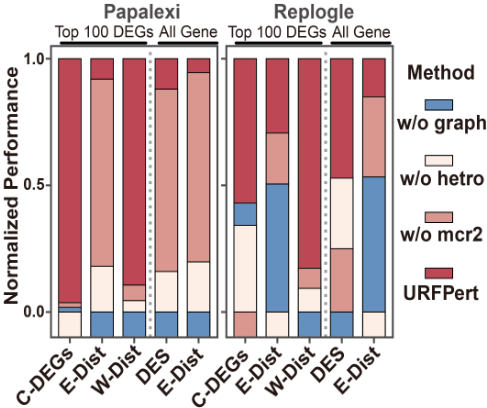
We conducted ablation studies to evaluate the specific contributions of the RSU, HGFN, and DOS within URFPert. Fig. 2 compares evaluation metrics across the Papalexi and Replogle datasets. For cross-metric comparison, we report normalized scores (higher is better). Full evaluation metrics and calculation details are provided in Appendix E and L.
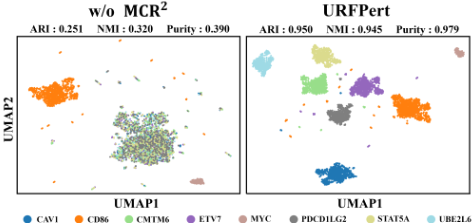
Overall, the complete URFPert framework consistently achieves the best performance on both datasets at both evaluation levels. Excluding RSU (w/o RSU) results in significant performance reductions in C-DEGs and W-Dist scores, particularly on the Replogle dataset. This underscores the critical role of dynamic structural modeling in capturing perturbation-specific signals. Excluding HGFN (w/o HGFN) mainly degrades the performance of E-Dist at the all gene level, indicating that the absence of heterogeneous information weakens the model's ability to integrate patterns specific to diverse regulatory relations. Furthermore, we validated the necessity of the DOS by removing the MCR2 regularization: Ltotal = LMSE (w/o MCR2 ). Note that LMSE was retained in this variant to ensure basic model convergence. The results (Fig. 2) show that removing MCR2 degrades performance across all metrics, particularly regarding distributional fidelity (W-Dist, E-Dist). UMAP visualizations (Fig. 3) further confirm that MCR2 effectively prevents feature collapse, producing well-separated, perturbation-specific clusters with significantly higher ARI and NMI scores. These findings underscore the necessity of MCR2 for learning discriminative and high-fidelity latent representations.
4.4 Interpretable Analysis
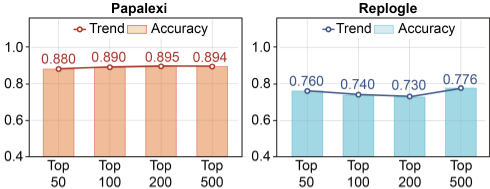
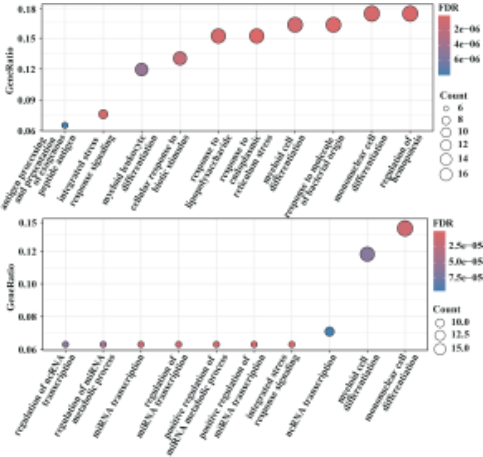
We assessed the inferred regulatory structures by measuring the overlap between top-K predicted edges and the GOderived [Consortium, 2021] co-functional network (Fig. 4). URFPert achieves high edge support across both benchmarks (up to 89.5% on Papalexi and 77.6% on Replogle), providing a principled basis for the following enrichment analyses (Appendix N). The evaluation process and metric definition are detailed in Appendix M. For the MYC single perturbation (K = 100), the inferred GRN (93 genes) aligns strongly with prior knowledge, with 89 of the top 100 edges supported by GO annotations (Appendix F). The network topology reflects the loss of MYC-driven proliferation and the derepression of innate immunity [Macek et al., 2018], characterized by central STAT1/IRF hubs and downstream antigen-presentation (e.g., HLA-DRA) and UPR (e.g., DDIT3) modules. This structural shift is consistent with the enrichment of antigen processing and stress response pathways observed in the functional analysis (Fig. 5) [Zou et al., 2018].
Similarly, the inferred GRN from ETAA1+FDPS double perturbation (142 genes) demonstrates high biological alignment when K=100 (75/100 edges supported; Appendix F). The topology captures a convergence of replication stress (via ETAA1 loss) and metabolic stress (via FDPSmediated mevalonate blockade) [Dhar et al., 2013]. This is evidenced by high-centrality hubs for immediate early genes (JUN, EGR1) and UPR regulators (ATF4, DDIT3), which align with GO enrichment for the integrated stress response and DNA damage-associated ncRNA regulation pathways [Pakos-Zebrucka et al., 2016; Wan et al., 2011].
5 Conclusion
In this study, we present URFPert, an unrolled regulatory flow network designed to predict single-cell perturbation responses in OOD settings. By integrating dynamic regulatory structure learning with continuous-time cellular trajectories, URFPert effectively captures state-dependent regulatory remodeling during perturbation responses. Extensive benchmarks show URFPert excels in distributional fidelity and combinatorial modeling, offering a powerful and interpretable tool to decipher the molecular mechanisms behind complex cellular transitions.
Acknowledgements
This work was supported in part by the National Key Research and Development Program of China (2024YFF1206600); in part by Guangdong S&T Programme (2025B0101130001); in part by the National Natural Science Foundation of China (62325204, 62502161, 62502163); in part by the China Postdoctoral Science Foundation (2025M782912).
Contribution Statement
Xiaoqi Sheng: Conceptualization, Methodology, Software, Validation, Formal analysis, Investigation, Writing-Original Draft. Jiawen Liu: Conceptualization, Methodology, Software, Validation, Formal analysis, Data Curation, WritingOriginal Draft. Yutong Li: Methodology, Software, Validation, Investigation, Formal analysis, Writing-Original Draft. Sankar Mondal: Validation, Formal analysis, Investigation, Writing-Review & Editing. Jiaming Liang: Software, Data Curation, Validation, Writing-Review & Editing, Visualization. Tinghe Zhang: Conceptualization, Methodology, Supervision, Formal analysis, Writing-Review & Editing. Hongmin Cai: Conceptualization, Supervision, Project administration, Funding acquisition, Writing-Review & Editing. Xiaoqi Sheng, Jiawen Liu, and Yutong Li contributed equally to this work and share first authorship. Tinghe Zhang (zhangth@scut.edu.cn) and Hongmin Cai (hmcai@scut.edu.cn) are the corresponding authors.
@inproceedings{ijcai2026p534,
  title     = {URFPert: Unrolled Regulatory Flow Networks for Out-of-Distribution Single-Cell Perturbation Prediction},
  author    = {Sheng, Xiaoqi and Liu, Jiawen and Li, Yutong and Mondal, Sankar and Liang, Jiaming and Zhang, Tinghe and Cai, Hongmin},
  booktitle = {Proceedings of the Thirty-Fifth International Joint Conference on
               Artificial Intelligence, {IJCAI-26}},
  publisher = {International Joint Conferences on Artificial Intelligence Organization},
  editor    = {Diego Calvanese},
  pages     = {4795--4803},
  year      = {2026},
  month     = {8},
  note      = {Main Track},
  doi       = {10.24963/ijcai.2026/534},
  url       = {https://doi.org/10.24963/ijcai.2026/534},
}
TY - CPAPER TI - URFPert: Unrolled Regulatory Flow Networks for Out-of-Distribution Single-Cell Perturbation Prediction AU - Sheng, Xiaoqi AU - Liu, Jiawen AU - Li, Yutong AU - Mondal, Sankar AU - Liang, Jiaming AU - Zhang, Tinghe AU - Cai, Hongmin T2 - Proceedings of the Thirty-Fifth International Joint Conference on Artificial Intelligence, IJCAI-26 PB - International Joint Conferences on Artificial Intelligence Organization PY - 2026 SP - 4795 EP - 4803 DO - 10.24963/ijcai.2026/534 UR - https://doi.org/10.24963/ijcai.2026/534 ER -Copied
Machine-readable versions of this paper, for tools and AI agents:





