
From Traits to Roles: Consensus-Guided Composition of Orthogonal Experts for Cooperative MARL
Proceedings of the Thirty-Fifth International Joint Conference on Artificial Intelligence. Main Track. Pages 481-489.
https://doi.org/10.24963/ijcai.2026/55
Keywords
- Agent-based and Multi-agent Systems: Multi-agent learning
Abstract
Parameter sharing is a central design choice in cooperative multi-agent reinforcement learning, yet it fundamentally conflicts with the need for role specialization in heterogeneous cooperative environments. Existing role-based methods typically learn monolithic role representations, which often suffer from gradient interference and fail to capture the compositional structure of complex behaviors. Inspired by Trait Theory, we propose DEcompose and COnstruct Roles (DECOR), a framework that models agent roles as dynamic compositions of orthogonal behavioral traits. DECOR introduces an orthogonal Mixture-of-Experts architecture to decompose behaviors into independent traits, mitigating destructive gradient interference under parameter sharing, and a group-consensus guided mechanism to extract team-level tactical intents that guide role composition.Experiments on multiple benchmarks demonstrate that DECOR consistently improves sample efficiency and overall performance over existing related methods.
- [Björck, 1967] Åke Björck. Solving linear least squares problems by gram-schmidt orthogonalization. BIT Numer- ical Mathematics, 7(1):1-21, 1967.
- [Briggs, 1976] Katharine C Briggs. Myers-Briggs type in- dicator. Consulting Psychologists Press Palo Alto, CA, 1976.
- [Christianos et al., 2021] Filippos Christianos, Georgios Pa- poudakis, Muhammad A Rahman, and Stefano V Al- brecht. Scaling multi-agent reinforcement learning with selective parameter sharing. In International Conference on Machine Learning, pages 1989-1998. PMLR, 2021.
- [Chu et al., 2019] Tianshu Chu, Jie Wang, Lara Codecà, and Zhaojian Li. Multi-agent deep reinforcement learning for large-scale traffic signal control. IEEE transactions on in- telligent transportation systems, 21(3):1086-1095, 2019.
- [Ellis et al., 2023] Benjamin Ellis, Jonathan Cook, Skander Moalla, Mikayel Samvelyan, Mingfei Sun, Anuj Ma- hajan, Jakob Nicolaus Foerster, and Shimon Whiteson. SMACv2: An improved benchmark for cooperative multi- agent reinforcement learning. In Thirty-seventh Confer- ence on Neural Information Processing Systems Datasets and Benchmarks Track, 2023.
- [Feng et al., 2024] Pu Feng, Junkang Liang, Size Wang, Xin Yu, Xin Ji, Yiting Chen, Kui Zhang, Rongye Shi, and Wenjun Wu. Hierarchical consensus-based multi-agent reinforcement learning for multi-robot cooperation tasks. In 2024 IEEE/RSJ International Conference on Intelligent Robots and Systems (IROS), pages 642-649. IEEE, 2024.
- [Foerster et al., 2016] Jakob Foerster, Ioannis Alexandros Assael, Nando De Freitas, and Shimon Whiteson. Learn- ing to communicate with deep multi-agent reinforcement learning. Advances in neural information processing sys- tems, 29, 2016.
- [Gupta et al., 2017] Jayesh K Gupta, Maxim Egorov, and Mykel Kochenderfer. Cooperative multi-agent control us- ing deep reinforcement learning. In International confer- ence on autonomous agents and multiagent systems, pages 66-83. Springer, 2017.
- [Hu et al., 2023] Zican Hu, Zongzhang Zhang, Huaxiong Li, Chunlin Chen, Hongyu Ding, and Zhi Wang. Attention- guided contrastive role representations for multi-agent re- inforcement learning. arXiv preprint arXiv:2312.04819, 2023.
- [Jung and Beebe, 2016] Carl Jung and John Beebe. Psycho- logical types. Routledge, 2016.
- [Kim and Sung, 2023] Woojun Kim and Youngchul Sung. Parameter sharing with network pruning for scalable multi-agent deep reinforcement learning. arXiv preprint arXiv:2303.00912, 2023.
- [Kurach et al., 2020] Karol Kurach, Anton Raichuk, Piotr Stańczyk, Michał Zajkac, Olivier Bachem, Lasse Espe- holt, Carlos Riquelme, Damien Vincent, Marcin Michal- ski, Olivier Bousquet, et al. Google research football: A novel reinforcement learning environment. In Proceed- ings of the AAAI conference on artificial intelligence, vol- ume 34, pages 4501-4510, 2020.
- [Li et al., 2021] Chenghao Li, Tonghan Wang, Chengjie Wu, Qianchuan Zhao, Jun Yang, and Chongjie Zhang. Cel- ebrating diversity in shared multi-agent reinforcement learning. Advances in Neural Information Processing Sys- tems, 34:3991-4002, 2021.
- [Li et al., 2024a] Dapeng Li, Na Lou, Bin Zhang, Zhiwei Xu, and Guoliang Fan. Adaptive parameter sharing for multi-agent reinforcement learning. In ICASSP 2024- 2024 IEEE International Conference on Acoustics, Speech and Signal Processing (ICASSP), pages 6035-6039. IEEE, 2024.
- [Li et al., 2024b] Xinran Li, Ling Pan, and Jun Zhang. Kalei- doscope: Learnable masks for heterogeneous multi-agent reinforcement learning. Advances in Neural Information Processing Systems, 37:22081-22106, 2024.
- [Lowe et al., 2017] Ryan Lowe, Yi I Wu, Aviv Tamar, Jean Harb, OpenAI Pieter Abbeel, and Igor Mordatch. Multi- agent actor-critic for mixed cooperative-competitive envi- ronments. Advances in neural information processing sys- tems, 30, 2017.
- [Maaten and Hinton, 2008] Laurens van der Maaten and Ge- offrey Hinton. Visualizing data using t-sne. Journal of machine learning research, 9(Nov):2579-2605, 2008.
- [Oliehoek et al., 2016] Frans A Oliehoek, Christopher Am- ato, et al. A concise introduction to decentralized POMDPs, volume 1. Springer, 2016.
- [Puigcerver et al., 2023] Joan Puigcerver, Carlos Riquelme, Basil Mustafa, and Neil Houlsby. From sparse to soft mix- tures of experts. arXiv preprint arXiv:2308.00951, 2023.
- [Qin et al., 2025] Haoyuan Qin, Zhengzhu Liu, Chenxing Lin, Chennan Ma, Songzhu Mei, Siqi Shen, and Cheng Wang. Gradps: Resolving futile neurons in parame- ter sharing network for multi-agent reinforcement learn- ing. In Forty-second International Conference on Machine Learning, 2025.
- [Rashid et al., 2020] Tabish Rashid, Mikayel Samvelyan, Christian Schroeder De Witt, Gregory Farquhar, Jakob Fo- erster, and Shimon Whiteson. Monotonic value function factorisation for deep multi-agent reinforcement learning. Journal of Machine Learning Research, 21(178):1-51, 2020.
- [Samvelyan et al., 2019] Mikayel Samvelyan, Tabish Rashid, Christian Schroeder de Witt, Gregory Farquhar, Nantas Nardelli, Tim G. J. Rudner, Chia-Man Hung, Philiph H. S. Torr, Jakob Foerster, and Shimon White- son. The StarCraft Multi-Agent Challenge. CoRR, abs/1902.04043, 2019.
- [Shazeer et al., 2017] Noam Shazeer, Azalia Mirhoseini, Krzysztof Maziarz, Andy Davis, Quoc Le, Geoffrey Hin- ton, and Jeff Dean. Outrageously large neural net- works: The sparsely-gated mixture-of-experts layer. arXiv preprint arXiv:1701.06538, 2017.
- [Sunehag et al., 2017] Peter Sunehag, Guy Lever, Audrunas Gruslys, Wojciech Marian Czarnecki, Vinicius Zambaldi, Max Jaderberg, Marc Lanctot, Nicolas Sonnerat, Joel Z Leibo, Karl Tuyls, et al. Value-decomposition networks for cooperative multi-agent learning. arXiv preprint arXiv:1706.05296, 2017.
- [Sutton et al., 1998] Richard S Sutton, Andrew G Barto, et al. Reinforcement learning: An introduction, volume 1. MIT press Cambridge, 1998.
- [Van Den Oord et al., 2017] Aaron Van Den Oord, Oriol Vinyals, et al. Neural discrete representation learning. Advances in neural information processing systems, 30, 2017.
- [Wang et al., 2020a] Jianhao Wang, Zhizhou Ren, Terry Liu, Yang Yu, and Chongjie Zhang. Qplex: Duplex dueling multi-agent q-learning. arXiv preprint arXiv:2008.01062, 2020.
- [Wang et al., 2020b] Tonghan Wang, Heng Dong, Victor Lesser, and Chongjie Zhang. Roma: multi-agent rein- forcement learning with emergent roles. In Proceedings of the 37th International Conference on Machine Learn- ing, pages 9876-9886, 2020.
- [Wang et al., 2020c] Tonghan Wang, Tarun Gupta, Anuj Ma- hajan, Bei Peng, Shimon Whiteson, and Chongjie Zhang. Rode: Learning roles to decompose multi-agent tasks. arXiv preprint arXiv:2010.01523, 2020.
- [Yu et al., 2022] Chao Yu, Akash Velu, Eugene Vinitsky, Ji- axuan Gao, Yu Wang, Alexandre Bayen, and Yi Wu. The surprising effectiveness of ppo in cooperative multi-agent games. Advances in neural information processing sys- tems, 35:24611-24624, 2022.
- [Yu et al., 2024] Yang Yu, Qiyue Yin, Junge Zhang, Pei Xu, and Kaiqi Huang. Admn: Agent-driven modular network for dynamic parameter sharing in cooperative multi-agent reinforcement learning. In Proceedings of the Thirty-Third International Joint Conference on Artificial Intelligence, IJCAI-24, pages 302-310, 2024. IJCAI
- [Zeng et al., 2023] Xianghua Zeng, Hao Peng, and Ang- sheng Li. Effective and stable role-based multi-agent col- laboration by structural information principles. In Pro- ceedings of the AAAI conference on artificial intelligence, volume 37, pages 11772-11780, 2023.
- [Zhao et al., 2024] Yang Zhao, Chang Zhou, Jin Cao, Yi Zhao, Shaobo Liu, Chiyu Cheng, and Xingchen Li. Multi-scenario combination based on multi-agent rein- forcement learning to optimize the advertising recommen- dation system. In 2024 5th International Conference on Artificial Intelligence and Electromechanical Automation (AIEA), pages 190-194. IEEE, 2024.
References were extracted automatically from the PDF and may contain errors.
Full text extracted automatically from the PDF; figures, tables and equations may differ. The PDF is the version of record.
1 Introduction
Cooperative multi-agent reinforcement learning (MARL) has been successfully applied to a wide range of complex decision-making scenarios that require coordinated behaviors, such as traffic signal control [Chu et al., 2019], recommendation systems [Zhao et al., 2024], and multi-robot coordination [Feng et al., 2024]. Most existing cooperative MARL methods adopt the centralized training with decentralized execution (CTDE) paradigm [Lowe et al., 2017], in which agents are trained with access to global information while executing policies based solely on local observations. Within this paradigm, parameter sharing is commonly employed, where all agents are instantiated with the same network, in order to improve training efficiency and scalability through parameter reuse and shared experience learning. However, this design implicitly assumes agent homogeneity, an assumption that is frequently violated in real-world cooperative tasks involving heterogeneous agents with diverse roles, capabilities, and functional responsibilities. As a consequence, enforcing shared parameters on heterogeneous agents induces destructive gradient interference, where distinct functional requirements drive the shared parameters in competing directions, leading to suboptimal convergence and behavioral homogenization [Li et al., 2024b].
In response to the behavioral homogenization induced by parameter sharing, recent studies have explored two representative directions to enhance agent specialization in cooperative MARL. One line of work focuses on modifying the parameter-sharing structure itself, for example by adopting fully independent networks or selective-sharing schemes [Christianos et al., 2021]. While these approaches alleviate behavioral homogenization to some extent, they often incur reduced sample efficiency or rely on rigid, manually designed grouping heuristics, resulting in static forms of diversity that fail to adapt to the emergent and dynamic role requirements of complex cooperative tasks. Alternatively, a growing body of work introduces explicit role modeling to induce specialization among agents [Wang et al., 2020b; Wang et al., 2020c]. Despite their algorithmic differences, these role-based methods share several common design choices. In these approaches, role representations are typically learned as compact and holistic embeddings that encode multiple functional aspects within a single latent vector. Although effective in practice, this design can introduce optimization challenges, as improving one capability may affect others through the shared latent space. Moreover, role inference is often driven primarily by individual observation histories, which may not fully capture the global coordination cues necessary for teamlevel cooperation.
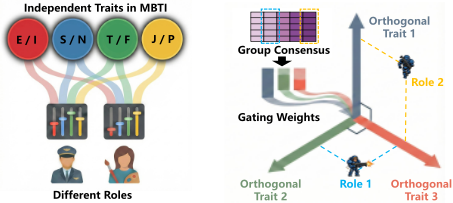
In psychology, the Trait Theory of personality suggests that complex human behaviors and personalities are not monolithic constructs, but rather emerge from the composition of a set of relatively independent and stable traits [Jung and Beebe, 2016]. This perspective underlies widely used personality frameworks, such as the Myers-Briggs Type Indicator (MBTI) [Briggs, 1976], where individuals are characterized through combinations of fundamental behavioral dimensions rather than a single unified type, as shown in Figure 1. A key implication of this view is that diversity in behavior arises naturally from different compositions of shared traits, enabling both commonality and specialization within a population.
Inspired by this compositional view of personality, we propose DECOR (DEcompose and COnstruct Roles), a framework that rethinks role representation in cooperative MARL from a trait-based perspective. Instead of modeling roles as static and monolithic embeddings, DECOR represents an agent's role as a dynamic composition of shared yet independent behavioral traits. To realize this idea, DECOR introduces an orthogonal role decomposition mechanism that parameterizes traits as independent expert subspaces within an orthogonal Mixture-of-Experts (MoE) architecture [Puigcerver et al., 2023], explicitly decoupling different behavioral capabilities and mitigating gradient interference during parameter sharing. Based on the decomposed trait experts, a group-consensus guided module learns discrete consensus embeddings via a Vector QuantizedVariational Autoencoder (VQ-VAE) based discrete codebook [Van Den Oord et al., 2017], implicitly grouping agents into coordination clusters that share the same consensus embedding. This shared consensus is then used to compute gating weights for agent-level trait composition. Through this gated composition process, agents can dynamically reconstruct their roles by combining orthogonal traits with rolespecific weights, enabling both specialization and coordinated team behavior. Moreover, DECOR is designed as a plug-in framework that can be readily integrated into existing cooperative MARL algorithms, and extensive experiments across multiple domains demonstrate its consistent performance gains.
Our main contributions are summarized as follows:
- We propose the orthogonal role decomposition mechanism to parameterize traits as independent expert subspaces within an orthogonal MoE architecture, mitigat-
ing gradient interference under parameter sharing.
- A group-consensus guided role reconstruction module is proposed to compute trait composition weights, enabling agents to dynamically reconstruct their roles in response to evolving team objectives.
- Extensive experiments on multiple challenging benchmarks demonstrate that the proposed DECOR framework consistently outperforms existing baselines.
2 Preliminaries
2.1 Dec-POMDP and CTDEMethods
Cooperative MARL problems are commonly formulated as decentralized partially observable Markov decision processes (Dec-POMDPs) [Oliehoek et al., 2016], defined by a tuple G = ⟨S,U, P, r,Ω,O,N, γ⟩, where N agents interact with the environment. At each timestep, the environment is in a global state s ∈ S. Each agent i ∈ {1, . . . ,N} receives a local observation oi ∈ Ω from the observation function O(s, i) and selects an action ui ∈ U based on its action-observation history τi. The joint action u = ⟨u1, . . . , uN⟩ ∈ U N induces a state transition according to P(s′ | s, u) and yields a shared reward r(s, u). The objective is to learn a joint policy π that maximizes the expected discounted return J(π) = Eπ [∑∞t=0 γ t rt].
Centralized training with decentralized execution (CTDE) is a widely adopted learning paradigm for cooperative MARL [Lowe et al., 2017]. During training, agents are allowed to leverage additional centralized information, such as the global state s or joint action u, to facilitate learning and stabilize optimization. During execution, agents act in a fully decentralized manner using only local information, typically summarized by τi. This paradigm enables effective learning in partially observable cooperative environments while preserving decentralized deployability. Under the CTDE framework, two major classes of methods have been developed. Value-based approaches learn a centralized action-value function during training and enable decentralized decision-making through structured factorization or value decomposition [Sunehag et al., 2017; Rashid et al., 2020]. Policy-based approaches [Yu et al., 2022], in contrast, directly parameterize decentralized policies while exploiting centralized information for training, such as centralized critics or joint value estimators.
2.2 Vector-Quantized Variational Autoencoder
The Vector-Quantized Variational Autoencoder (VQ-VAE) learns discrete latent representations, which enables capturing identifiable patterns from high-dimensional inputs [Van Den Oord et al., 2017]. It consists of an encoder fϕ, a decoder fψ, and a learnable codebook C = {ek}Kk=1 ⊂ RD , where D denotes the dimensionality of each codebook embedding. ϕ and ψ denote the learnable parameters of the encoder and decoder, respectively. Given an input x, the encoder produces a continuous latent representation ze(x). This representation is then discretized by mapping it to the nearest codebook entry:
The training objective of VQ-VAE combines a reconstruction loss, a codebook loss, and a commitment loss:
where ˆx = fψ(zq(x)) denotes the reconstruction, and sg[·] represents the stop-gradient operator. β is a hyperparameter that balances the commitment loss, encouraging the encoder outputs to stay close to the selected codebook entries. By quantizing continuous representations into a finite codebook, VQ-VAE implicitly partitions inputs into K discrete latent groups that share common semantic prototypes.
2.3 Soft Mixture-of-Experts
A Mixture-of-Experts (MoE) layer combines multiple subnetworks (experts) {E1, . . . ,EM} through a gating network G [Shazeer et al., 2017]. While sparse MoE variants activate only a small subset of experts for computational efficiency, a Soft MoE [Puigcerver et al., 2023] assigns continuous weights to all experts. This dense weighting allows the output to be expressed as a linear combination of multiple expert functions, providing a flexible function approximation form that supports smooth interpolation across experts. Given an input x, the gating network produces a dense weight vector w(x) = [w1(x), . . . , wM(x)] ∈ RM , and the MoE output y is computed as
This weighted aggregation allows the model to represent outputs as continuous combinations of multiple expert functions, while remaining fully differentiable.
3 Methodology
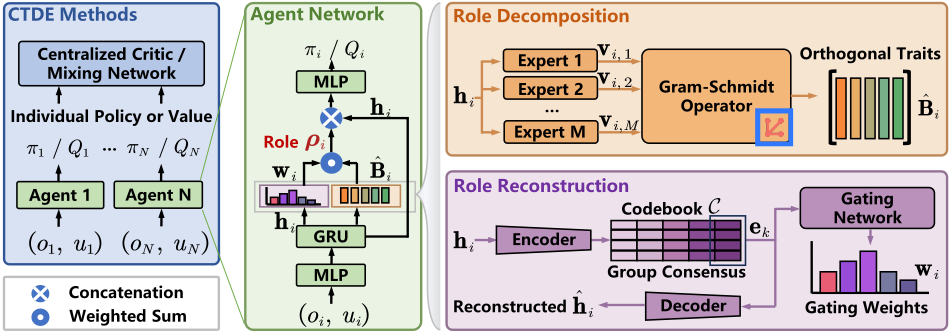
In this section, we present DECOR, a framework designed to address the tension between parameter sharing and role specialization in cooperative MARL. The central idea of DECOR is to move beyond static, monolithic role representations and instead construct agent roles through dynamic compositions of orthogonal behavioral traits. By decomposing role representations into orthogonal components, distinct agent capabilities are routed to separate experts, which explicitly alleviates gradient interference under shared parameters. At the same time, role reconstruction is guided by a learned group-level consensus, which provides a shared strategic context for agents within the same coordination group, thereby aligning their behaviors with the global team objective. Concretely, DECOR consists of two core components, as illustrated in Figure 2: an Orthogonal Role Decomposition module that learns a set of independent trait experts, and a Group-Consensus Guided Role Reconstruction module that dynamically composes these traits into agent roles.
3.1 Orthogonal Role Decomposition
Effective parameter sharing in cooperative MARL requires disentangling agent-specific capabilities that are otherwise coupled within monolithic role representations. When agent roles are modeled as single latent vectors, gradients corresponding to different functional requirements are prone to interfere with each other, leading to unstable optimization and limited specialization. To address this issue, we first introduce an orthogonal role decomposition mechanism that factorizes role representations into independent components, providing a structured basis for subsequent role construction.
Role Decomposition via Orthogonal MoE. To extract fundamental behavioral traits, we introduce an Orthogonal MoE. Let {Em}Mm=1 denote a set of M parallel expert networks. Given the latent embedding hi for agent i, each expert produces a raw role basis vector vi,m = Em(hi) ∈ Rd . These vectors are stacked to form a raw basis matrix Vi = [vi,1, . . . , vi,M] ∈ Rd×M .
To encourage diverse and non-redundant trait representations, we aim to transform the raw basis Vi into an orthogonal basis matrix ˆBi whose columns are mutually orthogonal. Specifically, ˆBi is obtained by applying a deterministic yet differentiable orthogonalization transformation to Vi, which enables gradients to be propagated back to the raw basis Vi during optimization. Conceptually, this objective can be expressed as maximizing the standard reinforcement learning objective subject to an orthogonality constraint:
where I denotes the identity matrix. This constraint encourages the resulting ˆBi to form an orthonormal system, thereby promoting diverse trait representations across experts.
However, directly solving this constrained optimization is not amenable to standard gradient-based training. Instead, we realize this objective constructively by employing the GramSchmidt (GS) [Bj¨orck, 1967] process as a deterministic and differentiable orthogonalization operator. The GS process sequentially projects each raw vector vi,m onto the orthogonal complement of the subspace spanned by the previously constructed basis vectors. The resulting orthogonal basis vector ˆbi,m is computed recursively as:
where ϵ is a small constant introduced for numerical stability. Since the preceding basis vectors {ˆbi,j} are already normalized, the projection reduces to a scalar inner-product coefficient. The final orthogonal basis matrix is assembled as ˆBi = [ˆbi,1, . . . , ˆbi,M].
Geometrically, this orthogonalization ensures that ˆBi forms a linearly independent coordinate system in the role representation space. By enforcing ⟨ˆbi,m, ˆbi,n⟩ = 0 for m ̸= n, the gradient updates associated with different role components are confined to mutually orthogonal subspaces. As a result, when heterogeneous agents update specific role components, their gradient flows remain disentangled, effectively mitigating the destructive interference commonly observed under naive parameter sharing.
3.2 Group-Consensus Guided Role Reconstruction
While orthogonal role decomposition provides a set of disentangled trait representations, effective coordination further requires that these traits be composed in a manner consistent with the global team objective. To this end, we introduce a Group Consensus Builder that extracts shared coordination signals from decentralized agent experiences, dynamically forming coordination groups and providing semantic guidance for role reconstruction.
The group consensus builder is implemented using a VQVAE, whose discrete latent space serves as a shared dictionary of group-level coordination consensus, where each codebook entry represents a recurring coordination pattern observed across agents and timesteps. Compared to continuous latent representations, the discrete codebook introduces an information bottleneck that suppresses task-irrelevant variability while preserving identifiable and stable team-level structures [Van Den Oord et al., 2017]. By mapping continuous and potentially noisy local representations into a shared discrete codebook, the consensus builder encourages agents with similar underlying coordination states to be associated with the same consensus, thereby implicitly aligning their local representations.
Formally, we take the latent agent embedding hi, which summarizes the agent's action-observation history τi, as the input to the consensus builder. A learnable codebook C = {ek}Kk=1 ⊂ RD is maintained, where each embedding ek corresponds to a distinct consensus. An encoder fϕ maps hi to a continuous latent representation ze(hi), which is then quantized by retrieving the nearest codebook entry according to Equation (1):
Through this quantization process, agents exhibiting similar underlying coordination patterns are mapped to the same consensus, even when their local observations differ. The selected codebook entry ek thus represents a stable group-level intent and serves as a discrete semantic anchor for subsequent role reconstruction.
To prevent degenerate solutions and ensure that the consensus captures meaningful temporal information, a decoder fψ reconstructs the original latent embedding as ˆhi = fψ(zq(hi)). The group consensus builder is trained using the standard VQ-VAE objective as given in Equation (2):
The reconstruction term preserves information encoded in hi, while the remaining terms align the continuous latent space with the discrete consensus.
Trait Composition via Consensus-Guided Gating. Conditioned on the group consensus ek, DECOR reconstructs an agent-specific role by composing the orthogonal trait basis ˆBi through a consensus-guided gating mechanism. Intuitively, while ˆBi characterizes the agent's available capabilities, the consensus ek specifies how these capabilities should be combined under the current team strategy. To implement this composition, we employ a lightweight gating network that maps the consensus embedding ek to a continuous importance distribution over the M orthogonal traits. The resulting gating weights wi ∈ RM are computed as:
where each weight wi,m reflects the relevance of the m-th trait under the shared group consensus. Since the gating weights depend solely on the consensus, agents associated with the same consensus are encouraged to emphasize a consistent subset of traits, promoting coordinated behavior. The final role representation is then reconstructed as a weighted combination of orthogonal traits:
This formulation achieves a dual effect: orthogonality in ˆBi mitigates gradient interference across trait subspaces during training, while the consensus-guided weights wi align individual role compositions with the global team objective during execution.
It is worth noting that the reconstructed role representation ρi in DECOR can be flexibly integrated into different MARL backbones. For value-based methods, ρi is concatenated with the latent agent embedding hi and provided as additional context to the individual utility network [Rashid et al., 2020]:
For policy-based methods, ρi can be incorporated analogously as a context-modulating input to the decentralized policy network [Yu et al., 2022].
3.3 Overall Learning Objective
Having established the mechanisms for orthogonal role decomposition and tactical intent alignment, we integrate these components into an end-to-end training scheme. DECOR is designed to be agnostic to the specific cooperative MARL backbone and can be trained under a general CTDE framework. The role decomposition and reconstruction operations are applied at the individual agent level and therefore do not impose additional structural constraints on the underlying reinforcement learning objective.
The entire framework is optimized by minimizing a composite objective that balances the primary reinforcement learning objective with an auxiliary role representation learning objective:
where LRL denotes a generic cooperative reinforcement learning loss. In value-based instantiations, LRL corresponds to a temporal-difference objective defined on a centralized or factorized action-value function [Sunehag et al., 2017]. For policy-based methods, LRL can be instantiated as a policy gradient or actor-critic objective [Sutton et al., 1998]. λVQ controls the contribution of the auxiliary role learning objective defined in Equation (7), and θ represents the parameters of the agent networks as well as any centralized components used during training. A detailed algorithmic description of DECOR is provided in Appendix A.
4 RelatedWork
Parameter Sharing and Gradient Conflict in MARL. Parameter sharing has emerged as a dominant paradigm in cooperative MARL for enhancing sample efficiency and scalability [Gupta et al., 2017; Foerster et al., 2016]. However, this paradigm implicitly assumes agent homogeneity. When applied to agents with distinct role specialization, naive sharing forces a single network to simultaneously satisfy contradictory optimization objectives, inducing gradient interference and behavioral homogenization [Qin et al., 2025]. To mitigate this, distinct architectural strategies have been proposed. Static grouping methods like SePS [Christianos et al., 2021]
rely on manual heuristics, which are inflexible in dynamic tasks. Dynamic approaches, such as CDS [Li et al., 2021] and recent pruning-based techniques [Kim and Sung, 2023; Li et al., 2024a], adaptively generate agent-specific subnetworks. More recently, ADMN [Yu et al., 2024] introduces routing mechanisms to select modules. However, these methods primarily focus on architectural variations, without explicitly regulating the semantics of the learned representations. Consequently, functional features corresponding to different roles may remain entangled within shared latent subspaces, allowing conflicting gradients to interfere during optimization. In contrast, DECOR explicitly enforces orthogonality at the level of behavioral traits, thereby disentangling gradient flows across roles and addressing gradient interference in a principled manner.
Role Emergence and Representation. Role-based methods seek to induce structured coordination by learning latent representations that guide policies [Zeng et al., 2023]. Early works such as ROMA [Wang et al., 2020b] and RODE [Wang et al., 2020c] construct roles based on local observations or action spaces. ACORM [Hu et al., 2023] further advances this by employing contrastive learning to extract trajectorybased embeddings. Despite these advances, existing methods commonly model roles as compact and monolithic embeddings that are inferred predominantly from individual experience. Such formulations make it difficult to incorporate explicit group-level coordination signals that should constrain and align individual roles. Moreover, encoding diverse and potentially conflicting functional requirements into a single latent vector can lead to entangled representations. In contrast, our framework adopts a decompose-and-reconstruct perspective, where roles are composed from orthogonal traits and guided by a learned group consensus.
5 Experiments
This section evaluates the proposed DECOR framework in cooperative MARL settings. Experiments are conducted on multiple cooperative MARL benchmarks, including SMAC [Samvelyan et al., 2019], SMACv2 [Ellis et al., 2023], and Google Research Football [Kurach et al., 2020]. These experiments assess the effectiveness of DECOR in promoting coordinated behavior, its generality across different learning paradigms, and the contribution of its core components. In addition, visualization analyses are provided to offer intuitive insights into how DECOR improves learning efficiency. Unless otherwise specified, DECOR is instantiated on top of the classical value decomposition algorithm QMIX [Rashid et al., 2020].
5.1 Performance on SMAC
To enable a systematic comparison with representative cooperative MARL baselines, we first evaluate DECOR on the StarCraft Multi-Agent Challenge (SMAC). This benchmark comprises a variety of cooperative tasks with heterogeneous agents, where effective role specialization and coordination are critical for success. Baselines that explicitly address agent heterogeneity or role learning are included, namely ADMN [Yu et al., 2024], SePS [Christianos et al.,
2021], CDS [Li et al., 2021], ROMA [Wang et al., 2020b], and RODE [Wang et al., 2020c]. In addition, QMIX and QPLEX [Wang et al., 2020a] are considered as standard value decomposition methods for reference.
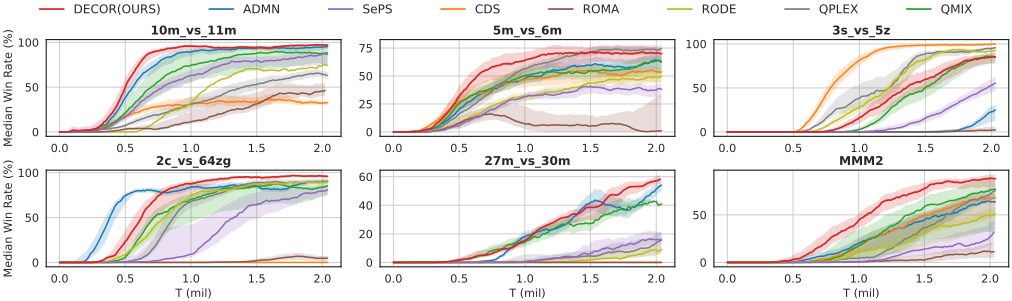
Figure 3 reports the median win rates across representative SMAC scenarios. Overall, DECOR demonstrates consistently superior performance and improved sample efficiency across most tasks. In highly heterogeneous scenarios such as MMM2, DECOR converges substantially faster than strong baselines. While ADMN adaptively routes information through different modules, it does not explicitly regulate the semantics of shared representations. In contrast, the orthogonal MoE in DECOR explicitly disentangles gradients associated with different unit types, effectively mitigating interference. In large-scale scenarios that demand complex division of labor, such as 27m vs 30m, DECOR maintains a clear performance advantage. This result indicates that the consensus-guided role reconstruction mechanism successfully breaks behavioral symmetry, enabling homogeneous agents to spontaneously group into specialized tactical roles, whereas competing methods tend to suffer from behavioral homogenization. A marginal performance gain is observed on 3s vs 5z. This behavior is primarily attributed to limitations of the underlying QMIX backbone on this specific map rather than the proposed framework itself. These empirical results validate the effectiveness of DECOR in resolving the tension between parameter sharing and role specialization, demonstrating clear advantages over existing role-based and selective-sharing approaches.
5.2 Performance on SMACv2 and GRF
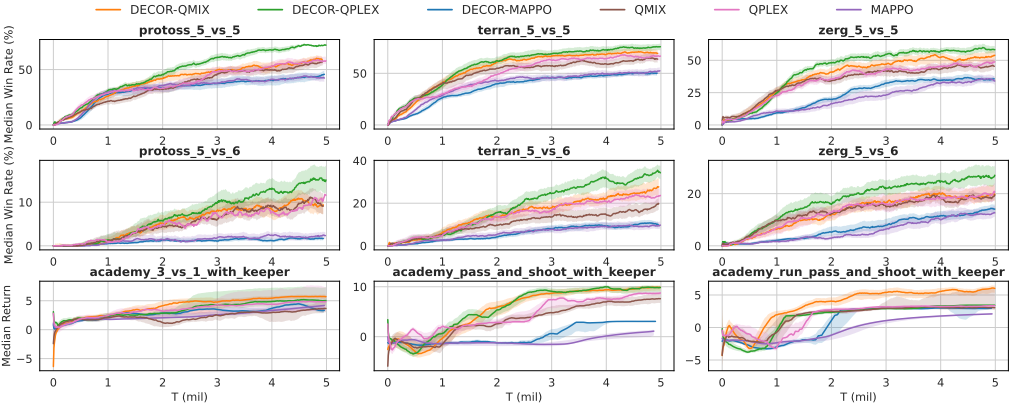
To further evaluate generalization capability and robustness under environmental stochasticity, experiments are conducted on SMACv2 and Google Research Football (GRF). Compared to the static scenarios in SMAC, SMACv2 introduces substantial randomness by varying unit types and initial configurations across episodes, breaking the assumption of fixed team compositions and preventing agents from memorizing specific trajectories. GRF provides an additional challenging cooperative benchmark, characterized by dynamic multiagent interactions and diverse tactical situations that require adaptive coordination. To assess architectural universality, DECOR is integrated into representative cooperative MARL baselines spanning different learning paradigms, including value decomposition methods (QMIX and QPLEX) and the policy-based approach MAPPO [Yu et al., 2022]. Figure 4 shows the performance of the original base algorithms with their DECOR-augmented counterparts across representative scenarios. DECOR improves performance across heterogeneous backbone architectures, indicating that its benefits are not tied to a specific learning paradigm. Given the substantial stochasticity present in both SMACv2 and GRF, these results suggest that DECOR's dynamic role reconstruction enables robust generalization to diverse coordination settings.
5.3 Ablation Study
We conduct ablation studies to examine the contribution of each core component in DECOR. To isolate the effect of individual modules, the full DECOR framework is compared against the following ablated variants:
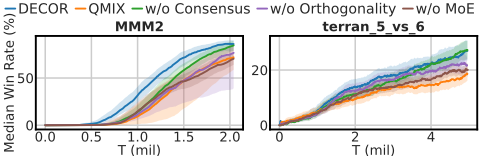
- w/o Consensus: removes the group consensus builder, with gating weights generated directly from the local hidden state hi, evaluating the necessity of global coordination signals and shared group-level consensus.
- w/oOrthogonality: retains theMoE architecture but removes the Gram-Schmidt orthogonalization, using standard soft gating to assess the importance of explicit gradient disentanglement.
- w/o MoE: replaces the orthogonal decomposition module with a standard shared MLP of comparable parameter count, evaluating whether performance gains arise merely from increased model capacity.
Ablation experiments are conducted on representative heterogeneous scenarios from both SMAC and SMACv2, including MMM2 and terran 5 vs 6, respectively. Figure 5 presents the ablation results on these two scenarios. The full DECOR framework outperforms all ablated variants, demonstrating the complementary and synergistic effects of its components. Notably, w/o Orthogonality variant leads to a severe performance drop, degrading to a level comparable to the vanilla QMIX baseline. This provides empirical support for our claim: without explicit orthogonalization, different experts tend to learn redundant or entangled representations, failing to disentangle heterogeneous functional requirements. The w/o MoE variant also exhibits performance close to QMIX, indicating that simply increasing network capacity does not yield meaningful improvements. Although the w/o Consensus variant performs better than orthogonality-ablated settings, its gap with the full DECOR model highlights the importance of group-level consensus. These results confirm that the global consensus provided by the VQ-VAE codebook is essential for coherently composing orthogonal traits into effective team strategies.
5.4 Visualization
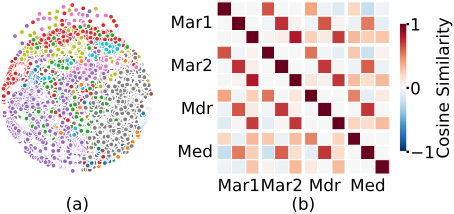
To examine whether the group consensus effectively guides role reconstruction, we visualize the learned role representations using t-SNE [Maaten and Hinton, 2008]. Each point corresponds to an agent's reconstructed role representation ρi and is colored according to the selected group consensus k ∈ {1, . . . ,K} during reconstruction. As shown in Figure 6(a), role representations associated with the same consensus form well-separated clusters in the embedding space. This clustering pattern indicates that the proposed group consensus builder provides a coherent global coordination signal, aligning role representations across agents.
In addition, we visualize the similarity matrix of trait representations across different agents in the MMM2 scenario in Figure 6(b). For clarity, only the first three orthogonal traits of each selected agent are shown. In the similarity matrix, rows and columns correspond to the concatenated trait vectors of four agents, where indices 0, 1, and 2 denote the corresponding orthogonal traits for each agent. The resulting matrix exhibits a block-wise periodic structure: traits with the same index across different agents consistently show high similarity, while traits with different indices remain well separated with low similarity values. This structured pattern demonstrates that trait alignment is preserved across agents, providing evidence that the proposed orthogonal role decomposition module learns a coherent and semantically consistent trait basis.
6 Conclusion
In this paper, we proposed DECOR, a trait-inspired framework for cooperative MARL that reconciles parameter sharing with role specialization. DECOR decomposes agent roles into orthogonal behavioral traits and reconstructs them through group-consensus guided gating. Experiments on SMAC, SMACv2, and GRF demonstrate that DECOR consistently improves performance across value-based and policy-based CTDE backbones. Ablation and visualization results further verify the complementary roles of orthogonal decomposition and group consensus.
Acknowledgments
This work was supported by the National Natural Science Foundation of China (Grant No.62506210, Grant No.62622210, Grant No.62472261).
@inproceedings{ijcai2026p55,
  title     = {From Traits to Roles: Consensus-Guided Composition of Orthogonal Experts for Cooperative MARL},
  author    = {Zhou, Yewei and Zhang, Bin and Zhou, Ying and Ge, Xuri and Li, Dapeng and Mao, Hangyu and Ren, Pengjie and Xu, Zhiwei},
  booktitle = {Proceedings of the Thirty-Fifth International Joint Conference on
               Artificial Intelligence, {IJCAI-26}},
  publisher = {International Joint Conferences on Artificial Intelligence Organization},
  editor    = {Diego Calvanese},
  pages     = {481--489},
  year      = {2026},
  month     = {8},
  note      = {Main Track},
  doi       = {10.24963/ijcai.2026/55},
  url       = {https://doi.org/10.24963/ijcai.2026/55},
}
TY - CPAPER TI - From Traits to Roles: Consensus-Guided Composition of Orthogonal Experts for Cooperative MARL AU - Zhou, Yewei AU - Zhang, Bin AU - Zhou, Ying AU - Ge, Xuri AU - Li, Dapeng AU - Mao, Hangyu AU - Ren, Pengjie AU - Xu, Zhiwei T2 - Proceedings of the Thirty-Fifth International Joint Conference on Artificial Intelligence, IJCAI-26 PB - International Joint Conferences on Artificial Intelligence Organization PY - 2026 SP - 481 EP - 489 DO - 10.24963/ijcai.2026/55 UR - https://doi.org/10.24963/ijcai.2026/55 ER -Copied
Machine-readable versions of this paper, for tools and AI agents:





