
VGAS: Value-Guided Action-Chunk Selection for Few-Shot Vision-Language-Action Adaptation
Proceedings of the Thirty-Fifth International Joint Conference on Artificial Intelligence. Main Track. Pages 5110-5118.
https://doi.org/10.24963/ijcai.2026/569
Keywords
- Robotics: Learning in robotics
- Machine Learning: Offline reinforcement learning
- Machine Learning: Few-shot learning
Abstract
Vision-Language-Action (VLA) models bridge multimodal reasoning with physical control, but adapting them to new tasks with scarce demonstrations remains unreliable. While fine-tuned VLA policies often produce semantically plausible trajectories, failures often arise from unresolved geometric ambiguities, where near-miss actions lead to divergent execution outcomes under limited supervision. We study few-shot VLA adaptation from a generation-selection perspective and propose a novel framework, VGAS (Value-Guided Action-chunk Selection). It performs inference-time best-of-N selection to identify action chunks that are both semantically faithful and geometrically precise. Specifically, VGAS employs a finetuned VLA as a high-recall proposal generator and introduces Q-Chunk-Former, a geometrically grounded Transformer critic to resolve fine-grained geometric ambiguities. In addition, we propose Explicit Geometric Regularization (EGR), which shapes a discriminative value landscape to preserve action ranking resolution among near-miss candidates while mitigating value instability under scarce supervision. Experiments and theoretical analysis demonstrate that VGAS consistently improves success rates and robustness under limited demonstrations and distribution shifts. Our code is available at https://github.com/Jyugo-15/VGAS
- [Bacchiocchi et al., 2024] Francesco Bacchiocchi, Francesco Emanuele Stradi, Matteo Papini, Alberto Maria Metelli, Nicola Gatti, et al. Online learning with off- policy feedback in adversarial mdps. In Proceedings of the Thirty-Third International Joint Conference on Artificial Intelligence (IJCAI-24), pages 3697-3705, 2024.
- [Black et al., 2024] Kevin Black, Noah Brown, Danny Driess, Adnan Esmail, Michael Equi, Chelsea Finn, Nic- colo Fusai, Lachy Groom, Karol Hausman, Brian Ichter, et al. π 0 : A vision-language-action flow model for general robot control. arXiv preprint arXiv:2410.24164, 2024.
- [Brohan et al., 2022] Anthony Brohan, Noah Brown, Justice Carbajal, Yevgen Chebotar, Joseph Dabis, Chelsea Finn, Keerthana Gopalakrishnan, Karol Hausman, Alex Herzog, Jasmine Hsu, et al. Rt-1: Robotics transformer for real- world control at scale. arXiv preprint arXiv:2212.06817, 2022.
- [Chebotar et al., 2023] Yevgen Chebotar, Quan Vuong, Karol Hausman, Fei Xia, Yao Lu, Alex Irpan, Aviral Kumar, Tianhe Yu, Alexander Herzog, Karl Pertsch, et al. Q-transformer: Scalable offline reinforcement learning via autoregressive q-functions. In Conference on Robot Learning, pages 3909-3928. PMLR, 2023.
- [Chen et al., 2025] Yuhui Chen, Shuai Tian, Shugao Liu, Yingting Zhou, Haoran Li, and Dongbin Zhao. Conrft: A reinforced fine-tuning method for vla models via con- sistency policy. arXiv preprint arXiv:2502.05450, 2025.
- [Dass et al., 2022] Shivin Dass, Karl Pertsch, Hejia Zhang, Youngwoon Lee, Joseph J Lim, and Stefanos Nikolaidis. Pato: Policy assisted teleoperation for scalable robot data collection. arXiv preprint arXiv:2212.04708, 2022.
- [Fu et al., 2020] Justin Fu, Aviral Kumar, Ofir Nachum, George Tucker, and Sergey Levine. D4rl: Datasets for deep data-driven reinforcement learning. arXiv preprint arXiv:2004.07219, 2020.
- [Fujimoto et al., 2019] Scott Fujimoto, David Meger, and Doina Precup. Off-policy deep reinforcement learning without exploration. In International conference on ma- chine learning, pages 2052-2062. PMLR, 2019.
- [Ghasemipour et al., 2021] Seyed Kamyar Seyed Ghasemipour, Dale Schuurmans, and Shixiang Shane Gu. Emaq: Expected-max q-learning operator for simple yet effective offline and online rl. In International Conference on Machine Learning, pages 3682-3691. PMLR, 2021.
- [Guo et al., 2025] Yanjiang Guo, Jianke Zhang, Xiaoyu Chen, Xiang Ji, Yen-Jen Wang, Yucheng Hu, and Jianyu Chen. Improving vision-language-action model with online reinforcement learning. arXiv preprint arXiv:2501.16664, 2025.
- [He et al., 2026] Keji He, Yan Huang, Ya Jing, Qi Wu, and Liang Wang. Fine-grained alignment supervision matters in vision-and-language navigation. IEEE Transactions on Pattern Analysis and Machine Intelligence, 48(6):6525- 6540, 2026.
- [Huang et al., 2025] Dongchi Huang, Zhirui Fang, Tianle Zhang, Yihang Li, Lin Zhao, and Chunhe Xia. Co- rft: Efficient fine-tuning of vision-language-action mod- els through chunked offline reinforcement learning. arXiv preprint arXiv:2508.02219, 2025.
- [Intelligence et al., 2025] Physical Intelligence, Kevin Black, Noah Brown, James Darpinian, Karan Dhabalia, Danny Driess, Adnan Esmail, Michael Equi, Chelsea Finn, Niccolo Fusai, et al. π 0.5 : A vision-language-action model with open-world generalization. arXiv preprint arXiv:2504.16054, 2025.
- [Janner et al., 2022] Michael Janner, Yilun Du, Joshua B Tenenbaum, and Sergey Levine. Planning with dif- fusion for flexible behavior synthesis. arXiv preprint arXiv:2205.09991, 2022.
- [Kim et al., 2024] Moo Jin Kim, Karl Pertsch, Siddharth Karamcheti, Ted Xiao, Ashwin Balakrishna, Suraj Nair, Rafael Rafailov, Ethan Foster, Grace Lam, Pannag San- keti, et al. Openvla: An open-source vision-language- action model. arXiv preprint arXiv:2406.09246, 2024.
- [Kim et al., 2025] Moo Jin Kim, Chelsea Finn, and Percy Liang. Fine-tuning vision-language-action mod- els: Optimizing speed and success. arXiv preprint arXiv:2502.19645, 2025.
- [Kostrikov et al., 2021] Ilya Kostrikov, Ashvin Nair, and Sergey Levine. Offline reinforcement learning with im- plicit q-learning. arXiv preprint arXiv:2110.06169, 2021.
- [Kumar et al., 2020] Aviral Kumar, Aurick Zhou, George Tucker, and Sergey Levine. Conservative Q-learning for offline reinforcement learning. In Advances in Neural In- formation Processing Systems (NeurIPS), 2020.
- [Kumar et al., 2022] Aviral Kumar, Anikait Singh, Frederik Ebert, Mitsuhiko Nakamoto, Yanlai Yang, Chelsea Finn, and Sergey Levine. Pre-training for robots: Offline rl en- ables learning new tasks from a handful of trials. arXiv preprint arXiv:2210.05178, 2022.
- [Levine et al., 2020] Sergey Levine, Aviral Kumar, George Tucker, and Justin Fu. Offline reinforcement learning: Tu- torial, review, and perspectives on open problems. arXiv preprint arXiv:2005.01643, 2020.
- [Li et al., 2025a] Haozhan Li, Yuxin Zuo, Jiale Yu, Yuhao Zhang, Zhaohui Yang, Kaiyan Zhang, Xuekai Zhu, Yuchen Zhang, Tianxing Chen, Ganqu Cui, et al. Simplevla-rl: Scaling vla training via reinforcement learn- ing. arXiv preprint arXiv:2509.09674, 2025.
- [Li et al., 2025b] Qiyang Li, Zhiyuan Zhou, and Sergey Levine. Reinforcement learning with action chunking. arXiv preprint arXiv:2507.07969, 2025.
- [Liu et al., 2023] Bo Liu, Yifeng Zhu, Chongkai Gao, Yi- hao Feng, Qiang Liu, Yuke Zhu, and Peter Stone. Libero: Benchmarking knowledge transfer for lifelong robot learn- ing. Advances in Neural Information Processing Systems, 36:44776-44791, 2023.
- [Liu et al., 2025] Jijia Liu, Feng Gao, Bingwen Wei, Xinlei Chen, Qingmin Liao, Yi Wu, Chao Yu, and Yu Wang. What can rl bring to vla generalization? an empirical study. arXiv preprint arXiv:2505.19789, 2025.
- [Lu et al., 2022] Cong Lu, Philip J Ball, Tim GJ Rudner, Jack Parker-Holder, Michael A Osborne, and Yee Whye Teh. Challenges and opportunities in offline reinforce- ment learning from visual observations. arXiv preprint arXiv:2206.04779, 2022.
- Luo et al., ] Kairong Luo, CAIWEI XIAO, Zhiao Huang, Zhan Ling, Yunhao Fang, and Hao Su. Dreamfuser: Value- guided diffusion policy for offline reinforcement learning. [Lyu et al., 2022] Jiafei Lyu, Xiaoteng Ma, Xiu Li, and Zongqing Lu. Mildly conservative q-learning for offline reinforcement learning. Advances in Neural Information Processing Systems, 35:1711-1724, 2022.
- [Marafioti et al., 2025] Andrés Marafioti, Orr Zohar, Miquel Farré, Merve Noyan, Elie Bakouch, Pedro Cuenca, Cyril Zakka, Loubna Ben Allal, Anton Lozhkov, Nouamane Tazi, et al. Smolvlm: Redefining small and efficient mul- timodal models. arXiv preprint arXiv:2504.05299, 2025.
- [Mark et al., 2024] Max Sobol Mark, Tian Gao, Geor- gia Gabriela Sampaio, Mohan Kumar Srirama, Archit Sharma, Chelsea Finn, and Aviral Kumar. Policy agnos- tic rl: Offline rl and online rl fine-tuning of any class and backbone. arXiv preprint arXiv:2412.06685, 2024.
- [Nakamoto et al., 2025] Mitsuhiko Nakamoto, Oier Mees, Aviral Kumar, and Sergey Levine. Steering your general- ists: Improving robotic foundation models via value guid- ance. In Conference on Robot Learning, pages 4996-5013.
- PMLR, 2025.
- [Sapkota et al., 2025] Ranjan Sapkota, Yang Cao, Konstanti- nos I Roumeliotis, and Manoj Karkee. Vision-language- action models: Concepts, progress, applications and chal- lenges. arXiv preprint arXiv:2505.04769, 2025.
- [Shin and Kim, 2023] Wonchul Shin and Yusung Kim. Guide to control: Offline hierarchical reinforcement learn- ing using subgoal generation for long-horizon and sparse- reward tasks. In IJCAI, pages 4217-4225, 2023.
- [Shukor et al., 2025] Mustafa Shukor, Dana Aubakirova, Francesco Capuano, Pepijn Kooijmans, Steven Palma, Adil Zouitine, Michel Aractingi, Caroline Pascal, Mar- tino Russi, Andres Marafioti, et al. Smolvla: A vision-language-action model for affordable and efficient robotics. arXiv preprint arXiv:2506.01844, 2025.
- [Song et al., 2025] Haoming Song, Delin Qu, Yuanqi Yao, Qizhi Chen, Qi Lv, Yiwen Tang, Modi Shi, Guanghui Ren, Maoqing Yao, Bin Zhao, et al. Hume: Introducing system- 2 thinking in visual-language-action model. arXiv preprint arXiv:2505.21432, 2025.
- [Sutton et al., 1998] Richard S Sutton, Andrew G Barto, et al. Reinforcement learning: An introduction, volume 1. MIT press Cambridge, 1998.
- [Sutton et al., 1999] Richard S Sutton, Doina Precup, and Satinder Singh. Between mdps and semi-mdps: A frame- work for temporal abstraction in reinforcement learning. Artificial intelligence, 112(1-2):181-211, 1999.
- Tan et al., ] Shuhan Tan, Kairan Dou, Yue Zhao, and Philipp Krähenbühl. Interactive post-training for vision-language- action models (2025). arXiv preprint arXiv:2505.17016.
- [Team et al., 2024] Octo Model Team, Dibya Ghosh, Homer Walke, Karl Pertsch, Kevin Black, Oier Mees, Sudeep Dasari, Joey Hejna, Tobias Kreiman, Charles Xu, et al. Octo: An open-source generalist robot policy. arXiv preprint arXiv:2405.12213, 2024.
- [Xin et al., 2024] Jimmy Xin, Linus Zheng, Kia Rahmani, Jiayi Wei, Jarrett Holtz, Isil Dillig, and Joydeep Biswas. Programmatic imitation learning from unlabeled and noisy demonstrations. IEEE Robotics and Automation Letters, 9(6):4894-4901, 2024.
- [Yu et al., 2025] En Yu, Jie Lu, Xiaoyu Yang, Guangquan Zhang, and Zhen Fang. Learning robust spectral dynamics for temporal domain generalization. In The Thirty-ninth Annual Conference on Neural Information Processing Sys- tems, 2025.
- [Yu et al., 2026] En Yu, Jie Lu, and Guangquan Zhang. Gen- eralized incremental learning under concept drift across evolving data streams. In Proceedings of the ACM Web Conference 2026, WWW '26, page 3905-3916, 2026.
- [Zhang and Tan, 2023] Zhe Zhang and Xiaoyang Tan. Adap- tive reward shifting based on behavior proximity for of- fline reinforcement learning. In IJCAI, pages 4620-4628, 2023. IJCAI
- [Zhang et al., 2025] Dapeng Zhang, Jing Sun, Chenghui Hu, Xiaoyan Wu, Zhenlong Yuan, Rui Zhou, Fei Shen, and Qingguo Zhou. Pure vision language action (vla) models: A comprehensive survey. arXiv preprint arXiv:2509.19012, 2025.
- [Zhao et al., 2023] Tony Z. Zhao, Vikash Kumar, Sergey Levine, and Chelsea Finn. Learning fine-grained biman- ual manipulation with low-cost arms. In Robotics: Science and Systems (RSS), 2023.
- [Zitkovich et al., 2023] Brianna Zitkovich, Tianhe Yu, Sichun Xu, Peng Xu, Ted Xiao, Fei Xia, Jialin Wu, Paul Wohlhart, Stefan Welker, Ayzaan Wahid, et al. Rt-2: Vision-language-action models transfer web knowledge to robotic control. In Conference on Robot Learning, pages 2165-2183. PMLR, 2023.
References were extracted automatically from the PDF and may contain errors.
Full text extracted automatically from the PDF; figures, tables and equations may differ. The PDF is the version of record.
1 Introduction
Vision-Language-Action (VLA) models have emerged as a transformative paradigm for embodied AI, bridging multimodal reasoning with physical control [Brohan et al., 2022; Zitkovich et al., 2023; He et al., 2026]. By pretraining on vast robotic datasets, these generalist policies learn to map complex visual observations and linguistic instructions directly into executable actions [Black et al., 2024; Kim et al., 2024; Team et al., 2024; Intelligence et al., 2025]. However, the reliability of VLAs in downstream applications remains heavily bottlenecked by the prevailing Supervised Fine-Tuning (SFT) paradigm [Kim et al., 2025; Zhang et al., 2025]. SFT-based adaptation demands a high volume of expert demonstrations to bridge the gap between generalist priors and task-specific requirements. This is often challenging in real-world environments where high-quality robotic data collection is costly, unscalable, and prone to out-of-distribution (OOD) uncertainties [Dass et al., 2022; Xin et al., 2024; Sapkota et al., 2025; Yu et al., 2026]. Consequently, under data-scarce regimes, VLA policies often exhibit brittle performance, failing to generalize across even minor distribution shifts [Liu et al., 2025; Li et al., 2025a; Yu et al., 2025; Tan et al., ; Guo et al., 2025].
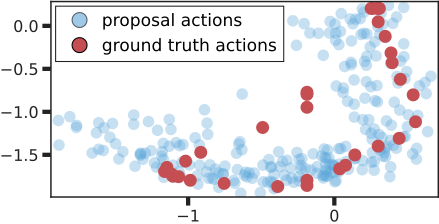
To study this data-scarce regime, we simulate a realistic few-shot adaptation setting by fine-tuning a pretrained VLA policy with only five demonstrations per task, and evaluating it on held-out demonstrations with different initial spatial configurations (e.g., object positions). As shown in Figure 1, the fine-tuned policy generally preserves the task semantics, producing actions toward the correct object. However, due to the limited state-action coverage, even slight variations in the initial spatial configuration can make the policy's action predictions less concentrated, yielding dispersed near-miss predictions around the ground-truth actions. Although semantically reasonable, these predictions are often geometrically imprecise and can cause failures such as inaccurate grasps, end-effector pose deviations, or joint-angle overshoot [Kumar et al., 2022; Zhao et al., 2023]. This suggests that few-shot VLA adaptation is primarily limited by geometric precision under sparse supervision, rather than semantic understanding alone. Motivated by this, we reformulate adaptation as a value-guided selection problem: instead of requiring a generative policy to jointly acquire semantic reasoning and finegrained geometric control end-to-end, we decouple adaptation into high-recall proposal generation and high-precision value-based selection, prioritizing candidates with the highest likelihood of long-horizon success.
Offline Reinforcement Learning (ORL) provides a natural framework for this selection objective, as it learns an outcome-aware critic that maps long-horizon success into a scalar value signal [Sutton et al., 1998]-perfectly suited for ranking candidate proposals [Ghasemipour et al., 2021; Janner et al., 2022; Luo et al., ]. However, applying existing ORL methodologies to modern VLA policies exposes two fundamental limitations: 1) Structural and observational mismatch: Standard RL assumes per-step atomic actions, whereas modern VLAs output temporally extended action chunks, inducing an SMDP structure that complicates value learning and temporal credit assignment [Sutton et al., 1999]. Moreover, most offline RL is evaluated with compact, near-Markovian state inputs; in contrast, VLA relies on high-dimensional vision-language observations with geometric grounding, making value estimation substantially harder and comparatively under-explored [Fu et al., 2020; Lu et al., 2022]. 2) Ranking resolution vs. conservatism: Offline RL often controls extrapolation to low-support actions via conservative objectives or behavior-regularized extraction [Kumar et al., 2020; Kostrikov et al., 2021]. In fewshot sparse-reward settings, however, such regularization can compress value gaps among proposal-supported near-miss candidates, yielding low-contrast gradients and weakening inference-time Best-of-N selection [Lyu et al., 2022]. These limitations raise two major research questions: RQ1. What critic architecture can robustly ground high-dimensional VLA observations into precise value estimates for temporally extended action chunks? and RQ2. How can a value function be trained under scarce demonstrations to maintain high ranking resolution among near-miss action chunks?
To address these questions, we propose VGAS (ValueGuided Action-chunk Selection) for VLA adaptation via generation-selection decoupling. For RQ1, we introduce Q-Chunk-Former, a geometrically grounded critic architecture built on a Transformer backbone. By leveraging the Transformer's sequence modeling capability, our design naturally captures temporal dependencies within action chunks. Crucially, our architecture preserves fine-grained, token-level features, allowing attention to explicitly focus on geometric cues that are critical for precise value estimation. For RQ2, we propose a hybrid offline RL objective that anchors temporal consistency via a proposal-constrained Bellman backup, augmented by Explicit Geometric Regularization (EGR). Unlike traditional conservative methods that indiscriminately penalize out-of-distribution actions, EGR injects dense geometric supervision, shaping the value landscape into a smooth funnel anchored at expert demonstrations. This allows the critic to maintain high ranking resolution among near-miss candidates even under scarce supervision. Our contributions are summarized as follows:
- We reformulate few-shot VLA adaptation as a valueguided selection problem and propose the novel VGAS method, shifting the paradigm from likelihood-based generation to outcome-aware ranking.
- We propose Q-Chunk-Former, which enables precise geometric grounding for action-chunk evaluation. We introduce EGR, a regularization technique that injects dense geometric priors into offline RL to maintain high ranking resolution under data-scarce regimes.
- We provide theoretical guarantees for the convergence of our chunk-level value operator and demonstrate through extensive experiments on the LIBERO benchmark that VGAS consistently outperforms SFT and standard ORL baselines, particularly in terms of success rate and robustness under distribution shifts.
2 Preliminary
Offline Reinforcement Learning. We consider a Markov Decision Process (MDP) defined by M = (S, A, P, r, ρ, γ), where s ∈ S, a ∈ A, P(s′ | s, a) is the transition kernel, r(s, a) ∈ R is the reward function, ρ0 ∈ ∆(S) is the initialstate distribution, and γ ∈ [0, 1) is the discount factor. The objective is to learn a policy π maximizing the expected discounted return J(π) = Eπ [∑t≥0 γ t r(st, at)].
Value-based methods estimate the optimal action-value function Q⋆ as the fixed point of the Bellman optimality operator [Fujimoto et al., 2019; Levine et al., 2020]:
In offline RL, the agent learns from a fixed dataset D collected by a behavior policy πβ, without additional environment interaction [Bacchiocchi et al., 2024]. A key challenge is extrapolation error [Zhang and Tan, 2023]: the maximization over a′ may select actions outside the data support, leading to overestimation and instability. Many offline RL methods [Shin and Kim, 2023] mitigate this via conservative regularization [Kumar et al., 2020], which discourages high values on out-of-distribution actions.
Action Chunking in VLAs. Modern VLAs condition on multimodal inputs, which we denote by the state st = (It, Lt, pt), comprising visual tokens It, language instruction Lt, and robot proprioception pt [Zitkovich et al., 2023]. With a slight abuse of notation, we treat this policy input as the MDP state. Instead of per-step control, these models often output a temporally extended action chunk with horizon h:
At := (at, . . . , at+h-1) ∈ Ah , At ∼ πµ(· | st). (2) Few-shot VLA Adaptation Objective. Given a few-shot expert dataset D = {τi}Ki=1 , we first obtain a task-aligned base chunk policy πµ(A | s), for example via SFT on D. In this regime, SFT can capture task semantics yet may struggle to resolve fine-grained geometric ambiguities. We therefore treat πµ as a high-recall proposal distribution and assume non-trivial local support around each demonstrated chunk:
πµ({A : ∥A-At∥2 ≤ ε} | st) ≥ p0, ∀(st,At) ∈ D, (3) for some ε > 0 and p0 > 0. Intuitively, p0 ensures the proposal covers valid near-miss candidates. Our goal is to improve upon πµ by learning an offline-adapted chunk policy within a proposal-constrained class Πµ:
where Πµ denotes policies supported by (or centered at) the proposal πµ. Under chunked execution, the return is
where tk = kh denotes the start time of the k-th chunk, Atk ∼ π(· | stk ) is the action chunk, and Rh(stk ,Atk ) = ∑h-1 j=0 γ j r(stk+j, atk+j) is the discounted cumulative reward over the chunk.
3 Methodology
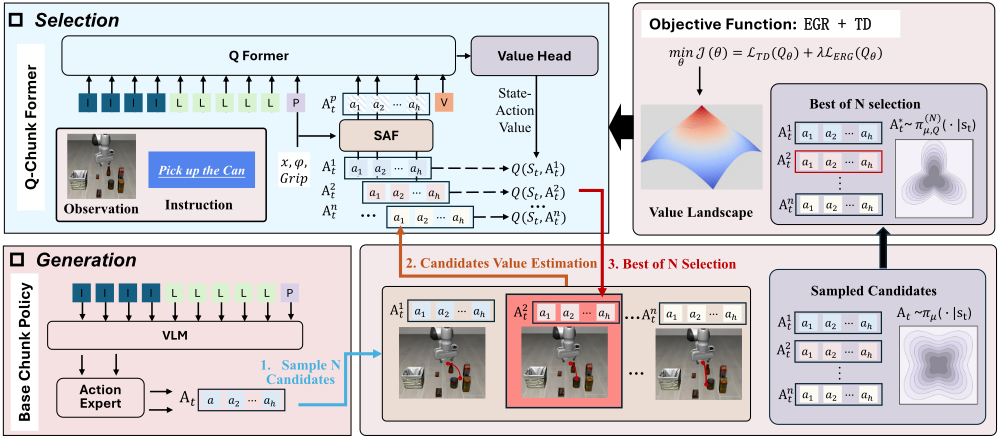
Framework Overview. VGAS reformulates few-shot VLA adaptation as a generate-then-select process. As illustrated in Figure 2, our pipeline decouples the policy into two components: a high-recall generator and a high-precision critic. First, we utilize a supervised fine-tuned (SFT) VLA model as the base policy πµ(At | st) to provide a proposal distribution covering plausible action chunks. At inference time, we sample N candidates {A(i) t }Ni=1 ∼ πµ(· | st) and employ a learned critic Qθ to execute Best-of-N selection, A⋆t = argmaxi Qθ(st,A(i) t ). This strategy approximates policy improvement within the support of πµ, prioritizing geometric precision without requiring online exploration.
To realize this selection mechanism effectively, VGAS addresses two core challenges: representation and optimization. First, regarding critic representation (Sec.3.1), we introduce Q-Chunk-Former, a Transformer-based architecture tailored for VLA inputs. To prevent high-dimensional visual tokens from overwhelming physical cues, we design a State-Action Fusion (SAF) module that explicitly grounds action chunks in proprioceptive states before multimodal integration. Second, for critic optimization (Sec.3.2), we propose a hybrid learning objective that combines temporal and spatial supervision. We stabilize offline training using a Proposal-Constrained Chunked Expected-Max backup, which enforces temporal consistency across action chunks. We further augment this with Explicit Geometric Regularization (EGR), a dense supervision signal that directly shapes the value landscape based on geometric proximity to expert demonstrations, enabling the critic to reliably distinguish near-miss actions from failures even under sparse task rewards.
3.1 Q-Chunk-Former
To optimize the few-shot adaptation objective in Eq. (4), the critic network must accurately estimate the long-horizon value of a temporally extended action chunk At given state st. This imposes two key requirements, (i) Chunk-level evaluation with temporal structure: the critic must assign a single long-horizon value to an entire action chunk At for Bestof-N selection (Eq. (9)), while preserving the within-chunk temporal ordering of actions; (ii) Multimodal fusion without geometric collapse: unlike classical critics operating on compact state vectors, VLA conditioning involves heterogeneous inputs such as vision, language, and proprioception, where naive compression can discard geometry-critical cues needed for feasibility-aware value estimation.
Motivated by token-level multimodal modeling [Marafioti et al., 2025], we introduce a Transformer-based critic. A naive design treats all modalities as a single concatenated token sequence:
where [·] denotes concatenation. However, in practice, the self-attention mechanism tends to be dominated by the abundant visual and linguistic tokens, so the single proprioceptive token pt receives insufficient attention. This is detrimental because value estimation for manipulation requires joint reasoning over the external world context (from It and Lt) and the internal robot state (embodiment and configuration encoded by pt). If pt is under-utilized, the critic becomes less sensitive to geometric feasibility, weakening feasibilityaware value estimation.
To address this, we introduce a lightweight State-Action Fusion (SAF) module that conditions the raw chunk At on pt prior to mixing with high-dimensional perceptions. The SAF module produces proprioception-grounded action tokens Apt ,
where Wa and Wp are learnable projections mapping inputs to a shared latent space andWfuse aggregates the concatenated features. This design enforces a high-fidelity interaction between action tokens and the proprioceptive state, ensuring that feasibility cues are embedded directly into the chunk representation. The grounded action tokens Apt are then integrated with the frozen perceptual tokens 1 and a learnable [VALUE] token v via a Transformer decoder, denoted as the Q-Former (QF). Finally, a Value Head (VH) maps the output embedding of v to a scalar Q-value:
In summary, Q-Chunk-Former comprises SAF, QF, and VH modules. This architecture mitigates attention imbalance and ensures that value estimation is strictly grounded in geometric reality, providing a reliable signal for selection.
3.2 Optimization Objective
Our goal is to learn a critic that supports value-guided selection over a fixed proposal distribution. We assume access to a task-adapted base chunk policy πµ(A | s) that generates semantically plausible action chunks. At inference time, we draw N i.i.d. candidates from πµ and select the best one according to a scoring rule Q:
Although the maximization in Eq. (9) is deterministic conditioned on the sampled set, proposal sampling induces a stochastic selection policy. We denote this induced policy by π(N) µ,Q (A | s), defined as the distribution of A⋆Q(s).
To learn Q from a fixed offline dataset D, we train the critic as a proxy for the long-horizon return of the induced policy π(N) µ,Q in the chunk-induced SMDP. A reliable critic in the few-shot regime must satisfy two coupled desiderata: (i) temporal consistency, i.e., Bellman-style alignment with the expected max return under best-of-N selection over πµ samples; and (ii) spatial consistency, i.e., preserving fine-grained geometric ranking among near-miss proposals. We instantiate these principles with the following hybrid objective:
1 Perceptual tokens It and Lt are extracted from the pre-trained VLM encoder of the base policy to ensure feature alignment and computational efficiency.
Temporal Consistency. The primary goal of LTD is to align critic learning with our inference-time execution, i.e., to learn the value function induced by Best-of-N selection, π(N) µ,Q . This alignment requires two ingredients. First, since execution commits to a length-h action chunk, the critic must evaluate the return of an entire chunk. We therefore adopt the chunk-level TD formulation from Q-Chunking [Li et al., 2025b] and learn Q(st,At) that conditions on the full action chunk.
Second, we must ensure that the Bellman backup matches the same Best-of-N rule used at inference. To this end, inspired by Expected-Max Q-learning (EMaQ) [Ghasemipour et al., 2021], the key insight of EMaQ is to construct a Bellman backup that replaces the standard expectation under a policy with an expected maximization over a set of sampled proposals. By targeting this maximum, the objective ensures that the critic trained with this operator is guaranteed to converge to the value function of the corresponding Bestof-N selection policy π(N) µ,Q . Thus, we define the proposalconstrained Chunked Expected-Max backup operator T N µ as
where Rh is the discounted cumulative reward over the chunk and Ph is the h-step transition kernel. The inner maximization corresponds exactly to selecting A⋆Q(s′ ) from Eq. (9), thereby enforcing strict train-test consistency.
This operator formulation offers rigorous theoretical guarantees for offline adaptation, which we summarize below.
Proposition 1 (Chunked Expected-Max in tabular SMDPs). In the tabular chunk-induced SMDP, assume bounded rewards and γ h ∈ (0, 1). Then T N µ in Eq. (11) is a γ h - contraction under ∥ · ∥∞ and has a unique fixed point QNµ . Let π(N) µ := π(N) µ,QNµ be the induced Best-of-N policy. Then QNµ = Qπ(N) µ . Monotonicity in N and the N→∞ limit are given in Prop. 3 and Thm. 2 (App. B).
Proposition 1 shows that the proposed backup is welldefined in the tabular induced SMDP and that its unique fixed point corresponds exactly to the value function of the induced Best-of-N selection policy. A detailed proof of these properties in the tabular SMDP setting is provided in Appendix B.
Based on this operator, we instantiate the final temporaldifference loss with a standard target network Q¯ θ for stability:
Here, the proposals {A′i t+h }Ni=1 are sampled from the frozen proposal distribution πµ(· | st+h) at the next decision state. This loss provides a stable, proposal-constrained temporal anchor for our critic, paving the way for the spatial regularization described next.
Spatial Consistency. While the proposal-constrained TD loss provides a stable temporal anchor, offline critic learning remains vulnerable to extrapolation error, where OOD (off-demo) candidates deviating from the training data distribution receive spuriously high values. Standard conservative methods, such as CQL [Kumar et al., 2020], mitigate this by indiscriminately suppressing values for all low-support actions. However, in the few-shot regime, this uniform penalty is overly aggressive, because it compresses the value dynamic range among proposal-supported candidates and reduces the fine-grained ranking resolution needed to distinguish plausible near-miss candidates from catastrophic failures. This value collapse directly undermines inference-time Best-of-N selection.
To address this, we introduce Explicit Geometric Regularization (EGR). Instead of uniformly suppressing off-demo actions, EGR serves as a structural regularizer. During training, we regularize the critic with off-demo candidates sampled from ρ(· | st), a proposal-centered mixture detailed in Appendix D.1. At inference time, Best-of-N selects only among proposal samples from πµ(· | st). Accordingly, EGR targets two desiderata: (i) TD-Anchored Calibration: anchor the value scale to the TD target yt to mitigate overestimation on off-demo candidates; (ii) Geometric Discriminability: within the inference-time proposal set, preserve a graded preference for geometric proximity, providing a smooth signal to separate recoverable near-misses from divergence.
We formalize EGR as the following weighted combination of Anchoring and Ranking losses.
where η ≥ 0 balances the absolute scale (Anchoring) and the local ordering (Ranking).
a. Geometric anchoring (Lanchor). For any off-demo action chunk ˆAt ∼ ρ(· | st), we define
where sg(·) stops gradients and yt is the TD target from Eq. (12). Crucially, we do not posit Euclidean distance as a global ground-truth metric; rather, we employ this surface as a structural inductive bias to shape the value landscape in regions where task supervision is absent. In our setting, we employ a weighted metric ∥ˆAt - At∥2W to prioritize critical kinematic dimensions (e.g., end-effector position) within the normalized control space. This serves as a robust local proxy for geometric proximity: under smooth dynamics, small weighted action deviations tend to induce small shorthorizon trajectory deviations. (See Appendix D.3 for details).
To satisfy TD-anchored calibration, we align the critic's estimates on candidate chunks with the reference surface:
where ℓ(·, ·) is the squared error.
b. Geometric ranking (Lrank). While anchoring constrains the absolute scale, it does not guarantee robust local discrimination. To enforce geometric discriminability, we introduce a pairwise ranking loss. For any pair (ˆAit , ˆAjt ) ∼ ρ(· | st), define squared distances to the expert:
By Eq. (14), the reference differential value satisfies Y(st, ˆAit ) - Y(st, ˆAjt ) = β(dj - di). We thus encourage the critic to preserve the same relative differences among candidate chunks:
The Closed Loop of Spatio-Temporal Consistency. The TD and EGR form a mutually reinforcing loop for safe and effective value learning. The Expected-Max TD objective provides a foundational safety layer by inherently operating within the support of the proposal distribution πµ. However, this implicit constraint alone can still be vulnerable to selecting outlier candidates that are accidentally overestimated. EGR reinforces this safety by explicitly shaping the OOD value landscape into a geometric funnel. This structure actively biases the Best-of-N maximization toward candidates that remain close to expert behavior, providing a tighter and more reliable bound on the TD target. This enhanced safety guarantee is formalized by the following proposition:
Proposition 2 (Best-of-N bound under an EGR anchoring envelope). Fix a demonstration pair (st,At) ∼ D and a candidate distribution πµ(· | st). Define the EGR reference surface Y(st, A′t ) = sg(yt) - β∥A′t - At∥2W (Eq. (14)) and the anchoring residual δθ(st,A′t ) := Qθ(st,A′t )-Y(st,A′t ). Assume it is uniformly upper-bounded on the candidate set:
Draw N candidates {A′i t }Ni=1 ∼ ρ(· | st). Then
See Appendix B.2 for the full statement and proof.
TD Anchors and Calibrates EGR. Conversely, the TD objective provides an essential grounding signal for EGR. The TD target yt sets the absolute scale for the EGR reference surface, preventing the geometric shaping from degenerating into an uncalibrated ranking function. This synergy allows the TD-EGR loop to progressively correct value estimates: TD provides the return-aware scale, while EGR provides the finegrained geometric structure, jointly enabling robust ranking.
4 Experiment
In our experiments, we aim to answer the following research questions: RQ1: Does VGAS benefit from a Transformerbased chunk critic (Q-Chunk-Former) for modeling finegrained geometric dependencies under multimodal inputs? RQ2: Does Explicit Geometric Regularization (EGR) improve value calibration and ranking over state-action-chunk candidates for Best-of-N selection?
| LIBERO-Spatial | LIBERO-Object | LIBERO-Goal | LIBERO-Long | Average | |||||||
|---|---|---|---|---|---|---|---|---|---|---|---|
| Type | Method | SR (↑) | Rank (↓) | SR (↑) | Rank (↓) | SR (↑) | Rank (↓) | SR (↑) | Rank (↓) | SR (↑) | Rank (↓) |
| BC-Only | SmolVLA | 46.0 | 4 | 45.8 | 4 | 52.0 | 3 | 15.5 | 4 | 39.8 | 4 |
| BC + RL | QC-M | 46.0 | 4 | 42.1 | 5 | 49.2 | 5 | 14.4 | 5 | 37.9 | 5 |
| QC-M+CQL | 47.8 | 2 | 50.3 | 2 | 54.2 | 2 | 16.5 | 3 | 42.2 | 2 | |
| QC-T+CQL | 47.7 | 3 | 50.1 | 3 | 51.9 | 4 | 17.5 | 2 | 41.8 | 3 | |
| VGAS (Ours) | 56.2 | 1 | 59.0 | 1 | 60.8 | 1 | 20.0 | 1 | 49.0 | 1 | |
4.1 Experiment Settings
Benchmark and Architecture. We evaluate VGAS on the widely used simulation benchmark, LIBERO [Liu et al., 2023]. LIBERO is a lifelong learning benchmark focused on language-guided manipulation tasks across diverse object types, task specifications, and environments scenarios. Specifically, it includes 4 suites: Goal, Spatial, Object, and Long. Each suite is designed to evaluate a specific aspect of object manipulation and containing 10 distinct tasks. We use SmolVLA-0.5B [Shukor et al., 2025] as the base chunk policy. We initialize Q-Chunk-Former with the first two decoder layers of the pre-trained SmolVLM2 [Marafioti et al., 2025], keeping the critic's token space aligned with the policy. Comprehensive architectural details are provided in Appendix D.
Baselines. We compare VGAS against baselines covering VLA fine-tuning and offline value-based improvement. BConly fine-tunes SmolVLA with behavior cloning. CQL [Kumar et al., 2020] serves as a representative conservative offline RL objective and is widely used in VLA settings [Song et al., 2025; Chebotar et al., 2023; Huang et al., 2025; Nakamoto et al., 2025; Chen et al., 2025]. QC-M follows Q-Chunking [Li et al., 2025b], training an MLP critic with standard TD learning over action chunks. QC-M+CQL augments QC-M with the CQL regularizer. Finally, QC-T+CQL retains the same objective but replaces the MLP with our QChunk-Former, enabling a controlled comparison of critic architectures under identical conservative constraints. Implementation details are provided in Appendix D.2.
4.2 Main Results
Table 1 reports LIBERO success rates. The unregularized QChunking baseline (QC-M) underperforms BC (37.9% vs. 39.8%), reflecting a maximization issue in offline RL. With sparse demonstrations, the critic can overestimate slightly off-demonstration near-miss chunks due to function approximation error, and Best-of-N selection then preferentially picks these overvalued outliers, inducing compounding drift as rollouts enter poorly covered state-action regions [Kumar et al., 2020; Mark et al., 2024].
Adding CQL alleviates this failure, improving QC-M from 37.9% to 42.2% (QC-M+CQL), but the gain over BC remains modest. Replacing the MLP with our Transformer backbone yields a similar result (41.8% for QC-T+CQL), suggesting that indiscriminate conservative suppression compresses value gaps among proposal-supported candidates, leaving Best-of-N with insufficient ranking resolution.
Finally, VGAS achieves 49.0%, outperforming QCT+CQL by a clear margin. Since both methods share the same Q-Chunk-Former backbone, this improvement is primarily attributed to Explicit Geometric Regularization (EGR). See Sec. 4.4 for further comparative analysis.
4.3 Ablation Studies
Table 2 isolates the contribution of each component. The dominant gain arises from Explicit Geometric Regularization (LEGR). Removing LEGR leads to a sharp drop in success rate from 49.0% to 36.4%, effectively collapsing performance back to the unregularized QC-M baseline (37.9%). This regression suggests that, without geometric shaping, the critic is susceptible to a canonical offline RL failure mode: it assigns spuriously high values to off-demo candidates, and the subsequent Best-of-N maximization amplifies these overestimations. These results indicate that EGR plays a dual role: beyond suppressing erroneous high values on offdemo actions, it explicitly structures the local value landscape around demonstrations, preserving the ranking resolution required for reliable Best-of-N selection. In addition, ablating the temporal consistency term (LTD) reduces performance to 45.5%, showing that while EGR provides strong spatial guidance, a TD-based anchor remains necessary to stabilize longhorizon value estimates.
| Variants | Spatial | Object | Goal | LONG | Avg |
|---|---|---|---|---|---|
| w/o SAF w/o | 51.8 | 54.2 | 56.8 | 17.4 | 45.1 |
| QCF | 53.4 | 55 | 55.9 | 16.8 | 45.3 |
| w/o LEGR w/o LTD | 42.6 | 42.3 | 48.2 | 12.5 | 36.4 |
| 55.2 | 54.5 | 56.0 | 16.4 | 45.5 | |
| VGAS | 56.2 | 59.0 | 60.8 | 20.0 | 49 |
Architectural choices prove equally critical. We denote our Transformer-based critic as QCF (Q-Chunk-Former). Replacing QCF with a standard MLP backbone (w/o QCF) yields 45.3%, validating the necessity of the Transformer's attention mechanism for modeling complex multimodal dependencies. Notably, ablating the State-Action Fusion mod-
- (a) Projection on X-Z Plane
(b) Projection on Y-Z Plane
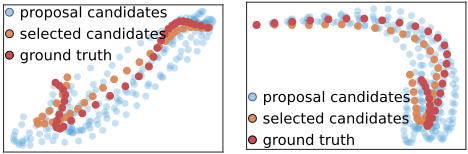
Figure 4: Multi-view Spatial Rollouts of Action Chunks and VGAS Selection. Trajectories are reconstructed via temporal integration in orthogonal views. VGAS identifies the trajectory aligning with the expert across 3D space.
ule (w/o SAF) further lowers performance to 45.1%. This suggests that without explicit grounding, the critic struggles to resolve fine-grained geometric ambiguities amidst highdimensional visual features.
4.4 Visualization Analysis
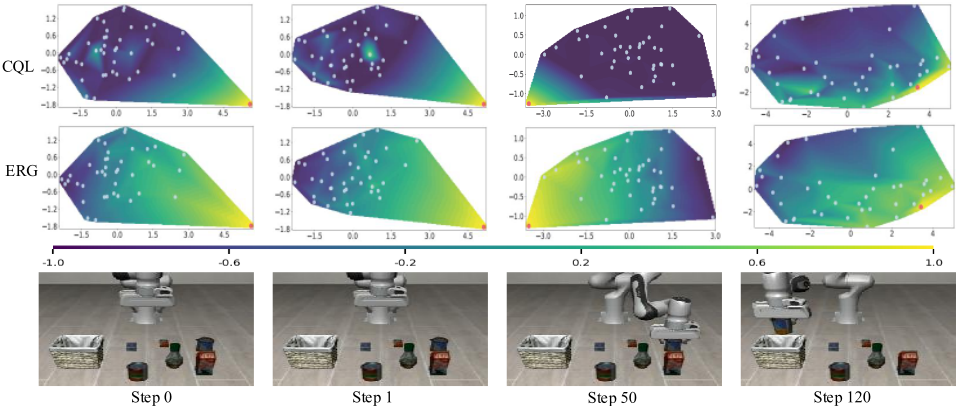
Figure 3 visualizes the landscape of estimated action-chunk values projected onto a 2D plane, with Q-values normalized to [-1, 1] for comparison. As shown in the top row, standard conservative regularization (CQL) results in a collapsed value landscape. It indiscriminately suppresses the Q-values of all proposal candidates (white dots) to a uniformly low level. Consequently, the critic loses the resolution to differentiate recoverable near-miss proposals from failures, rendering the selection process ineffective. In contrast, the bottom row demonstrates that VGAS successfully restores finegrained ranking resolution. Instead of uniform suppression, the value signal exhibits a graded geometric preference that decays smoothly as candidates deviate from the expert actions (red dot). This structure ensures that the critic can meaningfully rank candidates based on their physical proximity to the optimal solution. The detailed analysis is in Appendix C.
To assess execution precision, we visualize the spatial rollouts induced by action chunks on held-out task instances. Although these instances remain semantically aligned with the training demonstrations, they contain subtle yet consequential spatial variations. The SFT baseline (blue) exhibits pronounced dispersion, producing a "cloud" of candidates that frequently drifts away from the target. This indicates poor geometric generalization under few-shot supervision: the policy tends to memorize demonstration-specific trajectories rather than adapt its execution to instance-level spatial configurations. In contrast, VGAS acts as a geometric stabilizer. By enforcing structural consistency rather than exact path memorization, the learned critic suppresses this variance and selects the candidate (orange) that best matches the current spatial arrangement. Consequently, VGAS corrects execution drift induced by rigid imitation in the base policy. Additional experiments on other VLA baselines, inference-budget sensitivity, demonstration-budget scaling, and hyperparameter sensitivity are provided in Appendix E.
5 Conclusion and Limitations
We propose VGAS, which reformulates few-shot VLA adaptation as value-guided selection by decoupling highrecall proposal generation from a high-precision geometric critic. Two components jointly address the near-miss failure mode: Q-Chunk-Former grounds multimodal observations into chunk-level value estimates, and EGR prevents value-landscape collapse to preserve ranking resolution. On LIBERO, VGAS consistently outperforms SFT and offline RL baselines. Despite these improvements, two practical limitations remain. First, inference-time Best-of-N selection incurs computational latency, limiting applicability in highfrequency control. Second, extending VGAS to real-world platforms remains an important direction for future work.
Acknowledgments
The work was supported by the Australian Research Council (ARC) under Laureate project FL190100149.
@inproceedings{ijcai2026p569,
  title     = {VGAS: Value-Guided Action-Chunk Selection for Few-Shot Vision-Language-Action Adaptation},
  author    = {Xu, Changhua and Yu, En and Xuan, Junyu and Lu, Jie},
  booktitle = {Proceedings of the Thirty-Fifth International Joint Conference on
               Artificial Intelligence, {IJCAI-26}},
  publisher = {International Joint Conferences on Artificial Intelligence Organization},
  editor    = {Diego Calvanese},
  pages     = {5110--5118},
  year      = {2026},
  month     = {8},
  note      = {Main Track},
  doi       = {10.24963/ijcai.2026/569},
  url       = {https://doi.org/10.24963/ijcai.2026/569},
}
TY - CPAPER TI - VGAS: Value-Guided Action-Chunk Selection for Few-Shot Vision-Language-Action Adaptation AU - Xu, Changhua AU - Yu, En AU - Xuan, Junyu AU - Lu, Jie T2 - Proceedings of the Thirty-Fifth International Joint Conference on Artificial Intelligence, IJCAI-26 PB - International Joint Conferences on Artificial Intelligence Organization PY - 2026 SP - 5110 EP - 5118 DO - 10.24963/ijcai.2026/569 UR - https://doi.org/10.24963/ijcai.2026/569 ER -Copied
Machine-readable versions of this paper, for tools and AI agents:





