
EnzyPGM: Pocket-conditioned Generative Model for Substrate-specific Enzyme Design
Proceedings of the Thirty-Fifth International Joint Conference on Artificial Intelligence. Main Track. Pages 5585-5593.
https://doi.org/10.24963/ijcai.2026/622
Keywords
- Multidisciplinary Topics and Applications: Bioinformatics
- Multidisciplinary Topics and Applications: Life sciences
Abstract
Designing enzymes with substrate-binding pockets is a critical challenge in protein engineering, as catalytic activity depends on the precise interaction between pockets and substrates. Currently, generative models dominate functional protein design but cannot model pocket-substrate interactions, which limits enzyme generation with precise catalytic environments. To address this issue, we propose EnzyPGM, a unified framework that jointly generates enzymes and substrate-binding pockets conditioned on functional priors and substrates, with a particular focus on learning accurate pocket–substrate interactions. At its core, EnzyPGM includes two main modules: a Residue-atom Bi-scale Attention (RBA) that jointly models intra-residue dependencies and fine-grained interactions between pocket residues and substrate atoms, and a Residue Function Fusion (RFF) that incorporates enzyme function priors into residue representations. Also, we curate EnzyPock, an enzyme–pocket dataset comprising 84,336 enzyme–substrate pairs across 1,036 four-level enzyme families. Extensive experiments demonstrate that EnzyPGM achieves state-of-the-art performance on EnzyPock. Notably, EnzyPGM reduces the average binding energy by 0.47 kcal/mol over EnzyGen, showing its superior performance on substrate-specific enzyme design. The code is available at https://github.com/John-Lin98/EnzyPGM.
- [Ahern et al., 2025] Woody Ahern, Jason Yim, Doug Tischer, Saman Salike, Seth M Woodbury, Donghyo Kim, Indrek Kalvet, Yakov Kipnis, Brian Coventry, Han Raut Altae- Tran, et al. Atom level enzyme active site scaffolding using rfdiffusion2. bioRxiv, page 2025.04.09.648075, 2025.
- [Baek et al., 2021] Minkyung Baek, Frank DiMaio, Ivan An- ishchenko, Justas Dauparas, Sergey Ovchinnikov, Gyu Rie Lee, Jue Wang, Qian Cong, Lisa N Kinch, R Dustin Scha- effer, et al. Accurate prediction of protein structures and interactions using a three-track neural network. Science, 373(6557):871-876, 2021.
- [Bar-Even et al., 2011] Arren Bar-Even, Elad Noor, Yonatan Savir, Wolfram Liebermeister, Dan Davidi, Dan S Tawfik, and Ron Milo. The moderately efficient enzyme: evolution- ary and physicochemical trends shaping enzyme parame- ters. Biochemistry, 50(21):4402-4410, 2011.
- [Capra and Singh, 2007] John A Capra and Mona Singh. Pre- dicting functionally important residues from sequence con- servation. Bioinformatics, 23(15):1875-1882, 2007.
- [Chu et al., 2024] Alexander E Chu, Tianyu Lu, and Po-Ssu Huang. Sparks of function by de novo protein design. Nature Biotechnology, 42(2):203-215, 2024.
- [Dauparas et al., 2022] Justas Dauparas, Ivan Anishchenko, Nathaniel Bennett, Hua Bai, Robert J Ragotte, Lukas F Milles, Basile IM Wicky, Alexis Courbet, Rob J de Haas, Neville Bethel, et al. Robust deep learning-based protein se- quence design using proteinmpnn. Science, 378(6615):49- 56, 2022.
- [Dauparas et al., 2025] Justas Dauparas, Gyu Rie Lee, Robert Pecoraro, Linna An, Ivan Anishchenko, Cameron Glass- cock, and David Baker. Atomic context-conditioned protein sequence design using ligandmpnn. Nature Methods, pages 1-7, 2025.
- [Dauphin et al., 2017] Yann N Dauphin, Angela Fan, Michael Auli, and David Grangier. Language modeling with gated convolutional networks. In ICML, pages 933-941. PMLR, 2017.
- [Du et al., 2025] Jiahe Du, Kaixiong Zhou, Xinyu Hong, Zhaozhuo Xu, Jinbo Xu, and Xiao Huang. Retrieval aug- mented zero-shot enzyme generation for specified substrate. In ICML, 2025.
- [Edgar, 2022] Robert C Edgar. Muscle5: High-accuracy alignment ensembles enable unbiased assessments of se- quence homology and phylogeny. Nature communications, 13(1):6968, 2022.
- [Ferruz et al., 2022] Noelia Ferruz, Steffen Schmidt, and Birte Höcker. Protgpt2 is a deep unsupervised lan- guage model for protein design. Nature Communications, 13(1):4348, 2022.
- [Francoeur et al., 2020] Paul G Francoeur, Tomohide Ma- suda, Jocelyn Sunseri, Andrew Jia, Richard B Iovanisci, Ian Snyder, and David R Koes. Three-dimensional convo- lutional neural networks and a cross-docked data set for structure-based drug design. Journal of chemical informa- tion and modeling, 60(9):4200-4215, 2020.
- [Hayes et al., 2025] Thomas Hayes, Roshan Rao, Halil Akin, Nicholas J Sofroniew, Deniz Oktay, Zeming Lin, Robert Verkuil, Vincent Q Tran, Jonathan Deaton, Marius Wiggert, et al. Simulating 500 million years of evolution with a language model. Science, 387(6736):850-858, 2025.
- [Hsu et al., 2022] Chloe Hsu, Robert Verkuil, Jason Liu, Zeming Lin, Brian Hie, Tom Sercu, Adam Lerer, and Alexander Rives. Learning inverse folding from millions of predicted structures. In ICML, pages 8946-8970. PMLR, 2022.
- [Hua et al., 2024] Chenqing Hua, Jiarui Lu, Yong Liu, Odin Zhang, Jian Tang, Rex Ying, Wengong Jin, Guy Wolf, Doina Precup, and Shuangjia Zheng. Reaction-conditioned de novo enzyme design with genzyme. arXiv preprint arXiv:2411.16694, 2024.
- [Huang et al., 2021] Juan Huang, Qin Xu, Zhuo Liu, Nitin Jain, Madhusudan Tyagi, Dong-Qing Wei, and Liang Hong. Controlling the substrate specificity of an enzyme through structural flexibility by varying the salt-bridge density. Molecules, 26(18):5693, 2021.
- [Jumper et al., 2021] John Jumper, Richard Evans, Alexander Pritzel, Tim Green, Michael Figurnov, Olaf Ronneberger, Kathryn Tunyasuvunakool, Russ Bates, Augustin Žídek, Anna Potapenko, et al. Highly accurate protein structure prediction with alphafold. Nature, 596(7873):583-589, 2021.
- [Kortemme, 2024] Tanja Kortemme. De novo protein de- sign-from new structures to programmable functions. Cell, 187(3):526-544, 2024.
- [Lesk, 2001] Arthur M Lesk. Introduction to protein archi- tecture: the structural biology of proteins, volume 741. Oxford university press Oxford, 2001.
- [Lin et al., 2022] Zeming Lin, Halil Akin, Roshan Rao, Brian Hie, Zhongkai Zhu, Wenting Lu, Allan dos Santos Costa, Maryam Fazel-Zarandi, Tom Sercu, Sal Candido, et al. Lan- guage models of protein sequences at the scale of evolution enable accurate structure prediction. bioRxiv, 2022.
- [Meshchaninov et al., 2025] Viacheslav Meshchaninov, Pavel Strashnov, Andrey Shevtsov, Fedor Nikolaev, Nikita Ivanisenko, Olga Kardymon, and Dmitry Vetrov. Diffusion on language model encodings for protein sequence generation. In ICML, 2025.
- [Nijkamp et al., 2023] Erik Nijkamp, Jeffrey A Ruffolo, Eli N Weinstein, Nikhil Naik, and Ali Madani. Progen2: exploring the boundaries of protein language models. Cell Systems, 14(11):968-978, 2023.
- [Notin et al., 2024] Pascal Notin, Nathan Rollins, Yarin Gal, Chris Sander, and Debora Marks. Machine learning for functional protein design. Nature Biotechnology, 42(2):216- 228, 2024.
- [Satorras et al., 2021] Vıctor Garcia Satorras, Emiel Hooge- boom, and Max Welling. E (n) equivariant graph neural networks. In ICML, pages 9323-9332. PMLR, 2021.
- [Song et al., 2024] Zhenqiao Song, Yunlong Zhao, Wenxian Shi, Wengong Jin, Yang Yang, and Lei Li. Generative enzyme design guided by functionally important sites and small-molecule substrates. In ICML, pages 46259-46279.
- PMLR, 2024.
- [Song et al., 2025] Chao Song, Zhiyuan Liu, Han Huang, Liang Wang, Qiong Wang, Jian-Yu Shi, Hui Yu, Yihang Zhou, and Yang Zhang. Enzycontrol: Adding functional and substrate-specific control for enzyme backbone genera- tion. In NeurIPS, 2025.
- [Stank et al., 2016] Antonia Stank, Daria B Kokh, Jonathan C Fuller, and Rebecca C Wade. Protein binding pocket dy- namics. Accounts of Chemical Research, 49(5):809-815, 2016.
- [Stärk et al., 2022] Hannes Stärk, Octavian Ganea, Lagnajit Pattanaik, Regina Barzilay, and Tommi Jaakkola. Equibind: Geometric deep learning for drug binding structure predic- tion. In ICML, pages 20503-20521. PMLR, 2022.
- [Tipton and Boyce, 2000] Keith Tipton and Sinéad Boyce. History of the enzyme nomenclature system. Bioinfor- matics, 16(1):34-40, 2000.
- [Trippe et al., 2023] Brian L Trippe, Jason Yim, Doug Tis- cher, David Baker, Tamara Broderick, Regina Barzilay, and Tommi S Jaakkola. Diffusion probabilistic modeling of protein backbones in 3d for the motif-scaffolding problem. In ICLR, 2023.
- [Trott and Olson, 2010] Oleg Trott and Arthur J Olson. Autodock vina: improving the speed and accuracy of dock- ing with a new scoring function, efficient optimization, and multithreading. Journal of Computational Chemistry, 31(2):455-461, 2010.
- [Vaswani et al., 2017] Ashish Vaswani, Noam Shazeer, Niki Parmar, Jakob Uszkoreit, Llion Jones, Aidan N Gomez, Łukasz Kaiser, and Illia Polosukhin. Attention is all you need. NeurIPS, 30, 2017.
- [Wang et al., 2004] Renxiao Wang, Xueliang Fang, Yipin Lu, and Shaomeng Wang. The pdbbind database: Collection of binding affinities for protein-ligand complexes with known three-dimensional structures. Journal of medicinal chemistry, 47(12):2977-2980, 2004.
- [Wang et al., 2024] Xinyou Wang, Zaixiang Zheng, Fei Ye, Dongyu Xue, Shujian Huang, and Quanquan Gu. Diffusion language models are versatile protein learners. In ICML, pages 52309-52333. PMLR, 2024.
- [Wang et al., 2025] Yuhang Wang, Shuangxin Han, Yi Wang, Quanfeng Liang, and Wei Luo. Artificial intelligence tech- nology assists enzyme prediction and rational design. Jour- nal of Agricultural and Food Chemistry, 73(12):7065-7073, 2025.
- [Watson et al., 2023] Joseph L Watson, David Juergens, Nathaniel R Bennett, Brian L Trippe, Jason Yim, Helen E Eisenach, Woody Ahern, Andrew J Borst, Robert J Ragotte, Lukas F Milles, et al. De novo design of protein structure and function with rfdiffusion. Nature, 620(7976):1089- 1100, 2023.
- [Xiong et al., 2020] Ruibin Xiong, Yiming Yang, Di He, Kai Zheng, Shuxin Zheng, Chenxiang Xing, Huishuai Zhang, Yanyan Lan, Liqiang Wang, and Tie-Yan Liu. On layer nor- malization in the transformer architecture. arXiv preprint arXiv:2002.04745, 2020.
- [Zhang et al., 2024a] Zaixi Zhang, Wan Xiang Shen, Qi Liu, and Marinka Zitnik. Efficient generation of protein pockets with pocketgen. Nature Machine Intelligence, 6(11):1382- 1395, 2024.
- [Zhang et al., 2024b] Zaixi Zhang, Marinka Zitnik, and Qi Liu. Generalized protein pocket generation with prior- informed flow matching. NeurIPS, 37:38559-38589, 2024.
References were extracted automatically from the PDF and may contain errors.
Full text extracted automatically from the PDF; figures, tables and equations may differ. The PDF is the version of record.
1 Introduction
Enzymes are nature's most efficient biocatalysts, accelerating chemical reactions by 103-1017 fold [Bar-Even et al., 2011] while maintaining unique substrate specificity [Huang et al., 2021]. The catalytic activity of enzymes arises from precisely folded 3D structures that form confined spatial regions, called substrate-binding pockets [Stank et al., 2016], where specific substrates are recognized, bound, and rapidly transformed into products. Recently, deep learning methods have demonstrated impressive potential for functional protein design [Chu et al., 2024; Kortemme, 2024; Notin et al., 2024], where these methods can be classified as: (1) general functional protein design guided by functional labels and partial protein information [Baek et al., 2021; Nijkamp et al., 2023]; (2) ligand-binding protein design relies on the geometric structure of protein-ligand complexes [Watson et al., 2023; Dauparas et al., 2025]; and (3) substratespecific enzyme design based on the substrate properties and enzyme function [Du et al., 2025; Wang et al., 2025].
∗Corresponding authors.
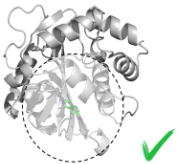
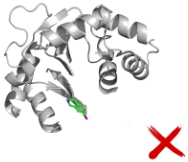
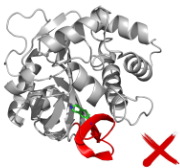
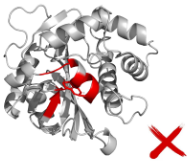
Challenges. However, joint modeling of enzymes and substrate-binding pockets remains rarely studied as it faces several key challenges: (1) How to learn an effective representation of substrate-binding pockets to capture pocket-substrate interactions? These interactions affect the binding configuration and geometric structure of the enzyme and substrate [Stärk et al., 2022]. Figure 1(b) shows the case without the pocketsubstrate interaction modeling, where the predicted enzyme does not have a binding pocket and cannot bind to the substrate. (2) How to accurately model the residues and substrate in the pocket? The minor prediction deviations on residue and substrate significantly reduce catalytic efficiency [Lesk, 2001]. Figure 1(c) and (d) show the cases without accurately modeling the residue and substrate, where the predicted pocket and substrate have an atom clash. (3) A lack of public datasets that contain enzyme and substrate binding pockets.
Solution. To tackle these challenges, in this paper, we propose the Pocket-conditioned Enzyme Generative Model (EnzyPGM), which explicitly models the substrate-binding pocket to design substrate-specific enzymes. Our key motivation is to model pocket-substrate interactions by bi-scale representation learning, thereby dynamically adjusting pocket sites in the enzyme to form a valid pocket. Furthermore, given that enzymes have obvious functional categories and functionally conserved sites, we integrate them into the language model for enzyme design. Specifically, we propose the Residue-atom Bi-scale Attention (RBA) module to accurately model the interaction between pocket residues and substrate atoms. It mainly consists of intra-residue and residue-atom attention mechanisms, which individually capture neighborhood correlations among residues, and the interaction between pocket residues and substrate atoms, thus facilitating bi-scale representation learning across pockets and substrates. To fuse the enzyme function and structure into the residue representation, we employ the Residue Function Fusion (RFF) module. It integrates Enzyme Commission (EC) number as the function embedding and updates residue representations and 3D coordinates based on their spatial neighborhoods. Also, to solve the lack of public datasets in enzyme-pocket modeling, we curate EnzyPock, the first enzyme-pocket dataset comprising 84,336 enzyme-substrate pairs across 17,404 PDB entries.
Main contributions are summarized as: (1) We propose EnzyPGM, the first model to generate enzyme and substratebinding pockets conditioned on specific substrates jointly. (2) We design a bi-scale attention mechanism and fuse enzyme function priors, which accurately captures the interaction across residues and substrate atoms to generate a binding pocket. (3) We curate EnzyPock, a refined enzyme-pocket dataset to tackle the lack of datasets for enzyme-pocket jointly modeling. Experimental results show that EnzyPGM consistently outperforms existing methods across EnzyPock, generating enzymes with higher catalytic activity, structural confidence, and substrate selectivity.
2 RelatedWork
Deep Learning for Protein Design. Recent protein design methods mainly cover inverse folding, de novo sequence generation, and joint sequence-structure design. Inverse folding models such as ProteinMPNN [Dauparas et al., 2022] and ESM-IF [Hsu et al., 2022] recover sequences for given backbones. De novo sequence models such as ProtGPT2 [Ferruz et al., 2022], DPLM [Wang et al., 2024], and DiMA [Meshchaninov et al., 2025] learn protein sequence distributions, while joint models such as EGNN [Satorras et al., 2021] and ESM3 [Hayes et al., 2025] models both sequence and structure. However, these methods do not explicitly model enzyme catalytic functions and substrate-specific binding pockets.
Ligand-binding Pocket Generation. Owing to the importance of the ligand-pocket binding in drug design, several studies propose ligand-aware pocket generation frameworks. PocketGen [Zhang et al., 2024a] and PocketFlow [Zhang et al., 2024b] explore ligand-binding pocket generation by integrating molecular priors. These methods usually require a non-pocket scaffold and focus on local pocket redesign. In contrast, EnzyPGM jointly generates enzymes and substratebinding pockets from conserved-site and substrate conditions, thus their task settings are essentially different.
Substrate-specific Enzyme Generation. EnzyGen [Song et al., 2024], GENzyme [Hua et al., 2024], and EnzyControl [Song et al., 2025] introduce functional, reaction, or substrate-specific control into enzyme generation. Compared with these methods, EnzyPGM explicitly models residue-atom pocket-substrate interactions in a unified enzyme generation framework for substrate-specific enzyme generation.
3 EnzyPGM: Pocket-conditioned Enzyme Generative Model
3.1 Substrate-specific Enzyme Design
This work aims to design substrate-specific enzymes with the binding pocket by modeling pocket-substrate interactions and fusing enzyme function priors.
An N-residue enzyme E is represented as a sequence of residues E = {r1, r2, . . . , rN}, where each residue ri = (si, xi), with si ∈ A denoting the amino acid type, and xi ∈ R3 being its 3D coordinate of the Cα atom. Here, A represents the 20-amino-acid alphabet. A substrate molecule V consisting of M atoms is denoted as V = {v1, v2, . . . , vM}, where each atom vj = (aj, yj), with aj ∈ R5 representing the five atom-level chemical feature composed of element type, aromaticity, connectivity, hydrogen atom number, and hybridization type, and yj ∈ R3 being its 3D coordinate.
Given an enzyme E and substrate V, the substrate-binding pocket P is the residue set spatially proximal to the substrate:
where ∥ · ∥2 denotes the L2 norm, and d is a distance threshold (in Å) and set to 10 in our practice.
Enzyme Commission (EC) numbers are a standard for enzymes based on catalytic reaction types, where the fourthlevel classification precisely defines functional families and provides a basis for inferring enzyme functions via homology [Tipton and Boyce, 2000]. Functionally conserved sites of enzymes are highly conserved across evolution, as these residues directly determine catalytic activity and structural stability, serving as key signatures of enzymes' functions and
(a) General Framework
(b) Residue-atom Bi-scale Attention
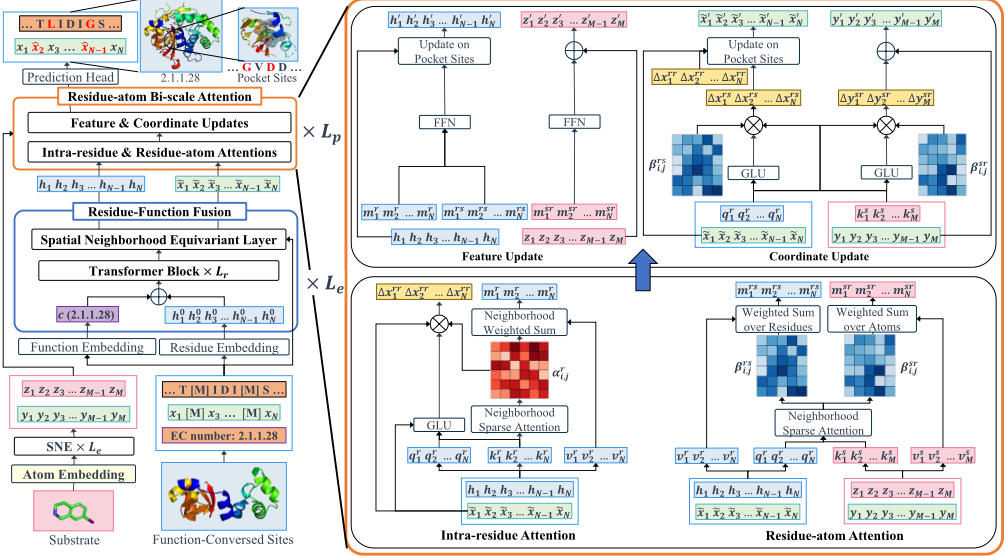
Figure 2: Overview of EnzyPGM. (a) EnzyPGM takes enzyme function-conversed sites as a masked input sequence, conditioned on EC number and substrate atom, and predicts the complete enzyme and pocket sites via RFF and RBA modules. The mask sites at the input are represented by [M] both in sequence and coordinate space, their prediction results are indicated in red at the output. (b) present the specific process of the intra-residue and residue-atom attention, the feature and coordinate updates.
structures [Capra and Singh, 2007]. To fully utilize these functional priors, we obtain conserved sites M under EC label c as part of the input using multiple sequence alignment (MSA), and then predict other masked sites using a model.
In summary, our study problem can be formulated as a conditional masked language modeling (MLM) task: given a EC label c, a given substrate V, a functionally conserved site index set M, its residues set EM, generate a complete enzyme ˆ E and its substrate-binding pocket ˆ P that can bind the substrate. Essentially, we need to train a generative model to learn the probability P ( ˆ E, ˆ P | EM, V, c).
3.2 Overall Framework
EnzyPGM is proposed for generating enzyme and substratebinding pockets conditioned on both enzyme functional class and functionally conserved sites (Figure 2 (a)). It mainly consists of two modules: the Residue Function Fusion (RFF) and the Residue-atom Bi-scale Attention (RBA).
At a high level, RFF aims to fuse residue-level contextual information from the enzyme sequence with functional priors in EC number and maintain their SE(3)-equivariance, while RBA focuses on enhancing pocket residues in both feature and coordinate spaces selectively.
Next, we will detail the components of EnzyPGM.
3.3 Residue-Function Fusion (RFF)
RFF is stacked Transformer [Vaswani et al., 2017] blocks with a function embedding and Spatial Neighborhood Equivariant (SNE) layer. The former embeds the EC number into residue embeddings to obtain function-aware residue embeddings, while the latter performs message passing within the residue neighborhood graphs to ensure SE(3)-equivariance of residue representations and coordinates. We also use the SNE layer to model the substrate atom and coordinates.
Given E and M, each si in E are first embedded into a residue h(1) i ∈ Rdh :
where [mask] is the special token to mask the sites we need to predict, and dh denotes the dimensions of the representation.
For introducing the enzyme family priors, we encode the EC number c into a function embedding Emb(c) ∈ Rdh using a learnable embedding table and add it to the residue embedding. Then, we apply Lr Transformer blocks with function embedding to model long-range residue dependencies. In the t-th transformer block, a multi-head self-attention (MHA) and fully connected feedforward network (FFN) are performed to obtain the function-aware residue representation h(t+1) i :
Here LN(·) denotes the layer normalization (LN) operator, Pre-LN instead of Post-LN [Xiong et al., 2020] is adopted, and ˜H(t) = [˜h(t) 1 , . . . , ˜h(t) N ].
The output {h(Lr+1) i }Ni=1 of the last Transformer block and the residue coordinates are then input to the SNE layer to ensure their SE(3)-equivariance:
Here, mik denotes messages exchanged between residues, N(i) is the local neighboring nodes set of residue ri within a predefined radius, |N(i)| represents the number of the set, and [;] denotes concatenation of vectors. Finally, the SNE layer outputs refined residue representations {˜hi}Ni=1 with updated coordinates {˜xi}Ni=1 , which are passed to the RBA module.
Similarly, we stack Le of SNE layers to learn the substrate atom representation {zj}Mj=1 from the embedding of the j-th substrate atom chemical feature z(1) j = Emb(aj), but we do not update the atom coordinates.
3.4 Residue-atomBi-scale Attention (RBA)
RBA aims to enhance pocket residues in both feature and coordinate spaces by jointly modeling (I) residue-residue and (II) residue-substrate interactions (Figure 2(b)).
(I) Intra-Residue Attention. To capture global message exchange within the enzyme, we perform the intra-residue attention to integrate intra-residue message using a radial basis function ϕrbf based on the refined residue representations {˜hi}Ni=1 and coordinates {˜xi}Ni=1 . Specifically, the attention weight αr ik between the residue ri and rk is calculated as:
where qri =WrQ · LN(˜hi), krk =WrK · LN(˜hk), and vrk = WrV · LN(˜hk) are the query, key, and value projections of residue representation, andW[·] is a linear projection weight.
The intra-residue message mri from neighboring residues and the coordinate update amount ∆xrr i for residue ri are then
Here gr ik is the learnable gate weight controlling the magnitude of coordinate update between residue ri and rk, computed by a Gated Linear Unit (GLU) [Dauphin et al., 2017].
(II) Residue-AtomAttention. To model the interaction between residues and substrate atoms, we perform cross-modal attention between them. The attention weights βrs ij between the residue ri and the substrate atom vj are computed as:
where ksj = WsK · LN(zj), vs j = WsV · LN(zj), softmaxi means normalizing over residues.
We perform the softmaxj to the same attention score to obtain the attention weight βsr ij over atoms. The residue message mrs i and substrate atommessage msr j is then aggregated as:
Feature and Coordinate Updates. Next, we update the representations and coordinates of pocket residues and substrate atoms based on the obtained messages and attention weights. To avoid disturbing the global enzyme scaffold, coordinate updates are sparsely applied only to non-conserved residues within the predicted pocket region ˜ P = {i | minvj∈V ∥˜xi - yj∥2 < d} and all atoms of the substrate. This local refinement improves pocket geometry while preserving structural continuity. Specifically, we integrate intra-residue and residue-substrate messages to obtain the updated representations h′i and z′i :
Here M is the non-functionally conserved sites.
Then, we use two GLUs to respectively compute the gate weight grs ij and gsr ij of residues and atoms based on Equation 11 and qri , ksj , ˜xi, yj. The coordinate update amount ∆xsr i for residue ri and ∆yrs j for atom vj are computed as:
Finally, the coordinates of residues and atoms are updated as follows:
We stack Lp of RBA modules to obtain the final representation ˆ hi and coordinates ˆ xi and ˆ yj, a prediction head is then employed to predict amino acid type:
whereWaa ∈ R|A|×hd and baa ∈ R|A| are trainable parameters, and |A| = 20 denotes the amino acid vocabulary size.
3.5 Training Objective
EnzyPGM is trained jointly using sequence reconstruction and structural refinement. The training loss L considers the joint optimization objective, including the enzyme sequence loss Ls, pocket loss Lps, enzyme coordinates loss Lc, pocket coordinates loss Lpc, and substrate coordinates loss Lsub:
Here P is the ground-truth of pocket residue sites. sgt i denotes the ground-truth amino acid type, xgt i and ygt j are correspond to real 3D coordinates of residue ri and substrate atom vj. lCE and lHuber denote cross-entropy and Huber loss, respectively. Then we obtain the total loss:
where λ[·] are hyperparameters for balancing these losses.
4 Experiments
4.1 EnzyPock: Dataset Curation
To build EnzyPock, we collect protein-ligand pairs from PDBbind [Wang et al., 2004] and CrossDocked [Francoeur et al., 2020], map PDB IDs to UniProt EC annotations, group enzymes by fourth-level EC labels, and infer conserved sites using Muscle5 [Edgar, 2022]. Pockets are extracted using Equation 1. For multi-chain proteins, we retain the first ECannotated chain to avoid low-quality MSA analysis and excessive sequence lengths. When records conflict, we prioritize PDBbind over CrossDocked because PDBbind contains experimentally validated complexes. To prevent leakage, we cluster
| Dataset | Training | Validation | Test |
|---|---|---|---|
| Sample Size | 83,062 | 483 | 791 |
| Third-Level Family | 161 | 18 | 24 |
| Fourth-Level Family | 973 | 30 | 33 |
| Average Seq. Length | 324 | 314 | 322 |
| Method | AAR ↑ | Vina ↓ | pLDDT ↑ | scRMSD ↓ | scTM↑ |
|---|---|---|---|---|---|
| ESM3 (1.4B) | 0.76 | -3.46 | 77.87 | 5.26 | 0.89 |
| RFD2+IF (84M) | 0.56 | -6.65 | 68.70 | 6.36 | 0.86 |
| EnzyControl (21M) | 0.49 | -6.90 | 58.74 | 8.54 | 0.77 |
| EnzyGen (714M) | 0.64 | -6.65 | 60.46 | 9.64 | 0.75 |
| EnzyPGM (798M) | 0.77 | -7.12 | 74.87 | 3.10 | 0.91 |
| w/o res-res attn | 0.73 | -7.08 | 73.63 | 4.54 | 0.88 |
| w/o res-atom attn | 0.73 | -7.13 | 72.48 | 4.55 | 0.87 |
| w/o pock & sub loss | 0.73 | -7.13 | 74.43 | 3.54 | 0.89 |
| Freeze RFF | 0.70 | -6.82 | 69.75 | 6.16 | 0.84 |
| Method | AAR ↑ | Vina ↓ | pLDDT ↑ | scRMSD ↓ | scTM↑ |
|---|---|---|---|---|---|
| ESM3 (1.4B) | 0.64 | -6.58 | 71.64 | 13.89 | 0.72 |
| RFD2+IF (84M) | 0.32 | -7.15 | 61.91 | 11.81 | 0.72 |
| EnzyControl (21M) | 0.35 | -7.18 | 60.64 | 10.88 | 0.71 |
| EnzyGen (714M) | 0.88 | -8.27 | 70.10 | 6.37 | 0.82 |
| EnzyPGM (798M) | 0.71 | -8.17 | 67.77 | 10.48 | 0.72 |
17,404 PDB entries at 70% sequence identity and split nonoverlapping clusters into training, validation, and test sets, as shown in Table 1. We choose this threshold to balance leakage control and dataset scale, since stricter thresholds substantially reduce the number of usable families and lead to overfitting.
4.2 Experimental Settings
Baselines: We compare EnzyPGM with four representative baselines: ESM3 [Hayes et al., 2025], RFD2+IF, EnzyControl [Song et al., 2025], and EnzyGen [Song et al., 2024]. RFD2+IF first uses RFDiffusion2 [Ahern et al., 2025] to generate enzyme structures conditioned on functionally important sites, and then applies ProteinMPNN [Dauparas et al., 2022] for inverse folding. Since ESM3 and RFDiffusion2 do not release their training scripts, we use their released model weights for generation. For EnzyControl, we use the public checkpoint and follow its evaluation pipeline.
Evaluation Metrics: We evaluate generated enzymes using amino acid recovery (AAR), Vina score (Vina) [Trott and Olson, 2010], pLDDT [Jumper et al., 2021], scRMSD and scTM [Trippe et al., 2023]. AAR measures the percentage of correctly recovered residue recovery in generated enzymes, Vina score estimates enzyme-substrate binding affinity, and pLDDT reflects the foldability of generated sequences. scRMSD and scTMmeasure structural consistency. For fair comparison across modeling paradigms, we compute structurerelated metrics mainly on ESMFold-predicted structures and confirm that using native structures for structure-only baselines leads to consistent conclusions.
| Binding affinity (Vina score ↓) | ||||||||||
| EC Family | 1.1 | 2.1 | 2.3 | 2.7 | 3.2 | 3.5 | 4.1 | 5.2 | 5.3 | Avg. |
|---|---|---|---|---|---|---|---|---|---|---|
| ESM3 (1.4B) | -4.55 | -0.60 | -0.00 | -2.04 | -1.53 | -5.67 | -0.91 | -3.71 | -0.14 | -3.52 |
| RFD2+IF (84M) | -5.62 | -6.38 | -9.14 | -8.57 | -7.27 | -6.47 | -6.88 | -6.79 | -5.30 | -7.01 |
| EnzyControl (21M) | -4.74 | -6.28 | -8.57 | -8.48 | -6.59 | -6.45 | -6.96 | -7.10 | -5.88 | -6.93 |
| EnzyGen (714M) | -4.75 | -6.12 | -9.03 | -8.44 | -6.36 | -5.96 | -6.97 | -6.80 | -6.06 | -6.66 |
| EnzyPGM (798M) | -4.89 | -6.21 | -9.37 | -8.39 | -6.97 | -6.85 | -7.15 | -6.98 | -5.84 | -7.14 |
| Foldability (pLDDT ↑) | ||||||||||
| EC Family | 1.1 | 2.1 | 2.3 | 2.7 | 3.2 | 3.5 | 4.1 | 5.2 | 5.3 | Avg. |
| ESM3 (1.4B) | 83.41 | 80.82 | 82.21 | 75.80 | 74.84 | 80.37 | 67.18 | 78.89 | 84.58 | 77.91 |
| RFD2+IF (84M) | 77.15 | 77.90 | 70.07 | 73.15 | 43.66 | 71.84 | 56.38 | 73.07 | 81.63 | 68.56 |
| EnzyControl (21M) | 68.59 | 76.06 | 71.05 | 70.58 | 37.74 | 55.16 | 50.05 | 62.83 | 82.42 | 58.62 |
| EnzyGen (714M) | 63.31 | 75.78 | 53.34 | 70.47 | 45.00 | 58.73 | 50.65 | 63.08 | 76.60 | 60.33 |
| EnzyPGM (798M) | 79.96 | 76.27 | 75.68 | 71.34 | 75.59 | 79.25 | 49.68 | 79.38 | 85.34 | 74.89 |
Implementation Details: EnzyPGM is composed of three stacked RFF and RBA modules, where each RFF contains 11 Transformer blocks initialized with ESM2 weights [Lin et al., 2022]. A total of 3 individual SNE layers are used to process the substrate, and RBA only updates the pocket area within a 10Å radius of the substrate. The total parameter of EnzyPGM is 798M. The spatial K-nearest neighbor number in RFF, substrate SNE, and RBA are set to 30, 16, and 10, respectively. The hyperparameters λs, λps, λc, λpc, and λsub are set to 1, 0.5, 1, 0.5, and 1, respectively. For training EnzyPGM on EnzyPock, we adopt AdamW with a learning rate of 1e-5 and a cosine learning schedule, dynamic batch size on GPU memory capacity, and use four NVIDIA A100 GPUs to train 30 epochs with 8000 warmup steps.
4.3 Quantitative Results
EnzyPGM realizes more effective enzyme design. As shown in Table 2, EnzyPGM achieves the highest AAR of 0.77
and the lowest Vina score of -7.12 on EnzyPock, surpassing EnzyGen by 0.13, reducing the average binding energy by 0.47 kcal/mol. Meanwhile, EnzyPGM exhibits state-of-the-art performance in scRMSD and scTM on EnzyPock, suggesting the generated enzymes are well-folded and of high substrate affinity. Although ESM3 obtains the highest pLDDT, EnzyPGM substantially outperforms it on Vina score while using fewer parameters, showing that explicit pocket-substrate interaction modeling is more effective for enzyme design than general protein pre-training. Also, we test all approaches on EnzyBench (Table 3), confirming that EnzyPGM has desirable performance and generalization, particularly in binding affinity. Specifically, we demonstrate the performance of all approaches on 9 main EC-2 families of EnzyPock in Table 4. These results demonstrate that pocket modeling benefits to generate enzymes with higher substrate-binding capability and structural validity, leading to more effective enzyme design.
4.4 Ablation Studies
All designs in EnzyPGM contribute to enzyme generation.
We conduct ablation experiments to assess the contribution of core designs in EnzyPGM, which are the intra-residue and residue-atom attention, pocket and substrate loss, and RFF module. As shown in Table 2, removing two attentions results in a 1.24 and 2.39 drop in pLDDT, respectively. This confirms that the bi-scale attention improves performance in enzyme sequence design. Removing the pocket and substrate loss leads to a modest drop in overall performance, confirming that they promote model training. Freezing the RFF during training results in a performance drop across all metrics, suggesting that the backbone model is essential for EnzyPGM. These results confirm that EnzyPGM's core designs jointly promote its enzyme design performance.
4.5 Case Studies
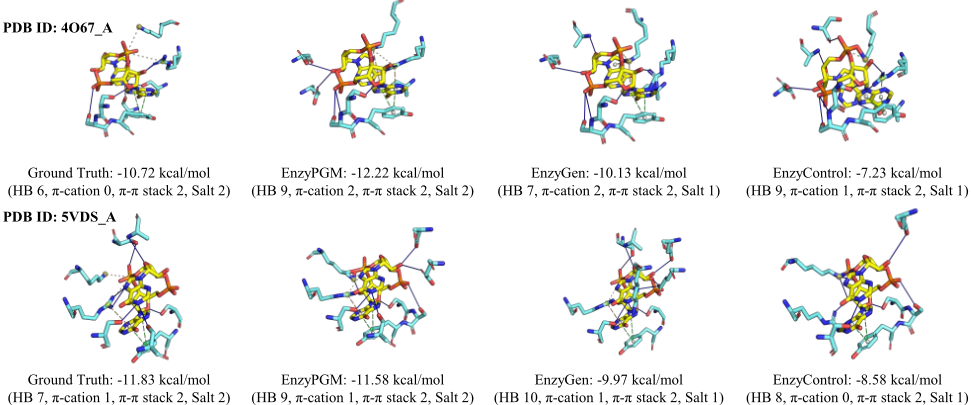
EnzyPGM designs high-affinity binding pockets. To demonstrate EnzyPGM's performance in generating pockets, we perform a case study to compare it with 2 baselines and the ground truth. Visualization in Figure 3 reveals that EnzyPGM generates valid substrate-binding pockets with a lower Vina score than baselines and more abundant hydrogen bonds, which means the residues in the pocket form strong chemical bonds with the substrate. In contrast, EnzyGen and EnzyControl generate irregular binding regions where residues struggle to form stable chemical bonds with the substrate. These results highlight that pocket-conditioned training not only improves enzyme design quality but also generates valid and stable substrate-binding pockets.
5 Conclusion
We propose EnzyPGM, a unified pocket-conditioned generative model for substrate-specific enzyme design. By integrating residue-atom bi-scale attention and enzyme function priors, EnzyPGM jointly models enzyme generation and pocketsubstrate interactions. We also curate EnzyPock, a dataset containing 84,336 enzyme-substrate pairs across 1,036 fourthlevel EC families. Experiments on EnzyPock show EnzyPGM outperforms state-of-the-art methods in both binding affinity and structure validity metrics, highlighting its effectiveness for substrate-specific enzyme design.
A Further Analysis
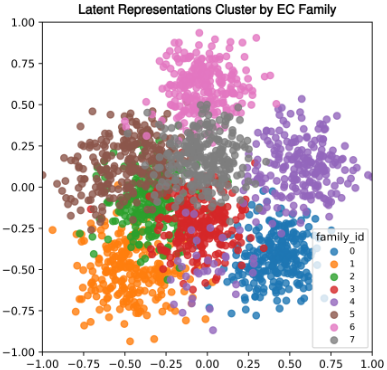
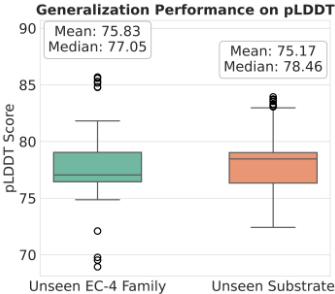
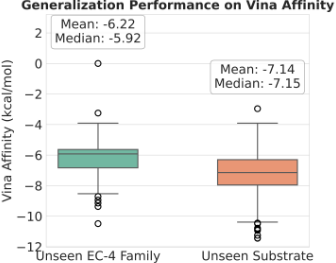
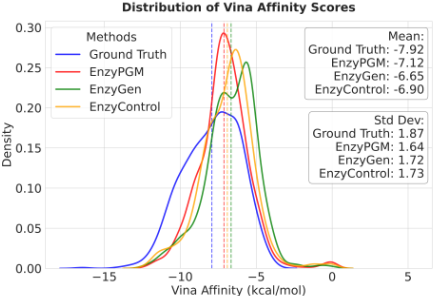
We provide additional t-SNE, generalization, and Vinadistribution analyses (Figure 4, 5, 6, and 7), showing that EnzyPGM learns function-aware representations and maintains stable substrate-specific binding performance.
Acknowledgements
Tianfan Fu is supported by Young Scientists Fund (C Class) of the National Natural Science Foundation of China (Grant No. 62506154), the Fundamental Research Funds for the Central Universities and Nanjing University International Collaboration Initiative (Grant No. 020214380129) and the "111 Center"(No. B26023).
Contribution Statement
Zefeng Lin, Zhihang Zhang, Weirong Zhu, and Tongchang Han contributed equally to this work. Zefeng Lin led the method design, implementation, experiments, and manuscript writing. Zhihang Zhang contributed to model development and analysis. Weirong Zhu and Tongchang Han contributed to dataset construction, evaluation, and visualization.
@inproceedings{ijcai2026p622,
  title     = {EnzyPGM: Pocket-conditioned Generative Model for Substrate-specific Enzyme Design},
  author    = {Lin, Zefeng and Zhang, Zhihang and Zhu, Weirong and Han, Tongchang and Fang, Xianyong and Fu, Tianfan and Xu, Xiaohua},
  booktitle = {Proceedings of the Thirty-Fifth International Joint Conference on
               Artificial Intelligence, {IJCAI-26}},
  publisher = {International Joint Conferences on Artificial Intelligence Organization},
  editor    = {Diego Calvanese},
  pages     = {5585--5593},
  year      = {2026},
  month     = {8},
  note      = {Main Track},
  doi       = {10.24963/ijcai.2026/622},
  url       = {https://doi.org/10.24963/ijcai.2026/622},
}
TY - CPAPER TI - EnzyPGM: Pocket-conditioned Generative Model for Substrate-specific Enzyme Design AU - Lin, Zefeng AU - Zhang, Zhihang AU - Zhu, Weirong AU - Han, Tongchang AU - Fang, Xianyong AU - Fu, Tianfan AU - Xu, Xiaohua T2 - Proceedings of the Thirty-Fifth International Joint Conference on Artificial Intelligence, IJCAI-26 PB - International Joint Conferences on Artificial Intelligence Organization PY - 2026 SP - 5585 EP - 5593 DO - 10.24963/ijcai.2026/622 UR - https://doi.org/10.24963/ijcai.2026/622 ER -Copied
Machine-readable versions of this paper, for tools and AI agents:





