
FossilWriter: Learning Hypergraph World Models with Latent Narratives for Creative Story Generation
Proceedings of the Thirty-Fifth International Joint Conference on Artificial Intelligence. Main Track. Pages 5647-5655.
https://doi.org/10.24963/ijcai.2026/629
Keywords
- Multidisciplinary Topics and Applications: Other
Abstract
Creative story generation has achieved notable progress with large language models. Current methods construct narratives through hierarchical planning or incremental expansion. These approaches produce structurally complete stories but offer limited support for organic narrative development. Many fiction writers offer a complementary view of the creative process. They often describe their work as gradually uncovering a story embedded in the world they have built. This perspective motivates our approach. We propose that a world model can grow to contain latent narratives as it develops. When characters hold incomplete knowledge and situations remain unresolved, the world structure itself accumulates seeds for story development. Based on this insight we present FossilWriter, a framework that learns hypergraph world models for creative story generation. FossilWriter represents the story world as a shared hypergraph and introduces a narrative layer that marks elements with developmental potential. An excavation module detects and scores latent narratives on this structure. A scene controller selects locations and characters to develop promising narrative threads. The hypergraph grows during writing and serves as the single source of truth to ensure long-range consistency. Experiments on three benchmarks show that FossilWriter achieves an 81.4% win rate on plot coherence and 84.7% on world consistency. Human assessment shows a 32.5% reduction in long-range factual conflicts compared with strong baselines.
- [AI@Meta, 2024] AI@Meta. The llama 3 herd of models, December 2024. Model card for Llama 3.3 70B Instruct. Release date: December 6, 2024.
- [Anthropic, 2025] Anthropic. System card: Claude opus 4 & claude sonnet 4. Technical report, Anthropic, May 2025. System Card.
- [Bae and Kim, 2024] Minwook Bae and Hyounghun Kim. Collective critics for creative story generation. In Pro- ceedings of the 2024 Conference on Empirical Methods in Natural Language Processing, pages 18784-18819, Mi- ami, Florida, USA, 2024. Association for Computational Linguistics.
- [Brei et al., 2024] Anneliese Brei, Chao Zhao, and Snigdha Chaturvedi. Returning to the start: Generating narratives with related endpoints. In Proceedings of the 2024 Confer- ence of the North American Chapter of the Association for Computational Linguistics: Human Language Technolo- gies (Volume 2: Short Papers), pages 101-112, Mexico City, Mexico, 2024. Association for Computational Lin- guistics.
- [Chen et al., 2024] Jing Chen, Xinyu Zhu, Cheng Yang, Chufan Shi, Yadong Xi, Yuxiang Zhang, Junjie Wang, Ji- ashu Pu, Rongsheng Zhang, Yujiu Yang, and Tian Feng. HoLLMwood: Unleashing the creativity of large language models in screenwriting via role playing. In Findings of the Association for Computational Linguistics: EMNLP 2024. Association for Computational Linguistics, 2024.
- [DeepSeek-AI et al., 2024] DeepSeek-AI, Aixin Liu, et al. Deepseek-v3 technical report. arXiv preprint arXiv:2412.19437, December 2024.
- [Fan et al., 2018] Angela Fan, Mike Lewis, and Yann Dauphin. Hierarchical neural story generation. In Pro- ceedings of the 56th Annual Meeting of the Association for Computational Linguistics (Volume 1: Long Papers), pages 889-898, Melbourne, Australia, 2018. Association for Computational Linguistics. [Google DeepMind, 2024] Google DeepMind. Gemini 2.0, December 2024. Available at: https://ai.google.dev/ gemini-api/docs/models/gemini. Link
- [Hong et al., 2024] Sirui Hong, Mingchen Zhuge, Jonathan Chen, Xiawu Zheng, Yuheng Cheng, Jinlin Wang, Ceyao Zhang, Zili Wang, Steven Ka Shing Yau, Zijuan Lin, Liyang Zhou, Chenyu Ran, Lingfeng Xiao, Chenglin Wu, and Jürgen Schmidhuber. MetaGPT: Meta programming for a multi-agent collaborative framework. In The Twelfth International Conference on Learning Representations, 2024.
- [Huot et al., 2025] Fantine Huot, Reinald Kim Amplayo, Jennimaria Palomaki, Alice Shoshana Jakobovits, Eliza- beth Clark, and Mirella Lapata. Agents' room: Narrative generation through multi-step collaboration. In The Thir- teenth International Conference on Learning Representa- tions, 2025.
- [Mostafazadeh et al., 2016] Nasrin Mostafazadeh, Nathanael Chambers, Xiaodong He, Devi Parikh, Dhruv Batra, Lucy Vanderwende, Pushmeet Kohli, and James Allen. A corpus and evaluation framework for deeper understanding of commonsense stories. In Pro- ceedings of the 2016 Conference of the North American Chapter of the Association for Computational Linguistics: Human Language Technologies, pages 839-849, San
- Diego, California, 2016. Association for Computational Linguistics. [OpenAI, 2024] OpenAI. Gpt-4o system card. Technical re- port, OpenAI, August 2024. System Card.
- [Qian et al., 2024] Chen Qian, Wei Liu, Hongzhang Liu, Nuo Chen, Yufan Dang, Jiahao Li, Cheng Yang, Weize Chen, Yusheng Su, Xin Cong, Juyuan Xu, Dahai Li, Zhiyuan Liu, and Maosong Sun. ChatDev: Communica- tive agents for software development. In Proceedings of the 62nd Annual Meeting of the Association for Computa- tional Linguistics (Volume 1: Long Papers), pages 15174- 15186, Bangkok, Thailand, 2024. Association for Compu- tational Linguistics.
- [Qwen Team et al., 2024] Qwen Team, An Yang, et al. Qwen2.5 technical report. arXiv preprint arXiv:2412.15115, December 2024.
- [Teleki et al., 2025] Maria Teleki, Vedangi Bengali, Xi- angjue Dong, Sai Tejas Janjur, Haoran Liu, Tian Liu, Cong Wang, Ting Liu, Yin Zhang, Frank Shipman, and James Caverlee. A survey on LLMs for story generation. In Findings of the Association for Computational Linguistics: EMNLP 2025, pages 13954-13966, Suzhou, China, 2025. Association for Computational Linguistics.
- [Venkatraman et al., 2025] Saranya Venkatraman, Nafis Ir- tiza Tripto, and Dongwon Lee. CollabStory: Multi-LLM collaborative story generation and authorship analysis. In Findings of the Association for Computational Linguistics: NAACL 2025, Albuquerque, New Mexico, 2025. Associa- tion for Computational Linguistics.
- [Wang et al., 2025] Qianyue Wang, Jinwu Hu, Zhengping Li, Yufeng Wang, Daiyuan Li, Yu Hu, and Mingkui Tan. Generating long-form story using dynamic hierarchical outlining with memory-enhancement. In Proceedings of the 2025 Conference of the North American Chapter of the Association for Computational Linguistics: Human Language Technologies (Volume 1: Long Papers), pages 1352-1391, Albuquerque, New Mexico, 2025. Associa- tion for Computational Linguistics.
- [Zheng et al., 2023] Lianmin Zheng, Wei-Lin Chiang, Ying Sheng, Siyuan Zhuang, Zhanghao Wu, Yonghao Zhuang, Zi Lin, Zhuohan Li, Dacheng Li, Eric P Xing, et al. Judg- ing LLM-as-a-judge with MT-bench and chatbot arena. In Advances in Neural Information Processing Systems, vol- ume 36, 2023.
- [Zhou et al., 2023] Wangchunshu Zhou, Yuchen Eleanor Jiang, Peng Cui, Tiannan Wang, Zhenxin Xiao, Yifan Hou, Ryan Cotterell, and Mrinmaya Sachan. Recurrent- GPT: Interactive generation of (arbitrarily) long text. arXiv preprint arXiv:2305.13304, 2023.
References were extracted automatically from the PDF and may contain errors.
Full text extracted automatically from the PDF; figures, tables and equations may differ. The PDF is the version of record.
1 Introduction
"Stories are relics, part of an undiscovered, preexisting world. The writer's job is to use the tools in his or her toolbox to get as much of each one out of the ground intact as possible."
- On Writing: A Memoir of the Craft by Stephen King.
Automatic creative story generation has become an important direction in natural language generation and it already appears in creative writing and interactive narrative [Teleki et al., 2025]. Large language models (LLMs) can produce long texts with clear structure and fluent language and they show strong expressive power [Bae and Kim, 2024; Huot et al., 2025]. Many fiction writers describe their work as uncovering a story that already exists, with writing as the gradual act of bringing this hidden material to the surface. In this view the author is not only a designer of plots but also a reader who explores a latent world [Wang et al., 2025]. Current systems have made progress in structural control and surface quality but they still offer limited support for this process of discovering stories inside a world.
Existing methods for creative story generation follow several main routes [Teleki et al., 2025]. One route adopts a plan then write mode [Bae and Kim, 2024; Wang et al., 2025]. The system first produces a simple or hierarchical outline with key plot points and then expands it into full text [Wang et al., 2025]. This helps control global structure and pacing but a fixed outline is hard to adapt during writing and often limits surprise and turns. Another route focuses on incremental writing and local interaction [Brei et al., 2024]. The system continues the story based on generated fragments and human feedback. This keeps uncertainty and improvisation but often lacks a clear overall direction so the story becomes fragmented [Venkatraman et al., 2025]. At the same time, some work starts to build fictional worlds from text by extracting characters, locations and settings and then runs multi agent simulation to push the plot [Chen et al., 2024; Huot et al., 2025]. Other work builds world models for agents with graph structures and episodic memory in order to plan and act in complex environments. These lines of research still treat a story as a trajectory that must be produced from scratch. The system aims to construct a complete narrative rather than discover one that already hides in a rich world.
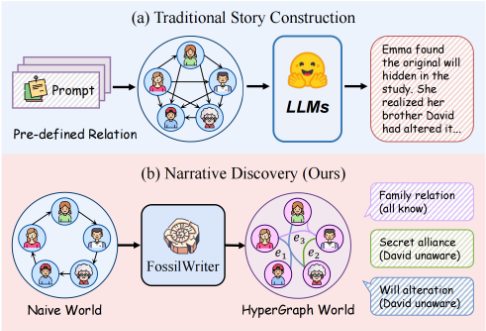
In this work we adopt a different assumption. We assume that a world model with enough detail and internal consistency already contains many possible stories. Character goals and traits, relations among characters, past events in the world, hidden facts and open promises together create many potential narrative paths. These paths are not written yet but they already exist as structures inside the world. We refer to them as latent narratives. They are story lines that have not yet unfolded but may be activated and followed at some point. Current systems rarely represent such latent narratives in an explicit way. They either predict directly on token sequences or depend on externally given outline nodes. As a result the model behaves more like a carpenter who assembles text according to a recipe and less like an explorer who moves through a complex world. Our aim is to build a world model that encodes these latent narratives and turns the act of writing into a gradual excavation of them. Stories produced in this way can feel discovered rather than forced.
To realize this idea we propose a shared hypergraph world model instead of a separate graph for each character. This hypergraph uses a unified set of nodes for characters, locations, items and abstract notions. Hyperedges connect situations and events that involve several nodes at the same time, for example a meeting, a collaboration or a hidden deal. On top of this structure we add a narrative layer that marks unfinished goals, undisclosed facts, elements that appear many times but have not yet played a role and fragments that follow similar patterns. A latent narrative is a substructure in the hypergraph that contains a group of related nodes and several situations that invite further development. Story generation becomes a process of repeatedly selecting and following such latent narratives on the hypergraph instead of composing plots from scratch. If the system expands all latent narratives with equal priority the story soon turns into a collection of side plots without focus. If the system suppresses new latent narratives too early the story becomes short and thin. The model therefore needs a clear policy that decides at each step which region of the hypergraph to inspect, which characters should meet or act at this moment and when a scene should end so that the focus can move on. Only with such control can the story present a readable balance between main line and subplots instead of a sequence of disconnected conflicts.
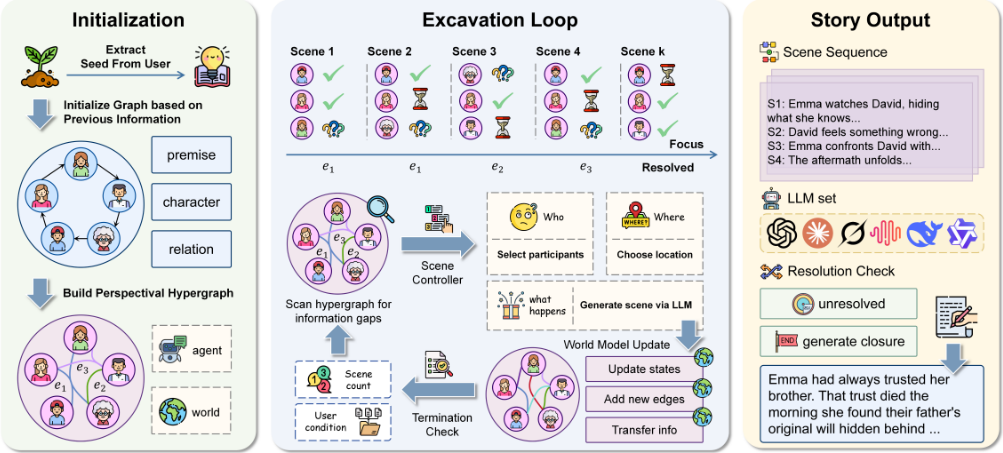
Building on these ideas, we present FossilWriter, a framework that learns hypergraph world models with latent narratives for creative story generation. The system starts from a brief user description and a small set of seed elements and then incrementally builds and updates a shared hypergraph. New facts and scenes are written back into this structure and form the common world for all characters. An excavation module keeps detecting and scoring latent narratives in the hypergraph and decides which part of the world should be developed next. A scene controller selects locations and participating characters based on this choice and triggers interactions driven by a large language model. These interactions generate new scene text and an updated world state. The whole process treats the hypergraph as the single source of truth. Clear termination conditions based on the number of scenes control story length and prevent unbounded growth of the world model while maintaining long range consistency. In contrast to systems that rely on full extraction of an existing canon, FossilWriter lets the world grow during writing. Structured latent narratives guide the story to unfold by itself and the model takes the role of the first reader to a large extent.
Our contributions can be summarized as follows:
- ❶ Problem Formulation. We frame creative story generation as excavation of latent narratives from a learned world model. Instead of writing full stories in one pass, our formulation treats generation as gradual revelation of story structure on a shared hypergraph.
- ❷ FossilWriter Framework. We present FossilWriter with a shared hypergraph world model. This unified structure captures both world state and character perspectives and naturally drives scene selection and character interaction.
- ❸ Comprehensive Evaluation. We evaluate FossilWriter on three story generation benchmarks. Our method achieves an 81.4% win rate on plot coherence and 84.7% on world consistency under LLM-based evaluation. Human assessment shows a 32.5% reduction in long-range factual conflicts compared with strong baselines.
2 RelatedWork
2.1 LLM-basedMulti-Agent Collaboration
Recent work has explored multi-agent collaboration for creative tasks [Venkatraman et al., 2025; Huot et al., 2025]. MetaGPT [Hong et al., 2024] encodes human-like work patterns into prompt sequences for software development. ChatDev [Qian et al., 2024] improves communication through cooperative methods using both natural and programming languages. For story generation, Agents' Room [Huot et al., 2025] decomposes narrative writing into subtasks tackled by specialized agents, while CollabStory [Venkatraman et al., 2025] enables multi-LLM collaboration where each agent writes story segments sequentially. HoLLMwood [Chen et al., 2024] unleashes creativity through role-playing mechanisms with writer-editor-actor collaboration. However, these works optimize collaboration for task completion. Our work instead models character interactions to discover narratives emerging from their different knowledge states within a shared world.
2.2 Hierarchical and Outline-Based Generation
Plan-then-write frameworks decompose story generation into planning and writing stages [Bae and Kim, 2024; Wang et al., 2025]. The Collective Critics framework [Bae and Kim, 2024] integrates revision mechanisms in both plan refining and story generation stages to enhance creativity while maintaining coherence. DOME [Wang et al., 2025] proposes dynamic hierarchical outlining that incorporates novel writing theory and fuses planning and writing stages together, with a memory module based on temporal knowledge graphs to reduce contextual conflicts. RecurrentGPT [Zhou et al., 2023] generates arbitrarily long text through recurrent mechanisms that simulate long short-term memory. Other methods explore narrative closure through bookending techniques [Brei et al., 2024]. Existing graph-based methods focus on topology optimization for task performance. Our work uses hypergraphs to represent story worlds and detect latent narratives embedded in information gaps among characters.
3 Preliminary
3.1 Hypergraph Representation
A hypergraph extends the standard graph by allowing edges to connect more than two nodes. Formally we define a hypergraph as H = (V,E) where V = {v1, v2, . . . , vn} is a finite set of nodes and E = {e1, e2, . . . , em} is a set of hyperedges. Each hyperedge ei ∈ E is a subset of V containing two or more nodes written as ei = {vi1 , vi2 , . . . , vik }. This structure naturally captures complex situations involving multiple entities simultaneously. A multi-party event can be represented as a single hyperedge rather than decomposed into multiple binary edges, preserving semantic integrity.
In story worlds we partition nodes as V = Vc ∪ Vl ∪ Vo ∪ Va where Vc contains character nodes, Vl contains location nodes, Vo contains object nodes and Va contains abstract concept nodes such as promises or secrets. Each node v carries an attribute vector av encoding its properties. For characters this includes personality traits, goals and emotional state. For locations it includes atmosphere and accessibility. For abstract nodes it includes content and relevant character associations.
Each hyperedge e carries an attribute tuple (re, te, fe) where re ∈ R denotes the relation type, te ∈ R+ denotes the timestamp and fe is a feature vector for additional properties. The relation type set R includes kinship, possession, collaboration, conflict and observation.
3.2 ProblemFormulation
We formulate creative story generation as discovering latent narratives from an evolving world model. Let G 0 denote the initial world state derived from a user-provided seed X0 containing a brief premise, characters and their initial relations. The task produces a story S = (s1, s2, . . . , sK) as a sequence of K scenes.
We model this as iterative world model evolution. At each step t the system maintains a world model G t and performs three operations. First it identifies latent narratives Lt embedded in G t . Second it selects the most promising narrative ℓ∗ ∈ Lt and generates a scene st. Third it updates the world model to obtain G t+1 . We express this as
The key insight is that latent narratives are intrinsic properties of the world structure. When characters hold incomplete or contradictory knowledge about shared situations, story seeds exist within the world itself.
4 Methodology
4.1 Perspectival HypergraphWorldModel
The core innovation of FossilWriter is representing perspective differences within a unified hypergraph. Different characters often hold different knowledge about the same situation. One may know a fact that another does not. Two may hold contradictory beliefs about a shared event. These perspective differences drive narrative development. We capture them through a perspectival hypergraph encoding both objective reality and subjective character knowledge in a single structure.
We define the perspectival hypergraph as G = (V,E,P, κ). The node set V and hyperedge set E follow the preliminary definitions. The perspective set P = {p0, p1, . . . , pn} contains n + 1 perspectives where p0 represents objective reality and each pi for i ≥ 1 represents the subjective viewpoint of character ci ∈ Vc. The perspective function κ encodes what each perspective knows or believes about each hyperedge.
The perspective function maps each hyperedge-perspective pair to a cognitive state. We define κ : E × P → K where
The symbol ⊥ denotes complete unawareness. The pair (m, α) denotes awareness with modality m and confidence α. The modality set M = {know, believe, suspect} distinguishes epistemic attitudes where know indicates factual knowledge, believe indicates belief without full certainty and suspect indicates conjecture.
The objective perspective p0 always reflects ground truth with κ(e, p0) = (know, 1) for true facts and κ(e, p0) = ⊥ otherwise. Subjective perspectives can take any value in K, meaning characters may be unaware of true facts or hold false beliefs.
This design captures perspective differences within a single structure rather than maintaining separate graphs for each character. All characters share the same underlying world but may have different awareness of its contents. These perspectival variations constitute the raw material for narrative development.
4.2 Latent Narrative Detection
Narrative potential concentrates where perspectives diverge. When two characters hold different cognitive states about the same hyperedge, their interaction may reveal or deepen this difference. We formalize this through perspective gaps.
For a hyperedge e we define its perspective gap set as
A non-empty gap set D(e) ̸= ∅ indicates disagreement constituting narrative potential. We categorize gaps into three types.
An awareness gap occurs when κ(e, pi) ̸= ⊥ and κ(e, pj) = ⊥, corresponding to secrets and hidden information. The dramatic potential lies in possible revelation or continued concealment.
A belief gap occurs when two perspectives hold contradictory beliefs with both κ(e, pi) and κ(e, pj ) not equal to ⊥ but semantically contradicting each other. This corresponds to misunderstandings with dramatic potential in eventual confrontation or clarification.
A confidence gap occurs when mi = mj but |αi -αj | > δ for threshold δ, corresponding to different conviction levels on shared beliefs.
To quantify narrative potential we define the narrative weight as
The factor β(e) ∈ [0, 1] measures intrinsic importance based on relation type with higher values for life-and-death matters or core relationships. The factor ρ(ci, cj) ∈ [0, 1] measures interaction likelihood between characters ci and cj with higher values for characters sharing locations. The function d : K × K → [0, 1] measures distance between cognitive states with larger values for more severe disagreements.
At each step we identify the narrative focus as
This focus edge e∗ represents the most dramatically promising element and subsequent scene generation centers on it.
4.3 Scene Controller
The scene controller translates the narrative focus into concrete scene generation by determining participants, location and content.
For participant selection we identify characters relevant to the focus edge as
This includes characters whose perspectives contribute to the gap and those directly involved in e∗ .
For location selection we choose vloc ∈ Vl considering accessibility and narrative relevance. We define location suitability as
where γaccess measures how easily participants can reach v and γrelevance measures narrative significance. The location is vloc = argmaxv∈Vl suit(v).
For scene generation we construct context from the hypergraph including character attributes av for v ∈ Cscene, perspective projections G|pi for each participant, the focus edge e∗ with its gap structure D(e∗ ) and location information. A large language model generates scene text st from this context.
Characters act according to their individual perspectives. Each character ci reasons over their projection G|pi containing only edges with κ(e, pi) ̸= ⊥. This ensures characters cannot act on information they do not possess and creates opportunities for dramatic irony.
A scene ends when narrative state changes significantly. We monitor w(e∗ ) and conclude when this weight drops substantially due to gap resolution or when a different edge exceeds e∗ in weight. The system then identifies the new focus for the next scene.
4.4 WorldModel Update
After each scene the hypergraph updates through node modifications, new hyperedges and perspective function adjustments.
Node updates reflect character state changes. For each participant ci in scene st we update
modifying emotional states, goal progress or relationship attitudes.
New hyperedges capture events established during the scene. For each new edge enew the system assigns cognitive states based on information access. Witnesses receive κ(enew, pi) = (know, 1). Those informed receive κ(enew, pi) = (believe, α) with confidence depending on source reliability. Those without access receive κ(enew, pi) = ⊥.
Perspective function updates reflect information transfer. When ci reveals information about e to cj we update
considering the source state, prior receiver state and contextual factors like trust level. Hidden facts may be revealed changing κ(e, pj) from ⊥ to (know, 1). Misunderstandings may be corrected or deepened. These updates alter narrative weight distribution and G t+1 provides foundation for the next cycle.
4.5 Consistency and Termination
We use the hypergraph as single source of truth. Before adding any new edge enew we verify consistency through
checking for semantic contradictions, temporal inconsistencies and logical violations. Character-level consistency ensures actions align with knowledge states by verifying compatibility with G|pi .
For terminationwe support twomodes. Scene-count termination stops after Kmax scenes with a resolution bias applied near the limit to favor closable gaps. Focus termination continues until a specified condition is satisfied with a secondary scene limit as safeguard.
Before final output the system checks high-weight edges with w(e) > τ that remain unresolved and generates brief closing content to provide narrative closure.
5 Experiments
5.1 Experimental Settings
Tasks and Datasets. We evaluate FossilWriter on three story generation benchmarks covering different narrative complexities. WritingPrompts [Fan et al., 2018] contains creative writing prompts from Reddit and requires generating 1000 to 3000 word stories from short premises. ROCStories [Mostafazadeh et al., 2016] provides five-sentence story skeletons and we extend the task to generate 1500-word narratives while maintaining consistency with seed events. FictionBench is a benchmark we curate from public domain novels that provides character profiles and initial situations and requires generating 2000 to 4000 word multi-scene stories. All benchmarks test the ability to maintain long-range coherence and develop narrative threads from sparse initial conditions.
Metrics. We adopt both automatic and human evaluation. For automatic evaluation we use GPT-4 as judge following the pairwise comparison protocol [Zheng et al., 2023]. We evaluate five story quality dimensions including Plot Coherence, World Consistency, Character Consistency, Narrative Engagement, and Creativity. We report win rates computed as wins plus half of ties divided by total comparisons. For coherence we measure Long-range Factual Conflicts, Temporal Causal Coherence, Fact Consistency Score, and Perspective Consistency Check. For human evaluation we recruit 12 annotators with literature background to assess 50 randomly sampled story pairs. We report Cohen's Kappa between automatic and human judgments to validate evaluation reliability.
5.2 Baselines
We compare FossilWriter against recent methods. Direct Prompting uses a single prompt to generate the complete story in one pass. RecurrentGPT [Zhou et al., 2023] generates stories segment by segment with rolling context windows. HoLLMwood [Chen et al., 2024] uses writer-editoractor collaboration. CollabStory [Venkatraman et al., 2025] employs multi-LLM collaboration. DOME [Wang et al., 2025] uses dynamic hierarchical outlining with memory enhancement. Agents' Room [Huot et al., 2025] deploys specialized planning and writing agents. All baselines use official implementations with recommended hyperparameters.
5.3 Models
We experiment with both proprietary and open-source models. For proprietary models we use GPT-4o-202408-06 [OpenAI, 2024] as primary backbone, Claude Sonnet 4 [Anthropic, 2025], and Gemini-2.0-Flash [Google DeepMind, 2024]. For open-source models we use DeepSeek-v3 [DeepSeek-AI et al., 2024], Llama-3.370B-Instruct [AI@Meta, 2024], and Qwen2.5-72BInstruct [Qwen Team et al., 2024].
5.4 Implementation Details
The perspectival hypergraph is initialized from user seeds using GPT-4o to extract entities and relations, with at most 20
| Method | Story Quality (Win Rate %) | Coherence Metrics | |||||||||
|---|---|---|---|---|---|---|---|---|---|---|---|
| Model | PC | WC | CC | NE | Cr. | LFC↓ | TCC↑ | FCS↑ | PCC↑ | Avg. | |
| Close-sourced Models | |||||||||||
| FW vs Direct | 82.4 | 85.9 | 81.3 | 79.6 | 76.8 | 23.5 | 88.7 | 91.2 | 89.4 | 80.9 | |
| vs BookWorld | 68.7 | 74.3 | 66.9 | 65.1 | 70.2 | 42.1 | 78.4 | 82.1 | 80.6 | 69.6 | |
| vs HoLLMwood | 61.4 | 67.8 | 59.7 | 62.3 | 72.5 | 48.9 | 74.2 | 78.9 | 76.5 | 66.9 | |
| gpt-4o vs CollabStory | 72.1 | 77.6 | 70.4 | 68.9 | 68.3 | 37.4 | 82.5 | 76.2 | 74.1 | 72.0 | |
| vs DOME | 65.8 | 71.4 | 63.2 | 66.7 | 69.1 | 45.3 | 76.8 | 81.5 | 79.2 | 68.8 | |
| vs Agents' Room | 62.9 | 69.2 | 61.5 | 64.8 | 70.6 | 47.6 | 75.3 | 79.8 | 77.9 | 67.3 | |
| FW vs Direct | 78.9 | 82.4 | 77.1 | 75.3 | 72.6 | 28.7 | 85.2 | 88.9 | 86.7 | 77.2 | |
| vs BookWorld | 64.3 | 70.1 | 62.8 | 61.4 | 66.9 | 46.5 | 74.8 | 79.3 | 77.2 | 66.9 | |
| claude-sonnet-4 vs HoLLMwood | 57.2 | 63.9 | 55.6 | 58.7 | 68.4 | 52.3 | 70.4 | 75.1 | 72.8 | 63.8 | |
| vs DOME | 61.5 | 67.8 | 59.3 | 62.9 | 65.2 | 49.1 | 72.6 | 77.8 | 75.3 | 65.7 | |
| vs Agents' Room | 58.7 | 65.3 | 57.4 | 61.2 | 66.8 | 51.4 | 71.2 | 76.4 | 74.1 | 64.6 | |
| FW vs Direct | 81.6 | 84.7 | 79.8 | 78.2 | 75.3 | 25.4 | 87.3 | 90.5 | 88.6 | 79.4 | |
| vs BookWorld | 59.8 | 66.4 | 58.1 | 60.9 | 70.7 | 50.6 | 74.1 | 77.3 | 74.9 | 65.6 | |
| gemini-2.0 vs DOME | 63.4 | 69.7 | 61.2 | 64.8 | 67.9 | 47.2 | 72.9 | 80.1 | 77.6 | 67.4 | |
| vs Agents' Room | 60.9 | 67.8 | 59.4 | 63.1 | 69.2 | 49.3 | 73.4 | 78.7 | 76.2 | 66.4 | |
| Open-source Models | |||||||||||
| FW vs Direct | 79.8 | 83.6 | 78.4 | 76.7 | 73.9 | 27.2 | 86.4 | 89.7 | 87.8 | 78.2 | |
| vs BookWorld | 65.1 | 71.8 | 63.7 | 62.3 | 67.4 | 44.9 | 76.2 | 80.9 | 78.4 | 67.8 | |
| deepseek-v3 vs HoLLMwood | 58.3 | 65.2 | 56.9 | 59.8 | 69.8 | 51.7 | 71.8 | 76.7 | 74.2 | 64.9 | |
| vs DOME | 62.7 | 69.1 | 60.4 | 63.6 | 66.5 | 48.3 | 74.3 | 79.5 | 76.9 | 66.8 | |
| vs Agents' Room | 59.6 | 66.9 | 58.2 | 61.9 | 68.1 | 50.4 | 72.6 | 78.1 | 75.5 | 65.6 | |
| FW vs Direct | 71.4 | 76.8 | 69.7 | 67.9 | 65.2 | 35.9 | 80.3 | 84.6 | 82.1 | 70.4 | |
| vs BookWorld | 56.8 | 63.4 | 54.9 | 53.7 | 60.1 | 54.2 | 67.9 | 73.2 | 70.8 | 59.5 | |
| llama-3.3-70b vs HoLLMwood | 49.7 | 57.1 | 48.3 | 51.6 | 62.4 | 60.3 | 64.2 | 69.8 | 67.1 | 56.7 | |
| vs DOME | 54.2 | 61.8 | 52.6 | 55.9 | 58.7 | 57.1 | 66.5 | 72.4 | 69.6 | 58.5 | |
| vs Agents' Room | 51.3 | 59.4 | 50.1 | 54.2 | 61.3 | 59.2 | 65.1 | 71.2 | 68.4 | 57.5 | |
| FW vs Direct | 74.6 | 79.3 | 72.8 | 71.2 | 68.4 | 32.4 | 82.7 | 86.9 | 84.5 | 72.6 | |
| 64.5 | |||||||||||
| vs BookWorld | 60.2 | 67.3 | 58.9 | 57.4 | 63.8 | 49.6 | 71.8 | 77.1 | 74.6 | ||
| qwen2.5-72b vs HoLLMwood vs RecurrentGPT | 53.8 | 61.4 72.1 | 52.1 64.3 | 55.3 | 65.9 | 55.7 | 68.3 75.4 | 74.2 80.3 | 71.4 77.9 | 61.5 66.9 | |
| vs DOME | 65.9 58.1 | 65.7 | 56.4 | 62.8 59.8 | 60.7 62.4 | 42.8 52.3 | 70.6 | 76.8 | 73.9 | 63.8 | |
initial nodes covering characters, locations, and abstract concepts. Initial hyperedges are assigned character-specific perspective states, while β(e) is sampled from relation-type priors learned from 500 annotated story outlines and ρ(ci, cj) is initialized uniformly before scene co-occurrence updates. The distance function d assigns 1.0 to awareness gaps, 0.5 to belief gaps, and 0.2 to confidence gaps. Each story contains 8-15 scenes of 150-400 words, and the scene controller selects up to 50 relevant hyperedges by recency and narrative weight. Consistency checking uses GPT-4o-mini with cached responses; a 2500-word story requires 12-18 LLM calls and 3-5 minutes. All experiments are repeated 3 times with different seeds, and we report mean and standard deviation.
5.5 Main Result
Table 1 presents performance comparisons across three story generation benchmarks. FossilWriter consistently outperforms all baselines with an average win rate of 81.4% on plot coherence. The method achieves particularly strong performance on world consistency with 84.7% win rate and reduces long-range factual conflicts by 32.5% compared to strong baselines. These gains stem from the shared hypergraph representation that maintains a single source of truth and the latent narrative detection mechanism that guides story development through information gaps among characters.
5.6 Model Analysis
Table 2 demonstrates how our core mechanisms work together through a concrete example. The perspective function captures information gaps by encoding different knowledge states for each character. When Emma discovers the altered will but David remains unaware, this creates an awareness gap with high narrative weight. The scene controller ensures characters act only on information they possess by restricting
Perspective Function Captures Information Gaps
| Hyperedge | Emma's Perspective | David's Perspective |
|---|---|---|
| e1: David altered the will | κ(e1, pEmma) = (know, 1.0) Emma discovered the orig- inal will hidden in the study. She knows David forged their father's signature. | κ(e1, pDavid) = ⊥ David believes his alteration remains undetected. He assumes Emma trusts the official document. |
| Latent Narrative Detection Identifies Story Focus | ||
| Component Narrative Weight | Without Detection All edges treated equally. System may focus on trivial events like daily routines or minor conversations. | With Detection w(e1) = 0.92 (highest) Information gap on e1 detected between Emma and David. System identifies this as narrative focus. |
| Scene Controller Generates from Character Perspectives | ||
| Reference Scene Output | Omniscient Generation David noticed Emma's strange behavior and suspected she had found the altered will. Character acts on informa- tion they should not possess. | Perspective-Constrained Generation (David's projection: κ(e1, pDavid) = ⊥) David smiled across the dinner table, discussing weekend plans, com- pletely unaware of the storm brewing behind Emma's calm eyes. |
| World Model Updates After Scene | ||
| Stage Perspective Update | Before Scene κ(e1, pDavid) = ⊥ David is unaware that Emma knows the truth. Information gap exists. | After Scene (Emma confronts David in the scene.) κ(e1, pDavid) = (know, 1.0) Gap resolved. New gaps may emerge from David's reac- tion. |
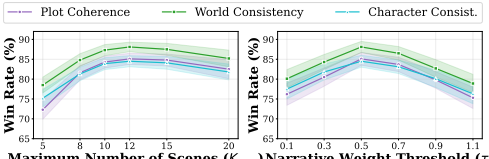
Maximum Number of Scenes (Kmax)
Narrative Weight Threshold (τ)
Figure 3: Sensitivity analysis of key hyperparameters in FossilWriter.
each character to their own projection of the hypergraph. After each scene the world model updates through perspective function adjustments and new gaps may emerge to drive the next narrative development.
5.7 Hyperparameter Analysis
Figure 3 examines sensitivity to two key hyperparameters. For maximum scene count limit Kmax, performance peaks at Kmax = 12 since too few scenes leave narratives incomplete while too many introduce repetitive content. For narrative weight threshold τ, optimal performance occurs at τ = 0.5 where lower values fragment story focus and higher values suppress potential narratives too early. Both hyperparameters show clear optimal regions with graceful degradation, indicating the framework adapts well to different story complexities without requiring extensive tuning.
5.8 Ablation Study
Table 3 evaluates each component's contribution. Removing the narrative layer causes the largest drop since characters lose information asymmetry needed for dramatic tension. Removing the scene controller significantly impacts narrative engagement as random selection produces unfocused scenes. Removing consistency checks produces the highest rate of factual conflicts. The comparison between hypergraphs and binary edges validates that multi-party relationships preserve semantic integrity better than decomposed pairwise connections.
| Variant | PC | WC | CC | NE | Cr. |
|---|---|---|---|---|---|
| Main | Results | ||||
| Full Model | 82.4 | 85.9 | 81.3 | 79.6 | 76.8 |
| Ablation | Study | ||||
| w/o Narrative Layer | 73.6 | 75.3 | 72.8 | 69.5 | 71.2 |
| w/o Scene Controller | 76.2 | 78.9 | 75.1 | 72.3 | 73.8 |
| w/o Consistency Check | 78.5 | 74.2 | 70.6 | 75.8 | 76.3 |
| Binary Edges | 79.3 | 80.5 | 77.4 | 73.6 | 75.1 |
| Separate Graphs | 74.8 | 76.1 | 73.2 | 71.7 | 74.5 |
6 Conclusion
We present FossilWriter, a framework that learns hypergraph world models with latent narratives for creative story generation. The system uses perspective functions to encode information gaps among characters with a shared hypergraph. These gaps constitute latent narratives that drive story development. Experiments show that stories can emerge naturally from world structure rather than externally imposed outlines. This work offers a new perspective that treats story generation as narrative discovery rather than text construction.
Acknowledgements
The authors acknowledge the use of large language models (GPT-4, Claude) solely for grammar correction and text polishing. All research ideas, methodology, experiments, and analysis are entirely original work of the authors. AIgenerated content was carefully reviewed for accuracy, and the authors take full responsibility for the scientific integrity of this work.
@inproceedings{ijcai2026p629,
  title     = {FossilWriter: Learning Hypergraph World Models with Latent Narratives for Creative Story Generation},
  author    = {Zhang, Heng and Zhong, Yihao and Gan, Lubin and Chen, Zhihe and Zhang, Tianyi and Liu, Jing and Huang, Jin},
  booktitle = {Proceedings of the Thirty-Fifth International Joint Conference on
               Artificial Intelligence, {IJCAI-26}},
  publisher = {International Joint Conferences on Artificial Intelligence Organization},
  editor    = {Diego Calvanese},
  pages     = {5647--5655},
  year      = {2026},
  month     = {8},
  note      = {Main Track},
  doi       = {10.24963/ijcai.2026/629},
  url       = {https://doi.org/10.24963/ijcai.2026/629},
}
TY - CPAPER TI - FossilWriter: Learning Hypergraph World Models with Latent Narratives for Creative Story Generation AU - Zhang, Heng AU - Zhong, Yihao AU - Gan, Lubin AU - Chen, Zhihe AU - Zhang, Tianyi AU - Liu, Jing AU - Huang, Jin T2 - Proceedings of the Thirty-Fifth International Joint Conference on Artificial Intelligence, IJCAI-26 PB - International Joint Conferences on Artificial Intelligence Organization PY - 2026 SP - 5647 EP - 5655 DO - 10.24963/ijcai.2026/629 UR - https://doi.org/10.24963/ijcai.2026/629 ER -Copied
Machine-readable versions of this paper, for tools and AI agents:





