
EvoThink: Evolving Thinking in Large Reasoning Models via Self-Pruning and Aha-Moment Preference Optimization
Proceedings of the Thirty-Fifth International Joint Conference on Artificial Intelligence. Main Track. Pages 5693-5701.
https://doi.org/10.24963/ijcai.2026/634
Keywords
- Natural Language Processing: Language models
- Natural Language Processing: Applications
Abstract
Large Reasoning Models (LRMs) often suffer from overthinking due to redundant verification steps. Existing approaches for mitigating overthinking, such as fast-slow thinking switching and reasoning trajectory compression, fail to make a fine-grained distinction between beneficial and redundant steps within the LRM's reasoning process, and may thus impair reasoning capability in their pursuit of efficiency. To simultaneously improve reasoning efficiency and capability, we propose EvoThink, a framework that reduces redundant verification and encourages the exploration of new reasoning paths. EvoThink comprises two key components: Self-Pruning Training (SPT), an unsupervised method that iteratively prunes redundant reasoning steps and self-trains on the concise trajectories; and Aha-Moment Preference Optimization (AMPO), which, inspired by genetic algorithms, identifies valuable failed reasoning attempts, synthesizes from-wrong-to-right aha-moment data, and optimizes the model to internalize this reasoning pattern. Extensive evaluations across mathematical reasoning and code generation benchmarks demonstrate that EvoThink not only substantially reduces inference-time token usage but also improves the reasoning capability of LRMs.
- [Aytes et al., 2025] Simon A Aytes, Jinheon Baek, and Sung Ju Hwang. Sketch-of-thought: Efficient LLM rea- soning with adaptive cognitive-inspired sketching. In Pro- ceedings of the 2025 Conference on Empirical Methods in Natural Language Processing, pages 24296-24320, 2025.
- [Chen et al., 2024] Xingyu Chen, Jiahao Xu, Tian Liang, Zhiwei He, Jianhui Pang, Dian Yu, Linfeng Song, Qiuzhi Liu, Mengfei Zhou, Zhuosheng Zhang, et al. Do not think that much for 2+ 3=? on the overthinking of o1-like llms. arXiv preprint arXiv:2412.21187, 2024.
- [Chen et al., 2025] Weize Chen, Jiarui Yuan, Tailin Jin, Ning Ding, Huimin Chen, Zhiyuan Liu, and Maosong Sun. The overthinker's DIET: Cutting token calories with DIfficulty-aware training. In The Thirty-ninth Annual Con- ference on Neural Information Processing Systems, 2025.
- [Cheng et al., 2025a] Xiaoxue Cheng, Junyi Li, Zhenduo Zhang, Xinyu Tang, Xin Zhao, XinYu KONG, and Zhiqiang Zhang. Incentivizing dual process thinking for efficient large language model reasoning. In The Thirty- ninth Annual Conference on Neural Information Process- ing Systems, 2025.
- [Cheng et al., 2025b] Zhengxiang Cheng, Dongping Chen, Mingyang Fu, and Tianyi Zhou. Optimizing length compression in large reasoning models. arXiv preprint arXiv:2506.14755, 2025.
- [Cuadron et al., 2025] Alejandro Cuadron, Dacheng Li, Wenjie Ma, Xingyao Wang, Yichuan Wang, Siyuan Zhuang, Shu Liu, Luis Gaspar Schroeder, Tian Xia, Huanzhi Mao, et al. The danger of overthinking: Examin- ing the reasoning-action dilemma in agentic tasks. arXiv preprint arXiv:2502.08235, 2025.
- [Guo et al., 2025] Daya Guo, Dejian Yang, Haowei Zhang, Junxiao Song, Ruoyu Zhang, Runxin Xu, Qihao Zhu, Shi- rong Ma, Peiyi Wang, Xiao Bi, et al. Deepseek-r1: In- centivizing reasoning capability in llms via reinforcement learning. arXiv preprint arXiv:2501.12948, 2025.
- [Han et al., 2025] Tingxu Han, Zhenting Wang, Chunrong Fang, Shiyu Zhao, Shiqing Ma, and Zhenyu Chen. Token- budget-aware llm reasoning. In Findings of the Associ- ation for Computational Linguistics: ACL 2025, pages 24842-24855, 2025.
- [Hendrycks et al., 2021] Dan Hendrycks, Collin Burns, Saurav Kadavath, Akul Arora, Steven Basart, Eric Tang, Dawn Song, and Jacob Steinhardt. Measuring mathemat- ical problem solving with the math dataset. In Proceed- ings of the Neural Information Processing Systems Track on Datasets and Benchmarks, volume 1, 2021.
- [Hou et al., 2025] Bairu Hou, Yang Zhang, Jiabao Ji, Yu- jian Liu, Kaizhi Qian, Jacob Andreas, and Shiyu Chang. Thinkprune: Pruning long chain-of-thought of llms via re- inforcement learning. arXiv preprint arXiv:2504.01296, 2025.
- [Li et al., 2023] Rongao Li, Jie Fu, Bo-Wen Zhang, Tao Huang, Zhihong Sun, Chen Lyu, Guang Liu, Zhi Jin, and Ge Li. Taco: Topics in algorithmic code generation dataset. arXiv preprint arXiv:2312.14852, 2023.
- [Liang et al., 2025] Guosheng Liang, Longguang Zhong, Ziyi Yang, and Xiaojun Quan. ThinkSwitcher: When to think hard, when to think fast. In Findings of the Associ- ation for Computational Linguistics: EMNLP 2025, pages 5185-5201, 2025.
- [Luo et al., 2025a] Haotian Luo, Li Shen, Haiying He, Yibo Wang, Shiwei Liu, Wei Li, Naiqiang Tan, Xiaochun Cao, and Dacheng Tao. O1-pruner: Length-harmonizing fine- tuning for o1-like reasoning pruning. arXiv preprint arXiv:2501.12570, 2025.
- [Luo et al., 2025b] Michael Luo, Sijun Tan, Justin Wong, Xiaoxiang Shi, William Y. Tang, Manan Roongta, Colin Cai, Jeffrey Luo, Li Erran Li, Raluca Ada Popa, and Ion Stoica. Deepscaler: Sur- passing o1-preview with a 1.5b model by scaling rl. https://pretty-radio-b75.notion.site/DeepScaleR- Surpassing-O1-Preview-with-a-1-5B-Model-by-Scaling- RL-19681902c1468005bed8ca303013a4e2, 2025. Notion Blog. Ma et al., 2025] Link
- Wenjie Ma, Jingxuan He, Charlie Snell, Tyler Griggs, Sewon Min, and Matei Zaharia. Reasoning models can be effective without thinking. arXiv preprint arXiv:2504.09858, 2025.
- [Muennighoff et al., 2025] Niklas Muennighoff, Zitong Yang, Weijia Shi, Xiang Lisa Li, Li Fei-Fei, Hannaneh Hajishirzi, Luke Zettlemoyer, Percy Liang, Emmanuel Candès, and Tatsunori B Hashimoto. s1: Simple test-time scaling. In Proceedings of the 2025 Conference on Empirical Methods in Natural Language Processing, pages 20286-20332, 2025.
- [Pan et al., 2024] Jiabao Pan, Yan Zhang, Chen Zhang, Zuozhu Liu, Hongwei Wang, and Haizhou Li. DynaThink: Fast or slow? a dynamic decision-making framework for large language models. In Proceedings of the 2024 Con- ference on Empirical Methods in Natural Language Pro- cessing, pages 14686-14695, 2024.
- [Rafailov et al., 2023] Rafael Rafailov, Archit Sharma, Eric Mitchell, Christopher D Manning, Stefano Ermon, and Chelsea Finn. Direct preference optimization: Your lan- guage model is secretly a reward model. Advances in neural information processing systems, 36:53728-53741, 2023.
- [Shen et al., 2025] Yi Shen, Jian Zhang, Jieyun Huang, Shuming Shi, Wenjing Zhang, Jiangze Yan, Ning Wang, Kai Wang, Zhaoxiang Liu, and Shiguo Lian. DAST: Difficulty-adaptive slow-thinking for large reasoning mod- els. In Proceedings of the 2025 Conference on Empirical Methods in Natural Language Processing: Industry Track, pages 2322-2331, 2025.
- [Sheng et al., 2025] Guangming Sheng, Chi Zhang, Zil- ingfeng Ye, Xibin Wu, Wang Zhang, Ru Zhang, Yanghua Peng, Haibin Lin, and Chuan Wu. Hybridflow: A flexible and efficient rlhf framework. In Proceedings of the Twen- tieth European Conference on Computer Systems, pages 1279-1297, 2025.
- [Su et al., 2025] DiJia Su, Sainbayar Sukhbaatar, Michael Rabbat, Yuandong Tian, and Qinqing Zheng. Dualformer: Controllable fast and slow thinking by learning with ran- domized reasoning traces. In The Thirteenth International Conference on Learning Representations, 2025.
- [Sui et al., 2025] Yang Sui, Yu-Neng Chuang, Guanchu Wang, Jiamu Zhang, Tianyi Zhang, Jiayi Yuan, Hongyi Liu, Andrew Wen, Shaochen Zhong, Na Zou, et al. Stop overthinking: A survey on efficient reasoning for large lan- guage models. arXiv preprint arXiv:2503.16419, 2025.
- [Team et al., 2025] Kimi Team, Angang Du, Bofei Gao, Bowei Xing, Changjiu Jiang, Cheng Chen, Cheng Li, Chenjun Xiao, Chenzhuang Du, Chonghua Liao, et al. Kimi k1. 5: Scaling reinforcement learning with llms. arXiv preprint arXiv:2501.12599, 2025.
- [Yang et al., 2024] An Yang, Baosong Yang, Beichen Zhang, Binyuan Hui, Bo Zheng, Bowen Yu, Chengyuan Li, Dayiheng Liu, Fei Huang, Haoran Wei, Huan Lin, Jian Yang, Jianhong Tu, Jianwei Zhang, Jianxin Yang, Ji- axi Yang, Jingren Zhou, Junyang Lin, Kai Dang, Keming Lu, Keqin Bao, Kexin Yang, Le Yu, Mei Li, Mingfeng Xue, Pei Zhang, Qin Zhu, Rui Men, Runji Lin, Tian- hao Li, Tianyi Tang, Tingyu Xia, Xingzhang Ren, Xu- ancheng Ren, Yang Fan, Yang Su, Yichang Zhang, Yu Wan, Yuqiong Liu, Zeyu Cui, Zhenru Zhang, and Zihan Qiu. Qwen2.5 technical report. arXiv preprint arXiv:2412.15115, 2024.
References were extracted automatically from the PDF and may contain errors.
Full text extracted automatically from the PDF; figures, tables and equations may differ. The PDF is the version of record.
1 Introduction
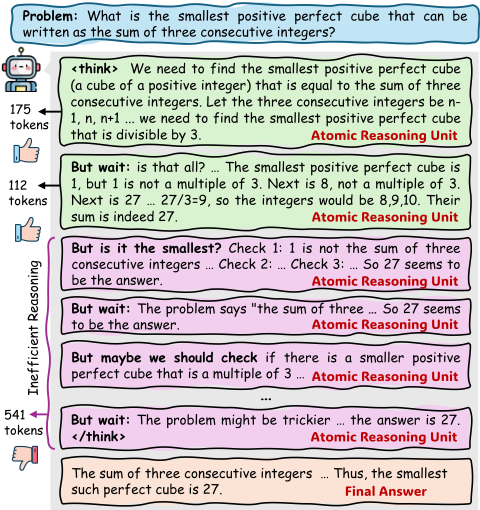
Large reasoning models (LRMs) have demonstrated significant performance improvements in solving complex tasks such as mathematical reasoning and code generation [Guo et al., 2025; Team et al., 2025]. However, they often exhibit overthinking, wherein they repeatedly solve and verify the same problem during inference, leading to a substantial increase in output length [Chen et al., 2024; Sui et al., 2025]. This verbose content incurs considerable computational costs and token consumption but offers minimal improvement in final task accuracy, sometimes even degrading performance through noise accumulation [Cuadron et al., 2025]. As illustrated in Figure 1, while some verification is beneficial for in-depth analysis, over 65% of the tokens are spent on redundant computations that retrace previously established reasoning paths, substantially reducing inference efficiency.
Existing efforts to mitigate overthinking in LRMs fall into two broad categories. The first line of work focuses on switching between fast and slow thinking: for difficult problems, it aims to exploit the reasoning capability of LRMs via step-by-step inference, whereas for simple problems, it encourages the model to bypass reasoning and respond directly. In essence, this approach makes a binary decision before reasoning begins [Pan et al., 2024; Su et al., 2025]. However, it is inherently vulnerable to misclassification, which can propagate errors and lead to reasoning failures. The second line of work targets reasoning trajectory compression, aiming to reduce the number of tokens produced during inference [Luo et al., 2025a; Hou et al., 2025; Chen et al., 2025]. In particular, methods that leverage a model's own capabilities to compress reasoning trajectories have attracted attention. They do not require supervision from human experts or stronger models; instead, they compress output length via lightweight heuristic rules during training. However, existing compression methods typically do not distinguish between beneficial verification steps that support deeper reasoning and redundant checks at a fine granularity. As a result, they tend to shorten reasoning trajectories indiscriminately, which may disrupt beneficial reasoning steps and thereby undermine the reasoning capability of LRMs. Overall, existing methods that switch reasoning modes based on problem difficulty or compress overall output length do not specifically address the issue of redundant reasoning steps, thereby limiting further improvements in reasoning efficiency.
Moreover, prior efforts to mitigate overthinking largely overlook enhancing reasoning capability [Cheng et al., 2025b; Hou et al., 2025]. They typically regard the slight performance drop of the optimized model relative to a vanilla LRM-attributable to shorter reasoning traces-as an acceptable trade-off. This perspective suggests that current overthinking-mitigation strategies do not focus on recovering the model's potentially undermined reasoning ability.
To address these challenges, we propose EVOTHINK, a two-stage framework that optimizes both reasoning efficiency and capability. First, to improve reasoning efficiency, we introduce Self-Pruning Training (SPT), an unsupervised procedure that iteratively identifies and removes redundant reasoning steps and then performs self-training on the pruned trajectories. Second, we propose Aha-Moment Preference Optimization (AMPO) to enhance reasoning capability. Inspired by genetic algorithms, AMPO treats failed reasoning trajectories as a population and uses a fitness function to quantify the diversity of reasoning attempts, thereby selecting high-potential failures. Based on these curated failures, we construct aha-moment data that captures the from-wrong-toright transitions. We then apply direct preference optimization (DPO) [Rafailov et al., 2023] to drive the model to internalize this reasoning pattern. We conduct extensive evaluations on mathematical reasoning and code generation benchmarks, revealing that EVOTHINK consistently improves both reasoning efficiency and capability. Furthermore, we find that, compared to optimizing the model using only correct solutions, our aha-moment data construction pattern better emulates the exploratory process of discovering new reasoning paths, thereby facilitating improvements in reasoning performance. In summary, our contributions are:
- We identify overthinking as a reasoning quality issue and introduce SPT, an unsupervised method to prune redundant verification steps from reasoning trajectories.
- We propose AMPO, a method to encourage exploration of new reasoning paths by learning from curated fromwrong-to-right transitions on high-potential failures.
- Through extensive experiments on math and code
benchmarks, we demonstrate that EVOTHINK significantly enhances both reasoning efficiency and overall task performance.
2 RelatedWorks
Slow-fast thinking mode switching. This line of research typically assesses reasoning complexity to determine whether to invoke a fast or slow reasoning mode. Dynathink [Pan et al., 2024] introduces a dynamic framework allowing an LLM to autonomously choose between strategies: a fast mode for tasks with quickly identifiable answers, and a slow mode for more complex problems. Dualformer [Su et al., 2025] proposes controllable fast-slow reasoning by learning stochastic reasoning trajectories, enabling the model to adaptively select reasoning modes during inference. Similarly, ACPO [Cheng et al., 2025a] introduces control tokens such as <fast think> and <slow think> to enable dynamic transitions between different reasoning depths. Thinkswitcher [Liang et al., 2025] determines when to engage in deep versus rapid reasoning by analyzing the impact of switching on computation time, thereby reducing decoding FLOPs. Despite their effectiveness, these approaches fundamentally rely on a classification mechanism to select an appropriate reasoning mode; this dependence may introduce binary decision errors and lead to selecting an incorrect reasoning mode due to error propagation.
Reasoning trajectory compression. Although complex reasoning is more likely to yield correct answers, the associated lengthy reasoning processes substantially increase both inference latency and computational costs. To promote efficient reasoning, recent studies incorporate efficiency considerations into training frameworks. For example, Kimi [Team et al., 2025], O1-Pruner [Luo et al., 2025a], and ThinkPrune [Hou et al., 2025] introduce length-based penalties into reinforcement learning reward functions, encouraging models to produce more concise reasoning while maintaining accuracy. In addition, DAST [Shen et al., 2025] and DIET [Chen et al., 2025] construct preference datasets to train models to generate reasoning sequences that match the complexity of the query. Beyond training-based approaches, several training-free methods improve test-time reasoning efficiency via advanced prompting techniques, such as Sketchof-Thought [Aytes et al., 2025], Token-Budget [Han et al., 2025], and No Think [Ma et al., 2025]. However, these methods generally lack a fine-grained distinction between beneficial steps that deepen reasoning and redundant, unproductive steps. Consequently, compression-based strategies may indiscriminately remove essential information, potentially impairing the model's reasoning capability.
3 Method
As illustrated in Figure 2, EVOTHINK comprises two sequential stages designed to improve the reasoning efficiency of LRMs by reducing redundant verification and optimizing reasoning patterns. The first stage, Self-Pruning Training (SPT), follows an iterative loop in which the model generates an initial solution, prunes redundant reasoning trajectories, and then performs self-training on the resulting pruned data.
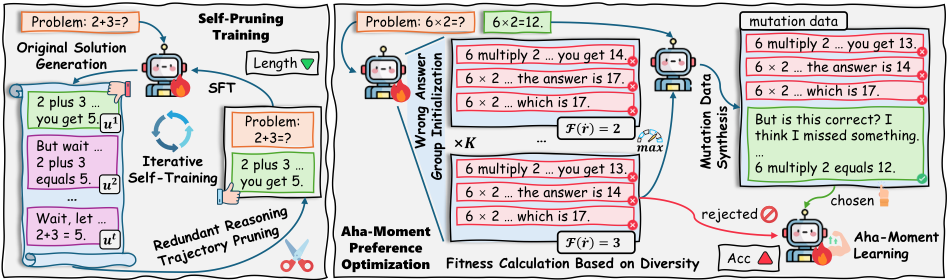
In the second stage, Aha-Moment Preference Optimization (AMPO), we initialize a population of incorrect responses and apply a fitness function F(.) to identify valuable failure cases. We then create mutated data by strategically connecting the incorrect reasoning paths in failure cases to the correct answers, yielding explicitly aha-moment instances. Finally, the model learns this reasoning pattern via DPO, thereby improving its reasoning capability.
3.1 Self-Pruning Training
Original Solution Generation
In this step, the LRM generates preliminary reasoning for a given query. Formally, we defineMi as the LRM at the i-th iteration of the self-training process. Specifically, M0 denotes the initial model prior to any optimization. This initial model serves as the annotator (denoted by A) and processes all data using our task-specific prompts within the EVOTHINK framework. Given a query q, the model generates an output sequence formulated as oi = ri ⊕ ˆai. Specifically, ri represents the reasoning trajectory (enclosed within <think> and </think> tokens) capturing the model's step-by-step thought process, ˆai represents the final predicted answer generated after the reasoning trajectory, and ⊕ signifies sequence concatenation.
Redundant Reasoning Trajectory Pruning
This step removes repetitive self-verification loops within the generated reasoning trajectory ri while preserving useful reasoning progress. We first introduce the concept of the atomic reasoning unit to formalize the pruning process.
Atomic reasoning unit. Given ri, we prompt A to decompose it into a sequence of complete reasoning sub-steps, denoted as ri = {u(t) i } for t ∈ {1, . . . , T}. Each u(t) i constitutes an atomic reasoning unit: a contiguous text span that starts when the model initiates a new self-contained reasoning attempt (understandable without relying on later units) and ends when that attempt reaches a local conclusion (e.g., a candidate direction, intermediate claim, or tentative answer). Empirically, with the exception of the first unit, such units often begin with discourse markers indicating a restart or recheck (e.g., wait, alternatively, but, however, double-check).
Pruning redundant atomic units. The LRMfirst segments the reasoning trajectory into atomic reasoning units and subsequently examines the redundancy of consecutive units. Concretely, the model compares the local conclusion implied by u(t) i with that of u(t-1) i ; if they are the same (i.e., the new unit does not expand the explored solution space and only re-derives or re-verifies an already reached conclusion), the model marks u(t) i as redundant and removes it. This yields a pruned reasoning trajectory ˜ ri, and the corresponding pruned output sequence ˜ oi = ˜ ri ⊕ ˆai, where the predicted answer ˆai remains unchanged during this step.
Pruning-induced efficient reasoning patterns. Our pruning strategy establishes an efficient reasoning pattern in the model. Specifically, (1) when a reasoning unit is consistently correct yet repeatedly revisited, pruning encourages the model to halt upon reaching the conclusion, thereby reducing unnecessary over-verification. (2) When a reasoning unit is incorrect yet repeatedly invoked, pruning removes consecutively repeated conclusions so that each attempt explores a new subspace, alleviating the model's over-concentration on high-likelihood but incorrect solutions. (3) When the model initially oscillates among incorrect conclusions but ultimately reaches the correct answer (i.e., an aha moment), pruning reduces the number of prior repeated attempts spent on incorrect trajectories, enabling the reasoning process to reach the correct answer faster.
Iterative Self-Training
Following the i-th pruning step, the model Mi-1 undergoes unsupervised fine-tuning on a set of concise solutions that it self-generates, yielding the subsequent model Mi. The size of the concise solution set is fixed at 100 for each iteration. This design encourages the model to internalize the generalizable skill of concise reasoning (the process) rather than simply memorize efficient paths to known correct answers (the results). Let ¯Li denote the average token length of the pruned outputs generated by Mi across all queries at the i-th iteration. We define the relative length reduction as S(i) = (¯Li-1 - ¯Li)/¯Li-1 for i ≥ 1. The procedure terminates when the compression gain becomes negligible, i.e., when S(i) ≤ ϵL, where the threshold hyperparameter ϵL is set to 0.1. We justify this choice in § 4.3.
The self-training process utilizes a standard next-token prediction loss, formulated as:
where q is the input query, ˜ oi denotes the pruned output sequence consisting of tokens ˜ oi,w, and PMi represents the probability distribution of the model at iteration i. By minimizing this loss, the model learns to internalize a more efficient reasoning pattern.
3.2 Aha-Moment Preference Optimization
Wrong Answer Group Initialization
In this stage, we employ a genetic algorithm to extract valuable learning signals from failures. These signals are then used to construct mutation data, which trains the LRM to acquire new reasoning patterns. The process starts with the model MI obtained at the final iteration (the I-th round) of the SPT stage. We specifically select this warm-started model because it has internalized efficient reasoning patterns. This trait proves particularly advantageous when generating erroneous reasoning trajectories: compared to a vanilla model lacking such internalized patterns, MI requires significantly fewer tokens to produce the same number of atomic reasoning units, as discussed in § 4.3.
For each query q, we use this model to produce K responses, where K is a hyperparameter. If all K attempts yield incorrect answers, we mark the query as a hard query, representing the current reasoning boundary of the model. This process forms a subset Dhard. For every q ∈ Dhard, the K incorrect reasoning outputs { ˙o1, . . . , ˙ok} constitute the initial population for evolution, termed the Wrong Answer Group. The choice of K is detailed in § 4.5.
Fitness Calculation Based on Diversity
To select the most informative failure cases for evolution, we define a diversity-based fitness function F. For a reasoning trajectory ˙r, we first decompose it into m atomic reasoning units, ˙r = (u1, u2, . . . , um). Let A be a parser that extracts from each unit ui a local conclusion ci = A(ui). We then define the set of distinct local conclusions in ˙r as C( ˙r) = {ci}mi=1 , and compute the fitness as the number of unique conclusions: F( ˙r) = |C( ˙r)| = |{A(ui) : i = 1, . . . ,m}|. A larger F( ˙r) indicates that the trajectory explores a broader range of intermediate conclusions, and is therefore more informative. In practice, we prompt A to extract {ci} and count the number of distinct conclusions.
Mutation Data Synthesis
To construct valid mutation data, we select the erroneous trajectory with the highest fitness score and prompt the annotator A to synthesize an aha-moment transition. Specifically, for a given query q, the model retains the entire incorrect reasoning prefix, while we prompt it to initiate a shift toward the correct answer a with the starting sentence, "But is this correct? I think I missed something." This creates a synthetic trajectory that begins with plausible but flawed reasoning (aligning with the model's internal distribution) and gradually bridges to the correct solution (aligning with the gold answer distribution). Unlike direct supervision with correct answers, this from-wrong-to-right pattern offers a softer learning curve, effectively mitigating the model's overconfidence in high-likelihood incorrect paths while demonstrating how to recover from errors. We analyze this setting in § 4.4 and present a case study in § 4.6.
Aha-Moment Learning
To help the model learn the synthesized aha-moment reasoning patterns, we train it using DPO. For each hard query q ∈ Dhard, we construct a preference pair (och , ore ), where the chosen response och is the synthesized mutation trajectory and the rejected response ore is the original incorrect trajectory with the highest fitness score. This pairing forces the model to distinguish between a dead-end reasoning path and a successful aha-moment correction. For q /∈ Dhard, och is the shortest correct response among K sampled outputs, while ore is the longest response, which is not necessarily correct. The objective of AMPO is formulated as:
where M is the policy model under optimization (initialized fromMI), and Pref is the reference model (typically a copy of MI before DPO begins). The hyperparameter β controls the strength of the preference optimization; we set β=0.5 to enforce closer fitting to the preference data. The function σ(·) is the standard sigmoid function. By minimizing LAMPO, the model is trained to assign higher probability to och relative to ore .
4 Experiments
4.1 Experimental Setups
Baselines. In our experiments, we evaluate three opensource backbone LRMs: Distill-Qwen-1.5B [Guo et al., 2025], DeepScaleR-1.5B [Luo et al., 2025b], and QwQ32B [Yang et al., 2024]. We compare EVOTHINK with three groups of baselines. (1) The vanilla model without compression. (2) Supervised Fine-tuning (SFT) and DPO baselines: Kimi 1.5 SFT[Team et al., 2025], fine-tuned on the shortest correct responses, and Kimi 1.5 DPO[Team et al., 2025], which treats the shortest correct response as a positive example and incorrect or longer ones as negative examples. (3) RL-based methods, including O1-Pruner [Luo et al., 2025a], ThinkPrune [Hou et al., 2025], and DIET [Chen et al., 2025]. We follow the settings established in these baselines. For ThinkPrune, we adopt the ThinkPrune-2k variant from the series, which achieves the greatest reduction in output length.
Datasets. We comprehensively evaluate all baselines on four benchmarks covering distinct domains: MATH500 [Hendrycks et al., 2021], AIME24 [Muennighoff et al., 2025] and AIME25 1 (mathematics), as well as TACO [Li et al., 2023] (code generation). For MATH-500, we train exclusively on the standard MATH training set. For AIME24 and AIME25, we construct a training set from AIME
1 https://huggingface.co/datasets/math-ai/aime25
| Backbone | Method | MATH500 | AIME24 | AIME25 | TACO | ||||
|---|---|---|---|---|---|---|---|---|---|
| P@1 ↑ | #Tok ↓ | P@1 ↑ | #Tok ↓ | P@1 ↑ | #Tok ↓ | P@1 ↑ | #Tok ↓ | ||
| Vanilla | 80.3 | 3171 | 29.2 | 6436 | 30.8 | 8282 | 4.2 | 7678 | |
| Kimi 1.5 SFT | 79.3 | 2911 | 27.5 | 6399 | 29.2 | 8185 | 3.5 | 7420 | |
| Kimi 1.5 DPO | 81.5 | 2883 | 35.0 | 6739 | 26.7 | 6751 | 3.7 | 7350 | |
| O1-Pruner | 79.6 | 2430 | 28.3 | 5205 | 33.3 | 6441 | 5.5 | 7622 | |
| DeepScaleR-1.5B ThinkPrune-2k | 80.1 | 1838 | 26.7 | 3862 | 27.5 | 4392 | 3.5 | 6117 | |
| DIET | 81.5 | 2255 | 29.2 | 5147 | 32.5 | 5881 | 5.8 | 7241 | |
| EVOTHINKSPT | 80.2 | 1861 | 26.7 | 4321 | 26.7 | 5470 | 6.4 | 6234 | |
| EVOTHINKAMPO | 84.7 | 3441 | 37.5 | 7044 | 37.5 | 8783 | 7.7 | 8013 | |
| EVOTHINKSPT+AMPO | 82.1 | 2146 | 36.7 | 5287 | 35.8 | 6254 | 7.4 | 6919 | |
| Vanilla | 75.4 | 3752 | 16.7 | 7337 | 24.2 | 8319 | 4.2 | 7680 | |
| Kimi 1.5 SFT | 68.7 | 3643 | 17.5 | 6688 | 19.2 | 7120 | 3.4 | 7450 | |
| Kimi 1.5 DPO | 70.6 | 3688 | 20.0 | 7423 | 20.8 | 6976 | 3.6 | 7380 | |
| O1-Pruner | 69.7 | 3451 | 14.2 | 6436 | 29.2 | 7371 | 4.1 | 7481 | |
| Distill-Qwen-1.5B ThinkPrune-2k | 72.1 | 2659 | 13.3 | 5402 | 20.8 | 5731 | 3.7 | 7029 | |
| DIET | 72.9 | 3142 | 16.7 | 6870 | 26.7 | 6702 | 3.5 | 7406 | |
| EVOTHINKSPT | 73.5 | 2481 | 20.0 | 5988 | 22.5 | 5946 | 5.2 | 6645 | |
| EVOTHINKAMPO | 78.0 | 3827 | 35.8 | 8071 | 30.0 | 9151 | 6.6 | 8448 | |
| EVOTHINKSPT+AMPO | 76.3 | 2778 | 30.8 | 6633 | 28.3 | 6572 | 6.2 | 7024 | |
| Vanilla | 87.6 | 4289 | 46.7 | 7290 | 33.3 | 8749 | 10.7 | 9003 | |
| Kimi 1.5 SFT | 87.4 | 4115 | 44.2 | 7025 | 31.7 | 7409 | 10.5 | 8735 | |
| Kimi 1.5 DPO | 85.8 | 4075 | 42.5 | 6950 | 30.8 | 7330 | 10.0 | 8640 | |
| O1-Pruner | 83.1 | 3002 | 37.5 | 6939 | 27.5 | 6598 | 8.4 | 8472 | |
| QwQ-32B ThinkPrune-2k | 88.7 | 2336 | 45.8 | 5824 | 32.5 | 6465 | 8.7 | 7198 | |
| DIET | 83.6 | 3740 | 49.2 | 6314 | 34.2 | 7125 | 9.8 | 7219 | |
| EVOTHINKSPT | 86.0 | 2406 | 50.8 | 6225 | 35.8 | 6224 | 9.4 | 6947 | |
| EVOTHINKAMPO | 90.1 | 4718 | 55.8 | 8019 | 38.3 | 9224 | 12.6 | 9903 | |
| EVOTHINKSPT+AMPO | 89.5 | 3016 | 52.5 | 6299 | 36.7 | 6395 | 11.9 | 7281 | |
(1983-2023). We obtain the gold solutions for all AIME problems from the Art of Problem Solving community 2 . For TACO, we use its official training sets. To ensure a fair comparison, all baselines are trained and evaluated on identical data splits. We use veRL [Sheng et al., 2025] as the training framework and train models on 8 H100 GPUs. For additional training details, please refer to the supplementary material.
Evaluation. Following the established metrics from DIET [Chen et al., 2025], we primarily evaluate performance using two metrics: Pass@1 (P@1) and the average response length in tokens (#Tok). To estimate P@1, we sample 8 independent responses per question for AIME and 4 for all other datasets. For MATH-500 and AIME, we require the model to enclose its final answer in \\boxed{} to enable exact matching with the ground-truth answer; for TACO, we use the official evaluation script provided by the dataset. During the evaluation, we employed a temperature of 0.6, a top-p value of 0.95. For both the baseline and EVOTHINK, we set the maximum token limit per instance to 32,768 tokens. If generation reaches this limit before completing the reasoning process, we mark the instance as incorrect and set its response length to 32,768. This policy ensures that models failing to produce a complete solution within the token limit are penalized during accuracy computation.
2 https://artofproblemsolving.com/wiki/index.php?title= AIME Problems and Solutions
4.2 Main Results
Table 1 presents a comprehensive quantitative evaluation of our EVOTHINK framework across diverse LRMs and benchmarks. The integrated method, EVOTHINKSPT+AMPO, consistently achieves a superior balance between reasoning accuracy (Pass@1) and computational efficiency (token length). When comparing fine-grained performance, we observe that while baselines like ThinkPrune-2k achieve substantial token reduction (e.g., reducing DeepScaleR-1.5B to 1838 tokens on MATH500), they often suffer significant performance degradation. For instance, on the MATH-500, when the vanilla model is DeepScaleR-1.5B, ThinkPrune-2k's Pass@1 drops to 72.1% compared to the vanilla model's 75.4%, whereas our EVOTHINKSPT+AMPO maintains a higher Pass@1 of 76.3% with comparable efficiency gains. Overall, our approach outperforms other compression-focused baselines in Pass@1 while maintaining similar output lengths, demonstrating consistency across varying model scales.
The ablation variants, EVOTHINKSPT and EVOTHINKAMPO, represent models trained exclusively with either SPT or AMPO, respectively. Through the EVOTHINKSPT stage alone, the LRM achieves reasoning performance comparable to or even better than most existing baselines while effectively reducing token consumption. For instance, on the TACO dataset, our DeepScaleR-1.5B model attains a score of 6.4% during the EVOTHINKSPT stage, outperforming all baselines. More importantly, EVOTHINKSPT training is unsupervised, requires only a few iterations, and uses much less data, whereas all competing baselines rely on gold answers and are trained on the full dataset. This suggests that, in addressing overthinking, improving reasoning quality by suppressing redundant atomic reasoning units is a more effective strategy than merely compressing the length of reasoning trajectories. Furthermore, EVOTHINKAMPO yields substantial performance gains; for example, on AIME24, QwQ-32B achieves 55.8% Pass@1, compared to 46.7% for the vanilla model. Consequently, the combined EVOTHINKSPT+AMPO framework achieves optimal overall performance, confirming the complementary advantages of its components. SPT minimizes token consumption, while AMPO significantly boosts the performance of the warm-started efficient models, thereby achieving a robust balance between performance and efficiency.
Iterations Local Conclusions
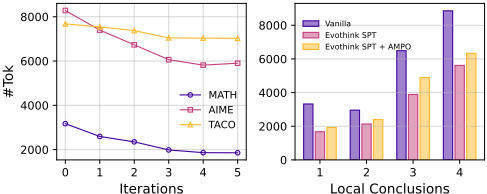
Figure 3: Evolution of reasoning length under EVOTHINKSPT on MATH (left). Correlation between reasoning length and the number of local conclusions on MATH (right).
4.3 Improvement of Reasoning Efficiency
Figure 3 (left) presents the evolution of the generated reasoning length of DeepScaleR-1.5B on the MATH-500 training set under the SPT algorithm. We observe that the length typically stabilizes within five iterations, at which point S(i) < 0.1. Accordingly, we set the length-tolerance threshold ϵL = 0.1. On other datasets, the number of iterations required to stabilize and satisfy S(i) < 0.1 remains within ten. Figure 3 (right) reports the average reasoning length associated with local conclusions produced by DeepScaleR-1.5B on the MATH training set under different methods. For the vanilla model, no strict correlation exists between the number of local conclusions and the inference length. Notably, the token cost for a single local conclusion can even exceed that for two local conclusions in the vanilla model, which indicates redundant atomic reasoning units. After applying SPT, our framework captures the relationship between local conclusions and reasoning token cost: the reasoning length increases monotonically as the number of local conclusions grows.
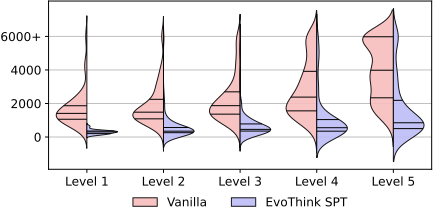
Figure 4 analyzes the output length of DeepScaleR-1.5B on MATH-500, grouped by problem difficulty (Levels 1-5, from easy to difficult). We find that: (1) EVOTHINKSPT yields substantially lower medians and interquartile ranges than the vanilla model at every difficulty level, indicating an effective reduction in reasoning length. (2) as difficulty increases, the vanilla model exhibits an increasingly heavy upper tail, suggesting that harder instances more frequently trigger extreme computational overhead. In contrast, EVOTHINKSPT shows a much milder increase with smaller variance; although its distribution shifts upward with difficulty, the magnitude is far smaller than that of the vanilla model. Overall, EVOTHINKSPT remains more stable and is less prone to excessive output length inflation.
4.4 Enhancement of Reasoning Capability
Figure 5 compares different training methods on curated difficult datasets composed of problems that the vanilla DeepScaleR-1.5B model consistently fails to solve. This setup allows for a focused analysis of how reasoning capabilities are improved by learning from gold solutions. We compare four approaches: (1) Supervised Fine-Tuning (SFT) directly on gold solutions; (2) DPO, using gold solutions as chosen and model generations as rejected responses; and (3, 4) our EVOTHINKAMPO and EVOTHINKSPT+AMPO methods, which leverage our constructed mutation data. The results show that, although training directly on human-written, highly condensed gold solutions substantially reduces reasoning length, SFT and DPO yield only limited improvements in reasoning capability, indicating that the model struggles to internalize this reasoning pattern through direct supervision. In contrast, the AMPO framework proves highly effective: our curated aha-moment data-enriched with diverse reasoning trajectories and aligned with gold solutions-substantially outperforms direct training on gold solutions alone.
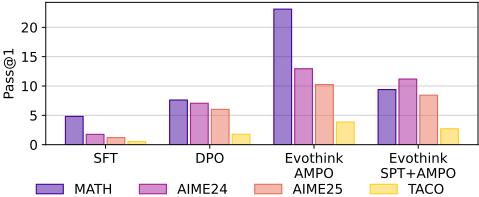
To disentangle whether the observed improvement in reasoning stems from either memorizing answers or optimizing the reasoning pattern, we train DeepScaleR-1.5B exclusively on the MATH dataset and evaluate it on AIME24
and AIME25. As reported in Table 2, after adopting the transfer learning setting, all baselines exhibit performance degradation to varying degrees. In contrast, EVOTHINKAMPO achieves a performance gain, further indicating that our method produces a more generalizable model. We attribute this improvement to high-quality synthetic data generated by our genetic algorithm, which teaches the model a robust reasoning strategy rather than rote memorization of solutions. Moreover, when combined with the SPT stage, EVOTHINKSPT+AMPO reduces output length while preserving its generalization capability. We further find that training on human-written gold solutions effectively reduces token cost; however, the reasoning style in these solutions differs substantially from the model's native reasoning patterns, and this mismatch markedly undermines LRM's generalization. As shown in Table 2, when models are trained on MATH with gold solutions, DPO reduces the Pass@1 score on the AIME to less than one-fifth of that of the untrained vanilla model.
| AIME24 | AIME25 | |||
|---|---|---|---|---|
| P@1 ↑ | #Tok ↓ | P@1 ↑ | #Tok ↓ | |
| Vanilla | 29.2 | 6436 | 30.8 | 8282 |
| SFT | 4.2 | 4965 | 3.3 | 6414 |
| DPO | 5.4 | 5342 | 4.6 | 6778 |
| O1-Pruner | 17.5 | 5937 | 16.3 | 7451 |
| ThinkPrune-2k | 23.8 | 5542 | 24.2 | 6988 |
| DIET | 26.3 | 5814 | 25.0 | 7861 |
| EVOTHINKSPT | 28.3 | 4811 | 30.4 | 7022 |
| EVOTHINKAMPO | 30.0 | 6492 | 31.3 | 8330 |
| EVOTHINKSPT+AMPO | 28.8 | 5005 | 30.8 | 7496 |
4.5 Analysis of Mutation Data
Figure 6 illustrates the impact of the initial population size (K) on the final performance of EVOTHINKSPT+AMPO with the QwQ-32B model, as evaluated on the MATH-500 and TACO datasets. We observe that as K increases, the variation in ∆Pass@1 tends to stabilize for K > 6. This observation is consistent across other models and datasets in our experiments; therefore, we set K = 6.
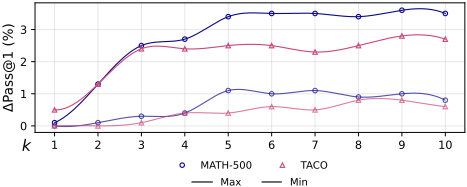
Furthermore, Figure 6 compares the performance of selecting the reasoning trajectory with maximum diversity (Max, i.e., max(F(rk)) for k ∈ 1, . . . ,K) with that of selecting the one with minimum diversity (Min, i.e., min(F(rk))). The results clearly show that high-diversity trajectories yield substantially larger performance gains than their low-diversity counterparts. This finding confirms that high-diversity trajectories are more suitable for use as mutation data, underscoring the importance of actively exploring new solution spaces to enhance the reasoning capabilities of LRMs.
4.6 Case Study
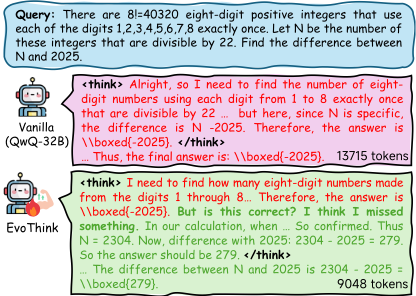
Figure 7 presents a case study of the QwQ-32B model solving an AIME25 problem. The vanilla model fails to execute the necessary reasoning steps, resulting in an incorrect answer and a lengthy output of 13,715 tokens. In contrast, EVOTHINK demonstrates the ability to explore new reasoning paths. As revealed in its thought process, it initially falls into a similar trap but then questions its own conclusion: "But is this correct? I think I missed something." This moment enables it to discard the erroneous path and perform the correct calculations, requiring only 9,048 tokens-a 34% reduction compared to the vanilla model.
5 Conclusion and FutureWork
We introduce EVOTHINK, a framework that significantly enhances the reasoning efficiency and capability of LRM through SPT and AMPO. Our approach leverages a fromwrong-to-right data construction process, allowing models to learn from failures and discover new reasoning paths. Extensive evaluations across math and code generation benchmarks demonstrate that EVOTHINK preserves performance, substantially reduces the average token count, and improves reasoning capability. For future work, we plan to investigate why the from-wrong-to-right learning pattern adopted by AMPO is particularly effective for model training. This exploration is outside the scope of this paper but represents a vital direction for LRM reasoning.
Acknowledgements
This work is partially supported by National Nature Science Foundation of China under No. 62476058. We thank the Big Data Computing Center of Southeast University for providing the facility support on the numerical calculations in this paper.
Contribution Statement
Xinbang Dai conceived the study, designed the experiments, and wrote the manuscript. Zheyu Xin and Huikang Hu collected the data and performed the experiments. Lin Ren, Rihui Jin, Guohui Xiao, Kuicai Dong, Zhaocheng Du, and Yuyang Zhang reviewed the final manuscript. Xinbang Dai, Zheyu Xin, and Huikang Hu contributed equally to this work.
@inproceedings{ijcai2026p634,
  title     = {EvoThink: Evolving Thinking in Large Reasoning Models via Self-Pruning and Aha-Moment Preference Optimization},
  author    = {Dai, Xinbang and Xin, Zheyu and Hu, Huikang and Ren, Lin and Jin, Rihui and Xiao, Guohui and Dong, Kuicai and Du, Zhaocheng and Zhang, Yuyang},
  booktitle = {Proceedings of the Thirty-Fifth International Joint Conference on
               Artificial Intelligence, {IJCAI-26}},
  publisher = {International Joint Conferences on Artificial Intelligence Organization},
  editor    = {Diego Calvanese},
  pages     = {5693--5701},
  year      = {2026},
  month     = {8},
  note      = {Main Track},
  doi       = {10.24963/ijcai.2026/634},
  url       = {https://doi.org/10.24963/ijcai.2026/634},
}
TY - CPAPER TI - EvoThink: Evolving Thinking in Large Reasoning Models via Self-Pruning and Aha-Moment Preference Optimization AU - Dai, Xinbang AU - Xin, Zheyu AU - Hu, Huikang AU - Ren, Lin AU - Jin, Rihui AU - Xiao, Guohui AU - Dong, Kuicai AU - Du, Zhaocheng AU - Zhang, Yuyang T2 - Proceedings of the Thirty-Fifth International Joint Conference on Artificial Intelligence, IJCAI-26 PB - International Joint Conferences on Artificial Intelligence Organization PY - 2026 SP - 5693 EP - 5701 DO - 10.24963/ijcai.2026/634 UR - https://doi.org/10.24963/ijcai.2026/634 ER -Copied
Machine-readable versions of this paper, for tools and AI agents:





