
Towards Fine-Grained Code-Switch Speech Translation with Semantic Space Alignment
Proceedings of the Thirty-Fifth International Joint Conference on Artificial Intelligence. Main Track. Pages 5711-5719.
https://doi.org/10.24963/ijcai.2026/636
Keywords
- Natural Language Processing: Speech
- Natural Language Processing: Machine translation and multilinguality
Abstract
Code-switching (CS) speech translation (ST) aims to translate speech that alternates between multiple languages into a target language text, posing significant challenges due to the complexity of semantic modeling and the scarcity of CS data. Previous studies mainly rely on the models themselves to implicitly learn semantic representations and resort to costly manual annotations. To mitigate these limitations, we propose enhancing Large Language Models (LLMs) with a Mixture-of-Experts (MoE) speech projector composed of language expert groups, where each group specializes in the semantic space of a specific language for fine-grained speech feature modeling. A language-specific loss and an intra-group load balancing loss are jointly introduced to guide efficient token routing across and within expert groups. Furthermore, we introduce a multi-stage training paradigm that utilizes readily available automatic speech recognition (ASR) and monolingual ST data, facilitating speech-text alignment and improving translation performance. To bridge the data gap for smooth domain transfer, a transition loss is employed to improve adaptation to CS scenarios. Extensive experiments on widely used datasets demonstrate the effectiveness and generality of our approach, achieving average improvements of 0.86 BLEU and 0.93 COMET over SeamlessM4T, with maximum improvements of 1.49 BLEU and 1.41 COMET across different test sets. Our code and supplementary appendices are available at https://github.com/XMUDeepLIT/CSST-SSA.
- [Agarap, 2018] Abien Fred Agarap. Deep learning using rec- tified linear units (relu). arXiv preprint arXiv:1803.08375, 2018.
- [Alastruey et al., 2023] Belen Alastruey, Matthias Sperber, Christian Gollan, Dominic Telaar, Tim Ng, and Aashish Agarwal. Towards real-world streaming speech translation for code-switched speech. In Proceedings of the 6th Work- shop on Computational Approaches to Linguistic Code- Switching, 2023.
- [Ardila et al., 2020] Rosana Ardila, Megan Branson, Kelly Davis, Michael Kohler, Josh Meyer, Michael Henretty, Reuben Morais, Lindsay Saunders, Francis Tyers, and Gregor Weber. Common voice: A massively-multilingual speech corpus. In Proc. of LREC, 2020.
- [Borisov et al., 2025] Maksim Borisov, Zhanibek Kozhir- bayev, and Valentin Malykh. Low-resource machine trans- lation for code-switched Kazakh-Russian language pair. In Proc. of NAACL (Volume 4: Student Research Workshop), 2025.
- [Chen et al., 2024] Xi Chen, Songyang Zhang, Qibing Bai, Kai Chen, and Satoshi Nakamura. LLaST: Improved end- to-end speech translation system leveraged by large lan- guage models. In Proc. of ACL Findings, 2024.
- [Chi and Bell, 2022] Jie Chi and Peter Bell. Improving code- switched ASR with linguistic information. In Proc. of COLING, 2022.
- [Cieri et al., 2004] Christopher Cieri, David Miller, and Kevin Walker. The fisher corpus: a resource for the next generations of speech-to-text. In Proc. of LREC, 2004.
- [Communication et al., 2023] Seamless Communication, Loïc Barrault, Yu-An Chung, Mariano Cora Meglioli, David Dale, Ning Dong, Paul-Ambroise Duquenne, Hady Elsahar, Hongyu Gong, Kevin Heffernan, John Hoffman, Christopher Klaiber, Pengwei Li, Daniel Licht, Jean Maillard, Alice Rakotoarison, Kaushik Ram Sadagopan, Guillaume Wenzek, Ethan Ye, Bapi Akula, Peng-Jen Chen, Naji El Hachem, Brian Ellis, Gabriel Mejia Gonzalez, Justin Haaheim, Prangthip Hansanti, Russ Howes, Bernie Huang, Min-Jae Hwang, Hirofumi In- aguma, Somya Jain, Elahe Kalbassi, Amanda Kallet, Ilia Kulikov, Janice Lam, Daniel Li, Xutai Ma, Ruslan Mavlyutov, Benjamin Peloquin, Mohamed Ramadan, Abinesh Ramakrishnan, Anna Sun, Kevin Tran, Tuan Tran, Igor Tufanov, Vish Vogeti, Carleigh Wood, Yilin Yang, Bokai Yu, Pierre Andrews, Can Balioglu, Marta R. Costa-jussà, Onur Celebi, Maha Elbayad, Cynthia Gao, Francisco Guzmán, Justine Kao, Ann Lee, Alexandre Mourachko, Juan Pino, Sravya Popuri, Christophe Ropers, Safiyyah Saleem, Holger Schwenk, Paden Tomasello, Changhan Wang, Jeff Wang, and Skyler Wang. Seamless: Multilingual expressive and streaming speech translation. arXiv preprint arXiv:2312.05187, 2023.
- [Dhawan et al., 2023] Kunal Dhawan, KDimating Rekesh, and Boris Ginsburg. Unified model for code-switching speech recognition and language identification based on concatenated tokenizer. In Proceedings of the 6th Work- shop on Computational Approaches to Linguistic Code- Switching, 2023.
- [Fedus et al., 2022] William Fedus, Barret Zoph, and Noam Shazeer. Switch transformers: Scaling to trillion param- eter models with simple and efficient sparsity. Journal of Machine Learning Research, 2022.
- [Gaser et al., 2023] Marwa Gaser, Manuel Mager, Injy Hamed, Nizar Habash, Slim Abdennadher, and Ngoc Thang Vu. Exploring segmentation approaches for neural machine translation of code-switched Egyptian Arabic-English text. In Proc. of EACL, 2023.
- [Gupta et al., 2021] Abhirut Gupta, Aditya Vavre, and Sunita Sarawagi. Training data augmentation for code- mixed translation. In Proc. of NAACL, 2021.
- [Gupta et al., 2024] Ayushman Gupta, Akhil Bhogal, and Kripabandhu Ghosh. Code-mixer ya nahi: Novel ap- proaches to measuring multilingual llms' code-mixing ca- pabilities. arXiv preprint arXiv:2410.11079, 2024.
- [Hinton and Roweis, 2002] Geoffrey E Hinton and Sam Roweis. Stochastic neighbor embedding. Advances in neu- ral information processing systems, 15, 2002.
- [Hu et al., 2022] Edward J Hu, Phillip Wallis, Zeyuan Allen- Zhu, Yuanzhi Li, Shean Wang, Lu Wang, Weizhu Chen, et al. Lora: Low-rank adaptation of large language models. In Proc. of ICLR, 2022.
- [Huber et al., 2022] Christian Huber, Enes Yavuz Ugan, and Alexander Waibel. Code-switching without switching: Language agnostic end-to-end speech translation. arXiv preprint arXiv:2210.01512, 2022.
- [Kronis et al., 2024] Martins Kronis, Askars Salimbajevs, and Mārcis Pinnis. Code-mixed text augmentation for Lat- vian ASR. In Proc. of LREC-COLING, 2024.
- [Li et al., 2026] Yi Li, Rui Zhao, Ruiquan Zhang, Jinsong Su, Daimeng Wei, Min Zhang, and Yidong Chen. Plast: Towards paralinguistic-aware speech translation. In Proc. of AAAI, 2026.
- [Mohamed et al., 2025] Amr Mohamed, Yang Zhang, Michalis Vazirgiannis, and Guokan Shang. Lost in the mix: Evaluating llm understanding of code-switched text. arXiv preprint arXiv:2506.14012, 2025.
- [Morris et al., 2004] Andrew Cameron Morris, Viktoria Maier, and Phil D Green. From wer and ril to mer and wil: improved evaluation measures for connected speech recognition. In Proc. of Interspeech, 2004.
- [Pengpun et al., 2024] Parinthapat Pengpun, Krittamate Tiankanon, Amrest Chinkamol, Jiramet Kinchagawat, Pitchaya Chairuengjitjaras, Pasit Supholkhan, Pubor- dee Aussavavirojekul, Chiraphat Boonnag, Kanyakorn Veerakanjana, Hirunkul Phimsiri, et al. On creating an english-thai code-switched machine translation in medical domain. In Proc. of EMNLP Findings, 2024.
- [Post, 2018] Matt Post. A call for clarity in reporting BLEU scores. In Proc. of MT, 2018.
- [Radford et al., 2023] Alec Radford, Jong Wook Kim, Tao Xu, Greg Brockman, Christine Mcleavey, and Ilya Sutskever. Robust speech recognition via large-scale weak supervision. In Proc. of ICML, 2023.
- [Rei et al., 2020] Ricardo Rei, Craig Stewart, Ana C. Far- inha, and Alon Lavie. COMET: A neural framework for MT evaluation. In Proc. of EMNLP, 2020.
- [Scotton and Ury, 1977] Carol Myers Scotton and William Ury. Bilingual strategies: The social functions of code- switching. International Journal of the Sociology of Lan- guage, 1977.
- [Shankar et al., 2025] Bhavani Shankar, Preethi Jyothi, and Pushpak Bhattacharyya. CoSTA: Code-switched speech translation using aligned speech-text interleaving. In Proc. of COLING, 2025.
- [Shazeer et al., 2017] Noam Shazeer, Azalia Mirhoseini, Krzysztof Maziarz, Andy Davis, Quoc Le, Geoffrey Hin- ton, and Jeff Dean. Outrageously large neural networks: The sparsely-gated mixture-of-experts layer. In Proc. of ICLR, 2017.
- [Vavre et al., 2022] Aditya Vavre, Abhirut Gupta, and Sunita Sarawagi. Adapting multilingual models for code-mixed translation. In Proc. of EMNLP Findings, 2022.
- [Weller et al., 2022] Orion Weller, Matthias Sperber, Telmo Pires, Hendra Setiawan, Christian Gollan, Dominic Telaar, and Matthias Paulik. End-to-end speech translation for code switched speech. In Proc. of ACL Findings, 2022.
- [Winata et al., 2020] Genta Indra Winata, Samuel Cahyaw- ijaya, Zhaojiang Lin, Zihan Liu, Peng Xu, and Pascale Fung. Meta-transfer learning for code-switched speech recognition. In Proc. of ACL, 2020.
- [Winata et al., 2023] Genta Winata, Alham Fikri Aji, Zheng Xin Yong, and Thamar Solorio. The decades progress on code-switching research in NLP: A system- atic survey on trends and challenges. In Proc. of ACL Findings, 2023.
- [Wu et al., 2025] Suhang Wu, Jialong Tang, Chengyi Yang, Pei Zhang, Baosong Yang, Junhui Li, Junfeng Yao, Min Zhang, and Jinsong Su. Locate-and-focus: Enhancing ter- minology translation in speech language models. In Proc. of ACL, 2025.
- [Xie et al., 2025] Peng Xie, Xingyuan Liu, Tsz Wai Chan, Yequan Bie, Yangqiu Song, Yang Wang, Hao Chen, and Kani Chen. Switchlingua: The first large-scale multi- lingual and multi-ethnic code-switching dataset. arXiv preprint arXiv:2506.00087, 2025.
- [Xu and Yvon, 2021] Jitao Xu and Franc ¸ois Yvon. Can you traducir this? machine translation for code-switched input. In Proceedings of the Fifth Workshop on Computational Approaches to Linguistic Code-Switching, 2021.
- [Yang et al., 2024] Chih-Kai Yang, Kuan-Po Huang, Ke- Han Lu, Chun-Yi Kuan, Chi-Yuan Hsiao, and Hung-yi Lee. Investigating zero-shot generalizability on mandarin- english code-switched asr and speech-to-text translation of recent foundation models with self-supervision and weak supervision. In Proc. of ICASSP Workshops, 2024.
- [Zhang et al., 2023] Ruochen Zhang, Samuel Cahyawijaya, Jan Christian Blaise Cruz, Genta Indra Winata, and Al- ham Fikri Aji. Multilingual large language models are not (yet) code-switchers. In Proc. of EMNLP, 2023.
- [Zhang et al., 2024a] Liang Zhang, Zhen Yang, Biao Fu, Ziyao Lu, Liangying Shao, Shiyu Liu, Fandong Meng, Jie Zhou, Xiaoli Wang, and Jinsong Su. Multi-level cross- modal alignment for speech relation extraction. In Proc. of EMNLP, 2024.
- [Zhang et al., 2024b] Wenbo Zhang, Aditya Majumdar, and Amulya Yadav. Chai for llms: Improving code- mixed translation in large language models through re- inforcement learning with ai feedback. arXiv preprint arXiv:2411.09073, 2024.
References were extracted automatically from the PDF and may contain errors.
Full text extracted automatically from the PDF; figures, tables and equations may differ. The PDF is the version of record.
1 Introduction
Code-switching (CS), the practice of alternating between multiple languages within a single utterance or discourse, is a pervasive phenomenon in multilingual speech and poses significant challenges to speech and language processing models [Scotton and Ury, 1977]. The task of CS speech translation (ST) aims to translate such speech into text in a target language. With globalization [Winata et al., 2023], CS has become increasingly prevalent, extending beyond multilingual communities to predominantly monolingual settings, thus drawing much attention recently.
∗Corresponding author.
While CS has been extensively explored in machine translation (MT) [Xu and Yvon, 2021; Gupta et al., 2021; Vavre et al., 2022; Gaser et al., 2023; Pengpun et al., 2024; Borisov et al., 2025] and automatic speech recognition (ASR) [Winata et al., 2020; Chi and Bell, 2022; Dhawan et al., 2023; Kronis et al., 2024], its research in ST remains under-explored. This is primarily due to two key challenges: 1) semantic modeling complexity introduced by language alternation, which poses significant challenges for the model in capturing effective representations from CS speech; 2) data scarcity, as high-quality and large-scale CS speech translation datasets are limited and difficult to construct, which limits effective model training. Prior methods tend to ignore the semantic complexity arising from language switching, simply leaving it to the models themselves to implicitly learn and resolve during training [Huber et al., 2022; Weller et al., 2022; Alastruey et al., 2023; Shankar et al., 2025], which hinders overall performance. To mitigate data scarcity, previous studies resort to manual annotations [Alastruey et al., 2023; Shankar et al., 2025], which are inefficient and costly, producing datasets of limited scale. Other approaches focus on synthetic data, which often suffer from unnatural switching, disrupted word order, and grammatical inconsistencies [Xie et al., 2025].
Recently, large language models (LLMs) have demonstrated remarkable performance across diverse tasks. To equip LLMs with cross-modal capabilities, prior approaches typically introduce a projector that connects a pretrained speech encoder to the LLM [Chen et al., 2024; Zhang et al., 2024a; Wu et al., 2025; Li et al., 2026]. This architecture effectively integrates the speech encoder's strength in extracting acoustic features with the LLM's powerful language modeling ability. However, existing studies reveal that despite being pretrained on large-scale multilingual corpora, LLMs still exhibit limited cross-lingual capability, resulting in inferior performance on CS data relative to monolingual data [Zhang et al., 2023; Mohamed et al., 2025]. Moreover, current research on LLMs in the context of CS primarily focuses on MT [Zhang et al., 2024b; Gupta et al., 2024], leaving their potential in CS speech translation largely unexplored.
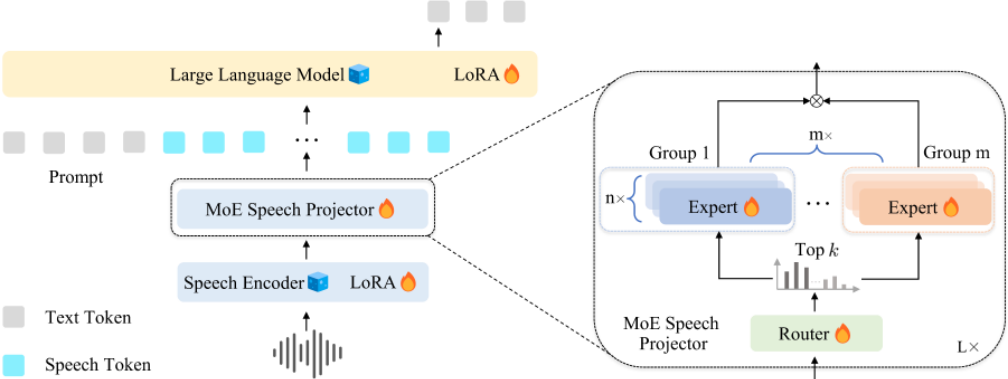
In this work, to address the aforementioned challenges, we explore the use of LLMs for CS speech translation, improving performance from the perspectives of both model architecture and data utilization. 1) Based on the abovementioned architecture, we introduce a novel Mixture-ofExperts (MoE) [Shazeer et al., 2017] speech projector, where experts are organized into language-aware groups to enable fine-grained modeling of speech features from different languages, thereby better capturing the complex cross-lingual semantics in CS speech. 2) To mitigate the scarcity of highquality CS speech translation data, we propose a novel multistage training paradigm that leverages high-resource ASR data to strengthen semantic comprehension and monolingual ST data to establish robust translation capability, followed by a gradual transition to CS speech translation data that enables smooth domain adaptation. Specifically, our training paradigm comprises four stages. In the first stage, ASR data are used to pretrain individual projectors for each language involved in the target CS scenario. In the second stage, these projectors of different languages form individual expert groups, which are further aggregated to construct a MoE speech projector. Additionally, a language-specific loss and an intra-group load balancing loss are introduced to better guide the learning of the MoE speech projector and promote effective expert specialization. The first two stages jointly align the speech and text modalities, facilitating the learning of cross-modal representations. In the third stage, we progressively transition from ASR to monolingual ST data using a transition loss to enhance the model's translation ability. In the final stage, the model is further adapted from monolingual ST to CS speech translation data, thus enabling effective translation of CS speech.
To summarize, the main contributions of our work include the following four aspects:
- To the best of our knowledge, we are the first to explore the use of LLMs in end-to-end CS speech translation, providing baseline results to facilitate future research.
- We propose a novel MoE speech projector that enables fine-grained modeling of speech features from different languages, thereby enhancing the model's ability to capture semantic distinctions in CS speech.
- We propose a multi-stage training paradigm that progressively guides the model to learn speech-text alignment and adapt to CS scenarios, effectively mitigating the scarcity of high-quality CS speech translation data.
- Empirical evaluations on monolingual and CS speech translation datasets validate the effectiveness of our model, and in-depth analysis experiments provide detailed insights into the contribution of each module.
2 RelatedWorks
CS translation in natural language processing (NLP) has garnered much attention and focuses mainly on MT [Xu and Yvon, 2021; Gupta et al., 2021; Vavre et al., 2022; Gaser et al., 2023; Pengpun et al., 2024; Borisov et al., 2025]. However, CS frequently occurs in spoken contexts such as lectures, meetings, and phone conversations, which necessitates handling speech input. To handle speech input, such methods are typically cascaded with ASR models [Winata et al., 2020; Chi and Bell, 2022; Dhawan et al., 2023; Kronis et al., 2024], which suffer from error propagation. Recent research efforts explore end-to-end (E2E) ST to mitigate this issue [Weller et al., 2022; Huber et al., 2022; Alastruey et al., 2023; Yang et al., 2024; Shankar et al., 2025]. A representative approach, COSTA [Shankar et al., 2025], enhances translation quality by aligning speech and text representations via interleaving their respective embeddings during fine-tuning.
| Settings | En | Es | zh-CN |
|---|---|---|---|
| Share Projector | 7.07 | 6.01 | 14.26 |
| Expert Projector | 7.05 | 4.52 | 13.21 |
Recently, LLMs have demonstrated impressive performance across diverse tasks, leading to increasing research on their use in CS machine translation [Zhang et al., 2023; Zhang et al., 2024b; Gupta et al., 2024; Mohamed et al., 2025] with promising results. Despite these successes, the potential of LLMs for CS speech translation remains largely unexplored. Current studies on monolingual ST generally integrate a pretrained speech encoder with an LLM through a projector [Chen et al., 2024; Wu et al., 2025; Li et al., 2026], thereby equipping the LLM with cross-modal understanding abilities. This framework effectively combines the strength of the speech encoder in extracting speech features with the powerful translation capability of the LLM. Although this framework has shown promising results in monolingual settings, its effectiveness in more challenging CS scenarios remains unclear.
3 Preliminary Study
In this section, we explore the complexity of semantic modeling in CS speech from two perspectives. First, we examine whether a semantic space gap exists between different languages. Second, we evaluate the impact of employing a shared projector on model performance.
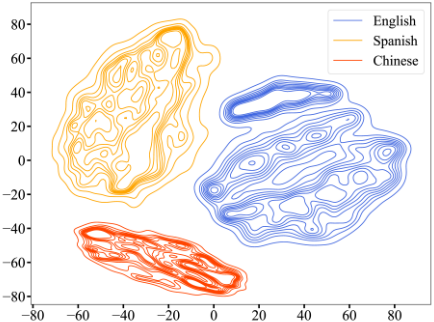
Does a semantic space gap exist between different languages? To investigate this issue, we conduct a preliminary experiment using Spanish, English, and Chinese ASR data from the Common Voice corpus [Ardila et al., 2020]. Specifically, mean-pooled speech features extracted from the Whisper encoder [Radford et al., 2023] are reduced to two dimensions using t-SNE [Hinton and Roweis, 2002] and visualized via a bivariate kernel density estimation (KDE) plot, as illustrated in Figure 1. The visualization reveals that samples from the same language cluster tightly, while those from different languages are clearly separated, indicating clear boundaries between languages. These findings provide empirical evidence of a substantial semantic space gap across languages in speech features.
Does sharing the projector across languages affect performance? Previous studies typically employ a single projector to align the semantic spaces of the speech encoder and the LLM. However, given the observed cross-lingual semantic space gap, the suitability of a shared projector in capturing semantic distinctions across languages remains uncertain. To investigate this issue, we compare two settings: (1) a shared projector for all languages, in which all speech tokens are processed by the single projector; and (2) one expert projector per language, where each speech token is processed by the projector corresponding to its language. We only finetune the projector, while keeping the parameters of the speech encoder and the LLM frozen. Since CS speech lacks oracle language labels at the token level, we also evaluate on monolingual ASR data, where all speech tokens are labeled with their corresponding language. First, we pre-train a single projector on the ASR data to mitigate variance from random initialization and establish a basic semantic alignment. Both the shared and expert projectors are then initialized with the pre-trained weights. We subsequently fine-tune both settings on the same ASR data. The experimental results, reported in Table 1, show that the expert projector consistently outperforms the shared projector, especially for Spanish and Chinese. This finding indicates that using expert projectors for different languages better captures semantic distinctions. However, in practical CS scenarios, oracle language labels for speech tokens are unavailable. To address this limitation, we adopt the MoE projector, enabling the model to route speech tokens to appropriate expert projectors in an adaptive manner.
4 Methodology
In this section, we first describe the architecture of our model and then detail the four-stage training strategy, which constructs the MoE speech projector with two auxiliary losses and progressively adapts the model from ASR to monolingual ST and finally to CS speech translation via the transition loss.
4.1 Model Architecture
As shown in Figure 2, our framework primarily consists of a speech encoder, a MoE speech projector, and an LLM. The speech encoder extracts features from the speech input, which are aligned with the representation space of the LLM via the MoE speech projector. These aligned features are concatenated with the prompt embeddings and fed into the LLM to generate the translation.
Speech Encoder. The speech encoder takes a speech input s and encodes it into a representation sequence h:
where h ∈ RTs×Denc denotes the encoder output, with sequence length Ts and encoder hidden dimension Denc.
MoE Speech Projector. The MoE speech projector connects the speech encoder to the LLM by mapping the representation space of the encoder output to the LLM input.
Each MoE layer consists of a set of N expert linear layers E = {E1,E2, . . . ,EN} and a sparse router G. For the l-th MoE layer, the sparse router predicts a probability distribution over experts and selects the top-k experts at the token level. The outputs of the selected experts are then weighted by their corresponding probabilities and summed to produce the output hl+1. The complete computation process is formulated as follows:
where i indexes the i-th expert, t indexes the t-th element in h, G(h) = XG · h and E(h) = XE · h denote the linear transformations of the router and an expert, respectively. Specifically, X(1) E ∈ RDenc×DLLM for the first layer and X(l) E ∈ RDLLM×DLLM for the remaining layers, where DLLM denotes the hidden dimension of the LLM.
The overall process is summarized as follows:
where hs ∈ RTs×DLLM denotes the speech projector output.
LLM. The tokenizer and embedding layer process the prompt text to obtain the representation ht, which is concatenated with the speech representation hs to form the LLM input hz :
where the operator ⊕ denotes vector concatenation, ht ∈ RTt×DLLM and hz ∈ R(Tt+Ts)×DLLM , with Tt denoting the sequence length of ht.
4.2 Multi-stage Transition Training
Stage 1. In the initial stage, we aim to align the speech and text modalities to obtain well-initialized parameters.
Given m languages involved in the CS scenario, we first randomly initialize an MLP-based projector for each language and pretrain it using the corresponding ASR data. The training objective is to minimize the cross-entropy loss:
where t is the decoding timestep, yt denotes the target text token at timestep t, and θ refers to the model parameters.
Stage 2. For each language, we initialize an expert group consisting of n experts with the weights of the corresponding pretrained projector to facilitate effective training. The expert groups from all m languages are then aggregated to form the MoE speech projector, with a randomly initialized router inserted between each layer. Thus, the total number of experts is N = n ×m. Although all experts within the same group share identical initial weights, the randomly initialized router assigns tokens to different experts, allowing them to gradually specialize through training.
In addition to the cross-entropy loss, we incorporate two auxiliary losses: a language-specific loss and an intra-group load balancing loss. The language-specific loss provides explicit supervision in routing speech tokens to the expert group corresponding to their language. For monolingual ASR data, all speech tokens are labeled with their respective language. Specifically, the loss penalizes the routing of tokens to experts from other language groups and is formally defined as below:
where L is the number of layers, and zi=1 if expert i belongs to the expert group corresponding to the language of the input speech, otherwise zi=0.
While the language-specific loss provides supervision at the group level, it lacks regulation over the token distribution among individual experts within each expert group. To address this limitation, the intra-group load balancing loss is introduced to encourage balanced token assignment within each expert group, preventing over-reliance on a subset of experts. The loss is formulated as:
where fijl is the fraction of tokens in language j dispatched to expert i within the corresponding expert group:
and Pijl is the average routing probability of assigning tokens in language j to expert i within the corresponding expert group:
where Tj is the set of tokens belonging to language j.
Using the same monolingual ASR data as in Stage 1, the overall objective is summarized as follows:
Stage 3. This stage focuses on enhancing the translation ability of the model by training on monolingual ST data. However, directly switching from ASR to ST introduces training inconsistency due to the task gap between speech recognition and translation. To enable a smoother transition, we mix ASR data with monolingual ST data and introduce the transition loss:
where λ = bB , b denotes the current batch index, and B is the total number of batches. Lasr ce and Lst ce denote the crossentropy losses for the ASR and monolingual ST data, respectively.
Additionally, the language-specific loss and the intra-group load balancing loss are also employed in this stage. The overall loss is therefore formulated as follows:
| Dataset | Common Voice | Fisher | NTUML2021 | |||||||||||
|---|---|---|---|---|---|---|---|---|---|---|---|---|---|---|
| En | Es | zh-CN | CS | Mono. | CS | Mono. | ||||||||
| Train | 233.0K | 364.4H | 64.4K | 96.6H | 7.1K | 10.4H | 8.2K | 14.7H | 130.6K | 156.8H | 7.9K | 5.1H | 9.9K | 5.7H |
| Valid | 15.5K | 26.1H | 13.2K | 21.8H | 4.8K | 7.9H | 0.2K | 0.3H | 3.4K | 4.1H | 1.5K | 1.0H | 1.5K | 0.8H |
| Test | 15.5K | 24.7H | 13.2K | 22.7H | 4.9K | 8.2H | 1.0K | 1.6H | 10.6K | 12.2H | 6.2K | 4.0H | 8.7K | 4.9H |
| Model | BLEU | COMET |
|---|---|---|
| Experts-3 | 38.02 | 80.95 |
| Experts-5 | 38.40 | 80.62 |
| Experts-7 | 38.55 | 81.02 |
| Experts-9 | 38.35 | 80.99 |
| Experts-11 | 37.74 | 80.77 |
| Model | BLEU | COMET |
|---|---|---|
| Top-1 | 27.76 | 76.38 |
| Top-3 | 38.55 | 81.02 |
| Top-5 | 38.53 | 81.01 |
| Top-7 | 38.90 | 81.14 |
Stage 4. In the final stage, we employ CS speech translation data to adapt the translation ability of the model to CS scenarios. To mitigate the distribution gap between monolingual and CS speech translation, we combine monolingual ST with CS speech translation data and apply the transition loss:
where Lcsst ce denotes the cross-entropy loss for the CS speech translation data.
Notably, since the language label of each speech token is unavailable in CS speech, both the language-specific loss and the intra-group load balancing loss are excluded at this stage.
5 Experiments
In this section, we conduct extensive experiments to evaluate the effectiveness of our proposed approach. We first describe the experimental setup, including evaluation metrics, datasets, model details, hyperparameters, and baseline methods. We then present the main results and ablation studies to analyze the overall performance and the contribution of each component, followed by in-depth analyses of the experts to better understand their semantic modeling behavior.
5.1 Experimental Setting
Metrics. We report SacreBLEU [Post, 2018] and COMET [Rei et al., 2020] to evaluate translation quality. ASR performance is measured by Word Error Rate (WER) [Morris et al., 2004] for English and Spanish, and Character Error Rate (CER) for Chinese.
Datasets. Following [Weller et al., 2022] and [Yang et al., 2024], we select the Fisher and NTUML2021 datasets to evaluate model performance, as well as the widely used Common Voice dataset for ASR. The dataset details are as follows:
- Common Voice. [Ardila et al., 2020] This is a widely used multilingual ASR dataset consisting of monolingual speech and corresponding transcriptions. We select the English, Spanish, and Chinese subsets as our ASR data.
- Fisher. [Cieri et al., 2004] This is a CS speech translation dataset containing English-Spanish source speech with English target translations. We follow the splits defined by [Weller et al., 2022] and adopt their separation of monolingual and CS speech translation data.
- NTUML2021. [Yang et al., 2024] This dataset consists of Chinese-English source speech with English target translations. We adopt the original data splits and categorize samples whose transcriptions contain both Chinese and English as CS speech translation data, while the remaining samples are treated as monolingual speech translation data.
The numbers of parallel speech-text pairs and total hours for each dataset are reported in Table 2.
Model Details. We use Llama-3-8B-Instruct 1 as the base LLM and adopt Whisper-large-v3 encoder as the speech encoder. The MoE speech projector consists of three layers and employs ReLU [Agarap, 2018] as the activation function.
Hyperparameter Tuning. We tune the number of experts per group n and the top-k value on the CS validation set of the NTUML2021 dataset. For consistency, we use a uniform number of experts across all groups to avoid introducing additional variability, although this number can be configured independently for each group. Specifically, we first fix the top-k value to 3 and vary n over the set {3, 5, 7, 9, 11}. As shown in Table 3, performance steadily improves as n increases until it peaks at n=7, and gradually declines thereafter. We then fix n=7 and tune the top-k value over the set {1, 3, 5, 7}. As illustrated in Table 4, activating more experts generally improves performance, with top-7 achieving the best results.
Accordingly, we set n=7 and select the top-7 experts during inference.
5.2 Baselines
Our baselines include the following models:
1 https://huggingface.co/meta-llama/Meta-Llama-3-8B-Instruct
| Model | Fisher | NTUML2021 | ||
|---|---|---|---|---|
| CS | Mono. | CS | Mono. | |
| Whisper | 31.56 / 72.63 | 31.04 / 75.93 | 29.12 / 74.90 | 28.92 / 77.54 |
| SeamlessM4T | 36.89 / 76.13 | 35.04 / 79.71 | 38.03 / 79.93 | 35.78 / 81.17 |
| Whisper+LLaMA | 29.67 / 70.99 | 33.20 / 76.08 | 34.85 / 79.08 | 35.21 / 81.68 |
| LLaST | 33.78 / 75.35 | 30.67 / 78.37 | 32.53 / 78.92 | 33.81 / 79.03 |
| Ours | 37.51 / 77.54 | 35.87 / 80.14 | 39.52 / 81.33 | 36.27 / 81.65 |
- Whisper. [Radford et al., 2023]. As a large-scale pretrained model, Whisper demonstrates strong performance across a wide range of speech translation tasks and is widely regarded as a robust baseline.
- SeamlessM4T. [Communication et al., 2023]. Similar to Whisper, SeamlessM4T also exhibits strong performance across diverse speech translation tasks and serves as a competitive baseline.
- Whisper+LLaMA. We construct a cascaded speech translation pipeline by combining Whisper for ASR with LLaMA for MT. Specifically, Whisper is first used to transcribe speech into source language text, which is then translated into the target language by LLaMA. This pipeline represents a strong cascaded baseline for comparison with our E2E speech translation models.
- LLaST. [Chen et al., 2024]. As there is currently no work specifically targeting E2E CS speech translation with LLMs, we include LLaST as a representative baseline. It follows a mainstream architecture that integrates a pretrained speech encoder with an LLM and shows competitive performance on monolingual ST tasks.
5.3 Main Results
Table 5 presents the BLEU and COMET scores of various models on the Fisher and NTUML2021 test sets under two evaluation settings: CS speech translation data only (CS) and monolingual ST data only (Mono.).
Under the CS setting, our model achieves state-of-theart performance with BLEU/COMET scores of 37.51/77.54 on Fisher and 39.52/81.33 on NTUML2021, clearly outperforming all baselines. Notably, although primarily designed for CS speech translation, our approach also delivers competitive or even superior performance in the Mono. setting, indicating its effectiveness for both monolingual and CS speech translation scenarios.
Overall, these results demonstrate the advantage of our method in capturing fine-grained speech features and improving translation robustness across diverse scenarios.
5.4 Ablation Studies
As shown in Table 6, we consider the following variants:
- w/o MoE Speech Projector. In this variant, the MoE speech projector is replaced with a single MLP projector that adopts the same number of layers and ReLU activation. Accordingly, the language-specific loss and
| Model | BLEU | COMET |
|---|---|---|
| Ours | 39.52 | 81.33 |
| w/o MoE Speech Projector | 36.85 | 79.95 |
| w/o Llang | 39.05 | 80.88 |
| w/o Lbalance | 38.86 | 81.03 |
| w/o Ltransition | 39.21 | 81.24 |
| conventional L′balance | 38.68 | 80.79 |
| w/o Stage 1 | 38.14 | 80.31 |
| w/o Stage 3 | 37.74 | 80.02 |
the intra-group load balancing loss are removed, along with Stage 2. As indicated in Line 2, replacing the MoE speech projector with an MLP projector leads to a significant performance drop, highlighting the effectiveness of our proposed MoE speech projector in capturing finegrained representations for CS speech.
- w/o Llang or Lbalance. To validate the benefit of our carefully designed loss functions, we evaluate the variant in which Llang or Lbalance is excluded from Stages 2 and 3. As shown in Line 3 and 4, we find a notable performance degradation, indicating that these two auxiliary losses play an important role in guiding expert specialization as well as routing consistency.
- w/o Ltransition. We remove Ltransition from Stages 3 and 4 to evaluate its impact. As illustrated in Line 5, the resulting performance decline suggests that the transition loss facilitates smoother adaptation across different domains.
- conventional L′balance . For a direct comparison, we replace our proposed Lbalance with the conventional L′balance introduced by [Fedus et al., 2022]:
where f ′ il = 1 T ∑T 1{argmaxr pr(htl ) = i}, and P ′ il = 1 T ∑T pi(htl ).
This comparison allows us to assess how different balancing objectives affect expert utilization and training stability. Results in Line 6 show a slightly lower performance, suggesting that our customized balance loss better facilitates stable and effective expert utilization within our MoE framework.
| Top-k | Fisher | NTUML2021 | ||
|---|---|---|---|---|
| En | Es | En | zh-CN | |
| Top-1 | 97.62% | 95.66% | 99.99% | 85.21% |
| w/o Llang | 54.42% | 51.16% | 45.72% | 69.28% |
| Top-7 | 96.72% | 95.76% | 99.98% | 81.03% |
| w/o Llang | 51.06% | 55.00% | 45.66% | 69.80% |
- w/o Stage 1. For this variant, training starts from Stage 2 with all expert weights randomly initialized. As shown in Line 7, removing Stage 1 causes a noticeable decline in performance. In addition, we observe that the training loss decreases more slowly, suggesting that Stage 1 helps provide a better initialization for subsequent stages and contributes to improved final performance.
- w/o Stage 3. Under this variant, Stage 3 is omitted and Stage 4 is initialized using the weights from Stage 2. Moreover, the training pipeline is further simplified to a direct transition from monolingual ASR to CS speech translation data. As reported in Line 8, the notable performance degradation reveals a considerable task gap between ASR and CS speech translation, validating the necessity of Stage 3 for effective domain adaptation.
5.5 Analysis of Experts Assignment
To further investigate how the MoE projector adaptively routes speech tokens to appropriate experts, we conduct an analysis using monolingual speech data from the Common Voice corpus, as oracle language labels are unavailable in CS speech. We use English and Spanish speech for the model trained on Fisher, whereas for the model trained on NTUML2021, English and Chinese speech are used. Specifically, for each speech token, we record the ranking of experts assigned by the router and compute the proportion of topk experts that belong to the corresponding language expert group. As shown in Table 7, the majority of speech tokens are routed to their corresponding language expert groups, demonstrating that the MoE projector effectively captures crosslingual semantic distinctions. Specifically, the routing accuracy exceeds 95% for both English and Spanish tokens, while that for Chinese tokens is slightly lower but still above 80%, which is likely due to data imbalance across languages. Meanwhile, the proportion of correctly routed speech tokens for all languages drops significantly when Llang is removed, indicating that Llang plays a crucial role in guiding the router to learn appropriate expert assignments. In addition, we compute the expert ranks within the corresponding language expert group for each speech token, and report their mean and variance, which are 4.25 / 0.69 and 4.77 / 0.88 for the models trained on Fisher and NTUML2021, respectively. In contrast, these statistics become 4.14 / 1.05 and 4.67 / 1.21 when Lbalance is excluded. These results indicate that Lbalance substantially reduces the variance of correct expert ranks, thereby promoting more balanced routing.
5.6 Expert-Level Semantic Analysis
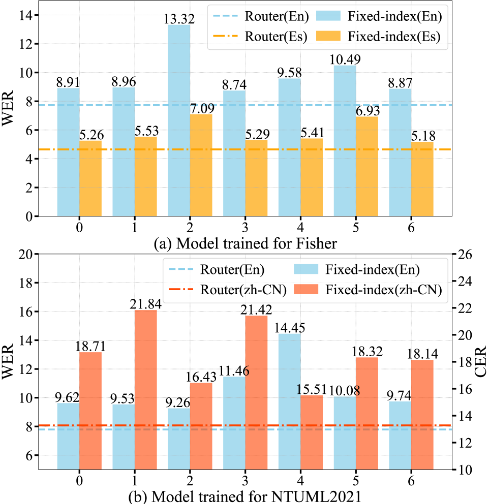
In this set of experiments, we further analyze the semantic comprehension capability of individual experts using ASR data. Specifically, we disable the router and assign all speech tokens to a single expert, iterating over all expert indices within the corresponding language expert group. As presented in Figure 3, enabling the router consistently achieves the best performance across datasets. Meanwhile, the performance of fixed-index experts does not degrade substantially when operating independently. These results suggest that different experts capture complementary aspects of semantic understanding, and that our router can effectively and adaptively route speech tokens to appropriate experts.
6 Conclusion and FutureWork
In this work, we first explore LLMs in end-to-end CS speech translation, and achieve significant improvements in two key aspects. First, we propose a novel MoE speech projector, which enables capturing fine-grained representations of CS speech. Second, we propose a novel multi-stage training paradigm that effectively utilizes diverse data domains while ensuring smooth transitions across training stages. Extensive experiments and analyses verify the effectiveness of our model. For future work, we plan to extend our model to support a wider range of CS language pairs and to investigate more adaptive expert selection mechanisms. Besides, we aim to generalize our model to related CS tasks such as ASR and MT to further validate its robustness and generalizability.
Acknowledgments
This work was supported by the First Batch of Projects for the 2025 "Intergovernmental International Science, Technology and Innovation Cooperation" of the National Key Research and Development Program of China under Grant 2025YFE0121700, Natural Science Foundation of Fujian Province of China (No. 2024J011001), and the Public Technology Service Platform Project of Xiamen (No.3502Z20231043). We also thank the reviewers for their insightful comments.
Contribution Statement
Yan Gao and Yazheng Yang contributed equally.
@inproceedings{ijcai2026p636,
  title     = {Towards Fine-Grained Code-Switch Speech Translation with Semantic Space Alignment},
  author    = {Gao, Yan and Yang, Yazheng and Lan, Zhibin and Chen, Yidong and Zhang, Min and Wei, Daimeng and Wong, Derek F. and Su, Jinsong},
  booktitle = {Proceedings of the Thirty-Fifth International Joint Conference on
               Artificial Intelligence, {IJCAI-26}},
  publisher = {International Joint Conferences on Artificial Intelligence Organization},
  editor    = {Diego Calvanese},
  pages     = {5711--5719},
  year      = {2026},
  month     = {8},
  note      = {Main Track},
  doi       = {10.24963/ijcai.2026/636},
  url       = {https://doi.org/10.24963/ijcai.2026/636},
}
TY - CPAPER TI - Towards Fine-Grained Code-Switch Speech Translation with Semantic Space Alignment AU - Gao, Yan AU - Yang, Yazheng AU - Lan, Zhibin AU - Chen, Yidong AU - Zhang, Min AU - Wei, Daimeng AU - Wong, Derek F. AU - Su, Jinsong T2 - Proceedings of the Thirty-Fifth International Joint Conference on Artificial Intelligence, IJCAI-26 PB - International Joint Conferences on Artificial Intelligence Organization PY - 2026 SP - 5711 EP - 5719 DO - 10.24963/ijcai.2026/636 UR - https://doi.org/10.24963/ijcai.2026/636 ER -Copied
Machine-readable versions of this paper, for tools and AI agents:





