
Emo-LiPO: Listwise Preference Optimization for Fine-Grained Emotion Intensity Control in LLM-based Text-to-Speech
Proceedings of the Thirty-Fifth International Joint Conference on Artificial Intelligence. Main Track. Pages 5855-5863.
https://doi.org/10.24963/ijcai.2026/652
Keywords
- Natural Language Processing: Speech
Abstract
Large language model (LLM)-based text-to-speech (TTS) systems enable prompt-conditioned emotional control but struggle with fine-grained emotion intensity due to the semantic--acoustic gap between text and speech. To address this challenge, we formulate emotion intensity control in LLM-based TTS as a learning-to-rank problem and propose Emo-LiPO, a listwise preference optimization framework that aligns prompt-conditioned speech generation with relative emotion intensity expressed in text. Emo-LiPO explicitly models global intensity ordering within each emotion under fixed transcripts, enabling more faithful and continuous emotional expression. We further construct ESD-plus, a multi-speaker dataset with explicit emotion intensity variations, to support fine-grained emotion modeling and evaluation. Experiments on ESD-plus demonstrate that Emo-LiPO significantly improves emotion accuracy and intensity controllability over both supervised- and DPO-based LLM TTS baselines, with particularly pronounced gains at high intensity levels.
- [Cho et al., 2024] Deok-Hyeon Cho, Hyung-Seok Oh, Seung-Bin Kim, Sang-Hoon Lee, and Seong-Whan Lee. Emosphere-tts: Emotional style and intensity modeling via spherical emotion vector for controllable emotional text-to-speech. arXiv preprint arXiv:2406.07803, 2024.
- [Cho et al., 2025] Deok-Hyeon Cho, Hyung-Seok Oh, Seung-Bin Kim, and Seong-Whan Lee. Emosphere++: Emotion-controllable zero-shot text-to-speech via emotion-adaptive spherical vector. IEEE Transactions on Affective Computing, 2025.
- [Du et al., 2024a] Zhihao Du, Qian Chen, Shiliang Zhang, Kai Hu, Heng Lu, Yexin Yang, Hangrui Hu, Siqi Zheng, Yue Gu, Ziyang Ma, et al. Cosyvoice: A scalable multilin- gual zero-shot text-to-speech synthesizer based on super- vised semantic tokens. arXiv preprint arXiv:2407.05407, 2024.
- [Du et al., 2024b] Zhihao Du, Yuxuan Wang, Qian Chen, Xian Shi, Xiang Lv, Tianyu Zhao, Zhifu Gao, Yexin Yang, Changfeng Gao, Hui Wang, et al. Cosyvoice 2: Scalable streaming speech synthesis with large language models. arXiv preprint arXiv:2412.10117, 2024.
- [Ethayarajh et al., 2024] Kawin Ethayarajh, Winnie Xu, Niklas Muennighoff, Dan Jurafsky, and Douwe Kiela. Kto: Model alignment as prospect theoretic optimization. arXiv preprint arXiv:2402.01306, 2024.
- [Gao et al., 2025] Xiaoxue Gao, Chen Zhang, Yiming Chen, Huayun Zhang, and Nancy F Chen. Emo-dpo: Control- lable emotional speech synthesis through direct preference optimization. In ICASSP 2025-2025 IEEE International Conference on Acoustics, Speech and Signal Processing (ICASSP), pages 1-5. IEEE, 2025.
- [Guo et al., 2023a] Yiwei Guo, Chenpeng Du, Xie Chen, and Kai Yu. Emodiff: Intensity controllable emotional text-to-speech with soft-label guidance. In ICASSP 2023- 2023 IEEE International Conference on Acoustics, Speech and Signal Processing (ICASSP), pages 1-5. IEEE, 2023.
- [Guo et al., 2023b] Zhifang Guo, Yichong Leng, Yihan Wu, Sheng Zhao, and Xu Tan. Prompttts: Controllable text-to- speech with text descriptions. In ICASSP 2023-2023 IEEE International Conference on Acoustics, Speech and Signal Processing (ICASSP), pages 1-5. IEEE, 2023.
- [Im et al., 2022] Chae-Bin Im, Sang-Hoon Lee, Seung-Bin Kim, and Seong-Whan Lee. Emoq-tts: Emotion inten- sity quantization for fine-grained controllable emotional text-to-speech. In ICASSP 2022-2022 IEEE International Conference on Acoustics, Speech and Signal Processing (ICASSP), pages 6317-6321. IEEE, 2022.
- [Lei et al., 2022] Yi Lei, Shan Yang, Xinsheng Wang, and Lei Xie. Msemotts: Multi-scale emotion transfer, pre- diction, and control for emotional speech synthesis. IEEE/ACM Transactions on Audio, Speech, and Language Processing, 30:853-864, 2022.
- [Leng et al., 2023] Yichong Leng, Zhifang Guo, Kai Shen, Xu Tan, Zeqian Ju, Yanqing Liu, Yufei Liu, Dongchao Yang, Leying Zhang, Kaitao Song, et al. Prompttts 2: De- scribing and generating voices with text prompt. arXiv preprint arXiv:2309.02285, 2023.
- [Li et al., 2024] Ziniu Li, Tian Xu, Yushun Zhang, Zhihang Lin, Yang Yu, Ruoyu Sun, and Zhi-Quan Luo. Remax: A simple, effective, and efficient reinforcement learning method for aligning large language models. In Interna- tional Conference on Machine Learning, pages 29128- 29163. PMLR, 2024.
- [Li et al., 2025] Haoxun Li, Yu Liu, Yuqing Sun, Hanlei Shi, Leyuan Qu, and Taihao Li. Emorl-tts: Reinforcement learning for fine-grained emotion control in llm-based tts. arXiv preprint arXiv:2510.05758, 2025.
- [Liang et al., 2025] Shixiong Liang, Ruohua Zhou, and Qingsheng Yuan. Ece-tts: A zero-shot emotion text-to- speech model with simplified and precise control. Applied Sciences, 15(9):5108, 2025.
- [Liu et al., 2025a] Tianqi Liu, Zhen Qin, Junru Wu, Jiaming Shen, Misha Khalman, Rishabh Joshi, Yao Zhao, Mo- hammad Saleh, Simon Baumgartner, Jialu Liu, et al. Lipo: Listwise preference optimization through learning- to-rank. In Proceedings of the 2025 Conference of the Nations of the Americas Chapter of the Association for Computational Linguistics: Human Language Technolo- gies (Volume 1: Long Papers), pages 2404-2420, 2025.
- [Liu et al., 2025b] Zhijun Liu, Dongya Jia, Xiaoqiang Wang, Chenpeng Du, Shuai Wang, Zhuo Chen, and Haizhou Li. Direct preference optimization for speech autoregressive diffusion models. arXiv preprint arXiv:2509.18928, 2025.
- [Ma et al., 2024] Ziyang Ma, Zhisheng Zheng, Jiaxin Ye, Jinchao Li, Zhifu Gao, Shiliang Zhang, and Xie Chen. emotion2vec: Self-supervised pre-training for speech emotion representation. In Findings of the Association for Computational Linguistics: ACL 2024, pages 15747- 15760, 2024.
- [Mittag et al., 2021] Gabriel Mittag, Babak Naderi, Assmaa Chehadi, and Sebastian Möller. Nisqa: A deep cnn- self-attention model for multidimensional speech quality prediction with crowdsourced datasets. arXiv preprint arXiv:2104.09494, 2021.
- [Radford et al., 2023] Alec Radford, Jong Wook Kim, Tao Xu, Greg Brockman, Christine McLeavey, and Ilya Sutskever. Robust speech recognition via large-scale weak supervision. In International conference on machine learning, pages 28492-28518. PMLR, 2023.
- [Rafailov et al., 2023] Rafael Rafailov, Archit Sharma, Eric Mitchell, Christopher D Manning, Stefano Ermon, and Chelsea Finn. Direct preference optimization: Your lan- guage model is secretly a reward model. Advances in neural information processing systems, 36:53728-53741, 2023.
- [Reddy et al., 2021] Chandan KA Reddy, Vishak Gopal, and Ross Cutler. Dnsmos: A non-intrusive perceptual objec- tive speech quality metric to evaluate noise suppressors. In ICASSP 2021-2021 IEEE International Conference on Acoustics, Speech and Signal Processing (ICASSP), pages 6493-6497. IEEE, 2021.
- [Saeki et al., 2022] Takaaki Saeki, Detai Xin, Wataru Nakata, Tomoki Koriyama, Shinnosuke Takamichi, and Hiroshi Saruwatari. Utmos: Utokyo-sarulab sys- tem for voicemos challenge 2022. arXiv preprint arXiv:2204.02152, 2022.
- [Schnell and Garner, 2021] Bastian Schnell and Philip N Garner. Improving emotional tts with an emotion intensity input from unsupervised extraction. In Proc. 11th ISCA Speech Synth. Workshop, pages 60-65, 2021.
- [Schulman et al., 2017] John Schulman, Filip Wolski, Pra- fulla Dhariwal, Alec Radford, and Oleg Klimov. Prox- imal policy optimization algorithms. arXiv preprint arXiv:1707.06347, 2017.
- [Song et al., 2024] Feifan Song, Bowen Yu, Minghao Li, Haiyang Yu, Fei Huang, Yongbin Li, and Houfeng Wang. Preference ranking optimization for human alignment. In Proceedings of the AAAI Conference on Artificial Intelli- gence, volume 38, pages 18990-18998, 2024.
- [Wang et al., 2023] Shijun Wang, Jón Gunason, and Damian Borth. Fine-grained emotional control of text-to-speech: Learning to rank inter-and intra-class emotion intensities. In ICASSP 2023-2023 IEEE International Conference on Acoustics, Speech and Signal Processing (ICASSP), pages 1-5. IEEE, 2023.
- [Wu et al., 2024] Haibin Wu, Xiaofei Wang, Sefik Emre Es- kimez, Manthan Thakker, Daniel Tompkins, Chung-Hsien Tsai, Canrun Li, Zhen Xiao, Sheng Zhao, Jinyu Li, et al. Laugh now cry later: Controlling time-varying emotional states of flow-matching-based zero-shot text-to-speech. In 2024 IEEE Spoken Language Technology Workshop (SLT), pages 690-697. IEEE, 2024.
- [Yang et al., 2025a] Guanrou Yang, Chen Yang, Qian Chen, Ziyang Ma, Wenxi Chen, Wen Wang, Tianrui Wang, Yifan Yang, Zhikang Niu, Wenrui Liu, et al. Emovoice: Llm- based emotional text-to-speech model with freestyle text prompting. In Proceedings of the 33rd ACM International Conference on Multimedia, pages 10748-10757, 2025.
- [Yang et al., 2025b] Qing Yang, Zhenghao Liu, Junxin Wang, Yangfan Du, Pengcheng Huang, and Tong Xiao. Rlaif-spa: Optimizing llm-based emotional speech synthe- sis via rlaif. arXiv preprint arXiv:2510.14628, 2025.
- [Zhang et al., 2024a] Chen Zhang, Chengguang Tang, Dad- ing Chong, Ke Shi, Guohua Tang, Feng Jiang, and Haizhou Li. TS-align: A teacher-student collaborative framework for scalable iterative finetuning of large lan- guage models. In Yaser Al-Onaizan, Mohit Bansal, and Yun-Nung Chen, editors, Findings of the Association for Computational Linguistics: EMNLP 2024, pages 8926- 8946, Miami, Florida, USA, November 2024. Association for Computational Linguistics.
- [Zhang et al., 2024b] Dong Zhang, Zhaowei Li, Shimin Li, Xin Zhang, Pengyu Wang, Yaqian Zhou, and Xipeng Qiu. Speechalign: Aligning speech generation to human pref- erences. Advances in Neural Information Processing Sys- tems, 37:50343-50360, 2024.
- [Zhang et al., 2025a] Chen Zhang, Dading Chong, Feng Jiang, Chengguang Tang, Anningzhe Gao, Guohua Tang, and Haizhou Li. Aligning language models us- ing follow-up likelihood as reward signal. Proceed- ings of the AAAI Conference on Artificial Intelligence, 39(24):25832-25841, Apr. 2025.
- [Zhang et al., 2025b] Shaozuo Zhang, Ambuj Mehrish, Yingting Li, and Soujanya Poria. Proemo: Prompt-driven text-to-speech synthesis based on emotion and intensity control. arXiv preprint arXiv:2501.06276, 2025.
- [Zhao et al., 2023] Yao Zhao, Rishabh Joshi, Tianqi Liu, Misha Khalman, Mohammad Saleh, and Peter J Liu. Slic- hf: Sequence likelihood calibration with human feedback. arXiv preprint arXiv:2305.10425, 2023.
- [Zhou et al., 2022a] Kun Zhou, Berrak Sisman, Rui Liu, and Haizhou Li. Emotional voice conversion: Theory, databases and esd. Speech Communication, 137:1-18, 2022.
- [Zhou et al., 2022b] Kun Zhou, Berrak Sisman, Rajib Rana, Björn W Schuller, and Haizhou Li. Emotion intensity and its control for emotional voice conversion. IEEE Transac- tions on Affective Computing, 14(1):31-48, 2022.
- [Zhou et al., 2026] Li Zhou, Hao Jiang, Junjie Li, Tianrui Wang, and Haizhou Li. Emoshift: Lightweight activation steering for enhanced emotion-aware speech synthesis. In ICASSP 2026 -2026 IEEE International Conference on Acoustics, Speech and Signal Processing (ICASSP), pages 17262-17266, 2026.
References were extracted automatically from the PDF and may contain errors.
Full text extracted automatically from the PDF; figures, tables and equations may differ. The PDF is the version of record.
1 Introduction
Large language model (LLM)-based text-to-speech (TTS) systems have recently enabled prompt-conditioned control over speaking style and emotion [Leng et al., 2023; Du et al., 2024a; Du et al., 2024b; Zhang et al., 2025b; Yang et al., 2025a; Zhou et al., 2026], offering substantially greater flexibility than traditional signal-driven approaches [Zhou et al., 2022b; Wang et al., 2023; Schnell and Garner, 2021; Im et al., 2022; Lei et al., 2022; Cho et al., 2024; Cho et al., 2025]. Despite this progress, fine-grained control over emotion intensity remains a fundamental challenge for promptconditioned LLM-based TTS systems [Guo et al., 2023b; Leng et al., 2023; Du et al., 2024a; Yang et al., 2025a].
∗Corresponding author.
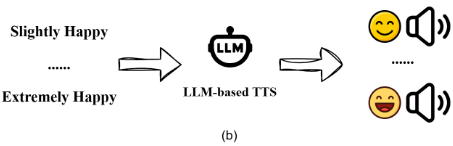
A key difficulty lies in the semantic-acoustic gap between textual emotion descriptions and their realization in speech. While natural language prompts can effectively convey emotion categories (e.g., happy or sad), they often fail to reliably induce perceptually distinguishable variations in emotion strength [Guo et al., 2023b; Leng et al., 2023; Zhang et al., 2025b], as illustrated in Figure 1. As a result, existing models tend to realize emotion intensity implicitly at the acoustic level, leading to unstable or weakly differentiated intensity expressions, especially under high-intensity emotional prompts [Du et al., 2024a; Du et al., 2024b; Yang et al., 2025a]. This limitation significantly constrains the controllability and expressiveness of emotional TTS systems in real-world applications.
Meanwhile, recent advances in preference optimization have demonstrated strong potential for aligning generative models with subjective human judgments. Pair-wise and list-wise preference learning frameworks provide principled mechanisms for modeling relative comparisons, making them particularly suitable for perceptual generation tasks [Rafailov et al., 2023; Zhao et al., 2023; Liu et al., 2025a]. In the context of TTS, emerging preference-aligned methods have shown improved emotional expressiveness and perceptual quality by encouraging preferred outputs over less preferred ones [Zhang et al., 2024b; Gao et al., 2025; Liu et al., 2025b; Yang et al., 2025b; Li et al., 2025]. However, existing preference-based TTS approaches primarily focus on controlling emotion at the categorical level, without explicitly modeling the ordinal structure of emotion intensity. Consequently, relative intensity information specified in text prompts is not directly aligned with preference supervision during training.
In this work, we address the challenge of fine-grained emotion intensity control in LLM-based TTS by framing it as a learning-to-rank problem. We adopt a listwise preference optimization approach that explicitly aligns prompt-conditioned speech generation with relative emotion intensity conveyed by natural language. To facilitate systematic modeling and evaluation of emotion intensity, we additionally construct a multi-speaker dataset with explicit intensity variations and conduct extensive experiments to validate the effectiveness of our approach. Our main contributions can be summarized as follows:
- We propose Emo-LiPO 1 , a listwise preference optimization framework that formulates emotion intensity control in LLM-based TTS as a learning-to-rank problem, enabling fine-grained and text-grounded intensity modeling.
- We construct ESD-plus 2 , a multi-speaker emotional speech dataset with explicit emotion intensity variations to support fine-grained emotion intensity modeling and evaluation.
- Extensive experiments on ESD-plus demonstrate that EMO-LiPO outperforms supervised- and DPO-based baselines in emotion accuracy and intensity controllability, with especially pronounced gains at high intensity.
2 RelatedWork
2.1 Emotion Intensity Control in TTS
Early studies on emotion intensity control mainly operate in the acoustic domain, where emotion strength is explicitly modeled as a continuous variable derived from speech signals using relative ranking or learning-to-rank objectives [Zhou et al., 2022b; Wang et al., 2023]. Other approaches extract intensity representations at different temporal levels and inject them into TTS systems for fine-grained control [Schnell and Garner, 2021; Im et al., 2022; Lei et al., 2022]. More recent methods further disentangle emotion intensity from style using geometric representations or incorporate soft intensity guidance through diffusion-based models [Cho et al., 2024; Cho et al., 2025; Liang et al., 2025; Guo et al., 2023a; Wu et al., 2024]. While effective in controlled settings, these approaches typically rely on explicit acoustic features or specialized architectures and lack flexible, text-driven intensity control. In contrast, recent prompt-conditioned and LLMbased TTS systems leverage natural language descriptions for expressive speech generation, but primarily control discrete emotion categories or coarse prosodic attributes, leaving emotion intensity implicitly realized [Guo et al., 2023b; Leng et al., 2023; Zhang et al., 2025b; Du et al., 2024a; Du et al., 2024b; Yang et al., 2025a]. Our approach directly grounds emotion intensity in natural language and aligns it with preference supervision, enabling explicit and finegrained intensity control in LLM-based TTS.
1 Code is available at hlt-cuhksz/Emo-LiPO.
2 Dataset is available at hlt-cuhksz/ESD-plus.
2.2 Preference Optimization for Generation Tasks
Preference optimization aims to align pre-trained large language models (LLMs) with human preferences through gradient-based optimization during training. Existing approaches can be broadly categorized into point-wise, pairwise, and list-wise methods. Point-wise methods optimize models using feedback defined on individual samples, typically in the form of scalar rewards or binary desirability signals, as exemplified by Proximal Policy Optimization (PPO) [Schulman et al., 2017], Reward Maximization (ReMax) [Li et al., 2024], and Kahneman-Tversky Optimization (KTO) [Ethayarajh et al., 2024]. Pair-wise methods, such as Direct Preference Optimization (DPO) [Rafailov et al., 2023; Zhang et al., 2025a] and SLiC-HF [Zhao et al., 2023], learn from relative preferences between two candidate outputs by contrasting a preferred response against a less preferred one, shaping the model's generation distribution accordingly [Zhang et al., 2024a]. List-wise methods further generalize preference alignment as a ranking problem, directly optimizing list-structured preference signals within a learning-to-rank framework [Song et al., 2024; Liu et al., 2025a]. These methods motivate us by providing a principled approach to learning from subjective human judgments in natural language processing, making them especially well suited for perceptual generation tasks such as emotional speech synthesis.
2.3 Preference Alignment for TTS
Recent studies have begun to incorporate preference alignment into TTS systems to better match human perceptual judgments of speech quality, expressiveness, and emotional appropriateness. SpeechAlign [Zhang et al., 2024b] is an early attempt in this direction, aligning codec-based speech language models by learning preferences between golden and synthetic codec tokens to mitigate distribution mismatches between training and inference. Building upon this paradigm, several works apply preference optimization to emotional speech synthesis. Emo-DPO [Gao et al., 2025] and ARDMDPO [Liu et al., 2025b] adopt pair-wise preference objectives to encourage emotionally preferred outputs over less preferred ones, while RLAIF-SPA [Yang et al., 2025b] and EMORL-TTS [Li et al., 2025] employ reinforcement learning with task-specific rewards to improve emotional expressiveness and controllability. These approaches demonstrate the effectiveness of preference-based optimization for enhancing perceptual speech quality. However, existing preferencealigned TTS methods mainly focus on selecting better samples rather than explicitly modeling the ordinal structure of emotion intensity. As a result, emotion strength is typically optimized implicitly at the acoustic level, and relative intensity specified in text prompts is not directly aligned with preference signals.
3 Method
3.1 ProblemFormulation
Task Definition. We investigate fine-grained control of emotion intensity in LLM-based TTS systems. Given a text transcript and an emotion specification, the TTS model generates speech conditioned on both linguistic content and emotional attributes. Natural language prompts specify an emotion category and, for non-neutral emotions, a relative intensity level. Our goal is to train an LLM-based TTS system to generate speech that accurately follows these specifications.
Formally, let C = Cemo ∪ {neutral} denote the set of emotion categories, where Cemo = {happy, sad, angry, . . .} and neutral corresponds to emotionally flat speech. For each c ∈ Cemo, we define an ordered set of intensity levels L = {l1, l2, . . . , lK}, where li < lj for i < j indicates strictly increasing emotional intensity (e.g., slightly, moderately, extremely). Crucially, the weakest level l1 must remain perceptually distinct from neutral speech, preserving a clear boundary between emotional and non-emotional outputs.
We define the model input as x = (t, Pc,l), consisting of a text transcript t and an emotion prompt Pc,l specifying an emotion category c and intensity level l. The TTS model generates speech S = πθ(x), which should satisfy: (i) Content fidelity, meaning the speech faithfully conveys the linguistic content of the transcript t; (ii) Category correctness, meaning the generated speech follows emotion c exactly; and (iii) Intensity ordering for c ∈ Cemo, such that speech generated with higher intensity levels is perceived as strictly stronger than that generated with lower levels.
Learning-to-Rank Formulation via LiPO (Emo-LiPO). To meet these requirements, we adopt the Listwise Preference Optimization (LiPO) framework [Liu et al., 2025a] and formulate fine-grained emotion intensity control as a Learningto-Rank (LTR) problem. In this formulation, all candidate speech samples compared under the same prompt are generated from the same text transcript. LiPO learns from listwise preference data defined over multiple candidates generated for the same prompt, making it well suited for modeling both emotion category correctness and global intensity ordering.
In contrast, Supervised Fine-Tuning (SFT) relies on independent prompt-target pairs, DSFT =
{(x = (t, Pc,l), y = Sc,l)}, which provide no supervision on relative emotional intensity across samples. Direct Preference Optimization (DPO) extends SFT by introducing pairwise preferences, DDPO = {(x = (t, Pc,l), y = Sc,l, ¯ Sc,l))}, where ¯ Sc,l denotes a negative sample. While DPO captures local preference information, it remains limited to binary comparisons. In emotional TTS, existing DPO-based methods such as Emo-DPO [Gao et al., 2025] similarly rely on pairwise emotional preferences 3 . As a result, these approaches are inherently constrained to local comparisons and cannot enforce a global ordering of emotional intensity.
Notably, Emo-LiPO adopts a listwise formulation, DLiPO = {(x = (t, Pc,l), y = (Tc,l, ψc,l))}, where Tc,l is a list of speech samples generated by the TTS model, and ψc,l ∈ [0, 1]|Tc,l| is a vector of real-valued preference scores associated with the corresponding samples, with larger values indicating stronger preference. This listwise supervision enables Emo-LiPO to explicitly model fine-grained emotional intensity rankings across multiple candidates.
3.2 Emo-LiPO Framework
We present the Emo-LiPO framework by specifying the construction of listwise preference data and the corresponding optimization objective under the LiPO formulation.
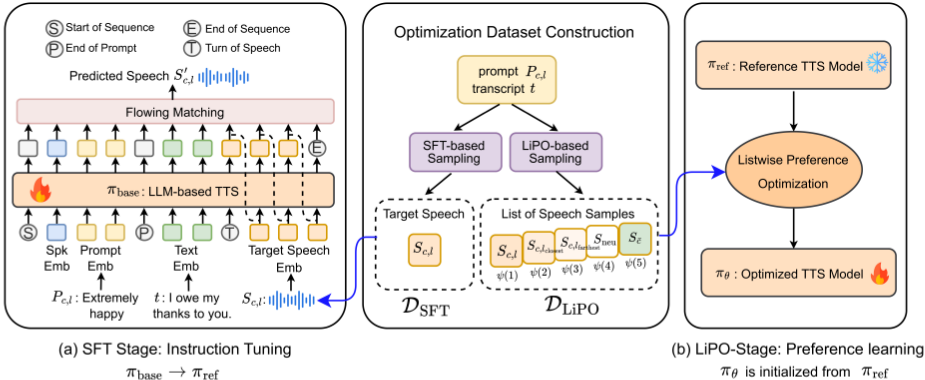
Rule-Based Preference Construction. For a prompt Pc,l, we construct a listwise preference set Tc,l of K + 2 speech candidates with the same text transcript t using a rule-based ranking strategy. The list consists of: (i) a target sample Sc,l with the exact emotion category c and intensity level l; (ii) K - 1 same-emotion samples with the same category c but different intensity levels l′ ∈ L \ {l}; (iii) one neutral speech sample; and (iv) one negative sample with a randomly selected non-target emotion category. Under this rule-based strategy, the K-1 same-emotion samples are ordered according to their absolute intensity distance |l′ - l|, with samples closer to the target intensity being preferred; ties are resolved by random ordering. The resulting preference list follows the order
3 In Emo-DPO, each training instance is defined as x = (t, Pc), y = (Sc, S¯ c).
where lclosest and lfarthest denote intensity levels of the same emotion category ordered by increasing distance from l.
Based on the rule-based ranking described above, we assign a real-valued preference label vector ψc,l ∈ [0, 1]|Tc,l| to the speech samples in Tc,l. Specifically, we adopt an indexbased preference scoring scheme, where the preference label of each sample is determined by its position in the ordered list Tc,l. Let i denote the index of a sample in the list, with smaller indices indicating stronger preference. The preference label of the i-th sample is defined as
Multi-Stage Optimization. As illustrated in Figure 2, following Emo-DPO [Gao et al., 2025], we optimize the TTS model in a multi-stage manner, starting with SFT to learn basic instruction following, and subsequently applying LiPO for fine-grained emotion intensity control. The LLM-based TTS model formulates text-to-speech as a conditional autoregressive generation task [Du et al., 2024a], in which speech tokens are generated sequentially conditioned on the joint input x = (t, Pc,l), together with a speaker embedding.
Specifically, in the SFT stage, we perform supervised finetuning on a paired prompt-speech dataset DSFT to initialize the backbone TTS model πbase:
where logπbase(S | x) is computed using teacher forcing with token-level cross-entropy over the autoregressively generated speech tokens. The resulting model is denoted as the reference TTS policy πref in the subsequent stage.
In the LiPO stage, initialized from πref , we optimize the model using the listwise preference dataset DLiPO as defined in §3.1. Given a preference list Tc,l and its associated preference label vector ψc,l, we apply Listwise Preference Optimization to encourage the model to generate speech samples that better align with the desired emotion intensity ordering. The corresponding optimization objective is defined as:
where r(·) denotes a listwise learning-to-rank loss under the LiPO framework, and s represents the ranking scores induced by the current policy πθ relative to the reference policy πref , The score of each candidate Si ∈ Tc,l is computed as:
Following the original LiPO formulation [Liu et al., 2025a], r(·) is defined as:
where ψc,l = {(i, j) | ψc,l(i) > ψc,l(j)}, the relative orders of candidate pairs (Si, Sj). The weighting term λi,j serves as an intensity-aware coefficient that scales each pairwise loss term according to the implied emotion-intensity discrepancy between (Si, Sj), injecting fine-grained intensity information beyond the binary preference order and promoting ordinal consistency for more reliable intensity control. We then define the gain and discount functions, G(·) and D(·), based on the position index i:
and λi,j is derived as:
A larger λi,j implies a larger implied intensity gap between Si and Sj under the list ranking, so the model is penalized more strongly for violating their order.
4 ESD-plus Dataset
4.1 Dataset Overview
To evaluate the effectiveness of the proposed Emo-LiPO method, we construct ESD-plus, a speech dataset with explicit emotion intensity variations designed to support research on fine-grained emotion control in TTS systems. ESDplus is built upon the English portion of the ESD corpus [Zhou et al., 2022a], from which we select 350 parallel sentences as synthesis scripts. We retain the original ESD emotion categories, including four non-neutral emotions (happy, surprise, sad, and angry) and one neutral emotion. For each non-neutral emotion, we further introduce three distinct intensity levels, resulting in a total of 13 fine-grained emotion labels.
In total, ESD-plus contains 45,500 fine-grained emotional speech samples, with an average duration of 2.92 seconds per sample, amounting to approximately 36.89 hours of audio for training and evaluation. Following the official data partitioning strategy of ESD [Zhou et al., 2022a], we split the dataset into training, development, and test sets with 300, 20, and 30 utterances, respectively, while ensuring that all speaker-emotion variants of each utterance are assigned to the same split.
4.2 Dataset Construction and Quality Control
We construct ESD-plus using a prompt-based emotional speech synthesis pipeline built upon gpt-4o-mini-tts 4 . For each emotion-intensity category, we design a structured prompt that combines a natural-language emotion description with a scalar intensity indicator, providing unified and reusable conditional control signals. To ensure perceptually distinguishable emotional variations across different intensity levels, the scalar indicators are deliberately spaced (e.g., 1/5, 3/5, and 5/5) rather than uniformly incremental. 5 Moreover, we generate speech using 10 official English voices, comprising 4 male and 6 female speakers, enabling multi-speaker emotional synthesis.
4 https://openai.fm/
5 Details on dataset construction, quality control, and dataset statistics are provided in the supplementary material (Appendix A).
| Model | Speech Quality | Emotion Relevance | |||||
|---|---|---|---|---|---|---|---|
| WER ↓ | NISQA ↑ | DNSMOS ↑ | UTMOS ↑ | EmoSIM↑ | Recall ↑ | Recall-ft ↑ | |
| CosyVoice | 4.47 | 4.71 | 3.16 | 4.30 | 81.87 | 25.10 | 29.90 |
| EmoVoice | 5.40 | 4.79 | 3.29 | 4.27 | 89.84 | 20.56 | 28.51 |
| Emo-DPO (R) | 12.78 | 4.37 | 3.04 | 3.90 | 91.52 | 24.77 | 33.46 |
| Emo-DPO (E) | 4.78 | 4.66 | 3.23 | 4.06 | 91.73 | 24.08 | 34.92 |
| Emo-DPO (I) | 6.79 | 4.60 | 3.21 | 4.00 | 91.85 | 26.87 | 37.21 |
| Emo-LiPO | 4.26 | 4.79 | 3.26 | 4.18 | 91.93 | 27.56 | 39.54 |
| - w/o λ | 4.15 | 4.79 | 3.24 | 4.17 | 92.30 | 26.21 | 37.59 |
To ensure data reliability, we perform human verification on the development and test sets of ESD-plus, which are used exclusively for model evaluation. Annotators perform pairwise comparisons within each emotion category to verify that speech samples generated at different intensity levels exhibit consistent and monotonically increasing emotional intensity in accordance with their prompts. Samples that fail to demonstrate the expected intensity ordering are flagged and regenerated until the target ordering is satisfied, thereby ensuring the correctness of emotion-intensity labels in the development and test sets. Overall, 91.23% of the evaluated samples pass verification, demonstrating that ESD-plus provides highquality and reliable data for model training and evaluation. 6
5 Experiments
5.1 Experimental Setup
Baselines and Implementation. We adopt several LLMbased TTS models as baselines. Specifically, we include two supervised LLM-based TTS models: CosyVoice [Du et al., 2024a], which is built upon supervised semantic tokens, and EmoVoice [Yang et al., 2025a], which supports freestyle text prompting for emotional control. In addition, we consider preference-optimized LLM-based TTS methods following Emo-DPO [Gao et al., 2025], which primarily target coarse-grained emotion category control. To evaluate their effectiveness in modeling fine-grained emotion intensity, we design three Emo-DPO variants: (i) Emo-DPO (R), trained with randomly sampled pairwise preferences (Sc,l, ¯ Sc,l); (ii) Emo-DPO (E), trained using pairwise preferences across different emotion categories at the same intensity level (Sc,l, S¯ c,l); and (iii) Emo-DPO (I), trained using pairwise preferences across different intensity levels within the same emotion category (Sc,l, Sc,¯l). Our Emo-LiPO model is built upon CosyVoice as the backbone, specifically using the CosyVoice-300M-Instruct version.
EvaluationMetric. We evaluate the generated speech from two complementary perspectives: speech quality and emotion relevance. At the speech level, we assess intelligibility and perceptual quality. Speech intelligibility is measured using Word Error Rate (WER), computed with the WhisperLarge-v3 ASR model [Radford et al., 2023]. Speech naturalness and overall perceptual quality are evaluated using three objective metrics: NISQA [Mittag et al., 2021], DNSMOS [Reddy et al., 2021], and UTMOS [Saeki et al., 2022]. At the emotion level, we evaluate how well the generated speech conveys the intended emotional content. We employ the emotion2vec model [Ma et al., 2024] for speech emotion recognition (SER) and adopt two metrics: Emotion Similarity (EmoSIM) and Recall. EmoSIM is computed as the cosine similarity between emotion embeddings extracted from the generated and ground-truth speech. Recall measures the emotion classification accuracy of emotion2vec on the generated speech. Due to its limited out-of-domain performance, we further fine-tune emotion2vec on ESD-plus and report the resulting score as Recall-ft.
6 The training set is not modified during this process, as its overall label correctness is already high.
5.2 Emotion Category Control Performance
Effect of Intensity-Aware Preference Modeling. Table 1 summarizes the performance of different prompt-conditioned TTS models in terms of emotion category control, together with their speech quality metrics. Overall, Emo-LiPO demonstrates the strongest ability to generate speech that aligns with the intended emotion categories, consistently outperforming both supervised baselines and DPO-based methods, while maintaining comparable speech quality. Compared with supervised LLM-based TTS models, preferenceoptimized approaches show clear advantages in emotion relevance, indicating that incorporating preference signals is critical for learning effective emotional control without sacrificing speech naturalness. Among the DPO-based variants, models trained with structured emotion-related preferences achieve better emotion category recognition than those trained with randomly sampled pairs, highlighting the importance of informative preference construction. Notably, introducing intensity-aware preference modeling further improves emotion category control. Emo-DPO trained with intensitylevel preferences performs better than variants relying solely on cross-category comparisons, suggesting that modeling relative intensity ordering within emotions provides transferable supervision for category-level emotion recognition. Finally, Emo-LiPO consistently achieves the best performance across emotion relevance metrics, demonstrating that listwise preference optimization enables more accurate and robust emotion category control under fine-grained emotional prompting, without degrading speech quality.
The impact of weighting term λ. To analyze the role of the distance-based weighting term λ (Eq. 8) in learning stable intensity ordering, we conduct an ablation study in which λ is fixed to 1 for all preference pairs, resulting in a uniformly weighted LiPO loss, while keeping all other training settings unchanged. As shown in Table 1, adopting uniform weighting leads to a slight improvement in emotion similarity but consistently degrades emotion control metrics compared with the full model. These findings indicate that λ does not primarily improve category-level alignment; rather, it provides more informative supervision for intensity-aware ranking by emphasizing ordinal consistency across candidates, thereby enhancing controllability and generalization during evaluation.
5.3 Emotion Intensity Control Performance
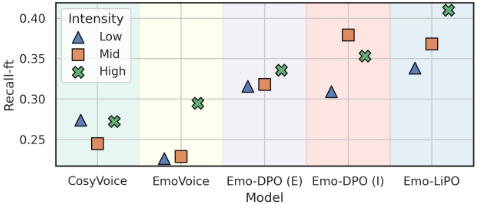
Automatic Evaluation Comparison. Intuitively, higher emotional intensity leads to more perceptually salient speech and should therefore result in higher emotion recognition accuracy. Accordingly, we evaluate emotion recognition accuracy (Recall-ft) across different emotion intensity levels, as shown in Figure 3. Emo-LiPO achieves the strongest overall performance and is the only model that exhibits a clear and stable monotonic increase in Recall-ft from low to high intensity levels. In contrast, supervised baselines and DPO-based variants display weaker or non-monotonic trends, indicating inconsistent alignment between textual intensity descriptions and the generated speech. These results demonstrate that Emo-LiPO more faithfully translates relative emotion intensity specifications into perceptually distinguishable speech, validating its effectiveness in fine-grained emotion intensity control.
Human Evaluation Comparison. To further validate the effectiveness of Emo-LiPO in emotion intensity control, we conduct a human Arena-style evaluation. We perform pairwise comparisons between Emo-LiPO and three representative baselines (CosyVoice, Emo-DPO (E), and Emo-DPO (I)) along three perceptual dimensions: Speech Quality, Emotion Expression, and Intensity Control. For each comparison, annotators are presented with the same text prompt and two candidate models, each providing a pair of speech samples generated under the same script and emotion category at adjacent intensity levels. The evaluated intensity transitions include (Sneu, Sc,llow ), (Sc,llow , Sc,lmid ), and (Sc,lmid , Sc,lhigh ). Annotators select the model that performs better with respect to a single evaluation dimension, with a tie option allowed when performance is comparable. The order of models is randomized, and five annotators participate in the evaluation. 7
| CosyVoice | Emo-DPO (E) | Emo-DPO (I) | |
|---|---|---|---|
| Speech Quality | 94.29 | 79.37 | 89.28 |
| Emotion Expression | 90.34 | 80.65 | 78.24 |
| Intensity Control | 86.08 | 66.44 | 58.33 |
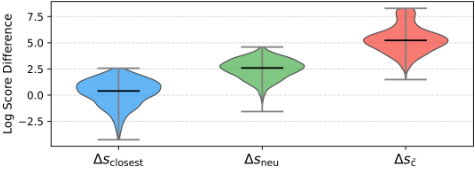
Table 2 reports the Arena win rates of Emo-LiPO compared with three baseline models across three perceptual dimensions. Overall, Emo-LiPO consistently outperforms all baselines in all evaluation dimensions, demonstrating strong perceptual advantages under human judgment. When compared with Emo-DPO (I), the advantage of Emo-LiPO in intensity control is less pronounced, suggesting that incorporating intensity-aware pairwise preferences already captures part of the fine-grained intensity information. However, EmoLiPO consistently outperforms Emo-DPO (I) in Speech Quality, indicating that listwise preference optimization better preserves acoustic naturalness while maintaining competitive intensity controllability. This comparison highlights a favorable trade-off achieved by Emo-LiPO, where global intensity ordering is modeled without sacrificing speech quality.
Score Distance Visualization. To diagnose whether the Emo-LiPO policy πθ induces a separable preference structure consistent with the rule-based list supervision in Eq. 1, we visualize the distribution of score margins between the target sample Sc,l and the candidates in Tc,l. Based on Eq. 5, we compute three absolute margins aligned with the list components: (i) the margin to closest same emotion sample, ∆sclosest = |s(Sc,l) - s(Sc,lclosest )|; (ii) the margin to neutral sample, ∆sneu = |s(Sc,l) - s(Sneu)|; and (iii) the margin to other emotion sample, ∆s¯ c = |s(Sc,l) - s(S¯ c)|. For comparability across scales, we plot the logarithm of these margins. As shown in Fig. 4, the three margins exhibit a stable hierarchy in both location and central tendency: ∆s¯ c is the largest and most concentrated, followed by ∆sneu, while ∆sclosest is the smallest and closer to zero with a longer tail, reflecting the finer and more challenging discrimination between nearest intensities within the same emotion. Overall, this distributional hierarchy is consistent with the rule-based order in Eq. 1, indicating that Emo-LiPO shapes a scoring landscape that prioritizes cross-emotion separation while preserving fine-grained intensity hierarchy modeling within the same emotion.
7 Detailed human evaluation settings, including the evaluation scale, platform, and annotation guidelines, are provided in the supplementary material (Appendix B).

5.4 Ablation Studies and Analysis
Effect of the Number of Negative Samples S¯ c. We investigate how the number of negative samples affects intensity learning in listwise optimization by varying the number of negatives while keeping the target intensity chain fixed. Each negative sample is drawn from a non-target emotion category under the same text condition. As shown in Figure 5 (a), introducing a single negative sample yields the best overall performance and produces a clearer monotonic trend across intensity levels. In contrast, increasing the number of negative samples to two or three does not lead to further gains and instead degrades performance. These results suggest that a limited amount of cross-emotion contrast is sufficient for effective intensity learning, whereas excessive negative samples weaken the supervision signal for modeling intensity ordering.
Effect of Ranking Strategy for Preference List Construction. To study how the ranking strategy for constructing preference lists Tc,l affects intensity learning, we compare three ordering schemes on the same candidate set. Specifically, we evaluate the proposed rule-based strategy against two acoustic-driven alternatives, where candidates are ranked by their distance to the target speech in terms of average pitch or energy. As shown in Figure 5 (b), the rule-based ranking achieves the best overall performance among the three strategies. In comparison, pitch-based ranking performs the worst, while energy-based ranking yields intermediate results. These findings suggest that rankings derived from a single acoustic attribute provide weaker supervision signals, whereas the rule-based strategy offers a more effective and stable ordering for listwise preference optimization.
Effect of Weighting Mechanism in Listwise Optimization. We study the effect of the weighting mechanism λ in listwise optimization under identical training settings. By default, Emo-LiPO adopts an index-based preference labeling scheme for ψc,l, from which the distance-aware weighting term λi,j is derived. We compare this default setting with two variants: (i) fixed-λ, which disables weighting by setting λi,j = 1 for all pairs; and (ii) score-λ, where λi,j is computed from pre-assigned preference score gaps. As shown in Figure 5 (c), introducing distance-aware weighting consistently improves performance over the fixed-λ variant. Index-based and score-based weighting achieve similar results, indicating that the performance gains mainly stem from the weighting mechanism itself rather than the specific definition of ψc,l.
Impact of Negative Sampling Strategies. We study how the sampling strategy for the single negative sample S¯ c affects intensity learning in listwise optimization. By default, our method samples the negative uniformly at random across all intensity levels (Rand). Each preference list includes one negative sample drawn from a non-target emotion category. We further compare this default strategy with three alternatives that restrict the negative sample to a specific intensity level (Low, Mid, or High). As shown in Figure 5 (d), the default random strategy achieves the best overall performance, while constraining negatives to a single intensity level consistently degrades performance. These results indicate that sampling negatives across diverse intensity levels provides more balanced supervision, whereas single-level sampling introduces bias and weakens stable intensity ordering.
6 Conclusion
This work studies fine-grained emotion intensity control in prompt-conditioned LLM-based text-to-speech systems and identifies the limitations of existing supervised and preference-aligned methods in modeling perceptually meaningful intensity variations. To address this challenge, we propose Emo-LiPO, a listwise preference optimization framework that formulates emotion intensity control as a learningto-rank problem and explicitly models global intensity ordering under fixed transcripts. We further introduce ESD-plus, a multi-speaker emotional speech dataset with explicit intensity variations to support systematic training and evaluation. Extensive automatic and human evaluations demonstrate that Emo-LiPO consistently outperforms strong supervised and DPO-based LLM TTS baselines in emotion accuracy and intensity controllability, while maintaining high speech quality. Overall, this work highlights the importance of listwise preference modeling for fine-grained emotional control and provides a principled direction for expressive and controllable speech generation.
Ethical Statement
There are no ethical issues.
Acknowledgments
This research is supported by National Natural Science Foundation of China (Grant No. 62271432), the Program for Guangdong Introducing Innovative and Entrepreneurial Teams(Grant No. 2023ZT10X044), Shenzhen Science and Technology Program(Shenzhen Key Laboratory, Grant No. ZDSYS20230626091302006), and the Shenzhen Stability Science Program 2023. This research was also supported by the Internal Project of the Shenzhen Research Institute of Big Data (SRIBD), the internal project of the Guangdong Provincial Key Laboratory of Big Data Computing under Grant B10120210117-KP02 (The Chinese University of Hong Kong, Shenzhen), and Shenzhen Key Lab of MultiModal Cognitive Computing.
Contribution Statement
Yihang Lin and Li Zhou are co-first authors and contributed equally.
@inproceedings{ijcai2026p652,
  title     = {Emo-LiPO: Listwise Preference Optimization for Fine-Grained Emotion Intensity Control in LLM-based Text-to-Speech},
  author    = {Lin, Yihang and Zhou, Li and Cao, Congwei and Xie, Dongchu and Gao, Xiaoxue and Zhang, Chen and Li, Haizhou},
  booktitle = {Proceedings of the Thirty-Fifth International Joint Conference on
               Artificial Intelligence, {IJCAI-26}},
  publisher = {International Joint Conferences on Artificial Intelligence Organization},
  editor    = {Diego Calvanese},
  pages     = {5855--5863},
  year      = {2026},
  month     = {8},
  note      = {Main Track},
  doi       = {10.24963/ijcai.2026/652},
  url       = {https://doi.org/10.24963/ijcai.2026/652},
}
TY - CPAPER TI - Emo-LiPO: Listwise Preference Optimization for Fine-Grained Emotion Intensity Control in LLM-based Text-to-Speech AU - Lin, Yihang AU - Zhou, Li AU - Cao, Congwei AU - Xie, Dongchu AU - Gao, Xiaoxue AU - Zhang, Chen AU - Li, Haizhou T2 - Proceedings of the Thirty-Fifth International Joint Conference on Artificial Intelligence, IJCAI-26 PB - International Joint Conferences on Artificial Intelligence Organization PY - 2026 SP - 5855 EP - 5863 DO - 10.24963/ijcai.2026/652 UR - https://doi.org/10.24963/ijcai.2026/652 ER -Copied
Machine-readable versions of this paper, for tools and AI agents:





