
RM-Distiller: Exploiting Generative LLM for Reward Model Distillation
Proceedings of the Thirty-Fifth International Joint Conference on Artificial Intelligence. Main Track. Pages 6118-6126.
https://doi.org/10.24963/ijcai.2026/681
Keywords
- Natural Language Processing: Language models
Abstract
Reward models (RMs) play a pivotal role in aligning large language models (LLMs) with human preferences. Due to the difficulty of obtaining high-quality human preference annotations, distilling preferences from generative LLMs has emerged as a standard practice. However, existing approaches predominantly treat teacher models as simple binary annotators, failing to fully exploit the rich knowledge and capabilities for RM distillation. To address this, we propose RM-Distiller, a framework designed to systematically exploit the multifaceted capabilities of teacher LLMs: (1) Refinement capability, which synthesizes highly correlated response pairs to create fine-grained and contrastive signals. (2) Scoring capability, which guides the RM in capturing precise preference strength via a margin-aware optimization objective. (3) Generation capability, which incorporates the teacher's generative distribution to regularize the RM to preserve its fundamental linguistic knowledge. Extensive experiments demonstrate that RM-Distiller significantly outperforms traditional distillation methods both on RM benchmarks and reinforcement learning-based alignment, proving that exploiting multifaceted teacher capabilities is critical for effective reward modeling. To the best of our knowledge, this is the first systematic research on RM distillation from generative LLMs.
- [Ankner et al., 2024] Zachary Ankner, Mansheej Paul, Bran- don Cui, Jonathan Daniel Chang, and Prithviraj Am- manabrolu. Critique-out-loud reward models. In Pluralis- tic Alignment Workshop at NeurIPS 2024, 2024.
- [Bai et al., 2022a] Yuntao Bai, Andy Jones, Kamal Ndousse, Amanda Askell, Anna Chen, Nova DasSarma, Dawn Drain, Stanislav Fort, Deep Ganguli, Tom Henighan, et al. Training a helpful and harmless assistant with reinforce- ment learning from human feedback. arXiv preprint arXiv:2204.05862, 2022.
- [Bai et al., 2022b] Yuntao Bai, Saurav Kadavath, Sandipan Kundu, Amanda Askell, Jackson Kernion, Andy Jones, Anna Chen, Anna Goldie, Azalia Mirhoseini, Cameron McKinnon, et al. Constitutional ai: Harmlessness from ai feedback. arXiv preprint arXiv:2212.08073, 2022.
- [Chen et al., 2025] Nuo Chen, Zhiyuan Hu, Qingyun Zou, Jiaying Wu, Qian Wang, Bryan Hooi, and Bingsheng He. Judgelrm: Large reasoning models as a judge. arXiv preprint arXiv:2504.00050, 2025.
- [Ding et al., 2023] Ning Ding, Yulin Chen, Bokai Xu, Yu- jia Qin, Shengding Hu, Zhiyuan Liu, Maosong Sun, and Bowen Zhou. Enhancing chat language models by scaling high-quality instructional conversations. In Proceedings of the 2023 Conference on Empirical Methods in Natural Language Processing, pages 3029-3051, 2023.
- [Dong et al., 2023] Yi Dong, Zhilin Wang, Makesh Sreed- har, Xianchao Wu, and Oleksii Kuchaiev. SteerLM: At- tribute conditioned SFT as an (user-steerable) alternative to RLHF. In Findings of the Association for Computa- tional Linguistics: EMNLP 2023, 2023.
- [Dubois et al., 2024] Yann Dubois, Percy Liang, and Tat- sunori Hashimoto. Length-controlled alpacaeval: A sim- ple debiasing of automatic evaluators. In First Conference on Language Modeling, 2024.
- [Grattafiori et al., 2024] Aaron Grattafiori, Abhimanyu Dubey, Abhinav Jauhri, Abhinav Pandey, Abhishek Kadian, Ahmad Al-Dahle, Aiesha Letman, Akhil Mathur, Alan Schelten, Alex Vaughan, et al. The llama 3 herd of models. arXiv preprint arXiv:2407.21783, 2024.
- [Huang et al., 2025] Hui Huang, Xingyuan Bu, Hongli Zhou, Yingqi Qu, Jing Liu, Muyun Yang, Bing Xu, and Tiejun Zhao. An empirical study of LLM-as-a-judge for LLM evaluation: Fine-tuned judge model is not a general substitute for GPT-4. In Findings of the Association for Computational Linguistics: ACL 2025, 2025.
- [Huang et al., 2026] Hui Huang, Yancheng He, Hongli Zhou, Rui Zhang, Wei Liu, Weixun Wang, Jiaheng Liu, and Wenbo Su. Think-j: Learning to think for generative llm-as-a-judge. Proceedings of the AAAI Conference on Artificial Intelligence, 40(37):31158-31166, 2026.
- [Hurst et al., 2024] Aaron Hurst, Adam Lerer, Adam P Goucher, Adam Perelman, Aditya Ramesh, Aidan Clark, AJ Ostrow, Akila Welihinda, Alan Hayes, Alec Rad- ford, et al. Gpt-4o system card. arXiv preprint arXiv:2410.21276, 2024.
- [Jiang et al., 2023] Albert Q. Jiang, Alexandre Sablayrolles, Arthur Mensch, Chris Bamford, Devendra Singh Chaplot, Diego de las Casas, Florian Bressand, Gianna Lengyel, Guillaume Lample, Lucile Saulnier, et al. Mistral 7b. arXiv preprint arXiv:2310.06825, 2023.
- [Jiang et al., 2024] Yuxin Jiang, Yufei Wang, Xingshan Zeng, Wanjun Zhong, Liangyou Li, Fei Mi, Lifeng Shang, Xin Jiang, Qun Liu, and Wei Wang. FollowBench: A multi-level fine-grained constraints following benchmark for large language models. In Proceedings of the 62nd Annual Meeting of the Association for Computational Lin- guistics, pages 4667-4688, 2024.
- [Jiang et al., 2025] Yuxin Jiang, Bo Huang, Yufei Wang, Xingshan Zeng, Liangyou Li, Yasheng Wang, Xin Jiang, Lifeng Shang, Ruiming Tang, and Wei Wang. Bridg- ing and modeling correlations in pairwise data for direct preference optimization. In International Conference on Learning Representations, pages 85386-85405, 2025.
- [Lambert et al., 2025] Nathan Lambert, Valentina Pyatkin, Jacob Morrison, LJ Miranda, Bill Yuchen Lin, Khyathi Chandu, Nouha Dziri, Sachin Kumar, Tom Zick, Yejin Choi, et al. RewardBench: Evaluating reward models for language modeling. In Findings of the Association for Computational Linguistics: NAACL 2025, pages 1755- 1797, 2025.
- [Liu et al., 2024] Chris Yuhao Liu, Liang Zeng, Jiacai Liu, Rui Yan, Jujie He, Chaojie Wang, Shuicheng Yan, Yang Liu, and Yahui Zhou. Skywork-reward: Bag of tricks for reward modeling in llms. arXiv preprint arXiv:2410.18451, 2024.
- [Liu et al., 2025a] Chris Yuhao Liu, Liang Zeng, Yuzhen Xiao, Jujie He, Jiacai Liu, Chaojie Wang, Rui Yan, Wei Shen, Fuxiang Zhang, Jiacheng Xu, et al. Skywork- reward-v2: Scaling preference data curation via human-ai synergy. arXiv preprint arXiv:2507.01352, 2025.
- [Liu et al., 2025b] Yantao Liu, Zijun Yao, Rui Min, Yixin Cao, Lei Hou, and Juanzi Li. Rm-bench: Benchmarking reward models of language models with subtlety and style. In International Conference on Learning Representations, 2025.
- [Lou et al., 2024] Xingzhou Lou, Dong Yan, Wei Shen, Yuzi Yan, Jian Xie, and Junge Zhang. Uncertainty-aware re- ward model: Teaching reward models to know what is un- known. arXiv preprint arXiv:2410.00847, 2024.
- [Malik et al., 2026] Saumya Malik, Valentina Pyatkin, Sander Land, Jacob Morrison, Noah A. Smith, Han- naneh Hajishirzi, and Nathan Lambert. Rewardbench 2: Advancing reward model evaluation. In International Conference on Learning Representations, 2026.
- [Park et al., 2024] Junsoo Park, Seungyeon Jwa, Ren Meiy- ing, Daeyoung Kim, and Sanghyuk Choi. OffsetBias: Leveraging debiased data for tuning evaluators. In Find- ings of the Association for Computational Linguistics: EMNLP 2024, pages 1043-1067, 2024.
- [Peng et al., 2025] Hao Peng, Yunjia Qi, Xiaozhi Wang, Zi- jun Yao, Bin Xu, Lei Hou, and Juanzi Li. Agentic reward modeling: Integrating human preferences with verifiable correctness signals for reliable reward systems. In Pro- ceedings of the 63rd Annual Meeting of the Association for Computational Linguistics, pages 15934-15949, 2025.
- [Schulman et al., 2017] John Schulman, Filip Wolski, Pra- fulla Dhariwal, Alec Radford, and Oleg Klimov. Prox- imal policy optimization algorithms. arXiv preprint arXiv:1707.06347, 2017.
- [Shao et al., 2024] Zhihong Shao, Peiyi Wang, Qihao Zhu, Runxin Xu, Junxiao Song, Xiao Bi, Haowei Zhang, Mingchuan Zhang, YK Li, Yang Wu, et al. Deepseekmath: Pushing the limits of mathematical reasoning in open lan- guage models. arXiv preprint arXiv:2402.03300, 2024.
- [Shen et al., 2025] Jiaming Shen, Ran Xu, Yennie Jun, Zhen Qin, Tianqi Liu, Carl Yang, Yi Liang, Simon Baum- gartner, and Michael Bendersky. RMBoost: Reward model training with preference-conditional multi-aspect synthetic data generation. In Scaling Self-Improving Foun- dation Models without Human Supervision, 2025.
- [Team et al., 2024] Gemma Team, Morgane Riviere, Shreya Pathak, Pier Giuseppe Sessa, Cassidy Hardin, Surya Bhu- patiraju, Léonard Hussenot, Thomas Mesnard, Bobak Shahriari, Alexandre Ramé, et al. Gemma 2: Improving open language models at a practical size. arXiv preprint arXiv:2408.00118, 2024.
- [Touvron et al., 2023] Hugo Touvron, Louis Martin, Kevin Stone, Peter Albert, Amjad Almahairi, Yasmine Babaei, Nikolay Bashlykov, Soumya Batra, Prajjwal Bhargava, Shruti Bhosale, et al. Llama 2: Open foundation and fine-tuned chat models. arXiv preprint arXiv:2307.09288, 2023.
- [Wang et al., 2024] Binghai Wang, Rui Zheng, Lu Chen, Zhiheng Xi, Wei Shen, Yuhao Zhou, Dong Yan, Tao Gui, Qi Zhang, and Xuanjing Huang. Reward modeling re- quires automatic adjustment based on data quality. In Findings of the Association for Computational Linguistics: EMNLP 2024, pages 4041-4064, 2024.
- [Wang et al., 2025] Chenglong Wang, Yang Gan, Yifu Huo, Yongyu Mu, Qiaozhi He, Murun Yang, Bei Li, Tong Xiao, Chunliang Zhang, Tongran Liu, and Jingbo Zhu. GRAM: A generative foundation reward model for reward gener- alization. In International Conference on Machine Learn- ing, pages 62916-62936. PMLR, 2025.
- [Yang et al., 2024a] An Yang, Baosong Yang, Beichen Zhang, Binyuan Hui, Bo Zheng, Bowen Yu, Chengyuan Li, Dayiheng Liu, Fei Huang, Haoran Wei, et al. Qwen2.5 technical report. arXiv preprint arXiv:2412.15115, 2024.
- [Yang et al., 2024b] Rui Yang, Ruomeng Ding, Yong Lin, Huan Zhang, and Tong Zhang. Regularizing hidden states enables learning generalizable reward model for llms. In Advances in Neural Information Processing Systems, vol- ume 37, pages 62279-62309, 2024.
- [Yang et al., 2025] An Yang, Anfeng Li, Baosong Yang, Be- ichen Zhang, Binyuan Hui, Bo Zheng, Bowen Yu, Chang Gao, Chengen Huang, Chenxu Lv, et al. Qwen3 technical report. arXiv preprint arXiv:2505.09388, 2025.
- [Ye et al., 2025] Zihuiwen Ye, Fraser David Greenlee, Max Bartolo, Phil Blunsom, Jon Ander Campos, and Matthias Gallé. Improving reward models with synthetic critiques. In Findings of the Association for Computational Linguis- tics: NAACL 2025, pages 4506-4520, 2025.
- [Yu et al., 2025] Qiying Yu, Zheng Zhang, Ruofei Zhu, Yufeng Yuan, Xiaochen Zuo, Yu Yue, Weinan Dai, Tiantian Fan, Gaohong Liu, Juncai Liu, et al. Dapo: An open-source llm reinforcement learning system at scale. In Advances in Neural Information Processing Systems, vol- ume 38, pages 113222-113244, 2025.
- [Yuan et al., 2025] Lifan Yuan, Ganqu Cui, Hanbin Wang, Ning Ding, Xingyao Wang, Boji Shan, Zeyuan Liu, Jia Deng, Huimin Chen, Ruobing Xie, et al. Advancing llm reasoning generalists with preference trees. In Interna- tional Conference on Learning Representations, 2025.
- [Zhang et al., 2025] Tao Zhang, ChengLIn Zhu, Yanjun Shen, Wenjing Luo, Yan Zhang, Hao Liang, Tao Zhang, Fan Yang, Mingan Lin, Yujing Qiao, et al. CFBench: A comprehensive constraints-following benchmark for LLMs. In Proceedings of the 63rd Annual Meeting of the Association for Computational Linguistics, 2025.
- [Zheng et al., 2023] Lianmin Zheng, Wei-Lin Chiang, Ying Sheng, Siyuan Zhuang, Zhanghao Wu, Yonghao Zhuang, Zi Lin, Zhuohan Li, Dacheng Li, Eric Xing, et al. Judg- ing llm-as-a-judge with mt-bench and chatbot arena. In Advances in Neural Information Processing Systems, vol- ume 36, pages 46595-46623, 2023.
- [Zhou et al., 2024] Hongli Zhou, Hui Huang, Yunfei Long, Bing Xu, Conghui Zhu, Hailong Cao, Muyun Yang, and Tiejun Zhao. Mitigating the bias of large language model evaluation. In Proceedings of the 23rd Chinese National Conference on Computational Linguistics, pages 1310- 1319, 2024.
- [Zhou et al., 2026] Hongli Zhou, Hui Huang, Rui Zhang, Kehai Chen, Bing Xu, Conghui Zhu, Tiejun Zhao, and Muyun Yang. Toward robust llm-based judges: Taxo- nomic bias evaluation and debiasing optimization. arXiv preprint arXiv:2603.08091, 2026.
References were extracted automatically from the PDF and may contain errors.
Full text extracted automatically from the PDF; figures, tables and equations may differ. The PDF is the version of record.
1 Introduction
Large language models (LLMs) have demonstrated remarkable capabilities across diverse domains, and their effective deployment relies on alignment with human values through Reinforcement Learning from Human Feedback (RLHF) [Bai et al., 2022a]. This paradigm primarily depends on reward modeling, which provides a proxy for human preferences to supervise policy optimization. However, effective reward models (RMs) require to train on large-scale, high-quality human preference data. As task complexity scales, obtaining high-quality human annotations becomes prohibitively expensive and difficult [Touvron et al., 2023].
∗Corresponding author.
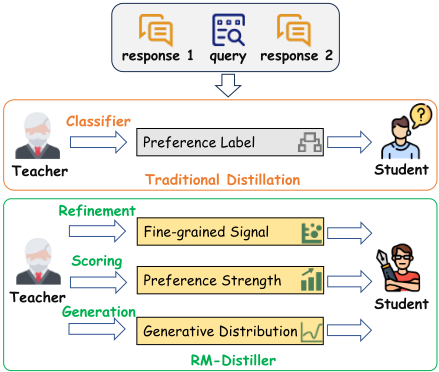
To mitigate reliance on human feedback, some works proposed to directly use powerful generative LLMs as RMs [Zheng et al., 2023; Huang et al., 2026]. However, despite their strong preference modeling capabilities, their practical use is limited by high API costs and inference latency. Consequently, other works have proposed to distill discriminative RMs from generative LLMs [Bai et al., 2022b; Malik et al., 2026]. These methods typically employ the LLM as an annotator to assign binary preference labels to response pairs. The resulting preference data with triplets of (instruction, responses, label) are then used to train RMs. Distilling RMs from powerful generative LLMs offers a cost-effective and scalable alternative to human annotation. As a result, it has been adopted widely in recent RL practice [Liu et al., 2024; Liu et al., 2025a].
Despite its popularity, this paradigm predominantly utilizes the teacher model's capability to assign binary preference labels, often treating it as a mere binary classifier [Huang et al., 2025], failing to fully leverage the rich capabilities embedded in LLMs. In practice, generative LLMs possess a wide range of capabilities and internal knowledge that are highly beneficial for preference modeling. The insufficient utilization of these capabilities limits the upper bound of RM performance and subsequent RL-based alignment.
We therefore investigate a crucial yet unexplored question: How can we more effectively distill generative LLMs
into reward models?
In this paper, we propose RM-Distiller, a framework that exploits generative LLMs to distill RMs, by incorporating their multifaceted capabilities across three dimensions:
- Refinement capability: We leverage the refinement capability of generative LLMs to construct highly contrastive preference pairs for RM training. By performing targeted revisions on rejected responses, the teacher synthesizes highly correlated response pairs that differ only in the attributes determining preference. This compels the RM to discern subtle quality nuances instead of spurious correlations [Jiang et al., 2025].
- Scoring capability: We utilize the scoring capability of generative LLMs to assess response quality and model preference strength. Instead of relying on discrete binary annotation, the teacher provides continuous preference scores that better reflect varying degrees of quality differences between response pairs. This allows the RM to be optimized with a margin-aware objective, capturing more nuanced preference strengths.
- Generation capability: We incorporate the generation capability of generative LLMs to safeguard the foundational linguistic proficiency of the student model. By distilling the teacher's output distribution into the student backbone, we enforce a constraint that prevents the RM from undergoing catastrophic forgetting. This ensures the model retains robustness during regressive RM training [Yang et al., 2024b].
We evaluate RM-Distiller on both RM benchmarks and downstream RL alignment tasks. The results demonstrate that RM-Distiller significantly outperforms existing distillation methods with superior RM accuracy and RL alignment efficacy. Despite the prevailing practice of distilling generative LLMs into RMs, this is the first work that systematically explores the best practice for RM distillation.
Our contributions are as follows:
- We conduct the first systematic investigation into RM distillation, by introducing a multifaceted distillation strategy RM-Distiller.
- We propose to exploit three capabilities of the generative LLMs, refinement, scoring, and generation, to provide comprehensive supervision for training the RMs.
- Extensive experiments demonstrate that RM-Distiller significantly improves RM performance both on RM benchmarks and downstream alignment scenarios.
2 Background
2.1 Preliminary: RewardModeling
RMs traditionally relied on human preference datasets, typically trained using the Bradley-Terry (BT) model to predict pairwise rankings. The standard objective of RM training is to learn a scalar function rϕ(x, y) that reflects human preference. Given a preference dataset D = {(x, yw, yl)}, where yw and yl denote the chosen and rejected responses for instruction x, respectively, the RM is optimized by minimizing the negative log-likelihood:
where σ is the sigmoid function. While effective for ranking, this loss function only considers the binary order of responses, ignoring the preference strength between them.
2.2 RMDistillation fromGenerative LLM
Due to the high cost and limited scalability of human oversight [Touvron et al., 2023], the community has increasingly shifted toward getting preference annotation from generative LLM [Liu et al., 2024], where teacher models are employed to evaluate paired responses and identify the preferred ones, thereby constructing preference annotations for training BT models [Liu et al., 2025a]. However, this paradigm often treats the teacher as a black-box classifier, failing to exploit its generative potential or the nuanced preference intensities necessary for reliable alignment.
To address this, recent studies have explored ways to enrich the distillation signal by incorporating more diverse information from teacher models. For instance, SynRM [Ye et al., 2025] integrates natural language critiques into RMs by appending teacher-generated justifications to the responses during both training and inference. Further extending this idea, CLoud [Ankner et al., 2024] explicitly distills the capability of generating critiques into discriminative RMs. Another line of research focuses on data augmentation, utilizing LLMs to synthesize a larger volume of preference data through response perturbation to cover a broader distribution of scenarios [Park et al., 2024; Shen et al., 2025]. While these methodologies enhance supervision or data diversity, they often only exploit a fraction of the teacher model's multifaceted capabilities, failing to fully harness its potential for RM distillation.
3 RM-Distiller
RM-Distiller begins by Initial Preference Pair Construction, which serves as the foundation for RM distillation. Subsequently, it fully exploits the teacher model's multifaceted capabilities through: (1) Refinement capability for Contrastive Refinement, (2) Scoring capability for Strength Guidance, (3) Generation capability for Generative Regularization.
3.1 Initial Preference Pair Construction
Initial Candidate Generation
Given an instruction x from an instruction set Dx, we first choose a set of candidate models M = {m1,m2, . . . ,mK}. After that, we collect a response pool Yx = {y1, y2, . . . , yK} such that each yj ∼ mj(x). The candidate models are chosen to differ in model families and sizes, ensuring responses to each instruction are with varying styles and quality levels.
Initial Preference Annotation
To construct the initial preference data, for each instruction x, we randomly sample two distinct responses (ya, yb) from Yx. We then employ the generative teacher LLM fT to determine the relative quality between (ya, yb). This results in an annotated preference pair (yw, yl), where yw and yl denote the chosen and rejected responses, respectively.
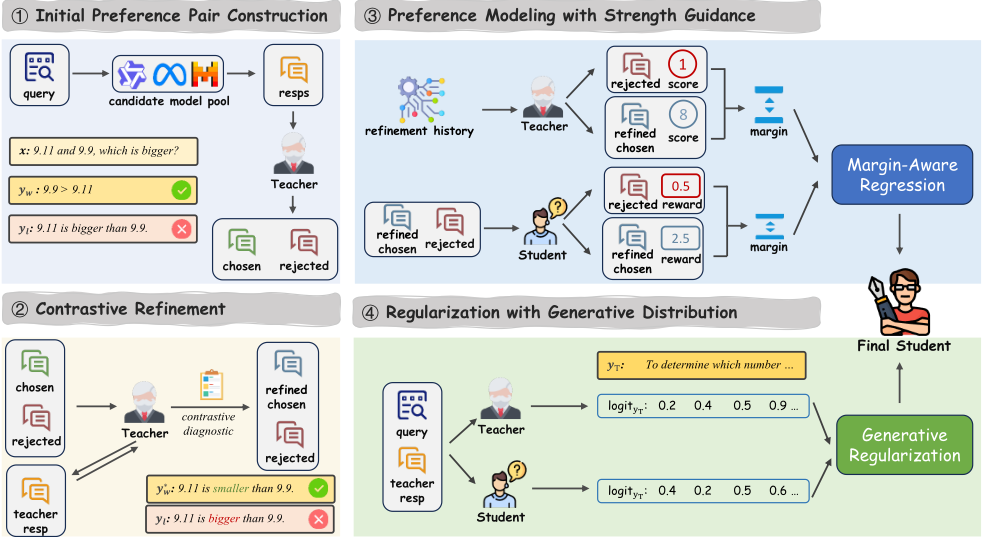
At this stage, we obtain preference triplets (x, yw, yl), which can be directly used to train RMs under the BT objective, as in standard RM distillation. However, this will result in the insufficient utilization of teacher models' capabilities. Therefore, we introduce the following methods to further leverage the teacher's supervision signal.
3.2 Contrastive Refinement
The efficacy of RMs depends heavily on the contrastive quality of the preference pairs. In standard distillation practices, pairs are often sampled independently, therefore exhibit significant discrepancies in length, formatting, or linguistic style [Jiang et al., 2025], which results in the RMs to rely on superficial shortcut instead of intrinsic quality attributes [Zhou et al., 2024]. To eliminate these spurious correlations and force the model to identify fine-grained preference boundaries, we utilize the refinement capability of the teacher model to synthesize highly correlated contrasts, as shown in Figure 3.
The refinement process begins by analyzing the gap between the rejected response yl and the teacher-generated response yT , where yT serves as a high-quality reference. We first prompt the teacher model fT to perform a contrastive diagnostic, where it articulates specific reasons for the rejection and outlines a path for improvement. Following this diagnostic, fT is instructed to minimally modify yl into a refined chosen version y∗w that matches the quality of yT while strictly
Contrastive Refinement Example
Instruction
How to get the last element of a list L in Python?
Rejected Response (yl)
You can use L[0] to access the last element of a list.
Refined Chosen Response (y∗w)
You can use L[-1] to access the last element of a list.
Teacher Response (yT )
In Python, negative indexing allows you to access elements from the end, with -1 representing the last item.
Figure 3: A concrete example of Contrastive Refinement.
preserving the original structure and phrasing. By maintaining a minimal edit distance, we ensure that y∗w and yl share a nearly identical semantic backbone, differing only in the attributes that define superiority.
3.3 Preference Modeling with Strength Guidance Margin-Aware Regression
In the traditional BT framework, the RM is trained as a binary classifier to maximize the probability P(yw ≻ yl). This objective implicitly assuming a uniform preference strength across all response pairs. However, in reality, the quality difference between responses varies significantly [Wang et al., 2024]. Therefore, we leverage the scoring capability of LLMs to explicitly capture and represent the strength of preferences to provide fine-grained supervision signals.
First, we prompt the teacher model fT to assign scalar quality scores sT (x, y) for chosen and rejected responses yw and yl, respectively. After that, we propose Margin-Aware Regression, to guide the student model to mimic the teacher's evaluative sensitivity by aligning the predicted reward difference with the teacher-generated score margin. Specifically, we define margin-aware loss as follows:
With this objective, the student model explicitly learns to align not only the relative order but also the exact magnitude of preferences, thereby being able to capture finegrained variations in preference strength, distinguishing between subtle improvements and absolute errors. While some recent studies have attempted to introduce a margin as a lower bound [Touvron et al., 2023], they still fail to capture the nuanced intensity of preference as in this work.
Self-Calibrated Scoring
As established in Section 3.2, we obtained the refined response y∗w through Contrastive Refinement as the chosen response. To assign more precise quality scores, we introduce Self-Calibrated Scoring. Specifically, we explicitly provide the teacher with the previously assigned score of the rejected response sT (x, yl) as a fixed anchor, and task it with scoring the refined response y∗w on the same scale. As a result, the score sT (x, y∗w ) reflects a calibrated increase proportional to the specific corrections applied during refinement. This relative evaluation protocol yields more stable and learnable preference margins for downstream reward modeling.
Moreover, during this process, we reuse the refinement dialogue history as the context for scoring, exposing the scorer to the teacher-produced contrastive diagnosis and its refinement outcome. By conditioning the scoring on the explicit refinement history, Self-Calibrated Scoring transforms absolute quality assessment into a relative adjustment.
Preference Pair Filtering
To ensure high data quality, we filter the synthesized preference pairs to retain sufficiently strong contrasts based on two criteria: (1) a substantial score margin and (2) a minimum edit distance between y∗w and yl:
where τs and τe denote the minimum thresholds for the score margin and the edit distance, respectively. Filtering for edit distance ensures that the refinement has introduced meaningful changes, while score margin ensures that the teacher recognizes a sufficient quality improvement. This ensures effective contrast between preference pairs for RM training.
3.4 Regularization with Generative Distribution Generative Regularization
Solely optimizing for discriminative signals can lead to reward over-optimization, where the model gradually loses its foundational understanding of language, which is essential for generalizability [Yang et al., 2024b]. Therefore, we propose Generative Regularization to preserve the generative knowledge of the backbone model during distillation.
Specifically, we retain the student's language model (LM) head and use the teacher fT as a linguistic anchor. For each teacher response yT , we supervise the student's LM head using a combination of negative log-likelihood (NLL) and Kullback-Leibler (KL) divergence distillation:
where yT = {y1T , y2T , . . . , yL T } denotes the teacher response of length L, and V denotes the vocabulary. Pϕ and PT represent the next-token probability distributions of the student and the teacher, respectively. α and β are coefficients that control the strength of the NLL loss and the KL divergence. Notably, if the teacher model is closed-source or if the teacher and student do not share a common vocabulary, we set β = 0.
Total Objective Function
Combining our proposed Margin-Aware Regression and the Generative Regularization loss, the total optimization objective of RM-Distiller is formulated as a weighted sum:
This multi-task objective synergizes precise preference modeling with linguistic anchoring. Specifically, Lmargin enables the model to capture precise quality differences, while Lreg prevents representation collapse by grounding the shared backbone in the teacher's generative distribution. This dual supervision ensures semantic robustness, leading to better generalization and stability during downstream RLHF.
4 Experiments
In this section, we evaluate RM-Distiller through a series of experiments to assess its reward modeling performance.
4.1 Experimental Setup
Data Settings
For training RMs, we utilize a 10,000-sample subset randomly drawn from the Skywork-Preference-v0.2 dataset [Liu et al., 2024]. Our method is evaluated across two scenarios:
- Unlabeled Scenario where no prior preference annotations are available, and we only utilize instructions from the dataset and employ candidate models to generate responses. This setup mirrors practical distillation settings with no access to high-quality human annotations, making LLM-based distillation a more practical alternative.
- Labeled Scenario where response pairs are associated with high-quality ground-truth preference annotations, and we retain the original response pairs from the dataset and keep only those samples for which the teacher's preference judgments are consistent with the original labels.
| Student | Teacher | Method | RewardBench | RM-Bench | |||||||
|---|---|---|---|---|---|---|---|---|---|---|---|
| Chat | Hard | Safety | Reason | Avg. | Easy | Normal | Hard | Avg. | |||
| LLM-as-a-Judge | |||||||||||
| Claude-3.5-Sonnet-20240620 | 96.4 | 74.0 | 81.6 | 84.7 | 84.2 | 73.8 | 63.4 | 45.9 | 61.0 | ||
| Llama-3.1-70B-Instruct [Grattafiori et al., 2024] | 97.2 | 70.2 | 82.8 | 86.0 | 84.1 | 74.7 | 67.8 | 54.1 | 65.5 | ||
| GPT-4o [Hurst et al., 2024] | 96.1 | 70.7 | 87.8 | 75.1 | 82.4 | 83.8 | 70.9 | 48.2 | 67.6 | ||
| Qwen3-14B [Yang et al., 2025] | 96.4 | 69.2 | 88.0 | 82.0 | 83.9 | 83.6 | 71.7 | 52.1 | 69.1 | ||
| Qwen2.5-3B-Instruct [Yang et al., 2024a] | 88.3 | 43.2 | 55.1 | 42.7 | 57.3 | 69.6 | 49.4 | 34.3 | 51.1 | ||
| Open-Source Reward Models | |||||||||||
| Eurus-RM-7B [Yuan et al., 2025] | 98.0 | 65.6 | 81.4 | 86.3 | 81.6 | 87.2 | 70.2 | 40.2 | 65.9 | ||
| GRAM-LLaMA3.2-3B-RewardModel [Wang et al., 2025] | 90.6 | 83.9 | 79.8 | 80.2 | 83.6 | 84.2 | 65.2 | 40.0 | 63.2 | ||
| JudgeLRM-7B [Chen et al., 2025] | 92.9 | 56.4 | 78.2 | 73.6 | 75.2 | 73.2 | 66.2 | 54.8 | 64.7 | ||
| Training on the Same Preference Dataset in the Unlabeled | Scene | ||||||||||
| BT Classifier | 93.3 | 37.7 | 69.3 | 81.0 | 70.3 | 91.9 | 62.3 | 13.6 | 55.9 | ||
| Margin BT [Touvron et al., 2023] | 93.6 | 33.6 | 73.5 | 80.8 | 70.4 | 90.4 | 61.0 | 17.5 | 56.3 | ||
| SteerLM [Dong et al., 2023] | 94.4 | 46.5 | 74.3 | 82.8 | 74.5 | 90.2 | 59.8 | 17.1 | 55.7 | ||
| SynRM [Ye et al., 2025] | 96.1 | 47.6 | 78.7 | 79.1 | 75.4 | 91.0 | 66.2 | 25.1 | 60.7 | ||
| GPT-4o | RMBoost [Shen et al., 2025] | 91.3 | 35.1 | 67.8 | 74.8 | 67.3 | 86.3 | 54.9 | 17.6 | 52.9 | |
| CLoud [Ankner et al., 2024] | 93.6 | 37.1 | 62.6 | 63.6 | 64.2 | 87.1 | 59.2 | 18.9 | 55.1 | ||
| LSAM [Wang et al., 2024] | 94.1 | 37.3 | 73.5 | 81.4 | 71.6 | 89.3 | 58.8 | 22.2 | 56.8 | ||
| Qwen2.5-3B-Instruct | RM-Distiller | 95.5 | 51.1 | 84.1 | 87.4 | 79.5 | 86.4 | 64.8 | 32.2 | 61.1 | |
| BT Classifier | 88.0 | 43.4 | 72.4 | 83.5 | 71.8 | 89.8 | 60.7 | 19.8 | 56.7 | ||
| Qwen3-14B | Margin BT [Touvron et al., 2023] | 94.7 | 46.3 | 79.9 | 70.4 | 72.8 | 90.7 | 63.6 | 26.3 | 60.2 | |
| SteerLM [Dong et al., 2023] | 93.6 | 45.0 | 79.1 | 78.5 | 74.0 | 89.9 | 64.1 | 19.9 | 58.0 | ||
| SynRM [Ye et al., 2025] | 84.9 | 57.0 | 79.1 | 91.1 | 78.0 | 92.7 | 66.7 | 20.0 | 59.8 | ||
| RMBoost [Shen et al., 2025] | 92.7 | 43.6 | 73.7 | 90.6 | 75.2 | 84.8 | 60.3 | 25.9 | 57.0 | ||
| CLoud [Ankner et al., 2024] | 91.1 | 39.7 | 74.1 | 67.5 | 68.1 | 87.7 | 58.4 | 20.3 | 55.5 | ||
| LSAM [Wang et al., 2024] | 92.5 | 39.9 | 72.7 | 84.9 | 72.5 | 88.8 | 60.4 | 24.6 | 57.9 | ||
| RM-Distiller | 95.0 | 55.0 | 81.8 | 89.0 | 80.2 | 87.2 | 66.3 | 34.6 | 62.7 | ||
| Training on the Same Preference Dataset | in the Labeled Scene | ||||||||||
| - | BT Classifier | 77.4 | 71.3 | 86.5 | 60.0 | 73.8 | 81.7 | 64.5 | 43.2 | 63.2 | |
| Margin BT [Touvron et al., 2023] | 88.6 | 70.8 | 87.3 | 67.8 | 78.6 | 80.3 | 66.8 | 48.2 | 65.1 | ||
| SteerLM [Dong et al., 2023] | 91.6 | 65.4 | 80.4 | 63.5 | 75.2 | 85.6 | 65.8 | 37.4 | 62.9 | ||
| SynRM [Ye et al., 2025] | 81.0 | 82.5 | 86.9 | 78.6 | 82.2 | 80.9 | 66.0 | 40.3 | 62.4 | ||
| GPT-4o | RMBoost [Shen et al., 2025] | 85.8 | 73.7 | 86.6 | 74.9 | 80.3 | 79.3 | 59.0 | 38.8 | 59.1 | |
| CLoud [Ankner et al., 2024] | 69.3 | 66.0 | 72.6 | 66.9 | 68.7 | 68.3 | 57.1 | 45.4 | 57.0 | ||
| LSAM [Wang et al., 2024] | 89.4 | 66.5 | 88.1 | 63.8 | 77.0 | 85.2 | 63.8 | 36.7 | 61.9 | ||
| Qwen2.5-3B-Instruct | RM-Distiller | 92.7 | 64.3 | 90.7 | 86.9 | 83.6 | 87.0 | 68.9 | 42.0 | 65.9 | |
| Margin BT [Touvron et al., 2023] | 88.6 | 72.8 | 86.6 | 71.6 | 79.9 | 81.0 | 67.8 | 49.1 | 66.0 | ||
| SteerLM [Dong et al., 2023] | 89.7 | 69.5 | 87.2 | 67.1 | 78.4 | 84.6 | 68.3 | 43.8 | 65.6 | ||
| [Ye et al., 2025] | 78.2 | 80.7 | 85.1 | 74.8 | 79.7 | 73.6 | 61.5 | 48.5 | 61.2 | ||
| Qwen3-14B | SynRM RMBoost [Shen et al., 2025] | 82.7 | 73.7 | 82.2 | 88.2 | 81.7 | 84.8 | 60.3 | 25.9 | 57.0 | |
| CLoud [Ankner et al., 2024] | 83.0 | 67.3 | 75.0 | 62.2 | 71.9 | 77.3 | 61.9 | 44.9 | 61.4 | ||
| LSAM [Wang et al., 2024] | 93.0 | 69.7 | 84.1 | 70.4 | 79.3 | 90.7 | 66.0 | 35.2 | 63.9 | ||
| RM-Distiller | 91.3 | 69.7 | 85.5 | 91.3 | 84.5 | 89.5 | 69.3 | 40.5 | 66.4 | ||
We employ RewardBench [Lambert et al., 2025] and RMBench [Liu et al., 2025b] as our primary evaluation benchmarks, which cover diverse subsets.
Models
We employ Qwen2.5-3B-Instruct [Yang et al., 2024a] as the backbone for the student RM. To facilitate distillation, we use GPT-4o [Hurst et al., 2024] and Qwen3-14B [Yang et al., 2025] in its non-thinking mode as the teacher models. For constructing the response pool in the unlabeled scenario, we leverage a set of candidate models including Llama-3.1-8BInstruct [Grattafiori et al., 2024], Mistral-7B-Instruct-v0.3 [Jiang et al., 2023], Gemma-2-9b-it [Team et al., 2024] and Vicuna-7b-v1.5 [Zheng et al., 2023].
Baselines
We compare RM-Distiller against several RM distillation methods including the vanilla BT Classifier, alongside its extensions Margin BT [Touvron et al., 2023] and LSAM [Wang et al., 2024]. We also evaluate against methods that leverage teacher-generated critiques, revisions or attributes, including SynRM [Ye et al., 2025], CLoud [Ankner et al., 2024], RMBoost [Shen et al., 2025], and SteerLM [Dong et al., 2023].
We also include a range of external RMs as reference points. These comprise discriminative models such as EurusRM-7B [Yuan et al., 2025], as well as off-the-shelf generative models including Claude-3.5-Sonnet and Llama-3.170B-Instruct, along with fine-tuned generative models including GRAM-LLaMA3.2-3B-RewardModel [Wang et al.,
| Policy | Student RM | Teacher | Dataset | Method | Algorithm | AlpacaEval 2.0 | FollowBench | CF-Bench | ||||
|---|---|---|---|---|---|---|---|---|---|---|---|---|
| LC | Len | HSR | SSR | CSR | ISR | PSR | ||||||
| - | - | UltraChat | Baseline | SFT | 8.86 | 1,017 | 41.04 | 57.39 | 0.51 | 0.15 | 0.22 | |
| GPT-4o | HH-RLHF | BT Classifier | PPO | 14.32 | 2,045 | 46.85 | 61.20 | 0.57 | 0.18 | 0.26 | ||
| GRPO | 17.89 | 2,310 | 48.33 | 62.15 | 0.61 | 0.22 | 0.30 | |||||
| DAPO | 18.25 | 2,005 | 48.59 | 62.48 | 0.62 | 0.22 | 0.31 | |||||
| RM-Distiller | PPO | 16.90 | 1,927 | 48.42 | 62.05 | 0.60 | 0.23 | 0.29 | ||||
| Llama-3-8B | GRPO | 20.10 | 2,342 | 49.95 | 63.14 | 0.64 | 0.24 | 0.33 | ||||
| Qwen2.5-3B -Instruct | DAPO | 20.52 | 2,487 | 50.09 | 63.31 | 0.63 | 0.23 | 0.32 | ||||
| ShareGPT | BT Classifier | PPO | 13.80 | 2,584 | 46.20 | 60.95 | 0.56 | 0.17 | 0.25 | |||
| GRPO | 17.92 | 2,360 | 47.90 | 61.88 | 0.61 | 0.21 | 0.30 | |||||
| DAPO | 17.45 | 2,200 | 48.15 | 62.10 | 0.60 | 0.21 | 0.29 | |||||
| RM-Distiller | PPO | 16.24 | 2,293 | 47.78 | 61.77 | 0.59 | 0.19 | 0.27 | ||||
| GRPO | 19.85 | 2,090 | 49.45 | 62.90 | 0.62 | 0.22 | 0.31 | |||||
| DAPO | 20.15 | 2,335 | 49.62 | 63.15 | 0.63 | 0.23 | 0.32 | |||||
| Method | RewardBench Average | RM-Bench Average |
|---|---|---|
| GPT-4o as Teacher and | Qwen2.5-3B-Instruct as | Student |
| BT Classifier | 70.3 | 55.9 |
| + Margin-Aware Regression | 72.7 | 57.3 |
| + Contrastive Refinement | 76.8 | 58.8 |
| + Generative Regularization | 79.5 | 61.1 |
| Qwen3-14B as Teacher and Qwen2.5-3B-Instruct | as Student | |
| BT Classifier | 71.8 | 56.7 |
| + Margin-Aware Regression | 75.7 | 59.5 |
| + Contrastive Refinement | 78.7 | 61.5 |
| + Generative Regularization | 80.2 | 62.7 |
2025] and JudgeLRM-7B [Chen et al., 2025].
4.2 Main Results
As shown in Table 1, RM-Distiller consistently and significantly outperforms traditional distillation methods across both unlabeled and labeled settings,whether using a closedsource or open-source model as a teacher. Notably, RMDistiller also surpasses several powerful external baselines, including both frontier generative models and open-source RMs built on significantly larger foundation models or trained with more extensive datasets.
These performance gains are driven by the effective synergy of three key capabilities leveraged from the teacher model. Specifically, the teacher's refinement and scoring abilities enable the RM to identify fine-grained differences in response pairs, thereby enhancing the perceptual capability of nuanced quality aspects. Furthermore, the teacher's generation capability helps the RM maintain a foundational understanding of language, allowing it to better comprehend what constitutes a good response.
4.3 Ablation Study
To further verify the effectiveness of RM-Distiller, we conduct an ablation study by incrementally adding each module, corresponds to each capability of the teacher. As shown in Table 3, each proposed module contributes significantly to the overall performance gains. Across both RewardBench and RM-Bench, we observe a steady increase in average accuracy as we incrementally integrate Margin-Aware Regression, Contrastive Refinement, and Generative Regularization. This confirms that leveraging the teacher's multifaceted capabilities is essential for high-fidelity RM distillation on both evaluation benchmarks.
4.4 Performance on RLHF
To evaluate the effectiveness of the distilled RMs in downstream alignment, we conduct RLHF experiments using PPO [Schulman et al., 2017], GRPO [Shao et al., 2024], and DAPO [Yu et al., 2025]. For all RL experiments, we adopt Llama-3-8B [Grattafiori et al., 2024] as the base policy model. We first perform SFT on the base model using the UltraChat dataset [Ding et al., 2023] as a cold-start. We then use prompts from the HH-RLHF [Bai et al., 2022a] and ShareGPT [Zheng et al., 2023] datasets as training instructions during RL. Alignment effectiveness are evaluated on both general and complex instruction following benchmarks, including AlpacaEval 2.0 [Dubois et al., 2024], FollowBench [Jiang et al., 2024] and CFBench [Zhang et al., 2025] 1 .
As shown in Table 2, RM-Distiller consistently outperforms the BT Classifier across all datasets and RL algorithms, indicating more effective reward signal for RLHF. Our distilled RM significantly enhances both general alignment and complex instruction following, demonstrating its ability to discern nuanced quality differences. Furthermore, the consistent gains under length-controlled evaluations confirm that these improvements reflect genuine enhancements in response quality rather than a mere verbosity bias.
1 Since these benchmarks rely on LLM-based evaluation, we adopt GPT-4o-0806 as the judge model.
| Model | Sample Num | Acc. |
|---|---|---|
| Skywork-Reward-V2-8B [Liu et al., 2025a] | 40,000K | 81.3 |
| Skywork-Reward-8B-v0.2 [Liu et al., 2024] | 80K | 75.9 |
| URM-LLaMA-3.1-8B [Lou et al., 2024] | 100K | 76.7 |
| Llama-3-OffsetBias-8B [Park et al., 2024] | 70K | 83.2 |
| Tulu-3-8B-RM-RB2 [Malik et al., 2026] | 350K | 83.2 |
| BT-Qwen2.5-3B-Instruct | 10K | 72.2 |
| RM-Distiller-Qwen2.5-3B-Instruct | 10K | 85.4 |
| Student | Teacher | Method | EvalBiasBench |
|---|---|---|---|
| GPT-4o [Hurst et al., 2024] | 70.0 | ||
| Qwen3-14B [Yang et al., 2025] | 75.0 | ||
| Qwen2.5-3B-Instruct [Yang et al., 2024a] | 44.4 | ||
| Qwen2.5-3B-Instruct | GPT-4o | BT Classifier | 30.0 |
| RM-Distiller | 57.5 | ||
| Qwen3-14B | BT Classifier | 47.5 | |
| RM-Distiller | 63.8 | ||
4.5 Fast Adaptation Capability
Fast Adaptation refers to the ability to rapidly provide reliable reward signals for novel, domain-specific tasks, which is a vital determinant of RM's efficacy. RM-Distiller offers an efficient and practical solution, enabling the rapid distillation of specialized RMs with only a small amount of targeted data. To evaluate this capability, we choose the Arabic language domain, where we utilize an Arabic dataset 2 , which has significant difference with general preference modeling 3 . We utilize Qwen2.5-3B-Instruct as the student model and Qwen3-14B as the teacher model.
As shown in Table 4, RM-Distiller not only demonstrates a substantial margin over the BT model but also surpasses currently top-performing generalist RMs. This empirical evidence reveals that generalist RMs struggle to achieve true universality across diverse specific domains. In contrast, RMDistiller provides an efficient mechanism to adapt and distill reliable reward signals into specialized scenarios with only a small group of instruction data, enabling fast adaptation of reward modeling to a new domain.
4.6 Generalizability
A robust RM should generalize to challenging scenarios without exploiting spurious shortcuts. Poor generalizability often leads to reward hacking, where the model exploits unintended biases to achieve deceptively high scores without fully following the instructions [Zhou et al., 2026]. In this section, we employ EvalBiasBench [Park et al., 2024] and IFBench [Peng et al., 2025] as our evaluation benchmarks.
2 https://huggingface.co/datasets/FreedomIntelligence/
3 We randomly sample 10,000 instructions as the start point for distillation. For evaluation, we extract a test set of 1,000 samples, which are filtered by GPT-5 to ensure a reliable ground truth.
| Student | Teacher | Method | IFBench |
|---|---|---|---|
| GPT-4o [Hurst et al., 2024] | 50.8 | ||
| Qwen3-14B [Yang et al., 2025] | 54.2 | ||
| Qwen2.5-3B-Instruct [Yang et al., 2024a] | 36.9 | ||
| Qwen2.5-3B-Instruct | GPT-4o | BT Classifier | 50.2 |
| RM-Distiller | 57.9 | ||
| Qwen3-14B | BT Classifier | 52.5 | |
| RM-Distiller | 57.7 | ||
| Teacher | Method | RewardBench Average | RM-Bench Average |
|---|---|---|---|
| GPT-4o | BT Classifier | 50.3 | 48.1 |
| RM-Distiller | 76.1 | 59.9 | |
| Qwen3-14B | BT Classifier RM-Distiller | 64.6 76.4 | 51.9 60.2 |
As shown in Table 5 and 6, RM-Distiller demonstrates a superior capacity to generalize to out-of-distribution tasks. In EvalBiasBench, while the BT Classifier collapses by relying on superficial patterns, RM-Distiller exhibits significantly higher robustness. This indicates the student model learns to discern semantic boundaries rather than spurious correlations. In IFBench, RM-Distiller not only outperforms the BT Classifier baseline but even surpasses the direct prompting performance of the teacher. This demonstrates that RM-Distiller effectively captures fine-grained constraints within instructions, verifying its generalizability to unseen tasks.
4.7 Data Efficiency
Data efficiency is critical in RM distillation, as high-quality instruction data is often scarce when dealing with specialized domains or rapid model iteration. To evaluate this, we compare RM-Distiller against the BT baseline using a reduced training set of only 1,000 instructions.
As illustrated in Table 7, when the training set is reduced to only 1,000 instructions, the performance of the student model trained with BT model deteriorates sharply. In contrast, RMDistiller exhibits exceptional data efficiency, maintaining a high level of discriminative accuracy. By extracting significantly more supervisory information from each sample, RMDistiller effectively distills the teacher's underlying preferences. This high-density training signal enables the development of reliable RMs with minimal data, offering a practical solution for real-world alignment tasks.
5 Conclusion
In this work, we present the first systematic research about how to distill generative LLMs into discriminative RMs. By exploiting the multifaceted capabilities of generative LLMs, our proposed RM-Distiller provides the student model with rich, reliable supervision signals, enabling high RM performance without additional inference overhead.
Acknowledgments
This work was supported by the National Key R&D Program of China (Grant No. 2024YFC3809100), the National Natural Science Foundation of China (Grant No. 62276077, 62376075, 62376076), the Department of Science and Technology of Heilongjiang Province (Grant No. ZL2025F004), and the MOE Key Laboratory of Cognitive Intelligence and Content Security (Grant No. 10120251103, Harbin Institute of Technology).
Contribution Statement
Hongli Zhou, Hui Huang and Wei Liu contributed equally.
@inproceedings{ijcai2026p681,
  title     = {RM-Distiller: Exploiting Generative LLM for Reward Model Distillation},
  author    = {Zhou, Hongli and Huang, Hui and Liu, Wei and Wang, Chenglong and Bu, Xingyuan and Han, Lvyuan and Song, Fuhai and Yang, Muyun and Jiang, Wenhao and Cao, Hailong and Zhao, Tiejun},
  booktitle = {Proceedings of the Thirty-Fifth International Joint Conference on
               Artificial Intelligence, {IJCAI-26}},
  publisher = {International Joint Conferences on Artificial Intelligence Organization},
  editor    = {Diego Calvanese},
  pages     = {6118--6126},
  year      = {2026},
  month     = {8},
  note      = {Main Track},
  doi       = {10.24963/ijcai.2026/681},
  url       = {https://doi.org/10.24963/ijcai.2026/681},
}
TY - CPAPER TI - RM-Distiller: Exploiting Generative LLM for Reward Model Distillation AU - Zhou, Hongli AU - Huang, Hui AU - Liu, Wei AU - Wang, Chenglong AU - Bu, Xingyuan AU - Han, Lvyuan AU - Song, Fuhai AU - Yang, Muyun AU - Jiang, Wenhao AU - Cao, Hailong AU - Zhao, Tiejun T2 - Proceedings of the Thirty-Fifth International Joint Conference on Artificial Intelligence, IJCAI-26 PB - International Joint Conferences on Artificial Intelligence Organization PY - 2026 SP - 6118 EP - 6126 DO - 10.24963/ijcai.2026/681 UR - https://doi.org/10.24963/ijcai.2026/681 ER -Copied
Machine-readable versions of this paper, for tools and AI agents:





