
BFHD: Bidirectional Feature Harmonization Decomposition for Heterogeneous Clinical Assessments
Proceedings of the Thirty-Fifth International Joint Conference on Artificial Intelligence. AI and Health. Pages 7046-7054.
https://doi.org/10.24963/ijcai.2026/784
Keywords
- Multimodal data: Multimodal data
- Public health: Public health
- Clinical decision support system: Clinical decision support system
Abstract
Clinical assessments are often collected using heterogeneous assessment systems across centers and time, leading to records that mix different but related sets of measurements. This motivates harmonization beyond total-score linking. We formulate clinical harmonization at the measurement level as a bidirectional recoverability problem: given paired observations from two assessment systems, the goal is to identify which measurements can be reliably translated in both directions within an application-defined tolerance, while separating non-translatable components. We propose Bidirectional Feature Harmonization Decomposition (BFHD), a feasibility-driven framework that enforces bidirectionally coupled translation and uses feature-wise output gating to produce an explicit decomposition in the original measurement space. Experiments on synthetic data and real clinical assessment pairs show that BFHD achieves broader feasible harmonization coverage and improved subset stability compared to baselines.
- [American Psychiatric Association, 2022] American Psy- chiatric Association. Diagnostic and Statistical Manual of Mental Disorders. American Psychiatric Association, 2022.
- [Andrew et al., 2013] Galen Andrew, Raman Arora, Jeff Bilmes, and Karen Livescu. Deep canonical correlation analysis. In International conference on machine learn- ing, pages 1247-1255. PMLR, 2013.
- [Bach and Jordan, 2005] Francis R Bach and Michael I Jor- dan. A probabilistic interpretation of canonical correlation analysis. 2005.
- [Barnhart et al., 2007] Huiman X Barnhart, Michael J Haber, and Lawrence I Lin. An overview on assessing agreement with continuous measurements. Journal of biopharmaceu- tical statistics, 17(4):529-569, 2007.
- [Beer et al., 2020] Joanne C Beer, Nicholas J Tustison, Philip A Cook, Christos Davatzikos, Yvette I Sheline, Russell T Shinohara, Kristin A Linn, Alzheimer's Dis- ease Neuroimaging Initiative, et al. Longitudinal com- bat: A method for harmonizing longitudinal multi-scanner imaging data. Neuroimage, 220:117129, 2020.
- [Bengio et al., 2013] Yoshua Bengio, Aaron Courville, and Pascal Vincent. Representation learning: A review and new perspectives. IEEE transactions on pattern analysis and machine intelligence, 35(8):1798-1828, 2013.
- [Breiman et al., 2017] Leo Breiman, Jerome Friedman, Richard A Olshen, and Charles J Stone. Classification and regression trees. Chapman and Hall/CRC, 2017.
- [Breiman, 2001] Leo Breiman. Random forests. Machine learning, 45(1):5-32, 2001.
- [Cella et al., 2007] David Cella, Susan Yount, Nan Rothrock, Richard Gershon, Karon Cook, Bryce Reeve, Deborah Ader, James F Fries, Bonnie Bruce, Mattias Rose, et al. The patient-reported outcomes measurement information system (promis): progress of an nih roadmap cooperative group during its first two years. Medical care, 45(5):S3-S11, 2007.
- [Chen, 2016] Tianqi Chen. Xgboost: A scalable tree boost- ing system. Cornell University, 2016.
- [Crane et al., 2023] Paul K Crane, Seo-Eun Choi, Michael Lee, Phoebe Scollard, R Elizabeth Sanders, Brandon Klinedinst, Connie Nakano, Emily H Trittschuh, Jesse Mez, Andrew J Saykin, et al. Measurement precision across cognitive domains in the alzheimer's disease neu- roimaging initiative (adni) data set. Neuropsychology, 37(4):373, 2023.
- [Dewey et al., 2019] Blake E Dewey, Can Zhao, Jacob C Reinhold, Aaron Carass, Kathryn C Fitzgerald, Elias S Sotirchos, Shiv Saidha, Jiwon Oh, Dzung L Pham, Peter A Calabresi, et al. Deepharmony: A deep learning approach to contrast harmonization across scanner changes. Mag- netic resonance imaging, 64:160-170, 2019.
- [Dinh et al., 2014] Laurent Dinh, David Krueger, and Yoshua Bengio. Nice: Non-linear independent compo- nents estimation. arXiv preprint arXiv:1410.8516, 2014.
- [Dinh et al., 2016] Laurent Dinh, Jascha Sohl-Dickstein, and Samy Bengio. Density estimation using real nvp. arXiv preprint arXiv:1605.08803, 2016.
- [Dinsdale et al., 2021] Nicola K Dinsdale, Emma Bluemke, Stephen M Smith, Zobair Arya, Diego Vidaurre, Mark Jenkinson, and Ana IL Namburete. Learning patterns of the ageing brain in mri using deep convolutional networks. NeuroImage, 224:117401, 2021.
- [Dorans, 2007] Neil J Dorans. Linking scores from multi- ple health outcome instruments. Quality of Life Research, 16(Suppl 1):85-94, 2007.
- [Fortin et al., 2017] Jean-Philippe Fortin, Drew Parker, Birkan Tunc ¸, Takanori Watanabe, Mark A Elliott, Kosha Ruparel, David R Roalf, Theodore D Satterthwaite, Ruben C Gur, Raquel E Gur, et al. Harmonization of multi-site diffusion tensor imaging data. Neuroimage, 161:149-170, 2017.
- [Hammarström et al., 2016] Anne Hammarström, Hugo Westerlund, Kaisa Kirves, Karina Nygren, Pekka Vir- tanen, and Bruno Hägglöf. Addressing challenges of validity and internal consistency of mental health measures in a 27-year longitudinal cohort study-the northern swedish cohort study. BMC medical research methodology, 16(1):4, 2016.
- [Hinton and Salakhutdinov, 2006] Geoffrey E Hinton and Ruslan R Salakhutdinov. Reducing the dimensionality of data with neural networks. science, 313(5786):504-507, 2006.
- [Hotelling, 1935] Harold Hotelling. The most predictable criterion. Journal of educational Psychology, 26(2):139, 1935.
- [Huang et al., 2023] Xia Huang, Hui-Qin Li, Alan Simp- son, Jia-Jun Xu, Wan-Jie Tang, and Yuan-Yuan Li. Dif- ferences among fathers, mothers, and teachers in symp- tom assessment of adhd patients. Frontiers in Psychiatry, 14:1029672, 2023.
- [Johnson et al., 2007] W Evan Johnson, Cheng Li, and Ariel Rabinovic. Adjusting batch effects in microarray expres- sion data using empirical bayes methods. Biostatistics, 8(1):118-127, 2007.
- [Kingma and Dhariwal, 2018] Durk P Kingma and Prafulla Dhariwal. Glow: Generative flow with invertible 1x1 con- volutions. Advances in neural information processing sys- tems, 31, 2018.
- [Kingma and Welling, 2013] Diederik P Kingma and Max Welling. Auto-encoding variational bayes. arXiv preprint arXiv:1312.6114, 2013.
- [Kolen and Brennan, 2013] Michael J Kolen and Robert L Brennan. Test equating: Methods and practices. Springer Science & Business Media, 2013.
- [Lawrence and Lin, 1989] I Lawrence and Kuei Lin. A con- cordance correlation coefficient to evaluate reproducibil- ity. Biometrics, pages 255-268, 1989.
- [Lawrence et al., 2017] Emma Lawrence, Carolin Vegvari, Alison Ower, Christoforos Hadjichrysanthou, Frank De Wolf, and Roy M Anderson. A systematic review of longitudinal studies which measure alzheimer's disease biomarkers. Journal of Alzheimer's Disease, 59(4):1359- 1379, 2017.
- [Little and Rubin, 2019] Roderick JA Little and Donald B Rubin. Statistical analysis with missing data. John Wi- ley & Sons, 2019.
- [Lord, 2012] Frederic M Lord. Applications of item response theory to practical testing problems. Routledge, 2012.
- [Louizos et al., 2017] Christos Louizos, Max Welling, and Diederik P Kingma. Learning sparse neural net- works through l 0 regularization. arXiv preprint arXiv:1712.01312, 2017.
- [Lui et al., 2025] Forshing Lui, Ischel Gonzalez Kelso, and Marjorie Launico. Cognitive assessment. StatPearls, 2025.
- [Molnar, 2020] Christoph Molnar. Interpretable machine learning. Lulu. com, 2020.
- [Mueller et al., 2005] Susanne G Mueller, Michael W Weiner, Leon J Thal, Ronald C Petersen, Clifford Jack, William Jagust, John Q Trojanowski, Arthur W Toga, and Laurel Beckett. The alzheimer's disease neuroimaging ini- tiative. Neuroimaging Clinics, 15(4):869-877, 2005.
- [Ng, 2004] Andrew Y Ng. Feature selection, l 1 vs. l 2 regu- larization, and rotational invariance. In Proceedings of the twenty-first international conference on Machine learning, page 78, 2004.
- [Riley et al., 2010] Richard D Riley, Paul C Lambert, and Ghada Abo-Zaid. Meta-analysis of individual participant data: rationale, conduct, and reporting. Bmj, 340, 2010.
- [Rubin, 1976] Donald B Rubin. Inference and missing data. Biometrika, 63(3):581-592, 1976.
- [Tibshirani, 1996] Robert Tibshirani. Regression shrinkage and selection via the lasso. Journal of the Royal Statistical Society Series B: Statistical Methodology, 58(1):267-288, 1996.
- [Villalpando et al., 2025] Juan Manuel Villalpando, Bernard-Simon Leclerc, Minh Tri Le, Carol Hudon, Aline Bolduc, Marie-Jeanne Kergoat, and Consortium for the Early Identification of Alzheimer's Disease-Quebec (CIMA-Q). A comparison of clinical diagnostic clas- sification criteria used in longitudinal cohort studies of the alzheimer's disease continuum: A systematic review. Neuropsychology Review, pages 1-22, 2025.
- [Willcutt et al., 2005] Erik G Willcutt, Alysa E Doyle, Joel T Nigg, Stephen V Faraone, and Bruce F Pennington. Validity of the executive function theory of attention- deficit/hyperactivity disorder: a meta-analytic review. Bi- ological psychiatry, 57(11):1336-1346, 2005.
- [Yamada et al., 2020] Yutaro Yamada, Ofir Lindenbaum, Sa- hand Negahban, and Yuval Kluger. Feature selection using stochastic gates. In International conference on machine learning, pages 10648-10659. PMLR, 2020.
- [Yang et al., 2019] Xinghao Yang, Weifeng Liu, Wei Liu, and Dacheng Tao. A survey on canonical correlation anal- ysis. IEEE Transactions on Knowledge and Data Engi- neering, 33(6):2349-2368, 2019.
- [Zhu et al., 2017] Jun-Yan Zhu, Taesung Park, Phillip Isola, and Alexei A Efros. Unpaired image-to-image translation using cycle-consistent adversarial networks. In Proceed- ings of the IEEE international conference on computer vi- sion, pages 2223-2232, 2017.
References were extracted automatically from the PDF and may contain errors.
Full text extracted automatically from the PDF; figures, tables and equations may differ. The PDF is the version of record.
1 Introduction
Clinical assessment of chronic and neuropsychiatric conditions relies on a wide range of rating scales, cognitive tests, and questionnaire-based assessments[American Psychiatric Association, 2022; Lui et al., 2025]. In real clinical workflows, however, different centers, cohorts, and time periods often employ different combinations or versions of these assessment systems[Villalpando et al., 2025]. Even when two assessment systems aim to measure similar clinical domains such as memory or executive function, their measurements (features) typically include both overlapping elements and system-specific components[Willcutt et al., 2005]. As patients move between centers or as protocols evolve, longitudinal records naturally become mixtures of heterogeneous assessment systems rather than observations from a single fixed system[Lawrence et al., 2017].
∗Corresponding author.
1 Code and supplementary technical materials (SM) are available at https://github.com/Zhuo-Yuanhao/BFHD.
This heterogeneity creates a central challenge for clinical data integration and longitudinal analysis[Fortin et al., 2017]. Beyond aligning summary scores, practical harmonization requires understanding how two assessment systems relate at the measurement level: which measurements can be reliably translated across systems, which encode systemspecific information, and whether such relationships are consistent in both directions[Dorans, 2007; Kolen and Brennan, 2013]. These questions are critical for cross-protocol integration, retrospective cohort pooling, and interpretation of heterogeneous clinical records[Riley et al., 2010].
Existing harmonization practices primarily address this problem through total-score linking and calibration methods, which estimate transformations between total scores or low-dimensional summaries[Kolen and Brennan, 2013]. While effective for aligning marginal outcomes, these approaches do not characterize bidirectional recoverability at the measurement level between heterogeneous assessment systems[Lord, 2012]. In practice, clinicians and researchers are often left without guidance on which individual measurements can be meaningfully harmonized and which should be treated as non-translatable[Hammarstr¨om et al., 2016]. In contrast to feature selection approaches that prioritize features based on their utility for downstream prediction, clinical harmonization requires identifying which measurements can be meaningfully translated across assessments while explicitly preserving system-specific information[Molnar, 2020].
In this work, we formalize clinical harmonization at the measurement level as a bidirectional recoverability problem. Given paired observations from two assessment systems, we seek to decompose each system into (i) a harmonizable component consisting of measurements that admit reliable bidirectional translation under a bidirectionally coupled model that enforces synchronous updates across directions, and (ii) a complementary non-translatable component whose information cannot be recovered from the other system. Recoverability is defined as a model-relative, feasibility-based notion, extending classical total-score linking from summary transformations to multivariate, feature-level harmonization.
We introduce Bidirectional Feature Harmonization Decomposition (BFHD), a framework that formulates clinical harmonization as a decomposition of measurements into bidirectionally recoverable and non-translatable components, identified directly in the original measurement spaces. BFHD
operationalizes this formulation through a bidirectionally coupled translation model that enforces consistent forward and backward relationships between assessment systems, together with feature-wise gating that determines which measurements must be reconstructed to satisfy cross-system feasibility within a clinically meaningful tolerance[Louizos et al., 2017]. This yields an explicit and interpretable decomposition without task supervision or latent projections.
The contributions of this work are as follows:
- We formulate clinical harmonization as a bidirectional recoverability problem at the measurement level, and provide a principled, model-relative definition of harmonizable and non-translatable measurements.
- We develop a feasibility-driven, single-operator framework with feature-wise gating that identifies large bidirectionally recoverable subsets directly in the original measurement spaces.
- We demonstrate on synthetic and real clinical datasets that BFHD reveals meaningful harmonization structure and supports utilities including cross-protocol integration, temporal deployment under protocol drift, and robustness to test-time missingness.
2 RelatedWork
2.1 Clinical Harmonization and Task-Driven Baselines
Classical psychometric linking and equating methods, including total-score linking [Dorans, 2007; Kolen and Brennan, 2013], equipercentile equating [Kolen and Brennan, 2013], and IRT calibration [Cella et al., 2007; Lord, 2012], map between assessment systems primarily at the level of total scores or low-dimensional traits. They support comparability across protocols but do not identify which individual measurements are bidirectionally recoverable between heterogeneous assessments.
In clinical ML, harmonization is often approached via predictive mappings [Fortin et al., 2017; Dewey et al., 2019; Dinsdale et al., 2021] using tree-based models such as feature-wise random forests (FRF) [Breiman, 2001; Breiman et al., 2017] or gradient boosted trees (XGB) [Chen, 2016]. These models can yield strong unidirectional prediction but their feature attributions depend on a chosen target and do not characterize intrinsic bidirectional recoverability. ComBatstyle statistical harmonization [Johnson et al., 2007; Beer et al., 2020] removes site/batch effects as nuisance variation, which is misaligned with our goal of explicitly retaining nontranslatable system-specific content.
2.2 Multiview Learning and Bidirectional Structure
Multiview learning relates multiple representations of the same individuals. CCA and its variants [Hotelling, 1935; Bach and Jordan, 2005; Yang et al., 2019; Andrew et al., 2013] and shared-private latent models such as multiview autoencoders and variational approaches [Kingma and Welling, 2013] capture cross-view dependence via latent projections or likelihood objectives. However, these methods typically operate in latent spaces and do not yield an explicit account of which observed measurements are recoverable across systems in the original measurement space.
Bidirectional mappings have also been explored in translation settings. Cycle-consistent models couple two directions through closed-loop reconstruction losses [Zhu et al., 2017], while tied-weight autoencoder-style models enforce parameter sharing [Hinton and Salakhutdinov, 2006; Bengio et al., 2013]. We implement a cycle-consistent MLP (CMLP) as a bidirectional mapping baseline without explicit subset selection. To realize strict single-operator coupling in our framework, which enforces shared constraints, we leverage invertible networks from the normalizing flow [Dinh et al., 2014; Dinh et al., 2016; Kingma and Dhariwal, 2018]. A tiedweight MLP (TWMLP) serves as a non-invertible alternative instantiation in our ablations.
2.3 Gating and Its Relation to Feature Selection
Feature selection methods typically identify features that improve task performance, commonly via sparsity-inducing penalties such as L1 regularization [Tibshirani, 1996; Ng, 2004] or via neural gating mechanisms [Louizos et al., 2017; Yamada et al., 2020]. In contrast, our gates are optimized as continuous proxies for membership in a bidirectionally recoverable subset under a shared operator, using feasibility-style reconstruction constraints rather than task supervision. This enables an explicit decomposition into recoverable and nontranslatable components aligned with clinical harmonization.
3 ProblemFormulation
We consider paired observations from two clinical assessment systems, represented by random vectors X ∈ RdX and Y ∈ RdY . Let IX = {1, . . . , dX} and IY = {1, . . . , dY } denote feature indices. We seek recoverable subsets of measurements SX ⊆ IX and SY ⊆ IY , whose complements are treated as non-translatable.
3.1 Bidirectional model class
Recoverability is defined relative to a bidirectional model class that reflects the mutual nature of harmonization. Given paired observations from two assessment systems, we consider two mappings parameterized by Φ:
A key requirement is that the two directions are not learned independently. Instead, updates to the mapping from X to Y must simultaneously constrain, and be constrained by, the mapping from Y to X. That is, learning the relationship between two assessment systems in one direction necessarily informs the relationship in the reverse direction.
We formalize this requirement by restricting fΦ and gΦ to be bidirectionally coupled: they are derived from a shared parameterization or structural constraint, such that optimizing one direction induces corresponding updates in the other, rather than allowing two unrelated functions linked only by loss terms.
3.2 ε-recoverability
Conceptual definition Noise and heterogeneity in clinical assessments make exact recoverability unrealistic. We therefore define a population-level, approximate notion of recoverability. A measurement Xi is said to be ε-recoverable from Y under a shared bidirectional model parameter Φ if
where d(·, ·) is a feature-wise discrepancy measure and ε > 0 specifies an application-level tolerance for clinically acceptable agreement rather than a tuning parameter for predictive accuracy. Analogously, a measurement Yj is ε-recoverable if
Recoverability is defined relative to a chosen bidirectional model class M, in the same way that classical total-score linking defines equivalence relative to a family of allowable linking functions. Smaller values of ε correspond to stricter harmonization requirements, while larger values admit broader but looser forms of cross-assessment translation. This definition is population-level and combinatorial: it assumes access to the true expectations and to the exact subsets of features whose recoverability constraints are satisfied.
Practical relaxation The population-level conditions in (1)-(2) cannot be evaluated directly: expectations are unobserved, and searching over all subsets (SX, SY ) is combinatorial. We therefore introduce a lightweight relaxation that preserves the semantics of recoverability while making the problem estimable from data.
Each feature is assigned a gate variable GX,i, GY,j ∈ [0, 1] that acts as a continuous proxy for membership in the recoverable subsets. Only gated features contribute to empirical reconstruction losses, so the optimizer keeps a gate open when the shared bidirectional operator can reconstruct that feature with sufficiently small empirical error. This operationalizes the theoretical ε-recoverability condition using standardized feature-wise reconstruction error, which approximate the magnitude of the deviations appearing in (1)-(2).
Features whose reconstruction errors remain large force their gates toward zero and are treated as non-translatable. This provides a compact and data-driven approximation to the conceptual BFHD formulation while maintaining its intended semantics; the neural instantiation is described in Section 4.
3.3 Feasible decompositions
A triple (SX, SY , Φ) is called ε-feasible if each selected feature satisfies its recoverability condition:
This definition does not require exact reconstruction and admits feasible solutions under realistic clinical noise levels.
3.4 The BFHD optimization problem
The BFHD problem seeks the largest bidirectionally recoverable subsets:
Here w is a fixed user-specified weight rather than an optimization variable. Unless otherwise stated, we use w = 0.5.
An optimal solution (S∗X , S∗Y ,Φ∗ ) yields the decomposition
When multiple maximal feasible solutions exist, BFHD recovers one such solution. In practice, stability across random initializations is used to assess identifiability.
4 Methodology
This section presents a practical realization of the BFHD framework. The goal is to construct a shared bidirectional operator for feature-level harmonization that jointly defines the mappings X → Y and Y → X, together with featurewise gating mechanisms that approximate the subsets appearing in the conceptual formulation in Section 3. The proposed method consists of three components: a shared bidirectional backbone with strict parameter sharing across directions (instantiated with an invertible architecture in our main implementation), feature-wise gates defining relaxed recoverable subsets, and cross-view reconstruction losses that implement the recoverability constraints in a differentiable manner.
4.1 Architecture Overview
Given paired observations (X, Y ), BFHD constructs two cross-view mappings using a shared bidirectional backbone, which is instantiated as an invertible neural network (INN) in our main implementation. The X → Y and Y → X mappings correspond to the forward and inverse passes of the same backbone. For X→Y and Y →X, we compute
and apply feature-wise L0 gates at the outputs:
The invertible backbone enforces strict bidirectional parameter sharing, while the feature-wise gates determine which measurements in each system are required to be reconstructed. Only gated outputs contribute to the loss, providing a differentiable approximation to the recoverability constraints in the BFHD formulation.
4.2 Bidirectional Backbone via Invertible Networks
A key requirement in the BFHD framework is that the mappings X → Y and Y → X share a common parameterization. To satisfy this requirement, we instantiate (fΦ, gΦ)
using an invertible neural architecture. Unlike conventional flow-based models, the invertible structure is not used for likelihood estimation or sampling; instead, it provides a single coupled operator that guarantees strict bidirectional parameter sharing.
Instantiation with a NICE-style architecture We adopt a NICE-style architecture because its additive coupling provides stable training for tabular, low-dimensional clinical data and avoids the scaling instability of affine coupling, which is unnecessary in our non-likelihood setting[Dinh et al., 2014].
Because the NICE architecture is exactly invertible by construction, the two cross-view mappings used in BFHD correspond to a single operator FΦ and its analytic inverse F -1 Φ . This guarantees strict bidirectional parameter sharing and thus directly satisfies the requirement specified in the BFHD formulation. Importantly, the invertible structure serves not as a generative modeling assumption, but as a mechanism that enforces a tightly coupled forward-backward relationship between the two clinical systems.
Dimension alignment When dX ̸= dY , both features are embedded into a common dimension D = max(dX, dY ) by zero-padding the lower-dimensional system. Padding dimensions are never supervised in the reconstruction losses and do not interact with the gating mechanism. This ensures that the decomposition concerns only the original features.
Role of Invertibility in BFHD Invertibility is used solely to enforce strict parameter sharing without assuming the invertibility in clinical assessment systems. The X→Y and Y→X mappings are the forward and inverse passes of a single operator. This eliminates forward-backward drift common in cycle-consistent dual networks and improves subset stability. After output gating, the overall mapping is intentionally noninvertible. We use a NICE-style INN as a convenient instantiation; a non-invertible tied-weight backbone is evaluated in ablations.
4.3 Output L0 Gating
The BFHD problem requires determining, for each feature of X and Y , whether it belongs to the bidirectionally recoverable subset. To obtain a differentiable relaxation of these binary decisions, we introduce feature-wise gates
GX = (GX,1, . . . ,GX,dX ), GY = (GY,1, . . . ,GY,dY ), with values in [0, 1]. A gate value near 1 indicates that the corresponding feature is treated as recoverable, and a value near 0 indicates that the feature is assigned to the non-translatable component.
Unlike conventional feature selection methods that gate inputs, BFHD applies gates at the outputs of the cross-view mappings. Thus the predicted vectors are masked according to the definitions in Eqs. (9), ensuring that the model always receives the full input X or Y while only the gated subset is required to be reconstructed. This matches the recoverability semantics of the BFHD formulation.
The gates are implemented using the hard-concrete relaxation of the L0 penalty [Louizos et al., 2017]. This parameterization yields stochastic binary gate variables during training while remaining differentiable in expectation, allowing gradient-based optimization of feature inclusion.
4.4 Gated Hinge Losses
The BFHD formulation defines ε-recoverability through measurement-level reconstruction error tolerances (Section 3). To approximate this conceptual feasibility constraint from data, we introduce a gated hinge loss with a stricter training tolerance εtrain, which serves as a conservative proxy for the target evaluation tolerance.
We first define a scale-normalized reconstruction error err(·, ·) for individual features. In our implementation, we use feature-wise normalized mean squared error (NMSE). Normalization ensures that εtrain has a consistent interpretation across heterogeneous features. Throughout this work, all assessment features are treated as numerical variables, and the same normalized squared-error-based discrepancy is used for all features. Ordinal items, when present, are modeled as numerical scores under this approximation.
Using err, we define the gated hinge losses for the two cross-view directions:
This loss has a direct feasibility interpretation. A gated feature incurs no penalty once its reconstruction error falls below εtrain, and therefore does not encourage over-optimization beyond the feasibility threshold. In practice, εtrain is set substantially smaller than the evaluation tolerance εcutoff to discourage borderline features from remaining gated open due to noise or finite-sample effects, thereby improving subset stability across random initializations. Penalties are applied only when the underlying ε-recoverability constraint cannot be satisfied under the shared bidirectional operator, creating pressure to either improve reconstruction or reduce the corresponding gate value.
4.5 Gate Reward Term
Using the same hard-concrete parameterization as above, we optimize gates to favor inclusion rather than sparsity. Unlike standard L0 regularization, which penalizes gate activation to promote sparsity, BFHD requires the opposite behavior. Gates should remain open unless cross-view reconstruction forces them to close. Accordingly, we use a reward rather than a penalty:
This term broadens the candidate recoverable subsets, while the gated cross-view losses apply opposing pressure by closing gates that lead to poor bidirectional reconstruction. Their interaction forms a continuous relaxation of the BFHD objective and identifies the largest empirically recoverable subsets.
4.6 Overall Objective
The complete training objective combines the gated crossview reconstruction terms with the gate reward term:
Minimizing Ltotal jointly optimizes the shared bidirectional operator and the gating variables, producing an empirical approximation to the BFHD decomposition.
Training is performed using a staged procedure to stabilize optimization and avoid degenerate solutions; details in SM.
5 Experiments
5.1 Experimental Setup
Datasets: We use (1) a synthetic dataset generated using a known shared/private/noise-factor model (details and exact parameters in SM). This provides ground-truth recoverable and non-translatable measurement labels for evaluating structure recovery. (2) Alzheimer's Disease Neuroimaging Initiative (ADNI) cognitive assessments[Mueller et al., 2005], and (3) a paired real-world ADHD assessment dataset consisting of two widely used symptom scales, collected under a controlled co-administration protocol and available upon reasonable request. All real-world datasets consist of paired, coadministered assessment systems with partially overlapping but non-identical measurement sets. To avoid subject-level leakage, each subject contributes at most one observation in all experiments unless otherwise stated.
Baselines: We compare our approach with:
- Clinically-used harmonization and predictive baselines (IRT, FRF, XGB), which learn unidirectional or taskdriven mappings;
- Bidirectional learning models (CMLP, NICE) that enforce forward-backward consistency without explicit feasibility-based gating;
- Ablated variants of our approach.
Implementation Details. Implementation details, model architectures, and training hyperparameters are reported in the SM. All experiments use 10 random seeds to assess stability (strain ∈ {1, ..., 10}), and synthetic datasets are generated using fixed data-generation seeds (sgen ∈ {1, ..., 5}). We distinguish between two tolerances: a training tolerance εtrain, used only for optimizing BFHD, and an evaluation tolerance εcutoff, used uniformly across all methods for reporting feasible measurements.
The feasibility tolerance εcutoff is system- and contextdependent rather than universal. Prior psychometric analyses report substantial intrinsic measurement uncertainty for NeuroBAT subtests in ADNI [Crane et al., 2023] and SNAP-IV items in ADHD [Huang et al., 2023]. When measurementlevel variance estimates are available, these uncertainties can be mapped to the normalized error scale used in our experiments; otherwise, they anchor the order of magnitude of acceptable reconstruction error. We therefore adopt εcutoff = 0.6 as a conservative, measurement-anchored reference operating point across all experiments, with full protocol details and sensitivity analyses provided in the SM.
5.2 Experiment 1: Synthetic Feasibility Recovery under Ground-Truth ε
We first evaluate BFHD in a controlled synthetic setting where ground-truth recoverability labels are available by construction. This experiment focuses on feasibility structure recovery: whether a method can correctly identify which measurements satisfy the ε-recoverability condition, rather than comparing reconstruction accuracy.
Evaluation protocol. Recoverability is evaluated as a structure recovery problem, with ground-truth defined at the feature-index (measurement) level. For BFHD, recoverability is determined directly by the learned output gates after binarization. For baseline methods that do not perform gating, recoverability is inferred post hoc using a relaxed feasibility criterion: a feature is classified as recoverable if its reconstruction error falls below 2εgen, where εgen is the noise tolerance used in synthetic data generation. This conservative relaxation compensates for finite-sample estimation error and favors baseline models that do not explicitly optimize feasibility.
We restrict baselines in this experiment to models that naturally admit bidirectional reconstruction and feature-level feasibility evaluation. Other architectures evaluated in realworld experiments are omitted here, as the synthetic data are designed to probe bidirectional feasibility recovery rather than predictive accuracy under task-specific assumptions.
We report structure recovery accuracy (Acc), defined as the proportion of feature indices whose recoverability status is correctly identified, separately for X and Y . To assess robustness, we additionally report the stability of the recovered measurement subsets across random seeds using Jaccard (J) similarity. Other diagnostic metrics are reported in the SM.
| Model | AccX | AccY | JX | JY |
|---|---|---|---|---|
| Ours | 0.880±0.024 | 0.830±0.024 | 0.933 | 0.924 |
| CMLP | 0.855±0.015 | 0.810±0.049 | 0.975 | 0.789 |
| NICE | 0.735±0.039 | 0.725±0.040 | 0.837 | 0.814 |
Results. Table 1 summarizes the results. Our approach achieves the best overall structure recovery accuracy with strong subset stability across seeds among bidirectional baselines. In particular, methods without explicit feasibilitydriven gating exhibit unstable behavior on weakly recoverable measurements near the 2εgen boundary, leading to increased variability across random seeds.
5.3 Experiment 2: Real-World Harmonization
We next evaluate BFHD on real clinical assessment systems to assess its practical utility for cross-protocol harmonization. In contrast to Experiment 1, where ground-truth recoverability is known, real-world datasets do not admit a definitive notion of measurement-level equivalence. Accordingly, the goal of this experiment is not to maximize reconstruction accuracy, but to characterize how much of each assessment system can be harmonized under a shared bidirectional model while maintaining feasibility and stability.
Evaluation protocol. For each paired assessment system and each mapping direction, we evaluate harmonization outcomes using one primary and three supporting metrics. The primary metric is the number of recoverable measurements (#Rec). For BFHD, recoverable measurements are reported using the learned output gates. For baseline methods, which do not produce an explicit measurement-level recoverability indicator, recoverability is inferred at the feature level using the feasibility criterion err < εcutoff. The Jaccard similarity (J) of the recovered measurement subsets across random seeds, which quantify harmonization coverage and stability, respectively. Diagnostic metrics summarize the strength of agreement among the selected measurements using concordance correlation coefficient (CCC) thresholds[Lawrence and Lin, 1989; Barnhart et al., 2007]. Specifically, we report the counts of selected measurements with strong agreement (CCC > 0.7) and marginal/moderate agreement (CCC > 0.5). These CCC-based counts are not used to define feasibility; rather, they help interpret whether the additional measurements included under ϵ-feasibility correspond to clinically meaningful agreement levels.
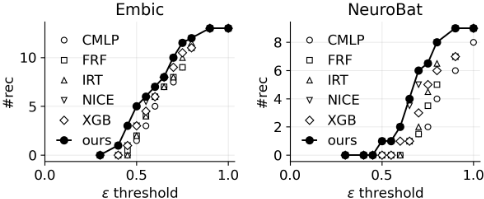
Unless otherwise stated, all real-world results are reported at a fixed feasibility threshold εcutoff = 0.6. We further analyze sensitivity to this choice through an ε-sweep in Figure 1 (with additional settings reported in the SM).
Results. Table 2 summarizes the harmonization results across all dataset pairs. Across all settings, our approach consistently identifies larger recoverable subsets than baseline methods while maintaining comparable or improved stability across random seeds. In particular, our approach recovers substantially more measurements than traditional linking and predictive baselines, reflecting its objective of maximizing feasible harmonization coverage rather than optimizing pointwise reconstruction accuracy.
Importantly, the additional measurements identified by our approach are not dominated by poorly reconstructed measurements. Across datasets, our approach matches baselines on the number of strongly aligned measurements while consistently increasing the number and stability of marginally aligned measurements. This pattern supports our goal of expanding feasible harmonization coverage without sacrificing the clinically reliable core.
Effect of the feasibility tolerance. To analyze how harmonization coverage varies with the feasibility criterion, we sweep the tolerance ε and report the number of recoverable measurements (#rec). Figure 1 shows the resulting curves for the EMBIC↔NeuroBAT pair, plotted separately for each assessment system. Across a broad range of thresholds, our approach consistently recovers more measurements than all baseline methods, demonstrating that it can achieve wider harmonization coverage while respecting the same feasibility constraint. This advantage is especially pronounced in the intermediate regime (approximately εcutoff ∈ [0.55, 0.8]), which corresponds to realistic clinical settings where assessments share a partially overlapping core but differ in system-specific content. In contrast, baseline methods tend to be either overly conservative at lower thresholds or exhibit abrupt and unstable increases in #rec as εcutoff is relaxed. These results highlight BFHD's ability to trace a smooth and interpretable coverage-feasibility frontier. Results for CAS↔SNAP and additional dataset pairs are deferred to the SM as they exhibit similar but less pronounced trends.
5.4 Experiment 3: Temporal Deployment Utility under Protocol Drift
While Experiment 2 evaluates harmonization outcomes under random splits from a fixed data distribution, real-world deployment requires applying harmonization decisions learned on earlier cohorts to data collected at a later time. Such temporal shifts may arise from changes in assessment procedures, rater behavior, cohort composition, or missingness patterns. Here we evaluate the temporal deployment utility of BFHD: whether measurement subsets identified as recoverable on early data remain feasible when deployed on later cohorts under potential protocol drift.
Temporal split and evaluation protocol. For each realworld dataset, we evaluate temporal deployment utility using a time-based split, where models are trained on early data and evaluated on a held-out later cohort; detailed split procedures and implementation details are provided in the SM.
Recoverable measurement subsets are defined on the training split and are not re-selected on the test split. For our approach, recoverable measurements are obtained by binarizing the learned output gates, while baseline methods infer recoverability on the training split using the same feasibility criterion as in Experiment 2. A training-period recoverable measurement is considered retained if it continues to satisfy errtest < εcutoff on the held-out test split.
We report two deployment utility metrics: (i) the number of retained recoverable measurements on the test split (#Ret), and (ii) the retention rate (Ret%), defined as the proportion of training-period recoverable measurements that remain feasible at test time. Agreement strength of retained measurements is reported in the SM.
Results. Table 3 summarizes temporal deployment results for the representative EMBIC↔NeuroBAT assessment pair. Across methods, our approach retains a larger number of training-period recoverable measurements under temporal shift while maintaining higher retention rates than baseline approaches. These results indicate that BFHD produces harmonization decisions that generalize more reliably across time and are therefore better suited for deployment in longitudinal and evolving clinical settings.
| Data | Method | #RecA | JA | #A > 0.7 | #A > 0.5 | #RecB | JB | #B > 0.7 | #B > 0.5 |
|---|---|---|---|---|---|---|---|---|---|
| IRT | 11 | 0.733 | 4.5 | 10.5 | 7 | 0.785 | 4 | 7 | |
| CAS(A) | XGB | 9 | 0.710 | 6 | 9 | 7 | 0.842 | 5 | 7 |
| ↔ | FRF | 9 | 0.683 | 4.5 | 9 | 7.5 | 0.858 | 6 | 7.5 |
| SNAP(B) | CMLP | 9 | 0.640 | 5 | 9 | 7 | 0.764 | 6 | 7 |
| NICE | 11 | 0.867 | 4 | 11 | 9 | 0.774 | 5 | 9 | |
| Ours | 11 | 0.930 | 4 | 11 | 9 | 0.817 | 5 | 9 | |
| IRT | 6 | 0.841 | 1 | 6 | 0 | N/A | 0 | 0 | |
| EMBIC(A) | XGB | 6 | 0.806 | 1 | 6 | 1 | 0.4 | 0 | 1 |
| ↔ | FRF | 6 | 0.819 | 1 | 6 | 0 | 0.533 | 0 | 0 |
| NeuroBAT | CMLP | 5 | 0.739 | 1 | 5 | 0 | 0.491 | 0 | 0 |
| (B) | NICE | 7 | 0.806 | 1 | 7 | 2 | 0.523 | 0 | 1.5 |
| Ours | 7 | 0.910 | 1 | 7 | 2 | 0.689 | 0 | 2 |
| Method | #RetA | Ret%A | #RetB | Ret%B |
|---|---|---|---|---|
| IRT | 3 | 42.9±0.0 | 0 | N/A |
| XGB | 6 | 85.7±0.0 | 0.5 | 62.5±48.4 |
| FRF | 5 | 56.0±8.0 | 0 | 0.0±0.0 |
| CMLP | 6 | 71.0±7.5 | 1 | 90.0±10.0 |
| NICE | 6 | 77.4±9.9 | 2 | 49.2±10.5 |
| Ours | 7 | 100.0±0.0 | 3 | 100.0±0.0 |
Additional utility analyses. Robustness under MCAR missingness[Little and Rubin, 2019; Rubin, 1976] and downstream transfer for prediction tasks are reported in the SM.
5.5 Experiment 4: Ablation and Stability Analysis
We examine how architectural and objective components contribute to the stability and behavior of BFHD.
Ablation settings. Starting from the full BFHD framework, we consider four ablations: (i) replacing the bidirectionally coupled invertible NICE backbone with a non-invertible tied weight backbone (TWMLP); (ii) switching the L0 gate reward to a standard L0 penalty; (iii) removing output gating; and (iv) replacing the hinge-based feasibility loss with a standard reconstruction loss. Each ablation modifies one component while keeping the others fixed.
Evaluation protocol. All variants are evaluated on representative real-world system pairs used in Experiment 2. We report the median number of recoverable measurements Table 4: Ablation study on EMBIC (A) ↔ NeuroBAT (B) under εcutoff = 0.6. Notation are consistent with Table 2. Additional results in the SM. † indicate trivial gating solutions.
| Variant | #RecA | JA | #RecB | JB |
|---|---|---|---|---|
| Ours (full) | 7 | 0.910 | 2 | 0.689 |
| - TWMLP | 7 | 0.886 | 1 | 0.600 |
| - L0 penalty | 0† | N/A | 0† | N/A |
| - No gating | 7 | 0.806 | 2 | 0.523 |
| - No hinge | 13† | N/A | 9† | N/A |
(#Rec) and the Jaccard similarity (J) across random seeds, which jointly capture coverage and stability.
Results and observations. Table 4 summarizes the ablation results. Replacing the L0 gate reward with a standard L0 penalty consistently leads to degenerate solutions, confirming the necessity of explicitly favoring maximal feasible subsets. Removing output gating reduces subset stability, indicating that enforcing feasibility at the reconstruction level is critical for consistent measurement identification. Replacing the invertible backbone with a non-invertible tied-weight MLP preserves recoverable subset size, with dataset-dependent effects on stability. This suggests that strict bidirectional parameter sharing contributes to robustness, while invertibility itself is not a prerequisite for feasibility-based coverage.
Overall, these results show that effective BFHD instantiations depend critically on the joint use of a shared bidirectional backbone, output-level gating, and gated hinge losses.
6 Conclusion
We formulated clinical harmonization as a bidirectional recoverability problem and proposed BFHD, a feasibilitydriven framework that identifies large bidirectionally recoverable measurement subsets under a shared operator. Across synthetic data and real clinical assessment pairs, BFHD consistently yields broader feasible harmonization coverage and higher subset stability than baselines. BFHD provides an explicit and interpretable decomposition for cross-protocol integration of heterogeneous clinical assessments.
Ethical Statement
This study uses de-identified datasets, including publicly available datasets and access-controlled datasets available upon reasonable request under appropriate approvals. No new data collection or human subject recruitment was conducted.
Acknowledgments
Data collection and sharing for the Alzheimer's Disease Neuroimaging Initiative (ADNI) is funded by the National Institute on Aging, National Institutes of Health Grant U19 AG024904. The grantee organization is the Northern California Institute for Research and Education.
Contribution Statement
Yuanhao Zhuo and Zixi Qin contributed equally to this work.
@inproceedings{ijcai2026p784,
  title     = {BFHD: Bidirectional Feature Harmonization Decomposition for Heterogeneous Clinical Assessments},
  author    = {Zhuo, Yuanhao and Qin, Zixi and Qin, Ling and Li, Wanqing},
  booktitle = {Proceedings of the Thirty-Fifth International Joint Conference on
               Artificial Intelligence, {IJCAI-26}},
  publisher = {International Joint Conferences on Artificial Intelligence Organization},
  editor    = {Diego Calvanese},
  pages     = {7046--7054},
  year      = {2026},
  month     = {8},
  note      = {AI and Health},
  doi       = {10.24963/ijcai.2026/784},
  url       = {https://doi.org/10.24963/ijcai.2026/784},
}
TY - CPAPER TI - BFHD: Bidirectional Feature Harmonization Decomposition for Heterogeneous Clinical Assessments AU - Zhuo, Yuanhao AU - Qin, Zixi AU - Qin, Ling AU - Li, Wanqing T2 - Proceedings of the Thirty-Fifth International Joint Conference on Artificial Intelligence, IJCAI-26 PB - International Joint Conferences on Artificial Intelligence Organization PY - 2026 SP - 7046 EP - 7054 DO - 10.24963/ijcai.2026/784 UR - https://doi.org/10.24963/ijcai.2026/784 ER -Copied
Machine-readable versions of this paper, for tools and AI agents:





