
A Review on Test-Time Scaling for Agentic Large Language Models
Proceedings of the Thirty-Fifth International Joint Conference on Artificial Intelligence. Survey Track. Pages 7731-7739.
https://doi.org/10.24963/ijcai.2026/859
Keywords
- Agent-based and Multi-agent Systems: Engineering methods, platforms, languages and tools
Abstract
The field of Large Language Models (LLMs) is moving beyond simply scaling the parameters during pre-training. Instead, researchers are focusing on Test-Time Scaling (TTS), which is a mechanism to allocate computational resources dynamically during the inference process. In the rapidly emerging field of Agentic LLMs, TTS has also shown great value in enabling agents to handle complex tasks that static models cannot handle. Despite all the substantial work in this field, it still lacks a comprehensive survey summarizing these advances. To the best of our knowledge, this paper presents the first systematic review of TTS tailored for Agentic LLMs. To this end, we propose a novel RAIE taxonomy along four scaling dimensions: (i) Reasoning optimizes the entire thought process through search algorithms and self-verification; (ii) Acting involves collecting information through external tools and environmental feedback; (iii) Interaction copes with complex tasks by forming various multi-agent networks; (iv) Evolution enables agents to continuously update their memory and strategies. Furthermore, we also introduce a task-oriented guideline for choosing the best TTS strategy. Finally, we sum up challenges and future directions to inspire further studies in this field. A curated list of papers and associated code will be made publicly available.
- [Acikgoz et al., 2025] Emre Can Acikgoz, Cheng Qian, Heng Ji, Dilek Hakkani-Tür, and Gokhan Tur. Self- improving llm agents at test-time. arXiv preprint arXiv:2510.07841, 2025.
- [Allabadi et al., 2025] Doaa Allabadi, Kyle Bradbury, and Jordan M Malof. Improving and evaluating open deep re- search agents. arXiv preprint arXiv:2508.10152, 2025.
- [Cai et al., 2025] Zhicheng Cai, Xinyuan Guo, Yu Pei, Jiang- Tao Feng, Jinsong Su, Jiangjie Chen, Ya-Qin Zhang, Wei- Ying Ma, Mingxuan Wang, and Hao Zhou. Flex: Continu- ous agent evolution via forward learning from experience. arXiv preprint arXiv:2511.06449, 2025.
- [Chen et al., 2025a] Hao Mark Chen, Zhiwen Mo, Guanxi Lu, Shuang Liang, Lingxiao Ma, Wayne Luk, and Hongxi- ang Fan. Democratizing agentic ai with fast test-time scal- ing on the edge. arXiv preprint arXiv:2509.00195, 2025.
- [Chen et al., 2025b] Weize Chen, Jiarui Yuan, Chen Qian, Cheng Yang, Zhiyuan Liu, and Maosong Sun. Op- tima: Optimizing effectiveness and efficiency for llm- based multi-agent system. In ACL (Findings), 2025.
- [Chen et al., 2025c] Yixing Chen, Yiding Wang, Siqi Zhu, Haofei Yu, Tao Feng, Muhan Zhang, Mostofa Patwary, and Jiaxuan You. Multi-agent evolve: Llm self-improve through co-evolution. arXiv preprint arXiv:2510.23595, 2025.
- [Chhikara et al., 2025] Prateek Chhikara, Dev Khant, Saket Aryan, Taranjeet Singh, and Deshraj Yadav. Mem0: Build- ing production-ready ai agents with scalable long-term memory. arXiv preprint arXiv:2504.19413, 2025.
- [Feng et al., 2025] Wenfeng Feng, Chuzhan Hao, Yuewei Zhang, Jingyi Song, and Hao Wang. AirRAG: Au- tonomous strategic planning and reasoning steer retrieval augmented generation. In EMNLP (Findings), 2025.
- [Gonzalez-Pumariega et al., 2025] Gonzalo Gonzalez- Pumariega, Vincent Tu, Chih-Lun Lee, Jiachen Yang, Ang Li, and Xin Eric Wang. The unreasonable effectiveness of scaling agents for computer use. arXiv preprint arXiv:2510.02250, 2025.
- [Guan et al., 2025] Xinyu Guan, Li Lyna Zhang, Yifei Liu, Ning Shang, Youran Sun, Yi Zhu, Fan Yang, and Mao Yang. rstar-math: Small LLMs can master math reason- ing with self-evolved deep thinking. In ICML, 2025.
- [Guo et al., 2025] Xiyu Guo, Shan Wang, Chunfang Ji, Xue- feng Zhao, Wenhao Xi, Yaoyao Liu, Qinglan Li, Chao Deng, and Junlan Feng. Towards generalized routing: Model and agent orchestration for adaptive and efficient inference. arXiv preprint arXiv:2509.07571, 2025.
- [He et al., 2025a] Yufei He, Ruoyu Li, Alex Chen, Yue Liu, Yulin Chen, Yuan Sui, Cheng Chen, Yi Zhu, Luca Luo, Frank Yang, et al. Enabling self-improving agents to learn at test time with human-in-the-loop guidance. In EMNLP, 2025.
- [He et al., 2025b] Yufei He, Juncheng Liu, Yue Liu, Yibo Li, Tri Cao, Zhiyuan Hu, Xinxing Xu, and Bryan Hooi. Evotest: Evolutionary test-time learn- ing for self-improving agentic systems. arXiv preprint arXiv:2510.13220, 2025.
- [Herr et al., 2025] Nathan Herr, Tim Rocktäschel, and Roberta Raileanu. Llm-first search: Self-guided ex- ploration of the solution space. arXiv preprint arXiv:2506.05213, 2025.
- [Jiang et al., 2025] Eric Hanchen Jiang, Guancheng Wan, Sophia Yin, Mengting Li, Yuchen Wu, Xiao Liang, Xin- feng Li, Yizhou Sun, Wei Wang, Kai-Wei Chang, et al. Dynamic generation of multi-llm agents communication topologies with graph diffusion models. arXiv preprint arXiv:2510.07799, 2025.
- [Jung et al., 2025] Dongwon Jung, Peng Shi, and Yi Zhang. Futureweaver: Planning test-time compute for multi-agent systems with modularized collaboration. arXiv preprint arXiv:2512.11213, 2025.
- [Kaesberg et al., 2025] Lars Benedikt Kaesberg, Jonas Becker, Jan Philip Wahle, Terry Ruas, and Bela Gipp. Voting or consensus? decision-making in multi-agent debate. In ACL (Findings), 2025.
- [Koh et al., 2024] Jing Yu Koh, Stephen McAleer, Daniel Fried, and Ruslan Salakhutdinov. Tree search for language model agents. arXiv preprint arXiv:2407.01476, 2024.
- [Leong et al., 2025] Hui Yi Leong, Yuheng Li, Yuqing Wu, Wenwen Ouyang, Wei Zhu, Jiechao Gao, and Wei Han. Amas: Adaptively determining communication topology for llm-based multi-agent system. In EMNLP, 2025.
- [Li et al., 2025a] Baixuan Li, Dingchu Zhang, Jialong Wu, et al. Parallelmuse: Agentic parallel thinking for deep information seeking. arXiv preprint arXiv:2510.24698, 2025.
- [Li et al., 2025b] Shiyuan Li, Yixin Liu, Qingsong Wen, Chengqi Zhang, and Shirui Pan. Assemble your crew: Automatic multi-agent communication topology design via autoregressive graph generation. arXiv preprint arXiv:2507.18224, 2025.
- [Lifshitz et al., 2025] Shalev Lifshitz, Sheila A. McIlraith, and Yilun Du. Multi-agent verification: Scaling test-time compute with multiple verifiers. In ICLR Workshop, 2025.
- [Liu et al., 2025] Tengxiao Liu, Zifeng Wang, Jin Miao, et al. Budget-aware tool-use enables effective agent scal- ing. arXiv preprint arXiv:2511.17006, 2025.
- [Ouyang et al., 2025] Siru Ouyang, Jun Yan, I Hsu, Yanfei Chen, Ke Jiang, Zifeng Wang, Rujun Han, Long T Le, Samira Daruki, Xiangru Tang, et al. Reasoningbank: Scal- ing agent self-evolving with reasoning memory. arXiv preprint arXiv:2509.25140, 2025.
- [Paglieri et al., 2025] Davide Paglieri, Bartłomiej Cupiał, Jonathan Cook, Ulyana Piterbarg, Jens Tuyls, Edward Grefenstette, Jakob Nicolaus Foerster, Jack Parker-Holder, and Tim Rocktäschel. Learning when to plan: Efficiently allocating test-time compute for llm agents. arXiv preprint arXiv:2509.03581, 2025.
- [Peng et al., 2025] Hao Peng, Yunjia Qi, Xiaozhi Wang, Zi- jun Yao, Bin Xu, Lei Hou, and Juanzi Li. Agentic reward modeling: Integrating human preferences with verifiable correctness signals for reliable reward systems. In ACL, 2025.
- [Qi et al., 2025] Zehan Qi, Xiao Liu, Iat Long Iong, Hanyu Lai, Xueqiao Sun, Jiadai Sun, Xinyue Yang, Yu Yang, Shuntian Yao, Wei Xu, et al. Webrl: Training llm web agents via self-evolving online curriculum reinforcement learning. In ICLR, 2025.
- [Shen et al., 2025] Junhong Shen, Hao Bai, Lunjun Zhang, Yifei Zhou, Amrith Setlur, Shengbang Tong, Diego Caples, Nan Jiang, Tong Zhang, Ameet Talwalkar, and Aviral Kumar. Thinking vs. doing: Improving agent rea- soning by scaling test-time interaction. In NeurIPS, 2025.
- [Tang et al., 2025] Xiangru Tang, Tianrui Qin, Tianhao Peng, Ziyang Zhou, Daniel Shao, Tingting Du, Xinming Wei, Peng Xia, Fang Wu, He Zhu, et al. Agent kb: Lever- aging cross-domain experience for agentic problem solv- ing. arXiv preprint arXiv:2507.06229, 2025.
- [Team, 2025] Tongyi DeepResearch Team. Tongyi deepre- search technical report. arXiv preprint arXiv:2510.24701, 2025.
- [Tu et al., 2025] Haoxin Tu, Huan Zhao, Yahui Song, Mehtab Zafar, Ruijie Meng, and Abhik Roychoud- hury. Agentic program verification. arXiv preprint arXiv:2511.17330, 2025.
- [Wang et al., 2025a] Fali Wang, Hui Liu, Zhenwei DAI, Jingying Zeng, Zhiwei Zhang, Zongyu Wu, Chen Luo, Zhen Li, Xianfeng Tang, Qi He, and Suhang Wang. AgentTTS: Large language model agent for test-time compute-optimal scaling strategy in complex tasks. In NeurIPS, 2025.
- [Wang et al., 2025b] Xiao Wang, Jia Wang, Yijie Wang, Pengtao Dang, Sha Cao, and Chi Zhang. Mars: toward more efficient multi-agent collaboration for llm reasoning. arXiv preprint arXiv:2509.20502, 2025.
- [Wei et al., 2025] Tianxin Wei, Noveen Sachdeva, Benjamin Coleman, et al. Evo-memory: Benchmarking llm agent test-time learning with self-evolving memory. arXiv preprint arXiv:2511.20857, 2025.
- [Wu et al., 2025a] Jialong Wu, Baixuan Li, Runnan Fang, Wenbiao Yin, Liwen Zhang, Zhenglin Wang, Zhengwei Tao, Ding-Chu Zhang, Zekun Xi, Xiangru Tang, Yong Jiang, Pengjun Xie, Fei Huang, and Jingren Zhou. Web- dancer: Towards autonomous information seeking agency. In NeurIPS, 2025.
- [Wu et al., 2025b] Rong Wu, Xiaoman Wang, Jianbiao Mei, et al. Evolver: Self-evolving llm agents through an experience-driven lifecycle. arXiv preprint arXiv:2510.16079, 2025.
- [Xu et al., 2025] Wujiang Xu, Zujie Liang, Kai Mei, Hang Gao, Juntao Tan, and Yongfeng Zhang. A-mem: Agentic memory for LLM agents. In NeurIPS, 2025.
- [Yang et al., 2025a] Cheng Yang, Xuemeng Yang, Licheng Wen, et al. Learning on the job: An experience-driven self-evolving agent for long-horizon tasks. arXiv preprint arXiv:2510.08002, 2025.
- [Yang et al., 2025b] Yan Yang, Dongxu Li, Yutong Dai, et al. Gta1: Gui test-time scaling agent. arXiv preprint arXiv:2507.05791, 2025.
- [Ye et al., 2024] Hai Ye, Mingbao Lin, Hwee Tou Ng, and Shuicheng Yan. Multi-agent sampling: Scaling inference compute for data synthesis with tree search-based agentic collaboration. arXiv preprint arXiv:2412.17061, 2024.
- [Yu et al., 2025] Xiao Yu, Baolin Peng, Vineeth Vajipey, Hao Cheng, Michel Galley, Jianfeng Gao, and Zhou Yu. Exact: Teaching ai agents to explore with reflective-mcts and exploratory learning. In ICLR, 2025.
- [Zhang and Liu, 2025] Zihao Zhang and Fei Liu. Cost- augmented monte carlo tree search for llm-assisted plan- ning. arXiv preprint arXiv:2505.14656, 2025.
- [Zhang et al., 2025a] Gongrui Zhang, Jialiang Zhu, Ruiqi Yang, et al. Infoagent: Advancing au- tonomous information-seeking agents. arXiv preprint arXiv:2509.25189, 2025.
- [Zhang et al., 2025b] Guibin Zhang, Fanci Meng, Guancheng Wan, Zherui Li, Kun Wang, Zhenfei Yin, Lei Bai, and Shuicheng Yan. Latentevolve: Self- evolving test-time scaling in latent space. arXiv preprint arXiv:2509.24771, 2025.
- [Zhang et al., 2025c] Guibin Zhang, Yanwei Yue, Xiangguo Sun, Guancheng Wan, Miao Yu, Junfeng Fang, Kun Wang, Tianlong Chen, and Dawei Cheng. G-designer: Architect- ing multi-agent communication topologies via graph neu- ral networks. In ICML, 2025.
- [Zhang et al., 2025d] Qian Zhang, Yan Zheng, Jinyi Liu, Hebin Liang, and Lanjun Wang. Key decision-makers in multi-agent debates: Who holds the power? arXiv preprint arXiv:2511.11040, 2025.
- [Zhang et al., 2025e] Qizheng Zhang, Michael Wornow, and Kunle Olukotun. Agentic plan caching: Test-time memory for fast and cost-efficient LLM agents. In NeurIPS, 2025.
- [Zhang et al., 2025f] Wenlin Zhang, Xiaopeng Li, Yingyi Zhang, Pengyue Jia, Yichao Wang, Huifeng Guo, Yong Liu, and Xiangyu Zhao. Deep research: A sur- vey of autonomous research agents. arXiv preprint arXiv:2508.12752, 2025.
- [Zhao et al., 2025] Xinjie Zhao, Fan Gao, Xingyu Song, Yingjian Chen, Rui Yang, Yanran Fu, Yuyang Wang, Yusuke Iwasawa, Yutaka Matsuo, and Irene Li. Reagent: Reversible multi-agent reasoning for knowledge-enhanced multi-hop qa. In EMNLP, 2025.
References were extracted automatically from the PDF and may contain errors.
Full text extracted automatically from the PDF; figures, tables and equations may differ. The PDF is the version of record.
1 Introduction
Test-Time Scaling (TTS) improves reasoning performance by allocating additional computational resources during the inference stage [Shen et al., 2025]. This approach allows models to generate more accurate and thoughtful responses than standard inference [Paglieri et al., 2025]. Agentic Large Language Models (LLMs) represent a novel and vital research domain. These models exhibit higher levels of autonomy and decision-making capabilities than traditional agents [Team, 2025]. In this context, TTS provides immense value, enabling agents to handle complex long-range tasks [Wang et al.,
∗Corresponding author
2025a]. For instance, rStar-Math [Guan et al., 2025] shows how scaling internal reasoning deals with difficult mathematical problems. Additionally, the Thinking vs. Doing framework [Shen et al., 2025] proves that scaling environmental interactions leads to sustained performance gains.
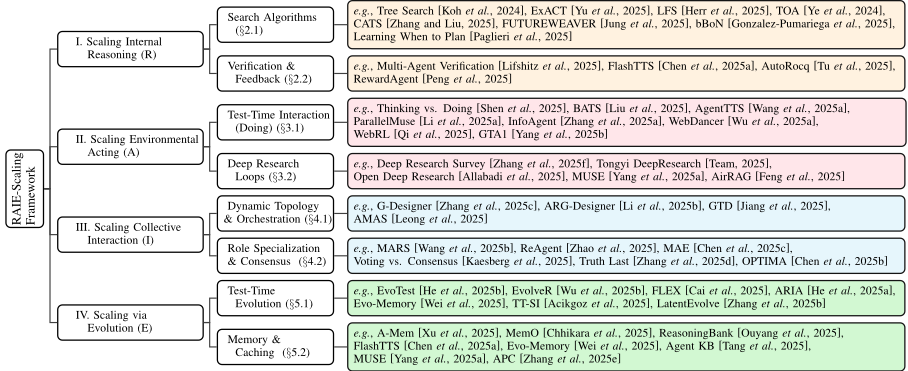
Despite the recent encouraging progress on TTS for agentic LLMs, current surveys exclusively focus on general TTS for non-agentic LLMs or neglect dynamic compute allocation as a primary scaling factor for agentic LLMs. For instance, Deep Research Survey [Zhang et al., 2025f] investigates specialized autonomous agents, but does not address the broader principles of agentic TTS. Meanwhile, general surveys of LLM agents largely overlook dynamic test-time compute as a key dimension of scaling [Team, 2025]. To bridge this gap, we present, to the best of our knowledge, the first systematic survey of TTS for agentic LLMs. To achieve this goal, we propose a novel taxonomy organized around the RAIE framework. The taxonomy is illustrated in Figure 1. It categorizes methodologies into four critical dimensions: (i) Internal Reasoning (R) which uses algorithms like Monte Carlo Tree Search to scale cognitive depth [Yu et al., 2025]; (ii) Environmental Acting (A) which explores how agents scale interaction with the world [Shen et al., 2025]; (iii) Collective Interaction (I) where frameworks like G-Designer [Zhang et al., 2025c] and MAE [Chen et al., 2025c] optimize multi-agent collaboration; and (iv) Continuous Evolution (E) where methods like EvoTest [He et al., 2025b] and FLEX [Cai et al., 2025] allow agents to learn on-the-fly.
Building on our proposed taxonomy, we further introduce a task-oriented guideline that maps specific scaling mechanisms to diverse problem domains, aiming to facilitate both research development and practical adoption in the community. Finally, we summarize major challenges and outline several future research directions, highlighting system-level efficiency.
In sum, this paper for the first time provides a dedicated and comprehensive overview of agentic TTS via the proposed RAIE taxonomy. Leveraging this framework, we derive a roadmap in selecting appropriate scaling strategies. We further identify key challenges and promising research directions to spur continued progress in agentic TTS. Together, these contributions will consolidate the emerging landscape of agentic TTS, meanwhile serving as a practical toolkit for advancing future agentic TTS in real-world settings.
2 Scaling Internal Reasoning
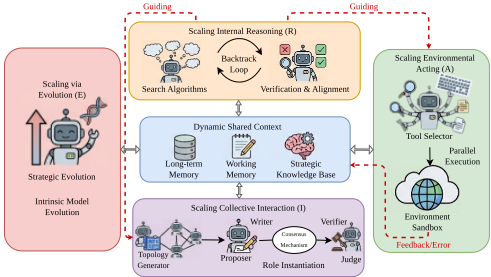
Scaling Internal Reasoning refers to the allocation of additional test-time compute to cognitive processes. It occurs especially within the agent and is independent of external environmental feedback. The essence of this paradigm is to dynamically scale the depth and breadth of thought during inference. In this framework, the agent builds a latent thought space to simulate and refine strategies, breaking complex problems into sub-goals and correcting errors before acting. As illustrated in the RAIE framework, internal reasoning acts as the commander, guiding the agent's "Acting" and "Interacting" processes. We categorize the methodologies for scaling internal reasoning into two complementary mechanisms. A summary of internal representative agentic TTS methods is provided in Table 1.
2.1 Search Algorithms
Search algorithms enable agents to explicitly explore the thought space or action space before execution. These methods can simulate potential trajectories and evaluate intermediate states. Current research in this domain can be categorized into the following three main streams.
Tree Search in Action Space. Traditional planning algorithms like Monte Carlo Tree Search (MCTS) have been successfully adapted, which perceives the reasoning process as a tree. Early attempts to scale inference compute focused on applying best-first search directly to environmental interactions. Koh et al. illustrate this by introducing a search algorithm that operates directly in a browser's state space [Koh et al., 2024]. The agent uses a learned value function to evaluate action trajectories, backtracks from invalid paths, and trades increased inference time for higher success rates. Furthermore, recent works introduces reflection and cost constraints to standard search. ExACT [Yu et al., 2025] integrates MCTS with a self-learning mechanism known as Reflective-MCTS (R-MCTS). R-MCTS uses contrastive reflections to guide the search policy which compares successful trajectories with failed ones dynamically.
Addressing the budget aspect, Cost-Augmented Monte Carlo Tree Search (CATS) [Zhang and Liu, 2025] explicitly incorporates cost factors into tree expansion. It implements early pruning of infeasible solutions and prioritizes low-cost paths under resource constraints.
Adaptive and Self-Guided Exploration. Although structured search is powerful, fixed search heuristics may not align with the semantic capabilities of LLMs. A new methods focuses on empowering agentic LLMs to autonomously control the search process. Herr et al. proposed LLM-First Search (LFS), which enables self-guided exploration [Herr et al., 2025]. In LFS, the model acts as a controller, using internal scoring to dynamically decide between node expansion and backtracking. This removes the need for tuning and allows the search strategy to adapt to task difficulty. Moreover, The decision of when to search is as critical as how to search. Paglieri et al. investigated this trade-off in their work Learning When to Plan [Paglieri et al., 2025]. They point out that always planning is computationally wasteful and can harm performance due to error accumulation. They propose a policy that dynamically allocates test-time compute. Activating planning only when task complexity requires it balances efficiency and performance.
Ensemble Search in Multi-Agent Systems. The search is not limited to single-agent thought process, but is increasingly applied to orchestrate multi-agent systems and select optimal trajectories from different rollouts. Scaling through generating multiple samples is a proven strategy, though selecting the best outcome remains challenging. Behavior Bestof-N (bBoN) [Gonzalez-Pumariega et al., 2025] generates multiple rollouts and selects the best one based on abstracted behavior narratives. bBoN enables principled selection and substantially improves robustness. Moving beyond the selection of final trajectories, Ye et al. propose Tree Search-based Orchestrated Agents (TOA) [Ye et al., 2024] to show interaction patterns can be optimized through search. TOA treats the coordination of multiple agents as a search problem. It uses MCTS to dynamically optimize the collaboration graph for each input query. Similarly, FUTUREWEAVER [Jung et al., 2025] introduces a framework for planning test-time compute under strict budget constraints. FUTUREWEAVER maximizes utility using a dual-level planning architecture to select and execute modularized collaboration patterns.
2.2 Verification &Logic Alignment
Although search algorithms provide the breadth to explore solution spaces, they cannot guarantee the correctness of the reasoning path. In long-horizon agentic tasks, a single logical fallacy may lead to failure of the entire system. Therefore, Internal Reasoning Scaling must also address the depth of processing. Specifically, how an agent assesses, verifies and corrects its own decisions. We categorize these advancements into Verification & Logic Alignment.
Collaborative Verification via Multi-Agent Systems. A defining characteristic of Agentic AI is the ability to distribute cognitive load across specialized roles. Multi-Agent Verification (MAV) [Lifshitz et al., 2025] introduces a Divide-andConquer architecture for reliability. MAV deploys a suite of specialized verifier agents rather than a single scalar reward. That includes an Edge-Case Inspector, a Domain Expert and a Logic Checker. A central Meta-Verifier aggregates these diverse perspectives to form a final judgment. Similarly, Agentic Reward Modeling (REWARDAGENT) [Peng et al., 2025] transforms the reward function itself into an agentic workflow and actively integrates heterogeneous signals. It combines human preference data with verifiable factuality checks and instruction-following constraints.
Neuro-Symbolic Integration for Formal Guarantees. To combat hallucinations in high-stakes domains, Agentic AI increasingly integrates with deterministic tools. The GenerateVerify-Refine closed loop is established to meet this requirement. AUTOROCQ [Tu et al., 2025] illustrates this by coupling an LLM agent with the Rocq theorem prover. When the prover rejects a proof, the agent analyzes the formal error message and adjusts its strategy against ground-truth logic.
Runtime Verification & Efficiency. In open-ended environments, agent behaviors are unpredictable, which requires verification mechanisms that scale across the system lifecycle. Crucially, to support these intensive verification loops on resource-constrained edge devices, FlashTTS [Chen et al., 2025a] introduces an Asymmetric Multi-Model Memory Allocation mechanism. It optimizes KV-cache management for the verification phase and deploys memory-hungry verifiers alongside generation models.
3 Scaling Environmental Acting
Internal Reasoning especially focuses on allocating compute to latent cognitive processes before acting. In contrast, Scaling Environmental Acting investigates how Agentic AI can enhance performance by dynamically scaling its interaction with external environments. In this paradigm, we unravel a new dimension of scaling where intelligence emerges from the feedback loop between the agent and the world.
3.1 Test-Time Interaction
TTI assumes that for information-sparse or dynamic tasks, the bottleneck is information acquisition rather than reasoning depth. Therefore, scaling the number of parallel explorations and length of interaction trajectories becomes critical. We categorize TTI methodologies into the following four distinct parts.
Foundations: Interaction as Compute. Traditional scaling laws focus on training compute or inference token counts. However, Thinking vs. Doing [Shen et al., 2025] establishes the theoretical basis for Interaction Scaling. Their analysis shows that simply increasing reasoning time yields diminishing returns in complex environments. In contrast, scaling the number of interaction steps and allowing the agent to gather missing observations leads to performance gains. Formally, let Ctotal be the total test-time compute budget. It is made up of internal reasoning compute Cint and external interaction compute Cext. The agent's performance P on a task T can be modeled as:
where Cext is defined by the number of environment steps and cost per action. Their work shows that shifting the budget from Cint to Cext is often optimal for tasks requiring a grounding in external knowledge.
Strategic & Resource-Aware Acting. Agentic AI differentiates itself from standard agents by possessing MetaCognition with respect to its resource constraints. These systems dynamically optimize their interaction strategy based on the remaining budgets. BATS (Budget-Aware Tool-Use) [Liu et al., 2025] introduces a dynamic planning mechanism. The agent monitors a continuous budget variable bt. The policy π(at|st, bt) adapts to dig deeper only when bt is high. AgentTTS [Wang et al., 2025a] extends this to multi-stage complex tasks. It formulates interaction scaling as a global optimization problem. Given a task decomposed into subtasks {s1, . . . , sk}, AgentTTS searches for the optimal model size Mi and interaction steps Ki. For each subtask, its goal is to maximize the total success rate R:
In the domain of Graphical User Interfaces (GUI), GTA1 [Yang et al., 2025b] applies scaling to the action space itself. Recognizing that GUI actions are often irreversible, GTA1 performs test-time Action scaling by parallel sampling multiple action proposals and selecting the optimal trajectory. Deep Information Orchestration. For tasks requiring deep research, Agentic AI acts as an orchestrator of information flow. PARALLELMUSE [Li et al., 2025a] proposes Agentic Parallel Thinking which performs uncertainty-guided branching by partitioning the reasoning space into functional regions. Multiple agent instances could explore disparate information sources simultaneously. Complementing this, INFOAGENT [Zhang et al., 2025a] introduces a self-hosted search infrastructure. An entity tree is constructed to decompose high-level queries into granular sub-tree sampling operations. Similarly, WebDancer [Wu et al., 2025a] optimizes the end-to-end information seeking process by learning from browsing trajectories.
| Method | Core Mechanism | TTC | MA | Key Capabilities |
|---|---|---|---|---|
| Scaling Internal Reasoning | ||||
| ExACT [Yu et al., 2025] LFS [Herr et al., 2025] ReAgent [Zhao et al., 2025] AutoRocq [Tu et al., 2025] | Reflective-MCTS with contrastive self-learning Self-guided exploration via internal scoring (LLM-First Search) Controller-Verifier architecture with recursive backtracking Integration with Rocq theorem prover for formal verification | High Medium High High | Yes Yes Yes Yes | Logic Search Adaptive Exploration Error Correction Neuro-Symbolic Verify |
| Scaling Environmental Acting | ||||
| Thinking vs. Doing [Shen et al., 2025] BATS [Liu et al., 2025] WebRL [Qi et al., 2025] MUSE [Yang et al., 2025a] | Scaling interaction steps (Cext) vs. reasoning steps (Cint) Budget-aware tool-use planning based on remaining resources Self-evolving online curriculum via outcome-supervised RL Hierarchical memory for long-horizon deep research | Medium Low High Medium | Yes Yes Yes Yes | Grounded QA Resource Management Web Navigation Research Synthesis |
| Scaling Collective Interaction | ||||
| G-Designer [Zhang et al., 2025c] GTD [Jiang et al., 2025] MARS [Wang et al., 2025b] MAE [Chen et al., 2025c] Truth Last [Zhang et al., 2025d] OPTIMA [Chen et al., 2025b] | GNN-based dynamic topology generation Guided Topology Diffusion for structure denoising Hierarchical role specialization (Author-Reviewer-MetaReviewer) Proposer-Solver-Judge co-evolution via RL Positional weighting strategy for consensus Training-based communication optimization | Medium High Medium High Low High | No Yes Yes Yes Yes No | Adaptive Collaboration Generative Topology Academic/Logic QA Self-Improving Roles Bias Mitigation Efficient Consensus |
| Scaling via Evolution | ||||
| EvoTest [He et al., 2025b] FLEX [Cai et al., 2025] Evo-Memory [Wei et al., 2025] TT-SI [Acikgoz et al., 2025] APC [Zhang et al., 2025e] FlashTTS [Chen et al., 2025a] | Evolutionary prompt rewriting by Actor-Evolver Experience library with forward learning reflection Streaming memory with active forgetting & updating Test-time gradient updates via self-data augmentation Caching & reusing structured plan templates (System Optim) Speculative beam extension & KV-cache reuse (System Optim) | Medium Medium Medium Very High Low Low | Yes Yes Yes No Yes No | Strategy Optimization Experience Reuse Long-horizon Memory Parameter Learning Latency Reduction Efficient Serving |
Active Exploration & Evolution. The most advanced form of TTI involves agents that evolve through interaction. The environment serves not just as a task space, but as a source of training signal. WebRL [Qi et al., 2025] introduces a selfevolving online curriculum. WebRL employs a self-reflection mechanism to convert failed long-horizon attempts into simpler and solvable curriculum tasks. It is combined with an Outcome-Supervised Reward Model (ORM) to establish a closed loop system. The interaction directly promotes policy improvement internally:
3.2 Deep Research Loops
While TTI scales the breadth of simple actions, Deep Research Loops scale the temporal depth and complexity of information acquisition. A deep research agent autonomously constructs a long-horizon investigation process until a certain information density is achieved.
The Deep Research Pipeline. The foundational structure of this paradigm is defined by the Deep Research Survey [Zhang et al., 2025f]. This work formalizes the research lifecycle into four distinct stages: (1) Planning, (2) Question Development, (3) Web Exploration, and (4) Report Generation. Building on this pipeline, Tongyi DeepResearch [Team, 2025] demonstrates a full-stack implementation of an agentic model. The model features a recursively expanding planning mechanism that allows the agent to autonomously determine when to stop searching and start writing. Similarly, Open Deep Research (ODR) [Allabadi et al., 2025] explores the strategic improvements required for open-source models to compete in this domain. By optimizing the Search-and-Utilize loop, ODR enables agents to navigate the open web dynamically.
Reasoning & Evolution within the Loop. To maximize the efficiency of the research loop, advanced agents employ reasoning-guided navigation and long-term memory. AirRAG [Feng et al., 2025] integrates MCTS into the retrieval process. Reasoning actions could be expanded to dynamically explore the solution space. We can model the agent's objective as maximizing the cumulative Information Gain (IG) over a research horizon T :
where the policy π is optimized via MCTS to balance the value of new information against retrieval costs. Finally, MUSE [Yang et al., 2025a] addresses the stateless limitation of traditional agents. It introduces a self-evolving framework with Hierarchical Memory. The agent abstracts successful trajectories into high-level skills stored in long-termmemory to learn on the job.
4 Scaling Collective Interaction
For the aspect of single-agent scaling, researchers focus on internal depth or external breadth. Scaling Collective Interaction explores how intelligence emerges from the collaboration of multiple specialized agents. In this paradigm, the compute is scaled by increasing the number of active agents and optimizing their communication structures. Agentic AI is required to match the specific requirements of each query which is different from static multi-agent systems. Thus, Dynamic Topology is used to autonomously design and restructure the collaboration graph at test time.
4.1 Dynamic Topology &Orchestration
The core premise of dynamic topology is that the ideal collaboration structure is not invariant but query-dependent. A linear chain of commands is sufficient for simple queries. However, it requires a dense cyclic graph of experts for problems with more complexity. Therefore, the topology is treated as a learnable variable during the inference.
Generative Topology Design. Instead of selecting from predefined templates, advanced frameworks now generate collaboration graphs from scratch. G-Designer [Zhang et al., 2025c] formulates topology construction as a graph generation problem. It employs a Graph Neural Network (GNN) and a Variational Graph Auto-Encoder (VGAE) to refine the communication structure. It dynamically adds or prunes edges to optimize information flow. ARG-Designer [Li et al., 2025b] approaches this using an autoregressive generation paradigm. Given a complex task, it has the ability to sequentially select the necessary agent roles and construct a customized network. Taking a generative modeling approach, GTD (Guided Topology Diffusion) [Jiang et al., 2025] models the search for an optimal topology as a denoising process. It utilizes a Graph Diffusion Model to sample collaboration structures from a continuous space. The goal is to optimize a multiobjective function that balances accuracy, cost, and robustness. Formally, given a query q, the system seeks the optimal graph G ∗ that maximizes the expected utility U:
where P represents the performance of the agent team executing under topology G. Meanwhile, Cost penalizes excessive communication overhead.
Difficulty-Aware Orchestration. One of the key characteristics of Agentic AI is its Meta-Cognition. It stands for the ability to assess task difficulty and allocate resources accordingly. MoMA (Mixture-of-Models-and-Agents) [Guo et al., 2025] proposes a flexible routing framework which orchestrates diverse computational units within. It decides whether to dispatch a query to a standalone LLM or to dynamically instantiate a specialized agent team.
Context-Adaptive Communication. Beyond structure and routing, the information flow within the graph must also adapt as well. AMAS [Leong et al., 2025] proposes a mechanism to adaptively determine the communication topology based on the evolving context. At each step of the problem-solving process, agents determine which peers to query instead of broadcasting. It ends up with a real-time evolving and nonstationary communication graph.
4.2 Role Specialization &Consensus
While Dynamic Topology addresses how agents connect, Role Specialization & Consensus addresses what they do and how they agree. The mere duplication of homogeneous agents often leads to echo chambers where errors are amplified. In order to effectively scale reasoning, Agentic AI systems employ heterogeneous role definitions and robust consensus protocols.
Role-Based Architectures. By assigning distinct cognitive functions to different agents, a system can achieve the separation of concerns that enhances global performance. MARS (Multi-Agent Review System) [Wang et al., 2025b] emulates the academic peer-review process and designates specific roles to carry out the mechanism. The structure involves an Author to generate solutions, Reviewers to provide independent critiques, and a Meta-Reviewer to make final decisions. Furthermore, ReAgent [Zhao et al., 2025] introduces a Controller-Verifier architecture capable of backtracking in the system-level. When the Verifier detects a logical inconsistency, the Controller will initiate a rollback to a previous valid state. In general, a non-linear error-correction loop can be implemented during inference. Finally, MAE (Multi-Agent Evolve) [Chen et al., 2025c] proposes a Proposer-SolverJudge triangle where roles are co-evolved rather than static. Through the process of iterative interaction and reinforcement learning, each role gradually improves its specific ability. Thus, the system scales through both interaction and evolution.
Consensus Protocols & Optimization. Once diverse perspectives are generated, the systemmust aggregate them into a single coherent output. Voting vs. Consensus [Kaesberg et al., 2025] provides a foundational analysis of decisionmaking protocols. It reveals that unanimity minimizes false positives in high-stakes knowledge tasks. However, it is more robust using Majority Voting for reasoning tasks. The paper suggests that the ideal aggregation rule is actually taskdependent. However, not all votes should count equally. Key Decision-Makers [Zhang et al., 2025d] uncovers a positional bias in multi-agent debates. It proposes a Truth Last strategy. The system flexibly weights agents based on their consistency and speaking order to reduce the echo chamber effect.
Beyond fixed protocols, recent work has focused on optimizing the interaction itself through training. OPTIMA [Chen et al., 2025b] introduces a Communication Optimization framework. OPTIMA could explicitly optimize the communication protocol itself by training on a Generate-RankSelect-Train pipeline. This workflow teaches agents how to exchange information more efficiently and reach consensus with fewer communication turns. Formally, it maximizes a reward R that balances task success S and communication cost C:
where τ represents the multi-agent interaction trajectory.
5 Scaling via Evolution
Previous scaling dimensions focus on expanding the search space, external actions, or agent quantity. Scaling via Evolution explores the temporal dimension instead. It addresses the fundamental limitation of static agents which is the inability to learn from experience after deployment. Agentic AI overcomes this by implementing a Test-Time Training loop. The system updates its strategies, memory, or even internal parameters on-the-fly.
5.1 Test-Time Evolution
Test-Time Evolution indicates that an agent's performance should increase with the number of tasks it processes. Agentic AI systems continuously learn during test phase to adapt to distribution shifts and personalize behavior without retraining. We categorize these approaches into three levels.
Strategic Evolution (Prompt & Principle Optimization). The most accessible way of evolution is refining the agent's high-level strategies or system prompts based on feedback. EvoTest [He et al., 2025b] introduces a framework which includes an Actor and an Evolver. Instead of updating weights, the evolver analyzes the actor's failure trajectories and rewrites the system prompt. Similarly, EvolveR [Wu et al., 2025b] formalizes an Experience-Driven Lifecycle. It distills successful interaction trajectories into abstract principles during an offline phase. These rules are retrieved to guide online decision-making. FLEX [Cai et al., 2025] extends this by building a structured Experience Library. The agent reflects on both successes and failures to update the library, which prevents repeated mistakes.
Memory & Knowledge Adaptation. For agents operating in dynamic environments, evolution requires maintaining an up-to-date state of the world. Evo-Memory [Wei et al., 2025] proposes a self-evolving memory system. The process of Forgetting, Updating, and Consolidating ensures that the context remains relevant over long interaction streams. Addressing the challenge of concept drift, ARIA [He et al., 2025a] introduces an Adaptive Reflective mechanism. When ARIA detects inconsistencies between internal knowledge and external observations, it will update a timestamped knowledge repository to renovate its knowledge base.
Intrinsic Model Evolution (Parameter & Latent Scaling). The deepest form of evolution involves modifying the model's internal representations during inference. The authors of LatentEvolve [Zhang et al., 2025b] implement a dual-process evolution. "Daytime" scaling retrieves historical latent states in reasoning, while "Nighttime" memory consolidation optimizes latent representations. The model can scale its capability in the continuous latent space rather than discrete token space. Finally, TT-SI (Test-Time SelfImprovement) [Acikgoz et al., 2025] employs an uncertaintybased mechanism to identify weak spots in the agent's knowledge. The model generates synthetic training data via SelfData Augmentation, and performs immediate fine-tuning. Formally, the agent updates its parameters θ at test step t to minimize the uncertainty U on the current task distribution
where Lself represents the self-supervised loss on generated data.
5.2 Memory &Caching
Effective TTS also requires a mechanism to persist and efficiently retrieve the accrued intelligence. Without structured memory, an agent will be forced to reason from scratch for every query. Memory & Caching establishes the infrastructure for long-term state management. It is the key for Agentic AI to maintain continuity and trade storage for compute by reusing past reasoning.
Cognitive Memory Architectures. To support complex reasoning, memory must be more than a flat list of text chunks. A-Mem [Xu et al., 2025] draws inspiration from structuring memory as a network of interconnected notes. A-Mem employs dynamic indexing and linking to replace static vector databases. The relationships between memory nodes are reorganized when new information comes in. MemO [Chhikara et al., 2025] advances this by adopting a Graph-Based Memory where entities and their relations are explicitly modeled. The model captures the subtle dependencies in long conversations and accomplishes multi-hop retrieval. Furthermore, MUSE [Yang et al., 2025a] contributes a Hierarchical Memory Architecture. It explicitly separates storage into "Procedural Memory" (abstract high-level skills and plans) and "Episodic Memory" (specific execution trajectories). This allows the agent to retrieve generalizable strategies for novel tasks without the noise of historical details.
Experience & Knowledge Banks. Beyond internal state, Agentic AI can also scale by accessing shared or accumulated experience repositories. Agent KB [Tang et al., 2025] proposes a universal memory infrastructure that enables CrossFramework Knowledge Transfer. It allows agents built on different architectures to share solutions through standardizing experience storage. ReasoningBank [Ouyang et al., 2025] focuses on storing Generalizable Reasoning Strategies. Instead of raw data, it distills all trajectories into a bank of reasoning patterns that serve as high-level cognitive templates. Addressing the temporal dimension, Evo-Memory [Wei et al., 2025] introduces a Streaming Memory Container. Memory is structured as a continuous stream, while data is temporally ordered. This design forces the system to perform active memory management which emulates a working memory buffer. Efficient Caching Strategies. Finally, caching at systemlevel is crucial for making TTS computationally feasible. APC (Agentic Plan Caching) [Zhang et al., 2025e] introduces a specialized cache for Structured Plan Templates. High-level planning is computationally expensive and often repetitive. APC caches and adapts abstract plans to redundant reasoning and reduce latency. At the serving layer, FlashTTS [Chen et al., 2025a] optimizes the underlying inference engine. It implements Speculative Beam Extension and efficient KV-Cache Reuse strategies. This design achieves the theoretical benefits of memory scaling especially for irregular reasoning paths.
Taken together, as shown in Figure 2, the reviewed works aforementioned in the previous sections indicate that TTS is
best viewed as a design space for adaptive inference rather than as a single technique. Despite differing implementations, these methods share a common principle: allocating computation dynamically by treating inference as iterative search and policy refinement over trajectories, with shared context and feedback enabling controllable trade-offs between compute and reliability.
6 Challenges and Future Directions
TTS has shown that more inference compute yields intelligence gains comparable to scaling parameters. However, the field is still in its early stages and faces many challenges. Before discussing future directions, we propose a practical scaling roadmap to contribute to addressing the challenges.
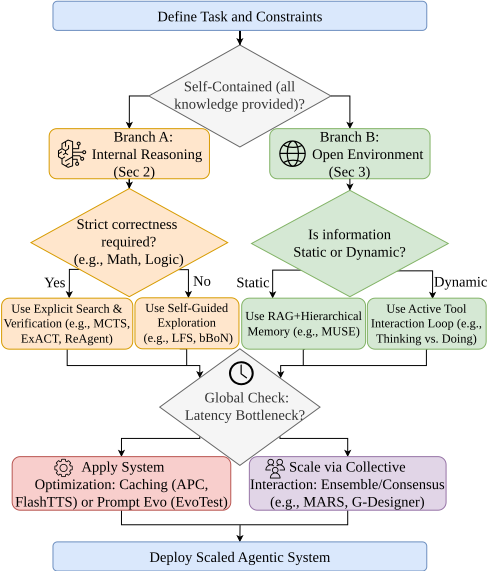
Figure 3 presents a roadmap for selecting TTS strategies. Users assess whether a task is self-contained at first. Branch A deals with tasks based on internal reasoning and provides paths for both logical precision and creative exploration. Branch B focuses on open environments and recommends strategies based on different type of information. Finally, evaluating system latency helps to choose between efficient caching and robust collective interaction. This framework aims to help researchers deploy agentic systems and advance this field in the following three directions for future research.
Unified Scaling Laws for Reasoning and Acting. Currently, scaling internal reasoning (e.g., via latent search) and external acting (e.g., via tool use) are often studied in isolation. How-
ever, optimal performance is highly likely to occur in a dynamic equilibrium between the two. As highlighted by Shen et al. [Shen et al., 2025], there is a critical need to formulate unified scaling laws that can mathematically predict the marginal utility in allocating compute. Future systems should act as meta-controllers to arbitrate between deep internal verification and broad external information seeking based on the specific entropy of the query [Zhao et al., 2025].
System-Level Efficiency and Caching. The prohibitive latency and cost of TTS remain major bottlenecks for realworld deployment. System-level optimization techniques such as FlashTTS [Chen et al., 2025a] and Agentic Plan Caching (APC) [Zhang et al., 2025e] have shown that caching structured plans and optimizing KV-cache reuse can significantly reduce overhead. Future work must bridge the gap between AI algorithms and system infrastructure. Specialized serving engines must handle irregular computation paths in dynamic topologies while without sacrificing responsiveness [Zhang et al., 2025c] .
Reliability in Continuous Self-Evolution. Moving from static agents to self-evolving systems introduces the risks of instability and concept drift. Frameworks like EvoTest [He et al., 2025b] and FLEX [Cai et al., 2025] enable agents to optimize their strategies on-the-fly. Ensuring that such updates do not lead to catastrophic forgetting or performance degradation is significant. Future research should focus on robust mechanisms that allow agents to learn from test-time interactions (e.g., through streaming memory in Evo-Memory [Wei et al., 2025]). Meanwhile, they should also be able to guarantee the consistency and safety in their decision-making processes.
7 Conclusion
In this paper, motivated by the paradigm shift in scaling from training-time parameter growth to test-time compute allocation, we for the first time systematically review emerging methodologies tailored for agentic LLMs that scale their testtime computation. To this end, we organize prior work along key dimensions, including deepening internal reasoning, expanding external action spaces, orchestrating collective interactions, and supporting continuous self-evolution. Collectively, these approaches reconceptualize inference as a generative and adaptive search process rather than a static model readout, revealing a new axis for improving capability and robustness. Future research should give priority to unified scaling laws and system efficiency to bridge the gap with actual deployment. These advances are crucial to achieving fully autonomous and self-evolving agents. We hope our work can provide a unifying perspective and serve as a foundation for future research on TTS in agentic LLMs.
Acknowledgements
Bo Li's research was supported in part by an NSFC grant 62432008, RGC RIF grant R6021-20, an RGC TRS grant T43-513/23N-2, RGC CRF grants C7004-22G, C1029-22G and C6015-23G, NSFC/RGC grant CRS HKUST601/24 and RGC GRF grants 16207922, 16207423 and 16203824.
@inproceedings{ijcai2026p859,
  title     = {A Review on Test-Time Scaling for Agentic Large Language Models},
  author    = {An, Jiayu and Chen, Zheng and Jing, Yongcheng and Tao, Dacheng and Li, Bo},
  booktitle = {Proceedings of the Thirty-Fifth International Joint Conference on
               Artificial Intelligence, {IJCAI-26}},
  publisher = {International Joint Conferences on Artificial Intelligence Organization},
  editor    = {Diego Calvanese},
  pages     = {7731--7739},
  year      = {2026},
  month     = {8},
  note      = {Survey Track},
  doi       = {10.24963/ijcai.2026/859},
  url       = {https://doi.org/10.24963/ijcai.2026/859},
}
TY - CPAPER TI - A Review on Test-Time Scaling for Agentic Large Language Models AU - An, Jiayu AU - Chen, Zheng AU - Jing, Yongcheng AU - Tao, Dacheng AU - Li, Bo T2 - Proceedings of the Thirty-Fifth International Joint Conference on Artificial Intelligence, IJCAI-26 PB - International Joint Conferences on Artificial Intelligence Organization PY - 2026 SP - 7731 EP - 7739 DO - 10.24963/ijcai.2026/859 UR - https://doi.org/10.24963/ijcai.2026/859 ER -Copied
Machine-readable versions of this paper, for tools and AI agents:





