
Harnessing Multiple Large Language Models: A Survey on LLM Ensemble
Proceedings of the Thirty-Fifth International Joint Conference on Artificial Intelligence. Survey Track. Pages 7807-7816.
https://doi.org/10.24963/ijcai.2026/867
Keywords
- Agent-based and Multi-agent Systems: Other
- SV: Agent-based and Multi-agent Systems
- Machine Learning: Ensemble methods
- Natural Language Processing: Applications
Abstract
LLM Ensemble---which involves the comprehensive use of multiple large language models (LLMs), each aimed at handling user queries during downstream inference, to benefit from their individual strengths---has gained substantial attention recently. The widespread availability of LLMs, coupled with their varying strengths and out-of-the-box usability, has profoundly advanced the field of LLM Ensemble. This paper presents the first systematic review of recent developments in LLM Ensemble. First, we introduce our taxonomy of LLM Ensemble and discuss several related research problems. Then, we provide a more in-depth classification of the methods under the broad categories of ``ensemble-before-inference, ensemble-during-inference, ensemble-after-inference'', and review relevant methods. Finally, we introduce related benchmarks and applications, summarize existing studies, and suggest future research directions. GitHub project link is: https://github.com/junchenzhi/Awesome-LLM-Ensemble.
- [Achiam et al., 2023] Josh Achiam, Steven Adler, et al. Gpt- 4 technical report. ArXiv preprint, abs/2303.08774, 2023.
- [Aggarwal et al., 2024] Pranjal Aggarwal, Aman Madaan, et al. Automix: Automatically mixing language models. In NeurIPS, 2024.
- [Ban et al., 2026] Yikun Ban, Fengkai Yang, et al. Agent exploration toward artificial general intelligence. SSRN preprint SSRN:6748619, 2026.
- [Chen et al., 2020] Zhijun Chen, Huimin Wang, et al. Struc- tured probabilistic end-to-end learning from crowds. In IJCAI, pages 1512-1518. ijcai.org, 2020. IJCAI
- [Chen et al., 2022] Pengpeng Chen, Hailong Sun, et al. Ad- versarial learning from crowds. In AAAI, 2022.
- [Chen et al., 2023a] Pengpeng Chen, Yongqiang Yang, et al. Black-box data poisoning attacks on crowdsourcing. In IJCAI, pages 2975-2983. ijcai.org, 2023. IJCAI
- [Chen et al., 2023b] Zhijun Chen, Hailong Sun, et al. Neural-hidden-crf: A robust weakly-supervised sequence labeler. In SIGKDD, pages 274-285. ACM, 2023.
- [Chen et al., 2025a] L. Chen, M. Zaharia, et al. Frugalgpt: How to use large language models while reducing cost and improving performance. TMLR, 2025.
- [Chen et al., 2025b] Yi Chen, JiaHao Zhao, et al. A survey on collaborative mechanisms between large and small lan- guage models. ArXiv preprint, abs/2505.07460, 2025.
- [Chen et al., 2025c] Z. Chen, Z. Wei, et al. Tagrouter: Learn- ing route to llms through tags for open-domain text gener- ation tasks. ArXiv preprint, abs/2506.12473, 2025.
- [Chen et al., 2025d] Zehao Chen, Tianxiang Ai, et al. Llm- boost: Make large language models stronger with boost- ing. ArXiv preprint, abs/2512.22309, 2025.
- [Chen et al., 2025e] Zhijun Chen, Zeyu Ji, et al. Scoring, reasoning, and selecting the best! ensembling large lan- guage models via a peer-review process. ArXiv preprint, abs/2512.23213, 2025.
- [Dekoninck et al., 2024] Jasper Dekoninck, Maximilian Baader, et al. A unified approach to routing and cascading for llms. ArXiv preprint, abs/2410.10347, 2024.
- [Ding et al., 2024a] D. Ding, A. Mallick, et al. Hybrid LLM: cost-efficient and quality-aware query routing. In ICLR, 2024.
- [Ding et al., 2024b] N. Ding, Y. Chen, et al. Mastering text, code and math simultaneously via fusing highly special- ized language models. ArXiv, abs/2403.08281, 2024.
- [Dong et al., 2020] Xibin Dong, Zhiwen Yu, et al. A sur- vey on ensemble learning. Frontiers of Computer Science, 14(2):241-258, 2020.
- [Du et al., 2024] Yilun Du, Shuang Li, et al. Improving fac- tuality and reasoning in language models through multia- gent debate. In ICML. OpenReview.net, 2024.
- [Feng et al., 2025] Tao Feng, Haozhen Zhang, et al. Fusion- factory: Fusing llm capabilities with multi-llm log data. arXiv preprint arXiv:2507.10540, 2025.
- [Fernandez et al., 2025] Nigel Fernandez, Branislav Kveton, et al. Radar: Reasoning-ability and difficulty-aware rout- ing for reasoning llms. ArXiv, abs/2509.25426, 2025.
- [Frick et al., 2025] Evan Frick, Connor Chen, et al. Prompt- to-leaderboard. ArXiv preprint, abs/2502.14855, 2025.
- [Fu et al., 2025] Jiale Fu, Yuchu Jiang, et al. Fast large language model collaborative decoding via speculation. ArXiv preprint, abs/2502.01662, 2025.
- [Guha et al., 2024] N. Guha, M. F. Chen, et al. Smoothie: Label free language model routing. In NeurIPS, 2024.
- [Guo et al., 2024] Taicheng Guo, Xiuying Chen, et al. Large language model based multi-agents: a survey of progress and challenges. In IJCAI, 2024. IJCAI
- [Gupta et al., 2024] Neha Gupta, Harikrishna Narasimhan, et al. Language model cascades: Token-level uncertainty and beyond. In ICLR, 2024.
- [He et al., 2025] Xinrui He, Yikun Ban, et al. Llm-forest: Ensemble learning of llms with graph-augmented prompts for data imputation. In Findings of ACL, 2025.
- [Hu et al., 2024a] J. Hu, Y. Wang, et al. Dynamic ensemble reasoning for llm experts. ArXiv, abs/2412.07448, 2024.
- [Hu et al., 2024b] Qitian Jason Hu, Jacob Bieker, et al. Routerbench: A benchmark for multi-llm routing system. ArXiv preprint, abs/2403.12031, 2024.
- [Huang et al., 2024] Yichong Huang, Xiaocheng Feng, et al. Ensemble learning for heterogeneous large language mod- els with deep parallel collaboration. In NeurIPS, 2024.
- [Huang et al., 2025] Z. Huang, G. Ling, et al. Routereval: A comprehensive benchmark for routing llms to ex- plore model-level scaling up in llms. ArXiv preprint, abs/2503.10657, 2025.
- [Jiang et al., 2023] Dongfu Jiang, Xiang Ren, et al. LLM- blender: Ensembling large language models with pairwise ranking and generative fusion. In ACL, 2023.
- [Jin et al., 2024] Lifeng Jin, Baolin Peng, et al. Collaborative decoding of critical tokens for boosting factuality of large language models. ArXiv preprint, abs/2402.17982, 2024.
- [Jin et al., 2025] Weiqiang Jin, Hongyang Du, et al. A com- prehensive survey on multi-agent cooperative decision- making: Scenarios, approaches, challenges and perspec- tives. arXiv preprint arXiv:2503.13415, 2025.
- [Jitkrittum et al., 2023] Wittawat Jitkrittum, Neha Gupta, et al. When does confidence-based cascade deferral suf- fice? In NeurIPS, 2023.
- [Lee et al., 2023] Young-Suk Lee, Md Arafat Sultan, et al. Ensemble-instruct: Generating instruction-tuning data with a heterogeneous mixture of lms. ArXiv preprint, abs/2310.13961, 2023.
- [Li et al., 2023] Weishi Li, Yong Peng, et al. Deep model fusion: A survey. ArXiv preprint, abs/2309.15698, 2023.
- [Li et al., 2024a] Junyou Li, Qin Zhang, et al. More agents is all you need. ArXiv preprint, abs/2402.05120, 2024.
- [Li et al., 2024b] Tianlin Li, Qian Liu, et al. Purifying large language models by ensembling a small language model. ArXiv preprint, abs/2402.14845, 2024.
- [Li et al., 2024c] Xinyi Li, Sai Wang, et al. A survey on llm- based multi-agent systems: workflow, infrastructure, and challenges. Vicinagearth, 2024.
- [Li et al., 2026a] Hao Li, Yiqun Zhang, et al. Llmrouter- bench: A massive benchmark and unified framework for llm routing. arXiv preprint arXiv:2601.07206, 2026.
- [Li et al., 2026b] Zhongyi Li, Wan Tian, et al. Adaptive robust estimator for multi-agent reinforcement learning. arXiv preprint arXiv:2603.21574, 2026.
- [Li, 2025a] Yang Li. Llm bandit: Cost-efficient llm gener- ation via preference-conditioned dynamic routing. ArXiv preprint, abs/2502.02743, 2025.
- [Li, 2025b] Yang Li. Rethinking predictive modeling for llm routing: When simple knn beats complex learned routers. ArXiv preprint, abs/2505.12601, 2025.
- [Liu et al., 2024a] Aixin Liu, Bei Feng, et al. Deepseek- v2: A strong, economical, and efficient mixture-of-experts language model. ArXiv preprint, abs/2405.04434, 2024.
- [Liu et al., 2024b] T. Liu, S. Guo, et al. Decoding-time re- alignment of language models. In ICML, 2024.
- [Liu et al., 2025] C. Liu, X. Quan, et al. Cool-fusion: Fuse large language models without training. In ACL, 2025.
- [Lu et al., 2024a] Jinliang Lu, Ziliang Pang, et al. Merge, ensemble, and cooperate! a survey on collaborative strate- gies in the era of large language models. ArXiv preprint, abs/2407.06089, 2024.
- [Lu et al., 2024b] Keming Lu, Hongyi Yuan, et al. Routing to the expert: Efficient reward-guided ensemble of large language models. In NAACL, 2024.
- [Lu et al., 2025] Yifan Lu, Rixin Liu, et al. Routerarena: An open platform for comprehensive comparison of llm routers. arXiv preprint arXiv:2510.00202, 2025.
- [Lv et al., 2024a] Bo Lv, Chen Tang, et al. Specfuse: Ensem- bling large language models via next-segment prediction. ArXiv preprint, abs/2412.07380, 2024.
- [Lv et al., 2024b] Bo Lv, Chen Tang, et al. Urg: A unified ranking and generation method for ensembling language models. In Findings of the ACL, 2024.
- [Maurya et al., 2024] Kaushal Kumar Maurya, KV Srivatsa, et al. Selectllm: Query-aware efficient selection al- gorithm for large language models. ArXiv preprint, abs/2408.08545, 2024.
- [Mavromatis et al., 2024] Costas Mavromatis, Petros Karypis, et al. Pack of llms: Model fusion at test-time via perplexity optimization. ArXiv, abs/2404.11531, 2024.
- [Mei et al., 2025] Kai Mei, Wujiang Xu, et al. Omnirouter: Budget and performance controllable multi-llm routing. ACM SIGKDD Explorations Newsletter, 2025.
- [Mohammadshahi et al., 2024] Alireza Mohammadshahi, Arshad Rafiq Shaikh, et al. Routoo: Learning to route to large language models effectively. ArXiv preprint, abs/2401.13979, 2024.
- [Mohammed and Kora, 2023] A. Mohammed and R. Kora. A comprehensive review on ensemble deep learning: Opportunities and challenges. Journal of King Saud University-Computer and Information Sciences, 2023.
- [Mu et al., 2024] Feiteng Mu, Yong Jiang, et al. Adaptive selection for homogeneous tools: An instantiation in the rag scenario. ArXiv preprint, abs/2406.12429, 2024.
- [Nguyen et al., 2024] Quang H Nguyen, Duy C Hoang, et al. Metallm: A high-performant and cost-efficient dynamic framework for wrapping llms. ArXiv preprint, abs/2407.10834, 2024.
- [Ong et al., 2025] Isaac Ong, Amjad Almahairi, et al. Routellm: Learning to route llms from preference data. In ICLR, 2025.
- [Park et al., 2025] Sungjin Park, Xiao Liu, et al. Ensem- bling large language models with process reward-guided tree search for better complex reasoning. In NAACL, 2025.
- [Ramírez et al., 2023] Guillem Ramírez, Matthias Linde- mann, et al. Cache & distil: Optimising api calls to large language models. ArXiv preprint, abs/2310.13561, 2023.
- [Ratner et al., 2017] Alexander Ratner, Stephen H Bach, et al. Snorkel: Rapid training data creation with weak su- pervision. In VLDB, 2017.
- [Ruan et al., 2025] Wei Ruan, Tianze Yang, et al. From task- specific models to unified systems: A review of model merging approaches. ArXiv, abs/2503.08998, 2025.
- [Šakota et al., 2024] Marija Šakota, Maxime Peyrard, et al. Fly-swat or cannon? cost-effective language model choice via meta-modeling. In WSDM, pages 606-615, 2024.
- [Shen et al., 2024] Shannon Zejiang Shen, Hunter Lang, et al. Learning to decode collaboratively with multiple lan- guage models. ArXiv preprint, abs/2403.03870, 2024.
- [Shi et al., 2024] Ruizhe Shi, Yifang Chen, et al. Decoding- time language model alignment with multiple objectives. In NeurIPS, 2024.
- [Shirkavand et al., 2026] Reza Shirkavand, Shangqian Gao, Peiran Yu, and Heng Huang. Cost-aware contrastive rout- ing for llms. NeurIPS, 2026.
- [Shnitzer et al., 2023] Tal Shnitzer, Anthony Ou, et al. Large language model routing with benchmark datasets. In NeurIPS, 2023.
- [Si et al., 2023] Chenglei Si, Weijia Shi, et al. Getting MoRE out of mixture of language model reasoning experts. In Findings of EMNLP, 2023.
- [Sikeridis et al., 2024] Dimitrios Sikeridis, Dennis Ramdass, et al. Pickllm: Context-aware rl-assisted large language model routing. ArXiv preprint, abs/2412.12170, 2024.
- [Song et al., 2025] Wei Song, Zhenya Huang, et al. Irt- router: Effective and interpretable multi-llm routing via item response theory. ArXiv, abs/2506.01048, 2025.
- [Srivatsa et al., 2024] Kv Aditya Srivatsa, Kaushal Maurya, et al. Harnessing the power of multiple minds: Lessons learned from LLM routing. In Workshop on Insights from Negative Results in NLP, 2024.
- [Stripelis et al., 2024] Dimitris Stripelis, Zijian Hu, et al. Tensoropera router: A multi-model router for efficient llm inference. ArXiv preprint, abs/2408.12320, 2024.
- [Sun et al., 2024] Chuanneng Sun, Songjun Huang, et al. Llm-based multi-agent reinforcement learning: Current and future directions. arXiv arXiv:2405.11106, 2024.
- [Team et al., 2023] Gemini Team, Rohan Anil, et al. Gem- ini: a family of highly capable multimodal models. ArXiv preprint, abs/2312.11805, 2023.
- [Tekin et al., 2024] Selim Tekin, Fatih Ilhan, et al. Llm- topla: Efficient llm ensemble by maximising diversity. In Findings of EMNLP, 2024.
- [Touvron et al., 2023] Hugo Touvron, Thibaut Lavril, et al. Llama: Open and efficient foundation language models. ArXiv preprint, abs/2302.13971, 2023.
- [Tran et al., 2025] Khanh-Tung Tran, Dung Dao, et al. Multi-agent collaboration mechanisms: A survey of llms. ArXiv preprint, abs/2501.06322, 2025.
- [Varshney and Baral, 2022] Neeraj Varshney and Chitta Baral. Model cascading: Towards jointly improving ef- ficiency and accuracy of NLP systems. In EMNLP, 2022.
- [Wang et al., 2024] Yuanshuai Wang, Xingjian Zhang, et al. Bench-coe: a framework for collaboration of experts from benchmark. ArXiv preprint, abs/2412.04167, 2024.
- [Wang et al., 2025] Xinyuan Wang, Yanchi Liu, et al. Mixllm: Dynamic routing in mixed large language mod- els. ArXiv preprint, abs/2502.18482, 2025.
- [Wicks et al., 2025] Rachel Wicks, Kartik Ravisankar, et al. Token-level ensembling of models with different vocabu- laries. ArXiv preprint, abs/2502.21265, 2025.
- [Wu and Silwal, 2025] Fangzhou Wu and Sandeep Silwal. Efficient training-free online routing for high-volume multi-llm serving. ArXiv preprint, abs/2509.02718, 2025.
- [Xu et al., 2024] Yangyifan Xu, Jinliang Lu, et al. Bridging the gap between different vocabularies for LLM ensemble. In NAACL, 2024.
- [Xu et al., 2025] Yangyifan Xu, Jianghao Chen, et al. Hit the sweet spot! span-level ensemble for large language models. In COLING, pages 8314-8325, 2025.
- [Yang et al., 2024] Enneng Yang, Li S., et al. Model merg- ing in llms, mllms, and beyond: Methods, theories, appli- cations and opportunities. ArXiv, abs/2408.07666, 2024.
- [Yang et al., 2025] Zongzhen Yang, Binhang Qi, et al. Cabs: Conflict-aware and balanced sparsification for enhancing model merging. ArXiv preprint, abs/2503.01874, 2025.
- [Yao et al., 2024] Yuxuan Yao, Han Wu, et al. Determine- then-ensemble: Necessity of top-k union for large lan- guage model ensembling. ArXiv, abs/2410.03777, 2024.
- [Yu et al., 2024] Yao-Ching Yu, Chun-Chih Kuo, et al. Breaking the ceiling of the llm community by treating to- ken generation as a classification for ensembling. ArXiv preprint, abs/2406.12585, 2024.
- [Yue et al., 2024] Murong Yue, Jie Zhao, et al. Large lan- guage model cascades with mixture of thought representa- tions for cost-efficient reasoning. In ICLR, 2024.
- [Zhang et al., 2021] Jieyu Zhang, Yue Yu, et al. Wrench: A comprehensive benchmark for weak supervision. ArXiv preprint, abs/2109.11377, 2021.
- [Zhang et al., 2022] Jieyu Zhang, Cheng-Yu Hsieh, et al. A survey on programmatic weak supervision. ArXiv preprint, abs/2202.05433, 2022.
- [Zhang et al., 2023] Jieyu Zhang, Ranjay Krishna, et al. Ecoassistant: Using llm assistant more affordably and ac- curately. ArXiv preprint, abs/2310.03046, 2023.
- [Zhang et al., 2025a] Hangfan Zhang, Zhiyao Cui, et al. If multi-agent debate is the answer, what is the question. ArXiv preprint, abs/2502.08788, 2025.
- [Zhang et al., 2025b] Tuo Zhang, Asal Mehradfar, et al. Leveraging uncertainty estimation for efficient llm rout- ing. ArXiv preprint, abs/2502.11021, 2025.
- [Zhang et al., 2025c] Y. Zhang, H Li, et al. The avengers: A simple recipe for uniting smaller language models to chal- lenge proprietary giants. ArXiv, abs/2505.19797, 2025.
- [Zhang et al., 2025d] Y. Zhang, F. Xie, et al. Meta- router: Bridging gold-standard and preference-based eval- uations in large language model routing. ArXiv preprint, abs/2509.25535, 2025.
- [Zhang, 2022] Jing Zhang. Knowledge learning with crowd- sourcing: A brief review and systematic perspective. IEEE/CAA Journal of Automatica Sinica, 2022.
- [Zhao et al., 2024] Zesen Zhao, Shuowei Jin, et al. Ea- gle: Efficient training-free router for multi-llm inference. ArXiv preprint, abs/2409.15518, 2024.
- [Zheng et al., 2017] Yudian Zheng, Guoliang Li, et al. Truth inference in crowdsourcing: Is the problem solved? Pro- ceedings of the VLDB Endowment, 10(5):541-552, 2017.
- [Zheng et al., 2025] Wenhao Zheng, Yixiao Chen, et al. Citer: Collaborative inference for efficient large language model decoding with token-level routing. ArXiv preprint, abs/2502.01976, 2025.
- [Zhou, 2021] Zhi-Hua Zhou. Ensemble learning. In Machine learning, pages 181-210. Springer, 2021.
- [Zou et al., 2025] Jiaru Zou, Yikun Ban, et al. Transformer copilot: Learning from the mistake log in llm fine-tuning. ArXiv preprint, abs/2505.16270, 2025.
References were extracted automatically from the PDF and may contain errors.
Full text extracted automatically from the PDF; figures, tables and equations may differ. The PDF is the version of record.
1 Introduction
In recent years, the landscape of artificial intelligence has been dramatically reshaped by the development of Large Language Models (LLMs), including Gemini [Team et al., 2023], GPT-4 [Achiam et al., 2023], Llama [Touvron et al., 2023], and the recently introduced DeepSeek [Liu et al., 2024a]. The success of these LLMs continues to fuel widespread research enthusiasm, with a remarkable total of over 182,000 large language models now accessible in the Hugging Face library. 1
Behind this research enthusiasm, however, we can identify two main aspects: 1) The performance concerns: The direct out-of-the-box capability of LLMs (from zero-shot inference) and their indirect out-of-the-box capability (from in-contextlearning few-shot inference) still raise performance worries, including accuracy, hallucinations, and misalignment with human intent, among others; 2) The varying strengths and weaknesses of LLMs, each with different inference costs: Due to differences in architecture, size, tokenization, dictionary, training data, methodology, these LLMs exhibit substantial variability and their responses can differ significantly. With the above two aspects in mind and drawing on the spirit of Ensemble Learning [Dong et al., 2020; Zhou, 2021; Mohammed and Kora, 2023], it is natural to consider that, for each query, rather than relying on a single LLM based on public rankings or other criteria, it might be more advantageous to simultaneously consider multiple LLM candidates (usable out-of-the-box) and harness their distinct strengths. This is exactly what the emerging field of LLM Ensemble explores.
*Corresponding authors.
1 https://huggingface.co/models.
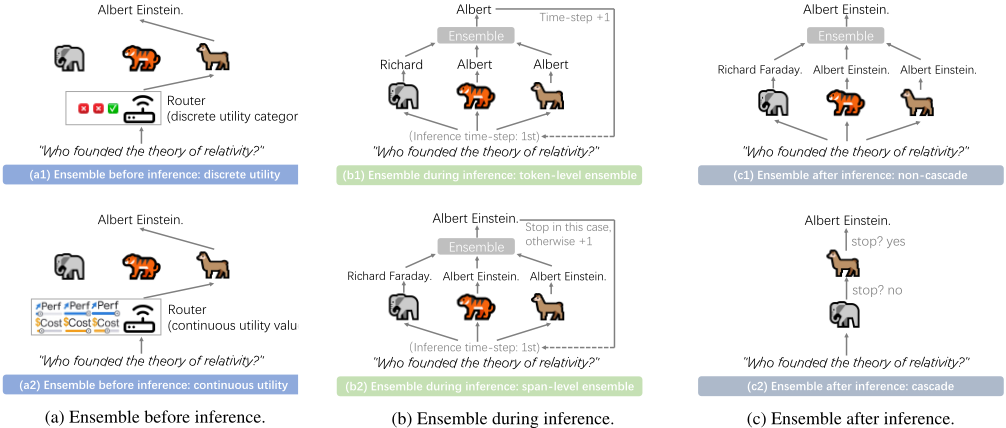
Existing LLM Ensemble methods can be broadly categorized into three types, depending on the sequence of LLM inference and ensemble: 1) Ensemble-before-inference approach, utilizes the given query information while considering the diverse characteristics of all LLM candidates to route an appropriate model for inference (this approach is similar to the hard voting strategy in Ensemble Learning); 2) Ensembleduring-inference approach, aggregates incomplete responses (e.g., token-level information) from multiple LLMs during the decoding process and feeds the combined result back into all the models; 3) Ensemble-after-inference approach, performs the ensemble after full responses (instead of fragments) have been generated by all models or a subset of them. Despite the emergence of numerous methods derived from these paradigms recently, there is still no formal survey that offers a comprehensive review of the core ideas and related research.
We present the first comprehensive survey on LLM Ensemble, introducing recent advances and focusing on taxonomy, related problems, methods, benchmarks, applications, and future directions. We hope that this survey will provide a thorough review for researchers and inspire further exploration.
2 LLMEnsemble Taxonomy and Related Problems
2.1 LLMEnsemble Taxonomy
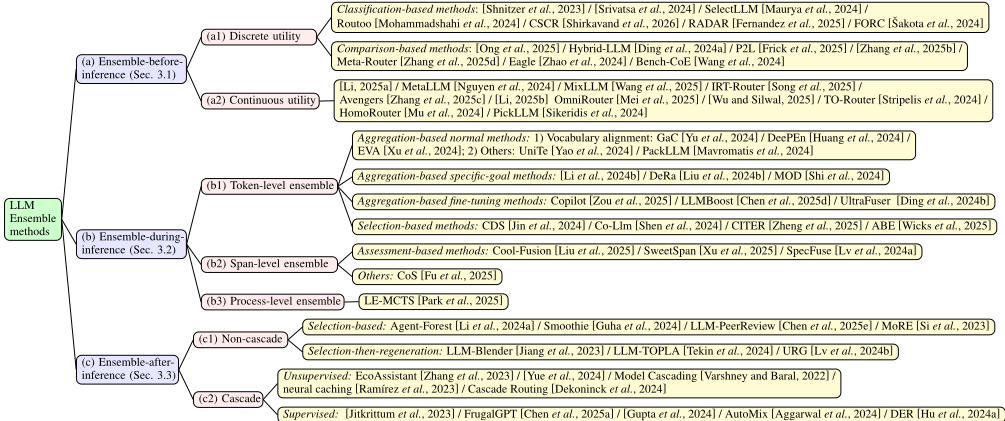
This section formally introduces our LLM Ensemble taxonomy, illustrated by the schematic shown in Figure 1 and the detailed taxonomy in Figure 2. As mentioned in Section 1, the following three broad categories of LLM Ensemble exist. (a) Ensemble before inference. In essence, this approach employs a routing algorithm prior to LLM inference to allocate a specific query to the most suitable model, allowing the selected model that is specialized for the query and typically more cost-efficient inference to perform the task. As illustrated in Figure 1a and Figure 2, existing methods can be classified into two categories, depending on whether the router utility is discretized: (a1) discrete utility methods and
(a2) continuous utility methods.
(b) Ensemble during inference. As the most granular form of ensemble among the three broad categories, this type of approach encompasses: (b1) token-level ensemble methods, integrate the token-level outputs of multiple models at the finest granularity of decoding; (b2) span-level ensemble methods, perform ensemble at the level of a sequence fragment (e.g., a span of four words); (b3) process-level ensemble methods, select the optimal reasoning process step-bystep within the reasoning chain for a given complex reasoning task. Note that for these ensemble-during-inference methods, the aggregated text segments will be concatenated with the preceding text and fed back into the models.
(c) Ensemble after inference. These methods can be classified into two categories: (c1) Non-cascade methods, perform ensemble by integrating multiple complete responses contributed from all LLM candidates; (c2) Cascade methods, consider both performance and inference costs, progressively performing inference through a chain of LLM candidates ranked primarily by model size to identify the most suitable response and terminate the cascade process.
2.2 Related Problems
Here we briefly introduce the closely related problems.
LLMMerging, also known as LLM Fusion [Yang et al., 2024; Yang et al., 2025; Ruan et al., 2025; Li et al., 2023], integrates parameters from various LLMs to construct a universal model without requiring original training data or extensive computation. It is highly relevant to LLM Ensemble, as both promote knowledge fusion and transfer.
LLM Collaboration leverages the distinct strengths of each model to approach tasks with increased flexibility [Du et al., 2024; Lu et al., 2024a; Chen et al., 2025b; Tran et al., 2025; Zhang et al., 2025a; Li et al., 2024c; Guo et al., 2024]. Unlike LLM Ensemble where models are employed with equal status to directly faced to user queries, the collaboration approach assigns distinct roles to each LLM, exchanging response information to enhance task resolution. Furthermore, a closely related line of research to LLM Collaboration-which mainly focuses on zero-shot inference-is Multi-LLM Reinforcement Learning [Sun et al., 2024; Jin et al., 2025; Li et al., 2026b], which investigates how multiple agents learn optimal decision-making strategies in a shared environment.
Weak Supervision [Zhang et al., 2021; Chen et al., 2023b; Zhang et al., 2022; Ratner et al., 2017], sometimes referred to as Learning from Crowds [Chen et al., 2020; Chen et al., 2022; Zhang, 2022], uses weak labels contributed from multiple weak annotation sources to perform information aggregation [Chen et al., 2023a; Zheng et al., 2017] (corresponding non-cascade ensemble after inference in LLM Ensemble) or directly train a classifier [Zhang et al., 2021], yet most methods focus on classification rather than general open-ended generation tasks.
combined value to balance performance and cost. Following this line, existing methods extend the classification-based methods along empirical analysis [Srivatsa et al., 2024], decision policy [Maurya et al., 2024; Shnitzer et al., 2023; ˇSakota et al., 2024], and router architecture [Shirkavand et al., 2026; Mohammadshahi et al., 2024].
Comparison-based methods. Compared to multi-label binary classification routing, which requires estimating an absolute (pointwise) utility score for each candidate LLM's output, comparison-based approaches only need to infer relative preferences among a pair of model outputs, thereby simplifying the routing objective and reducing supervision difficulty [Zhang et al., 2025d]. Specifically, a preference datum can be represented as a tuple (q,M1,M2, y), where q denotes a given query, M1 and M2 are two candidate LLMs, and y is a binary label such that y = 1 indicates that the response of M1 is better than that of M2, while y = 0 indicates otherwise (e.g., [Ong et al., 2025]). In this setting, the router aims to predict the win rate of M1, i.e., the probability that M1's response is better given the query q and the model pair (M1,M2). Following this idea, subsequent methods extend the comparison-based routing framework along several directions, including data construction [Ong et al., 2025; Zhang et al., 2025b], learning target [Frick et al., 2025; Chen et al., 2025c; Wang et al., 2024], routing strategy [Zhang et al., 2025d; Zhao et al., 2024]
(a2) Continuous Utility Methods
Unlike prior discrete-category approaches, continuous-utility methods model LLM utility as real-valued variables, such as response length or performance scores. This formulation enables a fine-grained characterization of model behavior, capturing subtle performance differences obscured by categorical definitions. Moreover, continuous utilities naturally aggregate multiple objectives (e.g., latency and cost) into a unified scalar, allowing the router to jointly optimize
3 Methodology
In this section, following the taxonomy in Section 2.1, we systematically review the three types of methods-ensemble before inference, ensemble during inference and ensemble after inference-in Sections 3.1, 3.2, and 3.3, respectively.
3.1 Ensemble Before Inference
Since these methods route a query to the most suitable LLM before inference, their core lies in predicting candidate model utility for a given query under specific preferences (e.g., performance or cost). Based on how utility is formulated, we divide existing methods into discrete utility methods and continuous utility methods, as shown in Table 1.
(a1) Discrete Utility Methods
Discrete utility methods discretize the model utility into categorical labels. Depending on whether categories are defined independently or via pairwise comparisons, they are divided into classification-based and comparison-based methods.
Classification-basedmethods. For this type of method, the utility of a candidate LLM for a given query is typically treated as a discrete variable reflecting the quality of the model's response. Typically, the utility is binary: a value of 1 indicates that the model produces a satisfactory response, whereas 0 indicates an unsatisfactory one. For example, in a commonsense question-answering (QA) task, a correct answer is labeled as 1 and an incorrect answer as 0 (e.g., [Shnitzer et al., 2023]). Under this formulation, the routing problem naturally becomes a multi-label binary classification task, where the router estimates the probability that each candidate LLM will produce a satisfactory output. Based on different optimization objectives, one can then design corresponding decision strategies-for instance, when model costs are known, the router can compute a combined value via a weighted aggregation of the predicted score and cost [Fernandez et al., 2025], and select the model with the highest these objectives and learn more flexible policies. The most straightforward continuous-utility approach formulates routing as a utility prediction problem, where the router is often trained to predict the utility of each candidate model using regression-based losses [Song et al., 2025; Zhang et al., 2025c; Mei et al., 2025; Li, 2025b; Wu and Silwal, 2025; Mu et al., 2024]. For example, OmniRouter [Mei et al., 2025] trains two MLP predictors to estimate performance and cost, respectively, and then considers batch query routing as a cost-constrained performance optimization problem, thereby achieving a trade-off between performance and cost. Beyond such explicit utility modeling, other methods instead directly learn a routing policy that outputs selection probabilities over candidate LLMs, treating utility as a feedback signal to optimize the policy [Nguyen et al., 2024; Li, 2025a; Lu et al., 2024b; Stripelis et al., 2024; Sikeridis et al., 2024]. For example, Li et al. [2025a] define the reward as a weighted sum of cost and performance, and adopt a multi-objective policy gradient algorithm to learn the selection policy.
| Methods | Param./Non-param.§ | Goals | Loss functions | Tasks∗ | Generalization† | Code | |
|---|---|---|---|---|---|---|---|
| [Shnitzer et al., 2023] | Parametric | Performance | Binary CE loss | OE-G/EM-G | ✗ | - | |
| [Srivatsa et al., 2024] | Parametric | Performance | Class-balanced CE loss | EM-G | ✓ | [Link] | |
| SelectLLM [Maurya et al., 2024] | Parametric | Performance and cost | Class-balanced CE loss | EM-G | ✗ | - | |
| Routoo [Mohammadshahi et al., 2024] | Parametric | Performance and cost | CE loss | EM-G | ✗ | - | |
| CSCR [Shirkavand et al., 2026] | Parametric | Performance and cost | InfoNCE | OE-G/EM-G | ✗ | - | |
| RADAR [Fernandez et al., 2025] | Parametric | Perf., cost and query time | Binary CE loss | EM-G | ✗ | - | |
| (a1) | FORC [ ˇSakota et al., 2024] | Parametric | Performance and cost | Avg. of multi-metric integration | OE-G/EM-G | ✓ | [Link] |
| [Ong et al., 2025] | Parametric | Performance and cost | Binary CE loss | OE-G/EM-G | ✓ | [Link] | |
| Hybrid-LLM [Ding et al., 2024a] | Parametric | Performance and cost | Binary CE loss | OE-G/EM-G | ✗ | [Link] | |
| P2L [Frick et al., 2025] | Parametric | Performance and cost | Binary CE loss | OE-G/EM-G | ✗ | [Link] | |
| [Zhang et al., 2025b] | Parametric | Performance and cost | Binary CE loss | OE-G/EM-G | ✗ | - | |
| Meta-Router [Zhang et al., 2025d] | Non-parametric | Performance and cost | - | OE-G/EM-G | ✗ | ||
| Eagle [Zhao et al., 2024] | Non-parametric | Performance and cost | - | OE-G/EM-G | ✗ | - | |
| Bench-CoE [Wang et al., 2024] | Parametric | Performance | CE loss | EM-G | ✓ | [Link] | |
| [Li, 2025a] | Parametric | Performance and cost | MSE loss | OE-G/EM-G | ✓ | - | |
| MetaLLM [Nguyen et al., 2024] | Parametric | Performance | MSE loss | EM-G | ✗ | [Link] | |
| MixLLM [Wang et al., 2025] | Parametric | Perf., cost and query time | Negative Expected Reward | OE-G/EM-G | ✗ | - | |
| IRT-Router [Song et al., 2025] | Parametric | Perf., cost and query time | Binary CE loss | OE-G/EM-G | ✗ | [Link] | |
| Avengers [Zhang et al., 2025c] | Non-parametric | Performance | Clustering | OE-G/EM-G | ✗ | [Link] | |
| (a2) | OmniRouter [Mei et al., 2025] | Parametric | Performance and cost | MSE loss, Binary CE loss | EM-G | ✗ | [Link] |
| [Li, 2025b] | Non-parametric | Performance and cost | - | OE-G/EM-G | ✗ | - | |
| [Wu and Silwal, 2025] | Non-parametric | Performance and cost | - | OE-G/EM-G | ✗ | [Link] | |
| TO-Router [Stripelis et al., 2024] | Parametric | Perf., cost and query time | KL divergence | OE-G/EM-G | ✓ | - | |
| HomoRouter [Mu et al., 2024] | Parametric | Performance and cost | MSE loss | EM-G | ✓ | - | |
| PickLLM [Sikeridis et al., 2024] | Parametric | Perf., cost and query time | Negative Expected Reward | OE-G/EM-G | ✓ | - |
Table 1: Summary of ensemble-before-inference methods.
3.2 Ensemble During Inference
We present a comprehensive review of token-level, spanlevel, and process-level ensemble methods in the following subsections and offer a summary analysis in Table 2.
(b1) Token-Level Ensemble
For these methods, at each decoding time-step, 1) aggregation approach produces the final token distribution for generation by (weighted) averaging probability distributions from multiple LLMs, whereas 2) selection approach opts to directly adopt the output token from a selected single model.
Aggregation-based normal methods. When attempting token-level aggregation, vocabulary discrepancies across different LLMs, which produce varying embedding lengths, impede the fusion and averaging of multiple probability distributions, creating a substantial obstacle. Thus, several methods focus on addressing the vocabulary alignment issue. (i)
GaC [Yu et al., 2024] is the most straightforward method, which constructs a "union dictionary" by combining the vocabularies of multiple models to include all tokens, and subsequently projects the distribution information onto this new merged dictionary for averaging aggregation; (ii) Further, DeePEn [Huang et al., 2024] and EVA [Xu et al., 2024] project the output distributions of multiple models into a shared relative/pivot space, followed by either an averaging aggregation [Huang et al., 2024] or a weighted aggregation [Huang et al., 2024; Xu et al., 2024] to derive a final distribution. 2 Furthermore, there are additional advanced aggregation-based token-level ensemble methods. Specifically, (i) Yao et al. [2024] propose UniTe, which focuses solely on the TOP-K portion of each model's output distribution for performing averaging aggregation, reducing computational overhead; (ii) Mavromatis et al. [2024] present a weighted averaging approach, where the weights were determined by the perplexity of each model at each time step, indicating whether the current input aligns with its expertise.
Aggregation-based specific-goal methods. Unlike the aggregation-based normal methods introduced above, which are primarily intended to improve task performance in general scenarios, there are other methods that have their own specific goals. These methods aim to mitigate the prominent weaknesses of a single large LLM [Li et al., 2024b] or achieve a balanced effects (including decoding-time realignment [Liu et al., 2024b] and multi-objective decoding [Shi et al., 2024]) by weighted averaging the token-level outputs from multiple LLMs with different characteristics. Among them, Li et al. [2024b] reduce negative issues during the deployment of LLMs, such as copyright infringement and data poisoning, by integrating the token-level outputs of a benign small model with a large model using weighted averaging aggregation.
2 Beyond the aforementioned research focusing on vocabulary alignment, all other token-level aggregation-based ensemble methods either employ existing alignment techniques or assume that the LLMs under consideration share a common vocabulary.
| Methods | Granularities | Main Strategies | Unsup. | #Models† | Other Traits§ | Efficiency-Aware | Tasks∗ | Code |
|---|---|---|---|---|---|---|---|---|
| GaC [Yu et al., 2024] | Token | Averaging agg.,Vocabulary align. | ✓ | ≥ 2 | Union dictionary | ✗ | OE-G/EM-G | [Link] |
| DeePEn [Huang et al., 2024] | Token | Aggregation,Vocabulary align. | ✓ | ≥ 2 | Relative representation | ✗ | OE-G/EM-G | [Link] |
| EVA [Xu et al., 2024] | Token | Averaging agg.,Vocabulary align. | ✓ | ≥ 2 | Relative representation | ✗ | OE-G/EM-G | [Link] |
| UniTe [Yao et al., 2024] | Token | Averaging agg.,TOP-K union | ✓ | ≥ 2 | Union dictionary | ✓ | OE-G/EM-G | - |
| PackLLM [Mavromatis et al., 2024] | Token | Weighted avg. agg.,Perplexity | ✓ | ≥ 2 | Greedy optimization | ✗ | OE-G/EM-G | [Link] |
| [Li et al., 2024b] | Token | Weighted-averaging agg. | ✓ | = 2 | Reduce negative issues | ✗ | EM-G | - |
| DeRa [Liu et al., 2024b] | Token | Weighted-averaging agg. | ✓ | = 2 | Decoding-time realignment | ✗ | OE-G/EM-G | [Link] |
| (b1) MOD [Shi et al., 2024] | Token | Weighted-averaging agg. | ✓ | ≥ 2 | Multi-objective decoding | ✗ | OE-G/EM-G | [Link] |
| Copilot [Zou et al., 2025] | Token | Weighted avg. agg.,Boosting | ✗ | = 2 | Token-level boosting,SFT | ✗ | OE-G/EM-G | [Link] |
| LLMBoost [Chen et al., 2025d] | Token | Weighted avg. agg.,Boosting | ✗ | ≥ 2 | Token-level boosting,SFT | ✗ | OE-G/EM-G | - |
| UltraFuser [Ding et al., 2024b] | Token | Weighted avg. agg.,Gating | ✗ | ≥ 2 | Gating mechanism,SFT | ✗ | OE-G/EM-G | - |
| CDS [Jin et al., 2024] | Token | Token-Level routing (selection) | ✗ | = 2 | Critical token classifier | ✗ | EM-G | - |
| Co-Llm [Shen et al., 2024] | Token | Token-Level routing (selection) | ✗ | = 2 | Classifer,PGM | ✗ | OE-G/EM-G | [Link] |
| CITER [Zheng et al., 2025] | Token | Token-Level routing (selection) | ✗ | = 2 | Reinforcement learning | ✓ | EM-G | [Link] |
| ABE [Wicks et al., 2025] | Token | Token-Level routing (selection) | ✓ | = 2 | Agreement-based ensembling | ✗ | OE-G/EM-G | [Link] |
| Cool-Fusion [Liu et al., 2025] | Span | Generation-assessment-selection | ✓ | ≥ 2 | Perplexity, common words | ✗ | OE-G/EM-G | - |
| SweetSpan [Xu et al., 2025] | Span | Generation-assessment-selection | ✓ | ≥ 2 | Perplexity, fixed-length | ✗ | OE-G/EM-G | - |
| (b2) SpecFuse [Lv et al., 2024a] | Span | Generation-assessment-selection | ✓ | ≥ 2 | Perplexity, fixed-length | ✓ | OE-G/EM-G | - |
| CoS [Fu et al., 2025] | Span | Collaborative decoding | ✓ | ≥ 2 | Speculation decoding | ✓ | OE-G/EM-G | [Link] |
| (b3) LE-MCTS [Park et al., 2025] | Process | Reasoning process selection | ✗ | ≥ 2 | Monte Carlo Tree Search | ✗ | OE-G/EM-G | - |
- 2 §: "Other Traits§ " denotes unique and relatively important capabilities, modules or characteristics that are noteworthy.
3 ∗ : OE-G denotes Open-Ended Generation; EM-G denotes Exact-Match Generation, characterized by objectively verifiable answers (e.g., mathematical solutions).
Table 2: Summary of ensemble-during-inference methods.
Aggregation-based fine-tuning methods. Additionally, there are methods such as Copilot [Zou et al., 2025], LLMBoost [Chen et al., 2025d] and UltraFuser [Ding et al., 2024b], which consider task-downstream supervised fine tuning. These methods use labeled data to fine-tune multiple pre-trained LLMs based on the Ensemble Learning paradigm [Zhou, 2021], i.e., boosting [Zou et al., 2025; Chen et al., 2025d] and MOE (Mixture-of-Experts) [Ding et al., 2024b]. Finally, they perform token-level weighted averaging ensemble during the inference phase.
Selection-based methods. These methods directly choose a token from a specific model's output. (i) Jin et al. [Jin et al., 2024] propose CDS, which trains a binary classifier based on the preceding context. This classifier determines whether to invoke an unaligned model (to leverage its factual knowledge) or an aligned model (to utilize its instruction-following and safety capabilities) at each decoding step; (ii) Similar to CDS, Co-Llm [Shen et al., 2024] employs a routing classifier to switch between a general-purpose model and a specialized model for optimal output; (iii) Similarly, Zheng et al. [2025] introduce CITER, which uses reinforcement learning to train a policy function; (iv) Wicks et al. [Wicks et al., 2025] use an approach they termed "agreement-based ensembling" to select the intersection of various token information.
(b2) Span-Level Ensemble
(i) These methods mostly adhere to a "generationassessment-selection" pipeline. These methods first employ multiple LLMs to generate word-containing fragments, then utilize the concept of perplexity, to make each model score all generated model responses, ultimately selecting the fragment with the highest cumulative score. The key distinction lies in that Cool-Fusion [Liu et al., 2025] have each source LLM individually generate text segments until the word boundary of each segment is common to all LLMs, whereas SweetSpan [Xu et al., 2025] and SpecFuse [Lv et al., 2024a] adopt a straightforward approach by setting the span as a fragment with a fixed word count; (ii) Further, Fu et al. [2025] incorporate speculative decoding, a well-known acceleration technique, into the ensemble process to achieve faster inference.
(b3) Process-Level Ensemble
Confronted with complex step-by-step reasoning tasks, Park et al. [2025] use a trained Monte Carlo Tree Search strategy at each reasoning step to select the output with the highest reward value from multiple model reasoning outputs.
3.3 Ensemble After Inference
We review the non-cascade and cascade methods in the following, and provide a summary analysis in Table 3.
(c1) Non-Cascade
As shown in Figure 2 and Table 3, these methods include: 1) selection-based, which is dedicated to selecting a single response from multiple candidates; 2) selection-thenregeneration, which involves initially selecting a subset of candidates and subsequently feeding this refined subset into a generative model for regeneration to obtain the final output.
Selection-based methods. First, as unsupervised methods, 1) Agent-Forest [Li et al., 2024a] and Smoothie [Guha et al., 2024] leverage the similarity between model responses for selection, adhering to a majority voting (MV) principle: selecting the response most similar to others. Specifically, (i) Li et al. [2024a] obtain multiple responses by repeatedly querying a single model (equivalent to using multiple homogeneous models) and employ the MV ensemble, discovering a scaling property when ensembling more responses; they use BLEU scores and occurrence frequencies to quantify similarities for open-ended and exact-match generative tasks, respectively; (ii) Guha et al. [2024] input multiple <query, response> pairs into SentenceBERT, leveraging the Euclidean distance between the resulting low-dimensional encoded vectors as a measure of similarity; 2) Unlike these similarity-based MV ensemble methods, Chen et al. [2025e] propose LLM-PeerReview, an academic peer-review-inspired framework that leverages LLM-as-a-Judge to score response quality, selecting the one with the highest aggregated score.
Further, as a supervised method, MoRE [Si et al., 2023] utilizes some training data to train a random forest classifier for selecting among multiple responses, using the response similarity among LLMs as one of the constructed features.
| Methods | Un-/Supervised | Main Strategies | # Models | Other Traits§ | Efficiency-aware | Tasks∗ | Code | |
|---|---|---|---|---|---|---|---|---|
| Agent-Forest [Li et al., 2024a] | Unsupervised | Similarity-based selection | > 2 | Scaling property | ✗ | OE-G/EM-G | [Link] | |
| Smoothie [Guha et al., 2024] | Unsupervised | Similarity-based selection | > 2 | Graphical model | ✗ | OE-G/EM-G | [Link] | |
| LLM-PeerReview [Chen et al., 2025e] | Unsupervised | PeerReview framework | > 2 | Probabilistic Graphical Model | ✗ | OE-G/EM-G | [Link] | |
| (c1) | MoRE [Si et al., 2023] | Supervised | Supervised Sim.-based sel. | > 2 | Feature engineering | ✗ | EM-G | [Link] |
| LLM-Blender [Jiang et al., 2023] | Supervised | Selection-then-regeneration | > 2 | Pairwise ranking | ✗ | OE-G/EM-G | [Link] | |
| LLM-TOPLA [Tekin et al., 2024] | Supervised | Selection-then-regeneration | > 2 | Maximising diversity | ✗ | OE-G/EM-G | [Link] | |
| URG [Lv et al., 2024b] | Supervised | Selection-then-regeneration | > 2 | Unified processes | ✓ | OE-G/EM-G | - | |
| EcoAssistant [Zhang et al., 2023] | Unsupervised | User judgment | ≥ 2 | Prompt engineering | ✓ | OE-G (code generation) | [Link] | |
| [Yue et al., 2024] | Unsupervised | Answer consistency | ≥ 2† | Sampling and checking | ✓ | EM-G | [Link] | |
| Model Cascading [Varshney and Baral, 2022] | Unsupervised | Class uncertainty | ≥ 2 | Cascade-pioneer | ✓ | EM-G | - | |
| neural caching [Ram´ırez et al., 2023] | Unsupervised | Class unc./Ans. cons. | = 2 | Distillation | ✓ | EM-G | [Link] | |
| (c2) | Cascade Routing [Dekoninck et al., 2024] | Unsupervised | Class uncertainty | > 2 | Routing-equipped | ✓ | EM-G | [Link] |
| [Jitkrittum et al., 2023] | Supervised | (Upgraded) Class unc. | ≥ 2† | Post-hoc deferral | ✓ | EM-G | - | |
| FrugalGPT [Chen et al., 2025a] | Supervised | Score function | ≥ 2 | Prompt engineering, etc. | ✓ | EM-G | - | |
| [Gupta et al., 2024] | Supervised | Score function | = 2 | Quantile features | ✓ | OE-G/EM-G | - | |
| AutoMix [Aggarwal et al., 2024] | Supervised | MDP | ≥ 2 | Routing-equipped, etc. | ✓ | EM-G | - | |
| DER [Hu et al., 2024a] | Supervised | MDP,Ans. Cons. | ≥ 2 | Routing-equipped | ✓ | EM-G | - |
- 1 §: "Other Traits§ " denotes unique and relatively important capabilities, modules or characteristics that are noteworthy.
- 2 ∗ : OE-G denotes Open-Ended Generation; EM-G denotes Exact-Match Generation, characterized by objectively verifiable answers (e.g., mathematical solutions).
- 3 †: "≥ 2† " denotes that the study considers a 2-models cascade scenario in its methodology introduction/derivation, but it can be easily adapted to K-models cascade scenarios.
Table 3: Summary of ensemble-after-inference methods.
Selection-then-regeneration methods. These methods stem from the pioneering work LLM-Blender, introduced by Jiang et al. [2023]. (i) LLM-Blender uses some training data to train the "PairRanker" selection module in the first phase, serving to select a subset from multiple responses, and to train the "GenFuser" generator in the subsequent phase for synthesizing the final response; (ii) Further, the improvement made by LLM-TOPLA [Tekin et al., 2024] mainly lies in optimizing the selection process in the first step by "maximizing the diversity among multiple response candidates"; (iii) URG [Lv et al., 2024b] proposes an end-to-end framework that integrates selection and regeneration.
(c2) Cascade
Methodologically, all cascade methods revolve around the deferral rule/decision maker: determining whether to adopt the output of the current model at hand or to invoke a subsequent, more powerful model.
Unsupervised methods. As shown in Table 3, these methods can be further categorized into three types according to the pivotal "main strategy": user judgment [Zhang et al., 2023], answer consistency [Yue et al., 2024; Ram´ırez et al., 2023], and class uncertainty [Varshney and Baral, 2022; Ram´ırez et al., 2023; Dekoninck et al., 2024].
As one most straightforward method, Zhang et al. [2023] propose a cascade method, EcoAssistant, that utilizes user judgment rather than machine algorithms to determine whether the cascading inference should be terminated. Further, Yue et al. [2024] introduce a method based on answer consistency-more precisely, on the observation of whether the inference results generated from multiple identical/diverse prompts exhibit sufficient uniformity-to solve the cascade problem for in-context-learning reasoning tasks.
Last but certainly not least, a critically important category of approaches is grounded in class uncertainty--an approach that also manifests in the following "supervised methods". Class uncertainty, also known as confidence, can be implemented through various variants, including Maximum Softmax Probability [Varshney and Baral, 2022], Distance To Uniform Distribution [Varshney and Baral, 2022], Margin Sampling [Ram´ırez et al., 2023], and Prediction Entropy [Ram´ırez et al., 2023]. However, at its core, it evaluates whether the probability of the dominant class inferred by the current model exceeds a sufficient threshold. When this probability is sufficiently high-signifying adequate confidencethe cascading process is concluded; otherwise, it proceeds.
Supervised methods. Unlike the aforementioned unsupervised cascade methods, supervised cascade methods use some training data to train cascade-related modules, including post-hoc deferral based on upgraded class-uncertainty strategy [Jitkrittum et al., 2023], scoring functions [Chen et al., 2025a; Gupta et al., 2024], and Markov Decision Processes (MDPs) [Aggarwal et al., 2024; Hu et al., 2024a]. Specifically, (i) Jitkrittum et al. [2023] use the training data to learn a cascade method called post-hoc deferral; and the core idea is that, in contrast to aforementioned class-uncertainty cascade methods which solely focus on the class uncertainty of the current model's output, it also takes into account the estimated uncertainty of the next, stronger model's output; (ii) Further, Chen et al. [2025a] and Gupta et al. [2024] use the training data to learn a scoring function that produces a confidence score regarding the current model's output, enabling cascading judgments; (iii) Both Aggarwal et al. [2024] and Hu et al. [2024a] adopt theidea of "introducing routing in the cascading process" and train an MDP for decision-making.
4 Benchmarks and Applications
Here we briefly discuss popular benchmarks and applications in LLM Ensemble. First, there are two types of benchmarks specifically tailored for LLM Ensemble evaluation. 1) Benchmark MIXINSTRUCT proposed by Jiang et al. [2023], which serves to assess the performance of ensembleafter-inference methods; 2) In contrast, most later benchmarks target ensemble-before-inference, i.e., LLM routing: RouterEval [Huang et al., 2025] is mainly performanceoriented, RouterBench [Hu et al., 2024b], FusionFactory [Feng et al., 2025], RouterArena [Lu et al., 2025] and LLMRouterBench [Li et al., 2026a] further evaluate performance-cost. In terms of applications, Lee et al. [2023] leverage the ROUGE-L metric and employed a similarity-based selection strategy for ensemble to produce Instruction-Tuning data; additionally, several studies focus on tabular data imputation [He et al., 2025], tool routing for RAG systems [Mu et al., 2024], and so on.
| Approaches | Ensemble Strategies | Ensemble Granularities | Ensemble Goals | |
|---|---|---|---|---|
| (a) Ensemble before inference | (a1) Discrete utility methods (a2) Continuous utility methods | Selection Selection | Response-level ♣ Response-level ♣ | Performance (and cost) Performance and cost |
| (b) Ensemble during inference | (b1) Token-level ensemble (b2) Span-level ensemble (b3) Process-level ensemble | Aggregation, Selection Selection Selection | Token-level ♣♣♣ Span-level ♣ ♣ Process-level ♣ ♣ | Performance§ Performance Performance |
| (c) Ensemble after inference | (c1) Non cascade (c2) Cascade | Selection, Regeneration Selection | Response-level ♣ Response-level ♣ | Performance Performance and cost |
Table 4: Summary analysis of the key attributes of LLM Ensemble approaches.
(e.g., prediction uncertainty, self-consistency, or internal representations), enabling low-cost profiling without extensive domain-specific annotations.
Direction 2. Existing ensemble-before-inference methods are typically evaluated in closed and static settings with a fixed model pool. However, real-world deployments are dynamic: the set of available models and their capabilities continuously evolve, leading to shifts in the candidate model distribution. This calls for routing strategies that can rapidly and data-efficiently adapt to evolving model distributions, enabling low-cost few-shot recalibration when models are added, removed, or updated.
Direction 3. Span-level ensemble-during-inference methods already offer sufficient granularity and show higher performance potential compared to response-level methods. However, current segment segmentation techniques are still overly simplistic (e.g., rigidly defining segment lengths as a 4-word sequence). Shifting to a more principled segment segmentation approach could provide richer, more valuable information for the subsequent autoregressive ensemble.
Direction 4. Compared to ensemble-before-inference, cascade methods can address cost constraints while utilizing intermediate responses. However, they often lack generalizability, struggling with open-ended tasks or relying on supervised data. Thus, developing general unsupervised cascades is highly significant.
Direction 5. Current ensemble approaches lack sufficient intrinsic agent exploration [Ban et al., 2026] and crossparadigm integration; future work should allow multi-agent iterative reasoning to dynamically select sub-models and ensemble strategies per task.
6 Conclusion
LLM Ensemble stands as a direct manifestation of ensemble learning in the era of large language models. The accessibility, diversity, and out-of-the-box usability of large language models have made the spirit of ensemble learning shine even brighter, fueled by the rapidly developing LLM Ensemble studies. This paper provides a comprehensive taxonomy and a review of the methods in the field of LLM Ensemble, introduces relevant applications and benchmarks, conducts a summative analysis of these methods, and proposes several potential research directions. We hope that this review will offer valuable insights to researchers and inspire further advancements in LLM Ensemble and related research areas.
5 Discussion
5.1 Summarization
Here we provide a summary analysis of all LLM Ensemble approaches, as illustrated in Table 4, considering the most critical methodological attributes: ensemble strategy, granularity and ensemble goal. From the perspective of ensemble strategy, aggregation methods (involving the average or weighted ensemble of all model outputs) are more sophisticated compared to selection-based methods, which select a single output (equivalent to a hard voting process). However, regeneration-based methods are burdened by the additional need for large model-specific training data preparation and model training. From the perspective of ensemble granularity, it is apparent that response-level ensemble methods are relatively coarse-grained; while methods with finer granularity, particularly token-level ensemble methods, can more effectively harness the distribution information from each model during the decoding phase. Further, from the perspective of ensemble goals, (b) ensemble-during-inference methods and (c1) non-cascaded-based methods, unconstrained by cost considerations, can employ more flexible ensemble strategies beyond selection and utilize finer-grained ensemble approaches, yielding greater performance potential.
5.2 Existing Limitations and Future Directions
Summary on Future Directions
- 1) Label-efficient un-/weakly-supervisedmodel profiling for ensemble-before-inference methods.
- 2) Efficient adaptation under evolving model distributions for ensemble-before-inference.
- 3) Principled span-level ensemble-during-inference approach.
- 4) Sophisticated unsupervised cascade ensembleafter-inference approach for open-ended generation.
- 5) Enable active exploration by multiple LLM agents during reasoning, beyond fixed ensemble methods.
Direction 1. Existing ensemble-before-inference methods typically require costly supervised data to estimate domain competence. However, a model's internal states often inherently encode signals about its reliability. A promising direction is developing un-/weakly-supervised profiling strategies that infer model strengths directly from intrinsic signals
Acknowledgments
This work was supported by the National Key Research and Development Program of China (Grant No. 2024YFB3309602) and the National Natural Science Foundation of China (Grant Nos. 62472017 and 62506024).
@inproceedings{ijcai2026p867,
  title     = {Harnessing Multiple Large Language Models: A Survey on LLM Ensemble},
  author    = {Chen, Zhijun and Lu, Xiaodong and Li, Jingzheng and Chen, Pengpeng and Li, Zhuoran and Sun, Kai and Luo, Yuankai and Mao, Qianren and Li, Ming and Xiao, Likang and Yang, Dingqi and Ban, Yikun and Sun, Hailong},
  booktitle = {Proceedings of the Thirty-Fifth International Joint Conference on
               Artificial Intelligence, {IJCAI-26}},
  publisher = {International Joint Conferences on Artificial Intelligence Organization},
  editor    = {Diego Calvanese},
  pages     = {7807--7816},
  year      = {2026},
  month     = {8},
  note      = {Survey Track},
  doi       = {10.24963/ijcai.2026/867},
  url       = {https://doi.org/10.24963/ijcai.2026/867},
}
TY - CPAPER TI - Harnessing Multiple Large Language Models: A Survey on LLM Ensemble AU - Chen, Zhijun AU - Lu, Xiaodong AU - Li, Jingzheng AU - Chen, Pengpeng AU - Li, Zhuoran AU - Sun, Kai AU - Luo, Yuankai AU - Mao, Qianren AU - Li, Ming AU - Xiao, Likang AU - Yang, Dingqi AU - Ban, Yikun AU - Sun, Hailong T2 - Proceedings of the Thirty-Fifth International Joint Conference on Artificial Intelligence, IJCAI-26 PB - International Joint Conferences on Artificial Intelligence Organization PY - 2026 SP - 7807 EP - 7816 DO - 10.24963/ijcai.2026/867 UR - https://doi.org/10.24963/ijcai.2026/867 ER -Copied
Machine-readable versions of this paper, for tools and AI agents:





