
Concept Bottleneck Models for Explainable Decision Making: A Survey of Progress, Taxonomy, and Future Directions
Proceedings of the Thirty-Fifth International Joint Conference on Artificial Intelligence. Survey Track. Pages 8041-8049.
https://doi.org/10.24963/ijcai.2026/892
Keywords
- AI Ethics, Trust, Fairnes: Explainability and interpretability
Abstract
Deep neural networks deliver strong performance but remain opaque, limiting their use in high-stakes domains that require transparency and human oversight. Concept Bottleneck Models (CBMs) address this gap by introducing a human-interpretable concept layer that mediates inputs and decisions, enabling semantic explanations and test-time intervention. This survey provides a unified review of CBMs organized along four dimensions: concept acquisition, concept-based decision making, concept intervention, and concept evaluation. We summarize the evolution of concept construction from manual annotation to lexicon-based mining, LLM/VLM-guided generation, and visually grounded discovery via prototypes and diffusion models; review emerging CBM architectures beyond strict bottlenecks; and consolidate evaluation and intervention protocols emphasizing faithfulness, sparsity, and intervenability, with particular relevance to high-stakes domains such as healthcare. We synthesize fragmented literature and outline key challenges and future directions for concept-based interpretable decision making.
- [AYSEL et al., 2025] Halil Ibrahim AYSEL, Xiaohao Cai, et al. Concept-based explainable artificial intelligence: Metrics and benchmarks. In Available at SSRN 5210908, 2025.
- [Benou and Raviv, 2025] Itay Benou and Tammy Riklin Ra- viv. Show and tell: Visually explainable deep neural nets via spatially-aware concept bottleneck models. In CVPR, 2025.
- [Bie et al., 2024] Yequan Bie, Luyang Luo, et al. Xcoop: Explainable prompt learning for computer-aided diagno- sis via concept-guided context optimization. In MICCAI, 2024.
- [Choukali et al., 2024] Mohammad Amin Choukali, Mehdi Chehel Amirani, et al. Pseudo-class part prototype networks for interpretable breast cancer classification. In Sci. Rep, 2024.
- [Chowdhury et al., 2024] Townim F Chowdhury, Vu Minh Hieu Phan, et al. Adacbm: An adaptive concept bottleneck model for explainable and accurate diagnosis. In MICCAI, 2024.
- [De Felice et al., 2025] Giovanni De Felice, Arianna Casanova, et al. Causally reliable concept bottleneck models. In ICLR 2025 Workshop: XAI4Science: From Understanding Model Behavior to Discovering New Scientific Knowledge, 2025.
- [Du et al., 2025] Xingbo Du, Qiantong Dou, et al. Flexible concept bottleneck model. In AAAI, 2025.
- [Espinosa Zarlenga et al., 2022] Mateo Espinosa Zarlenga, Pietro Barbiero, et al. Concept embedding models: Be- yond the accuracy-explainability trade-off. In NeurIPS, 2022.
- [Espinosa Zarlenga et al., 2023] Mateo Espinosa Zarlenga, Katie Collins, et al. Learning to receive help: Intervention- aware concept embedding models. In NeurIPS, 2023.
- [Gao et al., 2024a] Yibo Gao, Zheyao Gao, et al. Evidential concept embedding models: Towards reliable concept ex- planations for skin disease diagnosis. In MICCAI, 2024.
- [Gao et al., 2024b] Yunhe Gao, Difei Gu, et al. Aligning hu- man knowledge with visual concepts towards explainable medical image classification. In MICCAI, 2024.
- [Gao et al., 2025] Yibo Gao, Hangqi Zhou, et al. Learning concept-driven logical rules for interpretable and general- izable medical image classification. In MICCAI, 2025.
- [Grobrügge et al., 2025] Arne Grobrügge, Niklas Kühl, et al. Towards human-understandable multi-dimensional con- cept discovery. In CVPR, 2025.
- [Havasi et al., 2022] Marton Havasi, Sonali Parbhoo, et al. Addressing leakage in concept bottleneck models. In NeurIPS, 2022.
- [He et al., 2025a] Hangzhou He, Jiachen Tang, et al. Training-free test-time improvement for explainable med- ical image classification. In MICCAI, 2025.
- [He et al., 2025b] Hangzhou He, Lei Zhu, et al. Chat- cbm: Towards interactive concept bottleneck models with frozen large language models. In arXiv preprint arXiv:2509.17522, 2025.
- [He et al., 2025c] Hangzhou He, Lei Zhu, et al. V2c-cbm: Building concept bottlenecks with vision-to-concept tok- enizer. In AAAI, 2025.
- [Hou et al., 2024] Junlin Hou, Sicen Liu, et al. Self- explainable ai for medical image analysis: A survey and new outlooks. In arXiv preprint arXiv:2410.02331, 2024.
- [Hu et al., 2024] Lijie Hu, Songning Lai, et al. Towards multi-dimensional explanation alignment for medical clas- sification. In NeurIPS, 2024.
- [Hu et al., 2025] Lijie Hu, Chenyang Ren, et al. Editable concept bottleneck models. In ICML, 2025.
- [Huang et al., 2024] Qihan Huang, Jie Song, et al. On the concept trustworthiness in concept bottleneck models. In AAAI, 2024.
- [Huy et al., 2025] Ta Duc Huy, Sen Kim Tran, et al. Interac- tive medical image analysis with concept-based similarity reasoning. In CVPR, 2025.
- [Ismail et al., 2024] Aya Abdelsalam Ismail, Julius Ade- bayo, et al. Concept bottleneck generative models. In ICLR, 2024.
- [Jeon et al., 2024a] Sujin Jeon, Inwoo Hwang, et al. Locality-aware concept bottleneck model. In UniReps, 2024.
- [Jeon et al., 2024b] Sujin Jeon, Inwoo Hwang, et al. Locality-aware concept bottleneck model. In UniReps: 2nd Edition of the Workshop on Unifying Representations in Neural Models, 2024.
- [Kazmierczak et al., 2024] Rémi Kazmierczak, Eloïse Berthier, et al. Clip-qda: An explainable concept bottleneck model. In TMLR, 2024.
- [Kim et al., 2023] Eunji Kim, Dahuin Jung, et al. Probabilis- tic concept bottleneck models. In ICML, 2023.
- [Koh et al., 2020] Pang Wei Koh, Thao Nguyen, et al. Con- cept bottleneck models. In ICML, 2020.
- [Lai et al., 2023] Songning Lai, Lijie Hu, et al. Faith- ful vision-language interpretation via concept bottleneck models. In ICLR, 2023.
- [Lin et al., 2025] Jiakai Lin, Jinchang Zhang, et al. Graph integrated multimodal concept bottleneck model. In arXiv preprint arXiv:2510.00701, 2025.
- [Liu et al., 2025] Yang Liu, Tianwei Zhang, et al. Hybrid concept bottleneck models. In CVPR, 2025.
- [Mahinpei et al., 2021] Anita Mahinpei, Justin Clark, et al. Promises and pitfalls of black-box concept learning mod- els. In arXiv preprint arXiv:2106.13314, 2021.
- [Margeloiu et al., 2021] Andrei Margeloiu, Matthew Ash- man, et al. Do concept bottleneck models learn as in- tended? In ICLR Workshop on Responsible AI, 2021.
- [Midavaine et al., 2024] Nesta Midavaine, Gregory Hok Tjoan Go, et al. [re] on the reproducibility of post-hoc concept bottleneck models. In TMLR, 2024.
- [Mpinda et al., 2026] Berthine Nyunga Mpinda, Mehran Hosseinzadeh, et al. Towards multi-label concept bottle- neck models in medical imaging: An exploratory survey. In Medical Imaging with Deep Learning-Validation Pa- pers, 2026.
- [Oikarinen et al., 2023] Tuomas Oikarinen, Subhro Das, et al. Label-free concept bottleneck models. In ICLR, 2023.
- [Panousis et al., 2024] Konstantinos P Panousis, Dino Ienco, et al. Coarse-to-fine concept bottleneck models. In NeurIPS, 2024.
- [Park et al., 2025] Seonghwan Park, Jueun Mun, et al. An analysis of concept bottleneck models: Measuring, under- standing, and mitigating the impact of noisy annotations. In NeurIPS, 2025.
- [Penaloza et al., 2025] Emiliano Penaloza, Tianyue H Zhang, et al. Addressing concept mislabeling in concept bottleneck models through preference optimization. In ICML, 2025.
- [Pugnana et al., 2025] Andrea Pugnana, Riccardo Massidda, et al. Deferring concept bottleneck models: Learning to defer interventions to inaccurate experts. In NeurIPS, 2025.
- [Radford et al., 2021] Alec Radford, Jong Wook Kim, et al. Learning transferable visual models from natural language supervision. In ICML, 2021.
- [Rao et al., 2024] Sukrut Rao, Sweta Mahajan, et al. Discover-then-name: Task-agnostic concept bottlenecks via automated concept discovery. In ECCV, 2024.
- [Schrodi et al., 2025] Simon Schrodi, Julian Schur, et al. Se- lective concept bottlenecks without predefined concepts. In TMLR, 2025.
- [Selvaraju et al., 2017] Ramprasaath R Selvaraju, Michael Cogswell, et al. Grad-cam: Visual explanations from deep networks via gradient-based localization. In ICCV, 2017.
- [Semenov et al., 2024] Andrei Semenov, Vladimir Ivanov, et al. Sparse concept bottleneck models: Gumbel tricks in contrastive learning. In arXiv preprint arXiv:2404.03323, 2024.
- [Shang et al., 2024] Chenming Shang, Shiji Zhou, et al. In- cremental residual concept bottleneck models. In CVPR, 2024.
- [Shen et al., 2025] Matthew Shen, Aliyah R Hsu, et al. Adaptive test-time intervention for concept bottleneck models. In ICLR 2025 Workshop BuildingTrust, 2025.
- [Shin et al., 2023] Sungbin Shin, Yohan Jo, et al. A closer look at the intervention procedure of concept bottleneck models. In ICML, 2023.
- [Singhi et al., 2024] Nishad Singhi, Jae Myung Kim, et al. Improving intervention efficacy via concept realignment in concept bottleneck models. In ECCV, 2024.
- [Srivastava et al., 2024] Divyansh Srivastava, Ge Yan, et al. Vlg-cbm: Training concept bottleneck models with vision- language guidance. In NeurIPS, 2024.
- [Steinmann et al., 2024] David Steinmann, Wolfgang Stam- mer, et al. Learning to intervene on concept bottlenecks. In ICML, 2024.
- [Tan et al., 2024a] Andong Tan, ZHOU Fengtao, et al. Post- hoc part-prototype networks. In ICML, 2024.
- [Tan et al., 2024b] Andong Tan, Fengtao Zhou, et al. Ex- plain via any concept: Concept bottleneck model with open vocabulary concepts. In ECCV, 2024.
- [Vandenhirtz et al., 2024] Moritz Vandenhirtz, Sonia La- guna, et al. Stochastic concept bottleneck models. In NeurIPS, 2024.
- [Vemuri et al., 2026] Deepika SN Vemuri, Gautham Bel- lamkonda, et al. Logiccbms: Logic-enhanced concept- based learning. In WACV, 2026.
- [Wang et al., 2025] Chunjiang Wang, Kun Zhang, et al. Mvp-cbm: Multi-layer visual preference-enhanced con- cept bottleneck model for explainable medical image clas- sification. In IJCAI, 2025. IJCAI
- [Xu et al., 2024] Xinyue Xu, Yi Qin, et al. Energy-based concept bottleneck models: Unifying prediction, concept intervention, and probabilistic interpretations. In ICLR, 2024.
- [Xu et al., 2025] Haotian Xu, Tsui-Wei Weng, et al. Graph concept bottleneck models. In arXiv preprint arXiv:2508.14255, 2025.
- [Yang et al., 2023] Yue Yang, Artemis Panagopoulou, et al. Language in a bottle: Language model guided concept bot- tlenecks for interpretable image classification. In CVPR, 2023.
- [Yuksekgonul et al., 2023] Mert Yuksekgonul, Maggie Wang, et al. Post-hoc concept bottleneck models. In ICLR, 2023.
- [Zhang et al., 2024] Rui Zhang, Xingbo Du, et al. The de- coupling concept bottleneck model. In TPAMI, 2024.
- [Zhao et al., 2026] Delong Zhao, Qiang Huang, et al. Par- tially shared concept bottleneck models. In AAAI, 2026.
References were extracted automatically from the PDF and may contain errors.
Full text extracted automatically from the PDF; figures, tables and equations may differ. The PDF is the version of record.
1 Introduction
Deep neural networks have achieved strong performance in vision, language, and multimodal learning, enabling broad real-world adoption in healthcare, medicine, and so on [Mpinda et al., 2026]. However, their decision-making is often opaque, creating risks in high-stakes settings that require trust, accountability, and human oversight. This performance-interpretability gap has driven explainable AI (XAI), which aims to make model reasoning understandable, verifiable, and correctable by humans.
Concept Bottleneck Models (CBMs) have emerged as a principled and influential paradigm to address this challenge [Koh et al., 2020]. Rather than mapping inputs directly to outputs, CBMs explicitly factorize the prediction process by introducing an intermediate layer of humanunderstandable concepts between inputs and decisions. This structured decomposition enables semantic explanations, facilitates expert inspection of intermediate reasoning, and supports test-time intervention through concept correction. These properties distinguish CBMs from post-hoc explanation techniques [Selvaraju et al., 2017] and position them as a unifying framework for interpretable decision-making.
∗Corresponding authors.
Early concept bottleneck models relied on manually defined and annotated concepts (e.g., visual attributes or clinical findings) to provide a transparent intermediate interface, but were limited by annotation cost, incomplete coverage, and label noise [Koh et al., 2020]. Recent progress can be organized into four stages of concept-based reasoning: concept acquisition is moving from manual curation to scalable lexicon mining, LLM/VLM-guided generation, and visually grounded discovery via prototypes or diffusion models, enabled by large-scale foundation models [Radford et al., 2021; Yang et al., 2023; Tan et al., 2024b]; concept-based decision making is evolving from strict bottlenecks toward soft, hybrid, probabilistic, and energy-based designs that preserve a concept interface while improving predictive capacity [Espinosa Zarlenga et al., 2022; Liu et al., 2025; Kim et al., 2023; Xu et al., 2024]; concept intervention increasingly supports structured and dependency-aware corrections to better propagate human feedback through the concept layer [Shin et al., 2023; Jeon et al., 2024a]; and concept evaluation is expanding beyond accuracy to interpretabilitycentric metrics (e.g., faithfulness, consistency under intervention, robustness to noisy or missing concepts), with ongoing challenges in visual grounding, semantic stability, and alignment with human reasoning [Yang et al., 2023].
Despite rapid progress, the CBM literature remains fragmented. Existing surveys [Hou et al., 2024] and reviews typically focus on attribute learning, prototype-based explanations, or general interpretability methods, but they do not capture the broader evolution of CBMs as an integrated framework spanning concept acquisition, decision-making architectures, intervention mechanisms, and evaluation protocols. In particular, the recent convergence of CBMs with foundation models, editable learning, and multimodal interaction has not yet been systematically synthesized.
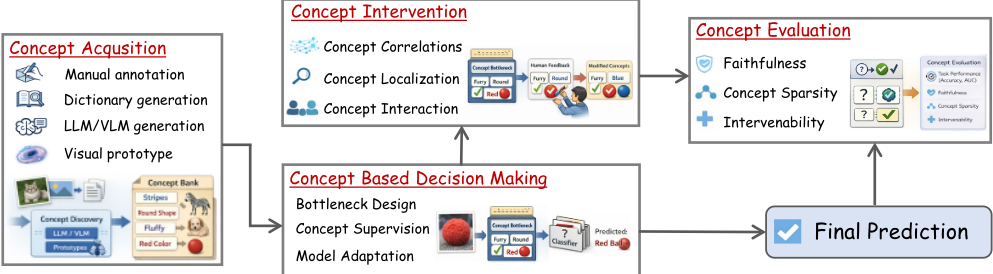
The main contributions of this survey can be summarized as follows. (1) A unifying taxonomy of CBMs across concept acquisition, decision making, intervention, and evaluation. (2) A systematic review of concept construction methods from manual annotation to LLM-guided and prototype-based discovery. (3) A synthesis of emerging CBM architectures with different bottleneck designs and degrees of editability. (4) A consolidation of evaluation protocols and benchmarks, with emphasis on faithfulness, sparsity, intervenability, and medical applications. We maintain an updated repository of representative CBM papers, code, and benchmarks to support reproducibility and community use at Awesome CBMs.
2 Preliminary
2.1 Concept BottleneckModel
Concept Bottleneck Models (CBMs) [Koh et al., 2020] are a class of interpretable neural architectures that explicitly decompose prediction into two stages through humanunderstandable intermediate variables, referred to as concepts. Formally, a CBM factorizes the mapping from an input x ∈ X to a target y ∈ Y as
where c = (c1, . . . , cK) ∈ CK denotes a set of interpretable concepts, such as visual attributes, anatomical structures, pathological findings, or semantic descriptions.
A canonical CBM consists of two components: a concept predictor fθ : X → CK , which maps raw inputs to concept activations, and a task predictor gϕ : CK → Y, which produces the final prediction based solely on the predicted concepts. The overall model can be written as:
This structure enables two defining capabilities of CBMs: (i) semantic interpretability, as each concept dimension aligns with a human-recognizable property; and (ii) intervenability, since users may inspect or modify c at test time to correct reasoning errors. These properties motivate a range of architectural variants discussed later in this survey, including models that relax the strict bottleneck constraint, incorporate structured dependencies among concepts, or leverage external knowledge such as multimodal foundation models.
2.2 Taxonomy
Figure 1 presents a four-part taxonomy of Concept Bottleneck Models, while Table 1 summarizes representative methods across these dimensions. We distinguish four primary dimensions: (1) Concept Acquisition, which concerns how humaninterpretable concepts are constructed, ranging from expert annotation to automated discovery and language-induced vocabularies; (2) Concept-based Decision Making, which specifies how the concept layer mediates prediction, including strict bottlenecks and relaxed or hybrid designs; (3) Concept Intervention, which studies how humans or external systems interact with concepts at inference time to correct or guide reasoning; and (4) Concept Evaluation, which assesses interpretability-oriented properties such as faithfulness, sparsity, and robustness under intervention.
Importantly, a growing body of work cuts across these dimensions, such as jointly integrating concept acquisition, decision making, and intervention within a single architecture. We therefore review each dimension in turn and highlight representative methods.
3 Concept Acquisition
Concept construction is the foundation of Concept Bottleneck Models, defining a human-interpretable interface between inputs and predictions. Concept construction has evolved from fully manual annotation to dictionary-based mining, LLM/VLM-guided generation, and visual prototype discovery. The overarching trend is to reduce manual supervision while improving concept quality, scalability, and visual grounding. This section reviews four representative paradigms and their core mechanisms.
3.1 Manual Annotation-based Concepts
Manual annotation provides the strongest semantic grounding by relying on expert-defined and explicitly labeled concepts, such as visual attributes or clinical findings. This paradigm ensures high interpretability and clear alignment with domain knowledge, but is fundamentally constrained by annotation cost, incomplete concept coverage, and label noise.
Recent work within this paradigm focuses on improving robustness and flexibility under imperfect supervision. One line of research addresses noisy or missing annotations by modifying the training objective, exemplified by CPO [Penaloza et al., 2025], which introduces preference-based optimization to jointly stabilize concept prediction and downstream performance. A complementary direction models dependencies among annotated concepts to mitigate leakage and limited expressiveness. Havasi et al. [Havasi et al., 2022] augment manually annotated concepts with latent side-channel variables and adopt autoregressive predictors to capture inter-concept structure. To support practical deployment, editable CBMs [Hu et al., 2025] enable posthoc correction of concept definitions and dataset labels using influence-function-based updates, without requiring full retraining. Despite these advances, manual annotation remains difficult to scale to complex domains, and its reliance on predefined concept sets limits adaptability to evolving tasks.
3.2 Dictionary-Based Concept Construction
Dictionary-based approaches replace task-specific manual definition with scalable discovery from predefined vocabularies, such as adjective lists or medical descriptors. By constraining the concept space to linguistically meaningful units, these methods offer improved controllability and transparency compared to fully automated generation.
Representative methods focus on filtering visually grounded concepts from large lexicons. V2C-CBM [He et al., 2025c] constructs a candidate pool of n-grams and uses CLIP-based vision-language similarity to remove non-visual or weakly grounded entries, yielding compact and interpretable concept sets. OpenCBM [Tan et al., 2024b] further aligns trainable visual features with CLIP embeddings and introduces mechanisms for discovering missing concepts, improving coverage beyond the initial dictionary.
While dictionary-based construction reduces annotation cost and limits hallucination risk, its expressiveness remains bounded by the predefined vocabulary, which may fail to capture fine-grained or task-specific semantics.
3.3 LLM/VLM-Guided Concept Generation
LLM- and VLM-guided concept generation substantially expands the concept space by leveraging large language models to produce diverse, high-level, and often hierarchical semantics. This paradigm offers strong scalability and flexibility, but introduces new challenges related to hallucination, weak visual grounding, and semantic instability.
Recent work addresses these issues through structure, alignment, and statistical regularization. Med-MICN [Hu et al., 2024] organizes concepts into multi-level hierarchies and employs gating mechanisms to control abstraction. Vision-language consistency constraints [Lai et al., 2023; Rao et al., 2024; Schrodi et al., 2025] and prompt-level alignment strategies [Bie et al., 2024] further improve grounding reliability. From a supervision perspective, Label-free CBMs and FCBM [Oikarinen et al., 2023; Du et al., 2025] demonstrate that usable concepts can be induced without explicit annotations by coupling LLMs with CLIP, provided that strong visual regularization is imposed.
Overall, LLM/VLM-guided concept acquisition significantly lowers human supervision requirements, but its interpretability ultimately depends on the reliability of language priors and the effectiveness of grounding constraints.
3.4 Visual Prototype-based Concept Discovery
Visual prototype-based methods learn concepts directly from the image space by extracting representative regions, parts, or disentangled components, yielding strong visual grounding and spatial localization. This paradigm is particularly appealing for medical imaging and other domains where morphological evidence is central to decision making.
Prototype-based discovery faces inherent challenges, including unstable semantic naming, saliency-driven spurious correlations, and trade-offs between prototype granularity and coverage. Recent work explores several design patterns to mitigate these limitations. Disentanglement-oriented approaches, such as HU-MCD, LCBM [Grobr¨ugge et al., 2025; Jeon et al., 2024b], learn multi-dimensional concept factors to reduce semantic underspecification. Deployment-oriented methods [Tan et al., 2024a; Choukali et al., 2024] focus on extracting prototype dictionaries from pretrained models to enable post-hoc interpretability. Interaction-oriented designs [Huang et al., 2024; Huy et al., 2025] explicitly associate prototypes with spatial regions, supporting region-level inspection and intervention.
Despite improved grounding fidelity, achieving stable semantic alignment and scalable reuse of visual prototypes across datasets remains an open challenge.
Summary. Concept acquisition in CBMs spans a spectrum from expert-defined semantics to automated discovery, reflecting trade-offs between semantic precision, supervision cost, and robustness, and motivating hybrid designs that integrate language and visual cues.
4 Concept-based DecisionMaking
Concept Bottleneck Models (CBMs) improve interpretability by mediating predictions through a layer of interpretable concepts, enabling validation and intervention. Beyond concept construction, CBM architectures have evolved to enhance flexibility and deployability. This section reviews three key directions: Bottleneck Design, Concept Supervision, and Model Adaptation, highlighting a shift from rigid pipelines toward adaptive, human-aligned decision making.
4.1 Bottleneck Design
A core innovation of CBMs lies in how the concept bottleneck governs decision making by controlling the information flow between inputs and outputs. Early CBMs adopted hard bottlenecks, enforcing a strict pipeline where all predictive signals pass through a discrete, interpretable concept layer. Such designs provide strong transparency and intervenability, but their rigidity may limit capacity and degrade performance under imperfect or incomplete concept supervision.
To address these limitations, soft bottlenecks were introduced [Mahinpei et al., 2021; Margeloiu et al., 2021], enabling continuous concept activations and joint optimization of concept and task predictors. This relaxation improves flexibility and predictive capacity, but makes the semantic boundary of each concept less explicit. Subsequent variants relaxed the strict bottleneck through residual pathways [Shang et al., 2024] and structured dependencies, including autoregressive sequencing [Havasi et al., 2022], graphical priors [Xu et al., 2025; Singhi et al., 2024], and stochastic latent variables [Vandenhirtz et al., 2024]. These designs capture inter-concept correlations and uncertainty difficult to represent with independent concept predictions. Energybased CBMs [Xu et al., 2024] unify prediction and intervention within a joint probabilistic framework, enabling decisions to be revised by modifying concept states. More recent work injects higher-level structure into the bottleneck, including causal graphs for robust intervention [De Felice et al., 2025], concept decoupling to mitigate concept-label distortion [Zhang et al., 2024], and differentiable logical composition to move beyond linear aggregation [Vemuri et al., 2026; Gao et al., 2025].
| Category | Method | Concept | Decision | Intervention | Code | ||||
|---|---|---|---|---|---|---|---|---|---|
| Source | Gran. | Sup. | Bottleneck | Corr. | Mechanism | Policy | Link | ||
| FVLC [Lai et al., 2023] | LLM | global | weak | soft | indep. | - | - | Link | |
| OpenCBM [Tan et al., 2024b] | dict. | local | none | hybrid | indep. | param. | vanilla | - | |
| Med-MICN [Hu et al., 2024] | LLM | global | weak | hybrid | joint | - | - | - | |
| XCoOp [Bie et al., 2024] | manual/LLM | global + local | strong/weak | sotf | indep. | - | - | Link | |
| Acquisition PCPPN[Choukali et al., 2024] | proto. | local | unsup. | soft | indep. | - | - | Link | |
| Tan et al. [2024a] | proto. | local | unsup. | soft | indep. | scalar | vanilla | - | |
| HU-MCD[Grobr¨ugge et al., 2025] | proto. | local | unsup. | - | indep. | - | - | Link | |
| CPO [Penaloza et al., 2025] | manual | global | strong | soft | indep. | scalar | active | Link | |
| V2C-CBM [He et al., 2025c] | dict. | global | weak | soft | indep. | scalar | vanilla | Link | |
| CBMs[Koh et al., 2020] | manual | global | strong | hard | indep. | scalar | vanilla | Link | |
| PCBMs [Yuksekgonul et al., 2023] | manual/dict. | global | weak | hybrid | indep. | scalar/param. | vanilla | Link | |
| CLIP-QDA [Kazmierczak et al., 2024] | dict. | global | weak | soft | joint | scalar | - | - | |
| Label-Free CBM [Oikarinen et al., 2023] | LLM | global | weak | soft | indep. | scalar | vanilla | Link | |
| Explicd [Gao et al., 2024b] | LLM | global | weak | soft | indep. | - | - | Link | |
| Decision ECBMs [Hu et al., 2025] | manual | global | strong | soft | indep. | param. | vanilla | Link | |
| AdaCBM [Chowdhury et al., 2024] | LLM | global | weak | soft | indep. | - | - | Link | |
| Graph CBM [Xu et al., 2025] | manual/dict. | global | strong/weak | soft | graph | scalar | prop. | Link | |
| C 2 BMs [De Felice et al., 2025] | LLM | global | weak | soft | causal | scalar | prop. | Link | |
| MVP-CBM [Wang et al., 2025] | LLM | global | weak | soft | indep. | - | - | Link | |
| Havasi et al. [2022] | manual | global | strong | hard | joint | scalar | prop. | Link | |
| SCBMs [Vandenhirtz et al., 2024] | manual/LLM | global | weak | hard | joint | scalar | active + prop. | Link | |
| ECBMs [Xu et al., 2024] | manual | global | strong | hybrid | joint | scalar | prop. | Link | |
| evi-CEM [Gao et al., 2024a] | manual/LLM | global | strong/weak | hybrid | indep. | scalar | active | Link | |
| Intervention CSR [Huy et al., 2025] | manual + proto. | local | strong | soft | indep. | scalar/spatial | vanilla | Link | |
| Concept Realignment[Singhi et al., 2024] | manual | global | strong | soft/hybrid | joint | scalar | active + prop. | Link | |
| CB2M [Steinmann et al., 2024] | manual | global | strong | soft | indep. | scalar | active | Link | |
| Chat-CBM [He et al., 2025b] | LLM | local | none | hard | indep. | lang. | vanilla | - | |
| SALF-CBM [Benou and Raviv, 2025] | LLM | local | weak | soft | indep. | spatial | vanilla | Link | |
| CEM [Espinosa Zarlenga et al., 2022] | manual | global | strong | soft | indep. | scalar | vanilla | Link | |
| IntCEMs [Espinosa Zarlenga et al., 2023] | manual | global | strong | soft | indep. | scalar | active | Link | |
| CF-CBM [Panousis et al., 2024] | LLM | global + local | weak | hard | hier. | scalar | prop. | Link | |
| Evaluation Res-CBM [Shang et al., 2024] | manual/LLM | global | weak | soft | indep. | scalar | vanilla | Link | |
| ProtoCBM[Huang et al., 2024] | manual + proto. | local | strong | soft | indep. | - | - | Link | |
| VLG-CBM [Srivastava et al., 2024] | LLM | local | weak | soft | indep. | - | - | Link | |
| PS-CBM[Zhao et al., 2026] HybridCBM [Liu et al., 2025] | LLM LLM + proto. | global global | weak weak | soft soft | joint indep. | scalar - | vanilla - | Link Link | |
Together, these advances reflect a gradual relaxation of strict bottlenecks toward more expressive and structured architectures, enabling CBMs to better balance interpretability and predictive capacity in complex real-world settings, while preserving the concept layer as an aligned semantic interface for explanation and intervention.
4.2 Concept Supervision
Concept supervision defines how the intermediate semantic layer of CBMs is constructed and grounded. While early models relied on manually annotated concepts with strong domain semantics [Koh et al., 2020], such supervision is often costly, sparse, or domain-specific. Consequently, recent research has pursued alternatives that scale to broader tasks while retaining semantic interpretability.
Post-hoc CBMs [Yuksekgonul et al., 2023] bypass architectural constraints by learning concept predictors atop frozen encoders, recovering concept interpretability without retraining. Probing-based approaches [Semenov et al., 2024] and prototype discovery methods [Huang et al., 2024; Tan et al., 2024a] extract interpretable units from pretrained features using sparsity regularization or part-based decomposition. Leveraging vision-language models, CLIP-based pipelines [Kazmierczak et al., 2024; Oikarinen et al., 2023; Lin et al., 2025] align concept labels with textual prompts, enabling open-vocabulary supervision. LLM-guided strategies [Hu et al., 2024; Lai et al., 2023; Gao et al., 2024b; Wang et al., 2025] go further by generating hierarchical or task-specific concepts, though challenges in visual grounding and hallucination remain.
These approaches shift concept supervision from direct annotation to alignment- and prompt-based induction, enabling scalable and adaptive concept construction. This evolution preserves the human-aligned semantics of CBMs while improving flexibility across tasks and domains.
4.3 Model Adaptation
For CBMs to be practically useful in real-world and evolving environments, they must support dynamic adaptation. Static pipelines with fixed concepts are difficult to update when task requirements shift, new concepts emerge, or user corrections are needed. As a result, model adaptation has become a critical frontier for operational CBMs.
Editable CBMs [Hu et al., 2025] introduce influence function-based parameter updates, enabling localized changes to concept, instance, or label predictions without full retraining. This allows for fine-grained corrections and dataset updates while preserving the model's overall structure. Probabilistic energy-based models [Xu et al., 2024] support testtime correction by formulating inference as energy minimization over inputs, concepts, and outputs. More interactively, recent methods such as Chat-CBM [He et al., 2025b] and SALF [Benou and Raviv, 2025] expand the model interface to support natural language and spatial-region-based interventions, making adaptation accessible to non-technical users. Training-free test-time adaptation [Chowdhury et al., 2024; He et al., 2025a]further enables CBMs to handle conceptlevel distribution shifts using only a few image-level labels, without retraining or concept supervision.
These advances mark a shift from static interpretability toward dynamic, human-in-the-loop decision-making. Adaptable CBMs retain their core semantic bottleneck while allowing post-deployment editing, correction, and collaboration, extending their viability in real-world, high-stakes systems.
Summary. Concept-based decision making in CBMs has evolved from strict bottleneck pipelines to more flexible architectures that better balance interpretability and performance. Advances in bottleneck design, supervision, and model adaptation position the concept layer as a dynamic interface for prediction and intervention.
5 Concept Intervention
Concept intervention enables human and AI collaboration by correcting intermediate concepts, transforming CBMs from passive interpretable models into interactive systems. In the seminal work of Koh et al. [2020], intervention was formulated as a test-time edit that allows users to modify concept activation values. While foundational, this paradigm relies on strong independence assumptions, incurs high human effort, and supports limited interaction modalities.
5.1 Concept Correlations
Early intervention mechanisms typically assume that concepts are independent, implying that modifying one concept does not affect others. This assumption is often unrealistic in real-world settings, where concepts exhibit strong semantic and statistical dependencies in practice across complex decision tasks. To address this limitation, correlation-aware intervention methods explicitly model inter-concept relationships and propagate corrections accordingly.
Havasi et al. [2022] proposed an autoregressive concept predictor, allowing interventions on earlier concepts to influence subsequent predictions through sequential dependency modeling. Stochastic CBMs [Vandenhirtz et al., 2024] further improve efficiency by modeling concept logits as a multivariate normal distribution, enabling instantaneous propagation of a single intervention through the learned covariance structure. Energy-Based CBMs [Xu et al., 2024] adopt a joint energy formulation over inputs, concepts, and outputs, allowing concept corrections to propagate via energy minimization. Singhi et al. [2024] introduced a post-hoc Concept Realignment Module (CIRM), which updates non-intervened concepts based on learned statistical correlations.
While these approaches significantly improve intervention consistency and efficiency, they critically depend on the quality of learned correlations. If spurious dependencies are captured, interventions may propagate errors rather than corrections, highlighting an important open challenge.
5.2 Concept Localization
Identifying which concepts to intervene remains a major bottleneck in practical deployment, as manual selection is laborintensive and cognitively demanding. To alleviate this burden, recent work has shifted toward model-guided localization strategies that prioritize high-impact intervention targets.
Some approaches internalize localization into training or model design. Espinosa Zarlenga et al. [2022] introduced intervention-aware training that simulates test-time intervention during learning, enabling the model to recommend concepts for correction. Evidential CEM (evi-CEM) [Gao et al., 2024a] models concept predictions as Beta distributions, using epistemic uncertainty to guide intervention toward ambiguous concepts. Other methods rely on post-hoc analysis or auxiliary structures. Shin et al. [2023] proposed metrics such as Uncertainty-based Concept Potential (UCP) and Loss on Concept Prediction (LCP) to rank intervention priorities. Shen et al. [2025] further introduced FIGS-BD, which distills predictors into greedy sum-trees to identify concept groups with high contribution variance.
5.3 Concept Interaction
Beyond selecting and correcting concept values, recent work increasingly explores richer interaction modalities that are more intuitive for human users [Steinmann et al., 2024]. Chat-CBM [He et al., 2025b] replaces the concept-based predictor with large language models, allowing users to intervene through natural language dialogue. While this improves usability in practice, it may weaken the strict interpretability guarantees of traditional CBMs.
In the visual domain, Concept-based Similarity Reasoning (CSR) [Huy et al., 2025] enables spatial interaction by allowing users to draw bounding boxes that guide model attention. However, such spatial guidance does not explicitly decouple interventions across distinct concepts. Spatially-Aware and Label-Free (SALF) CBM [Benou and Raviv, 2025] addresses this limitation by leveraging spatial concept maps, enabling users to specify a region of interest and selectively modulate the activation of a single concept within that region. Beyond discriminative models, Concept Bottleneck Generative Models extend concept-level interaction to GANs, VAEs, and diffusion models, enabling interpretable steering and debugging of generation [Ismail et al., 2024].
Summary. Concept intervention transforms CBMs from static explanatory models into interactive human-in-the-loop systems. By modeling concept correlations, enabling efficient localization of intervention targets, and supporting richer interaction modalities, recent advances improve the effectiveness and usability of concept-level correction.
6 Evaluation for Concept BottleneckModels
Concept Bottleneck Models introduce interpretable and intervenable intermediate concepts, requiring evaluation protocols that go beyond downstream task performance. Existing evaluation frameworks therefore assess three core dimensions: concept faithfulness, concept sparsity, and intervenability, capturing semantic validity, cognitive tractability, and human-in-the-loop controllability.
6.1 Concept Faithfulness
Concept faithfulness measures whether learned bottleneck representations align with human-understandable semantics, serving as a prerequisite for reliable explanation and effective intervention in practice. Evaluation strategies have evolved from direct label matching to more rigorous assessment of intrinsic structure and external grounding.
Label Alignment. A common approach evaluates agreement between predicted concepts and ground-truth annotations using standard metrics such as Accuracy and F1 Score. However, in high-dimensional and sparse concept spaces, these metrics can be dominated by true negatives. To mitigate this bias, recent work emphasizes active concept evaluation using metrics such as Jaccard Similarity [Panousis et al., 2024] and the Concept Existence Metric (CEM) [AYSEL et al., 2025], which focus on positively activated concepts.
Intrinsic Representation Quality. Beyond label matching, valid concept representations should possess coherent topological structures and distinct separability. The Concept Alignment Score (CAS) [Espinosa Zarlenga et al., 2022] addresses the former in embedding-based models, verifying whether local neighborhoods in the high-dimensional space maintain semantic homogeneity. Complementarily, to address the latter in scalar-based bottlenecks, Gap [Midavaine et al., 2024; Park et al., 2025] evaluates the latent space separability by measuring the divergence between positive and negative activation distributions, thereby quantifying the intrinsic discriminative quality of the representation.
Semantic and Visual Grounding. To detect spurious correlations, further evaluation aligns learned concepts with external semantic or visual references. Semantic grounding metrics, including CGIM [AYSEL et al., 2025], Similarity [Shang et al., 2024], and Concept Purity [Liu et al., 2025], assess consistency with human-defined importance or canonical embeddings. Visual grounding metrics such as the Concept Trustworthiness Score [Huang et al., 2024] and CLM [AYSEL et al., 2025] quantify spatial alignment between concept activations and annotated regions. While effective in practice, these approaches often require costly annotations; VLM-based alternatives such as Concept-Image Relevance [Liu et al., 2025] reduce supervision but introduce potential hallucination risks.
6.2 Concept Sparsity
Concept sparsity evaluates whether CBMs rely on a minimal and cognitively manageable set of concepts. Excessively dense bottlenecks undermine interpretability and increase the risk of information leakage. Metrics such as Sparsity [Panousis et al., 2024] and the Number of Effective Concepts (NEC) [Srivastava et al., 2024] quantify activation density and reasoning complexity. However, sparsity must be considered jointly with task performance. To capture this trade-off, composite metrics such as Concept Utilization Efficiency (CUE) [Shang et al., 2024] and Concept-Efficient Accuracy (CEA) [Zhao et al., 2026] balance predictive accuracy against concept usage, with CEA offering a bounded, textinvariant formulation for robust comparison.
6.3 Intervenability
Intervenability reflects the ability of CBMs to support effective human correction at inference time. Evaluation protocols in this category assess both the responsiveness of model predictions to concept-level corrections and the efficiency of intervention strategies. Test-Time Intervention (TTI) curves [Koh et al., 2020] and their area-under-curve variants [Espinosa Zarlenga et al., 2023] are widely used to summarize performance gains under increasing intervention budgets. Extending this analysis, recent work examines correction propagation among correlated concepts [Vandenhirtz et al., 2024] and explicitly models the cost of intervention through empirical user time [Midavaine et al., 2024] or theoretical complexity [Shin et al., 2023; Pugnana et al., 2025].
Summary. Evaluating CBMs requires a holistic protocol beyond downstream accuracy. Concept faithfulness ensures semantic validity, concept sparsity maintains cognitive tractability, and intervenability quantifies the effectiveness and cost of human-in-the-loop correction. Together, these dimensions form a principled basis for assessing the interpretability, reliability, and practical utility of CBMs.
7 Benchmark
Table 2 summarizes representative benchmarks used to evaluate Concept Bottleneck Models (CBMs) across general and medical domains. These datasets differ substantially in concept annotation source, supervision granularity, and support for concept-level intervention, which in turn determines which aspects of CBMs, such as faithfulness, scalability, or intervenability, can be reliably assessed. Unlike deep models, CBMs depend on benchmark design to validate concept faithfulness and intervention effectiveness.
| Domain | Dataset | #Classes | #Concepts | #Samples | Task | Concept Annotation | Concept Type | Annotation Granularity | Intervention Support | Dataset Link |
|---|---|---|---|---|---|---|---|---|---|---|
| CUB-200-2011 | 200 | 312 | 11788 | Fine-grained Cls. | Human-Annotated | Binary | Instance-level | ✓ | Link | |
| CelebA | 10k | 40 | 200000 | Cls. | Human-Annotated | Binary | Instance-level | ✓ | Link | |
| Places365 | 365 | 102 | ∼1.8M | Scene Rec. | Weakly Supervised | Binary | Instance-level | × | Link | |
| AWA2 | 50 | 85 | 37322 | Cls./Zero-shot Learning. | Human-Annotated | Binary | Class-level | ✓ | Link | |
| RIVAL10 | 10 | 18 | 26484 | Cls. | Human-Annotated | Binary | Instance-level | ✓ | Link | |
| SUN Attribute | 717 | 102 | 14340 | Scene Cls. | Human-Annotated | Binary | Instance-level | ✓ | Link | |
| CEBaB | 5 | 4 | 5113 | Sentiment Cls. | Human-Annotated | Multi-class | Instance-level | ✓ | Link | |
| IMDB-C | 2 | 4 | 200 | Sentiment Cls. | Human-Annotated | Multi-class | Instance-level | ✓ | Link | |
| General | CIFAR-10/100 | 10/100 | - | 60000 | Cls. | LLM/VLM-Generated | - | - | × | Link |
| COCO-Stuff | 171 | - | 164000 | Scene Cls. | LLM/VLM-Generated | - | - | × | Link | |
| ImageNet | 1000 | - | ∼1.2M | Cls. | LLM/VLM-Generated | - | - | × | Link | |
| DTD | 47 | - | 5640 | Texture Cls. | LLM/VLM-Generated | - | - | × | Link | |
| UCF101 | 101 | - | 13320 | Action Cls. | LLM/VLM-Generated | - | - | × | Link | |
| Resisc45 | 45 | - | 31500 | Scene Cls. | LLM/VLM-Generated | - | - | × | Link | |
| Food-101 | 101 | - | 101000 | Fine-grained Cls. | LLM/VLM-Generated | - | - | × | Link | |
| Flower102 | 102 | - | 8189 | Fine-grained Cls. | LLM/VLM-Generated | - | - | × | Link | |
| AGNews | 4 | - | 127600 | Text Cls. | LLM-Generated | - | - | × | Link | |
| Derm7pt | 5 | 7 | 1011 | Skin Lesion Cls. | Expert-Annotated | Multi-class | Instance-level | ✓ | Link | |
| OAI | 5 | 10 | 36369 | Kellgren-Lawrence Grading | Expert-Annotated | Ordinal | Instance-level | ✓ | Link | |
| Fitzpatrick17k | 114 | 48 | 16577 | Skin Disease Cls. | From SkinCon | Binary | Instance-level | ✓ | Link | |
| SkinCon | 4 | 48 | 3230 | Skin Disease Cls. | Expert-Annotated | Binary | Instance-level | ✓ | Link | |
| WBCAtt | 5 | 31 | 10298 | Fine-grained WBC Cls. | Expert-Annotated | Continuous | Instance-level | ✓ | Link | |
| VinDr-CXR | 6 | 22 | 18000 | Thoracic Disease Cls. | Expert-Annotated | Binary | Instance-level | ✓ | Link | |
| HAM10000 | 7 | - | 10015 | Skin Lesion Cls. | LLM/VLM-Generated | - | - | × | Link | |
| MIMIC-III EWS | 16 | - | 796250 | EWS Prediction | Rule-based | - | - | ✓ | Link | |
| Medical | NCT-CRC-HE | 9 | - | 100k | Tissue Cls. | LLM/VLM-Generated | - | - | × | Link |
| IDRiD | 5 | - | 455 | Diabetic Retinopathy Grading | LLM/VLM-Generated | - | - | × | Link | |
| BUSI | 3 | - | 780 | Breast Cancer Cls. | LLM/VLM-Generated | - | - | × | Link | |
| CMMD | 2 | - | 1775 | Breast Cancer Cls. | LLM/VLM-Generated | - | - | × | Link | |
| TBX11K | 4 | - | 11200 | Tuberculosis Cls. | LLM/VLM-Generated | - | - | × | Link | |
| CTI | 3 | - | 750 | Choroid Neoplasia Cls. | LLM-Generated | - | - | × | Link | |
| ISIC2018 | 7 | - | 10015 | Skin Lesion Cls. | LLM/VLM-Generated | - | - | × | Link | |
| MiniDDSM | 3 | - | 9684 | Breast Cancer Cls. | LLM/VLM-Generated | - | - | × | Link |
General Domain Datasets. General-domain benchmarks evaluate CBMs on visual and textual recognition tasks, including fine-grained classification, zero-shot learning, and NLP applications. A key distinction lies in concept supervision. Datasets with human-annotated concepts, such as CUB-200-2011 and AWA2, support concept evaluation and test-time intervention, enabling causal analysis of concept corrections. In contrast, large-scale benchmarks relying on LLM- or VLM-generated concepts assess scalability and open-vocabulary capability, but lack verified ground truth and therefore cannot support intervention-based evaluation.
Medical Domain Datasets. Medical benchmarks emphasize clinically meaningful concepts and safety-critical interpretability, making them particularly suitable for evaluating concept faithfulness and intervention effectiveness. Datasets with expert-annotated, ordinal, or continuous concepts explicitly support intervention experiments and enable validation of human-in-the-loop correction in realistic clinical settings. Larger medical datasets that rely on automatically generated concepts improve coverage and scalability, but the absence of validated concept annotations generally limits their suitability for rigorous intervention and causal analysis.
8 Conclusion and Future Directions
Concept Bottleneck Models provide a principled framework for interpretable and controllable decision making by grounding predictions in human-understandable concepts. This survey unified CBM research across the full pipeline of concept acquisition, decision making, intervention, and evaluation, with a particular emphasis on high-stakes medical applications. Despite substantial progress, several fundamental challenges remain, including balancing predictive performance with interpretability, ensuring the semantic faithfulness of learned concepts, enabling reliable and scalable interventions, and maintaining robustness under data scarcity and distribution shift in real-world practice.
Future research directions of CBMs include: (1) Adaptive Concept Acquisition. Future CBMs should move beyond fixed bottleneck designs toward adaptive and structured concept representations, such as hierarchical, compositional, or sparsely activated bottlenecks. Such designs better reflect the multi-level and task-dependent nature of human semantics, while improving efficiency. (2) Faithful and Reliable Concepts. Ensuring that learned concepts faithfully correspond to their intended semantics remains a central challenge, particularly under weak supervision or when concepts are derived from LLMs or VLMs. Promising directions include uncertainty-aware modeling, causal representation learning to mitigate spurious correlations, and mechanisms for detecting or correcting unstable concepts. (3) Structured Concept Intervention. Beyond direct concept replacement, future work should explore structured intervention strategies that account for dependencies among concepts and identify decision-critical subsets. Supporting partial or soft interventions is essential for reducing effort and enabling scalable expert-in-the-loop deployment in safety-critical domains. (4) Robust Concept Evaluation. Robust evaluation remains necessary for reliable deployment. Future research should examine how concept representations and intervention effects generalize across domains and shifts, and how concept-based reasoning supports uncertainty estimation, out-of-distribution detection, and intervention-aware evaluation protocols.
Acknowledgments
This work was supported by the National Natural Science Foundation of China (62271465, 62502490), the National Key R&D Program of China (2025YFC3408300), the Suzhou Basic Research Program (SYG202338), the Natural Science Foundation of Jiangsu Province (BK20250496), the China Postdoctoral Science Foundation (2024M763178), and the Jiangsu Funding Program for Excellent Postdoctoral Talent.
Contribution Statement
- Wang, F. Li, and W. Hu contributed equally to this work.
@inproceedings{ijcai2026p892,
  title     = {Concept Bottleneck Models for Explainable Decision Making: A Survey of Progress, Taxonomy, and Future Directions},
  author    = {Wang, Chunjiang and Li, Fan and Hu, Wenbo and Yan, Rui and Zhang, Kun and Zhou, Shaohua Kevin},
  booktitle = {Proceedings of the Thirty-Fifth International Joint Conference on
               Artificial Intelligence, {IJCAI-26}},
  publisher = {International Joint Conferences on Artificial Intelligence Organization},
  editor    = {Diego Calvanese},
  pages     = {8041--8049},
  year      = {2026},
  month     = {8},
  note      = {Survey Track},
  doi       = {10.24963/ijcai.2026/892},
  url       = {https://doi.org/10.24963/ijcai.2026/892},
}
TY - CPAPER TI - Concept Bottleneck Models for Explainable Decision Making: A Survey of Progress, Taxonomy, and Future Directions AU - Wang, Chunjiang AU - Li, Fan AU - Hu, Wenbo AU - Yan, Rui AU - Zhang, Kun AU - Zhou, Shaohua Kevin T2 - Proceedings of the Thirty-Fifth International Joint Conference on Artificial Intelligence, IJCAI-26 PB - International Joint Conferences on Artificial Intelligence Organization PY - 2026 SP - 8041 EP - 8049 DO - 10.24963/ijcai.2026/892 UR - https://doi.org/10.24963/ijcai.2026/892 ER -Copied
Machine-readable versions of this paper, for tools and AI agents:





