
An Automated Maintenance Plant for Highways
Proceedings of the Thirty-Fifth International Joint Conference on Artificial Intelligence. Demo Track. Pages 8354-8357.
https://doi.org/10.24963/ijcai.2026/955
Keywords
- AI: Robotics
- AI: Multidisciplinary Topics and Applications
Abstract
The Digital Roads project at Cambridge University is leveraging digitalisation, automation, and low-carbon materials to build an Automated Maintenance Plant (AMP) for UK road networks, aimed at minimising repair times to reduce congestion, improving safety, and contributing to the UK’s net-zero goals through faster, more accurate, and efficient road maintenance.
- [de Silva et al., 2013] Lavindra de Silva, Amit Kumar Pandey, and Rachid Alami. An interface for inter- leaved symbolic-geometric planning and backtracking. In IEEE/RSJ International Conference on Intelligent Robots and Systems, pages 232-239, 2013.
- [De Silva et al., 2018] Lavindra De Silva, Felipe Rech Meneguzzi, and Brian Logan. An operational semantics for a fragment of prs. In Proceedings of the 27th Interna- tional Joint Conference on Artificial Intelligence (IJCAI), 2018, Brasil., 2018. IJCAI
- [England, 2017] Highways England. Highways England highlights dangers faced by road workers, 2017.
- [Haas and others, 1992] C Haas et al. Investigation of a pavement crack-filling robot. Report to the Strategic High- way Research Program, 1992.
- [INRIX, 2017] INRIX. INRIX reveals the UK's worst traffic jams over the past year. https://inrix.com/press-releases/ uk-traffic-jams/, 2017. Accessed: 2024. Link
- [Lam et al., 2025] Percy Lam, Sooyong Park, Weiwei Chen, Lavindra De Silva, and Ioannis Brilakis. CRAAC: Con- sistency regularised active learning with automatic cor- rections for real-life road image annotations. In 2025 IEEE/CVF Winter Conference on Applications of Com- puter Vision (WACV), pages 4778-4787. IEEE, 2025. [Legislation.gov.uk, 1984] Legislation.gov.uk. Road traf- fic regulation act 1984. https://www.legislation.gov.uk/ ukpga/1984/27, 1984. Accessed: 2024. Link
- [Marie d'Avigneau et al., 2025] Alix Marie d'Avigneau, Lilia Potseluyko, Nzebo Richard Anvo, Hussameldin M Taha, Varun Kumar Reja, Diana Davletshina, Percy Lam, Lavindra De Silva, Abir Al-Tabbaa, and Ioannis Brilakis. CAMHighways: The Cambridge Highways dataset. Advanced Engineering Informatics, 64:103036, 2025.
- [Mott MacDonald, 2021] Mott MacDonald. Decarbonising england's strategic road network. https://www.mottmac. com/article/77609/net-zero-plan, 2021. Accessed: 2024. Link
- [National Highways, 2021] National Highways. Digital roads: Safer construction and operations -faster delivery -better customer experience. National Highways, 2021.
- [National Highways, 2024] National Highways. Road to zero harm. https://nationalhighways.co.uk/about-us/ what-we-do/road-to-zero-harm/, 2024. Accessed: 2024. Link
- [Palin et al., 2026a] Damian Palin, Samuel Schaefer, Alix Marie d'Avigneau, Jie Xu, Georgios M Had- jidemetriou, Michael Ambrose, Abir Al-Tabbaa, Fumiya Iida, Ioannis Brilakis, and Thomas George Thuruthel. Autonomous maintenance of highway pavements: A framework aiming toward implementation. Jour- nal of Construction Engineering and Management, 152(3):03126001, 2026.
- [Palin et al., 2026b] Damian Palin, Jie Xu, Christos Vlachakis, Michael Ambrose, Fumiya Iida, and Abir Al-Tabbaa. Microfibre-reinforced cementitious materials for preventive concrete pavement crack repair: Balancing extrusion-based crack-filling with mechanical perfor- mance. Cement and Concrete Composites, 167:106460, 2026.
- [Robotic Maintenance Vehicles, 2024] Robotic Main- tenance Vehicles. Robotic crack sealer. https: //rmv.llc/robotic-crack-sealer, 2024. Accessed: 2024. [Robotiz3d, 2024] Robotiz3d. Road maintenance rein- vented. https://www.robotiz3d.com/, 2024. Accessed: 2024. Link
- [Schaefer et al., 2024] Samuel D Schaefer, Jie Xu, Damian Palin, Abir Al-Tabbaa, and Fumiya Iida. Position-based fluid simulation for robotic injection sealing of pavement cracks. Journal of Field Robotics, 41(5):1438-1451, 2024.
- [Seo et al., 2014] Won-Jung Seo, Hyun-Seok Yoo, and Young-Suk Kim. A comparative study on productivity analysis of automated pavement crack sealing machines. KSCE Journal of Civil and Environmental Engineering Research, 34(4):1289-1298, 2014.
- [Xu et al., 2024] Jie Xu, R Anvo N'Zebo, Hussameldin Taha-Abdalgadir, Alix M d'Avigneau, Damian Palin, Ran Wei, Georgios Hadjidemetriou, Samuel Schaefer, Lavin- dra de Silva, Abir Al-Tabbaa, et al. Highway digital twin-enabled autonomous maintenance plant: a perspec- tive. Data-Centric Engineering, 5:24, 2024.
- [Xu et al., 2026] Jie Xu, Damian Palin, Samuel D Schaefer, Abir Al-Tabbaa, and Fumiya Iida. Rapid flow cup-enabled liquid perception using a position-based physics simulator for robotic liquid manipulation. IEEE Transactions on Au- tomation Science and Engineering, 23:2135-2147, 2026.
References were extracted automatically from the PDF and may contain errors.
Full text extracted automatically from the PDF; figures, tables and equations may differ. The PDF is the version of record.
1 Introduction
Highways are crucial to the UK's economy, contributing £314bn per annum or 10% of its annual Gross Domestic Product [Highways, 2021]. Significant investment is needed to maintain their functionality, with many of these highways surpassing or nearing their service life. However, in 2020, maintenance and construction activities on England's highways amounted to 734,000 CO2 equivalents (MtCO2e) [Mott MacDonald, 2021]. Furthermore, highway maintenance and road construction activities pose safety risks [England, 2017] and cause congestion, resulting in £9bn of economic losses [INRIX, 2017]. To address these challenges, highway maintenance in England requires a permit for works longer than 15 minutes [Legislation.gov.uk, 1984] and National Highways (England's Highway authority) champions leveraging digitalisation and automation to enhance safety and reduce the carbon emissions of its maintenance activities to achieve its zero harm [National Highways, 2021] and net zero [National Highways, 2024] targets. Automated maintenance vehicles offer to be a promising solution to realise these needs.
2 Automated RoadMaintenance
Automated road maintenance vehicles emerged in the 1990s, driven by initiatives such as the USA Government's Strategic Highway Research Program [Seo et al., 2014], aimed at improving the speed and effectiveness of highway maintenance. One of the first examples was a crack-repairing trailer equipped with a camera, a XY-gantry fitted with a material extrusion nozzle and materials tank [Haas and others, 1992]. Following this, many automated maintenance vehicles have been trialled, including a crack repair vehicle that is yet to be commercialised by Robotiz3d, a UK start-up company
[Robotiz3d, 2024]. However, there is only one commercial automated maintenance vehicle in operation, by the company Robotic Maintenance Vehicles, which repairs cracks on USA roads [Robotic Maintenance Vehicles, 2024]. More crucially, we are unaware of reports on the carbon benefits of these vehicles nor efforts to reduce their carbon footprint through their operation or the repair materials they use. Net Zero oriented automated road repair is thus still in its infancy, highlighting a pressing need for a vehicle that can repair using both safe and low-carbon operations and materials.
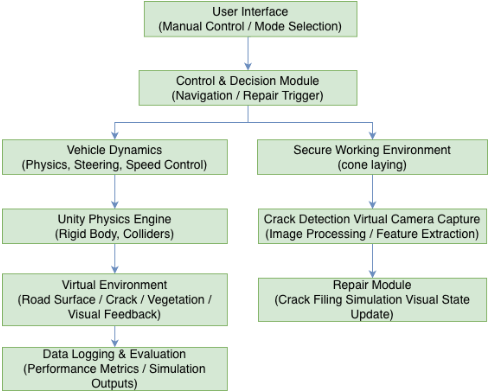
We are working with stakeholders such as National Highways, Costain, and the UK Department of Transport to pioneer technologies that enhance the management, operation, and maintenance of highways [Schaefer et al., 2024; Xu et al., 2024]. Core to this is the design, simulation, highway trials and commercialisation of an Autonomous Maintenance Plant (AMP) (Figure 1) [Xu et al., 2024] to undertake various tasks such as inspection and crack repair. The AMP will use low-carbon repair materials that we have developed, as well as minimising repair time and optimising repair effectiveness.
3 AMP Simulation Framework
The AMP simulation framework 1 is designed as a modular system implemented within the Unity 3D platform. We have integrated our virtual pavement environment [Marie d'Avigneau et al., 2025] into the framework, as well as a physics-based vehicle model, crack detection and repair modules, and user interaction components. Unity 3D serves as the core simulation engine, managing scene rendering, physics computation, and real-time system interaction. The simulated environment represents road assets and a road pavement which reflect real assets with defects on them (e.g., cracks), scanned as part of a National Highways road survey. For the purpose of demonstration, we have also created artificial pavement cracks of various dimensions, enabling controllable testing scenarios. The AMP model interacts with the environment through Unity's physics engine, allowing realistic motion, steering, and collision behavior. A virtual cameras, placed below the van, is used for crack detection [Lam et al., 2025] and repair monitoring, while the repair module simulates crack-filling operations through state changes and visual feedback. User inputs and control logic manage AMP operation modes, including manual and semi-autonomous with controls (see Figure 4).
1 https://youtu.be/8AJ1Ig6-WLk
3.1 AMP Composition
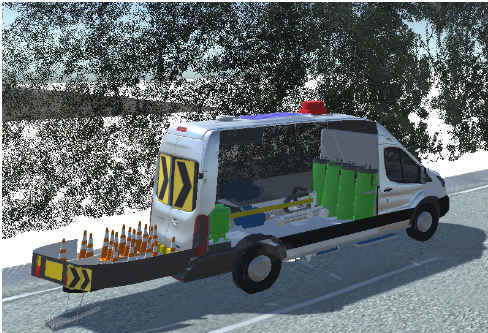
The AMP (referring to the simulated AMP for the rest of the text unless explicitly stated) is composed of several integrated subsystems designed to support safe, efficient, and automated road maintenance operations. One subsystem focuses on safety, and securing the environment through the placement of traffic cones to define and protect the operational area. This system is supported by a conveyor mechanism that enables controlled deployment of cones during operation, ensuring a secure working zone for the maintenance tasks. The AMP is equipped with a high-resolution LiDAR sensor to support environment perception and point cloud collection. Power for all maintenance modules is provided by a battery, complemented by solar panels for auxiliary power generation and overall energy efficiency. (While included as part of the AMP design, the LiDAR and power systems are not yet simulated.) A key structural component of the AMP is the gantry system, which supports an array of extrusion and cleaning nozzles. These tools are used for surface preparation and crack repair operations. The extrusion system is designed to deliver, e.g., bitumen and cementitious repair materials developed in-house [Palin et al., 2026a]. We simulate the material flow through a particle physics engine [Xu et al., 2026]. An air compressor system is included to support crack cleaning before material application, while dedicated storage tanks are used to hold repair materials and compressed air. Together, these components form a cohesive AMP body model that realistically represents the structure and functionality of an automated road maintenance vehicle, as illustrated in Figure 2.
3.2 AMP Crack Repair Mechanism
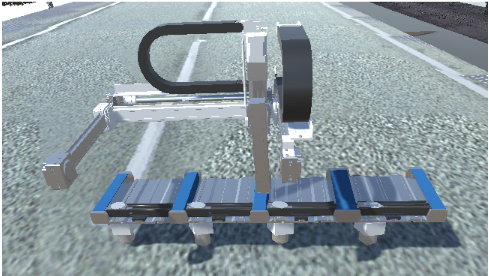
The gantry system represents an innovative design inspired by existing commercial gantry-based maintenance solutions and has been adapted to support automated pavement crack repair operations (Figure 3). The system employs a twolevel gantry architecture consisting of a primary gantry and multiple secondary mini-gantries, providing three degrees of freedom for accurate positioning of the material extrusion units across the pavement surface. The mini-gantries move collectively with the primary gantry while also being capable of operating independently from one another for localised positioning and control. This configuration ensures stable operation while enabling precise alignment of repair tools. Compared with traditional single-nozzle crack repair systems, which typically address one operation at a time, the proposed gantry system integrates four independently controlled extrusion units capable of operating simultaneously. Each extrusion unit offers three-axis movement, allowing effective repair of longitudinal, transverse, and alligator crack patterns [Marie d'Avigneau et al., 2025]. Moreover, multiple cracks within the same operational area can be repaired in a single pass. This parallel operation significantly reduces overall repair time, as fewer vehicle stops and repositioning actions are required.
4 User Interaction and Control
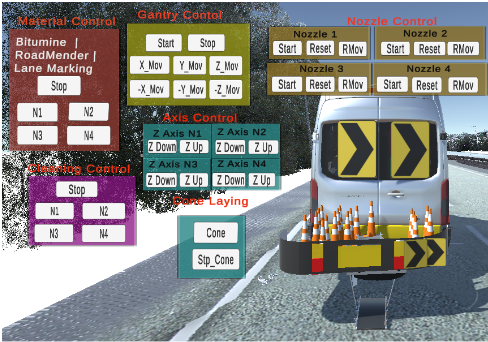
User interaction with the AMP simulation is provided through a graphical user interface (GUI) integrated into the Unity 3D environment (Figure 4). The interface is structured into dedicated functional panels, each corresponding to a core subsystem of the AMP, enabling intuitive operation and effective demonstration of crack repair workflows. In manual mode, the operator directly controls the vehicle's motion, cone laying, and repair actions through the Gamepad controller and the GUI. In semi-autonomous mode, the operator only needs to supervise such operations.
A key feature of the system is the use of pre-processed crack trajectory data (stored in CSV files), which define the spatial coordinates of observed pavement cracks. These trajectory files are read by the gantry and extrusion control systems, allowing the repair tools to follow predefined crack paths accurately. When a trajectory file is loaded, a control and decision module interprets the coordinate data and generates motion commands that guide the gantry and individual extrusion nozzles along the crack geometry without requiring continuous manual input. The Material Control panel enables the operator to select the type of repair material, such as bitumen or lane marking material, and to manage material flow for each extrusion unit (N1-N4). Material activation can be executed manually or automatically in synchronisation with the crack trajectory, ensuring that filling is applied only when the nozzle is aligned with the crack path.
The Gantry Control and Axis Control panels provide both manual positioning and automated trajectory execution. In automated mode, gantry movements along the X and Y axes are driven directly by the crack trajectory coordinates. Each extrusion nozzle can also be independently positioned and adjusted along its Z axis to accommodate variations in crack depth and surface irregularities. 2 The Nozzle Control panel allows individual extrusion units to be activated, reset, or disabled. During operation, nozzle activation is synchronised with the trajectory data. The Cleaning Control panel manages surface preparation operations, activating air-based cleaning tools. These cleaning actions are also guided by the same trajectories, ensuring that debris removal occurs before repair material is applied. The Cone Control panel supports realistic work-zone safety by enabling the deployment of traffic cones to secure the operational area.
5 The AMP Simulator as an AI Testbed
The AMP simulator builds directly on our recent AI-driven work [Marie d'Avigneau et al., 2025] using real UK highway data. In particular, the road surface and surrounding assets are not synthetically generated but reconstructed from high-definition LiDAR point clouds and images of operational highways, producing textured 3D meshes that accurately capture road and asset geometry. This reconstruction pipeline employs automated segmentation and classification of multiple asset types, e.g., the surface, crash barriers, and road signs. The same reconstructed asset meshes are used as the navigable environment in this simulator.
Building on this asset-level representation, we have also developed AI methods for analysing road surface imagery to recognise and classify surface defects. Our recent work [Lam et al., 2025] uses computer vision and active learning techniques to identify defect types such as potholes, transverse cracks, and alligator cracks, and to extract their precise spatial geometry. The output of this process is an explicit representation of the crack shape, which naturally supports crack filling simulation and maps to the crack trajectories used in this paper. These trajectories form the interface between perception and action in the AMP, enabling automated gantry and nozzle motion.
2 In practice, we would use affordable proximity sensors on each nozzle to ensure a safe distance is kept from the pavement surface.
Besides being the 'capsule' that integrates the above work into a unified framework, we position the AMP as a public research "playground for AI techniques"; e.g., the platform also supports integration with agent-based systems such as OpenPRS [De Silva et al., 2018], enabling research into autonomous driving and decision-making in a realistic environment. At the manipulation level, the simulator enables experimentation with symbolic-geometric [de Silva et al., 2013] planning for coordinating multiple concurrent extrusion nozzles, including the joint optimisation of nozzle trajectories, material extrusion rates, and timing on complex 3D road surfaces.
6 Conclusion
This paper presented a simulation framework for an AMP targeting highway inspection and defect repair. The framework integrates a realistic 3D road environment with a physicsbased vehicle and gantry model, supporting automated and semi-automated maintenance operations. Using this framework, we can demonstrate features such as simultaneous multi-nozzle material extrusion on representative road surface defects. The AMP is motivated not only by the reduction of carbon emissions associated with highway maintenance, but also by improved safety, reduced congestion, and increased operational efficiency. In addition, the particle physics simulation is designed to support the extrusion of low-carbon repair materials that we have developed and tested in our lab [Palin et al., 2026b]; we have shown that our simulations closely mimic the flow and extrusion behaviour of our materials [Xu et al., 2026], enabling realistic evaluation of repair strategies prior to on-road deployment.
Acknowledgments
This research is supported by the Digital Roads Prosperity Partnership (DR). DR is supported by the Engineering and Physical Sciences Research Council (EPSRC) grant number [EP/V056441/1], Costain, National Highways, the University of Cambridge, Department for Transport and Didimi. The authors gratefully acknowledge the collaboration of all academic and industrial project partners. Any opinions, findings and conclusions or recommendations expressed in this material are those of the authors and do not necessarily reflect the views of the institutes mentioned above.
@inproceedings{ijcai2026p955,
  title     = {An Automated Maintenance Plant for Highways},
  author    = {Anvo, N'zebo Richard and Mathew, Alwyn and de Silva, Lavindra and Palin, Damian and Xu, Jie and Schaefer, Samuel and Al-Tabbaa, Abir and Iida, Fumiya and Brilakis, Ioannis},
  booktitle = {Proceedings of the Thirty-Fifth International Joint Conference on
               Artificial Intelligence, {IJCAI-26}},
  publisher = {International Joint Conferences on Artificial Intelligence Organization},
  editor    = {Diego Calvanese},
  pages     = {8354--8357},
  year      = {2026},
  month     = {8},
  note      = {Demo Track},
  doi       = {10.24963/ijcai.2026/955},
  url       = {https://doi.org/10.24963/ijcai.2026/955},
}
TY - CPAPER TI - An Automated Maintenance Plant for Highways AU - Anvo, N'zebo Richard AU - Mathew, Alwyn AU - de Silva, Lavindra AU - Palin, Damian AU - Xu, Jie AU - Schaefer, Samuel AU - Al-Tabbaa, Abir AU - Iida, Fumiya AU - Brilakis, Ioannis T2 - Proceedings of the Thirty-Fifth International Joint Conference on Artificial Intelligence, IJCAI-26 PB - International Joint Conferences on Artificial Intelligence Organization PY - 2026 SP - 8354 EP - 8357 DO - 10.24963/ijcai.2026/955 UR - https://doi.org/10.24963/ijcai.2026/955 ER -Copied
Machine-readable versions of this paper, for tools and AI agents:





