
TraceBrain: An Open-Source Framework for Agentic Trace Management
Proceedings of the Thirty-Fifth International Joint Conference on Artificial Intelligence. Demo Track. Pages 8441-8444.
https://doi.org/10.24963/ijcai.2026/975
Keywords
- AI: Agent-based and Multi-agent Systems
- AI: Knowledge Representation and Reasoning
- AI: Search
- AI: Uncertainty in AI
Abstract
As Large Language Model (LLM) agents scale toward real-world deployment, they generate large volumes of fragmented, non-standardized execution traces. Many existing observability platforms treat these traces primarily as passive logging artifacts, lacking the unified infrastructure to operationalize them for active governance and agent adaptation across heterogeneous single-agent and multi-agent workflows. To address this gap, we introduce TraceBrain, an open-source infrastructure for autonomous agent trace management. TraceBrain adopts a framework-agnostic architecture built on a delta-based OpenTelemetry (OTLP) schema, which mitigates context explosion and supports on-demand reconstruction of long-horizon execution trajectories. For runtime governance, TraceBrain implements uncertainty-driven supervision, where an internal Trace Evaluator prioritizes ambiguous trajectories for human review, thereby reducing manual annotation workload. Moving beyond passive observation, the platform incorporates a hybrid semantic-lexical retrieval engine that combines dense vector similarity and exact keyword matching for operational memory retrieval. Furthermore, an automated curriculum mechanism continuously synthesizes failure patterns into structured training artifacts. Empirical evaluations demonstrate a ~100x reduction in storage overhead together with high precision in uncertainty-guided trace supervision. Ultimately, TraceBrain transforms the execution history into a reusable operational memory substrate, bridging runtime observability with retrieval-driven agent adaptation. The system is publicly available at https://github.com/ToolBrain/TraceBrain.
- [Anonymous, 2026] Anonymous. Agenttrace: A structured logging framework for agent system observability. In AAAI 2026 Workshop on Trust and Control in Agentic AI (TrustAgent), 2026.
- [Arize AI, 2023] Arize AI. Openinference. https://github. com/Arize-ai/openinference, 2023. Accessed: 2026-05- 14. Link
- [Bengio et al., 2009] Yoshua Bengio, Jérôme Louradour, Ronan Collobert, and Jason Weston. Curriculum learning. In Proceedings of the 26th Annual International Confer- ence on Machine Learning, ICML '09, page 41-48, New York, NY, USA, 2009. Association for Computing Ma- chinery. [Cormack et al., 2009]
- Gordon V. Cormack, Charles L A Clarke, and Stefan Buettcher. Reciprocal rank fusion out- performs condorcet and individual rank learning methods. In Proceedings of the 32nd International ACM SIGIR Con- ference on Research and Development in Information Re- trieval, SIGIR '09, page 758-759, New York, NY, USA, 2009. Association for Computing Machinery.
- [Deshpande et al., 2025] Darshan Deshpande, Varun Gan- gal, Hersh Mehta, Jitin Krishnan, Anand Kannappan, and Rebecca Qian. Trail: Trace reasoning and agentic issue localization, 2025.
- [Desmond et al., 2025] Michael Desmond, Ja Young Lee, Ibrahim Ibrahim, James M. Johnson, Avirup Sil, Justin MacNair, and Ruchir Puri. Agent trajectory explorer: Vi- sualizing and providing feedback on agent trajectories. In Proceedings of the AAAI Conference on Artificial Intelli- gence (AAAI), volume 39, pages 29634-29636, 2025.
- [Kim et al., 2024] Seungone Kim, Jamin Shin, Yejin Cho, Joel Jang, Shayne Longpre, Hwaran Lee, Sangdoo Yun, Seongjin Shin, Sungdong Kim, James Thorne, and Min- joon Seo. Prometheus: Inducing fine-grained evaluation capability in language models. In The Twelfth Interna- tional Conference on Learning Representations, 2024. [LangChain, 2026] LangChain. Langchain overview. https: //docs.langchain.com/oss/python/langchain/overview, 2026. Accessed: 2026-02-12. Link
- [Lewis et al., 2020] Patrick Lewis, Ethan Perez, Aleksan- dra Piktus, Fabio Petroni, Vladimir Karpukhin, Na- man Goyal, Heinrich Küttler, Mike Lewis, Wen-tau Yih, Tim Rocktäschel, Sebastian Riedel, and Douwe Kiela. Retrieval-augmented generation for knowledge-intensive nlp tasks. In H. Larochelle, M. Ranzato, R. Hadsell, M.F. Balcan, and H. Lin, editors, Advances in Neural Informa- tion Processing Systems, volume 33, pages 9459-9474.
- Curran Associates, Inc., 2020.
- [OpenTelemetry Authors, 2026] OpenTelemetry Authors. OpenTelemetry Documentation. https://opentelemetry.io/, 2026. Accessed: 2026-02-12. Link
- [Roucher et al., 2025] Aymeric Roucher, Albert Villanova del Moral, Thomas Wolf, Leandro von Werra, and Erik Kaunismäki. 'smolagents': a smol library to build great agentic systems. https://github.com/huggingface/ smolagents, 2025. Link
- [Settles, 2009] Burr Settles. Active learning literature sur- vey. Computer Sciences Technical Report 1648, Univer- sity of Wisconsin-Madison, 2009.
- [Shinn et al., 2023] Noah Shinn, Federico Cassano, Ashwin Gopinath, Karthik Narasimhan, and Shunyu Yao. Re- flexion: language agents with verbal reinforcement learn- ing. In A. Oh, T. Naumann, A. Globerson, K. Saenko, M. Hardt, and S. Levine, editors, Advances in Neural In- formation Processing Systems, volume 36, pages 8634- 8652.
- Curran Associates, Inc., 2023.
- [Wang et al., 2023] Guanzhi Wang, Yuqi Xie, Yunfan Jiang, Ajay Mandlekar, Chaowei Xiao, Yuke Zhu, Linxi Fan, and Anima Anandkumar. Voyager: An open-ended embodied agent with large language models. In Second Agent Learn- ing in Open-Endedness Workshop, 2023.
- [Wu et al., 2024] Qingyun Wu, Gagan Bansal, Jieyu Zhang, Yiran Wu, Shaokun Zhang, Erkang Zhu, Beibin Li, Li Jiang, Xiaoyun Zhang, Chi Wang, et al. AutoGen: Enabling next-gen LLM applications via multi-agent con- versations. In First Conference on Language Modeling (COLM), 2024.
- [Yao et al., 2023] Shunyu Yao, Jeffrey Zhao, Dian Yu, Nan Du, Izhak Shafran, Karthik Narasimhan, and Yuan Cao. ReAct: Synergizing reasoning and acting in language models. In International Conference on Learning Repre- sentations (ICLR), 2023.
- [Zheng et al., 2023] Lianmin Zheng, Wei-Lin Chiang, Ying Sheng, Siyuan Zhuang, Zhanghao Wu, Yonghao Zhuang, Zi Lin, Zhuohan Li, Dacheng Li, Eric Xing, Hao Zhang, Joseph Gonzalez, and Ion Stoica. Judging llm-as-a-judge with mt-bench and chatbot arena. In A. Oh, T. Naumann, A. Globerson, K. Saenko, M. Hardt, and S. Levine, edi- tors, Advances in Neural Information Processing Systems, volume 36, pages 46595-46623.
- Curran Associates, Inc., 2023.
References were extracted automatically from the PDF and may contain errors.
Full text extracted automatically from the PDF; figures, tables and equations may differ. The PDF is the version of record.
1 Introduction
Recent advances in Large Language Model (LLM) agents have enabled long-horizon workflows involving reasoning, tool use, and multi-agent interaction [Yao et al., 2023; Wu et al., 2024]. As these agents transition to real-world deployments, they generate large volumes of execution traces, aligning with emerging observability standards [OpenTelemetry Authors, 2026; Arize AI, 2023]. However, in practice, these traces are often fragmented across heterogeneous frameworks. As a result, practitioners lack a unified infrastructure to systematically manage, analyze, and operationalize trace data for continual agent adaptation.
∗Corresponding authors.
This gap presents a major challenge for the operational governance of autonomous agents. Many existing observability systems primarily treat traces as passive logging artifacts, providing limited support for active supervision and trace-driven adaptation. Although recent work explores selfreflection and experiential learning in autonomous agents [Shinn et al., 2023; Wang et al., 2023], there remains insufficient operational support to transform execution traces into structured supervision and learning assets. To address these limitations, we introduce TraceBrain, a unified infrastructure for trace collection, governance, and adaptation, making the following contributions:
- Standardized ingestion and hybrid retrieval. TraceBrain adopts a framework-agnostic, delta-based OpenTelemetry (OTLP) [OpenTelemetry Authors, 2026] schema. This design mitigates context duplication, enabling efficient trajectory reconstruction. Furthermore, TraceBrain incorporates a hybrid semantic-lexical retrieval engine based on Reciprocal Rank Fusion (RRF) [Cormack et al., 2009] to support operational trace querying.
- Uncertainty-driven supervision. TraceBrain implements a semi-automated feedback pipeline where an internal LLM-based Trace Evaluator generates annotations and requests expert input only when uncertainty arises. Conceptually similar to uncertainty-based active learning [Settles, 2009], this design improves the efficiency of human-in-the-loop monitoring by prioritizing critical or borderline cases.
- Trace-driven adaptation. TraceBrain continuously mines failure patterns from operational traces and synthesizes them into structured curricula and retrievalready trajectories, supporting downstream fine-tuning and retrieval-augmented adaptation [Bengio et al., 2009; Lewis et al., 2020].
- Comprehensive system evaluation. We provide quantitative assessments demonstrating TraceBrain's scalability and operational trade-offs. Empirical results show a ∼100× reduction in storage overhead compared to naive logging, stable hybrid retrieval latency (median 96.9 ms, P95 122.6 ms), and high precision in uncertainty-guided supervision.
We demonstrate TraceBrain through representative multiagent coordination scenarios involving real-time trace inspection, uncertainty-driven supervision, and trace-driven adaptation. By integrating observability, governance, and retrievaldriven learning within a unified infrastructure, TraceBrain provides a practical foundation for scalable autonomous agent systems.
2 Background and RelatedWork
The growing deployment of autonomous LLM agent systems [Yao et al., 2023; Wu et al., 2024] has increased the need for scalable infrastructure to manage execution traces. Existing systems primarily treat traces as passive debugging artifacts rather than reusable operational data. TraceBrain addresses these limitations through observability, supervision, and trace-driven adaptation.
Agent Observability and Tracing. Platforms such as LangSmith [LangChain, 2026] and OTLP-based observability systems support instrumentation and monitoring, but largely focus on passive logging. Frameworks such as AgentTrace [Anonymous, 2026] extend scalable observability toward security monitoring, while OpenInference [Arize AI, 2023] standardizes LLM telemetry on top of OTLP but still relies on cumulative prompt logging. TraceBrain instead introduces a delta-based OTLP schema for incremental state transitions together with hybrid semantic-lexical trace retrieval.
Model Evaluation and Supervision. LLM-based evaluators have emerged as an effective approach for automated assessment [Zheng et al., 2023]. While models such as Prometheus [Kim et al., 2024] provide specialized evaluation capabilities, operational systems often lack uncertaintyaware human feedback mechanisms. Agent Trajectory Explorer [Desmond et al., 2025] supports human review but remains limited to manual binary feedback. TraceBrain introduces an uncertainty-driven supervision pipeline in which an internal LLM-based Trace Evaluator selectively escalates low-confidence trajectories for expert review, improving supervision efficiency [Settles, 2009].
Continuous Agent Adaptation. Prior work has shown that agents can improve through self-reflection and experiential learning [Shinn et al., 2023; Wang et al., 2023]. However, most observability systems treat traces as terminal artifacts. TraceBrain extends observability through automated curriculum synthesis inspired by curriculum learning [Bengio et al., 2009], continuously mining historical failure patterns to generate structured adaptation signals for downstream refinement workflows.
| Framework | Trace Storage | Feedback | Retrieval | Adaptation |
|---|---|---|---|---|
| LangSmith Langfuse Prometheus Agent Traj. Exp. TensorZero TraceBrain (Ours) | Proprietary Relational DB Eval records Proprietary Prop. tables Delta-OTLP | Manual UI Manual labels Automated only Manual binary Code annotations Uncertainty- Driven | × × × × × Hybrid | × × Eval synthesis × × Curriculum |
3 SystemArchitecture
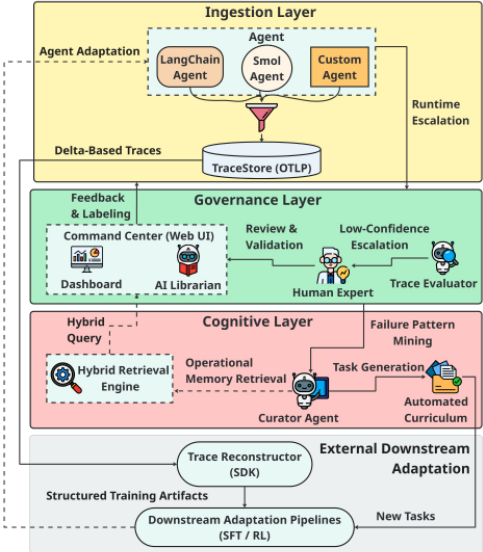
TraceBrain organizes trace management through three layers (Figure 1): ingestion, governance, and cognitive adaptation.
3.1 Ingestion Layer: Structuring Execution
Agent frameworks such as LangChain [LangChain, 2026] and SmolAgents [Roucher et al., 2025] produce heterogeneous execution logs. The Ingestion Layer standardizes these activities through a delta-based OpenTelemetry (OTLP) schema [OpenTelemetry Authors, 2026], recording incremental state updates rather than cumulative prompt histories. Conversational state is reconstructed on demand through hierarchical parent-child execution links. The TraceClient SDK provides consistent instrumentation across heterogeneous frameworks.
3.2 Governance Layer: Enabling Runtime Supervision
The TraceStore exposes runtime governance interfaces for:
- Runtime Intervention. TraceBrain supports runtime escalation for anomalous or unstable execution behaviors, enabling supervisory intervention beyond passive post-hoc debugging.
- Uncertainty-Driven Supervision. An internal LLMbased Trace Evaluator assigns confidence-aware evaluations to trajectories using previously validated expert feedback. Only low-confidence traces are escalated for human review, improving supervision efficiency.
3.3 Cognitive Layer: Supporting Trace-Driven Adaptation
The Cognitive Layer transforms stored traces into structured learning assets.
- Experience Retrieval. Successful trajectories are indexed through a hybrid semantic-lexical retrieval engine, enabling runtime retrieval of operational memory for retrieval-augmented adaptation [Lewis et al., 2020].
- Automated Curriculum. An LLM-based curator mines clustered failure patterns to synthesize structured remediation tasks inspired by curriculum learning [Bengio et al., 2009].
Curated traces and synthesized curricula are exportable in standardized formats (e.g., JSONL), enabling integration with downstream fine-tuning and evaluation pipelines.
4 SystemDemonstration and Evaluation
To demonstrate TraceBrain and evaluate its infrastructure scalability, we present a representative multi-agent scenario followed by quantitative system benchmarks. A demonstration video is available at https://youtu.be/rH3Nlsd4Ut8.
4.1 Scenario: Multi-Agent Coordination Failure
We demonstrate TraceBrain through a Collaborative Coding Environment implemented with LangChain [LangChain, 2026], featuring a Coder and a Reviewer agent. This scenario highlights TraceBrain's support for multi-agent observability.
Anomaly Detection and Semantic Diagnosis. During execution, the agents enter a cyclical negotiation loop caused by semantic misalignment. Using the TraceClient SDK, TraceBrain ingests these interactions through the delta-based schema, automatically flagging the trajectory as anomalous (internally categorized as logic loop). The Trace Explorer visualizes the interaction as a hierarchical execution graph for localizing divergence points.
Uncertainty-Driven Supervision andAdaptation. Due to low evaluator confidence, the trajectory is prioritized for human review. The Automated Curriculum engine then synthesizes the labeled failure into a targeted remediation task (e.g., "Multi-Agent Conflict Resolution"). Reconstructed trajectories can be exported as JSONL artifacts for downstream adaptation workflows.
4.2 SystemEvaluation
We conducted quantitative benchmarks to evaluate TraceBrain's infrastructure scalability and supervision performance. The key results are summarized in Table 2.
| Metric | Result & Impact |
|---|---|
| Storage Efficiency | Delta-based schema mitigates context explosion associated with naive cumulative logging. For a 200-step trajectory, storage dropped from 16.10 MB to 0.15 MB, achieving a ∼100× reduction. |
| Reconstruction | Backward traversal overhead is minimal. Rebuilding a 500-span trajectory context requires only 3.64 ms and 0.82 MB peak memory on the client side. |
| Ingestion vs. Retrieval | Hybrid indexing introduces write-time overhead (41.8 RPS under a throttled 20-concurrency load) while maintaining stable retrieval latency (median 96.9 ms, P95 122.6 ms) at 100k traces. |
| Labeling Efficiency | Evaluated on 75 complex traces from the TRAIL benchmark [Deshpande et al., 2025]. The LLM-based Trace Evaluator achieved an 89% automatic acceptance rate (> 0.8 confidence) and 0.93 priority precision, indicating strong potential for reducing human annotation workload. |
Table 2 demonstrates scalable retrieval and uncertaintydriven supervision with low storage overhead. The evaluator automatically processes routine trajectories while escalating severe anomalies for expert review.
5 Conclusion
We presented TraceBrain, an open-source infrastructure for trace-driven observability, supervision, and adaptation in autonomous LLM agents. TraceBrain introduces a delta-based OTLP schema that mitigates context explosion caused by cumulative prompt logging, while supporting uncertaintydriven supervision and retrieval-driven adaptation using historical execution traces. Empirical evaluations demonstrate substantial reductions in storage overhead together with scalable hybrid retrieval, efficient uncertainty-aware supervision, and robust trajectory reconstruction. Future work will explore automated workflow mining and fine-grained error attribution across long-horizon execution trajectories.
Ethics Statement
TraceBrain may process sensitive operational data. The platform supports self-hosted deployment and trace sanitization to mitigate privacy risks.
Acknowledgements
This publication has emanated from research supported in part by a grant from Research Ireland under Grant number [12-RC-2289-P2] which is co-funded under the European Regional Development Fund. For the purpose of Open Access, the author has applied a CC BY public copyright licence to any Author Accepted Manuscript version arising from this submission.
Contribution Statement
Quy Minh Le and Oscar Cao contributed equally to this work. All authors contributed to the design, implementation, and writing of this paper.
@inproceedings{ijcai2026p975,
  title     = {TraceBrain: An Open-Source Framework for Agentic Trace Management},
  author    = {Le, Quy Minh and Cao, Oscar and Pham, Hoang Quoc Viet and Lam, Hoang Thanh and Nguyen, Hoang D.},
  booktitle = {Proceedings of the Thirty-Fifth International Joint Conference on
               Artificial Intelligence, {IJCAI-26}},
  publisher = {International Joint Conferences on Artificial Intelligence Organization},
  editor    = {Diego Calvanese},
  pages     = {8441--8444},
  year      = {2026},
  month     = {8},
  note      = {Demo Track},
  doi       = {10.24963/ijcai.2026/975},
  url       = {https://doi.org/10.24963/ijcai.2026/975},
}
TY - CPAPER TI - TraceBrain: An Open-Source Framework for Agentic Trace Management AU - Le, Quy Minh AU - Cao, Oscar AU - Pham, Hoang Quoc Viet AU - Lam, Hoang Thanh AU - Nguyen, Hoang D. T2 - Proceedings of the Thirty-Fifth International Joint Conference on Artificial Intelligence, IJCAI-26 PB - International Joint Conferences on Artificial Intelligence Organization PY - 2026 SP - 8441 EP - 8444 DO - 10.24963/ijcai.2026/975 UR - https://doi.org/10.24963/ijcai.2026/975 ER -Copied
Machine-readable versions of this paper, for tools and AI agents:





