
DeepLog: A Software Framework for Modular Neurosymbolic AI
Proceedings of the Thirty-Fifth International Joint Conference on Artificial Intelligence. Demo Track. Pages 8462-8465.
https://doi.org/10.24963/ijcai.2026/980
Keywords
- AI: Uncertainty in AI
- AI: Machine Learning
- AI: Knowledge Representation and Reasoning
Abstract
DeepLog is an operational neurosymbolic framework that unifies logic and deep learning within standard PyTorch workflows. While existing neurosymbolic systems focus on a particular paradigm and semantics, DeepLog serves as a universal backend that can emulate many systems in the neurosymbolic alphabet soup. By treating diverse neurosymbolic languages as high-level specifications, the DeepLog software automatically compiles them into optimized arithmetic circuits. This design lowers the barrier for machine learning practitioners by treating logic as composable modules, while providing neurosymbolic developers with a shared, high-performance basis for prototyping new integration strategies. The code is available here: https://github.com/ML-KULeuven/deeplog
- [Ahmed et al., 2022] Kareem Ahmed, Tao Li, Thy Ton, Quan Guo, Kai-Wei Chang, Parisa Kordjamshidi, Vivek Srikumar, Guy Van den Broeck, and Sameer Singh. Py- lon: A PyTorch framework for learning with constraints. In NeurIPS 2021 Competitions and Demonstrations Track, pages 319-324. PMLR, 2022.
- [Badreddine et al., 2022] Samy Badreddine, Artur d'Avila Garcez, Luciano Serafini, and Michael Spranger. Logic Tensor Networks. Artificial Intelligence, 303:103649, 2022.
- [Darwiche, 2011] Adnan Darwiche. Sdd: A new canonical representation of propositional knowledge bases. In IJCAI, pages 819-826. IJCAI/AAAI, 2011. IJCAI
- [De Smet and De Raedt, 2025] Lennert De Smet and Luc De Raedt. Defining neurosymbolic ai. arXiv preprint arXiv:2507.11127, 2025.
- [Derkinderen et al., 2026] Vincent Derkinderen, Robin Manhaeve, Rik Adriaensen, Lucas Van Praet, Lennert De Smet, Giuseppe Marra, and Luc De Raedt. The DeepLog Neurosymbolic Machine. arXiv preprint arXiv:2508.13697, 2026.
- [Garcez and Lamb, 2023] Artur d'Avila Garcez and Luis C Lamb. Neurosymbolic ai: The 3rd wave. Artificial Intelli- gence Review, 56(11):12387-12406, 2023.
- [Hitzler and Sarker, 2022] Pascal Hitzler and Md Kamruz- zaman Sarker, editors. Neuro-symbolic artificial intelli- gence: The state of the art, volume 342 of Frontiers in Artificial Intelligence and Applications. IOS press, 2022.
- [Maene et al., 2025] Jaron Maene, Vincent Derkinderen, and Pedro Zuidberg Dos Martires. KLay: Accelerating arith- metic circuits for neurosymbolic AI. In ICLR, 2025.
- [Manhaeve et al., 2018] Robin Manhaeve, Sebastijan Du- mančić, Angelika Kimmig, Thomas Demeester, and Luc De Raedt. DeepProbLog: Neural probabilistic logic pro- gramming. Advances in neural information processing systems, 31, 2018.
- [Marra et al., 2019] Giuseppe Marra, Francesco Giannini, Michelangelo Diligenti, and Marco Gori. LYRICS: A general interface layer to integrate logic inference and deep learning. In Joint European Conference on Machine Learning and Knowledge Discovery in Databases, pages 283-298. Springer, 2019.
- [Marra et al., 2024] Giuseppe Marra, Sebastijan Dumančić, Robin Manhaeve, and Luc De Raedt. From statistical re- lational to neurosymbolic artificial intelligence: A survey. Artificial Intelligence, 328:104062, 2024.
- [van Krieken et al., 2024] Emile van Krieken, Samy Badred- dine, Robin Manhaeve, and Eleonora Giunchiglia. Uller: A unified language for learning and reasoning. In Interna- tional Conference on Neural-Symbolic Learning and Rea- soning, pages 219-239. Springer, 2024.
- [Wang et al., 2024] Benjie Wang, Denis Mauá, Guy Van den Broeck, and YooJung Choi. A compositional atlas for al- gebraic circuits. Advances in Neural Information Process- ing Systems, 37:141318-141355, 2024.
- [Xu et al., 2018] Jingyi Xu, Zilu Zhang, Tal Friedman, Yitao Liang, and Guy Broeck. A semantic loss function for deep learning with symbolic knowledge. In International con- ference on machine learning, pages 5502-5511. PMLR, 2018.
- [Yang et al., 2020] Zhun Yang, Adam Ishay, and Joohyung Lee. NeurASP: Embracing neural networks into answer set programming. In Proceedings of the Twenty-Ninth International Joint Conference on Artificial Intelligence, pages 1755-1762, 2020. IJCAI
References were extracted automatically from the PDF and may contain errors.
Full text extracted automatically from the PDF; figures, tables and equations may differ. The PDF is the version of record.
1 Introduction
Neurosymbolic AI (NeSy) aims to combine deep learning with symbolic reasoning and representations [Hitzler and Sarker, 2022; Garcez and Lamb, 2023; Marra et al., 2024]. However, the current landscape resembles an "alphabet soup" of seemingly disconnected paradigms and frameworks. Several dimensions are commonly used to distinguish among these approaches, including the nature of their semantics (e.g., fuzzy or probabilistic), the integration paradigm (e.g., incorporation of symbolic representations into the loss function or the architecture of the machine learning model), and the type of symbolic front-end employed (e.g., first-order logic or logic programming). Because these differences are often treated as fundamental rather than alternative instantiations, new approaches are generally pursued within noninteroperable frameworks. As a result, no cross-paradigm software tool has yet emerged, slowing systematic comparison and cumulative progress in the field.
To address this gap, we contribute and demo the DeepLog software that provides building blocks and primitives for neurosymbolic AI, enabling abstraction over commonly used representations and computational mechanisms. It is based on the DeepLog abstract neurosymbolic machine defined in [Derkinderen et al., 2026], and can be used to easily implement, reconstruct and compare a wide range of neurosymbolic systems. To this end, it consolidates essential components from the existing "alphabet soup" of approaches and offers the necessary primitives for designing new ones.
The DeepLog software exploits modern deep learning softand hardware. First, it extends standard PyTorch modules with symbolic annotations on their inputs and outputs, based on formulas expressed in the DeepLog language [Derkinderen et al., 2026], enabling the software to manage composition and integration automatically. Second, it does not only use GPU-acceleration for neural modules, but also for its symbolic components. Most other neurosymbolic AI systems implement their symbolic component on the CPU, which not only degrades performance due to data transfer and synchronization, but also introduces additional complications for debugging, and potential errors in terms of what data is on what device.
While most existing NeSy systems adopt a monolithic design encompassing model specification, data handling, and training, DeepLog is designed to be modular and nonintrusive. Rather than replacing established machine learning workflows, it can be integrated selectively into existing pipelines. This design choice lowers the barrier to entry for machine learning practitioners interested in neurosymbolic AI, while simultaneously providing framework developers with a flexible basis for prototyping new ideas without sacrificing performance.
The main contribution of this work is an implementation of DeepLog, an abstract neurosymbolic machine, that
- allows us to reconstruct any member of the alphabet soup with minimal code,
- provides out-of-the-box GPU acceleration,
- provides modularity as automatic module compositions,
- integrates with modern ML software (PyTorch).
2 Bridging Paradigms
The integration of neurosymbolic systems remains largely an open challenge, with only a few approaches explicitly aiming at unification. Most of them focus on the uniform encoding of multiple types of semantics, such as LYRICS [Marra et al., 2019] and Pylon [Ahmed et al., 2022]. However, these frameworks are usually limited to a specific neurosymbolic paradigm, most often semantic-based regularization, where logical constraints are added as loss terms during training. In addition, they rely on a single front-end representation, which limits their use across the broader neurosymbolic landscape. More recent work, such as ULLER [van Krieken et al., 2024], attempts to overcome this limitation by introducing a unified language that can express a wide range of neurosymbolic specifications. However, this unification mainly takes place at the high-level front-end layer. At present, no public implementation is available, so its practical usefulness is still unclear. Moreover, because the unification is restricted to the front-end, it has a strong impact on user interaction, as different research communities prioritize different syntactic structures and modeling abstractions.
3 DeepLog for ML Practitioners
This section introduces DeepLog from the perspective of machine learning practitioners who wish to integrate symbolic reasoning into existing PyTorch-based workflows. The central idea is that symbolic information attached to module interfaces enables automatic composition, validation, and transformation of neurosymbolic components, while remaining compatible with standard deep learning practices.
3.1 Module Composition
Neurosymbolic models are typically constructed by composing heterogeneous components, such as neural network predictors, logical functions or constraints. Each of these components assumes that its inputs represent specific semantic quantities, for example Boolean values, probabilities, or continuous fuzzy scores. In practice, these assumptions are rarely made explicit, leading to fragile compositions and error-prone glue code. DeepLog addresses this through DeepLogModules, which are standard PyTorch modules augmented with symbolic annotations on their inputs and outputs. These annotations specify the semantic role of each tensor and are represented using (tuples of) SymTensors: Ndimensional tensors whose entries are associated with symbolic expressions.
These symbolic interfaces allow DeepLog to automatically compose modules. When chaining two modules, DeepLog automatically derives and inserts the necessary GPU-accelerated transformations between them. The annotations also enable run-time validation of module interfaces, ensuring that inputs and outputs satisfy the expected symbolic structure, significantly improving debuggability.
DeepLog supports two primary composition patterns. First, modules can be composed sequentially, analogous to torch.nn.Sequential, where the output of one module feeds directly into the next. Second, when a collection of modules forms a directed acyclic graph based on their symbolic input-output dependencies, DeepLog can automatically wire the full computation graph, including all required intermediate transformations. By leveraging PyTorch's asynchronous execution model, this approach maximizes parallelism and GPU utilization.
Example 1 (Semantic loss from a DIMACS constraint). We demonstrate semantic loss [Xu et al., 2018] using a logical constraint loaded from a DIMACS CNF specification. Assume a classifier produces probabilities for classes {A,B,C}, and domain knowledge enforces a hierarchy: A ⇒ B and C ⇒ B. This constraint is encoded once as a Boolean CNF and reused independently of the neural model.
dimacs = """ p cnf 3 2 -1 2 0 c A -> B -3 2 0 c C -> B """ phi = parse_dimacs_to_module(dimacs, structure='probability') expected = SymTensor(["A_p","B_p","C_p"]) phi = reshape_input(phi, expected)Phi is a PyTorch module that now fits into a normal training loop:
...
semantic_loss = -(phi(y_pred).log()).mean() loss = classification_loss + semantic_loss3.2 GPU-Accelerated Circuits
A second key component of DeepLog is its use of GPUaccelerated circuits for evaluating Boolean formulas, probabilistic expressions, and related symbolic computations. These circuits provide an efficient inference structure for reasoning tasks that would otherwise be executed on the CPU, creating a performance bottleneck in hybrid systems. In DeepLog, we rely on the KLay [Maene et al., 2025] package for efficient circuit evaluation; comparative performance results are summarized in Table 1. To enforce structural properties such as determinism or decomposability, DeepLog targets specialized circuit backends, including representations based on sentential decision diagrams [Darwiche, 2011].
4 DeepLog as a Backend Architecture for NeSy Systems
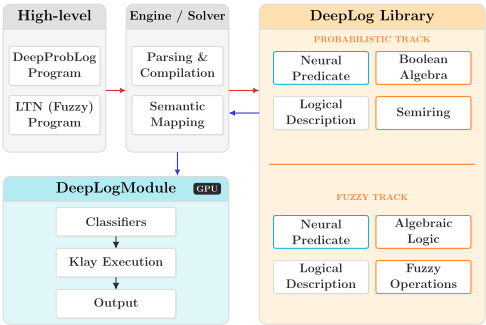
Different NeSy systems appear fundamentally different, yet in practice they all execute the same pipeline: enumerate symbolic structures, attach neural scores, and aggregate them. This duplication obscures real design trade-offs and leads to CPU-bound, hard-to-optimize implementations. At a semantic level, inference in virtually all NeSy systems reduces to evaluating a single formula [De Smet and De Raedt, 2025]. Apparent differences arise from how this formula is calculated, not from what is computed. The DeepLog abstract machine [Derkinderen et al., 2026] was introduced to make this computation explicit. It serves as a semantic intermediate representation and abstract machine target for NeSy systems, separating front-end symbolic languages from back-end execution strategies.
| Inference time [s/query] | |||
|---|---|---|---|
| Digits | DPL CPU | DeepLog CPU | DeepLog GPU |
| 1 | 6.14×10⁻³ | 1.09×10⁻⁵ | 5.62×10⁻⁷ |
| 2 | 3.52×10⁻² | 4.13×10⁻⁵ | 1.52×10⁻⁶ |
| 3 | 1.32×10⁻¹ | 2.43×10⁻³ | 1.52×10⁻⁴ |
| 4 | - | 1.96×10⁻¹ | 5.40×10⁻² |
Languages such as DeepProbLog [Manhaeve et al., 2018] and NeurASP [Yang et al., 2020] use a Prolog- and ASPlike language, respectively. The base languages are lifted to the NeSy level through inclusion of the neural predicate, which parameterizes the probability of each model of the logic. Such a system would be implemented by first gathering proofs from a solver or engine. These proofs, whose symbolic information is backed by neural networks that provide their probabilities, are then used to calculate the probability of the query. While this process can be optimized (cf. knowledge compilation), without careful design the inference is typically still CPU-bound.
In DeepLog, the process is closer to Figure 1. The solver or engine does not construct a proof, but instead calls methods from a factory object in the DeepLog library, which immediately returns an instantiation of a DeepLog module. This factory can be configured to rely on certain components, or on techniques of choice (e.g. circuits versus sampling based approaches).
ltn_fuzzy = { 'not': lambda x: 1 - x, 'and': lambda x, y: x * y, ... } exists = AggregationModule(name='exists', op=lambda x: p_mean(x, 6) ... class EqualityPredicate(Predicate): functor, arity = 'eq', 2 structure = 'fuzzy' def forward_predicate(self, x, y): return (-(x - y).norm(dim=1)).exp()These can now be combined into a single factory object, with a one-to-one mapping from LTN concepts to factory methods:
ltn = DeepLogModuleFactory( structures = {'fuzzy': ltn_fuzzy}, aggregators = {'exists': exists, ...}, ... predicates = [EqualityPredicate], ) Not = lambda x: ltn.unary_node('not', x) Or = lambda x,y: ltn.binary_node('pr', x, y) ...This configurability of the DeepLog backend allows us to easily digest the NeSy alphabet soup, as we can easily substitute probabilistic logic with fuzzy logic, and more generally compare inference techniques while keeping the remainder fixed.
5 Conclusion and FutureWork
We introduced DeepLog, an operational framework that serves as a neurosymbolic abstract machine bridging symbolic reasoning and deep learning within standard PyTorch workflows. By separating semantic specification from operational realization, DeepLog enables automatic composition, validation, and efficient execution of neurosymbolic models on modern accelerators. Through symbolically annotated modules, a semantic intermediate language, and a compilerstyle factory, the framework supports both ML practitioners seeking lightweight integration of symbolic constraints and NeSy developers building new languages and inference paradigms on a shared backend.
Several directions for future work remain. A primary focus is the automation of more aggressive circuit-level optimizations. While DeepLog already supports multiple compilation strategies and circuit backends, we aim to incorporate systematic optimization techniques [Wang et al., 2024], including structure-aware rewritings, fusion of aggregation and inference, and others. Automating such transformations would further reduce manual engineering effort while improving performance and scalability. Beyond circuit optimization, future work includes providing alternative inference mechanisms such as sampling.
Acknowledgements
This work project has received funding from the European Research Council (ERC) under the European Union's Horizon 2020 research and innovation programme (Grant agreement No. 101142702), the Flemish Government under the "Onderzoeksprogramma Artifici¨ele Intelligentie (AI) Vlaanderen" programme and the Research Foundation-Flanders FWO (GA No. G047124N).
@inproceedings{ijcai2026p980,
  title     = {DeepLog: A Software Framework for Modular Neurosymbolic AI},
  author    = {Manhaeve, Robin and Colamonaco, Stefano and Derkinderen, Vincent and Adriaensen, Rik and Van Praet, Lucas and de Raedt, Luc and Marra, Giuseppe},
  booktitle = {Proceedings of the Thirty-Fifth International Joint Conference on
               Artificial Intelligence, {IJCAI-26}},
  publisher = {International Joint Conferences on Artificial Intelligence Organization},
  editor    = {Diego Calvanese},
  pages     = {8462--8465},
  year      = {2026},
  month     = {8},
  note      = {Demo Track},
  doi       = {10.24963/ijcai.2026/980},
  url       = {https://doi.org/10.24963/ijcai.2026/980},
}
TY - CPAPER TI - DeepLog: A Software Framework for Modular Neurosymbolic AI AU - Manhaeve, Robin AU - Colamonaco, Stefano AU - Derkinderen, Vincent AU - Adriaensen, Rik AU - Van Praet, Lucas AU - de Raedt, Luc AU - Marra, Giuseppe T2 - Proceedings of the Thirty-Fifth International Joint Conference on Artificial Intelligence, IJCAI-26 PB - International Joint Conferences on Artificial Intelligence Organization PY - 2026 SP - 8462 EP - 8465 DO - 10.24963/ijcai.2026/980 UR - https://doi.org/10.24963/ijcai.2026/980 ER -Copied
Machine-readable versions of this paper, for tools and AI agents:





