
Goal Recognition Design - Survey
Proceedings of the Twenty-Ninth International Joint Conference on Artificial Intelligence. Survey track. Pages 4847-4853.
https://doi.org/10.24963/ijcai.2020/675
Keywords
- Planning and Scheduling: general
- Agent-based and Multi-agent Systems: general
Abstract
Goal recognition is the task of recognizing the objective of agents based on online observations of their behavior. Goal recognition design (GRD), the focus of this survey, facilitates goal recognition by the analysis and redesign of goal recognition models. In a nutshell, given a model of a domain and a set of possible goals, a solution to a GRD problem determines: (1) to what extent do actions performed by an agent reveal the agent’s objective? and (2) what is the best way to modify the model so that the objective of an agent can be detected as early as possible? GRD answers these questions by offering a solution for assessing and minimizing the maximal progress of any agent before recognition is guaranteed. This approach is relevant to any domain in which efficient goal recognition is essential and in which the model can be redesigned. Applications include intrusion detection, assisted cognition, computer games, and human-robot collaboration. This survey presents the solutions developed for evaluation and optimization in the GRD context, a discussion on the use of GRD in a variety of real-world applications, and suggestions of possible future avenues of GRD research.
- [Albrecht and Stone, 2018] S.V. Albrecht and P. Stone. Au- tonomous agents modelling other agents: A comprehensive sur- vey and open problems. Artificial Intelligence, 258:66-95, 2018.
- [Ang et al., 2017] S. Ang, H. Chan, A.X. Jiang, and W. Yeoh. Game-theoretic goal recognition models with applications to se- curity domains. In GameSec, 2017.
- [Bisson et al., 2011] F. Bisson, F. Kabanza, A.R. Benaskeur, and H. Irandoust. Provoking opponents to facilitate the recognition of their intentions. In AAAI, 2011.
- [Carberry, 2001] S. Carberry. Technique for plan recognition. User Modeling and User-Adapted Interaction, 2001.
- [Chakraborti et al., 2017] T. Chakraborti, S. Sreedharan, Y. Zhang, and S. Kambhampati. Plan explanations as model reconciliation: Moving beyond explanation as soliloquy. In IJCAI, 2017. IJCAI
- [Chakraborti et al., 2019] T. Chakraborti, A. Kulkarni, S. Sreedha- ran, D.E. Smith, and S. Kambhampati. Explicability? legibility? predictability? transparency? privacy? security? the emerging landscape of interpretable agent behavior. In ICAPS, 2019.
- [Freedman and Zilberstein, 2017] R.G. Freedman and S. Zilber- stein. Integration of planning with recognition for responsive interaction using classical planners. In AAAI, 2017.
- [Geffner and Bonet, 2013] H. Geffner and B. Bonet. A concise in- troduction to models and methods for automated planning. Syn- thesis Lectures on AI and ML, Morgan & Claypool Publishers, 2013.
- [Ha et al., 2011] E. Ha, J. P. Rowe, B. W. Mott, and J.C. Lester. Goal recognition with Markov logic networks for player-adaptive games. In AIIDE, 2011.
- [Harman and Simoens, 2019] H. Harman and P. Simoens. Ac- tion graphs for performing goal recognition design on human- inhabited environments. Sensors, 19(12):2741, 2019.
- [Jarvis et al., 2004] P. A. Jarvis, T. F. Lunt, and K. L. Myers. Iden- tifying terrorist activity with AI plan recognition technology. In IAAI, 2004.
- [Kabanza et al., 2010] F. Kabanza, P. Bellefeuille, F. Bisson, A.R. Benaskeur, and H. Irandoust. Opponent behaviour recognition for real-time strategy games. In PAIR, 2010.
- [Kautz, 1987] H. A. Kautz. A Formal Theory of Plan Recognition. PhD thesis, Bell Laboratories, 1987.
- [Keren et al., 2014] S. Keren, A. Gal, and E. Karpas. Goal recog- nition design. In ICAPS, 2014.
- [Keren et al., 2015] S. Keren, A. Gal, and E. Karpas. Goal recog- nition design for non-optimal agents. In AAAI, 2015.
- [Keren et al., 2016a] S. Keren, A. Gal, and E. Karpas. Goal recog- nition design with non-observable actions. In AAAI, 2016.
- [Keren et al., 2016b] S. Keren, A. Gal, and E. Karpas. Privacy pre- serving plans in partially observable environments. In IJCAI, 2016.
- [Keren et al., 2018] S. Keren, A. Gal, and E. Karpas. Strong stub- born sets for efficient goal recognition design. In ICAPS, 2018.
- [Keren et al., 2019] S. Keren, A. Gal, and E. Karpas. Goal recog- nition design in deterministic environments. Journal of Artificial Intelligence Research, 65:209-269, 2019.
- [Keren et al., 2020] S. Keren, H. Xu, K. Kwapong, D. C. Parkes, and B. Grosz. Information shaping for enhanced goal recognition of partially-informed agents. In AAAI, 2020.
- [Kulkarni et al., 2019a] A. Kulkarni, S. Sreedharan, S. Keren, T. Chakraborti, D. E. Smith, and S. Kambhampati. Design for interpretability. In XAIP-ICAPS, 2019.
- [Kulkarni et al., 2019b] A. Kulkarni, S. Srivastava, and S. Kamb- hampati. A unified framework for planning in adversarial and cooperative environments. In AAAI, 2019.
- [Levine and Williams, 2018] S. J. Levine and B. C. Williams. Watching and acting together: concurrent plan recognition and adaptation for human-robot teams. Journal of Artificial Intelli- gence Research, 63:281-359, 2018.
- [MacNally et al., 2018] A. MacNally, N. Lipovetzky, M. Ramirez, and A. Pearce. Action selection for transparent planning. In AAMAS, 2018.
- [Masters and Sardina, 2017] P. Masters and S. Sardina. Cost-based goal recognition for path-planning. In AAMAS, 2017.
- [Masters and Sardina, 2019] P. Masters and S. Sardina. Cost-based goal recognition in navigational domains. Journal of Artificial Intelligence Research, 64:197-242, 2019.
- [Mirsky et al., 2018] R. Mirsky, R. Stern, K. Gal, and M. Kalech. Sequential plan recognition: An iterative approach to disam- biguating between hypotheses. Artificial Intelligence, 260:51-73, 2018.
- [Mirsky et al., 2019] R. Mirsky, K. Gal, R. Stern, and M. Kalech. Goal and plan recognition design for plan libraries. ACM Trans- actions on Intelligent Systems and Technology, 2019.
- [Pereira et al., 2017] R. F. Pereira, N. Oren, and F. Meneguzzi. Landmark-based heuristics for goal recognition. In AAAI, 2017.
- [Ramirez and Geffner, 2010] M. Ramirez and H. Geffner. Proba- bilistic plan recognition using off-the-shelf classical planners. In AAAI, 2010.
- [Shoham and Tennenholtz, 1995] Y. Shoham and M. Tennenholtz. On social laws for artificial agent societies: Off-line design. Ar- tificial Intelligence, 1995.
- [Shvo and McIlraith, 2020] M. Shvo and S. A. McIlraith. Active Goal Recognition. In AAAI, 2020.
- [Son et al., 2016] T.C. Son, O. Sabuncu, C. Schulz-Hanke, T. Schaub, and W. Yeoh. Solving goal recognition design using ASP. In AAAI, 2016.
- [Sukthankar et al., 2014] G. Sukthankar, C. Geib, H. H. Bui, D. Py- nadath, and R. P. Goldman. Plan, activity, and intent recognition: Theory and practice. Newnes, 2014.
- [Vered and Kaminka, 2017] M. Vered and G. A. Kaminka. Heuris- tic online goal recognition in continuous domains. In IJCAI, 2017. IJCAI
- [Wayllace et al., 2016] C. Wayllace, P. Hou, W. Yeoh, and T. C. Son. Goal recognition design with stochastic agent action out- comes. In IJCAI, 2016.
- [Wayllace et al., 2017] C. Wayllace, P. Hou, and W. Yeoh. New metrics and algorithms for stochastic goal recognition design problems. In IJCAI, 2017. IJCAI
- [Wayllace et al., 2020] C. Wayllace, S. Keren, W. Yeoh, A. Gal, and E. Karpas. Accounting for partial observability in stochastic goal recognition design: Messing with the marauder's map. In ECAI, 2020.
- [Zhang et al., 2009] H. Zhang, Y. Chen, and D.C. Parkes. A general approach to environment design with one agent. In IJCAI, 2009.
References were extracted automatically from the PDF and may contain errors.
Full text extracted automatically from the PDF; figures, tables and equations may differ. The PDF is the version of record.
1 Introduction and Overview
Goal recognition design (GRD) involves the analysis and redesign of goal recognition settings in order to enhance the ability to recognize the goals of agents that are operating in some environment. As such, GRD extends the task of goal recognition [Kautz, 1987; Carberry, 2001; Ramirez and Geffner, 2010; Sukthankar et al., 2014; Vered and Kaminka, 2017; Pereira et al., 2017], which aims at discovering the goals of agents based on observations of their behavior collected online, by allowing design changes to the goal recognition setting.
This line of research is motivated by applications in various domains, from urban transportation to medical informatics, which require systems to automatically and rapidly analyze agents' behavior, identify their goals, and then help them reach (or, depending on the application, prevent them from reaching) those goals. Potential applications include intrusion detection [Jarvis et al., 2004], computer games [Ha et al., 2011], and human-robot collaboration [Levine and Williams, 2018; Freedman and Zilberstein, 2017; Albrecht and Stone, 2018]. Such applications make use of recent developments in data science, which offers efficient and effective tools for gathering, managing, analyzing, and visualizing big amounts of data in order to observe and predict the intentions of agents. GRD supports rapid goal recognition whenever the model design of the application can be controlled.
∗Contact Author
A GRD problem includes a description of a goal recognition setting with a set of possible goals and a description of the available ways to modify the system. The GRD analysis consists of two main stages, namely evaluation and optimization. In the evaluation stage, we assess to what extent the goal of an agent acting in the system may remain unrecognized, while the optimization stage consists of finding the best way to modify the system so as to facilitate recognition.
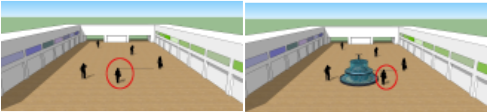
(b) Modified GRD Environment two possible exit points, marked as 'G0' (boarding gates for domestic flights) and 'G1' (international flights). Agents can move vertically or horizontally from 'Start' to either of these goals (see Figure 1c). Assuming agents behave optimally and are unaware or agnostic to their behavior being monitored, for each goal there are several possible paths (a subset of possible paths is marked by dashed lines in Figure 1c). As illustrated, paths to different goals may share a common prefix. In this model, an agent's goal becomes clear once turning left or right.
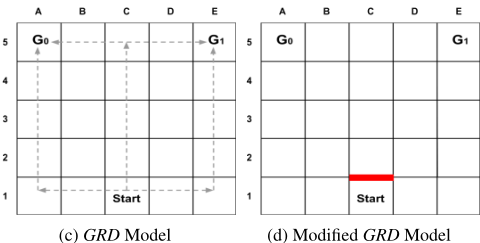
Example 1 A simple GRD problem is presented in Figure 1, positioned in the context of airport security. The model consists of a simple room with a single entry point ('Start') and
GRD introduces measures of model quality in terms of goal recognition. In this example, worst case distinctiveness (WCD) examines how long an agent can operate in a model without its 1 goal being identified by an observer; the longer it takes to reveal the agent's goal, the worse is the model. In Figure 1a, for example, the circled user can walk all the way up to the opposite side of the terminal (four steps in Figure 1c) before revealing her true intention.
Once the quality of a model is defined, it can be improved. Towards this end, means of model modification are defined. An example of a change to a model is through restrictions on the set of available actions an agent can perform. To maintain user comfort, a GRD solution may be required to preserve the original solution cost for all goals. In addition, we may wish to attain maximal achievable improvement while minimizing introduced changes and respecting any design constraints that may be specified. To illustrate, assume now that airport managers can place barriers in the terminal to control the flow of passengers (a common and effective solution for passenger control), but also wish to minimize obstruction to the ease of use of the terminal. Figures 1b and 1d present a solution to a GRD problem, where a single modification (adding a fountain at the room entrance) reduces WCD from 4 to 0 without increasing the minimal cost to any of the goals.
The ideas presented above can be applied to a variety of goal recognition settings. For example, consider a smart home in which the activity of a user with a physical or mental disability is tracked so as to help the user perform daily activities and avoid hazards. In such a setting, the environment may need to be redesigned (e.g., by furniture repositioning) so that a goal recognition system can detect dangerous situations as early as possible (e.g., approaching a hot oven).
The initial work on GRD [Keren et al., 2014] (and the example above) puts forward a model based on three simplifying assumptions, namely that the environment is fully observable both to the goal recognition system and to the acting agents; that the outcomes of agent actions are deterministic; and that agents, who are agnostic to the goal recognition system, act optimally. The model is modified by disallowing (removing) actions from the set of applicable actions. Several extensions have since been suggested to this basic setting. The objective of this survey is to describe the components that comprise a GRD problem, against which we describe the different extensions that have been suggested in the literature since the first GRD setting was introduced.
GRD, with its emphasis on analysis and redesign of goal recognition models, is closely related to and complements goal recognition research efforts, where the objective is to recognize goals (or plans for plan recognition) of agents on the basis of their observed behavior [Sukthankar et al., 2014]. Commonalities, as well as differences, have been highlighted in multiple discussions at the PAIR (Plan, Activity, and Intent Recognition) workshop series. 2 However related, GRD is a different task. While goal recognition aims at discovering the goals of an agent by analyzing a specific observation sequence, GRD analyzes the goal recognition setting, offering a solution to facilitate online recognition by allowing early detection of an agent's goal.
1 Agents are referred to as she, he, and it interchangeably, depending on the context.
GRD is also related and complements a variety of recent lines of work on explainable and privacy preserving AI that consider settings where observers aim at recognizing the goals and plans of agents, while agents can choose to behave in a way that either explains or obfuscates their intentions [MacNally et al., 2018; Chakraborti et al., 2017; Chakraborti et al., 2019; Kulkarni et al., 2019b]. The GRD framework suggests a third and possibly complementary approach, where the ability to perform goal recognition is controlled by the design of the goal recognition setting.
The specific use of GRD tools depends on the analyzed setting and the relationship between the agents within it. If acting agents (actors) are agnostic or unaware of the recognition process, as in our depicted example, their behavior is unaffected by the observer's presence. In adversarial settings, GRD can be used to support early goal recognition of attackers by an observing agent or goal recognition system [Kabanza et al., 2010; Keren et al., 2015; Masters and Sardina, 2017]. In addition, Keren et al. (2016b) show that privacy-preserving actors can use GRD tools to identify plans that lead to their destination while keeping their goal ambiguous as long as possible. Even in collaborative settings, minimizing WCD guarantees a bound on the number of observations that need to be collected before recognition is achieved, thus reducing the need to generate explanations or incur the costs of performing expensive behaviors that align with the observer's expectations [MacNally et al., 2018; Kulkarni et al., 2019a].
In the rest of this survey, we provide a description of the main components of a GRD model (Section 2), and then dive into the GRD extensions that have been developed to account for different variations of the three components, namely environment dynamics (Section 3), actor types (Section 4), and observer's sensor models (Section 5). We conclude with a discussion of approaches to (re)design (Section 6) and outlook on future directions and challenges (Section 7). Table 1 lists the GRD models presented so far in the literature.
2 Components of a GRD Problem
A GRD problem has two main components; the analyzed goal recognition setting (Section 2.1), and a design model specifying possible ways to modify the goal recognition setting (Section 2.2).
2.1 Goal Recognition
There are multiple ways to define goal recognition in the literature [Carberry, 2001; Sukthankar et al., 2014; Ramirez and Geffner, 2010; Vered and Kaminka, 2017]. This task typically includes the analysis of a specific observation sequence to be mapped to a set of possible goals the agent may be trying to achieve. This is one of the major differences from GRD, which needs to account for all possible sequences that may be observed. Accordingly, the GRD analysis needs to consider all aspects of the recognition setting that may affect goal recognition. To facilitate this analysis, we divide a goal recognition model R into three main elements, namely the environment, the actor, and the observer. This division applies to most goal recognition models even though the actual representation formalism used to describe them may vary.
The environment describes the dynamics of the setting in which agents act, including all aspects of the model that dictate the possible behaviors of agents within it. It is common to use a compact, rather than explicit, representation of possible agent behaviors, including the set of possible goals G, the initial state I, and the set of actions A that may be executed by an agent. For deterministic settings, agent behavior is described by a plan π, which is a sequence of actions from the initial state to some goal, and pre(π) represents a plan's prefix. For non-deterministic settings, a policy π, which is a mapping from states to actions, is used instead. A policy prefix is a policy defined only for states that are reachable from the start state [Wayllace et al., 2016]. While most work on GRD so far uses planning domain theories [Geffner and Bonet, 2013] to represent the environment, Mirsky et al. 2019 use plan libraries to represent agent behavior.
Given the set of possible policies (or plans) to a goal, the actor component describes the set Πleg (g) ⊆ Π(g) of legal policies, the policies actors may choose to execute in order to achieve goal g. These policies are those allowed under assumptions about the behavior of actors in the system and about how they choose which action to execute at each stage.
There are various factors that affect an actor's decision on how to behave, including its familiarity with the environment (possibly reflected by its sensor model), its capabilities and preferences (e.g., can the actor compute an optimal plan?), its relationship to the recognizer (e.g., is it aware of its presence?), and more. For example, assuming actors are optimal, the set of legal plans are those that minimize the cost to a goal in a deterministic environment, and the set of policies that minimize the expected cost to a goal in a stochastic environment.
The observer models the way actors and their actions are perceived. The observer component can represent a passive recognition system or another agent that may be active in the system, aiming to interpret the actors' behavior. Either way, the GRD analysis focuses on the goal recognition task, and the observability as considered here describes how the activity of an actor is perceived by the observer, independently of how the actors perceive the environment.
The observer's sensor model S maps an execution sequence to an observation sequence ⃗o that may be emitted when performed by an actor. The simplest sensor model corresponds to the fully observable setting, where the observer can sense actions and state transitions. More generally, a sensor model may reflect partial and noisy sensing where an execution may emit different observation sequences and probabilities that may be associated with each observation. The set ⃗O of possible observation sequences and their associated probabilities are therefore induced by the sensor model S and the set of legal plans Πleg (G).
Given a goal recognition model and its sensor model, each sequence of actions is associated with (mapped to) a set of goals satisfied by its emitted observations. Typically, a goal can be recognized when the behavior of an actor becomes distinctive, i.e., it can be associated with a single goal.
2.2 DesignModel
The available ways to modify a goal recognition model and the different constraints that may be imposed on the design process vary among applications and settings. For example, disallowing actions correspond to removing actions from the action set. Other modifications were proposed in the literature, including sensor refinement [Keren et al., 2019; Wayllace et al., 2020], applied in partially observable settings, which is expressed as a change in the recognition system's sensor model.
We present next a generic model to support arbitrary modifications. Given a set of goal recognition models R, the design model describes the modifications that can be applied to a goal recognition model R ∈ R and the design objective.
Definition 1 A design model D = 〈M, δ, φ, U〉 is a quadruple where:
- M is a finite set of atomic modifications a system can apply. A modification sequence is an ordered set of modifications ⃗m = 〈m1, . . . ,mn〉 s.t. mi ∈ M and ⃗M is the set of all such sequences.
- δ : M×R→R is a deterministic modification transition function, specifying the goal recognition model that results from applying a modification to a goal recognition model.
- φ : ⃗M× R → {0, 1} is a constraint indicator that specifies the modification sequences that can be applied to a goal recognition model, and
- U : R → R is a score used to assess a goal recognition model.
Each modification m ∈ M can be associated with a design cost CD(m), and the cost of a sequence is the aggregated cost of its components (CD(⃗m) = ∑ni=1 CD(mi)).
The constraint indicator φ imposes the set of modifications that are applicable in a goal recognition model R. We represent this set as appφ(R) = {m ∈ M | φ(m, R) = 1}. A constraint function may, for example, impose a design budget, limiting the cost (or number) of allowed modifications. With the objective of maintaining usability, one can also bound the increase in optimal costs to the goals in the modified setting. Specifically, one may require the redesign process to leave the optimal cost for plans to all goals unchanged.
The final component of the design model is the measure U used to assess how well goal recognition can be performed in a given model. This measure can vary between applications and settings. In our running example, we described the worst case distinctiveness (WCD) measure, first presented by Keren et al. (2014), which represents the maximal cost of a nondistinctive path, which is a path an agent can follow without revealing its goal. Additional measures were presented in the literature and will be discussed below.
2.3 GRD ProblemDefinition
Given a goal recognition model and a design model, a GRDmodel is defined as follows:
Definition 2 A goal recognition design (GRD) model is given by the pair T = 〈R0, D〉 where
- R0 is an initial goal recognition model, and
- D is the design model
The design model D imposes a set RT ⊆ R of goal recognition models reachable from the initial model R0 by applying a valid modification sequence. Using a GRD model, the GRD problem aims at identifying a sequence of modifications that maximize the design objective while complying with the design constraints.
3 Environment Dynamics Overview
The initial GRD model [Keren et al., 2014] is based on the assumption that action outcomes are deterministic. Therefore, when an actor transitions between states, it is assumed that it was the actor's intention for this transition to occur. In many realistic settings, however, this assumption does not hold, and the recognizer needs to account for the environment dynamics to be able to infer the actor's intentions.
In the running example, when an optimal actor is observed moving to the right of the initial state and assuming a deterministic environment, the actor's goal can be inferred to be the goal on the right. Blocking the ability to move straight ahead from the initial state is sufficient to minimize WCD. However, if the environment is stochastic such that the actor ends up in its intended cell only with 80% probability, with the remaining 20% randomly distributed among adjacent cells, a move to the right no longer guarantees that the actor's goal is revealed.
To account for such settings, Wayllace et al. (2017) extended GRD to support stochastic agent actions. Instead of minimizing the maximal non-distinctive path, Stochastic GRD (S-GRD) accounts for probabilistic behaviors by computing the maximal expected cost an actor may incur before its goal is revealed. Accordingly, WCD of an S-GRD model represents the largest expected cost incurred by the agent over all non-distinctive policy prefixes. In addition, since the WCD definition makes the implicit assumption that all goals have equal prior likelihood, Wayllace et al. (2017) formulate the expected-case distinctiveness (ECD) measure that weighs the possible goals based on their prior likelihood of being the true goal.
In terms of design, environment modifications that have been examined so far include disallowing actions [Keren et al., 2014; Wayllace et al., 2017], as demonstrated in our example. Keren et al. (2018; 2019) support action conditioning, a more general design option that can be used to induce a partial order among actions. Similarly, Mirsky et al. (2019) remove rules from the grammar that represents the actor's planning domain, effectively changing the preconditions and effects of actions in the model.
4 Actor Types Overview
Our discussion thus far assumed that both actor and observer have full observability and full knowledge about the environment. This section describes work that considered cases where the actor is only partially informed and may be suboptimal. Considering cases where the observer may be partially informed is discussed in the next section.
The first account of sub-optimal actors was by Keren et al. (2015), where actors are bounded sub-optimal, with a bound by which they can divert from optimal behavior. According to this model, actors behave sub-optimally either na¨ıvely, by following any plan within the specified bound, or intentionally, by following prefixes of optimal plans to other goals, thus obfuscating their true goal as far as possible within the cost bound. In our example, actors aiming at G0 can conceal their objective with a diversion bound of 4 actions by following an optimal path to G1 (moving right two steps and then up to G1), revealing their true goal only after reaching G1. Consequently, the design solution suggested in Figure 1 cannot guarantee WCD minimization. The optimal design solution for this case would require creating a longer barrier.
Keren et al. (2016b) show that the same WCD measure and the tools used for its computation can become handy to privacy-preserving actors to understand how to behave in order to obfuscate their goals. Other lines of work considered other forms of adversarial or privacy-preserving actors that try to conceal their objective. Ang et al. (2017) support a game-theoretic version of GRD, in which a recognition system can alter the environment to facilitate the early detection of attacks by strategic adversarial agents that obfuscate their targets. An adversarial GRD setting was also suggested by Bisson et al. (2011) where it is possible to dynamically set the value of environment features in order to provoke an opponent to behave in a way that reveals her intention. Masters and Sardina (2017; 2019) consider adversarial agents in continuous path planning domains. While their work does not discuss design per-se, it offers an offline analysis of goal recognition settings by creating a probabilistic heatmap that includes the probabilities of each goal at every step in the actor's grid. This heatmap finds the Radius of Maximum Probability (RMP), the radius within which a goal is guaranteed to be the most probable. This framework allows the actor to find a path such that the probability of an observer identifying its final destination before it has been reached, is minimised.
Recently, Keren et al. 2020 suggest a GRD setting where actors, which are agnostic to the recognition process, are modeled as partially informed planning agents. The recognizer has perfect information and can selectively perform information shaping modifications that reveal information to the actors in order to alter their behavior and induce behaviors that facilitate recognition by minimizing WCD.
| Environment Dynamics | Actor Type | Observer's Sensor Model | Metric | Design | |
|---|---|---|---|---|---|
| Offline | |||||
| Keren et al. 2014 | deterministic | optimal | full observability | WCD | action removal |
| Keren et al. 2015 | deterministic | bounded suboptimal or adversarial | full observability | WCD | action removal |
| Son et al. 2016 | deterministic | optimal | full observability | WCD | action removal |
| Keren et al. 2016a | deterministic | bounded suboptimal or adversarial | partial observability | WCD | action removal action sensor refinement |
| Keren et al. 2016b | deterministic | privacy preserving | noisy sensing | WCD | state sensor refinement |
| Ang et al. 2017 | deterministic | adverserial | full observability | min-max value | action removal |
| Wayllace et al. 2017 | stochastic actions | optimal | full observability | WCD ECD | action removal |
| Mirsky et al. 2019 | deterministic | optimal | full observability | WCD | rule removal |
| Masters and Sardina 2019 | continuous | adversarial | full observability | RMP | none |
| Wayllace et al. 2020 | stochastic actions | optimal | partial observability | WCD | action removal state sensor refinement |
| Keren et al. 2020 | deterministic | partially informed | full observability | WCD | information shaping |
| Online | |||||
| Bisson et al. 2011 | deterministic | adversarial | full observability | goal probability | environment change |
| Mirsky et al. 2018 | deterministic | optimal | full observability | goal probability | actor queries |
| Shvo and McIlraith 2020 | deterministic | optimal | partial observability | landmarks | world-altering actions sensing actions |
5 Observer Models Overview
Initial works on GRD assume that actors are fully observable to the goal recognition system. However, many real-world applications must account for various forms of partial observability. In particular, goal recognition systems may suffer from reduced and noisy observability due to a lack of suitable sensors, insufficient sensor coverage, faulty sensors, inaccurate measurements, etc. Whereas in the fully observable setting, goal recognition is hampered only if an actor's behavior could fit more than one goal, when observability is partial an actor's goal can remain unrecognized even if its behavior is goal-specific.
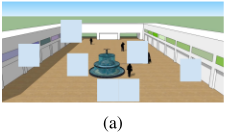
thus guaranteeing recognition at the first step (to the left or right), setting WCD to 0.
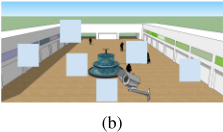
Example 2 The setting depicted in Figure 2 differs from the one described in Example 1 by accounting for partial sensor coverage (a move action ending in a blank cell is nonobservable). As can be seen, the modification applied to the fully observable setting does not offer the same benefit in the partially observable setting. Even with the obstacle placed in front of the entry point, optimal agents may advance one step before their goal is revealed (Figure 2a) (WCD = 1). In Figure 2b, a sensor is placed to the right of the entry point,
To support settings with partially informed observers Keren et al. (2016a) extend GRD to account for goal recognition systems with partial sensor coverage. In this setting, actions can be either observable or non-observable, and sensor placement is proposed to improve recognition. Keren et al. (2016b) generalize the sensor model to account for nondeterministic and noisy sensor models. Sensor refinement, the act of improving the system's sensor resolution, is added to the set of possible modifications to the model. Wayllace et al. (2020) offer a model that accounts for partial observability and sensor refinement in stochastic domains.
Sensor refinement can also be applied to continuous domains where, as in discrete domains, the recognition system may fail because the same observation sequence may by emitted by multiple plan prefixes to different goals due to low sensor resolution [Vered and Kaminka, 2017]. In such settings, GRD can be applied to increase the resolution of specific parts of the model.
All the frameworks mentioned so far assume the observer is passive, forced to wait until an actor produces observations that can disambiguate its goal. Supporting a proactive observer, Bisson et al. (2011) offer a framework in which the observer can dynamically provoke the actor to behave in a way that reveals its intentions by setting a value of an environment variable. Knowing how it would react to the provocation, deciding when and which variable to set is modeled as a planning problem, where the value of each intervention is based on the expected reduction of the uncertainty on the actor's intentions. Similarly, Mirsky et al. (2018) support settings in which the observer can iteratively query an actor about some environment variable to ensure early recognition. The decision of which query to pose is based on the likelihood of the different goals that are related to the query and its potential information gain given the current probabilities of each goal. Shvo and McIlraith (2020) support an observer that can dynamically decide to sense specific environment variables or act in the environment in a way that expedites the recognition of an actor's goal. The decision of which intervention to perform is based on the analysis of each goal's landmarks, facts that hold for all plans that achieve that goal. At each iteration, the approach finds the most unique landmark, generates a plan to sense it, and eliminates all goals that are not associated with the sensed value.
6 Approaches to Design
We now explore the different methods that have been suggested to solve GRD problems. Such solutions typically need to answer two main questions: how to evaluate a given goal recognition model and how to find the best design solution.
A baseline approach to evaluate the ability to perform goal recognition involves exploring possible actor plans to each goal, and finding the maximal overlap (or expected overlap in stochastic domains) between behaviors associated to different goals using some goal recognition method (e.g. [Ramirez and Geffner, 2010]). Such an approach is only effective when possible plans can be enumerated and calculated efficiently offline. An alternative approach defers the analysis of actors' behavior until they are active in the system, deciding online about the need to intervene based on the current most probable goal [Kabanza et al., 2010; Mirsky et al., 2018; Shvo and McIlraith, 2020]. For cases where an actor's possible plans to each goal are bounded by the actor's maximal cost to goal, Keren et al. (2019) suggest a variety of compilations to classical planning that allow the offline computation of WCD for a variety of GRD settings, using a single call to an off-the-shelf classical planner.
As far as finding the best design solution, a na¨ıve approach is an exhaustive exploration of the design options. However, the design search space may be large and more efficient design solutions were proposed in the literature.
Keren et al. (2019) formulate the design process as a state space search in the space of modification sequences ⃗M. The root node is the initial goal recognition model R0 (and empty modification set), and the operators (edges) are the modifications m ∈ M that transition between models. Each node (modification sequence) is evaluated according to the utility measure for the problem at hand (e.g. using the WCD value of its corresponding model). This formulation inspired the design of different pruning approaches. Keren et al. (2019) suggest the pruned-reduce approach, which focuses the search on the current plans that maximize WCD, and specify conditions under which it is guaranteed to yield optimal solutions. A variation of the pruned-reduce approach was used in other lines of work [Mirsky et al., 2019; Wayllace et al., 2017]. Harman and Simoens (2019) propose the use of action graphs, and-or graphs that capture the relationship between actions, to determine which actions should be replaced or removed from the model in order to facilitate recognition. Son et al. (2016) formulate a GRD problem as an Answer Set Programming (ASP) and use highly optimized and effective ASP solvers to compute a solution to a GRD problem. To date, this solution outperforms planningbased approaches for fully observable models with optimal agents, but has not been applied to more general settings. Ang et al. (2017) encode the design process as a mixed-integer program (MIP) that is used to find the best observer strategy for applying modifications to the environment.
As a concluding remark, we note that GRD can be viewed as a form of environment design [Zhang et al., 2009], which supports an interested party in finding optimal modifications to apply to an environment in order to maximize some utility measure. GRD can also be seen as a form of mechanism design, where the objective is to influence future interactions between an agent and the goal recognition system. Specifically, reducing WCD by eliminating actions can be seen as an aspect of social law [Shoham and Tennenholtz, 1995], with eliminated actions viewed as being made illegal.
7 Concluding Discussion
Since the early days of AI, a variety of goal recognition tools have been developed to provide automated ways to efficiently analyze agent behavior, contributing to this active and evolving field of research. Goal recognition design (GRD), the focus of this survey, is a novel approach that suggests a principled way to redesign a goal recognition setting in order to facilitate online goal recognition.
Although GRD has made substantial progress since it was first introduced, there are many challenges that have not yet been addressed. While there exists GRD work that supports either offline or online design solutions, there is no work that combines the two approaches. Considering the trade-off between the offline and online design options is an interesting avenue for future research. Another important issue involves incorporating into GRD tools more general accounts of uncertainty of goal recognition systems, especially those concerning partial information actors may have about their surroundings and about other actors in a stochastic environment with noisy sensing. Finally, the relationship between the actors and the observer, that can be characterized as collaborative, agnostic, or adversarial, deserves a more thorough investigation in the context of GRD.
The theoretical progress in analyzing GRD under various settings opens the way to exploring GRD in various realworld applications where goal recognition is essential and for which the design can be controlled. Specifically, GRD fits well with the emerging need for efficient and effective communication between humans and robots, may it be at home, at the office, or on the move. Such transfer from theory to practice requires looking into engineering solutions that can scale to environments with many behavior and design alternatives.
Acknowledgements
The research leading to these results is partially supported by Accenture LTD and by the Center for Research on Computation and Society at Harvard University.
@inproceedings{ijcai2020p675,
  title     = {Goal Recognition Design - Survey},
  author    = {Keren, Sarah and Gal, Avigdor and Karpas, Erez},
  booktitle = {Proceedings of the Twenty-Ninth International Joint Conference on
               Artificial Intelligence, {IJCAI-20}},
  publisher = {International Joint Conferences on Artificial Intelligence Organization},
  editor    = {Christian Bessiere},
  pages     = {4847--4853},
  year      = {2020},
  month     = {7},
  note      = {Survey track},
  doi       = {10.24963/ijcai.2020/675},
  url       = {https://doi.org/10.24963/ijcai.2020/675},
}
TY - CPAPER TI - Goal Recognition Design - Survey AU - Keren, Sarah AU - Gal, Avigdor AU - Karpas, Erez T2 - Proceedings of the Twenty-Ninth International Joint Conference on Artificial Intelligence, IJCAI-20 PB - International Joint Conferences on Artificial Intelligence Organization PY - 2020 SP - 4847 EP - 4853 DO - 10.24963/ijcai.2020/675 UR - https://doi.org/10.24963/ijcai.2020/675 ER -Copied
Machine-readable versions of this paper, for tools and AI agents:





