
Clustered-patch Element Connection for Few-shot Learning
Proceedings of the Thirty-Second International Joint Conference on Artificial Intelligence. Main Track. Pages 991-998.
https://doi.org/10.24963/ijcai.2023/110
Keywords
- Computer Vision: CV: Transfer, low-shot, semi- and un- supervised learning
Abstract
Weak feature representation problem has influenced the performance of few-shot classification task for a long time. To alleviate this problem, recent researchers build connections between support and query instances through embedding patch features to generate discriminative representations. However, we observe that there exists semantic mismatches (foreground/ background) among these local patches, because the location and size of the target object are not fixed. What is worse, these mismatches result in unreliable similarity confidences, and complex dense connection exacerbates the problem. According to this, we propose a novel Clustered-patch Element Connection (CEC) layer to correct the mismatch problem. The CEC layer leverages Patch Cluster and Element Connection operations to collect and establish reliable connections with high similarity patch features, respectively. Moreover, we propose a CECNet, including CEC layer based attention module and distance metric. The former is utilized to generate a more discriminative representation benefiting from the global clustered-patch features, and the latter is introduced to reliably measure the similarity between pair-features. Extensive experiments demonstrate that our CECNet outperforms the state-of-the-art methods on classification benchmark. Furthermore, our CEC approach can be extended into few-shot segmentation and detection tasks, which achieves competitive performances.
- [Bolei et al., 2016] Zhou Bolei, Khosla Aditya, Lapedriza Agata, Oliva Aude, and Torralba Antonio. Learning deep features for discriminative localization. In CVPR, 2016.
- [Bruna et al., 2013] Joan Bruna, Wojciech Zaremba, Arthur Szlam, and Yann LeCun. Spectral networks and lo- cally connected networks on graphs. arXiv preprint arXiv:1312.6203, 2013.
- [Finn et al., 2017] Chelsea Finn, Pieter Abbeel, and Sergey Levine. Model-agnostic meta-learning for fast adaptation of deep networks. In ICML, 2017.
- [Hou et al., 2019] Ruibing Hou, Hong Chang, MA Bing- peng, Shiguang Shan, and Xilin Chen. Cross attention network for few-shot classification. In NeurIPS, 2019.
- [Jiangtao et al., 2022] Xie Jiangtao, Long Fei, Lv Jiaming, Wang Qilong, and Li Peihua. Joint distribution matters: Deep brownian distance covariance for few-shot classifi- cation. In CVPR, 2022.
- [Jinxiang and Siqian, 2022] Lai Jinxiang and Yang Siqian. Adaptive multi distance metrics for few-shot classification. In arXiv, 2022.
- [Kang et al., 2019] Bingyi Kang, Zhuang Liu, Xin Wang, Fisher Yu, Jiashi Feng, and Trevor Darrell. Few-shot ob- ject detection via feature reweighting. In Proceedings of the IEEE/CVF International Conference on Computer Vi- sion, pages 8420-8429, 2019.
- [Kipf and Welling, 2017] Thomas N. Kipf and Max Welling. Semi-supervised classification with graph convolutional networks. In ICLR, 2017.
- [Krizhevsky et al., 2012] Alex Krizhevsky, Ilya Sutskever, and Geoffrey E Hinton. Imagenet classification with deep convolutional neural networks. In NeurIPS, 2012.
- [Liu et al., 2020] Yongfei Liu, Xiangyi Zhang, Songyang Zhang, and Xuming He. Part-aware prototype network for few-shot semantic segmentation. In ECCV, 2020.
- [Malik et al., 2021] Boudiaf Malik, Kervadec Hoel, Im- tiaz Masud Ziko, Piantanida Pablo, Ben Ayed Ismail, and Dolz Jose. Few-shot segmentation without meta-learning: A good transductive inference is all you need? In CVPR, 2021.
- [Qiao et al., 2021] Limeng Qiao, Yuxuan Zhao, Zhiyuan Li, Xi Qiu, Jianan Wu, and Chi Zhang. Defrcn: Decoupled faster r-cnn for few-shot object detection. In ICCV, 2021.
- [Rizve et al., 2021] Mamshad Nayeem Rizve, Salman Khan, Fahad Shahbaz Khan, and Mubarak Shah. Exploring com- plementary strengths of invariant and equivariant represen- tations for few-shot learning. In CVPR, 2021.
- [Siam et al., 2019] Mennatullah Siam, Boris N Oreshkin, and Martin Jagersand. AMP: Adaptive masked proxies for few-shot segmentation. In ICCV, 2019.
- [Snell et al., 2017] Jake Snell, Kevin Swersky, and Richard Zemel. Prototypical networks for few-shot learning. In NeurIPS, 2017.
- [Tian et al., 2020] Yonglong Tian, Yue Wang, Dilip Krish- nan, Joshua B Tenenbaum, and Phillip Isola. Rethinking few-shot image classification: a good embedding is all you need? In ECCV, 2020.
- [Vaswani et al., 2017] Ashish Vaswani, Noam Shazeer, Niki Parmar, Jakob Uszkoreit, Llion Jones, Aidan N Gomez, Łukasz Kaiser, and Illia Polosukhin. Attention is all you need. In NeurIPS, 2017.
- [Vinyals et al., 2016] Oriol Vinyals, Charles Blundell, Tim- othy Lillicrap, Daan Wierstra, et al. Matching networks for one shot learning. In NeurIPS, 2016.
- [Wang et al., 2020] Xin Wang, Thomas E Huang, Trevor Darrell, Joseph E Gonzalez, and Fisher Yu. Frustrat- ingly simple few-shot object detection. arXiv preprint arXiv:2003.06957, 2020.
- [Wu et al., 2022] Shuang Wu, Wenjie Pei, Dianwen Mei, Fanglin Chen, Jiandong Tian, and Guangming Lu. Multi- faceted distillation of base-novel commonality for few- shot object detection. In ECCV, 2022.
- [Xu et al., 2021a] Chengming Xu, Yanwei Fu, Chen Liu, Chengjie Wang, Jilin Li, Feiyue Huang, Li Zhang, and Xi- angyang Xue. Learning dynamic alignment via meta-filter for few-shot learning. In CVPR, 2021.
- [Xu et al., 2021b] Luo Xu, Wei Longhui, Wen Liangjian, Yang Jinrong, Xie Lingxi, Xu Zenglin, and Tian Qi. Rec- tifying the shortcut learning of background for few-shot learning. NeurIPS, 2021.
- [Yang et al., 2022] Liu Yang, Zhang Weifeng, Xiang Chao, Zheng Tu, Cai Deng, and He Xiaofei. Learning to affiliate: Mutual centralized learning for few-shot classification. In CVPR, 2022.
- [Zhang et al., 2020a] Chi Zhang, Yujun Cai, Guosheng Lin, and Chunhua Shen. Deepemd: Few-shot image classifica- tion with differentiable earth mover's distance and struc- tured classifiers. In CVPR, 2020.
- [Zhang et al., 2020b] Xiaolin Zhang, Yunchao Wei, Yi Yang, and Thomas S Huang. SG-one: Similarity guidance net- work for one-shot semantic segmentation. IEEE Transac- tions on Cybernetics, 2020.
- [Zhengyu et al., 2021] Chen Zhengyu, Ge Jixie, Zhan Hes- hen, Huang Siteng, and Wang Donglin. Pareto self- supervised training for few-shot learning. In CVPR, 2021.
References were extracted automatically from the PDF and may contain errors.
Full text extracted automatically from the PDF; figures, tables and equations may differ. The PDF is the version of record.
1 Introduction
In contrast to general deep learning task [Krizhevsky et al., 2012], Few-Shot Learning (FSL) aims to learn a transferable classifier with amount seen images (base class) and few labeled unseen images (novel class). Due to the lack of effective features from unseen classes, a robust feature embedding model is indispensable. Recent researchers[Hou et al., 2019; Rizve et al., 2021; Xu et al., 2021a] manage to design an embedding network for generating more discriminative features.
∗Corresponding Author
Our Clustered-patch Element Connection
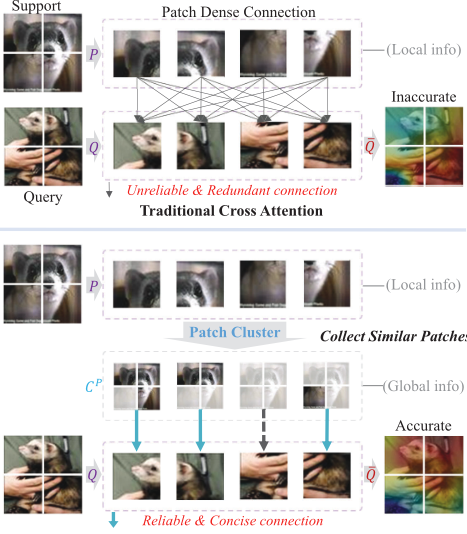
Figure 1: Comparison between traditional Cross Attention and our Clustered-patch Element Connection. The proposed Clusteredpatch Element Connection, which utilizes the global info Cp integrated from support feature P to perform element connection with query Q leading to a confident and clear connection, is able to generate a more clear and precise relation map than Cross Attention. The detailed Patch Cluster operation is illustrated in Fig.2. The visualization comparisons are referred to Fig.4(a).
Specifically, cross attention based methods [Hou et al., 2019; Xu et al., 2021a; Xu et al., 2021b] focus on reducing the background noise and highlighting the target region to generate more discriminative representations. The core idea of these methods is to divide extracted features into patches and connect all local patch features. However, as shown in Fig.1, we observe that the target object may be located randomly with different scales among the query images. Hence, these methods suffer two main problems: inconsistent semantic in feature space, and unreliable and redundant connections. To tackle these problems, we propose a Clustered-patch Element Connection (CEC) layer which consists of Patch Cluster and Element Connection operations. In detail, given inputs features P (support) and Q (query), CEC layer firstly obtains the global clustered-patch C p features by Patch Cluster operation as illustrated in Fig.2, then performs Element Connection on Q by using C p , and finally produces a more discriminative representation ¯Q. Patch Cluster aims to collect the objects in source feature P that are similar to the reference patch in Q, which adaptively alignments the P into C P to obtain a consistent semantic feature for each patch of Q. Then, with the global clustered-patch features, CEC layer generates more reliable and concise connections than cross attention.
According to CEC layer, we find the key of generating accurate relation map is to obtain appropriate clustered-patch features. In this paper, four solutions are introduced to perform Patch Cluster, including MatMul, Cosine, GCN and Transformer. Different from the naive MatMul and Cosine modes, we propose the meta-GCN and Transformer based Patch Cluster operations to obtain a more robust clusteredpatch by implementing additional feature refinement. The insight of meta-GCN is constructing a dynamic correlationbased adjacent for each current input pair-features, other than the static GCN [Kipf and Welling, 2017] using a fixed adjacent. Besides, the transformer structure obtains global information via modeling a spatio-temporal correlation among instances, which generates a more accurate relation map.
Along with the description of CEC mechanism, we propose three CEC-based modules: (I) The Clustered-patch Element Connection Module (CECM) distinguishes the background and the object for each image pair (support and query) at the feature level adaptively, which gives a more precise highlights at the regions of target object; (II) The Self-CECM enhances the semantic feature of target object in a self-attention manner to make the representation more robust; (III) The Clusteredpatch Element Connection Distance (CECD) is a CEC-based distance metric which measures the similarity between pairfeatures via the obtained reliable relation map.
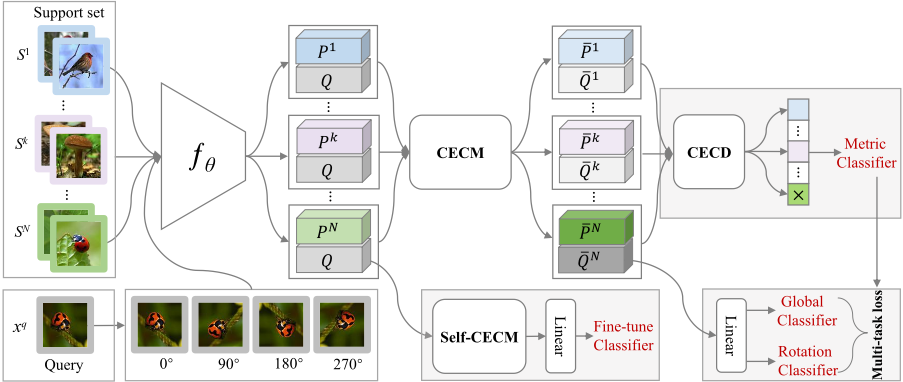
For few-shot classification task, we introduce a novel Clustered-patch Element Connection Network (CECNet) as illustrated in Fig.3, which learns a generalize-well embedding benefiting from auxiliary tasks, generates a discriminative representation via CECM and Self-CECM, and measures a reliable similarity map via CECD. Furthermore, we derive a novel CEC-based embedding module named CEC Embedding (CECE), which can be applied into few-shot semantic segmentation (FSSS) and few-shot object detection (FSOD) tasks. We simply stack the proposed CECE after the backbone network of the existing FSSS and FSOD methods, which achieves consistent improvements around 1%- 3%.
To summarize, our main contributions are:
- We propose a Clustered-patch Element Connection (CEC) layer to strengthen the target regions of query features by element-wisely connecting them with the global clusteredpatch features. Four different CEC modes are introduced, including MatMul, Cosine, GCN and Transformer.
- We derive three CEC-based modules: CECM and SelfCECM modules are utilized to produce more discriminative
representations, and CECD is able to measure a reliable similarity map.
- With CEC-based modules and auxiliary tasks, a novel CECNet model is designed for few-shot classification. CECNet improves state-of-the-arts on few-shot classification benchmark, and the experiments demonstrate that our method is effective in FSL.
- Furthermore, our CECE (i.e. CEC-based embedding module) can be extended into few-shot segmentation and detection tasks, which achieves performance improvements around 1% - 3% on the corresponding benchmarks.
2 RelatedWork
Few-Shot Learning The FSL algorithms aim to recognize novel categories with few labeled images, and a categorydisjoint base set with abundant images is provided for pretraining. The classic FSL tasks include few-shot classification [Finn et al., 2017; Vinyals et al., 2016; Snell et al., 2017; Hou et al., 2019; Tian et al., 2020], semantic segmentation [Zhang et al., 2020b; Siam et al., 2019; Malik et al., 2021] and object detection [Kang et al., 2019; Wang et al., 2020; Qiao et al., 2021]. More introductions are presented in APPENDIX. In a word, the existing FSL methods lack a uniform function to control the connections among the patches between support and query instances semantically.
Other RelatedWorks are introduced in APPENDIX, such as Auxiliary Task for FSL [Hou et al., 2019; Rizve et al., 2021], Graph Convolutional Network (GCN) [Bruna et al., 2013], and Transformer [Vaswani et al., 2017].
3 ProblemDefinition
3.1 Few-Shot Classification
A classic few-shot classification problem is specified as a N-way K-shot task, which means solving a N-class classification problem with only K labeled instances provided per class. In the recent investigations[Hou et al., 2019; Snell et al., 2017], the source dataset is divided into three category-disjoint parts: training set Xtrain, validation set Xval and test set Xtest. Moreover, the episodic training mechanism is widely adopted. An episode consists of two sets (randomly sampling in N categories): support and query. Let S = {(xsi , ys i )}ns i=1 (ns = N × K) denote the support set, and Q = {(xqi , yq i )}nq i=1 denote the query set. Note that ns and nq are the size of corresponding sets. Especially, S = {S 1 , S 2 , ..., S k }, where S k denotes the support set of the kth category in S. Specifically, let (P, Q) ∈ Rhw×c denote the support and query features, which are extracted from support subset and query instance (S k , xq ). Note that c, h, w are channel number, height, width of features, respectively.
3.2 Cross Attention
The traditional Cross Attention [Hou et al., 2019] proves that highlighting target regions could generate more discriminative representations, leading to accuracy improvements for FSL. The key is to generate an fine-grained relation map RQ ∈ Rhw to represent the target regions in Q ∈ Rhw×c . Then, a spatial-wise feature attention can be obtained through RQ ⊙ Q, where ⊙ is the Element-wise Product. The traditional Cross Attention produces relation map RQ for Q by:
where h is a CNN-based layer to refine the correlation matrix P ||P||2 ( Q ||Q||2 )T ∈ Rhw×hw . According to Eq.1, the Cross Attention produces relation map by Local-to-Local fully connection among local feature patches of P and Q. In detail, (Pi, Qj) ∈ R1×c represent a pair of support feature patch and query feature patch among (P,Q) ∈ Rhw×c . As shown in Fig.1, the target object may be located unregularly among the query images at different scale, which results in inconsistent semantic in feature space, i.e feature patches Pi and Qj may be semantically inconsistent. This semantically inconsistent problem causes low confident correlation between patches, and the complex Local-to-Local fully connection further accumulates this inaccurate bias, which affect the quality of the generated relation map.
To establish concise and clear connections among global and local features, we propose a Clustered-patch Element Connection layer (CEC), which consists of two key operations: Patch Cluster and Element Connection.
4 Clustered-patch Element Connection
4.1 Patch Cluster
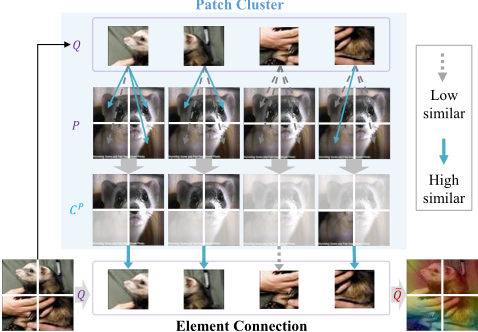
As illustrated in Fig.2, Patch Cluster operation obtains a set C p , named Clustered-patch, via collecting those objects in support feature set P , which are similar to the reference patch in Q. We define a generic Patch Cluster operation fPC as:
Here P is the input source feature, Q is the input reference feature, and C p ∈ Rhw×c is the output Clustered-patch. A pairwise function g computes an affinity matrix representing relationship between Q and P . The clustered patches can be refined by function ϕ. In detail, we divide the source image into w × h patches. Here, w and h are the same as the size of the features in P, which is convenient for element connection operation. A Clustered-patch C p ∈ Rhw×c collects w × h clusters. Each cluster collects the patch-features in P = [P1, P2, ..., Phw] ∈ Rhw×c that are similar to the corresponding patch-feature in the reference patch-features in Q. Therefore, C p is semantically similar to Q.
To implement the Patch Cluster operation, we give four solutions including MatMul, Cosine, GCN and Transformer.
MatMul A simplest way to obtain the clustered patches is treating MatMul operation as the pairwise function g (in Eq.(2)) and not implementing any further embedding refinement. Formally,
where σ is softmax function.
Cosine A simple extension of the MatMul version is to compute cosine similarity in feature space. Formally,
GCN GCN [Kipf and Welling, 2017] updates the input features P via utilizing a pre-defined adjacent matrix A ∈ Rhw×hw and a learnable weight matrix W ∈ Rc×c . Formally, the updated features Gp ∈ Rhw×c can be expressed as: Gp = δ(APW), where δ(·) is the nonlinear activation function (Sigmoid(·) or ReLU(·)). However, the adjacent matrix A used in GCN is fixed for all inputs after training, which is not able to recognize the new categories in few-shot task. Comparing Eq.(2) and the definition of GCN, we observe that the affinity matrix g (Q, P) can be considered as the adjacent matrix A, because they all try to describe the relationship between features P and Q. Hence, we derive a meta-GCN through replacing the static adjacent matrix with the dynamic affinity matrix. Formally, the meta-GCN based Patch Cluster operation is derived as follows:
Transformer The Transformer[Vaswani et al., 2017] based Patch Cluster operation is defined as follows:
where, FFN is the Feed-Forward Network in transformer, Wq,Wk,Wv are learnable weights (e.g. convolution layers).
4.2 Element Connection
According to the global semantic features C p obtained from Patch Cluster operation, element Connection operation generates the relation map RQ for Q by simply computing the patch-wise cosine similarity between Q and C p . Finally, we obtain a rectified discriminative representation by the Element Connection operation fEC:
where, ⊗ is Patch-wise Dot Product, ⊙ is Element-wise Product. The nth position of RQ is RQ n = Qn ||Qn||2 · Cpn ||Cpn||2 , where ·
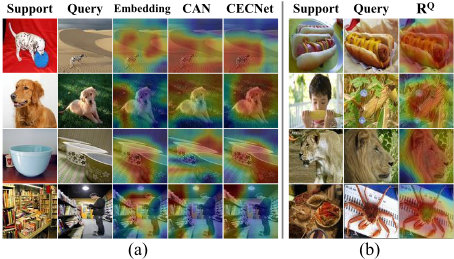
is Dot Product. The visualizations of the CEC-based relation map RQ are shown at the last column in Fig.4(b). Overall, the Clustered-patch Element Connection (CEC) layer is able to highlight the regions of Q that are semantically similar to P. Formally, CEC layer fCEC is expressed as:
4.3 Discussion
Compared with traditional Cross Attention, the key point of our Clustered-patch Element Connection is to perform the Global-to-Local element connection between the Clusteredpatch C p (global) and query Q (local). It is able to generate a more clear and precise relation map, as shown in Fig. 4(a) visualizations. As demonstrated in Tab. 2, our CEC-based approach achieves 4% accuracy improvement than the traditional Cross Attention based CAN [Hou et al., 2019].
Generally, the advantages of our Clustered-patch Element Connection are: (I) The relation map generated by Element Connection is more confident than Cross Attention, because the global Clustered-patch feature C p is more stable and representative than the local feature P. (II) Element Connection (1-to-1 patch-connection) has more clear connection relationship than Cross Attention (1-to-hw patch-connection).
Moreover, the respective advantages of different solutions for realizing Patch Cluster are: (I) These four solutions can be divided into two groups: fixed (i.e. MatMul and Cosine) and learnable (i.e. GCN and Transformer) solutions. The fixed solutions can be used to perform patch clustering without additional learnable parameters, while the learnable solutions are data-driven to refine the affinity matrix or clustered-patch. (II) According to experimental results in Tab. 2, the learnable solutions are better than the fixed ones when they are applied as a embedding layer for feature enhancing (i.e. CECM defined in Eq. 9), which indicates that the learnable solutions can generate better embedding features. In contrast, according to Tab. 3, the fixed solutions are better than the learnable ones when they are applied as the distance metric for measuring similarity (i.e. CECD defined in Eq. 11), which indicates fixed solutions can obtain more reliable similarity scores.
5 CECNetwork for Few-Shot Classification
5.1 CECModule and Self-CECModule
According to the CEC layer mentioned above, we propose two derivative modules: the CEC Module (CECM) and the Self-CEC Module (self-CECM). The CECM is able to highlight the mutual similar regions via learning the semantic relevance between pair feature. Specifically, CECM transfers the input pair-features (P, Q) ∈ Rhw×c into more discriminative representations ( ¯ P, ¯Q) ∈ Rhw×c . Formally, its function fCECM is expressed as:
The Self-CECM enhances the semantic feature of target object via self-connection, which turns the input Q into
¯¯Q ∈ Rhw×c . Formally, Self-CECM function fSCECM is expressed as:
The CECM exploit the relation between P and Q via ¯Q = fCEC(Q, P), while Self-CECM exploit the relation between the input itself via ¯¯Q = fCEC(Q,Q), i.e. Self-CECM explores the relation between the patches of input image. Because we assume that patch-features of the target are mutually similar, Self-CECM can enhance the target region by clustering the similar regions.
5.2 CECNet Framework
Then, we give the overall Clustered-patch Element Connection Network (CECNet). The framework is shown in Fig.3, which integrates CECM, Metric Classifier and Finetune Classifier for few-shot classification task, and Rotation Classifier and Global Classifier for the auxiliary tasks. The network involves three stages: Base Training, Novel Finetuning and Novel Inference.
Base Training As illustrated in Fig.3, every image xq in query set Q = {(xqi , yq i )}nq i=1 is rotated with [0◦ , 90◦ , 180◦ , 270◦ ] and outputs a rotated ˜Q = {(˜xqi , ˜ yq i )}nq×4 i=1 . The support subset S k and the rotated query instance ˜xq are processed by the embedding fθ and produces the prototype feature P k = 1 |S k | ∑xsi ∈S k fθ(xsi ) and query feature Q = fθ(˜xq ) ∈ Rc×h×w , respectively. Then each pair-features (P k , Q) are processed via CECM to enhance the mutually similar regions and generates more discriminative features ( ¯ P k , ¯Qk ) for the subsequent classification. Note that the inputs and outputs of CECMwill be reshaped to satisfied its format. Finally, CECNet is optimized via multi-task loss contributing from metric classifier and auxiliary tasks.
Novel Fine-tuning The Fine-tune Classifier consists of SelfCECM and a linear layer as shown in Fig.3. In fine-tuning phase, the pre-trained embedding fθ is frozen, and the Finetune Classifier is optimized with cross-entropy loss.
Novel Inference In inductive inference, the overall prediction of CECNet is Y = YM + YF , where YM and YF are the results of Metric and Fine-tune Classifiers respectively.
5.3 Metric Classifier
As illustrated in Eq. 7, the proposed CEC layer is able to generate a reliable relation map RQ. The relation map RQ can also be utilized as a similarity map, and the mean of RQ is the similarity score. Therefore, we obtain the CECD distance metric dCECD which is expressed as:
With the proposed CECD distance metric, the Metric Classifier make predictions by measuring the similarity between the query and the N support classes. Following [Hou et al., 2019], the patch-wise classification strategy is used to produce precise feature representations. In detail, each patchwise feature ¯Qkn at nth spatial position of ¯Qk , is recognized as N classes. And the probability of predicting ¯Qkn as kth class is:
where, the similarity map Rk is obtained by the CECD distance metric formulated in Eq. 11, and the similarity score Rkn is the nth position of Rk .
5.4 Fine-tune Classifier
The Fine-tune Classifier consists of Self-CECM and a linear layer. It predicts the query feature ¯¯Q into N categories by a linear layer WF . And its loss is computed as:
where, PCE is patch-wise cross-entropy, and N q i is the ground truth of xqi with N categories of few-shot task.
5.5 Objective functions in Base Training
Metric Loss The metric classification loss with the groundtruth few-shot label ˜ yq is:
Auxiliary Loss The loss of Global Classifier is LG = PCE(WG( ¯Q),Dq ), where Dq i is the global category of ˜xqi with D classes of train set, and WG is a fullyconnected layer. Similarly, the loss of Rotation Classifier is LR = PCE(WR( ¯Q), Bq ), where Bq i is the rotation category of ˜xqi with four classes, and WR is a fully-connected layer.
Multi-Task Loss Then, inspired by [Jinxiang and Siqian, 2022], the overall loss is defined as:
where w = 1 2α2 and α is a learnable variable. The hyperparameter λ is utilized to balance the few-shot and auxiliary tasks, of which the influence is studied in Tab. 4.
6 Experiments on Few-Shot Classification
Datasets The two popular FSL classification benchmark datasets are miniImageNet and tieredImageNet, where detailed introductions are presented in APPENDIX.
Experimental Setup We report the mean accuracy by testing 2000 episodes randomly sampled from meta-test set. According to Tab. 4, the hyperparameter λ is set to 1.0 and 2.0 for ResNet-12 and WRN-28, respectively. Other implementation details can be found in our public code.
6.1 Comparison with State-of-the-arts
As shown in Tab.1, we compare with the state-of-the-art fewshot methods on miniImageNet and tieredImageNet datasets. It shows that our CECNet outperforms the existing SOTAs, which demonstrates the effectiveness and strength of our CEC based methods. Different from existing metric-based methods [Zhang et al., 2020a; Yang et al., 2022; Jiangtao et al., 2022] extracting support and query features independently, our CECNet enhances the semantic feature regions of mutually similar objects and obtains more discriminative representations. Comparing to the metric-based Meta-DeepBDC [Jiangtao et al., 2022], CECNet achieves 1.98% higher accuracy on 1-shot. Some metric-based methods [Xu et al., 2021a; Hou et al., 2019] apply cross attention, while our CECNet still surpasses DANet [Xu et al., 2021a] with an accuracy improvement up to 2.36% under WRN-28 backbone, which demonstrates the strength of our Clustered-patch Element Connection.
| Model | Backbone | miniImageNet | tieredImageNet | ||
|---|---|---|---|---|---|
| 1-shot | 5-shot | 1-shot | 5-shot | ||
| ProtoNet [Snell et al., 2017] | Conv4 | 49.42 ± 0.78 | 68.20 ± 0.66 | 53.31 ± 0.89 | 72.69 ± 0.74 |
| Our CECNet | Conv4 | 54.45 ± 0.47 | 70.57 ± 0.38 | 56.59 ± 0.50 | 72.86 ± 0.42 |
| CAN [Hou et al., 2019] | ResNet-12 | 63.85 ± 0.48 | 79.44 ± 0.34 | 69.89 ± 0.51 | 84.23 ± 0.37 |
| DeepEMD [Zhang et al., 2020a] | ResNet-12 | 65.91 ± 0.82 | 82.41 ± 0.56 | 71.16 ± 0.87 | 86.03 ± 0.58 |
| IENet [Rizve et al., 2021] | ResNet-12 | 66.82 ± 0.80 | 84.35 ± 0.51 | 71.87 ± 0.89 | 86.82 ± 0.58 |
| DANet [Xu et al., 2021a] | ResNet-12 | 67.76 ± 0.46 | 82.71 ± 0.31 | 71.89 ± 0.52 | 85.96 ± 0.35 |
| MCL [Yang et al., 2022] | ResNet-12 | 67.36 ± 0.20 | 83.63 ± 0.20 | 71.76 ± 0.20 | 86.01 ± 0.20 |
| Meta-DeepBDC [Jiangtao et al., 2022] | ResNet-12 | 67.34 ± 0.43 | 84.46 ± 0.28 | 72.34 ± 0.49 | 87.31 ± 0.32 |
| Our CECNet | ResNet-12 | 69.32 ± 0.46 | 84.65 ± 0.32 | 73.14 ± 0.50 | 86.88 ± 0.36 |
| PSST [Zhengyu et al., 2021] | WRN-28 | 64.16 ± 0.44 | 80.64 ± 0.32 | - | - |
| DANet [Xu et al., 2021a] | WRN-28 | 67.84 ± 0.46 | 82.74 ± 0.31 | 72.18 ± 0.52 | 86.26 ± 0.35 |
| Our CECNet | WRN-28 | 70.20 ± 0.46 | 85.00 ± 0.30 | 73.84 ± 0.50 | 87.36 ± 0.34 |
| Model | Attention | Distance Metric | Param | miniImageNet | |
|---|---|---|---|---|---|
| Module | 1-shot | 5-shot | |||
| ProtoG | - CAM | cosine | 7.75M 7.75M | 61.87 63.85 | 78.87 79.44 |
| CAN CECNet | CECM(M) CECM(C) CECM(G) CECM(T) | cosine | 7.75M 7.75M 8.00M 10.25M | 67.69 67.65 67.80 67.91 | 81.84 81.79 82.15 82.40 |
6.2 Ablation Study
Influence of CECM As shown in Tab.2, comparing CECNet to ProtoG, it shows consistent improvements on 1/5-shot classifications, because our CECM enhances the mutually similar regions and produces more discriminative representations. Comparing with CAN adopting cross attention module CAM, our CECNet achieves obvious improvements up to 4.06% on 1-shot task. The results of CECM(M), CECM(C), CECM(G) and CECM(T) show that CECM is not sensitive to alternative modes such as MatMul, Cosine, GCN and Transformer, which indicates the generic Patch Cluster behavior is the key insight for the improvements.
Influence of CECD As shown in Tab.3 without attention module, comparing CECNet to ProtoG, it shows consistent improvements, because our CECD distance metric can obtain a more reliable similarity map. Besides, the results show that the best combination is CECM(T) + CECD(C).
Influence of Multi-Task Loss In Tab.4 with the integration of auxiliary tasks, our CECNet obtains large improvements, which indicates that learning a good embedding is helpful.
Influence of CECM+CECD As shown in Tab.5, comparing to ProtoG (no-attention + cosine), our methods adopting CECM(T) + cosine and no-attention + CECD(C) achieve obvious improvements, which demonstrates the effectiveness of the proposed CECM and CECD. The combination of CECM(T) + CECD(C) obtains further performance gains.
| Model | Attention Module | Distance Metric | Param | miniImageNet | |
|---|---|---|---|---|---|
| 1-shot | 5-shot | ||||
| ProtoG | - | cosine CECD(M) | 7.75M 7.75M | 61.87 67.50 | 78.87 82.00 |
| CECNet | - | CECD(C) CECD(G) CECD(T) | 7.75M 8.00M 10.25M | 67.89 67.79 67.44 | 82.02 81.74 81.17 |
| CECNet | CECM(T) | CECD(M) CECD(C) CECD(G) CECD(T) | 10.25M 10.25M 11.25M 12.75M | 67.64 68.27 66.52 64.37 | 81.24 82.59 78.55 78.32 |
Influence of Self-CECM As illustrated in Tab.6, the baseline is the Metric Classifier of CECNet, and the competitor is Fine-tune Classifier with only Linear layer. By comparing Self-CECM+Linear to Linear, it shows consistent improvements, which demonstrates the usefulness of Self-CECM. By comparing Metric+Fine-tune to Metric Classifier, it shows an improvement on 5-shot classification.
| Loss weights | ResNet-12 | WRN-28 | ||||
|---|---|---|---|---|---|---|
| λ Metric | Global | Rotation | 1-shot | 5-shot | 1-shot | 5-shot |
| - 0.5 | - | - | 62.45 | 79.50 | 61.98 | 76.64 |
| - 0.5 | - | 1.0 | 65.54 | 79.55 | 63.47 | 77.62 |
| - 0.5 | 1.0 | - | 68.27 | 82.59 | 67.13 | 81.95 |
| - 0.5 | 1.0 | 1.0 | 68.86 | 83.67 | 69.49 | 83.71 |
| 0.5 0.5 | wG | wR | 69.05 | 83.86 | 69.33 | 83.55 |
| 1.0 0.5 | wG | wR | 69.32 | 84.21 | 69.66 | 84.09 |
| 0.5 | wG | wR | 69.15 | 84.03 | 69.86 | 84.30 |
| 1.5 2.0 0.5 | wG | wR | 69.18 | 83.29 | 70.20 | 84.59 |
| Attention | Distance | Param | miniImageNet | |
|---|---|---|---|---|
| Module | Metric | 1-shot | 5-shot | |
| - | cosine | 7.75M | 65.59 ± 0.47 | 80.94 ± 0.33 |
| CECM(T) | cosine | 10.25M | 68.27 ± 0.46 | 83.43 ± 0.32 |
| - | CECD(C) | 7.75M | 68.79 ± 0.46 | 83.39 ± 0.32 |
| CECM(T) | CECD(C) | 10.25M | 69.32 ± 0.46 | 84.21 ± 0.32 |
6.3 Visualization Analysis
Fig.4(a) shows the class activation maps [Bolei et al., 2016] of our CECNet and CAN [Hou et al., 2019]. Comparing CECNet to its Embedding, CECNet can highlight the target object which is unseen in the pre-training stage. Comparing to CAN, CECNet is more accurate and has larger receptive fields. The essential is that our Clustered-patch Element Connection utilizes the global info to implement element connection leading to a more confident correlation and a more clear connection. Fig.4(b) shows the visualizations of the CECbased relation map RQ generated by CECNet via Eq.7. Our CEC approach produces a high-quality relation map with a more complete region for the target.
7 Applications on FSSS and FSOD Tasks
In this section, we first introduce a novel CEC-based embedding module named CEC Embedding (CECE). Then, we extend the proposed CECE into few-shot semantic segmentation (FSSS) and object detection (FSOD) tasks. The experimental results in Tab.7 and Tab.8 show that our CECE can achieve performance improvements around 1% - 3%, and more extensive results are presented in APPENDIX.
where, {Q,Q′ } ∈ Rhw×c are the input and output features respectively, and WE ∈ Rne×c are learnable weights (pytorch code is WE = nn.Embedding(ne, c), and ne represents the number of semantic groups, and the empirical setting is ne = 5). The proposed CECE can enhance the target regions of input features that are semantically similar toWE, where WE contains the semantic information of base categories after trained on the base dataset.
| Metric | Fine-tune Classifier | miniImageNet | ||
|---|---|---|---|---|
| classifier | Self-CECM | Linear | 1-shot | 5-shot |
| ✓ | - | - | 70.20 ± 0.46 | 84.59 ± 0.30 |
| - | - | ✓ | 69.20 ± 0.47 | 84.40 ± 0.30 |
| - | ✓ | ✓ | 69.36 ± 0.46 | 84.78 ± 0.30 |
| ✓ | ✓ | ✓ | 70.20 ± 0.46 | 85.00 ± 0.30 |
| Model | PASCAL-5i | COCO-20i | ||
|---|---|---|---|---|
| 1-shot | 5-shot | 1-shot | 5-shot | |
| PPNet [Liu et al., 2020] | 51.5 | 62.0 | 25.7 | 36.2 |
| RePRI [Malik et al., 2021] | 59.3 | 64.8 | 36.6 | 45.2 |
| RePRI+CECE(M) | 60.4 | 66.5 | 38.3 | 46.9 |
| RePRI+CECE(T) | 60.5 | 66.2 | 38.1 | 46.7 |
| Model | PASCAL | COCO | ||
|---|---|---|---|---|
| 1-shot | 5-shot | 1-shot | 5-shot | |
| DeFRCN [Qiao et al., 2021] | 52.5 | 60.7 | 6.5 | 15.3 |
| MFDC [Wu et al., 2022] | 56.1 | 62.2 | 10.8 | 16.4 |
| MFDC+CECE(M) | 59.4 | 63.4 | 11.5 | 17.2 |
| MFDC+CECE(T) | 58.7 | 64.9 | 11.2 | 16.9 |
CECE Applications As an embedding module, our CECE can be stacked after the backbone network. To verify the effectiveness of the proposed CECE, we insert it into the FSSS method RePRI [Malik et al., 2021] and FSOD method MFDC [Wu et al., 2022], via stacking CECE after their backbones. As illustrated in Tab.7 and Tab.8, our CECE can make consistent improvements upon RePRI and MFDC methods.
8 Conclusion
We propose a novel Clustered-patch Element Connection network (CECNet) for few-shot classification. Firstly, we design a Clustered-patch Element Connection (CEC) layer, which strengthens the target regions of query features by element-wisely connecting them with the clustered-patch features. Then three useful CEC-based modules are derived: CECM and Self-CECM generate more discriminative features, and CECD distance metric obtains a reliable similarity map. Extensive experiments prove that our method is effective, and achieves the state-of-the-arts on few-shot classification benchmark. Furthermore, our CEC approach can be extended into few-shot segmentation and detection tasks, which achieves competitive improvements.
@inproceedings{ijcai2023p110,
  title     = {Clustered-patch Element Connection for Few-shot Learning},
  author    = {Lai, Jinxiang and Yang, Siqian and Zhou, Junhong and Wu, Wenlong and Chen, Xiaochen and Liu, Jun and Gao, Bin-Bin and Wang, Chengjie},
  booktitle = {Proceedings of the Thirty-Second International Joint Conference on
               Artificial Intelligence, {IJCAI-23}},
  publisher = {International Joint Conferences on Artificial Intelligence Organization},
  editor    = {Edith Elkind},
  pages     = {991--998},
  year      = {2023},
  month     = {8},
  note      = {Main Track},
  doi       = {10.24963/ijcai.2023/110},
  url       = {https://doi.org/10.24963/ijcai.2023/110},
}
TY - CPAPER TI - Clustered-patch Element Connection for Few-shot Learning AU - Lai, Jinxiang AU - Yang, Siqian AU - Zhou, Junhong AU - Wu, Wenlong AU - Chen, Xiaochen AU - Liu, Jun AU - Gao, Bin-Bin AU - Wang, Chengjie T2 - Proceedings of the Thirty-Second International Joint Conference on Artificial Intelligence, IJCAI-23 PB - International Joint Conferences on Artificial Intelligence Organization PY - 2023 SP - 991 EP - 998 DO - 10.24963/ijcai.2023/110 UR - https://doi.org/10.24963/ijcai.2023/110 ER -Copied
Machine-readable versions of this paper, for tools and AI agents:





