
Analyzing and Combating Attribute Bias for Face Restoration
Proceedings of the Thirty-Second International Joint Conference on Artificial Intelligence. Main Track. Pages 1151-1159.
https://doi.org/10.24963/ijcai.2023/128
Keywords
- Computer Vision: CV: Applications
- Computer Vision: CV: Bias, fairness and privacy
- Computer Vision: CV: Neural generative models, auto encoders, GANs
Abstract
Face restoration (FR) recovers high resolution (HR) faces from low resolution (LR) faces and is challenging due to its ill-posed nature. With years of development, existing methods can produce quality HR faces with realistic details. However, we observe that key facial attributes (e.g., age and gender) of the restored faces could be dramatically different from the LR faces and call this phenomenon attribute bias, which is fatal when using FR for applications such as surveillance and security. Thus, we argue that FR should consider not only image quality as in existing works but also attribute bias. To this end, we thoroughly analyze attribute bias with extensive experiments and find that two major causes are the lack of attribute information in LR faces and bias in the training data. Moreover, we propose the DebiasFR framework to produce HR faces with high image quality and accurate facial attributes. The key design is to explicitly model the facial attributes, which also allows to adjust facial attributes for the output HR faces. Experiment results show that DebiasFR has comparable image quality but significantly smaller attribute bias when compared with state-of-the-art FR methods.
- [Chen et al., 2018] Yu Chen, Ying Tai, Xiaoming Liu, Chun- hua Shen, and Jian Yang. Fsrnet: End-to-end learning face super-resolution with facial priors. In CVPR, pages 2492- 2501, 2018.
- [Chen et al., 2021] Chaofeng Chen, Xiaoming Li, Lingbo Yang, Xianhui Lin, Lei Zhang, and Kwan-Yee K. Wong. Progressive semantic-aware style transformation for blind face restoration. In CVPR, pages 11896-11905. Computer Vision Foundation / IEEE, 2021.
- [Courbariaux et al., 2015] Matthieu Courbariaux, Yoshua Bengio, and Jean-Pierre David. Binaryconnect: Training deep neural networks with binary weights during propaga- tions. In Corinna Cortes, Neil D. Lawrence, Daniel D. Lee, Masashi Sugiyama, and Roman Garnett, editors, NeurIPS, 2015.
- [Dong et al., 2015] Chao Dong, Yubin Deng, Chen Change Loy, and Xiaoou Tang. Compression artifacts reduction by a deep convolutional network. In ICCV, pages 576-584, 2015.
- [Gondal et al., 2018] Muhammad Waleed Gondal, Bernhard Schölkopf, and Michael Hirsch. The unreasonable ef- fectiveness of texture transfer for single image super- resolution. In ECCV, pages 80-97. Springer, 2018.
- [Grm et al., 2019] Klemen Grm, Walter J Scheirer, and Vit- omir Štruc. Face hallucination using cascaded super- resolution and identity priors. IEEE Transactions on Im- age Processing, 29:2150-2165, 2019.
- [Gu et al., 2022] Yuchao Gu, Xintao Wang, Liangbin Xie, Chao Dong, Gen Li, Ying Shan, and Ming-Ming Cheng. VQFR: blind face restoration with vector-quantized dictio- nary and parallel decoder. In ECCV, volume 13678, pages 126-143, 2022.
- [Hassan et al., 2021] Bilal Hassan, Ebroul Izquierdo, and Tomas Piatrik. Soft biometrics: a survey. Multimedia Tools and Applications, pages 1-44, 2021.
- [Heusel et al., 2017] Martin Heusel, Hubert Ramsauer, Thomas Unterthiner, Bernhard Nessler, and Sepp Hochre- iter. Gans trained by a two time-scale update rule converge to a local nash equilibrium. In Isabelle Guyon, Ulrike von Luxburg, Samy Bengio, Hanna M. Wallach, Rob Fergus, S. V. N. Vishwanathan, and Roman Garnett, editors, NeurlPS, pages 6626-6637, 2017.
- [Huang and Liu, 2016] Dongdong Huang and Heng Liu. Face hallucination using convolutional neural network with iterative back projection. In Zhisheng You, Jie Zhou, Yunhong Wang, Zhenan Sun, Shiguang Shan, Wei-Shi Zheng, Jianjiang Feng, and Qijun Zhao, editors, CCBR, 2016. Huang et al., 2015]
- Zhiwu Huang, Shiguang Shan, Ruiping Wang, Haihong Zhang, Shihong Lao, Alifu Kuerban, and Xilin Chen. A benchmark and comparative study of video- based face recognition on COX face database. IEEE Trans. Image Process., 24(12):5967-5981, 2015.
- [Härkönen et al., 2020] Erik Härkönen, Aaron Hertzmann, Jaakko Lehtinen, and Sylvain Paris. Ganspace: Discov- ering interpretable gan controls. In NeurIPS, 2020.
- [Karras et al., 2018] Tero Karras, Timo Aila, Samuli Laine, and Jaakko Lehtinen. Progressive growing of gans for im- proved quality, stability, and variation. In ICLR. OpenRe- view.net, 2018.
- [Karras et al., 2019] Tero Karras, Samuli Laine, and Timo Aila. A style-based generator architecture for generative adversarial networks. In CVPR, pages 4401-4410, 2019.
- [Kupyn et al., 2018] Orest Kupyn, Volodymyr Budzan, Mykola Mykhailych, Dmytro Mishkin, and Jiří Matas. Deblurgan: Blind motion deblurring using conditional adversarial networks. In CVPR, pages 8183-8192, 2018.
- [Lee et al., 2018] Cheng-Han Lee, Kaipeng Zhang, Hu- Cheng Lee, Chia-Wen Cheng, and Winston Hsu. Attribute augmented convolutional neural network for face halluci- nation. In CVPRW, pages 721-729, 2018.
- [Li et al., 2018] Xiaoming Li, Ming Liu, Yuting Ye, Wang- meng Zuo, Liang Lin, and Ruigang Yang. Learning warped guidance for blind face restoration. In ECCV, 2018.
- [Li et al., 2019] Mengyan Li, Yuechuan Sun, Zhaoyu Zhang, Haonian Xie, and Jun Yu. Deep learning face hallucination via attributes transfer and enhancement. In ICME, pages 604-609. IEEE, 2019.
- [Li et al., 2020] Xiaoming Li, Wenyu Li, Dongwei Ren, Hongzhi Zhang, Meng Wang, and Wangmeng Zuo. En- hanced blind face restoration with multi-exemplar images and adaptive spatial feature fusion. In CVPR, 2020.
- [Lu et al., 2018] Yongyi Lu, Yu-Wing Tai, and Chi-Keung Tang. Attribute-guided face generation using conditional cyclegan. In ECCV, pages 282-297, 2018.
- [Menon et al., 2020] Sachit Menon, Alexandru Damian, Shijia Hu, Nikhil Ravi, and Cynthia Rudin. PULSE: self- supervised photo upsampling via latent space exploration of generative models. In CVPR, pages 2434-2442, 2020.
- [Mittal et al., 2012] Anish Mittal, Rajiv Soundararajan, and Alan C Bovik. Making a "completely blind" image quality analyzer. IEEE Signal processing letters, 20(3):209-212, 2012.
- [Or-El et al., 2020] Roy Or-El, Soumyadip Sengupta, Ohad Fried, Eli Shechtman, and Ira Kemelmacher-Shlizerman. Lifespan age transformation synthesis. In ECCV, pages 739-755. Springer, 2020.
- [Radford et al., 2021] Alec Radford, Jong Wook Kim, Chris Hallacy, Aditya Ramesh, Gabriel Goh, Sandhini Agar- wal, Girish Sastry, Amanda Askell, Pamela Mishkin, Jack Clark, et al. Learning transferable visual models from nat- ural language supervision. In ICML, pages 8748-8763, 2021.
- [Rothe et al., 2018] Rasmus Rothe, Radu Timofte, and Luc Van Gool. Deep expectation of real and apparent age from a single image without facial landmarks. Inter- national Journal of Computer Vision, 126(2-4):144-157, 2018.
- [Shen and Zhou, 2021] Yujun Shen and Bolei Zhou. Closed- form factorization of latent semantics in gans. In CVPR, pages 1532-1540, 2021.
- [Shen et al., 2020] Yujun Shen, Jinjin Gu, Xiaoou Tang, and Bolei Zhou. Interpreting the latent space of gans for se- mantic face editing. In CVPR, pages 9243-9252, 2020.
- [Simonyan and Zisserman, 2015] Karen Simonyan and An- drew Zisserman. Very deep convolutional networks for large-scale image recognition. In Yoshua Bengio and Yann LeCun, editors, ICLR, 2015.
- [Song et al., 2017] Yibing Song, Jiawei Zhang, Shengfeng He, Linchao Bao, and Qingxiong Yang. Learning to hallu- cinate face images via component generation and enhance- ment. In Carles Sierra, editor, IJCAI, pages 4537-4543. IJCAI
- [van den Oord et al., 2017] Aäron van den Oord, Oriol Vinyals, and Koray Kavukcuoglu. Neural discrete repre- sentation learning. In Isabelle Guyon, Ulrike von Luxburg, Samy Bengio, Hanna M. Wallach, Rob Fergus, S. V. N. Vishwanathan, and Roman Garnett, editors, NeurlPS, pages 6306-6315, 2017.
- [Wang et al., 2021] Xintao Wang, Yu Li, Honglun Zhang, and Ying Shan. Towards real-world blind face restoration with generative facial prior. In CVPR, pages 9168-9178, 2021.
- [Yang et al., 2021] Tao Yang, Peiran Ren, Xuansong Xie, and Lei Zhang. Gan prior embedded network for blind face restoration in the wild. In CVPR, pages 672-681, 2021.
- [Yu et al., 2018] Xin Yu, Basura Fernando, Richard Hartley, and Fatih Porikli. Super-resolving very low-resolution face images with supplementary attributes. In CVPR, pages 908-917, 2018.
- [Zhang et al., 2017] Kai Zhang, Wangmeng Zuo, Yunjin Chen, Deyu Meng, and Lei Zhang. Beyond a gaussian de- noiser: Residual learning of deep cnn for image denoising. IEEE transactions on image processing, 26(7):3142-3155, 2017.
- [Zhao et al., 2022] Yang Zhao, Yu-Chuan Su, Chun-Te Chu, Yandong Li, Marius Renn, Yukun Zhu, Changyou Chen, and Xuhui Jia. Rethinking deep face restoration. In CVPR, pages 7652-7661, 2022.
- [Zhou et al., 2015] Erjin Zhou, Haoqiang Fan, Zhimin Cao, Yuning Jiang, and Qi Yin. Learning face hallucination in the wild. In Blai Bonet and Sven Koenig, editors, Proceed- ings of the Twenty-Ninth AAAI Conference on Artificial In- telligence, January 25-30, 2015, Austin, Texas, USA, pages 3871-3877. AAAI, 2015.
- [Zhu et al., 2022] Feida Zhu, Junwei Zhu, Wenqing Chu, Xinyi Zhang, Xiaozhong Ji, Chengjie Wang, and Ying Tai. Blind face restoration via integrating face shape and gen- erative priors. In CVPR, pages 7662-7671, 2022.
References were extracted automatically from the PDF and may contain errors.
Full text extracted automatically from the PDF; figures, tables and equations may differ. The PDF is the version of record.
1 Introduction
Face restoration (FR) is the task of recovering high-resolution (HR) faces from their low-resolution (LR) counterparts and finds many applications such as video surveillance, portal control, and traffic monitoring. FR is challenging as the problem is under-constrained and LR faces can come with severe degradation (e.g., motion blur [Kupyn et al., 2018], noise [Zhang et al., 2017], and JPEG compression [Dong et al., 2015]). Early methods [Zhou et al., 2015; Huang and Liu, 2016] treat face image as natural image. They design methods without exploiting any face characteristics and the output HR faces suffer from the severe over-smooth problem. Latter methods [Song et al., 2017; Chen et al., 2018;
∗Corresponding author.
§ Code and supplementary materials are available at the link: https://github.com/Seeyn/DebiasFR.
16×16


VQFR
Age:48, male Age:57, male Age:54, male

GFPGAN

GPEN
512×512

Figure 1: An example of attribute bias, best viewed when zoomed in. The low-resolution face is downsampled from a high-resolution face, and three existing face restoration methods produce realistic output faces. However, key face attributes of the restored faces are dramatically different from the ground-truth high-resolution face.
Grm et al., 2019] incorporate various face priors (e.g., facial landmarks, parsing maps, and identity information) to improve image quality, but their outputs are still over-smooth and the magnification factor usually does not exceed 8x. State-of-the-art methods, VQFR [Gu et al., 2022], GFPGAN [Wang et al., 2021] and GPEN [Yang et al., 2021] for example, use reference prior or pre-trained generative adversarial network (GAN) priors and produce faces with realistic and clear details as illustrated in Figure 1.
However, the restored faces produced by state-of-the-art methods can be unreliable as their key facial attributes (e.g., age and gender are altered) can be dramatically different from the ground truth. We show such an example in Figure 1, where a teenage girl is restored to a middle-aged man by three methods. We call this phenomenon attribute bias, which can be fatal for applications where facial attributes count, e.g., identifying and tracking criminals for surveillance. We quantify attribute bias as how far the restored faces deviate from the ground truth in attribute and analyze it with extensive experiments, which lead to two main findings. ❶ Attribute bias becomes more severe when there is less attribute information in the input LR faces. In particular, the confidence of pretrained classifiers for attribute information decreases with the resolution of the LR faces but the attribute bias increases. ❷ Data prior affects attribute bias. Specifically, we construct datasets with different attribute distributions for model training and find that the attributes of the restored faces are biased toward the majority.
Our findings suggest that attribute bias is difficult to tackle using only the LR faces: low resolution is why we need FR in the first place and it is difficult to collect large datasets with balanced distribution on the attribute. Thus, we consider cases where additional attribute information is provided as input. For instance, in criminal investigation, attribute information of suspects can be obtained from the witnesses, and when restoring old films, attribute information of the characters and actors is available. We aim to produce faces with not only high quality but also small attribute bias. The task is challenging as images and attributes lie in different domains and they need to be coherent for high image quality.
We propose the DebiasFR framework for such use cases. DebiasFR explicitly models facial attributes in the latent space of GAN priors that are used to produce the HR face via the decoder model and represents each value in the domain of an attribute as an embedding vector. Thus, the output face can be configured to have certain attributes by activating the corresponding embedding vectors in the latent space. To train attribute embedding for encoding facial attributes, besides the usual pixel-wise restoration loss, we introduce an attribute loss, which measures how well the attributes of the output face match the input specifications. As a pair of HR and LR faces allow only one set of attribute information, we propose a pseudo pair strategy for data augmentation, which allows using different attribute information for one LR face. For pseudo pairs, we compute the restoration loss by degrading the HR faces into LR ones to tackle the absence of ground-truth HR faces. We compare DebiasFR with state-ofthe-art FR methods on three datasets from different scenarios. The results show that DebiasFR matches the baselines in image quality and effectively retains the input facial attributes in the HR faces. Besides manual attribute inputs, DebiasFR can also take attribute information produced by pre-trained classifiers and allows applying different attribute information on the same LR face for trials.
To sum up, we made the following contributions:
- We observe attribute bias in face restoration, which is fatal for many applications and suggests that focusing only on image quality may be problematic.
- We thoroughly analyze attribute bias and trace it to two main causes, i.e., the lack of attribute information and bias in training data.
- We propose DebiasFR, which faithfully preserves input attribute information and produces quality HR faces.
2 Analyzing the Attribute Bias
In this section, we systematically analyze the cause of the attribute bias problem. We target widely used face attributes including gender and age for our observation, as they can be easily captured in the real scene and are important biometrics [Hassan et al., 2021]. Meanwhile, our observation experiment is more of a paradigm, it can be extended to include more attributes if there are any. For data selection, we use FFHQ [Karras et al., 2019] and CelebA-HQ [Karras et al., 2018] and their predicted attributes as target images and attributes. Specifically, we use the attribute estimator [Rothe et al., 2018] to generate gender (i.e., belongs to Male, Female)
- (a) Age Confidence.
- (b) Gender Confidence.
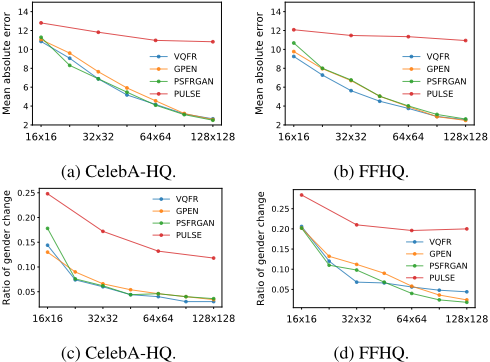
Figure 3: Average attribute bias of the methods when restoring images of different resolutions.
and age (i.e., ranging from 0 to 100 years old). To ensure the universality of the experiment, we conduct experiments with four representative face restoration methods, namely, PLUSE [Menon et al., 2020], PSFRGAN [Chen et al., 2021], GPEN [Yang et al., 2021], and VQFR [Gu et al., 2022].
Observation 1: The attribute bias increases dramatically as the input image information decreases.
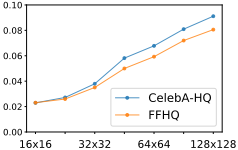
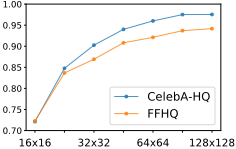
As illustrated in Figure 2(a) and Figure 2(b), the confidence of both gender and age continues to decrease as the input image resolution decreases. This indicates that the attribute information loses as the image resolution becomes lower. As shown in Figure 3, the lack of attribute information results in an obvious attribute bias enlargement, which is quantified by the mean absolute error of age and the ratio of gender change. As illustrated in Figure 3(a) and Figure 3(b), we can observe an increase in age bias, as indicated by the rise in the mean absolute error. It reaches 10 years when the input resolution decreases to 16 × 16. This phenomenon also occurs with gender, as shown in Figure 3(c) and Figure 3(d), where the ratio of gender change dramatically increases as the resolution decrement.
Experiment settings: we divide the gender attribute into male and female groups, and the age attribute into five groups: 10-20, 20-30, 30-40, 40-50, 50+. We sample 500 images from FFHQ and CelebA-HQ and guarantee an equal number of images from each attribute group. The images are then downsampled to several different resolutions including 162 , 242 , 322 , 482 , 642 , 962 , and 1282 via bilinear interpolation to simulate the loss of image information at different extend.
Observation 2: The attributes of the recovered images are greatly affected by the attribute distribution of training data.
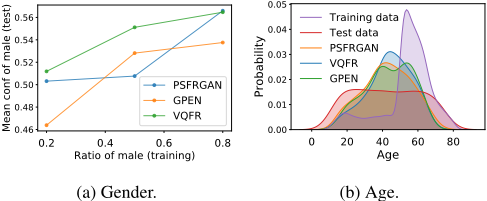
As illustrated in Figure 4(a), as the ratio of males in the training data increases from 0.2 to 0.8, we observe the same trend in the confidence of males in the recovered images from 0.46 to 0.56. Specifically, when the ratio of training males is 0.5, that is, half male training images and half female training images, the confidence of males in the recovered images is about 0.5. This finding shows that the recovered attribute information is strongly affected by the attribute distribution of training data, which has not been explored in existing face restoration methods. The same observation is also found in the age attribute in Figure 4(b). Although the age distribution in the test dataset is uniform, different face restoration methods are prone to recovery images with a certain similarity to the age distribution of the training data. For example, all methods tend to restore age attributes to 40-50, which is biased toward the training data distribution. Some qualitative results are included in our supplementary material.
Experiment settings: FFHQ is used as training data and CelebA-HQ is used for testing. We sample 260 images from CelebA-HQ to ensure an equal number of images for each attribute group. All images are downsampled to 32 × 32 for restoration. For the training dataset, we adjust the attribute distribution to suit our purpose. Specifically, we sample 41350 images from FFHQ to generate subsets with different male ratios, including 0.2, 0.5, and 0.8. Similarly, we sample 14300 images from FFHQ and set the ratio of images for 10-20, 20-30, 30-40, 40-50, and 50+ age groups to 1:1:1:1:6 and use kernel density estimation to estimate the age distribution of training and test sets.
3 The DebiasFR Framework
As depicted in Figure 5, the model consists of three parts: An image encoder, a decoder and some attribute representations. The encoder adopts a U-Net architecture, while the decoder is a fixed pre-trained StyleGAN [Karras et al., 2019]. The attribute representations are embedding vectors in the latent space of the StyleGAN.
The image information is extracted by the encoder and inputted to the decoder by skip-connection structures and latent space in the form of a latent vector. The base latent vector from the encoder is adjusted by the addition of attribute representations which can be viewed as a movement in the latent space. After the addition, the decoder reconstructs the image according to the input from skip-connection structures and latent space. Since the addition of the attribute is independent of the image input, it can be adjusted after the restoration. This process can be formulated as follows:
where x is the input image and ˆ y is the restored image. θ is the model parameters and f denotes the model. -→n is the base latent vector extracted by the encoder and -→r is the attribute representations. λ is the weight of the attribute representations. An adaptive feature fusion module employing the attention mechanism is adopted to better utilize the GAN prior, whose detailed introduction is in supplementary materials.
3.1 Attribute Representation
It has been observed that the latent space of a well-trained GAN model has great properties in attribute manipulation. We find that with the architecture modification, the model still keeps some useful properties from the GAN model.
Property 1: Given the base latent vector -→n , the attribute of the restored image can be manipulated by moving the latent vector in an interpretable direction.
The face attribute space is well-bridged with the latent space [Shen et al., 2020; Shen and Zhou, 2021; H¨ark¨onen et al., 2020]. If there exists a scoring function s for a face attribute and corresponding direction -→r for the attribute, then:
with the ϵ > 0. We call the direction an interpretable direction, and this property indicates that fine-grained manipulation can be achieved by finding out the interpretable directions and adjusting the distance. We train attribute representations, which essentially search the direction for corresponding attributes, and the weights are used for distance adjustment.
Property 2: The interpretable directions are almost orthogonal with each other [H¨ark¨onen et al., 2020].
This property guarantees no need to train representations for the combinations of different attributes. Instead, we can train representations for attributes individually and combine them by addition. This is because adjusting the age attribute through age representation addition has less impact on gender representation (less movement on the gender direction) and vice versa. It increases the extensibility of our design to involve more kinds of attributes. Since if there are N kinds of attributes and for each attribute, there are n choices, we need to train N n representations for combination attributes while only needing N × n for individual attributes.
According to the two properties, the process of adding attribute representations is designed to be:
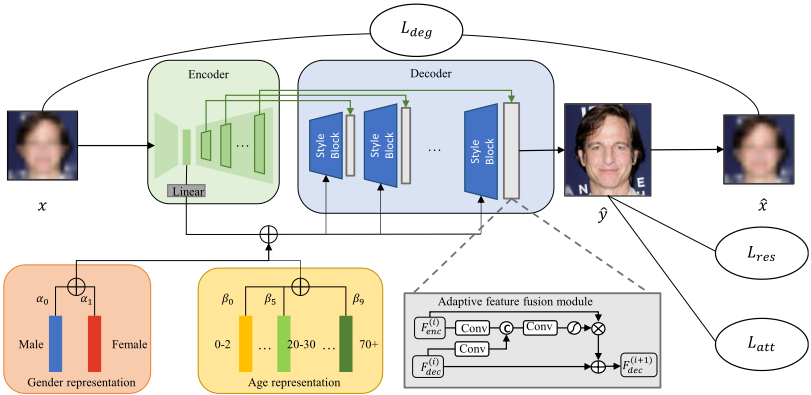
where genderi ∈ {Male, Female}, agej ∈ {0-2, 3-6, 79, 10 - 14, 15 - 19, 20 - 29, 30 - 39, 40 - 49, 50 - 69, 70+} and αi, βj are the weights for the representations. During training, the weights of attribute representations are decided by the attribute label of the image. The correct attribute's representation weight is set to 1, and the others are 0.
3.2 Training Strategy
Given the image and its attribute label, we train the model with two losses: Restoration loss and Attribute loss. The former requests the model to restore the image faithfully and realistically, and the latter helps form the attribute representations. A Pseudo pair strategy is proposed as a data augmentation strategy to help the learning of attribute representation. If the model is trained by pseudo pair, restoration loss will not be counted. Instead, a degradation loss is designed to make up for the absence of restoration loss.
Restoration loss. The restoration loss consists of two parts: reconstruction loss and adversarial loss. We adopt pixel-wise L1 loss and perceptual loss as reconstruction loss:
where y is the ground-truth image and ϕ denotes the pretrained VGG-19 network [Simonyan and Zisserman, 2015] and and we use the conv1, · · · , conv5 feature maps before activation. The Gram(·) denotes calculating the Gram matrix [Gondal et al., 2018]. Mapping restored the image and the target image in Gram matrix statistics can effectively reduce unpleasant artifacts [Wang et al., 2021]. As for the adversarial loss, we adopt the same design as the pre-trained StyleGAN network:
where D and G denote the discriminator and the restoration model.
Attribute loss. The training of attribute representations is to search the interpretable direction in the latent space. To accelerate this process, we use attribute loss to constrain the attribute consistency between the input attribute weights and attribute information in the restored image. The loss can be calculated as follows:
where CE denotes the cross entropy and a is the attribute label. The probability P(a|ˆ y) comes from a pre-trained classifier. The classifier's architecture consists of two parts. The first part is a pre-trained CLIP [Radford et al., 2021] model, and the second part is an MLP, which classifies the extracted feature vectors. The experiments about the superiority of clip embedding are placed in the supplementary materials.
Pseudo Pair Strategy
Using the restoration loss and attribute loss, the model can only support training by the image and its correct attribute label. To alleviate the necessity of attribute labels and improve the generalized ability of the model, we propose a strategy to construct pseudo pairs for model training. The strategy helps the model train with images without ground-truth attribute labels. However, the lack of ground-truth images for calculating restoration loss can harm the model performance in image reconstruction. To address this problem, we propose degradation loss. The loss is designed based on the assumption that the face attribute adjustment for the restored image should be constrained by its degraded version. When the attribute of the restored image is adjusted, there should not be a big alteration for its degraded version. It needs a pair of images for model training: an HR image and its corresponding LR image. A complex degradation process synthesizes the LR image:
The HR image y is blurred by convolution in the Gaussian kernel k and downsampled by a factor r. After that, additive Gaussian noise nσ is added, and a JPEG compression with quality q is applied to obtain the LR image x. We keep the arguments of the degradation and degrade the restored image ˆ y by the same degradation procedure. Then, the degradation loss is calculated as follows:
The degradation process involves JPEG compression, containing some quantization operations that prevent the gradient calculation. Following the principle of straight-through estimator [Courbariaux et al., 2015], we treat the quantization process as an identity function when calculating the gradient to guarantee the gradient back-propagation.
The attribute loss is also calculated on the pseudo pairs. To generate the pseudo label, we pre-train an attribute classifier predicting the labels for the LR images. The top-2 probability label will be selected. They are normalized by their sum and taken as the weight of the attribute representation and the attribute label.
4 Experimental Evaluation
4.1 Experiment Settings
Training data. We use the FFHQ-Aging dataset [Or-El et al., 2020] from FFHQ [Karras et al., 2019] as our training data. Compared to FFHQ, FFHQ-Aging removes images with large challenges, such as low-confidence annotation predictions, large pose variations, and severe face occlusion. It consists of 53831 images and is annotated with both gender and age. During training, all images are degraded according to Eq. (7) to obtain low-quality images. Specifically, the factor k, r, σ, q are randomly sampled from [0,0.1], [0.8,20], [0,20] and [60,100], respectively.
Test data. We use three datasets from two application scenarios, namely CelebA-HQ [Karras et al., 2018], IMDBWIKI [Rothe et al., 2018], and COX [Huang et al., 2015] for testing. CelebA-HQ consists of 3000 images and is widely used to evaluate the performance of face super-resolution. IMDB-WIKI and COX are two datasets that can be used for real-world face restoration applications. We clean these two datasets according to the filtering rule detailed in the supplementary materials for our experiment.
Metrics. There are two types of metrics used for evaluation. The first is the traditional image quality metrics, including PSNR, SSIM, NIQE [Mittal et al., 2012] and FID [Heusel et al., 2017], which measure the quality of restored images. The second is the attribute error metric, which quantifies the attribute bias in the recovered images, defined as:
where C denotes the attribute classifier, which we use the pre-trained model in [Rothe et al., 2018] in our experiments. I and D denote the indicator function and the image set.
Implementation details. The implementation details, like parameters setting and weights of the loss terms, are placed in the supplementary materials.
| CelebA-HQ | NIQE↓ | FID↓ | PSNR↑ | SSIM↑ | Age error (%)↓ | Gender error (%)↓ |
|---|---|---|---|---|---|---|
| Bilinear | 16.59 | 213.3 | 23.25 | 0.6951 | 60.90 | 14.37 |
| AACNN | 4.132 | 59.80 | 22.65 | 0.6052 | 43.60 | 2.930 |
| PULSE | 3.765 | 65.90 | 20.81 | 0.5695 | 68.90 | 14.16 |
| PSFRGAN | 3.982 | 55.88 | 21.71 | 0.6173 | 50.66 | 3.500 |
| GFPGAN | 3.800 | 53.87 | 20.72 | 0.6001 | 50.50 | 4.160 |
| GPEN | 3.877 | 47.39 | 22.12 | 0.6152 | 47.70 | 3.333 |
| VQFR | 3.350 | 52.09 | 20.48 | 0.5699 | 50.60 | 3.666 |
| Ours | 4.411 | 48.63 | 21.71 | 0.6247 | 22.30 | 1.467 |
| PULSE | PSFRGAN | AACNN Predict Age: 40 | VQFR Predict Age: 51 | GPEN Predict | GFPGAN | Ours | Target |
|---|---|---|---|---|---|---|---|
| Predict Age: 41 female | Predict Age: 40 female | female | female | Age: 31 female | Predict Age: 39 female | Predict Age: 25 female | Predict Age: 22 female |
| Predict Age: 37 male | Predict Age: 31 male | Predict Age: 30 male | Predict Age: 42 male | Predict Age: 44 male | Predict Age: 40 male | Predict Age: 23 male | Predict Age: 23 male |
4.2 Main Results
We include five state-of-the-art methods for comparison. All experiments are performed using their official open-source models. We consider two comparison tasks: 1) 16× face super-resolution that the degradation is achieved by fixed downsampling. 2) blind face restoration that the degradation process is unknown. It is worth noting that AACNN [Lee et al., 2018] is an attribute-constrained face restoration model, which also needs the attribute input but is only designed for 8× face super-resolution. We reproduce the AACNN by adding additional convolution layers with the same training data as DebiasFR to support our 16× face super-resolution task comparison.
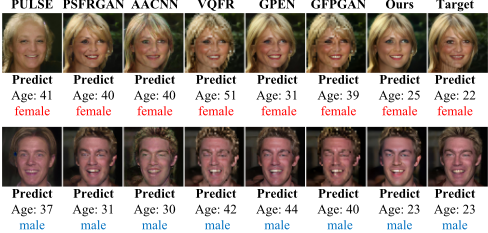
Face super-resolution. We conduct super-resolution experiments under a large-scale factor: 16x, which we consider a good simulation of small faces captured in surveillance scenarios. The high-quality images from CelebA-HQ and FFHQ-Aging are downsampled by bilinear interpolation and resized back to 512 × 512 to adapt to the input of the restoration model. The quantitative results are presented in Table 1. Our method can achieve comparable face restoration results with SOTA methods and apparent alleviation in attribute bias. The qualitative results are presented in Figure 6. The images show the actual effect of our method in solving the problem of attribute bias. AACNN also receives attribute information input, but it suffers from severe artifacts. As for other methods that can generate quality images, the features like wrinkles and beards that do not exist in the original human face might be generated, leading to an age bias. DebiasFR circumvents this problem without harming the image quality.
| IMDB | NIQE↓ | FID↓ | Age error (%)↓ | Gender error (%)↓ |
|---|---|---|---|---|
| PSFRGAN | 4.316 | 39.04 | 50.72 | 1.790 |
| GFPGAN | 4.133 | 32.30 | 48.30 | 1.699 |
| GPEN | 4.719 | 54.13 | 49.25 | 1.155 |
| VQFR | 3.540 | 33.40 | 50.29 | 1.631 |
| Ours | 4.482 | 39.41 | 26.57 | 0.929 |
| COX | ||||
| PSFRGAN | 4.521 | 88.94 | 61.60 | 21.19 |
| GFPGAN | 5.036 | 82.52 | 59.50 | 20.59 |
| GPEN | 4.713 | 84.01 | 64.30 | 22.59 |
| VQFR | 4.190 | 70.00 | 59.40 | 22.90 |
| Ours | 5.238 | 80.45 | 29.50 | 8.80 |
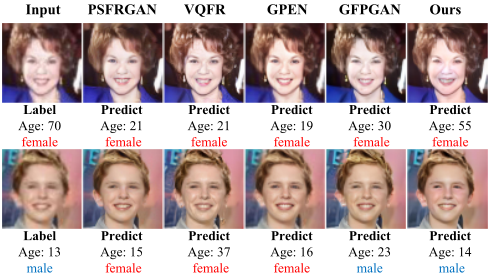
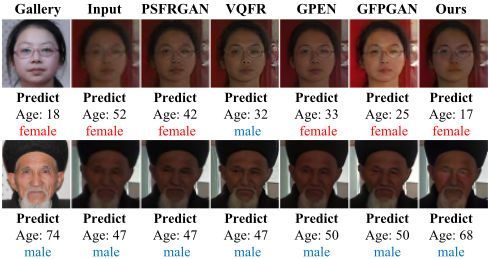
Blind face restoration. Since the degradation model of the compared methods is slightly different from each other, instead of synthesizing LR images by our degradation model, we collect real-world LR images from the IMDB-WIKI dataset for fairness. We also compare face restoration for the images from COX, which is challenging as these images are captured under the surveillance scenario. The quantitative results are presented in Table 2. The qualitative results are presented in Figure 7 and Figure 8. It can be found that other methods may convert noise in some regions into wrinkles, whiskers, and ornaments which can cause attribute bias. Also, the repair of wrinkles can be ignored due to information loss. In contrast, DebiasFR is free from these problems.
4.3 Micro Results
Impact of training data prior. Data-driven method is inevitable to be influenced by the data prior. However, we speculate that the design of attribute representations can alleviate the influence of the data prior. The training of a single attribute representation is not influenced by gradient results from other representations during the training. Also, the pseudo-pair strategy improves the generalized ability of the model for the low-frequency class images in the training set. To support our assumption, we repeat the experiments for observation 2. We propose two metrics for the experiment: Gender var and Age var. Gender var is the variance of the mean confidence of males. It evaluates the influence of the change of training set on the model. With lower variance, the model performance is more robust to the variation of training data. Age var is the variance of the age of the restored images. A large variance indicates less concentration on a single age period which implies better robustness on the influence of training data. As listed in Table 3, our method suffers from less Gender var as the gender distribution change. As for the age attribute, our method can produce a more balanced age distribution with higher variance than other methods. Also, our method suffers from lower attribute error than other methods.
Performance gain of inference strategy. Our model accepts the weight of attributes as input, which can be obtained from either the ground-truth label or an attribute predictor estimation. We pre-trained an attribute predictor to evaluate the latter setting. Two strategies can be adopted for this two-stage inference: 1) The weight of the attribute with the largest confidence is set to 1, while the others are 0. 2) The confidences of the two most confident labels are used as weights (normalized and sum up to 1). As Table 4 shows, our model can only perform slightly better than baseline methods as the pretrained attribute predictor performance is limited. This setting can be improved by adopting a predictor with better performance. The predictor can also predict attributes from other sources of information like voice or gait, which are extensively discussed in the context of multi-modal research.
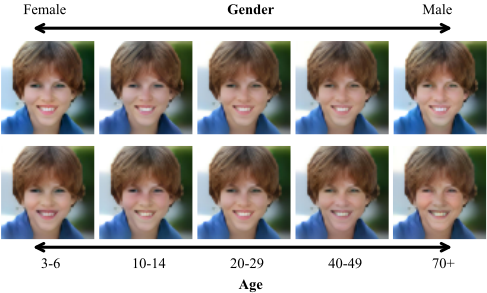
Flexibility of manual control. Since the input attribute weight can be manually adjusted, the user can interact with the model by tuning the attribute weights, similar to the criminal portrait drawing. Figure 9 shows the manipulation results with different attribute weights. It can be found that the manipulation of the face mainly focuses on the high-frequency parts of the image, such as eyes, beards, wrinkles, etc. These parts are easily overlooked in image restoration and cause the attribute bias problem.
| Gender var (10-5)↓ | Age var↑ | Age error (%)↓ | Gender error (%)↓ | |
|---|---|---|---|---|
| PSFRGAN | 81.81 | 182.14 | 54.61 | 7.179 |
| GPEN | 107.38 | 169.47 | 51.92 | 7.948 |
| VQFR | 50.11 | 152.6 | 60.77 | 7.308 |
| Ours | 8.05 | 282.6 | 34.62 | 1.667 |
| Age error (%)↓ | Gender error (%)↓ | |
|---|---|---|
| GPEN | 47.70 | 3.33 |
| Attribute predictor | 51.43 | 4.13 |
| Ours (Top1 strategy) | 47.50 | 3.43 |
| Ours (Top2 strategy) | 46.80 | 3.10 |
5 RelatedWork
Blind face restoration. Blind face restoration, also called real-world face super-resolution. Previous face superresolution only focused on addressing the low-resolution problem, while blind face restoration should deal with the complex and unexpected degradations of the captured image in the real scene. Although the complex degradations lead to a severe loss of face information, existing works can utilize facial prior information to fill realistic face information. GAN prior and reference prior are the current mainstream used face prior. PULSE [Menon et al., 2020] first proposed to leverage GAN prior to do face restoration. It redefined super-resolving a low-resolution image as generating the image whose corresponding downsampling result is most similar to it by GAN inversion. Although PULSE can produce high-quality images, it is time-consuming, and its capacity to generalize to real scenes is limited. The subsequent methods [Wang et al., 2021; Yang et al., 2021; Zhu et al., 2022] address this problem by adopting encoderdecoder architecture and blending the features through a welldesigned feature fusion module. As for the reference prior, vector quantization [van den Oord et al., 2017] is the mainly used technique. The features extracted from the degraded image are used to select the suitable features from high-quality images, which help restore realistic face [Zhao et al., 2022; Gu et al., 2022]. Existing methods treat the face restoration task as a combination of face reconstruction and face generation. The model can generate realistic face information to replace the missing information, but the correctness of the information is not guaranteed. As a result, although existing methods have achieved great progress in restoring realistic face details, they can still suffer from the attribute bias problem. The guided face restoration methods might alleviate this problem, which require a guidance image and align the degraded image with it to achieve restoration. GFRNet [Li et al., 2018] addresses this issue by training a warping sub-network. The warped image is concatenated with the degraded image and fed to the reconstruction network. ASFFNet [Li et al., 2020] improves this pipeline by adopting a one-stage framework and employs spatial adaptive feature fusion. Guided-based methods should perform well when the guidance image is available and the image information perfectly aligns with the degraded image. However, it is more possible to only own simple attribute information (e.g., age and gender) in real scenes.
Attribute-constrained face super-resolution. Existing works have explored face super-resolution with supplementary attribute information [Yu et al., 2018; Lee et al., 2018; Lu et al., 2018; Li et al., 2019]. Although they only focus on the low-resolution problem in face restoration, these works explored the feasibility of involving attribute information. The addition of attribute information is achieved through the concatenation of image features and attribute features. These works did not yet explore the attribute bias problem, and they evaluate their methods by traditional metrics PSNR, SSIM. Instead of directly fusing the image and attribute information, we map the attribute information into the latent space of GAN. Utilizing the GAN prior, DebiasFR produces realistic face restoration. Although the editability of latent space in face attribute has been studied by many face editing works [Karras et al., 2019; Shen et al., 2020; H¨ark¨onen et al., 2020; Shen and Zhou, 2021], we are the first to propose the attribute bias problem and explore exploiting the editability to combat the bias problem in image restoration.
6 Conclusions
In this paper, we propose and analyze the attribute bias problem in face restoration. Existing works can restore LR images to HR images with realistic face details. However, the reconstruction of attribute information is still biased. We propose DebiasFR for combating attribute bias. The framework leverages the editability of GAN's latent space to support a finegrained attribute manipulation on the restoration result. It is superior to SOTA solutions on attribute accuracy while with comparable image restoration performance. Furthermore, exploring the impact of DebiasFR on face recognition is an intriguing avenue for future research.
Acknowledgments
This work was supported by the National Natural Science Foundation of China No.62206123, the Shenzhen Fundamental Research Program (Grant No.20220815112848002), and a research gift fromHuawei.
@inproceedings{ijcai2023p128,
  title     = {Analyzing and Combating Attribute Bias for Face Restoration},
  author    = {Li, Zelin and Zeng, Dan and Yan, Xiao and Shen, Qiaomu and Tang, Bo},
  booktitle = {Proceedings of the Thirty-Second International Joint Conference on
               Artificial Intelligence, {IJCAI-23}},
  publisher = {International Joint Conferences on Artificial Intelligence Organization},
  editor    = {Edith Elkind},
  pages     = {1151--1159},
  year      = {2023},
  month     = {8},
  note      = {Main Track},
  doi       = {10.24963/ijcai.2023/128},
  url       = {https://doi.org/10.24963/ijcai.2023/128},
}
TY - CPAPER TI - Analyzing and Combating Attribute Bias for Face Restoration AU - Li, Zelin AU - Zeng, Dan AU - Yan, Xiao AU - Shen, Qiaomu AU - Tang, Bo T2 - Proceedings of the Thirty-Second International Joint Conference on Artificial Intelligence, IJCAI-23 PB - International Joint Conferences on Artificial Intelligence Organization PY - 2023 SP - 1151 EP - 1159 DO - 10.24963/ijcai.2023/128 UR - https://doi.org/10.24963/ijcai.2023/128 ER -Copied
Machine-readable versions of this paper, for tools and AI agents:





