
ReportParse: A Unified NLP Tool for Extracting Document Structure and Semantics of Corporate Sustainability Reporting
Proceedings of the Thirty-Third International Joint Conference on Artificial Intelligence. Demo Track. Pages 8749-8753.
https://doi.org/10.24963/ijcai.2024/1024
Keywords
- Natural Language Processing: NLP: Tools
- Natural Language Processing: NLP: Applications
- Multidisciplinary Topics and Applications: MDA: Social sciences
- Multidisciplinary Topics and Applications: MDA: Finance
Abstract
We introduce ReportParse, a Python-based tool designed to parse corporate sustainability reports.
It combines document structure analysis with natural language processing (NLP) models to extract sustainability-related information from the reports.
We also provide easy-to-use web and command interfaces.
The tool is expected to aid researchers and analysts in evaluating corporate commitment to and management of sustainability efforts.
- [Abid et al., 2019] Abubakar Abid, Ali Abdalla, Ali Abid, Dawood Khan, Abdulrahman Alfozan, and James Zou. Gradio: Hassle-free sharing and testing of ML models in the wild. arXiv preprint arXiv:1906.02569, 2019.
- [Bingler et al., 2024] Julia Anna Bingler, Mathias Kraus, Markus Leippold, and Nicolas Webersinke. How cheap talk in climate disclosures relates to climate initiatives, corporate emissions, and reputation risk. Journal of Bank- ing & Finance, 164:107191, 2024.
- [Bolton and Kacperczyk, 2021] Patrick Bolton and Marcin Kacperczyk. Do investors care about carbon risk? Journal of Financial Economics, 142(2):517-549, 2021.
- [Bosi et al., 2022] Mathew Kevin Bosi, Nelson Lajuni, Avn- ner Chardles Wellfren, and Thien Sang Lim. Sustainability reporting through environmental, social, and governance: A bibliometric review. Sustainability, 14(19), 2022.
- [deepdoctection, 2024] deepdoctection. deepdoctection Github repository. https://github.com/deepdoctection/ deepdoctection, 2024. Accessed: 2024-05-29. Link
- [Deng et al., 2023] Ming Deng, Markus Leippold, Alexan- der F Wagner, and Qian Wang. War and policy: Investor expectations on the net-zero transition. In Swiss Finance Institute Research Paper Series, number 22-29, 2023.
- [DistilBERT-SST2, 2022] DistilBERT-SST2. distilbert- base-uncased-finetuned-sst-2-english (revision bfdd146). https://huggingface.co/distilbert-base-uncased-finetuned- sst-2-english, 2022. Link
- [Gutierrez-Bustamante and Espinosa-Leal, 2022] Marcelo Gutierrez-Bustamante and Leonardo Espinosa-Leal. Natural language processing methods for scoring sus- tainability reports: A study of Nordic listed companies. Sustainability, 14(15), 2022.
- [Honnibal et al., 2020] Matthew Honnibal, Ines Montani, Sofie Van Landeghem, and Adriane Boyd. spaCy: Industrial-strength natural language processing in python, 2020.
- [In et al., 2019a] Soh Young In, Ki Young Park, and Ashby Monk. Is 'being green' rewarded in the market?: An empirical investigation of decarbonization and stock re- turns. Stanford Global Projects Center Working Paper, page Available at SSRN 3020304, 2019.
- [In et al., 2019b] Soh Young In, Dane Rook, and Ashby Monk. Integrating alternative data (also known as ESG data) in investment decision making. Global Economic Review, 48(3):237-260, 2019.
- [In et al., 2024] Soh Young In, Gaku Morio, Jungah Yoon, and Christopher D. Manning. When do firms oversell or undersell their environmental sustainability? An empirical analysis of corporate sustainability commu- nications. Available at SSRN 3264923, 2024.
- [Kang and Kim, 2022] Hyewon Kang and Jinho Kim. An- alyzing and visualizing text information in corporate sus- tainability reports using natural language processing meth- ods. Applied Sciences, 12(11), 2022.
- [Li et al., 2022] Mei Li, Gregory Trencher, and Jusen Asuka. The clean energy claims of BP, Chevron, ExxonMobil and Shell: A mismatch between discourse, actions and invest- ments. PLOS ONE, 17(2):1-27, 02 2022.
- [Lo et al., 2023] Kyle Lo, Zejiang Shen, Benjamin New- man, Joseph Chang, Russell Authur, Erin Bransom, Ste- fan Candra, Yoganand Chandrasekhar, Regan Huff, Bai- ley Kuehl, Amanpreet Singh, Chris Wilhelm, Angele Za- marron, Marti A. Hearst, Daniel Weld, Doug Downey, and Luca Soldaini. PaperMage: A unified toolkit for process- ing, representing, and manipulating visually-rich scientific documents. In Yansong Feng and Els Lefever, editors, Pro- ceedings of the 2023 Conference on Empirical Methods in Natural Language Processing: System Demonstrations, pages 495-507, Singapore, December 2023. Association for Computational Linguistics.
- [Morio and Manning, 2023] Gaku Morio and Christopher D Manning. An NLP benchmark dataset for assessing corpo- rate climate policy engagement. In Advances in Neural In- formation Processing Systems: Datasets and Benchmarks Track, 2023.
- [Mukherjee, 2020] Mukut Mukherjee. ESG-BERT: NLP meets sustainable investing. Towards Data Sci- ence, 2020. https://towardsdatascience.com/nlp-meets- sustainable-investing-d0542b3c264b. Link
- [Ni et al., 2023] Jingwei Ni, Julia Bingler, Chiara Colesanti- Senni, Mathias Kraus, Glen Gostlow, Tobias Schimanski, Dominik Stammbach, Saeid Ashraf Vaghefi, Qian Wang, Nicolas Webersinke, Tobias Wekhof, Tingyu Yu, and Markus Leippold. CHATREPORT: Democratizing sus- tainability disclosure analysis through LLM-based tools. In Yansong Feng and Els Lefever, editors, Proceedings of the 2023 Conference on Empirical Methods in Natu- ral Language Processing: System Demonstrations, pages 21-51, Singapore, December 2023. Association for Com- putational Linguistics.
- [Polignano et al., 2022] Marco Polignano, Nicola Bellan- tuono, Francesco Paolo Lagrasta, Sergio Caputo, Pier- paolo Pontrandolfo, and Giovanni Semeraro. An NLP approach for the analysis of global reporting initiative in- dexes from corporate sustainability reports. In Proceed- ings of the First Computing Social Responsibility Work- shop within the 13th Language Resources and Evaluation Conference, pages 1-8, Marseille, France, June 2022. Eu- ropean Language Resources Association. [PyMuPDF, 2024] PyMuPDF. PyMuPDF Github repository. https://github.com/pymupdf/PyMuPDF, 2024. Accessed: 2024-05-29. Link
- [Rouen et al., 2022] Ethan Rouen, Kunal Sachdeva, and Aaron Yoon. The evolution of ESG reports and the role of voluntary standards. In Harvard Business School Work- ing Paper, number 23-024, 2022.
- [Sautner et al., 2023] Zacharias Sautner, Laurence Van Lent, Grigory Vilkov, and Ruishen Zhang. Firm-level climate change exposure. The Journal of Finance, 78(3):1449- 1498, 2023.
- [Schimanski et al., 2023] Tobias Schimanski, Julia Bingler, Mathias Kraus, Camilla Hyslop, and Markus Leippold. ClimateBERT-NetZero: Detecting and assessing net zero and reduction targets. In Houda Bouamor, Juan Pino, and Kalika Bali, editors, Proceedings of the 2023 Conference on Empirical Methods in Natural Language Processing, pages 15745-15756, Singapore, December 2023. Associ- ation for Computational Linguistics.
- [Stammbach et al., 2023] Dominik Stammbach, Nicolas Webersinke, Julia Bingler, Mathias Kraus, and Markus Leippold. Environmental claim detection. In Proceedings of the 61st Annual Meeting of the Association for Com- putational Linguistics (Volume 2: Short Papers), pages 1051-1066, Toronto, Canada, July 2023. Association for Computational Linguistics.
- [Wolf et al., 2020] Thomas Wolf, Lysandre Debut, Victor Sanh, Julien Chaumond, Clement Delangue, Anthony Moi, Pierric Cistac, Tim Rault, Remi Louf, Morgan Fun- towicz, Joe Davison, Sam Shleifer, Patrick von Platen, Clara Ma, Yacine Jernite, Julien Plu, Canwen Xu, Teven Le Scao, Sylvain Gugger, Mariama Drame, Quentin Lhoest, and Alexander Rush. Transformers: State-of-the- art natural language processing. In Proceedings of the 2020 Conference on Empirical Methods in Natural Lan- guage Processing: System Demonstrations, pages 38-45, Online, October 2020. Association for Computational Lin- guistics.
References were extracted automatically from the PDF and may contain errors.
Full text extracted automatically from the PDF; figures, tables and equations may differ. The PDF is the version of record.
1 Introduction
As societal awareness of sustainability grows, corporations are increasingly disclosing their sustainability actions, both mandatorily and voluntarily. These disclosures often take the form of annual sustainability reports [Rouen et al., 2022; Bosi et al., 2022] (simply 'reports' hereafter), which are textual documents spanning hundreds of pages. Researchers and practitioners analyze these reports to examine corporate commitment to sustainability goals, such as decarbonization and energy transition [Morio and Manning, 2023], and to investigate the potential for 'greenwashing' [Kang and Kim, 2022].
The reports often contain complex, unstructured data [In et al., 2019b] and are typically distributed in PDF format. The varying layouts, designs, and disclosed items across companies complicate the automation of information extraction using NLP techniques. Researchers have independently developed methods for report analysis [Li et al., 2022; Kang and Kim, 2022; Gutierrez-Bustamante and Espinosa-Leal, 2022; Polignano et al., 2022]. While Ni et al. [2023] provided a QA-based tool, there is no well-standardized tool for both structure and semantic analysis as far as we know. The lack of a standardized, open tool not only burdens researchers with implementation of a report analysis tool but also leads to reproducibility issues and methodological robustness concerns.
We introduce REPORTPARSE 1 , a unified tool for parsing both the document structure and semantics of the reports. The concept of extracting document structure and semantics is inspired by a unified scientific paper parsing tool [Lo et al.,
1 Project website: https://github.com/climate-nlp/reportparse
2023]. However, our work is tailored for the reports. Here, 'document structure' refers to explicit units such as titles, blocks, and sentences, while 'semantics' involve annotations on these structure units for the reports. For instance, REPORTPARSE can extract sentences (i.e., part of document structure) tagged as environmental claims (i.e., semantics), thereby simplifying the process of layout analysis, text extraction, and integration of NLP models. We describe each functionality of the tool and demonstrate the effectiveness of REPORTPARSE through discussions.
2 RelatedWork
A widely used method for extracting document structure from a report involves tools like PyMuPDF [2024] to extract text from PDF files [Kang and Kim, 2022]. For information extraction in sustainability reports, CHATREPORT [Ni et al., 2023] offers a QA-based interface utilizing large language models (LLMs). Tools using LLMs, such as CHATREPORT, offer flexibility in extracting information. However, REPORTPARSE distinguishes itself by providing users with a platform from which they can choose among various document structure analysis and NLP methods according to their needs.
| Method / Model | Extracted information | Example label and text in sustainability reports |
|---|---|---|
| [Bingler et al., 2024] [Stammbach et al., 2023] [Deng et al., 2023] [Bingler et al., 2024] [Schimanski et al., 2023] [Mukherjee, 2020] [DistilBERT-SST2, 2022] | Climate commitments / actions Environmental claims Renewable energy Climate sentiments Net zero or reduction targets ESG-related texts Sentiments | Yes: We use the reduction rate of CO2 emissions per unit ... Yes: ... 35 cases of investment in energy-saving equipment ... Yes: ... we will promote wider use of renewable energy through ... Risk: As for climate-related business risks, we have followed ... Net-zero: ... an additional goal of realizing carbon neutrality ... Air quality: ... control and reduction of chemical substances ... one of the causes of urban air pollution ... Positive: DEI is also at the core of our sustainability strategy ... |
Technically, our work is most similar to PaperMage [Lo et al., 2023], which offers a tool for analyzing scientific papers through layout analysis and public NLP models. However, our focus is on corporate sustainability reports, which lack a standard format. Additionally, we utilize NLP models that are specifically tailored for the climate change and sustainability domain.
3 SystemOverview of REPORTPARSE
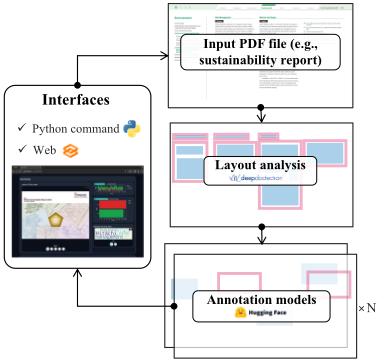
The system pipeline is detailed in Figure 1. Our system is built upon a Python codebase. For a given PDF report, a 'reader' identifies the document structure, while 'annotators' use NLP models to assign semantics in relation to the structure. We also integrate command line and web interfaces.
Reader. The reader identifies the document layouts and semantic units. This is similar to 'Parser' of PaperMage. We use deepdoctection [2024] to identify elements like titles, text blocks, and lists. This structure, along with associated bounding boxes, is stored in an internal format and fed into the annotators. Text is tokenized into sentences using spaCy [Honnibal et al., 2020]. Users have the option to use PyMuPDF or to integrate their custom reader.
Annotators. The annotators assess the semantics related to the document structure, benefiting from valuable third-party models. The annotator is similar to the 'predictor' of PaperMage. Table 1 lists the example third-party annotators. Users can select any annotators suitable for their needs. These annotators can extract various sustainability-related details, such as environmental claims [Stammbach et al., 2023]. Each annotator assigns labels to specific document structures, e.g., an annotator assigns 'risk' labels of Bingler et al. [2024] for text blocks. Users can integrate a custom annotator.
Python Command Line Tool. This interface processes an input PDF file and outputs a JSON or CSV file with the analysis results. For instance, the following command employs deepdoctection as the reader and uses the model of Bingler et al. as the annotator to transform 'filename.pdf' into a JSON file in the current directory:
python -m reportparse.main -i filename.pdf -o ./ \ -reader "deepdoctection" \ -annotators "climate commitment"
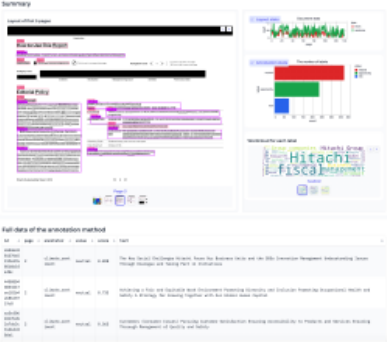
Web Interface. We provide a user-friendly web interface created with Gradio [Abid et al., 2019], designed to visualize document structures and associated labels. Figure 2 shows an example of the analysis results. The top left panel illustrates the bounding boxes for both document structures and labels, helping users grasp the analysis process. The top right panels present statistics related to these structures, such as the distribution of annotated labels.
| Respondent | Usefulness of the tool | The num. of correct outputs by 'climate policy' | Comments |
|---|---|---|---|
| NPO analyst | 4 (1=min, 5=max) | Correct=1 Partly correct=2 Incorrect=2 | - This tool would cut down on the time it takes to read through every page, allowing me to do more work and track more evidence of engagement. |
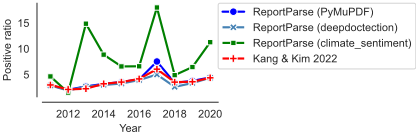
System Verification. By replicating an existing study with REPORTPARSE, we verify that the tool works properly. We replicate the work by [Kang and Kim, 2022], where we investigate trends in the sentiment ratio (i.e., num. of positive sentences / num. of negative sentences) from reports for a firm. To follow the setting of the original paper as much as possible, we use PyMuPDF for the reader and DistilBERTSST2 for the annotator. Additionally, we explored variants by using deepdoctection as the reader or using deepdoctection as the reader and 'climate sentiment' [Bingler et al., 2024] as the annotator. Figure 3 shows that REPORTPARSE, with PyMuPDF as the reader, reasonably replicates the original study's trends, including the notable 2017's peak, which corresponds to the firm's ESG crises [Kang and Kim, 2022]. It indicates our tool works properly. However, we observe different trends when using deepdoctection as the reader or 'climate sentiment' as the annotator, suggesting that the choice of reader or annotator methods can significantly impact the analysis. Different readers / annotators may need to be considered to increase the robustness of research claims. Thus, REPORTPARSE is useful to improve reproducibility of studies and the robustness of analyses.
4 Problem Scenarios
While acknowledging the limitations of the tool, we show small pilot studies and discussions, providing insight into how our tool can be used.
4.1 For Analysts
Applying NLP methods to the reports offers significant advantages for practitioners such as analysts. The detailed data analysis afforded by NLP modules could aid analysts in supporting data-driven arguments.
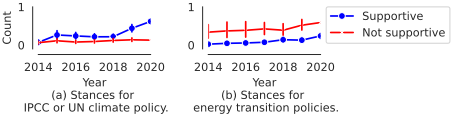
Pilot Study - Hypothesis Generation. We present a study that may be useful for analysts in generating hypotheses for sustainability trends. We gathered 2,480 reports from various formats (ESG, sustainability, and responsibility reports) in the energy and basic materials sectors, including major oil and gas companies. Of those, we analyzed the corporate stances on climate change from 2014 to 2020 using REPORTPARSE. We integrate an annotator named 'climate policy' based on the model from [Morio and Manning, 2023], which can predict corporate climate policy engagement for multiple aspects. Using this annotator, we first investigated the average number of pages related to IPCC or UN climate policies, categorizing them as 'supportive' or 'not supportive' (including no or mixed positions.) Figure 4 (a) indicates a recent trend towards positive stances on IPCC and UN policies. However, the effectiveness of these claims is questionable, as shown in Figure 4 (b), where we did not find a significant positive stance in corporate engagement with energy transition policies (like carbon capture and storage, and transportation decarbonization). While it is not possible to determine whether this case indicates greenwashing trends, it does provide useful insights for hypothesis generation for further analyses.
Survey Study. We conduct a survey with an analyst from a non-profit organisation (NPO), who specializes in analyzing corporate climate policy engagement within the reports. We randomly selected four reports of NYSE-listed companies in 2021, sampled from the collected reports. The analyst was asked to complete our survey, which included questions about the usefulness of the web interface and the correctness of the output generated by the annotator models. Table 2 shows a part of our survey results. The analyst confirmed the usefulness of the tool in reducing reading cost of the reports for assessing corporate climate policy engagement. However, the output from the model is not rated as perfect, and the importance of the human analyst still remains. Although the survey results cannot be generalized and the role of human analysts remains crucial, the integration of this tool into the analytical framework of NPOs could improve efficiency.
4.2 For Sustainable Finance Researchers
Corporate sustainability has become a pivotal factor in investment decision-making, complementing conventional financial metrics like firm size and growth potential [In et al., 2019a; Bolton and Kacperczyk, 2021]. REPORTPARSE can assess the consistency of a firm's communications on a specific topic within its sustainability reports over time. However, challenges associated with data quality, bias, and interpretability require careful consideration [Sautner et al., 2023]. By addressing these challenges and emphasizing the contributions of our tool, we may improve decision-making processes, enhance transparency, and generate value for stakeholders within sustainable finance ecosystems. Again, REPORTPARSE can be used to investigate the reproducibility and robustness of studies. In future work, we plan to focus on the quantification of corporate sustainability reporting using our tool and on addressing interpretability issues in relation to corporate sustainability and NLP [In et al., 2024].
5 Conclusion and Demonstration Scenario
REPORTPARSE facilitates systematic analysis of sustainability reports, promoting open and reproducible research in this field. During the conference session, we will showcase the web interface, allowing users to interact with it. Visitor feedback will inform potential enhancements and the addition of new annotation models to REPORTPARSE.
Ethical Statement
We acknowledge that errors in layout analysis and model output from the use of this tool could raise ethical concerns when applied to real applications. For example, if a researcher uses a tool without examining the erroneous output in detail, it will lead to erroneous hypothesis generation and erroneous conclusions. We intend to make the tool available only to analysts and researchers, but its use by investors and general users will lead to incorrect labeling of companies. For example, a particular company might be falsely accused of greenwashing. Conversely, a company might use this tool to unfairly enhance its own reputation. We encourage users to be transparent and to use our tool only as a supplementary tool for humans.
In this study, a simple survey was conducted. The survey did not contain sensitive (personal or harmful) questions.
Acknowledgments
We would like to thank Cleo Rank at InfluenceMap, who completed our survey and shared her thoughts. Computational resource of AI Bridging Cloud Infrastructure (ABCI) provided by National Institute of Advanced Industrial Science and Technology (AIST) was used. GM did this research within the Stanford Data Science (SDS) Affiliates Program. GM receives financial supports from Hitachi America to conduct this study. We used OpenAI ChatGPT in part of our paper to translate text, correct grammatical errors, and improve the writing. We declare that the text is original.
@inproceedings{ijcai2024p1024,
  title     = {ReportParse: A Unified NLP Tool for Extracting Document Structure and Semantics of Corporate Sustainability Reporting},
  author    = {Morio, Gaku and In, Soh Young and Yoon, Jungah and Rowlands, Harri and Manning, Christopher},
  booktitle = {Proceedings of the Thirty-Third International Joint Conference on
               Artificial Intelligence, {IJCAI-24}},
  publisher = {International Joint Conferences on Artificial Intelligence Organization},
  editor    = {Kate Larson},
  pages     = {8749--8753},
  year      = {2024},
  month     = {8},
  note      = {Demo Track},
  doi       = {10.24963/ijcai.2024/1024},
  url       = {https://doi.org/10.24963/ijcai.2024/1024},
}
TY - CPAPER TI - ReportParse: A Unified NLP Tool for Extracting Document Structure and Semantics of Corporate Sustainability Reporting AU - Morio, Gaku AU - In, Soh Young AU - Yoon, Jungah AU - Rowlands, Harri AU - Manning, Christopher T2 - Proceedings of the Thirty-Third International Joint Conference on Artificial Intelligence, IJCAI-24 PB - International Joint Conferences on Artificial Intelligence Organization PY - 2024 SP - 8749 EP - 8753 DO - 10.24963/ijcai.2024/1024 UR - https://doi.org/10.24963/ijcai.2024/1024 ER -Copied
Machine-readable versions of this paper, for tools and AI agents:





