
DenseKoopman: A Plug-and-Play Framework for Dense Pedestrian Trajectory Prediction
Proceedings of the Thirty-Third International Joint Conference on Artificial Intelligence. Main Track. Pages 1020-1028.
https://doi.org/10.24963/ijcai.2024/113
Keywords
- Computer Vision: CV: Machine learning for vision
- Computer Vision: CV: Motion and tracking
- Computer Vision: CV: Other
Abstract
Pedestrian trajectory prediction has emerged as a core component of human-robot interaction and autonomous driving. Fast and accurate prediction of surrounding pedestrians contributes to making decisions and improves safety and efficiency. However, pedestrians’ future trajectories will interact with their surrounding traffic participants. As the density of pedestrians increases, the complexity of such interactions also increases significantly, leading to an inevitable decrease in the accuracy of pedestrian trajectory prediction. To address this issue, we propose DenseKoopman, a plug-and-play framework for dense pedestrian trajectory prediction. Specifically, we introduce the Koopman operator theory to find an embedding space for a global linear approximation of a nonlinear pedestrian motion system. By encoding historical trajectories as linear state embeddings in the Koopman space, we transforms nonlinear trajectory data for pedestrians in dense scenes. This linearized representation greatly reduces the complexity of dense pedestrian trajectory prediction. Extensive experiments on pedestrian trajectory prediction benchmarks demonstrate the superiority of the proposed framework. We also conducted an analysis of the data transformation to explore how our DenseKoopman framework works with each validation method and uncovers motion patterns that may be hidden within the trajectory data. Code is available at https://github.com/lixianbang/DenseKoopman.
- [Abraham and Murphey, 2019] Ian Abraham and Todd D Murphey. Active learning of dynamics for data-driven control using koopman operators. IEEE Transactions on Robotics, 35(5):1071-1083, 2019.
- [Alahi et al., 2016] Alexandre Alahi, Kratarth Goel, Vignesh Ramanathan, Alexandre Robicquet, Li Fei-Fei, and Sil- vio Savarese. Social lstm: Human trajectory prediction in crowded spaces. In Proceedings of the IEEE conference on computer vision and pattern recognition, pages 961-971, 2016.
- [Avila and Mezić, 2020] Allan M Avila and I Mezić. Data- driven analysis and forecasting of highway traffic dynam- ics. Nature communications, 11(1):2090, 2020.
- [Bagheri, 2013] Shervin Bagheri. Koopman-mode decom- position of the cylinder wake. Journal of Fluid Mechanics, 726:596-623, 2013.
- [Batchelor, 1967] George Keith Batchelor. An introduction to fluid dynamics. Cambridge university press, 1967.
- [Berger et al., 2015] Erik Berger, Mark Sastuba, David Vogt, Bernhard Jung, and Heni Ben Amor. Estimation of pertur- bations in robotic behavior using dynamic mode decom- position. Advanced Robotics, 29(5):331-343, 2015.
- [Bruder et al., 2021a] Daniel Bruder, Xun Fu, R. Brent Gillespie, C. David Remy, and Ram Vasudevan. Data- driven control of soft robots using koopman operator the- ory. IEEE Transactions on Robotics, 37(3):948-961, 2021.
- [Bruder et al., 2021b] Daniel Bruder, Xun Fu, R Brent Gille- spie, C David Remy, and Ram Vasudevan. Koopman- based control of a soft continuum manipulator under vari- able loading conditions. IEEE robotics and automation letters, 6(4):6852-6859, 2021.
- [Chen et al., 2021] Guangyi Chen, Junlong Li, Nuoxing Zhou, Liangliang Ren, and Jiwen Lu. Personalized trajec- tory prediction via distribution discrimination. In Proceed- ings of the IEEE/CVF International Conference on Com- puter Vision, pages 15580-15589, 2021.
- [Dendorfer et al., 2020] Patrick Dendorfer, Hamid Rezatofighi, Anton Milan, Javen Shi, Daniel Cre- mers, Ian D. Reid, Stefan Roth, Konrad Schindler, and Laura Leal-Taixé. Mot20: A benchmark for multi object tracking in crowded scenes. CoRR, abs/2003.09003, 2020.
- [Dendorfer et al., 2021] Patrick Dendorfer, Sven Elflein, and Laura Leal-Taixé. Mg-gan: A multi-generator model pre- venting out-of-distribution samples in pedestrian trajec- tory prediction. In Proceedings of the IEEE/CVF Inter- national Conference on Computer Vision, pages 13158- 13167, 2021.
- [Gu et al., 2022] Tianpei Gu, Guangyi Chen, Junlong Li, Chunze Lin, Yongming Rao, Jie Zhou, and Jiwen Lu. Stochastic trajectory prediction via motion indeterminacy diffusion. In Proceedings of the IEEE/CVF Conference on Computer Vision and Pattern Recognition, pages 17113- 17122, 2022.
- [Helbing and Molnár, 1995] Dirk Helbing and Péter Molnár. Social force model for pedestrian dynamics. Phys. Rev. E, 51:4282-4286, May 1995.
- [Jeon et al., 2023] Yuntae Jeon, Dai Quoc Tran, Minsoo Park, and Seunghee Park. Leveraging future trajectory pre- diction for multi-camera people tracking. In Proceedings of the IEEE/CVF Conference on Computer Vision and Pat- tern Recognition, pages 5398-5407, 2023.
- [Jiang et al., 2024] Han Jiang, Yilong Ren, Jing Fang, Yang Yang, Liang Xu, and Haiyang Yu. Ship: A state-aware hybrid incentive program for urban crowd sensing with for-hire vehicles. IEEE Transactions on Intelligent Trans- portation Systems, 25:3041-3053, 2024.
- [Koopman and Neumann, 1932] Bernard O Koopman and J v Neumann. Dynamical systems of continuous spec- tra. Proceedings of the National Academy of Sciences, 18(3):255-263, 1932.
- [Koopman, 1931] Bernard O. Koopman. Hamiltonian sys- tems and transformation in hilbert space. Proceedings of the National Academy of Sciences of the United States of America, pages 315-318, 1931.
- [Kosaraju et al., 2019] Vineet Kosaraju, Amir Sadeghian, Roberto Martín-Martín, Ian Reid, Hamid Rezatofighi, and Silvio Savarese. Social-bigat: Multimodal trajectory fore- casting using bicycle-gan and graph attention networks. In Advances in Neural Information Processing Systems, vol- ume 32.
- Curran Associates, Inc., 2019.
- [Kostic et al., 2022] Vladimir Kostic, Pietro Novelli, An- dreas Maurer, Carlo Ciliberto, Lorenzo Rosasco, and Mas- similiano Pontil. Learning dynamical systems via koop- man operator regression in reproducing kernel hilbert spaces. In Advances in Neural Information Processing Systems, pages 4017-4031.
- Curran Associates, Inc., 2022.
- [Lerner et al., 2007] Alon Lerner, Yiorgos Chrysanthou, and Dani Lischinski. Crowds by example. Computer Graphics Forum, 26, 2007.
- [Li et al., 2022] Haopeng Li, Lingbo Liu, Kunlin Yang, Shi- nan Liu, Junyu Gao, Bin Zhao, Rui Zhang, and Jun Hou. Video crowd localization with multifocus gaussian neigh- borhood attention and a large-scale benchmark. IEEE Transactions on Image Processing, 31:6032-6047, 2022.
- [Li et al., 2023] Cruz Y Li, Zengshun Chen, Xuelin Zhang, KT Tim, and Chongjia Lin. Koopman analysis by the dy- namic mode decomposition in wind engineering. Jour- nal of Wind Engineering and Industrial Aerodynamics, 232:105295, 2023.
- [Linscott et al., 2023] Edward B Linscott, Nicola Colonna, Riccardo De Gennaro, Ngoc Linh Nguyen, Giovanni Borghi, Andrea Ferretti, Ismaila Dabo, and Nicola Marzari. koopmans: An open-source package for accu- rately and efficiently predicting spectral properties with koopmans functionals. Journal of Chemical Theory and Computation, 19(20):7097-7111, 2023.
- [Lisotto et al., 2019] Matteo Lisotto, Pasquale Coscia, and Lamberto Ballan. Social and scene-aware trajectory prediction in crowded spaces. In Proceedings of the IEEE/CVF International Conference on Computer Vision Workshops, Oct 2019.
- [Mezić and Banaszuk, 2004] Igor Mezić and Andrzej Ba- naszuk. Comparison of systems with complex behav- ior. Physica D: Nonlinear Phenomena, 197(1-2):101-133, 2004.
- [Mezić, 2013] Igor Mezić. Analysis of fluid flows via spec- tral properties of the koopman operator. Annual review of fluid mechanics, 45:357-378, 2013.
- [Mitjans et al., 2022] Marc Mitjans, David M Levine, Louis N Awad, and Roberto Tron. Koopman pose pre- dictions for temporally consistent human walking estima- tions. In 2022 IEEE/RSJ International Conference on In- telligent Robots and Systems (IROS), pages 5257-5264. IEEE, 2022.
- [Mohamed et al., 2022] Abduallah Mohamed, Deyao Zhu, Warren Vu, Mohamed Elhoseiny, and Christian Claudel. Social-implicit: Rethinking trajectory prediction evalua- tion and the effectiveness of implicit maximum likelihood estimation. In Computer Vision -ECCV 2022, pages 463- 479. Springer Nature Switzerland, 2022.
- [Pellegrini et al., 2009] S. Pellegrini, A. Ess, K. Schindler, and L. van Gool. You'll never walk alone: Modeling so- cial behavior for multi-target tracking. In 2009 IEEE 12th International Conference on Computer Vision, pages 261- 268, 2009.
- [Pellegrini et al., 2010] Stefano Pellegrini, Andreas Ess, and Luc Van Gool. Improving data association by joint model- ing of pedestrian trajectories and groupings. In Computer Vision-ECCV 2010, pages 452-465. Springer, 2010.
- [Ren et al., 2022] Yilong Ren, Han Jiang, Nan Ji, and Haiyang Yu. Tbsm: A traffic burst-sensitive model for short-term prediction under special events. Knowledge- Based Systems, 240:108120, 2022.
- [Salzmann et al., 2020] Tim Salzmann, Boris Ivanovic, Punarjay Chakravarty, and Marco Pavone. Trajectron++: Dynamically-feasible trajectory forecasting with heteroge- neous data. In Computer Vision-ECCV 2020, pages 683- 700, 2020.
- [Schmid, 2010] Peter J Schmid. Dynamic mode decomposi- tion of numerical and experimental data. Journal of fluid mechanics, 656:5-28, 2010.
- [Shi et al., 2019] Xiaodan Shi, Xiaowei Shao, Zhiling Guo, Guangming Wu, Haoran Zhang, and Ryosuke Shibasaki. Pedestrian trajectory prediction in extremely crowded sce- narios. Sensors, 19(5):1223, 2019.
- [Sundararaman et al., 2021] Ramana Sundararaman, Cedric De Almeida Braga, Eric Marchand, and Julien Pettre. Tracking pedestrian heads in dense crowd. In Proceedings of the IEEE/CVF Conference on Computer Vision and Pat- tern Recognition, pages 3865-3875, 2021.
- [Tsuneda et al., 2010] Takao Tsuneda, Jong-Won Song, Satoshi Suzuki, and Kimihiko Hirao. On koopmans' theo- rem in density functional theory. The Journal of Chemical Physics, 133(17):174101, 11 2010.
- [Wang et al., 2022] Jingke Wang, Tengju Ye, Ziqing Gu, and Junbo Chen. Ltp: Lane-based trajectory prediction for autonomous driving. In 2022 IEEE/CVF Conference on Computer Vision and Pattern Recognition (CVPR), pages 17113-17121. IEEE, 2022.
- [Wang et al., 2023] Xinghan Wang, Xin Xu, and Yadong Mu. Neural koopman pooling: Control-inspired tempo- ral dynamics encoding for skeleton-based action recog- nition. In Proceedings of the IEEE/CVF Conference on Computer Vision and Pattern Recognition, pages 10597- 10607, 2023.
- [Williams et al., 2015] Matthew O Williams, Ioannis G Kevrekidis, and Clarence W Rowley. A data-driven ap- proximation of the koopman operator: Extending dy- namic mode decomposition. Journal of Nonlinear Science, 25:1307-1346, 2015.
- [Wu et al., 2017] Hao Wu, Feliks Nüske, Fabian Paul, Ste- fan Klus, Péter Koltai, and Frank Noé. Variational koop- man models: Slow collective variables and molecular ki- netics from short off-equilibrium simulations. The Journal of chemical physics, 146(15), 2017.
- [Yu et al., 2023] Xinyan Yu, Marius Hoggenmueller, and Martin Tomitsch. Your way or my way: Improv- ing human-robot co-navigation through robot intent and pedestrian prediction visualisations. In Proceedings of the 2023 ACM/IEEE International Conference on Human- Robot Interaction, pages 211-221, 2023.
- [Zhang et al., 2021] Shaoxiong Zhang, Yunhong Wang, and Annan Li. Cross-view gait recognition with deep univer- sal linear embeddings. In Proceedings of the IEEE/CVF Conference on Computer Vision and Pattern Recognition, pages 9095-9104, 2021.
- [Zhang et al., 2022] Xinglong Zhang, Wei Pan, Riccardo Scattolini, Shuyou Yu, and Xin Xu. Robust tube-based model predictive control with koopman operators. Auto- matica, 137(3):110114, 2022.
- [Zhang et al., 2023] Liang Zhang, Nathaniel Xu, Pengfei Yang, Gaojie Jin, Cheng-Chao Huang, and Lijun Zhang. Trajpac: Towards robustness verification of pedestrian trajectory prediction models. In Proceedings of the IEEE/CVF International Conference on Computer Vision, pages 8327-8339, 2023.
- [Zhang et al., 2024] Yaqian Zhang, Kai Ding, Jizhuang Hui, Sichao Liu, Wanjin Guo, and Lihui Wang. Skeleton- rgb integrated highly similar human action prediction in human-robot collaborative assembly. Robotics and Computer-Integrated Manufacturing, 86:102659, 2024.
References were extracted automatically from the PDF and may contain errors.
Full text extracted automatically from the PDF; figures, tables and equations may differ. The PDF is the version of record.
1 Introduction
Pedestrian trajectory prediction aims to predict pedestrians' future trajectories based on their past trajectories and surrounding scene information. This task is essential in a variety of applications, such as human-robot interaction [Zhang et al., 2024], autonomous driving[Wang et al., 2022], and augmented reality[Yu et al., 2023]. The future trajectories of pedestrians are characterized by uncertainty, as individuals have the ability to alter their intended motion and adjust their movement direction in response to their surroundings. In general, solving this problem requires the model to learn how pedestrians move.
∗The Corresponding author is Yilong Ren and Liang Xu
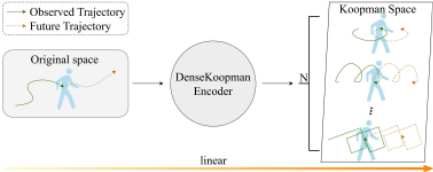
Although great progress has been made in recent years [Jeon et al., 2023; Zhang et al., 2023; Mohamed et al., 2022], pedestrian trajectory prediction is still affected by many unpredictable factors, such as different pedestrian walking posture habits, nonlinear motion systems, unknown intentions, and dense scenarios. All these factors can significantly reduce the accuracy and performance of pedestrian trajectory prediction. Among these disadvantages, pedestrian scene densification is perhaps the most intractable. Previous studies have proven that accuracy drops sharply as the density within a scene increases [Shi et al., 2019; Lisotto et al., 2019].
To address these challenges, numerous deep learning models have been proposed for predicting pedestrian trajectories in crowded scenarios, and these models have demonstrated excellent performance. For instance, several methods [Helbing and Moln´ar, 1995; Alahi et al., 2016] exploit social force to describe the self-organization of pedestrian behavior and propose many ingenious neural networks to imitate social interactions, while other methods [Dendorfer et al., 2021; Chen et al., 2021] apply the generative model to spread the distribution over all possible future trajectories or encode the multimodal distribution of future trajectories. These methods achieve high prediction performance within sparse scenes.
For both the social force and the generative model, when the density of pedestrians in the scene increases, the dynamic interaction characteristics of pedestrians become more complex and uncertain. Therefore, the difficulty of calculating the social relationships of a large number of pedestrians in the crowd and generating multiperson and multimodality prediction trajectories increases sharply, and the calculation accuracy is greatly affected.
Inspired by works on dynamical analysis of highway traffic [Avila and Mezi´c, 2020], we realized that Koopman theory has the potential to process data and improve model performance for temporal features in dense scenarios because it can construct state simulation transformations of nonlinear motion systems without needing to model their dynamics. Instead of spending much computing power to directly calculate and reason about the expression of the nonlinear system. Therefore, unlike most existing deep learning methods, we explore the nonlinear system of the original space from the perspective of a high-dimensional linear system. More specifically, we introduce Koopman theory, a key theoretical and popular tool in the field of fluid mechanics. In fact, in the field of various engineering applications, there are already many tasks that introduce and apply this theory, such as wind engineering [Li et al., 2023], soft robots [Bruder et al., 2021a], and model predictive control [Zhang et al., 2022]. In the field of pedestrian trajectory prediction, no work has introduced Koopman theory to predict pedestrian trajectories.
As shown in Figure 1, the Koopman theory is centred on the methodical linear portrayal of nonlinear systems, which provides a new way of representing pedestrian trajectories in extremely crowded scenarios. We propose a plug-and-play framework for dense pedestrian trajectory prediction by approximating the Koopman operator. First, the trajectories of the pedestrians in the scene are fed into our DenseKoopman encoder for space mapping, and the linear trajectory data in each Koopman space are obtained. Then, we apply various prediction algorithms to train and predict linear data within each of the Koopman spaces. Finally, we input the prediction results obtained from each Koopman space into our Dense Koopman decoder and obtain the future trajectories of pedestrians in the original space after superposition. In summary, this work has the following three major contributions.
- We incorporate the Koopman theory for nonlinear transformation in pedestrian trajectory prediction. To the best of our knowledge, this is the first study employing Koopman mode decomposition in this context.
- We propose a plug-and-play pedestrian trajectory prediction framework based on the Koopman theory, which can extract deeper pedestrian interaction features and achieve better pedestrian trajectory prediction in extremely crowded scenarios.
- We verify the applicability and effectiveness of DenseKoopman on three prediction models, which are representative models of the CNN, LSTM, and Stable Diffusion frameworks, respectively. The experimental results on three public datasets, which contain dense pedestrian scenes, prove the effectiveness of our DenseKoopman framework.
2 RelatedWorks
2.1 Pedestrian Trajectory Prediction
Existing methods predict future trajectories through learning past trajectory patterns. In the beginning stages of this discipline, researchers used a knowledge-based approach to consider pedestrians' physical and social factors. For instance, the SFM [Helbing and Moln´ar, 1995] introduces social force to describe the self-organization of pedestrian behavior. With the rapid development of deep learning, researchers have proposed many ingenious neural networks to imitate social interactions. In [Alahi et al., 2016], Social LSTM was designed to fuse neighboring nodes and generate multiple LSTM networks to obtain information about surrounding nodes by sharing the corresponding information of each node. Following Social LSTM, Trajectron++ [Salzmann et al., 2020] incorporating agent dynamics and heterogeneous data to forecasts the trajectories of a general number of diverse agents. In addition, Social-Implicit [Mohamed et al., 2022] cluster the observed trajectories based on their maximum observed speed and then generate the final output by combining the local and global streams via self-learning weights. Moreover, MID [Gu et al., 2022] formulate the trajectory prediction task as a reverse process of motion indeterminacy diffusion that can progressively discard indeterminacy from all the walkable areas until reaching the desired trajectory.
As the human density in the prediction scene increases, the computational cost of the prediction algorithm for crowd interaction modelling will also increase significantly, leading to a notable impact on the prediction accuracy. Several recent methods have been proposed to address the issue of predicting pedestrian trajectories in extremely crowded scenarios [Lisotto et al., 2019]. However, the effectiveness of these methods is not readily apparent, and a comprehensive algorithm framework for widely applicable crowded pedestrian trajectory prediction has yet to be established.
2.2 KoopmanMode Decomposition
Koopman theory is first proposed by Koopman [Koopman and Neumann, 1932] and has been widely applied in the field of fluid mechanics [Batchelor, 1967; Mezi´c, 2013]. Koopman mode decomposition, as known as KMD for the sake of brevity, is a set of infinite dimensional linear operators that describe the temporal evolution of observable (measurable) quantities in system dynamics [Bagheri, 2013; Williams et al., 2015]. Recently, KMD has attracted much attention due to state-of-the-art performance in various fields, including computational chemistry [Linscott et al., 2023; Tsuneda et al., 2010; Wu et al., 2017], robotics [Abraham and Murphey, 2019; Berger et al., 2015; Bruder et al., 2021b], computer vision [Wang et al., 2023; Zhang et al., 2021; Kostic et al., 2022; Mitjans et al., 2022]. However, the application of KMD to pedestrian trajectory prediction has not been explored in any research.
Our Approach. In this paper, we first introduce KMD to the pedestrian trajectory prediction field. Additionally, our work is the first to present a new data-driven-based framework to formulate the trajectory prediction task as linear prediction in Hilbert space.
3 ProposedMethod
In this section, we introduce our DenseKoopman method, which models pedestrian trajectory prediction tasks in dense crowd scenarios via Koopman mode decomposition.
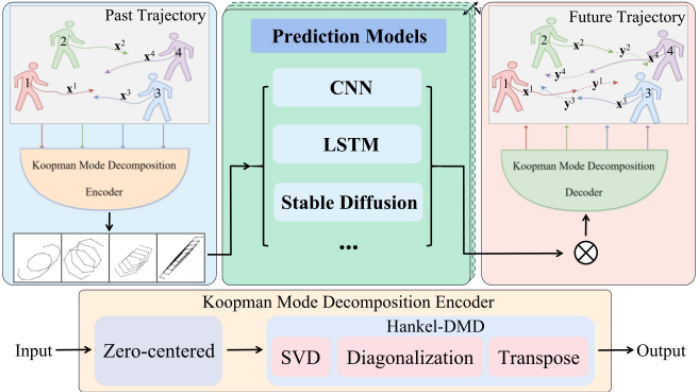
Specifically, we introduce the Koopman operator theory to find an embedding space for a global linear approximation of a nonlinear pedestrian motion system. By encoding historical trajectories as linear state embeddings in the Koopman space, we transforms nonlinear trajectory data for pedestrians in dense scenes. Then, we describe how the framework can be applied to upgrade general purpose algorithms to be applicable to dense crowd scenarios. Finally, we present the detailed framework architecture of our method in Figure 2.
3.1 Classic Koopman Theory
Definition 1. Before delving into the details of the proposed DenseKoopman framework, it is important to first provide a brief overview of the classic Koopman theory. Suppose that a discrete-time nonlinear dynamical system F can be represented by
where a0, at ∈ A are state vectors on the state space M, and St represents the solution of the dynamical system F. For a specific feature representation a0, the dynamics typically exhibit high-level non-linearity. The Koopman operator is a linear operator, and its spectrum enables the study of nonlinear, complex, and high-dimensional systems using linear techniques, albeit in an infinite-dimensional space.
Formally, for any function f and time t the action of the time-t Koopman operator on f can be expressed as follows [Koopman, 1931; Koopman and Neumann, 1932].
Where H is a Hilbert space of the function f, and U t is the Koopman semigroup of operators, parameterized by time t, which compose the functions in H with the solution St.
Due to the infinite dimensionality of the Koopman operator, its spectrum has the potential to include a continuous spectrum alongside the conventional point spectrum found in finite-dimensional operators. Assuming that the Koopman operator of a specific dynamical system contains only a point spectrum, its evolution in time is as follows [Mezi´c and Banaszuk, 2004].
Where φ ∈ H is an eigenfunction of U t , eλt is a Koopman eigenvalue for λ ∈ C. Moreover, a subspace A ⊂ H remains unchanged by the dynamics if, for any f ∈ A, its image under the flow, U t f ∈ A, remains constant for all time t.
If the Koopman eigenfunctions, or a subset of them, constitute a basis for an invariant subspace of H, then any function within the invariant subspace can be represented using the eigenfunction basis [Mezi´c and Banaszuk, 2004].
Definition 2. Formally, let ϕ = {φi}, i ∈ N be a set of Koopman eigenfunction and let εϕ = span(ϕ) be the Koopman eigenspace linked to the eigenfunction basis. The Koopman mode decomposition of any observable F can be formally expressed as follows.
Where vi = ⟨f, φ∗i ⟩ is the skew projection of f onto εϕ, obtained via the inner product of f and the dual eigenfunction
φ∗i , and is called a Koopman mode [Mezi´c and Banaszuk, 2004]. The finite-dimensional approximation of the Koopman operator U t is commonly achieved through the use of mode decomposition [Schmid, 2010].
3.2 ProblemFormulation
The objective of pedestrian trajectory prediction is to produce credible future trajectories for pedestrians by analysing their previous movements. The prediction system takes N historical trajectories in a scene as input and generates N future trajectories in the same scene as output.
Where the sit is the 2D location at timestamp t, Tpast indicates the length of the observed trajectory, and the current timestamp is t = 0.
3.3 TrajectoryMode Decomposition
Definition 3. The following section delves into the specific application of Koopman mode decomposition to pedestrian trajectory prediction. The past trajectory of N pedestrians in time Tpast can be expressed as a time-ordered data matrix X that contains a total of N data vectors. The 2D position coordinates of the pedestrian at an instant in time t correspond to the t-th column of the past trajectory data matrix X.
Where L is the 2D position coordinate of the pedestrian, with its elements forming the N-T matrix X. As previously stated, the Koopman operator U t can be perceived as the evolution of functions within the Hilbert space of all possible φ. However, the Koopman operator U t is not manageable due to its infinite-dimensional nature. Up to now, numerous algorithms have been developed to approximate the eigenfunctions, eigenvalues, and modes of the Koopman operator.
Theorem 1. The Exact-DMD seeks to approximate a finite-dimensional representation of the Koopman operator [Schmid, 2010]. A finite-dimensional matrix K can be utilized as an approximation of the Koopman operator, the results of which can be expressed as follows.
Where r is a residual error term arising from the finitedimensional approximation of a possibly infinite expansion.
The Exact-DMD achieves this approximation by minimizing the residual term using a least squares approach. Thus, by employing the singular value decomposition (SVD) of X = UΣW∗ is employed to rephrase X′ = KX + r as such.
By multiplying both sides of the above equation by U ∗ and considering that minimizing the residual term necessitates it to be orthogonal to U, we derive the expression in following equation.
By multiplying both sides of the above equation by WΣ-1 , we derive the expression in the following equation similarly.
Where S share the same eigenvalues and the eigenvectors with K.
Finally, since the sampled data produced a discrete time description of an originally continuous time process, kernel mean matching (KMD) can be utilized to derive a description of the observed data points through the following equation:
Where l is the dimension of the Koopman Mode Decomposition. And ωi is the continuous time eigenvalue, which is given by ωi = ln(λi) T , where T is the sampling rate and λi is the eigenvalues of K and S. Here, V is a matrix whose columns are the eigenvectors vi, b0 is a vector of coefficients associated with the initial data snapshot X, and eωt represents a diagonal matrix whose elements are eωit .
Consequently, it is possible to reconstruct the initial data to l dimensions within the Hilbert space. And the data in dimension i is represented as follows.
Theorem 2. As previously stated by Koopman theory, the Koopman operator is a linear operator, and its spectrum is within an infinite-dimensional Hilbert space.
Where Xkmd(i, t) is the data obtained after the decomposition of Xpast(t). Consequently, each data point decomposed using KMDmethods exhibits linearity, in contrast to the nonlinearity of the original dimensions. In time series prediction tasks, linear data are generally easier to predict than nonlinear data. The above is the main role of our KMD encoder network.
3.4 Training and Inference Objective
After performing Koopman Mode Decomposition on the trajectory data in the original space, we obtain the corresponding finite multidimensional data. In accordance with Koopman's theory, each dimension of the obtained data is inherently linear, thus enabling direct training of the model to learn these linear features after mode decomposition.
For nonlinear data, it is challenging for the model to learn its evolutionary characteristics and make predictions. However, for linearized data, accurate predictions are extremely easy to obtain. Similarly, the future trajectory of N pedestrians in time Tfuture can be expressed as a time-ordered data matrix Y that contains a total of N data vectors. The 2D position coordinates of the pedestrian correspond to the future trajectory data matrix Y .
Where Y is the future trajectory, which the model need to predict. For each dimension of the decomposed data Xkmd(i, t), the model will produce a linear prediction Ykmd(i, t).
Where Model is any pedestrian trajectory prediction model that can easily predict the evolution trend of linear data.
During training, we decompose the acquired data to augment the original spatial data. Each augmented datum is considered independent, and inference prediction is carried out by updating the model training parameters. Therefore, the plug-and-play framework proposed in this paper does not require changing the internal structure of the model during training, and it can be applied to any trajectory prediction model. Since the input and output of the trajectory prediction task consist of raw spatial data, a decoder is required to integrate the linear prediction data from each dimension during the reasoning and prediction process.
Where Ykmd(i, t) is the prediction of the data Xkmd(i, t), and Xkmd(i, t) is obtained after the decomposition of Xpast(t). Additionally, the Koopman Mode Decomposition decoder network plays the main role in our work.
3.5 Network Architecture
Different from other trajectory prediction models that directly train and predict nonlinear pedestrian motion trajectories, we design a new Koopman-based network for our DenseKoopman model. With the Koopman mode decomposition, the model can easily learn the evolutionary pattern of linearized data and make accurate predictions. Specifically, DenseKoopman consists of two key networks: a Koopmanbased encoder that can linearize the trajectory data in a datadriven manner and a decoder for trajectory mode combination. An overview of the entire architecture is illustrated in Figure 2. We introduce each part in detail in the following sections.
The Koopman-based encoder maps the historical trajectory of pedestrians in a scene to an infinite-dimensional Hilbert space and uses the Koopman Mode Decomposition method for decomposition to reduce the dimensionality and obtain a limited number of corresponding linearized enhanced data Xkmd(i, t). These linearized enhanced data are fed into the trainingmodel as independent training data. It is important to note that designing the model for training and inferring trajectories is not the main focus of our work. DenseKoopman is a model-agnostic framework that can be directly integrated with different pedestrian trajectory prediction models introduced in previous methods.
As depicted in Figure 2, the encoder's inputs consist of the motion trajectories of each pedestrian within the observed scene. The Koopman mode decomposition method is utilized in the encoder to process pedestrian trajectory data in the original space within the scene, resulting in the extraction of decomposed linearized data. Figure 2 clearly shows that these data exhibit clear linearization characteristics, making them amenable to learning and inference by diverse prediction models. Then, We verify the applicability and effectiveness of DenseKoopman on three prediction models, SocialImplicit [Mohamed et al., 2022], Trajectron++ [Salzmann et al., 2020], and MID [Gu et al., 2022], which are representative models of the CNN, LSTM, and Stable Diffusion frameworks, respectively. We can obtain the prediction results Ykmd(i, t) of each dimension by applying these models to learn and reason about the data Xkmd(i, t). Finally, the prediction results Ykmd(i, t) of each dimension are fed into the decoder network to obtain the future trajectory prediction of pedestrians in the original space. The decoder network is designed to integrate the linear prediction data from each dimension during the reasoning and prediction process. This superposition method can be readily applied to a variety of verification models.
4 Experiments
4.1 Experimental Setup
Datasets and Evaluation Metric. Different from existing research on pedestrian trajectory prediction, we use denser datasets than ETH/UCY [Lerner et al., 2007; Pellegrini et al., 2010] to simulate extremely crowded scenarios in the real world. We evaluated our method on three public datasets containing dense pedestrian scenarios, namely, Multiple Object Tracking 20 [Dendorfer et al., 2020], Head Tracking 21 [Sundararaman et al., 2021], VSCrowd [Li et al., 2022]. We employ two widely used metrics to evaluate the prediction accuracy, the average displacement error (ADE) and the final displacement error (FDE) [Alahi et al., 2016; Pellegrini et al., 2009]. The average displacement error (ADE) was calculated as the mean discrepancy between the actual positions and the estimated positions throughout the trajectory. On the other hand, the final displacement error (FDE) measures the difference in displacement between the final positions of the actual and predicted trajectories. For each dataset, we implemented the leave-one-out cross-validation approach, where the model was trained on four scenarios and then tested on the remaining scene [Salzmann et al., 2020; Kosaraju et al., 2019]. Given the probabilistic nature of our approach, we employed a Best-of-20 strategy to calculate the ultimate ADE and FDE. The size of the video images in each dataset is [1920, 1080] pixels. In all the scenarios, the locations of pedestrians are documented in relation to the pixel coordinates, resulting in pixel measurements.
| MOT 20 | HT 21 | VSCrowd | AVG | |||||
|---|---|---|---|---|---|---|---|---|
| ADE | FDE | ADE | FDE | ADE | FDE | ADE | FDE | |
| Social-Implicit | 31.8700 | 64.6662 | 46.7317 | 96.6619 | 64.0787 | 120.6881 | 47.5601 | 94.0054 |
| Trajectron++ | 89.1386 | 155.6726 | 157.6680 | 287.7625 | 73.9687 | 138.2461 | 106.9251 | 193.8937 |
| MID | 85.3863 | 148.8644 | 152.7899 | 278.2485 | 72.4891 | 135.3505 | 103.5551 | 187.4878 |
| DK+Social-Implicit | 4.6350 | 4.0771 | 19.2430 | 20.1432 | 7.0398 | 5.6340 | 13.1177 | 13.6081 |
| DK+Trajectron++ | 57.7387 | 37.1116 | 87.0235 | 62.8718 | 46.4417 | 41.9192 | 63.7346 | 47.3009 |
| DK+MID | 25.2022 | 27.0931 | 53.1306 | 59.3063 | 31.1145 | 29.5598 | 36.4824 | 38.6531 |
| Group | Methods | MOT20 | |
|---|---|---|---|
| ADE | FDE | ||
| 1 | SI | 31.8700 | 64.6662 |
| 2 | SI+Z-score | 30.6678 | 54.9980 |
| 3 | SI+Zero-centered | 32.1072 | 58.6256 |
| 4 | SI+Hankel-DMD | 6.2477 | 13.0819 |
| 5 | SI+Z-score +Hankel-DMD | 5.7004 | 5.2282 |
| 6 | SI+Zero-centered +Hankel-DMD (our KMD encoder) | 4.6350 | 4.0771 |
Baselines and Implementation Details. We choose three validation methods as our baseline, namely, Social-Implicit [Mohamed et al., 2022], Trajectron++ [Salzmann et al., 2020], and MID [Gu et al., 2022], which are representative of the CNN, LSTM and stable diffusion methods, respectively, for the pedestrian trajectory prediction task. The paths are sampled at intervals of 0.4 seconds, with the initial 3.2 seconds of a path serving as observed data for forecasting the subsequent 4.8 seconds of future trajectory. Therefore, we anticipate the future trajectories of pedestrians over a time frame of 12 frames based on their observed movements over a period of 8 frames. The sampling of trajectories is conducted at a frame rate of 2.5 frames per second. To verify the superiority of the proposed framework in crowded scenarios containing at least 20 people, we process data with [20 pedestrians, 8 seconds] as the spatiotemporal window.
4.2 Main Results
We apply our framework to current methods for quantitative comparison. Table 1 shows the comparison of these methods before and after applying our framework to three public datasets containing dense pedestrian scenarios. Obviously, for extremely dense pedestrian scenarios, existing pedestrian trajectory prediction algorithms involve large errors, and accurately predicting the motion trajectories of pedestrians is difficult.
Specifically, after applying our DenseKoopman framework, the original algorithm is greatly improved in terms of both the ADE and FDE accuracy metrics. This indicates that the enhanced accuracy in prediction results from improved performance in the Koopman Mode Decomposition, rather than from the use of training optimization techniques. It is worth noting that, regardless of the type of verification algorithm, the FDE significantly exceeds the ADE before applying our DenseKoopman framework. However, after applying our DenseKoopman framework, while the ADE and FDE are significantly reduced, the FDE is no longer significantly larger than the ADE.
4.3 KoopmanMode Analysis
To explore how DenseKoopman works with each validation method and uncovers motion patterns that may be hidden within the trajectory data, we analyse the data transformation before and after its passage through the encoder.
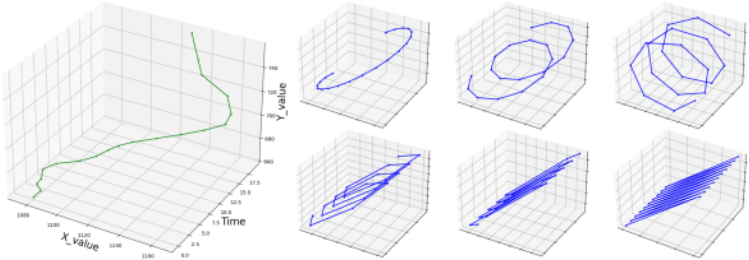
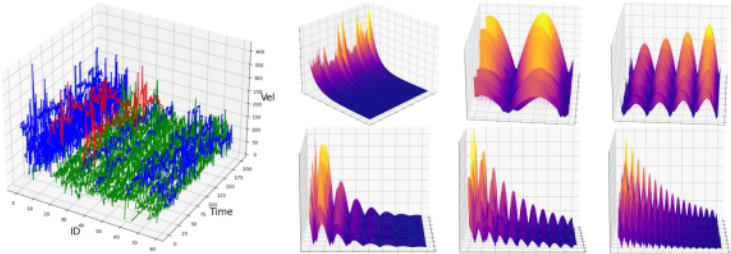
In Figure 3, we consider how the trajectory of a single pedestrian changes before and after passing through the encoder and find that the six leading patterns decomposed all have similar structures, showing a clear trend of periodic changes. As the mode decomposition progresses, the linearization becomes more pronounced. Moreover, Figure 4 plots the distribution of crowd movement velocities within the same scene. The crowd speed in the original space is chaotic, and even when the movement speed of the same person is not uniform, it shows strong irregularity and nonlinear changes. However, after passing through our KMD encoder, the velocity data exhibit similar uniform group characteristics in each of the Koopman modes. The ability to uncover such growing and decaying patterns is the significance of DenseKoopman.
4.4 Ablation Studies
In this subsection, we conducted ablation studies to investigate the effectiveness of each key component, including Zerocentered and Hankel-DMD.
Zero-centered. To examine the importance of the zerocentered approach in our framework, we reduced our zerocentered approach to the Z score or deleted the zero-centered approach. Groups 4, 5 and 6 in Table 2 show the performance comparison. Using the same method and datasets but without our Zero-centered approach, the results degrade significantly, demonstrating the effectiveness of our Zero-centered approach. In addition, replacing the Zero-centered module in our framework with the Z-score module leads to a decrease in accuracy, as shown for Group 5 and 6 in Table 2.
Hankel-DMD. We also conducted experiments to verify the necessity of Hankel-DMD. According to Groups 2, 3, 5 and 6 in Table 2, the method with Hankel-DMD outperforms the method without Hankel-DMD by a large margin, regardless of whether a zero-centered method was used previously. This indicates that Hankel-DMD is effective at obtaining the nonlinear characteristics of trajectories from our DenseKoopman framework. Specifically, groups 1 and 4, 2 and 5, and 3 and 6 are the three types of contrast items. The only variable is whether to apply Hankel-DMD, and by comparing the performance of these three items, it is easy to determine the necessity of Hankel-DMD.
5 Conclusions
In this work, we propose the dense pedestrian trajectory prediction framework DenseKoopman to formulate trajectory prediction in extremely crowded scenarios. In this framework, we design a pedestrian trajectory encoder for the Koopman space transformation to obtain a linear representation of the nonlinear original trajectory data in each space. And we apply the existing prediction method to learn and infer linear transformation data in each Koopman space. Finally, we use a corresponding decoder to overlay the linear data and output the prediction of the future trajectory of the pedestrian. The experimental results demonstrate the superiority of our method, which achieves state-of-the-art performance on three public datasets within extremely crowded scenarios. DenseKoopman could be applied to a wide range of applications with autonomous driving[Jiang et al., 2024]. With linear transformation, we can obtain the linear representation of the nonlinear original trajectory, which helps the predict model to generate accurate and reasonable future trajectories. Besides, DenseKoopman is able to handle other types of spatiotemporal sequence data, which has the potential to be applied in traffic flow prediction[Ren et al., 2022], human-robots interaction and nonlinear system. In addition, it is theoretically feasible to verify other methods of mode decomposition or dimension reduction. We leave it as future work to explore the feasibility of other decomposition methods for application in dense pedestrian scenes. Despite the accurate performance and generalization, the computational cost at model training process could be expensive due to multiple Koopman data spaces. Besides, the failure of linearization may occurs when the data lacks credibility and contains excessive noise.
Acknowledgments
This work is supported in part by Zhejiang Provincial Natural Science Foundation of China under Grant No.LD24F020008.
@inproceedings{ijcai2024p113,
  title     = {DenseKoopman: A Plug-and-Play Framework for Dense Pedestrian Trajectory Prediction},
  author    = {Li, Xianbang and Ren, Yilong and Jiang, Han and Yu, Haiyang and Cui, Yanlei and Xu, Liang},
  booktitle = {Proceedings of the Thirty-Third International Joint Conference on
               Artificial Intelligence, {IJCAI-24}},
  publisher = {International Joint Conferences on Artificial Intelligence Organization},
  editor    = {Kate Larson},
  pages     = {1020--1028},
  year      = {2024},
  month     = {8},
  note      = {Main Track},
  doi       = {10.24963/ijcai.2024/113},
  url       = {https://doi.org/10.24963/ijcai.2024/113},
}
TY - CPAPER TI - DenseKoopman: A Plug-and-Play Framework for Dense Pedestrian Trajectory Prediction AU - Li, Xianbang AU - Ren, Yilong AU - Jiang, Han AU - Yu, Haiyang AU - Cui, Yanlei AU - Xu, Liang T2 - Proceedings of the Thirty-Third International Joint Conference on Artificial Intelligence, IJCAI-24 PB - International Joint Conferences on Artificial Intelligence Organization PY - 2024 SP - 1020 EP - 1028 DO - 10.24963/ijcai.2024/113 UR - https://doi.org/10.24963/ijcai.2024/113 ER -Copied
Machine-readable versions of this paper, for tools and AI agents:





