
Automatic De-Biased Temporal-Relational Modeling for Stock Investment Recommendation
Proceedings of the Thirty-Third International Joint Conference on Artificial Intelligence. Main Track. Pages 1999-2008.
https://doi.org/10.24963/ijcai.2024/221
Keywords
- Multidisciplinary Topics and Applications: MTA: Finance
- Machine Learning: ML: Time series and data streams
- Data Mining: DM: Applications
- Data Mining: DM: Mining spatial and/or temporal data
Abstract
Stock investment recommendation is crucial for guiding investment decisions and managing portfolios. Recent studies have demonstrated the potential of temporal-relational models (TRM) to yield excess investment returns. However, in the complicated finance ecosystem, the current TRM suffer from both the intrinsic temporal bias from the low signal-to-noise ratio (SNR) and the relational bias caused by utilizing inappropriate relational topologies and propagation mechanisms. Moreover, the distribution shifts behind macro-market scenarios invalidate the underlying i.i.d. assumption and limit the generalization ability of TRM. In this paper, we pioneer the impact of the above issues on the effective learning of temporal-relational patterns and propose an Automatic De-Biased Temporal-Relational Model (ADB-TRM) for stock recommendation. Specifically, ADB-TRM consists of three main components, i.e., (i) a meta-learned architecture forms a dual-stage training process, with the inner part ameliorating temporal-relational bias and the outer meta-learner counteracting distribution shifts, (ii) automatic adversarial sample generation guides the model adaptively to alleviate bias and enhance its profiling ability through adversarial training, and (iii) global-local interaction helps seek relative invariant stock embeddings from local and global distribution perspectives to mitigate distribution shifts. Experiments on three datasets from distinct stock markets show that ADB-TRM excels state-of-the-arts over 28.41% and 9.53% in terms of cumulative and risk-adjusted returns.
- [Barabási and Albert, 1999] Albert-László Barabási and Réka Albert. Emergence of scaling in random networks. science, 286(5439):509-512, 1999.
- [Carta et al., 2021] Salvatore Carta, Anselmo Ferreira, Alessandro Sebastian Podda, Diego Reforgiato Recupero, and Antonio Sanna. Multi-dqn: An ensemble of deep q-learning agents for stock market forecasting. Expert systems with applications, 164:113820, 2021.
- [Cheng and Li, 2021] Rui Cheng and Qing Li. Modeling the momentum spillover effect for stock prediction via attribute-driven graph attention networks. In Proceed- ings of the AAAI Conference on artificial intelligence, vol- ume 35, pages 55-62, 2021.
- [Chung et al., 2014] Junyoung Chung, Caglar Gulcehre, KyungHyun Cho, and Yoshua Bengio. Empirical evalua- tion of gated recurrent neural networks on sequence mod- eling. arXiv preprint arXiv:1412.3555, 2014.
- [Ding et al., 2020] Qianggang Ding, Sifan Wu, Hao Sun, Ji- adong Guo, and Jian Guo. Hierarchical multi-scale gaus- sian transformer for stock movement prediction. In IJCAI, pages 4640-4646, 2020. IJCAI
- [Feng et al., 2019a] Fuli Feng, Huimin Chen, Xiangnan He, Ji Ding, Maosong Sun, and Tat-Seng Chua. Enhancing stock movement prediction with adversarial training. IJ- CAI, 2019. IJCAI
- [Feng et al., 2019b] Fuli Feng, Xiangnan He, Xiang Wang, Cheng Luo, Yiqun Liu, and Tat-Seng Chua. Temporal re- lational ranking for stock prediction. ACM Transactions on Information Systems (TOIS), 37(2):1-30, 2019.
- [Goodfellow et al., 2014] Ian J Goodfellow, Jonathon Shlens, and Christian Szegedy. Explaining and harnessing adversarial examples. arXiv preprint arXiv:1412.6572, 2014.
- [Granger, 1969] Clive WJ Granger. Investigating causal rela- tions by econometric models and cross-spectral methods. Econometrica: journal of the Econometric Society, pages 424-438, 1969.
- [He et al., 2022] Yanshen He, Qiutong Li, Feng Wu, and Jianliang Gao. Static-dynamic graph neural network for stock recommendation. In Proceedings of the 34th Inter- national Conference on Scientific and Statistical Database Management, pages 1-4, 2022.
- [Hospedales et al., 2021] Timothy Hospedales, Antreas An- toniou, Paul Micaelli, and Amos Storkey. Meta-learning in neural networks: A survey. IEEE Transactions on Pat- tern Analysis and Machine Intelligence, 44(9):5149-5169, 2021.
- [Hsu et al., 2021] Yi-Ling Hsu, Yu-Che Tsai, and Cheng-Te Li. Fingat: Financial graph attention networks for recom- mending top-k k profitable stocks. IEEE Transactions on Knowledge and Data Engineering, 35(1):469-481, 2021.
- [Huynh et al., 2023] Thanh Trung Huynh, Minh Hieu Nguyen, Thanh Tam Nguyen, Phi Le Nguyen, Matthias Weidlich, Quoc Viet Hung Nguyen, and Karl Aberer. Effi- cient integration of multi-order dynamics and internal dy- namics in stock movement prediction. In Proceedings of the Sixteenth ACM International Conference on Web Search and Data Mining, pages 850-858, 2023.
- [Khuwaja et al., 2021] Parus Khuwaja, Sunder Ali Khowaja, and Kapal Dev. Adversarial learning networks for fintech applications using heterogeneous data sources. IEEE In- ternet of Things Journal, 2021.
- [Kim et al., 2019] Raehyun Kim, Chan Ho So, Minbyul Jeong, Sanghoon Lee, Jinkyu Kim, and Jaewoo Kang. Hats: A hierarchical graph attention network for stock movement prediction. arXiv preprint arXiv:1908.07999, 2019.
- [Kingma and Ba, 2014] Diederik P Kingma and Jimmy Ba. Adam: A method for stochastic optimization. arXiv preprint arXiv:1412.6980, 2014.
- [Kipf and Welling, 2017] Thomas N. Kipf and Max Welling. Semi-supervised classification with graph convolutional networks. In International Conference on Learning Rep- resentations (ICLR), 2017.
- [Li et al., 2021] Wei Li, Ruihan Bao, Keiko Harimoto, Deli Chen, Jingjing Xu, and Qi Su. Modeling the stock re- lation with graph network for overnight stock movement prediction. In Proceedings of the twenty-ninth Interna- tional Conference on International Joint Conferences on Artificial Intelligence, pages 4541-4547, 2021. IJCAI
- [Li et al., 2022] Yang Li, Hong-Ning Dai, and Zibin Zheng. Selective transfer learning with adversarial training for stock movement prediction. Connection Science, 34(1):492-510, 2022.
- [Liang et al., 2018] Zhipeng Liang, Hao Chen, Junhao Zhu, Kangkang Jiang, and Yanran Li. Adversarial deep re- inforcement learning in portfolio management. arXiv preprint arXiv:1808.09940, 2018.
- [Lin et al., 2021] Hengxu Lin, Dong Zhou, Weiqing Liu, and Jiang Bian. Learning multiple stock trading patterns with temporal routing adaptor and optimal transport. In Pro- ceedings of the 27th ACM SIGKDD Conference on Knowl- edge Discovery & Data Mining, pages 1017-1026, 2021.
- [Liu et al., 2020] Yang Liu, Qi Liu, Hongke Zhao, Zhen Pan, and Chuanren Liu. Adaptive quantitative trading: An imi- tative deep reinforcement learning approach. In Proceed- ings of the AAAI conference on artificial intelligence, vol- ume 34, pages 2128-2135, 2020.
- [Næs et al., 2011] Randi Næs, Johannes A Skjeltorp, and Bernt Arne Ødegaard. Stock market liquidity and the busi- ness cycle. The Journal of Finance, 66(1):139-176, 2011.
- [Oord et al., 2016] Aaron van den Oord, Sander Diele- man, Heiga Zen, Karen Simonyan, Oriol Vinyals, Alex Graves, Nal Kalchbrenner, Andrew Senior, and Koray Kavukcuoglu. Wavenet: A generative model for raw au- dio. arXiv preprint arXiv:1609.03499, 2016.
- [Panaretos and Zemel, 2019] Victor M Panaretos and Yoav Zemel. Statistical aspects of wasserstein distances. Annual review of statistics and its application, 6:405-431, 2019.
- [Rezaei et al., 2021] Hadi Rezaei, Hamidreza Faaljou, and Gholamreza Mansourfar. Stock price prediction using deep learning and frequency decomposition. Expert Sys- tems with Applications, 169:114332, 2021.
- [Sawhney et al., 2021a] Ramit Sawhney, Shivam Agarwal, Arnav Wadhwa, Tyler Derr, and Rajiv Ratn Shah. Stock selection via spatiotemporal hypergraph attention net- work: A learning to rank approach. In Proceedings of the AAAI Conference on Artificial Intelligence, volume 35, pages 497-504, 2021.
- [Sawhney et al., 2021b] Ramit Sawhney, Shivam Agarwal, Arnav Wadhwa, and Rajiv Shah. Exploring the scale-free nature of stock markets: Hyperbolic graph learning for al- gorithmic trading. In Proceedings of the Web Conference 2021, pages 11-22, 2021.
- [Wang and Leu, 1996] Jung-Hua Wang and Jia-Yann Leu. Stock market trend prediction using arima-based neural networks. In Proceedings of International Conference on Neural Networks (ICNN'96), volume 4, pages 2160-2165. IEEE, 1996.
- [Wang et al., 2021] Heyuan Wang, Shun Li, Tengjiao Wang, and Jiayi Zheng. Hierarchical adaptive temporal-relational modeling for stock trend prediction. In IJCAI, pages 3691- 3698, 2021. IJCAI
- [Wang et al., 2022a] Heyuan Wang, Tengjiao Wang, Shun Li, and Shijie Guan. Hatr-i: Hierarchical adaptive tempo- ral relational interaction for stock trend prediction. IEEE Transactions on Knowledge and Data Engineering, 2022.
- [Wang et al., 2022b] Heyuan Wang, Tengjiao Wang, Shun Li, Shijie Guan, Jiayi Zheng, and Wei Chen. Heteroge- neous interactive snapshot network for review-enhanced stock profiling and recommendation. In IJCAI, pages 3962-3969, 2022. IJCAI
- [Wang et al., 2022c] Heyuan Wang, Tengjiao Wang, Shun Li, Jiayi Zheng, Shijie Guan, and Wei Chen. Adaptive long-short pattern transformer for stock investment selec- tion. In Proc. 31st Int. Joint Conf. Artif. Intell, pages 3970- 3977, 2022. IJCAI
- [Wang et al., 2022d] Jindong Wang, Cuiling Lan, Chang Liu, Yidong Ouyang, Tao Qin, Wang Lu, Yiqiang Chen, Wenjun Zeng, and Philip Yu. Generalizing to unseen do- mains: A survey on domain generalization. IEEE Trans- actions on Knowledge and Data Engineering, 2022. IJCAI
- [Wu et al., 2020] Zonghan Wu, Shirui Pan, Guodong Long, Jing Jiang, Xiaojun Chang, and Chengqi Zhang. Con- necting the dots: Multivariate time series forecasting with graph neural networks. In Proceedings of the 26th ACM SIGKDD International Conference on Knowledge Discov- ery & data mining, pages 753-763, 2020.
- [Xiang et al., 2022] Sheng Xiang, Dawei Cheng, Chencheng Shang, Ying Zhang, and Yuqi Liang. Temporal and het- erogeneous graph neural network for financial time series prediction. In Proceedings of the 31st ACM International Conference on Information & Knowledge Management, pages 3584-3593, 2022.
- [Xu et al., 2021] Ke Xu, Yifan Zhang, Deheng Ye, Peilin Zhao, and Mingkui Tan. Relation-aware transformer for portfolio policy learning. In Proceedings of the Twenty- Ninth International Conference on International Joint Conferences on Artificial Intelligence, pages 4647-4653, 2021. IJCAI
- [Ye et al., 2022] Junchen Ye, Zihan Liu, Bowen Du, Leilei Sun, Weimiao Li, Yanjie Fu, and Hui Xiong. Learning the evolutionary and multi-scale graph structure for multi- variate time series forecasting. In Proceedings of the 28th ACM SIGKDD Conference on Knowledge Discovery and Data Mining, pages 2296-2306, 2022.
- [Zhang et al., 2017] Liheng Zhang, Charu Aggarwal, and Guo-Jun Qi. Stock price prediction via discovering multi- frequency trading patterns. In Proceedings of the 23rd ACM SIGKDD International Conference on Knowledge Discovery and Data Mining, pages 2141-2149, 2017.
- [Zhao et al., 2022] Yu Zhao, Huaming Du, Ying Liu, Shaopeng Wei, Xingyan Chen, Fuzhen Zhuang, Qing Li, and Gang Kou. Stock movement prediction based on bi- typed hybrid-relational market knowledge graph via dual attention networks. IEEE Transactions on Knowledge and Data Engineering, 2022.
- [Zheng et al., 2023] Zetao Zheng, Jie Shao, Jia Zhu, and Heng Tao Shen. Relational temporal graph convolutional networks for ranking-based stock prediction. In 2023 IEEE 39th International Conference on Data Engineering (ICDE), pages 123-136. IEEE, 2023.
References were extracted automatically from the PDF and may contain errors.
Full text extracted automatically from the PDF; figures, tables and equations may differ. The PDF is the version of record.
1 Introduction
The stock market is an indispensable component of the financial ecosystem, which enables a large body of transactions between businesses and investors. Exploring methods for stock prediction carries significant economic implications and academic research value. With the rapid development of deep learning, deep neural networks have become a promising avenue for stock prediction. Most existing deep learning solutions formulate stock prediction as a classification (to predict stock trends) or a regression problem (to predict stock prices), which are not optimized toward the investment target, i.e., selecting the stocks that yield the highest profit. Recent breakthroughs in TRM target the disparity between optimizing optimal stock selection for maximizing profit [Sawhney et al., 2021a; Wang et al., 2022c; Feng et al., 2019b; Sawhney et al., 2021b; Wang et al., 2022b; He et al., 2022]. They jointly model temporal states and relational interactions to capture fine granular evolving patterns of the stock market. Despite previous successes, there are two significant challenges that have yet to be thoroughly explored.
∗Corresponding Author.
The first challenge is the temporal-relational bias of individual and grouped stock objects. Unlike general time-series tasks, the stock market is characterized by a low SNR nature. The mixture of multi-source noise can obscure the discovery of reliable prediction patterns and genuinely effective influencing factors, which leads to unstable gradient-based training and ineffective volatility patterns learning. To identify sound market signals, many stock prediction methods adopt a multi-level frequency decomposition approach [Zhang et al., 2017; Rezaei et al., 2021]. However, they may destroy the original statistical indicators, which are critical taskspecific information. Some other models apply complex attention mechanisms or hyper-networks to capture volatility patterns [Wang et al., 2022c; Zhao et al., 2022; Huynh et al., 2023], while the complex designs will exacerbate the overfitting in the low SNR stock data. On the other hand, relational bias can arise from the modeling of momentum spillover effects. In the stock market, the fluctuation event of a stock object not only determines its future movement but may also spread to associated companies [Cheng and Li, 2021; Zhao et al., 2022; Hsu et al., 2021; Wang et al., 2021; Wang et al., 2022a]. Existing methods exploiting stock relations generally rely on predefined adjacency graphs, which manifest the scale-free characteristics with a long-tailed distribution of node degrees. Hence, during the propagation of the observed relational signals through graph neural networks (GNN), a small number of hub stocks tend to receive the majority of momentum spillovers. This inevitably induces a notable bias between the attention and returns of various stock objects, as well as unfairness in investment recommendations. To alleviate such issues, the HyperStockGAT [Sawhney et al., 2021b] conducts relational modeling on the Riemannian Manifolds, and ALSP-TF [Wang et al., 2022c] applies multidimensional dynamic time warping to reconstruct the interstock dependencies from historical price curves. However, the evolution of stock correlations over time are overlooked. Furthermore, as the learning-to-rank loss function prioritizes top-ordered stocks and the influence of blended noise in the stock market, the optimization process is still prone to learning highly biased and noisy graphs.
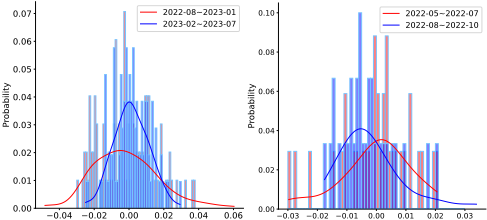
Apart from the micro-level bias of stock objects, the macro-market scenarios also suffer from distribution shifts due to non-stationary properties and economic cycles [Lin et al., 2021; Næs et al., 2011]. Figure 1 gives the illustrative examples. Even between adjacent time periods, the volatility of the stock market may undergo substantial changes. The distribution shifts actually invalidate the strict i.i.d. assumption in many stock prediction methods including current TRM. Neglecting this distribution shift phenomenon will have a detrimental impact on the model's prediction accuracy and stability. However, the common practices for handling distribution shifts including causal inference and domain generalization [Granger, 1969; Wang et al., 2022d] are inapplicable in this task, as it is hard to explore causality and prior domain identifiers for the evolution of financial time series.
In this paper, we propose ADB-TRM, an Automatic DeBiased Temporal-Relational Model to counter the above challenges in a unified meta-learning framework. ADB-TRM facilitates the extraction of invariant information from both global and local volatility distributions, which has two optimization stages. One is the inner meta-layer stage, which focuses on alleviating the temporal-relational bias through adversarial training in a local view, and the other is the outer meta-learner that interacts with the inner part to discover relative invariant information for alleviating distribution shifts in a global perspective. Specifically, we improve the robustness of extracting temporal dynamics in a noise-aware adversarial manner without requiring the decomposition of the original time series or attaching excessive model complexity. To leverage unbiased structures, we devise an adaptive dynamic graph learning approach for extracting inter-stock dependencies and automatically generate adversarial graph samples to steer the learned graphs away from highly biased conditions, which facilitates the robustness and fairness of our model's encoder and decoder. Our major contributions are as follows:
- We propose ADB-TRM with the aim of alleviating the bias from diverse stock objects and market scenarios in investment recommendations. The research plays a pioneering role in making accurate investment decisions by de-biasing the intrinsic stock market biases.
- The proposed de-biasing paradigm improves themodel's adaptability to dynamic market conditions and enhances its resilience against malicious attacks, a capability that current TRM lack. Detailed experiments also demonstrate the superior training convergence of the model.
- Through extensive experiments on three long-term datasets from NYSE, NASDAQ, and TSE exchange markets, we demonstrate the exceptional performance of ADB-TRM compared to state-of-the-art approaches.
2 RelatedWork
2.1 Stock Investment Recommendation
Stock investment recommendation redefines stock prediction as a learning-to-rank task. This approach necessitates choosing stocks with the highest returns from a vast stock pool, making the inter-stock correlations crucial additional market signals, which can significantly enhance returns and minimize losses. Recent work enhances the temporal extraction module and emphasizes the correlation information between stocks [Sawhney et al., 2021a; Wang et al., 2022c; Huynh et al., 2023; Zheng et al., 2023; Sawhney et al., 2021b; Hsu et al., 2021]. The above models are temporal-relational and have realized state-of-the-art profitability.
2.2 Adversial Training
Adversarial training [Goodfellow et al., 2014] can reveal the defects of models and improve their robustness. Most adversarial examples are generated by adding small perturbations to clean samples. We focus on the application of adversarial training in stock prediction. [Feng et al., 2019a] explores the potential of adversarial training in stock movement prediction, small perturbations are added to the hidden representation to improve the generalization of the model. Adversarial training is exploited in STLAT [Li et al., 2022] to improve the generalization against the stochasticity of stock. [Liang et al., 2018] proposes to combine deep reinforcement learning with adversarial training, which adds random noise to the market stock prices, improving the training efficiency and promoting average daily return and sharp ratio in the backtest. [Khuwaja et al., 2021] proposes to use two adversarial networks to increase the efficacy of stock prediction. The two adversarial networks are heterogeneous data fusion representing market crash Q-learning and confrontational Q-learning network.
3 Proposed Framework
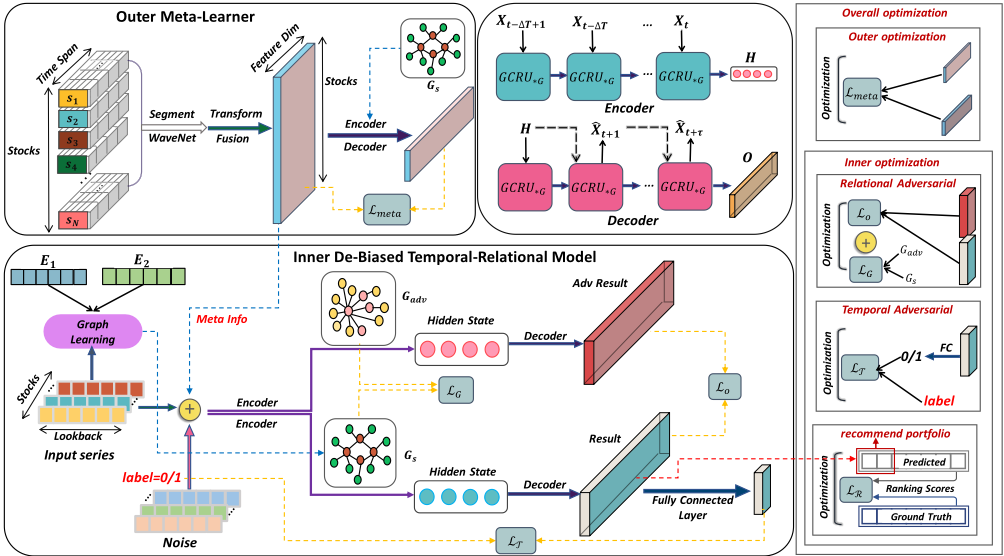
In this section, we describe our framework of ADB-TRM for stock ranking in detail. The framework is shown in Figure 2. We first present the stock recommendation task in our paper.
3.1 Stock Investment Recommendation
We conceptualize the task of stock prediction as a learningto-rank problem, with a focus on developing it for practical investment recommendations. Let cti be the closing price of stock i at time t, yt i = cti -ct-1 i ct-1 i is the associated 1-day return ratio. Given the stock relational graph Gs ∈ RN×N and stock prices X t ∈ RN×D , where N represents the number of all stocks, and D represents the feature dimension of each stock. Our objective is to develop a model Fθ(·), that accurately predicts the ranking of all stocks at a given time t. This ranking, P t = Fθ(Gs,X t ) = {pt1 ≥ pt2 ≥ . . . ≥ ptN }, is arranged such that stocks expected to generate higher revenues are ranked higher. The optimal outcome is to ensure that for any pair of stocks si, sj ∈ S, the stock si is ranked higher than sj (i.e., pti ≥ ptj ) if and only if yt i ≥ yt j .
3.2 Rank Loss
The objective of the rank loss is to assist in the identification of investment opportunities, specifically targeting the selection of top-ranked stocks [Feng et al., 2019b]. In ranking optimization, we obtain predicted return ratios for stocks on day t. Subsequently, we perform concurrent calculations for point-wise regression and pair-wise ranking losses, introducing a weighting coefficient denoted as λ. This approach is designed to minimize the disparity between the predicted values pt [1 : N] and the actual values yt [1 : N], while simultaneously preserving the relative order of the stocks:
3.3 De-biased Temporal-Relational Model
Following the bilevel optimization view [Hospedales et al., 2021], we first dive into the inner meta-layer stage.
Adaptive Graph Learning
First of all, we intend to infer static relational graph Gst to reveal the stable correlations (e.g., sector and industry). Using the low-rank approximation method, we randomly initialize two learnable parameters E1 ∈ RN×F ,E2 ∈ RF×N as two stock embedding dictionaries, where F is the hidden dimension. We propose the static relational graph Gst as:
We name E1 as the source stock embedding and E2 as the target stock embedding. By multiplying E1 and E2, we derive the relational weights between the sources and the targets.
Later, we intend to infer a time-specific adjacency matrix G tdy , which aims at capturing dynamic correlations between stocks. Specifically, G tdy [i, j] captures how much stock i is affected by stock j at a specific timestamp t. We use the normalized embedded Gaussian function to capture the correlation between X t i of stock i and X t j of stock j at t:
Eq.3 resembles the attention mechanism. We first use two embedding functions ρ and ϕ, to perform a linear transformation on the data between stock entities i and j. Specifically, an embedding function multiplies input data by a learnable weight matrix to generate linearly transformed data. We use two embedding functions because we want to distinguish source and target stocks, which enables us to capture asymmetric correlations between two stocks.
Besides, due to the smooth evolving nature of the graph structures [Ye et al., 2022], we assume that the G tdy remains unchanged in a time interval while having evolutionary relationships between adjacent time intervals. The final stock relation graph G t in within the input time-span at start time point tin can be calculated as follows:
where σ represents the Sigmoid activation function to normalize the value of the graph matrix to be (G t in )ij ∈ [0, 1].
Temporal-Relational Fusion
After obtaining G t in , we combine the GRU [Chung et al., 2014] with graph convolution [Kipf and Welling, 2017] as Graph Convolutional Gated Recurrent Unit (GCRU) to incorporate the momentum spillover signals among stocks into the temporal representation and infer the ranking results:
where Ht denotes the output of at time t, X t is the input series at time t, Rt,Ut are reset gate and update gate at time t respectively responsible for catching irrelevant information to forget and the part of past state to move forward. || is concatenation along the feature dimension and ⊙ represents the element-wise product. bR, bC, bU are model parameters, Inv is the relative invariant information learned by outer metalearner, and ⋆ is the two-step graph convolutional operation:
where W Q k , (k = 0, 1, 2) are trainable parameters, I is an identity matrix, and Xin denotes all of the input sequences. ADB-TRM adopts the architecture of encoder and decoder, both of which can be represented as Eq.5. The difference is that the encoder encodes historical information while the decoder decodes future stock sequences based on historical encoding embeddings. To simplify the notation, in subsequent representations, we use Enc(.) to represent the encoder, Dec(.) to represent the decoder of our proposed method, and P t ∈ RN as the stock predicted return ratios.
Temporal Adversarial Training
We propose temporal adversarial training (TAT) to enhance the model's predictability to counter the temporal bias. Specifically, we incorporate perturbations to mimic the inherent stochastic nature of stocks, training the model to perform effectively even under deliberate perturbations:
where τ is a temperature hyper-parameter and tp ̸= t. However, when the added noise is highly conspicuous, the process of identifying noise may not effectively enhance the temporal robustness of the model. Besides, considering the inherently low SNR in stock market data, introducing minimal noise levels can impede effective learning convergence. Consequently, we introduce a "warm-up" strategy for injecting noise into the input training data. As the number of training batches increases, the τ gradually escalates, resulting in a reduction in the amplitude of noise introduced:
where τo denotes the initialized temperature, S denotes the training batches, and δ is a hypermeter for restricting minimum amplitude. We decide whether to add noise to the input with equal probability, which means a becomes 0/1 with equal probability. Our training model judges whether noise is added to the X t from the final output P t to transform the temporal adversarial training into a binary classification task:
where FCT is one fully connected layer and BCE is the Binary CrossEntropy Loss. Unlike any previous method, we use stock sequences from different time periods as noise. These noise sources used for adversarial training can be obtained simply by sampling at different periods and reflect the evolution dynamics of stock variables themselves. We apply a binary classification task to make the model judge whether the noise is added to the input, which can effectively distinguish different temporal dynamics of stocks to enhance the capability to capture dynamic temporal patterns. Moreover, since noise itself implies the temporal dynamics of stocks, we only need to make the model aware of the presence of noise without noise removal. By minimizing LT , the model is encouraged to correctly classify both clean and adversarial samples, which helps perceive the inherent data distribution.
Relational Adversarial Training
As mentioned earlier, we adopt relational adversarial training (RAT) to boost the generalization capacity and modeling ability of the relational learning part. Specifically, we automatically generate adversarial samples for regularizing the learned dynamic graphs. In RAT, we consider the following three adversarial graph samples: (i) The degree ratio between nodes in the adversarial graph is high (degreemax/degreemin > U1). (ii) Extreme sparsity (Sparsity > U2) in adversarial graph samples. (iii) Excessive density (Sparsity < U3) in adversarial graph samples. Sparsity refers to the proportion of zero elements in a graph matrix, and Uk, (k = 1, 2, 3) are three hyperparameters.
To simulate the graph generation task in the real world, we use the Barabasi Albert (BA) graph model [Barab´asi and Albert, 1999] to generate the first type of adversarial graph. The hyperparameters of the BA graph model are designed to make the degree ratio between nodes in the generated adversarial graph fairly large. We further generate the second and third adversarial graph samples based on the first type to maintain the scale-free characteristics to some extent. Specifically, we generate overly sparse adversarial graph samples by randomly generating a mask matrix to mask the edges in the first generated adversarial graph. To generate overly dense adversarial graph samples, we add a noise matrix to the first generated adversarial graph. The probability setting of adopting the above three adversarial graph samples for adversarial training is 1:1:1. We mark the adversarial graph sample as Gadv, and we push the latent representation of G t in away from the latent representation of Gadv:
where FCG is one fully connected layer and MI is the metric used to measure the proximity of mutual semantic information. In addition to obtaining a well-represented graph, we hope that the encoder and decoder of ADB-TRM have robustness against erroneous relational interactions. Therefore, we express as follows:
Intuitively speaking, we use the same encoder and decoder parameters with different stock relational graphs to generate different ranking results. We increase mutual semantic information between the two ranking results to enhance the robustness of the model to the erroneous relational graph:
which means the model can make accurate inferences even when it receives erroneous relational interactions. The combination of LO and LG forms adversarial training because the simple way to increase the MI between P t and Padv is to make G t in as close as possible to Gadv, which counters LG.
3.4 Outer Meta-Learner
We introduce the outer meta-learner to address the inherent vulnerability of the inner meta component in handling distribution shifts. The role of the outer meta-learner is to effectively capture relative invariant information Inv pertaining to stocks, in contrast to the inner meta-layer. To operationalize this concept, it is imperative to endow the outer meta-learner with a comprehensive global perspective, enabling it to analyze and understand the temporal dynamics of stocks across diverse time spans. We input the whole training stock sequence Xall into the outer meta-learner to provide a global distribution perspective. From a long-term perspective, the patterns in different time intervals and across time intervals can be captured in parallel by splitting the stock series into segments. Specifically, we set a hyper-parameter period P to segment Xall into S = ⌊Ttrain/P⌋ segments, each containing time-series ˆXi, i = 1, 2, ..., S.. After acquiring these time-series segments, they are concatenated to form a fourdimensional tensor: Q = [ ˆX1∥ˆX2∥...∥ˆXS] ∈ RN×P×S×D .
To further emphasize the uniqueness of different time segments and the particular dynamic characteristics of stocks, we apply the WaveNet [Oord et al., 2016] across the dimension S and P to have different time perspectives and obtain two four-dimensional tensors:
WaveNet employs a stacked expansion convolution layer, which requires only a few layers to obtain a large receptive field while retaining the input resolution and computing efficiency. We then use three fully connected layers and one 1D convolution as feature extractors to perform dimensional transformation and information extraction on Z (1) and Z (2) :
where g(i) j , (j = 1, 2, 3, i = 1, 2) are six fully connected layers, I (i) ∈ RN×D . I (1) and I (2) harvest temporal information from different time perspectives (S and P ). We fuse I (1) and I (2) in the form of weighted sum to obtain Inv:
Inv contains the semantic information of the stock volatility patterns from the global perspective. To further train the outer meta-learner and discover robust time-invariant information, we leverage the interaction between the outer layer's global perspective and the inner layer's local view, akin to a latent projection. Specifically, we input Inv as the daily sequence information, i.e., X t = Inv and replace the original Inv with the same size zero tensor into the inner meta part, and obtain output Ievo. Intuitively, Ievo is the evolving result of Inv over a short time horizon. To ensure that Inv is relatively invariant stock embeddings, we aim to maximize the mutual semantic information between Ievo and Inv:
We feed Inv as the time-invariant info into the TemporalRelational Fusion module to mitigate distribution shifts.
4 Experiments
4.1 Experimental Setup
Dataset
We conduct an extensive analysis of ADB-TRM on three stock exchange datasets. Detailed statistics are presented in Table 2. The first dataset [Feng et al., 2019b] consists of 1,026 stock shares from the relatively volatile US S&P 500 and NASDAQ Composite Indexes. The second dataset [Feng et al., 2019b] encompasses 1,737 stocks listed on the NYSE, which is renowned as the world's largest stock exchange in terms of market capitalization of listed companies, and is comparatively more stable with NASDAQ. The third dataset [Li et al., 2021] is centered around the widely recognized TOPIX100 Index, which includes 95 stocks with the highest market capitalization on the Tokyo stock exchange.
| Methods | NASDAQ | NYSE | TSE | |||||
|---|---|---|---|---|---|---|---|---|
| SR | IRR | SR | IRR | SR | IRR | |||
| ARIMA [Wang and Leu, 1996] | Auto Regressive Integrated Moving Average to fit non-stationary stock price data | 0.55 | 0.10 | 0.33 | 0.10 | 0.47 | 0.13 | |
| CLF | ALSTM [Feng et al., 2019a] | Adversarial LSTM simulates stock stochasticity during training | 0.97 | 0.23 | 0.81 | 0.14 | 1.10 | 0.43 |
| HATS [Kim et al., 2019] | Hierarchical graph attention model to aggregate information from multi-graph | 0.80 | 0.15 | 0.73 | 0.12 | 0.96 | 0.31 | |
| HMG-TF [Ding et al., 2020] | Enhanced Transformer for learning multi-scale features of Finance data | 0.83 | 0.19 | 0.75 | 0.13 | 1.05 | 0.33 | |
| RL | DQN [Carta et al., 2021] | Annotation-free ensembled RL method for maximizing return function | 0.93 | 0.20 | 0.72 | 0.12 | 1.08 | 0.31 |
| iRDPG [Liu et al., 2020] | An enhanced model combines deep reinforcement learning and imitation learning | 1.32 | 0.28 | 0.85 | 0.18 | 1.10 | 0.55 | |
| RAT [Xu et al., 2021] | Relation-aware Transformer for portfolio selection with reinforcement learning | 1.37 | 0.40 | 1.03 | 0.22 | 1.20 | 0.64 | |
| REG | SFM [Zhang et al., 2017] | State Frequency Memory recurrent network for modeling multi-level time frequency | 0.16 | 0.09 | 0.19 | 0.11 | 0.08 | 0.07 |
| MTGNN [Wu et al., 2020] | Adaptive GNN framework with dilated inception module for time-series forecasting | 0.82 | 0.29 | 0.94 | 0.17 | 1.01 | 0.33 | |
| THGNN [Xiang et al., 2022] | A temporal and heterogeneous GNN based on learning dynamic relations | 0.88 | 0.31 | 0.78 | 0.13 | 1.15 | 0.41 | |
| RAN | RSR-E [Feng et al., 2019b] | Temporal GCN based on similarity measure as relation weight | 1.12 | 0.26 | 0.88 | 0.20 | 1.07 | 0.50 |
| RSR-I [Feng et al., 2019b] | Temporal GCN based on neural network to calculate relation weight | 1.34 | 0.39 | 0.95 | 0.21 | 1.08 | 0.53 | |
| STHAN-SR [Sawhney et al., 2021a] | A temporal-relational hypergraph attentive architecture for stock selection | 1.42 | 0.44 | 1.12 | 0.33 | 1.19 | 0.62 | |
| HyperStockGAT [Sawhney et al., 2021b] | Hyperbolic graph attention network on the Riemannian Manifolds for stock selection | 1.40 | 0.44 | 1.10 | 0.25 | 1.20 | 0.75 | |
| ALSP-TF [Wang et al., 2022c] | A temporal-relation adaptive transformer architecture for stock selection | 1.55 | 0.53 | 1.24 | 0.41 | 1.27 | 0.71 | |
| RT-GCN [Zheng et al., 2023] | A relational-temporal GCN based on three relation-aware strategies | 1.49 | 0.48 | 1.22 | 0.37 | 1.29 | 0.78 | |
| ADB-TRM (Ours) | Automatic de-biased temporal-relational model for stock selection | 1.66 | 0.66 | 1.42 | 0.58 | 1.38 | 0.93 | |
| Improve | Improvements over state-of-the-art | 7.10% | 24.53% | 14.52% | 41.46% | 6.98% | 19.23% | |
| Datasets | Stocks | Train Days | Valid Days | Test Days |
|---|---|---|---|---|
| NASDAQ | 1026 | 01/13-12/15 (756) | 01/16-12/16 (252) | 01/17-12/17 (237) |
| NYSE | 1737 | 01/13-12/15 (756) | 01/16-12/16 (252) | 01/17-12/17 (237) |
| TSE | 95 | 11/15-08/18 (693) | 08/18-07/19 (231) | 07/19-08/20 (235) |
Framework Training Strategy
We follow the bilevel optimization format as in [Hospedales et al., 2021], where the inner focuses on addressing temporalrelational bias and the outer part tackles distribution shifts:
where the data source Dsource is the price series of all stocks. We follow the normal training process of meta-learning and first train the parameters of the inner part, then fix the inner parameters and train the parameters of the outer meta-learner. The overall training procedure is end-to-end. It's important to highlight that the MI metric plays a significant role in our overall optimization strategy. As such, we conduct a thorough discussion on the selection of MI, with detailed experiments provided in Appendix A 1 . In Table 1, we utilize Wasserstein distance [Panaretos and Zemel, 2019] as the MI metric.
1 Appendix is provided in https://oncecwj.github.io/ADB-TRM-Appendix/Appendix.pdf
Implementation Details
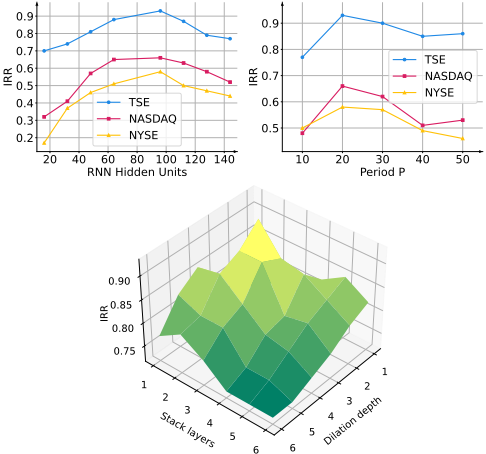
Our model is implemented with PyTorch. We collect stock data from Wind-Financial Terminal 2 , including normalized opening-high-low-closing prices and trading volume (OHLCV). For a fair comparison, we follow [Sawhney et al., 2021b] and generate samples by moving a 16-day lookback window along trading days. We use grid search to find optimal hyperparameters. For the proposed framework, the period P and dimension F are searched within {10, 20, 30, 40, 50} and finally set to 20 and 10, respectively. In temporal-relational fusion, we set the RNN hidden units Hu to 96. The dilation depth Dep and stacked layers Ls in WaveNet are both set to 2. The hyperparameters λ ∈ [1, 10], β, γ ∈ [0.5, 5], and b ∈ {1e2 , 5e2 , 1e3 , 1.5e3 , 2e3 } are finally set to 4, 1.2, 1.2, and 1e3 , respectively. The initial temperature τo ∈ {10-2 , 10-1 , 1, 10} and δ ∈ {10, 102 , 103 , 104 } are set to 1 and 103 . The hyperparameters U1 ∈ {20, 25, 30, 35, 40}, U2 ∈ {83%, 87%, 91%, 95%, 99%}, and U3 ∈ {63%, 67%, 71%, 75%, 79%} are finally set to 25, 95%, and 67%, respectively. We tune the model and ablation variants on one Nvidia GeForce RTX 3090 GPU by Adam optimizer [Kingma and Ba, 2014] for 50 epochs, the learning rate is set to 0.001, and the batch size is set to 20.
Metrics
Follow prior research [Sawhney et al., 2021b; Feng et al., 2019b], we employ a daily buy-hold-sell trading strategy to evaluate the profitability of ADB-TRM and use the Sharpe Ratio (SR) and the cumulative investment return ratio (IRR) as metrics. Specifically, the trader purchases k stocks with the highest anticipated revenues after the market closes on day t and sells these shares at the close of the following day's market session. Formally, IRRt = ∑i∈ ˆ S t ct+1 i -cti cti , where ˆ S t is the stocks in the portfolio on day t. The Sharpe Ratio (SR) is a risk-adjusted return metric that quantifies the additional earnings an investor receives per unit of increased risk, given by SR = E[Rp]-Rf std[Rp] . We also assess the model's ranking ability using the widely adopted metric nDCG@k. We report the mean results obtained from ten independent runs with k = 5.
2 https://www.wind.com.cn/en/wft.html
4.2 Overall Performance
Following the previous work [Sawhney et al., 2021a; Wang et al., 2022c], we consider four categories of baselines for comparison. The results are shown in Table 1, from which we have several observations: (1) In general, RL and ranking approaches (e.g., iRDPG, RSR) perform better in investment returns than conventional price classification and regression methods (e.g., HATS, SFM), which justifies the effectiveness of learning-to-rank optimization and temporal-relational modeling toward stock selection. (2) Through the strategic enhancement of TRM to counter temporal-relational bias and adapt to distribution shifts, our novel ADB-TRM consistently achieves superior results across all datasets. In particular, it demonstrates an average relative performance improvement of 9.53% and 28.41% in terms of risk-adjusted returns and cumulative profits when compared to the leading baseline models. Empowering the model with enhanced adjustment and error-correction capabilities in the context of a volatile and evolving stock market effectively bolsters its generalization and results in improved returns. (3) In contrast to the prior state-of-the-art temporal-relational models such as RTGCN and ALSP-TF, which exhibit consistent computational demands between training and testing phases, our ADB-TRM primarily assigns the computational load to the adversarial training stage rather than during inference, enhancing model performance without additional model complexity. The overall model structural design of ADB-TRM is lightweight.
Ablation Study
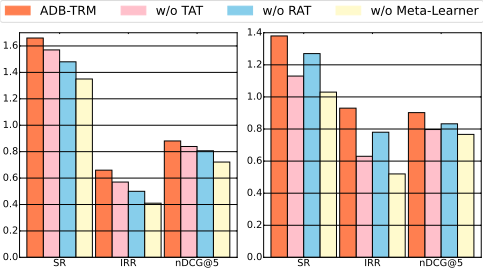
In our ablation experiments, we investigate the impacts of TAT, RAT, and the outer meta-learner on the overall performance. The results are depicted in Figure 3, with similar trends observed on NASDAQ and TSE, and comparable findings anticipated for the NYSE. As illustrated, these different components collectively contribute to enhanced performance. The ablation study demonstrates incremental improvements stemming from TAT, RAT, and the outer meta-learner. The primary benefits arise from the outer meta-learner, which effectively mitigates the substantial distributional shifts en-
*200
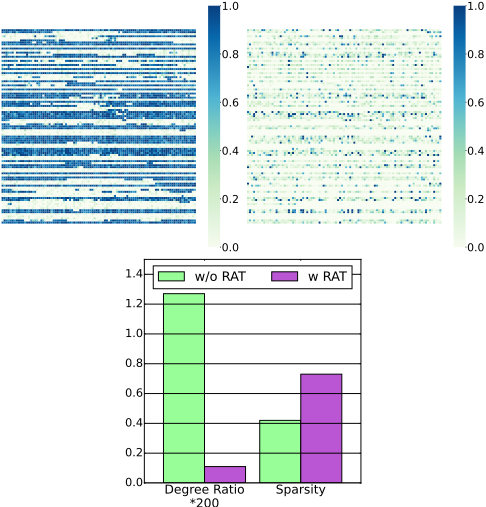
Figure 4: Visualization of learned relational graph with RAT (upper right) and without RAT (upper left). The lower figure compares the statistical properties of the learned graph with and without RAT.
countered in the stock market and enhances the model's generalization capabilities. Furthermore, it's noteworthy that the impact of RAT on the NASDAQ is significantly more pronounced than on the TSE, a trend similarly observed on the NYSE. This observation suggests that larger stock pools may exhibit a heightened susceptibility to relational bias.
Stock Graph Visualization
Figure 4 illustrates the role of RAT on the TSE dataset. In essence, the design of RAT primarily functions as a regularization mechanism, facilitating the sparsity of the learned graph and efficacious redistribution of momentum spillovers among stocks. The incorporation of RAT does not notably alter the intercorrelations between stocks but, instead, restructures the relational characteristics and eliminates potentially task-irrelevant connections, resulting in a more concise relational graph. Besides, RAT effectively uplifts the sparsity of the learned graph to a normal range and mitigates the degree polarization issue in the learned graph. Based on the results of the ablation experiment, these reformulations also contribute to an overall improvement in the model's profitability.
4.3 In-depth Analysis
Adversarial Attacks
Moreover, our findings reveal that the ADB-TRM is capable of effectively countering the impact of malicious activities (like stock price manipulation) within the temporal and relational domains on the overall revenue. In contrast, existing TRM are vulnerable to these attacks, leading to a swift decrease in overall profit. Details are provided in Appendix B.
4.4 Hyper-parameter Sensitivity
We focus on the number of RNN hidden units Hu, the segmentation period P, the stack layers Ls, and the dilation depth Dep. The experimental results on IRR are shown in Figure 5. Due to space limitations, we demonstrate the impact of Ls and Dep on the IRR metric on the TSE dataset, similar regularities can be observed on other datasets. Note that when studying the effect of one hyperparameter, others are kept as the default values. Specifically, the ADB-TRM model demonstrates a significant sensitivity to the hyperparameter Hu. If Hu is set too small, the model struggles to capture effective temporal patterns because the recurrent memory module has insufficient training parameters. Conversely, setting Hu too high can lead to issues in the volatile and low SNR stock market environment, resulting in overfitting. The effects of hyperparameters Ls and Dep on IRR exhibit a similar trend, with larger values rendering the model more vulnerable to noise within the stock market, albeit with diminishing returns. The influence of period P on the IRR exhibits a diminished effect. Specifically, when P assumes the value of 20/30, IRR attains its peak, a phenomenon that is likely attributable to the extraction of pertinent monthly features.
5 Conclusion
This paper pioneers alleviating the intrinsic temporalrelational bias and distribution shifts in the stock market by employing the well-designed meta-learning framework and carefully calibrated temporal-relational adversarial training techniques, thereby enhancing stock investment returns. Experiments are conducted on three real-world datasets from the US and Japanese Stock Exchange markets. The experiments cover four major categories and sixteen compared methods.
Results show that our model outperforms other non-rank and rank-based state-of-the-art stock investment methods. Detailed experiments also substantiate the efficacy of our approach in mitigating the biases within the stock market and fortifying the model's robustness.
Acknowledgements
This research is supported by the National Natural Science Foundation of China (No.62176005) and the Art Project of the National Social Science Fund of China (2022CC02195).
@inproceedings{ijcai2024p221,
  title     = {Automatic De-Biased Temporal-Relational Modeling for Stock Investment Recommendation},
  author    = {Chen, Weijun and Li, Shun and Yu, Xipu and Wang, Heyuan and Chen, Wei and Wang, Tengjiao},
  booktitle = {Proceedings of the Thirty-Third International Joint Conference on
               Artificial Intelligence, {IJCAI-24}},
  publisher = {International Joint Conferences on Artificial Intelligence Organization},
  editor    = {Kate Larson},
  pages     = {1999--2008},
  year      = {2024},
  month     = {8},
  note      = {Main Track},
  doi       = {10.24963/ijcai.2024/221},
  url       = {https://doi.org/10.24963/ijcai.2024/221},
}
TY - CPAPER TI - Automatic De-Biased Temporal-Relational Modeling for Stock Investment Recommendation AU - Chen, Weijun AU - Li, Shun AU - Yu, Xipu AU - Wang, Heyuan AU - Chen, Wei AU - Wang, Tengjiao T2 - Proceedings of the Thirty-Third International Joint Conference on Artificial Intelligence, IJCAI-24 PB - International Joint Conferences on Artificial Intelligence Organization PY - 2024 SP - 1999 EP - 2008 DO - 10.24963/ijcai.2024/221 UR - https://doi.org/10.24963/ijcai.2024/221 ER -Copied
Machine-readable versions of this paper, for tools and AI agents:





