
A Strategic Analysis of Prepayments in Financial Credit Networks
Proceedings of the Thirty-Third International Joint Conference on Artificial Intelligence. Main Track. Pages 3040-3048.
https://doi.org/10.24963/ijcai.2024/337
Keywords
- Game Theory and Economic Paradigms: GTEP: Auctions and market-based systems
- Game Theory and Economic Paradigms: GTEP: Noncooperative games
Abstract
In financial credit networks, prepayments enable a firm to settle its debt obligations ahead of an agreed-upon due date. Prepayments have a transformative impact on the structure of networks, influencing the financial well-being (utility) of individual firms. This study investigates prepayments from both theoretical and empirical perspectives. We first establish the computational complexity of finding prepayments that maximize welfare, assuming global coordination among firms in the financial network. Subsequently, our focus shifts to understanding the strategic behavior of individual firms in the presence of prepayments. We introduce a prepayment game where firms strategically make prepayments, delineating the existence of pure strategy Nash equilibria and analyzing the price of anarchy (stability) within this game. Recognizing the computational challenges associated with determining Nash equilibria in prepayment games, we use a simulation-based approach, known as empirical game-theoretic analysis (EGTA). Through EGTA, we are able to find Nash equilibria among a carefully-chosen set of heuristic strategies. By scrutinizing the equilibrium behavior of firms, we outline the characteristics of high-performing strategies for strategic prepayments and establish connections between our empirical and theoretical findings.
- [Bertschinger et al., 2023] Nils Bertschinger, Martin Hoe- fer, Simon Krogmann, Pascal Lenzner, Steffen Schulden- zucker, and Lisa Wilhelmi. Equilibria and convergence in fire sale games. In In Proc. of AAMAS, pages 215-223, 2023.
- [Bertschinger et al., 2024] Nils Bertschinger, Martin Hoefer, and Daniel Schmand. Flow allocation games. Mathemat- ics of Operations Research, 0, 2024.
- [Boss et al., 2004] Michael Boss, Helmut Elsinger, Martin Summer, and Stefan Thurner 4. Network topology of the interbank market. Quantitative Finance, 4(6):677-684, 2004.
- [Cont et al., 2010] Rama Cont, Amal Moussa, and Edson Bastos e Santos. Network structure and systemic risk in banking systems. In Handbook of Systemic Risk, pages 327-368. Cambridge University Press, 2010.
- [Eckbo et al., 2022] B Espen Eckbo, Xunhua Su, and Karin S Thorburn. Bank compensation for the penalty-free loan-prepayment option: Theory and tests. Tuck School of Business Working Paper, 0(1964843), 2022.
- [Eisenberg and Noe, 2001] Larry Eisenberg and Thomas H. Noe. Systemic risk in financial systems. Management Sci- ence, 47(2):236-249, 2001.
- [Elliott et al., 2014] Matthew Elliott, Benjamin Golub, and Matthew O Jackson. Financial networks and contagion. American Economic Review, 104(10):3115-3153, 2014.
- [Fricke and Lux, 2015] Daniel Fricke and Thomas Lux. Core-periphery structure in the overnight money market: evidence from the e-MID trading platform. Computational Economics, 45:359-395, 2015.
- [Gai and Kapadia, 2010] Prasanna Gai and Sujit Kapadia. Contagion in financial networks. Proceedings of the Royal Society A: Mathematical, Physical and Engineering Sci- ences, 466(2120):2401-2423, 2010.
- [Gallegati et al., 2022] Marco Gallegati, Thomas Carraro, and Edoardo Gaffeo. The Financial Accelerator Effect: Multiresolution Evidence from the C&I Business Loan Market. Available at SSRN 4145367, 2022.
- [Hoefer and Wilhelmi, 2022] Martin Hoefer and Lisa Wil- helmi. Seniorities and minimal clearing in financial net- work games. In Proc. of SAGT, pages 187-204, 2022.
- [Ioannidis et al., 2022] Stavros D Ioannidis, Bart de Keijzer, and Carmine Ventre. Strong Approximations and Irra- tionality in Financial Networks with Derivatives. In Proc. of ICALP, pages 76:1-76:18, 2022.
- [Ioannidis et al., 2023] Stavros D Ioannidis, Bart De Kei- jzer, and Carmine Ventre. Financial networks with sin- gleton liability priorities. Theoretical Computer Science, 963:113965, 2023.
- [Kanellopoulos et al., 2021] Panagiotis Kanellopoulos, Maria Kyropoulou, and Hao Zhou. Financial network games. In Proc. of ICAIF, pages 1-9, 2021.
- [Kanellopoulos et al., 2022] Panagiotis Kanellopoulos, Maria Kyropoulou, and Hao Zhou. Forgiving debt in financial network games. In Proc. of IJCAI, pages 335-341, 2022. IJCAI
- [Kanellopoulos et al., 2023] Panagiotis Kanellopoulos, Maria Kyropoulou, and Hao Zhou. Debt transfers in financial networks: Complexity and equilibria. In Proc. of AAMAS, pages 260-268, 2023.
- [Leventides et al., 2019] John Leventides, Kalliopi Loukaki, and Vassilios G Papavassiliou. Simulating financial conta- gion dynamics in random interbank networks. Journal of Economic Behavior & Organization, 158:500-525, 2019.
- [Li and Schürhoff, 2019] Dan Li and Norman Schürhoff. Dealer networks. The Journal of Finance, 74(1):91-144, 2019.
- [Mayo and Wellman, 2021] Katherine Mayo and Michael P Wellman. A strategic analysis of portfolio compression. In Proc. of ICAIF, pages 1-8, 2021.
- [Müller, 2006] Jeannette Müller. Interbank credit lines as a channel of contagion. Journal of Financial Services Re- search, 29:37-60, 2006.
- [Papp and Wattenhofer, 2020] Pál András Papp and Roger Wattenhofer. Network-Aware Strategies in Financial Sys- tems. In In Proc. of ICALP, 2020.
- [Papp and Wattenhofer, 2021] Pál András Papp and Roger Wattenhofer. Debt swapping for risk mitigation in finan- cial networks. In Proc. of ACM EC, pages 765-784, 2021.
- [Patruno, 1994] Gregg N Patruno. Mortgage prepayments: A new model for a new era. The Journal of Fixed Income, 4(3):42-56, 1994.
- [Rogers and Veraart, 2013] Leonard CG Rogers and Luit- gard AM Veraart. Failure and rescue in an interbank net- work. Management Science, 59(4):882-898, 2013.
- [Schuldenzucker et al., 2017] Steffen Schuldenzucker, Sven Seuken, and Stefano Battiston. Finding clearing payments in financial networks with credit default swaps is PPAD- complete. In Proc. of ITCS, pages 32:1-32:20, 2017.
- [Schuldenzucker et al., 2020] Steffen Schuldenzucker, Sven Seuken, and Stefano Battiston. Default ambiguity: Credit default swaps create new systemic risks in financial net- works. Management Science, 66(5):1981-1998, 2020.
- [Vitali et al., 2011] Stefania Vitali, James B Glattfelder, and Stefano Battiston. The network of global corporate con- trol. PloS one, 6(10):e25995, 2011.
- [Wah et al., 2017] Elaine Wah, Mason Wright, and Michael P Wellman. Welfare effects of market mak- ing in continuous double auctions. Journal of Artificial Intelligence Research, 59:613-650, 2017.
- [Wang and Wellman, 2017] Xintong Wang and Michael P Wellman. Spoofing the limit order book: An agent-based model. In Proc. of AAMAS, pages 651-659, 2017.
- [Wiedenbeck and Wellman, 2012] Bryce Wiedenbeck and Michael P Wellman. Scaling simulation-based game anal- ysis through deviation-preserving reduction. In Proc. of AAMAS, pages 931-938, 2012.
- [Wright and Wellman, 2018] Mason Wright and Michael P Wellman. Evaluating the stability of non-adaptive trading in continuous double auctions. In Proc. of AAMAS, pages 614-622, 2018.
References were extracted automatically from the PDF and may contain errors.
Full text extracted automatically from the PDF; figures, tables and equations may differ. The PDF is the version of record.
1 Introduction
A financial system can be understood as a credit network, in which nodes represent financial institutions such as firms engaging in financial transactions, and directed edges capture bilateral financial obligations between firms, with the weight on edges denoting the amount of the corresponding debt or liability. A firm's total assets encompass exogenous external assets (e.g., cash or claims on entities outside the network) and its future incoming payments due within the system; equity measures the amount of remaining assets after payments (total assets minus liabilities) if this is positive, and zero otherwise (in which case the firm is bankrupt/insolvent). Firms employ their total assets to fulfill their liabilities by making payments to lenders. Should a firm's assets prove insufficient to cover its liabilities, the firm enters default, leading to a reduction in the value of its assets, often through costly liquidation. The extent of this decrease is denoted by default costs, signifying that the firm will have only a portion of its total assets available for payments. On liquidation day, "clearing" takes place, with the calculation and execution of actual payments in the financial network. These payments adhere to three fundamental principles of bankruptcy law, as outlined by Eisenberg and Noe [2001]: i) absolute priority: firms must first settle their liabilities in full to attain positive equity; ii) limited liability: firms cannot pay more than their total assets; iii) proportionality: in the event of default, payments to lenders are made in proportion to the respective liability.
Prepayments generally refer to transactions in which a borrower opts to make repayments to lenders ahead of the debt's maturity. A common example of individual-level prepayment is observed in mortgage security markets, where some borrowers might pay off their mortgage loans before the designated maturity date [Patruno, 1994]. Prepayments are also prevalent in the financial sector, notably in the commercial and industrial (C&I) business loan market, which constituted approximately two-thirds of short-term credit in the US in 2022 [Gallegati et al., 2022]. C&I loans provide companies with funds for working capital or capital expenditures (e.g., machinery purchases). Penalty-free prepayments, often permitted in C&I loan agreements, offer borrowing firms the flexibility to prepay without subsequent penalties 1 . Lenders universally accept such prepayments, so our work assumes such consistent acceptance (i.e., prepayments are always accepted by the lenders [Eckbo et al., 2022]). Motivations for prepayments can vary among firms in practice. Some borrowers prepay loans to lower the firm's leverage ratio (e.g., debt-to-asset ratio), while others may aim to reduce total interest costs or mitigate interest rate risk.
In our context, prepayments specify the early utilization of a firm's external assets to fulfill its liabilities before the clearing process for a given financial system. An individual firm in a financial network can have incentives to prepay with the following underlying rationale: in the event of firm bankruptcy during clearing, a firm can only employ a fraction of its original total assets to settle its liabilities due to the presence of default costs; if the firm decides to prepay before the anticipated clearing day, prior to the realization of default costs, then it can make full use of its external assets. These undiscounted prepayments could potentially prevent other firms from facing bankruptcy, yielding augmented cash flow throughout the network during clearing. In return, the augmented cash flow could benefit the firm initiating the prepayments when it flows back. Given that making prepayments leads to an immediate loss in a firm's external assets (and, consequently, in utility), strategic decisions regarding whether to prepay and whom to prepay should be contingent on whether the resulting benefit can offset the immediate loss. Our study explores the impacts of strategic prepayments in financial credit networks, addressing relevant questions through a blend of theoretical and empirical analyses.
1 Borrowers typically incur an upfront fee for the penaltyfree prepayment option during the loan commitment drafting phase [Eckbo et al., 2022].
Contributions. Our work has three main contributions:
- We establish prepayment games, where the act of making prepayments is a strategic decision;
- Using our game model, we offer a comprehensive theoretical understanding of the existence, (in)efficiency, and computational aspects of equilibria in prepayment games; and
- We scrutinize the equilibrium behavior of firms in prepayment games through the application of empirical game-theoretic analysis (EGTA), involving gametheoretic reasoning via extensive simulation.
Specifically, when assuming firms have complete information of the credit network, we prove that computing a prepayment profile that maximizes the sum of total assets or total equity is NP-complete if there are non-trivial default costs. Then we shift our focus to understanding the strategic behavior of individual firms in the presence of prepayments. We first introduce prepayment games where firms strategically decide which lender to prepay. Then we explore the existence, quality, and computational complexity of pure-strategy Nash equilibria (PSNE) under two different utility models; total assets and equity. We observe that PSNE may not exist when firms aim to maximize their total assets in the presence of default costs, whereas they always exist when the goal is to maximize equity, irrespective of default costs. By assessing the quality of equilibria, we find that, when firms' utility is total assets, even the best PSNE can have arbitrarily bad social welfare (sum of firms' utilities) relative to the optimal subset of prepayments. In contrast, when utility is defined in terms of equity, the best PSNE is socially optimal. However, the worst PSNE remains arbitrarily inefficient. Furthermore, we emphasize the intractability of determining PSNE existence and computing the best response in the total-assetbased setting, whereas these problems are trivially solvable in the equity-based setting. The computation of the best PSNE remains NP-hard in the equity-based setting.
Finally, we complement our theoretical results with an empirical analysis through EGTA, with a realistic setting where firms only have local information about the network. We discover the existence of mixed Nash equilibria with prepayment strategies in the equilibrium support, demonstrating higher social welfare compared to abstaining from prepayments. This underscores the benefits of prepayments in financial systems. Additionally, we perform a systematic ablation study, unveiling the strengths and weaknesses of different prepayment strategies and providing insights for making beneficial prepayments.
Related work. Our model is grounded in the influential work of Eisenberg and Noe [2001] in which firms are nodes that are connected via debt contracts, with proportional payments in the case of insolvency. Subsequent work extended the basic model, incorporating features such as default costs [Rogers and Veraart, 2013], cross-ownership relations [Elliott et al., 2014; Vitali et al., 2011], and credit default swaps [Schuldenzucker et al., 2020; Papp and Wattenhofer, 2020]. Rogers and Veraart [2013] prove the existence of maximal clearing payments in the presence of default costs and provide an efficient algorithm to compute them. Schuldenzucker et al. [2017] demonstrate the intractability of finding clearing payments with credit default swaps. Ioannidis et al. [2022] study the clearing problem from the point of view of irrationality of solutions and strength of approximation, while Ioannidis et al. [2023] investigate the complexity of clearing problems in networks with derivatives and lender priorities.
A game-theoretic approach to financial networks is introduced by Bertschinger et al. [2024]. They relax the principle of proportionality [Eisenberg and Noe, 2001] and model payments under bankruptcy as a decision-making process. In particular, they propose two different payment schemes - coinranking and edge-ranking - and present a range of results on the existence and quality of equilibria arising in games corresponding to each payment scheme. Kanellopoulos et al. [2021] extend this line of research by examining priorityproportional payment schemes. Furthermore, Papp and Wattenhofer [2020] analyze firms' incentives for redefining liabilities and donating external assets. In subsequent work, Papp and Wattenhofer [2021] investigate the impact of debt swaps in risk mitigation. In recent contributions, Hoefer and Wilhelmi [2022] investigate clearing games with varying seniorities, while Bertschinger et al. [2023] study equilibria in a game that models fire sales, analyzing the convergence of best-response dynamics. Kanellopoulos et al. [2022] study edge-removal games where each bank wants to maximize its total assets by strategically removing a part of incoming edges, and provide results about the properties of resulting equilibria. More recently, the same authors investigate debt transfer games, where banks can be strategic about whether or not to transfer their debt claims, and complement their theoretical study with an empirical game analysis [Kanellopoulos et al., 2023]. To the best of our knowledge, our work is the first to study a model for financial networks with prepayment.
Extensive empirical research on financial network topologies indicates that very different structures may arise, ranging from centralized networks [M¨uller, 2006] to core-periphery structures [Fricke and Lux, 2015; Li and Sch¨urhoff, 2019] and scale-free structures [Boss et al., 2004; Cont et al., 2010].
Additionally, numerous studies, including [Gai and Kapadia, 2010; Elliott et al., 2014; Leventides et al., 2019], simulate default contagion within random networks. A comparable random financial network has been employed by Mayo and Wellman [2021] to simulate strategic behavior from an empirical game-theoretic perspective.
2 Preliminaries
We examine a financial credit network model proposed by Rogers and Veraart [2013]. Specifically, we analyze a network G where nodes represent firms, and edges symbolize debt contracts. Each firm vi initially holds non-negative external assets ei, representing liquid assets received from entities external to the financial system. Moreover, firms are connected by directed edges that represent liabilities. The directed edge (vi, vj) signifies a financial relationship between firms vi and vj , with lij ≥ 0 denoting the liability that firm vi (the borrower) has to firm vj (the lender). If no directed edge connects firms vi and vj, then vi has no liability to vj, and lij = 0. The graph G is irreflexive, meaning no firm can be liable to itself, resulting in a directed and positively weighted graph without self-loops. It is worth noting that both lij > 0 and lji > 0 might coexist. The total liabilities of vi are denoted by Li = ∑j lij. Firms capable of fully meeting their obligations are considered solvent, while those unable to do so are labeled in default or insolvent interchangeably.
Let pij denote the actual payment made by firm vi to firm vj , where pij may not be equal to the liability lij , and pii = 0. We denote by P = (pij) for i, j ∈ [n] the induced payment matrix, where [n] := {1, . . . , n}. The total outgoing payments of vi are represented by pi = ∑j∈[n] pij. In the case of insolvency, a firm may need to liquidate its assets or make payments beyond the financial system, such as salary disbursements. Consequently, a defaulting firm can only utilize an α fraction of its external assets and incoming payments. When α = 1, it means an absence of default costs. Payments P aligned with the three principles discussed in the introduction are termed clearing payments. Specifically, a solvent firm must fully pay all its obligations, while a firm in default can only pay partially but should repay as much of its debt as possible, based on its total assets affected by the default costs. A partial payment to a lender should be proportional to its liability to the same lender. Mathematically, the clearing payment from vi to vj with i, j ∈ [n] satisfies pij = lij when vi is solvent, and pij = α · (ei + ∑nj=1 xji) · lij Li when vi is in default. It is important to note that clearing payments are not necessarily unique; however, we focus on maximal clearing payments-those that point-wise maximize all corresponding payments. Such maximal clearing payments are known to exist and unique, and can be computed in polynomial time [Rogers and Veraart, 2013].
Strategic prepayments. Prepayments in our context are the settlement of debt obligations ahead of clearing using external assets. For a given financial network G, a single prepayment from borrower vi to lender vj results in a direct reduction of vi's external assets ei by an amount equal to the liability lij (i.e., e′i = ei -lij); meanwhile, there is an increase of lij to vj's external assets (i.e., e′j = ej +lij), accompanied by a cancellation of the liability lij.
Each firm vi has the option to select a set of lenders to prepay, and consequently, a strategy determines the chosen set of lenders for prepayment. Assuming that all firms strategically engage in prepayments to enhance their individual financial well-being, this naturally leads to the formulation of a prepayment game in strategic form. Let Di and Ci represent the sets of borrowers and creditors for vi, respectively. Consequently, each pure strategy of firm vi constitutes a subset C ′ i ⊆ Ci of lenders to prepay. A mixed strategy for firm vi is defined as a discrete probability distribution over the power set of its lenders Ci. A pure strategy profile, denoted by s = (s1, . . . , sn) or s = (si, s-i), specifies a pure strategy for each firm. Here, the pure strategy profile for all firms except vi is denoted by s-i.
Given a prepayment profile 2 , s, and the corresponding clearing payments P, we explore two definitions of a firm's utility. The total assets of firm vi encompass the updated external assets post-prepayments, along with its incoming clearing payments, expressed as ai(P) = e′i + ∑j∈[n] pji, while its equity is defined as Ei(P) = max{0, ai(P) -L′i }. Here, e′i and L′i represent vi's updated external assets and total liabilities, respectively, under the strategy profile s. Specifically, e′i is computed as ei + ∑j∈D′i lji - ∑j∈C′ i lij, and L′i is determined by Li - ∑j∈C′ i lij, where D′i denotes the set of vi's borrowers choosing to prepay vi under s. When P is clear from the context, the notation ai and Ei will be used. The social welfare SW(P) is the sum of the firms' utilities, with the specific utility notion (total assets or equity) clarified by the context. The optimal social welfare (chosen globally, disregarding strategic considerations) is denoted by OPT .
We consider Nash equilibrium (NE) as our strategic solution concept for prepayment games. A NE is a strategy profile in which no firm has an incentive to unilaterally deviate (and improve its utility); if such a profile is pure, we call it a pure-strategy Nash equilibrium. Let Peq be the set of clearing payments consistent with all pure NE strategy profiles. The Price of Anarchy and Price of Stability in a game are characterized by the worst-case and best-case ratios, respectively, of the optimal social welfare over the achieved welfare at any equilibrium, considering all potential networks. Formally, PoA = maxGmaxP∈Peq OPT SW(P) , and PoS = maxG minP∈Peq OPT SW(P) , respectively. At times, a broader class of equilibria is considered, (e.g., mixed or correlated equilibria), but we focus on PSNE in this work.
An illustrative example. Figure 1 presents a specific financial network that exemplifies an individual firm's incentive to prepay, illustrating some key concepts. If v1 chooses to prepay v2, where the liability l12 is 4, v1's external assets directly decrease from 4 to 0. Simultaneously, v2's external assets become 4, leading to the removal of the edge (v1, v2). The clearing payments before and after this prepayment are outlined below.
2 Throughout this paper, the terms 'strategy profile' and 'prepayment profile' are used interchangeably.
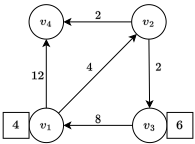
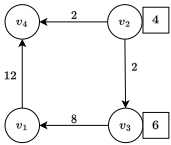
In this example, we assume a default cost of α = 12 . In the initial network (without prepayments), firm v1 defaults since its potential maximum total assets of 12 fall short of total liabilities of 16. This triggers a default contagion, rendering v2 and v3 insolvent sequentially. Consequently, the clearing payments are p12 = 8 9 , p14 = 24 9 , p23 = p24 = 29 , and p31 = 28 9 with total assets a1 = 64 9 , a2 = 89 , a3 = 56 9 , a4 = 26 9 , and equities E1 = E2 = E3 = 0, and E4 = 26 9 .
However, if v1 strategically prepays v2, both v2 and v3 become solvent, avoiding asset loss due to default costs. This results in more payments on the existing edges, including those flowing back to v1. The clearing payments in this case are p′14 = 4, p′23 = p′24 = 2, p′31 = 8 with a′1 = 8, a′2 = 4, a′3 = 8, a′4 = 6, and equities E′1 = E′2 = E′3 = 0, and E′4 = 6, respectively. These values can be easily verified by running the clearing algorithm of Rogers and Veraart [2013]. We can conclude that v1 is better off after the prepayment in terms of total assets, i.e., a′1 > a1, although it remains insolvent with zero equity.
3 Computing Optimal Prepayments
We start with the centralized setting, where as motivation one can imagine a financial regulator that possesses the authority to govern each firm. We present computational hardness results associated with achieving specific objectives related to the financial well-being of the entire system. With this in mind, we define three decision problems. The first is PARTITION, a well-known NP-hard problem, whilst the other two decision problems correspond to the maximization of total assets and equity in financial networks. All missing proofs are included in the full version.
Decision Problem 1 (PARTITION). Given an instance I that consists of a set X of positive integers {x1, x2, . . . , xk}, determine whether there exists a subset X′ of X such that ∑i∈X′ xi = ∑i/∈X′ xi = 1 2 ∑i∈X xi.
Decision Problem 2 (MAX-SUM-TOTAL-ASSETS). Given a financial credit network G and a positive constant µ, determine whether there exists a prepayment profile such that the sum of total assets is greater than or equal to µ.
Decision Problem 3 (MAX-SUM-EQUITY). Given a financial credit network G and a positive constant µ, determine whether there exists a prepayment profile such that the total equity is greater than or equal to µ.
Theorem 1. MAX-SUM-TOTAL-ASSETS is NP-complete.
Note that this result holds for any α ∈ [0, 1]. Next, we consider the objective of maximizing total equity.
Lemma 1. ([Schuldenzucker et al., 2020]). In the networks without default costs, the total equity always equals the sum of external assets, that is, ∑i Ei = ∑i ei.
An implication of Lemma 1 is that any prepayment profile maximizes the total equity. The situation changes significantly, however, in the presence of non-trivial default costs. We formally present these remarks in the following result.
Theorem 2. MAX-SUM-EQUITY is
- trivial when α = 1;
- NP-complete when α ∈ [0, 1).
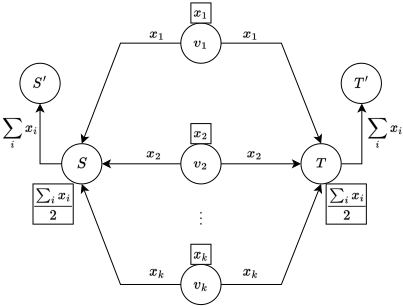
Proof Sketch. We only present a proof sketch here. For case a) the statement holds by Lemma 1. In case b), we demonstrate that MAX-SUM-EQUITY is in NP by employing the maximal cleaning payments algorithm, which runs in polynomial time [Rogers and Veraart, 2013], to verify if a proposed prepayment profile achieves the total equity at least value µ. Thereupon, we establish the NP-hardness of MAXSUM-EQUITY by reducing it from the PARTITION problem. The reduction works as follows. Given an instance I of PARTITION problem, we construct an instance I ′ of MAXSUM-EQUITY. We add firms vi for each element xi ∈ X; we also allocate an external asset of xi to vi. Additionally, we include four additional firms S, S′ , T and T ′ and allocate an external asset of 1 2 ∑i∈X xi to both S and T. Each firm vi has a liability of xi to S and T , while S and T have a liability of ∑i∈X xi to S′ and T ′ respectively; see also Figure 2. Clearly, the reduction requires polynomial time.
By minimizing default costs through prepayments and ensuring prepayments to firm S and T , the total equity is equal to 2 ∑i∈X xi, reaching its maximum value. Finally, we prove that I is a yes-instance for PARTITION if and only if the prepayment profile has total equity of 2 ∑i∈X xi.
Note that the hardness of decision problems 2 and 3 immediately imply that the corresponding optimization problems are computationally intractable unless NP = P.
4 Prepayment Games
We turn our attention to the scenario where firms strategically determine prepayments to maximize their utility. Specifically, we investigate two variations of prepayment games, in which the utility of a firm is defined by total assets and equity respectively. For each variant, we examine the existence, quality, and computational complexity of finding PSNE. In both the total asset and equity setting, we assume that the firms know the financial network G.
4.1 Maximizing Total Assets
We first consider prepayment games where firms attempt to maximize their total assets and investigate the existence of PSNE. The following result establishes the existence of a unique PSNE in prepayment games without default costs.
Theorem 3. In the total assets setting, for α = 1, the prepayment profile where no firm prepays is the unique PSNE.
The existence of pure equilibria, however, is not guaranteed when non-trivial default costs apply.
Theorem 4. In the total assets setting, there is a game such that for all α ∈ (0, 1) there is no PSNE.
Next, we investigate the quality of pure equilibria and observe that even the best pure equilibria can be highly undesirable in terms of social welfare.
Theorem 5. In the total assets setting, for all α ∈ [0, 1], the Price of Stability is unbounded.
We conclude with our results on computational complexity for the setting with default costs. These findings are quite negative and mean that computing pure equilibria with total assets is not tractable, which essentially serves as a foundational motivation for the subsequent exploration of EGTA in Section 5.
Theorem 6. In the total assets setting, for all α ∈ (0, 1), the following problems are NP-hard:
- verifying if a given strategy profile is a PSNE even when PSNE are guaranteed to exist;
- computing the best response strategy;
- deciding if there exists a PSNE.
4.2 Maximizing Equity
We now turn our attention to prepayment games where utility is defined by equity. In contrast to the negative results considering total assets, we illustrate that prepayment games with equity-based utilities possess several desirable properties. To begin, we establish the existence of PSNE, even in the presence of default costs.
Theorem 7. In the equity setting, for all α ∈ [0, 1], any prepayment profile is a PSNE.
According to Theorem 7, the strategy profile with the maximum total equity is a PSNE, which implies that:
Corollary 1. In the equity setting, for all α ∈ [0, 1], the Price of Stability is 1.
Although the best NE consistently yields the global optima, we then show that the worst pure equilibria can deviate significantly from the optimal scenario in terms of total equity.
Theorem8. In the equity setting, for all α ∈ [0, 1), the Price of Anarchy is unbounded.
Regarding the computational aspects, Theorem 7 ensures that it is trivial to compute the best response for a given strategy profile and determine whether pure equilibria exist or not. Nevertheless, the problem of computing the best PSNE remains NP-hard - a corollary of Theorem 2.
Corollary 2. In the equity setting, for all α ∈ [0, 1), computing the best PSNE is NP-hard.
5 Empirical Game-Theoretic Analysis
We now present our empirical analysis of prepayments on synthetic networks. Due to lack of space some parts have been omitted, the complete analysis will appear in the full version.
5.1 Method
Given the computational challenges in determining NE in prepayment games involving multiple firms, as indicated in Theorem 6, we employ EGTA, a process that engages in game-theoretic reasoning through extensive simulation. Our approach begins by proposing a set of heuristic prepayment strategies, which, in contrast to the theoretical results in Section 4, rely solely on local information that would definitely be available to firms, such as claims (expected incoming payments), liabilities, and external assets. This is realistic and mirrors real-world financial scenarios where firms typically lack awareness of the external assets and liabilities of other market participants. Consequently, each strategy becomes a mapping from the local information to the set of lenders to prepay. Additionally, each strategy is inherently designed to adhere to feasibility constraints. The individual strategies are outlined below:
No Operation (h1): Make no prepayment.
Random (h2): Uniformly prepay a subset of lenders.
Max Claim (h3): Prepay the lender who has highest claim to itself.
Max ClaimGreedy (h4): Prepay all lenders, ordered by the claims, until the external assets are exhausted.
Heuristic Belief (h5): Estimate the external assets of lenders (details in the full version). If the sum of the prepayment to a lender and its asset estimate is larger than the claim from the lender and this does not hold under their estimated payment without prepayment, then prepay the lender.
Randomwith Solvency Check (h6): If the liability is greater than the sum of claims and the external assets, employ the random strategy h2. Otherwise, take no-operation strategy h1.
Max Claimwith Solvency Check (h7): If the liability is greater than the sum of claims and the external assets, employ the max-claim-greedy strategy h3. Otherwise, take no-operation strategy h1.
Max ClaimGreedy with Solvency Check (h8): If the liability is greater than the sum of claims and the external assets, employ the max-claim-greedy strategy h4. Otherwise, take no-operation strategy h1.
Heuristic Belief with Solvency Check (h9): If the liability is greater than the sum of claims and the external assets, employ the heuristic-belief strategy h5. Otherwise, take no-operation strategy h1.
Among these strategies, the "no-operation" strategy and the "random" strategy correspond to scenarios without prepayment and those involving random behaviors, respectively. The "max-claim" strategy and the "heuristic-belief" strategy consider whether a firm could benefit from prepayments. In essence, a firm should only engage in prepayments to lenders within a debt circle that leads back to itself, preventing the insolvency of lenders. Due to the limited local observation of individual firms, it is challenging to identify lenders on this cycle (i.e., which lenders to prepay). Therefore, heuristics become crucial in making such decisions.
The "max-claim" strategy opts to prepay the lender with the highest claim (i.e., the firm owing the most). In contrast, the "heuristic-belief" strategy estimates other firms' external assets (e.g., based on annual financial reports) and prepays only lenders with insufficient estimated external assets to cover the claim. Essentially, the "heuristic-belief" strategy estimates whether prepayments would make a difference.
We then refine these strategies (h2-h5) and introduce strategies h6-h9 by incorporating an additional condition that checks the solvency of the firm engaging in prepayment. Since a firm can only observe the claims rather than the actual incoming payments, which could be less than the claims, a firm may still turn out to be insolvent even if the solvency check passes. However, if the solvency check fails, a firmwill undoubtedly be insolvent. Adding a solvency check is rooted in the fact that prepayments, when made by a firm believing itself to be insolvent, are not discounted by α. Consequently, engaging in prepayments under these circumstances injects more cash flow into the network, potentially benefiting the entire financial system and the firm itself.
Taking an ex-ante perspective, we model the prepayment game as a symmetric game, where firms share the same strategy set and utility function. The utility function is based on total assets rather than equity, as every profile serves as a PSNE with equity as the utility function, as per Theorem 7. In this model, a firm aims to maximize its expected utility with respect to a network generator that defines the joint distribution of liabilities and external assets. We give details about the network generator in the full version.
In a symmetric game, it is sufficient to outline a strategy profile by the number of players employing each strategy. In our EGTA approach, given a strategy profile, expected payoffs are calculated by averaging the payoffs over individual instances sampled from the network generator. For each individual instance, the payoffs are determined by the clearing of a corresponding stable network-meaning no firm would make further prepayments to others. This stability is achieved by executing the strategies in the profile simultaneously and continuously.
As the number of firms and strategies in a game grows, conducting a thorough game-theoretic analysis becomes computationally impractical. To address this challenge, we employ an aggregation technique, known as deviationpreserving reduction (DPR) [Wiedenbeck and Wellman, 2012], to approximate complex many-player games as simpler ones with fewer participants. DPR has been widely applied in the analysis of various AI applications, including for financial systems [Wah et al., 2017; Wang and Wellman, 2017; Wright and Wellman, 2018]. We identify symmetric NE of the reduced game, in lieu of being able to find NE of the original game.
5.2 Experimental Results
We begin by calculating the NE for the prepayment games generated by the network generator with external assets ranging from 40 to 70. Our findings reveal the existence of a mixed-strategy NE, wherein all firms decide between the random strategy h1 and the heuristic-belief with solvency check strategy h9. As we varied the default cost discount α, we observed a reduction in the probability mass on h9 as α approaches 1. This trend is attributed to the diminishing benefits of prepayments as α nears 1. As α becomes closer to 1, firms are less inclined to choose prepayment, as the immediate loss incurred outweighs the damage caused by insolvency. The explanation of this immediate loss will be provided later in this section. In the extreme case where α equals 1, we observed that refraining from prepayment becomes a PSNE, and the probability of playing h9 drops to zero, as per Theorem 3.
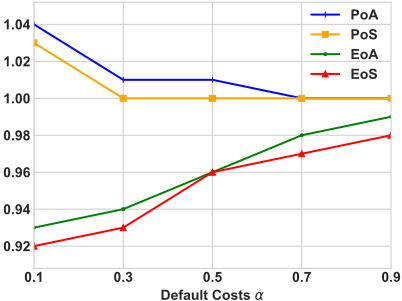
Figure 3 illustrates the equilibrium measures across varying αs. The considered measures encompass PoA, PoS, Effect of Anarchy (EoA), and Effect of Stability (EoS), as defined by Kanellopoulos et al. [2022]. EoA and EoS represent the ratio of the initial-state social welfare to the social welfare of the worst, and best, respectively, NE. They serve as metrics for evaluating the performance of NE in comparison to making no prepayment. Upon examination of Figure 3, we initially observed that both EoA and EoS are below 1. This indicates that making prepayments enhances social welfare compared to refraining from prepayments. Subsequently, all curves converge to a horizontal line with a value of 1 as α increases. This convergence is attributed to the diminishing benefits of making prepayments. Ultimately, abstaining from prepayment becomes the social optimum.
Through our experiments, we observed that opting not to make prepayments emerges as a robust strategy when compared to other heuristic prepayment approaches. This strength stems from the fact that making prepayments incurs an immediate loss in a firm's external assets, consequently impacting its utility. The viability of prepayments depends on their substantial influence on the well-being of firms within a debt circle that includes the concerned firm, wherein the immediate loss could be offset by the resulting benefit. Given the stringent conditions required for prepayments to be effective (e.g., the existence of debt circles, prepayments making a significant difference to lenders, and the benefit of a favorable prepayment outweighing the costs of all other non-beneficial ones), choosing not to make prepayments can easily outperform simplistic heuristics.
To assess the relative effectiveness of all strategies except h1, we conduct an ablation study with α = 0.5, as depicted in Figure 4. Specifically, we iteratively eliminate equilibrium strategies, starting from h9, from the current strategy set and recompute NE. In Figure 4, the orange dots signify NE, the blue dots denote strategies outside the NE support, and the absence of a dot indicates the removal of a strategy. Each row in the figure represents a game obtained by removing the NE strategy (pure NE exists in row 2 to row 9) from the preceding row. The earlier a strategy appears in an NE, the stronger its strategic position.
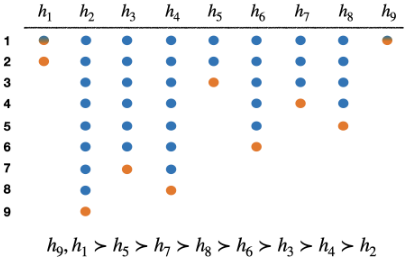
Our initial observation underscores the significance of heuristics in determining which lender to prepay, as evidenced by the superior performance of h3, h4, and h5 compared to the random strategy h2. This trend persists even when applying the solvency check, as strategies h7, h8, and h9 all outperform the random strategy h6. Upon comparing the performance of h3 and h4, we discerned that making one prepayment at a time might be more advantageous than making multiple ones, primarily due to the potential loss incurred by non-beneficial prepayments. Additionally, it becomes apparent that strategies h7 and h8 do not participate in an NE if h9 remains in the strategy set. This underscores the importance of considering the estimated external assets of other firms in the decision-making process.
Moreover, we observed that strategies incorporating the solvency check outperform those without. This finding aligns with intuition, as only insolvent firms stand to increase their utilities through prepayments. The solvency check effectively prevents a solvent firm from engaging in prepayments, a scenario that would otherwise result in an immediate loss of external assets for the firm.
Finally, we made more aggressive adjustments to the configurations of network generators, enabling either insufficient or excessive external assets. In both scenarios, we observed a lack of prepayment. When external assets are insufficient, no firm has the capacity to engage in prepayments. Similarly, when the entire network is solvent with an ample amount of external assets, firms have no incentive to make prepayments.
To sum up, the crux of making advantageous prepayments lies in the fact that prepayments made by insolvent firms are not discounted by α. This implies that a greater amount of money flows into the network, potentially benefiting other firms. The payoff from prepayments occurs when there is a path for the money to circulate back, covering the immediate loss. Consequently, making prepayments is meaningful only if the firm engaging in prepayment is insolvent, and appropriate debt circles exist.
6 Conclusion
We examine the characteristics and impacts of prepayments in financial credit networks through both theoretical analysis and empirical study. We evaluate the computational complexity of identifying prepayments that maximize welfare from a centralized standpoint. Additionally, we delve into the behavior of individual firms from a game-theoretic perspective, outlining the strengths and weaknesses of different heuristics. Our findings indicate that prepayments can be advantageous for financial systems, particularly in situations where the insolvency of firms happens.
Building upon the existing model, our analysis leaves a number of compelling questions unresolved. For instance, there remains a need for a conclusive answer regarding the existence of PSNE when firms seek to maximize their total assets under the condition α = 0. Additionally, our discrete treatment of prepayments, wherein firms either fully prepay or refrain entirely, prompts an interesting trajectory for further investigation. Extending the prepayment game model to encompass fractional prepayments will make our analysis more realistic. Furthermore, while our theoretical analysis utilizes the PSNE solution concept, an unexplored avenue entails the examination of prepayment games under the mixed Nash equilibria. The limitations and structural assumptions inherent in our analysis give rise to additional avenues for future exploration. In particular, since in our model firms act in a solitary manner, a trajectory for future work involves exploring scenarios where a firm enhances its utility by incentivizing another firm to prepay. This injects the prepayment games into the area of cooperative game theory and gives rise to many intriguing research questions such as the outcome of the interaction and the formation of coalitions.
Contribution Statement
Hao Zhou and Yongzhao Wang contributed equally.
Acknowledgements
This research was supported by a UKRI AI World Leading Researcher Fellowship awarded to M. Wooldridge (grant EP/W002949/1). MW, AC and HZ acknowledge funding from Trustworthy AI - Integrating Learning, Optimisation and Reasoning (TAILOR), a project funded by European Union Horizon2020 research and innovation program under Grant Agreement 952215. RS, KV, and YW thank the Alan Turing Institute for its support via the "Automated Analysis of Strategic Interactions" project. RS would also like to acknowledge the support of EPSRC (grant EP/W014750/1).
@inproceedings{ijcai2024p337,
  title     = {A Strategic Analysis of Prepayments in Financial Credit Networks},
  author    = {Zhou, Hao and Wang, Yongzhao and Varsos, Konstantinos and Bishop, Nicholas and Savani, Rahul and Calinescu, Anisoara and Wooldridge, Michael},
  booktitle = {Proceedings of the Thirty-Third International Joint Conference on
               Artificial Intelligence, {IJCAI-24}},
  publisher = {International Joint Conferences on Artificial Intelligence Organization},
  editor    = {Kate Larson},
  pages     = {3040--3048},
  year      = {2024},
  month     = {8},
  note      = {Main Track},
  doi       = {10.24963/ijcai.2024/337},
  url       = {https://doi.org/10.24963/ijcai.2024/337},
}
TY - CPAPER TI - A Strategic Analysis of Prepayments in Financial Credit Networks AU - Zhou, Hao AU - Wang, Yongzhao AU - Varsos, Konstantinos AU - Bishop, Nicholas AU - Savani, Rahul AU - Calinescu, Anisoara AU - Wooldridge, Michael T2 - Proceedings of the Thirty-Third International Joint Conference on Artificial Intelligence, IJCAI-24 PB - International Joint Conferences on Artificial Intelligence Organization PY - 2024 SP - 3040 EP - 3048 DO - 10.24963/ijcai.2024/337 UR - https://doi.org/10.24963/ijcai.2024/337 ER -Copied
Machine-readable versions of this paper, for tools and AI agents:





