
Higher-Order Argumentation Frameworks: Principles and Gradual Semantics
Proceedings of the Thirty-Third International Joint Conference on Artificial Intelligence. Main Track. Pages 3224-3231.
https://doi.org/10.24963/ijcai.2024/357
Keywords
- Knowledge Representation and Reasoning: KRR: Argumentation
- Knowledge Representation and Reasoning: KRR: Common-sense reasoning
Abstract
The paper investigates how to evaluate elements in complex argumentation frameworks, where both arguments and attacks are weighted and might be attacked by arguments. We propose the first gradual semantics that assign a numerical value to every argument and attack. The value represents the acceptance (seriousness) degree of an argument (attack). We start by highlighting various technical challenges facing semantics in such complex settings, including how to deal with attacks vs arguments, and how to combine their values. We present principles that describe different strategies offered to semantics to meet such challenges. Then, we introduce various semantics per strategy. For instance, some semantics evaluate attacks and arguments in the same way while others, called hybrid, treat them differently. Finally, the principles are used to compare the plethora of novel semantics. The final result is a catalogue of semantics with different formal guarantees and behaviours.
- [Amgoud and Ben-Naim, 2016] Leila Amgoud and Jonathan Ben-Naim. Axiomatic foundations of ac- ceptability semantics. In Proc. of KR, pages 2-11, 2016.
- [Amgoud and Doder, 2019] Leila Amgoud and Dragan Do- der. Gradual semantics accounting for varied-strength at- tacks. In Proc. of AAMAS, pages 1270-1278, 2019.
- [Amgoud and Prade, 2009] Leila Amgoud and Henri Prade. Using arguments for making and explaining decisions. Ar- tificial Intelligence, 173:413-436, 2009.
- [Amgoud et al., 2017] Leila Amgoud, Jonathan Ben-Naim, Dragan Doder, and Serdjan Vesic. Acceptability semantics for weighted argumentation frameworks. In Proc of IJCAI, pages 56-62, 2017. IJCAI
- [Amgoud et al., 2022] Leila Amgoud, Dragan Doder, and Srdjan Vesic. Evaluation of argument strength in attack graphs: Foundations and semantics. Artificial Intelligence, 302:103607, 2022.
- [Baroni and Giacomin, 2007] Pietro Baroni and Massim- iliano Giacomin. On principle-based evaluation of extension-based argumentation semantics. Artificial Intel- ligence, 171(10-15):675-700, 2007.
- [Baroni et al., 2011] Pietro Baroni, Federico Cerutti, Massi- miliano Giacomin, and Giovanni Guida. AFRA: Argu- mentation framework with recursive attacks. International Journal of Approximate Reasoning, 52(1):19-37, 2011.
- [Baroni et al., 2015] Pietro Baroni, Marco Romano, Francesca Toni, Marco Aurisicchio, and Giorgio Bertanza. Automatic evaluation of design alternatives with quan- titative argumentation. Argument & Computation, 6(1):24-49, 2015.
- [Baroni et al., 2018] Pietro Baroni, Antonio Rago, and Francesca Toni. How many properties do we need for gradual argumentation? In Proceedings of the National Conference on Artificial Intelligence AAAI, pages 1736- 1743, 2018.
- [Barringer et al., 2005] Howard Barringer, Dov Gabbay, and John Woods. Temporal dynamics of support and attack networks : From argumentation to zoology. In Dieter Hutter and Werner Stephan, editors, Mechanizing Mathe- matical Reasoning, Essays in Honor of Jörg H. Siekmann. LNAI 2605, pages 59-98. Springer, 2005.
- [Boella et al., 2008] Guido Boella, Leon van der Torre, and Serena Villata. Social viewpoints for arguing about coali- tions. In Proceedings of the 11th Pacific Rim Internationa Conference on Multi-Agents (PRIMA), pages 66-77, 2008.
- [Bonzon et al., 2016] Elise Bonzon, Jérôme Delobelle, Sébastien Konieczny, and Nicolas Maudet. A comparative study of ranking-based semantics for abstract argumenta- tion. In Proceedings of the AAAI Conference on Artificial Intelligence (AAAI), pages 914-920, 2016.
- [Calvo et al., 2002] Tomasa Calvo, Anna Kolesárová, Magda Komorníková, and Radko Mesiar. Aggrega- tion Operators: Properties, Classes and Construction Methods, pages 3-104. Physica-Verlag HD, 2002.
- [Cayrol and Lagasquie-Schiex, 2005] Claudette Cayrol and Marie-Christine Lagasquie-Schiex. Graduality in argu- mentation. Journal of Artificial Intelligence Research, 23:245-297, 2005.
- [Cayrol et al., 2020] Claudette Cayrol, Jorge Fandinno, Luis Fariñas del Cerro, and Marie-Christine Lagasquie-Schiex. Valid attacks in argumentation frameworks with recursive attacks. Annals of Mathematics and Artificial Intelligence (Special Issue: Commonsense 2017), 2020.
- [Cayrol et al., 2021] Claudette Cayrol, Andrea Cohen, and Marie-Christine Lagasquie-Schiex. Higher-order interac- tions (bipolar or not) in abstract argumentation: A state of the art. IfCoLog Journal of Logics and their Applications FLAP, 8(6):1339-1436, 2021.
- [da Costa Pereira et al., 2011] Célia da Costa Pereira, An- drea Tettamanzi, and Serena Villata. Changing one's mind: Erase or rewind? In Proc. of IJCAI, pages 164-171, 2011.
- [Doutre et al., 2022] Sylvie Doutre, Mickaël Lafages, and Marie-Christine Lagasquie-Schiex. Towards Algorithms for Argumentation Frameworks with Higher-order At- tacks. International Journal on Artificial Intelligence Tools, 31(07):2260007, 2022.
- [Dung, 1995] Phan Minh Dung. On the Acceptability of Arguments and its Fundamental Role in Non-Monotonic Reasoning, Logic Programming and n-Person Games. Ar- tificial Intelligence, 77:321-357, 1995.
- [Lafages, 2021] Mickaël Lafages. Algorithms for En- riched Abstract Argumentation Frameworks for Large- scale Cases. PhD thesis, Paul Sabatier Univ., 2021.
- [Leite and Martins, 2011] João Leite and João Martins. So- cial abstract argumentation. In Proceedings of the Inter- national Joint Conference on Artificial Intelligence IJCAI, pages 2287-2292, 2011. IJCAI
- [Modgil, 2009] Sanjay Modgil. Reasoning about prefer- ences in argumentation frameworks. Artificial Intelli- gence, 173(9-10):901-934, 2009.
- [Rago et al., 2016] Antonio Rago, Francesca Toni, Marco Aurisicchio, and Pietro Baroni. Discontinuity-free deci- sion support with quantitative argumentation debates. In Proc. of the fifteenth International Conference on Prin- ciples of Knowledge Representation and Reasoning KR, pages 63-73, 2016.
- [Simari et al., 2021] Guillermo Simari, Massimiliano Gia- comin, Dov Gabbay, and Matthias Thimm, editors. Hand- book of Formal Argumentation, Vol. 2. College Publica- tions, 2021.
References were extracted automatically from the PDF and may contain errors.
Full text extracted automatically from the PDF; figures, tables and equations may differ. The PDF is the version of record.
1 Introduction
Argumentation is one of the reasoning approaches that has attracted increasing interest in the last two decades in artificial intelligence [Simari et al., 2021]. The approach consists mainly in justifying claims by interacting arguments, and evaluating the strength or acceptance status of the arguments with a formal method, called semantics. Two families of methods can be distinguished in the literature: extension semantics, initiated in [Dung, 1995], and gradual semantics, initiated in [Cayrol and Lagasquie-Schiex, 2005]. The former look for sets of arguments, called extensions, that are jointly acceptable while the latter focuses more on evaluating individual arguments without necessarily going through extensions. Existing gradual semantics provide finer-grained evaluation of individual arguments, which makes them more suitable in tasks like decision making (eg., [Amgoud and Prade, 2009; Baroni et al., 2015]) where discriminating comparisons between arguments are strongly recommended. Consequently, during the last few years a plethora of gradual semantics have been proposed (eg., [da Costa Pereira et al., 2011; Leite and Martins, 2011; Rago et al., 2016; Amgoud et al.,
2022]), and properties to analyse them have been defined (eg. [Amgoud and Ben-Naim, 2016; Bonzon et al., 2016; Baroni et al., 2018; Amgoud et al., 2022]). All those semantics deal only with frameworks where attacks cannot themselves be attacked.
The authors in [Barringer et al., 2005] have argued in favour of higher-order (or recursive) attacks - attacks onto attacks. Consider the following three arguments: A: "The washing machine no longer works. You have to buy a new one", B: "Following the instructions on the Do it yourself website, the machine works perfectly", C: "This website is not reliable". The argument C does not attack the previous ones but rather the fact that B can attack A. Such attacks are ubiquitous in natural language dialogues, reasoning about preferences [Modgil, 2009] and coalitions [Boella et al., 2008] (see more applications in [Cayrol et al., 2021]). Barringer et al. defined a rich argumentation setting containing such attacks but did not propose any semantics. Later, extension semantics have been introduced in three flat frameworks (where neither arguments nor attacks have weights): Extended Argumentation Framework (EAF) [Modgil, 2009], Argumentation Framework with Recursive Attacks (AFRA) [Baroni et al., 2011], and Recursive Argumentation Framework (RAF) [Cayrol et al., 2020]. From examples, the semantics proposed in the three frameworks are clearly different, however the origins of disagreements have never been identified, more generally there is no formal analysis of assumptions underlying each semantics. Besides, there is no gradual semantics dealing with higher-order attacks.
This paper studies enriched higher-order argumentation frameworks (HO-AFs), where both arguments and attacks are weighted and may be attacked by arguments, and proposes the first gradual semantics that assign a numerical value to every argument and attack. The value represents the acceptance (seriousness) degree of an argument (attack). The paper bridges the above-mentioned gaps by five contributions:
- It defines principles that describe different strategies proposed to semantics to meet certain technical challenges raised in the context of HO-AFs, in particular concerning attack evaluation.
- It proposes a broad family of semantics that treat equally arguments and attacks.
- It introduces the novel notion of hybrid semantics, which
treat differently arguments and attacks.
- It presents the first formal analysis of the extension semantics defined for RAF and AFRA.
- It provides the first formal comparison of all semantics dealing with higher-order attacks.
The paper is structured as follows: Section 2 presents HOAFs and the existing semantics dealing with them; Section 3 defines principles; Section 4 (resp. 5) introduces and analyses gradual semantics that treat equally (resp. differently) attacks and arguments. The last section concludes.
2 Higher-Order Argumentation Frameworks
This paper focuses on higher-order argumentation frameworks (HO-AFs) where arguments and attacks have basic weights which may represent various things including reliability degrees of their sources, number of votes received by the elements, etc. Both arguments and attacks may be attacked by arguments. Attacked attacks of an HO-AF are called higher-order when there may exist a sequence of n > 1 attacks αi in a framework such that the target of the αi is αi+1; they are called two-order attacks when n ≤ 2.
For the sake of consistency with other frameworks from the literature, we will not follow below the presentation from the original paper. Throughout the paper, we assume a set Pa containing names of arguments (denoted by a, b, c, . . .) and a set Pr (with Pa ∩ Pr = ∅) containing names of attacks (denoted by π, µ, δ, . . .). We refer to an arbitrary element, which may be either argument or attack, by variables x, y, z, . . .. We define a HO-AF as follows:
Definition 1. A higher-order argumentation framework (HOAF) is a tuple H = ⟨A, R, s, t, w⟩ such that:
- A ⊆ Pa with A ̸= ∅, and R ⊆ Pr,
- s : R→A and t : R→A∪R,
- w : A∪R→ [0, 1].
H is said to be flat if ∀x ∈ A ∪ R, w(x) = 1 (i.e., w ≡ 1). We denote by AF the set of all possible HO-AFs.
The functions s and t return the source and the target of an attack respectively. Note that the source is always an argument meaning that an attack cannot be the source of another attack. When ∀π ∈ R, t(π) ∈ A, the HO-AF H is nothing more than a classical argumentation framework where only arguments may be attacked.
Example 1. Let H1 = ⟨A1,R1, s1, t1,w1⟩ be as follows.
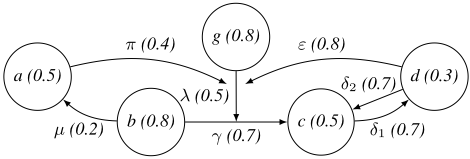
For instance, s1(π) = a, t1(π) = λ, w1(π) = 0.4 and w1(a) = w1(λ) = 0.5.
Notations: Let H = ⟨A,R, s, t,w⟩ ∈ AF. For any x ∈ A ∪ R, AttH(x) = {π ∈ R | t(π) = x} (i.e., the set of all attacks targeting x), and SrH(x) = {a ∈ A | ∃π ∈ R s.t. s(π) = a and t(π) = x} (i.e., the set of arguments attacking x). For instance, AttH1 (a) = {µ}, AttH1 (λ) = {π, ε} and SrH1 (a) = {b}, SrH1 (λ) = {a, d}. For x ∈ A and y ∈ A ∪ R s.t. x attacks y, n(x, y) returns the name of the attack, i.e., n(x, y) ∈ R (eg., n(b, a) = µ, n(a, λ) = π).
Example 1 (Cont) The HO-AF H1 contains two cycles [Doutre et al., 2022; Lafages, 2021]: (λ, γ, c, δ1, d, ε, λ) which involves the higher-order attack λ, and (c, δ1, d, δ2, c).
In the literature, there are mainly three frameworks that deal with attacked attacks: Extended Argumentation Framework (EAF) [Modgil, 2009], Recursive Argumentation Framework (RAF) ([Cayrol et al., 2020]), and Argumentation Framework with Recursive Attacks (AFRA) [Baroni et al., 2011]. They are all flat (i.e., w ≡ 1). EAF allows only two-order attacks while the two others handle higher-order ones. Hence, for the sake of generality, in this paper we only focus on RAF and AFRA. These two frameworks deal with the same types of graphs but differ in the way they handle attacks. We recall below their (acceptability) semantics for a fixed but arbitrary flat HO-AF H = ⟨A, R, s, t, w ≡ 1⟩.
RAF semantics. They are based on the notion of structure and extended versions of acceptability and conflict-freeness from [Dung, 1995]. A structure, which replaces extension, is a set of arguments and attacks. The two other notions are based on a defeat relation. Indeed, a structure defeats an element (argument or attack) if it contains an attack targeting the element and whose source belongs to the structure. In Example 1, the structures {π} and {a, d} do not defeat the attack λ since the former does not contain the source a of π and the latter does not contain an attack targeting λ. A structure is conflict-free if it does not contain an attack whose source and target are both in the structure. For instance, the structure {a, π, λ} is not conflict-free since s1(π) = a and t1(π) = λ. Finally, an element is acceptable wrt to a structure if the latter defeats any attack (or its source) targeting the element. Formally, let x ∈ A ∪ R, S ⊆ A, Γ ⊆ R.
- U = S ∪ Γ is called structure. 1
- U defeats x iff ∃π ∈ Γ s.t. s(π) ∈ S and t(π) = x.
- x is acceptable wrt U iff ∀π ∈ R, if t(π) = x, then ∃µ ∈ Γ s.t. s(µ) ∈ S and either t(µ) = π or t(µ) = s(π). Acc(U) is the set of acceptable elements wrt U.
- U is conflict-free iff ∄π ∈ Γ s.t. s(π) ∈ U and t(π) ∈ U.
Structure-based semantics are defined as follows.
Definition 2. Let U = S ∪Γ be a structure.
- U is complete iff U is conflict-free and Acc(U) = U.
- U is preferred iff U is a ⊆-maximal conflict-free structure s.t. U ⊆ Acc(U).
- U is grounded iff U is the ⊆-minimal complete structure.
- U is stable iff U is conflict-free and defeats any element x ∈ (A ∪ R) \ U.
Let Struc·(H) be the set of structures for RAF under semantics · where · ∈ {c, p, s, g} and c, p, s, g stand respectively for complete, preferred, stable and grounded.
1 Note that in [Cayrol et al., 2020], U is a pair (S, Γ).
Example 1 (Cont) The complete structures of H1 are Strucc(H1) = {U1, U2, U3} such that:
- U1 = {b, g, π, µ, δ1, δ2, ε},
- U2 = {b, c, g, π, µ, δ1, δ2, ε, λ},
- U3 = {b, d, g, π, µ, δ1, δ2, ε, γ}.
Note that U1 is the grounded structure while U2, U3 are preferred and stable structures.
AFRA semantics. Like existing extension semantics, they are based on conflict-freeness and acceptability. However, they are also founded on a special defeat relation which makes them different from RAF semantics. First, defeats can only come from attacks (never from arguments). Second, they allow new conflicts between two attacks in the graph if one of them targets the source of the other. In Example 1, the attack π is not attacked. However, since µ attacks the source of π, then we say that µ defeats π. Let us now introduce the formal definitions: x ∈ A ∪ R, π ∈ R and S ⊆ A ∪ R.
- π defeats x if t(π) = x, or x ∈ R and t(π) = s(x).
- S is conflict-free iff ∄x, y ∈ S such that x ∈ R and x defeats y.
- x is acceptable wrt S iff ∀µ ∈ R such that µ defeats x, ∃δ ∈ S ∩R such that δ defeats µ. Acc(S) denotes the set of acceptable elements wrt S.
AFRA semantics provide extensions which are defined as in Def. 2. It is sufficient to consider the above definitions of defeat, conflict-freeness and acceptability. Ext·(H) is the set of extensions of H under semantics · where · ∈ {c, p, s, g}.
Example 1 (Cont) The complete extensions of H1 under AFRA are Extc(H1) = {S1, S2, S3} such that:
- S1 = {b, g, µ},
- S2 = {b, c, g, µ, δ1, λ},
- S3 = {b, d, g, µ, δ2, ε, γ}.
The set S1 is the grounded extension and the two others are preferred and stable extensions. Note that π does not belong to any extension whereas it is a member of all RAF structures.
To sum up, RAF and AFRA are both extension-based but use different defeat relations. AFRA introduces additional conflicts and thus modifies the topology of the graph, while RAF keeps the original one. The running example shows that they may return different sets of elements. Subsequent sections unravel the key properties behind their differences.
3 Gradual Semantics and Principles
This paper investigates gradual semantics, which are functions mapping every element of an argumentation framework to a single value taken from an ordered scale. The value represents the strength of the element. The strength of an argument assesses how robust it is against attacks and thus how acceptable it is. Existing gradual semantics only evaluate arguments whereas in the context of HO-AF, strength of attacks (i.e., their seriousness) also must be assessed. We therefore generalize below the definition of gradual semantics.
Definition 3. A gradual semantics is a function S assigning to any H = ⟨A, R, s, t, w⟩ ∈ AF a weighting V on A ∪ R, i.e., V : A ∪ R → [0, 1].
Remark: At some places, we will use the notation VSH, which includes the semantics and the graph.
We propose a set of nine principles, or formal properties, that a gradual semantics S may follow. Some contain two sub-principles: one on arguments and another on attacks. As we will see later, a semantics may satisfy a sub-principle and violate the other. For a principle, say P, we call A-P and R-P its argument and attack sub-principle respectively. A semantics S satisfies a principle x-P (x ∈ {A, R}) if x-P holds.
The first five principles adapt for HO-AFs properties defined in [Amgoud and Doder, 2019], by showing how to take into account strengths of attacks in the evaluation of arguments. They also extend them to attack evaluation. The first principle states that the strength of an element depends only on its basic weight, the strengths of attacks targeting it and the strengths of their sources.
Equivalence: ∀H = ⟨A, R, s, t, w⟩ ∈ AF, ∀x, y ∈ R (resp. ∀x, y ∈ A) if
- w(x) =w(y),
- there exists a bijective function F from AttH(x) to AttH(y) such that ∀π ∈ AttH(x),
Maximality states that every element keeps its basic weight if it is not attacked.
Maximality: ∀H = ⟨A, R, s, t, w⟩ ∈ AF, ∀x ∈ R (resp. ∀x ∈ A), if AttH(x) = ∅, then VSH(x) = w(x).
Neutrality ensures that worthless attacks and attackers have no impact on the strength of their targets. This property is important in most applications including dialogues where fallacious arguments are common. It prevents such arguments from impacting reasonable ones.
Neutrality: ∀H = ⟨A,R, s, t,w⟩ ∈ AF, ∀x, y ∈ R (resp. ∀x, y ∈ A), if
- w(x) =w(y),
- SrH(y) = SrH(x) ∪ {a} such that a ∈ A\ SrH(x) and VSH(a) = 0 or VSH(n(a, y)) = 0,
- ∀z ∈ SrH(x), VSH(n(z, x)) = VSH(n(z, y)),
The next two properties are suitable in decision-making contexts, where discrimination between arguments is strongly required as it leads to a discrimination between the alternatives they support. Reinforcement ensures that the stronger the attackers, the more harmful they are to their targets.
Reinforcement: ∀H = ⟨A,R, s, t,w⟩ ∈ AF, ∀x, y ∈ R (resp. ∀x, y ∈ A), if
- w(x) =w(y), VSH(x) > 0,
- SrH(x) \ SrH(y) = {a}, SrH(y) \ SrH(x) = {b},
- VSH(b) >VSH(a),
- VSH(n(a, x)) = VSH(n(b, y)) > 0 and ∀z ∈ SrH(x) ∩ SrH(y), VSH(n(z, x)) = VSH(n(z, y)),
The next principle states that the stronger the attacks on an element, the weaker the element.
| Principles (A-P/R-P) | |||||||||
|---|---|---|---|---|---|---|---|---|---|
| Equiv. | Max. | Neut. | Reinf. | Att.-S. | Eq. | Precedence | Local Eq. | ||
| RAF • = | g | ✓ | ✓ | ✓ | × | × | ✓ | ✓ | ✓ |
| s | × | × | ✓ | × | × | ✓ | ✓ | × | |
| p | × | ✓ | × | × | × | ✓ | ✓ | × | |
| c | × | ✓ | × | × | × | ✓ | ✓ | × | |
| AFRA • = | g | ✓/× | ✓/× | ✓ | × | × | × | ✓/× | ✓/× |
| s | × | × | ✓ | × | × | × | ✓/× | × | |
| p | × | ✓/× | × | × | × | × | ✓/× | × | |
| c | × | ✓/× | × | × | × | × | ✓/× | × | |
| Hbs h h = | min | ✓ | ✓ | ✓ | × | × | ✓ | ✓ | ✓ |
| max | ✓ | ✓ | × | × | × | ✓ | ✓ | ✓ | |
| avg. | ✓ | ✓ | × | ✓ | ✓ | ✓ | ✓ | ✓ | |
| m-avg. | ✓ | ✓ | ✓ | ✓ | ✓ | ✓ | ✓ | ✓ | |
| mw-avg. | ✓ | ✓ | ✓ | ✓ | ✓ | ✓ | ✓ | × | |
| Mbs h h = | min | ✓ | ✓ | ✓ | × | × | ✓ | ✓ | ✓ |
| max | ✓ | ✓ | × | × | × | ✓ | ✓ | ✓ | |
| avg. | ✓ | ✓ | × | × | × | ✓ | ✓ | ✓ | |
| m-avg. | ✓ | ✓ | ✓ | × | × | ✓ | ✓ | ✓ | |
| mw-avg. | ✓ | ✓ | ✓ | × | × | ✓ | ✓ | × | |
| Hyb1 | m-avg | ✓ | ✓ | ✓ | ✓ | ✓ | × | ×/✓ | ✓ |
Attack-sensitivity: ∀H = ⟨A,R, s, t,w⟩ ∈ AF, ∀x, y ∈ R (resp. ∀x, y ∈ A), if
- w(x) =w(y), VSH(x) > 0,
- SrH(x) \ SrH(y) = {a}, SrH(y) \ SrH(x) = {b},
- VSH(a) = VSH(b) > 0,
- VSH(n(b, y)) > VSH(n(a, x)) and ∀z ∈ SrH(x) ∩ SrH(y), VSH(n(z, x)) = VSH(n(z, y)),
Let us now introduce the second group of principles. These are novel and have no counterpart in the literature. The three first ones concern how a semantics may treat attacks compared to arguments. Equality considers arguments and attacks as objects that should be evaluated in the same way.
Equality: ∀H = ⟨A, R, s, t, w⟩ ∈ AF, ∀x ∈ A, ∀y ∈ R, if
- w(x) =w(y), Sr(x) = Sr(y),
- ∀z ∈ Sr(x), VSH(n(z, x)) = VSH(n(z, y)),
Remark: Note that if a semantics satisfies Equality, then the two sub-principles of each of the first five principles can be combined into a single principle that applies to arbitrary elements (it is sufficient to consider x, y ∈ A∪R).
A-Precedence ensures that a semantics gives precedence to arguments in that it penalizes them less than attacks.
A-Precedence: ∀H = ⟨A,R, s, t,w⟩ ∈ AF, ∀x ∈ A and ∀y ∈ R, if
- w(x) =w(y), Sr(x) = Sr(y) and
- ∀z ∈ Sr(x), VSH(n(z, x)) = VSH(n(z, y)),
R-Precedence ensures that a semantics gives precedence to attacks over arguments.
R-Precedence: ∀H = ⟨A,R, s, t,w⟩ ∈ AF, ∀x ∈ A and ∀y ∈ R, if
- w(x) =w(y), Sr(x) = Sr(y) and
- ∀z ∈ Sr(x), VSH(n(z, x)) = VSH(n(z, y)),
The last principle concerns how a semantics assesses the overall strength of an attack, and more precisely when it combines its strength with that of its source. The principle ensures a sort of "local equality" by giving the same importance to the attack and its source.
Local Equality: ∀H = ⟨A,R, s, t,w⟩ ∈ AF, ∀x, y ∈ R (resp. ∀x, y ∈ A), if
- w(x) =w(y),
- SrH(x) \ SrH(y) = {a}, SrH(y) \ SrH(x) = {b},
- ∀c ∈ SrH(x) \ {a}, VSH(n(c, x)) =VSH(n(c, y)),
- VSH(b) = VSH(n(a, x)) and VSH(a) = VSH(n(b, y)),
All the principles presented so far are compatible, i.e., can be satisfied all together by a semantics.
Theorem 1. The following properties hold.
- Equality⇐⇒A-precedence and R-precedence.
- The set of all above-defined principles is compatible.
To recap, we proposed nine principles that will serve as a formal basis for analysing and comparing gradual semantics. They show the possible strategies that a semantics may follow to evaluate arguments and attacks. The first five principles adapt existing properties to the HO-AF setting (namely concerning arguments), and extend them to deal with attacks. The four last principles are novel and specific to HO-AF.
4 Treating Equally Arguments and Attacks
In this section, we introduce the first gradual semantics that deal with HO-AFs. We focus on those that treat equally arguments and attacks, thus that satisfy the equality principle. We define two families of such semantics. The first extends RAF semantics by assigning scores to individual elements while the second extends in various ways the two gradual semantics Mbs and Hbs from [Amgoud et al., 2017].
4.1 Structure-based Gradual Semantics
The first family is based on RAF semantics. Given an HOAF, the idea is to generate its structures, then to assign a numerical value from an ordered scale to every element according to its membership in structures. Following the classical approach from [Cayrol and Lagasquie-Schiex, 2005; Baroni and Giacomin, 2007], we will use the fixed fourvalued scale D = {0, α, β, 1}, where α, β are fixed but arbitrary values that satisfy the inequalities 0 < α < β < 1.
Definition 4. Let H = ⟨A,R, s, t,w⟩ ∈ AF and X be a set of subsets of A ∪ R. An aggregator is the mapping V X H : A∪R→D s.t. ∀x ∈ A∪R, V X H (x) = α if X = ∅. Else,
- V X H (x) = 1 if x ∈ ⋂ E∈X E.
- V X H (x) = β if ∃E, E′ ∈ X s.t. x ∈ E and x /∈ E′ .
- V X H (x) = α if x /∈ ⋃ E∈X E and ∄E ∈ X s.t. E defeats x.
For fixed H and X, there is a unique aggregator on X. Let us now define the first family of gradual semantics. They assign to every HO-AF the aggregator on its set of structures.
Definition 5. We define S· as a function assigning to any H = ⟨A,R, s, t,w⟩ ∈ AF the aggregator V Struc·(H) H where · ∈ {c, p, s, g}.
Since the RAF approach considers flat graphs, the abovedefined semantics ignore the basic weights of elements.
Example 1 (Cont) In this example, we have (ignoring w1):
The following result shows that S· is a gradual semantics and identifies the principles it satisfies.
Theorem 2. Let S· be such that · ∈ {c, p, g, s}.
- S· is a gradual semantics.
- Table 1 gives the principles satisfied by S·.
To recap, the four gradual semantics defined in this section satisfy Equality, which means they treat equally arguments and attacks. However, they do not take into account the initial weights of arguments and attacks while these may be useful for solving conflicts. Furthermore, they violate several principles including reinforcement and attack-sensitivity which may be desirable in some applications like decision making. Finally, note that the grounded semantics is the only one that satisfies local equality and equivalence.
4.2 Extensions of Hbs andMbs
Semantics of the second family satisfy the principle of equivalence, i.e., the strength they assign to an element is based on the basic weight of the element and the strengths of its attacks and their sources. They extend in various ways weighted H-Categorizer (Hbs) and weighted Max-based (Mbs) from [Amgoud et al., 2017]. Extensions of each of the two differ in the way they aggregate strengths of attacks with strengths of their sources. Before introducing the family, let us first recall the notion of aggregation operator [Calvo et al., 2002].
Definition 6. An aggregation operator is a function F : [0, 1]n → [0, 1] that satisfies the following properties:
- F(0, . . . , 0) = 0 and F(1, . . . , 1) = 1 (Boundary)
- ∀n ∈ N, if x1 ≤ y1, . . ., xn ≤ yn, then F(x1, . . . , xn) ≤ F(y1, . . . , yn) (Non-decreasingness)
There exist several aggregation operators, the most common of which are recalled in Table 2. Note that h1, h2, h3, h6 are symmetric (i.e., ∀x, y, h(x, y) = h(y, x)) while the weighted ones (h4, h5) are not. Throughout the paper, let
We show next how to use such operators to define gradual semantics and discuss their impact on semantics' properties.
Definition 7. Let h : [0, 1]2 → [0, 1] be an aggregation operator. We define Hbs h (resp. Mbs h ) as a function which assigns to each H = ⟨A, R, s, t, w⟩ ∈ AF a weighting VHbs,h H (resp. VMbs,h H ) on A∪R such that ∀x ∈ A∪R:
Note that h aggregates the strength of an attack and the strength of its source and returns a single value representing the overall strength of the attack. We show below that Hbs h and Mbs h are gradual semantics whenever h ∈ T.
Unattacked elements (arguments or attacks) keep their basic weight and any attacked element loses weight under both semantics. Note also that Hbs h may be more harmful than Mbs h since every attack contributes to further weakening its target. This is the case for c and λ which have two attackers.
Every element of an HO-AF receives a single value. The following result confirms this property for all semantics Hbs h and Mbs h that use an aggregation operator h ∈ T, meaning that the semantics are well-defined.
| min | h1(x, y) = min(x, y) |
| max | h2(x, y) = max(x, y) |
| Average (avg.) | h3(x, y) = x+y |
| Weighted avg. (w-avg) | 2 h4(x, y) = wx + (1 - w)y, w ∈ [0, 1] |
| Modified weighted avg. (mw-avg) | h5(x, y) = { wx+ (1 -w)y,w ∈ [0, 1] if xy ̸= 0 0 else. |
| Modified avg. (m-avg) | h6(x, y) = { x+y 2 if xy ̸= 0 0 else. |
Theorem 4. Let h ∈ T and H = ⟨A,R, s, t,w⟩ ∈ AF. For every x ∈ A ∪ R, we define the sequence {σ(x)(n) }+∞ n=1 s.t.
Then, for every x ∈ A∪R, the following hold:
The following result shows that the semantics Hbs h and Mbs h generalize their counterparts in [Amgoud and Doder, 2019]. Indeed, when an HO-AF does not contain higher-order attacks, each semantics assigns exactly the same values to arguments and attacks as its counterpart. In particular, the value of every attack is its basic weight.
Theorem 5. Let h ∈ T and H = ⟨A, R, s, t, w⟩ ∈ AF such that ∀α ∈ R, t(α) ∈ A.
The next result summarizes the behaviour of every semantics with respect to the principles introduced previously.
Theorem 6. Table 1 summarizes the list of principles that are satisfied/violated by Hbs h and Mbs h for every h ∈ T \ {h4}.
Table 1 shows that the semantics Hbs h6 is the only one that satisfies all the principles. It shows also that the choice of the operator h has a great impact on some principles, namely neutrality, reinforcement, attack-sensitivity and local equality. For instance, Hbs h1 satisfies neutrality and violates attacksensitivity while Hbs h3 satisfies attack-sensitivity and violates neutrality, Hbs h2 violates both principles while Hbs h6 satisfies them. The operator h has also an impact on local equality, which is only ensured if h is symmetric. Thus this principle is violated by Hbs h4 , Hbs h5 as h4, h5 are not symmetric.
The choice of h may also impact the values assigned by a semantics to elements. The reason is that some operators may be more generous than others.
Definition 8. Let h, h′ be two aggregation operators. h ⪰ h′ iff ∀x, y, h(x, y) ≥ h′ (x, y), and h ≻ h′ iff h ⪰ h′ while h′ ⪰ h does not hold.
It is easy to check the inequalities max(x, y) ≥ x+y 2 ≥ min(x, y). Thus, h2 ≻ h3 ≻ h1.
To recap, we proposed a second family of gradual semantics that satisfy equality. Unlike the instances of the first family that consider the whole topology of a graph and ignore basic weights, its semantics satisfy the equivalence principle, thus their evaluations are only based on basic weights and direct attacks. It is also worth mentioning that neutrality, reinforcement and attack sensitivity are satisfied by the original Weighted H-Categorizer Hbs but violated by some of its extensions Hbs h . The same observation holds for Mbs which satisfies neutrality while some Mbs h violate it. These three properties and local equality are sensitive to the aggregation operator h. The choice of h should be made carefully depending on the needs of the application under study.
5 Treating Differently Arguments &Attacks
This section introduces two other novel families of semantics which treat differently attacks and arguments. The first family builds on AFRA semantics while the second combines various extensions of Hbs and Mbs.
5.1 Extension-based Gradual Semantics
The idea of this family is to compute AFRA extensions for a given HO-AF, then to use the aggregator given in Definition 4 to assign a value to every element of the graph.
Definition 9. We define E· as a function assigning to any H = ⟨A,R, s, t,w⟩ ∈ AF the aggregator V Ext·(H) H , where · ∈ {c, p, s, g}.
Recall that the AFRA semantics consider flat graphs, thus any E· ignores basic weights.
Example 1 (Cont) Here, ignoring w1, we have:
Ep treats differently arguments and attacks; indeed the two non-attacked arguments (b, g) get a maximal value while the non-attacked attack π gets 0. Recall that Sp assigns the value 1 to π. Thus, the two semantics provide different evaluations.
We show next that any function E· is a gradual semantics.
Theorem 7. Let E· be such that · ∈ {c, p, g, s}.
- E· is a gradual semantics.
- Table 1 gives the principles satisfied by E·
To recap, we proposed the third family of semantics that deal with HO-AFs. Table 1 highlights their differences with those based on RAF. While the later satisfy R-maximality (except stable) and equality, the four semantics E· violate both properties. These violations are mainly due to the additional conflicts in AFRA. In Example 1, the attack π is not attacked but it is defeated by µ. Consequently, π does not appear in any extension and gets the value 0 instead of the maximal one. However, these semantics accept all non-attacked arguments, which explains their satisfaction of A-Precedence.
5.2 Parameterized Hybrid Semantics
So far, we defined semantics that satisfy equality or Aprecedence but no semantics that follows R-precedence while violating equality. Furthermore, those that enjoy Aprecedence violate interesting properties like R-maximality, neutrality, reinforcement, and attack-sensitivity. In what follows, we introduce a fourth family of semantics whose instances may satisfy different subsets of principles. To satisfy A-(or R-) precedence but not equality, a gradual semantics should be hybrid as it combines two functions, called base semantics, to evaluate attacks and arguments. We propose below a broad parameterized family of such semantics whose base semantics are Hbs h and/or Mbs h .
Definition 10. Let Θ,Θ′ ∈ {∑,max}, h, h′ ∈ T with Θ ̸= Θ′ or h ̸= h′ . Hyb is a function that assigns to any H = ⟨A, R, s, t, w⟩ ∈ AF a weighting on A ∪ R s.t ∀x ∈ A ∪ R:
The above family has four parameters: Θ and Θ′ , which specify the base semantics, and their aggregation operators h, h′ . It covers semantics that use the same base semantics for both arguments and attacks but with different aggregation operators, semantics that use the same aggregation operator but in different base semantics, and finally semantics where Θ ̸= Θ′ and h ̸= h′ .
Conjecture. For every semantics Hyb, Equation (3) admits a single solution, ensuring thus its well-definition.
The properties of the semantics covered by the family are summarized in the following result.
Theorem 8. Let (Θ,Θ′ , h, h′ ) be the parameters of Hyb.
- Hyb satisfies maximality and equivalence.
- If h (resp. h′ ) is symmetric, then Hyb satisfies A- (resp. R-) local equality.
- If Θ = Θ′ , h′ ≻ h (resp. h ≻ h′ ), then Hyb satisfies Aprecedence (resp. R-precedence) but violates equality.
- If Θ = max, Θ′ = ∑ and h′ ⪰ h, then Hyb satisfies A-precedence but violates equality.
- If Θ = ∑, Θ′ = max and h ⪰ h′ , then Hyb satisfies R-precedence but violates equality.
- If h(x, y) = 0 (resp. h′ (x, y) = 0) whenever xy = 0, then Hyb satisfies A-neutrality (resp. R-neutrality).
- If Θ = max (resp. Θ′ = max), Hyb violates A-(resp. R-) attack-sensitivity and A-(resp. R-) reinforcement.
- Let Θ = ∑ (resp. Θ′ = ∑). If h ∈ {h1, h2} (resp. h′ ∈ {h1, h2}), then Hyb violates A-(resp. R-) attacksensitivity and A-(resp. R-) reinforcement. Otherwise, Hyb satisfies the two properties.
The above result shows that this new family covers semantics that may satisfy either A-precedence or R-precedence. We show next that it generalises Mbs h and Hbs h .
Theorem 9. Let h ∈ T, H = ⟨A, R, s, t, w⟩ ∈ AF s.t. ∀α ∈ R, t(α) ∈ A. If Θ = ∑, then Hyb ≡ Hbs h , else Hyb ≡ Mbs h (Hbs h , Mbs h being defined as in Theorem 5).
Let us now introduce the first semantics which satisfies Rprecedence. It is Hyb1 whose parameters are:
From the above properties, it violates A-precedence and equality and satisfies all the others, including R-precedence.
Example 1 (Cont) To see how Hyp1 is more harmful with arguments than with attacks, compare a and λ. The argument a is attacked by b via µ and VHyb1 H1 (b) = 0.8, VHyb1 H1 (µ) = 0.2. The attack λ has two attackers: a via π and d via ε where VHyb1 H1 (ε) = 0.8, VHyb1 H1 (d) = 0.2, VHyb1 H1 (π) = 0.4. Thus, a and λ have each an attack of strength h6(0.2, 0.8). However, VHyb1 H1 (a) = VHyb1 H1 (λ) = 0.33. Indeed, they get the same value despite the fact that λ is more attacked than a.
6 Conclusion
The paper investigated for the first time gradual semantics that deal with higher-order attacks. It introduced novel principles on how attacks should be considered and evaluated, proposed a plethora of families of semantics, showing multiple ways of defining such semantics. Finally, it analysed all semantics against the principles, providing thus the first formal comparison of AFRA and RAF semantics. The results highlight fundamental differences between them. The final output of the paper is a catalogue of semantics with different formal guarantees and behaviours. Depending on the application requirements, the most appropriate one must be chosen. A first trivial implementation of the new gradual semantics has already been carried out. The results show that they are efficient even in case of large and complex HO-AFs.
As future work, we plan to investigate the principles that are required in different application contexts and characterize the corresponding families of semantics.
Ethical Statement
There are no ethical issues.
Acknowledgments
This work was supported by the AI Interdisciplinary Institute ANITI, funded by the French program "AI-Cluster".
@inproceedings{ijcai2024p357,
  title     = {Higher-Order Argumentation Frameworks: Principles and Gradual Semantics},
  author    = {Amgoud, Leila and Doder, Dragan and Lagasquie-Schiex, Marie-Christine},
  booktitle = {Proceedings of the Thirty-Third International Joint Conference on
               Artificial Intelligence, {IJCAI-24}},
  publisher = {International Joint Conferences on Artificial Intelligence Organization},
  editor    = {Kate Larson},
  pages     = {3224--3231},
  year      = {2024},
  month     = {8},
  note      = {Main Track},
  doi       = {10.24963/ijcai.2024/357},
  url       = {https://doi.org/10.24963/ijcai.2024/357},
}
TY - CPAPER TI - Higher-Order Argumentation Frameworks: Principles and Gradual Semantics AU - Amgoud, Leila AU - Doder, Dragan AU - Lagasquie-Schiex, Marie-Christine T2 - Proceedings of the Thirty-Third International Joint Conference on Artificial Intelligence, IJCAI-24 PB - International Joint Conferences on Artificial Intelligence Organization PY - 2024 SP - 3224 EP - 3231 DO - 10.24963/ijcai.2024/357 UR - https://doi.org/10.24963/ijcai.2024/357 ER -Copied
Machine-readable versions of this paper, for tools and AI agents:





