
Efficient and Stable Offline-to-online Reinforcement Learning via Continual Policy Revitalization
Proceedings of the Thirty-Third International Joint Conference on Artificial Intelligence. Main Track. Pages 4317-4325.
https://doi.org/10.24963/ijcai.2024/477
Keywords
- Machine Learning: ML: Reinforcement learning
- Machine Learning: ML: Offline reinforcement learning
Abstract
In offline Reinforcement Learning (RL), the pre-trained policies are utilized for initialization and subsequent online fine-tuning. However, existing methods suffer from instability and low sample efficiency compared to pure online learning. This paper identifies these limitations stemming from direct policy initialization using offline-trained policy models. We propose Continual Policy Revitalization (CPR) as a novel efficient, stable fine-tuning method. CPR incorporates a periodic policy revitalization technique, restoring the overtrained policy network to full learning capacity while ensuring stable initial performance. This approach enables fine-tuning without being adversely affected by low-quality pre-trained policies. In contrast to previous research, CPR initializes the new policy with an adaptive policy constraint in policy optimization. Such optimization keeps the new policy close to behavior policy constructed from historical policies. This contributes to stable policy improvement and optimal converged performance. Practically, CPR can seamlessly integrate into existing offline RL algorithms with minimal modification. We empirically validate the effectiveness of our method through extensive experiments, demonstrating substantial improvements in learning stability and efficiency compared to previous approaches. Our code is available at https://github.com/LAMDA-RL/CPR.
- [Abbas et al., 2023] Zaheer Abbas, Rosie Zhao, Joseph Mo- dayil, Adam White, and Marlos C. Machado. Loss of plasticity in continual deep reinforcement learning. arXiv preprint arXiv:2303.07507, 2023.
- [Agarwal et al., 2022] Rishabh Agarwal, Max Schwarzer, Pablo Samuel Castro, Aaron C. Courville, and Marc G. Bellemare. Reincarnating reinforcement learning: Reusing prior computation to accelerate progress. In Ad- vances in Neural Information Processing Systems, pages 28955-28971, 2022.
- [Beeson and Montana, 2022] Alex Beeson and Giovanni Montana. Improving TD3-BC: Relaxed policy constraint for offline learning and stable online fine-tuning. In Offline RL Workshop: Offline RL as a "Launchpad", 2022.
- [Brockman et al., 2016] Greg Brockman, Vicki Cheung, Ludwig Pettersson, Jonas Schneider, John Schulman, Jie Tang, and Wojciech Zaremba. OpenAI Gym, 2016. Erhan et al., 2010]
- Dumitru Erhan, Aaron C. Courville, Yoshua Bengio, and Pascal Vincent. Why does unsuper- vised pre-training help deep learning? In International Conference on Artificial Intelligence and Statistics, pages 201-208, 2010.
- [Fu et al., 2020] Justin Fu, Aviral Kumar, Ofir Nachum, George Tucker, and Sergey Levine. D4RL: datasets for deep data-driven reinforcement learning. arXiv preprint arXiv:2004.07219, 2020.
- [Fujimoto and Gu, 2021] Scott Fujimoto and Shixi- ang Shane Gu. A minimalist approach to offline re- inforcement learning. In Advances in Neural Information Processing Systems, pages 20132-20145, 2021.
- [Fujimoto et al., 2018] Scott Fujimoto, Herke van Hoof, and David Meger. Addressing function approximation error in actor-critic methods. In International Conference on Machine Learning, pages 1582-1591, 2018.
- [Fujimoto et al., 2019] Scott Fujimoto, David Meger, and Doina Precup. Off-policy deep reinforcement learning without exploration. In International Conference on Ma- chine Learning, pages 2052-2062, 2019.
- [Gao and Rui, 2023] Chen-Xiao Gao and Kong Rui. OfflineRL-Lib: Benchmarked Implementations of Offline RL Algorithms, February 2023.
- [Gao et al., 2024] Chen-Xiao Gao, Chenyang Wu, Mingjun Cao, Rui Kong, Zongzhang Zhang, and Yang Yu. ACT: Empowering decision transformer with dynamic program- ming via advantage conditioning. In AAAI Conference on Artificial Intelligence, pages 12127-12135, 2024.
- [Haarnoja et al., 2018] Tuomas Haarnoja, Aurick Zhou, Pieter Abbeel, and Sergey Levine. Soft actor-critic: Off-policy maximum entropy deep reinforcement learning with a stochastic actor. In International Conference on Machine Learning, pages 1856-1865, 2018.
- [Harris et al., 2020] Charles R. Harris, K. Jarrod Millman, Stéfan van der Walt, Ralf Gommers, Pauli Virtanen, David Cournapeau, Eric Wieser, Julian Taylor, Sebastian Berg, Nathaniel J. Smith, Robert Kern, Matti Picus, Stephan Hoyer, Marten H. van Kerkwijk, Matthew Brett, Allan Haldane, Jaime Fernández del Río, Mark Wiebe, Pearu Peterson, Pierre Gérard-Marchant, Kevin Sheppard, Tyler Reddy, Warren Weckesser, Hameer Abbasi, Christoph Gohlke, and Travis E. Oliphant. Array programming with NumPy. Nature, 585:357-362, 2020.
- [Kostrikov et al., 2022] Ilya Kostrikov, Ashvin Nair, and Sergey Levine. Offline reinforcement learning with im- plicit Q-learning. In International Conference on Learning Representations, 2022.
- [Kumar et al., 2019] Aviral Kumar, Justin Fu, Matthew Soh, George Tucker, and Sergey Levine. Stabilizing off-policy Q-learning via bootstrapping error reduction. In Advances in Neural Information Processing Systems, pages 11761- 11771, 2019.
- [Lai et al., 2020] Kwei-Herng Lai, Daochen Zha, Yuening Li, and Xia Hu. Dual policy distillation. In International Joint Conference on Artificial Intelligence, pages 3146- 3152, 2020.
- [Lee et al., 2021] Seunghyun Lee, Younggyo Seo, Kimin Lee, Pieter Abbeel, and Jinwoo Shin. Offline-to-online re- inforcement learning via balanced replay and pessimistic q-ensemble. In Conference on Robot Learning, pages 1702-1712, 2021.
- [Levine et al., 2020] Sergey Levine, Aviral Kumar, George Tucker, and Justin Fu. Offline reinforcement learning: Tu- torial, review, and perspectives on open problems. arXiv preprint arXiv:2005.01643, 2020.
- [Li et al., 2023] Jianxiong Li, Xiao Hu, Haoran Xu, Jingjing Liu, Xianyuan Zhan, and Ya-Qin Zhang. PROTO: Iterative policy regularized offline-to-online reinforcement learn- ing. arXiv preprint arXiv:2305.15669, 2023.
- [Mnih et al., 2016] Volodymyr Mnih, Adrià Puigdomènech Badia, Mehdi Mirza, Alex Graves, Timothy P. Lillicrap, Tim Harley, David Silver, and Koray Kavukcuoglu. Asyn- chronous methods for deep reinforcement learning. In International Conference on Machine Learning, pages 1928-1937, 2016.
- [Nair et al., 2020] Ashvin Nair, Murtaza Dalal, Abhishek Gupta, and Sergey Levine. Accelerating online rein- forcement learning with offline datasets. arXiv preprint arxiv:2006.09359, 2020.
- [Nakamoto et al., 2023] Mitsuhiko Nakamoto, Yuexiang Zhai, Anikait Singh, Max Sobol Mark, Yi Ma, Chelsea Finn, Aviral Kumar, and Sergey Levine. Cal-QL: Calibrated offline RL pre-training for efficient online fine-tuning. arXiv preprint arXiv:2303.05479, 2023.
- [Nikishin et al., 2022] Evgenii Nikishin, Max Schwarzer, Pierluca D'Oro, Pierre-Luc Bacon, and Aaron C. Courville. The primacy bias in deep reinforcement learn- ing. In International Conference on Machine Learning, pages 16828-16847, 2022.
- [Pomerleau, 1991] Dean A Pomerleau. Efficient training of artificial neural networks for autonomous navigation. Neu- ral Computation, 3(1):88-97, 1991.
- [Ran et al., 2023] Yuhang Ran, Yi-Chen Li, Fuxiang Zhang, Zongzhang Zhang, and Yang Yu. Policy regularization with dataset constraint for offline reinforcement learning. In International Conference on Machine Learning, pages 28701-28717, 2023.
- [Schulman et al., 2017] John Schulman, Filip Wolski, Pra- fulla Dhariwal, Alec Radford, and Oleg Klimov. Prox- imal policy optimization algorithms. arXiv preprint arXiv:1707.06347, 2017.
- [Tarasov et al., 2022] Denis Tarasov, Alexander Nikulin, Dmitry Akimov, Vladislav Kurenkov, and Sergey Kolesnikov. CORL: Research-oriented deep offline rein- forcement learning library. In Offline RL Workshop: Of- fline RL as a "Launchpad", 2022.
- [Todorov et al., 2012] Emanuel Todorov, Tom Erez, and Yu- val Tassa. MuJoCo: A physics engine for model-based control. In IEEE/RSJ International Conference on Intelli- gent Robots and Systems, pages 5026-5033, 2012.
- [Uchendu et al., 2022] Ikechukwu Uchendu, Ted Xiao, Yao Lu, Banghua Zhu, Mengyuan Yan, Joséphine Simon, Matthew Bennice, Chuyuan Fu, Cong Ma, Jiantao Jiao, Sergey Levine, and Karol Hausman. Jump-start reinforce- ment learning. arXiv preprint arXiv:2204.02372, 2022.
- [Wu and Zhang, 2023] Chenyang Wu and Zongzhang Zhang. Surfing information: The challenge of intelligent decision-making. Intelligent Computing, 2:0041, 2023.
- [Xu et al., 2021] Tengyu Xu, Yingbin Liang, and Guanghui Lan. CRPO: A new approach for safe reinforcement learn- ing with convergence guarantee. In International Confer- ence on Machine Learning, pages 11480-11491, 2021.
- [Ye et al., 2021] Weirui Ye, Shaohuai Liu, Thanard Kuru- tach, Pieter Abbeel, and Yang Gao. Mastering Atari games with limited data. In Advances in Neural Information Pro- cessing Systems, pages 25476-25488, 2021.
- [Yu and Zhang, 2023] Zishun Yu and Xinhua Zhang. Actor- critic alignment for offline-to-online reinforcement learn- ing. In International Conference on Machine Learning, pages 40452-40474, 2023.
- [Yu, 2018] Yang Yu. Towards sample efficient reinforcement learning. In International Joint Conference on Artificial Intelligence, pages 5739-5743, 2018. IJCAI
- [Zhang et al., 2023] Haichao Zhang, Wei Xu, and Haonan Yu. Policy expansion for bridging offline-to-online rein- forcement learning. In International Conference on Learn- ing Representations, 2023.
- [Zhang et al., 2024] Yinmin Zhang, Jie Liu, Chuming Li, Yazhe Niu, Yaodong Yang, Yu Liu, and Wanli Ouyang. A perspective of Q-value estimation on offline-to-online reinforcement learning. In AAAI Conference on Artificial Intelligence, pages 16908-16916, 2024.
- [Zhao et al., 2022] Yi Zhao, Rinu Boney, Alexander Ilin, Juho Kannala, and Joni Pajarinen. Adaptive behavior cloning regularization for stable offline-to-online rein- forcement learning. In European Symposium on Artificial Neural Networks, 2022.
- [Zhou et al., 2022] Hattie Zhou, Ankit Vani, Hugo Larochelle, and Aaron C. Courville. Fortuitous for- getting in connectionist networks. In International Conference on Learning Representations, 2022.
- [Zhou et al., 2024] Renzhe Zhou, Chen-Xiao Gao, Zongzhang Zhang, and Yang Yu. Generalizable task representation learning for offline meta-reinforcement learning with data limitations. In AAAI Conference on Artificial Intelligence, pages 17132-17140, 2024.
References were extracted automatically from the PDF and may contain errors.
Full text extracted automatically from the PDF; figures, tables and equations may differ. The PDF is the version of record.
1 Introduction
Deep Reinforcement Learning (RL) involves agents learning through interactions with the environment and encoding decision-making knowledge with neural networks. It has demonstrated significant potential in mastering complex tasks and developing robust policies. However, attaining high performance often demands millions or even billions of samples [Ye et al., 2021; Wu and Zhang, 2023]. The notorious sample inefficiency of deep RL obstructs its application to many problems where only limited interactions with the environment are acceptable [Yu, 2018; Zhou et al., 2024].
∗Zongzhang Zhang is the corresponding author.
Offline RL algorithms offer a novel approach, enabling the learning of policies from offline data generated by a behavior policy. This avenue has garnered significant interest from both academia and industry [Gao et al., 2024; Ran et al., 2023]. Though the offline methods exempt RL from costly online interactions, they often learn policies inadequate to meet the practical needs due to the insufficient data coverage [Kumar et al., 2019].
To further fine-tune these agents in the online environment, Offline-to-Online (O2O) RL [Lee et al., 2021] is proposed. Fine-tuning is expected to increase the agent's performance monotonically in RL just as the supervised finetuning. Still, it is observed empirically that directly tuning the pre-trained policy model gets it ruined [Uchendu et al., 2022; Yu and Zhang, 2023]. We refer to this paradigm of updating policy function with offline trained checkpoints as direct policy initialization. We argue such a paradigm would cause instability and low sample efficiency due to two issues:
- Distribution shift between the offline state-action distributions and the online environment would cause unreliable value prediction. On the one hand, extrapolation error propagation [Fujimoto et al., 2019] in OutOf-Distribution (OOD) data devastates the pre-trained policy quickly with a few online updates. On the other hand, over-conservatism in offline learning [Nakamoto et al., 2023] hinders online value function updating.
- Primacy bias of the overtrained policy function impedes subsequent learning [Nikishin et al., 2022]. The loss of plasticity in pre-trained policy [Abbas et al., 2023] hinders continual learning and degenerates the agent's asymptotic performance especially when the offline dataset is of low quality.
Existing work focuses on alleviating the negative impact caused by direct policy initialization. Several O2O algorithms have been proposed to mitigate this issue of distribution shift. Unfortunately, these methods have their drawbacks. In addition, the primacy bias issue has not been identified in the context of O2O RL previously.
In this work, we delve into the negative effects of direct policy initialization in O2O RL. Our contributions unfold in two main facets: firstly, the identification and analysis of issues associated with direct policy initialization, substantiated by empirical evidence; and secondly, the introduction of a stable and efficient O2O RL methodology named Continual Policy Revitalization (CPR). CPR is designed to replace an overtrained offline policy with a newly revitalized one during the policy revitalization stage. This revitalized policy begins as a blank slate, maintaining receptiveness to new knowledge, whereas the historical policies are preserved in the policy set to prevent forgetting. To balance learning and forgetting, we compose all existing policies to decide which action to choose. The new policy is initialized by efficient offline training with an adaptive policy constraint. CPR enjoys benefits absent from the previous methods. It is free of assumptions about offline pre-trained algorithms and does not assume access to offline datasets. The combination of policy revitalization and adaptive policy constraint provides stability and efficiency in the learning process. We empirically confirm the effectiveness of our method by a comprehensive comparison with existing algorithms, highlighting the efficacy of independent components within CPR.
2 Background
2.1 Markov Decision Process
We consider a standard Markov Decision Process (MDP) defined by M = (S, A, P, R, ρ, γ), where S is the state space, A is the action space, R : S ×A ↦→ [0, 1] is the normalized reward function, P : S ×A ↦→∆S is the transition function, ∆X is the set of distribution over the set X, ρ is the initial state distribution, and γ ∈ [0, 1) is the discount factor.
A deterministic policy π : S ↦→ A is a function that maps a state to an action. For each policy, the corresponding value function V π : S ↦→ R and Q-function Qπ : S × A ↦→ R are the expected discounted cumulative reward (a.k.a. return):
We measure the performance of a policy by its expected return J(π) = Es∼ρ [V π (s)]. The goal in an MDP is to find a policy that maximizes J(π), i.e., π⋆ = argmaxπ J(π).
2.2 Offline RL
Online interaction with real environments could be costly or unsafe, in which cases offline RL algorithms [Levine et al., 2020] are preferred. These algorithms train a policy πβ on an offline logged dataset D collected by a behavior policy from the environment. The dataset is composed of transition tuples (s, a, r, s′ ), where r = R(s, a) is the reward obtained when taking action a at state s, and s′ ∼ P(· | s, a) is the next state sampled by the environment. The trained policy πβ is expected to maximize the expected return as much as possible given the information presented by the dataset.
2.3 Offline-to-Online (O2O) RL
O2O RL learns the optimal policy by interacting with the environment starting with a pre-trained policy πβ obtained by offline RL training. Other forms of knowledge can also be accessible under certain assumptions, such as offline datasets and value functions. An O2O method tries to transfer the knowledge acquired in the offline stage to enable sampleefficient online learning and poses unique challenges.
3 Issues of Direct Policy Initialization
This section exposes the main issues of direct policy initialization in O2O RL. We empirically demonstrate the damage of these issues, which motivates the proposal of our method.
3.1 Distribution Shift
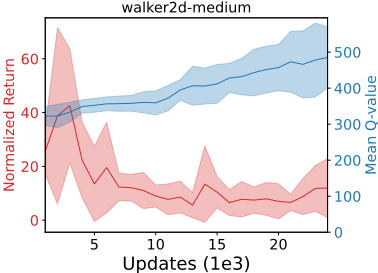
It is observed in previous research that O2O RL via off-policy RL algorithms suffers from a performance drop in the initial stage, which is attributed to distribution shift [Lee et al., 2021; Yu and Zhang, 2023]. As demonstrated in Figure 1, we conduct a tuning experiment with direct policy initialization. We train a SAC policy [Haarnoja et al., 2018] initialized from an AWAC [Nair et al., 2020] model pre-trained on the same task. We observe the performance drop is concomitant with severe value overestimation of the Q-value function. Therefore, we hypothesize that the distribution shift in the tuning stage leads to the well-known extrapolation error problem [Fujimoto et al., 2019] and the extrapolation error further leads to performance drop.
Though extrapolation error is thoroughly discussed in offline RL, we would like to take one step further in the context of O2O RL. The OOD actions would also be encountered in off-policy learning, however, direct policy initialization from a checkpoint and updating the model with naive off-policy learning is a common practice in online RL. In online offpolicy learning, things do not get too bad because the overestimated value gets corrected when the policy executes these actions in the stage of training. Nevertheless, this problem is exacerbated in offline RL, where the policy does not get a chance to interact with the environment to fix its value estimation. In this case, the extrapolation error of value estimation at OOD actions gets continuously amplified by bootstrapping and makes the Q-value estimation unreliable. Initializing from offline Q-value function makes finetuning extremely unstable compared to common off-policy learning.
| Step | Average Return ˆR′ | Drop Ratio ρ |
|---|---|---|
| 0 | 3135.55 | 34.15% |
| 1000 | 2745.57 | 42.34% |
| 3000 | 2516.06 | 47.16% |
| 5000 | 2377.49 | 50.07% |
This distinction is the fundamental difference between the tuning processes of offline models and online learning. At the initial stage of O2O RL, the online buffer contains only a few samples, which makes numerous actions out-of-distribution, and the extrapolated value estimate for some of them could be fairly high. Therefore, the policy has an incentive for deviating from the pre-trained policy and selecting these OOD actions, which immediately causes a performance drop.
Since Figure 1 only presents the co-occurrence of performance drop and over-estimation, more evidence is required to confirm it. We designed a controlled experiment to investigate whether the policy update is biased because of the unreasonable Q-value prediction. We fine-tune a pre-trained policy with the SAC algorithm in the online MuJoCo [Todorov et al., 2012] Hopper environment. The policy is pre-trained on the D4RL [Fu et al., 2020] hopper-medium-expert-v2 dataset with the AWAC algorithm. During O2O RL, we first collect 10000 transition tuples from the online environment with pretrained policy and update the policy with the SAC algorithm. Then, we keep the policy unchanged and update the Q-value function with additional gradient steps using online data. After that, the Q-value network is frozen and we conduct policy improvement for 1000 gradient steps. As shown in Table 1, additional updates hurt the performance due to the amplification of value extrapolation error and policy deviation.
Our analysis and empirical results show that visiting OOD actions should be avoided in online fine-tuning updates to achieve a stable fine-tuning process, especially in the beginning stage. This requires adding constraints on the policy update to make the visiting distribution not too far from the offline dataset. When it comes to the case that the offline dataset is not accessible, we should let the policy stay close to the offline trained policy.
3.2 Primacy Bias in Offline RL
Another issue of direct policy initialization in O2O RL is the primacy bias in neural networks. The primacy bias in deep RL is first observed as a tendency to overfit early experiences in online learning, which damages the rest of the learning process [Nikishin et al., 2022]. Although such observation is intuitive in supervised learning and transfer learning, primacy bias in single-task offline RL is more difficult to identify. Excessive training on the early collected data could trap the neural network into unrecoverable plasticity loss. In common offline RL experiments, networks are trained for hundreds or thousands of epochs on the offline dataset, inevitably leading to overfitting.
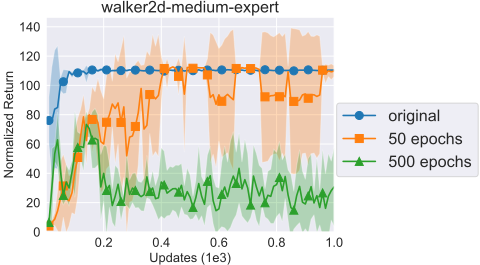
Unfortunately, even if the policy suffers from plasticity loss, popular evaluation metrics may fail to exhibit any evidence of primacy bias. A policy may perform well in terms of evaluation scores but can also be extremely inefficient in the further learning process. So, simple online evaluation cannot reflect the actual continual learning ability of a policy.
We design a learning ability test experiment to demonstrate how primacy bias could suppress the learning ability of a pre-trained model. We first train the offline model by the TD3+BC algorithm [Fujimoto and Gu, 2021] in the walker2d-random-v2 dataset of D4RL. We then use the saved checkpoint of different training epochs to initialize the policy that is further trained on the walker2d-medium-expert-v2 dataset. We use this dataset as an unseen data distribution to test the continual learning capability. This fixed dataset helps to ablate the effects of data collection in the online stage. As depicted in Figure 2, the policy initialized with a model trained for 500 epochs falls short of attaining the performance level it would have reached if learned from scratch. On the contrary, the policy initialized with an insufficiently fitted model recovers from the distribution shift at the beginning stage. Considering that offline RL algorithms normally train over 1000 epochs on the D4RL MuJoCo datasets, 500 epochs should be considered as a common setting in practice.
The damage of primacy bias in offline RL suggests direct policy initialization from the offline trained policy could cause low learning efficiency. This issue limits the performance of direct policy initialization.
4 Methodology
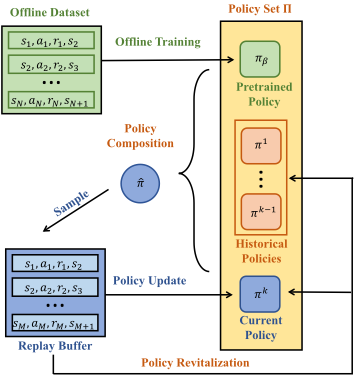
This section presents our method to resolve the issues of direct policy initialization. In Section 4.1, we first introduce the continual policy revitalization technique. Then we discuss the proper design of policy constraint after revitalization in Section 4.2. The practical implementation is given in Section 4.3. The overall framework is shown in Figure 3.
4.1 Continual Policy Revitalization
As discussed before, the existing issues of direct policy initialization pose a challenge to designing appropriate O2O RL algorithms. On the one hand, the policy should be as close to the offline trained policy to alleviate the distribution shift. On the other hand, direct policy initialization from the overtrained offline policy could cause primacy bias, hindering online learning efficiency. Our intuitive idea is to find a surrogate of the given offline model with full learning capacity and comparable performance.
Inspired by this intuition, we propose Continual Policy Revitalization (CPR) to reinvigorate the continual learning capability of the policy function. Specifically, we first define the procedure of policy revitalization which is periodically performed every Tr epoch. At the k-th round of policy revitalization, we initialize the parameter of the policy network to generate a new policy πk+1 . While maintaining the value network Qµ of parameter µ unchanged, we exploit an arbitrary offline training algorithm Aoffline to initialize πk+1 on the online replay buffer D with batch RL training:
This designed procedure ensures that the revitalized policy πk+1 is not severely affected by previous training and is wellconditioned for continual learning. Since the size of the online replay buffer D is limited, policy revitalization uses the offline RL method to achieve sample efficiency and stable policy initialization with a high replay ratio in batch training.
Of course, the offline training in policy revitalization could not clone the previous behavior policy perfectly. Inspired by PEX [Zhang et al., 2023], we maintain a policy set Π and add the policy composition mechanism in the action selection stage. At the k-th round of policy revitalization, we add the current policy πk to the policy set Π ← Π ∪ {πk } to avoid catastrophic forgetting. When interacting with the environment at state s, each policy πi in the policy set Π proposes a candidate action ai and the agent would select the action with the Boltzmann distribution of the predicted Q-value Qπk (s, ai). Here πk is the current policy. The probability of selecting action proposed by policy πi , P ⋆ (i), is defined as:
Here η is the temperature hyper-parameter to balance exploitation and exploration. In this way, we perform a one-step policy improvement with maximal entropy at every action selection step in the following form:
We use the notation of ˆπk to represent the composed policy distribution at the k-th round of policy revitalization. By sampling from the composed policy ˆπk , we combine the decision knowledge of all policies. With a higher η, the mixed policy tends to explore and randomly choose from the proposed actions. On the contrary, with a small η, the mixed policy makes greedy decisions based on the evaluated action quality of the proposed actions. Since all policies are archived in the policy set, historical knowledge could be preserved even if old data is no longer stored. This mechanism protects the policy from radical forgetting and policy improvement.
4.2 Adaptive Policy Constraint
Since we set the composed policy ˆπ as the behavior policy in the online replay buffer, CPR does not adopt a fixed policy constraint in pure offline RL or an iterative policy regularization in online off-policy learning. Instead, CPR uses the policy set to propose an adaptive policy constraint. We use subscript to denote the policy iteration step and superscript to represent the number of policy revitalization rounds. Thus, the optimization of the current policy at the k-th round of policy revitalization can be formalized as:
where ρˆπk is the state visitation distribution of ˆπk , ϵ is a small positive number, and DKL is the Kullback-Leibler (KL) divergence. Eq. 4 implements a trust region policy update adapting to the change of behavior policy.
Compared to iterative policy constraint in PPO [Schulman et al., 2017] which constrains the updated policy to close with the current policy, our adaptive policy constraint can alleviate harmful forgetting in recent policy updates with no significant drop of useful knowledge from the offline dataset. Thus CPR can gain a more stable performance improvement. Different from fixed policy constraints in offline RL [Fujimoto et al., 2019], CPR can achieve higher performance even if the offline pre-trained policy is of low quality.
All historical policies within the policy set engage in competition, each vying for their actions to be manifested in the behavioral policy. Over time, only proficient actions are preserved in the replay buffer. The quality of the behavior policy of CPR is improved together with the update of the Q-value function. This, in turn, elevates the initial performance of the freshly revitalized policy. Thus our policy composition mechanism leads to an adaptive policy constraint where the target policy distribution is improved in learning.
4.3 Practical Implementation
Though the analytical distribution of ˆπk is complex, we show that the implementation can be simple in practice. The KL divergence inequality constraint of Eq. 4 can be written as the Lagrangian L(π, α) = Es∼ρ ˆπk Ea∼π(·|s)Qπ (s, a)+α[ϵEs∼ρ ˆπk DKL ( ˆπk (· | s)∥π(· | s))], where α is a coefficient. To maximize L(π, α), we can simplify the optimization of the second term into the following forms:
Note this is the form of the Behavioral-Cloning (BC) objective [Pomerleau, 1991], which tries to mimic the likelihood under the state-action distribution of ˆπk . We use the BC loss to minimize the proposed adaptive policy constraint.
Policy update through Eq. 4 is of on-policy fashion, which uses only the data collected by the last behavior policy ˆπk and can be inefficient. Therefore, in practice, we instead update the Q-function and enforce the constraint on all states in the replay buffer, leading to a TD3+BC[Fujimoto and Gu, 2021] update. The BC-regularized policy loss is given as:
where θ is the policy function parameter, λ = ξ/ ¯Q, ¯Q = E(s,a)∼D[|Qµ(s, a)|], and ξ is a hyper-parameter to balance the Q loss and the BC loss term. The loss function of the Q-value function Qµ is given as:
where y(r, s′ ) = r + Qµ (s′ , πθ(s)).
We present the practical implementation of CPR in Algorithm 1. The policy set Π starts with the pre-trained policy πβ and the mixed policy specified by Eq. 2 is equivalent to πβ. After collecting trajectories with πβ, we add a random policy π1 to Π. Then CPR initializes π1 via offline batch updates on the replay buffer to minimize Eq. 6. As Π contains more
Algorithm 1 CPR
Input: Pre-trained policy πβ, parameter µ of the pre-trained Q-value function, revitalization interval
- Tr 1: Initialize k with 0, parameters µ1, µ2 of twin Q-value functions with µ, the online replay buffer D with ∅, and the policy set Π with {πβ} 2: for each epoch do 3: for each sampling step t do 4: Select action with probabilities specified by Eq. 2 5: D←D∪ {(st, at, r (st, at) , st+1)} 6: if k > 0 then 7: Update the Q-value function by minimizing Eq. 7 for one step of stochastic gradient descent 8: Update the policy by minimizing Eq. 6 for one step of stochastic gradient descent 9: end if 10: if t%Tr == 0 then 11: Initialize the new policy πk+1 by minimizing Eq. 6 and add it to the policy set Π 12: k ← k + 1 13: end if 14: end for 15: end for
policies, CPR collects new samples using the mixed policy. At each step, we make a gradient update to the Q-value function Qµ, and the current policy πk . All other policies in Π are kept unchanged. Periodically, we add a new policy πk+1 to Π to maintain the continual learning capability.
5 RelatedWork
Existing O2O RL Methods. Existing O2O RL methods can be divided into policy constraint, pessimistic value estimation, and offline data replay. Explicit policy constraint slows online learning by constraining the policy towards the initial pre-trained policy [Nair et al., 2020; Beeson and Montana, 2022; Zhao et al., 2022]. It is especially detrimental when the pre-trained policy is poor. Conservative value function may hinder exploration and deteriorate learning efficiency [Kostrikov et al., 2022; Nakamoto et al., 2023; Zhang et al., 2024]. The offline data replay requires access to the offline dataset which might not be accessible due to privacy and safety concerns [Lee et al., 2021].
Policy Set. The idea of maintaining more than one policy function has been proposed for stabilizing the policy [Mnih et al., 2016], exploration [Uchendu et al., 2022], knowledge transfer [Lai et al., 2020], and safety concern [Xu et al., 2021]. In O2O RL, it was first proposed in PEX to construct a set containing two policies: the frozen policy πβ and the current learnable policy πθ [Zhang et al., 2023]. CPR inherits the idea of PEX and extends it. By periodically adding a new policy to the policy set, CPR restores the learning capability of the policy network while preserving historical knowledge.
Primacy Bias. Resetting sub-networks and the advantage of forgetting have been discussed in supervised learning
[Zhou et al., 2022]. Early experiments on the effect of example ordering report that early examples have greater influence in supervised learning [Erhan et al., 2010]. The effect of primacy bias in deep RL is currently considered in the area of online RL [Nikishin et al., 2022] and multi-task RL [Abbas et al., 2023]. To our knowledge, CPR is the first algorithm to consider the primacy bias issue in O2O RL.
Reincarnating RL. Reincarnating RL (RRL) [Agarwal et al., 2022] is proposed for reusing previous computation results without re-training from scratch in online learning. Different from RRL, CPR is designed for solving issues of direct policy initialization in O2O RL.
6 Evaluation
In this section, we conduct extensive experiments on MuJoCo to answer the following questions:
- (i) How does CPR compare to other state-of-the-art methods for O2O RL? (See Section 6.2).
- (ii) Can our continual policy revitalization method alleviate the primacy bias issue and prevent forgetting? (See Figure 4 and Section 6.3).
We present the ablation study of our method and extra experiments in Appendix C 1 .
6.1 Experiment Settings
Our experiments are conducted with the following settings:
- Task and offline datasets. We select the popular MuJoCo locomotion tasks from D4RL [Fu et al., 2020] as our benchmark for performance comparison. We select
1 https://www.lamda.nju.edu.cn/kongr/CPR/appendix.pdf
- the random and three medium levels for each task to simulate offline datasets with different quality.
- Offline training protocol. All offline algorithms are trained for 1000 epochs of 1000 random mini-batches each. For each algorithm, we run 5 random seeds. The last checkpoint file is used as the pre-trained model.
- Online training protocol. We run all methods for 300 episodes with 5 random seeds. In each episode, there are 1000 online interaction steps.
We compare the following baselines:
- TD3 [Fujimoto et al., 2018], which represents the performance of learning from scratch with online RL.
- TD3+BC [Fujimoto and Gu, 2021], which adds a BC regularization term upon the policy update loss in TD3. As a pure offline RL algorithm, we initialize an offline buffer by the offline dataset.
- TD3+BC-FT [Beeson and Montana, 2022], which anneals the weight of BC term in TD3+BC for fine-tuning.
- AWAC [Nair et al., 2020], which performs a KL divergence constraint in the policy improvement step.
- IQL [Kostrikov et al., 2022], which uses expectile regression to learn the policy. IQL can be directly transferred to online fine-tuning without any modification.
- PEX [Zhang et al., 2023], which freezes the pre-trained policy and adds a learnable policy for online learning.
The offline performance of all baselines is listed in Appendix C.1 for a fair comparison. In the experiments, CPR uses the same set of hyper-parameters on most tasks. We set revitalization interval Tr = 10 and revitalization fitting epochs Nr = 32. All hyper-parameter value selections are discussed in Appendix B in detail.
6.2 Main Results
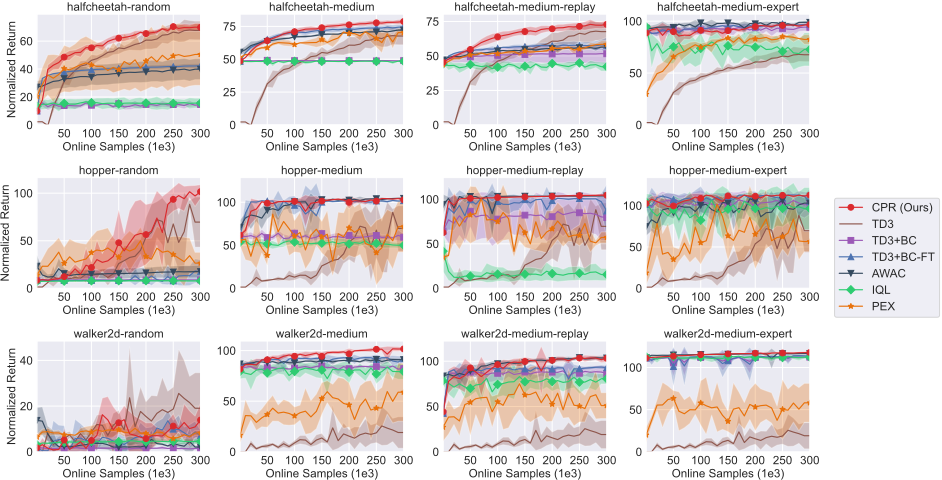
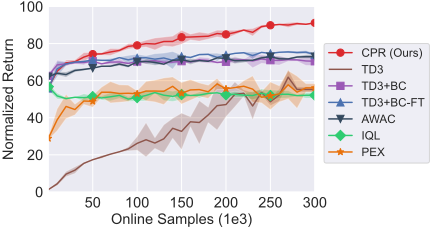
We demonstrate the normalized score curves of all the tasks in Figure 4, and the aggregated normalized return across all tasks is illustrated in Figure 5. From the reported results, the dilemma of direct policy initialization is shown clearly. Because of the distribution shift issue, conservatism should be considered in the algorithm design to overcome performance drop in the early stage. However, over-conservatism severely hinders policy improvement. TD3+BC shows little improvement due to the fixed policy constraint to the offline dataset. With an unchanged hyper-parameter during the whole tuning process, IQL suffers from low sample efficiency compared to other algorithms. AWAC and TD3+BC-FT share the advantage of applying an implicit policy constraint over the online replay buffer and outperforming on medium tasks. Compared to AWAC, TD3+BC-FT updates the hyper-parameters with annealing. Though this could support more improvement on the top of the pre-trained policy, it also suffers from distribution shift when updating the actor too fast and causes policy improvement unstable. The adaptive policy constraint and policy design help CPR to achieve a stable policy improvement without a severe performance drop.
For the initial model pre-trained on the random level dataset, the primacy bias is observed and all the baseline algorithms fail to beat online algorithm learning from scratch. PEX uses a fresh learnable policy to learn from the online environment, it transfers knowledge from the offline model to the new policy by directly accessing the offline dataset. This could suppress the learning ability of the new policy and lead to suboptimal performance and high variance. In contrast, the policy revitalization procedure makes CPR achieve significant improvement even on tasks with low-quality datasets.
Our proposed method CPR outperforms all the baseline methods on most of the tasks and achieves the best overall performance, demonstrating its effectiveness.
6.3 Memory Test
We conduct an experiment to show the agent's memory capacity after revitalization. We split the set of samples (s, πβ(s)) collected by the pre-trained policy πβ to be a training set and a testing set. We keep the testing set not exposed to the agent and only utilize the training set to train a new policy π0. We then sample states s from the testing set and let the agent predict actions π0(s) on those states. By assessing the L2 loss Es∼Dv (πβ(s) - π0(s))2 on the validation set Dv, we show that expanding a new policy could help in remembering. The Mean Squared Error (MSE) results are shown in Figure 6. The first number of each group means the number of training epochs. We use NPR to denote the no-policy-revitalization group and PR for the policyrevitalization group. PRC is the group where actions are selected from composition policy ˆπ. As more rounds of fitting on the training set are performed, the loss of the testing set decreases at first and then increases which suggests over-fitting could happen when a high replay ratio is applied. As the control group, we also set an NPR group which simply fits the training set in the same way as other revitalized policies.
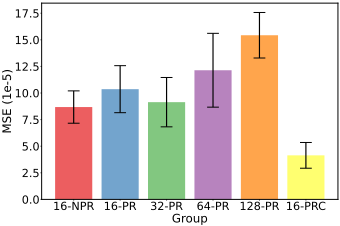
Compared with the control group, simply increasing fitting rounds only shows little improvement on memory and would cause overfitting if the replay ratio is too high. However, by introducing the policy composition mechanism CPR shows good performance on memorizing actions from behavior policy and outperforms even with limited fitting rounds.
7 Limitations and Discussion
The limitations of CPR include the extra running time and restricted policy model size. We list the analysis of running time results in Appendix C.4. The extra cost of computation is acceptable for most tasks. Contrary to O2O RL algorithms, our method does not introduce any specific constraints to the offline training portion to adapt different offline RL algorithms. This leads to a passive solution of primacy bias by resetting a part of the parameters to obtain a policy with full learning capacity. Appealing future directions are extending CPR to large-scale policy models and developing efficient utilization methods of pre-trained models.
8 Conclusion
This paper identifies the distribution shift and primacy bias issues and attributes these issues to direct policy initialization. Leveraging this analysis, we propose CPR to replace direct policy initialization in O2O RL. Our method periodically performs policy revitalization to reactivate the learning capacity and preserves good initial performance by adaptive policy constraint. Our experiment results show CPR's ability to improve learning efficiency and stability.
Acknowledgments
This work is supported by the National Science Foundation of China (62276126, 62076121, 62250069), and the Tencent AI Lab (RBFR2023011).
@inproceedings{ijcai2024p477,
  title     = {Efficient and Stable Offline-to-online Reinforcement Learning via Continual Policy Revitalization},
  author    = {Kong, Rui and Wu, Chenyang and Gao, Chen-Xiao and Zhang, Zongzhang and Li, Ming},
  booktitle = {Proceedings of the Thirty-Third International Joint Conference on
               Artificial Intelligence, {IJCAI-24}},
  publisher = {International Joint Conferences on Artificial Intelligence Organization},
  editor    = {Kate Larson},
  pages     = {4317--4325},
  year      = {2024},
  month     = {8},
  note      = {Main Track},
  doi       = {10.24963/ijcai.2024/477},
  url       = {https://doi.org/10.24963/ijcai.2024/477},
}
TY - CPAPER TI - Efficient and Stable Offline-to-online Reinforcement Learning via Continual Policy Revitalization AU - Kong, Rui AU - Wu, Chenyang AU - Gao, Chen-Xiao AU - Zhang, Zongzhang AU - Li, Ming T2 - Proceedings of the Thirty-Third International Joint Conference on Artificial Intelligence, IJCAI-24 PB - International Joint Conferences on Artificial Intelligence Organization PY - 2024 SP - 4317 EP - 4325 DO - 10.24963/ijcai.2024/477 UR - https://doi.org/10.24963/ijcai.2024/477 ER -Copied
Machine-readable versions of this paper, for tools and AI agents:





