
Cross-View Diversity Embedded Consensus Learning for Multi-View Clustering
Proceedings of the Thirty-Third International Joint Conference on Artificial Intelligence. Main Track. Pages 4788-4796.
https://doi.org/10.24963/ijcai.2024/529
Keywords
- Machine Learning: ML: Multi-view learning
- Machine Learning: ML: Clustering
Abstract
Multi-view clustering (MVC) has garnered significant attention in recent studies. In this paper, we propose a novel MVC method, named CCL-MVC. The novel method constructs a cross-order neighbor tensor of multi-view data to recover a low-rank essential tensor, preserves noise-free, comprehensive, and complementary cross-order relationships among the samples. Furthermore, it constructs a consensus representation matrix by fusing the low-rank essential tensor with auto-adjusted cross-view diversity embedding, fully exploiting both consensus and discriminative information of the data. An effective optimization algorithm is developed, which is theoretically guaranteed to converge. Extensive experimental results confirm the effectiveness of the proposed method.
- [Brbić and Kopriva, 2018] Maria Brbić and Ivica Kopriva. Multi-view low-rank sparse subspace clustering. Pattern Recognition, 73:247-258, 2018.
- [Chen et al., 2020] Man-Sheng Chen, Ling Huang, Chang- Dong Wang, and Dong Huang. Multi-view clustering in latent embedding space. Proceedings of the AAAI Confer- ence on Artificial Intelligence, page 3513-3520, Jun 2020.
- [Chen et al., 2021] Yongyong Chen, Shuqin Wang, Chong Peng, Zhongyun Hua, and Yicong Zhou. Generalized non- convex low-rank tensor approximation for multi-view sub- space clustering. IEEE Transactions on Image Processing, 30:4022-4035, 2021.
- [Elhamifar and Vidal, 2009] Ehsan Elhamifar and René Vi- dal. Sparse subspace clustering. In 2009 IEEE Conference on Computer Vision and Pattern Recognition, pages 2790- 2797. IEEE, 2009.
- [Fu et al., 2023] Lele Fu, Zhaoliang Chen, Yongyong Chen, and Shiping Wang. Unified low-rank tensor learning and spectral embedding for multi-view subspace clustering. IEEE Transactions on Multimedia, 25:4972-4985, 2023.
- [Gao et al., 2021] Quanxue Gao, Pu Zhang, Wei Xia, Deyan Xie, Xinbo Gao, and Dacheng Tao. Enhanced tensor rpca and its application. IEEE Transactions on Pattern Analysis and Machine Intelligence, 43(6):2133-2140, 2021.
- [Kang et al., 2020] Zhao Kang, Wangtao Zhou, Zhitong Zhao, Junming Shao, Meng Han, and Zenglin Xu. Large- scale multi-view subspace clustering in linear time. Pro- ceedings of the AAAI Conference on Artificial Intelligence, page 4412-4419, Jun 2020.
- [Kang et al., 2022] Zhao Kang, Zhanyu Liu, Shirui Pan, and Ling Tian. Fine-grained attributed graph clustering. In Proceedings of the 2022 SIAM International Conference on Data Mining (SDM), pages 370-378, 2022.
- [Kang et al., 2023] Kehan Kang, Chenglizhao Chen, and Chong Peng. Consensus low-rank multi-view subspace clustering with cross-view diversity preserving. IEEE Sig- nal Processing Letters, 30:1512-1516, 2023.
- [Kumar et al., 2011] Abhishek Kumar, Piyush Rai, and Hal Daumé. Co-regularized multi-view spectral clustering. In Proceedings of the 24th International Conference on Neural Information Processing Systems, NIPS'11, pages 1413-1421, Red Hook, NY, USA, 2011.
- [Larson, 2019] Ray R. Larson. Introduction to information retrieval. J. Assoc. Inf. Sci. Technol., 61:852-853, 2019.
- [Li et al., 2019] Ruihuang Li, Changqing Zhang, Huazhu Fu, Xi Peng, Tianyi Zhou, and Qinghua Hu. Reciprocal multi-layer subspace learning for multi-view clustering. In Proceedings of the IEEE/CVF international conference on computer vision, pages 8172-8180, 2019.
- [Liu et al., 2010] Guangcan Liu, Zhouchen Lin, and Yong Yu. Robust subspace segmentation by low-rank represen- tation. In Proceedings of the 27th International Confer- ence on Machine Learning, pages 663-670, 2010.
- [Liu et al., 2022] Suyuan Liu, Siwei Wang, Pei Zhang, Kai Xu, Xinwang Liu, Changwang Zhang, and Feng Gao. Ef- ficient one-pass multi-view subspace clustering with con- sensus anchors. Proceedings of the AAAI Conference on Artificial Intelligence, page 7576-7584, Jul 2022.
- [Lu et al., 2016] Canyi Lu, Jiashi Feng, Yudong Chen, Wei Liu, Zhouchen Lin, and Shuicheng Yan. Tensor robust principal component analysis: Exact recovery of corrupted low-rank tensors via convex optimization. In Proceedings of the IEEE conference on computer vision and pattern recognition, pages 5249-5257, 2016.
- [Ng et al., 2001] Andrew Ng, Michael Jordan, and Yair Weiss. On spectral clustering: Analysis and an algo- rithm. In Advances in neural information processing sys- tems, volume 14, pages 849-856, 2001.
- [Ng et al., 2023] Tsz Ching Ng, Siu Kai Choy, Shu Yan Lam, and Kwok Wai Yu. Fuzzy superpixel-based image segmen- tation. Pattern Recognition, 134:109045, 2023.
- [Nie et al., 2018a] Feiping Nie, Guohao Cai, Jing Li, and Xuelong Li. Auto-weighted multi-view learning for im- age clustering and semi-supervised classification. IEEE Transactions on Image Processing, page 1501-1511, Mar 2018.
- [Nie et al., 2018b] Feiping Nie, Lai Tian, and Xuelong Li. Multiview clustering via adaptively weighted procrustes. In Proceedings of the 24th ACM SIGKDD international conference on knowledge discovery & data mining, pages 2022-2030, 2018.
- [Pan et al., 2023] Baicheng Pan, Chuandong Li, and Hangjun Che. Nonconvex low-rank tensor approximation with graph and consistent regularizations for multi-view subspace learning. Neural Networks, 161:638-658, 2023.
- [Park et al., 2022] Namyong Park, Ryan Rossi, Eunyee Koh, Iftikhar Ahamath Burhanuddin, Sungchul Kim, Fan Du, Nesreen Ahmed, and Christos Faloutsos. Cgc: Contrastive graph clustering forcommunity detection and tracking. In The Web Conference (WWW), pages 1115-1126, 2022.
- [Peng et al., 2015] Chong Peng, Zhao Kang, Huiqing Li, and Qiang Cheng. Subspace clustering using log-determinant rank approximation. In Proceedings of the 21th ACM SIGKDD International Conference on Knowledge Discov- ery and Data Mining, pages 925-934. ACM, 2015.
- [Peng et al., 2017] Chong Peng, Zhao Kang, and Qiang Cheng. Subspace clustering via variance regularized ridge regression. In Proceedings of the IEEE Conference on Computer Vision and Pattern Recognition, pages 2931- 2940, 2017.
- [Peng et al., 2020] Chong Peng, Yongyong Chen, Zhao Kang, Chenglizhao Chen, and Qiang Cheng. Robust prin- cipal component analysis: A factorization-based approach with linear complexity. Information Sciences, 513:581- 599, 2020.
- [Peng et al., 2022a] Chong Peng, Yang Liu, Kehan Kang, Yongyong Chen, Xinxing Wu, Andrew Cheng, Zhao Kang, Chenglizhao Chen, and Qiang Cheng. Hyperspec- tral image denoising using nonconvex local low-rank and sparse separation with spatial-spectral total variation regu- larization. IEEE Transactions on Geoscience and Remote Sensing, 60:1-17, 2022.
- [Peng et al., 2022b] Chong Peng, Yiqun Zhang, Yongyong Chen, Zhao Kang, Chenglizhao Chen, and Qiang Cheng. Log-based sparse nonnegative matrix factorization for data representation. Knowledge-Based Systems, page 109127, 2022.
- [Shi and Malik, 2000] Jianbo Shi and Jitendra Malik. Nor- malized cuts and image segmentation. IEEE Transactions on Pattern Analysis and Machine Intelligence, 22(8):888- 905, 2000.
- [Tang et al., 2015] Jian Tang, Meng Qu, Mingzhe Wang, Ming Zhang, Jun Yan, and Qiaozhu Mei. Line: Large- scale information network embedding. In Proceedings of the 24th international conference on world wide web, pages 1067-1077, 2015.
- [Tang et al., 2023] Chang Tang, Zhenglai Li, Jun Wang, Xin- wang Liu, Wei Zhang, and En Zhu. Unified one-step multi- view spectral clustering. IEEE Transactions on Knowledge and Data Engineering, 35(6):6449-6460, 2023.
- [Wang et al., 2020] Hao Wang, Yan Yang, and Bing Liu. Gmc: Graph-based multi-view clustering. IEEE Trans- actions on Knowledge and Data Engineering, page 1116-1129, Jun 2020.
- [Wang et al., 2022] Siwei Wang, Xinwang Liu, Xinzhong Zhu, Pei Zhang, Yi Zhang, Feng Gao, and En Zhu. Fast parameter-free multi-view subspace clustering with con- sensus anchor guidance. IEEE Transactions on Image Pro- cessing, 31:556-568, 2022.
- [Wang et al., 2023] Jun Wang, Chang Tang, Zhiguo Wan, Wei Zhang, Kun Sun, and Albert Y. Zomaya. Efficient and effective one-step multiview clustering. IEEE Trans- actions on Neural Networks and Learning Systems, pages 1-12, 2023.
- [Wen et al., 2023] Jie Wen, Zheng Zhang, Lunke Fei, Bob Zhang, Yong Xu, Zhao Zhang, and Jinxing Li. A survey on incomplete multiview clustering. IEEE Transactions on Systems, Man, and Cybernetics: Systems, 53(2):1136- 1149, 2023.
- [Wu et al., 2019] Jianlong Wu, Zhouchen Lin, and Hong- bin Zha. Essential tensor learning for multi-view spec- tral clustering. IEEE Transactions on Image Processing, 28(12):5910-5922, 2019.
- [Wu et al., 2023] Yang Wu, Zhiwei Ge, Yuhao Luo, Lin Liu, and Sulong Xu. Face clustering via graph convolutional networks with confidence edges. In Proceedings of the IEEE/CVF International Conference on Computer Vision, pages 20990-20999, 2023.
- [Xia et al., 2014] Rongkai Xia, Yan Pan, Lei Du, and Jian Yin. Robust multi-view spectral clustering via low-rank and sparse decomposition. In Proceedings of the 28th AAAI Conference on Artificial Intelligence,, pages 2149- 2155. AAAI Press, 2014.
- [Xia et al., 2021] Wei Xia, Xiangdong Zhang, Quanxue Gao, Xiaochuang Shu, Jungong Han, and Xinbo Gao. Multi- view subspace clustering by an enhanced tensor nuclear norm. IEEE Transactions on Cybernetics, 52(9):1-14, 2021.
- [Xia et al., 2022] Wei Xia, Quanxue Gao, Qianqian Wang, and Xinbo Gao. Tensor completion-based incomplete multiview clustering. IEEE Transactions on Cybernetics, 52(12):13635-13644, 2022.
- [Xie et al., 2018] Yuan Xie, Dacheng Tao, Wensheng Zhang, Yan Liu, Lei Zhang, and Yanyun Qu. On unifying multi- view self-representations for clustering by tensor multi- rank minimization. International Journal of Computer Vi- sion, page 1157-1179, Nov 2018.
- [Yang et al., 2019] Zhiyong Yang, Qianqian Xu, Weigang Zhang, Xiaochun Cao, and Qingming Huang. Split mul- tiplicative multi-view subspace clustering. IEEE Transac- tions on Image Processing, 28(10):5147-5160, 2019.
- [Yu and Yang, 2023] Quan Yu and Ming Yang. Low-rank tensor recovery via non-convex regularization, structured factorization and spatio-temporal characteristics. Pattern Recognition, 137:109343, 2023.
- [Zhan et al., 2018] Kun Zhan, Changqing Zhang, Junpeng Guan, and Junsheng Wang. Graph learning for mul- tiview clustering. IEEE Transactions on Cybernetics, 48(10):2887-2895, 2018.
- [Zhang et al., 2015] Changqing Zhang, Huazhu Fu, Si Liu, Guangcan Liu, and Xiaochun Cao. Low-rank tensor con- strained multiview subspace clustering. In 2015 IEEE In- ternational Conference on Computer Vision, ICCV 2015, Santiago, Chile, December 7-13, 2015, pages 1582-1590. IEEE Computer Society, 2015.
- [Zhang et al., 2020] Changqing Zhang, Huazhu Fu, Qinghua Hu, Xiaochun Cao, Yuan Xie, Dacheng Tao, and Dong Xu. Generalized latent multi-view subspace clustering. IEEE Transactions on Pattern Analysis and Machine In- telligence, page 86-99, Jan 2020.
- [Zhang et al., 2024] Chuanbin Zhang, Long Chen, Zhaoyin Shi, and Weiping Ding. Latent information-guided one- step multi-view fuzzy clustering based on cross-view an- chor graph. Information Fusion, 102:102025, 2024.
- [Zhou and Burges, 2007] Dengyong Zhou and Christo- pher JC Burges. Spectral clustering and transductive learning with multiple views. In Proceedings of the 24th international conference on Machine learning, pages 1159-1166, 2007.
- [Zhou et al., 2005] Dengyong Zhou, Jiayuan Huang, and Bernhard Schölkopf. Learning from labeled and unlabeled data on a directed graph. In Proceedings of the 22nd in- ternational conference on Machine learning, pages 1036- 1043, 2005.
- [Zhu et al., 2019] Pengfei Zhu, Binyuan Hui, Changqing Zhang, Dawei Du, Longyin Wen, and Qinghua Hu. Multi- view deep subspace clustering networks. arXiv preprint arXiv:1908.01978, 2019.
References were extracted automatically from the PDF and may contain errors.
Full text extracted automatically from the PDF; figures, tables and equations may differ. The PDF is the version of record.
1 Introduction
As one of the fundamental tasks of machine learning, clustering has achieved notable successes in diverse domains, such as image segmentation [Ng et al., 2023], face clustering [Wu et al., 2023], community detection [Park et al., 2022], etc. Among the extensive clustering algorithms, the subspace clustering methods have drawn significant attention in recent years due to their effectiveness and elegant theory [Liu et al., 2010; Peng et al., 2017; Elhamifar and Vidal, 2009].
In real-world scenarios, the advancement of technology has led to an increase in the availability of data from multiple sources, leading to the natural emergence of multi-view data [Zhang et al., 2020]. Consequently, multi-view data are prevalent and contain a wealth of useful, discriminative, and complementary information across multiple perspectives, making them essential for enhancing clustering capability [Xia et al., 2021]. However, traditional clustering methods mainly focus on single-view data and are not suitable for analyzing multi-view data, as each view can provide a unique and valuable insight. Thus, multi-view clustering (MVC) has garnered significant attention in recent years due to its versatility and effectiveness in various domains [Xia et al., 2022; Wen et al., 2023; Brbi´c and Kopriva, 2018].
Due to the great success of single-view subspace clustering (SVSC) methods, they have been extensively developed for MVC [Fu et al., 2023; Zhang et al., 2020; Yang et al., 2019]. Most of these methods follow a pipeline similar to the SVSC with a two-step strategy. In particular, they first construct an affinity matrix, on which the standard spectral clustering (SPC) [Ng et al., 2001] is then performed. Since the SPC is standard, the step of affinity matrix construction has been the main focus of MVC [Chen et al., 2021; Zhang et al., 2020].
According to the way of affinity matrix construction, existing MVC methods can be mainly categorized into two types [Wu et al., 2019]. The first type is developed from the SPC-based subspace clustering methods [Zhang et al., 2015; Li et al., 2019; Zhang et al., 2020], while the second is developed from the graph-based clustering, which constructs affinity matrix using similarity matrix [Wang et al., 2020; Xia et al., 2014; Zhan et al., 2018; Kumar et al., 2011] and is the main focus of our paper. It has been revealed that the Markov random walk has a close connection with the SPC [Zhou et al., 2005; Shi and Malik, 2000], based on which a number of methods have been developed [Zhou and Burges, 2007; Xia et al., 2014; Wu et al., 2019]. For example, the transductive inference approach constructs a Markov transition probability matrix (TPM) in each view, and combines the TPMs using the Markov mixture [Zhou and Burges, 2007]. The RMSC constructs the TPMs of different views and learns a common low-rank stochastic matrix to alleviate the noise effects [Xia et al., 2014]. Different from them, the ETLMSC learns a low-rank essential tensor using the low-rank tensor recovery (LTR) approach from the TPMs [Wu et al., 2019].
The LTR approach has been quite popular and successful in recent development of MVC [Xie et al., 2018; Zhang et al., 2015; Wu et al., 2019], which has been extensively attempted in above mentioned methods [Zhou and Burges, 2007; Xia et al., 2014; Wu et al., 2019; Xie et al., 2018]. However, these methods suffer from some key issues, which may severely degrade the learning performance. First, by adopting the tensor nuclear norm (TNN), the LTR approach may suffer from inaccurate approximation issue [Yu and Yang, 2023]. Second, the high-order neighbor information of the data is rarely considered, which has been revealed essential in graph learning [Tang et al., 2015]. Third, simultaneous consensus and diversity learning is rarely considered on the low-rank essential tensor, which omits some essential properties. To this end, we develop a new method for MVC to address the above issues.
We summarize the key contributions of this paper as follows: 1) We recover a low-rank essential tensor from a crossorder neighbor graph tensor derived from multi-view data, which preserves comprehensive and complementary information of the data. 2) By embedding an automatically adjusted weighting vector with the learned noise-free crossorder neighbor graphs, our method explicitly preserves crossview diversity information of the multi-view data to learn a consensus affinity matrix. 3) We design an efficient optimization algorithm, which is theoretically guaranteed to converge under some mild conditions. 4) Extensive experimental results confirm the effectiveness of the proposed method and its superiority to baselines.
2 RelatedWork
Given multi-view data {X(v) }Vv=1 , with superscript (·)(v) denoting the v-th view of multi-view data or the v-th frontal slice of a tensor, X(v) ∈ Rdv×n being the v-th view samples, dv and n being the number of features and samples in the vth view, and V being the number of views, respectively, the ETLMSC recovers a low-rank essential tensor Z ∈ Rn×n×V from a TPM-based tensor P ∈ Rn×n×V constructed from multi-view data by [Wu et al., 2019]:
where E denotes the noise, ∥ · ∥⊛ is the t-SVD-based TNN, and ∥ · ∥2,1 denotes the tensor ℓ2,1 norm defined as the sum of ℓ2-norm of mode-3 fibers. Here, the tensor P is constructed by slice as P (v) = (Ds(S (v) ))-1S (v) , where Ds(·) returns a diagonal matrix with diagonal elements being the sum of rows of the input matrix, and S ∈ Rn×n×V is a similarity tensor constructed by slice with S (v) being a pair-wise similarity matrix in the v-th view. Eq. (1) essentially follows the robust tensor PCA [Lu et al., 2016], where the key difference between them is that they aim at different learning tasks with different types of data as input.
3 The ProposedMethod
Due to the great success of low-rank essential recovery approach, in this paper, we follow the framework of Eq. (1) and develop a new method with some more desired properties for enhanced learning performance. As has been widely revealed in literature, the convex approach to rank or sparsity approximation is not accurate, and nonconvex approach may provide a more accurate approximation and enhance the structural learning capability of the model [Peng et al., 2022a; Peng et al., 2022b]. Therefore, in a way similar to the t-SVD-based TNN [Wu et al., 2019] and tensor Schatten norm [Xia et al., 2022], and inspired by [Peng et al., 2022a; Peng et al., 2020], we expand the log-based matrix rank and sparsity approximation to log-based tensor rank approximation (LTRA) and sparsity approximation (LTSA) as ∥Z∥® = ∑Vv=1 ∑ni=1 log(1+σi( ˆ Z (v) )), and ∥E∥Ⓢ = ∑nj=1 log(1+ (∑ni=1 ∑Vv=1 E 2 ijv )1/2 ), respectively, where the LTRA is defined in the frequency domain, ˆ Z = fft(Z, [ ], 3) ∈ Rn×n×V with fft(·) being the fast Fourier transform (FFT) along the third dimension, σi(·) is the i-th largest singular value of the input matrix, and the LTSA is defined in a lateral slicewise manner that enhances the cross-view sparsity and helps strengthen the connections among different views. Then, we may develop Eq. (1) into the following model:
in which the nonconvex approach provides more accurate approximations and helps preserve more useful information to enhance the learning capability [Peng et al., 2022a].
In Eq. (2), P reveals the probability of a one-step random walk from one example to another in each view, which provides soft neighbor relationships of the samples. In practice, such relationships may be insufficient to explicitly measure the structure of the data, because samples may have latent higher-order neighbor relationships that are not directly preserved in a first-order graph [Kang et al., 2022]. Intuitively, a higher-order relationship can be measured by the probability of a multi-step random walk from one example to another [Tang et al., 2015]. Therefore, we may incorporate the higher-order neighbor relationships into LTR by defining a high-order TPM for multi-step random walks in each view as: (P (v) )k = P (v) · P (v) · · · · · P (v) , with k being the step of random walks or the order of neighbor relationships. To fully exploit the cross-order neighbor relationships, we define the following fine-grained probability tensor PK ∈ Rn×n×V by slice as: P (v) K = ∑Kk=1 (P (v) )k+((P (v) )k )T 2 , where the transpose ensures the symmetry of the neighbor relationships that is natural and essentially desired for neighbor relationships. Moreover, to exploit local structure of the data and filter the redundancy of neighbor relationships, we construct a local similarity tensor S, where in each view we keep N neighbors in the neighbor graph while setting the others to zero for each sample. Consequently, we construct PK with local structure of the data and our model becomes
In particular, Eq. (3) is treated as a K-th order model. In literature, an intuitive and common way of clustering is to fuse Z across different views to obtain a representation matrix by Z0 = 1 V ∑Vv=1 Z (v) , on which the final clustering algorithm is performed for the final clustering result [Wu et al., 2019]. However, the two-step strategy omits the close connection between the learning and fusion tasks, and the straight fusion omits the discriminative information embedded in different views, which might be insufficient to fully exploit structural information of the data [Pan et al., 2023].
To build a close connection between learning and fusion, we embed the fusion task into our model, leading to:
where Z0 is a consensus affinity matrix that fuses cross-view neighbor graphs, and w ∈ RV is a weighting vector that is automatically adjusted to balance the discrinimative information embedded across different views. To further enhance the cross-view diversity embedded in the weighting vector w, and thus in the consensus affinity matrix Z0, it is desired to prevent the weights from being simultaneously large if the TPMs of their corresponding views are highly similar [Kang et al., 2023], which leads to the diversity embedding defined as minw≥0,∑i wi=1 ∑i,j wiwjTr((P (i) K )T P (j) K ). Although the embedding is straightforward and easy to solve, PK may be prone to noise effects and thus the embedding might be inaccurate. As an alternative, we may embed the diversity of w with Z, which efficiently alleviates the noise effects while is more challenging to solve. Therefore, to embed the crossview noise-free diversity, we finally develop Eq. (4) as:
where β > 0 is a balancing parameter. We name the above model the Cross-view diversity embedded Consensus Learning for Multi-View Clustering (CCL-MVC). We will develop an effective optimization algorithm in the next section.
4 Optimization
In this section, we develop an effective optimization algorithm using the augmented Lagrange multiplier method (ALM). We introduce an auxiliary variable Q ∈ Rn×n×V and obtain the following augmented Lagrange function:
where Y1, Y2 ∈ Rn×n×V are Lagrange multipliers and ρ is the penalty parameter. Then, we alternately optimize each variable with details presented as follows.
4.1 Optimization of Z
The subproblem associated with Z is to minimize
An intuitive way is to optimize each Z (v) while keeping the others fixed. However, this strategy may suffer from the following issues. First, all Z (v) 's depend on each other and we cannot obtain the global solution for all Z (v) 's simultaneously. Second, we may need to iteratively update all Z (v) 's within an inner loop until convergence to obtain the optimal Z, which lacks efficiency. To address these issues, we design an efficient optimization strategy as follows. First, we define the following augmented variables:
Then, with these notations, we derive an equavilent form of Eq. (7) to facilitate the optimization. For the first term of Eq. (7), we have α ∑v ∥Z0-wvZ (v) ∥2F = α∥¯Z0-¯I1 ¯Z∥2F . For the second term, we have β∑ij wiwjTr((Z (i) )T Z (j) )= β∑ij Tr((wiZ (i) )T (wjZ (j) ))=β∥∑i wiZ (i)∥2F =β∥¯I2 ¯Z∥2F . For the last two terms, we may combine them and obtain ρ2 ∥Q - Z + Y1/ρ∥2F + ρ2 ∥PK - Z - E + Y2/ρ∥2F = ρ∥¯Z-¯H∥2F , where ¯H = [ (Q(1)+P (1) K -E (1) )T 2 + (Y (1) 1 +Y (1) 2 )T 2ρ ,· · ·, (Q(V )+P (V ) K -E (V ) )T 2 + (Y (V ) 1 +Y (V ) 2 )T 2ρ ]T ∈ RnV×n . Thus, we may convert Eq. (7) to the following quadratic problem:
The first-order optimality condition of Eq. (10) is:
¯Z = (α¯IT1 ¯I1 + β¯IT2 ¯I2 + ρI)-1 (α¯IT1 ¯Z0 + ρ ¯H). (10) It is seen that the above solution involves inversion of an nV × nV matrix, which generally has O(n3V 3 ) complexity. Fortunately, the above solution admits a special structure, which can be further simplified by the Sherman-MorrisonWoodbury formula. First, we have
whose complexity surprisingly mainly comes from scattermatrix product. Then, Z is obtained by tensorizing ¯Z.
4.2 Optimization of Q
The subproblem of Q is minQ ∥Q∥® + ρ2 ∥Q-Z +Y1/ρ∥2F . This problem is not straightforward to solve since the LTRA is defined in the frequency domain. In a way similar to the shrinkage problems in [Gao et al., 2021; Pan et al., 2023; Wu et al., 2019], the above problem can be converted to the frequency domain as
where ˆK = fft(Z - Y1/ρ, [ ], 3). Then, the above problem can be divided into V independent subproblems of Q(v) with v = 1, · · · , V , which are the standard log-determinant regularized shrinkage problems described in [Peng et al., 2022a]. We denote U(·) and V(·) as operators that return the left and right singular vectors of the input, and De(·) as an operator that returns a diagonal matrix based on the input elements, then according to [Peng et al., 2022a; Peng et al., 2015], ˆQ(v) is obtained by
with ˆσ(v) i = argminx≥0 1 2 (x - σ(v) i )2 + 1ρ log(1 + x) for i = 1, · · · , n. With straightforward algebra, we may obtain ˆσ(v) i = I{ˆσ(v) i ∈Si,v} · σ(v) i -1+√(1+σ(v) i )2- 4ρ 2 , with I{·} being an indicator function that returns 1 if the conditions in subscript hold and 0 otherwise, and Si,v = {x|x∈R, f :R→R, f(x) = 1 2 (x - σ(v) i )2 + 1ρ log(1 + x), ξ = σ(v) i -1+√(1+σ(v) i )2-4ρ 2 > 0, f(ξ) ≤ (σ(v) i )2 2 , (1+σ(v) i )2 > 4ρ }. Thus, we may obtain Q = ifft( ˆQ, [ ], 3), with ifft(·) being the inverse FFT of the
input tensor along the third dimension. For ease of notation, we summarize the above procedure as
4.3 Optimization of E
The LTSA-regularized shrinkage problem of E is:
which is a LTSA-regularized shrinkage problem. It is noted that by reforming the lateral slices of the tensors in Eq. (15) into vectors, the problem is a direct extension of the ℓ2,lognorm regularized shrinkage problem in [Peng et al., 2022a]. Then, by performing a vectorization-matrixization procedure to the ℓ2,log-norm shrinkage problem in [Peng et al., 2022a], we may obtain the above solution. Thus, it is straightforward that Eq. (15) admits the following closed-form solution by
4.4 Optimization of Z0
The subproblem of Z0 is α ∑v ∥Z0 - wvZ (v) ∥2F , which is convex and quadratic, and admits a closed-form solution by the first-order optimality condition: Z0 = 1 V ∑Vv=1 wvZ (v) .
4.5 Optimization of w
The subproblem of w is minw≥0,∑i wi=1{α ∑i ∥Z0 - wiZ (i) ∥2F +β ∑ij wiwjTr((Z (i) )T Z (j) )}. Let zi be vectorized Z (i) for i = 1, · · · , V , M1 ∈ RV×V be a diagonal matrix with (M1)ii = zTi zi, M2 ∈ RV×V with (M2)ij = zTi zj, and h ∈ RV with hi = -αTr(ZT0 Z (i) ), then the subproblem of w is equavilent to
It is easy to verify that ∀z ∈ RV and z ̸= 0, we have zT (αM1 + βM2)z = α ∑i z2 i zTi zi +β ∑i,j zizjzTi zj = α ∑i (zizi)T (zizi)+β ∑i ∑j (zizi)T (zj zj ) =α ∑i ∥zizi∥22 +β∥[z1, · · · , zV ]De(z)∥2F ≥ 0, with zi and zj being the vectorized Z (i) and Z (j) , and zi and zj denoting the i-th and j-th elements of z, respectively. Thus, αM1 + βM2 ⪰ 0, and Eq. (17) is convex. Then, w can be efficiently solved by standard convex programming technique, which is denoted as
4.6 Updating of Y1, Y2, and ρ
The Lagrange multipliers and the penalty parameter are updated in a standard way as follows:
Y1=Y1+ρ(Q-Z), Y2=Y2+ρ(PK-Z-E), ρ=ρκ, (19) with κ>1 being a parameter that keeps ρ increasing. In our paper, we update the variables in the order of Z, E, Q, Z0, w, Y1, Y2, and ρ, which is essentially important for the convergence analysis in Section 5. After we obtain the solution, the standard SPC is applied to Z0 for the final clustering result.
5 Convergence Analysis
In this section, we analyze the convergent property of the CCL-MVC. The main results are presented in the following.
Theorem 1. Let t in the superscript denote the iteration number. Under assumptions that ∑ 1 ρt < ∞ and ∑ ρt+1 (ρt )2 < ∞, and given a bounded initialization of the variables, the variable sequences {Z t }, {E t }, {Qt }, {Zt0 }, {wt }, {Y t1 }, and {Y t2 } generated by our optimization algorithm are bounded.
Proof: According to the constraints of w, it is easy to verify that {wt } is bounded. At the (t + 1)-th iteration, according to the first-order optimality condition of Q, we have
By definition of the LTRA, and according to [Wu et al., 2019; Peng et al., 2022a], it is clear that ∥∂∥Q∥®/∂Q|Qt+1∥2F <∞ and thus Y t+1 1 is bounded.
Similarly, according to the first-order optimality condition of E, at the (t + 1)-th iteration, we have
By definition of the LTSA, it is clear that ∥∂∥E∥Ⓢ/∂E|E t+1∥F < ∞ and thus Y t+1 2 is bounded. Then, according to the updating rules of Y1 and Y2, we have
where the last inequality holds by Y t+1 1 = Y t1 + ρt (Qt+1 - Z t+1 ) and Y t+1 2 = Y t2 + ρt (PK -Z t+1 - E t+1 ). Thus, by repeating the above inequality t + 1 times, it is clear that
with Γ1 = maxt+1 s=0 {∥Y s 1 ∥2F } and Γ2 = maxt+1 s=0 {∥Y s 2 ∥2F }. Thus, with bounded initialization, Eq. (23) must be bounded.
By definition of L(Z, E,Q, Z0,w, Y1, Y2, ρ) in Eq. (6), it is clear that all of its terms are nonnegative and are thus bounded. Then, according to the definitions of ∥Qt+1 ∥® and ∥E t+1 ∥Ⓢ, the boundedness directly implies that Qt+1 and E t+1 are bounded. Because Qt+1 , Y t+1 1 , and ρt+1 ∥Qt+1 - Z t+1 + Y t+1 1 /ρt+1 ∥2F are all bounded, it is clear that Z t+1 is also bounded. Then, Zt+1 0 = 1 V ∑Vv=1 wt i (Z t+1 )(v) is also bounded. Now, we may conclude that the sequences of {Z t }, {E t }, {Qt }, {Zt0 }, {wt }, {Y t1 }, and {Y t2 } are all bounded.
Theorem 2. Let {Z t ,E t ,Qt ,Zt0 ,wt ,Y t1 ,Y t2} be a sequence generated by our algorithm. Under assumptions that ∑ 1 ρt <∞, ∑ ρt+1 (ρt )2 < ∞, ρt (Qt+1 -Qt ) → 0, and ρt (E t+1 -E t ) → 0, the sequence {Z t , E t , Qt , Zt0 , wt , Y t1 , Y t2 } has at least one accumulation point. For any accumulation point, denoted as {Z ∗ , E ∗ , Q∗ , Z∗0 , w∗ , Y ∗ 1 , Y ∗ 2 }, {Z ∗ , E ∗ , Q∗ , Z∗0 , w∗ } is a stationary point of the optimization problem in Eq. (5).
Proof: By Theorem1, we know {Z t , E t ,Qt , Zt0 ,wt , Y t1 , Y t2 } is bounded. Then, according to the Bolzano-Weierstrass theorem, the sequence has at least one accumulation point, denoted as {Z ∗ , E ∗ , Q∗ , Z∗0 , w∗ , Y ∗ 1 , Y ∗ 2 }. Then, there exists a sub-sequence of {Z t , E t ,Qt , Zt0 ,wt , Y t1 , Y t2 } that converges to {Z ∗ , E ∗ , Q∗ , Z∗0 , w∗ , Y ∗ 1 , Y ∗ 2 }. Without loss of generality, we assume that {Z t , E t , Qt , Zt0 , wt , Y t1 , Y t2 } itself converges to {Z ∗ , E ∗ ,Q∗ , Z∗0 ,w∗ , Y ∗ 1 , Y ∗ 2 }. Next, we will show that {Z ∗ ,E ∗ ,Q∗ ,Z∗0 , w∗ } is a stationary point of Eq. (5).
By the assumption that ∑ 1 ρt <∞, it is clear that ρt →∞. Then, by the boundedness of {Y t1 } and {Y t2 }, we have
At the (t + 1)-th iteration, according to the optimality conditions of Q and E, we have the following equalities:
For ease of notation, we denote G t+1 = ∂{ α ∑Vv=1 ∥Z0 - wvZ (v) ∥2F + β ∑Vi,j=1 wiwjTr((Z (i) )T Z (j) )}/∂Z|Zt+1, which may be obtained by tensorizing the first three terms of Eq. (9). Then, at the (t + 1)-th iteration, according to the optimality condition of Z, and under the assumptions that ρt (Qt+1 -Qt ) → 0 and ρt (E t+1 - E t ) → 0, it is clear that
where G ∗ = limt→∞G t must exist according to Eq. (9) and the boundedness of {Z t } and {wt }. Besides, since w and Z0
are optimized using the standard convex programming techniques, the corresponding Karush-Kuhn-Tucker (KKT) conditions are satisfied by w∗ and Z∗0 .
Therefore, {Z ∗ , E ∗ ,Q∗ , Z∗0 ,w∗ , Y ∗ 1 , Y ∗ 2 } satisfies KKT conditions of Eq. (6) and thus {Z ∗ , E ∗ ,Q∗ , Z∗0 ,w∗ } is a stationary point of the original problem Eq. (5).
6 Experiments
In this section, we conduct extensive experiments to evaluate the proposed method. In particular, we use six benchmark data sets, including the BBC-4view, BBC-Sport, Flowers, UCI-3view, StillDB, and MITindoor, and four evaluation metrics, including the clustering accuracy (ACC), normalized mutual information (NMI), adjusted rand index (AR), and F-Score, of which the detailed descriptions can be found in [Wu et al., 2019; Larson, 2019], respectively. Seventeen state-of-the-art methods are adopted as baselines for comparison, including the AWP [Nie et al., 2018b], MvDSCN [Zhu et al., 2019], MLAN [Nie et al., 2018a], UOMvSC [Tang et al., 2023], EOMSC-CA [Liu et al., 2022], LMSC [Zhang et al., 2020], GMC [Wang et al., 2020], MCLES [Chen et al., 2020], FPMVS-CAG [Wang et al., 2022], CLR-MVP [Kang et al., 2023], t-SVD-MSC [Xie et al., 2018], SM2SC [Yang et al., 2019], ETLMSC [Wu et al., 2019], LMVSC [Kang et al., 2020], E2OMVC [Wang et al., 2023], RMSL [Li et al., 2019], and OMVFC-LICAG [Zhang et al., 2024], among which six are developed within the last two years.
For the baseline methods, we follow the parameters in the original papers. For the proposed method, we set the parameters in the following way. For all balancing parameters, we tune themwithin the set {0.001,0.01,0.1,1,10,100,1000}. For ρ, κ, and N, we fix them to 0.001, 1.5, and 5 throughout the paper. If not otherwise clarified, we use a third-order CCLMVC in the experiment. For all methods, the final clustering step is repeated 10 times and we report the averaged results with parameters tuned to the best.
6.1 Clustering Performance
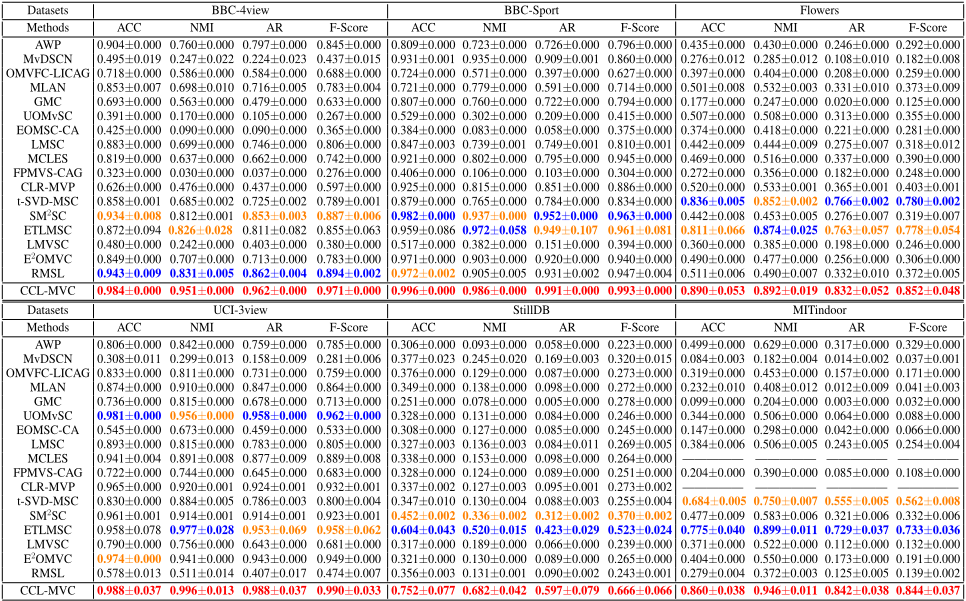
We compare the CCL-MVC with the baseline methods and report the clustering results in Section 5. In general, the CCLMVC has the best performance among all methods, where it obtains the best results in all 24 cases. Among the baseline methods, the RMSL, SM2SC, ETLMSC and t-SVD-MSC are among the most competitive ones, which obtain the top three results in 5, 11, 19, and 8 out of a total number of 24 cases, respectively. Compared with the baseline methods, the CCL-MVC has significantly improved performance, where it improves the performance by about 0.04-0.12, 0.01-0.04, 0.02-0.07, 0.01-0.03, 0.14-0.17, and 0.05-0.11 in different metrics on the BBC-4view, BBC-Sport, Flowers, UCI-3view, StillDB, and MITindoor data sets, respectively. Among these data sets, the StillDB data set is considered as a "difficult" one, on which the baseline methods rarely obtain results higher than 0.4. On this data set, the CCL-MVC improves the performance by about 0.14-0.17 and 0.29-0.35 in different
(b) StillDB
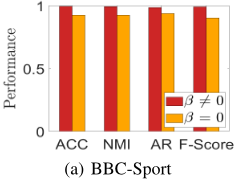
Figure 1: Comparison of the CCL-MVC models to show the significance of cross-view diversity embedding.
metrics, compared with the top second and third methods, i.e., the ETLMSC and SM2SC, respectively. Such improvements are indeed significant. Moreover, the CCL-MVC has superior performance in terms of its stability. In particular, the CCL-MVC has the best performance on all data sets, while none of the baseline methods have the top three performance on all data sets. For example, as the most competitive method among the baselines, the ETLMSC is not among the top three on the BBC-4view data set; although the RMSL has the top second performance on the BBC-4view data set, it fails on several other data sets. These observations confirm the effectiveness and stability of the CCL-MVC on these data sets.
6.2 Ablation Study
We conduct ablation study from two perspectives, using the BBC-Sport and StillDB data sets without loss of generality. First, we validate the significance of adopting cross-view diversity and present the results in Fig. 1. In particular, we test how the CCL-MVC performs when the cross-view diversity embedding is eliminated from the model, for which we set β = 0 and tune the other parameters in the same way as described in Section 6.1. From Fig. 1, we may observe that the performance of the CCL-MVC is significantly degraded when the diversity is not considered, which confirms the significance of cross-view diversity embedding.
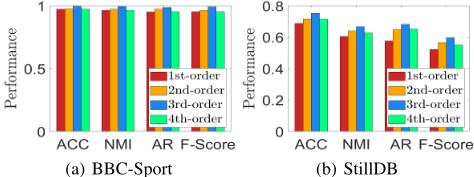
Then, we verify the significance of adopting crossorder neighbor information and show the results in Fig. 2. Compared with the first-order CCL-MVC, the second and third-order models have significantly improved performance, which confirms the significance of adopting cross-order neighbor information in our model. Moreover, when the order is higher than 3, the CCL-MVC cannot be further improved, or may even degrade. This may be explained by the fact that a very high order may introduce redundancy or noise to the relationships. Given the difficulty in finding a suitable K, and considering the significance of incorporating the third-order information, it is reasonably convincing to recommend utilizing a third-order CCL-MVC in practical applications.
6.3 Convergence Study
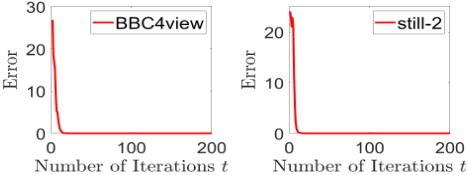
Besides the theoretical results about convergence provided in Section 5, we further show some empirical results to illustrate the convergent behavior of the CCL-MVC. Without loss of generality, we show the results on the BBC-4view and StillDB data sets in Fig. 3. Due to space limit, rather than ploting the curves for each variable, we plot the curve of error sequence, where at the t-th iteration the error is defined as max{∥Z t -Z t-1 ∥F , ∥E t -E t-1 ∥F , ∥Qt -Qt-1 ∥F , ∥Zt0 - Zt-1 0 ∥F , ∥wt-wt-1 ∥2, ∥PK-Z t-E t ∥F , ∥Z t-Qt ∥F}. From the results, it is seen that the curves converge to zero within about 50 iterations, which is quite efficient. Similar observations can be found on other data sets as well, which is convincing to claim the convergent behavior of the CCL-MVC.
7 Conclusion
In this paper, we propose a novel CCL-MVC method for multi-view clustering. The CCL-MVC incorporates crossview diversity to learn a consensus affinity matrix by fusing a low-rank essential tensor recovered from a fine-grained neighbor tensor that encompasses comprehensive and complementary cross-order information of multi-view data. We develop an effective optimization algorithm for the CCLMVC, which is proved to converge with theoretical guarantee. Extensive experimental results show the superiority of the CCL-MVC.
Acknowledgements
Y.C. and C.C. are corresponding authors. This work is supported in part by the National Natural Science Foundation of China (NSFC) under Grants 62276147, 62172246, and 62106063; in part by the Shandong Province Colleges and Universities Youth Innovation Technology Plan Innovation Team Project under Grants 2022KJ149, 2021KJ062, and 2020KJN011; and in part by the Guangdong Major Project of Basic and Applied Basic Research under Grant 2023B0303000010.
@inproceedings{ijcai2024p529,
  title     = {Cross-View Diversity Embedded Consensus Learning for Multi-View Clustering},
  author    = {Peng, Chong and Zhang, Kai and Chen, Yongyong and Chen, Chenglizhao and Cheng, Qiang},
  booktitle = {Proceedings of the Thirty-Third International Joint Conference on
               Artificial Intelligence, {IJCAI-24}},
  publisher = {International Joint Conferences on Artificial Intelligence Organization},
  editor    = {Kate Larson},
  pages     = {4788--4796},
  year      = {2024},
  month     = {8},
  note      = {Main Track},
  doi       = {10.24963/ijcai.2024/529},
  url       = {https://doi.org/10.24963/ijcai.2024/529},
}
TY - CPAPER TI - Cross-View Diversity Embedded Consensus Learning for Multi-View Clustering AU - Peng, Chong AU - Zhang, Kai AU - Chen, Yongyong AU - Chen, Chenglizhao AU - Cheng, Qiang T2 - Proceedings of the Thirty-Third International Joint Conference on Artificial Intelligence, IJCAI-24 PB - International Joint Conferences on Artificial Intelligence Organization PY - 2024 SP - 4788 EP - 4796 DO - 10.24963/ijcai.2024/529 UR - https://doi.org/10.24963/ijcai.2024/529 ER -Copied
Machine-readable versions of this paper, for tools and AI agents:





